
After the 1997 AFI 100 “A-list,” this is the rest of the American canon through 2019.
This list includes all of the American-made films that are NOT already on the 1997 AFI 100, from the following lists:
Metacritic Top 25
IMDb Top 25
2007 AFI 100
University of Turin’s study of the 20 Most Influential Films
Films that were, upon their release, the highest-grossing film of all time (until being displaced by another such film)
BBC Top 25 of the 21st Century (177 world critics)
Sight and Sound Top 175, 2012 list (about 1000 filmmakers/critics)
My *other* 25 most influential films not heretofore covered
This is presented chronologically to let this list serve as a secondary “narrative” of American cinema. Most lists are about ostensible “greatness”; this site is about IMPORTANCE, defined with roughly a 3-to-1 ratio of greatness-to-influence, a sort of living stature that the site and the podcasts repeatedly question and explore.
As a term, “B-list” should be considered somewhat tongue-in-cheek; in fact, the total of the Rotten Tomatoes scores of this list is slightly higher than that of the “A-list.” The more salient point is that if you have seen all of the motion pictures on this list and the AFI 100, people will say that you have seen the basic building blocks of American cinema…a notion that the next list (the counter-canon) challenges.
~
B1. Intolerance: Love’s Struggle Through the Ages (Griffith, 1916) BO clip imdb LB RT trailer wiki
stream on youtube watch analysis by Keil read analysis by Schrom listen to my podcast
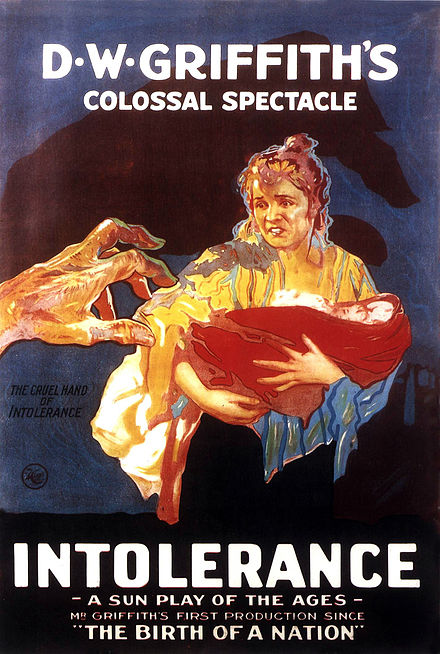
“Seeing youth drawn to youth, Miss Jenkins realizes the bitter fact that she is no longer part of the younger world.”
After The Birth of a Nation, Griffith had several scripts for shorts lying around; he might have made them as written, or he might have developed each one into its own feature. He chose to do neither, and instead combine four of them into one interwoven, monumental story that would, unlike any short, justify the sort of lavish sets and costumes that would wow the crowds, and maybe even rival or improve upon Italian epics like Cabiria. Griffith would borrow Cabiria’s moving camera and put it on a crane for his most spectacular shot, that of Babylon in sumptuous splendor, with six train-engine-sized colonnades supporting balconies full of people walking around life-sized upright elephant sculptures – a testament to cinema’s power to conjure tableaus beyond that of any other medium.
Griffith told one of his stars, Lillian Gish, that they were creating a new language, one that Griffith saw as combining the other great art forms to create a new art form. Contemporaries agreed, writing that for millennia, six art forms had existed, namely the three so-called plastic (or permanently molded) arts of architecture, sculpture, and painting, and the three less molded arts of music, dance/performance, and poetry/prose, and then one day, voila, a seventh art form appeared called cinema. Griffith enjoyed comparing himself to Shakespeare and Dickens, and was thrilled when critics praised the novelistic, melodramatic cross-cutting in the final 30 minutes of Birth. For his next film, Griffith would cut between locations and between centuries, even millennia. He would film literal pages of a book, or sometimes stone tablets, with title cards over them in case any audience members got confused. When possible, Griffith would assign a different color tint to each of his four periods, although none of those specialized prints now survive. All Griffith needed was a unifying theme, and he felt he found it in the triumph of love over intolerance. Griffith meant to also rebuke critics of Birth, as though his prejudice against non-white people was simply prejudice for letting people love. I realize some people will never see Intolerance because of, well, intolerance of Griffith, and while I understand that, Intolerance is both foundational and fascinating. Griffith’s conflicting prejudices made Intolerance what it was, and what it wasn’t.
Intolerance is never boring or lacking for intrigue. It begins by establishing the motherly motif of Lillian Gish rocking a timeless, or really time-straddling, cradle. In the present day of 1916, we meet a wealthy, maybe-35-year-old Miss Jenkins standing outside a vibrant dance hall as she is becoming, titles tell us, “bitter that she is no longer part of the young world.” We meet the Dear One, old enough for love but girlish enough for pigtails and cartwheels, clearly part of Griffith’s preferred world. We cut to the birth of Jesus, while in the nearby Bethlehem streets, land-owning Pharisees demand local Jews deference. We cut to French Court in 1572, where Catherine de Medici looks on with bitterness as her son, King Charles the Ninth, favors the upstart Huguenots. In the Paris streets, a mercenary soldier thirsts for an already-betrothed Huguenot named Brown Eyes. And we cut to ancient Babylon of 539 B.C., with prodigiously opulent fixtures and 50-foot castle walls that no enemy has ever broached. In Babylon we meet the Mountain Girl, the film’s fieriest, fiercest, fearlessest female, who throws rocks at would-be suitor Rhapsode. Back in 1916, workers strike, bosses cut wages, and so Dear One and her father move to a nearby slum where they rub shoulders with unsavory citizens. Back in ancient Babylon, Mountain Girl’s brother puts her up for auction where she laughs at dudes until she meets Belshazzar, fresh off establishing the world’s first court of justice, who gives the Mountain Girl a seal that will permit her to marry or not. Meantime, Rhapsode tries to convert people away from Belshazzar and toward the High Priest of Bel, who schemes as he watches the city from on high. Broke and hungry, Dear One’s father dies, and she begins dating a Boy who, under her influence, quits working for the criminal Musketeer, who in turn makes an example by framing the Boy for theft and sending him to prison. The movie makes a big deal out of Jesus’s first miracle, in Galilee, being the changing of water into wine. The Pharisees show up to stone an adulterous woman until Jesus stops them by saying “let he who is without sin cast the first stone.” By now, the spinster Jenkins has given her fortune to, and joined, the Uplifters, a group of stiff-upper-lipped women who shut down dance halls and take away alcohol. Outside Babylon, we see Cyrus’s troops preparing to attack, and we are invited to despise this holistic group of “Barbarians,” Persians, Ethiopians (seen for three seconds, these are the only Blacks in the 3-hour film), and the treacherous high priest of Bel. With Dear One’s Boy wrongly imprisoned, she must raise the infant alone, and seeing this, The Uplifters seize Dear One’s babe right out of her arms. Another older woman that the film hates, Catherine de Medici, persuades her Catholic courtesans to declare war on the Huguenots. Cyrus assaults Babylon with siege towers in a long, long, long battle, but Babylon barely holds, partly thanks to the Mountain Girl’s assiduous arrows. The Musketeer meets Dear One and promises to help recover her infant. More than an hour into any cut of the film, we finally see Babylon in the full splendor I mentioned, including a lot of lasciviously vertical and horizontal women, even as Mountain Girl becomes suspicious of, and secretly follows, Rhapsode and the high priest of Bel. More invidiously, the Musketeer’s wife follows her husband to Dear One’s flat, and sees him seducing/assaulting her even as the Boy, fresh out of prison, breaks in to stop them; the Musketeer’s wife shoots her husband dead and throws the gun into the flat, causing the police to arrest and charge the Boy with murder. A jury sentences him to hang. In France, Brown Eyes awakens to the start of the St. Bartholomew’s Day massacre. Finally, the Musketeer’s wife admits her crime, and as she and Dear One race to the gallows to stop the execution, the French army slaughters and the Mountain Girl speeds to cut off Cyrus, causing the intertitles to give way to rushing, chasing, and carnage. The thirsty mercenary soldier tries to rape Brown Eyes, but when she resists, he kills her and his allies kill her boyfriend. Cyrus invades Babylon, and Mountain Girl fights to her death, attended by two solemn white doves. Jesus is hung on the cross as the women arrive just in time to save Dear One’s baby daddy from the gallows. In a final rush of aspirational double-exposures, prison walls become wisteria, warring soldiers become warm comrades, and love brings peace as the cradle will rock throughout time.
Intolerance, a film about straddling periods of time, was both behind and ahead of its time. As a Kentuckian defending alcohol through the ages, Griffith was too antiquated for the coming 18th amendment, but actually anticipatory of the later-coming 21st amendment. With the exception of the Mountain Girl, delightfully incarnated by an 18-year-old Constance Talmadge, Intolerance is parochially, paternalistically prejudiced against every woman over the age of twenty-five as snooty and intolerant. But timing was perhaps the biggest difference between the box office fortunes of Birth of a Nation and Intolerance: when the former came out in early 1915, America was patriotically pacifist, but by the time the latter came out in late 1916, most Americans were resigned to the Great War, and Griffith’s repeated reminders of love and peace were not really reading the room. But if Intolerance battled to a draw at the box office, the film won the war of history’s wider judgment. Intolerance was Europe and Russia’s favorite American film for most of the next decade, influencing innumerable filmmakers. Intolerance influenced, intimated and even initiated Hollywood. By 1916, shoestring film companies had moved to Los Angeles, but within the next decade they would become well-financed Hollywood studios with backlots that could simulate Babylon, Judea, France, modern New York, or a dozen other picturesque locales. And on a stylistic level, Intolerance proved that a motion picture could simulate or even elevate literature’s narrative fluidity without losing melodramatic pathos. Apres Intolerance, le deluge.
Influenced by: Italian historical epics, 19th-century literature
Influenced: Hollywood casting conventions, Pickford Studios, European masters from Lang to Eisenstein
~
B2. The Mark of Zorro (Niblo, 1920) BO clip imdb LB RT trailer wiki
stream on amazon watch analysis by Midnight’s Edge read analysis by Kramer listen to my podcast
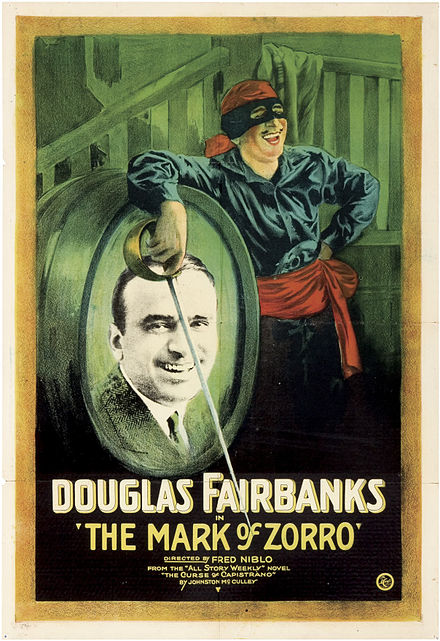
“He hurt a Native.”
Johnston McCulley’s story “The Curse of Capistrano” was published in 1919 in five installments in All-Story Weekly, one of the period’s pulpy magazines whose potboilers were perpended by product-hungry, prolific, cut-price movie studios. Mary Pickford suggested the story to Fairbanks, who might have taken the path of least resistance and made Capistrano into a madcap comedy, but he saw instead a chance to shift the stale swashbuckler genre. (Fred Niblo directed, but this was the sort of film where the producer-writer-star made first and final decisions.) Partly because McCulley’s story was set in Spanish-ruled California, the film’s period details could be filmed economically, mostly assured by the horseplay, swordplay and rope-play. Onscreen Fairbanks wouldn’t entirely lose his renowned sense of humor, particularly when dressed as Zorro, but the idea was to contrast his heroic alter ego with his dandyish Don Diego de la Vega, a new kind of two-sided hero for new 1920s audiences.
The Mark of Zorro begins with a title card that warns that oppression creates the power that crushes it, whether Cromwell or someone like this film’s masked rider. The first word of dialogue, spoken by one bar patron to another, points out a man who beat “a native” for no reason and now bears the mark of Zorro – and we see the Z on his face even as he and his drunk friends prepare for more oppressing. Quote “In the hut of a native,” unquote a dark-faced man says Señor Zorro is their only friend. Corrupt Governor Alvarado overtaxes Don Carlos Pulido and hires this drunk band of racist oppressors to kill Zorro, but Zorro shows up as Don Vega, fools them, leaves, sees them attack innocent Natives, changes into Zorro, and returns and fights and defeats the mercenaries. As Don Vega, our hero meets the Pulidos and tries to court their adult daughter Lolita, but she finds him foppish and repulsive, telling a friend, “he isn’t a man, he’s a fish!” The banditos, led by the dark-hearted Captain Ramon, invade the Pulidos’ home looking for Zorro, and Vega changes into Zorro to lead them away and astray. When the Pulidos go to the military Presidio to beg to keep their house, Captain Ramon shows up and sexually assaults Lolita, but before he gets too far, Zorro drops from the ceiling, sword-fights with Ramon for a few minutes, brands his neck with the Z, and chases him off the property. Lolita is now in love with Zorro but wants nothing to do with his fancy-pants alter ego. Impudent soldiers invade an indigenous-friendly iglesia and string up its Father Felipe and flay him, causing Vega to change into Zorro, roust some allies at midnight, and string up and flay the chief flayer. Now it’s war, and Ramon’s men arrest and imprison a lot of brown men as well as the Pulido family. Some of the government’s newer conscripts arrive at Don Alberto’s looking for Zorro, and Alberto shames his friend Don Vega for doing no more than offering them wine and then leaving. Minutes later, Zorro shows up and shames this landed-gentry dinner party for permitting oppression and peering at the flaying of a priest; this odd recruitment rhetoric persuades them to roll with Zorro. With their help, Zorro stages a raid and frees the prisoners, and when he asks Lolita if she trusts him, she says love means trust. Zorro’s allies escort the former prisoners to Don Vega’s house as Zorro distracts a couple dozen of Ramon’s soldiers with an elaborate, exhilarating cat-and-mouse game around a large estate. Zorro returns home as Don Vega only to find that Governor Alvarado and Captain Ramon and their personal troops have taken over his house because they now know Zorro will come for Lolita. Zorro’s allied troops are also there but seemingly useless. Ramon insults Vega’s manhood, causing Vega to set off, scrap with Ramon, slip the collar off of his neck to reveal his Z scar, and shamelessly show off his sword, resulting in Ramon remarking, “I know that blade – Zorro?!?” Everyone, including Lolita, stares at Don Vega and says “ZORRO?!?” Vega-slash-Zorro slashes up Ramon and puts his epee’s point to the Governor’s chest, demanding that he abdicate. The governor sees that even his troops are now lost to him and he surrenders, causing everyone in the room to rejoice. Vega leaps up to the balcony to let Lolita know that he looks, lectures, and loves like Zorro. They try to kiss discreetly behind a bandana, but the breeze blows it high, and…so these sweethearts smooch anyway.
For Fairbanks himself, The Mark of Zorro marked a pivot from contemporary satire to historical swashbuckling, a mini-genre that became more spectacular, and expensive, with more Fairbanks films like The Three Musketeers in 1921, Robin Hood in 1922, The Thief of Bagdad in 1924, and The Black Pirate in 1926. These pictures set the standard for action-adventure, a genre that provided work for a lot of other silent-film actors, although none matched the fame and fortune of Fairbanks, who in 1927 was the first to place his feet in the cement outside the new Graumann’s Chinese Theater and, in the same year, was elected first President of the Motion Picture Academy, a job that included handing out the first Academy Awards. In many ways, every action star, from Fairbanks Junior to Flynn to Ford to the Fast and the Furious, are following in Fairbanks’ wet-cement-formed footsteps.
The character of Zorro, formulated by Fairbanks for folks that had never heard of him, is himself foundational. The key precedent is The Scarlet Pimpernel, a character created by Baroness Orczy in 1903, featured in his own book, play, and even a 1917 movie starring Dustin Farmer – just the sort of formulaic film that Fairbanks hoped to transcend. The Pimpernel is a masked hero who leaves calling cards and attracts women who dislike him in his “ordinary” life. But the Pimpernel’s calling cards are flowers, his clothes are ruffly, and his raison d’etre is saving aristocrats from France’s reign of terror. By contrast, Zorro’s calling cards are carved “Z”s, his clothes are shiny black topped by a sombrero cordobes, and his raison d’etre is defending commoners and indigenous peoples of California from tyrants and other deplor-ab-les, ably assisted by his clever deaf servant Bernardo and his faithful black stallion Tornado. In many ways, Zorro was the first American superhero, inspiration of every humble populist masked avenger who attracted a woman (and repulsed her with his secret identity); young Bruce Wayne’s parents were coming out of a screening of The Mark of Zorro when they were killed, leaving Wayne to grow up and become the Zorro-like Batman. Bottom line, Fairbanks’ Zorro made a major mark.
Influenced by: The pulp story, having only been invented the year before
Influenced: led to Fairbanks’ 1920s, from Robin Hood to Thief of Bagdad to The Black Pirate, setting the template for future action films
~
B3. Greed (von Stroheim, 1924) BO clip imdb LB RT trailer wiki
stream on amazon watch analysis by Hogan read analysis by Blichert listen to my podcast

“Don’t you lay your fingers on that sack!”
The story of the making and unmaking of Greed is probably better-known than the film itself; amongst film scholars, Greed has taken on almost Talmudic significance, like an endlessly enigmatic elegy from the Dead Sea Scrolls. The Von Stroheim-friendly version avers that the director signed with Abe Lehr because he bragged about encouraging directors their “individuality and personality,” and at the same time Abe Lehr bragged that Von Stroheim would be saving money by not building new sets. This latter point was remarkable for a picture set thirty years in the past in fidelity to the novel, but that fidelity also meant extensive location shooting in San Francisco, the high Sierras, and Death Valley – the latter in summer. Some histories call Greed the first feature filmed fastidiously on location. Quantitatively, Abe Lehr’s Goldwyn Company’s investment paid off handsomely – Von Stroheim filmed an unprecedented 85 hours of footage – but qualitatively, the Goldwyn Company didn’t really want a 2-hour film’s ratio of footage shot to footage used to be anywhere near 40 to 1. Ah, but Von Stroheim had no intention of making a 2-hour film; his ratio may have been closer to 10 to 1, as evidenced by the 9-hour film he showed to his colleagues and about a dozen critics.
Remember that it had been less than ten years since Americans adjusted their attention spans from 30-minute films to 2-hour films; maybe people could do another quadrupling? In fairness to Von Stroheim, he expected to, and did, cut it down to a more manageable, uh, roughly 5 hours, perhaps inspired by Germany’s 5-hour-ish Dr. Mabuse the Gambler. What Von Stroheim did not expect was that during his year of editing, for reasons unrelated to him, the Goldwyn Company would merge with Metro Pictures and Louis B. Mayer, forming Metro-Goldwyn-Mayer, placing yet another film of Von Stroheim’s at the mercy of Irving Thalberg. Later, Thalberg told the L.A. Times that he had taken the film to different suburban theaters, “took note of the places where interest seemed to droop,” and cut accordingly; naturally Thalberg defended these cuts as having made the film stronger. Von Stroheim disagreed vehemently and eventually violently; during one explosive shouting match, Louis B. Mayer apparently punched the Austrian, an anecdote that in itself shaped much of Hollywood’s 1930s product.
In Greed, John McTeague is a coal miner in Placer County, California, who meets a traveling dentist and becomes his apprentice, eventually opening his own practice in San Francisco. One day, McTeague’s friend Marcus Schouler brings his fiancée Trina to the dentist, and while she waits, she buys a lottery ticket. Trina and McTeague begin dating, and when her ticket wins her $5000, Schouler is bitterer about the lost money than he was about the lost fiancée. Just before Schouler leaves SF to pursue cattle ranching, he reports McTeague for practicing without a license and causes McTeague to lose his business. As months pass, Trina and McTeague become so broke that they must sell their few possessions, but Trina refuses to let McTeague touch her 5000-dollar windfall or a few hundred other dollars she has saved. The film makes much of her fingering her own money before McTeague, in frustration, bites her fingers. McTeague takes four hundred fifty and tries to earn a living fishing as Trina’s fingers become infected, and she takes a job as an elementary school janitor to pay for her fingers’ amputation. McTeague fails at fishing, forfeits his funds, and finds himself begging Trina for more; a day after she refuses, he comes to her job at school, beats her to death, and takes the five thousand dollars off of her corpse. Now a fugitive, McTeague returns to Placer Valley and establishes his own mining company only to learn that most of the region has been claimed. Following rumors, McTeague moves south and finds a quartz deposit just north of Death Valley, but before he can begin mining it, he gets word of marshals nearby. McTeague tries to lure them into summertime Death Valley where the marshals may get lost or dehydrated or killed from afar. As it happens, Schouler is with the marshals and pursues McTeague on his own course. Schouler and McTeague shoot at each other, resulting in McTeague’s horse running away and his canteen punctured and emptied. McTeague and Schouler fight in close quarters, and Schouler handcuffs himself to McTeague just before McTeague delivers the death blow. As the film ends, McTeague huddles in the heart of a hundred-degree desert handcuffed to a corpse with no horse, no water, and no way to return to his money.
Von Stroheim essayed from the best of then-current artistic movements from France, Germany, and the Soviet Union, using impressionistic flashes in some parts, collision editing in others. With that, as Blichert says, the genius of Greed is that we feel increasing empathy for its increasingly despicable leads, a tone that many, many masters imitated, among them Visconti, Welles, and Wilder. Arguably, the film’s planned length would have deepened our investments and moral concessions. However, Erich von Stroheim said that Greed was “cut by a hack with nothing on his mind but a hat.” Its editors worked for Louis B. Mayer, who never believed that the bleak, gloomy film could be a hit, and so demanded cuts that assured that…it wouldn’t be. In this regard, the battle over Greed presaged countless future battles between moguls and movie-makers. After many more developments that I’m deleting with the ruthlessness of Metro’s editors, a few parts of America saw a 4-hour version of Greed, but the most commonly available one ran about 2 hours and 20 minutes, and that’s the easiest one to see today. We can also see a stilted, reconstructed 4-hour version, but anything more is permanently lost – 81 hours’ worth of celluloid melted for traces of silver nitrate that Mayer presumed would be more valuable. Today, we wonder why von Stroheim ever thought to make a five-hour film – or possibly a nine-hour film, if that really was his intention – about such a relatively simple story of a corrupted love triangle. To ask the question is to invert the logic: cast-of-thousands, wide-angle, epic-scope films are the only films permitted four hours precisely becausevon Stroheim’s film wasn’t allowed to succeed. A century on, Greed comes to us as the original fort/da of film history, as interesting for what it contains as for what is missing.
Influenced by: camera innovations; social Darwinism; films like Intolerance; von Stroheim’s understanding of America and Hollywood, onscreen and off
Influenced: Eisenstein, Renoir, von Sternberg, Welles, Del Toro, Sontag, Hawks, Kurosawa, May, etc
~
B4. The General (Keaton and Bruckman, 1927) BO clip imdb LB RT trailer wiki
stream on amazon prime watch analysis by Born read analysis by Hamid listen to my podcast
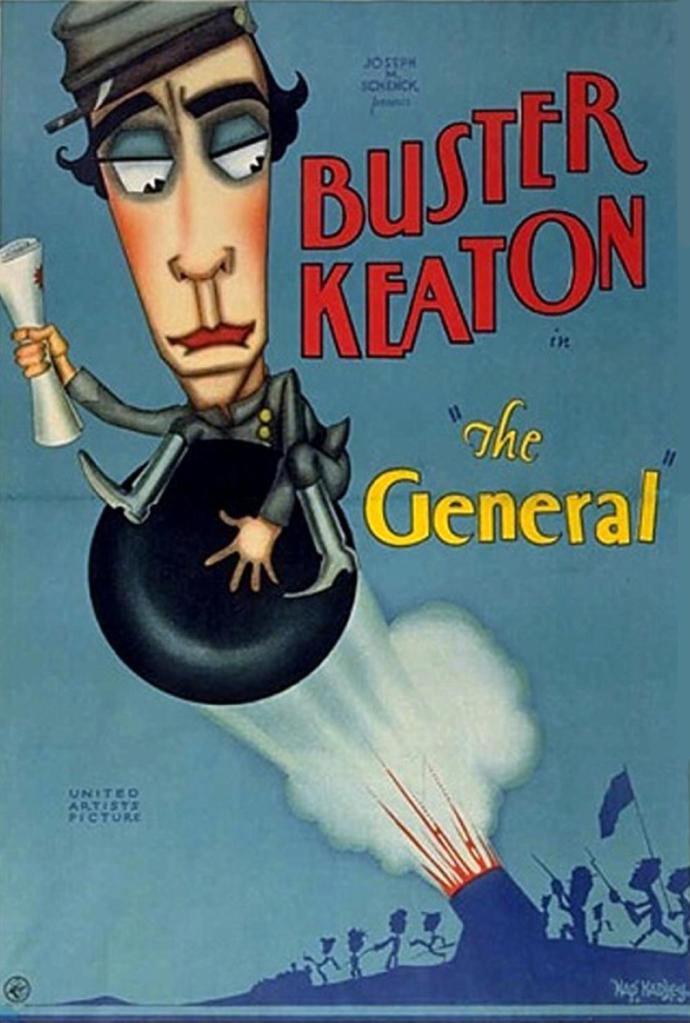
“He’s a disgrace to the South.”
Keaton’s co-director and longtime collaborator, Clyde Bruckman, too often forgotten by film historians, brought to Keaton William Pittenger’s memoir “The Great Locomotive Chase,” the true story of the Confederate Army stealing a Union train and sabotaging the rail lines behind them. It was Keaton’s idea to swap armies, because in the 1920s, authors and culture-makers saw Confederates as a defeated people, not to be made into villains. At that point, Keaton might have turned the rest into a fairy tale, but instead he over-compensated with relative realism, bringing to set 18 freight cars’ worth of Civil War-era cannons, props, wigs, costumes, passenger cars, stagecoaches, wagons, and even house facades. Cottage Grove, Oregon, turned out to be a better shooting location than the actual Tennessee localities, partly because it had unused vintage trains and tracks, but also – less often noted – because some tracks were built far enough apart so that Bruckman could follow the onscreen train with a dolly camera on the unseen track. Jo seph Schenck, the then-head of United Artists, loved Keaton and Bruckman’s ideas and allocated a then-high $400,000 budget – only to see, that summer of ’26, as Keaton’s meticulous manipulations of made-up militias brought the budget far beyond $400,000, perhaps as much as double that number. One multi-camera shot of thousands of extras dressed as soldiers cost about $42,000, which would be considered the most expensive shot in silent-film history were it not for another shot that cost just about as much, the climactic moment of The General falling from a burning bridge into a river.
The General begins with the General, a train engine, and its engineer, Johnnie Gray, just as the Civil War breaks out. Gray tries to enlist and is rejected twice, first by his native Georgia, second by his fiancée Annabelle, who prefers a man in uniform. A year later, Annabelle’s father is wounded and she travels north to see him on a W&ARR train pulled by The General. At a station, most passengers get off for a meal, but Annabelle remains onboard the General as it is usurped by unabashed Unionists. Johnnie Gray gives pursuit by foot, handcar, and boneshaker bicycle, arriving at a town where he finds an engine called Texas, and Confederates to help him, but a failed hitch-up results in the former leaving the latter. Driving the Texas, Johnnie passes a cannon on a flatbed, hooks it up, arms the cannon, lights the fuse, watches as the muzzle falls to point at the Texas, then gets lucky around a bend as the cannon fires and just misses the Union Soldiers on the General, causing them to believe an army is firing at them. They attempt to derail the Texas by throwing wood beams on the tracks; in one rather memorable moment, Johnnie rides his cowcatcher and unmoors one beam with another. Eventually, the Union soldiers dump 2 by 4s on the Texas from atop a high bridge, where they see that Johnnie is sans mates, do an about-face, and give chase, causing Gray to disembark and hide in the wooden glades. Hungry, Johnnie sneaks into a house, only to hide under a table as Union officers enter, sit next to him, and plan a surprise attack at the Rock River Bridge. Gray sees Annabelle held captive in a room, manages to knock out her two guards, and escapes with her into the rainy woods. The next day, when Johnnie and Annabelle see the Union gathering for their secret assault, Johnnie dresses in Blue, hides his fiancée in the General and steals it back. The Union’s hot pursuit reverses the situation of the film’s first half. After changing back to his Rebel uniform, Johnnie manages to warp a track, delaying the Union for a crucial hour while Johnnie sets fire to the Rock River Bridge and alights in a Confederate camp to warn them of the sneak attack. Annabelle reunites with her wounded father while Johnnie joins the Rebels to counter the Yankees, whose commander insists that the Rock River Bridge isn’t so burned as to prevent an engine crossing it. The camera actually pans to show the Union engine attempting to cross the bridge, which spectacularly collapses with the engine’s weight. Forces conflict at the forded river; Johnnie fights poorly but is fortunate. Back at camp, Johnnie’s valor gets rewarded by medallion and by Annabelle’s renewed happiness with him. As they lean on the General, Gray tries to push away her hair to kiss her, but the etiquette of passing soldiers requires him to salute and miss the kiss. In a last bit of symbolism that may also be a, ahem, salute to Zorro, Johnnie switches sides for a final time and smooches Lolita using his left hand to push away her locks, his right hand saluting and saluting and saluting as more soldiers pass.
Keaton expert Noel Carroll wrote, “The most recurrent themes in Keaton’s narratives and gags [are] the question of mastering and understanding causal relations in a world of things, on the one hand, and the question of correctly locating and precisely orienting oneself within one’s environment on the other hand.” The General provides an exceptionally audience-friendly version of these themes, with Johnnie Gray adjusting to chaos in the first half, and coordinating the chaos in the second. The General comes to us now as the funniest of action movies, or the most action-packed of comedies, in many ways better than any single film of Chaplin’s, certainly separating Keaton from Harold Lloyd and Laurel and Hardy in terms of scale and scope much as The Gold Rush had done for Chaplin in 1925. But The Gold Rush was a well-loved hit, while The General, well…the General is categorized as a 1926 film because it was released in two theaters in Japan on December 31, 1926, but its proper release was in February 1927, where it earned…roughly as much as Schenck’s original budget, or about $300,000 less than the film cost. Like Von Stroheim, Keaton would now be bound to a burdensome MGM contract for the rest of the peak of his career; like Von Stroheim and Fairbanks, the coming sound era would do him no favors. One of the underdiscussed reasons that we underdiscuss the silent era is that late-twenties audiences over-dismissed its stars and styles at the sound era’s sunrise.
Influenced by: vaudeville, Keystone films, Fatty Arbuckle, Charlie Chaplin
Influenced: this film did so poorly that Keaton never again enjoyed complete filmmaking freedom, but later, this film and Keaton influenced postmodernists and comedians from Billy Wilder to Woody Allen
~
B5. Sunrise: A Song of Two Humans (Murnau, 1927) BO clip imdb LB RT trailer wiki
stream on amazon watch analysis by Strand read analysis by Kuntzel listen to my podcast

“Then overturn the boat…it will look like an accident.”
Written by Murnau’s longtime collaborator and nonpareil Expressionist artist Carl Mayer, based on Hermann Sudermann’s novel “The Excursion to Tilsit,” Sunrise is intentionally generalized and made metaphorical, with its three leads bearing the names The Man, The Wife, and The Woman from the City, and the period vaguely set at any point during the new century. Sunrise signaled a new dawn as it was the first-ever feature made with the new, soon-to-be-standard Fox Movietone sound-on-film system, but Murnau chose to leave dialogue un-synch-ed, only synch-ing the sound effects and score. The cinematography by Charles Rosher and Karl Struss is particularly groundbreaking, with lush dreamy rural visuals that resemble Goya paintings alternating with double-exposed tracking shots that follow our Man and Wife through urban chaos. Even the fonts of the intertitles are made, well, expressive.
In Sunrise, The Woman from the City visits a lush lakeside town and affixes her eye on The Man, who lives in a modest shack with his Wife and their child dreaming of the days when he and his Wife were deeply in love. The visiting woman whistles for the Man, who is torn but finally leaves his shack and kisses this temptress. She tells him to sell his farm, join her in the city, and by the way kill his wife, a notion that causes him to strangle her until he loses his nerve. Soon, The Man takes The Wife on a boat outing on a lake, and moves to throw her overboard, but when she pleads for mercy, he loses his nerve again. When the boat reaches shore, she dashes away to catch a coming trolley, and he follows, boards, sits next to her on the trolley, and begs her not to fear him. Less than thirty minutes in, our emotional investment is comparable to a film’s final act; we deeply understand the conflict between Man and Wife and fear the result no matter which way it gets resolved. After they disembark the trolley in the city, we watch, wonderstruck, the Wife’s paralyzed body language and the big Man begging her forbearance with words and gifts. They see a bride, follow her into a church, watch the wedding, and the Man breaks down and begs her to forgive him. Tearfully, they leave the church and walk through the hubbub of the city which transforms into a dreamlike pastoral as she forgives him; when they come back to reality, they’re almost hit by traffic. Now delirious with relief, restitution, and renewed affection, they revel in a resplendently romantic day in the city; instead of an affair, the Man chooses a fair, a funfair, to enjoy with his wife. On the way back home, on the boat crossing the lake, they’re caught in a sudden storm, and the man ties around his wife some reeds he’d brought in case he needed to swim away from a capsizing. After the boat capsizes, the Man awakens on the shore, gathers townspeople to search for his Wife, and finds naught but broken reeds. With the Man home again and heartbroken, the Woman from the City turns up, cocksure that their plan has worked. The Man strangles her for real this time, but she is saved when a woman calls out that The Wife has been found alive, having clung to a small bundle of reeds. The Man leaves the Woman from the City, kneels at the Wife’s bed, and watches as she slowly opens her eyes. They kiss as the film dissolves into the sunrise outside.
Sunrise is an extraordinary film by any standard, probably the best non-comic silent film. The film is about dichotomies: city and country, woman and man, passion and revulsion, and even on the level of style, sound and silence as well as expressionism and realism. It recognizes and insists that bridging these opposites is never, ever as easy as many other films imply, and that any harmony in the bridging should be, and is, hailed as miraculous. Somehow, the overt symbolism of the non-names and the urban/rural imagery doesn’t play as phony but instead as more universal than it probably deserves.
Influenced by: German Expressionism, French Impressionism
Influenced: avant-garde envelope-pushing artists
~
B6. Morocco (von Sternberg, 1930) BO clip imdb LB RT trailer wiki
stream on youtube watch analysis by Ivins read analysis by Ross listen to my podcast

“What am I bid for my apple, the fruit that made Adam so wise? On the historic night, when he took a bite, they discovered a new paradise.”
Paramount Pictures, having extended von Sternberg’s contract after Underworld, was probably only too happy when, in 1929, its sister studio in Germany, UFA, asked for von Sternberg to travel to Berlin to make the first sound film of prestigious stage and silent actor Emil Jannings. If you’ve seen Cabaret, you might now imagine Jannings traveling to the real time and place and discovering none other than Marlene Dietrich and casting her as Jannings’ muse and undoer. In winter 1930, von Sternberg wrapped production on The Blue Angel, secured reels of a few scenes, received from Dietrich a copy of “Amy Jolly,” returned on a boat to the United States, and convinced Paramount to offer Dietrich a contract even before The Blue Angel’s American release. Dietrich was brought to Hollywood in mid-1930 and almost rushed to the set to make her first American film, based on “Amy Jolly” and retitled Morocco.
Morocco is probably Von Sternberg’s American masterpiece, and together with his German masterpiece, The Blue Angel, he set the tone for his 1930s string of Dietrich-obsessive love stories in war-torn foreign locales, a considerably influential oeuvre. Dietrich herself, introduced in Morocco in tux and tails with a kiss for a woman, became, with a little help from Paramount Pictures’ promotional team, what Andrew Sarris called “the purveyor of pansexuality and the supreme lover, male or female.” Dietrich was the ne plus ultra of sultry even for the less androgynous, from Garbo to West to Del Rio, but her pairing with Gary Cooper was more than just the singular matching of two of the most desired persons of the century. Dietrich proved that sound-era Hollywood could produce vibrant new stars, but Cooper in Morocco proved that sound-era Hollywood wouldn’t always have to. Gary Cooper in Morocco didn’t need lessons in movement, voice, or really anything; his projected persona was just what his most ardent silent fans might have hoped for, right down to the fact that he was playing a French Foreign Legionnaire in an unaltered plainspoken Montana drawl. In the unprecedented tumult of the sound transition, Morocco was the first great film that reappropriated most of the silent-film apparatus, from a lead like Cooper to the chiaroscuro lighting to the Arab-world sets. Quoting Charles Silver, the film curator at Museum of Modern Art, Morocco was the first film “to attain full mastery and control of what was essentially a new medium by restoring the fluidity and beauty of the late silent period.” Morocco is on this list not as the first great American sound film – that would be All Quiet on the Western Front – but as the first one that Hollywood could and would repeatedly emulate.
Morocco begins in an unnamed port city of Morocco where a contingent of the French Foreign Legion arrives around the same time as a passenger ship containing one Amy Jolly, whom we see rebuff the interest of one M’sieur La Bessiere. Amy Jolly turns out to be the headliner at a local nightclub, where she comes onstage in tuxedo and tails, performs “When Love Dies,” kisses a woman on the mouth, and playfully throws the woman’s flower to Legionnaire Private Tom Brown. She dresses in a womanlier fashion for her second number, “What am I bid for my apple?”, and afterward, while selling apples to the audience, she gives Private Tom her key. Tom visits Amy’s dressing room, and they talk of heartbreak and the shame of not meeting ten years before and decide that they like each other. As they walk arm-in-arm, a jealous ex-lover, Madame Caesar, hires two locals to assault Tom, but Tom attacks them back. The next day, when officers bring Tom before Adjutant Caesar on a court-martial-worthy charge of injuring two harmless natives, the Adjutant accuses Tom of romancing his wife. As a favor to Amy, the thirsty and wealthy La Bessiere persuades Caesar to drop the court-martial and instead send Tom on a suicide mission to Amalfi Pass. After La Bessiere tries and fails to court Amy, Tom stops by her dressing room to say goodbye, and Amy begs him to desert to the desert. Tom suggests they board a train to Europe together, and she agrees, but when she leaves to perform, he notices La Bessiere’s lavish gifts, decides she would be better off with a rich man, and writes on her mirror, “I changed my mind. Good luck!” When Amy comes to see Tom off anyway, she finds him in the company of many women that he has gathered to make her think him a scoundrel. She asks La Bessiere about some other women she watches following the men into the desert, and he answers that they may appear mad, but “you see, they love their men.” At Amalfi Pass, during a firefight, Caesar draws a pistol on Tom but is apparently killed by the enemy. Back in the town, Amy is behaving erratically at work and with La Bessiere, and when he confronts her about her feelings for Tom she shows him the mirror note and she agrees to his marriage proposal. At their engagement party, they learn that Caesar’s surviving troops are in a nearby hospital, and Amy insists on seeing what’s left of Tom. In the hospital, Caesar tells Amy Tom has been faking injury to avoid combat, and she finds him in a local bar cuddling with a local woman. He encourages her to marry the rich guy and gets up to join his unit which is mounting a new mission in the morning. Amy, distraught, sifts through Tom’s table of playing cards and cigarette ashes, and finds a wood heart on which Tom has carved the words “AMY JOLLY.” The next morning, Tom marches off and Amy remains torn, but as she watches a group of local ladies following the Legionnaires they love, she joins them.
Charles Silver writes that one reason Morocco was such an effective early talkie was that, perhaps ironically, von Sternberg’s “understanding of the value of silence itself.” From a modern perspective, there may be too many pauses between lines, leaving one to wonder if perhaps Paramount over-worried about dubbing it into other languages. Another way to see it is that 1930 audiences were seeing for the first time in a sound film the breathless longing and yearning between two very attractive people that had previously only existed in books or on stage. Without need for any particular dialogue, we understand why their characters would be better off without the other, why they can’t let the other go, and why at the end she follows him through the desert. Morocco was a big box-office hit, and Dietrich was nominated for the Best Actress Oscar. Her uninhibited sexuality and independence influenced Hollywood and American culture for the remaining two-thirds of the century.
Influenced by: German and American trends in filmmaking
Influenced: Gary Cooper became a symbol of America, Dietrich became an oasis for the gender-fluid before that term existed
~
B7. Dracula (Browning, 1931) BO clip imdb LB RT trailer wiki
stream on amazon watch analysis by Shives read analysis by Rhodes listen to my podcast
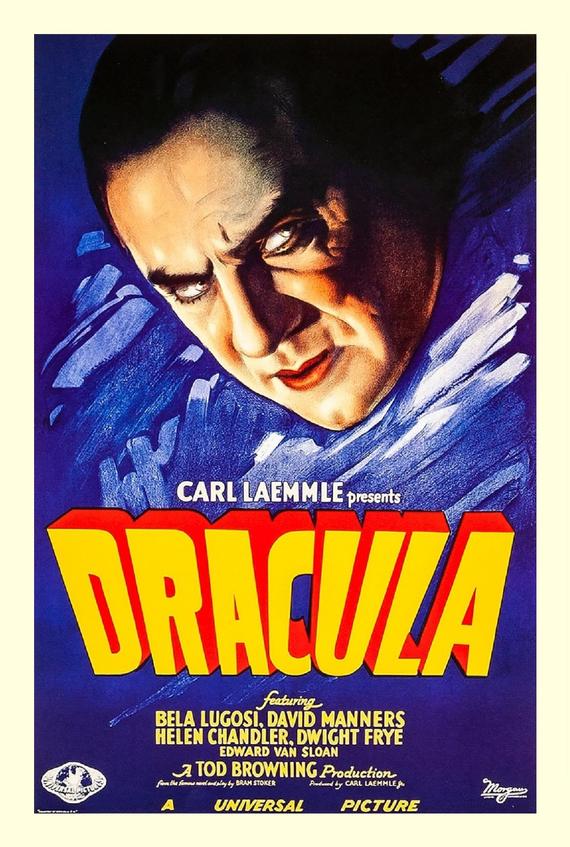
“There are far worse things awaiting man than death.”
Last podcast was partly about F.W. Murnau, whose excellent Expressionist film Nosferatu, released in Germany in 1922, led to 1931’s Dracula in more ways than one. The Irish author of the novel “Dracula,” Bram Stoker, could not rise from his coffin to challenge Nosferatu’s obvious plagiarism of his story, but his surviving widow Florence could get enough money for lawyers, ironically, by licensing her late husband’s story to a stage actor/producer who had worked with her late husband. Hamilton Deane’s play of “Dracula” debuted in Darby in 1924 and worked its way through England until 1927, when it began a successful yearlong run in London. In October 1927, on the same day The Jazz Singer debuted, the American adaptation opened on Broadway starring Bela Lugosi in his first major role, as the aristocratic Hungarian Dracula of Stoker’s story instead of the ratlike apparation in Murnau’s film. I told you last podcast that Murnau’s Sunrisewon Most Unique and Artistic Picture at the first Academy Awards in 1929; what I did not tell you was that award led to the long-delayed American release of Nosferatu in 1930, despite Florence Stoker’s lawyers’ best efforts. Louis B. Mayer and the other prestige-peddling moguls were wary of vampires and horror, but Carl Laemmle and especially his son Carl Laemmle Jr., the latter then head of production at his father’s Universal Studios, were willing to risk journeying to Transylvania despite the blood-sucking percentages demanded by Florence Stoker and Hamilton Deane.
Laemmle Jr. was hands-on, eventually giving himself a co-producer credit alongside director Tod Browning, and they had no easy time with the many names that might have been their Dracula. Lugosi had been replaced for the play’s American touring production, but like a vampire, happened to replace his American replacement in 1930 when the tour made it to Los Angeles. Lugosi lobbied hard and landed the part partly because he accepted a paltry total salary of $3,500. Laemmle Jr. and Browning instructed their designers, and screenwriter Garrett Fort, to study silent horror like The Hunchback of Notre Dame and Phantom of the Opera, but they focused closest on Murnau’s Nosferatu, lifting scenes from it that weren’t in the book or the play, for example an early pricked finger that tempts the vampire. Laemmle wasn’t above plagiarizing his own work, for example a 1925 Universal film called The Storm Breaker for shots of a ship adrift during a violent seastorm. Some say that the performances felt made for silents, but it’s closer to the truth to say that they were made for the stage, cued by Lugosi and the fog and spooky lighting and puppet bats. In the big scenes, much of this staginess is overwhelmed by sound effects created by Jack Foley, for whom the job of creating film sound-effects would be named, the Foley artist.
Dracula begins by introducing an Englishman named Renfield arriving in a Transylvanian town populated by people who, upon learning of his plan to complete a business deal with Count Dracula in his castle, warn him “you mustn’t go there.” The film cuts to the castle’s basement, where creatures emerge from coffins: rats, bees, and four people, these being three women in white and the aristocratically coiffured Count Dracula. Cutting back to Renfield, his new coach arrives, driven by Dracula in disguise. On the way to the castle, Renfield looks out his coach’s window to see that the driver has disappeared and a bat is hovering where the driver was. Somehow, the coach’s horses stop at the correct castle, and Renfield gets out and enters the spooky building, greeted by a caped man who says “I bid you…welcome,” cheers the distant, chilly noises of “children of the night,” and points out a spider spinning a web for an unwary fly. As Renfield sits to complete the business paperwork, he cuts his finger, causing the camera to zoom in on Dracula’s thirsty gaze before Renfield’s cross scares him off. After Dracula offers Renfield wine, Renfield asks “aren’t you drinking?” and Dracula answers, “I never drink…wine.” Dracula hypnotizes Renfield into opening a window, which lets in a bat, leading to all of Dracula’s wives biting Renfield before Dracula waves them off to bite Renfield himself. Aboard the schooner Vesta, Dracula feasts on most of the crew, and when the ship reaches England, Renfield is both the only man alive and a raving lunatic, causing him to be committed to Dr. Seward’s sanitorium. At a London theater, Dracula introduces himself to Seward, and meets his daughter Mina, her fiancé John Harker, and their friend Lucy, who takes an interest in the Count, gets a vampire visit in her sleep, gets rushed to the hospital for blood transfusions, and dies…or does she? Professor Van Helsing interrogates Renfield, who talks of vampires and wolfsbane and eats flies and spiders and how Dracula convinced him to enter custody by promising him thousands of delicious rats. During a visit to Seward’s parlor, as Dracula flirts with Mina to Harker’s consternation, Van Helsing notices that Dracula’s image does not reflect in the mirror, and when Van Helsing points this out to the Count, he smashes the mirror, stalks off, and attacks Mina in the garden. When newspapers report a woman in white luring children to the garden to bite them, Mina recognizes that Lucy has become a vampire, and Van Helsing orders Lucy to sleep with protective wolfsbane around her neck. Van Helsing and Dracula confront each other: the Professor promises to drive a stake through the Count’s heart, and the Count responds by trying to hypnotize the Professor, failing, lunging at him, and being repelled by Van Helsing’s crucifix. On a terrace that night, a bat cues Mina to attack her fiancé Harker, but Seward and Van Helsing save him, and when Mina explains what Dracula did to her, Harker dumps her. Dracula hypnotizes Mina’s nurse into removing the wolfsbane, grabs Mina, and kills Renfield for leading Van Helsing and Harker to him. In a climactic skirmish, Van Helsing impales Dracula through the heart.
Universal couldn’t be sure that audiences would accept a supernatural fright-fest, but viewers and critics mostly loved Dracula. If some found Bela Lugosi’s performance paralytic, others praised it as redolent of a walking, talking corpse. Released in February 1931, the film’s box office turned out to be more than double its budget, and Laemmle quickly repurposed the castle sets for another gothic horror story, Frankenstein, as mentioned in the A-list podcasts. Thanks to the success of Dracula, Universal repurposed itself as the House of Horror, following it first with Frankenstein, next with The Mummy, The Invisible Man, Bride of Frankenstein, The Wolf Man, Dracula’s Daughter, and many more.
Influenced by: Bram Stoker’s novel and Nosferatu, but only up to a point, because this film made the Count more of a suave aristocrat
Influenced: few had heard of vampires or Transylvania; the iconography of blood, crosses, and castles seeped into the American imagination
~
B8. The Public Enemy (Wellman, 1931) BO clip imdb LB RT trailer wiki
stream on amazon watch analysis by Gisriel read analysis by Maltby listen to my podcast

“What do you mean, you could go for her yourself? You could go for an eighty year old chick with rheumatism.”
By mid-1930, as two Hoovers sucked into prison America’s leading criminals – those two Hoovers being President Herbert and FBI Director J. Edgar – Hollywood became both less afraid of violent reprisals and more interested in putting Al Capone-like figures onscreen. The uncomfortable truth was that as the Depression worsened, some Americans saw some gangsters as Robin Hood-like heroes, and it was Darryl Zanuck, Warner Bros. new head of production, who staked his reputation on films that would come close to glorifying gangsters but avoid censure with moralistic opening and closing title cards.
Zanuck also wanted to come close enough to Capone to capture audiences without capturing a lawsuit or a bullet, and found it in two places: W.R. Burnett’s novel “Little Caesar” and John Bright and Kubec Glasmon’s unpublished novel “Beer and Blood.” For the latter, Zanuck chose William A. Wellman to direct partly because Wellman had served in World War I much like the character Mike Powers who gives the speech about Beer and Blood, and Wellman told Zanuck, “I’ll bring you the toughest, most violent picture you ever did see.” The name of the film came by way of the Chicago Crime Commission, in March 1930, designating Al Capone “Public Enemy #1,” an appellation that became part of every article about Capone. Jimmy Cagney was actually cast as Matt Doyle, Tom Powers’ longtime best friend, and Edward Woods was cast as Tom Powers, but after watching the two actors for a couple of days, Wellman switched them. This is why the actors playing Matt Doyle and Mike Powers look like brothers, and also why the kids playing young Tom and Matt look like they’ve been switched. Wellman didn’t have the budget or time to reshoot the kid scenes or recast much of anyone. You can well imagine Cagney’s accented, brusque, ethnic demeanor being relegated to sidekick stature, so give Wellman a little credit for intuiting what would play well to 30s audiences, and also for making a decision that would resonate through every wise-guy, hey-palooka film of the next two decades. The default home for such scripts became Warner Bros; after a dozen imitators of The Jazz Singer wore out their welcome, Little Caesar and The Public Enemypivoted Warner Bros. to the rough and ready, gutter-savvy, hard-boiled identity that it maintained throughout the 1930s.
The opening titles of The Public Enemy warn of the hoodlum problem that society must solve. The first few shots of prewar Chicago are as painterly and evocative as their descendants in Godfather Part II. In 1909, young adolescent Tom uses a string and a wooden sidewalk to trip the old-timey roller-skating sister of his friend Matt, establishing the distant past as well as Tom as a no-good kid. Tom and Matt bring boosted watches to the bar of a guy named Putty Nose who reluctantly gives them a few bits for them. Putty Nose enlists them to help on a warehouse robbery that Tom fouls up, leading to the police killing a fellow gang member, Tom and Matt killing a cop, and Putty Nose skipping town leaving Tom and Matt holding the bag. As young adults, Tom and Matt deepen their delinquency despite Tom’s older brother Mike’s discouragements; both brothers keep their doting mother in the dark. As Mike returns from World War I, Tom and Matt become bootleggers in the growing illegal trade of liquor, a business so lucrative that Tom and Matt can attend a fancy club and pick up well-anointed women despite their rough demeanor. But Tom never loses his street edge; when a bartender fails to stock the correct beer, Tom spits it his face. Tom turns a family dinner into a sumptuous feast, with steak and a keg of beer, but when his brother Mike sulks, Tom asks, “What’s eating you?” and Mike throws the keg across the room accusing Tom of trafficking “beer and blood!” Tom retorts, “You killed and liked it. You didn’t get them medals for holding hands with them Germans.” At breakfast, his girlfriend Kitty complains at how Tom treats her, and a silk-pajama-clad Tom impulsively picks up the half-grapefruit off of her plate and shoves it in her face. Driving around Chicago in a beautiful new 1920s convertible, Tom and Matt see a lovely woman who looks and acts like Mae West and convince her to take a ride with them. The woman, Gwen, tells Tom he’s not the worst she’s seen, and agrees to call him later; as they drive away, Matt says he could go for her, to which Tom replies, “you’d go for an 80-year-old chick with rheumatism.” Nonetheless, Matt marries his longtime beau Mamie, and at the wedding reception, Matt and Tom recognize Putty Nose, follow him and confront him; as he tries to play them a familiar song on the piano, the camera pans from the piano so that we hear, but don’t see, Tom shoot Putty Nose twice in the back. When Tom gives his mother a big wad of money, his brother Mike pushes it back to him, causing Tom to rip up the notes and throw them into Mike’s face. As Tom and Matt get drawn into war with a competing gang, they begin walking around Chicago more cautiously, and at one point they together jump and crouch and pivot at the rat-a-tat-tat sound of a coal truck loading. As they stand up laughing at the misdirect, they do incur sniper fire that kills Matt as Tom only barely skitters away. On a rainy night, Tom arrives at the rival gang’s jewelry shop to mete out justice, only to receive bullets himself; he staggers out of the jeweler, bleeding from the head and torso, says “I ain’t so tough,” and falls onto the rain-drenched curb. In the hospital, covered in bandages, Tom reconciles with Mike and agrees to reform. Back home, Tom’s mother gets a message that Tom will soon be coming home and merrily prepares the bedsheets as Mike takes a second suspicious look at the message, having heard that Tom was kidnapped from the hospital. Mike hears a knock at the door, makes sure that he answers it alone, and opens it to see Tom’s dead body, wrapped in sheets, fall CLUNK through the doorway. The closing title warns us that the hoodlum is society’s problem to solve.
In those 30s, gangsters became part of American mythology, as suffering Americans and even much of the world lionized these amoral ethnic white men with tommy-guns who took what they wanted and damned the long-term consequences. That lionization led to at least two surprising developments in 1933, first America’s first and last repeal of one of its own Amendments, Prohibition, and second a stricter Hays Code that would prevent more movies like The Public Enemy – at least until the Code fell apart in the 60s, permitting criminal-themed masterpieces that are also the favorites of critics and imdb users, like Bonnie and Clyde, The Godfather, Goodfellas, and Pulp Fiction. All these films and many more owe their basic structures to Darryl Zanuck’s greenlighting of Little Caesar and The Public Enemy for 1931, and then United Artists reacting to those films by releasing Scarface in 1932.
Influenced by: Capone’s story and reputation, Little Caesar (1931), The Public Enemy (1931)
Influenced: Among other things, Scarface, whose Howard Hughes and Ben Hecht loomed over 30s and 40s Hollywood
~
B9. Trouble in Paradise (Lubitsch, 1932) BO clip imdb LB RT trailer wiki
stream on youtube watch analysis by Jones and Sallitt read analysis by Daseler listen to my podcast

“I have a confession to make to you: You like me. In fact, you’re crazy about me.”
With the advent of sound, Ernst Lubitsch and his writing-directing partner Samuel Raphaelson, like half the town, made musicals, but the Lubitsch-Raphaelson musicals were worldlier and wiser than most of their peers, making Maurice Chevalier into a household name via films like The Love Parade and The Smiling Lieutenant. At that point, successful in 1931, Lubitsch read a brand-new play called The Honest Finder by Laszlo Aladar and decided to convert it not into a musical but a straight comedy with enough tuxedos and ball gowns to distract from the general raciness. He told Raphaelson not to read Aladar’s play but instead to base the lead thief on George Manolescu, a real-life Romanian rapscallion. Decades later, critics would name Trouble in Paradise as the essence of the “Lubitsch touch” and put it on enough best-of lists for me to put it on this B-list.
Paramount Pictures was tepid about Lubitsch changing gears from musical to comedy, and leaned on Lubitsch to cast Maurice Chevalier as the lead so that at least the poster would light up with a Gary Cooper-like star. But Lubitsch and Chevalier had fought on the set of The Smiling Lieutenant, and Lubitsch was wary of the fact that English was Chevalier’s second language; the jewel thief in Trouble in Paradise needed to command every conversation with his concupiscent communication skills. Lubitsch saw an early screening of Blonde Venus and decided that if von Sternberg could change gears from Gary Cooper to Herbert Marshall, then Lubitsch could too. Paramount wasn’t thrilled to cast as a lead this average-sized, ordinary-looking Brit, but what the studio got was a classier version of Groucho Marx-esque banter and perfect confidence in close two-shots, matching well with the fabulous Miriam Hopkins, whom Lubitsch already knew. In many ways, Marshall, Hopkins, and Kay Francis’s rapid, racy repartee and role reversals mark this film as a sort of proto-screwball comedy before anyone knew of that term.
Trouble in Paradise begins in dark alleys that are eventually revealed to be Venice at night, as though Lubitsch wanted to show the dark, seamy side of that postcard paradise before cutting to Gaston Monescu, watching from a window, of that gutter but now posing as an aristocratic baron. Fleecing a rich American named Filiba, Gaston meets a woman who is posing as Baroness and takes her to dinner. They accuse each other of masquerading as high society when in fact they’re low thieves, and after revealing each other’s stolen booty, they fall in love and abscond to Paris. At a Paris opera, Gaston steals a diamond-encrusted purse from Madame Mariette Colet, the young chief of perfume giant Colet and Company, and when she offers a reward, he turns up to claim it as the dapper M’sieur Lavalle. After charming her with ideas about art and grooming, he admits that he lost everything in the stock market, and she offers him a job as her personal secretary, permitting Gaston to secure a related admin job for Lily. Gaston confronts the company’s board of directors, led by M’sieur Giron, that they’re not giving Colet enough money; Gaston observes Colet open her private safe, and convinces her that the safe’s got too little money. Flirting with Colet all day, Gaston develops feelings for her, and Lily warns Gaston that she loves him as a thief, but he better not become a gigolo. At a garden party, Filiba accuses Gaston of having been in Venice, a charge Gaston deflects with jokes about harems in Constantinople. Gaston and Lily fear Filiba finding out their ruse, and make plans to flee France. At a lavish dinner party, a third party tells Filiba he once mistook Gaston for a doctor, and Filiba tells Colet that Gaston is an impostor, but she refuses to believe it, continuing to inappropriately flirt with her secretary. Lily sees this, secretly confronts Gaston, hears his denials, and robs Colet’s safe. Colet finds the safe robbed and accuses Gaston, who protects Lily by claiming complete credit even while blaming M’sieur Giron for filching from her family for years. With Colet on the verge of forgiving and kissing Gaston, Lily opens the door, hands Colet the cash, confesses to the theft by way of disparaging Gaston’s character, and departs with arch best wishes for “Colet…and company.” Gaston confesses everything and tells Colet this is goodbye; Colet understands everything, and lets him off with a parting gift. In the back of a taxi, Gaston and Lily reveal that each one pinched a little something extra from Colet – and each other. Love restored, Lily leaps into Gaston’s lap and they lock lips as the lens closes.Trouble in Paradise wasn’t a huge hit, but it’s the best pre-Code-enforcement example of the sort of movie that the major studios would try to make throughout the 30s – funny, white, sexualized, about non-violent crime, and classy, even if the classiness is complicated by something of a deception. Studios couldn’t quite copy Trouble in Paradise, or at least, not the dialogue’s breathless bawdy blue cheekiness, because Trouble in Paradise is one of the films that led to a much more rigid enforcement of the Hays Code after 1934.
Influenced by: less Chaplin/Keaton, more drawing-room stage comedies of the period
Influenced: the screwball comedy, particularly in terms of deadpan delivery and bourgeois trappings
~
B10. Gold Diggers of 1933 (LeRoy, 1933) BO clip imdb LB RT trailer wiki
stream on amazon watch analysis by Johnson read analysis by Kemp listen to my podcast
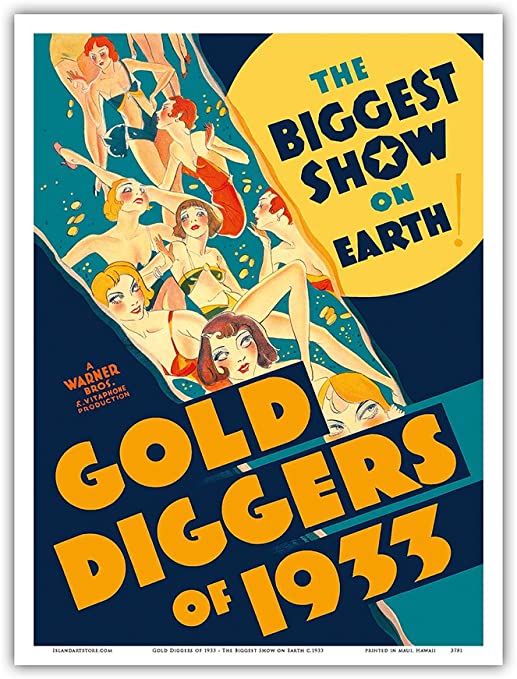
“Petting in the park? Bad boy. Petting in the dark? Bad girl. First you pet a little, then let up a little, then you get a little kiss.”
Threes curlicue around the film – there are two threes in the title, the film is about a trio of women who wind up with a trio of men, and the film was the third filmed version of Avery Hopwood’s 1919 play “The Gold Diggers.” The first was a 1923 silent adaptation that the second, in 1929, made into a successful talkie musical called Gold Diggers of Broadway. The third, Gold Diggers of 1933, owes these versions both everything and nothing: the story had been done often enough for Warners to know exactly what to cut, but the 1933 film’s new material would have been unimaginable in 1929. For one thing, almost every plot turn is explicitly because of the Depression, a situation that goes a long way toward excusing the ladies’ occasional materialism, even putting the title in something like air quotes. But the real groundbreaking here came from choreographer and designer Busby Berkeley, who staged elaborate, near-abstract musical numbers that could have no easy referent in real life or this podcast. 17 years after Griffith told Gish that they were creating a new language, and after many, many subsequent abstract filmic experiments by the likes of Dali, Delluc, Dulac, Duchamp, and many others, Busby Berkeley brought to bear the business he began in 42nd Street and brought abstraction into the mainstream.
In many ways, deep-Depression-dependent backstage musicals 42nd Street and Gold Diggers of 1933 should be considered two sides of the same coin, or two versions of the same story; for the first one, for the first time, Warner Bros. hired songwriters Warren and Dubin, choreographer Busby Berkeley, and actresses Ruby Keeler and Ginger Rogers, all of whom did or played the same roles in both films, as did Dick Powell as the young male ingenue singer-songwriter. Having to choose between 42 and 33 for this list, I chose Gold Diggers because the repartee is just a bit faster and more knowing, making the women seem more feminist; “The Gold Diggers Song (We’re in the Money)” and “Forgotten Man,” written for this film by Warren and Dubin, are classics and even somewhat deep; and here the Berkeley set-pieces are more extensive, extravagant, and extreme.
Gold Diggers of 1933 begins with a stupendous production of “We’re in the Money”: the camera pans over the closeup faces of beautiful eyelash-batting showgirls before yielding to a dance number that carefully coordinates coin props and chorus girls into kaleidoscopic shapes. Within five minutes, then, the film establishes the Berkeley style: sumptuous closeups with elaborate group work, or what you might call a rather 1933-apropos radical individualism with radical collectivism. Despite all that, this Money show gets closed for lack of money before it opens. Three of the show’s stars – Polly, Carol and Trixie – share an apartment and sit in it, dejected, until a fourth co-star, Fay, shows up promising that their producer is coming with a new offer. A neighbor, Brad, plays a torch song on piano in order to serenade Polly, who is very receptive. The producer, Mr. Hopkins, shows up, hears Brad, tells Polly to bring him over, and slyly jokes “I can fire Warren and Dubin.” Hopkins enjoys Brad’s first song, hates his second, and loves the third, envisioning men marching, spinning fantasies about a song and a show about jobs and struggle and the Depression. When Hopkins bemoans his lack of funds, the girls all moan…until Brad promises to bring Hopkins $15,000 tomorrow as long as Polly gets a featured role in the show. After many jokes back and forth over this offer, Brad shows up the next day with the cash, but he refuses to sing onstage despite his terrific tenor, causing the ladies to think him a thief. After Trixie tells him that without him the show will fail and the cast and crew will starve, he reluctantly agrees, and sings onstage, with Polly, his number “Pettin’ in the Park” which goes “Pettin in the park, bad boy, pettin in the park, bad girl, first you pet a little, let up a little, then you get a little kiss.” For this one, Berkeley regulates a roundelay of roller skates, snow flurries, showers, balls made into geometric patterns, park dwellers, police, and a pea-shooting baby played by Billy Barty. The next day’s newspaper names the show a hit and notes the surprising presence of wealthy scion Robert Bradford, whose family warns him to stay away from the theater in general and showgirls in particular, all being gold diggers. When Brad refuses to give up his dreams of theater or Polly, Brad’s brother Lawrence and family lawyer Faneuil Peabody come to the showgirl’s apartment to buy off Polly. Carol is so bollixed at their blue-blooded bombast that she pretends to be Polly, and she and Trixie play jokes on the men, leading to Trixie taking them out to a new speakie. Trixie, the one genuine gold-digger and jokester, makes light of Faneuil, or Fanny, but really does enjoy getting more of his cash and kisses. Carol, as pretend-Polly, prefers to punish the prudish plutocrat Lawrence, but after a few more nights of singing, dancing, and Fay and real-Polly playing along, both Carol and Lawrence confess that what started as a game became affection all the same. When Lawrence says he still opposes Brad’s engagement to the real Polly, Carol breaks it off. On a Broadway stage, Brad and Polly lead “The Shadow Waltz,” another wildly inventive, intricate investiture involving innumerable ingenues that could never have been mounted on an actual stage. Backstage, when Lawrence tries to break up Brad and Polly, Carol swears she may never see him again, and so he relents, meaning that along with Trixie kissing Fanny all three housemates are ending the movie with rich men. That said, Hopkins hustles Carol onstage, along with African-American torch song specialist Etta Moten Barnett, to sing “The Forgotten Man,” an evocation of exiguity and an Expressionistic encomium to men who fought in the Great War only to be dismissed in the Great Depression.
Of all the films on the A- or B-list, Gold Diggers of 1933 probably took the least amount of time from conception to release. 42nd Street was made as FDR was being elected, released in January 1933, a hit by February, so Jack Warner and Darryl Zanuck put Gold Diggers into production in March and premiered it that May. The short timeframe spoke to the previous adaptations, although who then or now released a remake four years later? Warner, Zanuck, director Mervyn LeRoy, and even Busby Berkeley knew that what they had was good, that it could be Depression-savvier and sort of post-Cagney-hard-boiled-er than anything from that wave of herky-jerky, hit-and-miss musicals from 1929. They alchemized that anarchy into something approaching art. They also made a third musical that year, Footlight Parade, and the fact that they all competed at that year’s Oscars might have indicated too much of a good thing; in any event, Gold Diggers was Warners’ biggest hit of the year.
Influenced by: the flurry of Broadway-based films of the early sound period, but mostly as contrast
Influenced: musicals; the Busby Berkeley style is widely renowned, sometimes condemned as female objectification, sometimes called symbolic of Roosevelt-era politics (individualism pressed into collectivism)
~
B11. A Night at the Opera (Wood, 1935) BO clip imdb LB RT trailer wiki
stream on amazon watch analysis by Rearview read analysis by The Massie Twins listen to my podcast

“I have here an accident policy that will absolutely protect you no matter what happens. If you lose a leg, we’ll help you look for it.”
Under Irivng Thalberg’s strict guidance, A Night at the Opera established a new or modified formula for MGM’s Marx Brothers films, like extravagant backdrops, Harpo as Chico’s brother or partner, Groucho and Chico having an extended “who’s on first?”-ish routine, a friendship between the romantic couple and Chico, and a big Act III setpiece where everyone appears and all the plot strands come together. The latter had been standard with Shakespeare and MGM comedies, but not with the Marxes. The plot of A Night at the Opera permitted and encouraged MGM-style large-scale musical numbers, and indeed Kitty Carlisle and Allan Jones were already operatically trained contract players who were happy to dub their own voices.
1935 audiences saw A Night at the Opera begin with a musical number loosely based on Leoncavallo’s Pagliacci, performed by a succession of everyday Italians doing everyday things, apparently full of “O solo mio”-level stereotyping. Quoting Glenn Mitchell’s The Marx Brothers Encyclopedia, Leonard Maltin, on the audio commentary on the current DVD, says that the musical opener was cut during the war as a diplomatic gesture to Italy, but MPAA records show that it was actually cut earlier, in 1938. This suggests that MGM was probably capitulating to Benito Mussolini prior to the war, but later didn’t want to admit that. The Italian-street opener was removed from the master print and no longer survives, which is why the often-stated running time of the film, 95 minutes, is three minutes more than the actual film.
The truncated film begins at an upper-class Italian club with a waiter, no longer singing, but instead calling out for Mr. Otis B. Driftwood, who has stood up wealthy dowager Mrs. Claypool by dining with a blonde woman just behind her. Driftwood (Groucho) turns, insults the waiter, receives the check for a meal, tells the blonde “If I were you I wouldn’t pay it,” joins Mrs. Claypool, and continues a barrage of overtures and understated insults. When the dowager mentions that after months he has mostly failed to get her into society, he introduces her to Herman Gottlieb, head of the New York Opera Company, and they arrange for her to finance the the New York Opera debut of Rodolfo Lassparri, “the greatest tenor since Caruso.” We soon learn that he also has one of the world’s greatest tempers when we see him backstage abusing his cross-dressing dresser, Tomasso (Harpo), to the chagrin of sweetheart soprano Rosa Castaldi, who spurns Lassparri’s advances and dotes upon the unknown tenor Ricardo Baroni, who hires his childhood best friend Fiorello (Chico) as his manager. As part of assuring the investment, Driftwood drifts backstage at Milan’s opera, where he sees Tomasso mallet-bonk Lassparri into unconsciousness. Fiorello tells Driftwood he represents the world’s greatest tenor, and Driftwood believes he’s signing Lassparri when he’s really getting Baroni – if in fact their patchwork contract is enforceable. As an ocean liner prepares to leave for America, Baroni sings a tearful goodbye to the departing Castaldi, but it later turns out that Baroni has snuck into Driftwood’s enormous steamer trunk along with Tomasso and Fiorello. Driftwood discovers this at about the same time that he grasps that his Gottlieb-granted stateroom is little more than a closet, but when he tells the hungry stowaways to leave before Claypool arrives, they insist on food first. This leads to one of the funniest and famousest scenes in comedy history as Driftwood orders a restaurant’s worth of food and the ship sends a hotel’s worth of service-people, from engineers to towel maids to a manicurist, all culminating in the closet containing maybe 15 people when Claypool opens the door, causing half of them to pop out of the stateroom like a freed jack-in-the-box. Later, on deck, during a ship party, the three stowaways can’t help but perform, with Chico on piano, Harpo on harp, and the singer played by Allan Jones singing “Cosa cosi.” After they’re found and placed in a detention room, Driftwood manages to throw a rope to their porthole, and Tomasso, after taking the rope from the ocean to the ship’s mast, lands in a room where he finds scissors and three sleeping, long-bearded aviators. When the ship arrives in New York, three impostors, posing as the heroic pilots, press forward with a press conference with their self-appointed interpreter, Driftwood, and everything goes preposterously. The stowaways are hiding out in Driftwood’s hotel room when they see their picture on the front page of the paper and soon foil a nosy policeman, leading to Ricardo climbing in the window of Rosa’s hotel room, leading to her joy and Lassparri’s fury, leading to The New York Opera Company’s sacking of Rosa and Driftwood. Revengefully, the team sabotages opening night of Il Trovatore, kidnapping Gottlieb and Lassparri and motivating some madcap mayhem, including Fiorello and Tomasso throwing a baseball as they conduct the MGM Orchestra playing Take Me Out to the Ball Game, and Tomasso swinging along various backstage ropes that make different modern sceneries interrupt the period piece. I might add that Chico and Harpo are happy to leap into drag to play the opera’s gypsies. Without any other tenor ready, the opera hires Baroni, who insists that he needs a familiar Leonor and thus gets Rosa, and together they wow the crowd. The film ends with the lovers performing an encore as Driftwood and Fiorello negotiate another contract.
Thalberg won his bet: A Night at the Opera was a big hit, and is regularly cited as one of the funniest and most influential comedies of the period. And as Thalberg had also predicted, critics were less than enthused. Mark Bourne spoke for many when he said the Marx Brothers “still let the air out of stuffed shirts and barbecue a few sacred cows, but something got lost in all that MGMness when the screen’s ultimate anti-authoritarian team started working the Andy Hardy side of the street.”
Influenced by: Monkey Business; Irving Thalberg, the MGM wunderkind who gave them free rein to do what they wanted
Influenced: the Marx Brothers’ spirit of creative anarchism reverberated through Warner Bros. cartoons and all of culture
~
B12. Swing Time (Stevens, 1936) BO clip imdb LB RT trailer wiki
stream on amazon watch analysis by Thomas read analysis by Smith listen to my podcast
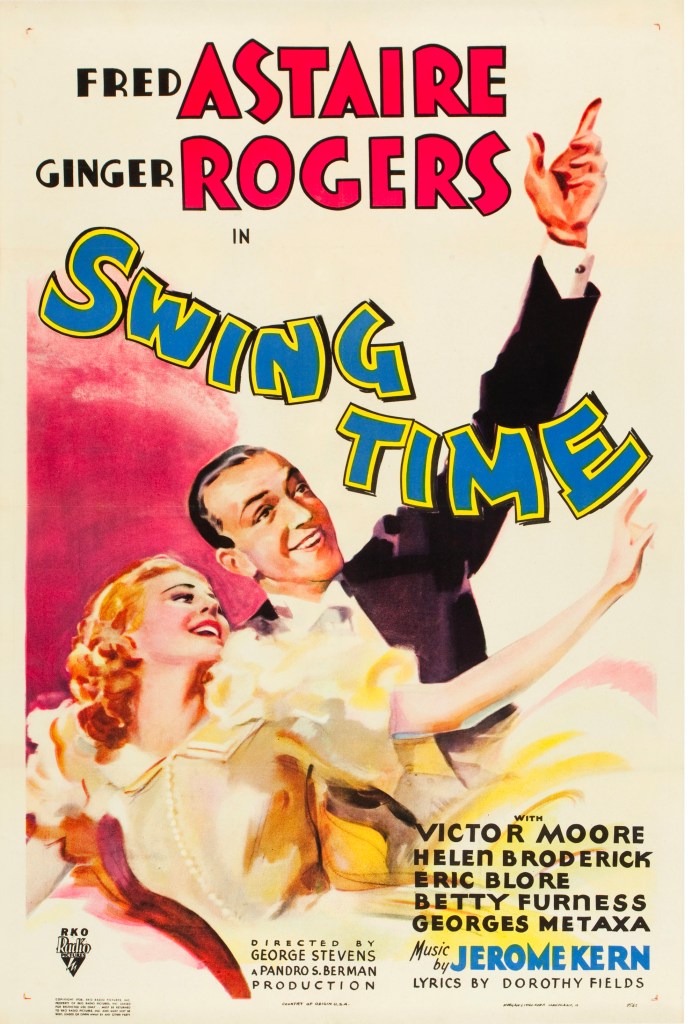
“Lucky, please don’t feel bad. You still got me. Course I ain’t a young and pretty girl. I ain’t even a girl, but I’ll stick. I’ll never leave you.”
Swing Time is in tune with the times in ways large and small, including running gags about clothes that keep Astaire in formal-occasion fashions for almost the entire film, even if his character is coming close to starving. By mid-1935, Astaire-Rogers films were clearly a beautiful thing quite unlike any other thing Hollywood was doing (or would ever do again), and RKO could choose from the wealth of would-be collaborators wishing to work with the pair. Erwin Gelsey’s spec script, featuring Astaire’s character disingenuously taking dance lessons from Rogers’ character, was about as clever as any. Irving Berlin and Max Steiner had done terrific work on previous Astaire-Rogers films, but RKO producer Pandro S. Berman wanted a songwriter who would set up the songs more snugly with the story, and so he summoned the melodist on Roberta, the great Jerome Kern, who brought in Dorothy Fields to help him with lyrics. Kern and Fields were hired to write seven songs, six of which made it into the movie; at least three are among the period’s finest. Another key hire was George Stevens, a director who had just established his feminist bona fides with Alice Adams, starring Katharine Hepburn, and Annie Oakley, starring Barbara Stanwyck. Rogers later wrote that Stevens let her redo takes if she had better ideas, and the result is that Rogers as Penny Carrol is considerably convincing in every frame of Swing Time, resisting Lucky’s charms when she doesn’t quite believe him.
Rogers very much appreciated Stevens, which is crucial background to the legendary anecdote from this film, that at some point between two of the 48 takes of “Never Gonna Dance,” Rogers took off her shoes to see that the insides were bathed in blood, and then kept right on dancing anyway. “Never Gonna Dance” is arguably the pair’s most melodrama-motivated great dance together, and the title was a working title of the film, but RKO worried that people would think the film was a non-dancing musical. If anything, the script invited more story-oriented cavorting than usual, with the exception of “Bojangles of Harlem,” in which Astaire appears for the first and last time in blackface…for about 12 minutes on and offstage. The elaborate number, featuring a salute to Al Jolson and rear-screen shadows moving in and out of synch, took three full days of shooting and some last-minute fixes by Kern and Astaire, who worked to pay tribute to his one-time teacher, John W. Bubbles, vaudevillian and father of rhythm tap, later one of the first black artists on TV. Bill “Bojangles” Robinson became broadly famous in 1935 by dancing on stairs with Shirley Temple in The Little Colonel, and the blackface is mitigated by Astaire’s sincere affection…and yet even that affection is mitigated by Astaire’s undercurrent of “oh that? I can do THAT too!”
Swing Time begins with a peek at the peak part of the performance of a dance troupe, who hurry to get offstage so that their leader, John “Lucky” Garnett, can rush off to his wedding to Margaret. Not wanting to lose Lucky, the troupe tricks him into fixing a fake fashion faux pas, and plays on his love of gambling, to delay him until the wedding is called off, unbeknownst to Lucky. One troupe-mate even bets Lucky’s bankroll that he won’t be married, and Lucky accepts, only to arrive at the venue with the bride, her father, a dog, and a cat all hissing at him. Eventually the father agrees that $25,000 would change his mind, a sum that Lucky feels he can earn with enough gambling and hustling in New York City. Lucky troops to the train ticket office, where his troupe-mates cut him off and insist on his bankroll because he bungled his bet on the bride, and so the bereft Lucky bounces onto a freight car train, trailed by his older sidekick, a magician who is confusingly yet endearingly named Pop. Walking around New York City, the pair are broke except for Lucky’s lucky quarter, so Lucky asks a random passerby, Penny Carrol, to change it, Pop pilfers it back from Penny’s purse, Penny accuses Lucky of theft and importunes a police officer, and then Penny, impugned, departs. Pop admits he pickpocketed the coin, leading to Lucky chasing Penny into her job as a dance instructor and pretending to promenade poorly. When a peeved Penny pronounces “I can’t teach you anything!,” her boss overhears and fires her, causing Lucky to show the man how much she really did teach him with a sudden spontaneous polka in perfect syncopation. Not only is Penny not fired, her boss sets up an audition for the pair, but Lucky needs a tuxedo, gambles and loses, and misses the audition, flipping Penny against him. Lucky and Pop march outside Penny’s apartment wearing cardboard signs, a la 1930s union strikers, that say “PENNY CARROL UNFAIR TO JOHN GARNETT” until Penny, with a little prompting by her older sidekick Mabel, permits them into her outer room. From there, Lucky sits at a piano and serenades her with the brand-new “The Way You Look Tonight,” impressing Penny so much that she shows up with hair in shampoo, conferring on the canticle a comical coda. Lucky and Penny’s next audition is thwarted when the club’s band leader, Ricardo Romero, in love with Penny, refuses to play for her to dance with any other man. At Romero’s club’s roulette table, Lucky is about to win the full $25,000 needed to marry Margaret, but pulls his chips at the last minute, proving he would prefer Penny. Lucky uses the almost-25-large to gamble with the club owner for Ricardo’s contract, but when Pop sees that the club owner is using a rigged deck, Pop uses sleight-of-hand to make sure Lucky’s card is the winner. Now that Lucky owns the club, Ricardo must reluctantly play for Penny’s dance with Lucky, and they sashay through one of the most superb of Astaire-Rogers sequences, a complex swing-waltz with tap overlays, a floating on air briefly punctuated with a knowing middle polka. Later, Lucky tells Pop not to leave him alone with Penny until after he tells her about his engagement to Margaret, but, reacting to Lucky’s reticence, Mabel arranges a double-date weekend at a rural, snowy cabin. Lucky and Penny sing the frustrated “A Fine Romance” while trudging their feet through the snow, marking the second standard-worthy song that doesn’t need to be, and isn’t, turned into a dance, instead relying on strong acting while lip-synching particularly from Rogers. Returned to New York City, Mabel dares Penny to act on her feelings, and you know it’s a post-Code film when you watch the over-the-moon reactions of Penny and Lucky to their mere first kiss. Ricardo Romero conducts as Lucky boogies through a boffo “Bojangles in Harlem.” Backstage, in blackface, Lucky’s life begins to break apart, first when the former club owner demands to replay for his club with a fair deck, second when that loses Lucky the club, third when Penny finds that out, and fourth when Penny finds one Margaret looking for John Garnett. After Penny tells Lucky she has accepted Ricardo’s marriage proposal, Lucky sings that he’s “Never Gonna Dance” without Penny, and they share a two-step that moves from melancholy to marvelously realized. (As an aside, Astaire also name-checks Groucho and Harpo.) The next day, Margaret reveals that she is leaving Lucky for another man, causing Lucky to say “Gee that’s swell!” and run to stop Penny’s wedding. After a few reversals, Penny agrees, and rather artfully, Penny sings “The Way You Look Tonight” while Lucky sings “A Fine Romance” as they walk to a window watching over the New York skyline, and conclude with a clandestine kiss.
Astaire and Rogers dancing together can’t be explained; seeing is believing, and no sights onscreen command your undivided attention quite like Fred and Ginger in harmony to a classic song. The comparison is to Broadway’s best dancers, but the comparison doesn’t take into account the hermetic details of plotting, acting and magazine-wedding-level elegance typical to 1930s Hollywood. As Edward Gallafent wrote, despite the tuxes and tails and trains, “this star couple seems to exude a sense of ease, or accessibility, even an intimacy – we can feel at home with them.” In Astaire and Rogers’ ten films together, not every scene could be said to work, but when everything’s working, as in Swing Time, effervescent dance supporting romance effects a transcendance not unlike eating the best meal of your life. The pairing of Fred Astaire and Ginger Rogers is a one-time filmic phenomenon, without equivalent in any other country or cinema with the exception of Bollywood. Gene Kelly is Astaire’s dance equal, but never had a partner that developed the same degree of prancing and romancing. No one else on a Western screen has come close, though it should be said that no one was allowed to; a more enlightened 21st century would have found the equivalent of Top Hat and Swing Time for someone like Savion Glover.
Influenced by: previous Astaire-Rogers films; 1930s codes; perhaps George Stevens’ confidence
Influenced: this is one of the leading examples of why Fred and Ginger are part of even the briefest versions of cinema history
~
B13. The Adventures of Robin Hood (Curtiz, 1938) BO clip imdb LB RT trailer wiki
stream on amazon watch analysis by 100YearsofCinema read analysis by Fraley listen to my podcast

“I’ll condemn anything that leaves the task of holding England to outlaws like me.”
It was called The Adventures of Robin Hood to distinguish it from the earlier Fairbanks film that most people called Robin Hood, which was ironic because that 1922 film’s technical full title was “Douglas Fairbanks in Robin Hood.” Warner Bros. had long ruminated on reviving Robin Hood for its biggest star, Jimmy Cagney, but the star and studio parted ways in 1935, the same year Jack Warner took a chance on two near-unknowns, 26-year-old Errol Flynn and 19-year-old Olivia De Havilland, to work under a new-ish director, Michael Curtiz, to star in a new swashbuckler called Captain Blood. After the big-budget picture broke out at the box office, Flynn and De Havilland became something like Warners’ Astaire and Rogers, co-starring together in eight films over the next six years. Robin Hood was sorta their Swing Time, their next logical step, but it was a far bigger gamble, its three-strip Technicolor bringing the budget to roughly double that of Captain Blood, more than $2 million, by far a first for the famously flinty studio. One reason there hadn’t been more color features was that then-necessary lighting for color scenes indoors was torturously hot (a year after Robin Hood, all theWizard of Oz actors would complain of their makeup melting between takes); Robin Hood was an ideal production in that every scene was either filmed in a mock castle, with lights hanging 30 feet overhead, or outside. Tarzan descended from branches that could never have supported his weight, but, declining to ask audiences to suspend their disbelief, Jack Warner demanded high-thick-branched trees that Los Angeles County didn’t have, and so half of production was moved hundreds of miles to an oak-filled park near Chico, California, while the other half was filmed in Pasadena and Warners studios, necessitating two credited directors, Michael Curtiz and William Keighley. As color and location costs accumulated in the winter of 1938, Warner and producer Hal B. Wallis worked to film and edit Robin Hood efficiently enough that it could be released as early as May 1938, giving the film a full six months in theaters before Gone with the Wind would inevitably replace it as America’s color-suffused sensation.
A minor footnote to this particular story concerns Viennese opera conductor and composer Erich Wolfgang Korngold, whom Wallis begged and pleaded and cajoled to come from Austria to America to compose the score for the new film. Though Korngold felt that an “action” picture was beneath him, he reluctantly agreed to a week-by-week deal that he could leave anytime he felt dissatisfied. Korngold arrived in America apprehensively planning to stay no longer than a couple of months, but then, on March 12, 1938, Hitler annexed Austria along with all of the Jewish composer’s possessions. Korngold remained in Los Angeles through 1945, lived until 1957, and always told anyone who asked that the Robin Hood movie saved his life. Beginning with Robin Hood, Korngold became one of Hollywood’s most influential composers, starting with a lush, passionate, chromatic score that elevated Robin Hood way beyond Flynn’s previous sword-fight films.
In an odd echo of what was almost Korngold’s fate, The Adventures of Robin Hood begins with medieval-scroll-looking title cards telling us that Richard the Lionheart, King of England, has been captured in Vienna. Out in Sherwood Forest, after an older, diminutive huntsman named Much kills an apparently royal deer, Sir Guy of Gisbourne turns up to punish him, and Robin Hood and friend Will Scarlet turn up to punish Sir Guy, laughing and threatening him enough that Guy rides off in a huff resulting in Much the Huntsman pledging his loyalty to Robin Hood. At a sumptuous, fully appointed royal feast in Nottingham Castle, Richard’s treacherous brother Prince John tells the many knights, as well as Lady Marian, that he is now usurping the throne with plans to over-tax the Saxons to recover Richard’s ransom. Disgraced Saxon nobleman Sir Robin of Locksley, aka Robin Hood, shows up at the feast, lays down a fresh deer for dinner, and bawdily, boldly, brazenly blazons his intent to restore Richard to his rightful throne. A bloodless brawl begins, but Robin Hood somehow smilingly subdues several soldiers and slips away out Guy of Gisbourne’s gates. Robin and Will recruit roustabouts in Sherwood Forest, like the stout but sword-skilled Friar Tuck and the staff-master Little John, who bests Robin Hood in a staff-off (probably because the actor also played Little John in Fairbanks’ film). Speaking to maybe twenty merry men, Robin makes them promise to fight for free England until Richard’s return, to rob from rich to give to poor, and to treat women with courtesy. From bows and branches high above, the Merry Men quite literally descend upon a traveling Norman party that includes Sir Guy, Lady Marian, and the Sheriff of Nottingham, commandeer their horses, and bring them into a bawdy Saxon feast that resembles an Octoberfest with endlessly overflowing mutton and venison. (In this motion picture, deer leg shanks are both motive and motif.) Maid Marian refuses to eat, eats, and declares herself unafraid of anything least of all Robin Hood, prompting Robin to escort her through the gypsy-refugee-looking backside of the encampment where she sees Saxon serfs’ sincere suffering due to Sir John. When Robin permits the Norman party to depart unharmed, he credits Lady Marian’s presence to Sir Guy and the Sheriff of Nottingham. When these two trip back to the castle and protest that they tried to arrest the Hood, Sir John asks where are their battle wounds, John apparently unaware that this is a clean Code-compliant film. Hoping to play on Robin Hood’s competitive nature, the Sheriff announces an archery tournament with a grand prize of a golden arrow to be presented by Lady Marian. Here the color pays off: in prior scenes, Robin distinguished himself wearing bright green tights, but in the archery tournament, in muted hues and a head scarf, Robin’s disguise is made more plausible. A rival’s arrow lands in the dead center of the bullseye, but Robin’s arrow splits that arrow and he wins, reveals himself, causes a fracas, and gets captured and sentenced to hang. Marian maneuvers the merry men into breaking Robin out of prison, and Robin returns the favor, sort of, by sneaking into Marian’s tower offering courtship and a wastrel’s life amongst the Saxon peasantry. When Robin threatens to fall from her high window and land on Norman guards, she chastely kisses him and admits her love for him, but refuses to leave with him on the grounds that she can help his cause more from inside the castle. At a roadside inn, a Norman bishop discovers that King Richard has returned with his retinue, all disguised as monks, and alerts John and Guy, who hire a disgraced knight to kill Richard in return for both the restoration of his rank and the receipt of Robin of Locksley’s legacy land. Marian gets word of this perfidy and quills a warning to Robin, but Guy intercepts the parchment and puts Marian in the castle prison pending trial and probable execution. Like the leads of Swing Time, Robin and Marian have older sidekicks who have started up their own relationship, and so Marian uses hers, Bess, to get a message to her sweetheart, Much, who manages to find and kill Dickon even as he, Much, becomes much wounded. Robin Hood and his men find the “monks” and feed them and find fault with them for fighting abroad when Richard needed them in England. When Will finds Much wounded he brings him to Robin to tell tale of Richard’s arrival in England, causing Richard to reveal his real identity, replete with a Royal Banner-lion-bedecked breastplate, provoking Robin and the Merry Men to kneel. Robin importunes Richard and his “monks” to remain in disguise as part of Sir John’s coronation, and sure enough, after they are inside the castle, Richard reveals his royal self and arouses a raging ruckus. Robin Hood and Sir Guy square off in a somewhat epic sword battle to the death that Robin finally wins. Robin releases Marian from her cell as Sir John’s soldiers surrender their swords, shields, and sigils. In the final scene, Richard holds court, exiling John and his followers, pardoning Saxons, and elevating Robin to Baron. Richard sees the way Marian and Robin are, checks in with each, and then commands Robin to marry Marian, a requisition to which Robin replies, “May I obey all your commands with equal pleasure, sire!”
Errol Flynn didn’t exactly make America forget Douglas Fairbanks, but he did confirm that Hollywood was now in an era of bold new sensations, for example its first beloved Australian star. Warners got lucky when Gone with the Wind went way past its schedule and was rescheduled for Christmas 1939, allowing The Adventures of Robin Hood to rob from rich studios and give to poor color-deprived moviegoers for 18 full months. Robin Hood was the first live-action full-color hit, and could even be called the first summer blockbuster. Released in May 1938 to avoid conflicting with more serious-minded Christmas competition, Robin Hood took advantage of new technology to present action-adventure and men in tights in new and good-humored ways. Swashbucklers aren’t superspies or superheroes, but those hadn’t yet been invented – well, to be precise, Superman only appeared in his first-ever comic book in April 1938 as Korngold was scoring Robin Hood’s picture lock edit. The Adventures of Robin Hood reminds modern viewers of the trappings of Medieval Times restaurants, with too many clean ramparts and coats of arms, but 1938 audiences cottoned to the colorful combination of English accents, literary pedigree, kinetic action scenes, and vague class warfare – somehow Robin’s stature as nobleman and royal sycophant was never a problem, or may even have increased his appeal.
Influenced by: 1920s’ swashbucklers, though Australian roustabout Errol Flynn remakes the type into his own image
Influenced: action movies; anyone who ever wanted to take from the rich to give to the poor
~
B14. Only Angels Have Wings (Hawks, 1939) BO clip imdb LB RT trailer wiki
stream on criterion watch analysis by Haitz read analysis by Sragow listen to my podcast

“Someday I’ll get a straight answer from you, and I won’t know what to do with it.”
Even many film aficionados don’t know Only Angels Have Wings, and its place in Sight and Sound’s Top 175 owes much to its citation by Andrew Sarris as an example of style serving as auteur signature across different genres. That said, Only Angels Have Wings endures as an excellent example of the almost routinized distinction of Hollywood product by 1939. Dmitri Tiomkin’s score is understatedly atmospheric, Viola Lawrence’s editing is supple, and Joseph Walker’s cinematography makes one think one could be in South America. Keeping with then-current sausage-making standards, principal photography was planned as a sixty-day shoot in rough script order, although Hawks went more than a month over, and then needed even more time for second-unit photography of Pilgrim Model 100-B “Barranca Airways” planes flying over parts of the Rocky Mountains substituting for the Andes.
Only Angels Have Wings may also be popular amongst foreign filmmakers and film critics because it unknowingly, or knowingly, comments on vicissitudes of American imperialism. The original script outline was by Anne Wigton, but Hawks rewrote the outline himself based on his experiences making films like Viva Villa! and Ceiling Zero.
Only Angels Have Wings begins by introducing us to (fictional) Barranca as a banana boat arrives bearing bushels of bananas and a piano player named Bonnie Lee, who disembarks and finds some sweaty, film-sped-up locals dancing to a Latin groove that goes “chiggi-chi, chiggi-chi.” Two Yankees, Joe and Les, creepily follow and then approach Bonnie, so she tells them how happy she is to hear something that doesn’t sound like Pig Latin, her apparent name for Spanish. They introduce her to their kind-hearted boss, Dutchy, who is also Barranca’s postmaster, banker, bar proprietor, and airline owner. As Joe leaves to deliver mail by air, Bonnie, in a possible gesture to the film’s title, marvels that pilots aren’t like birds at all, and the overbearing Geoff Carter, manager of the airline, says gruffly that a bird wouldn’t go out in this muck. Indeed, in an insane incident, Joe’s plane crashes and Joe dies. Geoff disingenuously blames Bonnie for distracting Joe and says “who’s Joe?” along with the other men, and after recoiling, Bonnie eventually plays along, literally on the piano. Privately, Dutchy argues with Geoff that the mail service isn’t worth sending more men to their deaths, but Geoff argues that if they can just finish this six-month probation period, they’ll secure a government contract that will earn the funds for better planes that won’t crash so easily. When Bonnie hits on Geoff and Geoff resists, Bonnie asks her about the honey that hardened his heart, only to learn that Geoff never asks a woman to do anything and never trusts a woman not to want everything. Joe’s replacement happens to be a pilot who can’t get work Stateside because he once parachuted out of an airplane leaving the plane’s mechanic to die – who happened to be the brother of “Kid” Dabb, Geoff’s favorite of his pilots. Geoff keeps Kid from killing McPherson, but will only license the latter to do a lunatic-level trial run, one whose snowy mountain peaks may be the most beautiful sight in the movie. McPherson has brought his wife Judy, and we soon learn that Judy is the woman Geoff once thought wasn’t like other women. When Kid confronts Geoff about McPherson, Geoff makes Kid take an eye exam, but after Kid learns about the six-month probation, Kid confesses to cheating on the exam, and both men realize Dutchy has been too kind to them and too hard on his own airline. Geoff says “Judy, Judy” to Judy and pours water on her hair to make her hear that she’s as repellently risk-aversive as every other woman. Because this is post-Code Hollywood, Bonnie, a piano-playing professional, seems perfectly pleased waiting around backwater Barranca for a week with the very occasional kiss from Geoff. When bad weather closes the mountain pass on the final day of the probation period, Geoff decides to take an untested Ford Tri-Motor that may or may not get above the clouds. The Kid insists on going and persuades Geoff to flip his, ahem, lucky quarter for it, winning passage until Geoff realizes the coin has two heads…but Geoff lets the Kid accompany him anyway. By this time Bonnie has seen Geoff take several risky flights, and so she hugs him as she begs him not to go…and pulls his pistol out of his holster saying she’ll shoot him if he sets off. After joking about whether he dies now or later, Geoff turns to go, and Bonnie puts the pistol on a table, where it goes off and shoots Geoff’s shoulder anyway. With Geoff too hurt to fly, McPherson and the Kid have to do the flight together, and their plane fails and then gets clocked by a convocation of condors, with McPherson barely able to bring the broken bird back to Barranca. As the Kid dies of his injuries, he avails Geoff of McPherson’s heroism, and the gang now accepts him. The next morning, the weather clears, Geoff’s wound feels better, and Geoff insists on flying one last attempt for the contract. Bonnie, on the verge of leaving, ventures to Geoff “I’m hard to get, all you have to do is ask me.” When Geoff takes out the Kid’s coin and says “all right tails you leave, heads you stay,” Bonnie holds back tears. Geoff kisses her goodbye, hands her the coin, and dashes out the door to pilot a plane. Distraught, Bonnie looks at the coin, sees that it has two heads, smiles widely, and shouts “Geoff!” as he flies his plane off the runway.
Working for Columbia meant using their actresses, which meant Howard Hawks was expected to hire, one, an unknown groomed and trained by studio head Harry Cohn for her featured-role debut, Rita Hayworth, and two, Frank Capra’s star actress, Jean Arthur, for the lead, who wound up fighting on set with Hawks. For a story set in South America, Hawks wanted the wise, wan, worldly “Hawksian woman,” while Arthur wanted to play her usual homespun sweetheart charm because it was a story set in South America. They fought on set a lot, and if they hadn’t, she might have obeyed Harry Cohn’s orders to star in Hawks’ next film, His Girl Friday…instead, she was suspended and missed that chance at eternal esteem.
Influenced by: Night Flight (1933), Ceiling Zero (1936), Flight From Glory (1937)
Influenced: merged Columbia house style with Hawks style, as model for many
~
B15. His Girl Friday (Hawks, 1940) BO clip imdb LB RT trailer wiki
stream on amazon watch analysis by AMillionMovies read analysis by Nehme listen to my podcast
“You keep out of this. All right, Bruce, suppose you have Mr. Burns examined over in his office and see what they’ll allow on that old carcass of his. If…eh, it was never anything to brag about.”
After looking for comedy scripts with the same wit and urgency as 1931 film The Front Page, Howard Hawks finally asked Harry Cohn to buy The Front Page, the twist being that America’s most trusted newsman, Walter Winchell, could play Walter Burns, the lead editor, opposite Grant as the star reporter. Cohn didn’t really care about Winchell as long as Grant would be starring, and Cohn coughed up the high rates demanded by now-major-Hollywood screenwriters Ben Hecht and Charles MacArthur. Their 1928 play The Front Page had served as their entry into Hollywood back when it was made into the 1931 movie starring Adolphe Menjou as Walter Burns and Mr. Pat O’Brien as star reporter Hildy Johnson.
But then…something wonderful happened that Hecht, MacArthur, and Cohn could never have foreseen. During post-production on Only Angels Have Wings, while Hawks was doing half-days in the editing room searching in vain for takes of Jean Arthur sounding less drecky and more smart-alecky, Hawks was also holding informal auditions for supporting roles in The Front Page, and he asked his secretary to read the lines of the role Grant was signed to play. Hearing the reporter’s lines come out of a woman’s mouth, something clicked for Hawks, and he began rewriting the script as a divorce comedy, with Walter trying to get Hildy back at his paper and back in his bed. Hawks, writing with Charles Lederer, knew that Code logic dictated Hildy would have to wind up with the only man she’d ever slept with, that being Walter. That being said, Hawks and Lederer knew Cohn and the Hays Office wouldn’t like the anti-marriage, ethics-optional tone of the revised script, and so the film began with titles saying, “It all happened in the ‘dark ages’ of the newspaper game – when to a reporter ‘getting that story’ justified anything short of murder. Incidentally you will see in this picture no resemblance to the men and women of the press of today.” Hawks hoped Cohn and Hays wouldn’t notice the cheeky tone of that “resemblance” line, nor dialogue like Hildy describing journalism as asking people “if Hitler’s gonna start another war.”
This was impressively improvised interlocution, considering Hitler had invaded Poland two weeks before principal photography began. Hawks encouraged so much improvisation that production went a week over the standard two-month schedule, finishing on November 21st. Hawks wanted what he felt was missing from Bringing Up Baby, the blustering, bantering, and bickering that was how smart ambitious people really talked to and over each other. Thirty years before Robert Altman pioneered modern overlapping dialogue on M*A*S*H, Hawks had no recourse to multi-track sound recording, and therefore dangled multiple hanging microphones and directed his sound mixer to switch between them speedily, sometimes dozens of times. Hawks purported to put plot points in the middles of sentences so that either sentence end could be spoken over, as part of Hawks’ determination to break the record for fastest dialogue in a film, then held by The Front Page; for a few friends he screened his film and the 1931 version side-by-side to prove that he’d surpassed their pace. Average American speech is about 140 words per minute; average speech in His Girl Friday is about 240 words per minute.
The good-natured Grant gave no resistance to swapping roles from reporter Hildy Johnson to editor Walter Burns – Columbia wouldn’t ask audiences to accept a woman as Grant’s boss and a newspaper’s boss – but that left Hawks with the difficulty of finding his ideal Hildy. Hawks had imagined Carole Lombard, but Harry Cohn couldn’t afford her; over summer 1939, Ginger Rogers, Claudette Colbert, Margaret Sullivan, Irene Dunne, and Katharine Hepburn all said no. (Hepburn was then starring on Broadway in The Philadelphia Story, another screwball-comedy-ish story that, a year later, Hepburn would make into her film comeback with help from Cary Grant playing a very Walter Burns-like smart-aleck.) Cohn forced Hawks to offer the role to Jean Arthur; when Arthur declined to fight on set with Hawks for another two months, Cohn suspended her, and Cohn’s general reputation with women may have had something to do with some of those refusals. Rosalind Russell wrote she was “everyone’s fifteenth choice” to play Hildy, something she gleaned reading The New York Times before meeting Hawks. Russell felt couldn’t turn down the role – she had hated being typed as a sophisticated lady and wanted to prove her Carole Lombard-esque chops – but after reading the Times, Russell turned up to Hawks’ office with swimming-pool-drenched hair as if she didn’t care, and later brought in her own writer to “punch up” Hildy’s dialogue. The lighting department complained about Russell’s soft chin, forcing them to overhead-cross-light her to create a jawline. I mention all these unlikely contingencies because Rosalind Russell as Hildy Johnson is surely one of the shining lights of feminine strength of the period, the equal of Scarlett O’Hara or Mildred Pierce or Leslie Crosbie. To be clear, as reimagined by Hawks and Russell, Hildy shares only the serendipitously androgynous name of her role from The Front Page; in this remake, she is every inch a woman, vascillating between imagined traditional domesticity and her professional virtuosity. As the only woman in the police station’s press room, in an awesome art-deco blazer-skirt combo, Hildy comes in for appreciation, approbation, and stronger connections to both the condemned man and his girlfriend. This remake needed a new title that somehow nodded to Hildy and Walter’s tempestuous relationship, like She Writes His Words or Stop Her Presses or something. Way after it was too late to rename Hildy Friday, Cohn and Hawks finally decided on His Girl Friday, which sounded vaguely cub-reporter-ish but was meant as an ironic reference to Robinson Crusoe’s dogsbody Friday – ironic because anyone who sees the film knows Hildy’s hardly Walter’s girl, although as Hildy says of an albino temptress, she’ll do til one comes along.
His Girl Friday begins with the aforementioned tongue-in-cheek title card, and pans through a carefully anonymized city’s Morning Post’s bustling newsroom of barking, braying reporters. Hildy Johnson arrives to tell her ex-boss and ex-husband, Walter Burns, that she’s quitting journalism and getting married in the morning. Humorously but relentlessly, Walter tries to change Hildy’s mind, telling her he needs her help writing a story that might stop that night’s scheduled execution of Earl Williams, apparently wrongly convicted of killing a black policeman, apparently framed to earn the mayor African-American votes. (This detail is carried over from the 1928 play and 1931 film; in no film made before World War II do we see any actual black policemen.) Walking in front of Hildy, failing to clear doors from her path, Walter approaches then mistakes Hildy’s fiancé Bruce for an old man instead of the kindhearted, mild-mannered insurance agent he is, Cary Grant doing his best Groucho Marx. Walter insists on taking the happy couple to lunch, and at the restaurant, after an abundance of back-and-forth banter that probably leaves their food cold, Walter offers to buy a $100,000 insurance policy from Bruce if Hildy will only delay their train trip to Albany long enough to write the Williams story. Bruce wants to go buy their train tickets to Albany, but Hildy insists on doing that and on all of their cash, about $500, because she doesn’t trust Walter. In Walter’s office, a doctor examines Walter and he signs the new policy with Bruce, but Hildy, on the phone, insists on a certified check and, after Walter leaves the room, insists that Bruce hide the check in his hat. At the prison press room, Hildy shows off her train tickets and assures the other six reporters – all average-sized middle-aged men – that she’s retiring after this to raise babies. The journalists do more smirking than working in the press room waiting for the execution even and especially when Mollie Malloy turns up and tearfully accuses them of telling lies about her and Earl until Hildy finally takes her out of the room. Bribing a guard with a dropped $20 to get into see Earl, Hildy offers the condemned man a sympathetic ear, even explaining his excess with Marxist theory, along the lines of a gun produced must be used. Bruce lands in jail for stealing a watch, forcing Hildy to go to another police station where she can only get him out by threatening a cop with becoming a headline in the next day’s Morning Post. Back at the prison press room, Hildy rips up her story, phones Walter, and says, “if I ever lay my two eyes on you I’m gonna walk right up to you and hammer on that monkey skull of yours til it rings like a Chinese gong!” As she’s leaving, Earl Williams stages a shootout/jailbreak, and Hildy pivots, knowing she must stay on such a sensational story. In the chaos of the jailbreak, Hildy, the only woman in sight, dashes through policemen, cars, bikes, and sirens to literally tackle a fast-footed guard whom she knows she can bribe. $450 of Bruce’s money later, Hildy extracts Walter’s phone promise to reimburse it and reveals that the prestigious New York doctor evaluator, as an exercise, loaned Williams a gun which Williams used perhaps because a gun produced must be used? The mayor turns up to chew out the sheriff, and both of them greet Pettibone, the governor’s messenger who has brought Williams’ reprieve, but needing the execution for election, the Mayor entices the messenger’s silence and distraction for a few hours, telling the sheriff to command his men to shoot to kill. With reporters on the manhunt, Hildy is alone in the press room when Earl Williams enters, points a gun at her, and shoots wildly at a scary noise. Now that Earl has made a scary noise, Hildy hides him in the cover of a desk, allows an arriving Mollie to talk to Earl, calls Bruce to hold him off, and calls Walter to bring him in. Mollie tells the arriving press that they’re all a bunch of liars and jumps out of the two-story window as Walter arrives. On a new lead the press leaves, leaving Hildy to tell Walter that Williams is hidden in the desk, causing Walter to promise Hildy fortune and notoriety and the toppling of corruption if she finishes her story. As she does, Bruce arrives, blames Walter, and gives Hildy an ultimatum she barely hears, muttering “If you want me, Bruce, you better take me as I am, instead of trying to change me into something else, I’m no suburban bridge player, I’m a newspaper man.” Four twists later, concerning Walter’s confidence versus his henchman, Bruce’s mother, the sheriff, and the press, Walter finally slips, knocks on the desk, and prompts Williams to knock back, causing the police to point pistols and the press to apprehend phones. (Everyone in His Girl Friday grabs phones but, delightfully, no one ever says anything like “Operator get me KL5…”) Cops arrest Williams and Walter and Hildy, cuffing the latter two for obstruction of justice, and Hildy names this their worst jam ever until Pettibone reappears with his reprieve, remarkably relieving Walter and Hildy, who are released even as they threaten the Mayor and sheriff with ruined reputations. In the final scene, Walter admits to his jealousy and encourages Hildy to catch up to Bruce’s train to Albany, and gives her the film’s only kiss for a goodbye, but when a phone call reveals that Walter had Bruce locked up, Hildy collapses in tears, music swells for the first time in the movie, and Hildy admits she’d thought Walter didn’t love her anymore. The matter settled now, Walter happily tells his deputy that Hildy will finish the story and even marry him, and just as they’re getting ready for two weeks in Niagara Falls, the deputy mentions a story in Albany, Hildy mutters they can honeymoon in Albany, and as they run out the door, Walter tells Hildy she might want to use her hand for her suitcase.
The banter of His Girl Friday is like the dancing in Swing Time: defying description, demanding to be seen to be believed, and demarcating a delight-inducing standard by which all future derivations would be defined. Columbia loved what they had, and even rushed it into theaters in January 1940 on the theory that people might see it if they couldn’t get into Gone With the Wind. That theory was wrong; instead, His Girl Friday’s box office mostly went with the wind, and it was forgotten by the time of 1940’s Oscars. Perhaps the dialogue or even the title was too clever by half. The copyright on the film was somehow allowed to expire, and the AFI somehow forgot it on both of its 100 Greatest lists. But feminist critics have long considered it one of prewar Hollywood’s two or three best films, and directors as different as Jean-Luc Godard and Quentin Tarantino have named it as one of their favorites. There’s also a wide range of well-deserved literature about His Girl Friday; skip to the index of half of cinema’s survey textbooks, and see what they have to say on the matter.
~
B16. Pinocchio (Sharpsteen, Hand, 1940) BO clip imdb LB RT trailer wiki
stream on Disney+ watch video by TheFangirl read essay by Williams listen to my podcast
“Prove yourself brave, truthful, and unselfish, and someday, you will be a real boy.”
After Snow White, Walt Disney knew he couldn’t again afford to spend three years making one feature. Instead, he and his animators spent the three years after Snow White’s Christmas 1937 release making two features, Pinocchio and Fantasia, as well as many of the storyboards and prep work for Dumbo and Bambi. Bambi had been scheduled as Snow White’s follow-up, but Disney didn’t love the sample nature animations nor the narrative trickiness of the killing of Bambi’s mother, so he sent that back to development while focusing on “The Adventures of Pinocchio,” Carlo Collodi’s 1883 children’s book that was given to Disney by animator Norman Ferguson. As Maurice Sendak put it, the book’s Pinocchio is “unruly, sulking, vicious, devious,” while Disney’s Pinocchio is more “mischievous, innocent, and very naïve.” No less the author of Where the Wild Things Are considered Disney’s changes to be a major upgrade, and most people agreed, although Disney would always occasion a few grumblers. Disney was lucky in that Edgar Bergen’s dummy Charlie McCarthy was already famous; Pinocchio’s personality could more or less knock off McCarthy’s. (As a parenthetical, as I said on the A-list podcasts, Walt Disney’s early animated features have credited directors like Ben Sharpsteen and Hamilton Luske, but control-freaky Walt supervised every frame, figure, and foley.)
Besides the puppet’s personality, Disney Blue Fairy-ed three other aspects that converted Collodi’s chronicle into a classic movie, and those were the cricket, the innovative animation, and the original music. In Collodi’s story, Pinocchio crushes the cricket and he comes back as a ghost; Disney felt Pinocchio was too monotonously misled and mislaid, so he made the cricket into the storyteller, sidekick, and self-appointed conscience. “Jumping Jiminy” and “Jumping crickets” were known expressions, so Disney himself came up with the name “Jumpin Jiminy cricket,” eventually just Jiminy Cricket. The effects animation of Pinocchio is particularly groundbreaking, with the theretofore most realistic renderings of rain, vehicles, clocks, machinery, lightning, snow, smoke, and shadows. Real animation fans should read animator Sandy Strother’s journal, a deep-dive into the splashes, ripples, bubbles, and other water effects that did so much to spellbind audiences during, well, Pinocchio’s deep-dive. It’s hard to think of many times in the 21st century that a moviemaker wished upon a star and got a song on the level of “When You Wish Upon a Star.” That song’s writers, Leigh Harline and Ned Washington, won Academy Awards for that song and for the film’s overall score, those being the first two competitive Oscars ever won by an animated feature.
Pinocchio begins with Jiminy Cricket singing that song, watching a twinkling star, and asking the audience if it believes wishes really can come true. Opening an old leather-bound volume called “Pinocchio,” Jiminy begins his tale in an antiquated Swiss Italian town where an older woodworker named Geppetto is finishing work on a marionette he names Pinocchio. As Geppetto and his cat Figaro and his fish Cleo lay down to sleep, Geppetto wishes on a bright star that Pinocchio might be a real boy. That night, a Blue Fairy visits the workshop and makes Pinocchio a living wooden puppet, telling him that if he proves himself brave, truthful, and unselfish, he can become a real boy. Jiminy Cricket, having snuck into the workshop, volunteers to be Pinocchio’s conscience, and the Blue Fairy blesses the bug by transfiguring his clothes from forlorn-wear to formal wear. Geppetto is delighted to discover and dance with his living puppet, and after they climb into bed together, Geppetto tells Pinocchio that he has to go to school in the morning. Pinocchio says “Why?”, Geppetto says “To learn things,” and Pinocchio says “Why?” The next day, as Pinocchio is cheerfully striding to school, a sly fox calling himself Honest John sees a poster for Stromboli’s puppet show and, with his sidekick Giddy, convinces Pinocchio that being an actor in the theater beats being a student at school. At the top of Stromboli’s stage, Pinocchio sings, “I’ve got no strings, to…” and falls down the stairs, to the fury of the corpulent, nefarious Stromboli, until Pinocchio recovers and completes the song, and even sings it alongside a succession of flirtatious stringed puppets. Jiminy Cricket walks away muttering to himself, “an actor doesn’t need a conscience.” Back in Stromboli’s covered wagon, Stromboli is counting his hundreds and counting on Pinocchio for future windfalls, so when Pinocchio tries to go home, Stromboli tosses him into a birdcage and locks its door, telling Pinocchio that when he gets too old to perform he’ll be turned into firewood. Jiminy returns, fails to free his friend, despairs, blames himself for having been a dummy, and sees the Blue Fairy arrive. When the Fairy asks Pinocchio about school, for the one and only time in the picture, Pinocchio’s nose grows along with his lies, something that the Blue Fairy fixes, along with freeing him, forewarning that this is the final time she can help. Geppetto searches in vain in the rain, getting less Puh-nocchio and more Puh-nemonia. At an inn, Honest John and Giddy meet a coachman who looks and acts like an evil Charles Laughton asking for the fox’s assistance recruiting “naughty stupid little boys” to go to Pleasure Island. On his way home from escaping Stromboli, Pinocchio unluckily bumps into Honest John and Giddy again, who pretend to be medical professionals, purport to Pinocchio he’s allergic, and proclaim that the cure is a vacation on Pleasure Island. After the boat of boys bobs up on the fairground-ish Pleasure Island, Pinocchio, his new friend Lampwick, and the other boys enjoy cigars, cigarettes, alcohol, gambling, and vandalism. Jiminy learns the island’s curse is that boys brought there transform into donkeys and become bartered as beasts of burden to circuses and salt mines. Jiminy races to the 8-ball-shaped pool hall to warn Pinocchio only to see Lampwick become a donkey, and the cricket and the puppet – still himself but now with donkey ears and a tail – to scale a rock wall, dive in the sea, and barely escape the island in time. When Jiminy and Pinocchio arrive home to find Geppetto’s workshop empty, a note arrives from the sky, giving every future screenwriter a strategy for scribbling together disparate plot points. Upon Pinocchio apprehending that Geppetto was sailing to search for him and swallowed by a super-whale, Pinocchio becomes determined to find him, and he and his cricket do another high dive, this one with a rock attached so that Pinocchio can walk on the sea floor. Geppetto is living on his wrecked boat with Figaro and Cleo in the dry belly of the mean Monstro, who occasionally opens his oversized mouth to trap a torrent of tuna, although this time he also allows in Pinocchio, who reunites with his father. Having smoked a smelly cigar on Pleasure Island, Pinocchio thinks to start a fire, give Monstro the same smoky discomfort, and make him sneeze as the family escapes on a makeshift raft. At first, the puppet’s plan fails, but then it succeeds, and the furious Monstro chases after them, almost swallows them again, and finally crashes into a cave inlet that they escape into. Geppetto and the animals seem to have survived, but not so much Pinocchio, who lies face-down in a tidepool. Back at the workshop, everyone is grieving as the Blue Fairy turns up unnoticed, pronounces Pinocchio’s goals fulfilled, removes his donkey parts, turns him into a real human boy, and vanishes into fairy dust. Pinocchio says “Father!”, Geppetto says “You’re dead Pinocchio,” Pinocchio says “No I’m not!” and there was much rejoicing. In the final moment, as Jiminy steps outside to look at the star and thank the fairy, a tiny beam of light hits his chest, creating a commemorative medal confirming the cricket is a conscience.
Pinocchio is often considered one of the best cartoons ever made – both gorgeously rendered and grittily resonant. Also, Pinocchio is decidedly and delightfully dark, in hues and in spirits. If Disney is often accused of sanitizing or whitewashing macabre tales, watching Pinocchio is a bracing reminder that Disney felt kids could and maybe should apprehend affliction for the sake of a more affective story. Pinocchio isn’t a place to look for pluralism; the only two female characters are a Carole Lombard-looking Blue Fairy and a flirtatious fish. What’s here is beauty, magic, and reasonable messages about what Nicholas Sammond called “deferred gratification, self-denial, thrift, and perseverance.” Leonard Maltin said, “with Pinocchio, Disney reached not only the height of his powers, but the apex of what many critics consider to be the realm of the animated cartoon.”
Pinocchio was released by RKO in February 1940 as a bit of counter-programming for audiences bored of or unable to get into Gone with the Wind…and it worked out about as well as His Girl Friday had. Pinocchio wasn’t a failure, but it barely recovered its considerable costs, calling into question any magic touch Disney might have maintained at movie theaters. After September 1939, European markets were mostly closed, and Disney waited until 1945 to see any ticket income from Pinocchio’s home continent. However, Pinocchio would get re-released every 7 or 8 or 9 years, and eventually earn the Walt Disney company tens of millions. Besides, Pinocchio’s village more or less scaled out to Fantasyland, the heart of Disneyland, and Disney would coordinate his brand with the film’s cobblestones, curiosos, and charm shops. “When You Wish Upon a Star” became Disney’s official theme song, its tag played at the outset of every official Disney film. Still, after the heady triumph of Snow White, animators were now bothered over their boss’s bottom line. When war rationing began, Disney’s animators began striking for fair wages, and the scabs Disney hired instead assured that we would no longer have movies like Pinocchio.
Influenced by: Walt Disney’s retro ideas of Americana and Italiana; avant-garde advances in animation
Influenced: animation, Fantasyland, whales (to need saving), the dreams and nightmares of children
~
B17. The Great Dictator (Chaplin, 1940) BO clip imdb LB RT trailer wiki
stream on criterion watch video by Kallgren read essay by Vance listen to my podcast
“I should like to help everyone if possible; Jew, Gentile, black man, white. We all want to help one another. Human beings are like that. We want to live by each other’s happiness, not by each other’s misery.”
For The Great Dictator, Paulette Goddard would be not the first, nor the last, wife that finally convinced her husband to speak. During the 1930s, newspaper cartoonists often acted as if Adolf Hitler had acquired his mustache and look from Chaplin’s Little Tramp. At first, Chaplin could consider this resemblance little more than a joke, but after a while, he began to consider it an insult and, as some of his friends had cajoled him, an opportunity. Some kind of prince-and-the-pauper-like switcheroo seemed too pat, too easy, and maybe too flattering to Hitler, but after the annexation of Austria in March 1938 that I discussed last podcast, and especially Kristallnacht a few months later, Chaplin felt he owed some kind of anti-Hitler project to his Jewish friends. While writing it in 1938 and 1939, Chaplin realized that switching prince-pauper parts for a whole picture wasn’t all that funny, and decided that if his humble persona was going to pretend to be Hitler even for a minute – if he would finally speak for the first time in a movie – he needed a speech that would make friends like Gandhi and Einstein proud.
To prepare to play the plainly Hitler-referential Adenoid Hynkel, Chaplin repeatedly watched Leni Riefenstahl’s The Triumph of the Will. According to Chaplin’s son, Charlie Jr., his father was unfailingly fascinated by Hitler, born four days apart from him in April 1889 and rising from poverty to international power. Chaplin and Hitler both enjoyed classical music by Wagner, although their contrary conclusions say something about context affecting music’s meaning. According to Charlie Jr., his father said “He’s the madman, I’m the comic. But it could have been the other way around.” This should be taken less as Chaplin admitting to fascist urges, and more Chaplin’s tendency to sympathize with every single human soul, no matter how sickly depraved. By the time Chaplin’s cameras commenced rolling in September 1939, Hitler had invaded Poland and started the war in earnest, but if Chaplin felt that his story was becoming obsolete, he certainly didn’t rush anything about production. For the big old inevitable Chaplin-Hitler comment picture, Chaplin would rather be right than rushed.
The Great Dictator begins on the Eastern Front in (fictional) Tomania in 1918, as an unnamed Charlie Chaplin working with other Tomanian soldiers try to fire cannons at Notre Dame but only hit outhouses and themselves. The Chaplin character, whom we will eventually know as a Jewish barber, helps a wounded Tomanian get into an airplane, flies with this man named Schultz, preserves some important documents, crashes, learns that Tomania just lost the war, and suffers amnesia. Twenty years later, still suffering from amnesia, the war hero is returned to his job as a barber in Tomania’s ghetto. We meet his doppelganger Adenoid Hynkel, the spitting image of Hitler except for his name and ubiquitous logos that look less like swastikas and more like the double Xs of cartoon dead eyes. Hynkel’s stormtroopers paint “JEW” on storefronts including the barber’s, who stonewalls them and scuffles with two troopers, causing Hannah to appear at a nearby window and knock out the Nazis with a natty frying pan. More stormtroopers show up to ensnare the barber, but Schultz emerges as the governor of the ghetto and returns the 20-year-old favor of saving his fellow veteran’s life. Hannah hangs out with the happy barber, who gives her a makeover as love happens to happen. An officer named Herring, a parody of Goring, shows Hynkel various defective inventions, and the brilliantly named Garbitsch informs Hynkel that if he wishes to win his war, he will need to borrow money from a Jewish banker named, uh, Epstein. Hynkel bounces a balloon globe around his office and belatedly loosens restrictions on the ghetto. However, when Epstein refuses Hynkel, Hynkel orders a punitive purge, and Schultz protests, gets pulled into a concentration camp, and escapes and hides with the barber. Stormtroopers return to the ghetto and arrest Schultz and the barber, but Hannah and her family manage to flee to Osterlich while wheeling a Stromboli-sized wagon. (The name of Osterlich is only one letter changed from the German name of its referent, Osterrich.) At his palace, Hynkel greets Benzino Napaloni, who looks and acts like Benito Mussolini, and the two have a tiff over troop placements in the field – at war, but also fronting on a field in front of them, where Napaloni makes merriment at Tomanian mistakes. Garbitsch, who has apparently been to film school, tries to keep Hynkel’s chair higher than Napaloni’s chair, leading to a series of stumbling shenanigans. We see the Semitic Barber and Schultz settling in at a surprisingly sedate Tomanian concentration camp. At a palace buffet, Hynkel and Napaloni argue over who should have the right to invade Osterlich, but after a food fight causes the two fascists to swallow spicy mustard, they find compromise followed by Hynkel invading Osterlich. Hannah and her family are trapped and trounced by Tomanian troopers. Hynkel goes duck hunting in civilian clothes, gets mistaken for the Barber, arrested, and collared into a concentration camp. Schultz and the Barber, dressed as officers, escape from the camp and walk up to the Osterlich border, where everyone salutes “Heil Hynkel!” not only for the usual reasons but because they think this is Hynkel about to deliver a victory speech. Having to give the speech or die, Hynkel walks up to the podium, the camera pulls in for a closeup, and whatever character Chaplin is now playing gives the speech of his or anyone’s life, defending peace, reason, anti-racism, technical progress, and democracy. At the end, he addresses Hannah, who hears it on her radio, allows her barbarian-beaten face to break into a beatific smile, and says, “Listen.”
The Great Dictator was widely released on Halloween of 1940 and became a shockingly big hit for United Artists. Unlike Disney, whose short films and merchandise saturated America between feature films, Chaplin probably benefited from four years entirely away from theaters and stores. The Great Dictator was even nominated for five Oscars, including three for Chaplin himself – writing, acting, and Best Picture (though the film didn’t win any). Generally, critics loved it, including Bosley Crowther of the New York Times, who called it “a truly superb accomplishment by a truly great artist” and “perhaps the most significant film ever produced.” Chaplin needed the American love, because most European markets were out of the question until after the war. Britain had planned to ban the film because of its appeasement policy, but by October the U.K. was at war, and the Brits welcomed the propaganda value from its most famous expatriate. In general, The Great Dictator has held up as one of the better, more biting satires made at a Hollywood budget.
Influenced by: Chaplin’s long-established humanism; the war in Europe
Influenced: among other things, probably every comic from Tina Fey to Larry Sanders who agreed to lampoon their political doppleganger
~
B18. The Lady Eve (Sturges, 1941) BO clip imdb LB RT trailer wiki
stream on amazon watch video by Bogdanovich read essay by Harvey listen to my podcast

“You see, Hopsi, you don’t know very much about girls. The best ones aren’t as good as you probably think they are and the bad ones aren’t as bad. Not nearly as bad.”
On staff at Paramount for most of the 30s, Preston Sturges mostly kept his head down and did years of uncredited rewrites along with his colleagues, whom he later compared to piano movers. Finally, in 1939, after war closed off most European markets, Sturges convinced a belt-tightening Paramount to let him direct The Great McGinty by paying him $10 for it. Paramount actually promoted its unprecedented deal with Preston as part of publicity for The Great McGinty, and soon other writers were following the “written and directed” trail blazed by Sturges, notably Billy Wilder and John Huston. Making up for lost time, The Great McGinty was followed by seven more uproariously funny, acerbic Sturges films within the next four years, a run unmatched by any other writer-director. These were banter-driven yet world-weary films that elevated the screwball comedy genre and inspired later writer-directors like Cameron Crowe, James L. Brooks, Nancy Meyers, Gina Prince-Blythwood, and John Lasseter. The first of the only two on the A- or B-list is The Lady Eve.
In 1938, Paramount purchased Monckton Hoffe’s 19-page story “Two Bad Hats,” about a card sharp who falls in love with her mark, and assigned Sturges to do lead writing duties on it; Sturges managed to drag out the process until The Great McGinty made him a director, at which point he circled back to making The Lady Eve his third “written and directed” film. During the summer of 1940, various names were attached and then unattached, but finally Darryl Zanuck at Fox lent Paramount Henry Fonda, fresh off of the hit The Grapes of Wrath, with the purpose of pairing him with Paulette Goddard. However, once Paramount had Fonda, it offered the script to its leading leading lady, Barbara Stanwyck, who accepted. The Lady Eve’s standard-schedule shoot went from October 1940 to December 1940, though Sturges was anything but standard on set, usually peacocking with a feather popping out of a bright beret, a white cashmere scarf, and/or a loud checkered shirt. Sturges liked people knowing who the director was, and he also liked relaxing and joking with the actors between takes, maybe more now that he had two A-listers and other projects in development.
Somewhere in the Amazon, mild-mannered herpetologist Charles Pike says goodbye to his fellow herpetologists as his canoe pushes out of the provincial port. On a cruise ship’s deck, we meet the Charles Laughton-esque Colonel Harrington and his daughter Jean, comparing notes on which nabob they’d like to fleece next. As Charles Pike’s canoe sidles up to the ship’s ladder, Jean apparently drops an apple on Pike’s head, neatly invoking the twin symbolisms of Genesis and Isaac Newton. At the ship’s opulent dinner, Jean watches through her pocket mirror and narrates to her father as Charles, also heir to the Pike’s Pale Ale fortune, turns down woman after woman, gets up, gets closer to the exit, and gets tripped up by Jean. In his stateroom, Charles fixes her shoe, admires her legs, notes that his pet snake seems to have escaped, and chases a screaming siren back to her stateroom. They cuddle and cant in a close two-shot that Roger Ebert later called “the single scene in all of romantic comedy that was sexiest and funniest at the same time.” Later, at a table set off from the dining hall, Jean, her father, and Charles are playing poker when Charles’ dogsbody, Muggsy, warns Charles about these strangers and Charles responds by warning Muggsy away, saying he’s won $600 on the night. The next evening, in private, Jean warns her father that she’s factually fallen for Hopsie (aka Charles) and her father must refrain from fleecing Charles, but he counter-warns her, leading to a series of reversals at the card table that culminate in Jean showing an ace to prevent her father winning a massive hand with four fake aces. Jean makes Charles promise not to bet again, but while she’s gone, the Colonel uses his rigged deck to do some quick makeup high card betting, and when she returns, Charles is writing a check for $32,000. She asks how he could do this to the man she loves, and he says it was just chiste and chops up Charles’ check. The suspicious Muggsy convinces the ship’s authorities to come up with photos of known cruise ship card sharp con artists, and brings Charles a picture of the Colonel and Jean, which Charles turns around and shows to Jean by way of breaking up with her despite her protestations that she wanted to reform with him. As the ship pulls into New York City, the Colonel reveals that he sleight-of-handed the $32,000 check, cheering Jean even as she ruminates on a more ruthless revenge against Charles, saying “I need him like the axe needs the turkey.” At a high society New York mansion party, Jean captivates a posse of plutocrats with her plummy British accent and identity as Lady Eve Sidwich, and when Charles asks her if she’s ever been to South America, she says no. Despite Muggsy warning “it’s the same dame,” Charles believes she isn’t, and begins a series of praises and pratfalls and praises and pratfalls that prefigure his proposal. In a brief montage, they court and wed, and on the train to their honeymoon, “Eve” tells Charles about previous dalliances until he gets deeply dissatisfied and disembarks. Back at their house, the Colonel tells his daughter to settle for nothing less than Charles’ entire brewery empire, but when they get Charles and his lawyers on the phone, she asks only for Charles to appear in person and apologize and say it’s over, to which Charles refuses. Jean learns that Charles is taking another ocean voyage to forget her, and she books passage on it as Jean and trips Charles just as she did before. She squeals “Hopsie!” as they hug, Charles vehemently expresses regrets, and they high-tail it to her cabin with the apparent intention of hot sweet love, although Charles holds up at the threshold, saying, “I’m married,” to which she answers, “So am I, darling” as the door closes.
Barbara Stanwyck is billed above Henry Fonda in the film’s credits, and that’s no wonder, because she’s the Lady Eve and Eve/Jean controls every aspect of the narrative. Charles is reduced to hapless and hopeless, a symbol of the fall of man as in the Bible and as in slapstick traditions. That somewhat summarizes the substance of Sturges, markedly highbrow and lowbrow and every brow beaten in between. Released in February 1941 without the competition His Girl Friday faced a year earlier, The Lady Eve did well at the box office.
Influenced by: Lubitsch, screwball comedy
Influenced: most literate comedy moviemakers, who tend to go on and on about Preston Sturges
~
B19. Sullivan’s Travels (Sturges, 1941) BO clip imdb LB RT trailer wiki
stream on amazon watch video by Spielberg read essay by Eggert listen to my podcast

“You know, the nice thing about buying food for a man is that you don’t have to listen to his jokes. Just think, if you were some big shot like a casting director or something, I’d be staring into your bridgework saying ‘Yes, Mr. Smearcase. No, Mr. Smearcase. Not really, Mr. Smearcase! Oh, Mr. Smearcase, that’s my knee!’ Give Mr. Smearcase another cup of coffee. Make it two. Want a piece of pie? Why, Mr. Smearcase, aren’t you getting a little familiar?”
The title, Sullivan’s Travels, was meant to evoke Jonathan Swift’s brilliant 200-year-old satire Gulliver’s Travels, not because Sturges’ story in any way resembled Swift’s story, but more to get people in the mood for literate, bitter satire that might say more, and less, than would be immediately apparent. Sullivan’s Travels is about a famous Hollywood director of comedies who chooses to live for weeks as a vagrant to gain socially relevant experience for a hard-hitting film. The role would have been perfect for Henry Fonda, as a sort of twist on The Grapes of Wrath, but Fox wouldn’t loan him again, perhaps preserving the power of his performance of Tom Joad. Warner Bros. was willing to loan John Garfield, whose real-life experiences as a bum may have inspired the Sullivan character, but Paramount didn’t favor casting a working-class persona as someone just learning the struggles of the working-class. The Sullivan character was in fact rather tricky, as the actor needed to convincingly play a successful yet clueless director that the audience could like; Sturges would always say that he wrote it hoping that Joel McCrea would play it and nail it, and that happened.
Sturges hoped to get Barbara Stanwyck again, but this role called “The Girl” was a bit too passive and picayune for Stanwyck. Instead, to play someone exhausted from trying to make it in Hollywood, Paramount suggested a 19-year-old ingenue recently renamed Veronica Lake to play her first lead. Sturges liked her dry line readings, but when she turned up to the set in the second trimester of her pregnancy, Sturges apparently had to be physically restrained from breaking things. Paramount procured a body double for several of “The Girl”’s scenes, and Edith Head, costume designer beyond compare, concealed Lake’s condition. Arguably, all this adhered, because Lake dominated the poster and is generally excellent in the film, from Hildy Johnson-esque banter to a Charlie Chaplin imitation. Sturges hoped to hail that likeness with a scene of an audience laughing loudly at an older Chaplin film, but Chaplin refused to loan him anything, perhaps because Sturges had told Paramount that this film was a response to comedies that “abandoned the fun in favor of the message,” a description of The Great Dictator if ever there was one. (Frank Capra was another obvious target.) Instead, Paramount and Sturges went to Chaplin’s friend Walt Disney, who was willing to loan them a clip from 1934’s Playful Pluto that was, in the end, used reverently.
Sullivan’s Travels begins with a projected clip from a movie showing two men fighting on top of a moving train at night. The movie ends, the lights of the screening room come up, and the film’s director, John Sullivan, tells his fellow producers and studio leaders that he hates what he just saw. In a nearby spacious office, we learn that he has made many profitable but shallow comedies, and he now wants to make O Brother Where Art Thou?, a “picture of dignity, a true canvas of the suffering of humanity.” The studio chiefs chafe at his cheek, and one accuses Sullivan of knowing nothing about suffering, which prompts Sullivan to embark on a journey amongst the inimitably impoverished adorned like the indigent. Yet Sullivan’s studio, sternly protecting its investment, follows him with a luxury tour bus decked out with a deli, a bar, a full kitchen, a hot shower, a radio to the studio, an operator, a butler, the previous film’s Muggsy, a doctor, assistants, and an African-American personal chef. Sullivan flags down a kid in a junior-grade sports car to help him ditch the bus, and the madcap car chase is reminiscent of Keystone silent comedies. Sullivan persuades the entourage to meet him in Las Vegas, but along the way, Sullivan sees true poverty and decides he has no business preening toward such a pretense. On the way home, shabbily-dressed Sullivan stops at a diner and realizes he has no money, and a young blonde woman kindly offers to buy him breakfast, because “the way I’m fixed, thirty-five cents isn’t going to make any difference.” He learns that she’s hitchhiking her way out of Hollywood because she never made it, and when he asks what he could do, she suggests that he write her a letter of introduction to Lubitsch. She says it’s nice that he’s not one of those big directors, because then she’d have to stare into his bridgework and say “Yes, Mr. Smearcase, no, Mr. Smearcase, that’s my knee Mr. Smearcase!” Sullivan obtains his nicer car from his estate and prepares to drive the Girl to Chicago, but they’re pulled over and, in a smash cut, imprisoned. The Girl is certain Sullivan stole the car until Sullivan’s servants bail them out and take them both to his mansion, and she pushes him into his pool for deceiving her. When Sullivan explains his desire to devolve into destitution, she demands to come with, he refuses, and she winds up coming with him dressed as a boy. This time, the experiment more or less works: they ride in cattle cars and have adventures without patronage or the entourage. In a montage, they eat in soup kitchens and sleep in homeless shelters. At a certain point, in an alley, eating gruel, they look at each other and realize they’ve both had enough. As the studio prepares publicity that purports the experiment as a success, The Girl tells Sullivan that she was kinda hoping to go where he goes, but he says he’s married, only as a tax scheme that doubly failed since his taxes went up and his “wife” is living with his manager. With the Girl angrily set off, Sullivan decides to set off with a fistful of five-dollar bills to thank as many homeless as he can. Some miscreant mugs Sullivan, takes his money and shoes, throws the unconscious Sullivan in a freight train leaving town, gets killed and mangled by a train, only identifiable by his shoes, leading to headlines that a famous director has been found dead. In a rail yard, a bleary-eyed, amnesiac Sullivan gets berated by a railway worker, and in his groggy state he hits the man with a rock. Vaseline or something on the lens indicates Sullivan’s fugue state of amnesia in court as he is sentenced to six years in prison. In the swampy bayou prison, Sullivan gradually regains his memory and with the other inmates, attends alms at an African-American church where everyone, parishioners and prisoners and even pastors, peels with laughter at the cartoon Playful Plato. Sullivan realizes something there, which might help him to realize something else, an escape plan by way of confessing to the murder of John Sullivan! The Girl, playing a French aristocrat, sees the headline and the photo of the confessed killer, dashes from her soundstage, knocks over various actors, shows the paper to the entourage and studio chiefs, and joins them in a dance of joy. In the final scene, on a plane, when Sullivan tells the Girl that now that his wife has married, she’ll have to either divorce Sullivan or be charged with bigamy, she says, “you’ll be free,” and he says “not for very long, I hope.” As they cuddle, the producers say that they’re ready for him to shoot O Brother Where Art Thou? and Sullivan responds that he doesn’t want to make it anymore, because “There’s a lot to be said for making people laugh. Did you know that’s all some people have? It isn’t much, but it’s better than nothing in this cockeyed caravan.”
Paramount Pictures presented to Preston Sturges an atypical epistle from Walter White, leader of the NAACP, writing about his work “to induce broader and more decent picturization of the Negro instead of limiting him to menial or comic roles. The sequence in Sullivan’s Travels is a step in that direction and I want you to know how grateful we are.” History has long since smiled upon Sullivan’s Travels, a film that is regularly considered one of the two or three best screwball comedies and is a regular fixture on film class syllabi. For Paramount, Sullivan’s Travels was a base hit that made a little bit more than it cost. The absence of Fonda-Stanwyck-level stars may have factored in, but this film about understanding suffering may have simply suffered from bad timing. The film pre-screened for critics on December 4, but Pearl Harbor was attacked three days later, and the film didn’t come out in most theaters until January or February, when lots of America was a little leery of levity. Then the Hays Office declined to approve the film for wartime export, purporting that its prison gang sequences might be parlayed as propaganda by the enemy.
Influenced by: screwball comedy, Hollywood vicissitudes
Influenced: anyone who goes back and watches old comedies, which includes most famous comedy filmmakers
~
B20. To Be or Not to Be (Lubitsch, 1942) BO clip imdb LB RT trailer wiki
stream on HBOMax watch video by Kallgren read essay by Hennefeld listen to my podcast
“It’s becoming ridiculous the way you grab attention. Whenever I start to tell a story, you finish it. If I go on a diet, you lose the weight. If I have a cold, you cough. And if we should ever have a baby, I’m not so sure I’d be the mother.”
In 1941, Hollywood had one Jewish director angry enough with Hitler to risk his life on a directly anti-Hitler, pro-Jewish film, written and made before anyone knew if America would ever go to war against the Nazis. German-born Ashkenazi Jewish Ernst Lubitsch had, no less than Disney, specialized in idealizing the Europe he’d emigrated from, of late with the great Ninotchka about Russians trading Romanov jewels in an idealized Paris, and The Shop Around the Corner about cautious epistolary lovers in an idealized Budapest. By the time these terrific films came out in 1939 and 1940, Hitler was transforming those dream locations into nightmares. Also in 1940, Lubitsch watched The Great Dictator and loved it, but also saw that it left a lot out…some of which could be ascribed to Chaplin having finished his script before Hitler formally began World War II by invading Poland on September 1, 1939.
While The Great Dictator had dozens of moments of characters saying “Heil Hynken,” but Lubitsch’s satire would have dozens of moments of “Heil Hitler”; while The Great Dictator was festooned with double-X’s, Lubitsch’s film would be festooned with swastikas. And unlike Chaplin and The Three Stooges and others who had explored similar themes, Lubitsch would set his entire story in a Hitler-besieged nation, transforming his American cast into Polish Jewish heroes, a choice that remains resonant in our real post-war world in which the Polish Jewish resistance has mostly been memory-holed. Speaking of memory, Hitler had forced early 40s viewers of Ninotchka and The Shop Around the Corner to rely on happier memories of Europe, and so Lubitsch would take that head-on, showing the absolute devastation of Warsaw, with proud Jewish names emblazoned on buildings now rendered into rubble and ruin.
Though Lubitsch generally avoided meta-comedy, in this case he felt he could best defend the particular problems faced by those who wished to satirize Nazis through impersonation. Since Poland had no film industry to speak of, a troupe of Shakespearean actors made the most sense as something that American audiences could understand and relate to, and an early treatment had the troupe performing The Merchant of Venice, mostly to feature Shylock’s speech that includes, “If you prick us, do not we bleed? If you poison us, do we not die?” After months working with Melchior Lengyel and Edwin Mayer, two screenwriters of Eastern European Jewish heritage, Lubitsch decided that Hamlet made more sense as the narrative’s play that Hitler insisted upon instead of a play about the Gestapo, and the Shylock speech made more sense as an aspiration from one of the lesser players. Hamlet’s characters Rosencranz and Guildenstern, names that implied a longstanding Jewish-German companionship, could be played by two actors frustrated with stereotyping, one who looked Jewish and another who looked like Hitler, one ready to deliver the Shylock speech onstage, the other frustrated by his sudden spurious status. As a film title, To Be or Not to Be had a certain existential panache.
To be clear, Lubitsch hoped for at least one of his leads to truly be Jewish, a problem because 1, very few A-listers were truly Jewish, and 2, Lubitsch leaned toward his leading lady from Trouble in Paradise, the shiksa Miriam Hopkins, hoping to help her Hollywood come back after a hullabaloo with Bette Davis had hindered her career. For the male lead, Lubitsch had his eye on Chicago-born Benjamin Kubelsky, who had a Jewish father born in Poland, a stage name of Jack Benny and a job hosting of one of America’s most popular radio shows that had led to occasional supporting film roles. Jack Benny was so enthusiastic about To Be or Not to Be that when he fought with Miriam Hopkins, Lubitsch wound up stopping and dropping Hopkins. Carole Lombard heard of To Be or Not to Be and wanted To Be first-billed and Not to Be an actor who’d never worked with Lubitsch. Lombard was a screwball comedy legend who had married the industry’s A-list-iest actor, Clark Gable, starred in Hitchcock’s second American film, and had known Robert Stack since he was a teenager, meaning that some of his character’s boyish enthusiasm for hers wasn’t exactly faked. After Hitler invaded Poland and made obvious designs on Britain, England’s two most prestigious filmmakers fled to Hollywood, and United Artists reached out to the one – not Hitchcock – who was Jewish and born in Hungary, and Alexander Korda was happy to loan his name to To Be or Not to Be to guarantee it would eventually play in the U.K. and other British territories.
To Be or Not to Be begins in pre-war Warsaw with a narrator wondering how Adolf Hitler himself can walk around downtown Warsaw while attracting only astonished gawkers. Well, we hear, it all started…and the action moves from pre-war Warsaw to a Nazi commander’s swastika-saturated office. After the action becomes absurd, we learn that we are watching rehearsal for a new stage satire called Gestapo, featuring an actor named Bronski who can and does pass for Hitler in the street. That evening, during the company’s performance of Hamlet, Bronski and Greenberg, apparently playing Guildenstern and Rosencranz, commiserate offstage as the latter begins the “If you prick us” speech. Joseph Tura, who plays Hamlet, visits the dressing room of his wife Maria Tura, who plays Ophelia, to ask about some mystery fan bouquets that also leave Maria tongue-tied…but when her husband leaves, Maria writes a note to the probable fan, suggesting that he come backstage when Hamlet begins his “to be or not to be” speech. As Joseph begins the famous monologue, he gets tongue-tied to see an audience member walk out on him, and this uniformed disruptor, Stanislav Sobinski, goes to Maria’s dressing room, recites obscure fan trivia about her, thirsts for her, and tells her about his job flying bombers for the Polish Air Force. During the next day’s rehearsal for Gestapo, a bureaucrat arrives to cancel the premiere because Hitler wouldn’t like it, and the poster gets changed back to Hamlet, the name Maria Tura conspicuously smaller than Joseph’s on either poster. That evening, Joseph suffers more slings of outrageous fortune as Sobinski walks out again during the monologue, romances Maria, and stands with her as an assistant barges in to tell them Germany has declared war on Poland. After Sobinski rushes out, Joseph rushes in to lament the tragedy of his twice-interrupted monologue, but everyone else rushes in to lament the war. Graphically, the Jewish-named edifices of downtown Warsaw burn and crumble, the Polish resistance blows up German tanks, and posters indicate months passing, conditions worsening, and concentration camps constructed by Officer Ehrhardt. In Britain, the Polish division of the Royal Air Force, including Sobinski, sings to Hitler’s defeat alongside their guest, Professor Siletsky, who is shipping off to Poland, and the pilots beg Siletsky to deliver messages to their loved ones. Later, Sobinski reports to his RAF superiors that Siletsky had never heard of Maria Tura, Poland’s most famous actress, and the superiors agree that Siletsky is a spy who can commit deadly reprisals, and they order Sobinski to fly to Poland. Siletsky, now in Poland, playfully invites Maria to a German spy recruitment dinner. Joseph arrives home to find Sobinski in his bathrobe, Maria crashes their fight to say that we have to stop Siletsky, and the scene ends with the clueless Joseph volunteering to kill Siletsky. Maria meets Siletsky and Heil Hitlers and kisses him as an actor playing an SS arrives and escorts Siletsky to a fake Gestapo HQ where Joseph, masquerading as Ehrhardt, grills Siletsky, but when Siletsky reveals Sobinski’s code message to Maria, “To be or not to be,” Joseph angrily loses his cool and Siletsky pulls a gun on him. Surrounded, Siletsky runs to escape, gets shot and killed by Sobinski, and gets impersonated by Joseph right down to the fake beard. As Siletsky, Joseph meets the real (goofy) Ehrhardt, who has heard of the “great actor Joseph Tura,” but hated him in a play he saw, saying “he did to Shakespeare what we’re doing to Poland.” Like Chaplin in The Great Dictator, Ehrhardt has an assistant named Schultz, but this one is suspicious of this so-called Siletsky, and the Nazis come close to catching him but for Joseph’s clever beard-switching. As Germans stage a show to honor the visiting Adolf Hitler, the acting company sneaks into their theater, and in the mezzanine Greenberg causes a conspicuous distraction for long enough for the Nazis to wheel around and be fooled by Bronski as Hitler, with an entourage including Joseph as his right-hand man grilling this Jewish raconteur who launches in to the Shylock speech. The real Nazis watch as this angry small group of fake Nazis arrest Greenberg and march out of this compromised theater and get into Hitler’s actual cars. Waiting for her ride to the airport to Hitler’s plane, Maria gets seduced by Ehrhardt until Hitler (actually Bronski) throws open the door, looks at this scene, and turns and pivots without a word, causing Maria to run after him shouting “Mein Fuhrer!” and Ehrhardt to panic. The full actors’ troupe plus Sobinski easily dispose of Hitler’s pilots, and Sobinski flies them to Britain. In Scotland, when the press interviews these heroes, they ask Joseph what he’d like to do now, and Maria quickly responds that he’d like to play Hamlet. On a Scottish stage, Joseph begins the famous monologue, at first happy to see Sobinski settled in the audience, until another handsome uniformed officer gets out of his seat.
This moment of Carole Lombard addressing the press turned out to be her final one onscreen, echoing her final public moments of selling war bonds in the Midwest. On her way home, on January 16, 1942, her plane crashed into a Nevada mountain and killed all 22 people onboard, including Lombard’s mother and Lombard, aged just 33. To Be or Not to Bewas filmed in November and December 1941 and was widely released around February to middling business as people weren’t sure if laughter was quite appropriate. Beginning the film with Big Ben and “Alexander Korda presents” turned out to be smart; British receipts helped the movie turn a profit. These days, despite unfortunate humor about concentration camps, To Be or Not to Be is considered to be an all-time comedy classic. It stands next to The Great Dictator as one of Hollywood’s only two great fictionalized overtly anti-Nazi, pro-Jew statements produced before the United States entered the war, with To Be or Not to Be being the only one of those two written, produced, directed by and starring Jewish men.
Influenced by: everything happening in Europe
Influenced: political comedy
~
B21. The Magnificent Ambersons (Welles, 1942) BO clip imdb LB RT trailer wiki
stream on amazon watch video by DeepFocusLens read essay by Tracz listen to my podcast

“There aren’t old times. When times are gone they aren’t old – they’re dead! There aren’t any times but new times!.”
RKO never changed a frame of Citizen Kane, but that film’s controversy and tepid box office led them to renegotiate Welles’ contract before production on Ambersons, and this time Welles couldn’t expect a better deal anywhere else. In exchange for points, personnel, and a pact for film Welles wound up never making, Welles surrendered final cut of The Magnificent Ambersons to RKO. And during production, Welles’ famous Martians held off but the Japanese really did attack Pearl Harbor, pivoting most American movie producers toward more upbeat pictures.
In later years, Welles would say that if it weren’t for the war, RKO never would have used its final cut clause so wickedly and wastefully. By the time the first preview of the film was ready, in March 1942, Welles was already in Brazil, having responded to his longtime theater benefactor Nelson Rockefeller’s request to make a film there as part of President Roosevelt’s Good Neighbor Policy. In March in Pomona, to the surprise of RKO chief George Shaffer, the film previewed quite badly, with viewers comtemptuously talking back to the screen, and after a few cuts, in Pasadena it previewed even worse, with viewers walking out like the theater was on fire. Telegrams and telephone calls flew between the hemispheres, but finally Shaffer forced editor Robert Wise to sever several scenes and sequences, and along with assistant director Fred Fleck and Mercury Theater business manager Jack Moss, Wise filmed new footage and even a new ending that was ironically closer to Tarkington’s novel’s ending.
The film The Magnificent Ambersons begins with several blurry-bordered shots of homes, horses, and humans in a “midland city” per narrator Orson Welles, who comments on 19th-century conventions, connections, confections, and costumes, the latter mostly modeled by Joseph Cotten, who plays Eugene Morgan. Meet Me in St. Louis will take two hours to do what The Magnificent Ambersons does in about a minute, showcasing a street-shot of a Queen Anne-style middle-class Midwestern home going from fall to winter to spring. In that same soil-spattered street, Morgan attempts to serenade Isabel Amberson, the lovely daughter of the richest family in town, but he collapses on his bass viola and embarrasses Isabel, who winds up marrying mild-mannered Wilbur Minafer. We watch the wanton carousing of their pre-teen son Georgie, the chattering townspeople hoping for Georgie’s comeuppance, and a parental dressing-down of Georgie even as he is dressed and framed like a contemporary painting of a European prince. Around the turn of the century, at a Christmas ball in the gothic, ornately opulent Amberson mansion, young-adult George, back for the holidays from his Eastern college, meets the recently returned-to-town Eugene Morgan, a horseless carriage developer whom George instantly dislikes almost as much as he likes Eugene’s gracious 18-year-old daughter, Lucy. Eugene says there are no times but new times as he dances forward in the frame with George’s mother Isabel; after the party, George angrily warns his family that they better not loan any money to this crackpot inventor. The next day, in a Norman Rockwell-ready landscape of small-town snow (with very visible breath), on a sleigh ride with Lucy, George sparks his stallion to surpass Eugene’s snow-stalled car and laughs skeptically, “get a horse!” But after George’s horse knocks them off and runs off, Lucy and George tumble into the snow smooching, Eugene’s machine starts, the ingenues join the adults singing in the jumpy, janky jalopy, and George snarls at the chemistry between his mother and Eugene. Milksop Wilbur Minafer misinvests most of his money, dies, and the funeral’s mourners are seen from Wilbur’s casket’s perspective. The apparent night after the funeral (in the novel, actually years later), George eats like a horse and teases his spinster aunt Fanny Minafer for being besotted by Eugene. Cut to the flaming burst of a hammer hitting an anvil as some Morgans tour some Ambersons through their modest automobile factory. In a gorgeous medium-two-shot as George drives his horse-drawn carriage through town, Lucy describes her reluctance to marry George when George has no particular plans for any profession. At a resplendent Amberson mansion dinner, George rudely ripostes that automobiles may be detrimental to humanity, and Eugene graciously agrees. Later, George confronts Aunt Fanny with rumors of Eugene courting his mother, caustically confronts a neighbor, and closes the Amberson door on George, proclaiming him no longer welcome. George and Lucy walk downtown near a nickelodeon where George announces that he and his mom are taking a trip around the world and he’ll never see Lucy again, to which Lucy smiles gracefully, waves heartily, and then, after George walks away, faints. Despite Isabel’s intensifying illness, despite her insistent inquiries, George won’t let Eugene see Isabel, Eugene instead attending her deathbed as we see her face in lace-bedecked shadows. After Isabel’s death, the Major slips into senility and perishes, Uncle Jack leaves for a job in another city, George decides upon law school only to hear from Fanny that they’ve only a few hundred dollars left. In a two-shot reminiscent of mossy willow-shots from F.W. Murnau’s Sunrise, Lucy tells her father an anecdote about an American Indian chief that fell from his canoe, apparently a metaphor for her failing to fix things with George. At a train station, Uncle Jack humbly borrows money from Eugene, and at Jack’s factory, George humbly asks Jack what he can do other than law clerking. In a upward-facing shot from George’s dazed, staggering perspective, George observes his city’s new maze of wires connecting telephone poles. On George’s last night before the Amberson mansion is to be sold, George prays alone at his mother’s bed, the narrator noting nobody got to see George’s comeuppance. Lucy and Eugene read a newspaper headlined “AUTO CASUALTIES MOUNT” – crowding out a cheekily placed Stage by Jed Leland featurette accompanied by some familiar brass sounds – as they learn George was injured by an automobile. In the final scene, in a hospital corridor, Eugene singularly confides in Fanny that his true love’s spirit inspired him to bring George “under shelter again.” Speaking of singular, instead of the above-the-line credits appearing as titles anywhere in the film, they are here spoken by the narrator, who concludes “I wrote the script and directed it. My name is Orson Welles. This is a Mercury Production.”
Robert Wise and RKO trimmed The Magnificent Ambersons from 131 minutes to a less magnificent 88, 86ing almost an hour of Orson Welles’ edited footage, and upon his return from Brazil, Welles said it looked like someone had cut his film with a lawnmower. It’s true that the film’s essence is evanescence, and that everything is meant to end while we might still miss it; it’s also true that Francois Truffaut wryly wrote that Orson Welles “shot like an exhibitionist and then edited like a censor,” but nothing can excuse RKO destroying the film footage forever. Bernard Herrmann, who composed the music for this and for Citizen Kane (and, later, Psycho and Taxi Driver), threatened a lawsuit, and RKO respected his request and released the movie with no credited musician. The Magnificent Ambersons was released in the same month, July 1942, as another film whose principal photography began before Pearl Harbor but, afterward, was rewritten and reshot, William Wyler’s eventual Best Picture winner, Mrs. Miniver, a huge patriotic hit on both sides of the Atlantic. In the second half of 1942, the story of Mrs. Miniver fared better than the story of Mrs. Minafer, with the million-dollar Magnificent Ambersons barely breaking even at the box office. In history’s longer judgment, though, the Ambersons would perform, uuh, magnificently, appearing on Sight and Sound’s Top Ten in 1972 and 1982.
Influenced by: Citizen Kane; innovative spirit; a certain kind of nostalgia for turn-of-the-century America
Influenced: drama, looking at the past
~
B22. Meet Me in St. Louis (Minnelli, 1944) BO clip imdb LB RT trailer wiki
stream on amazon watch video by CinematicVenom read essay by Dirks listen to my podcast

“Someday soon we all will be together, if the fates allow, until then we’ll just have to muddle through somehow.”
Sally Benson published almost 100 biographical stories of her Midwestern childhood in the New Yorker during the 1930s. In 1941, some of these became a book and a play by Moss Hart, and that’s when Arthur Freed purchased a bunch of the others, having long hoped to make a family musical that echoed his own childhood as one of eight siblings. Freed also brought Benson onto the expensive, extensive set to make sure that everything really resembled her childhood, yet Freed had a problem getting another woman on set: Judy Garland. The whole reason Freed was made head of MGM musicals was because he was the one of The Wizard of Oz’s ten producers who convinced Mickey Rooney to star with Judy Garland in Babes and Arms, which came out in 1939 scant months after The Wizard of Oz and did such strong business that Rooney and Garland became the Astaire-Rogers of juvenile-centered “backyard” or “let’s put on a show” musicals. After five years of these, Garland and her mother, Ethel, were extremely unenthused about Garland playing yet another plucky teenager in Meet Me in St. Louis – it was a little like asking Winona Ryder to play a teen in The Crucible ten years after she’d been playing that age. The difference was that Minnelli didn’t want Esther to look like another one of Garland’s “girl next door” and sometimes-“ugly duckling” roles, and Minnelli instructed makeup artist Dotty Ponedel to considerably alter Garland’s usual look, making her eyebrows, lips, nose and teeth more womanly. On a DVD extra, Liza Minnelli describes one of the first meetings of her parents Minnelli also describes the loving way her father often placed her mother’s face in frames. (During production, Garland divorced her husband David Rose, and married Minnelli the following year.) After seeing the film, according to Arthur Freed, Garland told him, “Arthur, remind me not to tell you what kind of pictures to make.”
One problem with films from what we now call the Freed unit was that characters seemed to scrap over something as saccharine as dance cards and corned beef preparation; that’s part of why we now prefer the period pieces like Singin’ in the Rain and Meet Me in St. Louis. The actors probably committed better in such circumstances, though the then-seven-year-old Margaret O’Brien, who played Tootie, felt the film functioned so well because of un-fakeable familial affection between the actors playing the Smith family. Minnelli told his wife-to-be Judy Garland that if she believed in Esther, the audience would as well. The role had already been tailored to Garland’s personality and persona, and Garland fans have been particularly fascinated with Meet Me in St. Louis’s girdle-tightening scene that seems almost a meta-commentary on how MGM starved or pushed Garland to maintain a certain appearance that, some feel, led to Garland’s neuroses, addictions, and too-early death in 1969.
Meet Me in St. Louis begins with a period tintype telling us we’re in Summer 1903, pulling into the pretty picture of the Queen Anne-style Victorian house on Kensington Street as it comes to colorful life, crossed by a beer-cask-carrying carriage riding down the ruddy dirt road near passersby in period pinafores and parasols. The first ten minutes introduce the Smiths’ maid, Katie, and all of the Smiths: the Grandpa, attorney Alonzo and wife Anna, their teen son Lon, and their four daughters Rose, Esther, Agnes, and Tootie. Esther moons over, and sings of, “The Boy Next Door,” John Truett, followed by her and sister Rose singing “Meet Me in St. Louis” to the consternation of their father, who is already tired of hearing of his city’s coming World’s Fair. At dinner, the entire family eavesdrops as Rose receives a long-distance ring from her beau Warren in New York, but everyone is let down when Warren won’t propose. The two younger girls eavesdrop on a house party, their older sisters call them out, and in front of the dozens of guests, Tootie and Esther perform a two-person cakewalk to “Under the Bamboo Tree.” John lingers a little at the party’s last gleaming to help Esther dim the house’s many gaslights. The twosome contrive to meet on the trolley, and Esther is dismayed to board without John, but when he shows up running, she happily joins in singing with other passengers, “Clang clang clang went the trolley, ding ding ding went the bell.” A new tintype tells us it’s Fall 1903, which turns out to be mostly Halloween. Tootie and Agnes, dressed as rough boys, walk out to a bustling bonfire, where boys berate them until Tootie agrees to sustain local Halloween tradition and “kill” a neighbor, meaning ring his doorbell, throw flour in his face, and tell him how much she hates him. After Tootie courageously goes through with this, the older Smiths come home to hear Tootie distantly crying, and when they see her with her split lip and lost tooth, she claims “John Truitt tried to kill me.” Esther dashes next door, declaims John as a bully, beats him, returns home, learns that in fact John had saved Tootie and Agnes from a streetcar prank, returns to John’s porch to apologize, and shares her first kiss with him. Alonzo arrives home and announces they’ll all be moving to New York after Christmas, causing considerable consternation, the declination of an exquisite cake, and finally a gentle duet aria between Alonzo and Anna. The tintype tells us it’s Winter 1903, and the Smiths arrange to attend an elegant Christmas Eve ball in the film’s only non-Kensington Street, non-trolley location. After all due drama of devastated dates, Esther brings her Grandpa, Rose goes with brother Lon (who is back for the holidays from his Eastern college), and these two sisters conspire to ruin Warren’s night until they learn that his date, Lucille, isn’t really an Eastern snob. As in the trolley scene, John Truitt turns up late, and here takes Esther into the quiet snow and proposes, Esther accepting with the condition that she has no idea how they’ll make it work after she moves to New York. Esther arrives home to find a disconsolate Tootie and attempts to console her by conceiving of and superbly singing the song “Have Yourself a Merry Little Christmas,” but Tootie sustains her sadness as she strides outside and severs the heads of several of the snowmen representing the Smith family. Mr. Smith watches from the window as Esther hugs Tootie and tells her how terrific New York will be. That same night, he assembles the family and informs them they’re not moving to New York and that St. Louis is plenty good enough, audaciously admonishing them, “You don’t appreciate it because it’s right here under your noses.” Warren enters, wags a finger like Mr. Smith, proposes to Rose, and walks out while the Smiths remember to wish each other Merry Christmas. The tintype tells us Spring 1904 as the Smith house comes close to the cover of a calendar, with pink and white stripes, roses blooming in the vines, and women all dressed in glorious puffy, lacey, white Edwardian dresses. Together the Smith family boards a carriage, and its horses take them to the Louisiana Purchase Exposition, where their faces alight at the lights and sights and sounds and smells, as Esther says, “right here in St. Louis.”
Because President Roosevelt had expropriated many Technicolor cameras for wartime use, there actually weren’t many left in Hollywood by 1944, an argument Arthur Freed used on Louis B. Mayer that their film would be distinct, if expensive. Back then, black-and-white was “reality” and color was usually reserved for period, especially for bringing to colorful life a period like the early 1900s, a time most knew through photos and daguerreotypes. Later audiences would enjoy the color of Meet Me in St. Louis in the sense of a clearer view of MGM’s machinery at its classical peak.
Meet Me in St. Louis was Hollywood’s first very successful integrated musical, defined as a musical in which every song is meant to advance the plot, and therefore is a more influential film than it may appear. Fans as different as Gene Kelly and Martin Scorsese named it as their favorite movie musical. Meet Me in St. Louis may be seen as a semi-sequel to another rather famous film from 1939, that being another MGM color musical, The Wizard of Oz. L. Frank Baum’s original novel was written in 1900, a fictionalized version of certain 1890s trappings including, per many scholars, Emerald City being inspired by Chicago’s 1893 World’s Fair. St. Louis, home of the 1904 sequel fair, was a state over from Chicago as well as Kansas City, and yes, those are different places, but for most audiences, the homes aren’t all that different in these two films that are so reliant upon the theme of “there’s no place like home.” The Wizard of Oz is in many ways about the Judy Garland character finding her family; Meet Me in St. Louis is in many ways about the Judy Garland character keeping her family. As a minor footnote, in the scene where Tootie refuses to sing the song “Did you ever see a rabbit climb a tree,” a moment taken directly from Benson’s story, Tootie is refusing to perform a song written in 1900 by L. Frank Baum.
Influenced by: the Freed unit; Minnelli’s style as developed on Cabin in the Sky; rosy-eyed nostalgia for Edwardian America
Influenced: the Judy Garland cult, integrated musicals
~
B23. Notorious (Hitchcock, 1946) BO clip imdb LB RT trailer wiki
stream on amazon watch video by Weiselberry read essay by Bradshaw listen to my podcast

“Dry your eyes, baby, it’s out of character.”
As with all of Alfred Hitchcock’s films, whatever mystery may exist onscreen far exceeds any mystery offscreen; in other words, anyone can obtain the story of the making of Notorious in one of a half-dozen Hitchcock hagiographies. It still seems remarkable that David O. Selznick let Notorious slip through his fingers like so much powdered uranium. Selznick himself had suggested a Saturday Evening Post story about a spy supervising a former lover on a new operation, waiting for her to use her love for him as a reason to back out of her job. Hitch liked the idea but needed the story’s spies to be skirmishing over something, and Ben Hecht agreed. After Hitch hired the highest-rated writer in town, Ben Hecht, for uncredited rewrites on Lifeboat, Hitch hired Hecht for his next two films, Spellbound and Notorious. Hitch later told Truffaut, “A writer friend of mine had told me that scientists were working on a secret project some place in New Mexico. It was so secret that once they went into the plant, they never emerged again.” Together, in March of 45, Hitch and Hecht went to Caltech to ask one of America’s greatest scientists, Dr. Robert Millikan, how to build an atomic bomb. Although Millikan asked if they wanted all three of them arrested, the notion wasn’t from nothing: just as everyone knew Nazis were hiding in Brazil, everyone knew Marie Curie had died of uranium poisoning in the 30s, and the idea of some kind of radiation bomb was as well-known to fiction readers as the ideas of “The War of the Worlds.” That said, Selznick hated Hitch and Hecht’s hypothesis of uranium in bottles, disparaged it as science fiction, and wasn’t convinced when Hitch said that the idea was only the MacGuffin, the thing to keep the story moving, when for Hitch the real story was the love story. On Selznick’s orders, Hecht and Hitch rewrote but never could quite remove the uranium. In May, re-editing Hitchcock’s Spellbound, Selznick trimmed to two minutes a 20-minute dream sequence created by no less than Salvador Dali (while in Hollywood, the world’s most famous surrealist spent many more months with Walt Disney making Destino, that being quite another story), and Selznick’s prize project, Duel in the Sun, went way, way over-budget. These were determinate factors in Selznick’s decision, in June, to dispense with the whole package of Notorious, including Cary Grant and Ingrid Bergman, to RKO and to Hitchcock, now named as sole producer with his name above the title, for $800,000 in badly needed cash as well as 50% of Notorious’s eventual profits.
Then, on August 6, 1945, the United States dropped the atomic bomb on Hiroshima, Japan, and as the world reeled from the dawn of the nuclear age, Selznick reeled from realizing RKO and Hitchcock would soon be earning wine bottles’ worth of gold. With his 50% profit stake as rationale, Selznick sent RKO memo after memo after memo, for example begging them to dump the purportedly problematic Cary Grant and cast (Selznick’s contract player) Joseph Cotten in the lead, but RKO and Hitchcock had partly paid for the privilege of ignoring Selznick, and did, other than his idea of casting Claude Rains as the third lead. In a way, Notorious doesn’t belong on a list of American films – Rains, Grant, and Hitchcock are all British, Ingrid Bergman is Swedish, and the action is mostly set in Rio de Janeiro. On the other hand, production was as studio-bound as that of Meet Me in St. Louis; after seeing what RKO did to Orson Welles while he was in Brazil, Hitchcock was happy to use RKO’s sound stages to simulate the global South. Rear-screen projection sufficed for most outdoor scenes except one day of horseback riding filmed at the L.A. County Arboretum in Arcadia. As was his custom, Hitchcock storyboarded everything in advance and only shot what he planned to use, eschewing editorial “coverage” and giving the shoot a certain hermetic feeling. Some were aggravated by this airless approach, averring that Hitchcock treated actors like cattle, but in the case of Notorious, the very un-cattle-like Cary Grant, Ingrid Bergman, and Claude Rains were able to bring something to the screen with a half-life rivaling that of uranium-238.
Notorious starts with the strikingly specific title card of “Miami. Florida. Three-Twenty P.M., April the Twenty-Fourth, 1946,” and we peer into the courtroom of a man being convicted of treason just before his daughter, the alluring, alchemistic Alicia, leaves court permitting the pernicious paparazzi no more than a Mona Lisa smile. Back in her apartment, she drinks, entertains guests, and gets observed by a man whose face remains unseen to us…until the others leave, when we see that this is devilishly debonair Devlin deploying his charms upon Alicia. Alicia takes Devlin on a drunk car ride until a cop stops them and Devlin flashes an ID that causes the officer to salute and shove off and causes Alicia to call Devlin a copper and cuff and crack at him. Back at her place, she continues accosting this copper until spy recruiter Devlin plays – on her phonograph – a record of her fighting with her father and fulminating that she’s fond of America, a record that Alicia wouldn’t want falling into fascist hands. On their flight to Rio de Janeiro, as they tour Rio awaiting further instructions, they flirt, kiss, and fall into a deeply passionate love. At the British embassy, Devlin’s superiors inform him that Alicia’s job is to pretend to be in love with her father’s old friend, Nazi refugee Alex Sebastian, and Devlin replies she’s not suited to that sort of work but backs down. Briefing her at their hotel room, Alicia asks if Devlin tried to refuse on her behalf, but he suggests he didn’t, perhaps to harden her for the job, perhaps out of his hard suspicions about her past. Devlin and Alicia contrive to bump into Alex while horseback riding, and indeed Alex begins seeing his now-dead friend’s daughter, though not without Alex’s jealousy of Devlin particularly when she seems to fawn over him at a “chance” meeting at a racetrack. In fact, at the track, Devlin tasks Alicia to memorize the names of notional Nazis Alex is inviting to dinner at his mansion, and when she does, a German becomes agitated at a certain wine bottle, and a second one insists on taking him home to his presumed death. Alicia comes to the embassy to announce to all the handlers Alex’s marriage proposal, and Devlin declines to disapprove, leaving a devastated Alicia to agree to marry Alex and arrange an expeditious honeymoon. Back at the mansion, Alicia learns that her ring of keys opens every door but the wine cellar, and this fact along with the errant Nazi prompts Devlin to prompt Alicia to prompt Alex to hold a big party so that Devlin can search the estate. In one of Hitchcock’s most famous shots, the camera cranes down about 20 feet from an upper balcony along a curved staircase into the central ballroom and the mostly closed fist of Alicia, revealing the key she stole from Alex’s ring. Alicia greets Devlin by slipping him the key, but together they sneak from the party to the wine cellar, where Devlin accidentally breaks a bottle that spills some sort of black sand that Devlin scoops up for a sample of what we’ll eventually learn is uranium ore. As Sebastian enters the cellar to get more alcohol, Devlin grabs Alicia, who says “No, he’ll only think that we…” but Devlin interrupts “what I want him to think” and Devlin delivers a perfervid, passionate kiss. Caught, Devlin tells Alex, “I knew her before you, I loved her before you, but I wasn’t as lucky as you,” and leaves. Less honestly, Alicia says Devlin threatened to make a scene if they didn’t come down there. Alex sees that his key is missing, recovers it, carefully searches the cellar, and finds where the bottle was broken and replaced. Alex shares with his mother that, as she suspected all along, Alicia is an enemy agent that they now need to silence without alerting the other Nazis to Alex’s error, so Alex’s mom suggests the terror of poisoned coffee. As Alicia drinks it, another guest reaches for her coffee, and when Alex and his mother overreact, Alicia realizes what must be happening even as her POV blurs and smears. Alarmed that Alicia hasn’t appeared at their usual appointment, Devlin arrives unannounced at the mansion and scampers to her chamber, where she tells him the location of the uranium mine and that she’s been poisoned. His words, “I love you and I’ll never leave you again,” are more surprising and more curative, and he kisses and hugs her and keeps her barely talking and walking out of her room. As they struggle down that sumptuous staircase, Sebastian and mother set upon them, but when Devlin points out three nearby Nazi nabobs, Alex must maintain that Devlin is making Alicia’s way to the hospital. Outside, Devlin puts Alicia in an auto as Alex asks to accompany the agents, but Devlin locks the door on him, says “that’s your problem,” and drives away as Sebastian slowly tracks back through a black, closing door.
As of this writing, Notorious is one of 8 films with a 100 on Metacritic. On some level, I believe Notorious just works. I’m not sure it works with two stars that are less attractive or less proficient with acting. The minute you see Cary Grant with Ingrid Bergman, both playing enigmatic, secretive people, you want them to confess to each other and, if you ever wanted two characters in a film to kiss, you want them to kiss. When they do, it feels as generous and thrilling and fragile as new love ever is, with that new-love understanding that something may have been left unexpressed that could undo everything. When it turns out that those sentiments have been suppressed into espionage, Hitchcock tends to elevates the stakes more exquisitely than we expect, through spying or smooching.
Influenced by: Hitchcock’s growing mastery; anti-Nazi warcraft pivoting to Cold War spycraft
Influenced: spy films, romance films, anyone who studied Hitchcock
~
B24. Out of the Past (Tourneur, 1947) BO clip imdb LB RT trailer wiki
stream on amazon watch video by TCM read essay by Russell listen to my podcast

“If I’m gonna die, I want to die last.”
Prompted by The Maltese Falcon and Double Indemnity, Hollywood was getting better at a certain combination of styles and themes that would later be called film noir. By 1946, by the time Howard Hawks’s adaptation of The Big Sleep was released, the noir genre or style had reached a certain knowing maturity, with a Sam Spade or Philip Marlowe-like detective chain-smoking and liquor-drinking his way around shady characters and shadier streets. Somehow, all of those were necessary pre-conditions for what I personally perceive as the most perfect of films noir, voice-overed by and starring a deeply fatalistic private eye facing off with a fiercely formidable femme fatale, both bantering well beyond the bounds of propriety. The film happens to have a title that holds close to the heart of noir themes: Out of the Past.
Italian-born director of photography Nicholas Musuraca helped create the edgy, high-contrast look of film noir when he shot Stranger on the Third Floor in 1940 and Cat People in 1942. On the latter, his director was Paris-born Jacques Tourneur, an assistant and second unit director at MGM in the 1930s who got picked up by RKO. Robert Mitchum was basically a wartime extra when RKO took a chance on him for a good supporting role in 1945’s The Story of G.I. Joe, for which Mitchum earned the only Oscar nomination he would ever get. With that laurel, and with Musuraca and Tourneur’s growing professionalism, RKO acquired the rights to Daniel Mainwaring’s 1946 novel “Build My Gallows High” and decided to invest an A-budget into the pulp novel’s peripatetic plot. As with Grant, Bergman, and Rains, this combo of Mitchum, Jane Greer and Kirk Douglas, the latter in only his second film, elevate the material into something special, and especially rare: a noir that uses but also transcends all the noir cliches.
Out of the Past begins with postcard-appropriate shots of the stunning Sierra Nevadas segueing to a sign telling us that we’re about 350 miles from Los Angeles, 80 miles from Lake Tahoe, and 1 mile from Bridgeport. A dark-coated, dark-hatted man drives us into Bridgeport, pesters a deaf-mute young man working at a gas station, introduces himself as Joe, and gathers info at a local diner. We meet the rough-hewn Jeff with wholesome Ann, fishing a mountain lake and dreaming of building a house there, when the young mute turns up and sign languages trouble. Jeff meets Joe at Jeff’s gas station, jokes, learns “Whit” demands to see him in Lake Tahoe, and picks up Ann from her skeptical parents. On the night car trip to Tahoe, Jeff tells Ann his real last name of Markham, warns Ann that the story will hurt her, and brings us into flashback. In New York City, Kathie has shot a gangster named Whit and run off with Whit’s $40,000, leading to Whit hiring Jeff, solo, to find her; in the hall Jeff agrees with his longtime partner Fisher they’ll split the reward fifty-fifty. In an African-American club, Jeff interviews Kathie’s roommate who randomly reveals that Kathie is in Mexico. In Acapulco, Jeff waits for her, and upon seeing her, narrates “I understood why Whit didn’t care about the $40,000.” He flirts until she tells him about another club, goes to Pablo’s knowing she wouldn’t show the first night, narrates that he grinded it out anyway, and they meet on the second night, tour the town, and wind up on the beach kissing. When Kathie proves wise, Jeff says Whit didn’t die but “give him time,” and Kathie insists she never took the money. They torrid affair takes place, her coming to him “like school just got out,” him telling her he didn’t miss her any more than he’d miss his eyes. As Jeff packs to meet Kathie and board a steamer leaving Acapulco, Whit and Joe surprise him in his hotel room, yet Jeff smoothly lies that he never quite saw Kathie. In the hotel bar, Jeff manages to divert Whit and Joe’s attention from Kathie by quitting the case and offering to refund Whit’s expenses, but Whit keeps Jeff on the job saying “I fire people, nobody quits me” and leaves to buy a racehorse. Jeff and Kathie set sail on a steamship, not south but north, lay low in San Francisco while Jeff takes “bottom of the barrel” jobs, and eventually get more ambitious, appearing at a racetrack only to bump into former partner Fisher. Jeff narrates that he separated from Kathie, drove all over the state to lose Fisher, met Kathie at a pre-arranged Pyramid Creek cabin…only to find out Fisher’d followed her. In the fire-lit cabin, Fisher demands the 40k to dummy up for Whit, fists fly, and our femme fatale shoots Fisher dead. As Jeff finally finishes his flashback he assures Ann he feels no more ardor for Kathie as his car approaches Whit’s Emerald Bay cabin, and Ann tells Jeff she wants him back as he tells her to drive off. At Whit’s palatial estate overlooking the lake, Whit cheerfully serves breakfast to Jeff and Kathie, says they’re both “back in the fold,” and makes Jeff an offer he can’t really refuse, to retrieve Whit’s tax documents from a San Francisco-based shady accountant named Leonard Eels who’s using the papers to blackmail Whit. In a private room, Kathie tells Jeff she had no choice, and Jeff says “Let’s just leave it where it all is. Get out.” On a wet night in San Francisco, Jeff meets one Meeta Carson, reviews the scheme against Eels, meets him and Meeta at his Bay Bridge-overlooking apartment, and when Meeta leaves them alone Jeff squeals to Eels that this feels like a frame. After losing and tailing Meeta with his cab driver friend, Jeff circles back, finds Eels dead, hides the body, gets the papers, mails them to an airport, returns to Meta’s place, finds a wide-eyed Kathie, grills and entraps her, and learns that she signed an affidavit that Jeff killed Fisher. Whit’s thugs catch up to both of them only to discover Jeff holding a phone book instead of Eels’ papers, and an hour later he manages to escape the police they send to him. Back in Bridgeport, Kathie orders Joe to trail the deaf-mute Kid, who drives with his fishing gear to a canyon-carved river where Jeff is hiding out, but when Joe stands on a cliff aiming his pistol at Jeff, the Kid fish-line-hooks his arm and pulls Joe into the river to his death. Jeff returns to the Tahoe mansion and tells Kathie and Whit about Joe’s death that Whit might spin into a guilty suicide over killing Eels, promising to hand over the tax papers in exchange for Kathie’s affidavit. Bridgeport is finally seen in darkness as Jeff comes to a moonlight-dappled grove where he meets and reassures Ann that he loves her and will return to her. Jeff returns to Tahoe to see that Kathie has killed Jeff and will frame him for three murders if he doesn’t escape with her to Mexico, and he agrees, but while she’s upstairs packing he phones the police. As Jeff drives them away from the lake, she sees the roadblock and pulls out a pistol, sputters “dirty double-crossing,” struggles with him, and fires exactly one shot into his gut. She shoots at the police who shoot back, the car crashes into the roadblock, and the police open Jeff’s door to watch his dead body descend to the dirt. In the final scene, accompanied by a good man who hopes to marry her, Ann asks the deaf-mute Kid if Jeff was really planning to go away with Kathie, and the Kid lies that Jeff was.
Most famous films noir, and most crime-themed films, present at least one mysteriously precipitated death in the film’s first ten minutes, presuming that you, the audience member, need that hook just to stick around. No one dies in Out of the Past until about the halfway mark, with Fisher’s unambiguous, non-mysterious murder. Instead, Out of the Past begins with life, the life of the high Sierras in bloom and Jeff’s hope of a long life with Ann in a cabin there. We mostly know we’re in a noir because of Jeff’s overcoat and tart, arch narration that includes the line “we called ourselves detectives,” but the larger effect of beginning with light and lilacs and life is that as the film gets literally and figuratively darker, we feel and remember the home and heart and hearth that we hope Jeff can return to. Kathie shoots Whit in two different, crucial scenes, but we don’t see either because the film is less about violence and more about Jeff’s perspective. The movie puts shadows in the dialogue before we really see any, first when Ann and Jeff speak of coming clouds bringing more fish, and second when clouds are predicted to burst, and then do burst, in Mexico as Jeff and Kathie avoid them, foreshadowing the Fog City shadows. Jeff’s confessional flashback to Ann, taking up about 30 of the film’s first 40 minutes, forms a subtle geographic spiral, from New York to a brushed-over Florida to Mexico City to Acapulco to San Francisco to Tahoe, a spiral implying a tightening or a painting into a corner. The story’s writer, Daniel Mainwaring, had theretofore mostly written whodunnits, and Out of the Past was his departure into whydunit, why any of us do it, something Jeff eventually asks himself and Ann when he says “I don’t know why I let you back in my stinking life.” Out of the Past understands that noir is about setting and lighting, yes, but mostly character, specifically a battle-scarred person like Jeff who seems so close to losing the shadows and finding his safe well-lit Sierra small-town life until, as he predicted, he dies last.
One problem with a lot of films noir, including Chinatown, are the endings, because the central detective has to live to be available for more stories. Billy Wilder’s two great noirs, already covered by the AFI 100, kill their cynical protagonists, but they’re not detectives. Jeff’s the sort of detective who’s consistently sure of, yet vaguely tired of, his own dialogue, no matter how hardboiled and Hemingwayesque, no matter how persistently pared to its pith. I still don’t know how Robert Mitchum is 30 in Out of the Past; he acts at least 50 and isn’t unconvincing when he asks for money for his waning years or says he’s “It’s too late in life for me to start thinking.” Out of the Past postulates a hero/narrator as clever and bitter as any Spade or Marlowe, but his conclusion is triply satisfying, first that his femme fatale kills him, second that his wholesome girlfriend gets a final fib about Jeff to free her, and third, maybe most important, in the final frame, the (apparently ethnic) deaf-mute who told the final fib seems poised to preserve the positively best and eschew the worst of who Jeff was.
Influenced by: noir
Influenced: noir, great California films
~
B25. In a Lonely Place (Ray, 1950) BO clip imdb LB RT trailer wiki
stream on amazon watch video by MovieMonarch read essay by Smith listen to my podcast

“I was born when she kissed me, I died when she left me, I lived a few weeks while she loved me.”
For star Humphrey Bogart, the role of a did-he-or-didn’t-he scripter was an almost-too-clever comment on the fact that Bogart was then known as the star who had, to use a well-known Bogey phrase, “stuck his neck out” furthest for the blacklisted Hollywood Ten screenwriters. Bogart felt Warner Bros. was failing to sufficiently defend him during HUAC’s persecution, particularly considering he and John Huston and Warner Bros. together made two hits in 1948, Treasure of the Sierra Madre and Key Largo. This was a key reason that Bogart set up his own Santana Productions, infuriating Jack Warner and intimidating the other moguls, who worried that stars would follow Bogart’s lead, and indeed many did, including Burt Lancaster and Kirk Douglas. These upstart actor-producers still needed studios for distribution, and Bogart moved quickly to prove the viability of the new model by partnering with Columbia Pictures and Nicholas Ray to make Knock on Any Door in 1949 and then In a Lonely Place in 1950. However, Bogart’s stiffing the studios scrambled his plans to cast Lauren Bacall as his female lead; Warner Bros. understandably refused to loan her out. Instead, Nicholas Ray cast his wife Gloria Graham, even though the two fought so vociferously during the making of In a Lonely Place that Ray slept in a dressing room worried that Bogart or Columbia would fire one of them if they found out. Things got so frosty that Graham signed a contract obligating her to obey Ray during daytime hours.
Like Out of the Past, In a Lonely Place begins with the camera mounted in the back of, and facing the front of, a moving convertible car, but this one is being driven through Los Angeles at night by Humphrey Bogart, whose eyes we see in the rearview mirror. At a stop sign, a female passenger identifies Bogart as Dixon Steele, writer of movies she loves, but when her hubby berates Dixon, Dix challenges him to a brawl and the man drives away. Steele arrives at a nightclub, warmly hugs his agent Mel Lippman, sharply criticizes a fellow screenwriter who writes only fluff hits, and curtly dismisses the hat-check girl, Mildred Atkinson, for her limited understanding of “epic.” Because Mildred has read the book Lippman wants Steele to adapt, and Steele is exhausted, Steele hires her to come to his house and tell him the plot. At his bungalow, Mildred details the book’s plot, Dix’s mind wanders to the window and a beautiful neighbor in a negligee, and Dixon pays Mildred and gives her cab fare for home as Mildred confirms she’ll be fine to wait by herself at the nearby taxi stand. The next day, Steele’s old war buddy Officer Brub Nicolai awakens Steele and brings him downtown so that his superior, Captain Lochner, can grill Steele about Mildred’s murder. The negligee neighbor, named Laurel Gray, turns up and vouches for Steele’s alibi. Back at the bungalows, Dixon thanks Laurel for her help, one thing leads to another, and she begins dating him and clearing his writer’s block. At a dinner with Nicolai and his wife Sylvia, the lights go dim around most of Steele’s face and brighten his eyes as he describes in detail how Mildred’s murder must have happened. Lochner brings Laurel into his office to let her know about Steele’s violent, if not murderous, past; at Laurel’s bungalow, her masseuse lets her know about Steele’s checkered, if not adulterous, past. At a night beach party double-date, Mrs. Nicolai lets slip that Laurel met Lochner again, causing Dix to lividly leave. As he three-point turns his car, Laurel leaps into the passenger seat and becomes part of a taut, tight-lipped, terrifying, traumatic, torturous, ride around blind seaside curves until Dixon sideswipes another moving car, causing Dix to get out and beat the other driver nearly to death until Laurel stops him. Now calmly driving home, Dix tells Lauren a bit of dialogue that he wants to fit, but can’t, into the current script: I was born when I met you. I lived while I loved you. I died when you left me”. Next-day’s newspapers announce that a UCLA football star was found badly beaten. Steele goes to the police station to clear his name but meets Mildred’s boyfriend Harry Kesler, and remarks to Nicolai that Kesler makes a better suspect. After a few more twists of intrigue, Laurel finds that she can’t sleep without pills, yet when Dixon proposes marriage, Laurel accepts. While Steele is away, Lippman comes over to celebrate and learns Laurel only accepted out of fear of what he’d do if she refused and is now planning to escape to New York. At an engagement party at their favorite nightclub, one of Steele’s old flames reveals that Lippman leaked Dix’s new script, and when a waiter brings a phone for Laurel, Steele grabs it, hears Laurel’s skeptical masseuse on the line, and sucker-punches a pesky Lippman. Back at the bungalows, Steele at first says that’ll never happen again, and next wants to know where Laurel’s ring is and why she has kept a certain room locked. She calms him until Dixon answers a phone call to tell Laurel Flight 16 to New York has been cancelled. Laurel says “I love you, Dix, I’ll stay with you” as he grabs her, manhandles her, and bellows “you’d leave me the first chance you’d get.” Laurel says she can’t live with a maniac while Dix says “I’ll never let you go” as he strangles her, but one more ringing phone stops him. Nicolai and Lochner are calling to say that Mildred’s ex confessed and they’re very sorry for everything they put the couple through. Dix hands Laurel the phone who tells the cops that yesterday this news would have been great, but now it’s too late, and she goes to the door to watch Dix leave the bungalows.
The film’s original ending, filmed by Ray, had Dixon killing Lauren, Nicolai showing up to clear him of Mildred’s murder and arrest him for Lauren’s, and a final shot of a page in the typewriter with those lines that ended “I lived a few weeks while she loved me.” Ray decided that he hated the ending he’d shot, and so he cleared the set of everyone except Bogart and Gloria Graham and basically improvised the ending as audiences know it. This wasn’t because of the Hays Code, which would have been fine with punishing Steele in the end, but instead a desire to play more to Steele’s ambiguity and guilt about Laurel…or perhaps Ray’s over Graham.
Influenced by: noir, mid-century writer’s problems
Influenced: fans of noir and ambiguous leading men
~
B26. The Day the Earth Stood Still (Wise, 1951) BO clip imdb LB RT trailer wiki
stream on amazon watch analysis by sfdebris read analysis by Errigo listen to my podcast

“Klaatu barada nicto.”
Robert Wise well knew that world-renowned architect Frank Lloyd Wright (whose granddaughter Anne Baxter played Lucy) had visited the The Magnificent Ambersons set and announced it was unrealistic and unacceptable, but that didn’t stop Wise from hiring Wright to design the interior and exterior of the futuristic spaceship in The Day the Earth Stood Still.
While Wise was getting Wright on board, producer Julian Blaustein and writer Edmund H. North were going back and forth with Joseph Breen at the Hays Office because of Klaatu and the aliens’ limitless power. Later in the 50s, Breen would barely blink at the broadly supernatural, but in 1950, such sentiments staged in cinema were sacrilegious. Blaustein knew that it was better to negotiate with Breen than deal with the Legion of Decency, and so North added a bit of dialogue after an apparent resurrection, Klaatu saying “that power is reserved to the Almighty Spirit.” Nonetheless, whether blasphemous or in tune with the times, North’s script had plenty of allusions to the New Testament, not least having Klaatu adopt the name “John Carpenter,” with everything those initials and profession implied. Oh, did I mention Klaatu preaches peace, is killed by military authority, rises from the dead, and ascends into the sky. North and Blaustein took a page from world leaders, deflecting difficult questions by telling the press that their project was really more pro-United Nations.
The Day the Earth Stood Still begins in space and brings the camera down through the clouds. We run through a montage of broadcasters, politicians, and civilians anticipating the arrival of a flying saucer. The silvery chromatic Unidentified Flying Object arrives on the White House’s ellipse, marked by three baseball infields. The military surrounds the UFO which pops out a ramp to permit the appearance of a man wearing a glittery onesie and bubble helmet, stepping forward offering some kind of flashlight-sized widget, which opens to reveal a bunch of spikes, and with one bullet a soldier manages to both destroy the object and wound the spaceman, who keels over. Only ten minutes into the movie, then, aliens have arrived and Americans have proven ourselves too aggressive for authentic allyship. An eight-foot-robot emerges from the ship, flips his visor, and uses a laser-beam eye to disintegrate the army’s other weapons while leaving the humans untouched. As the spaceman rises to explain in perfect English that the contraption was a gift for the President to let him study life on other planets, the head honchos huddle and hustle the spaceman to the military’s Walter Reed Hospital. There, Klaatu introduces himself as such, changes into a Western suit, and defies medical science by curing his gunshot wound with a balm that he gives to the doctors. In a private chat with the President’s secretary, Klaatu explains that because he doesn’t want to “add to your jealousies and suspicions,” he needs to deliver a message to every leader at the same time, but the secretary declares this impossible even with the United Nations. Klaatu breaks out of the military hospital and strolls down Georgetown streets until he sees a sign that says “room for rent”; as radios squawk auguries regarding an escaped spaceman, Klaatu wanders into the house and introduces himself as John Carpenter to a large family that includes Helen Benson and her pre-teen son Bobby. Because Helen wants to date a man named Tom, she takes up “Mister Carpenter” on his offer to let Bobby escort him around D.C., and they visit Arlington Cemetery, the Lincoln Memorial, and the spaceship, where they see the military trying and failing to break into the UFO as the eight-foot robot, Gort, guards it motionlessly from the adjacent grass. At one point, Bobby trades Klaatu two American dollars for two perfectly formed diamonds so that Klaatu can take him to the movies, though we never learn what movie they saw (one presumes it was The Thing From Another World). Klaatu asks Bobby if they can meet a modern Lincoln, or perhaps the smartest man in the world, prompting Bobby to propose Professor Barnhardt, whose apartment they…break into, Klaatu helping elucidate an elaborate equation on Barnhardt’s blackboard. With Bobby back in bed, Klaatu bounces back to Barnhardt’s place and meets the man himself, who sports an Einstein- or Eraserhead-esque hairstyle. Klaatu explains that aliens weren’t worried during the millennia while humans were wrangling with each other, but now that they’re putting atomic power on space-bound rockets, Earthlings must evolve or be “eliminated.” Barnhardt replies that he will gather the world’s best scientists, while wondering if Klaatu can provide evidence of the existential threat through a power demonstration that wouldn’t hurt or damage anyone or anything, a notion Klaatu calls “quite an interesting problem.” Bobby secretly follows Klaatu to his spaceship and watches as Gort knocks out a couple of soldiers and Klaatu enters the ship, where we, but not Bobby, see the spaceman set off some switches and spinners. After Bobby tells everything to his mom and Tom gets more and more mistrustful of this mysterious man, Klaatu comes to Helen’s office to confide everything to her, and creepily gets her alone in an elevator at high noon when all electricity goes out all over the world except that of hospitals and airplanes in flight. A montage of arrested developments confirms the day the Earth is standing still. Tom arrives at Helen’s office to report that the diamond they found is out of this world, and putting two and two together, Tom summons the military despite Helen’s misgivings. As night falls, the army closes in and Helen gets into a taxi with Klaatu and he tells her that if anything happens to him, she must take him to Gort and say “Klaatu barada nicto,” words that he confirms she has memorized. Sure enough, at a military roadblock, the taxi is stopped, Klaatu runs, soldiers shoot him, and Klaatu bloodlessly dies. Helen takes a subway to the ellipse, where she fearfully and carefully tells Gort, twice, “Klaatu barada nicto.” Gort brings Helen inside the spaceship, locks her in there, walks to the military facility that bears Klaatu’s corpse, uses his laser eye to disintegrate some of the wall, takes Klaatu’s body, returns to the spaceship with Klaatu, and hooks him up to flickering beeping machine that revives Klaatu, though Klaatu tells Helen the revival is only temporary. The three of them emerge from the spaceship to see Barnhardt’s assembled scientists from seemingly every race and nationality. Klaatu tells them that there’s an interplanetary police force of invincible robots like Gort to whom they’ve given absolute power “in matters of aggression.” Klaatu perorates more pedantic platitudes, and concludes elliptically, “Your choice is simple: join us and live in peace, or pursue your present course and face obliteration. We shall be waiting for your answer.” Klaatu and Gort get in the saucer and leave this, ah, godforsaken planet.
When I watch The Day the Earth Stood Still, I’m struck by just how many of its tropes, motifs and plot twists were adopted, barely reconstructed, by dozens of Twilight Zone episodes and other media in the 50s, 60s, and beyond. You could make the case that 2001: A Space Odyssey basically has the same plot and message but with better effects. So if 2001 is the film most filmmakers cite as their favorite sci-fi film, well, who influenced the influencers? Certainly Fritz Lang’s Metropolis, although I’m fascinated at this American film’s next step in the evolution of cinematic robots, namely as an A.I.-driven, omnipotent police force.
Influenced by: pulp comics, sci-fi literature; the nascent Cold War
Influenced: the nascent Cold War; foundational for American science-fiction films
~
B27. Roman Holiday (Wyler, 1953) BO clip imdb LB RT trailer wiki
stream on amazon watch analysis by kitstebe read analysis by Roznowski listen to my podcast

“So, so happy.”
When Dalton Trumbo and his wife arrived from Mexico City on their 1951 Roman holiday, they saw that Rome wasn’t all neo-realist ruin and rubble, and Trumbo reasoned that if he wrote something contemporary that showcased Rome’s glamour, Cinecitta might even pay for the privilege. The notion of a runaway European princess matched with a wise-guy American had a certain consonance with a lot of stories, not least several screwball comedies, though Trumbo and his writing partner John Dighton felt they could update the tropes with jokes about maintaining trade relations, royalty in a de-royal-izing world, and the somewhat pathetic passions and preoccupations of what Federico Fellini had not yet renamed the paparazzi. Paramount Pictures couldn’t credit Trumbo on screen, and so the film’s eventual Oscar was awarded to Dighton and Paramount staff writer Ian McLellan Hunter, an injustice that wasn’t rectified until 1993, when Trumbo’s widow received the long-delayed laurel.
After William Wyler became the first person to win the Best Picture and Best Director Oscars twice, thanks to Mrs. Miniver and The Best Years of Our Lives, he had considerable latitude over his next moves, and he eventually signed a five-year or five-picture deal with Paramount that gave him first choice of any script on the lot. Wyler liked Trumbo’s script of Roman Holiday right away, though Paramount couldn’t give him everything; after the existential despair of neo-realism, Wyler wanted to bring modern Rome to life in Technicolor, but the budget was locked in at $1.5 million and so Wyler settled for black-and-white. Wyler offered the Joe Bradley role to Cary Grant, who refused not because he had already played a higher-ranking, faster-talking journalist in His Girl Friday, but because at the age of almost 50 he didn’t want to be double the age of whatever 25-year-old Wyler found to play the princess. (He would later play opposite her in Charade.) Wyler was drawn to the unknown Audrey Hepburn partly because she was utterly uncurvy, unlike Elizabeth Taylor, Marilyn Monroe, Gina Lollabrigida, and other American and Italian stars of the period. Wyler didn’t attend Hepburn’s screen test, but told his assistant to keep the camera rolling even after he said cut, and this candid footage not only won Hepburn the role but was even featured in the trailer. Already an A-list star, Gregory Peck’s contract stipulated his name alone before the title and in the title cards’ largest font, but halfway through filming, Peck made an unprecedented request to put Hepburn’s name on an even keel with his own, because, he said, she was obviously going to become a pretty major star and at that point his billing would look majorly petty.
Roman Holiday begins with those successive title cards of Peck and Hepburn in equally large fonts as well as an avowal that all of the movie was made in Rome (as opposed to The Day the Earth Stood Still, which didn’t even film its actors in DC). A “Paramount News Flash” story tells us of a princess of an unnamed nation visiting capitals of Europe, giving a limp-wristed hand wave to thousands of enthusiastic throngs. In Rome, Princess Ann meets a series of diplomats, fidgets with her shoe, dances at a ball, and at bedtime, complains about her nightgowns and life having to smile and curtsy and improve trade relations. Despite a sedative, Ann covertly sneaks out of her country’s embassy on the covered bed of a supply truck and waves at a couple driving behind her on a Vespa. We meet Joe Bradley, of “American News Service,” who plays poker with his press-mates, leaves, discovers Ann asleep atop a low wall, puts her in a taxi, directs the driver to his dinky flat, and tries to stick the cabbie with her somnambulant self. When the driver refuses, Joe walks Ann upstairs as she mumbles “so happy” and puts her in his single bed. After sitting in a chair all night, Joe goes to work at his news office, learns that the princess is reportedly too ill to attend scheduled appearances, sees her picture in the paper, and realizes who’s really sleeping in his room. Joe asks his editor how much he’d theoretically pay for a story about a lost princess out on the town, and Joe commits five thousand dollars while also betting Joe five hundred dollars that he’ll never secure such a story. Joe hopes to earn enough to return to New York, hurries back to his flat, hides that he’s a reporter, hails “Anya,” offers to show her around, and jokes on his terrace that he could tell tales about all his neighbors, apparently inspiring Alfred Hitchcock to make Rear Window. However, “Anya” declines Joe’s offer, dresses in a sporty number, departs, drifts around the markets, and deviates from royal protocol by getting her hair cut short. Joe visits a Trevi Fountain that modern tourists have never seen, with kids crawling all over it, and after trying and failing to steal a camera from a girl Joe calls a photographer colleague, Irving, and insists that Irving drop everything and meet him for a story that “could blow wide open.” When Ann “just happens” to run into Joe at the Spanish Steps, she tells him that she’s on a break from “school” and all the things she’s always wanted to do, and he offers to do them together with her, starting with an outdoor café next to the Pantheon. Irving turns up, says “wow, you look just like…”, gets kicked by Joe, and gets pulled aside as Joe offers him 25% of the $5000 if he plays ball and takes lots of pictures. Ann sits behind Joe as he motors his Vespa and points out many, many highlights of Rome as Irving drives in front, and takes dangerous pictures, of them. Joe stops and asks directions, Ann starts the scooter, Joe jumps on the back just in time, and Ann drives around Rome fecklessly and recklessly, which rather implausibly attracts the attention of the local police who arrest them. After Joe and Irving’s supposedly “fake” press passes provide the privilege of freedom, Joe presents Ann the exaggerated bas-relief of the Mouth of Truth, or Bocca della Verita, which purportedly bites the hands of fabricators, and after Ann bravely places her hand in the mouth without incident, Joe follows suit, screams in agony, and reveals a missing hand…that he was hiding in his sleeve. That evening, Irving and Joe escort Ann to a boat party to which her barber had invited her, and everyone is having a delightful time until dark-suited government agents, notified by Ann’s embassy, try to forcibly drag her away. After a slippery scuffle-skirmish ensues, Joe winds up punched into the Tiber river and Ann follows him as they swim away from the goons, shiver on another bank, and kiss. At Joe’s apartment, they change into drier clothes, kiss and hug, and discuss the resumption of her royal responsibilities. The twosome take a taxi to the embassy gates, where Ann tells Joe not to follow her as she leaves; they share some final sappy sentiments. The royal family reprimands renegade Ann, and she reprimands them right back, saying that if she didn’t know her duties they’d never have seen again. At Joe’s apartment, his suspicious editor wants the real story, but Joe lies that there’s no story, feeling fine with foregoing the five thousand and frittering away the five hundred. Irving turns up with the photographs that Joe says Irving can still sell, but Irving knows they’ll sell better with Joe’s story, and they both imagine funny headlines for the many candid moments, like Ann gashing a goon with a guitar. The film’s final scene presents Princess Ann taking questions from the press, and when she sees Joe and Irving, we see her realize everything. Joe’s question, and Irving’s gift of candid shots, makes clear that she won’t have to worry about the story or the photos appearing in the press. Ann avers she’s been “so happy” to meet Joe and departs with her retinue, allowing Joe to be awkwardly alone.
Roman Holiday was a major hit in the U.K. because of the contemporaneous romance between Princess Margaret and “commoner” Peter Townsend – as the saying goes, you can’t buy that kind of publicity. I already told you Roman Holiday won Oscars for writing and costume design, but it also won a third, a debut award for Best Actress for Audrey Hepburn, who, as Peck predicted, became a major star and intended central character of countless scripts over the next decade. In a post-screwball era, Roman Holiday became the ur-film of urbane, utopian romantic comedy. The success of Quo Vadis and Roman Holiday inaugurated a period whose name was reflected in a later documentary’s title, “Hollywood on the Tiber,” as the studios frequented Cinecitta at least through Cleopatra in 1963. But when Wyler and Trumbo and Paramount precipitated a pivot from neo-realism to enchanted travelogue, the implications went beyond Italy; instead, Hollywood studios became international travel agents and leisure-peddlers, presenting people and places and possessions for newly peripatetic, airplane-aspirational audiences.
Influenced by: neo-realism, as contrast; other runaway princess stories
Influenced: romantic comedy; princess films; runaway production; ribbon-wrapped travelogue films; Audrey Hepburn’s effect on Hollywood (and all the scripts pitched to her)
~
B28. The Night of the Hunter (Laughton, 1955) BO clip imdb LB RT trailer wiki
stream on amazon watch analysis by Supple read analysis by Prose listen to my podcast

“And he ain’t no preacher neither.”
Paul Gregory was an assistant who met legendary character actor Charles Laughton in Hollywood in the 40s and produced Laughton’s successful lecture tour in 1949 and 1950, leading to the two men leveraging the lectures into producing Broadway plays. One of these was “The Caine Mutiny Court-Martial,” based on Herman Wouk’s successful 1951 novel, a play that Gregory produced and Laughton directed into a 1953 play that opened starring Henry Fonda. Around this time, there was a literary agent named Harold Matson who might have altered film history by sending a client’s book to Hitchcock or Wyler or Wilder or who knows, but instead he sent Davis Grubb’s brand-new novel The Night of the Hunter to Paul Gregory, who loved it and showed it to Laughton, and soon the producing pair was meeting with Grubb, an art major who began drawing sketches for a play or movie. Only one studio was edgy enough to make a serial killer into a lead character, so United Artists was approached with a Night of the Hunter movie idea with Laughton as director, Gregory as producer, and Grubb as sole writer, but United Artists demanded that at least one of these jobs be filled by someone who had done it for a studio feature, and so for the writing they hired James Agee, who had written The African Queen and well-received stories about the South during the Depression. Agee’s adaptation apparently ran 293 pages, enough for two (long) feature films. One reporter claimed that Laughton rewrote everything himself, but Laughton insisted that Agee agreed to, and made, all the changes, and further insisted that Agee’s sole credit as screenwriter was strictly accurate.
Laughton seriously considered casting his fifty-six-year-old self as Preacher Powell, but Gregory worried that Laughton couldn’t really direct and act, and that if they had to choose, they were more likely to get the film they wanted both with Laughton’s radical directorial vision and a star actor that would get United Artists to bestow a bigger budget. Also, in the mid-50s, the time of the actor-director seemed over, with Chaplin and Welles’ recent films struggling for critical and audience approval. Welles, who’d went from breaking barriers on Broadway to Hollywood to make Citizen Kane, remained an inspiration to Laughton, and with Kane’s cinematographer Gregg Toland dead, Laughton hired Welles’ second DP, Stanley Cortez, who lensed The Magnificent Ambersons. Laughton told Cortez he expected The Night of the Hunter, like Ambersons and Citizen Kane, to look like nothing so much as high-contrast Expressionist paintings, to “restore the power of silent films to talkies.” They both studied the sharpness of the silver nitrate prints of silents and strove for simulations of such. This was one reason Laughton approached Lillian Gish to play the savior Rachel; he told Gish that when she was a star, viewers “sat in their seats straight and leaned forward. Now they slump down, with their heads back, and eat candy and popcorn. I want them to sit up straight again.” Laughton offered Powell to Gary Cooper, who said no to the seedy story, then to Laurence Olivier, who said yes but was busy for two years. Robert Mitchum wanted the role badly and got it, and when David Grubb protested that his predator-preacher was being presented as sexy, Laughton proclaimed to Grubb, “If you want to sell God, you have to be sexy.”
Laughton wouldn’t have said this to the Hays Office, whom Gregory negotiated with throughout 1954. Gregory and Agee ascertained that their central cleric never appeared as an actual ordained minister, and never referred to him as anything but “preacher,” because after all anyone could preach. As the filmmakers reckoned, however, religious reformists could never parse such a personable parson. They almost filmed on location in Wheeling, West Virginia, but ultimately decided the sets were easier to control in Los Angeles and at the Rowland Lee ranch in the San Fernando Valley, with stunning results.
The Night of the Hunter begins with the maternal Lillian Gish sermonizing about false prophets to the heads of children. We see God’s-eye shots of children playing hide and seek discovering, near the exterior doors of a storm cellar, a woman’s dead body. As Gish continues her sermon, the aerial view wanders to a convertible Model-T rolling down a river road, and we cut to a shot of the driver, who speaks to God about the 6, maybe 12 widows he’s killed for the money hid in a sugar bowl or likewise. Purported Preacher Harry Powell claims the Lord hates curly-haired perfumed persons, and we cut to a Marilyn Monroe-like performer in a 30s burlesque, whom Powell watches while clenching his fist that has H, A, T, E tattooed on his fingers above his knuckles. A policeman arrests Harry for a stolen car, and a judge with a portrait of Lincoln behind him sentences Powell to a month in Moundsville Penitentiary. Back to God’s-eye view to bring us in on John and Pearl, maybe 9 and 6, playing amidst a fusillade of fallen flowers and fixing her doll. Their father, Ben Harper, shows up frantic, bleeding, needing to hide $10,000. Ben hides the cash without us seeing where, swears both kids to secrecy, gets forcibly arrested, and appears before the same Lincoln-loyal judge who sentences him to a hanging. In his cell, Harper harps on in his sleep as Powell’s head descends, less from the heavens and more from the top bunk, begging Ben to blurt out the location of the money, prompting Ben to punch Powell and ask what he was talking about. Harper explains he stole because of his kids starving during the Depression and gets executed without revealing his secret, but Powell thanks the Lord for getting him this close as the executioner goes home and tucks in his children, who look like John and Pearl. The real John and Pearl listen to children singing praises of the hangman, go to a bakery called Spoon’s for a treat, and get waved off by their mother Willa, who works there. Icey Spoon, an older woman, works on Willa to find a husband as the film cuts to an approaching locomotive. Birdie Steptoe, an older man working a fishing outpost and keeping an eye on Ben’s small skiff, shares some coffee and sexism with John. John and Pearl arrive at Spoon’s and meet Preacher Powell, who charms the adults with stories of Ben Harper and his hand tattoos that are about love beating hate. At a Sunday town picnic, Harry sings “bringing in the sheaves” as Icey privately urges Willa to marry the Harry John finds scary, but Willa can’t stop worrying about the waylaid money. Willa watches Harry while Harry watches John as Harry claims Ben claimed he buried the money in the river. In the humble Harper hallway, Harry tells John that he and Willa will soon wed, and John says “I won’t tell, I won’t!” before clasping his own mouth. On their wedding night, Willa walks into their bedroom willingly, but Powell reprimands her, reminds her that her body is meant only to bear children that neither of them want, and redirects her to teaching fire and brimstone, something we soon see at an abstract-ified sermon complete with tirades, tarnation, and tiki torches. Pearl makes paper dolls of portions of the cash pile, and John promptly puts the paper back into Pearl’s Raggedy-Ann-ish doll, revealing itself to be the treasure repository. While Willa is away, Harry tries various forms of persuasion on the kids, threatening Pearl with violence just as Willa returns, and soon Willa lies prostrate in a very cantilevered, churchy bedroom doubting Harry’s word about the drowned money until Harry brings down a switchblade knife as though it’s the sword of Damocles. Harry appears at the Spoons store and lies that Willa has permanently run off, saying “The devil wins sometimes, Can’t nobody say I didn’t do my best to save her” as the camera cross-fades to one of the most remarkable shots in American cinema, flowing underwater reeds panning over to the flowing blonde hair of Willa’s corpse tied to her car as Birdie’s fishing line finds her. As the Preacher stands outside the Harper house hollering for the children, as in The Magnificent Ambersons, Cortez’s camera irises in on one fixture, this being a basement window where John and Pearl are hiding. Soon, Powell sets out a sumptuous feast in exchange for secrets, and when the babes won’t barter, he marches them into the basement and begins torturing John until Pearl finally confesses, “my doll, my doll!” John jostles loose a ledge of jars onto Powell’s head, leaving he and Pearl just enough time to escape to Uncle Birdie’s, who believes police will blame him for killing Willa, and is so drunk as to be useless. John puts Pearl in his father’s rowboat and pushes it out to the current just barely eluding Powell who is wielding a knife and wallowing in mud. As Pearl sings a creepy song, in stunning visuals, the kids’ boat drifts by a spider-web, an iguana, a turtle, rabbits, an owl, sheep, cows, a bird in a cage, and a fox. As Harry rides his horse sings “Leaning,” his silhouette resembles a paper cut-out as John sees him and says “Don’t he never sleep?” Finally, their skiff lands in reeds and the kids get whipped, cleaned, and adopted by Rachel Cooper, the tough woman from the opener who helps stray kids with housing, shopping, and a lecture about a boat landing in reeds; when the kids say it was John and Pearl, she corrects them no, it was Moses. In town, a Rachel adoptee, teenage Ruby, flirts with Harry, reveals John and Pearl have come with the doll, asks if she herself has pretty eyes, and causes Harry to hide his shivering “hate” hand in his pocket. Harry arrives at Rachel’s house, requests his two children, and gets grilled by Rachel, but when John arrives and says “he ain’t my dad” Rachel responds “and he ain’t no preacher neither.” Waving his blade, our devil dives for the doll as Rachel retrieves her shotgun and directs it at Powell, who promises to return and calls the household “whores of Babylon,” a possible reference to Gish’s Intolerance. Rachel and the Preacher sit still during the night of the hunter – but who is hunter and who is hunted, Rachel rocking her shotgun or the Preacher prowling nearby with his predatory knife? The two wind up harmonizing a duet of “Leaning on the everlasting arms,” but Rachel conspicuously sings “Leaning on Jesus” where Powell simply sings “Leaning.” Powell finally finds his way in, Rachel fires, Powell flees to a barn, and Rachel phones the police. As the police arrive and arrest Harry for the murder of Willa Harper, they throw him down as they did Ben Harper, causing a disconsolate John to offer the doll’s contents to Harry as the money flies aloft uselessly. Icey, once infatuated with Powell, now inflames a lynch mob to pull Powell out of the police station, and Rachel just barely escorts her children out of their way, including Ruby who remains inexplicably infatuated with the inmate. Snow covers the Cooper cottage in much the way it did the Ambersons manse, and as the kids exchange Christmas courtesies and charities, Rachel acclaims that children “abide and they endure.”
United Artists serialized the script in the Los Angeles Herald-Express in April 1955, andThe Night of the Hunter actually premiered in Paul Gregory’s hometown of Des Moines, Iowa, but…it never really caught on. One might have thought that religious groups would applaud the film’s frontal assault on false prophets, but…the Legion of Decency objected to its “degrading of marriage” and the Protestant Motion Picture Council said any religious person would be offended by it. Gregory asked United Artists to sue these groups, perhaps as publicity, but UA refused; one of its executives called the film “too arty.” Sometimes, we see audiences going ga-ga for a film going against the grain, and sometimes we don’t. The term “serial killer” wouldn’t be coined for decades, and furthermore few Americans knew of such a person; Ed Gein had yet to commit his worst crimes.
Influenced by: silent cinema; Citizen Kane
Influenced: later, everyone from Spike Lee to David Lynch to the Coen Brothers
~
B29. The Ten Commandments (DeMille, 1956) BO clip imdb LB RT trailer wiki
stream on amazon watch analysis by vonTunzelmann read analysis by TBE listen to my podcast
“So let it be written, so let it be done.”
Cecil B. DeMille knew perfectly well what was happening in national religious life and in Hollywood in terms of spectacle-based differentiation from TV and productions in foreign countries – heck, we can suppose he saw Gene Kelly and Donald O’Connor sing “Moses Supposes,” written for Singin’ in the Rain – and asked Paramount for Hollywood’s first-ever eight figure budget to remake his 1923 film The Ten Commandments.
At the time of DeMille’s pitch in 1953, several other Biblical/Roman/swords-and-sandals movies were in production, including Julius Caesar (1953), Demetrius and the Gladiators (1954), Attila (1954), The Egyptian (1954), The Silver Chalice (1954), Land of the Pharaohs (1955), The Prodigal (1955), and Alexander the Great (1956). The difference would be Paramount Pictures paying for the best effects, film stock, cameras, actors, real Egyptian locations…Paramount swallowed hard realizing The Ten Commandments would cost at least a million per commandment. Tiny bonus: absolutely no interference from any meddling censorship group, especially considering this time DeMille wasn’t even bothering with implying sex. Ultimately the story of Exodus and Moses proved picture-worthy for its appeal to New Testament audiences and even American patriotism, resonating with the pro-abolition, promised-land story of The United States. As a general rule, scenes in The Ten Commandments tended to eschew well-established shot/reverse-shot conventions, and instead often followed what stage directors call “proscenium staging” on cavernous, ornately appointed sets, privileges a theatrical performative style. Vincent Canby wrote that Heston “prepared for the part of Moses by memorizing passages from the Old Testament. When filming began on the sun-baked slopes of Mount Sinai, he suggested to DeMille that he play the role barefoot — a decision that he felt lent an edge of truth to his performance.” According to Anton Karl Kozlovic, Heston chose to slow down his speech, apparently to seem more declamatory. For example, Heston says, “What…words…can I speak…that they…will heed?” instead of “what words can I speak that they will heed?” In Heston’s own book, “The Actor’s Life,” Heston claims that to play Moses, he sometimes tried to imitate Laurence Olivier’s more “imperious” moments, an actor with whom Heston had appeared on Broadway. In this context, I would point to one irony: Heston never sounds even slightly British in this or Ben-Hur, and those, along with Spartacusstarring a non-British-sounding Kirk Douglas, became far better-regarded than all the British-led swords-and-sandals cinema.
The Ten Commandments begins with an overture and a lot more than ten title cards, including one that reads “Those Who See This Motion Picture – Produced and Directed by Cecil B. DeMille – Will Make a Pilgrimage Over the very ground that Moses Trod More than 3,000 Years Ago,” before the narrator, DeMille, says “And God said, let there be light” as the film segues to clouds, dashes through half the scripture, and shows an abstract gold Pharaoh being pulled by rope lines made up of hundreds of slaves as the narrator says “freedom was gone from the world.” The court of Pharaoh Rameses I hears about a Jewish prophecy of a savior just born, and orders every Hebrew newborn killed as a result, saying “So let it be written, so let it be done.” One mom, Yochabel, puts her baby in a basket and pushes him off from the bullrushes; the Pharaoh’s daughter Bithiah rescues the baby from the river, hears her servant Menmet identify the babe as Hebrew, and adopts him anyway and names him Moses. We meet Moses as an adult falling in love, and sharing suspiciously expository dialogue, with Nefretiri, and we learn that Nefretiri is Bithiah’s niece and daughter of Bithiah’s brother, Pharaoh Sethi, who has commissioned the building a city for his own jubilee. At the construction site, Moses meets a slave named Joshua who tells him of a Hebrew God, and also narrowly saves an older slave, Yochabel, from being crushed. When Moses reforms the construction procedures, Moses’ adoptive brother Rameses shows up and accuses Moses of planning an insurrection, to which Moses claims that he’s only making these slaves more productive. After Menmet shows Nefretiri a piece of Levite cloth from Moses’ basket, Nefretiri kills her but winds up telling Moses about the cloth, anyway. Rocking high Egyptian fashion, Moses follows Bithiah to a hovel where he sees the old woman he’d saved and grills her about his parentage, with her replying that her son wouldn’t be a courtier but instead a broken-handed slave until she finally admits yes, I’m your biological mother, and here are your siblings Aaron and Miriam. Moses is working with the slaves when Hebrew Joshua argues with his overseer Baka, and to save Joshua’s life, Moses winds up killing Baka. Arrested and shackled to an iron bar on his back, Moses tells Pharaoh Sethi he’s not the prophecied Deliverer but would free the slaves if he could. Sethi declares Rameses II his sole heir, who proceeds to banish Moses to the desert, telling him “Here is your kingdom, with the scorpion, the cobra, and the lizard for subjects. Free them, if you will.” Instead, Moses has other sorts of desert adventures, including defending sisters from Amalekites, living with a Bedouin sheik, marrying the sheik’s oldest daughter Sephora, reuniting with an escaped Joshua, and, on Mount Sinai, encountering a talking burning bush that tells Moses he must return to Egypt to free the Hebrews. Gray-bearded Moses returns to ageless Rameses, who is now Pharaoh, and commands him “Let my people go.” Rameses scoffs at Moses and demands proof of Moses’ God, and so Moses turns his staff into a fierce cobra, but Rameses calls this a magician’s trick and has an assistant turn two other staffs into snakes…which get eaten by Moses’ cobra…which we only know because Nefretiri narrates it. When Rameses retaliates by refusing to provide straw for Hebrew bricks, the city Hebrews begin to stone Moses to death…but Nefretiri saves him only to learn he’s married. Moses makes his way to a festival and turns the Nile water red with blood, brings burning hail onto the palace, and warns that the Pharaoh will instigate the next plague. Infuriated, Rameses orders all first-born Hebrews dead, but some weird cloud of death instead kills all the firstborn of Egypt, including Rameses and Nefretiri’s boy. Exasperated and enraged, Rameses exiles the Hebrews who begin an exodus out of Egypt. But after Nefretiri taunts Rameses, he decides to chase down the fleeing Hebrews and kill them anyway. In effects shots that still gets included in a lot of best-of-cinema montages, Moses works with God to create a pillar of fire that parts the Red Sea, hustles the Hebrews through the dry gap, and upon their safe crossing unwinds the walls of water which drown the soldiers. Wretched Rameses returns to Nefretiri and reluctantly admits that Moses’ God is God. Having brought the burning bush’s brief to bear, bedraggled Moses clambers back up Mount Sinai and sees God’s lightning create two stone tablets emblazoned with further instructions. While the Hebrews are waiting, Dathan and Aaron create a golden calf idol and many of them party and perpetrate an orgy until party-pooping Moses pops up and propels the tablets at the calf idol, which explodes, killing many, and apparently causing a wide swath of wastrel Hebrews to wander in a wilderness for four decades. Ancient Moses leads the remaining faithful to the Promised Land, demurs on entering it himself, names Joshua leader, and bids farewell.
The Ten Commandments, released with all the subtlety of a Red Sea parting in November 1956, became the highest-grossing film of all time in non-adjusted dollars. (In adjusted dollars, that’s still Gone with the Wind, even today.) On an unprecedented budget of about $13 million, The Ten Commandments earned an unprecedented $122 million. Whatever we may think today, it was clearly a Best Loved Film. And the lesson was a fateful one: size matters, from Best-of sets to Heston’s chest. More begets more. And not just amongst executives; UCLA scholar Vivian Sobchack felt that Biblical epics like The Ten Commandments communicated “an expansive, excessive, and multilayered temporality that can be experienced by the spectator as subjectively transcendent and objectively significant.” Maybe you know the feeling of paying for the latest hot blockbuster instead of the art film your arty friends like. Maybe you don’t. What Sobchack is saying is that movies like The Ten Commandments felt like something important in a way that, well, this episode’s final film today didn’t. Looking at the data from summer 1957, American viewers opted to pay for The Ten Commandments a tenth time instead of seeing 12 Angry Men…once.
Influenced by: the swords-and-sandals cycle up to that point; American religiosity in the Cold War
Influenced: the swords-and-sandals cycle after that; American religiosity in the Cold War; epics
~
B30. 12 Angry Men (Lumet, 1957) BO clip imdb LB RT trailer wiki
stream on amazon watch analysis by screenprism read analysis by Rapf listen to my podcast

“It’s always difficult to keep personal prejudice out of a thing like this. And wherever you run into it, prejudice always obscures the truth. I don’t really know what the truth is. I don’t suppose anybody will ever really know. Nine of us now seem to feel that the defendant is innocent, but we’re just gambling on probabilities – we may be wrong. We may be trying to let a guilty man go free, I don’t know. Nobody really can. But we have a reasonable doubt, and that’s something that’s very valuable in our system. No jury can declare a man guilty unless it’s sure.”
The basic premise of 12 Angry Men almost had to begin as a teleplay or a stage play. As a movie concept, 12 jurors arguing in one static room would have been dismissed in a studio meeting as too boring. Early television was mostly live and desperate for content; if twelve actors could share a room and a story for 90 minutes, so much the better. On September 20, 1954, CBS aired the one-time-only live teleplay of Twelve Angry Men. Henry Fonda was captivated and so he contacted writer Reginald Rose, who had served on a jury case similar to the one in his story. Rose also served in World War II for more than three years, rising to the rank of Lieutenant…just like Henry Fonda. And yet, the obviously contemporary 12 Angry Men makes no reference to the war, and not one man claims to be a veteran. Ironically, this may have been part of its appeal to Fonda, who had been offered almost only war and western scripts since returning from service. In 1954, Fonda hadn’t been in a film for six years, instead doing stage work in New York in theaters next to the likes of Marlon Brando and Charles Laughton, even though Fonda didn’t see himself as the sort of actor-producers who controlled his material like Burt Lancaster or Kirk Douglas. After a year of phone calls with the studios during which he turned 50, Fonda realized that 12 Angry Men wasn’t going to become a film without him starring and he and Rose producing it and deferring their own salaries, keeping the budget around $300,000, or about 1/40th of the budget of The Ten Commandments. On the one hand, with United Artists’ approval, Fonda loved the idea of meting out meaty feature opportunities to some of the Broadway talent he’d come to know. On the other hand, after it was all over and the film failed, Fonda, not unlike Laughton after The Night of the Hunter, would swear never to take a producing or directing job again.
After Henry’s teenage kids Jane and Peter got the privilege of watching rehearsals at Fonda’s house, 12 Angry Men was shot on a tight three-week schedule at Fox’s (rented) New York Studio in the middle of summer 1956, with the opening and closing filmed at the real New York County Courthouse. As director, Rose and Fonda recruited Sidney Lumet, a TV director who hadn’t made the original teleplay but proved a clever craftsman on other projects. For this, Lumet’s feature film debut, he was fully on board with Fonda drafting Boris Kaufman, cinematographer of everything from Jean Vigo’s 1930s French Impressionist films to Elia Kazan’s On the Waterfront, the latter having just earned Kaufman an Academy Award. (Another nominee from that film, Lee J. Cobb, agreed to play the crucial role of Juror #3 in exchange for second-billing and the film’s top individual salary, probably $50,000.) Working closely together, Lumet and Kaufman positioned wide-angle-lensed cameras above the subjects during the film’s first half-hour, graaaaaadually lowering the cameras and increasing their focal length to effectively diminish the depth of field to deepen and distend the claustrophobia as the close-ups correspond to Carl Dreyer’s The Passion of Joan of Arc. Lumet and Kaufman may well have mapped out their film better than the master of pre-storyboarding, Alfred Hitchcock, on his recent single-chamber thriller called Dial M for Murder. In Sidney Lumet’s fantastic book “Making Movies,” still a must-read for every aspiring filmmaker, Lumet remembers that of the 387 camera set-ups he and Kaufman did for 12 Angry Men, half were saved for the film’s final thirty minutes, turning the editing tempo into a torrent that reflected the rain outside.
12 Angry Men begins with chirpy voices echoing across the neo-classical hallways of New York County Courthouse, cutting to a courtroom where a judge thanks the jury for hearing testimony, reminds them that their verdict must be unanimous, and points out that in a murder trial a guilty decision means the defendant’s death. For the first and last time, the film shows us the defendant, clearly yet vaguely ethnic, in a muted, mournful close-up that cross-fades into a court sideroom as the jury convenes to decide his fate. The foreman seats the all-white-male jury around a table by juror number, and we will only ever know them by those numbers until the film’s second-to-last shot. Several, especially Juror 7, seem nervous to settle it up, and a preliminary vote results in eleven votes for guilty, all except Juror 8, wearing a distinctive white suit while saying a man’s life is worth a brief discussion. Despite much resistance from the room, Juror 8 laments the 18-year-old defendant’s rough upbringing and questions the behavior of the young prosecutor and the testimony of his only two witnesses, a woman who saw the defendant stab his father and a man who heard his dad slap his son, heard his son say “I’m going to kill you!,” and saw the son run out of the flat. Led by a cantankerous Juror 3, the room questions the defendant’s claim of buying then losing the fingerprint-free, unusually hilted switchblade found at the murder scene; debating it, Juror 4 sticks the evidence into the table. When Juror 8 stands, the camera remains on his torso, which seems a mistake until 8 withdraws a blade just like the murder weapon that 8 bought in the defendant’s neighborhood and 8 sticks it next to the other blade in the table, a stunt Juror 3 dismisses as proving nothing. 8 suggests a secret ballot that he’ll abstain from, saying that if it’s 11-0, he’ll stop standing alone and vote to convict, and as he bends over the water cooler the look on 8’s face almost says “they have to want to be saved.” Only one, Juror 9, an older sprightly man, votes not guilty, respecting 8’s carefully stated heterodoxy and wanting to hear more. In the bathroom, separately, salesman Juror 7 and working-man Juror 6 tell 8 he’s wasting their time. Juror 9 says that the very old male witness has never been quoted in the paper and so might have exaggerated. 8 notes that people say “I’m going to kill you” all the time, though not shouting it if they really mean to do it, and that the female witness was unlikely to see something through the tracks of the L train. Juror 11, the room’s only obvious immigrant, speaks up for the first time, saying you don’t return hours later to retrieve a knife if you’ve already wiped it clean of prints, and in a new vote, 11 and 5 switch to not guilty. 8 suspects 9 is right about the stroke-victim witness, summons a diagram from the bailiff, and stages a shuffle that falls short of testimony by 20 seconds. When Juror 3 says “you’re letting him slip through our fingers,” Juror 8 calls him biased and a sadist, causing 3 to lunge forward bellowing “I’ll kill you!” and 8 responding “you don’t really mean you’ll kill me.” In open ballot closeups, they go around the table in order, and are now deadlocked at a sweaty, sticky, stinky 6-6. Thunder cracks, rain pours heavily outside, 10 wants to tell the judge they’re a hung jury, 4 doubts the boy’s alibi, 8 grills 4 about his own moviegoing memories, 5 points out from his own life in the slums that no one stabs downward with a switchblade, and 7 changes to not guilty seemingly just to get to his baseball game, though not without an anti-immigrant swipe at 11 for telling him “how to run the place.” After another vote leaves only 3, 4, and 10 voting guilty, 10 explodes in a remarkable, racist rant, saying “that’s the way they are by nature” as the camera widens to the whole room as every other white man stands and turns their back on 10, except 4, who calmly tells 10 to “sit down and don’t open your mouth again,” causing 10 to move to the corner humiliated as the camera comes back to 8 giving civil-rights-worthy remarks about prejudice. 8 speaks of a reasonable doubt as the bespectacled 4 renews his commitment to the woman’s testimony until 9 remembers he watched her do 4’s sort of nose-rubbing on similar nose impressions, and everyone agrees she probably wears glasses and was unlikely to have been wearing them during the midnight murder. Now that 3 is alone, he acts like a caged tiger, snarling reasons and rationale, until he finally sees a photo of himself with his 16-year-old son whom he hasn’t seen in two years, barks “rotten kids, you work your life out!” and rips up the picture. 3 covers his face and breaks down whispering “no, no…not guilty…not guilty.” Almost everyone leaves; 8 dons his white coat but also helps 3 put on his black coat. Framed by Doric columns as he steps outside, 8 looks just a bit like a white angel as 9 approaches him, exchanges names with him, shakes hands, and they say “so long.” 8 looks up at the just-cleared sky as he almost skips down the stairs, and 3 trudges down other stairs as the card says “The End.”
12 Angry Men’s esteem has considerably risen since 1997, when it wasn’t on the AFI 100, to now when it’s IMDb’s fifth favorite film. Maybe this is because of QAnon voters who haven’t seen it – hey, we’re 12 angry men! – or maybe it’s because of liberals who want to recover the idea that 12 white guys could sometimes do the right thing for a non-white guy even back when Rosa Parks was refusing to sit in the back of the bus. Or maybe, just maybe, the Henry Fonda character is at the Last Supper? Counting the bailiff who helps them bring in props, there are 13 men here, but only one dressed all in white, only one who, after offering his best favored disciple some water, seems to…make it rain outside? This isn’t to take anything away from my preferred secular reading, just to say…there are other readings. The last thing we see Fonda/#8 do is look up at the clearing sky.
Influenced by: TV; dawning white awareness of inner-city problems and racism
Influenced: readers of Sidney Lumet’s “Making Movies” (hopefully most filmmakers); anyone who looks at IMDb’s Top 5 to see what to watch
~
B31. Touch of Evil (Welles, 1958) BO clip imdb LB RT trailer wiki
stream on amazon watch analysis by FilmNoirReport read analysis by Comito listen to my podcast

“I don’t speak Mexican. Let’s keep it in English, Vargas.”
The film engaged many of America’s then-current forms and themes, from religiosity to noir to civil rights to greaser kids playing rock-n-roll to border anxiety to white imperialism. It all might have gone very differently for Paul Monash’s adaptation of a book called “Badge of Evil,” written by two men under the single eponym of Whit Masterson. After eight epicurean years in Europe as the eminence behind Citizen Kane, making movies and hosting a radio show playing The Third Man’s Harry Lime, Orson Welles returned to America in 1956 to make movies (and TV cameos) for Desi Arnaz and Lucille Ball, who had just taken over RKO. Orson Welles liked Monash’s script enough to sign on to play Hank Quinlan, one of the very few leads being offered to a star of his range, at that point ranging over 300 pounds. With the smash-hit November 1956 release of The Ten Commandments, every studio in town wanted to make Charlton Heston’s next picture, and Universal won the sweepstakes with the “Badge of Evil” script. In December 1956, when Universal nervously told Heston that Welles was already attached as Hank Quinlan, Heston asked if Welles could also direct it. At Heston’s prompting, Universal paid Welles $125,000 to star in, direct, and entirely rewrite Touch of Evil.
Heston and Welles well knew that Heston’s career needed whatever was the opposite of Cecil B. DeMille, and so during January Welles took the adaptation and his diet in dramatic new directions. Welles made the book’s lead, Mitch Holt, into Miguel Vargas, Mexican detective, on honeymoon with his white American wife, precisely to upend audience expectations by making a Mexican the manly mainstay and the asinine American the antagonist. (One wonders if Welles was also somehow channeling his new friendship Cuban-born Desi Arnaz and his white wife Lucy, seeing them as heroes and himself as the villain.) This is crucial context for Heston’s clear brownface, which could, by 1950s logic, be considered a radically progressive act; besides very few films with Sidney Poitier, no Hollywood hero had had skin of such a shadowy hue. Could Welles have cast a Mexican or other Latino? Of course, Anthony Quinn and Jose Ferrer and Ricardo Montalban and Welles’ friend Desi Arnaz were sitting right there. Now imagine The Avengers came out three months ago and is setting box-office records and you’re thinking of asking Universal, who just hired you, if you can replace Robert Downey Jr, how do you think that would have gone? That said, there’s no excusing Heston’s non-accent, unless maybe as a Mexican he only mastered English in a sort of methodical manner. Most of this mess melts away when you watch the movie, because Miguel Vargas is not just a Mexican hero the way that, say, John Gavin is in Imitation of Life; Vargas, repeatedly named and shamed as Mexican, clearly vouchsafes Mexican valor versus American villainy.
Beyond Welles’ delightful performance of decadence, American decline is a crucial aspect of Touch of Evil’s subtext; Aldous Huxley suggested to Welles that he use the Los Angeles suburb of Venice to substitute for the script’s made-up border town, and even in 1957 Venice was dilapidated enough to serve quite nicely. During scouting, Welles saw a worn-down bridge near some power towers and rewrote the ending around them. We’re told that the script rewriting was done in 10 days and finished February 5 of ’57; that the actors rehearsed for two weeks and finished February 18; and that the film was shot for two months and finished April 2. Despite or because of the compressed schedule, Janet Leigh, cast as Susan, wrote “You could feel the pulse growing as we rehearsed. You felt you were inventing something as you went along. Mr. Welles wanted to seize every moment. He didn’t want one bland moment. He made you feel you were involved in a wonderful event that was happening before your eyes.” Working closely with cinematographer Russell Metty, Welles shot most of the close-ups with exaggerated wide-angles on newish, nearly-handheld cameras.
Touch of Evil begins with Welles and Metty’s legendary opening shot, three minutes and twenty seconds of a crane-dolly camera establishing a timer being activated, the border town of Los Robles, USA, and our central couple driving into it, namely Miguel Vargas and his new wife Susan, a shot that finishes with Miguel and Susan standing and kissing before cutting to a bomb explosion. As police gather, Miguel disappoints Susan by saying that they can’t leave the town before he learns more about why the bomb killed two people. As Susan walks to find a hotel, she’s followed way too closely by some louche locals loosely affiliated with the area’s notorious gangster guerrillas, the Grandi family. At the accident, authorities like Schwartz smile at the arrival of plus-sized police legend Hank Quinlan and his partner Pete Menzies. Quinlan meets Vargas saying “you don’t look Mexican,” probably referring more to his sharply tailored double-breasted suit than to a role not exactly tailored to Heston. After an accumulation of allegations, Quinlan accuses a man called Sanchez who is, perhaps, secretly married to the daughter of one of the bomb victims. Expeditiously, Miguel Vargas moves his wife to a more remote hotel and beats Quinlan to Sanchez’s apartment, partly because Quinlan stops by a brothel to blab with Tanya, who looks exactly like Marlene Dietrich. When Quinlan arrives at Sanchez’s, he takes up most of the frame and the room as he “finds” dynamite in Sanchez’s shoebox that Vargas had just found empty. When Vargas accuses Quinlan of planting evidence, Quinlan accuses Vargas of bias in favor of Mexicans. At the police station, Vargas studies records and reports Quinlan’s career of corruption to cops including Schwartz when Quinlan appears and threatens to resign. Instead, Vargas and Quinlan drive out of town to a construction site to inventory explosives, an encounter that ends inconclusively while invidious leather-clad greasers invade Susie’s apartment to the dissonant sounds of rock and roll. Wearing his new headpiece and acting on Quinlan’s orders, Grandi drugs Susie, who falls unconscious, but when Quinlan arrives he decides to strangle Grandi to make Vargas seem more like a criminal. Susie awakens, sees Grandi’s body and Quinlan’s carelessly forgotten cane, screams, and gets arrested for Grandi’s murder. Miguel Vargas stops uselessly calling and starts usefully running to the hotel, which he now learns is owned by Grandi and missing his wife and his handgun. Vargas finds Grandi’s thugs in a bar and shouts “Where is my wife?” as he beats them to a pulp. (After four hours of The Ten Commandments and an hour of this movie, Heston’s punishing pugilism represents a long-postponed palliative.) With the impressive Heston chest now manifest, one man tells Miguel that his mujer has been arrested for murder, and Miguel arrives at the police station to find her barely conscious. Officer Menzies admits that Hank Quinlan’s cane was found at the murder scene, and agrees to Vargas’s prompting that he, Menzies, wear a wire and try to prompt Hank’s impromptu confession. At the brothel, Tanya takes stock of Quinlan’s tarot cards and tells him he has no future. Menzies arrives in the loud parlor and asks Quinlan to quit the cathouse so they can acquaint somewhere quieter. In black night on a broken-down bridge, Quinlan brusquely admits to planting evidence only to nail guilty perps, as Vargas listens on a toaster-sized radio from atop a proximate power tower. Quinlan hears a microphone echo, shouts out for Vargas, and shoots Menzies, who stumbles onto the bridge’s broken balustrade. When Miguel asks Hank for his gun back, Hank cracks that they’ll find his gun’s bullet in Grandi, but Hank decides to shoot at him anyway, but not, Hank says, in the back…until Menzies rises from near-death to shoot Hank in the back. Schwartz shows up in a Chevrolet with Susan, who vehemently hugs her husband just before he drives their car away. Seeing Tanya, Schwartz says Quinlan’s confession exculpates Miguel and Susan from Grandi’s murder, and because Sanchez just admitted everything, Quinlan didn’t need to frame him. Watching Quinlan’s dead body float away, Schwartz says “Hank was a great detective, all right,” and Tanya answers, “and a lousy cop.” When Schwartz asks what she means, she replies with the film’s final line, “He was some kind of a man. What does it matter what you say about people?”
After wrapping Touch of Evil, Welles flew to Mexico City to make Don Quixote while producer Albert Zugsmith and a series of editors kept making unauthorized changes to the point where Zugsmith required reshoots from Heston and Leigh, who refused out of loyalty to Welles until Universal urged them to comply with their contracts. Zugsmith commissioned a body double for Welles’ character yet asked Welles to return to recording booth for re-dubbing, which he refused to do, leaving one to wonder which onscreen words are drawn from the Welles.
In any event, Touch of Evil was released widely in America in April and May of 1958 to mediocre earnings, much like another film then released that I reviewed on the A-list podcasts, Vertigo. Instead of paying for defective-detective masterworks by Welles and Hitchcock, audiences chose to see that year’s eventual Best Picture winner, Gigi, which begins with its hero, 70-year-old Maurice Chevalier, singing “Each time I see a little girl of five or six or seven, I can’t resist a joyous urge to smile and say Thank Heaven for Little Girls.” Arguably, America was attentive to the wrong touch of evil; in Europe, Touch of Evil wound up winning a slew of awards. As for Welles, he wound up filming Don Quixote and other projects in Europe over the next dozen years, and quixotically enough, failed to finish his own Quixote.
Influenced by: camera innovations; noir; empathy with Mexico
Influenced: filmmakers who study Welles
~
B32. Rio Bravo (Hawks, 1959) BO clip imdb LB RT trailer wiki
stream on amazon watch analysis by JonnyBaak read analysis by Eggert listen to my podcast

“You want that gun? Pick it up. I wish you would.”
High Noon was written by the blacklisted Carl Foreman and meant as a not-so-subtle allegory against McCarthyism. Perhaps as a present to his non-partisan pal Gary Cooper, perhaps because praise for High Noon as a perfect western flourished for years after the film came out, John Wayne worked for years to fashion a response with his friend who had directed him in Red River, Howard Hawks, and Hawks’ oldest daughter, Barbara, who wanted to be a screenwriter. Wayne called High Noon “the most un-American thing I’ve ever seen in my whole life” and hated the idea that an Old West sheriff might shirk his responsibilities or rely upon recruitment even when the town is experiencing an existential threat. Of course, High Noon’s Will Kane wasn’t wholly a shirker and, as Rio Bravo evolved under exemplary writers Jules Furthman and Leigh Brackett, John T. Chance wasn’t wholly a weather-beaten loner. Almost everyone on the A-list was considered for the roles of Dude and Colorado, but Hawks hoped less for rivals and more for rogues who appeared happy to be supporting Wayne. Hawks decided to build the supporting cast around two musicians who were relative newcomers to cinema, crooner and magazine staple Dean Martin, and teenage pop sensation Ricky Nelson, partly to bring two kinds of music together and channel that energy into a John Wayne Western. (Colorado was first offered to Elvis Presley, whose fans won’t be shocked to hear that Colonel Tom Parker prevented Elvis from hearing of the overture.) By the time of production in summer 1958, even Hawks was using the phrase “Hawksian woman,” and he and Angie Dickinson assured a laudable last call for Lauren Bacall-ism. The title Rio Bravo might have implied border maintenance – Rio Bravo is the Mexican name for the Rio Grande – but the screenwriters found it easier to make Latinos into droll supporting characters and the antagonists into white people, not unlike in the 21st century. By this time, the heyday of TV shows like Bonanzaand Gunsmoke, one might have thought that Americans were tired of characters looking like Woody in the flashbacks in Toy Story 2, but that’s why Warner Bros. was willing to pay for color, Cinemascope, conspicuous location shooting near Tuscon, and, uh, the composer of High Noon, Dimitri Tiomkin. Finally directing with a seven-figure budget, one can feel Hawks here stretching his legs even while making sure they’re coiled for action.
It’s not clear if Howard Hawks saw the unusually fluid openers of 12 Angry Men and Touch of Evil, but what is clear is that Rio Bravo starts with an unusual, few minutes of action that is silent or silent-film-esque. A mean man taunts a town drunk by tossing coins into a spittoon, a sheriff stops the drunk from gathering the coins, the drunk swings a stick and knocks the sheriff unconscious, and the mean man beats up the drunk, casually shoots dead a man who tries to stop him, and absconds to another bar where the entering sheriff, his head now bleeding, announces that he’s going to arrest this mean man named Joe. Joe’s allies seem to have outschemed the sheriff until the drunk slips in and surprisingly assists the sheriff in neutralizing Joe’s allies and arresting Joe. The next day, the drunk becomes a deputy named Dude who trades derisive japes with Pat Wheeler while he wheels into town with a wagon train of dynamite and a new recruit named the Colorado Kid who promises not to chase any trouble without first checking with Sheriff John T. Chance. Sheriff Chance shares with his old friend Pat that the town is bottled up by Nathan Burdette’s men because Nathan’s brother Joe is biding time in the local jail until the U.S. Marshall turns up. The local hotel’s Carlos jokes that Chance doesn’t know how to treat women and a lovely woman arrives and jokes about Chance wearing the red pantaloons Carlos has bought for his wife. Later, carrying a handbill that calls this woman a card-cheater, Chance accuses her of conning other card-players, but Colorado clears her character by uncovering the authentic cheater. Wheeler gets gunned down in the street causing Chance and Dude to bound into a bar and line up a bunch of fibbing bandits until Dude notices blood dripping into a beer glass, at which point Dude wheels around and kills Wheeler’s killer as Chance tells the liars to leave town. The next morning, Chance awakens to find that the woman, whom the credits (but no characters) call “Feathers,” has guarded his room all night, and Chance orders Feathers onto the next stage as she obliges him out of her room. After Nathan Burdette arrives and barters barbs with Dude and Stumpy, it becomes clear to them and Chance that Burdette has beckoned his men to bottle up the town while playing El Deguello, the same song that, Stumpy says, Mexican soldiers played outside the Alamo. Feathers has refused to flee and informs Chance she
has taken a job from Carlos which fires up her feud with Chance until they kiss…until the second kiss when she says “It’s nicer when two people do it.” On the street, the Dude gets ambushed and held hostage as the Burdette-ettes demand Chance free Joe, but at Colorado’s command, Feathers flings a flowerpot through a window distracting the desperadoes for due time for Chance and Colorado to wreck them and recover Dude. Back at the police station, Dude makes a show first of surrendering his star, second of pouring a shot of whiskey back into a bottle without losing a drop, and third resolving to help. Chance realizes that they’ve only been rushed on the road and resolves to stay indoors, and he and Dude enter the hotel…only to find Carlos and his wife Consuelo trapped by the Burdette-ettes. At gunpoint, Dude tells Chance they have no choice but to surrender and walk with these flunkies to the prison to free their friends, but when they arrive, as Dude knew, Stumpy opens fire, effecting a fracas during which the flunkies somehow again force Dude into capture. This time, though, Nathan and the know-nothings stow away way off near where Wheeler had stored his dynamite, and Nathan’s emissary demands that Chance bring Joe from jail to the joint and there trade him for Dude. As Chance and Colorado chaperone Joe near the hideout house, Colorado jokes that Chance may need Feathers to fling another flowerpot. Joe and Dude each approach no-man’s-land and are about to walk past each other…when Dude tackles Joe into a half-finished brick room where Dude beats Joe unconscious as Chance and Colorado trade gunfire with the Burdette-ettes. Stumpy begins throwing Wheeler’s old dynamite at the house, and Chance unerringly shoots it producing many booms. When Colorado throws Dude a rifle, Dude barely recovers it and uses it to shoot a stick of dynamite on his second attempt. After Chance and Stumpy wield words over who can do what when where, Stumpy throws a stick directly onto the porch, Chance shoots it, the explosion lights the hideout on fire, and Nathan and his men come out with hands up. With every Burdette-ette now behind bars, Chance returns to find Feathers in a one-piece and pantyhose preparing a performance, prompting plenty of pique from Chance that Feathers declares to be rationale for them to rise to romance as the film wraps up.
After Wheeler’s death, everything comes a little too easily in Rio Bravo, from Feathers’ amorousness to Dude’s talents to Colorado’s teenage wisdom to bad guys dumb enough to take refuge near loose boxes of dynamite. As counter-hypothesis to High Noon’s hitches and hindrances, Rio Bravo offers the full color fantasy that if friends maintain their fun and fellowship, everything will work out fine. Even John T. Chance’s name seems to imply that if you take a chance on this John, your faith will have no cause to Wayne. The fable proved profitable: on a budget of about 1.2 million dollars, Rio Bravo was a solid hit during 1959, earning Warner Bros. about 5 million in the United States. The following year, John Ford’s The Alamo, starring John Wayne, used the same Dimitri Tiomkin-inflected music supposedly suffered by soldiers under siege in San Antonio. Three years later, Sergio Leone told a young Ennio Morricone that he wanted Tiomkin-like music for a movie that would be called A Fistful of Dollars, and Rio Bravo is often called the first popular western in Italy and the inspiration for the spaghetti western cycle. Rio Bravo’s stars used it to springboard into successes in the 60s, Howard Hawks and John Wayne more or less remade Rio Bravo twice (as El Dorado and Rio Lobo), Robin Wood called it his favorite film of all time, it is the highest-ranked western on Sight and Sound’s 2012 list, and as of now, it has a 100 rating on Rotten Tomatoes.
Influenced by: High Noon, the Hawksian style
Influenced: male buddy-buddy movies
~
B33. Imitation of Life (Sirk, 1959) BO clip imdb LB RT trailer wiki
stream on amazon watch analysis by BetterwithBob read analysis by Caldwell listen to my podcast
“Miss Lora, we just come from a place where… where my color deviled my baby. Now, anything here has gotta be better.”
Fannie Hurst, author of the 1933 novel Imitation of Life, was what we would now call an ally, though Sirk and his white screenwriters, Eleanore Griffin and Allan Scott, knew Hurst’s story needed a little updating. Instead of white Lora building her fortune by, uh, borrowing black Delilah’s pancake recipe, Lora was rewritten into a successful Broadway star with Delilah, renamed Annie, as her faithful nanny. (The idea of Lana Turner in an aggregation of runway-ready dresses particularly appealed to producer Ross Hunter, who liked his pictures lavish, lush, and luxurious, whether he was producing Sirk’s films or the Doris Day-Rock Hudson cycle.) Imitation of Life isn’t A Raisin in the Sun; Annie and her daughter Sarah Jane are ultimately supporting characters seen from white perspectives. That said, the allyship here is mostly authentic, and perhaps made possible because the allies here are fellow marginalized women.
Imitation of Life begins on a crowded Coney Island beach as Lora Meredith shouts for her Susie over a sign saying “1947 Carnival.” Lora finds 6-year-old Susie under the boardwalk happily playing with 8-year-old Sarah Jane as a random handsome photographer snaps their pictures. When he asks for an address to advance the pics along, Susie politely gives hers, Sarah Jane says she lives nowhere, and Lora offers Sarah Jane and her mom, Annie, a night in a back room of her Manhattan apartment. When Annie volunteers to become Lora’s maid, aspiring actress Lora says she can’t afford a maid and besides Annie can work as one anywhere, but Annie says most won’t hire a woman who won’t live without her child, and when Lora looks alarmed to learn Sarah Jane is Annie’s daughter, Annie says she favors her “practically white” father who went away. The next morning, Annie answers a phone “Miss Meredith’s residence,” an agent offers Lora an audition, Annie takes over Lora’s envelope-addressing gig, and with that expedited explanation Annie becomes Lora’s maid. Steve the photographer arrives to share the beach photos with the squealing girls and share his dreams of exhibits in the Museum of Modern Art with Lora, who in turn shares her dreams of conquering the (acting) world. At an audition, agent Allen Loomis almost sexually harasses Lora who walks out in a huff; when Annie teaches the girls religion, Sarah Jane insists Jesus is “white, like me.” On a wintry December day, Annie comes to Sarah Jane’s elementary school to drop off warm clothes, causing Sarah Jane to hide her face, bolt out of the classroom into the icy snow, and insist that she is white and will never return to a school where kids think otherwise. In an extended tenement hallway scene, Steve proposes to Lora, who demurs as she refuses to rule out Loomis-like roads to acting success. Lora auditions for prestigious playwright David Edwards and puts down his play, which impresses him so much that he casts her and even dates her. In a classic classical-Hollywood montage, the years roll on and off the screen – 1948, 1949, all the way to 1958 – as audiences applaud and Lora assumes ample stardom. Backstage, Lora rejects David’s nuptial proposal, ponders a film offer from a famous Italian filmmaker named “Felluci,” and meets Steve for the first time in years and invites her to her country ranch. There, Steve admits to never getting over Lora and meets Sarah Jane and Susie as teens for the first time; when Susie invites him to her graduation Steve answers he wouldn’t miss it for the world. Sarah Jane confesses to Susie that she’s been dating a white boy and lying about her racial status. Feeling sick, Annie asks her daughter to bring a tray of shrimp to Lora’s party guests, and Sarah Jane sashays out sarcastically saying “No trick to toting, Miss Lora. I learned it from my mammy, and she learned it from ole massa ’fore she belonged to you.” One hour and 19 minutes in, the movie uses a particular word exactly once when we see Sarah Jane on a date with a white blonde jock, who says “Is it true? Is your mother a trigger?” only he actually says a word that rhymes with trigger. When Sarah Jane answers “No, I’m as white as you!” he beats her to a pulp, and when she comes home to the care and empathy of Annie, Lora, and Susie, Sarah Jane blames her mother for all her problems. At graduation, Lora learns Felluci wants her in Italy for the role and asks Steve to watch Susie while she’s gone. Annie calls the library where Sarah Jane had claimed to be working, puts two and two together, finds Sarah Jane on stage at a seedy club, approaches her backstage as her mother, and causes Sarah Jane to quit in embarrassment. Susie goes dancing with Steve and confesses to Annie that she tried to love other boys but couldn’t because they weren’t Steve. After Sarah Jane leaves her mother a note never to look for her again, Lora returns from Italy to tell Steve to find someone to find Sarah Jane, who does, and ailing Annie asserts she must take an airplane alone to California. At L.A.’s Moulin Rouge, Annie watches Sarah Jane do a burlesque and enters her dressing room insisting that no one saw her, and although Sarah Jane tries to dispatch her mother she does hug her and tell her she loves her. Another chorus girl interrupts, prompting Annie to aver that she always took care of “Miss Linda,” and after she goes the the girl guffaws, “Linda, you had a mammy!,” to which Sarah Jane sniffles, “All my life.” When Lora tells Susie of her impending wedding with Steve, the blondes battle it out, Susie breaking the news that Lora always gave her stuff instead of herself. Bedridden, Annie tells Lora and Steve her dying wishes, and Lora is selfishly shattered over surrendering her support system, uh, I mean best friend. The one and only Mahalia Jackson sings “Trouble of the World” as we are amidst a abundantly lavish African-American church funeral that Sarah Jane crashes, apologizing and admitting her love for her mother and announcing to Lora that she killed her own mother. Lora, Steve, Susie, and Sarah Jane sit in a limo and watch the coach carrying Annie’s coffin in the fashion she specified, drawn by four white “proud, high-stepping” horses, an image that I personally prefer over 1959’s more famous four white horses drawing a wagon belonging to the title character of Ben-Hur.
Imitation of Life preserves its potency partly because glossy production values so rarely appertain to female-centered stories of love, family, and happiness. Watching the film is like seeing a model ship in a bottle or a bouquet of peacock feathers: it’s a rare, precious item that requires respect. Of course, Susan Kohner as the grown-up Sarah Jane isn’t actually black, but she was mixed-race, being of Mexican and Irish heritage, a hybridity she had in common with John Gavin who played Steve. It may be too petulant to protest that Black persons face separate prejudices that many Latinos do not; the film is progressive and surprisingly without wince-worthy words from the lead women, except when such sentiments are supposed to be lessons.
Imitation of Life premiered in the spring of 1959 and became Universal Pictures’ highest-grossing film of the year, partly because of interest stimulated by the real-life scandal of Lana Turner’s daughter killing her, Turner’s, boyfriend. It would be nice to say that throughout the 50s, Douglas Sirk shone more and more light on marginalized persons up until Imitation of Life, when he went as far as he or the studios would go, and then Sirk left because he wasn’t permitted to go any further. However, the truth is that we don’t know exactly why Sirk decided to make Imitation of Life his final Hollywood film and return to Europe. Perhaps, like Orson Welles, he noticed that the studios were sclerotic and squashing of creativity, while vital films were blossoming out of Europe like mushrooms after rain, made by people like Fellini, Bresson, Bergman, Truffaut, Antonioni, Godard, and many others. Maybe.
Influenced by: Sirk’s decade-long refinement of his style; the civil rights movement
Influenced: filmmakers and audiences interested in the 50s, women, African-Americans, “sentimental pictures”
~
B34. Spartacus (Kubrick, 1960) BO clip imdb LB RT trailer wiki
stream on amazon watch analysis by Lomax read analysis by Farber listen to my podcast

“I’m Spartacus!”
Kirk Douglas was very disappointed when his former director William Wyler chose Heston over him to head up Ben-Hur– unlike Heston, Douglas wouldn’t have had to “play” Jewish. After Wyler’s decision, Douglas directed his production company’s resources to developing another drama of an underdog taking on the Roman Empire, but Douglas’s leading lieutenant, Eddie Lewis, realized that the best idea was already under development at United Artists, a Spartacus to star Yul Brynner. 42-year-old Douglas didn’t want to remain in gladiator shape for five more years waiting for the right script; instead, he and Lewis approached the novelist, Howard Fast, who was belying his surname by slowly shaping his Spartacus novel into a script for UA. Fast’s deal with UA meant that if his script was actually made, he wouldn’t be actually paid any more than if a second studio gave him a second sum for his same material, and Fast took the extra money as Douglas traveled from Out of the Past to Out of the Fast. But Douglas and Lewis had to work, uh, fast to be the first Spartacus, so with promises of reams of sesterces, Douglas rounded up the rather remarkable Roman cast of Laurence Olivier, Peter Ustinov, and Charles Laughton even as he also commissioned, as he would later say, the fastest writer he knew. This description may have been a strategically disingenuous deflection; Douglas wanted both Fast andTrumbo partly because both served time in prison for refusing to testify to HUAC. Throughout the 50s, the Otto Premingers had been fighting the John Waynes on behalf of freedom of expression; with this story about freedom of everything, Douglas, Olivier and Universal would be happy to make the blacklist enforcers look like the oppressors they were by putting Trumbo’s real name on its own title card in the opening credits. Trumbo was happy…until he arrived on set and fought with the director almost every day.
Anthony Mann is not that director, but instead a terrific director whose work deserves to be on more best-of lists, a story that I’ll pick up in the K-list. Douglas wrote in his autobiography The Ragman’s Son that he fired Anthony Mann a week into the Spartacus shoot because he “seemed scared of the scope of the picture.” The scoresheet on being scared of scope may not have significantly improved with the instatement of Douglas’ second choice, his young director from Paths of Glory, Stanley Kubrick, who fought with Universal to shoot as few shots per day as they’d let him. Spartacus isn’t a Stanley Kubrick film the way that later films were; the script was written, the spanking-new Technirama 70mm cameras were chosen, the shots were pre-storyboarded, the six-track sounds were set, and Stanley never had final cut. Perhaps that’s why Kubrick took so many frustrations out on Trumbo, or perhaps Kubrick was right that the Spartacus character didn’t have enough flaws. Kubrick was less justified in his fights with Russell Metty over lighting choices and amount of shots during scenes. When the 53-year-old DP of more than 100 Hollywood films (yes) threatened to quit, the 30-year-old director of five features informed Metty he should sit in a chair and get the DP credit while he, Kubrick, ran the lights. Kubrick also fought about locations with Universal; the studio wanted to curtail the trend of “runaway production” even while improving upon The Ten Commandments as much as Ben-Hur aspired to. In the end, Universal and Douglas’s $12 million budget paid for three weeks not in Italy but, as Hollywood preferred more and more, in Fascist-controlled Spain. As a story about an extended slave uprising, the parallels to the civil-rights movement were obvious; Spartacusrepresented allyship as much as any film could that was made in Francisco Franco’s Fascist nation with thousands of white extras being paid something similar to slave wages.
Spartacus begins with an overture, vigorously scored opening credits that end on a statue’s smashed visage, and title cards that situate us in the century before Christianity corrected the “pagan tyranny” of Roman civilization. Hundreds of mining slaves strain and struggle but one pushes back only to get pushed down a stony slope, upon which he bites his master’s ankle. This slave, Spartacus, gets slated to be slain but seen by Lentulus Batiatus (Buh-tie-uh-tus) who selects Spartacus for gladiator school. Slave women are lined up and assigned to individually quote-unquote “entertain” the students, but Spartacus is one gladiator who refuses to be, and is not, entertained. After shouting to Batiatus “I am not an animal!”, he and his virtuous vassal Varinia receive abuses and tortures. In training, Spartacus smashes wood swords with other slaves and jumps and ducks on top a wheel that rotates blades near his head and feet. Wealthy, ambitious Roman senator Marcus Licinius Crassus visits gladiator school, reclines on a lounge chair nibbling on olives, notices Varinia, learns she’s a slave from Britannia, buys her, and arranges to amuse his female associates by paying Batiatus 25,000 sesterces for a combat to the death. In the choosing of combatants, Crassus’ brunette companion says, “I want the most beautiful. I’ll take the big black one.” In the arena, after “those who are about to die salute,” “the big black one,” Draba, dramatically defeats Spartacus and is duty-bound to dispatch him, but instead defiantly delivers his trident toward the patricians – in one shot it sails from the arena past the plutocrats to plunk the lens – and ascends to the aristocrats only for Crassus to cut his throat. As Batiatus leaves for Rome with Varinia, the students stew over their circumstances, and at the mess hall, major Marcellus messes with Spartacus causing this slave to stick Marcellus’ head in a stew pot as the other slaves arise in a wide-ranging riot. In Rome, at Gracchus’ urging, the Senate appoints Glabrus and six cohorts of his garrison to extinguish the insurrection. The former slaves pillage, plunder, and grapple with each other until Spartacus convinces them to flit from Italy. Along the way, Spartacus sees Varinia, asks how she escaped, and they fat-shame Batiatus and declare their mutual skinny love. From a line of slaves, Crassus chooses a singer named Antoninus (Anto-nine-us) as his “body servant” who winds up bathing and “Yes master”ing Crassus in a rather homoerotic scene that vaguely justifies Antoninus’ escape and enlistment in the expanding army of former slaves, one of whom, an old woman, successfully censures Spartacus for his sexism regarding soldiers. Stalkacus, I mean, Spartacus sneaks up on Varinia while she’s naked bathing and she towels off and cheerfully reports they’re going to become parents. Spartacus’ army sets a night fire to Glabrus’ encampment, spells out their desire to escape to the sea, and sends Glabrus back to Rome as warning. Intermission. Particularly compared to The Ten Commandments, the movie features many, many shots of former slaves trudging through the treacherous tundra, tending to tempestuous tykes, and training to triumph over tyrants. In the resplendent Roman baths and elsewhere, Crassus and Gracchus maneuver for control of young Julius Caesar and Rome more generally, Gracchus bribing Cilicians to attack Spartacus’ army and Crassus counter-bribing pirates to prevent the slaves’ seabound escape and pincer them towards Rome. In cross-cutting, Crassus colloquializes while commandeering the Roman army as Spartacus speechifies to the slave-cum-soldiers that he’d rather be free with friends than fat on food he didn’t farm, but now they have to free every slave in Italy or go down fighting. Varinia begs Spartacus to live to meet their son; Spartacus is stoic. On a vast valley field, Crassus appears on horseback behind his mammoth militia, and in a massive, monumental melee, Spartacus’ soldiers roll flaming logs at the Romans, which works for a minute, until their well-fortified, formidable forces flood the former slaves. The camera pans over clusters and congeries of corpses and corpses, and we soon see Crassus approach hundreds of captured, chained soldiers with an offer to avoid crucifixion on one condition, that they single out the slave Spartacus. A moment passes, after which Antoninus and Spartacus and their nearby compatriot rise and declare, “I am Spartacus!” and many more sprout up saying “I am Spartacus!” Later, Crassus recognizes Varinia holding her new baby, confirms that she is Spartacus’s baby mama, and seizes her and the slight infant. Later still, Crassus recognizes Antoninus and singles out his own former slave and his new friend for eventual death by combat, but lines the Appian Way with most of the others, naming 6,000 slaves as there crucified. In Rome, Varinia is composed like nobility, but refuses Crassus’ seduction, telling him he’ll never be Spartacus. In that midnight moment, Crassus makes his way to a mess of prisoners to humiliate the man he suspects is Spartacus, but when Spartacus refuses to answer, Crassus opts to smack a cuss and Spartacus opts to spit at Cuss, I mean, Crassus. When Crassus commands his forces to force Antoninus and Spartacus into combat, both try to kill rather than let the other be crucified, but as Spartacus wins, the dying Antoninus says he loves Spartacus as a father and Spartacus says he loves Antoninus as a son. Crassus orders Spartacus crucified, not knowing that Gracchus, in his only possible revenge against the new Emperor, has bribed Batiatus to bribe pliable bouncers to buy Varinia’s freedom. As Varinia and Batiatus barely abscond out of the city, Varinia insists on showing the crucified, barely breathing Spartacus his free son, whom she promises to enlighten with his father’s legend.
The battle scenes are as impressive as in any of the swords-and-sandals films made before 1970, but the performances are a cut above most of them, especially those of Tony Curtis, Jean Simmons, and Charles Laughton, who might have been onscreen channeling his offscreen frustration with Laurence Olivier for turning down The Night of the Hunter. Kirk Douglas is a fascinating case; on the one hand, Kubrick isn’t wrong that Spartacus plays in a rather restricted emotional range, but on the other hand, Douglas may have meant to emulate the stone-faced resistance expressions of civil-rights leaders. Stanley Kubrick always disavowed Spartacus, his final film for which he didn’t have final cut, and went on to more personal projects; personally, I wish more of those projects pursued the explicit civil-rights themes of Spartacus.
Spartacus premiered in the fall of 1960 and replaced Ben-Hur in about 100 of America’s nicest theaters for about the next year, eventually earning about half of Ben-Hur’s total, a healthy $60 million. The film won four Academy Awards, including Best Supporting Actor for the terrific Peter Ustinov and Best Color Cinematography for Russell Metty. Like its central character, the name Spartacus lingered well through the ages, enough to earn the film a place on the AFI 100 from 2007. Spartacus received predictable blowback from people like John Wayne and the National Legion of Decency which organized picket lines around theaters, including one in Boston that was broken by another John…the first Catholic President-elect of the United States, John Kennedy. That day, the blacklist basically ended, and the surviving Hollywood Ten who wanted to work under their own name began to do so.
Influenced by: epics
Influenced: better epics; the frequent cultural resonance of “I am Spartacus”
~
B35. The Man Who Shot Liberty Valance (Ford, 1962) BO clip imdb LB RT trailer wiki
stream on amazon watch analysis by Scott read analysis by Trifonova listen to my podcast

“This is the West, sir. When the legend becomes fact, print the legend.”
On the set of The Man Who Shot Liberty Valance, Ford taunted Wayne that he was never a real football player like Woody Strode, formerly of the NFL. Whatever Ford’s exact intentions, The Man Who Shot Liberty Valance played and plays as an extended encomium to the John Wayne archetype, to the hero we may not want but certainly need. Rio Bravo was a mere week in the life of such a sheriff; The Man Who Shot Liberty Valance was an entire two-hour eulogy delivered by no less than James Stewart, working with Wayne for the first time. In 1939, most movie audiences met Stewart and Wayne for the first time, one as the reluctant but effective politician in Mr. Smith Goes to Washington, the other as the reluctant but effective gunfighter in Stagecoach. The Man Who Shot Liberty Valance introduces them in Ransom’s old age but most of the film is Ransom’s flashback of 25 years ago when Ransom was a so-called tenderfoot and Tom was tending to him. The effect is to sanctify the last quarter-century of Wayne’s questionable choices as sort of a lesson of How the West Was Won. Two other considerably more expensive John Wayne films from 1962 were The Longest Day, about how the Normandy invasion was won, and How the West Was Won, including a section directed by Ford where Wayne plays General Sherman in the Civil War. Compared to those plodding, overstuffed ensemble films, The Man Who Shot Liberty Valance has a more admirable, more ambivalent third act, not unlike Spartacus’s, where the hero’s identity gets twisted for the sake of the greater good and larger legacy.
The Man Who Shot Liberty Valance begins with a train carrying Senator Ransom Stoddard and wife Hallie arriving in fictional Old West town Shinbone, where Stoddard agrees to an interview with a reporter only because he, Ranse, used to work at the local paper. Link Appleyard drives a coach with himself and Hallie to the long-abandoned, dilapidated home of one Tom Doniphon, where they lament its disrepair. Visiting the funeral home, Stoddard opens Doniphon’s coffin to see that the mortician has nicked a few items, and he instructs them returned to the pine box. Reporters and local officials demand to know why a Senator has come to town for such a minor figure’s funeral, so Senator Stoddard stands near a stilled stage and starts the story. Stoddard says that 25 years ago he heard Horace Greeley’s advice “Go west young man” and followed it as a young lawyer on just that stage, and Liberty Valance stopped the stage, robbed its passengers, and clobbered Ranse and left him bleeding on the rural road. In flashback, Tom Doniphon picks up Ranse and takes him to Shinbone where Hallie and others take care of him but warn him that the law, represented by Marshall Link Appleyard, can’t stop Liberty Valance. Tom Doniphon, who always calls Ranse “pilgrim,” tells this pilgrim that he’ll need a gun if he’s thinking to practice law anywhere near Shinbone. A few minutes after Hallie becomes clearly embarrassed that she can’t read, Ranse expresses his confidence in her and willingness to tutor her. Ranse works alongside Hallie in the kitchen at the local restaurant while Tom romances Hallie with gifts and compliments, but Liberty Valance shows up steak-knocking and fight-picking until Tom chases him off. In class, student teacher Hallie conducts the younger Mexican kids in their ABCs, student Pompey recites the Preamble, and teacher Stoddard reads a draft of Dutton Peabody’s new front page about cattlemen preventing statehood until Tom busts in, marches Pompey out, warns of guns if that front page goes out, causes the white Marshall to amscray his Mexican family with the other Mexican kids, and orders Hallie back to the kitchen, to which she replies her whereabouts are none of his business, to which he replies, “Gee Hallie, you’re awful pretty when you get mad.” Despite Ranse’s confidence in jurisprudence and non-confidence in just pistols, Ranse practices with a gun to Hallie’s chagrin, causing Tom to provoke Ranse’s feelings for Hallie, present to Ranse his new house meant for Hallie, prepare Ranse for Liberty’s treachery, and practice pistols by exploding white paint all over Ranse’s suit, this last one prompting Ranse’s punch of Tom’s puss. At a town meeting to nominate two delegates to a statehood convention, Tom nominates Ranse, Ranse nominates Tom, Tom refuses, Liberty crashes the meeting and insists on being nominated, Tom nominates newspaper editor Dutton Peabody, Dutton drunkenly demurs, the all white male crowd nominates him anyway, Liberty threatens this throng of “sodbusters” when they’re alone, but when they ignore him and vote for Stoddard and Peabody anyway, Valance summons Stoddard to a score-settling showdown on the street that night. Hallie and the kitchen staff beg Ranse to leave town as a drunk Dutton returns to the darkened offices of the Shinbone Star only to light an oil lamp that illuminates Liberty and his gang, who demolish Dutton and destroy his office. Later seeing Dutton’s bleeding, blanched face, Ranse becomes determined to keep his deadly date with Valance. On the street, Valance shouts for the dishwasher and hash-slinger, and Ranse appears wearing his apron and a pistol. Valance laughs as he shoots a flower-pot near Ranse’s head (not unlike the paint can Tom shot), and then shoots Ranse’s arm, and then waits for Ranse to pick up the gun with his left hand before firing his next shot, Liberty promises, “right between the eyes.” Stoddard shoots and Valance falls dead; Ranse returns to Hallie who repairs his wounded wing. At the statehood convention, knowing he killed Valance, Ranse withdraws his name from consideration and withdraws from the rowdy convention hall where he’s met by Tom Doniphon, who says “Besides, you didn’t kill Liberty Valance. Think back, pilgrim…” and in a flashback within a flashback, Tom shows how he’d hid in shadows and shot Liberty Valance and got drunk after seeing Hallie’s feelings for Ranse. (In the briefest of moments, as Woody Strode’s Pompey tries to remove Tom from the bar, the bartender refuses to serve Pompey and Tom/John Wayne says “What’s wrong with serving him?”) Drunk, Tom returns to his home and burns it down; now it hurts him to tell Ranse to make Hallie proud and stand for the nomination. Back in the present, the current reporter says Stoddard’s story won’t stand to be published, because “This is the West, sir. When the legend becomes fact, print the legend.” In the final scene, on the train leaving town, Ranse asks Hallie if they might move back to Shinbone, and she surely agrees, wondering if he’s proud of changing it from a wilderness to a garden. Ranse thanks a rather thoughtful train conductor who answers, “Nothing’s too good for the man who shot Liberty Valance.”
For us fans of Vertigo who know that Vera Miles was fully fitted in fashionable dresses to play Judy/Madeleine and only fired because of pregnancy, there’s something subversively satisfying about Vera Miles and James Stewart riding off in sync; better for Stewart to feel guilty about credit for killing an outlaw than feel guilt about…everything. In theory, another version of The Man Who Shot Liberty Valance might have explored colonialist guilt, but Ford’s version did question myth-making in its own manner, which is why a more mistrustful generation of critics later lifted it into a long litany of best-of lists. That said, when it came out, a more typical reaction came from Richard L. Coe of The Washington Post, who said he was bothered by “the incredulous fact that the lively townsfolk of Shinbone didn’t polish off Valence for themselves. On TV he would have been dispatched by the second commercial and the villainy would have passed to some shadowy employer, some ruthless rancher who didn’t want statehood.” Lee Marvin’s terrific acting sells his presence onscreen, but Coe’s quote speaks to why the film only did okay business; especially because of its black-and-white, studio-bound appearance (because of Paramount’s budget cuts), the film didn’t look all that different from the latest episodes of Bonanza and Gunsmoke. By 1962, audiences and critics were keener for the combination of epic production values and forthright diversity of Lawrence of Arabia.
Influenced by: the John Ford oeuvre; evolving ideas about the West and inclusion
Influenced: list-makers looking for more Ford
~
B36. Who’s Afraid of Virginia Woolf? (Nichols, 1966) BO clip imdb LB RT trailer wiki
stream on amazon watch analysis by Farr read analysis by Hagopian listen to my podcast
“A drowning man takes down those nearest.”
Ernest Lehman was looking for more power over challenging material, and after seeing on stage the disputatious domestic drama Who’s Afraid of Virginia Woolf? he and Warners outbid all other comers for the film rights, handing its playwright Edward Albee $500,000 for absolute control in exchange for Albee’s name on its own title card before the film’s title in the credits. Much to Albee’s eventual frustration, Warner’s deal with Lehman named him sole screenwriter and producer; Warners set aside director as a possible enticement to make sure the project got the most famous stars available. As it happened, they were, and as it happened Elizabeth Taylor and Richard Burton did prefer a certain director who got to know Burton so well (while they were booked for season-long gigs at adjacent theaters) that Burton flew him over to the Cleopatra set to amuse Taylor while Burton flew to another gig. One reason for Taylor’s comfort level was that Mister Mike Nichols told her he’d seen A Place in the Sun more than 20 times; after getting the Woolf job he would watch it a few more to remind himself how well Taylor could act when she wanted to. Nichols was a stand-up comedy star, multiple-Tony-winning director of Neil Simon’s first plays, and a novice newbie nobody to filmmaking. Where Nichols excelled was portraying, and manipulating, human relations, and soon after Warners got him the gig he flew to L.A. and asked for filmmaking advice from Billy Wilder, Otto Preminger, and Joseph Mankiewicz, director of Cleopatra.
By 1966, Alfred Hitchcock was famous, at least amongst filmmakers, for refusing to shoot “coverage,” meaning the studio could only choose the shots and edit the films the way he’d planned; Mike Nichols did something similar on the set of Virginia Woolf? so that Warners couldn’t disinfect the dirty dialogue. On seeing the first cut, 72-year-old Jack Warner said “My God, we’ve got a $7.5 million dirty movie on our hands,” and kicked Nichols out of the editing suite, Warner wielding the power over the Woolf-ian Room of One’s Own. Jack Warner had been accommodating censors for over three decades and perhaps didn’t appreciate that after a decade of well-received “obscene” foreign films the Hays Code had become a paper tiger, tame-able by a talent like Taylor’s if given the opportunity. The Hays Office had just been replaced by the Motion Picture Association of America, or MPAA, and its new head, Lyndon Johnson apparatchik Jack Valenti, was looking to expand American possibilities if the right A-list film came along. Warner remained justifiably afraid of the Legion of Decency’s “C” for Condemned rating which had scuttled other films’ box office, but then Mike Nichols made Warner an offer that no mogul could refuse. In exchange for re-entering the editing room of Warner’s own, Nichols would persuade his very good friend, Jacqueline Kennedy, widow of the slain Catholic President, to sit behind the Catholic censors during their screening (in 1966, absolutely no one on Planet Earth would dare stop Jackie Kennedy from sitting anywhere she wanted) and say as the picture ended, “What a beautiful movie. Jack would have loved it.” (Nichols later said he never asked another friend to do anything like that, but it’s hard to imagine how many more times he had that chance.) In 1966, Warner took that deal, Nichols preserved every word of Albee’s, Kennedy played her part to perfection, and the Woolf was unleashed, I mean, released, with the Legion’s A-IV rating, “morally unobjectionable for adults, with reservations,” and the MPAA’s tacit approval which effectively ended what was the Hays Code. The name of the movie became multitudinously meaningful: Who’s afraid, indeed, of filthy words, of feminism, or of foul females on film?
Who’s Afraid of Virginia Woolf? begins on a college campus at 2:00am as fortysomethings George and Martha walk home from a university function. Inside their college home, Martha goes “What a dump!”, gnaws on a refrigerated chicken leg, gasps “good grief!.” and grills her husband about which Bette Davis picture features the “dump” quote. George and Martha cuddle on their bed where George is surprised to hear that Martha has invited guests from the party, and he warns her not to bring up their kid “bit,” a term she bites back against. Twentysomethings Nick and Honey arrive, the four drink together, and when the men and women pair off, Martha tells Honey that the next day is their son’s sixteenth birthday, followed by a scene in which George becomes upset at Martha’s reveal. As we learn that George teaches history, we also learn Martha’s history of George marrying the college President’s daughter, her, and how he humiliated her in front of her dad. To the clear discomfort of Nick, a new biology professor, Martha continues taunting George until George retreats during a relating of his “roundhouse right” and returns to the room with a rifle, points it at Martha’s head to Nick and Susan’s shock…until an umbrella is unveiled. Honey and Martha laugh and sing to a joke from the prior party “Who’s Afraid of Virginia Woolf?”, George smashes a bottle, and Martha moves to the kitchen to make coffee. George and Nick escape to an outdoor tree swing, where George tells the story of a group of young people repeatedly laughing at the story of a teenage boy who killed his parents. When George admits to seeing Nick as a threat, he responds by admitting to some George-like traits, like departmental ambition and marrying Honey partly for money, although Nick adds that Honey had a so-called “hysterical pregnancy” that went away after the wedding. When Nick insists that this party is over, George insists on (drunk) driving the couple home, Honey in the car insists that she loves dancing, and Martha insists that they stop at a roadhouse. As Nick drunk-dances with Martha, she accuses George of basing his novel about murdering his parents on his own real life, and he counters by characterizing his second novel as concerning a young couple and a hysterical pregnancy, causing Honey to realize Nick revealed too much as the two run from the roadhouse. In the parking lot, George and Martha double down on interdependent domestic abuse, including George shoving Martha hard and causing Martha to promise “total war” as she scoops up Nick and Honey and drives away. George walks home, finds his car crashed with an unhurt Honey inside, smashes his way through his chain-locked front door, sees Martha’s robe on the stairs, and stumbles sobbing onto his stoop. In her kitchen, Martha accuses Nick of poor priapic performance, and upon hearing the doorbell she orders her “houseboy” to open it. Someone says and presents “Flores, flores por los Muertos” and behind the snapdragons we see George, who saunters in and taunts the new twosome by tossing stems at their faces. George and Martha make dueling accusations about their runaway son, until George ups the ante by unveiling an unctuous telegram telling them their son has been killed in a car accident. When Martha begs George not to “kill” their son, Nick realizes the infertile Martha and George have been pretending to have an imaginary son, Martha broke their rule by mentioning him to an outsider, and George has retaliated by “killing” him causing Martha to collapse in wailing howls. As dawn breaks outside, Nick and Honey discreetly depart, George tenderly touches Martha whisper-singing “Who’s afraid of Virginia Woolf?” and Martha quietly says, “I am, George, I am.”
If we put this film with The Graduate as Mike Nichols’ first two films and two of the first films to express an edgy, European-ish sensibility in American filmmaking, it’s interesting to me that they’re both about what Time and Newsweek covers were starting to call “The Generation Gap” between forty-somethings (George calls himself that) and twenty-somethings, a subject that Mike Nichols himself, then in his mid-30s, claimed not to be interested in. Whatever he may have said, I do think films like contribute to what Raymond Williams called “structures of feelings,” suggesting where the battle-lines may be and may not be.To be specific, Who’s Afraid of Virginia Woolf? helped make melodrama more realistic and certainly more scabrous. Maybe the film was merely about the domestic love behind the hate behind the love, but several columnists perceived a wider-scale critique. The names George and Martha were obviously referring to the first First Couple, and the infertility plot may have alluded to George Washington’s impotence, perhaps suggesting that the Father of our Country fathered a dream that can no longer be sustained, an appropriate gateway to the bitterly alienated films to come. Not every critic saw Who’s Afraid of Virginia Woolf? this way, but most of them loved Jack Warner’s “$7.5 million dirty movie” which wound up earning more than $30 million at the U.S. box office, 1966’s third-highest- grossing film after Doctor Zhivago and the fourth 007 film, Thunderball. Everyone involved had pulled it off, even and especially Elizabeth Taylor, who won her second Best Actress Oscar, one of five Oscars won by Woolf. (After the awards, Edward Albee maintained that George and Martha should have been James Mason and Bette Davis, who would have made a “deeper film.”)
Influenced by: trends in theater, trends in camerawork, willingness to push boundaries
Influenced: ended the Hays Code, paved the way for the Hollywood Renaissance
~
B37. In the Heat of the Night (Jewison, 1967) BO clip imdb LB RT trailer wiki
stream on amazon watch analysis by Fishburne read analysis by Schlesinger listen to my podcast
“They call me MISTER Tibbs!”
Norman Jewison came up through television and his first four features were all light comedies, two starring Doris Day. Jewison’s breakthrough was The Cincinnati Kid, a movie that saw The Hustler’s pool cues and Paul Newman and replaced them with poker cards and Steve McQueen; on this film Jewison forged a foundational friendship with editor Hal Ashby. Viewing Dr. Strangelove convinced both Jewison and Ashby to look for stronger material, and they found it in Stirling Silliphant’s adaptation of John Ball’s novel “In the Heat of the Night,” about a black cop helping white cops investigate a murder in a small Southern town. In his book “Pictures at a Revolution,” Mark Harris traces in granular detail the script’s metamorphosis as Silliphant wound up changing the screenplay during every day of 1966’s first six months, an era of evident evolution regarding representation of race relations and everything else in edgier movies. We also learn that masterful Method Actor Rod Steiger got deeply in touch with his Bull Connor impression, gaining generous tonnage and literally chomping through scenes with some gum Jewison encouraged. Sidney Poitier told Harris that Steiger was unlike any previous colleague, altering Poitier’s apperception of acting; the two of them turn in career-best work.
A motion picture called The Chase, despite an A-list cast, bombed in 1965 partly because its ostensible bayou ambience was fabricated on an L.A. backlot, and Norman Jewison was determined not to make the same mistake. Yet scouting Southern locations was a sweaty and scary exercise; Poitier wouldn’t be able to stay at the same hotels as most of the crew and could have become a target for racist idiots. In the end, In the Heat of the Night’s production took place in a real Southern Illinois town named Sparta as the story’s action was resettled to fictional Sparta, Mississippi, complete with water tower, sign welcoming people to town, and Steiger wearing the local “Sparta Police” uniform; perhaps the word would remind audiences of Spartacus. Jewison asked Poitier if they could film just a few days in Tennessee to get a traditional plantation home over cotton fields, and Poitier agreed, though so much trouble turned up that after 72 hours they hightailed it out of Tennessee. Jewison made the very wise decision to hire Quincy Jones for the soundtrack, and Jones’ contributions included commissioning the bluesy, backwoodsy ballad “In the Heat of the Night” sung and performed by no less than Ray Charles and Billy Preston.
Mark Harris well describes Wexler’s very first color feature: “In the Heat of the Night’s palette – inky black nighttime scene with patches of dull greenish or reddish illumination – was a violation of the shadowless, picturesque aesthetic that had ruled Hollywood color movies for decades. The visual motif Wexler created was harsh, murky, resolutely unscenic” and “heavy with intangible menace.” He goes on: “Unlike almost all of his colleagues at the time, Wexler knew that white and black actors shouldn’t be lit the same way. The low light he used throughout In the Heat of the Night was designed in part to make his star’s facial features completely clear…Wexler and Jewison made sure that every unspoken thought that played across his lips and eyes would read on camera and be visible to moviegoers.”
In the Heat of the Night begins with Wexler’s camera on vague colored dots pushing through a screen to see a train arriving in Sparta, Mississippi, and a black man in a suit disembarking. After ogling a naked young Delores Purdy in her house from his car, white police officer Sam Wood drives, finds a corpse, and calls local police chief Bill Gillespie, who arrives, chomps his gum, and wonders who would want dead the wealthy, wallet-less Phillip Colbert, who was building a factory in Sparta. After Gillespie orders Wood to search for any and all suspects, at the train station, Wood sees the suited black man, draws his gun, and puts the black man’s hands against the wall as he searches him and finds what Wood views as an unusually fat wallet. Hauled to the police station, Virgil Tibbs introduces himself, endures unfounded accusations, presents his police ID, and suggests that Sparta’s police chief place a confirmation call to Philadelphia, Pennsylvania’s police chief, who petitions Philadelphia’s premier homicide investigator to help Sparta’s police with their murder probe. Because Tibbs has heard his missed train and the next one isn’t scheduled until noon, Tibbs reluctantly agrees to check the corpse, and his forensic expertise clearly eclipses that of the room’s other examiners. In a somewhat sensational, even spectacular sequence by 60s standards, handheld cameras hound Harvey Oberst running from policemen until Chief Gillespie chases and catches him crossing a bridge over the Mississippi River. Back at the station, Tibbs touches Oberst’s cuffed hands to everyone’s evident discomfort before Oberst bends down before Mrs. Colbert confessing to only coming across her husband’s stray wallet. When Tibbs tells Gillespie and Mrs. Colbert that left-handed Harvey is almost certainly not Colbert’s murderer, a frustrated Gillespie sputters, and I’m using “trigger” instead of the word the chief actually says, “Virgil, that’s a pretty funny name for a trigger boy from Philadelphia, what do they call you up there?” to which Tibbs answers, “They call me Mister Tibbs!” Even more frustrated, Gillespie throws Tibbs in the small prison cell with Oberst, who says, “Why are you dressed in white man’s clothes?” before Tibbs learns more details confirming Oberst’s innocence. After Gillespie lets Tibbs out of prison to catch the noon train, Mrs. Colbert tells the Chief that if he doesn’t keep Tibbs on the case and if they don’t solve her husband’s murder, she’ll move their factory out of Sparta. Gillespie reluctantly meets Tibbs at the train station explaining that the town desperately needs the thousand jobs of the planned factory, half of which will go to colored people, and besides, Tibbs’ chief told him to stay and doesn’t Tibbs want to prove how much smarter he is than Sparta’s white police? After Tibbs finds fern root on the brake pedal of Colbert’s car, Tibbs and Gillespie drive past many black cotton-pickers on their way to visiting the head of the Endicott Cotton Company, Mr. Endicott, who greets them gregariously in his greenhouse. When Tibbs mentions that Endicott’s opposition to Colbert’s factory is well-known and asks Endicott if Colbert was in the greenhouse the night before, Endicott slaps Tibbs and Tibbs slaps him right back, a moment that makes Endicott say “There was a time I could have had you shot” and makes Tibbs determined to, as he tells Gillespie minutes later, “pull this fat cat right off this hill.” The next minute that Tibbs is driving himself alone, he is pursued by four parlous rednecks with Confederate plates who run him off the road and, in dramatic handheld shots, corner him in an old warehouse until Gillespie rescues him. That night, after racist restauranteur Ralph refuses to serve Tibbs, Tibbs tells Officer Wood to drive himself and Gillespie on his previous night’s route, catches Wood lying to keep them from potentially seeing Delores Purdy, and wends his own way out of Wood’s car. The next day, Gillespie visits the bank, learns that Colbert just withdrew $900, and arrests his own officer Wood for Colbert’s murder because of Wood’s lie and his suspicious possession of cash. Lloyd Purdy drags his 16-year-old sister Delores into Chief Gillespie’s office, which Tibbs refuses to leave while Lloyd accuses Sam Wood of raping his sister and making her pregnant. Tibbs walks to the jails and asks Harvey Oberst where a guy goes if he gets a woman pregnant, and Harvey says he can’t say but his friend Paddy can and he’ll send Paddy to Tibbs. Tibbs locates the murder site and probable murder weapon, a pine stake, exonerating Wood, as he and Gillespie literally find some common ground. Paddy appears at the police station and accompanies Tibbs alone to the local abortionist, a black woman who warily admits Delores is coming tonight to pay her $100 for services, but when Delores shows up, she sees Tibbs and scrams. Tibbs catches up with Delores only to find a gun drawn on him, and Ralph comes out of the shadows only to find the rednecks returned including Lloyd brandishing a gun. Tibbs tells Lloyd to inspect his sister’s purse for $100 in abortion money, and when Lloyd finds it and turns his rifle on Ralph, Ralph kills him first. At the station, Ralph confesses that he struck Colbert without meaning to kill him, Gillespie escorts Tibbs to his train out of town, and they share warm looks just before the credits roll.
On the one hand, In the Heat of the Night is a kind of low-stakes whodunnit; on the other hand, Wexler’s neo-noir palette and the engagement with contemporary racial politics finds it holding up well. Robert Kennedy was genuinely enthusiastic about In the Heat of the Night even before it came out, after a chance encounter with Norman Jewison that had RFK sending Jewison magazine articles about black authorities south of the Mason-Dixon line. Jewison tells this story on the Criterion DVD commentary, concluding with the film winning the New York Critics Award at a dinner hosted by then-Senator Bobby Kennedy, who, according to Jewison, handed him the award saying “See I told you the timing was right!” Compared to Hollywood’s few extant films centralizing black persons, at least In the Heat of the Nightdidn’t seem behind the times, and later cultural historians would credit Poitier’s slap of a rich white man and his “They call me Mister Tibbs!” as breakthroughs that ratified less restrained representations of African-Americans in the next few years. In that year’s Oscar race, where Sidney Poitier’s more 1950s-progressive-style Guess Who’s Coming to Dinner? squared off against counterculture darlings Bonnie and Clyde and The Graduate, the fact that In the Heat of the Nightemerged as the compromise winner was its own mild step forward, particularly as the award occurred a few days after Martin Luther King’s assassination. Like Virginia Woolf?, In the Heat of the Night won five Oscars, including the well-deserved Best Actor Oscar for Rod Steiger and Best Film Editing for Hal Ashby, an award that Ashby would avail into making some of the 1970s best films.
Influenced by: Bull Connor, civil rights, the South in the mid-1960s
Influenced: many consider this the pivot to more forceful mainstream African-American representation onscreen
~
B38. Once Upon a Time in the West (Leone, 1968) BO clip imdb LB RT trailer wiki
stream on amazon watch analysis by Renegade Cut read analysis by Orr listen to my podcast

“You don’t sell the dream of a lifetime.”
By 1967, Leone was wary of being called the father of the spaghetti western; he didn’t want credit for the many, many bad Italian- and Spanish-made westerns produced after A Fistful of Dollars. At the time, “spaghetti western” was used as a pejorative as often as not, and after The Good The Bad and the Ugly, Leone did NOT want to be restricted to that genre. However, Paramount Pictures, impressed with Leone’s westerns’ worldwide box office, used its purse and the possibility of a few dollars more to persuade Leone and his longtime favorite American actor to get back in the saddle. That actor, Henry Fonda, was also initially reluctant, but was persuaded by the money, Leone’s personal appeal, and Fonda’s former filmmate Eli Wallach (you may know him as El Tuco), who told Fonda he’d have the time of his life. One person Leone and Paramount could not persuade was Clint Eastwood, who’d said, on the set of The Good The Bad and The Ugly, “In the first film I was alone. In the second, we were two. Here we are three. If it goes on this way, in the next one I will be starring with the American cavalry.” Eastwood wasn’t wrong; after Claudia Cardinale communicated her interest, the script was evolving into a four-hander. At least two of Eastwood’s five biographers claim Clint was pitched the part that Charles Bronson played, and if that’s true, the script evolved progressively, because that character is clearly declared to be a Mexican boy in flashback, and it’s hard to believe that Leone would have presented that origin story for his “Blondie.”
When I see the title card that says story by Sergio Leone, Dario Argento and Bernardo Bertolucci, I imagine that card to be one reason so many critics put this picture in their Top 100s. This trio of Good, Bad and Ugly directors spent much of 1967 watching westerns like High Noon and The Searchers and The Tin Star and tried to refer to many of them, in a manner that was determinedly less melodious and more melancholic than in the Dollars trilogy. Henry Fonda showed up on set with a beard and brown contacts and Leone told him to eschew both; he wanted THE Henry Fonda, honest-hearted star of a wealth of well-known westerns, recalibrated as a man evil enough to shoot children and one of the first bad guys to lead any western. Paramount also paid Leone’s crucial crew of producer Fulvio Morsella, DP Tonino Delli Colli, complex editor Nino Baragli, and commanding composer Ennio Morricone.
Once Upon a Time in the West gloriously begins on the hand of an African-American cowboy whom we come to see is one of three tough dudes taking over a rural, broken-planked train station. After a prolonged interval in which one of them blows on a fly, a train finally arrives, departs, and a harmonica-playing man faces off with them and kills them all. 15 minutes in, we meet Brett McBain and his three kids, the youngest being about ten, just before a cowboy in black, Frank, appears and kills them all, making a show of even the 10-year-old. Just the way McBain had described her, Jill steps off a train into Flagstone station and a coachman drives her through picturesque Monument Valley on her way to Sweetwater. At a roadhouse, a degenerate called Cheyenne sizes up Jill but gets interrupted by the harmonica-playing man, whom Cheyenne dubs Harmonica as they argue over who really set up the station ambush. Jill discovers her new husband and step-children slain as local authorities saddle up; Jill fails to discover dollars or other valuables in McBain’s drawers and collapses on the bed in an overhead shot through a lovely lace-filled lens. Cheyenne shows up to warn Jill that when you’ve killed four, it’s easy to make it five, and she retorts that after he’s done with her she’ll pour some boiling water and be what she was before. Now more than an hour in, we finally dismount at Mr. Morton’s headquarters, an opulently decorared three-car train, where Morton chastises Frank for murdering the McBain family while sparing Mrs. McBain. As Cheyenne leaves Jill he says she reminds him of his mother, “the biggest whore in Alameda and the finest woman in the world.” Harmonica comes down from the attic and makes it clear he heard the whole thing as he holds off hurting her, walks with the woman to the well, and kills two of Frank’s men who try to shoot at her. Morton and Frank dispute tactics on the train as Frank takes sight of and captures a sneaky Harmonica who names himself some of Frank’s old victims, earning him mercy because Frank needs to know more but must now ride with his henchmen to the McBain house. After he’s gone, a sneakier Cheyenne slowly penetrates the train car and shoots dead Morton’s men. We see a flashback of a gorgeous Moab half-cavern as Frank argues with Morton over the McBain property and realize the two are not likely to remain loyal to each other. Workers show Jill an empty sign that she commands be engraved with “Station” and she dashes back into her house to find a previously noticed little model with a “Station” sign, but to her shock, Frank holds it up saying “Looking for this?” Back at Sweetwater, Harmonica explains to Cheyenne that McBain’s long wait will soon pay off with a valuable train station but a clause in the contract could, ahem, derail the plan if the station isn’t ready by the time the train arrives, information that drives Cheyenne’s dudes to dig ditches at double-time. After Cheyenne considered it and Harmonica got closer, Frank lies down with Jill in a threatening, rapey way while saying she’d do anything to save her skin, and indeed he seems right when we cut to her at a town auction where Frank’s goons keep anyone from bidding too high on her property. At the auction, Jill is about to settle for $500 when Harmonica shows up and offers $5000…in the promissory note that is Cheyenne, whose reward is worth that much despite the fact that his fellows will follow him and free him. After the auction hall clears out, Jill very implausibly goes upstairs to take a bath while Frank much more plausibly turns up and offers Harmonica $5000 and one dollar for the property, but Frank suddenly has to defend himself from Morton’s men…until Harmonica makes them muerte. When Jill upbraids Harmonica for saving Frank’s life, he responds, “I didn’t let them kill him, and that’s not the same thing.” Frank rides out to Morton’s train to find Morton and his gang dead because of Cheyenne’s gang and must ride on to Sweetwater. Cheyenne is already there telling Jill that at some point she should take water to the working men and not worry if one should pat her behind, because they’ve earned it. Jill and Cheyenne watch as Frank and Harmonica size up and we learn why we have been seeing Harmonica’s out-of-focus flashbacks now that they do focus and we see a younger Frank convivially coming out of a canyon. In flashback, the camera pulls back to show Frank savoring a Mexican standing on his younger brother’s shoulders hanging by a noose from an old brick arch with a distant view of the postcard parts of Monument Valley. In flashback, Frank sticks a harmonica in the boy’s mouth telling him to “keep your lovin’ brother happy,” but that brother shouts curses and kills himself by kicking over his own brother, who falls in the dirt with the harmonica falling out of his mouth. Back in the present, Frank and Harmonica draw and wound each other, but Harmonica gets the better of him and sticks a harmonica in Frank’s mouth so that dying Frank finally finds out who the F he is. Harmonica and Cheyenne say goodbye to Jill and ride off until Cheyenne falls, admitting he’d masked his mortal wound from Morton’s men. While Harmonica rides off with Cheyenne’s body, Jill brings out the water to the men just as Cheyenne had instructed as the camera pans out to suggest an eventually successful train station.
A lot of the film feels like waiting, which often turns out to be waiting to die. The many blurry flashback shots that finally reveal themselves to be Henry Fonda walking out of (what looks like) the Grand Canyon amount to no less than a radical reimagining of frontier myths, as from the depths of a gorge, the gorgeous, smiling young Fonda here signifies a barbarism and racism as massive as the Monument Valley monoliths in the distance. Leone’s artistry is unusual because it can be crowd-pleasing but can also be dissonant and post-modern. Christopher Frayling, responding to critics who prefer more self-critical filmmakers, writes that Leone “does not exactly ‘lay bare the device’ but he does draw attention to devices which have characteristically been understated or unobtrusive. And in this way he keeps the audience at arm’s length.” The best Leone films, like Once Upon a Time in the West, are not quite as self-reflexive as 8 ½ or some mid-60s Godard, but are not Rio Bravo, either. Pleasure is certainly insisted upon but also problematized. These films are fantasies of a world more exciting than ours, but the fantasies are recognized as often devolving into nightmares.
I’ll grant that Once Upon a Time in the West isn’t as all-out fun as The Good The Bad and the Ugly, but that’s the point: here, Leone goes for an often melancholic tone suiting the real sacrifices of our ancestors on their way to founding train stations. The combined legacy of The Good, The Bad and The Ugly alongside Once Upon a Time in the West go way beyond Quentin Tarantino. There are many, many spaghetti westerns by many directors, but above them all, Sergio Leone mastered a cynicism and alienation that was also stylized and spirited, the hectic, frenetic formal choices supporting the lives of men living on the edge.
Once Upon a Time in the West was one of the most popular films in France for years, and very successful elsewhere, but in the United States it was released in May 1969 and…didn’t achieve that French popularity. At first, this might have been ascribed to competing in theaters with Midnight Cowboy, a popular film that made cowboys look obsolete. But then, The Wild Bunch came out, another Leone-flavored anti-western or post-modern western that even starred a classical Hollywood icon “roughing up” his clean image, in that case William Holden, and The Wild Bunch did fine.
I’ll posit one other possible reason for the relative under-performance of Once Upon a Time in the West in the, uh, West during summer 1969: Easy Rider, a film sold to audiences on the back of Peter Fonda – literally, the poster was mostly Fonda’s face and back. It’s possible that audiences only wanted one Fonda at a time, or that after The Graduate, they were more interested in the ideas of the son than of the father. When reporters asked co-writer and producer Fonda if he and Dennis Hopper’s characters were named after Wyatt Earp and Billy the Kid, Fonda would say he conceived of Easy Rideras a “modern” or “existential” Western. If you ask me which one I would take to a desert island, I would take Once Upon a Time in the West, but everything we’ve ever read about Easy Rider suggests that it was a smash hit because it uniquely captured a moment in the zeitgeist. In summer of 1969, Americans preferred a collection of rock songs starting with “Born to Be Wild” over hearing a harmonica hymn again and again.
Influenced by: the many, many westerns it pays homage to, as well as the spirit of saying goodbye to them
Influenced: From Tarantine to Garrone, Leone’s jaunty, counter-intuitively complex style lingers over cinema
~
B39. The Last Picture Show (Bogdanovich, 1971) BO clip imdb LB RT trailer wiki
stream on amazon watch analysis by bandgeek8208 read analysis Fuller by listen to my podcast

“Being crazy about a woman like her is always the right thing to do. Being an old decrepit bag of bones, that’s what’s ridiculous. Gettin’ old.”
Even without Orson Welles or Mike Nichols, Bogdanovich might have chosen black-and-white for The Last Picture Show because the story was about a declining, desolate Texas town, much like Hud, for which James Wong Howe won the Oscar for Best Black-and-White cinematography back in 1963. In fact, Hud and The Last Picture Show were both based on stories by Larry McMurtry that Bogdanovich, a born-and-raised New Yorker, felt were entirely out of his wheelhouse. Sal Mineo pushed Platt to make it, and she pushed her husband to make it alongside herself and McMurtry. Sadly, Polly Platt is too-often remembered only as the “other woman,” or the cuckolded woman, during accounts of Bogdanovich beginning an affair with The Last Picture Show’s lead actress, Cybill Shepherd, whom Peter cast for her movie debut after seeing her on a magazine cover. Platt and Bogdanovich worked with BBS partly because of the Corman connection, but mostly because they trusted BBS not to re-edit their movie. Platt, Bogdanovich, and BBS assembled a first-rate cast and crew and traveled to McMurtry’s home town of Archer City, Texas in autumn 1970 to make the film. Bogdanovich called John Ford to get Ben Johnson to accept the eventually Oscar-winning role of Sam the Lion (Ford supposedly said “Do you want to be the Duke’s sidekick forever?”), and Bogdanovich repaid Ford in ways large and small, from putting a Ford-esque left-eye eyepatch on Sonny in Act 3 to changing the literal Last Picture Show from the novel’s B-film into a A-film directed by John Ford, Red River. Red River is set in Abilene, Kansas, and Bogdanovich renamed a character Abilene and chose the town’s name of Anarene to sound like Abilene, the real Anarene being a genuine ghost town well before the film’s events of 1951.
The Last Picture Show begins on a wind-swept, shuttered street in a small town that we learn is Anarene, Texas. Sonny Crawford barely starts his pickup, picks up a mentally disabled friend named Billy sweeping the street, and takes him into Sam’s pool hall, where they listen to Hank Williams’ “Cold, Cold Heart” and Sam becomes the first of seven adults to slam Sonny for his atrocious high-school football playing the night before. Wearing a hard hat, Duane shows up to stroll with Sonny to the local breakfast diner where they trade jokes with the sardonic waitress Genevieve. That night, Sonny and girlfriend Charlene linger in the dark balcony of the local movie house screening Father of the Bride, but Sonny is more interested in watching Duane kiss his girlfriend Jacy. Sonny and Charlene in a pickup becomes an argumentative blowup and a breakup, and Sonny wanders into the diner and tells Genevieve he wishes he could date Jacy. In high school, Sonny is bored with book-learning, bad at basketball, but boisterous at belting the school’s fight song while riding in a convertible with Duane and Jacy, whose mom Lois comes to corral her daughter home. In Jacy’s bedroom, Lois warns her not to get pregnant by or marry Duane if she doesn’t want a dreary life. Coach Popper sends Sonny to drive his wife Ruth to a clinic and back, and Ruth cries over her missing husband. At the town’s Christmas dance party, graceless but wealthy Lester Marlow invites Jacy to a pool party, who tells him to wait while she makes out with Duane in a back seat, receives from him a watch he’d long saved for, and lies to him that her mother is making her go with Lester to the pool party that night. Sonny helps Ruth clean up the town party and they kiss. At the indoor pool party, playboy-ish host Bobby Sheen greets Jacy by telling her she has to strip as naked as the other present young adults, and they all stop and awkwardly watch as she awkwardly does so. Back in town, the boys push Billy into a car with a prostitute who bonks Billy’s beak and conspicuously complains about Billy coming too quickly, a scene that ends on her stepping into a close up saying “I wouldn’t mess with him again for less than three and a half.” When the boys drop off Billy at the pool hall and Sam sees his bloody nose, he asks for the story and, upon hearing it, bans all them boys from all his businesses. When Sonny has sex with Ruth, she cries, but when they sit around post-coitally, she brushes his hair and considers buying new things he might like. Sam forgives Sonny as they fish at a turtle pond and Sam monologues about a long-lost lover that he’d love again if she alighted in town, because “being crazy about a woman like her is always the right thing to do.” Jacy expresses interest in Bobby, but he tells her to come back after she’s lost her virginity. On a lark, Sonny and Duane leave for Mexico in their beatup pickup, and the film cuts to Duane wearing a sombrero as Sonny drives them back into town, where they meet a man who explains that Sam died and left Sonny the pool hall, among other bequests. After the somber funeral, Duane and Jacy meet in a hotel room, tell each other they love each other, and try to have sex, but he fails to get hard and she tosses him out with shame and anger. Jacy and Duane sing at graduation as he begs her for another chance, but after Jacy implies she’s now seeing Bobby, Duane leaves town to work on Odessa oil fields. After Jacy learns Bobby eloped, Jacy’s mother’s lover, fortysomething Abilene, takes Jacy into town and they make love on the pool table, but when he drops her off at home she cries in front of her mother. Jacy asks Sonny to drive her out of town, where they kiss, and soon they are regularly dating while Ruth sits alone in her bedroom in a pretty dress. Duane returns, confronts Sonny, fights, hits Sonny’s eye with a bottle, and decides to join the army to fight in Korea. Jacy doesn’t love the patch on Sonny’s eye but evidently elopes with him anyway; we don’t see a wedding, but we do see a state trooper pulling them over and routing them back to Anarene. Lois arranges the annulment and advises Sonny she was Sam the lion’s lover and Sonny would be better off with Ruth. In uniform, Duane returns home from training before shipping out, and he and Sonny join the small group at the movie house before it closes down. After Duane departs, Billy, while street-sweeping, is hit and killed by a bus. A disconsolate Sonny seeks comfort at Ruth’s house, who shouts at him that she’s tired of apologizing to him when he’s not even here and that he ruined her life…but then she finishes the movie by touching him tenderly saying, “Never you mind, honey. Never you mind.”
What I love about The Last Picture Show is that it achieves a tone that isn’t nostalgia but isn’t sad or mad at the past, either. It’s just a recognition that something like this was once something. Superficially, The Last Picture Show resembles 1963’s Hud or even some films made in 1951, but we know we’re in MPAA-rated Hollywood when we hear certain language and see certain parts of the female anatomy. For its partisans, The Last Picture Show is a poignant portrait of postwar provincial Texas. Some of these partisans write for Rotten Tomatoes, where it enjoys a score of 100; other partisans include most reviewers of the time, like Roger Ebert, who named it his favorite film of 1971 and said “It is about a town with no reason to exist, and people with no reason to live there. The only hope is in transgression.” One reason the film existed was to establish Bogdanovich, at 32, as a major filmmaker of the Hollywood Renaissance whom magazines could no longer pay to interview other filmmakers.
Influenced by: Bogdanovich’s close study of Hawks, Ford, and others
Influenced: Arguably, American Graffiti, and in that case, Grease, Happy Days, Laverne and Shirley, Animal House, and a lot of formica diners
~
B40. Dirty Harry (Siegel, 1971) BO clip imdb LB RT trailer wiki
stream on amazon watch analysis by Leva read analysis by Lohr listen to my podcast
“I know what you’re thinking: ‘Did he fire six shots or only five?’ Well, to tell you the truth, in all this excitement, I’ve kinda lost track myself. But being this is a .44 Magnum, the most powerful handgun in the world, and would blow your head clean off, you’ve got to ask yourself one question: ‘Do I feel lucky?’ Well, do you, punk?”
Harry Callahan was invented by Harry Fink and his wife Rita Fink for a script called Dead Right, about a New York cop determined to stop a serial killer in a story that asked how far a free society can go to protect itself. During development, the script was partially rewritten by Terrence Malick and John Milius, the latter of whom went on to praise the final product as “more important than the Godfather” because it’s not “so brilliantly written or brilliantly directed. Siegel can take more credit than anyone for it.” Like everyone not named John Milius, I wouldn’t call Dirty Harry more important than The Godfather, but Milius is right that Don Siegel made a sharply effective film, remarkable considering that for about thirty years, Warner Bros. and Universal had given Siegel mostly B- or C-projects. In retrospect, the breakup of the Hays Code was much better for Siegel than it was for most 1950s directors; allowing explicit language and sexuality into his efficacious, economical films had the effect of highlighting their somewhat tough, shrewd qualities. The second adaptation of Hemingway’s novel, The Killers from 1964, proved Siegel could do a film like Coogan’s Bluff, which was the crime film Eastwood decided to do in 1968 instead of Once Upon a Time in the West. This marked the first of five Siegel-Eastwood collaborations, followed by the westerns Two Mules for Sister Sara and The Beguiled, and fourth, Dirty Harry. In a post-Classical Hollywood, Siegel and Eastwood were coming to stand less for innovation and more for unsentimental getting the job done, and I’d say they got lucky, punks.
Dirty Harry begins with a voluptuous woman swimming in a rooftop pool where she is randomly shot in the back and drowns. In a wide shot of San Francisco Bay filmed from atop the highest building in town, police inspector Dirty Harry Callahan walks around the roof and finds the sniper’s note, and soon he and his superiors are reading that “Scorpio” will kill a person a day if not given $100,000. The mayor wants to pay him; this Harry wants to slay him. On Callahan’s lunch, he sees a robbery in progress and walks out of his downtown deli while dressed like a civilian, wields a weapon with wizardly accuracy, and shoots the getaway car into a fire hydrant. Harry approaches a black, bleeding recumbent bandit and says some rather memorable words about guns and punks. The bandit says he has to know, and Harry’s smile as he pulls the empty trigger suggests he was just joking? An African-American police doctor treats Harry saying “Us Potrero Hill kids gotta stick together,” possibly playing on the audience knowing that Heisman winner O.J. Simpson came from there. Harry strenuously objects when Police Chief Dacanelli assigns him an inexperienced partner named Chico Gonzalez, leading to another cop spelling out all the ethnic slurs that Harry hates, Chico asking “what about Mexicans?” and Harry answering “Especially Mexicans.” We see Scorpio on a rooftop reading the mayor’s coded message to him asking for more time, but when he sees a police helicopter above, he slips away. That night, a police crane raises Harry to a rooftop where he thwarts what turns out to be a suicide risk, punches the perp on the way down, and tells Chico that his name comes from doing dirty jobs like this one. After learning that Scorpio has killed a black boy, the police decide that Scorpio will return to his familiar roof, and he shocks Harry by showing up and shooting back at Chico and Harry and damaging the glowing rotating “Jesus Saves” sign above their heads. The next day, the Chief presents Chico and Harry a new message from Scorpio saying that because of last night, he has kidnapped a 14-year-old girl and now demands $200,000. The Chief makes Harry the bagman carrying a yellow bag full of cash, Harry defies the Chief by making Chico his clandestine backup, and Scorpio sends Harry all around the city before ultimately meeting him at the Mount Davidson cross. Scorpio commands this “pig” and “oinker” to pull his gun out of his jacket, and when he does, Scorpio says “wow, that’s a big one.” As Chico shoots, Scorpio shoots back, Harry shows a hidden switchblade and shivs it into Scorpio’s leg, and Scorpio runs away blasting, bleeding, bereft ransom. Chico and Harry get an anonymous tip about Scorpio living in Kezar Stadium and break in without a warrant; in a remarkable copter shot that begins in the middle of the field, Harry asks about the girl’s location and presses on Scorpio’s wounded leg as the camera drifts out of the stadium. After the girl is found dead, the district attorney brings in a Berkeley constitutional law professor to help Harry comprehend that because he tortures suspects, eschews warrants, and ignores the fourth amendment, they can’t admit Scorpio’s rifle as evidence nor charge Scorpio and will have to let him go. Harry follows Scorpio on his own time to various places, but not to an alley where an African-American gets paid to beat up Scorpio, who tells him, “Every penny’s worth, you black son of a bitch.” After Scorpio is hospitalized claiming Callahan crushed his face, Callahan’s supervisor tells him to stop following him, and Callahan’s partner Chico quits the case while his wife asks Harry why he bothers. Not unlike Duane to Sonny, Scorpio smashes a bottle into the left side of the face of a liquor store owner, and then takes his gun and uses it to hijack a San Francisco school bus, getting the kids to sing songs like “Old McDonald.” Scorpio pulls over the bus, uses a pay phone, and tells the mayor that he’s going to drive the bus along Sir Francis Drake Boulevard to Santa Rosa airport where he expects a plane waiting for him and the kids to get on. Officials including Callahan hear this on speaker phone as well as the mayor promising Scorpio won’t be molested, and when the mayor asks Harry to deliver the money, Harry tells the mayor he can find himself another delivery boy. As the school bus exits the freeway, Scorpio gulps as Harry stands darkly on a railway overpass, and then jumps onto the bus in a shot where Eastwood’s face is clearly visible. Scorpio shoots through the roof, commandeers the bus, drives erratically, and crashes into a pile of rocks at a quarry. With gunfire traded back and forth, Callahan pursues Scorpio through the quarry until Scorpio holds a boy hostage and tells Callahan to drop his gun. At the last moment, Harry pivots and shoots Scorpio’s shoulder anyway. Now that the killer is isolated, Harry gives him the same speech from the bank robbery, ending with “Well, do ya, punk?” but this time there is a sixth bullet, and Harry uses it to shoot the killer into the nearby pond where he floats with the rest of the scum. Harry throws his police badge into the same lagoon and walks away as the camera cranes out again.
Apparently Eastwood almost didn’t film the ending because he felt that Harry wouldn’t leave the force, but Siegel convinced him that Harry was reacting only to the SFPD’s inefficiency and bureaucracy. If Dirty Harry is a less-polished French Connection, it’s interesting to think how much America had changed in the four years between Best Picture winners In the Heat of the Night and The French Connection. In the Heat of the Night seems almost naively utopian, where a Northern black cop and a Bull Connor type could see past their differences and nail the perp. Four years later, after choppers dropping tear gas on Oakland, after the Chicago Convention, the Manson killings, Altamont, Kent State…forget utopia, forget alliances. Bring in Popeye Doyle or Harry Callahan to clean them all up, right? Is Dirty Harry a fascist film?
Dirty Harry is correctly not considered one of the greatest films ever made, but it easily belongs on any list of the most influential films ever made in America. Dirty Harry is less a movie than a mood, a mode, a motif, a motion, maybe a medley of attitudes against apparently anarchic criminals who, by 1971, called for considerable comeuppances. With his refusal to remain rule-bound, Dirty Harry basically put the “loose-cannon” cop in the canon, leading to a sub-genre of crime films led first by Clint Eastwood and Charles Bronson, later Chuck Norris, Sylvester Stallone, Arnold Schwarzenegger, Bruce Willis, and many, many others. Dirty Harry also found its way into official Congressional speeches and innumerable mainstream-media articles about over-the-top tactics that trash cops as little better than the criminals they’re collaring. Less consequentially, Dirty Harry may or may not have left the SFPD, but Clint Eastwood stayed close to Warner Bros., who gave him a free hand for much of the next half-century as Eastwood wound up producing and directing many films that were less Harry and more humanist.
Influenced by: perceptions of out-of-control crime in the late 60s
Influenced: crime movies, action attitudes
~
B41. Cabaret (Fosse, 1972) BO clip imdb LB RT trailer wiki
stream on amazon watch analysis by IndieAlbatross read analysis by Tropiano listen to my podcast

“I may have my flaws, but I’m not gonna white-slave her to Latin America!”
Cabaret began as a memoir/novel by British author Christopher Isherwood about trying to live as an openly gay man in Berlin in the early 30s as the Nazis were coming into power. Isherwood changed his flatmate, friend, and cabaret performer Jean Ross into Sally Bowles for a 1937 short story that evolved into the 1955 film I Am a Camera and John Kander and Fred Ebb’s 1966 musical Cabaret that won many Tonys and ran for three years. The lewd, lustful, lascivious musical was so letter-perfect for the licentious filmmaking era that its eventual producers, ABC and Allied Artists, felt they needed an old-time experienced hand on the reins, and were happy to secure the enthusiastic 60-year-old multiple-Tony winner producing legend Cy Feuer. Feuer was happy to secure Joel Grey, as MC, reprising his role from the original production, and Liza Minnelli as Sally, who auditioned for and failed to get Sally on Broadway, but after 1970 had an Oscar nomination and an intangible credibility as the just-passed Judy Garland’s daughter. For director, Feuer and ABC and Allied Artists wanted an old Hollywood director, like Billy Wilder, Gene Kelly, or Vincent Minnelli, but they all passed, although Minnelli did consult his daughter Liza to model her look and behavior after silent screen legend Louise Brooks. As recounted, sort of, in the recent F/X series “Fosse/Verdon,” Bob Fosse campaigned hard for the job in the wake of his movie failure Sweet Charity. With that failure foremost in mind, Feuer laid down certain sine qua nons, like Grey, Minnelli, and their chosen cinematographer Geoffrey Unsworth, rejecting Fosse’s DP from Sweet Charity, Robert Surtees, which freed Surtees to shoot the heck out of last podcast’s The Last Picture Show. Eyeing the success of The Sound of Music and the many subsequent failures to imitate it, Feuer also insisted on filming in West Germany – yet mostly not in Berlin itself – at half of The Sound of Music’s budget, or about $4 million.
The F/X series never teaches you why Fosse chose to change the range of the stage musical to the trio of MC, Sally, and Brian, the latter British, no longer American as in Kander and Ebb’s show. Well, one factor was Fosse hiring a friend of Christopher Isherwood’s, Alan Wheeler, to move the material closer to Isherwood’s actual life, which meant deleting certain characters and songs but bringing “Brian” to at least bisexuality compared to his closeted counterpart on Broadway. By cutting all of the non-nightclub songs and all of the “let’s randomly break into a song” songs with the lone exception of “Tomorrow Belongs to Me,” Fosse gives that nationalist tune more trepidation and terror. My perspective on the restructuring is summarized by Fraulein Schneider’s stage sentiment that movie-only audiences don’t know: “So the sun will rise, and the moon will set, and you learn how to settle for what you get, it’ll all go on, if we’re here or not, so who cares, so what? So who cares, so what?” Instead, Kander and Ebb wrote two new songs for the movie version, “Mein Herr” and “Money, Money” as well as licensing their unrelated song “Maybe This Time” so that every song moves the drama forward, rendering the film’s relative realism resonant.
Cabaret might have begun with “Wilkommen” from the jump, but instead starts with credits, the sound of nightclub audience pitter-patter, and a refracted, fly-vision-like mirror that frames the fractious, fragmented world of Berlin in 1931. The white-powdered-face, gleamy-eyed MC seems to understand the fragmentation as he turns from looking at the mirror to you, the audience, and sings “Wilkommen, bienvenue, welcome” to Cabaret. While the host croons, the film cuts to the train arrival of a clean-cut Brit we will know as academic and amateur author Brian Roberts. The MC belts out that Cabaret is beautiful and hot, where every night he has to fight to keep the clothes on his suite of shabbily, scantily dressed female Kit-Kat Club dancers, including one Sally Bowles. American Sally answers her front door to Brian, who is seeking a room to rent, and Sally happily welcomes him in, tours him around the boarding house, shows him his small room, and offers her larger one for the English lessons he plans to teach. At the cabaret, alongside a group of snapping, leg-crossing women on bentwood chairs minting a style that would later be expressed as the essence of Fosse, Sally performs “Farewell, Mein Herr.” While the MC sprays Kit-Kat mud wrestlers, in the audience, Brian recruits his first English pupil, Fritz Wendel. Sally tells Brian she’s going to be a great film star if booze and sex don’t get her first, seems surprised that she can’t shock Brian, shouts with him under train tracks, kisses his mouth, and asks “doesn’t my body drive you wild with desire?” Rejected, she suggests maybe he doesn’t sleep with girls; reluctant, he answers he went through the motions three times “all of them disastrous.” The streets and the stage are stuffed with irreverent references to Nazis, Jews, violence, class, and non-binary sexuality. Fritz begins falling in love with the posh Natalia as Sally uses the only German word she can pronounce perfectly to say she’s been bumsen-ing some old producer all afternoon. When Sally falls apart at her father’s rebuff, Brian kisses her as the film cross-cuts to her performing “Maybe This Time” onstage as the film cross-cuts to Brian and Sally in bed naked together deciding that the other affairs “were just the wrong three girls.” The wealthy Baron Maximilian picks up Sally in a shop and then in a nice car as Sally and MC appear together onstage for the one and only time to perform “Money, Money.” The Baron finds Sally literally sleeping with Brian and doesn’t seem to mind, though Brian does then and when Sally laughs again and again at everything the Baron does. Onstage, MC performs the threesome-positive “Two Ladies” as Sally and Brian frolic at the Baron’s country estate and the Baron suggests the three of them travel to Africa. The West German locations get a long look and conclude with the Baron and Brian at a biergarten awkwardly watching as a Nazi leads the crowd in an impromptu creepy “Tomorrow Belongs to Me.” Although Fritz clings to Natalia’s car’s running boards, she rejects him because of what’s happening in Germany, and “I am a Jew. You are not.” Back in Berlin bickering, Brian yells at Sally, “Screw Maximilian!” to which she says “I do,” to which he says “So do I.” Brian challenges street Nazis, gets beaten, reconciles with Sally, and learns that she’s pregnant. They decide the father is probably Brian and he comes to love the idea. Already big on bigamy, MC brings in the bestiality while performing a love song with a person in a tutu-clad-gorilla-costume, ending with the line “If you could see her through my eyes, she wouldn’t look Jewish at all,” cross-cutting to Fritz converting to Judaism and a rabbi marrying him to Natalia. No onstage song gets paired with Sally’s offscreen abortion that Brian only learns of afterward, and Sally tries to calm his fury by saying “How long til we started hating each other? How long before you…” At the train station, Brian departs Berlin with a warm hug for Sally, and we cut to her on stage singing “Life is a cabaret old chum, come to the cabaret.” The MC appears in the fractured mirror of the opener, saying “See, your troubles? Forgotten” as the dancers join in a reprise. The curtain quietly falls, the camera pans over the audience, the frame freezes on a soft-focused man wearing a swastika, and the credits roll.
On its $4.5 million budget, Cabaret earned at least $40 million in North America in 1972. We think of it as surprising that The Godfather was released in March of 1972 but was well-remembered enough to win Best Picture almost a year later; Cabaret was released a month earlier than The Godfather and beat it in many categories, finishing with twice as many Oscars. I think both films benefit from marinating on them and seeing them two or three or ten times. The filmmaking of Cabaret well suits feelings felt and lives lived in fragments and shards, never really knowing if one’s best life and artistic dreams are enough especially against endemic despotism.
No musical looked like Cabaret before Cabaret, and Cabaret certainly wouldn’t have looked that way if it had been directed by, for example, Liza Minnelli’s father. (This gives a certain double-entendre to Sally’s rejection letter from her father.) Musicals were meant to show you all of the dancing to prove the performers had really done the steps. Cabaretwas edited less to be true to choreography and more to be true to the feelings of life. For what it’s worth, most performers in Cabaret really did do the steps, although descendants of Cabaret from MTV to Moulin Rouge might be a little less insistent on them. Compared to most musicals, Cabaret is both immersive and impressive: this seedy, cynical, queer-positive, burlesque paradise is all the more remarkable for pre-dating punk rock by five or ten or even 45 years, depending which Cabaret you mean. The sexual freedom and ambiguity of Cabaret was not something Hollywood had really done, and I believe most of that holds up as at least refreshing.
Influenced by: Fosse’s experiences directing Sweet Charity(1969) amended by devices from the French New Wave, resulting in a very intimate, friskily edited, almost anti-musical musical
Influenced: won twice as many Oscars as The Godfather on the same night, and deserved them; Fosse’s style loomed over Broadway and Hollywood
~
B42. The Exorcist (Friedkin, 1973) BO clip imdb LB RT trailer wiki
stream on amazon watch analysis by Hollinger read analysis by Pelan listen to my podcast

Friedkin began The French Connection with the idea of making the greatest car chase ever filmed; now he wanted to make the scariest, most obscene movie ever filmed. In this, he had a more than willing ally in novelist William Peter Blatty, who insisted on producing the film and writing the screenplay partly to assure that the film squeezed in every single scary anecdote from witnesses to the 1949 case on which Blatty based his book. Warner Bros. had other directors in mind, but Blatty loved The French Connection so much that he insisted on Friedkin, and after the Oscars, Warner Bros. capitulated and coughed up a considerable eight-figure budget. Gene Hackman and the cast of The French Connectionweren’t stars, and when a director does well without stars he (rarely she) tends to negotiate for a similar budget to make another starless film or a bigger budget to make a star-filled film; Friedkin opted for neither, but instead a big budget to make a starless film. Blatty wanted Shirley MacLaine, whom he befriended when Blatty was consulted on a film called The Possession of Joel Delaney, and indeed Blatty may have based the Chris MacNeil character on her (MacLaine’s daughter was 14 during the Delaney shoot), but Friedkin pushed back on Blatty, bearing in mind audiences might be reminded of the other film. Friedkin did consider some major stars to play Chris and Karras, but they all turned down the job for one reason or another, while Ellen Burstyn and Jason Miller spoke of pursuing and accepting their roles in almost religious terms.
Casting 12-year-old Regan was difficult and borderline-unethical, causing Blatty and Friedkin to consider hiring a young-looking 18-year-old, but they met Linda Blair and were impressed with her sweetness, wisdom, and professionalism in having read the novel before the audition and understanding the material. Blair is an even better actress than most people realize because she reportedly hates being cold, and yet she wore little more than a nightgown in many scenes in Regan’s room, actually a rigorously refrigerated set made for us to regard the actors’ breath. Friedkin was apparently an abusive autocrat on set, truly making Blair’s neck spurt blood in the angiography scene, causing back injuries to Blair and Burstyn, slapping a real priest for effect, and lying to Jason Miller during setups so as to solicit shocked reactions. Also, the shoot was scheduled for 100 days in the fall of 1972 and wound up stretching its horrors to about 200, the film barely being released by Christmas 1973.
The Exorcist begins with Max Von Sydow as an archeologist traipsing around Northern Iraq unearthing an amulet, seeing a spooky statue, and hearing some ominous music. At the exact ten-minute mark, the film cuts to an aerial shot of a neighborhood in Washington D.C., shows the title card “Georgetown,” and introduces us to 40ish Chris MacNeil, up late in her house, hearing scratching noises from the attic and seeing her daughter’s window oddly open. During the day, we see Chris is an actress on a picture called “Crash Course” where she commands a megaphone at an anti-defense department protest and says that between human rights and education, “we have to work within the system!” Back in the beautiful Victorian rental home, Chris and her 12-year-old daughter Regan clearly love each other deeply, as they goof around, share tenderness at bedtime, and Regan finds a Ouija board and asks it, “Captain Howdy, is my mother pretty?” Walking off the college set, Chris smiles at trick-or-treaters and notices a priest, Father Damien Karras, whom we follow through his rounds, including comforting a ward of distressed women, thinking of quitting this area, punching a weight bag at a gym, and finding a church statue made up as a sexualized demon. Regan claims she can’t sleep because her bed is shaking; Chris comforts her. Chris hosts a cast party, during which her director Burke Dennings gets obnoxiously drunk, guests sing, one Father Dyer plays piano while describing his heaven as a white nightclub, and Regan appears in her nightgown, says cryptically “You’re gonna die up there,” and pees on the floor. Later, Chris asks Regan why she said that, but kisses her to sleep saying it’s just nerves…until Regan shouts “Help!” on top of a very, very violently shaking bed. Father Karras prays for his recently deceased mother whom we see in Karras’ dreams as Karras cannot stop her descending into a subway nor stop a descending diadem. At a hospital, after Regan tries to refuse an injection while calling a nurse a “fucking bastard,” a smoking doctor tells Chris that Regan has a lesion in her temporal lobe causing a chemical-electrical imbalance and likely hallucinations. Going where no Hollywood movie has gone before, doctors see Regan flip out on her bed, scream “he’s trying to kill me!”, roll her eyes into milky whiteness, slap a doc, say (deep voice) “the sow is mine!”, and touch her private parts saying “Fuck me! Fuck me!” as Chris’ assistant Sharon drags her away. Doctors find nothing again on a second EEG, ask Chris about drugs in the house, and recommend finding a psychiatrist. At night, Chris comes home to Regan’s open window and soon learns that Sharon asked Burke to stay with Regan while she went out for Thorazine, and Burke has been found dead. On Georgetown campus, the investigating officer tells Father Karras he loves to talk about and critique movies on his way to revealing that in fact Burke’s head was spun 180 degrees on his body, and the priest tells the cop to go bother the Dominicans. After the starstruck cop visits Chris, she hears her daughter screaming and enters her room to see dozens of objects flying and a bloody-faced Regan stabbing her vagina with a crucifix saying “Let Jesus fuck you!” As Chris tries to stop her, Regan pushes her face into her vagina saying “Lick me!” slaps her, tosses furniture around the room, and spins her head 180 degrees saying (evil British) “Do you know what she did, your cunting daughter?” On campus, often saying “Jesus Christ!” and even “Judas Priest!” Chris finally meets Father Karras, asks about his psychological training, wonders if he can perform an exorcism, buries her head in his shoulder asking for help, and brings him to Regan. Bound in bed, intubated, and severely scarred, Regan demands that Karras loosen the straps, identifies herself as the devil, tells Karras his mother is down there, says “would you like to leave a message?” and projectile vomits green goo all over Karras, who later tells Chris the church wouldn’t yet authorize an exorcism. After recording Regan speaking Latin and what turns out to be backwards English, after Sharon shows Karras an impression on her stomach saying “help me,” Karras goes to the archbishop to ask for authority for an exorcism. High priests decide to contact a man with exorcism experience, Father Merrin at Woodstock, and his tall silhouette soon appears in a misty blue night outside the MacNeil house. As Merrin introduces himself to Chris and Karras we see that he is the archeologist we met in Iraq, and he and Karras enter Regan’s room and recite Biblical passages as she writhes in pain and says things like “Your mother sucks cocks in hell, Karras.” The bed rises, edifices crack, Merrin tosses holy water, Regan tells Karras he killed his mother, Merrin invokes Christ, Regan replies “Fuck him!”, and when Regan herself floats milky-eyed out of her still bed, Merrin and Karras chant “The power of Christ compels you” 14 times. After a break, Karras hears Regan speaking with his mother’s voice and freaks, and so Merrin kicks him out of the bedroom and continues the exorcism but minutes later Karras finds Merrin dead and his vial of holy water runnething over. Karras strangles Regan, says “take me instead!”, turns his eyes yellow, and leaps or gets thrown out of Regan’s window onto the M-street steps below, rolling and dying as he goes, with Father Dyer unable to extract a final confession. The next day, as Chris packs up her car, she sees Father Dyer, tells him Regan remembers nothing, and in one of the most relieving moments in cinema history, Regan appears with a barely damaged face and her old sunny disposition. Regan sees the priest’s collar and kisses his neck affectionately as Chris gives Dyer the diadem and drives her and her daughter away.
There was, at the time, a bit of a battle to break the most taboos, as evidenced by films like Deep Throat, Cabaret, and The Devil in Miss Jones, which starred a Kit-Kat dancer from Broadway’s Cabaret named Georgina Spelvin and engaged some of the themes of The Exorcist. All four of these films were discussed on the Tonight Show and reviewed by major newspapers and critics like Roger Ebert. I’m not sure if that context helps or hurts. Andrew Sarris wrote “The Exorcist succeeds on one level as an effectively excruciating entertainment, but on another, deeper level it is a thoroughly evil film.” On a secular level, I understand Sarris completely. Blatty’s story expresses gleeful contempt for much more than religion, for everything from female independence to early 70s films about campus activism. The Exorcist reminds me in some ways of South Park, where its defenders call it an equal-opportunity offender and its detractors show how the authors declined to give everyone equal time.
The Perils of Pauline, the 1910s series of short films that gave the English language the word “cliffhanger,” and the 1921 film The Sheik, which gave the world Rudolph Valentino and by extension the Latin Lover type, were directly premised on punishing a woman who has left home on some kind of adventure, on humiliating her and even physically torturing her to the point where she learns never to leave home again. In other words, this was a forceful filmic fantasy for a half-century before The Exorcist. As with Pauline and Lady Diana (yes, that’s her name) in those old silent films, there’s a sense that these women have used their money and power to some kind of excess – did Chris MacNeil really need such a big house on location, did she have to pull her daughter out of school for a film shoot 3000 miles from LA?
One fascinating thing I learned while researching this film for this podcast is that some film historians blame it for the end of blaxploitation. For the uninitiated, that word refers to a cycle of films begun by Sweet Sweetback’s Badassss Song, Shaft, and Superfly, in which all-black casts dealt with problems caused by crime, drugs, or “The Man.” The word blaxploitation came from African-American preachers who had marched with Martin Luther King and felt that the films were mostly demeaning and insulting to black people. Until recently, I thought the movement was stopped by those preachers and prejudiced moguls and the presumptive difficulties around any kind of filmmaking, but I just read that The Exorcist, which was in no way marketed to African-Americans, earned record fortunes at theatres in black communities and convinced studios that they didn’t need to fund all-black, or even part-black, casts to attract black audiences. I can’t verify that theory but it is fascinating.
Anyway, William Paul said that The Exorcist did for horror what 2001: A Space Odyssey did for science-fiction, and I think that observation holds up. There are simply too many imitators to name, although none of them ever get named as a favorite film by the likes of Stanley Kubrick, David Fincher, and Martin Scorsese the way that The Exorcist does.
Influenced by: The French Connection made Friedkin into novelist William Peter Blatty’s first choice
Influenced: cannot be overestimated
~
B43. A Woman Under the Influence (Cassavetes, 1974) BO clip imdb LB RT trailer wiki
stream on amazon watch analysis by Jones read analysis by Nunn listen to my podcast

The American Film Institute is more than a creator of lists; in the early 70s, they made Cassavetes their inaugural “filmmaker in residence” at their Center for Advanced Film Studies. To make A Woman Under the Influence, Cassavetes used that Center’s professionals and many of its students, an experience that apparently meant nothing to the expert list-makers at the AFI, who excluded this film and all of Cassavetes’ other films from their two Top 100 lists and their many Top 10 lists. Cassavetes may be too iconoclastic or independent-minded for the listers, although it’s possible that sexism and/or feminism prejudiced their perception of A Woman Under the Influence, probably his most accessible great film.
When I say “sexism and/or feminism,” I’m referring to the fact that after A Woman Under the Influence earned major Oscar nominations and audiences finally got to see it, liberals and conservatives distinctly disparaged the Mabel character for different reasons, but let’s leave that to elucidate at more length after the paragraph on the plot. Just to set that up, I should say that Cassavetes and Rowlands, married since 1954, were aware of the many taboo-breaking projects of the early 70s and chose to break the taboo about honest examinations of working-class lives. The couple first planned it as a play, but when Rowlands read what Cassavetes had written she knew she could never perform it eight times a week. Cassavetes shopped it to every studio in town, all of whom turned down this screenplay about what one called “a crazy middle-aged dame” before The Exorcist came out. Cassavetes might have compromised by surrendering final cut, but instead Cassavetes’ friend Peter Falk loved the script and offered the project most of what he’d just earned by starring on the new TV show “Columbo”, adding about $500,000 to the hundred thousand Cassavetes received by re-mortgaging he and Rowlands’ house. In adjusted dollars, A Woman Under the Influence is one of the cheapest films on the A-list or B-list and arguably one of the best.
A Woman Under the Influence begins with hard-hatted, blue-collar men crawling out of a watery ditch and getting drinks at a rural diner, where Nick discloses his date that evening with his wife. At the house, Mabel sends off her three small children with her mother, puts her bare feet up on tables, and listens to classical music. When a water main bursts, Nick pushes back on a co-worker who implies Mabel might be crazy, says she cooks cleans and maintains the house, deeply apologizes to her on the phone, and promises that he’ll take the next day off for them to spend together. Mabel goes to a bar, meets a guy named Garson, and sings to him the 1974 film version of “I Get a Kick Out of You” that isn’t in Blazing Saddles. After Garson drives her home and sleeps over, the next morning, she insists that Garson is Nick and Garson leaves. When Nick shows up with his hungry co-workers, Mabel says hi, cooks them spaghetti, feeds them around their table, and has trouble remembering whom she may have met before, or just now. When Mabel starts singing, dancing, and touching a black co-worker’s face, Nick shouts at her to stop it and sit down, breaking up the party. Alone, Nick calls her wacko, assures her she did nothing wrong, and claims not to mind being married to a lunatic, to which she says “I can be anything you want me to be, Nicky.” Mabel’s mother motors back the kids before school, who all pile up on Nick and Mabel’s sofa-bed, giving Nick cause to grab Grandma, who takes the kids to school. Out on a busy L.A. street, Mabel goes “pfft” at people who won’t tell her the time and celebrates “Vroom! Yay!” as the school bus arrives and drops off her children. After neighbor kids come over to play, their father Harold arrives to Mabel saying Swan Lake is perfect and “Die for Mr. Jensen, kids!” After Harold tells Mabel she is acting “erratic and strange,” they find the kids and house in a state of disrepair, and Harold freaks and argues with Nick and everything gets way too physical. After the Jensen family barely gets out the door, Nick slaps Mabel and warns her that she’s going to be committed. Doctor Zepp arrives with a bag and Nick’s mother Margaret asks “Doctor, aren’t ya gonna give her a shot?” Mabel’s veering between hope and despair can’t be described, only endured, as she says things like “Am I right, Nick? Am I right, Nick? Am I right, Nick?” Nick tells her “I love you”, hugs her, apologizes if this might be the wrong thing, and loses her to the kids, who hold her but can’t keep away Doctor Zepp and his authorizing paperwork. Cut to the rock quarry where Nick yells at fellow hard-hats who say things like “I heard your wife is in a nuthouse” and one man falls down a long cliff and, we later hear, “breaks all his bones.” Nick takes the kids to the beach and brings them home unbuckled in the flatbed of a co-worker’s truck while offering them beer, making it way too easy for me to rhyme “offering them beer” with “Father of the Year.” A title card says Six Months Later as Nick, at the quarry, organizes his co-workers and their wives to come to a whopping-big welcome-home party for Mabel at his house. In the pouring rain, Margaret picks on Nick to kick out of the party its dozens of non-family guests, although a few linger long enough to say a quick hi to Mabel as she gets out of the car. We feel tension as Mabel re-enters her home to the hugs of Margaret and Zepp who had hurried to have her committed. Mabel is quiet and fragile as Nick privately comforts her, then brings her out to the full extended family at the dinner table, saying “Things are gonna get better and better and then better than that.” Mabel asks her father to stand up for her and isn’t satisfied until he truly stands up, at which point he murmurs to Mabel’s mother, “Don’t you see what’s going on here?” and the extended family clears out. Left to only Nick, Mabel, and the three kids, Mabel stands on their living room couch and dances without music, waving her hands in almost Fosse-esque patterns. At first, Nick merely threatens her, but then he follows through, punches her off of the couch, and spits “I’ll kill ya, and I’ll kill these sons-o-bitchin kids.” Three times, Nick attempts to take the kids upstairs to bed so that he can really deal with Mabel, but each time, the three kids slip out of his grasp and run downstairs to cling to their mom, and Nick finally surrenders and stands by as Mabel tucks the tykes into their beds in a totally tender, loving way. Back downstairs, Mabel asks Nick if he loves her and he says, “I…I…let’s clean up this stuff” and they do during credit title cards.
One of the most important points of A Woman Under the Influence is that Mabel’s non-violent pathologies are stigmatized to the point of institutionalization, but Nick’s physical and verbal abuse is considered simply normal. As I was saying, after Rowlands and Cassavetes earned well-deserved Oscar nominations for Actress and Director, respectively, the film earned more distribution and more derision. Some conservative commentators felt frustrated that Mabel was representing a working-class wife as crazy or extreme, while some liberal commentators felt frustrated that Mabel didn’t seem to want any free or independent identity outside marriage and motherhood. As you might guess, neither of these critiques would have come up if it weren’t for the film’s advocates defending Gena Rowlands’ performance as a deeply insightful portrait of a mistreated housewife.
Ray Carney teaches film at Boston University and received tens of thousands of pages of unpublished material from Cassavetes before the artist’s untimely demise in 1989. Carney says that the various critiques of A Woman Under the Influence miss the point: Mabel is nothing like the real Gena Rowlands but Mabel is in fact based on John Cassavetes himself. Neither feminist nor anti-feminist, the film is instead deeply, harrowingly biographical, about Cassavetes’ real life as “eccentric, idiosyncratic, and emotionally demanding, as frustrating by understandings of what was and was not regarded as ‘normal’ behavior and expression.”
In case you’re wondering, after A Woman Under the Influence, Falk and Cassavetes starred together in the somewhat improvisational Mikey and Nicky, a film directed by Elaine May, who was more or less the only regularly working female director of the 70s and was and is roundly ignored by best-of lists. Speaking of roundly ignored, Cassavetes’ next directorial effort, a somewhat Exorcist-ish film called Opening Night, failed to get distribution and was hated by reviewers who did see it. Cassavetes continued acting and barely gathering enough financing for films, but never again broke through to Oscar-level attention. Cassavetes wasn’t close with Corman’s crowd or anyone else’s, and he died too early, 1989, to benefit from the burgeoning Sundance-promoted independent scene. Every year since 1999, the Independent Spirit Awards have given out the John Cassavetes Award for the best feature made under $500,000.
Influenced by: Cassavetes’s wife, Gena Rowlands, asked her husband to write a play for her about modern women’s issues, but upon reading it she knew she couldn’t play it eight times a week; it had to be a movie
Influenced: Cassavetes’ influence cannot be overstated; almost every naturalist filmmaker has studied his work
~
B44. Nashville (Altman, 1975) BO clip imdb LB RT trailer wiki
stream on amazon watch analysis by Eggert read analysis by James listen to my podcast

On one hand, Nashville makes sense as the raison d’être d’Altman, a sort of freeform composition combination of his actors and themes into the “let’s-make-a-film” spirit his open-ended, open-minded films generally implied. Altman recruited Jerry Weintraub as co-producer because he had specialized in team-troupe TV specials and tours for the likes of Frank Sinatra and Elvis Presley. On the other hand, if Nashville has an auteur, it may not be Altman. Joan Tewkesbury was a screenwriter and creative partner of Robert Altman’s on excellent films like McCabe and Mrs. Miller and Thieves Like Us. As early as 1971, Tewkesbury suggested a film set in Nashville because it represented a rarely seen, unparalleled area of Americana. Altman sent her there in 1973 and her journals turned into the screenplay, although, as with all Altman films, she allowed for improvisation as well as what she called Altman’s “penchant for the tragic denouement.” She never saw anyone killed; that was all an Altman abstraction.
Tewkesbury wrote the Opal character as her avatar and even cast Charlie Chaplin’s daughter Geraldine Chaplin to play her, who Altman even flew from her home in Switzerland to Nashville for the summer 1974 shoot. Many characters were based on real-life Nashville personalities like Loretta Lynn and Charley Pride, and many actors were cast based on prior relationships with Altman, like Keith Carradine, Shelley Duvall, and Gwen Welles. If you were willing to work cheap, spend summer in Nashville, vibe well with Altman, and your personality loosely fit Tewkesbury’s script, you had a good chance of appearing in a film that now looks like a white postcard from the 1970s with appearances by the likes of Lily Tomlin, Scott Glenn, Jeff Goldblum, and Ned Beatty. Remarkably, many of the actors composed many of the songs that their characters perform; the Winifred-like star-aspirant Ronee Blakely performed her songs “Tapedeck in His Tractor” and “My Idaho Home” (Blakely was from Idaho) as Barbara Jean; Karen Black performed her songs “Memphis” and “Rolling Stone” as Connie White; Keith Carradine performed his songs “I’m Easy” (which won him an Oscar) and “It Don’t Worry Me,” also performed by Barbara Harris and company in the finale. Almost as remarkably, many of the performances were recorded live and presented with minimal post-production alteration. If all or most of the songs in Nashville had been written by the same person, and if those songs advanced the plot, Nashville would probably be a hit Broadway musical by now, but then, its subversion of such standards is part of its point.
Nashville’s unusual opening credits look and sound like an album ad or a concert promotion, with spinning faces, rolling names, and breathless verbalizing of the film’s 24 stars a la The Magnificent Ambersons. A rolling van adorned with megaphone speakers and the words “Hal Philip Walker, Replacement Party” explains that politics pertains to un-political persons, for example, when you pay more for your car than Christopher Columbus paid to get to the New World, that’s politics. Country singer Haven Hamilton records “We must be doing something right to last 200 years” and kicks a reporter out of his studio, namely Opal of the BBC, who enters an adjacent studio and sees a white gospel singer, Linnea Reese, singing “Do you believe in Jesus?” to an enthusiastic black chorus responding “Yes I do!” An extensive high school band, along with dozens of cheerleaders, performs to celebrate the airport arrival of Nashville celebrity Barbara Jean as Haven Hamilton conducts a press conference introducing his Harvard-grad son Bud and then welcoming the waving, smiling, Barbara Jean, who collapses on the sidewalk. A fallen couch causes a concatenation of cars to crash and more to stop on the highway, including the Walker van, which continues its patriotic, populist, non-partisan platitudes even as people pile out of it. After the impromptu tailgate party, many of the tailgaters wind up at Barbara Jean’s bedside as she cheerfully greets visitors including singer Tommy Brown, saying “You look just like a big black butterfly”; that night, a uniformed private privately visits Barbara Jean but groupie wannabe L.A. Joan picks him up in the lobby. At a restaurant-bar, we hear a bluegrass band, see folk singer Tom Frank, listen to the atrocious singing of Sueleen Gay, and watch African-American Wade Cooley complain that Timothy Brown is the whitest black man in Nashville. Linnea hangs up on a caller trying to pick her up and instead enjoys, while her husband Delbert barely tolerates, listening to their two deaf children just before they host Walker apparatchik John Triplette for dinner. Raggedy, sloppy Winifred causes car accidents and fails to get backstage as she walks around town with little more than dreams of becoming a famous singer; her estranged husband gives a ride to the violin-case-carrying Kenny Frasier who rents a room from the older Mr. Green. Tom sleeps with Opal as we hear his voice singing “It don’t worry me.” Haven Hamilton hosts a country-home party where Linnea laments lots of low-riding, perilous motorcycles since Easy Rider, Haven’s wife Lady Pearl says only the Kennedys were special while reneging on Del’s promise of Haven helping Triplette with the Walker campaign, and Opal rushes away from Bud’s serenade when she sees the real Elliott Gould has arrived. At the Grand Old Opry, Tommy sings “If the bluebird flies why can’t I?,” Haven sings “For the sake of the children, we must say goodbye,” and “Keep a-goin,” and Connie White sings “Help keep me from sliding down some more,” the latter jealously observed by Barbara Jean from her bouquet-bedecked hospital room, becalmed by her husband/manager Barnett. On Sunday morning, cross-cutting contrasts Catholic mass, a black Baptist church complete with baptism, and the hospital chapel where Barbara Jean sings from her wheelchair. Opal walks through a dump of crushed cars and a parking lot of school buses speaking into her recorder trying to infuse the scenes with poetry and majesty. With much fanfare, the hospital discharges Barbara Jean; with no fanfare, doctors tell Mr. Green his wife has died before he could get his daughter, L.A. Joan, to stop chasing stars and come say goodbye. Opal jabbers with a visibly annoyed Private Kelly and Kenny while they intently watch Barbara Jean’s comeback show, during which Barbara Jean breaks down bawling and Barnett helps her offstage, promising the paying crowd a complimentary performance at the Parthenon. Tom plays the gentle, James Taylor-ish “I’m easy” as Opal, Linnea, Mary, and L.A. Joan stare on with love, contrasted to a men’s club where Sueleen sings “I’ll never get enough” terribly as Del and Bud watch with pity and lust until John promises her a spot singing in the Parthenon next to Barbara Jean if she finishes the show by stripping, so Sueleen strips, sulks and scrams. Del drives Sueleen home and tries to kiss her in her urban-grimy doorway, but Wade interrupts, prompts Del’s departure, warns Sueleen she can’t sing so this industry will only destroy her, and desires she depart for Detroit with him. We are told that the Parthenon was built for the previous centennial as Barnett chews out Triplette over the stage-dominating Walker campaign signs and stage seats that weren’t stipulated. As Barbara Jean sings “I still love Mama and Daddy best and my Idaho home” under the massive flag and the Walker banner, with the chairs gone, the camera pans over stage-standers Sueleen, Bill, Mary, and Tom, Norman, Bud, Lady Pearl, Haven, Del, John, Tommy, and African-American singers in gospel robes. Kenny unlocks his violin case and shoots Barbara Jean apparently mortally as Private Kelly collars Kenny and the stage devolves into chaos. His arm only wounded, Haven implores someone, anyone, to sing, and of all people, Winifred takes the mic and leads the gospel singers and eventually the crowd in “You may say I ain’t free, but it don’t worry me” as the camera pans up and out.
Neal Gabler spoke to its larger legacy in the LA Times: “the film’s fragmented storytelling, its nonstop intercutting among its characters, its improvisational approach and pioneering use of sound, in which each actor was separately miked and words keep overlapping (“That’s how people talk,” Altman said), broke the rules and showed the way for others willing to challenge the Hollywood verities.” Made for $2.2 million, it made about $10 million and was nominated for five Oscars. It was a success without being a big hit, but as with Cassavetes, Altman bequeathed styles and forms for future filmmakers. Much, much later, six years after Altman’s 2006 death, in 2012, the Oscar-winning writer of Thelma and Louise, Callie Khouri, created the TV show Nashville, but it wasn’t really based on anything Altman did…any more than every TV show is.
Paul Lauter compared Nashville to “a poststructuralist theoretical text”, adding that “it invites, indeed valorizes, contradiction and seems designed to resist closure.”[15] As a result, he explained, “interpretations of the film have been wildly divergent and evaluations contradictory.”
To me, that’s a compliment. My favorite kinds of films invite individual interpretation and impart new insights on each viewing. My one problem with Altman in general and Nashville in particular is that it’s sometimes so literal, but I was happy to read Lauter and then read some of the alternate takes.
I noticed in the takes that the unseen Hal Philip Walker was generally read as George Wallace, whom many assumed would run third-party in 1976 and potentially poison politics with faux populism. I would argue that Tewkesbury’s Walker was meant, and holds up, as more of a longstanding criticism of both major parties who aren’t exactly addressing his many eminently logical statements. As far as the movie shows, the main problem with Walker’s platform was, well, that it was a literal platform, an advertisement for itself with a big fat flag on top and pop and country singers cheering it from below. Politics and show business were merged and mutually demeaned, a prediction that went back to Adorno and Horkheimer but got fully realized four decades after Nashville with the ascendancy of Donald Trump.
Maybe politics is only a sideshow of the film Nashville, or perhaps the point is that no matter how selfish and self-involved these people are, politics remains relevant, as the Walker van said early on. Set specifically in 1976, Nashvillewas always intended as commentary on the U.S.A. at the bicentennial.
Influenced by: post-structuralism; everything in early-70s America, including Tennessee having been neglected by the mainstream
Influenced: sound, ensemble work, auteurs, and anyone who ever loved Altman (that’s most of the critics’ favorite filmmakers)
~
B45. All the President’s Men (Pakula, 1976) BO clip imdb LB RT trailer wiki
stream on amazon watch analysis by Orlando read analysis by Burns listen to my podcast

In summer 1974, Woodward and Bernstein published “All the President’s Men” to blockbuster sales, President Nixon resigned, and Redford was voted by trade magazines as the country’s top star. Before the year was over, Redford paid Bernstein and Woodward and their publishers $450,000 to make a $5 million movie of All the President’s Men. Bob Redford was finding himself becoming de-facto producer, and looked for talent he trusted to let him focus on playing the role of Bob Woodward. Walter Koblenz had been a successful line producer and took over the project’s day-to-day problem solving. Dustin Hoffman was perfect for playing Bernstein in that he already had three Oscar nominations and was pretty much as big a star as Redford; neither would outshine the other onscreen or on the posters. Redford might have asked Mike Nichols to direct, considering Nichols had been instrumental in his and Hoffman’s careers, but Alan J. Pakula had impressed everyone on Klute and The Parallax View and Redford felt Pakula could reach the right rhythm of the reporters’ records. Pakula brought his DP from both of those films, who had also shot the two Godfather films, the prodigious Gordon Willis. Remembering his positive experience on Butch Cassidy and the Sundance Kid, Redford hired that film’s Oscar-winning screenwriter, William Goldman. The real Washington Post executive editor Ben Bradlee soon decided that the film would be made with or without his input, and so he offered it when asked.
Goldman had a harder time with Pakula and then with Bernstein, who was asked to provide notes on Goldman’s draft and wound up writing a whole new draft with his girlfriend, Nora Ephron. When Redford received it and passed it to Goldman as possible material, Goldman gagged on what he called a “gutless betrayal.” Goldman didn’t love how irresistible the Bernstein character had suddenly become, nor a fake scene of Bernstein faking out a secretary that found its way to the final film. Goldman only felt comfortable after he threw away the second half of the book and Redford and Pakula approved. Prior to the summer 1975 shoot, the Washington Post allowed Redford and Hoffman to witness months’ worth of workdays, but WaPo put the kibosh on production in the newsroom, and so Pakula’s team took hundreds of photographs and built a replica on Warners’ Burbank soundstages. Ben Bradlee heard rumors that his role had been entertained by every living Hollywood legend – think Henry Fonda, Burt Lancaster, Robert Mitchum, Anthony Quinn, etc. – and felt a little disappointed upon meeting the somewhat less famous Jason Robards, wondering if Redford had only cast Robards based on physical resemblance. Redford has said he always wanted Robards, who won a well-deserved Academy Award for the role.
All the President’s Men begins with the loud sound and close-up sight of letters typing June 17, 1972 before cutting to news footage of President Richard Nixon triumphantly entering Congress for a joint session. We see rubber-gloved men break into a hotel room and a security guard seeing them and calling the police who arrive and arrest the scrambling men. Washington Post editor Harry Rosenfeld gets a tip and assigns the story to Bob Woodward who grills lawyers at the arraignment. Woodward returns to Rosenfeld’s office with a few pieces of information, and fellow reporter Carl Bernstein shares from his Miami contact that four of the five defendants are affiliated with the CIA. Woodward makes a lot of phone calls regarding various tips, and almost stumbles onto Howard Hunt working with the burglars while working for White House Special Counsel Charles Colson. Bernstein, a newsie since he was a teen, objects to Woodward having been on the paper nine months and modifies Woodward’s sloppy copy. After disparate splinters of stories from sources, Woodward and Bernstein go to the Library of Congress and check on thousands of cards of books Hunt may have checked out but come up with nothing. Woodward and Bernstein show Executive Editor Ben Bradlee their story on Hunt and Colson’s library lending, leading Bradlee to lament that they need more. Woodward meets Deep Throat in a garage, who tells a story of new suspect G. Gordon Liddy holding his hand over a candle saying “the trick is not minding,” and Deep Throat continues that he can only confirm information but that Woodward could “follow the money.” Bernstein flies to Miami to a Mr. Dardis’ office, fakes out his secretary, refuses to take no for an answer, fulminates that he’ll write a story one way or another, and fetches a look at Watergate burglar Bernard Barker’s canceled checks from Mexico City, including $25,000 paid by one Kenneth Dahlberg. On the phone with Woodward, Dahlberg remarks he didn’t want to carry around that much cash so he conveyed the money to Maurice Stans, and as Woodward’s eyes widen he whispers, “Maurice Stans, White House head of finance?” During a daily deliberation, Washington Post editors discuss the many stories they prefer to Watergate, a dangerous, unbelievable story dismissed by most papers, denied by the White House, and dependent upon anonymous contacts. When Woodward and Bernstein tell Bradlee they’re trying to get a list of employees of CREEP (Committee to Re-Elect the President) but they haven’t had any luck yet, Bradlee says, “Get some.” That happens when a woman at a strange man’s desk leaves a document on Woodward’s desk, a disassociated list of thousands of CREEP employees. Woodward and Bernstein use the list to knock on doors all over DC that get slammed in their faces and their car winds around DC streets as the camera rises and rises. Rosenfeld tells Woodward and Bernstein that The General Accounting Office is postponing its report until after Nixon’s renomination, but all indications are that only the 5 burglars, Hunt, and G. Gordon Liddy will be charged, “and that’s the end of your story.” Bernstein knocks on the door of the secretary to former CREEP treasurer Hugh Sloan, whom he carefully works on until she divulges information like Liddy extensively shredding documents and a slush fund receiving as much as $6 million a week, facts that Sloan himself confirms in a later scene. After former CREEP head John Mitchell threatens Kay Graham on a phone call with Bernstein, Bradlee authorizes the publication of a story that gets the FBI to also yell at Bernstein and the White House to issue what Bradlee dubs a factually dubious “non-denial denial,” redolent of Bob and Carl’s many metaphysical arguments over absence being presence. Another tip leads Bernstein to California to meet Donald Segretti, who admits to non-Watergate chicanery he calls “ratfucking,” which leads Woodward to talk to Deep Throat who confirms “ratfucking” as infiltration of Democrats and fake leaks and fake letters that would have to go beyond Segretti. As Bob walks out of the garage into a creepy, Exorcist-like night, he feels he’s being followed. Woodward and Bernstein use process of elimination to implicate White House Chief of Staff H.R. Haldeman, but Bradlee pushes back on that they need at least one more source, which Bernstein gets with a sort of non-confirmation confirmation, and the Post’s next day’s front page says “Testimony Ties Top Nixon Aide to Secret Funds.” Bradlee barks “WOODSTEIN!” and they come in to see Sloan on camera denying implicating Haldeman to the grand jury. After Woodward explodes at Deep Throat, he tells Woodward Haldeman controlled everything, everyone’s involved, and their lives are in danger. Woodward goes straight to Bernstein, cranks up the music, and types out the danger they’re in, leading Bernstein to type back that Sloan confirmed that he implicated Haldeman to the grand jury, leading both men to drive to Bradlee’s house, where he comes out in his robe, chats with the boys, and finishes by saying, “Nothing’s riding on this except the first amendment of the Constitution, freedom of the press, and maybe the future of the country. Not that any of that matters, but if you guys fuck up again, I’m going to get mad. Good night.” The film’s final proper shot is of the Post newsroom slowly coming to life as soft-focused Woodward and Bernstein, at separate desks, type away while a TV shows Nixon’s second inauguration. Lastly, typewriter keys on paper report subsequent major events through Nixon’s resignation.
All the President’s Men is a more influential and important film than it initially seems. Mark Harris’ recent biography of Mike Nichols explains how Silkwood, of 1983, barely got made because its villainous corporation sued the studio by claiming Hollywood didn’t make films that used the real names of its antagonists. (Despite this corporation maybe having killed Karen Silkwood, their opinion on docudrama etiquette was, as Harris shows, supported by many leading film writers.) Not only did All the President’s Men prove a pivotal precedent for docudrama, but it also pivoted some of the anti-establishment tendencies of the Hollywood Renaissance. Prior to 1976, Hoffman was known for alienated, insurgent films like Midnight Cowboy, Straw Dogs, and Lenny; Redford’s characters had challenged the system in films like The Candidate and Three Days of the Condor. However, within four years after the soberer All the President’s Men, Hoffman and Redford had each transitioned to films that were less about fighting and resistance and more about families and repression; they spearheaded the consecutive Best Pictures Kramer vs. Kramer and Ordinary People. First Hoffman and Redford brought down Nixon; then, to some degree, they brought down the Hollywood Renaissance.
All the President’s Men was released in April 1976 and earned good money all that summer, the $8 million film finishing with about $70 million and four Oscars. Somehow, Rocky won Best Picture over Taxi Driver, Network, and All the President’s Men. There was a 2015 Hollywood Reporter poll of Academy members who said that in retrospect, All the President’s Men should have beaten Rocky. I’m a little surprised Taxi Driver didn’t win that poll; to me, that’s the masterpiece that might have been a little too violent or edgy for voters of the time. I can see how Network and All the President’s Men might have canceled each other out; yes, I know their takes on the news business are about 180 degrees from each other, but they probably split the vote of the news-obsessed section of voters. I also think All the President’s Men might have had a better chance for the Best Picture Oscar had it waited for December, like Rocky did, but the election was in early November, and Redford wanted all of America to see his film before that. I somehow suspect that the election loss of Gerald Ford, who had pardoned Nixon, was all the victory Redford had hoped for.
Influenced by: Pakula’s focus on empathy even as his heroes uncover vast conspiracies
Influenced: probably inspired generations of journalists toward the job; also pivoted the Hollywood Renaissance toward nice people
~
B46. National Lampoon’s Animal House (Landis, 1978) BO clip imdb LB RT trailer wiki
stream on amazon watch analysis by Robinson read analysis by Ebert listen to my podcast

In 1975, Harold Ramis was downhearted at not having been hired for the first class of “Saturday Night Live”…which is why Ivan Reitman reasoned Ramis was ready to help realize the first-ever feature film under the Lampoon banner and pitch it to his pals now performing on SNL. Ramis and Reitman reconnoitered with Lampoon publisher Matty Simmons and Lampoon writers Douglas Kenney and Chris Miller, who had already lengthily, uh, lampooned the college experience. Everyone working on what became Animal House was an entitled white guy, a problem reflected in a script that featured a lot of rapey humor, plainly post-Exorcist projectile vomiting, and Black people mostly “represented” by an altogether awkward and almost racist scene. And so, studios weren’t any more stimulated than most of the cast of Saturday Night Live, despite the five male leads having been tailored to Chevy Chase, Dan Aykroyd, Bill Murray, Brian Doyle-Murray, and John Belushi, only the latter of whom lasted as loyal to Ramis and liking playing Bluto.
Reitman and Simmons thought to stir up stars and/or studios by employing a name director, but everyone said no except the very non-name John Landis, who had somehow parlayed his very, very low-budget independent film Schlock into an appearance on The Tonight Show, leading to Jim Abrahams and the Zucker brothers hiring Landis to direct their debut digest of sketch comedies, The Kentucky Fried Movie. Landis claims that his key contribution to Animal House was giving the story a conflict between the good frat and the bad frat, but his actual key contribution was getting the movie made at all by saving money with unknowns except Belushi and Donald Sutherland, the latter of whom Landis met when Landis was a lowly flunky and babysitter of Kiefer on Donald’s 1970 film Kelly’s Heroes. On Animal House, Sutherland was paid more than anyone else in the cast, namely $50,000 for two days of filming; Sutherland could have signed for less and sought a percentage, but he assumed the film would fail, a decision Sutherland says lost him $14 million.
All during summer 1977, young male teens lined up around the block to see Star Wars a second or tenth time, causing studio executives to consider for the first time trying to attract a young male demographic, or consider for the first time saying the word “demographic.” After many, many negotiations, after The Kentucky Fried Movie was released in August 1977 to decent business, after Belushi and Sutherland signed on, Universal committed a bare-bones $3 million that September, which turned out to be entirely terrible timing. Reitman and Simmons and Landis needed a real college, and every campus had just reconvened; they hoped for more members of SNL, and the cast had all just begun Season 3, except Chase who was shooting his lead debut in Foul Play. Reitman and Landis might have waited a year for everyone in the cast to look even less college-age, but there was no way to know how hip SNL would still be by 1978 or if Universal would still be interested. Almost every college passed on the tacky, crass, crude script, but the President of the University of Oregon had been a senior admin at Berkeley when that school passed on providing places for The Graduate, and he made sure not to twice make the same mistake. U of O didn’t stand for Optimal for Belushi, who kept his SNL schedule by flying into Eugene every week for Monday through Wednesday and returning to New York every Thursday through Saturday. This added up to fewer takes for Blutarsky and more trusting the untested talent.
Like Who’s Afraid of Virginia Woolf?, National Lampoon’s Animal House begins with two people walking at night through a campus that, in this case, we are told is Faber College in 1962. The two men enter the prestigious Omega fraternity, introduce themselves as Kroger and Dorfman, get called a “wimp and a blimp” by a snooty blonde, and end up escorted by effete Greg Marmalard to the ethnic and handicapped students, understating their status as unwanted outsiders. Kroger and Dorfman are better disposed toward the dilapidated, disheveled Delta frat, where Bluto sprays them with the keg tap, mannequins crash through windows, “Louie Louie” resounds loudly, Kroger meets a neck-playing D-Day, and Dorfman’s tie is mocked by the frat’s leaders, Otter and Boon. When Marmalard conspires with commandante-like College Dean Vernon Wormer to enact discipline on disordered Delta, the Dean designates Delta with “double secret probation.” Boon’s girlfriend Katy wants him to shape up while Delta rechristens Kroger and Dorfman as “Pinto” and “Flounder” as they pledge allegiance to the frat. At a college military exercise, a totalitarian Niedermeyer taunts Pinto and Flounder which tips Boon and Otter to launch golf balls until Niedermeyer’s horse Trooper takes off toting Niedermeyer behind him. Professor Dave Jennings listlessly lectures on Paradise Lost and later lights up a joint with Pinto, Katy and Boon, telling them he’s only teaching while trying to complete a tome he’s been tinkering on for four-and-a-half years. Now neck-braced Niedermeyer forces Flounder to fall and do push-ups in horse dung, causing D-Day and Bluto to help Flounder retaliate by leading that horse not to water but to the Dean’s office. At the cafeteria, Otter hits on Mandy, the Omegas gather to confront him, and offensive Bluto plops down his tray full of carbs. Bluto fills his mouth with a matzoh ball, punches it, splatters the preppies, says “I’m a zit!”, gets chased, and bellows, “Food fight!” After an unsuccessful date, Greg takes Mandy home to her sorority, where Bluto hoists and scales a ladder, somehow stays unseen while ogling an oddly underwear-optional pillow fight and in the next window, Mandy undressing, and falls backwards onto the grass with pleasure. Bluto and D-Day dumpster-dive and dig up an exam that turns out to be the wrong exam, leading to what a Delta-visiting Dean Vernon reveals as Faber’s worst-ever grades, so “one more slip-up, one more mistake, and this fraternity of yours has had it at Faber.” The boys react with Bluto bellowing “toga, toga, toga, toga” which Boon later tells Katy does NOT mean orgy. The frat brothers shoplift at a supermarket where Otter hits on an older woman and Pinto hits on a younger one, both of whom turn up at the toga party where the film’s only featured black people play “Shout” to the shimmying of the sheet-wearers. As music sweetens the sarcasm, Otter and Pinto retreat to rooms with their romantic partners, although Pinto’s playmate falls asleep before anything happens and he leaves her in a shopping cart outside the house of her father the mayor. With new pressure on Dean Wormer, he and Omega convene a sort of mock trial of Delta, which Otter mocks with a sort of preening, pedantic panegyric that fails to free the frat. Delta is disbanded right down to the removal of livestock and alcohol, but Otter has been reading local periodicals and recommends a road trip. At Emily Dickinson College, Otter oscillates over to Emily Dickinson Hall and lies that he was engaged to be engaged to a “Fawn Liebowitz,” getting Fawn’s former roommate to offer him, well, anything, even a date and three friends for his friends. The eight become very nervous in an all-African-American club where the same “Shout” singers sing on stage and soon the racist, buffoonish boys bounce into the car where Otter is on top of the obligating roommate. The boys drive off, stranding the women, as Boon finds Katy sleeping with Professor Dave. Dean Wormer receives Delta’s dire grades, delightfully directs the Deltas into his office, and dumps them from Faber with phrases like “Fat, drunk and stupid is no way to go through life, son.” At the disconsolate, disenfranchised Delta house, Bluto attempts a rousing “when the going gets tough” speech which fails…then works as Bluto says “Let’s do it!!!!!” Pinto reunites with his party date, lies with her on a football field, and admits lying to her that he wasn’t a virgin which leads her to admit lying about her age: she’s actually 13. The final scene is the annual homecoming parade that anoints Dean Wormer as the parade marshal just before the Deltas, led by D-Day dangerously driving a cake-shaped float that says “Eat Me,” cause chaos throughout the parade as freeze-frames reveal the students’ farcical futures.
The final minutes of Animal House remind us of the film’s debt to George Lucas’s American Graffiti, another almost all-white-male soundtrack-dependent nostalgia-fest set in 1962. Animal House almost plays as a sequel to American Graffiti, but Animal House is more (chrono)logically a sequel to a film set in high school in 1958, Grease, that was 1978’s #1 film. Animal House was 1978’s #2 film; Superman was #3. In a sense, all three films owed something to American Graffiti and America’s then #1 and #2 shows, “Laverne and Shirley” and “Happy Days,” for showing the profits that period could produce.
Animal House was highly praised by the likes of Time, Newsweek, the Washington Post, and the Chicago Sun-Times, whose critic, Roger Ebert, gave it four out of four stars; some of these writers may have reconsidered these reviews in retrospect. Speaking of retrospect, Rolling Stone later praised its “anarchical, biting, and brilliantly infantile non-stop hedonism” and “the collegiate id come to life, lashing out against order (the dean, military, stuffed-shirt types) while luxuriating in booze, sex, and rock’n’roll” from toga to topless, from four-letter words to food fights.
Let me make it clear one more time for the cheap seats. National Lampoon’s Animal House is not one of the 200 greatest films Hollywood ever made. However, it is easily one of the 100 or maybe even the 50 most important. With all due respect to John Waters’ little-seen 70s films, Animal House basically created the gross-out “raunch” genre, and Hollywood rushed to imitate it with puerile R-rated comedies that were sometimes called sexcapades or sexploitation, with more sophomoric morons ogling bosomy ornaments in movies like Porky’s, Hardbodies, Spring Break, Zapped, and then, twisting the formula to appeal to females, films like Fast Times at Ridgemont High, Revenge of the Nerds, The Sure Thing, and the hallowed John Hughes oeuvre. Raunch retreated in the AIDS-paranoid late 80s and early 90s, but roared back in the late 90s via ribald rapscallions like Adam Sandler, the Farrelly Brothers, Todd Browning, and Judd Apatow, all of whose admirable mansions can be traced to the architecture of Animal House.
Influenced by: the experiences of the writing staff of National Lampoon; Reitman and Ramis’s ideas of funny
Influenced: indirectly, teen films; raunch, gross-out humor, including sexist objectification
~
B47. Days of Heaven (Malick, 1978) BO clip imdb LB RT trailer wiki
stream on amazon watch analysis by Seitz read analysis by Martin listen to my podcast

Paramount Pictures provided Bert Schneider a $3 million budget if Schneider would personally cover any overages, a deal for Days of Heaven that Schneider and Terrence Malick would later regard as a deal for Years of Hell. Malick’s first and foremost find was the cinematographer who had composed contemporary Francois Truffaut films so colorfully, Nestor Almendros. After Stanley Kubrick’s 1975 film Barry Lyndon became celebrated amongst filmmakers for being filmed in candlelight and framed based on William Hogarth paintings, Malick and Almendros studied certain silents as well as paintings by Johannes Vermeer, Edward Hopper, and Andrew Wyeth.
Malick’s audacious plan was to one-up Kubrick by filming most, or at least half, of Days of Heaven during the magic hour, that period when sepia light casts long shadows in the half-hour after sunrise and the half-hour before sunset. As production gathered in the ghost town of Whiskey Gap, Alberta during the late summer of ’76, actors and crew members were often asked to wait around all day or all night for the right light. If that wasn’t enough, Almendros was losing his eyesight and relying upon his high-contrast glasses for assessing his assistants’ 1976-quality Polaroids of the set-ups. If that wasn’t enough, Almendros, a citizen of Spain, was unable to join a union of Canada or the United States, wasn’t actually allowed to handle the cameras, and was instead forced to direct assistants how and what to shoot. If that wasn’t enough, Almendros and Malick repeatedly insisted on natural lighting, again and again turning off lights and light crew to the point of leaving the production. Malick hated the dailies, and as Peter Biskind put it in Easy Riders, Raging Bulls, Malick “decided to toss the script, go Leo Tolstoy instead of Fyodor Dostoyevsky, wide instead of deep [and] shoot miles of film with the hope of solving the problems in the editing room.”
The shoot went so deeply into autumn that magic hour grew dimmer and Almendros had to depart for a preceding commitment to Francois Truffaut, and somehow Schneider seduced the superlative cinematographer Haskell Wexler, fresh off the set of Bound for Glory, where Wexler’s work with the first feature-film-fitted Steadicam would win Wexler his second Academy Award. In Whiskey Gap, Wexler wound up shooting more of Days of Heaven than Almendros had, at least according to Wexler’s stopwatch. Wexler wasn’t expecting his Academy Award to be used against him, but during post-production, Schneider wheedled Wexler as an award-winner to let Almendros have what would likely be, and indeed was, an Oscar, while Wexler settled for a credit that said “additional photography.” As for solving problems in the editing room, Malick took, uh, two protracted years, long enough for the director of Looking for Mr. Goodbar, Richard Brooks, to see the footage of brand-new film actor Richard Gere, cast him, film him, and release Looking for Mr. Goodbar in October 1977 while Malick was still editing Days of Heaven and Bert Schneider was re-re-mortgaging his house. Finally, finally, Malick compressed his epic into a tight ninety minutes by bridging moments with Ennio Morricone’s music and Linda Manz’s voice-over, but the movie’s premiere in September 1978 was much too late for Malick, Schneider, or Paramount to emerge from this thing unscathed.
Days of Heaven opens with credits on sepia photos of pre-World War I America. At a Chicago steel mill, manual laborer Bill argues inaudibly with, then decks, his bowler-bedecked boss and bolts from the mill. Bill’s sister Linda narrates about hell and heaven as she and Bill and Bill’s girlfriend Abby ride the top of a train all the way to the Texas panhandle, where they see an overseer soliciting seasonal “sackers” to reap sheared wheat for a landowning farmer whose name we never learn. Although this isn’t The Night of the Hunter, we watch workers “bringing in the sheaves” in long, languorous, lemon-lit tableaus as the farmer eyes and eventually chatters with Abby. Bill believes he hears a doctor diagnose the farmer with a lone year to live as Linda laconically narrates that because we only have one life to live, it ought to be nice. As the harvest concludes, the farmer asks Abby if she’d like to abide there and make the same money, and her subsequent creek conversation with Bill clarifies that they’re lovers pretending to be siblings. As the sackers sing, swing, and strum music around a final-night bonfire, Abby informs the Farmer she’ll stay if her brother and sister can remain as well. In a heart-breakingly beautiful wide pan shot, a blonde worker cries, waves goodbye to Linda, and boards a departing train with dozens of other sackers. As the Farmer’s intentions get clearer, Abby and Bill have a cutting, clandestine conversation where Bill asserts his abhorrence and acceptance of the situation because the farmer will soon be dead and in a couple of years it won’t matter how they acted. The farmer and Abby are married in a pastoral ceremony as Bill meanders around the farmer’s ornate Queen Anne house that he means to someday manage. Linda voice-overs that the filthy rich have it figured out as she, Bill, and Abby frolic on the farmer’s wheat-filled acres. Abby sneaks off with Bill to the farmer’s suspicions, but to her he only expresses his love and care, even when his credible overseer calls Abby and Bill a couple of con men. Linda narrates that the farmer never sickened as predicted. Out quail-hunting, Bill almost blasts buckshot at the Farmer, but when they return home to discuss it, they are interrupted by arriving airplanes bearing alluring circus performers much to Linda’s pleasure over a weekslong period. The farmer confronts Abby about her absorbing affection for Bill, leading to her confronting Bill, leading to Bill accusing Abby of loving the farmer, leading to Bill leaving “just like that.” After months of pastoral splendor, Bill returns, locusts descend upon the crops, and Abby, Bill, Linda, the farmer, and dozens of hired bums burn the bugs in a series of sumptuous shots. The farmer confronts Abby as a liar and approaches Bill with intent to kill, causing Bill to shank the farmer’s chest and run, remindful of Bill’s behavior in the film’s first scene. After Bill tells Abby they have to go, Linda soon narrates about her, Abby and Bill’s bold bohemian boat life on and off a skiff. However, the overseer corrals the local constables who locate the parked skiff, leading to a crazy cat-and-mouse chase that concludes with cops shooting Bill dead. Abby dresses like a lady, drops off Linda at an orphanage, and drags herself onto a train of soldiers presumably shipping off to war. The long-lost lachrymose blonde worker sneaks Linda out of the orphanage and, in one final twilight shot, the two of them walk down an empty train track as Linda voice-overs, “This girl, she didn’t know where she was going or what she was gonna do. She didn’t have no money on her. Maybe she’d meet up with a character. I was hoping things would work out for her. She was a good friend of mine.”
I think we should all be grateful that Paramount-funded a magic-hour-heavy film in the 1970s, because any 21st-century studio film’s lighting is too likely to have been recalibrated. Days of Heaven is a rarefied, rapturous experience redolent of an Andrew Wyeth art gallery come to life. Yet it also misses several chances to be weightier; Linda’s narration suggests getting all the people together and the Farmer reads of Bill’s activism in Chicago, but those are almost the only mentions of a world beyond the four leads. Days of Heaven has lingered like a lissome Liebfraumilch, for example in 2011, when pre-eminent film author David Thomson asked “Is Days of Heaven the most beautiful film ever made?” However, in 1978, Thomson and his fellow critics weren’t exactly rushing to put Days of Heaven on their Top 10 lists. Like 1978 audiences, they were more likely to favor Warren Beatty’s Heaven Can Wait, a fantasy-comedy that came out three months before Days of Heaven, finished as the year’s fifth-highest grossing film, and did Days of Heaven no favors of heavenly providence. The director of that year’s The Deer Hunter saw this situation and decided that America needed another auteur-driven original (not book-based) competitive-men love-triangle set in scenic frontier America near the turn of the century with the very different title of Heaven’s Gate. That film caused United Artists to declare bankruptcy and, per most histories, ended the Hollywood Renaissance, but the hellish mishaps around Days of Heaven had already halted the careers of one of its greatest producers, Bert Schneider, who only had one more imdb credit, and Terrence Malick, who went into something like exile for 20 years.
Influenced by: Malick’s ability to charm producers; Nestor Almendros’ and Haskell Wexler’s artistry; Ennio Morricone, Linda Manz
Influenced: began Richard Gere’s career; perfected the Malick style, which is an extreme many avoid but some love
~
B48. Alien (Scott, 1979) BO clip imdb LB RT trailer wiki
stream on amazon watch analysis by EssentialFilms read analysis by Holtz listen to my podcast
At University of Southern California in the early ’70s, Dan O’Bannon collaborated with John Carpenter and Ron Cobb on a sci-fi comedy called Dark Star, which O’Bannon wanted remade as a horror movie with astronauts. O’Bannon moved to Paris for a while to work on Alejandro Jodorowsky’s adaptation of Frank Herbert’s “Dune,” where he learned of the work of Swiss artist H.R. Giger, and later said “I ended up writing a script about a Giger monster.” O’Bannon was in fact inspired by innumerable stories, later saying “I didn’t steal Alien from anybody. I stole it from everybody!” including some whom the studio eventually settled with out of court. During the Gerald Ford presidency, O’Bannon’s most valuable ally on Alien was his co-screenwriter Ron Shusett, who conceived of an alien leaving its seed in a crew member only to have the young alien pop out of it, and who, with O’Bannon, pitched the script as “Jaws in space”…only to watch as no studio bit.
O’Bannon and Shusett were about to sign a deal to make Alien with Roger Corman’s company when they got connected with Brandywine, a production team with a deal with 20th Century Fox, then kicking itself for giving a blank check to the wunderkind director of American Graffiti because he was squandering it on some space opera called Star Wars…which came out and soon surpassed Jaws as history’s most successful movie. O’Bannon, Shusett, and Brandywine didn’t even have to pitch Alien as “Jaws meets Star Wars” because, as O’Bannon put it, Fox “wanted to follow through fast, and the only spaceship script they had sitting on their desk was Alien.” However, O’Bannon had always pitched Alien as though he would direct it and got perplexed when Fox offered the job to Brandywine’s more experienced Walter Hill, who didn’t want the job. O’Bannon went from perplexed to vexed when Fox next suggested several C-listers before Brandywine branched out to Ridley Scott, who drafted detailed storyboards and designs for spacesuits and spaceships that saluted 2001: A Space Odyssey and Star Wars. Scott certainly benefitted from those films’ Anglo-American alliances and both having been made in the U.K., because Fox didn’t think it strange to shoot Alien on the same sets and hire a British director. In fact, Fox loved Scott’s storyboards so much that it doubled the budget, morphing this Alien to A-list-ien level.
O’Bannon introduced H.R. Giger’s work to Scott and the production hurriedly hired him. Giger, Scott, O’Bannon, Shusett, and the Brandywine producing team all agreed that in comparison with too much sleek, antiseptic, pristine science-fiction, Star Wars’ “used future” aesthetic represented a leap forward as well as an opportunity to reflect years of erotic or risqué art around science-fiction. If Star Wars was determined to be PG, Alien was determined to be R, and that dovetailed with O’Bannon and Shusett’s themes of defilement, degradation, and desecration. Furthermore, the script embraced androgyny – the alien and the humans weren’t assigned genders – and Giger and Ron Cobb’s and Scott’s designs followed suit, with creatures and crevasses and contraptions that looked and even dripped like penises, vaginas, or parts in-between. In another aspect, Alien flipped Star Trek’s script: instead of seven clean-cut adventurers who were probably looking for trouble, here were seven workers hoping not to get screwed by their company. (In 1978, the year of Convoy and Every Which Way But Loose, one Fox executive called the Alien cast “truckers in space.”) The cast’s only under-40-year-olds were the two women, both about 30, one of whom, in her first major film role, role modeled new strength and tenacity for women in horror and science-fiction.
Alien opens with ominous credits in space and a title card telling us that the commercial towing vehicle “Nostromo” is returning 20 million tons of ore to Earth. The seven crew members – first Kane, then Captain Dallas, Ripley, Lambert, Ash, Brett and Parker – come out of hibernation and discuss “the bonus situation” at their ship’s common table. The crew calls their craft Mother, and Mother makes Dallas aware of a mysterious transmission that may indicate alien life, something that Dallas tells the crew they must stop and investigate or forfeit all of their pay. Despite Parker’s protests, Dallas steers Nostromo onto a moon, sustains damage, and instructs Brett and Parker to fix said damage. Dallas, Kane, and Lambert slip on spacesuits, search the signal-sending area, soldier into a gorgeously androgynous, long-abandoned spaceship, and somehow lose contact with Ripley on the Nostromo. Kane comes upon a chamber full of dinosaur-egg-sized, uh, eggs, approaches one that seems to flower its top, peers into its postules, and pulls back as a porcupine-sized alien pops out of the egg. Back at Nostromo, Dallas reports a creature must be removed from Kane’s face and requires the hatch be opened, but Ripley refuses because of quarantine protocol…that Ash violates by letting them in. While four crew members watch from behind a window, Ash and Dallas attempt to remove the creature from the face of the unconscious Kane, but its acidic blood is so corrosive that it melts through three floors of Nostromo before the crew can cut it off. While Ash runs tests on both bodies, Ripley boldly confronts him about his baldly dangerous protocol violations. After time passes, Dallas, Ash, and Ripley enter the infirmary to find Kane’s face alien-free, Ripley gets jump-scared by the dying slimy yellow face-hugger, and Ash insists over Ripley’s objections that they transport its corpse to our world. When Ripley confronts Dallas over his capitulation, Dallas carps that he only craves home, and soon Nostromo soars off of this moon. Kane awakens and whoops it up with his workmates during one ultimate meal before hibernation, but then Kane collapses on the common table as an arm-sized alien alarmingly comes out of his chest in a moment now canonized as the “chestburster scene.” Ash keeps Parker from killing the alien as it skitters into the cooling ducts. Dallas asks his team if anyone wants to say anything, and no one does, as Dallas delivers Kane’s dead body into space. Brett goes looking for the ship’s cat – here, Jonesy, Jonesy – and comes upon the now raptor-sized alien, who kills Brett while Jonesy watches. At a crew meeting, Dallas commands them to cordon off the ducts, create flame-throwers, and contrive to corral the alien into space. Dallas enters Mother’s octagonal, thousand-points-of-lighty control center and types “What are my chances?” to which Mother replies “Unable to compute.” Armed with a flamethrower, Dallas creeps carefully across a cramped corridor until the alien appears and annihilates him. When Lambert contends they must take their chances in the shuttle, Ripley counters that it can’t hold four and they must continue with Dallas’ plan. Ripley enters Mother’s command center, overrides security, and learns that the company has prioritized organism recovery over human occupants. Appearing from nowhere, Ash reflects on this until Ripley roughs him up and reveals Ash to be a robot…who roundhouses Ripley and almost asphyxiates her when Parker appears and pulverizes Ash with receptacles. Ash’s severed robot head, covered in white goo, refuses to ascertain how to assassinate the alien. After Ash compliments the creature’s purity and perfection, Ripley punches out this Ash-hole and proceeds with Lambert’s shuttle plan. We only get a few minutes to enjoy the first horror movie to leave three non-white-males as the final three survivors, because, with its pointy-teethed, drooly-smiley mouth coming out of its other pointy-teethed, drooly-smiley mouth, the alien kills Lambert and Parker. Ripley takes too much time to collect the cat and initiate Nostromo’s self-destruct sequence, at one point saying “Mother!” Finally, Ripley rigs and rides off in the shuttle to watch as Nostromo explodes not once, not twice, but three times, the third leaving a 2001 stargate-ish after-burn. Ripley relaxes until realizing that the alien, while crippled, has stowed aboard her shuttle, and she shivers as she shimmies into a spacesuit. Ripley gasses out the room and the alien lunges; Ripley opens the airlock and the alien clings; Ripley hits it with a harpoon and the alien uses the tether to pull itself to the engine exhaust; Ripley fires the engine and finally fries this fiendish infiltrator. The final shot seems to salute 2001’s star-child as Ripley and Jonesy settle into an oval-windowed, beatific hibernation just before dissolving into space credits.
In Gallardo and Smith’s book Alien Woman, they write, “Ripley’s confrontation with, and final destruction of, the Alien, the object of desire of the military-industrial complex, becomes the major theme of the film (and the series), and thereby gives voice to the contemporary feminist goal of saving humanity from the destructive impulses of the patriarchy.”
20th Century Fox promoted Alien everywhere in summer of 1979 with an ominously dark cracking egg and the immortal tagline, “In space, no one can hear you scream.” Alien received reasonable-if-not-rapturous reviews and became a runaway hit. Cobb and Giger’s biomechanical designs, in which men run around erotically lethal designs of what David Cronenberg deemed “new flesh,” represent relentless, even rancid transgression between man, machine, and monster from another world. Alien obviously made possible its own feminist sequels and the career of Sigourney Weaver, but it also became the first referent for R-rated science-fiction as well as the apotheosis of so-called “body horror,” in which the horror contaminates you, gestates inside you, probably transforms you, and busts out – in the case of Alien, through a forcible impregnation and a bursting forth of a penis-like object sporting a vagina dentata. O’Bannon may have ripped off everyone to make Alien, but now everyone just rips off Alien.
Influenced by: pre-existing horror and science fiction, often as contrast to Dan O’Bannon’s arch script
Influenced: brought more gender-fluidity and R-rated roughness to fantasy, horror, and science fiction
~
B49. The Empire Strikes Back (Kershner, 1980) BO clip imdb LB RT trailer wiki
stream on amazon watch analysis by Films&Stuff read analysis by Zehr listen to my podcast

“Never tell me the odds.”
Sequels to great successes were almost impossible to get right, and the only one George Lucas knew of, The Godfather Part II, wound up a financial disappointment for himself, his fraternal friend Francis Coppola, and Paramount. Plus, Star Wars had meant four years of salary wars with Fox, an experience Lucas promised himself he would never revisit. As unprecedented profits piled up throughout 1977, though, Fox threw up signs it was ready to make almost any sequel deal. Lucas would get final cut, start production by January 1979, premiere the film in May 1980, finance 80% of the sequel himself, and therefore earn 80% of all merchandise profits and 80% of box office over $100 million. Lucas thus contravened decades of Hollywood wisdom about never spending your own money and real profit would now require cinema’s most successful sequel. When Lucas set up a company for his sequel called the Chapter II company, several wags saw Lucas’ roman numeral 2 and scoffed that we’d soon be seeing Chapter 11.
Well, the company kept its name but the movie didn’t. Dealing with Fox was one thing, but for Lucas, the Dark Side was Forcing himself to write and rewrite and rewrite as he did to create from scratch the intricate universe of Star Wars; having never quite told the story he really wanted, a sequel just might support smoother adventures on screen and off as Lucas sloughed off the screenwriting. In November 1977, Lucas happily hired Leigh Brackett, legendarily the Queen of the Space Opera, the expert of novelistic interplanetary romance, and Howard Hawks’ most hallowed writer. Lucas and Brackett together developed snowy Hoth, froggy Yoda, a cloudy city, an Emperor pulling Darth Vader’s strings, and Han, Leia, and Luke in a love triangle like Rhett, Scarlett, and Ashley, respectively. Brackett wrote all this into a draft where Luke has a non-Leia sister and non-Vader father, the latter of whom we meet as a ghost, and left it to Lucas just before we lost her to cancer on March 18, 1978. Seeing it in writing, Lucas knew what he wanted to change, and he wrote as backstory what would become forestory in a film 27 years later: Anakin was Ben’s brilliant student swayed by a Sithian pre-Emperor to the dark side, a new name of Vader, and a new job of Jedi-hunter causing Ben to hide Luke on Tatooine. With all this backstory, Lucas began calling the script Episode V: The Empire Strikes Back. As I told you during the A-list podcasts, that summer Lawrence Kasdan used Steven Spielberg’s office to finish a script for Spielberg and Lucas that would be called Raiders of the Lost Ark, and as soon as he finished, Lucas foisted upon him Episode V to fix. One question was whether they could really afford an open-ended “ending” implying an eventual Episode VI; ultimately, Lucas decided to trust the future.
After losing his Star Wars team to other projects, George Lucas had to re-create both Lucasfilm and Industrial Light and Magic, which he envisioned as provide pioneering special effects for not only Empire but all F/X-heavy films. Thus Lucas felt too busy to write or direct his Episode V, but he also liked giving jobs to hard-working people he liked, and he liked his USC professor Irvin Kershner who had recently made Raid at Entebbe and The Eyes of Laura Mars. Together, Kershner, Kasdan, and Lucas worked out the kinks of the script throughout 1978, planning to shoot about 60 scenes in 100 minutes. The Empire Strikes Back was filmed over most of 1979 in Norway and Elstree Studios in the U.K. after the facility recovered from a fire during the making of The Shining. (The Shining has no onscreen flames; The Empire Strikes Back has plenty.) Lucas, Kasdan, and Kershner kept secret the twist about Luke’s real father from everyone else right up until the day they filmed the scene, when they told only Mark Hamill, who claims to have kept the secret through opening night, even from his wife.
The Empire Strikes Back begins with familiar titles and a spacey, starry scrawl telling us this is Episode Five and that despite the Death Star’s destruction, Imperial forces are following the fleet-footed rebels through the galaxy’s far reaches. On the snow planet Hoth, Luke Skywalker controls a sort of polar-raptor beast called a tauntaun, combs the snow for a mysterious meteorite, calls in his frustration, and gets clocked by a yeti-like wampa. At the rebel base, Han Solo and Princess Leia argue over why she cares that he has to leave…until Han learns that Luke is missing and rides his own tauntaun after his friend. Luke hangs by his feet in the wampa’s cave, sees his light saber lying in the snow, uses the Force to, uh, force the device into his fingers, cuts himself down, cleaves off the wampa’s arm, and crawls out into the snow. Luke sees an illusion of long-dead Obi-Wan Kenobi telling him to travel to Dagobah and train with Yoda just before Han and his Tauntaun turn up, but when the Tauntaun dies and is gone, Han slices him like a prawn to keep Luke balmy until rebel ravens rescue them both. At base, Luke reheats in a water tank, re-emerges to hear more bickering between Leia and Han, and receives a kiss from Leia to prove to Han how horribly he apprehends women. The rebels make out that the mystery meteor is an Empire monitor machine, Darth Vader uses the Force to kill a clumsy commander, and Leia assembles her aviators for an all-out assault on the arriving army of AT-AT walkers, something like skyscraper-sized, silver-metal elephants. Launching loose cables, Luke and the rebels bring down the AT-ATs but lose the base to the invasive Vader and the Empire, leading to the rebels disbanding in different directions. Luke and robot R2D2 fly their X-Wing Fighter to Dagobah while Han, Leia, Chewbacca and C3PO fly the Millennium Falcon away from Imperial Tie Fighters to where C3PO warns Han of the odds of surviving an asteroid field and Han barks “Never tell me the odds.” We see the exposed, desiccated back of Darth Vader’s head before he clicks down his helmet, orders his helpmates to keep hunting rebels, and chats with an Emperor in a holo-convo that later versions will really really retcon. Landed inside an asteroid, Han works on his ship’s hyperdrive and Leia, who calls him a scoundrel as he kisses her and C3PO cuts in on this caustic couple. Suspicious life forms cause Han to launch the Falcon before it’s fully fixed and the Falcon just barely flies out of the mouth of a suspension-bridge-sized eyeless space worm that, as it abates back into its asteroid, achieves tribute to the cartoon Pinocchio, the film Alien and the novel Dune at the same time. Luke lands on swampy, soupy Dagobah, libels the small green creature who greets Luke and his droid, learns from Ben’s disembodied voice that this is actually Yoda, and implores the old master to train him as a Jedi. Yoda eventually rides Luke like Luke rode the blizzard lizard and, uh, forces Buddhist wisdom upon Luke like “Size matters not” and “Anger, fear, aggression: the dark side of the Force are they” and “Do or do not. There is no try.” The Imperial Fleet catches up to the Millennium Falcon, shoots at it, watches it pull a 180 and shoot straight at the star destroyer, and then…somehow loses it as Vader’s latest lieutenant steels himself to lose his life. Luke tells Yoda “You ask the impossible,” Yoda levitates Luke’s X-wing out of the swamp, Luke says “I don’t believe it,” and Yoda says “That is why you fail.” Han somehow slips the Falcon onto an outcropping of the star destroyer, and when the ship releases its cargo, the rebels, as Leia puts it, “float away with the other garbage”…except that bounty hunter Boba Fett boldly follows Solo solo all the way to the Cloud City of Bespin, administered by Han’s old frenemy Lando Calrissian. Yoda and Obi-Wan’s ghost try to discourage Luke from leaving to help Han and Leia before he’s done with training, but after he and R2D2 leave anyway, Obi-Wan mutters that boy is our last hope and Yoda responds, “No, there is another.” While Lando’s people are fixing Han’s ship, Lando announces a deal that will keep the Empire out of Bespin forever and delivers Han and Leia straight to a waiting Darth Vader who was brought to Bespin by Boba Fett. Chewbacca stares at C3PO’s distended helmet in a Hamlet-esque moment before fixing his voice, strapping the droid’s parts to his back, and reuniting with the imprisoned Han and Leia as they all yell at Lando about being betrayed. Vader wants Bespin’s primitive carbon-freezing machine to deliver Luke to the Emperor unharmed, and so he tests it on Han Solo, who gives Leia what may be a final kiss, prompting her to say “I love you” and him to reply “I know” before he freezes, alive, into a carbon slab that Vader gives to Boba Fett to give to Jabba the Hutt. Luke arrives and fights Vader in a somewhat epic light-saber battle as Lando, switching sides again, shoots at stormtroopers as he helps Leia, C3PO, R2D2, and Chewbacca escape in the Millennium Falcon. Vader’s saber severs Skywalker’s right hand in the midst of a lecture about releasing anger, and when Luke says Obi-Wan said Darth killed Luke’s father, Vader says, “No, I am your father.” Instead of dealing with that, Luke jumps hundreds of feet into a trash chute, falls out of the Cloud City, clings to a sort of antenna, and apparently communicates Leia telepathically who turns around the Falcon and picks up Luke. As the Empire bears down on the Falcon, Vader abuses Luke through telepathy and at the last minute R2D2 manages to fix the hyperdrive and the Falcon warps away. As our heroes rejoin the rebel fleet, Luke acquires a new prosthetic hand that can wave goodbye to Lando and Chewbacca as they take the Falcon to find Han.
Charles Champlin at the L.A. Times wrote, “What can you say about The Empire Strikes Back that has not already been said about the Acropolis, the cotton gin, Ella Fitzgerald’s voice, and Star Wars?” I will say that everyone did exceptional work on The Empire Strikes Back, but John Williams deserves special praise for the Imperial March, which gave the film a sort of zero-g gravitas. As Sheerly Avni put it, “it was lively, warm, and funny, but it was also in many ways a much darker movie.” According to Avni, Lucas consulted psychiatrists to make sure his film wasn’t too dark for kids. FollowingStar Wars with The Empire Strikes Back did for the Star Wars franchise what following Snow White with Pinocchio did for Disney: establishing the possibility of painting in darker colors.
The Empire Strikes Back became the highest-grossing film of 1980. Star Wars was no single-film fluke on the level of Gone with the Wind, and in terms of franchises, could maybe only be compared to the popularity and ubiquity of the mid-1960s 007 films. Yet James Bond hadn’t spawned a universe of merchandise, of toys, clothes, mugs, bedding, and dozens of other products indicative of audiences’ love for Jedis and the Force. Together, Jaws, Rocky, and Star Wars had turned Hollywood toward optimism and myths, but The Empire Strikes Back layered on top of all that the possibility of a tech-savvy sequel that could be the #1 movie of a year.
Even if IMDb fans hadn’t voted The Empire Strikes Back as one of their 20 favorite films, it would arguably belong on this list because of its role in promoting FX shop Industrial Light and Magic. While most of Star Wars’ effects concerned aircraft in dark space, Empire required wire-work for day-lit X-wing fighters plus swamp telepathy plus massive AT-AT machines plus much, much more. After Empire, ILM set the industry standard for FX and, indeed, occupied George Lucas’ interest much, much more than his own movies for the better part of the next two decades.
Influenced by: Leigh Brackett; Lawrence Kasdan; what was left out of Star Wars
Influenced: see above; myth-making, sequel-ready science-fiction represented half the studios’ budgets in the 1980s, and plenty afterward
~
B50. The Shining (Kubrick, 1980) BO clip imdb LB RT trailer wiki
stream on amazon watch analysis by Ager read analysis by Morrow listen to my podcast
“Wendy? Darling? Light of my life. I’m not gonna hurt ya. You didn’t let me finish my sentence. I said, I’m not gonna hurt ya. I’m just going to bash your brains in!”
Critics and audiences were not kind to Barry Lyndon and Kubrick reacted to its pedestrian reception by researching, uh, revenge. After two future-set films and one 18th-century film, of all the films Kubrick might have made in the late 1970s – that’s literally all films – Kubrick wanted some kind of contemporary horror story that would express his rage, scandalize the critics, and make a fortune. Since Kubrick became America’s most famous respected director, The Shiningwas the first time he followed conventional wisdom instead of spearhead his own muse. He did this by one, hiring America’s most famous respected star, Jack Nicholson; two, extensively using Garrett Brown’s brand-new invention of the Steadicam; three, choosing child-possession-style horror after The Exorcist had made it hot; four, importuning the cast and crew to view David Lynch’s 1977 film Eraserhead. Kubrick would have been unlikely to make up a film from his own head like Eraserhead; Kubrick preferred literary adaptations, and after the success of Brian DePalma’s film Carriethat DePalma adapted from a book by 30-year-old Stephen King, King was the hottest author of transgressive (not Agatha Christie-like) horror. However, King came to curse the contract that gave Kubrick carte blanche, not realizing how many liberties Stanley would allow he and his screenwriter, Diane Johnson. Some of these changes included diminished interiority and increased initial insanity for the Jack Torrance character, the near-elimination of a crucial scrapbook and water boiler, the reduction of Wendy to a horrifically harpying harridan, and the excision of enchanted exigencies like a weirdly bewitched wasps’ nest, a fire hose that becomes a snake, a self-motivated elevator, a croquet court from which Jack procures his killing club, and a trickily ambulatory topiary. The latter was replaced by a hedge maze that helped serve as a handy thematic symbol of both enclosure and escape, a doubling effect consonant with much of the rest of the film.
I’ll stop right here to recommend Thomas Allen Nelson’s book “Kubrick: Inside a Film Artist’s Maze” which analyzes all of Kubrick’s films but, as its title suggests, pays particular attention to the paths and permutations of the Overlook Hotel, with more insight than anything in the film Room 237. Interest in the shindigs surrounding The Shining has barely slackened in the decades since its release, and so it’s not hard to find information about the stultifying yearlong shoot, Stanley Kubrick’s abuse of Shelley Duvall, the Steadicam innovations, the studio fire, and DP John Alcott’s stated desire to conjure horror without cobwebs, shadows, skeletons, jump scares, or many of the genre’s other trappings…as it happens, long slow dissolves between scenes probably do a lot of the same work. The Overlook Hotel was set in rural Colorado, filmed as a long-shot exterior near Mount Hood, Oregon, based on the Ahwahnee in Yosemite, California, and mostly filmed in Elstree Studios in England. Enthusiasts will tell you so, so, much more; I will leave that to them.
The Shining begins with a very smoothly tilting, lilting crane camera following a yellow Volkswagen bug driving past a large lake into the high Rocky Mountains. Jack Torrance arrives at the sensational Overlook Hotel to secure the job of winter caretaker and sit with its manager, Stuart Ullman, who signals Jack that snowed roads will make the hotel impassable and impossible for skiers, oh and confidentially, a caretaker called Grady got so agitated and isolated that he chopped his family into pieces and killed himself. In a hotel in Boulder, Colorado, Danny Torrance’s finger, whom Danny calls Tony, warns Danny that the Overlook Hotel spells trouble for all three Torrances. Wendy Torrance watches a doctor investigate Danny and find nothing physically wrong, though Wendy later confesses to the doctor that Jack injured their son and later gave up drinking. Inside the VW bug, ascending again, Danny declares knowing the Donner Party, and Jack tells Wendy to trust tales of survival from television. Stuart Ullman walks Jack and Wendy around the grounds of the hotel, highlighting its extensive hedge maze, bodacious ballroom, and the fact that the hotel was built in 1909 on top of an Indian burial ground. The family meets African-American cook Dick Halloran, who takes Danny for ice cream, calls him “Doc,” names his own and Danny’s telepathic, past- and future-telling ability “shining,” expresses surprise that Danny refuses to use it, and warns Danny that the hotel has its own “shine” and he must avoid Room 237. A title card says “One month later” and we see Wendy wheeling a cart of breakfast to a recumbent Jack while Danny recumbently rides an awesome Big Wheel around the hotel halls, contrasting the noise of rugs and floor. When Danny isn’t playing with his mother in the hedge maze, he sees visions of rivers of blood pouring out of the hotel elevators and two sisters in twin dresses holding hands that become bloody axe-murdered girls. Wendy interrupts Jack while he types, causing Jack to freak out at him; Danny interrupts Jack while he stares out the window, causing Jack to say “You know I would never do anything to hurt you, don’t you?” The next day, Wendy finds Jack waking at his typewriter deeply disturbed that he dreamed of dismembering Danny and Wendy, when Danny enters with bruises that Wendy blame on Jack’s abuse. Jack enters the ballroom (called The Gold Room), sees a ghostly bartender, orders a drink, cites “white man’s burden, Lloyd, white man’s burden,” and explains the injury he once caused Danny as “a momentary loss of muscular coordination.” Wendy enters unnerved that Danny said someone in Room 237 strangled him, causing Jack to enter the tasteful mid-century room, see a naked woman come out of the bath, kiss her, watch her transform into an old desiccated woman, run from the room, return to Wendy, lie to her that he saw nothing, claim that Danny caused his own injuries, and blow up at her when she suggests they leave the hotel. In assonant close-ups, Danny seems to sense their session as does Dick Halloran in an awesomely decorated Miami hotel room that he leaves to unsuccessfully phone the hotel. Jack broods aggressively through an anteroom now strewn with balloons, enters the Gold Room now full of apparent 1920s partygoers, and chats in the cherry-red bathroom with a chilling Grady who tells him Jack’s son has a “great talent” but is bringing an outsider cook into the situation, using a word that rhymes with trigger, and that Jack, like him, must “correct” his wife and child. Not unlike Regan in The Exorcist, Danny tells Wendy that he, Danny, is no longer there. We watch Dick on an airplane, in an airport, in a chain-enabled car, and in a snowcat trying to return to the hotel. A baseball-bat-bearing Wendy discovers that Jack has only been typing “all work and no play makes Jack a dull boy” thousands of times, gets into a psychotic conversation with Jack about his obligations, swats him as he lunges at her, and drags his unconscious body into the kitchen freezer. When Jack requests to be released, Wendy replies she’ll get a doctor, prompting Jack to promise a prominent surprise when Wendy sees the radio and the snowcat, which she soon finds disabled. Napping, Jack hears Grady’s hectoring voice outside the freezer, begs for one more chance, and smiles to hear the latch turning. Danny, as “Tony,” repeats and repeats “redrum,” uses Wendy’s lipstick to write it on a door, and wakes Wendy, who sees the wet word in a mirror spelling “murder,” hears Jack’s axe breaking down her door, picks up a long knife, scrambles into and locks the bathroom, pushes Danny out the window down a snow slide, but fails to similarly squeeze herself. Swinging an axe, Jack breaks open enough of a gap in the bathroom door for him to put his face through it, say “Heeere’s Johnny!”, and reach for the doorknob causing Wendy to cut his hand as they both hear Dick’s snowcat arriving. In the wide hotel halls, Dick and Jack each try to find the other first and Jack jumps out and kills Dick with one axe swing to his chest, causing an assonant close-up of Danny screaming that Jack somehow hears. Axe-brandishing Jack follows Danny’s snowy footprints into the hedge maze and runs around yelling “Danny!” until Danny retraces his footsteps and covers over his side path retreat while knife-wielding Wendy witnesses the hotel’s ghosts and the elevator belching buckets of blood. Danny runs out of the hedge maze, reunites with Wendy, takes off with her in the snowcat, and leaves Jack to become a frozen figure of frustration. The film finishes by closing up on one of the lobby’s scores of framed photos, a July 4th ball from 1921 crowded with people including, apparently, Jack Torrance.
Maybe Jack should never have left the hotel; until the denouement, we never saw Jack leave it during the film’s previous two hours. Or maybe Jack never did leave it, and he’s frozen not only in the hedge maze but forever in a photo from 1921. Speaking of doubles, Jack seems to do his own Shining on two occasions, one speaking to Lloyd and one speaking to Delbert Grady, both times maybe only looking in a mirror. A mirror enables Jack’s revelation of some kind of double madness in room 237; the same mirror views Jack’s heart-to-heart chat with Danny as well as Wendy’s discovery that her son wrote REDRUM which, backwards, reads MURDER. Although Ullman calls the Grady daughters ten and eight years old, Kubrick cast twins, and Ullman bids farewell to two sets of departing young women, at least two of whom Jack seems attracted to. The film contains four bathrooms, two associated with the Torrances and murder (in Boulder during Tony’s warning, and later during “Here’s Johnny!”), and two, the hotel’s very red and very green, with Jack’s descent into delirium and derangement. Jack throws a tennis ball that lands where he will later kill Dick and, on Danny’s toy-car-strewn section of a maze-like rug, a second tennis ball beckons the boy into Room 237, about as big in the frame as the yellow VW bug Jack was driving in the film’s second shot. This is all a long way of saying that The Shining stimulates several associative responses, that the hotel and the film are each a hedge maze that upon satisfactory assembly seems to suggest more potential interpretations and intentional or unintentional inconsistencies.
Some people feel that the film is about the genocide of Native Americans, as evidenced by the Ahwahnee-like décor, the blood from the elevators, the line about the “white man’s burden,” and the final shot’s date, the Fourth of July, an infamously unindependent day for indigenous. African-American Dick Halloran is killed on a Navajo rug (in the novel, he’s only wounded, not on any rug), and the film may be commenting on, or conversely, employing, the racism that sidelines the film’s only reliable narrator to oblivion. Or perhaps Dick, using his Shining, knew he would, and wanted to, join the hotel’s ghosts? In an interview about the film, Kubrick said, “Ghost stories appeal to our craving for immortality. If you can be afraid of a ghost, then you have to believe that a ghost may exist. And if a ghost exists then oblivion might not be the end.” Maybe, but I’m going to give the final word to Stephen King, who countered that Kubrick “looked, instead, for evil in the characters and made the film into a domestic tragedy with only vaguely supernatural overtones. That was the basic flaw: because he couldn’t believe, he couldn’t make the film believable to others. What’s basically wrong with Kubrick’s version of The Shining is that it’s a film by a man who thinks too much and feels too little.”
Influenced by: Kubrick’s power over Warner Bros., especially compared to young novelist King
Influenced: if even Nicholson and Kubrick were now doing genre, everyone else could/should too
~
B51. The Thing (Carpenter, 1982) BO clip imdb LB RT trailer wiki
stream on amazon watch analysis by HN read analysis by Pridham listen to my podcast
“Why don’t we just wait here for a little while, and see what happens?”
After the relatively low-budget Halloween and The Fog, an Alien-ish project represented upgrades for all concerned, including John Carpenter’s crack cinematographer Dean Cundey, who lobbied for and acquired an anamorphic-lens format to increase the negative space around the characters.
John Carpenter rendezvoused with scripter Bill Lancaster, reread John Campbell’s 1938 source novella Who Goes There?, and realized Hawks’ version never really went there with the monster and other details. Carpenter appreciated Lancaster’s ardent adaptations but also his alterations, like the fibrillation chest chomp, the blood-test scene, and the removal of two-thirds of the novel’s characters. Filming would take place in Alaska, but the characters would move from that place to Antarctica, to make the film less about The Cold War and more about any existential peril, e.g. the environmental emergency. Antarctica was also somewhere Hollywood hadn’t really been, a sort of mini-United Nations of constrained cooperation that the characters continue when they cautiously help the Norwegians. Antarctica-based research stations in the 1970s were apparently all-male, that being The Thing’s excuse for its all-male cast three years after the more integrated cast of Alien. As with Alien, the Thing is never assigned a gender and may be read as a disruptive threat to broader masculinity. Alien cast such a large shadow that Lancaster made sure never to include the word “alien” in the script, only “thing,” although Universal’s promotion department couldn’t resist invoking it, changing the tagline from “Man is the warmest place to hide” to “The ultimate in alien terror.”
The first half-hour of Alien moves slowly, while The Thing represents a pivot to horror that hits the ground running…in fact, the film begins with the dog/Thing running. In a post-Alien, post-Jaws landscape, Lancaster elected to keep the monster hidden for as long as possible, but makeup supervisor Rob Bottin somehow convinced Carpenter to come out with it quicker. Carpenter basically committed to Bottin carte blanche, as long as The Thing didn’t wind up as a guy in a suit, an old B-movie cliché Carpenter sought to eschew. Rob Bottin’s work on The Thing, in which internal organs of immense mammals seem to morph human faces into funhouse mirror forms, is a major reason for the Thing’s inclusion on this list. Legend has it that Bottin worked every single day, often into the night, for more than a year on the creature effects of The Thing, eventually ending up in a hospital with exhaustion. Along with Stan Winston, who helped Bottin with the dogs, and Bottin’s mentor Rick Baker, who may have composed his masterpiece the year before with An American Werewolf in London, Bottin established the pre-eminent possibilities of practical prosthetics. Baker, Bottin, and Winston’s wild work is entirely obsolete in our current 21st century that relies upon computer graphics, and so I pause here for a gnarled, contorted salute.
A spaceship hurtles toward the bottom of Earth as titles rip through the screen saying The Thing. A title card tells us Antarctica, Winter 1982 and cuts to a helicopter hunting a huskie running through a frozen, mountain-lined landscape until arriving at the multi-building compound of National Science Institute Station 4. Inside, shaggy pilot MacReady loses at computer chess, opens up the panel, pours his drink into the computer, shorts it, calls the film’s only female voice a “cheating bitch,” and hears the helicopter and runs outside with the station’s other men. After the hunters leave their helicopter, one fumbles his grenade and blows himself up while the other fires at the huskie, shoots a man’s leg, yells in Norwegian about this dangerous dog, and gets shot and killed by Garry. We get to know the rough-and-ready researchers at Station 4, including Windows, whose radio hasn’t reached anyone for weeks, and Doctor Copper, who barely convinces MacReady to fly an hour in foggy weather to Norway’s station. There, Mac and Copper find the bloody remains of eight researchers as well as a refrigerator-sized block of ice that once held…perhaps a fossil? Mac and Copper return to their American camp with videos and a pile of contiguous entrails and stretched-out human remains for their biologist, Blair, to vivisect. Clark locks the orphaned huskie in the caged kennel with other dogs, who sense trouble and bark as their visitor sprouts red tentacles, cracks open its own head, and reveals another rancid red snake-like head. The men enter the hall next to the kennel cage and shoot bullets and throw flame on the creature until it dies. Blair calls it a life-form that perfectly imitates other life-forms to “digest them, absorb them, and in the process, shape its own cells to imitate them.” Clued by one of the Norwegian videos, Mac and Garry fly to a crater six miles beyond the Norwegian station where they find a convention-center-wide spaceship that had been buried for at least 100,000 years. Blair enters data in a computer, which gives him a 75% chance that someone else at camp is infected, as well as a projection that the entire world population will be infected 27,000 hours after the organism “reaches civilized areas.” When someone suggests burning all remains, someone else says that the twisted human remains will lead to someone getting a Nobel Prize, but what they lead to is something morphing into Bennings but with a barky voice. Realizing that the alien survives in remains and makes itself into perfect imitations, they burn Ben-Things and every other bloody entrail in a bonfire. They find the copter and radio made useless and contemplate waiting months for rescue, but Mac says by then it will have killed each of them and turned into them. Doc Copper suggests they compare stored blood with every apparent human’s blood as a test, but they find that the stored blood has all been drained, casting suspicion on the only two with access, Garry and Copper. As guns point around, to Childs’ chary chagrin, MacReady takes charge of all the weaponry and tells his audio journal that the Thing tends to rip through clothes. When Nauls finds a ripped piece of Mac’s clothing he locks him outside in the freezing cold, but Mac breaks in through a supply window and uses a flamethrower held to a batch of dynamite fuses to warn the others he’ll blow everyone up if he has to. Norris has an apparent heart attack, but when Copper tries to defibrillate Norris, his chest becomes a large mouth and bites off Copper’s arms as its creepy distended Norris head rises by entrails above what was Norris. Mac incinerates most of it, although its head breaks off and grows legs that he also incinerates. This gives Mac the idea to tie up most of the remaining men (to Childs’ chary chagrin), draw blood from them into individuated dishes, and poke each pool of blood with a hot needle to see if it shows Norris’s skull’s survival skills. Even as most of the men dismiss the experiment, Mac touches his hot needle to Palmer’s pool of blood which screams and morphs while the Thing pops out of Palmer and attacks and eats Windows before Mac fixes his flamethrower and burns down all atrocious alien attachments. Now that everyone alive other than Blair has been proven human, Mac, Garry and Nauls search for Blair and find, underground, a mini-UFO jerry-rigged from parts they had needed. Mac tells the other two the Thing would rather freeze and wait for rescue to begin this process all over again, and they decide to demolish all of the damn station to destroy the Thing. As Mac sets explosives, a Frank Herbert-like creature rolls under the ice between him, emerges as an enormous composite monster, and hears “yeah, fuck you too” as MacReady blows it up along with the rest of the base. Mac settles in to freeze to death as Childs appears saying he was lost looking for Blair. Neither trusts the other, neither can do much about it, and both know that they’ll be lucky if their sacrifice comes close to having its intended world-saving effect.
Several endings were imagined and filmed, with Universal having already agreed that Carpenter had final cut. The novella ended with the thing dead yet some concern that birds might take it to the mainland. The 1951 film had ended less ambiguously with the monster dead but “keep watching the skies!” One of Lancaster’s endings, which wasn’t filmed, had both MacReady and Childs turning into the Thing and rescued in spring, about to infect everything. Another ending that was filmed, as a call-back to the blood-test scene, had MacReady alone and rescued and blood-tested and proven uninfected. Carpenter filmed it but hated it for being cheesy. Universal head Sidney Sheinberg told Carpenter, “Think about how the audience will react if we see The Thing die with a giant orchestra playing,” and sent his best editor, Verna Fields, to post-production to possibly piece together or shoot a new ending. Carpenter and Fields ultimately presented test audiences two versions, one that we now know, the other where MacReady is alone without Childs. Because the latter tested slightly better, Carpenter gave it his green-light, but just as the prints were about to go to theaters, he changed his mind and restored the version we know with Childs. Apparently, Sheinberg attached the sound of a monster dying, but I don’t hear that in what I see now, and even if I did I’m not sure if it would mean a dying monster or a surviving one.
I like the current ending because I feel it echoes the American situation well. I see a black man and a white man who clearly do not trust each other but are also barely clinging to the current status quo because it’s probably their best chance at a sacrifice for a greater good. Sheinberg thought this ending was too nihilist; I would argue it reflects an earned hopefulness. I do think Ennio Morricone’s synthesizer-based score is sublime enough to suit the ending Sheinberg suggested, but I’m glad I never had to see it.
Kurt Russell has said that The Thing is ultimately about paranoia, and he’s not wrong, although I would say it’s just as much about the temptations of toxic masculinity in the face of a non-masculine threat; Kurt Russell’s character forms the fewest attachments and for a while seems to perform best, but he winds up alone or at best in a very tentative alliance. His character rejects the computer’s initial checkmate and that spirit animates the film: we believe Mac will light up the dynamite if the others get too close, we believe he will burn this village to save it or even not to save it, a sort of post-Vietnam bitterness that didn’t exist at the time of Campbell’s novella. The creature’s gender dysphoria may also be related to the blood-test scene and its associations with early-80s paranoia about AIDS. Apparently, the actors kept asking if a mutated imitation would know after it was taken over. I feel this was intentionally left vague for maximal symbolism, but the film might have been stronger with a clearer choice there.
The Thing famously did very, very poorly with critics and at the box office. We often hear that it was negatively compared with contemporary release E.T. The Extra Terrestrial; we less often hear that both films came from the same studio, giving Universal little incentive to keep backing the one horse when the other got galloping so gloriously. This was an ironic turn of events, because Universal was known as the scary creature-feature studio, and had only reluctantly signed onto E.T. after Spielberg failed to convince other studios to make what they saw as a Disney movie. (Disney itself was impossible because after his friend George Lucas made a mint on merchandise, Spielberg wanted all of E.T.’s intellectual property rights, a non-starter for Disney then, now, and in all notional futures.) But it’s not just E.T.: after The Empire Strikes Back struck gold in 1980 with a promise of more striking in 1983, every studio had fantastic fantasy ideas for 1982, including Blade Runner, Star Trek II, Mad Max 2, Tron, and Poltergeist. So The Thing got lost in the shuffle, and Carpenter lost his multi-film contract with Universal.
The Thing is on this B-list because it is now often considered history’s greatest B-movie. More than almost any critically reviled film, The Thing was revived and re-venerated by later generations and is now acclaimed alongside Alien as the major influence on R-rated science-fiction/horror.
Influenced by: Alien; Invasion of the Body Snatchers(both versions); increasing gore; nihilism
Influenced: The X-Files, Stranger Things, Futurama, Guillermo Del Toro, J.J. Abrams, Quentin Tarantino, John Sayles, Neill Blomkamp
~
B52. Blade Runner (Scott, 1982) BO clip imdb LB RT trailer wiki
stream on amazon watch analysis by Derrat read analysis by Dalton listen to my podcast
“All those moments will be lost in time, like…tears in rain.”
After directing Alien, Ridley Scott might have gone back to a project like The Duellists, but studios always want you to simultaneously repeat and change your big success. In this case, studios and Scott were on the same page, and Scott first signed on to the long-gestating Dune before deciding that production would take at least two years of, or off, his life. Scott left Dune and looked around for any latent “used-future” project was almost ready to be directed, and he found two: one called Blade Runner that he mostly liked for its title and one called “Do Androids Dream of Electric Sheep?” that he mostly liked for its noirish story. Warner Bros. wound up paying for the rights to both, putting the Blade Runner title on Hampton Fancher and David Webb Peoples’ sterling adaptation of Philip K. Dick’s novel. Michael Deeley went above and beyond the work of most producers, fending off creditors and finding funding even after the film’s original production company pulled out just before principal photography.
It’s strange to think that Ridley Scott was attracted to Blade Runner as a quick job, because the production design feels anything but rushed. One inspiration was Metropolis; another was the French comic magazine Metal Hurlant; another was the work of Italian architect Antonio Sant’Elia; another was “Hong Kong on a very bad day.” Syd Mead served as the concept artist, Lawrence G. Paull became the production designer, David Snyder was the art director, and Warners somehow got Douglas Trumbull, of 2001 and Close Encounters, to supervise the special effects. The novel’s author, Philip K. Dick, felt that the 20-minute reel he saw was true to his vision; he died at the age of 53 four months before the film was released. Perhaps the most impressive thing about Blade Runner, considering its many sets, suggestions, and significances, is that the flying-car-noir-industrial-cyberpunk-steampunk-street-market-televised-billboard-corporate-pyramid-behemoth-ism feels all part of one dystopia that is both out of our world and way, way, too close to it.
Blade Runner begins with title cards explaining that in this world, blade runners track down and “retire” replicants, a euphemism for extermination. Another title card says “Los Angeles November 2019.” cutting to what looks like a city-wide power plant at night, cutting to an interview room where a blade runner, Holden, empathy-tests a suspected replicant who shoots him dead. In the rainy downtown, a skyscraper-sized TV presents a geisha happily eating a pill and a loudspeaker extols the benefits of off-world colonies as we meet Rick Deckard getting and gorging on street food as he is grabbed by Gaff for a new gig. In a hovercar, Gaff drives Deckard away from the street food district and into the top of an octagonal police building. There, Chief Bryant explains that four replicants killed 23 people off-world on their way to Earth to infiltrate the Tyrell corporation, which is why Holden empathy-tested new employees and, as Bryant and Deckard examine on video, got shot by one named Leon. On a yellow day, Deckard drives his hovercar to the magisterially pyramidic Tyrell Corporation and meets its director, Eldon Tyrell, who demands that Deckard empathy-test his secretary Rachel so that Tyrell can see the workings of this specialized exam. After 100 questions and Rachel’s departure, Deckard declares to Tyrell that twenty questions are normally enough but Rachel’s a replicant who doesn’t know she’s a replicant, and Tyrell tells him that’s because she’s been given false memories to make her, as their motto has it, “more human than human.” While Deckard searches Leon’s flat, Leon meets his blond, athletic leader replicant, Roy Batty, who along with Leon chews out Chew, the Chinese designer of synthetic eyes, who reluctantly reveals they can reckon with Tyrell through J.F. Sebastian. Rachel waits at Deckard’s apartment to prove she’s no replicant only to hear Deckard recite several of her implanted memories, causing her to cry and leave. Pretty replicant Pris pretends to be homeless and hungry and hornswoggles J.F. Sebastian. Deckard’s home computer analyzes a clue from Leon’s flat and brings up a photo of Zhora, whom Bryant had IDd as a replicant, and Deckard traces her to a Chinatown strip club. Deckard puts on a geek voice and pretends to be inspecting her dressing room for pervert-poked peepholes, but she gets wise to him, knocks him out, runs, and gets chased by Deckard through the teeming masses of Chinatown until Deckard shoots her dead, dispatching the woman through a wall-sized window. Deckard departs the demented scene only to be deflected by Leon, who asks him how long he has to live, hears “four years,” tells Deckard “more than you” and “wake up, time to die” before he, Leon, is surprisingly shot and killed by Rachel. After the two return to his flat, Deckard makes clear he’s less interested in hunting and snaring her and more interested in sneaking in a snog while lit and darkened by Venetian blinds. Pris presents her puss in whiteface with raccoon eyes to an admiring Sebastian as Roy sneaks up behind Sebastian, admires his toys including a chess set and an imprisoned gagged man, and tells Pris that they’re the only two remaining renegade replicants. Learning that Sebastian has Methuselah syndrome, a condition of premature aging that prevents him emigrating to colonies, Roy colloquializes on their common interests as they conspire to take the funicular to Tyrell’s office. Arriving in Tyrell’s sumptuous saffron-colored suite, Sebastian says he brought a “friend,” Roy, who demands longer life only to be told that brighter lights burn shorter. Roy Batty kisses and then and kills Tyrell by shoving his thumbs through Tyrell’s eyes. Gun drawn, Deckard arrives at Sebastian’s strobe-lit studio and stares at the many oddball tchotchkes…one of whom, Pris, comes to life, kicks Deckard to the wall, does backflips, strangles him with her legs…until Deckard shoots her and she epileptic-seizes to death. Roy arrives to cat-and-mouse Deckard through the noirish, steamy, rainy, pipey, blue broken building. Deckard leaps to another building but only catches and clings to an outcropping as Roy easily leaps over and lectures Deckard about living in fear like a slave. In front of a massive neon TDK sign, Deckard almost loses his grip and falls to his death but Roy hoists him up and tells him some amazing memories which “will be lost in time, like tears in rain.” Gaff arrives and roars, re Rachel, “it’s too bad she won’t live, but then again who does?” (Olmos has spoken of trying to use a somehow pan-ethnic accent for this film.) Back at his flat, Deckard sees a sleeping Rachel and one of Gaff’s origami unicorns. In the original theatrical release, Deckard drives them out of L.A. into a sunny mountain landscape looking like the lilting beginning of the Shining.
Scott hated the idea of a sunlit, postcard-ready ending even or especially while he was asking Stanley Kubrick to use outtakes from his opener of The Shining. I’m going to say something radical: I like that original ending. After two hours in that rainy, dark place, full of Vangelis’ appropriate but disquieting synthesizers, I like the idea that the audience and Deckard and Rachel have earned a sort of break.
Blade Runner is one of the films that comes closest to a cinematic version of the floating signifier, a term or sign that means so many things in so many different contexts that it may have lost the ability to mean any particular thing. However, I don’t quite feel that Blade Runner is a floating signifier, and I can give a few reasons.
Blade Runner is one of the very rare films that may be more important for what it inhibited than for what it influenced. As Mike Davis explained in his book “City of Quartz,” for Los Angeles’ urban planners in the 1980s, Blade Runner became an example of what not to do. Instead of the almost Eastern European brutalism that was then in vogue, urban architects became more concerned with whimsy and letting in light, leading to fanciful cafeterias with exposed pipes and the mainstreaming of innovations we now associate with the Pompidou museum and the work of Frank Gehry. The battle cry was Don’t Become Blade Runner, and the battle was won.
But then, what about the war? During the 21st century, more “Ridleyvilles” began to crop up all over the world. David Vetter wrote that ever since, “Critics have dubbed the Blade Runner aesthetic ‘Ridleyville’ – characterised by urban grit intertwined with extreme, high-tech modernity; a profusion of neon and huge video billboards; quasi-Asian design elements rubbing up against American commercial motifs.”
Commenting on Ridleyvilles, Hugh Davies wrote, ‘This visage is replete with dualities: East and West, technology and tradition, affluence and destitution, all connected in space and time.’
Wong Kin Yuen described Ridleyville as ‘A bewildering collage of signs and patterns with enough anarchic elements remaining (a small part of the market and old style shops) to create a sense of pastiche. Yet nothing unusual or uncanny is felt by the people who live there.’
Ridleyville survives as a mode and a method and a madness, whether avoided or embraced.
There are at least three books devoted to Blade Runner, and these trace the long shadows Blade Runner casts (ha ha) over other science fiction films. I could, like those books, list some of the many polls and sources that consider it the best science-fiction film; I could cite various video games and anime, cyberpunk, biopunk, and so-called future-noir. I read on something called sloth.org that the dialogue and music in Blade Runner has been sampled in music more than any other film of the 20th century. Hard to believe, but what a statistic. Floating signifier or not, Blade Runner is not getting lost like tears in the rain.
Influenced by: Metropolis(1926), film noir, Japanese art/design of the time
Influenced: architects, designers, and a lot of 21st-century visions
~
B53. Sophie’s Choice (Pakula, 1982) BO clip imdb LB RT trailer wiki
stream on amazon watch analysis by Caleb read analysis by Phipps listen to my podcast

“I let go the rage and sorrow for Sophie and Nathan, and the many others who were but a few of the butchered and betrayed and martyred children of the earth.”
When Universal looked for someone to adapt and direct William Styron’s 1980 National Book Award-winning novel Sophie’s Choice, Pakula was almost a Sophist’s Choice as both a great director of vulnerable-yet-tough women and the descendent of Polish Jewish parents. Ironically, Pakula may have avoided a few hard choices when he decided to keep enough of the novel to make a 2 ½ hour film. One excellent choice was cinematographer Nestor Almendros, whom I discussed last podcast as one of the lead creatives on Days of Heaven. After that film earned him an Oscar and established his American career, he went on to excellent lenswork on many films including the Best Picture-winner Kramer vs. Kramer, where he met one Meryl Streep. Supposedly, Streep threw herself at Pakula, begging to be cast as the title character in Sophie’s Choice. If so, casting Streep was one of the smartest things anyone has been implored to do.
Sophie’s Choice begins with Stingo, voice-over-ing why he is moving from the post-World-War II South to become a writer, renting an apartment in Brooklyn from Yetta, receiving a neighborly welcome note from Nathan and Sophie, and recognizing his shaking chandelier as evidence of their passion. In the apartment stairwell, Nathan shoves Sophie, tells her to go back to Krakow, and slights Stingo’s surveillance and Southern accent. Separately, Sophie and Nathan return to Stingo’s flat to apologize, and that Sunday, the three dress up together and dance to records. Chatting, Stingo learns Sophie learned at least a half-dozen languages from her father, whom she calls a “learned man,” law professor, and laudable advocate for Jews. Through a montage of mid-century Coney Island rides and Stingo spying on the couple’s intimacy in and around their pink Queen Anne home that resembles the central houses in The Magnificent Ambersons, Meet Me in St. Louis, and Days of Heaven, Stingo narrates that, as Sophie predicted, the three of them became best friends. Stingo recounts Sophie’s recounting of the day she met Nathan in an American library after she fainted after a curator excoriated her for bad English. In flashback, Nathan takes Sophie back to his Brooklyn home and addresses her anemia with ample aliments, alcohol, and affection. To Stingo, Sophie confesses losing her parents and husband to war, stealing a ham for her mother and getting sent to Auschwitz, and attempting suicide while living in Sweden with postwar guilt. Nathan comes home from hard work at Pfizer to intense jealousy of Sophie and Stingo that subsides with Sophie’s supplications. In a culmination of their frequent admiration of writers like Emily Dickinson, Walt Whitman, and Thomas Wolfe, Nathan walks them to the middle of the Brooklyn Bridge, pours drinks, and announces Stingo’s ascension to that authorly association. Nathan comes home to Stingo and Sophie set to celebrate Nathan’s work with his favorite wine and a new watch, and Nathan drops the watch in his wine to honor “my disassociation from you, the coony chiropractic cunt of King’s county, and you, the dreary dregs of Dixie.” Jewish Nathan grills Catholic Sophie by reading the tattooed number on her arm, calling her “old lucky number 11379,” and demanding to know why she survived the concentration camps while so many Jews didn’t. After Sophie and Nathan separately flee, Stingo’s search takes him to a Dr. Blackstock who confounds Stingo with the information that contrary to Sophie’s story, her father loved Nazis and was only killed as part of a purge of professors. Stingo confronts Sophie, who explains that every day she loved and felt unworthy of her father until the day she came to hate him as she was typing up his speech about “the Jewish problem.” Sophie heard him recommend extermination, went to the Ghetto to stare at Jews, and riddled her speech with errors to the point where her father, after giving it, told Sophie her intelligence was “pulp.” Sophie flashes back to waving off her Warsaw wartime lover and his sister when they ask for help translating Gestapo documents and tell her of a Lebensborn program to transfer Aryan-appearing Polish kids to Germany; two weeks later, they’re slaughtered while she is shipped to Auschwitz with her son and daughter, the latter of whom is somehow selected for extermination. In color-desaturated Auschwitz, Sophie walks by a monstrous Block 25 that looks like the part of the opening of 8 ½ when the arms are all stuck out of the bus. Sophie becomes Commandante Hess’s secretary, Hess falls ill, Sophie revives him, Hess reveals his attraction to Sophie, Sophie begs that Hess transfer her son Jan into the Lebensborn program, and Sophie later learns that despite Hess’ promise, the transfer never happened. In the present, Nathan’s brother, a doctor, pulls aside Stingo to reveal that, contrary to what he says, Nathan is a paranoid schizophrenic with a drug problem and a menial job at Pfizer who needs to be spied upon for his own health. In fin-de-siecle costumes next to lakeside lights, Nathan proposes to Sophie and keeps Stingo close. On another day, Stingo finds Sophie with a near-broken arm and they use Yetta’s pay phone to call Nathan who freaks out and fires a gun that spurs Sophie and Stingo to flee the flat. In a hotel, Stingo proposes to Sophie that they move to his family’s farm as husband and wife, because of the region’s traditionalism and also because he deeply loves her and she would make a great mother to their future kids. Sophie says she has never told anyone this, then flashes back to Auschwitz when an officer tells Sophie to choose which of her children will live and which will die. When she refuses to choose, she begins to lose both, causing her to let him take her daughter whose screams cut us, and Sophie, as a permanent scar. As Sophie and Stingo have sex, he narrates about her fulfilling his infinite fantasies and her pushing away grief and death, the past and the future. In the morning, he finds her goodbye note; in the afternoon, at Yetta’s, he finds her and Nathan together dead from cyanide to their heads. He reads aloud Emily Dickinson’s “Ample Make This Bed” and walks across the Brooklyn Bridge to a new dawn as the camera dissolves to one more close-up of Sophie as she looked when informing Stingo of her fateful, fatal choice.
Styron’s novel was controversial when it was published in 1979, and it became even more controversial upon the December 1982 release of the film version. Sophie’s Choice was considered by some critics, notably Alvin Rosenfeld, as a sort of universalizing reaction to the Holocaust, minimizing the Shoah’s specifically anti-Semitic character and re-situating it as a more general evil. Some consider the film version profane because it portrayed the Holocaust at all, folding it into a fictional narrative. The unprecedented, almost unimaginable success of the 1977 mini-series Roots – 85% of all American homes with televisions watched some or all of the series, and well over half watched most of it – led to many things including NBC’s documentary Holocaust, which removed some of the long-standing stigma surrounding visual representations of the Shoah. Sophie’s Choice is a more influential film than it may appear, because it was a studio breakthrough in presenting Auschwitz as part of a made-up narrative.
I consider Sophie’s Choice no more problematic than, say, Cabaret. In that play and film, often set in domestic spaces, we don’t know any of the three leads to be Jewish, but they seem empathetic to the Jewish plight. In Sophie’s Choice, Nathan is of course Jewish, and he often confronts Sophie about her possible complicity with Nazis. This might be Styron’s, or Pakula’s, way of working through issues raised by the narrative.
When I think of Sophie’s Choice on this list, I think of the final image, a hazy one of Streep as Sophie burning herself into Stingo’s memory, into the memory of Holocaust deniers and rememberers, into the memory of the list-makers that mostly ignore performances like Streep’s, into the memory of people of good conscience everywhere. There were women like Sophie; they existed. Working with Styron and Pakula, Streep made the world’s Sophies unhateable and unforgettable.
Pauline Kael claimed that Sophie’s actual choice between her kids is “garish rather than illuminating, and too particular to demonstrate anything general.” I’m not sure I agree; certainly I’ve heard people use “Sophie’s Choice” in vernacular somewhat like “Hobson’s Choice,” shorthand for an impossible decision. Granted, comparing oneself to Nazi victims is garish, but I think Kael’s wrong to say it wasn’t generalized.
Sophie’s Choice was nominated for five Oscars, including one for Pakula’s script, and won one, Best Actress. Many people consider her performance one of the greatest pieces of acting ever committed to cinema. It’s hard to quantify the level of influence of Meryl Streep or what is often called her greatest portrayal; certainly, one would think that many actors would have studied it.
Influenced by: Pakula’s minimalist 70s style; the documentary series “Holocaust,” which was made possible by “Roots”
Influenced: actors, Holocaust portrayals
~
B54. Back to the Future (Zemeckis, 1985) BO clip imdb LB RT trailer wiki
stream on amazon watch analysis by Harris read analysis by St. James listen to my podcast
“Are you telling me that you built a time machine…out of a DeLorean?”
After making Used Cars (1980), Robert Zemeckis and Bob Gale conceived of Back to the Future and shopped it to various studios. Many rejected it for being too wholesome compared with the teen comedies then being greenlit (like Porky’s); Disney rejected it for not being wholesome enough, and asked if Zemeckis and Gale could remove the incest overtones. Around this same time, Disney also said no to E.T., forcing Steven Spielberg to reluctantly return to Universal; eventually, Universal would make E.T. and Back to the Future into the #1 films of 1982 and 1985 while Disney very nearly declared bankruptcy in 1984. By 1983, Spielberg made clear that he liked the script of Back to the Future, but Zemeckis and Gale worried that Spielberg might take over directing the film as people said he’d done on Poltergeist (1982). After Romancing the Stone proved to be a hit in 1984, Zemeckis and Gale returned to Spielberg and Universal confident that they had proven enough independence that Spielberg would remain comfortable as an executive producer.
This was true until it wasn’t. Had a studio greenlit Back to the Future in 1982, it certainly would not have starred the entirely unknown Michael J. Fox. By 1984, after his work on “Family Ties” made him famous, Zemeckis and Gale began talking about Marty McFly as a Michael J. Fox type, but they couldn’t get Fox because of his contract with the show. Instead they cast Eric Stoltz as Marty, but after five weeks of filming, decided he didn’t provide the comic, frictionless performance that aligned better with the script and with Christopher Lloyd’s performance as Doc Brown. (Marty isn’t like the superficially comparable George Bailey of It’s a Wonderful Life; he isn’t interested in the 1950s; he doesn’t need or get Bailey’s kind of comeuppance.) Spielberg agreed with Zemeckis and Gale, consented to add another $4 million to the budget, and negotiated with the makers of “Family Ties” to have Michael J. Fox work on their show during the day and on BTTF on nights and weekends.
Back to the Future concluded filming in late April, 1985, with the idea of releasing it around the time it takes place in October. However, the editing, which began before April, had been going incredibly well, in large part because Alan Silvestri, who before BTTF had mostly composed music only for the TV show “CHiPs,” got in touch with his inner John Williams and created somewhat perfect music for both big and small scenes. Universal head Sid Sheinberg looked at his studio’s wan summer schedule and decided to attempt a preview screening in May in San Jose; despite the unfinished effects, audience response was so positive that Sheinberg demanded the film’s release over the July 4 holiday. For the next two months, everything got rushed, including some effect shots, like Marty’s hand fading out of existence, that Zemeckis complained could have been much better. Nonetheless, when that July 4 weekend arrived, Back to the Future got (back) there in time – and soon found itself “outatime” in the sense of being a film for all times.
Back to the Future begins in 1985 with teenage Marty McFly entering a garage lab full of ticking clocks, hooking up its amp, playing a note that blows up the system, and answering a call from the lab’s owner, Doc Brown, who reminds Marty of their planned night rendezvous as well as the fact that he’s late for school. After a pop-song-scored montage skateboard ride through Hill Valley, California, Marty arrives late to school, gets called a slacker by the hall monitor, and sees his girlfriend, Jennifer, who, after school, writes for Marty her grandma’s number and the words “I love you!” on the back of a “Save the Clock Tower” flier. That evening, Marty arrives home to see his father, George, apologizing to his bullying boss Biff, who crashed George’s car that Marty needed for his romantic weekend with Jennifer. At dinner, Marty’s frumpy mom Lorraine hectors Marty’s sister about how girls should romance boys, using her (Lorraine’s) high school romance with George as example. At 1am, Marty skateboards to a mall’s parking lot to meet Doc Brown, who presents to him a DeLorean car made into a time machine that, powered by plutonium and remote-driven to the speed of 88 mph, successfully moves Doc’s dog a minute forward in time. Doc shows Marty the time circuits and notes the date that he basically invented time travel after falling off his toilet in 1955. The terrorists who paid Doc to make them a plutonium bomb show up, shoot dead Doc Brown, and chase Marty who accidentally activates the DeLorean’s time circuits, speeds to 88mph, and travels to 1955, where he hides the car, walks into Hill Valley’s coffee shop, pulls a page out of the yellow pages, sees his teenage father being bullied by teenage Biff, chases his future dad out of the cafe, sees him in a tree spying on his future Mom, watches him fall, rushes to save him, and gets hit by a car. At night, Marty awakens next to a flirtatious teenage Lorraine, awkwardly asks and answers questions at the family dinner, learns where Brown lives, and jumps up at Lorraine’s secret touch. At Doc Brown’s house, a 30-years-younger Doc disbelieves Marty’s story, especially when Marty claims the President in 1985 is Ronald Reagan, but when Marty tells Doc the story of the toilet fall, Doc accepts his word and rejoices when they drive to the car and he realizes he invented something that works. Back at Doc’s, Doc tells Marty it’s impossible to power the time circuits because they can’t obtain plutonium or a comparable source, like lightning, prompting Marty to fish into his pocket and show Doc the flier that shows the clock tower will be struck by harness-able lightning that Saturday night. A wallet photo of Marty with his older siblings shows his brother’s head fading out of existence, which Doc explains as Marty having disrupted his parents’ meeting, meaning Marty must now make sure his parents do meet so that Marty will exist at all. At the high school the next day, a sign reminds Marty that his parents fell in love at that Saturday’s dance; Doc sees that Lorraine has “the hots” for Marty; George tells Marty to stop bothering him. That night, Marty dresses in the car’s radiation suit, breaks into George’s, places his walkman headphones on George’s ears, plays Van Halen’s “Eruption,” and, as George tells Marty the next day, “Darth Vader came down from planet Vulcan and” warned him to pursue Lorraine or lose his brain. At the coffee shop, George awkwardly tells Lorraine she’s his “density” until Biff and his gang interrupt…until Marty interrupts Biff and leads him on a merry chase around the town square that ends with Biff crashing into, and getting the worst of, a truck hauling manure. Marty tries to tell Doc about his untimely death but Doc cuts him off because too much knowledge about the future is dangerous. Doc shows Marty his scale-model-city plan for the DeLorean to time-travel by redirecting lightning that Saturday at exactly 10:04pm, but the explanation is interrupted by a clearly smitten Lorraine, who has followed Marty to Doc’s to ask Marty to the dance. The next day, in George’s backyard, Marty tells George how, he, Marty, can bring Lorraine to the dance and still show her that she really loves George. At the coffee shop on Saturday evening, Marty writes Doc a letter that begs him to do whatever he must to prevent what he saw terrorists do in 1985. Outside the dance hall, Marty pulls up in his car with Lorraine, who drinks, flirts, kisses Marty, and stops because it’s like kissing her brother; a relieved Marty answers the knock at the car door – but instead of the planned George, it’s Biff, who sees Lorraine and throws Marty to his goons, who throw Marty into a car trunk. George knocks at the car door, expecting to stop Marty from fake-taking advantage of Lorraine, but instead, sees Biff truly attempting sexual assault. Marty calls out from the trunk that the keys are in it with him, so the guitarist in the band jimmies the lock and cuts his hand to free Marty. George stiffens his spine and confronts Biff, who knocks down George, throws down Lorraine, and laughs, causing George to concentrate all his fury into one punch which levels Biff. From a distance, Marty sees the end of this as Lorraine appears attracted to George who escorts her into the dance, but the 80s photo’s subjects are still fading, so Marty runs to the band, who says they can’t play without a guitarist. Smash cut to Marty onstage playing “Earth Angel” as a new bully pushes aside George, Marty’s photo image keeps fading, Marty himself begins fading, and…George finds the gumption to push aside this bully and dance close to Lorraine as Marty, the photo, and the song all recover. Marty plays “Johnny B. Goode,” stunning the crowd and even the band’s lead singer, who calls his cousin, Chuck Berry, to play for him the kind of sound he’s been looking for. As Marty bids farewell to a mutually smitten George and Lorraine, he asks for clemency if their kid ever sets fire to a living-room rug and runs away as Lorraine sighs, “Marty. Such a nice name.” At the clock tower, in the storm, Marty surreptitiously hands Doc the note about the future but Doc sees it and tears it up, prompting Marty to start to tell him the truth…until a tree branch falls on Doc’s cable connecting the tower to the street, prompting Doc to shoo Marty into the car and down the street while Doc ascends the tower to fix the cable. To arrive in ’85 early enough to warn Doc, Marty changes the time circuit settings by 10 minutes, accelerates to a high speed, sees Doc barely re-connecting the cable in time, hits 88 mph as the lightning strikes, and gets sent back to the future. At night in 1985, the car fails to restart as the van of terrorists drive past Marty, who runs after them but arrives at the mall only in time to see them shoot Doc dead. Marty watches breathlessly as his week-ago self jumps in the car, drives 88 mph, and disappears, causing the terrorists to crash into a Fotomat that subdues them. Marty runs to Doc to learn that he’s not dead because of a bulletproof vest he wore after taping together Marty’s old note, because Doc figured, “what the hell.” Doc drops off Marty at his house while saying he plans to go forward in time about thirty years. In the morning, Marty awakens to find that his brother is a corporate success, his sister is dating multiple men, and his confident, well-dressed 47-year-old parents are coming from tennis and celebrating the publishing of George’s new novel about a spaceman. George tells a befuddled Marty “if you put your mind to it, you can accomplish anything” as a supine Biff gives Marty the keys for a new truck that Marty can use for his romantic weekend with Jennifer, who reappears…just before the DeLorean also reappears, with a futuristic Doc telling Jennifer and Marty that they’ll be fine in the future but “your kids, something’s gotta be done about them!” As the teen couple squeezes in to the car, Marty says they’ll need more road to get to 88, but Doc replies, “Roads? Where we’re going we don’t need roads” as the wheels rotate, elevate the car into a hover mode, and blast off the trio into the credits.
Back to the Future became the #1 film of 1985; the #2 and #3 films starred Sylvester Stallone (Rambo: First Blood Part II and Rocky IV). Several critics lamented that all of these films reflected conservative values, fealty to President Ronald Reagan, and the return of the repressed. Compared with some of its teen-oriented peers, for example the John Hughes films, Back to the Future endorses Reagan’s vision of America, which values nostalgia, self-reliance, the American dream, and technological advancement. Some went so far as to compare Reagan to Doc Brown or George McFly or even Darth Vader (as BTTF uses him) as an apparently necessary patriarchal figure. But some of these readings seemed to intentionally misunderstand Marty McFly as a sort of rebel figure or 80s Oedipus. The real reason that Eric Stoltz wasn’t successful at playing Marty is that Marty doesn’t have a major internal conflict; unlike, say, the lead of Tron, Marty didn’t travel afield because he was too interested in (or nostalgic for) a different world.
If the Star Wars trilogy and the Indiana Jones films represented the kind of new blockbuster ideal, Back to the Future was the best evidence that their essential gestalt was replicable in present-set films directed by someone not named Lucas or Spielberg, scored by someone not named Williams. Sci-fi fans may have generally preferred Alien, Aliens, Blade Runner, The Thing, or The Terminator, but Back to the Future had an undeniable crossover appeal. Some noticed that the story perfectly illustrated, or aped, the stages of Joseph Campbell’s monomyth, sometimes called “The Hero of a Thousand Faces.”
But Back to the Future isn’t only for screenwriting students; it’s one of those movies that, decades later, everyone seems to know and love. Lea Thompson, who played Lorraine, may have said it best when she said that younger generations continue to love it because it shows how their parents were once their age and shared the same kinds of dreams. By building a bridge from 1985 to 1955, by leaping over the period that saw the wide generation gap between boomers and their parents, BTTF may have also built a bridge between those boomers who so hated their parents and those millennials who remained so close to theirs. If that’s true, it’s quite a testament to the world’s first named “slacker,” that skateboarding Gen Xer Marty McFly: where he takes us, where he’s going, we don’t need walls.
Influenced by: Lucas, Spielberg, Campbell, nostalgia
Influenced: “Rick & Morty”; discussions of tech and the future, particularly in 2015; modern Oedipus stories; theme parks
~
B55. Blue Velvet (Lynch, 1986) BO clip imdb LB RT trailer wiki
stream on amazon watch analysis by Renegade Cut read analysis by Hodges listen to my podcast
“I have a part of you with me. You put your disease in me. It helps me. It makes me strong.”
After the excellent Eraserhead and The Elephant Man, Lynch may have seen Dune as his Spartacus, a way of proving he could create art calibrated to higher costs; well, Dune is no Spartacus. However, the production did introduce him to young American actor Kyle MacLachlan and Italian producer Dino DeLaurentiis, the latter of whom began his Hollywood career by firing John Carpenter off of Firestarter after the poor box office of The Thing. DeLaurentiis lost a lot on Dune (though not as much as Universal) and he might have treated Lynch as he did Carpenter, except that Firestarter started a certain fire for Dino, namely the North Carolina Film Corporation. Firestarter was filmed in North Carolina because its then-governor, Jim Hunt, felt that films increased economic activity, and with tax incentives and loans, DeLaurentiis soon converted a local warehouse into what Governor Hunt hoped would be Hollywood-in-Wilmington. However, DeLaurentiis needed product, and so he took a second look at a script that Lynch had been shopping since the late 1970s called Blue Velvet. DeLaurentiis certainly knew why every studio had passed on the difficult material, but maybe DeLaurentiis’ new brand could be more edgy, so he made Lynch an offer he couldn’t refuse: Lynch could have final cut on a 2-hour Blue Velvet as long as he kept the budget under $5 million, got a few names, and filmed and set his movie in North Carolina. In the mid-80s, studios weren’t investing in independent films as they had in the 70s or would do in the 90s; Lynch well knew that DeLaurentiis’ offer was likely his last chance to leverage Eraserhead and The Elephant Man. Lynch met all of DeLaurentiis conditions except one, never clarifying that the film takes place in North Carolina, but that was just as well for Governor Hunt, who didn’t need to see his state associated with the seedy, seamy story.
Blue Velvet was filmed in Wilmington from August to November of 1985. Despite the efforts of Lynch and his producer Fred Caruso, locals gathered with picnic blankets and rugs to watch the night-time filming of a naked and apparently beaten Isabella Rossellini. This resulted in local police forbidding Lynch from filming in any more public areas of Wilmington. It also resulted in ICM Partners dropping Rossellini as a client and public prayers from her nuns at the Roman school where she’d been raised. The then 34-year-old daughter of Ingrid Bergman took all this in stride; after all, her mother had also scandalized the press when she was about the same age. When Lynch approached Rossellini in 1984, she had never been in an American film, though she was known from Lancome ads and certainly known to DeLaurentiis and his foreign investors. Rossellini helped to get Blue Velvet made along with its most established name, Dennis Hopper, who read the script and told Lynch “I’ve got to play Frank! I am Frank!” At the time, Hopper was on the outs in Hollywood, but that made him fit even better into Lynch’s aesthetic. Along with Dean Stockwell, Hopper was a known quantity from the 1950s, and the film was in many ways a twist on the 50s, showing the disguised sickness that was always there slinking surreptitiously through its suburban shadows.
Blue Velvet begins with credits over blue velvet curtains cutting to a conspicuously perfect suburbia, with roses blooming near bleached-white fenceposts, crossing guards hard at work, firefighters hardly working, and a man watering his lawn…who collapses of a stroke as the camera brings us into the beastly black beetles below the grassline. A billboard says Welcome to Lumberton as a radio encourages loggers to get out their chainsaws. College student Jeffrey Beaumont visits his dad in the hospital, finds a human ear in a grassy vacant lot, brings the ear to the office of police detective John Williams, watches people scourge the vacant lot, feels haunted by the image of the ant-ridden ear, visits Williams’ private house, leaves and sees, emerging from darkness to the sound of cicadas, the detective’s blonde, pink-clad teenage daughter Sandy, who walks with Jeffrey long enough to show him the apartment of a sultry singer who is a lead suspect. In a large American convertible, Jeffrey picks up Sandy outside her high school, gets noticed by catty girls, takes Sandy to Arlene’s Diner, and suggests a screwy scheme: he will pose as the building exterminator while Sandy distracts the dame at the door long enough for Jeffrey to jimmy a janky window. Singer Dorothy Vallens allows Jeffrey’s entry, but the knock at the door comes from a swarthy, suspicious man in a yellow coat, leaving Jeffrey only time to swipe a key. Jeffrey and Sandy see the singer’s nightclub act, in which Vallens belts “Blue Velvet,” but leave early for Jeffrey to try the key at her flat. Jeffrey gets in, Dorothy gets home early, Jeffrey gets in the closet and peers out the blinds, Dorothy gets into a phone argument, Jeffrey gets to making a noise, Dorothy gets a long knife and flings open the closet door, Jeffrey gets threatened with death, Dorothy gets his clothes off, Jeffrey gets head, and they both get interrupted by a knock at the door. Jeffrey watches from the closet as Frank Booth breathes from an oxygen tank, beats Dorothy, bleats “Don’t you fucking look at me!” and berates her with dry humping, humiliation, and a parting exhortation to stay alive for Van Gogh. With Frank gone, Jeffrey emerges to comfort Dorothy, who calls him Don and opens her blue velvet bathrobe to beckon Jeffrey to her breast. But then she asks to be hit, repelling Jeffrey, who dresses, detects her marriage certificate to Don, and departs. The next night, Jeffrey shares with Sandy his sentiments about this “strange world” and speculation that Frank sent Don’s ear to Dorothy as a threat, but warns her not to tell her father because he learned this illegally and she could get in trouble. Jeffrey asks why this world is so troubled and why it has men like Frank, and Sandy shares a dream about a dark world where robins return and restore light. Jeffrey knocks on Dorothy’s door, enters, and they kiss behind burgundy velvet curtains. Jeffrey picks up Sandy at high school again in view of her boyfriend Mike, takes her back to Arlene’s Diner, admits he loves learning what was once hidden, and explains how he stalked Frank to his apartment, saw him laughing with the once-yellow-coated man, and followed them to the bloody remains of what the police called a drug deal gone wrong. During love-making, Dorothy insists that Jeffrey hit her, and he reluctantly does; after, she says she knows the difference between right and wrong and she still has him inside her which helps her. As Jeffrey leaves her flat, Frank finds him and, along with his awkward associates, Frank abducts Jeffrey and Dorothy to the house of Ben, who has even more oddball goons. Frank commands “let tits see her kid,” leading Dorothy into another room, as well as “candy-colored clown they call the sandman,” leading to Ben lip-synching Roy Orbison’s “In Dreams,” which Frank loves, then stops in order to continue Dorothy and Jeffrey’s “joyride.” Deep at night, the crowded car stops near a lumber mill where Frank hits Dorothy, Jeffrey hits Frank, and Frank sucks oxygen, demands his goons bring Jeffrey out of the car, kisses Jeffrey, yells at Jeffrey, and beats the crap out of him while Dorothy wails and another woman dances to “In Dreams.” In the morning at the mill, Jeffrey awakens alone, walks home, calls Sandy, and brings her father photos of Frank with the “Yellow Man” and a third, mustachioed man. When Jeffrey picks up Sandy for a Friday date, he sees that the “Yellow Man” is Mr. Williams’ partner as Mr. Williams warns him “Don’t blow it.” At their date party, Sandy and Jeffrey slow dance, she says “I love you,” and he says “I love you too.” Driving home, a car is running them off of the road that Jeffrey believes is being driven by Frank, but when they arrive at Jeffrey’s house the driver turns out to be Mike, who is about to batter Jeffrey but gets bothered by a badly beaten, naked Dorothy appearing out of nowhere. As Jeffrey drives Dorothy and Sandy to the Williams house to get her an ambulance, Dorothy declares Jeffrey her “secret lover” and delights in his disease being inside her. As the ambulance arrives at the Williamses and assists out Dorothy, Sandy slaps Jeffrey for his betrayal, although later, on the phone, they do declare their ongoing affection. Jeffrey enters Dorothy’s flat to see the “Yellow Man” bleeding and somehow standing dead next to the ear-less apparent Don, and leaves…only to recognize Frank, in the fake mustache, coming up the building stairs to kill him. Jeffrey locks himself in Dorothy’s and uses the Yellow Man’s radio to call Williams for help, but then remembers that he’d seen a police radio in Frank’s car, and so he tells the device he’s hiding in Dorothy’s back bedroom and leaves the radio there. Frank busts in, fires off a lot of bullets and “you fuck”s, gets fooled, and finally gets shot by Jeffrey. When Jeffrey gets reunited with a faithful Sandy, they see a robin alighting on their window with a dead beetle in its mouth as the film cuts to Dorothy reuniting with her son amidst sentimentalized suburban splendor.
Blue Velvet is called neo-noir because Dorothy is considered a femme fatale, Frank is an amoral villain, and Jeffrey is a more moral hero who nonetheless entertains becoming less moral in order to have what Frank seems to have. The recurrent shots of Jeffrey looking through Venetian-blind-like slats seems to comment on noir and ourselves, curious and detached and maybe in the closet? In Jeffrey’s memory, the camera goes into the ear and only comes back out of Jeffrey’s healthy ear at the very end, perhaps suggesting that most of the movie is in Jeffrey’s head? Laura Mulvey and others have read the film as an Oedipal triangle with Frank as the abusive father, Dorothy as the abused mother, and Jeffrey as the son that loves the mother and kills the father.
No doubt, the film functions as comment on the false-front 50s, but I appreciate that it isn’t actually set in the 50s; if it is exposing rot, the rot also clearly belongs to the 80s. The 50s did bring us the movies Them! (about ants) and The Fly, and bugs are a major motif of Blue Velvet: right away, Lynch takes us below the grassline to see the beetles; a bug seems to attack Jeffrey’s father to begin the story; Sandy seems to emerge from cicadian rhythms; the ear is overrun with ants, recalling Salvador Dali paintings; one man is known by his yellow jacket; the robin proudly presents a pretty bug in the end; Frank uses a gas-mask that makes him resemble a bug; and of course, Jeffrey just happens to have a bug exterminator uniform in his trunk and successfully pretends to be one before he finally does, well, exterminate Frank.
Blue Velvet represents and establishes the Lynchian or Lynchesque world view, often described as askew, surreal, oddball, demented, off-kilter, dreamlike, or just weird. He was hardly the first, and I give credit to John Waters and Jonathan Demme and others, but Lynch certainly proved it could work at medium-scale. Lynch extended and expanded this style in other films as well as on the TV show “Twin Peaks,” and Lynch has been copied and imitated by way too many filmmakers to name, and besides, naming them might be rude.
Influenced by: Lynch loves the over-culture and the under-culture of the 50s
Influenced: “Lynchian” became an understood mode
~
B56. Die Hard (McTiernan, 1988) BO clip imdb LB RT trailer wiki
stream on amazon watch analysis by JMR read analysis by Breihan listen to my podcast
“I must have missed ’60 Minutes.’ What are you saying?”
Die Hard was based on Roderick Thorp’s “Nothing Lasts Forever,” which was printed in 1978, inspired by the 1974 film The Towering Inferno, and informed by a lot of 1970s politics/culture, from its evil oil corporation to its sincere insurgent terrorists to its lead, an older cop bridging the generation gap by rescuing his adult daughter. Die Hard, by contrast, features former terrorists trying to steal money up against a vulnerable working-class dude trying to reconcile with his wife. Although Die Hard was mostly written in 1987 and set in 1988, it looks forward to or holds up in the 90s in many ways, including cinematographer Jan De Bont’s lens flares, editor Frank Urioste’s cutting while the camera is in motion, a threat to call the INS, Run-DMC’s “Christmas in Hollis,” Nakatomi’s exterior and interior architecture as well as its office run by a Japanese man and an American woman, and black men going beyond the usual 1980s supporting roles. This film features Argyle, ever-steady, Theo, maybe cinema’s first black tech genius, Sergeant Al Powell, whose role was transposed into the 90s staple “Family Matters,” and Agent Johnson, who brings us into the post-Rambo era by answering the question “Just like Vietnam, eh?” with “I was in junior high, dickhead.” If any piece of dialogue ever connected classical-era cowboy movies to a more street smart, municipal milieu, surely that line is “Yippie-ki-yay, motherfucker.”
If Joel Silver had directed Die Hard, it might have only been Rambo in a building (as it was pitched at first); when Silver insisted to writers Jeb Stuart and Steven DeSouza that the top of the building had to explode, he may have intuited, or not, how film students would read a story where a phallic object gets stimulated for 90 minutes and then explodes. Yet Joel Silver hiring McTiernan as director is what made the story more post-modern or at least post-1980s, starting with McTiernan stipulating that Stuart’s story, which took place over three days, be transformed into one concentrated night, a Christmas Eve of revels where everyone changes and changes back, as in Shakespeare’s A Midsummer Night’s Dream. More importantly, if McTiernan would direct the film at all, he insisted on joy, and not only Beethoven’s Ode to Joy but on malefactors more motivated by money than mutiny. Seeking joy led the $30 million production to the practically unprecedented placement of an unknown first-timer as the villain, Alan Rickman, as well as an unheard-of $5 million to Bruce Willis, then known as the smart-aleck detective from Moonlighting, to give grace under pressure with dialogue like “Come out to the coast, we’ll have a few laughs.” Die Hard might merit inclusion in the canon based on that $5 million alone, a stat that instantly doubled every A-listers salary and hustled Hollywood into higher budgets, but as we will see,Die Hard is influential for many other reasons.
Die Hard begins at LAX with the arrival of the NYPD’s John McClane, who gets picked up by limo driver Argyle who grills his guest, grasps that McClane’s wife Holly moved to L.A. for a great gig six months ago, and gives John his word he’ll wait to hear how the reunion goes. John arrives at the Nakatomi building, ascertains on the computer directory that Holly is going by her maiden name, alights on the 30th floor for the Christmas party, gets greeted by Holly’s gracious boss Takagi and oily lieutenant Ellis, and argues with Holly about their marriage in a private washroom before Holly is whisked away to “give a speech to the troops.” A dozen terrorists show up, sever the skyscraper’s communications, and take over the tower party to track down Takagi while John escapes to an upper floor. Head honcho Hans Gruber takes Takagi to an upper suite to demand a code that Takagi refuses to reveal, resulting in his death and Gruber saying “All right, we’ll do it the hard way” while other thugs think they hear a noise but find nothing. That noise, McClane, escapes again, asks himself why he didn’t stop them, tells himself “cause then you’d be dead too asshole,” becomes frustrated by the dead phones, and thinks to activate the fire alarm. From 33 floors up, John watches fire trucks turn around, turns around himself to hear a terrorist tell him the fire has been called off, and turns the tables on this terrorist by twisting his neck. As Gruber tells his “guests” Takagi is dead and they’ve left nothing to chance, a woman screams to see a stiff stooge staged in the elevator wearing a shirt saying “Now I have a machine gun, ho-ho-ho.” From the roof, McClane uses the stooge’s radio to call the police but only calls forth Hans’ hit squad, headed up by Karl, whom John barely escapes via elevator shafts and ventilator ducts. Hans’ tech guru Theo hacks electronic locks on his way to the Nakatomi vault even as two terrorists track down John to a zigzagged Nakatomi table that he uses as cover to kill them both and seize some C-4 and detonators. Hans and John’s banter on CBs ends with Hans asking “Do you really think you have a chance against us, cowboy?” and John answering, “Yippie-ki-yay, motherfucker.” The skeptical police dispatch sends only Sergeant Al Powell, who arrives, is fooled by Gruber’s front desk flunky, and begins to drive away…when John drops a corpse onto his cop car, causing Hans’ henchmen to hail bullets upon him until he escapes by upending his car over an escarpment. Recovered, Powell radios McClane, who reveals the situation, radio-rankling Karl but not Hans. Dozens of officers from the LAPD arrive, led by Deputy Chief Dwayne T. Robinson, who, over Officer Powell’s objections, dismisses information from McClane and directs an all-out armed assault on Nakatomi. When Gruber’s goons glut the LAPD with rocket launchers, John lets explosives descend in an elevator shaft, blowing up a bulk of the building’s second floor and eliciting a livid lecture from Robinson who doesn’t want John’s help. In front of Gruber, Ellis radios McClane to tell his “old friend” to surrender, but McClane begs Ellis to tell Hans he doesn’t know him before Hans kills Ellis and promises to soon smoke out someone John does care about. Gruber personally checks his rooftop explosives, runs into McClane, fakes an American accent and identity, and apparently goads John into giving him a gun…but it’s bullet-less, but his bruisers arrive anyway and assault McClane with mellifluous machine gun fire, making off with the detonators and departing, deciding John is dead or disabled. While McClane pulls glass out of his feet, Powell tells him the FBI has arrived to run “the international terrorist playbook step by step,” McClane asks why Powell is a desk jockey, Powell explains he shot a kid by accident and since can’t hold a gun, and McClane tells Powell to later find his wife and tell her she’s the best thing that ever happened to a bum like him. The Feds cut the building’s power, which disables the vault’s final lock, permitting Hans and Theo to begin collecting $640 million in bearer bonds. When a reprobate reporter pressures Holly’s family on TV, Gruber realizes that Holly is McClane’s wife. Elsewhere, McClane realizes the roof is wired to blow, attempts to wire this info, and gets interrupted by Karl who wants to avenge his slain bro. In a burly battle, John barely beats him. Per Hans’ demand, choppers arrive near the roof around the same time as the hostages and John, who asks about Holly, begs the hostages leave the roof, fires his firearm in frustration, gets shot at by a chopper, gets cut off, ties a fire hose to his waist, and leaps from the roof as Hans blows it up. Dangling, McClane barely shoots his way into a lower floor as a fiery chopper fatally falls and Robinson says “Guess we’re gonna need some more FBI guys.” Finally, John faces Hans holding Holly hostage, drops his gun, shares a laugh, lets Hans point his gun at him, reaches for a weapon sneakily Christmas-taped to his back, shoots Hans into the breaking window, watches as Hans almost takes Holly with him, saves Holly, and sees Hans fall 30 floors to his fatal finish. As bearer bonds fall like snowflakes, John arrives safely on the ground, hugs Al Powell, and introduces Holly Gennaro, who corrects him, “Holly McClane.” Karl abruptly appears only to happen upon Powell blowing him away, who looks to do the same to an arriving Argyle until McClane says “he’s with me.” John and Holly kiss in the back of Argyle’s limo as it drives away as Dean Martin sings “Let it Snow” as credits roll.
Die Hard begins at LAX with the arrival of the NYPD’s John McClane, who gets picked up by limo driver Argyle who grills his guest, grasps that McClane’s wife Holly moved to L.A. for a great gig six months ago, and gives John his word he’ll wait to hear how the reunion goes. John arrives at the Nakatomi building, ascertains on the computer directory that Holly is going by her maiden name, alights on the 30th floor for the Christmas party, gets greeted by Holly’s gracious boss Takagi and oily lieutenant Ellis, and argues with Holly about their marriage in a private washroom before Holly is whisked away to “give a speech to the troops.” A dozen terrorists show up, sever the skyscraper’s communications, and take over the tower party to track down Takagi while John escapes to an upper floor. Head honcho Hans Gruber takes Takagi to an upper suite to demand a code that Takagi refuses to reveal, resulting in his death and Gruber saying “All right, we’ll do it the hard way” while other thugs think they hear a noise but find nothing. That noise, McClane, escapes again, asks himself why he didn’t stop them, tells himself “cause then you’d be dead too asshole,” becomes frustrated by the dead phones, and thinks to activate the fire alarm. From 33 floors up, John watches fire trucks turn around, turns around himself to hear a terrorist tell him the fire has been called off, and turns the tables on this terrorist by twisting his neck. As Gruber tells his “guests” Takagi is dead and they’ve left nothing to chance, a woman screams to see a stiff stooge staged in the elevator wearing a shirt saying “Now I have a machine gun, ho-ho-ho.” From the roof, McClane uses the stooge’s radio to call the police but only calls forth Hans’ hit squad, headed up by Karl, whom John barely escapes via elevator shafts and ventilator ducts. Hans’ tech guru Theo hacks electronic locks on his way to the Nakatomi vault even as two terrorists track down John to a zigzagged Nakatomi table that he uses as cover to kill them both and seize some C-4 and detonators. Hans and John’s banter on CBs ends with Hans asking “Do you really think you have a chance against us, cowboy?” and John answering, “Yippie-ki-yay, motherfucker.” The skeptical police dispatch sends only Sergeant Al Powell, who arrives, is fooled by Gruber’s front desk flunky, and begins to drive away…when John drops a corpse onto his cop car, causing Hans’ henchmen to hail bullets upon him until he escapes by upending his car over an escarpment. Recovered, Powell radios McClane, who reveals the situation, radio-rankling Karl but not Hans. Dozens of officers from the LAPD arrive, led by Deputy Chief Dwayne T. Robinson, who, over Officer Powell’s objections, dismisses information from McClane and directs an all-out armed assault on Nakatomi. When Gruber’s goons glut the LAPD with rocket launchers, John lets explosives descend in an elevator shaft, blowing up a bulk of the building’s second floor and eliciting a livid lecture from Robinson who doesn’t want John’s help. In front of Gruber, Ellis radios McClane to tell his “old friend” to surrender, but McClane begs Ellis to tell Hans he doesn’t know him before Hans kills Ellis and promises to soon smoke out someone John does care about. Gruber personally checks his rooftop explosives, runs into McClane, fakes an American accent and identity, and apparently goads John into giving him a gun…but it’s bullet-less, but his bruisers arrive anyway and assault McClane with mellifluous machine gun fire, making off with the detonators and departing, deciding John is dead or disabled. While McClane pulls glass out of his feet, Powell tells him the FBI has arrived to run “the international terrorist playbook step by step,” McClane asks why Powell is a desk jockey, Powell explains he shot a kid by accident and since can’t hold a gun, and McClane tells Powell to later find his wife and tell her she’s the best thing that ever happened to a bum like him. The Feds cut the building’s power, which disables the vault’s final lock, permitting Hans and Theo to begin collecting $640 million in bearer bonds. When a reprobate reporter pressures Holly’s family on TV, Gruber realizes that Holly is McClane’s wife. Elsewhere, McClane realizes the roof is wired to blow, attempts to wire this info, and gets interrupted by Karl who wants to avenge his slain bro. In a burly battle, John barely beats him. Per Hans’ demand, choppers arrive near the roof around the same time as the hostages and John, who asks about Holly, begs the hostages leave the roof, fires his firearm in frustration, gets shot at by a chopper, gets cut off, ties a fire hose to his waist, and leaps from the roof as Hans blows it up. Dangling, McClane barely shoots his way into a lower floor as a fiery chopper fatally falls and Robinson says “Guess we’re gonna need some more FBI guys.” Finally, John faces Hans holding Holly hostage, drops his gun, shares a laugh, lets Hans point his gun at him, reaches for a weapon sneakily Christmas-taped to his back, shoots Hans into the breaking window, watches as Hans almost takes Holly with him, saves Holly, and sees Hans fall 30 floors to his fatal finish. As bearer bonds fall like snowflakes, John arrives safely on the ground, hugs Al Powell, and introduces Holly Gennaro, who corrects him, “Holly McClane.” Karl abruptly appears only to happen upon Powell blowing him away, who looks to do the same to an arriving Argyle until McClane says “he’s with me.” John and Holly kiss in the back of Argyle’s limo as it drives away as Dean Martin sings “Let it Snow” as credits roll.
Many critics of Die Hard, alone with the makers of its sequels, seemed to see John McClane as just another Dirty Harry, a lone cop against the system who saves it and himself through violence. To me and some others, McClane is far more of a reluctant hero who wants the cops to win without him, or why would he throw away all his explosives trying to save them? Compared to Susan Jeffords’ hard bodies of Stallone, Schwarzenegger, Norris, and others, Willis has more of an average man’s body and mostly bears a blue-collar tanktop. It is reasonable to counter that the film summons the villains of World War II, Germany and Japan, situates them as greedy, and suggests that ordinary Americans will triumph, although to be fair McClane and friends are also triumphing over incompetent American officials and corporations and even the media. One can make a case that McClane, Gruber, and Ellis aren’t so different, white men who expect women to surrender to them, and that Holly has only traded her wedding ring for a corporate watch symbol that, in the end, she trades back for that ring. But I would argue that by the end, McClane has apologized and introduced his estranged wife by her maiden name; he seems to have accepted her choices. By Rambo standards, at least in the first Die Hard, McClane points toward a more inclusive, more sensitive 1990s.
Is Die Hard a Christmas movie? I’ll tell you one answer you don’t read on Wikipedia or in the Mottram-Cohen book about the making of Die Hard: producer Joel Silver had been trying to make a Christmas action movie for years, knowing that it would probably sell better to cable in December, which is why Lethal Weapon also comes close.
Die Hard is on this list partly because it is now generally considered the best non-fantasy (non-magic, non-sci-fi) action movie ever made, partly because its influence was felt throughout the 1990s and beyond in every “Die Hard on a ____” movie. Sometimes a movie is influential for minting a star persona as Roman Holiday did Audrey Hepburn’s or Alien did Sigourney Weaver’s, because scores of screenplays get scripted around such stars, as they certainly were in the 1990s for Bruce Willis types.
Influenced by: producer Joel Silver’s approach to action, with quips and tinsel
Influenced: Entertainment Weekly, and others, consider this the best (real-world) action movie ever made
~
B57. Do the Right Thing (Lee, 1989) BO clip imdb LB RT trailer wiki
stream on amazon watch analysis by PBS read analysis by Pryor listen to my podcast

“You wanna boycott someone? You ought to start with the goddamn barber that fucked up your head.”
This film made the list because the AFI had it on its 2007 list (but not its 1997 list which made up the A-list). There’s nothing “B” about this film, other than its indisputable status as a Best-Loved Film.
In 1986, John Hughes became something of a critical darling for his second film in two years about a single-day-in-the-life of-white people, Ferris Bueller’s Day Off having followed The Breakfast Club; that same year, a black man’s unjust death in Howard Beach led to what the media always called rioting. White people could be loved for movies about their day off, but we never heard what black people were doing on the day prior to a riot or uprising. Of course, part of the power of Lee’s eventual script, Do the Right Thing, is that it isn’t as hermetically African-American as Spike’s first two films; it explores the essences of several ethnicities, especially its Italian-American co-leads, so effectively that we empathize with everyone’s perspective. Cinematographer Ernest Dickerson and production designer Wynn Thomas established the neighborhood’s ebullience and vibrancy in many ways, with canted angles and bright red and orange paint. Eschewing the usual Hollywood back lot that obviously ended a block away, Spike Lee insisted on shooting on the real Stuyvesant Avenue between Quincy and Lexington. Formally and thematically, Do the Right Thing plays on realism and surrealism, on how the world is and how it should be.
The press sometimes asked Lee about Eddie Murphy, who had defined black insouciance in a series of white-made hit films, and Bill Cosby, whose show about good-humored black yuppies was America’s favorite TV program. This wasn’t entirely racist, because many of the better 1980s hip-hop artists took Murphy and Cosby as a baseline by which to present better or blacker representation. Spike Lee’s first two films rely heavily on his father Bill Lee’s saxophone work, but a lot was changing while Lee was making School Daze in 1987; artists like Gang Starr and B.D.P. and N.W.A. and Eric B. and Rakim were going way beyond School Daze’s featured song “Da Butt.” Spike Lee loved the strident black nationalism of Public Enemy and asked to write a song for Do the Right Thing. By the time they did, the band was almost disbanded over accusations of anti-Semitism, and Spike’s new movie was mostly edited; Spike decided to film a new opener with “Fight the Power” and thread the song throughout his screed. Of course, there had already been hip-hop films like Electric Boogaloo and Krush Groove and Disorderlies, but this would be the first and best film to centralize conscious hip-hop, collaring the country into a more aware 1990s whether it liked it or not.
Do the Right Thing begins like an adrenaline shot with a saxophone-inflected “Fight the Power” and Rosie Perez dancing in front of orange-lit Brooklyn stoops and credits. Picking up where School Daze left off, we hear “wake up” from Señor Love Daddy in his DJ booth, and we see Mookie waking up next to his sister Jade. When Sal and his two adult sons Pino and Vito arrive in their large white Cadillac that Sal parks in front of Sal’s Pizzeria, Pino complains about the Bedford-Stuyvesant neighborhood and Sal counters “I’m gonna kill somebody today.” Near the mural saying “Bed Stuy Do or Die,” we meet three street stoop cynics who complain about polar ice caps and Korean-American industriousness; Mother Sister, who warily watches from her window; Radio Raheem, who blasts his boombox bumping Public Enemy, and Smiley, who seems mentally disabled while perpetually trying to sell the only picture of Martin Luther King with Malcolm X. Mookie arrives in his Jackie Robinson jersey for his job as a pizza delivery boy, argues with Pino about work ethics, and solicits his salary from Sal, who says he must wait until closing. Mookie’s friend Buggin’ Out orders a slice from Sal, complains about cheese, asks why Sal’s Wall of Fame consists only of framed photos of Italian-Americans, and insists on more photos of black people because they spend “much money” there. Sal busts out a baseball bat, gets disarmed by Pino, calls Buggin’ Out a troublemaker, and kicks him out of his pizzeria as he shouts Boycott Sal’s! Boycott Sal’s! Da Mayor buys malt liquor, flirts with a frigid Mother Sister, and tells Mookie to always do the right thing. Newspapers announce a 100 degree day, and two black teenage boys unleash the force of a fire hydrant onto their friends and an expensive convertible and its white driver, who brings over two white cops to no real avail. Radio Raheem squares off his boombox with the boombox of the local Puerto Rican Americans, and preens when P.E. prevails over P.R. A white man in a Larry Bird Celtics jersey streaks Buggin’ Out’s new white Air Jordans and gets surrounded by Buggin’ Out and other black men, but he blurts he’s from Brooklyn as they blow him off into his brownstone. Mookie hears Pino’s regular use of the n-word and they privately discuss the origins of civilization, current black leaders, Pino’s kinky hair, and Pino’s favorite celebrities, who Pino believes are black but not really black. In an abstract series of zoomed-in close-ups, characters shout racial epithets at the camera, ending with Señor Love Daddy telling them to cut that shit out. Mookie goes home for a shower and returns to work to Sal warning him he’s walking a thin line. Radio Raheem walks into Sal’s blaring his boombox and ordering two slices, but Sal successfully insists that he stop the sounds before he can get served. Señor Love Daddy unrolls a roll call of all-time amazing African-American musicians. Pino privately tells his father that coming to work is like Planet of the Apes, but Sal says he’ll never sell and that he’s proud the neighborhood grew up on his pizza. Buggin’ Out’s boycott goes badly; one of the street stoop cynics tells Buggin’ Out he should boycott the barber who bestowed him with his zigzag fade. In a lovely pink-striped sundress, Jade visits the pizzeria to Sal’s eventual flirtations and Mookie’s eventual frustrations. When Radio Raheem’s boombox batteries run out, he orders more from the local Korean grocer, and they share sullen sentiments. Da Mayor saves a ten-year-old from getting hit by a car only to get reprimanded by his mother, who, after learning the truth, warns Da Mayor no one tells her how to raise her child, not even his father, a sentiment Da Mayor agrees with. Mookie delivers a pizza to his son’s mother, Tina, and they have erotic fun with ice cubes. As night falls on a profitable day for Sal, he announces he wants to change the name to Sal and Sons’ Pizzeria while assuring Mookie that there will always be a place for him. Suddenly, Radio Raheem, Smiley, and Buggin’ Out bust in, bring the blasting boombox to the counter, and beseech Sal for brothers on Sal’s Wall of Fame. After back-and-forth barking including Buggin’ Out blurting “guinea bastards” and Sal responding with the n-word, Sal breaks the boombox into pieces with his baseball bat. Radio Raheem lunges at Sal and the fight spills into the street, where Raheem strangles Sal until cops come up, collar Raheem in a choke-hold, and kill him. A crowd scares Sal and sons as Da Mayor tries to soothe things, but then Mookie picks up a garbage can and throws it through Sal’s window, causing the crowd to charge in and destroy the place. Smiley lights the place afire and Da Mayor scrambles to save Sal and sons from the sea of flames. The crowd almost turns its fury on their local Korean grocer, but he barely talks them out of it, saying “you and me, same.” Authorities return and turn the hose on the fire and the protesters shouting “Howard Beach” as Mookie and Jade watch glumly, Da Mayor hugs a disconsolate Mother Sister, and Smiley puts King and X on what’s left of the wall of fame. The next day, Mookie awakens with Hector and Tina, who tells him to get his life together because he’s leaving, in this case for Sal’s to get paid. Sal dismisses Mookie, who declares the insurance will cover the damages and demands his salary, which Sal throws at him, with extra, in wadded-up $100 bills. Mookie decamps with all of it as the film ends with dedications to Radio Raheem and real-life victims of police violence and paradoxical proclamations about violence from Martin Luther King and Malcolm X.
I would recommend Ed Guerrero’s book about Do the Right Thing. Guerrero analyzes the film is as a complex play of realism and anti-realism, both a naturalistic portrait of Brooklyn life and a somewhat expressionistic take that serves to excuse some of its excesses. One point of Do the Right Thing is to show normal life prior to the disruption of police violence and its consequent protesting-uprising.
It is true that Spike could do more to represent women. In a way, Do the Right Thing extends the same schema as She’s Gotta Have It, with a woman surrounded by a trio of men, although in this case, there are several such quartets: the teenagers at the fire-hydrant and knocking on Sal’s at closing, Pino, Vito and Sal, who are graced by Jade; Buggin’ Out, Radio Raheem, and Smiley, whose attitude is closest to the outspoken mother of the 10-year-old; the street stoop cynics, whose watchful wariness allies them with Mother Sister; and Tina, Mookie, Da Mayor, and Señor Love Daddy, who function as audience surrogates. We find ourselves invested in the characters partly because they are caricatures and we seek clarification. Spike has always been concerned with representation; Do the Right Thing uses representation as the narrative engine. The Wall of Fame consists of about 30 framed photos, and even without Señor Love Daddy’s roll call, we hear about roughly 30 black celebrities and leaders who might serve to fulfill Buggin’ Out’s dream of a wall of brothers, including Nelson Mandela, Al Sharpton, Jesse Jackson, Louis Farrakhan, Michael Jordan, Magic Johnson, Eddie Murphy, Prince, Dwight Gooden, Kunta Kinte, Mike Tyson, Black Panther (the Marvel character), Tawana Brawley, Sade, and much more.
Influenced by: Public Enemy, whose “Fight the Power” was written only after photography was finished; Spike Lee’s many influences, from NYU to radical literature
Influenced: the world
~
B58. When Harry Met Sally… (Reiner, 1989) BO clip imdb LB RT trailer wiki
stream on amazon watch analysis by Michael read analysis by Barber listen to my podcast
“Pecan piiie.”
Rob Reiner asked Nora Ephron what she thought of writing a motion picture about a man and a woman who become friends and avoid sex because it will ruin their friendship. Ephron and Columbia both liked the idea, the latter giving the former some development dollars even as Reiner decided to first direct a couple of literary adaptations, Stand By Me andThe Princess Bride. After delays, Ephron came close to directing the film herself, but Columbia wouldn’t promise her an eight-figure budget, and after The Princess Bride did mediocre box office, Reiner re-enlisted with evident enthusiasm; he wanted to help his best friend, Billy Crystal, become a Hollywood leading man. Crystal, Reiner, and co-producer Andy Scheinman had all contributed ideas and situations, but When Harry Met Sally was in many ways Ephron’s baby, and she made sure that her name appeared on solo title cards right after the cast, as “associate producer,” and right before the last opening credit, hers saying “written by” just before Reiner’s said “directed by.”
When Harry Met Sally…begins with an elderly couple on a classical chair sharing the story of how they met, one of many such couples we meet throughout the film. At University of Chicago in 1977, Sally meets Harry while he is kissing her friend Amanda, and Sally honks her horn for Harry to hop into the car for their drive to New York to begin their postgrad lives. During the drive, they discuss much, disagreeing on everything from Ilsa’s final choice in Casablanca to Harry’s hypothesis that men and women can never be friends because the “sex part gets in the way.” After Harry tells Sally she’s objectively attractive, they wish each other nice lives as they stiffly separate in Washington Square. Five years later, in an airport, Harry runs into his friend Joe kissing Sally, and on the plane, Harry shares with Sally that he is engaged, causing Sally to call him optimistic and decline to become his friend. Five years later, at a Central Park restaurant, Sally meets with her girlfriends upon breaking up with Joe, and the girlfriends mostly ruminate on romance and motherhood. Harry and his male friend Jess perfunctorily do the wave at a New York Giants game where Jess guesses that infidelity is just a symptom of other problems, and Harry replies “that symptom is fucking my wife.” In a bookstore, Harry spies on Sally, they chat, get lunch, discuss their breakups, walk, and after Harry apologizes for ten years ago, Sally advises that they do dinner as friends and Harry says “a woman friend, huh.” During a montage of mutual city activities, we hear them speaking on the phone about everything from his being sick to her being “high maintenance,” ending with them watching the ending of Casablanca together, separately, on respective televisions. In a catalog-worthy autumn wonderland, they walk through the Egyptian room at the Met as Harry says “I would like to partake of your pecan pie” and Sally warily confesses to dating someone else. At batting cages, Harry boasts to Jess of the benefits of being with a female friend. At Katz’s delicatessen, Harry says he hurries out after sex yet no woman has ever faked an orgasm with him, and fully clothed Sally goes out of her way to show what a fake orgasm sounds like, concluding with a close customer’s immortal line, “I’ll have what she’s having.” Christmas in New York resembles a Norman Rockwell rendering; at a New Year’s Eve party on a New York rooftop, Harry and Sally awkwardly watch others kiss at midnight as they chastely kiss and hug. Because Harry wants to set up Sally with Jess and she wants Harry to date Marie, the four of them have a mutual dinner where Marie quotes an article saying “Restaurants are to the 80s what theater was to the 60s” and Jess exclaims he wrote that, leading to the two of them jumping in a cab together to Harry and Sally’s bafflement. While karaoke-ing in a store with Sally, Harry barely handles running into Helen with her older new hookup. Harry responds to a late-night panic by rushing to Sally’s, where she cries over her ex getting married and sobs “and I’m gonna be 40!” When he answers “In eight years,” she responds “It’s sitting there like this big dead end,” and they wind up kissing and having sex. In the morning, lying in bed, she looks satisfied and he looks mortified. With awkward, unwieldy words, he walks out, and soon he and Sally are on separate phone calls to Jess and Marie, who are in bed together in the middle of the screen, making a telephone triptych, with Jess and Marie telling each other “they did it” and isn’t it great not to be out there dating? Harry very creepily leaves manifold, myriad, multitudinous messages on Sally’s answering machine before Sally finally tells Harry she refuses to be his consolation prize. Harry wanders the streets and then runs to the New Year’s Eve party that Sally is about to leave, finds her and assures her that she’s not a back-up plan and that the reason he ran there is that when you know who you want to spend the rest of your life with, you want the rest of your life to start as soon as possible. She says she hates him, but as people sing “Auld Lang Syne” she kisses him anyway and assures him the song is about old friends. We cut to them on a couch accounting for their couple-dom.
Ephron and Reiner both wanted to end the film with Harry and Sally as friends, an idea Ephron called “the true ending.” Either way, beginning the film in 1977 feels very symbolic to me, whether or not Ephron and Reiner meant it that way. That’s the year of Annie Hall, the ultimate jazzy Jew-meets-shiksa romantic comedy. Ephron could have begun Harry and Sally’s story in 76 or 78, but I do think there’s some intentional hailing here that goes beyond “It Had to Be You” and Harry’s thinking about death every day. By 1989, Allen had been getting away from Annie Hall for more than a decade, and in a way, Harry and Sally get away from each other for more than a decade before finally realizing, okay, fine, this works, and the film itself seems to be saying, okay, fine, this kind of Jew-shiksa romantic upper-west-side comedy works. I absolutely agree with Caryn James in The New York Times who called When Harry Met Sally “The sitcom version of a Woody Allen film, full of amusing lines and scenes, all infused with an uncomfortable sense of déjà vu.” In fact, I’ll go further: after Ephron and Reiner established that this sort of thing could be scaled out beyond Woody Allen’s actual films, they set the template for not only 90s fashion-magazine-friendly romantic comedies, but also the show “Seinfeld” and in turn “Friends.” One way those shows differed from NBC sitcoms of the 80s was the memorable minting of new chic terms, as When Harry Met Sally had done with “high maintenance,” “the transitional person,” and “you do the math.” When Harry Met Sally also established the high-end, but intentionally risqué, comic scene, with Sally’s fake orgasm. Basically, Seinfeld and Friends watched that scene and Ephron’s entire movie and said, “I’ll have what she’s having.”
If we’re going from Diane Keaton to Meg Ryan, I do think some ineffable degree of wit and power got lost in a 1990s where every romantic comedy was written for Ryan or a Ryan type, or eventually a Julia Roberts or a Roberts type. I don’t blame Ryan or Roberts for this; I believe their male directors probably mandated their softer sides.
Influenced by: Annie Hall, Ephron’s life, Reiner’s dry comic style
Influenced: romantic comedies
~
B59. sex, lies, and videotape (Soderbergh, 1989) BO clip imdb LB RT trailer wiki
stream on amazon watch analysis by July read analysis by Dare listen to my podcast

“I just don’t find this turn the tables thing very interesting.”
Steven Soderbergh made 8mm and 16mm films in his Baton Rouge high school, graduated, and moved straight to Hollywood to try to break into the film business. Other than directing a concert video for the band Yes, Hollywood mostly told him no. At 24, he kinda gave up and drove back to Baton Rouge, but returning to town inspired him to dig deep into the depraved parts of his biography and write sex, lies, and videotape. Soderbergh shopped his script to his few contacts in the industry, one of whom showed it to James Spader, who played supporting, below-the-title roles in four major films of 1987 – Mannequin, Less Than Zero, Baby Boom, and Wall Street – and saw a chance to prove himself an edgy leading man. With Spader, that title, and the prospect of two comely young actresses in states of undress, Soderbergh managed to scrape together $1.2 million from five different producers from that courageous 10% of the industry I just mentioned. Soderbergh found Peter Gallagher and Laura San Giacomo through theater and minor screen appearances. Unlike Peter Bogdanovich casting newcomer Cybill Shepherd, Andie MacDowell’s magazine-cover experience worked against her with a more skeptical Soderbergh, but after two terrific auditions he decided she was Ann. Soderbergh and DP Walt Lloyd shot all of sex, lies and videotape in Baton Rouge in August 1988, and then Soderbergh contravened Hollywood logic (and its editors guild) by editing the film himself quickly enough to submit it to that January’s U.S. Film Festival, stretching his director’s salary to feeding himself through February. Because that film festival was then still seeking to fill its quota for “regional” films, sex, lies and videotape wound up the 16th and final film accepted on that year’s slate.
Shaggy-blond Graham Dalton drives his white American convertible into Baton Rouge and uses a gas-station restroom to change into a black dress shirt. Ann Bishop Mullany tells her therapist that she can’t stop thinking about what’s going to happen to garbage, that she doesn’t want her husband John to touch her, and that she never masturbates. We meet John Mullany in his corner office overlooking the bayou as he opines on the phone with a friend that forlorn women love men wearing wedding rings like the one he spins on his desk. As Ann’s audio shares with her shrink, the film shows John lifting and love-making with Ann’s bartender sister Cynthia Bishop, who wants to have sex at her sister’s house or at least tell people about Ann’s frigidity. As the therapist reminds Ann that John stopped her from working, John reminds Cynthia he loathes the thought of all those barflies hitting on her. John’s college friend Graham, whom John hasn’t seen in nine years, arrives at the Mullany house, acquaints himself with Ann, and asks her if she’s been on TV and what she likes about marriage. At a three-person dinner, when Graham calls liars the second-worst form of human being, Ann asks about the worst, causing Graham to say “lawyers” and Ann to tell John, “That’s you, honey.” Ann helps Graham find an apartment and lunch, where Graham sounds wholly post-recovery while confessing he cannot get an erection in front of people. Meanwhile, Cynthia arrives at John’s to behold a houseplant bestriding his naked body. In a tense sister-to-sister talk, Ann is entirely defensive about Cynthia eventually contacting Graham even while Cynthia wonders where she lost her pearl earring. From the waist up, we see Graham’s ostensible onanism as he observes a video of a woman opening up about her own masturbation, only to stop when Ann arrives and offer her iced tea. After an array of Ann’s questions, Graham admits that his personal project is preserving dozens of candid videos about women talking about sex because watching them is the only way he can achieve pleasure. Ann scampers out the door, calls Cynthia on the phone, and conjectures that something’s wrong with Graham. Cynthia goes to Graham’s, introduces herself, asks “what got Ann so spooked,” learns of the videos, expresses skepticism, but says yes when he asks if she’ll be the subject of one, leading to a long list of libertine disclosures that later offend Ann in principle. Cynthia is aroused by the appointment and arranges an impromptu afternoon delight with John. In the middle of the night, Ann accuses John of having an affair with Cynthia, but backs down because of John’s lawyerly insistence on evidence that she doesn’t possess. When John excoriates Cynthia for revealing herself and masturbating in front of Graham, they break up. Ann discovers Cynthia’s lost earring, changes from her filmlong light colors into a loose-fitting black shirt, drives to Graham’s, and insists, over his objections, that he record her on one of his videos. That night, Ann tells John she wants out of their marriage, and after a back-and-forth, John almost hits Ann when he learns she appeared on one of Graham’s videos. John drives to Graham’s, busts in, awakens him, hits him, drags him out of his own flat, and begins to watch Graham’s video with Ann. In a sort of flashback, we watch Graham admit to picturing Ann orgasming and returning to Baton Rouge for closure with his ex, Elizabeth, only to see Ann turning the tables, the two intimately touching, and Graham turning…off the camera. John comes out on the porch and tells Graham he slept with Elizabeth while she was dating Graham, before they were even having trouble. Graham walks back into his flat, closes the door behind him, and destroys his collection of videotapes. At work, John loses his best client and brings on trouble with his boss. At Cynthia’s bar, Ann visits her sister, who seems receptive when Ann gives her a birthday plant and her new work phone number. Ann sits with Graham on his porch, takes his hand, says “It’s going to rain,” and hears, “It is raining.”
Peter Biskind’s book lays bare how sex, lies and videotape won the Festival’s Audience Award and inspired a newish company run by a couple of brothers, Bob and Harvey Weinstein, to take a bold chance on it. Because Miramax didn’t own and couldn’t get the video rights, the Weinsteins threw together a thorough theatrical campaign that took full advantage of the rapturous reviews. And somehow, it hit hard, apparently attracting many audiences who had just seen Do the Right Thing and When Harry Met Sally. Breaking every precedent since the time of American Graffiti, the $1.2 million-budgeted earned about $35 million in North America and became what Biskind calls “the paradigmatic indie film.” Biskind quotes Edward Norton calling the film his generation’s The Graduate, and adds “sex, lies was the first Gen-X picture, taking shots at the predatory, suspender-wearing, Reagan-era yuppie, in favor of Spader’s version of Soderbergh…a feminized man racked by the kind of guilt” foreign to those yuppies and “a premature slacker, aimless, and lacking money, career, or ambition.” It was lucky for us that these characteristics didn’t quite describe the film’s writer-director, Steven Soderbergh, who moved on from this audacious debut to develop one of the most delightful and thought-provoking careers in cinema.
More than any other film, sex lies and videotape is on this list not only because of its quality, but because of its effect on distribution and exhibition networks. Not to put too fine a point on it, sex, lies and videotape put the Sundance Film Festival and Miramax Films on the map, establishing their edge and prestige even or especially for people skeptical of the phrase “art film.” Together with Do the Right Thing and a few other films of the time, sex, lies and videotape uprooted the Reagan repression and raised possibilities that legions of other strong films would follow.
Influenced by: the French New Wave; Woody Allen-level anhedonia; John Cassavetes, Jim Jarmusch, and other shoestring-budget directors
Influenced: the title and content established the brands of Sundance and Miramax
~
B60. Terminator 2: Judgment Day (Cameron, 1991) BO clip imdb LB RT trailer wiki
stream on amazon watch analysis by Filmento read analysis by Ebiri listen to my podcast

“It’s in your nature to destroy yourselves.”
James Cameron and Arnold Schwarzenegger both wanted to make a sequel to The Terminator, not least because both stood to be paid very handsomely for it. If the characters were racing against time, well, so was the franchise: Schwarzenegger turned 42 in 1989 and, like Kirk Douglas in 1959, could probably only maintain a warrior physique for so long. Also, Arnold didn’t want to make R-rated action films forever and had already transitioned to the family-friendly films Twins and Kindergarten Cop. On the other hand, every year they waited, the technology grew better for realizing Cameron’s idea of a higher-tech Terminator to take down the Arnold version. The wizards at Industrial Light and Magic will eye you wearily and say sure, we can easily give you what we worked up for the last film, the problem is that our top clients want a wonder no one has ever witnessed, and that client base certainly included James Cameron.
After ILM’s water sprite in The Abyss served as a proof of concept, Schwarzenegger and Cameron aggressively lobbied the financially struggling Hemdale Films to surrender its 50% stake in the sequel, which is how Hemdale hauled in a hefty $5 million from Mario Kassar and Carolco Films. This number turned out to be a mere opening salvo for the first-ever film to cost nine figures, although Kassar and Carolco spent so much of 1990 making deals with so many foreign entities for theatrical and video rights that most of that budget was covered even before principal photography began in October.
Cameron and William Wisher wrote the script throughout 1990, though it was finished enough by July 15 to distribute to the cast, crew, and Carolco. Knowing what was coming, Schwarzenegger and Linda Hamilton spent most of 1990 on insane workout regimens. Casting director Mali Finn happened upon non-actor Edward Furlong in the Pasadena Boys and Girls Club and cast him as the hard but good-hearted John Connor. Perhaps taking a page from one of the extras in Do the Right Thing, Cameron dressed John Connor in the T-shirt of a band he assumed would still be cool by 1994, Public Enemy. Perhaps taking a page from Die Hard, Cameron sought a black actor to play his tech genius, and when new Oscar winner Denzel Washington said no, Cameron found The Brother From Another Planet, Joe Morton. Perhaps taking a page from Die Hard 2, Cameron cast a broke actor whose credits consisted only of a small role in that film, Robert Patrick, as his T-1000 to contrast his slender build to Arnold’s bodybuilder beefcake. Principal photography wrapped in March 1991, during the same month Rodney King became a household word. Cultural historians would later note the significance of a blue-eyed, blond (supposed) LAPD officer who is first presented as a savior but morphs into the ultimate villain. Did that help Terminator 2 eventually become 1991’s #1 film? It probably didn’t hurt. For a long time, the poster’s tagline, hailing thousands of fans who probably wanted it that way, read “He Said He’d Be Back,” but at the last minute, Cameron decided that was too cheesy, giving Carolco no time to think of anything but “It’s Nothing Personal.” Well, nothing personal, but at that point don’t bother to use a tagline.
Terminator 2: Judgment Day begins with an idyllic playground overlooking modern Los Angeles that white fades into post-apocalyptic L.A. as Sarah Connor narrates what happened or will happen in 1997: the intelligent computers of Skynet set off the world’s nukes, end half the global population on Judgment Day, and spend the next three decades working on the other half, culminating in a 2029 battle where Skynet uses time travel technology to try to terminate resistance leader John Connor in the past. In an update from the first film, Sarah says Skynet sent two Terminators, one to 1984 and one to 1994, and that in each case, Connor sent a single protector to muzzle the malevolent machine. In the present, an electrical surge brings forth a “synthetic organism” or “Model 101” recognizable to viewers of the first film, who strides stark-naked into a biker bar, beckons in robotic Austrian for the rednecks to give up their clothes, beats them up, and bikes away wearing muscle clothes, sunglasses, a pistol, and a shotgun. A similar electrical entrance elliptically results in a smaller blonde man assuming an identity as a cop driving a cop car and deep-diving into its data machine. We meet ten-year-old John Connor dissing his foster parents and using a fake ATM card attached to a strap to steal money so that he and his red-mulleted pal can play video games at the galleria. In Pescadero State Hospital, Doctor Silberman shows visitors a visibly strapping Sarah Connor who is soon in session with Silberman, beseeching him to see her son, as he plays a tape of her screaming at him “On August 29, 1997 anybody not wearing two million sunblock is gonna have a real bad day, get it?” Sarah fails to keep herself from behaving just as erratically, occasioning sodium pentathol injections. About 27 minutes into the film, in a reversal for any audience member who knew the original but hadn’t seen this film’s commercials, the two time travelers converge on John, but the Model 101 turns out to be saving John’s life from the lethal and liquid-metal T-1000 that can shape himself like Plastic-Man, but with more “knives and stabbing weapons.” In a spectacular, stunt-filled chase through flood-control channels, the 101, driving John on a motorcycle, barely manages to escape the T-1000. When the 101 almost assassinates a random man, John realizes he rules over it and orders his object never to kill a human. After the 101 ends a phone call with “your foster parents are dead,” it tells John that the T-1000 can assume the exact appearance of anyone it touches and will probably seek to imitate and terminate Sarah. At Pescadero, Sarah engineers her own escape with a paper clip and a syringe full of Windex held up to Silberman’s neck. Once again the two terminators coterminously converge on a Connor, but in this case Sarah is escaping, the staff is subduing her, and the 101 is helping subdue them as he says “Come with me if you want me to live.” Despite the 101 shooting at it, the T-1000 pursues them through a hall, a parking garage, and along the street before they finally slip away and Sarah says “just head south.” During the drive, John and Sarah exchange harsh words, the 101 asks John why he cries, and the 101 tells Sarah about Miles Dyson, the man now programming Skynet at Cyberdyne Systems. In Mexico, with John calling the machine “Uncle Bob,” they reunite and relax with extended family and an extended armory as Sarah watches John teach the 101 catch-phrases and thumbs-up gestures and narrates “of all the would-be fathers who came and went over the years, this thing, this machine, was the only one who measured up. In an insane world, it was the sanest choice.” Sarah dreams of graphic nuclear Armageddon and awakens to abscond, leaving John to read her knife-scrawled “no fate,” quote his dad “no fate but what we make,” and realize that Sarah is going to “blow away” Miles Dyson. In Dyson’s lovely house with his wife and young son, Sarah almost does that, but stops herself just before John and the 101 arrive and the latter shows his functioning metallic hand to Miles. Dyson admits his entire work is based on the chip and hand from the 1984 Terminator, and soon, Miles, John, Sarah, and the machine slip into Cyberdyne, set up explosives, and steal that chip and hand. The battle between the police and 101 end with a deadly wounded Miles Dyson telling the SWAT team he’s not sure how much longer he can hold the trigger and then releasing it to blow up himself and all his career work. As John, Sarah, and the 101 escape in a car, the T-1000 shows up, commandeers a helicopter in dramatic fashion, pursues the trio, wounds Sarah, gets knocked out of the sky, commandeers a liquid nitrogen truck, chases the trio into a steel mill, crashes, gets frozen in place by the nitrogen, and gets shot and destroyed by the 101 saying “Hasta la vista, baby.” The T-1000 reconstitutes itself and fights the 101, ending with the 101’s hand trapped in a wheel that it leaves behind after an alternate power source recharges itself. Meanwhile, the T-1000 tortures Sarah, imitates her, and gets surprised and shot by Sarah near a ledge when the 101 shows up with a grenade launcher and blows the T-1000 in half and into the molten steel, finally and dramatically destroying the dastardly device. After John tosses the hand and the chip into the lava, the 101 says it must also be destroyed despite John’s desires. The 101 says it now knows why John cries and can also apparently disobey direct orders as Sarah lowers it into the molten steel and the 101 “thumbs-up”s its own obliteration. We see drive-by close-ups of middle dividers on a road as Sarah narrates, “If a machine, a terminator, can learn the value of human life, maybe we can too.”
Die Hard and Terminator 2 separate themselves from most action films partly because they don’t treat women as objects, but also because of a lack of plot holes mirrored by a lack of bad shots or badly edited ones. If you intuitively sense that the pace of Terminator 2 is somewhat breakneck, you’re right: very few shots last more than 70 frames (or three seconds), and most shots advance the story in some way. This works partly because the story is about apocalypse bearing down on the Connors, but it also works because of Cameron’s sense of eyelines and when to get close and when to back up; anyone who has seen all of the Terminator movies can tell you that not every director has this same sense.
We don’t need to extensively visit every stop on the journey from Dan O’Bannon and Ridley Scott’s Alien to The Terminator to Aliens to Terminator 2 to see how certain themes and forms developed and evolved from 1979 to 1991, including production design, world destruction as personified through a single figure (the queen mother in Aliens), and the military-industrial complex and a feminist resistance to it. If Cameron is an auteur, then his themes are technophilia and technophobia, the cognitive dissonance of deep love and deep mistrust of new technologies. The editing and the framing suggests fealty to machine-like perfection (which is why it was nominated for Best Cinematography and Best Film Editing), and yet the robots seem to want to be more like the deeply flawed, vulnerable human characters.
Whether or not the first two Terminator movies accurately predicted 1997 or 2029, they certainly gave expression to real-life technophobia in the iPhone-internet-inflected 21st century; mainstream fears of artificial intelligence on TV talk shows are typically tied to the Terminator. I think a lot of that comes from the success of T2, the #1 film of 1991 and, as of this writing, the #36 film on the IMDb 250 – which fascinates me mostly because the first film isn’t on the Top 250 at all.
I do believe T2 is a slightly more influential film than the first Terminator. Other reasons include Brad Fiedel’s music, which, compared to what he wrote for the first film, is notably less New Wave and more Metallica-ish; the abbreviation “T2,” which would have been set a record for the shortest movie title ever if it had been the real title but nonetheless led to similar shortenings in cinema and tech; the four Oscars it won, including for Visual Effects, largely because of the T-1000, which is THE computer graphics milestone between The Abyss and Jurassic Park; the fact that it was Hollywood’s first $100 million film and earned more than five times that amount, encouraging mo’ money to make mo’ money; and of course Sarah Connor, who happened to share space in summer 1991 multiplexes with Thelma & Louise and Clarice Starling, the latter of The Silence of the Lambs.
I think of these women coming into America’s consciousness at the same moment as Susan Faludi’s “Backlash” and other early markers of third-wave feminism and I love whatever strength they may have provided to Anita Hill or riot girrrls or whoever. In the original Terminator, the Sarah Connor character is mostly a fragile waitress. I prefer the version who tells Miles Dyson that as a man, he’ll never understand life, only death. The Terminator is a Reagan-era film, yes. By contrast, watching Sarah’s scenes with Dr. Silberman makes clear that Terminator 2 is absolutely a return against the Reagan repressed.
Influenced by: Cameron’s unusually rabid technophilia and technophobia, blue palettes
Influenced: CGI; sequels that might earn 6x the B.O. of the original; spelling sequels/iterations as “_2” (where _ is 1 or 2 letters); non-Hollywood discussions of robotics and nuclear catastrophe
~
B61. Jurassic Park (Spielberg, 1993) BO clip imdb LB RT trailer wiki
stream on amazon watch analysis by JMR read analysis by Eggert listen to my podcast
“Life finds a way.”
When Dennis Muren, fresh off of Terminator 2, told Spielberg he might not need any animatronic ancient creatures, Spielberg asked him to prove it. Legend has it that late in 1991, when Spielberg and his animatronic supervisor Phil Tippett saw the computer-made T-rex chasing a litter of littler lizards, the director told Tippett “you’re out of a job” and Tippett riposted, “don’t you mean extinct?”, famous last words that found their way to the film.
Producers Kathleen Kennedy and Gerald Molen used the first half of 1992 to set up contracts with about 100 companies for a concatenation of dino-tie-ins, proscriptions from prominent paleontologists, and elaborate location shoots in Montana, two Hawaiian islands, and several soundstages in Southern California. Meanwhile, Spielberg used the half-year to develop Schindler’s List from treatment to pre-production. As I asserted in the A-list podcasts, no studio ever wanted to pay $20 million for any director’s three-hour black-and-white Holocaust drama, and it’s very possible Sid Sheinberg at Universal would have said no…if Spielberg hadn’t promised to do Jurassic Park and do it first. In other words, the legacy of Schindler’s List might be considered part of the legacy of Jurassic Park.
Jeff Goldblum and Laura Dern were cast early, even as Spielberg expected his friend Harrison Ford to furnish his usual commitment maybe a month ahead of principal photography, but that was the moment Ford imparted a firm no. Molen and Kennedy had all the locations set, so they had to scramble for an available A-lister, which Sam Neill was not. Spielberg had liked Neill’s work in supporting roles, and he was winding up what Spielberg was told was a lead in Jane Campion’s new film, The Piano. Living and working in New Zealand, Neill had never heard of the book or movie of Jurassic Park; he received and read the script while completing his part in the Piano in July, and within weeks was on a plane to Hawaii to play the pre-eminent high-profile role of his career. Jurassic Park’s principal photography began on August 24, 1992 in Kauai, and was interrupted by the most powerful hurricane to ever hit Hawaii, Iniki, costing them about a day but paying for itself with some rain scenes. Jurassic Park shot in Hawaii through September, and then moved to California, then Montana, then back to California. They wrapped on November 30, 12 days ahead of schedule, and within a week, editor Michael Kahn whipped up a rough cut that Universal liked enough to sponsor Spielberg’s spending Christmas in Poland on final pre-production for Schindler’s List. Spielberg’s proficiency paired with Kennedy and Molan’s prep work had paid off well. The rest would be in the hands of the effects team, who spent the first five months of 1993 making…magic.
Jurassic Park begins with a mild misdirect of something skyscraper-sized slicing through the high palm trees of Isla Nublar, off Costa Rica, that is revealed to be a dumpster-sized metal box carried by a forklift into a group of workers with electric spears which they soon need to subdue the creature inside when she grabs and lacerates one of them. In the Badlands in Montana, Doctors Alan Grant and Ellie Sattler dig up a raptor skeleton, scare a kid with its deadly avian aspects, argue over having their own kids, and are interrupted by a helicopter landing and bearing the cheerful John Hammond, their benefactor, who offers three more years of funding if they will spend a weekend in Isla Nublar and sign off on its safety. In an outdoor café in San Jose, Costa Rica, a rival company man bribes Hammond’s technician Dennis Nedry to bring him viable dino embryos in a custom-made shaving-cream can. A helicopter transports Grant, Sattler, Hammond, lawyer Donald Gennaro, and black-leather-clad, open-shirted, self-described chaotician Ian Malcolm to the island’s heli-pad where they board jeeps that pass through a high gate and soon see…a 50-foot-tall, vegetarian brachiosaurus and its friends as Hammond says “Welcome to Jurassic Park.” The scientists watch a cartoonified video that explains how dinosaurs were cloned from DNA extracted from long-calcified mosquitoes and fragments of frog DNA to fill in sequence gaps. In a lab, watching a baby raptor hatch, and then at lunch, Malcolm remonstrates the efficacy of female-only breeding, reports “life will find a way,” remarks upon “the rape of the natural world,” and responds to John, “your scientists were so preoccupied with whether they could, they didn’t stop to think if they should.” Hammond’s middle-school-aged grandkids Lex and Tim show up and join Alan, Ellie, Ian, and Donald for the automatized trucks-on-tracks tour of the park, where they jump out and examine a sick Triceratops, whom Ellie remains behind to study as the rest retreat to the rovers to return to base before a powerful storm hits the island. Nedry surreptitiously stops the power, steals the embryos, starts open and leaves open the main gate, and stalls the rovers in the staging area of the tyrannosaurus rex. In gushing night rain, the T-rex breaks through the wires, attacks the truck with the kids, gets distracted by Grant and Malcolm’s flares, eats the lawyer, and forces Alan and the kids over a concrete edge into a lower enclosure. Escaping in the storm, Nedry crashes his Jeep and taunts a dilophosaurus who kills him and leaves his shaving-cream can covered in crude mud. Sattler and one of Hammond’s men, Robert Muldoon, take a jeep to the T-rex area, find only injured Malcolm and an approaching T-rex, and barely make off with Malcolm as Muldoon sees his side-view mirror made of T-rex mouth and the message “Objects in mirror may be closer than they appear.” Alan, Lex and Tim spend the night high atop a tree beholding brachiosauruses buzzing songs, get bolted awake in the morning by a close one, boldly climb down, and discover broken eggs, leading Alan to conclude that despite Hammond’s formal female-only plan, the frog DNA mutated a few to male, as frogs have in parts of West Africa. At base, technician Ray Arnold avers he can’t get Jurassic Park online without Nedry, so Hammond shuts down the system and reboots it as Arnold heads to a maintenance shed and the rest bed down in an emergency bunker until Ellie and Muldoon elect to go help. As Alan and the kids scale a 30-foot wire fence, Ellie reactivates the power, almost electrocutes Tim, jump-scares at Arnold’s severed arm, and barely escapes a surprise velociraptor. The raptor’s two rapacious sisters kill Robert as Alan and the kids arrive at the visitor center, where Alan abandons them to find Ellie. As the kids attempt to eat lunch, two raptors arrive for their own lunch, which hides in the kitchen, plays cat and mouse with the dinos, and eventually escapes to encounter Ellie and Alan who escort them to the control room. At Nedry’s computer, Lex breaks through firewalls and gets the system fully online, shutting a door to a Grant-and-Sattler-battler of a raptor and enabling Hammond to command his wagehands on the mainland. Grant, Sattler, and the kids sneak toward the visitor center, get spotted by a raptor, stupidly climb down a display T-rex skeleton, fall off of it, almost get crushed by part of it, and get surrounded by two raptors…until the last moment when the T-rex arrives, rips up the raptors, and roars as the riven banner drifts by reading “When Dinosaurs Ruled The Earth.” With Malcolm, Hammond arrives in his jeep, picks up the four humans, agrees with Grant’s non-endorsement, drives to the helipad, and takes one long last look at his dino dream deferred. In the helicopter, Ellie smirks at Alan’s apparent affection with the sleeping children as they peer out the window at pelicans over the Pacific.
In June of 1993, did anyone over the age of 3 not know that there was a new movie called Jurassic Park? At the time, about 100 companies were marketing about 1000 related products, including tie-in video games, toys, Happy Meals, and much, much more. Jurassic Park may have been a pre-fab blockbuster, but it was a blockbuster all the same, and it seems that most millennials consider it roughly the equal of Spielberg’s other action films like Jaws and Raiders of the Lost Ark.
I don’t quite agree with millennials on this, because of the film’s complicated blend of technophobia and technophilia, the simultaneously fetishizing of, and cynicism about, science. Jaws and Raiders aren’t like that; they enjoy it when the soundtrack swells as things pop and jump and go boom. James Cameron’s films are like that, and indeed may have inspired Jurassic Park in more ways than one, but Cameron is unusual: he really does seem to love military-grade hardware, or Terminators, or a boat like Titanic, and then he really does seem to enjoy destroying this thing he’d loved. It’s a subtle difference with Jurassic Park and can’t be traced to any one particular shot, but for my money, when Spielberg is warning about the hazards of science, his heart isn’t really in it. One example is the Hammond character was changed from the villain in the novel to a victim in the movie. In Spielberg’s world, an over-ambitious wizard like himself doesn’t require a real comeuppance, but simply ice cream and a long last look.
During the A-list, I traced what some have called Spielberg’s Christianity trilogy, from the Moses-adjacent Close Encounters of the Third Kind to the Raiders of the Lost Ark of the Covenant to the Jesus-ish E.T. The Extra-Terrestrial.Jurassic Park is closer to trusting humans, as in Jaws, but Spielberg changed Benchley’s novel to let his heroes achieve an explosive victory over apocalypse. (Some critics unjustly dubbed Jurassic Park just Jaws with dinosaurs, or Jaws-rassic Park.) Keeping with Crichton’s novel, on the other hand, Alan, Ellie and Ian fight to an unsatisfying stalemate, as though neither Spielberg nor Crichton could decide which species should win. Unlike Crichton, Spielberg sidelines Malcolm through most of the film’s second half, as though Spielberg got tired of listening to chaos theory. The movie was more interesting in scenes like the one where Malcolm says “God creates dinosaurs. God destroys dinosaurs. God creates man. Man destroys God. Man creates dinosaurs.” And Ellie replied “Dinosaurs eat man. Woman inherits the earth.”
Influenced by: emerging understanding of DNA; CGI breakthroughs; Crichton’s cleverness and Spielberg’s skills
Influenced: zoos; circuses; discussions about “if you could, should you?”; sequels, theme parks
~
B62. The Lion King (Allers and Minkoff, 1994) BO clip imdb LB RT trailer wiki
stream on Disney+ watch analysis by TheTake read analysis by Ebert listen to my podcast

“Long live the king.”
If you believe what the principals told James B. Stewart for his authoritative book “Disney War,”The Lion King began as an idea between white male Disney executives in late 1988 whilst they were thinking about how to capitalize on or even improve upon Who Framed Roger Rabbit? by getting their first looks at videotapes of a lot of Studio Ghibli work as well as…a lot of other Japanese anime. Disney animators like Glen Keane happily acknowledge the influence of Hayao Miyazaki over this period I’m discussing that became known as the Disney Renaissance, but they absolutely never admit to directly appropriating anything from Japan. So what’s more likely regarding The Lion King, that Disney magically conjured its first entirely original animated feature ever, or some of the principals saw Osamu Tezuka’s legendary Africa-set series Kimba the White Lion?
The writers claimed to be more influenced by the (non-copyrighted) stories of Hamlet and Joseph and Moses. Certainly, the script was revised and rewritten and reformulated so much that it lost the lion’s share of its Kimba-like resemblances. Disney funded a trip to Hell’s Gate National Park in Kenya, and the attached director came back wanting to make a sort of Bambi on the savannah, refusing to make The Lion King into a musical, for which Katzenberg fired him shortly after Beauty and the Beast’s Best Picture nomination. Instead, the new, ahem, white directors, Roger Allers and Rob Minkoff, hired the, ahem, white songwriters Elton John and Tim Rice to communicate something of the essence of Africa? (One might see why Pocahontas seemed a better bet to the bigger bit of the animation department.)
After The Little Mermaid, uh, proved to have legs in late 1989, Katzenberg contacted Robin Williams, whom he had helped get cast in his first lead role, Popeye, for Paramount, and whom he had cast in Touchstone’s Good Morning, Vietnam, earning Williams his first Oscar nomination and a successful pivot toward A-list scripts in comedy and drama. Relying upon this relationship, Katzenberg convinced Williams to receive a million dollars for a few days of booth work in sweatpants as the voice of the Genie in Aladdin, changing the game for the great geniuses you’ve never heard of who did decades of lead animated voices and would soon find themselves as extinct as Alan Grant. Before Aladdin, A-listers avoided animated films as though they were anthrax; The Lion King and Pocahontas were the first animated films where Katzenberg could use Williams’ name, and The Simpsons, as examples to show talent they wouldn’t be ruining their careers. Even then, The Lion King didn’t exactly get Tom Cruise or Denzel Washington, but Katzenberg got a far more famous cast than he would have gotten in 1988, including Jeremy Irons, Matthew Broderick, Cheech Marin, Whoopi Goldberg, and James Earl Jones. The Williams-Genie casting also proved pivotal for a new place named Pixar. For The Lion King, Pixar’s engineers did some of their then-most extensive work in computer animating scenes like the wildebeest stampede. But now let’s stampede into the plot.
The Lion King begins with the only footage Disney used for the trailer, scored to “the Circle of Life,” of animals gathering during an African sunrise to Pride Rock to see Rafiki the mandrill baboon present baby Simba as their prospective patriarch. Simba’s uncle Scar is upset over losing place in the line of succession as Simba’s dad Mufasa slams his brother for skipping the ceremony. Mufasa walks Simba, now a child, around the pride lands and elucidates the circle of life and the loose limits on his large leonine inheritance. On an uncle-nephew visit, Scar “lets slip” that only brave lions go to the forbidden elephant graveyard, and soon, Simba and friend Nala are off on an ostensible water-hole adventure chaperoned by Zasu the royal hornbill who is also a royal pain in their…aspirations. Simba sings “I just can’t wait to be king,” effectively loses Zasu, and along with Nala apprehends the elephant graveyard as well as a trio of hostile humor-loving hyenas, who almost eat the cubs but for Mufasa’s last-second intervention. Later, Mufasa heart-to-hearts with his cub that cockiness isn’t courage and he could consult the stars if he ever feels alone. Scar sings “Be prepared” to a herd of compliant hyenas, who heed his command to instigate a wildebeest stampede to a gorge where Scar has situated Simba. When Scar notifies Mufasa about the danger to Simba, Mufasa saves Simba from the stampede only to barely clamber out of the gorge as Scar budges his brother back into the beastliness while sibilating “Long live the king.” Scar clocks Simba crying over his father’s corpse, condemns and blames the cub, counsels him to run away and never return, and commands the main hyena trio to kill Simba, though they throw away their shot while shouting at Simba that if he ever comes back to the Pride Lands they’ll kill him. Far from those lands, Pumbaa the naïve warthog and Timon the wise-cracking meerkat find Simba and cheer him up by singing hakuna matata, Swahili for no worries. Under Scar’s significantly substandard supervision, the Pride Lands wither, the hyenas kvetch, and grown-up Nala hunts beyond borders until she finds Pumbaa who gets saved by grown-up Simba. As a lament for losing their buddy to blooming romance, Timon and Pumbaa sing “Can You Feel the Love Tonight?,” the final song of a musical that still has one-third left in its running time. The romance goes sour when Simba refuses to reveal why he refutes helping the Pride Lands even as its food and water are running out. Pacing, Simba runs into Rafiki, who reveals who he is – the son of Mufasa – and helps him talk to Mufasa’s star-bound spirit who assists Simba in accepting his august destiny. Simba, Nala, Pumbaa and Timon travel to the withered Pride Lands which provoke Timon to say “talk about your fixer upper” before swearing to support Simba in his pursuits. Simba and Nala need to sneak past the hyenas, and so Timon hula-dances alongside Pumbaa as a droll distraction. Simba scorns Scar at Pride Rock in full view of the other lions, but Scar sneers at Simba and steers him into revealing that he was really responsible for Mufasa’s death. Scar sics the hyenas on Simba, prepares to push him off Pride Rock onto flames below, tells him “I killed Mufasa,” and enrages him to the point of recovering, pinning down Scar, and forcing Scar to repeat his confession to the pride. A battle of hyenas and lions is joined, and Timon and Pumbaa help the lions turn the tide. As Simba backs Scar to the edge of Pride Rock, Scar blames the hyenas, makes one last stand, and gets tossed off the rock, only to get punished by those overhearing, overhumored hyenas. The Pride Lands return to verdant green even as Rafiki reveals to the gathered healthy animals the newborn cub of King Simba and Queen Nala, continuing the circle of life.
Just to follow up the story of the story, when The Lion King was released in Japan, 488 Japanese cartoonists and animators signed a petition accusing Disney of plagiarism demanding Tezuka be given due credit. Disney admits nothing and the writers and directors claim they never heard of Kimba until the film was virtually finished. When Tezuka Productions refused to sue Disney, claiming fear of Disney’s lawyers, some accused them of accepting secret Disney hush money. Whatever the case, Disney owns The Lion King in perpetuity, which means no worries, for the rest of their days, hakuna matata.
When I see The Lion King I’m always impressed that in the first 15 minutes the movie has made this extraordinary explanation of the circle of life, in terms of our bodies becoming grass that other animals eat, maybe animated Disney’s most mature disquisition on death…and at the same time, there’s this scale hierarchy of superior lions and their servile subjects. I don’t know if I know what to do with that. I’d love to accept the good and reject the bad, but I can’t pretend that’s easy or that a 2-year-old can possibly understand how to do that. Instead, I think kids just receive all of it as prescription or even religion.
I teach a class on diversity in film, and I often use Benshoff and Griffin’s book America on Film, and in the first chapter that book uses The Lion King as the kind of film that people don’t often realize trades in negative stereotypes, pointing to the way Cheech Marin and Whoopi Goldberg are used as caricatures of Latino and Black villains. One year I even showed the film to start the class, which I realized was a mistake because of course everyone has already seen it. Many students don’t want to hear Disney disparaged.
This is history’s highest-grossing traditionally animated film and the best-selling VHS video, ever, animated or non-animated. The Lion King led to sequels, prequels, TV shows, shorts, video games, a photorealistic 2019 remake that became history’s highest-grossing film of any style of animation, and a stage version that some credit with reviving Broadway, Times Square, and perhaps the notion of urban renewal. (As of this writing, Julie Taymor’s musical The Lion King is the highest-ever-earning stage musical.) God knows how to measure the movie’s effect on zoos, on meerkats, and on our collective African imaginary. Somehow, all of that understates The Lion King’s influence; as much as any movie, it’s in our bloodstreams, in our memes, in and out of our dreams.
Influenced by: the Disney Renaissance, which allowed more money and B-listers; patriarchy; probably, Kimba the White Lion
Influenced: meerkats in zoos, how we think of Africa; our bloodstreams, our memes, our dreams
~
B63. The Shawshank Redemption (Darabont, 1994) BO clip imdb LB RT trailer wiki
stream on amazon watch analysis by Logos read analysis by Hooke listen to my podcast

“Maybe it’s because I’m Irish.”
In the pre-YouTube era, author Stephen King practiced a policy about 180 degrees from Disney Productions, whereby King fully licensed any of his short stories to any budding filmmaker for the price of one dollar on condition that the film wasn’t screened commercially and that King retained all the rights. Most of the resulting films were reprehensible, but King loved Frank Darabont’s short adaptation of his short eulogy to his dead mother The Woman in the Room, and after Darabont got his first proper screenwriting credit in 1987, he came back to King to request the feature rights to “Rita Hayworth and the Shawshank Redemption.” I previously shared King’s curdled comeback to the adaptation of another story of his largely set in a remote, tension-inducing, castle-sized hellhole, The Shining, directed by the world’s then-most famous respected director, Stanley Kubrick. Frank Darabont, by contrast, had never directed a feature film before The Shawshank Redemption; after it came out, King sent him back his uncashed $5000 check with a note that said “In case you ever need bail money. Love, Steve.”
Even during the previously elucidated ebullition of early-90s experimentation, debut filmmakers needed champions, and this one’s was Liz Glotzer of Castle Rock Entertainment, who bought an option on it and showed it to Rob Reiner, who offered Darabont a deal to make any other film and something like $2.5 million for Reiner to make it himself. Darabont needed the money, and he knew he could accept less to earn more on back-end points, which were a good bet considering Reiner was then finishing the almost unparalleled directorial seven-movie run of This is Spinal Tap, The Sure Thing, Stand By Me, The Princess Bride, When Harry Met Sally…, Misery, and A Few Good Men, two of which were excellent adaptations of Stephen King’s work. Just before the release of A Few Good Men, Tom Cruise “handled the truth” of performing Andy Dufresne in a couple of table readings, but when Darabont decided to direct Shawshank himself, Cruise stepped away, as did every other A-lister – Hanks, Costner, Depp, Cage – who had toyed with playing Dufresne. Darabont cast Tim Robbins based on his performance in Jacob’s Ladder, and Robbins appreciated Rob Reiner remaining as mentor, but resolutely recommended that production hire Roger Deakins, the DP who had just shot Robbins’ most recent film, The Hudsucker Proxy. Deakins and Darabont disagreed many times on set, with Deakins demurring that closer shots would escalate the prison claustrophobia; the gorgeous film that resulted is unimaginable without Deakins’ artistry. Darabont also often argued with the actors, although he did agree with Glotzer’s idea to cast Morgan Freeman as the novella’s clearly white Irish character Red, somehow becoming the first film to use Freeman’s sonorous basso profundo in movie-long voice-over. Sure, Freeman, Robbins, Deakins, and Darabont fought on set, but that only proves you don’t need on-set harmony to make cinematic music.
The Shawshank Redemption begins in 1947 with the trial of banker Andy Dufresne cross-cut with Andy in his parked car at night drinking, loading a gun, and staring at the palatial entrance to a house where, the prosecution tells us, Andy’s wife was conducting an affair that inspired Andy to kill his wife and her lover, for which the judge rules Andy serve two life sentences. Cut to darkness, prison bars sliding open, and a parole hearing for Ellis “Red” Redding, who reports he has been entirely rehabilitated and gets a red “rejected” stamp. Our narrator Red reveals his reputation as a man who knows how to get things as he and his fellow prisoners at Maine’s Shawshank Penitentiary gather to watch the arrival of a new busload of inmates, while Red organizes their cigarette bets on which fresh fish will first fall apart during his first night. Hosed and de-loused, the new arrivals meet Warden Norton, who tells them they’ll get two things from him, discipline and the Bible. From his cell, stuttering Heywood goads “Fat Ass” into whimpers that work out to Heywood winning the bet and cruel guard captain Hadley withdrawing the whinging man and baton-whipping him to death. On the yard, Andy approaches Red to procure him a rock hammer, spurring Red to warn him about using it, their future business, and that Bogs and his “sisters” have been eyeing him, causing Andy to say “don’t suppose it would help any if I explained to them I’m not homosexual,” and Red to respond, “Neither are they. You have to be human first.” Andy asks Red about his name and Red replies “Maybe it’s cause I’m Irish.” In a matter-of-fact montage never seen before or afterward in mainstream cinema, Andy “shows up with fresh bruises” as the sisters routinely assault and rape Andy for a couple of years. During a prison screening of Gilda, Andy asks Red for Rita Hayworth, and Red “gets” her for Andy in the form of a near-life-sized poster that Andy puts on his cell wall. In May of 1949, Red secures a work detail for he and his dozen friends tarring the prison roof, where Andy apprehends Hadley complaining about an inheritance tax, asks him “do you trust your wife?”, almost gets thrown off the roof, but expeditiously explains how to legally exculpate the money from the IRS if Hadley can arrange beers for the work crew, who sip them as Andy warmly watches them without drinking. The next time we see Bogs attack Andy, Hadley beats, cripples, and transfers Bogs. Warden Norton surprise-inspects Andy’s cell, sneers at his hammer-polished rocks and chess pieces and the Rita Hayworth poster, bonds with him over Bible quotations, and hands Andy back his Bible assuring him “salvation lies within.” Andy is assigned to Shawshank’s itty-bitty library to become Brooks Hatlen’s first assistant in his 40-odd years there, and guards soon come to Andy with tax questions as the film montages to the year that the entire visiting guard baseball team lines up with its tax forms arranged for Andy’s audits. Brooks’s parole becomes one of cinema’s best epistolary sequences, as Brooks writes to the men about his grocery work, his isolation, his missing institutionalization, his desire to kill someone simply to be re-sent to Shawshank, and his decision not to stay, with the film cutting from Brooks’ self-hung corpse to Red concluding the letter, lamenting “He should have died in here.” Andy and Red play chess on the yard where Andy gives him a parole rejection present of a harmonica and asks if Red, like Andy and everyone else there, claims to be innocent, causing Red to call himself “the only guilty man in Shawshank.” After years of Andy’s weekly and then twice-weekly letters, the legislature provides him a wealth of library resources, including a record of Marriage of Figaro that Andy plays on the loudspeaker, stopping the yard inmates in their tracks and earning himself a month in “the hole,” or solitary confinement, from which Andy emerges, preens about hope, and argues with Red about preserving promise while imprisoned. In quick cuts, we learn how Andy invaluably assists Norton in using inmate labor to invalidate competition, and when Red worries that Norton and Andy might get caught, Andy makes plain how he made manifest “Randall Stevens” through mail manipulation. In 1965, Andy and Red meet new inmate and James Dean-ish Tommy Williams, incarcerated on a 2-year stretch, who asks Andy if he can help him get his GED, something the two of them try for in a tumble of cuts that ends with Tommy frustratedly crumpling his test. When Tommy asks Red about Andy, Red says “caught his wife with some golf pro, greased ’em both,” causing Tommy to relate, in flashback, his former cellmate confessing to the murder of Andy’s wife, and it is only now, 90 minutes into the film, that we learn Andy is innocent. Warden Norton dismisses the story and Andy’s enthusiastic impertinence about it, putting Andy in the hole for a month and calling Tommy to a nighttime rendezvous in a border-fence area where Norton ascertains Tommy would testify his story before God and then tips Hadley to extirpate Tommy. Visiting the hole, Norton mock-laments Tommy’s death while trying to escape, Andy rejoinds he’s done running Norton’s scams, and Norton assigns him one more month in solitary and assures him of his readiness to cast Andy down with the Sodomites and combust the library as people dance around the flames like wild Injuns. In one of cinema’s best scenes, between Andy and Red in a private corner of the yard, Andy accepts guilt for having driven his wife away, tells Red his dream to retire in Mexican oceanside Zihuatanejo, and asks if Red could join him, only to have Red dismiss the notion for himself and Andy as a “shitty pipe dream,” prompting Andy to state “get busy living or get busy dying,” stand, and stimulate Red’s promise to unearth something under an un-indigenous rock in a specific hayfield in Buxton if he ever gets out. After Andy fails to appear at roll call or in his cell, a frustrated Norton throws rocks at Red and Hadley and Andy’s latest poster, of Raquel Welch, which rips, revealing the hole that Andy had been dredging for the last 19 years. Red voice-overs us through a clever montage of younger Andy escavating, depositing dirt in the yard, making a ledger switcheroo in Norton’s office, crawling through a real hole and then a real shitty pipe, and celebrating his freedom by removing his shirt in the rain and splaying his arms like a martyr. As Randall Stevens, Andy withdraws $370,000 from local banks and mails the incriminating ledger and other evidence to the Portland Daily Bugle, which blares about blatant Shawshank corruption in a front-page that Norton sees while sensing sirens as a police squad arrives, arrests Hadley, and accesses Norton’s office just as he shoots himself in the head, dead. Red narrates about Andy driving into coastal Mexico, about the boys telling stories, about missing his friend, and about his latest parole hearing, where he tells the board he doesn’t give a shit and they stamp his parole “approved.” On the outside, Norton lives like Brooks, working at the same store, sleeping at the same flat, and living with the same fear, only interrupted by his promise to Andy. Red rides to rural Buxton, takes a long walk by a longer low stone wall, finds the spot, and unearths Andy’s treasure, which is money and a note that, among other things, reads “Remember Red, hope is a good thing, maybe the best of things.” Red reconciles himself to “get busy living or get busy dying,” buys a bus ticket to Mexico, narrates his many hopes, and walks on a Mexican beach where he smiles to see Andy, and the feeling is reciprocated as the camera’s movement simulates a bird soaring.
In his documentary Shawshank: The Redeeming Feature and in his BBC book on the film, Mark Kermode points to a wide array of Christian symbols, from the cross-like-slit of the movie projector beam to dialogue about sinning and blasphemy to the Last Supper-like beer scene on the roof where Red voice-overs “We were the lords of all creation.” I’d like to expand on Kermode by noting the three times Andy is seen from above splaying his arms like Jesus on the cross – once, when Bogs attacks, twice, when Hadley is about to throw him from the roof, and thrice, in the poster shot. In each case, Andy’s antagonist thinks he’s won – first Bogs, then Hadley, then Norton – much as the Romans thought they defeated Jesus by crucifying him. Darabont combined all of King’s wardens into Norton, who is the key false prophet making all kinds of ungodly errors, from not opening Andy’s Bible to quoting “I am the light of the world” as though he is Andy’s savior to using Andy to choose Mammon over morality. Perhaps we’ve always suspected that Christ was made famous by faithless men with certain material incentives, and Andy’s comeuppance for Norton satisfies our modern desire for populist revenge in a way that the Gospels never do.
Robbins and Freeman are both quoted to the effect of the film showing a very rare case of non-sexual friendship between men, but homosociality was common in 70s films and in older literature and arguably those Gospels. That said, Andy and Red are special, partly because of their races, partly because of the decades we see them being friends, and partly because they entirely accept each other, even knowing that they are both murderers. (Perhaps out of self-interest, most people don’t befriend murderers.) In King’s novella, Red suspects Andy is innocent on the very first page; Darabont’s alteration was an elevation into full revelation. King may or may not have placed the story in the past to comment on repression of the 50s and the break into freedom of the 60s, but Darabont, maybe without realizing it, rebooted Shawshank for a post-Cold War era of internet isolation and more complicated reveries of racial reconciliation.
Shawshank delivers the illicit thrill of fitting ellipses; we feel twenty years between two friends condensed into what had to be the most important parts. That’s very, very rare on film; not even The Godfather Part II did that. (It condensed two parallel five-year spurts.) I think that artful compression is one of the key reasons we accept or even cry at its messages about hope and acceptance, which in poorer hands can be polar opposites. In this case, they are mutually reinforcing. The movie also represents breaking out of our own personal prisons and finding a paradise where hope can live.
Influenced by: Hollywood history of tall tales
Influenced: more than is often assumed – by re-elevating the homosocial, and playing on TNT ad infinitum during the 2000s, this film may have killed big-budget heterosexual romance films
~
B64. Se7en (Fincher, 1995) BO clip imdb LB RT trailer wiki
stream on amazon watch analysis by WhatItAllMeant read analysis by Wakeman listen to my podcast
“I just don’t think I can continue to live in a place that embraces and nurtures apathy as if it was virtue.”
The rise of Andrew Kevin Walker’s script for Seven required several precedents, including the hot spec-script market of the Sundancey, Miramaxy 90s, a pre-Lion King midtown New York City that filled Walker with Paul Schrader-ish disgust and despair, and, of course, the success of The Silence of the Lambs; of that film’s many lurid successors, Seven broke and perfected the mold that hundreds would attempt to remold while falling short. (Jodie Foster is name-checked in Seven; she would later star in Panic Room for the same director.)
20th Century Fox drafted Fincher as a replacement director for Alien 3, an experience Fincher expressed as so execrable that he expected never to direct another feature until he read a script for Seven that he was supposedly sent by accident, New Line having meant to send Fincher a revised script deleting the decapitation denouement. Fincher demanded to do only the darker, unrevised version, and somewhere around the time Pulp Fiction earned greenback gravy with its graphic rape, New Line greenlit the grisliest Seven.
Like Shawshank, Seven uses Morgan Freeman as its moral center, even if the studio felt the need to emphasize whiteness in the promotion; unlike Shawshank, Freeman’s character barely tolerates his poster-mate for most of the film; like Shawshank, by the end, Freeman’s character shows signs of having learned something crucial from him, although these lessons are about 180 degrees from each other, one of escape to rural paradise, the other of continuing to fight for a better city. Both Shawshank State Penitentiary and the unspecified Seven city contain uniquely unthinkable horrors, though Walker and Fincher’s city is about as putrescent as can be imagined, with even the constant rain failing to wash away the bleak, weak, creaky people and places. Fincher and DP Darius Khondji sometimes used bleach bypass to make images and locations appear permanently stained by emulsion, and anyone about to watch Seven should be warned, don’t do the time if you can’t do the grime.
Seven begins with the scene of a brutal crime where near-retired Detective Somerset meets new hotshot Detective Mills, walks out into the rain with him, and begins their seven-day transition by grilling Mills about why he chose this never-named municipal rat’s nest. After Stan Brakhage-esque credits scored to “Closer,” Mills wakes up with wife Tracy and meets Somerset at another crime scene, this one of a morbidly obese man oddly tied up, eliciting Mills’ cocky remarks and Somerset ushering him out. Later, Mills demands Somerset’s respect as they drive to a mortician who shows the overweight man’s head wounds and stretched stomach, leading Somerset to glean that he was made to eat himself to death. In the police captain’s office, Somerset fails to persuade the captain to take him off this case that will “go on and on,” but succeeds in persuading him to take Mills off it. The next day, Mills finds a local defense lawyer legend dead next to his own blood spelling GREED, and soon, the three cops convene, see the killer’s “Paradise Lost” quote and his note from the other scene spelling GLUTTONY, and Somerset states his certainty that this killer will attempt something with the other five sins, which is matched by Mills’ certainty that he’s “all over this.” In a rather Shawshanky scene, diegetic classical music is played over Somerset walking through the local library investigating sins and Dante, while Mills can’t even get through the Cliff Notes versions. Mills takes over Somerset’s office as Tracy calls and convinces Somerset to come to dinner, where she and he get along to Mills’ chagrin. On a chance comment from the lawyer’s wife, Mills and Somerset search behind a painting and find the first fingerprints at either crime scene, spelling Help Me. The print lab guy treats Somerset and Mills as Somerset treated Mills, kicking them out of his lab, and as they wait in the hall Mills asks Somerset if they can’t solve crimes what they are doing there, and Somerset responds they’re just assembling a record. The next day, with prints matched, the captain assembles them and a full SWAT team to break into the suspect’s dingy apartment, only to find the corpse of dangerously desiccated, disgusting “drug dealing pederast” strapped to his bed who disturbs the room by coming to life. The crime scene’s photos show the killer had tortured this SLOTH-ful man for an exact year; the hospital’s doctor tells Mills and Somerset that his brain is mush, he swallowed his own tongue, “and he still has hell to look forward to.” To Somerset’s shock, Tracy calls him, meets him for breakfast, says how much she hates this city, and tells him she’s pregnant but doesn’t want to bother Mills, to which Somerset can only offer his ambivalence about never becoming a father. At the police station, to Somerset’s disapproval, Mills ridicules the killer as a lunatic and says “just because he has a library card doesn’t make him Yoda,” triggering Somerset to field-trip them to the library, make a list of relevant titles, and, in a diner, give it and cash to a “stinky man,” whom Somerset later explains to Mills as a bureau friend who can print out library records, which can’t be used in front of a judge but sometimes help as a guide. Mills and Somerset receive the records, rap on a random door in an apartment building, get spotted by a man all the way down the hall who shoots at them, and go through a long, rainy cat-and-mouse where Mills is injured and eventually defeated by John Doe holding Mills’ gun to Mills’ temple and only saved by Somerset’s close voice. In a one-minute conversation that will go on to summarize 20 years of America’s moral stance during the post 9/11 War on Terror, Somerset begs Mills not to bust open John Doe’s door because Doe would walk, but Mills does it anyway and bribes a local homeless black person to tell a beat cop he’d called the detectives. As they search John Doe’s apartment, they get no fingerprints but do get a photo of a blonde and a phone call from John Doe expressing his admiration and schedule readjustment. The photo leads to a shop of custom-made sex toys and the arrest of a man who, shivering in a blanket in the police room, confesses to killing the blonde prostitute via a bladed strap-on that John Doe names as LUST. At a bar, Somerset says he can’t continue living in a city that nurtures apathy as a virtue, and Mills counters that Somerset isn’t quitting because he believes the many things he’s been saying, but wants to believe them because he’s quitting. The next day, Mills and Somerset arrive at the final crime scene and the fifth victim, with PRIDE written in her blood above the bed where she was given the choice to live disfigured or use pills to kill herself. As they walk back to the police station, Somerset asks Mills to keep him on just long enough to solve this case, but as they walk up the stairs of the lobby, they are interrupted by a blood-covered John Doe yelling “Detectives!!” In the captain’s office, Doe’s lawyer presents a choice: either Doe pleads insanity across the board and the police will never find the other two victims, or Doe signs a full guilty confession under specific conditions by which only Mills and Somerset escort him to the bodies at 6:00pm that day. After Mills persuades Somerset to finish it by choosing the latter, the two wire up in a bathroom as Somerset says, Pulp Fiction-like, that if a UFO flies out of Doe’s head he wants Mills to have expected it, and Mills wonders what his wife will think of him coming home late again. As police helicopters trail the car, our heroes ride with unarmed, handcuffed, backseat-caged John Doe way, way, out of town, where their wide, wide-ranging chat includes Somerset asking why a God-chosen killer gets such pleasure out of martyrdom and John Doe conjecturing Mills’ pleasure at pulverizing him, reminding them of his victims’ extreme sinfulness, and lecturing that “we see a deadly sin on every street corner, in every home, and we tolerate it.” In the middle of a desert flowering only with towers of power, Somerset leaves Mills with a kneeling John Doe as he cuts off a delivery van arriving with a package for Detective Mills, calls the bomb squad, sends the innocent driver away, hesitates, and then opens the box without us ever seeing what’s in it. Somerset runs back to Mills and Doe begging Mills to drop his gun as Doe confesses to Mills that he visited Tracy, sampled the life of a simple man, failed to make it work, and took the “souvenir” of “her pretty head,” admitting his envy while encouraging Mills to become wrath. After Mills realizes the answer to his plea “what’s in the box?,” Somerset says “if you kill him, he wins,” but Mills does it anyway, and seems to end the film being hauled off to an institution as Somerset promises to remain close and voice-overs, “Hemingway once wrote, the world is a good place, and worth fighting for. I agree with the second part.”
The ending was filmed after movie completion in an effort to placate the studio, not unlike Shawshank, which also reassembled production for exactly six final shots. Walker’s original script, which Fincher filmed, finished with Mills killing John Doe, but New Line never liked this dark ending, and even after Fincher and Pitt made the ending a condition of their participation, New Line continued to ask for the box to be filled with their dogs’ heads or to cut away before Mills killed Doe. Now that the debate was continuing even in post-production, the 1994 Oscars had come and gone, in which Brad Pitt’s Legends of the Fall had seriously underperformed and many noticed the joy of Morgan Freeman’s Shawshank voice-over. Legends of the Fall had had its ending altered, and Pitt felt that had ruined it, but he was willing to sign on to a coda of Somerset’s changed mind and his only voice-over of the film.
I recommend Richard Dyer’s book on Seven. Dyer begins by noting the many, many Sevens in American and world culture, although the movie only refers to the sins, the virtues, and the days of the week – which of course correspond to the seven days it took God to create the world. Seven separates itself from most serial killer stories by asking questions about sin, sanctimony, seriality and salvation.
Influenced by: The Silence of the Lambs, New York in the early 90s
Influenced: a whole hard-grime sickness genre
~
B65. Toy Story (Lasseter, 1995) BO clip imdb LB RT trailer wiki
stream on amazon watch analysis by Caesar read analysis by Zorthian listen to my podcast

“Let go of me, you zealots!”
During 1992, John Lasseter, Andrew Stanton, and Pete Docter watched Miyazaki movies and made time for classes from screenwriting master Robert McKee, which if distilled to their essence convey that choices create character. In January 1993, Katzenberg approved the $17 million budget and the team’s script, which allowed them to begin casting. A month earlier, Robin Williams’ Toys had come out and flopped, the latest in a long line of films to have bombed with “Toy” in their title, but this was offset, at least for Williams, by the fact that during the same season, a whole new generation of toddlers were bonding with him via Aladdin. These pros and cons were understood by John Lasseter’s first choice for Woody, Tom Hanks, who had just received his career’s best reviews for A League of Their Own, had just signed to play Forrest Gump, and had just finished filming Sleepless in Seattle and Philadelphia back-to-back and maybe didn’t want to go back to broad comedy? But Hanks was impressed with the script and by Lasseter’s presentation of some of his Turner and Hooch dialogue performed by Woody, named after Woody Strode. Lasseter made a similar presentation of some of When Harry Met Sally’s dialogue performed by Buzz Lightyear, named after Buzz Aldrin, but Billy Crystal turned it down because he didn’t believe the animation was ready. Crystal’s turn-down turned into serendipity, because it’s hard to imagine Crystal conjuring anything like the flinty false he-man-ism of Tim Allen, who was basically cast from Disney in house from its hit show, uh, Home Improvement. Unlike Matthew Broderick and Moira Kelly, who played Simba and Nala and didn’t meet until the film’s premiere, Hanks and Allen chose to do their dialogue as a duo.
Toy Story went through at least as many script changes as The Lion King at about the same time. Katzenberg’s notes kept asking for Woody to be darker or edgier; at some point, Hanks noted that he’d become a jerk. With their recent musical hits, Katzenberg wanted Toy Story to be a musical, an idea Lasseter met with lassitude. On November 19, 1993, a date Pixar later called “Black Friday,” Pixar showed a rough cut of the film’s first half that every Disney executive hated. Disney came very close to pulling the plug, but Steve Jobs spent his own money to keep the project afloat and even hire more writers. One of them, Joss Whedon, noted that the script already had a great structure, but that Buzz Lightyear would be a better character if he refused to admit he was a toy. Woody evolved from a sneaky mean manipulator of toys to a warm caring leader hoping Andy would play with him. Lasseter brokered a musical compromise: Woody and Buzz would not break into song, but a songwriter could compose internal monologue-ish songs a la The Graduate, leading to the hiring of Randy Newman.
Disney executives approved and production re-started in earnest in February 1994, with the revisions sending the budget way over the $17 million and Jobs demanding Katzenberg cover the costly detour into Woody’s corrosiveness. The two barely compromised, but a soured Jobs spent most of 1994 soliciting offers to pawn off Pixar on people like Paul Allen and Larry Ellison. Jobs only stopped asking after Hanks won his second Oscar in a row in March 1995 and Disney affirmed that Toy Story would be Disney’s only animated release, and Hanks’ only film, that Christmas. Test audiences were positive, and for the first time, Jobs made himself CEO and prepared for Pixar’s initial public offering to take place a week after the film debuted, two years to the day after that Black Friday.
Toy Story begins with credits over Andy playing with his toys to the sounds of “You’ve Got a Friend in Me” as we meet cowboy Sheriff Woody, Bo Peep, Mr. Potato Head, and some others. As the music ends, we learn that toys come to life when humans are out of the room, as Woody convenes a “staff meeting” where he reminds toys to get a moving buddy for the upcoming family move and warns them that the birthday party has been moved to, uh, today. The toys, especially the nervous Rex the dinosaur, worry that a new toy may mean their obsolescence, and Woody commissions the army soldiers to reconnoiter the party and report back over Playskool walkie-talkies. At first, the toys are relieved to hear of no new toys, but Andy’s mom brings out a last-minute surprise gift, and soon that gift is unpackaged and standing on Andy’s bed as the toys get their first look at Buzz Lightyear. Woody disputes Buzz’s purported space-ranger abilities particularly the power to fly, so Buzz soon slides down a Hot Wheels ramp, says “to infinity and beyond,” ski jumps to the propeller fan, and sticks a three-point landing on Andy’s bed, proving his veracity to the other toys while causing Woody to whine, “That wasn’t flying, that was falling with style.” In a montage set to “Strange things are happening,” Buzz replaces Woody on Andy’s bulletin board, in friendship with the other toys, on the bedding, and even sleeping with Andy. As Buzz tries to fix his “ship,” which is the box he came in, Woody tells Buzz to back off Andy and to stop pretending to be a spaceman, and all the toys watch from the second-story window as neighbor bad kid Sid blows up a toy for fun. When Woody overhears that Andy can choose only one toy to bring to the Pizza Planet restaurant, Woody tries to use R.C., Andy’s radio-controlled car, to make Buzz fall into the gap between Andy’s desk and the wall, but a series of mishaps knocks Buzz out of Andy’s high window into some hedges, to the horror of the other toys who accuse Andy of trying to murder Buzz. With no Buzz to bear, Andy brings Woody to his mom’s car, but Buzz apprehends this from the hedges, hitches a ride on the car, and hostilely confronts Woody as Andy’s mom stops for gas. As they spar they drift far from the car, which drives away, leaving Woody to lament that he’s a lost toy. Providence arrives as a Pizza Planet delivery truck that Woody, knowing his toy friends will need to see Buzz, reluctantly brings Buzz aboard, and the two soon arrive at the Chuck E. Cheese-esque establishment, where Buzz sees and enters what looks to him like a link to Star Command but is actually a crane game full of three-eyed alien toys who revere the claw as their God. Sid plays the game, grabs an alien, sees Woody and Buzz, grabs them, puts them in his backpack, and hauls them home as Woody warns the alien and Buzz that toys that go to Sid’s don’t come out. Andy’s toys are happy to be rid of Woody other than Slinky Dog and Bo Peep, and the camera pans from Bo Peep at Andy’s window at night over to Sid’s house as day breaks, where Woody tries to break out he and Buzz. As “I Will Go Sailing No More” plays, Buzz happens upon a TV commercial for Buzz Lightyear that confirms that Woody has been right all along that Buzz is a toy. Woody recovers Buzz from Sid’s sister’s tea party and tries to bring him to Sid’s window to signal his friends, but Buzz is too depressed to make an appearance, and Woody’s awkward use of Buzz’s detached arm only confirms that Woody must have murdered Buzz. Sid acquires a rocket toy that he ties to Buzz while he imprisons Woody in an upside-down milk crate until morning, as Woody tries to convince Buzz that Andy needs him. Andy stresses over Woody and Buzz’s absence as his mom packs up his remaining toys and his room for that day’s move, with the camera pushing through Andy’s window to show us Sid’s backyard where he is about to launch Buzz into space and likely blow him up, but Sid is interrupted by all his own encroaching, mangled toys, now allied with Woody, who breaks the toy rules by telling Sid “we toys can see everything…so play nice.” Andy’s mom is pulling away followed closely by a 12-wheeler that includes Andy’s boxed-up toys, and Woody and Buzz run after it, followed closely by Sid’s growly dog Scud. What follows is a rollicking action sequence as Woody alights on the truck, recovers R.C., saves Buzz from Scud with R.C., gets tossed out of the truck by mistrustful toys, tries to hang on via an over-extended Slinky, and loses the truck as R.C. runs out of batteries. Woody and Buzz realize a way to trigger the rocket remaining on Buzz’s back, which catches them up to the truck, raises them as Woody hurls R.C. into Potato Head, shoots them 100 feet up, and almost explodes before Buzz pops his “wings” and directs their drift downward while saying “This isn’t flying, it’s falling with style,” to which Woody whoops, “to infinity and beyond!” just before Buzz maneuvers them into the sunroof of Andy’s mom’s car to Andy’s delight. In a Christmas coda, the toys again worry about gifts in Andy’s new room, but we see Buzz and Woody are buddies even as Woody says “ah, what could be worse than you Buzz?” and they learn that the latest arrival is…a puppy!
Well Steve Jobs won his bet; in November 1995, Toy Story received rave reviews, premiered at #1, and a week later drove the year’s biggest IPO, surpassing Netscape, shooting from $22 a share to $45 in its first hour before closing its first day at $39. Pixar needed this foundation to establish its artistic integrity and semi-independence for what became a decades-long run of some of the best films ever made. There was no road map for this; there were not then, and are not now, other production houses that can reliably make about one film a year under the auspices of a major like Disney. Furthermore, Toy Story was the world’s first entirely computer-animated feature film and is thus often compared to Snow White and the Seven Dwarfs. If you squint, you can almost read the film as Buzz and the Seven Toys. In fall of 1995, Fincher had his Seven, Lasseter had his equivalent, and they both set the table for many, many films to come.
I appreciate the many analysts who see Toy Story as about Woody getting Buzz to accept their God Andy for who he is and their divine place in their limited cosmos for what it is.
Influenced by: Disney, McKee, Pixar’s many shorts, Steve Jobs
Influenced: mostly thanks to Pixar, 21st century animated blockbusters are the closest descendants of Chaplin/Keaton, combining comedy, action, economical pacing (including ample coincidences), morality, and often-great star acting
~
B66. Titanic (Cameron, 1997) BO clip imdb LB RT trailer wiki
stream on amazon watch analysis by moviebob read analysis by Eggert listen to my podcast

“I’ll never let go.”
You’ve heard about umpteen unlikely successes and bounteous big-budget blockbusters. Titanic is a sort of the ultimate hybrid, the most expensive film made in the 20th century and a film hypothesized by half of Hollywood as an eventual tax write-off for Paramount and Fox, the two studios stuck going down with the ship because neither wanted to risk it alone. Have I already used a sinking-ship metaphor? As Cameron was quick to tell interviewers during opening weekend, “the headlines write themselves.”
But back up this boat a bit to Terminator 2, which earned a fortune and revolutionized computer graphics, after which Cameron followed it in 1994 with True Lies, which truly…did neither. Perhaps for the sake of comparison, Cameron wanted to witness a real wreck, and after returning from a voyage to the mid-Atlantic wreck of Titanic, he pitched Fox on “Romeo and Juliet on the Titanic.” To be fair, Cameron’s idea was a bit more pauper-shows-life-to-rich-girl, yet another trope with a large, lengthy literary pedigree. When Fox asked if it could be more like Terminator 2, he replied it could be more like Gone with the Wind or Doctor Zhivago. The lead females of those films are introduced to viewers as 17-year-olds, and indeed so is the Rose that walks onto the Titanic, partly so that her present counterpart wouldn’t be too implausibly decrepit; the modern frame story made her 101. To Cameron’s credit, he knew better than to merely cast the latest young stars; he hoped for someone with at least an Oscar nomination, and of the four such actresses who could then look 17, only Kate Winslet campaigned very hard for the role. To find an Oscar nominee as her age-appropriate lover was even harder, as male actors are typically Oscar-nominated later in life. Fox had already signed Leonardo DiCaprio to play Romeo in a remake of Romeo and Juliet, and Cameron wound up asking DiCaprio (who had been nominated for What’s Eating Gilbert Grape?) to more or less play Romeo in two consecutive movies, to which he agreed after being promised five times his Romeo and Juliet salary, wherefore art Titanic paid him the Die Hard rate of $5 million.
DiCaprio’s salary was hardly the only premium expense on Titanic; from camerawork to costumes to the 90% scale model of the boat, Fox’s initial budget turned out to be, ahem, just the tip of the iceberg. There was probably a minute when Fox and Paramount thought that they would save money without Terminator-level action scenes and with an all-in-one location – after the real shots of the wreck and after the shoot in Canada with the modern cast. However, the various water scenes combined with Cameron’s Kubrick-esque camera precision-ism worked to push the budget past $200 million even before its extensive and expensive post-production. The film had long been scheduled for July 1997, but Cameron pushed back because the effects shots wouldn’t be ready, and the trade papers found new cause to castigate Cameron’s hubris, extravagance, pride and perfectionism. Fox hoped to recover money through more screenings and handed Cameron an hour’s worth of possible cuts to his three-hour film, but Cameron had final cut and held firm. What if he hadn’t? Fox was the Carpathia that almost changed history.
Titanic begins in 1996 with Brock Lovett’s round submersible and little drone treasure-hunting the undersea wreck of the RMS Titanic where they find a safe that gives Brock reason to say, “It’s payday, boys.” However, in daylight on their ship’s deck, Brock is disappointed to find little more than papers, one a drawing of Brock’s actual goal, an enormous diamond called The Heart of the Ocean, being worn by a naked young woman, who sees the drawing on TV, calls Brock, and identifies herself as Rose Dawson Calvert. Brock helicopters to the ship 101-year-old Rose, her granddaughter Lizzy, and her many trunks and framed photos. Lewis Bodine uses a computer simulation to show how the ship hit and split, to which Rose replies “the reality was…somewhat different,” and Brock asks “Are you ready to go back to Titanic?” As Rose says, “It’s been 84 years…and I can still smell the paint,” we watch the waterlogged bow transform into the way it was when wealthy passengers in Southampton were walking onto the world’s largest ship. We meet three of them, namely 17-year-old Rose, her fiancé Cal Hockley, and her mother Ruth, as Cal assures Rose the ship is unsinkable. At a nearby landbound poker game, destitute dudes Jack Dawson and Fabrizio win a couple of third-class tickets to Titanic, but only barely board in time by bamboozling the boatmen; when the ship hits the ocean, the young men slip to the tip of the ship’s bow and watch dolphins leap as Jack exults “I’m the king of the world!” At a society lunch, teenage Rose challenges the White Star Line’s director’s obsession with the ship’s size as Freudian, provoking her fiancé’s admonition and the unsinkable Molly Brown’s admiration. Rose happens to stampede by a stargazing Jack to the stern where she steps over the rail and almost jumps to certain death, but Jack says “you jump, I jump,” talks her out of suicide, and brings her clumsily back over the rail, looking suspicious to the suddenly arriving ship’s officers, Cal’s footman Lovejoy, and Cal, who believes Rose’s lies about Jack saving her from innocent teetering and invites Jack to first-class dinner the next night. In their stateroom, Cal presents Rose with the surprise gift of the diamond, the Heart of the Ocean, along with sentiments that sound less amorous and more ominous. During a 1-on-1 stroll on the first-class deck the next day, Jack learns that Rose feels suffocated by her impending nuptials and Rose learns that Jack is an accomplished street artist whose subjects have sometimes posed nude. When Ruth and society ladies catch Jack teaching Rose to spit, they hustle her off, leaving Molly to ask Jack what he might wear to dinner, and to turn out to turn him out in a tuxedo. At dinner, Cal and Ruth are taken aback at Jack’s lack of manners and his portraiture of his peripatetic preferences, but when he concludes with an encomium “to making it count” the table is won over. As the men retire for cigars, Rose follows up on Jack’s secret note and he sneaks her to a steerage fiesta full of festive Irish jigs where Rose loosens up as Lovejoy looks down on her. The next morning, Cal and Ruth each go ballistic at Rose’s bawdy behavior, Cal with domestic abuse, Ruth with a warning that if she fails to marry Cal, they’ll be broke, and “we’re women, our choices are never easy.” The three toddle with shipbuilder Thomas Andrews for a tiny tour where Andrews fails to justify the ship’s few lifeboats and Jack succeeds in pulling aside Rose, telling her they’ve got her trapped, and prompting her to answer she doesn’t need him to save her and goodbye. That evening at twilight, Rose sees a white-gloved little girl folding a napkin and goes to find Jack at the ship’s bow where he closes her eyes, leads her to the edge, opens her eyes, allows her to feel the feeling of flying, and, for the first time, passionately kisses her…as the bow decays again in an effect shot that returns us to 1996 and aged Rose saying “that was the last time Titanic ever saw daylight.” In young Rose’s stateroom, Rose asks Jack to “draw me like one of your French girls,” naked wearing only the diamond, and the camera spins over Rose’s young eye to her aged eye watching Brock’s crude crew. With Jack in Cal’s jacket and young Rose in freer clothes, the two play cat-and-mouse with Lovejoy, leading them to car storage, where they invent having sex in a backseat with a sweaty hand hitting the window. They emerge, clothed but touchy-feely, under the crow’s nest as Rose promises to get off the boat with Jack, admitting “It doesn’t make any sense, that’s why I trust it.” Their display distracts deputy officers who look up, see a massive iceberg, and activate an alarm that alerts First Officer Murdoch to order a hard-a-port that sees the ship swiping but not bypassing the big berg. After Cal finds the naked drawing of Rose, he takes revenge by framing Jack through Lovejoy adroitly dropping the diamond into the borrowed jacket, resulting in the master-at-arms arresting Jack and handcuffing him to a pole in a lower chamber. At the captain’s bridge, Ismay says “this ship cannot sink” and Andrews dismisses Ismay with the dismaying fact that she will sink in two hours at most. As Ruth asks if lifeboats will be seated according to class, Rose reprimands her mother that few lifeboats mean half the passengers will die, causing Cal to comment caustically “not the better half,” to which Rose speaks “you unimaginable bastard,” says goodbye to her mother in the lifeboat, and spits at Cal as she runs to Jack. By the time she finally, finally finds him, freezing water is flooding his chamber and they postpone kisses while she tries keys that can’t open his cuffs. Rose goes through growing flows of near-frozen water horrorshows before finally moseying back wielding an axe that unshackles Jack. Back at the first-class lifeboats, the situation becomes chaotic as Rose boards one when Cal shows up, gives her his coat, and promises her he’s arranged a boat for himself and Jack, but as the lifeboat lowers into the water, as Rose sees the look on Jack’s knowing face backlit by desperate rescue flares, Rose leaps from the boat back onto a lower deck and meets and kisses Jack at the grand staircase, saying “you jump, I jump.” Cal shoots them, chases them several flights down, loses them, and laughs to Lovejoy as realizes he left the diamond in his coat which is now on Rose. Jack and Rose go through a scary strobe-lit series of near-drownings trying to help others and themselves to unflooded decks. The ship officers refuse to let any steerage passengers past a metal gate; Murdoch shoots dead a rebellious man and kills himself; violinists play longer than they should, then stop; Cal grabs a toddler to beg passage on a boat; a smokestack fabulously falls on Fabrizio; Captain Smith stands in the captain’s bridge as the glass around it breaks and floods and kills him; people fall off the back onto propellers; Molly and Ruth watch from a lifeboat in tremulous terror toward Titanic. Rose says “Jack, this is where we met” when Jack leads her to the very back of the ship just before the thing breaks in half, causing them to fall and rise and fall into the ocean with the word Titanic under their feet. After getting sucked down and separated and swaggered, Jack puts Rose on a wood bed frame that can’t stay afloat with both of them, floats next to her, and tells Rose that because he met her, winning the ticket on Titanic was the best thing that ever happened to him. As they wait and wait for rescue with bountiful bobbing bodies, Jack dies of hypothermia, and Rose lets Jack go while quoting his advice that “I’ll never let go.” Rose finds a whistle and signals the only lifeboat leader who had the courage to return as the film returns to 101-year-old Rose saying 1500 souls were lost and the survivors would never find absolution. Later, Brock tosses away a long-saved cigar and tells Lizzy “For three years I thought of nothing but Titanic, but I never got it. I never let it in.” At the same time, elderly Rose stumbles to the stern of the sturdier ship, pulls the diamond out of her pocket – we see her in flashback find it in her pocket as her rescue ship passes the Statue of Liberty and she renames herself Rose Dawson – and throw it in the ocean. As the camera pans over framed photos of her post-Cal, post-Jack, Pearl White-like-life, sleeping, dying Rose thinks of Titanic, and is welcomed onto a brightly lit Grand Staircase into Titanic heaven, with all of its victims cheering her and Jack taking her hand and kissing her as the camera tilts upward.
Titanic was released in mid-December 1997, and only made about $30 million in its opening weekend, causing Fox and Paramount executives to consider jumping off the backs of their ships. However, Titanic refused to leave that #1 spot for another 15 weeks, a record since the time of weekly box-office charts. Titanic’s single highest-grossing day was Valentine’s Day of 1998. Two weeks later, it became the first film to earn more than a billion dollars worldwide. Three months after headlines like “Cameron film about to hit iceberg” the headlines regularly read things like “No iceberg in sight as Titanic earns more record grosses.”
In one book of scholarly essays about why Titanic is or was so popular, there’s no one consensus, but recurrent themes are end-of-millennium fatalism, nostalgia, technophilia, technophobia, and the desire to countervail the general blockbuster formula of the period. Titanic is a movie for those who don’t like or don’t see most movies, and indeed many of the people who came out to see it may have been motivated to see other adult-oriented romance movies when Titanic was sold out, or after: Good Will Hunting and As Good As It Gets both earned surprising nine-figure sums during the same winter of 1998. Speaking of surprising, historians have somewhat undersold the wider effect of Titanic on Hollywood, either claiming that it had no negligible effect or that its influence was limited to Hollywood noticing that teen and tween girls can be a profitable demographic, leading to the cycle of films that included American Pie, Bring It On, She’s All That, and 10 Things I Hate About You.
However, consider Titanic’s fortunes compared to the only other 1997-released film to have cost more than $100 million, starring Cameron’s longtime collaborator now left to fend for himself, Mister Arnold Schwarzenegger. In theory, when Titanic abandoned its July 4 release date, the leading beneficiary should have been Batman & Robin, but when that would-be blockbuster was brought out in late June, it suffered the scorn of critics, audiences, and a new website called aintitcoolnews that fought to give fandom back to fans. During the 1990s, star salaries escalated alongside big budgets; by 1997, the top ten or fifteen stars earned $20 million per movie versus 20% of the gross, with top movies tailored around their particular talents. However, Titanic represented, ahem, a sea change: instead of simply cutting and pasting top stars Schwarzenegger and Clooney into the latest Batman romp, Titanic centralized the medium-star DiCaprio and Winslet because they were talented and true to their parts. Many big-budget films would inculcate this lesson, not least Gladiator, the Harry Potter films, the Lord of the Rings films, X-Men and Spider-Man.
Influenced by: Cameron named Gone with the Wind and Doctor Zhivago; Cameron’s style; research from the real Titanic (found in 1985)
Influenced: money makes money (again); more digital (CGI) humans/effects; tween films; fewer stars, more strong actors that are right-for-the-part
~
B67. Saving Private Ryan (Spielberg, 1998) BO clip imdb LB RT trailer wiki
stream on amazon watch analysis by MUTS read analysis by Biguenet listen to my podcast

“Earn this.”
Steven Spielberg had been wanting a certain sort of script about World War II, despite or because he had tackled the same war in 1941, Empire of the Sun, Schindler’s List, and arguably two Indiana Jones films. What was missing and needed, Spielberg felt, was an empathetic deep dive into a World War II platoon as had been seen with Vietnam platoons in Apocalypse Now, Platoon, or Full Metal Jacket, but distinguished with desaturated hand-held cameras true to the deeper documentaries of the period. (There may be more handheld shots in Saving Private Ryan than in all of Spielberg’s previous films combined.) In 1995, when Spielberg read Robert Rodat’s screenplay very loosely based on the real-life Sullivan brothers, he knew he had the story he wanted, although Spielberg would greatly expand on the original script’s brief account of the Omaha Beach landings.
While James Cameron was busy going bonkers over-budget on the production and post-production of Titanic, Steven Spielberg was having his own busy 1997, first by affixing the finishing touches to the sequel to Jurassic Park and then by deciding that two aspects of Saving Private Ryan would take months instead of weeks: one, building the town of Ramelle on a London backlot almost from scratch, and two, sending his young lead actors to boot camp to make them move like, and appreciate, soldiers. With the extra time, Spielberg fast-tracked and shot a film that he had planned to make later called Amistad, which Michael Kahn edited while Spielberg was in Europe shooting Saving Private Ryan starting in late June of 1997. Starting with the hardest part, Spielberg shot the Omaha Beach sequence in Ireland with 1,500 extras, including many amputees, with slowed-down and sped-up footage, at the cost of about one-sixth of the film’s $70 million budget. Spielberg later said that he didn’t use storyboards to shoot D-Day because the action told him where to put the camera. Later directors would use Spielberg’s action to tell them where to put their cameras.
Like Titanic, Saving Private Ryan begins with a modern-day framing device establishing an elderly explainer weakly reflecting on one formative week, in this case a man who spends four almost wordless minutes walking through Normandy cemetery before collapsing at a grave as the camera pushes in on his face. We cut to the same place on June 6, 1944, as Captain Miller leads a Higgins Boat onto the beach and half his boys get blown away. In what is justifiably hallowed as Hollywood’s most heart-rending, remarkable, resonant 20-minute sequence, filmed like a grainy, gritty, jumpy, jagged documentary, soldiers endure all manner of injury on Omaha Beach from immolation to amputation. As Miller hits the shore, the sound goes out, providiing his personal POV an abstract, afraid, awkward aspect. Miller and his remaining men meticulously, methodically make it up the beach, storm the German fortresses, and force some soldiers to surrender, several of whom they slaughter. The camera pushes tight on Miller’s face as he views a beach full of bleeding out, breathless, bloated bodies, segueing to a seagull’s-eye view eventually seeing a corpse wearing a pack that says “S. Ryan.” In Washington D.C., we see the Women’s Army Corps answering phones and putting together papers as a realization leads from one lieutenant to the next until General George C. Marshall is presented with the fact that three sons of the Ryan family have died and the fourth just parachuted behind German lines. Marshall ruminates, reads aloud Abraham Lincoln’s letter to the mother of five slain sons, and requires they bring the final Ryan son home, a mission relayed to the Ryan mother at a very remote Iowa farmhouse. Titles say D-Day Plus Three as Miller receives the Ryan orders and requests his right-hand man, Horvath, to round up six more of their usual company while Miller recruits a French-German speaker, Upham, who resists because he can’t fire a gun. The camera keeps the horizon at about the two-thirds mark, a sign that they are getting deeper into France, as we get to know these nine men while they walk, stay close, and, led by Reiben, bicker about the uselessness of this mission. Carpazo laughs at Upham to ask Miller all about himself as Upham apprehends there’s a pool going on the puzzle of Miller’s real life. Rain begins to fall as Miller’s platoon arrives in a village recovering from a recent battle, but as Carpazo tries to rescue a ten-year-old girl, he is killed by a sniper in the reddening rain and avenged by Private Jackson who seriously sees himself as selected by God. Miller’s men meet another regiment, led by Captain Hamill, who summons their James Ryan, who cries as Miller tells him his brothers are dead and asks how they could have been killed in action when they’re in grammar school. Hamill encourages their mission, but as they wait for nightfall in a nearby church, Miller, Horvath and soldiers are skeptical or philosophical, with Miller hoping Ryan goes on to cure cancer or invent a longer-lasting light bulb. Lightning quivers the horizon like Miller’s quavering hands as the light company marches at night. Daylight brings an open field, another squadron, and a captain, still shaken from his company’s sacrifice for one general, who hands them a swag bag of dog tags that they try to flag, in vain, for Ryan. Instead, they get lucky with a random deafened soldier who recounts Ryan has been routed to Ramelle. On their way there, Miller refuses to let Germans maintain a mounted machine gun, but as they mount an attack, their medic, Wade, receives a mortal chest wound and they hem him in as he murmurs “mama, mama” and dies. Privately, Miller cries and shakes. The men almost kill a surrendered, ditch-digging German but after Upham pleads for his life, Miller permits the German to walk away blindfolded, resulting in Reiben’s revolt from the platoon producing Horvath pointing a pistol at Reiben. Miller reveals that he’s a schoolteacher and little-league coach in small-town Pennsylvania who wonders how he’ll ever tell his wife about days like this one and that for every man he kills, he feels farther from home. Reiben back in the fold, Mellish sings Billie Holiday’s “Solitude” as they march through a new field, come upon a moving Nazi tank, successfully ambush it, and meet some new helpful Yanks, including one James Francis Ryan. At the bridge in a ravaged, ruined Ramelle, Miller explains everything to Ryan, resulting in Ryan refusing to relinquish the only brothers he still has. When Reiben upbraids Ryan for the two soldiers they lost getting to him, Ryan asks for their names. As senior officer, Miller orders Ryan to remain no more than two feet from him as he commandeers the Ramelle soldiers to prepare sock-based sticky bombs, Molotov cocktails, and machine guns to defend the bridge or, if necessary, destroy it to keep it from the Nazis. Some soldiers sway to Edith Piaf and swap stories while, nearby, Ryan remembers to Miller his brother’s failed romance, with Miller saving as private his own, ahem, yarn. The German tanks arrive as Miller’s ambush goes amicably at first, but then doesn’t. This film-concluding battle takes roughly the same amount of screen time as the film-opening one, and is likewise bisected by Miller’s surreal hearing loss along with his views of slowed and sped-up footage. Sniping Germans from a high tower, Jackson invokes holy providence until a tank’s fireball sends him to his reward. As Jewish Mellish calls for Upham’s help, Upham, wearing more ammunition than Rambo, freezes with fear, and a fluky German seizes Mellish’s knife and slowly, intimately shoves it into Mellish’s heart and walks on by frozen Upham in a probable metaphor for American non-fortitude during the Shoah. As Miller, Reiben and Ryan fall back behind the bridge, Reiben respects Ryan even as Horvath is randomly killed. Upham sees the German that he’d insisted upon freeing, shooting at and possibly killing Miller as Miller tries to detonate the bridge but only winds up falling, flattening, and uselessly firing his pistol at an oncoming tank. However, the tank blows up and the camera pans up to reveal what Ryan calls American P-51 Mustangs, or, as Miller calls them, angels on our shoulders. Upham kills the one German. Miller pulls Ryan near to his face and says “Earn this” as we cut back to the present and realize that the old man at the cemetery wasn’t Miller but Ryan, now confessing to Miller’s grave he’s thought about that bridge moment ever since and tried to be worthy of everyone’s sacrifice. Ryan asks his wife if he’s a good man, and she confirms it as he salutes and the film ends where it began on a flapping, sun-darkened American flag.
Saving Private Ryan was released in late July of 1998 and went on to earn over $200 million in North America and more than that abroad, eventually winning five Oscars. The film’s first half-hour basically reinvented the war genre and was extensively imitated not only by war films but by other kinds of films, like Gladiator and Lord of the Rings, as well as by more video games than can be counted. Later in 1998, Random House released Tom Brokaw’s book “The Greatest Generation,” and the timing didn’t exactly hurt the author, publisher, or the subject. A considerable chunk of cable programming was given over to worship of the men and women who fought World War II, and Saving Private Ryan became something of a standard-bearer, the statement that every other statement sought to simulate. And Steven Spielberg became something like an elder statesman of the war even before he and Tom Hanks executive produced the HBO series “Band of Brothers,” or as I call it, “Saving Private Ryan: The Show.”
If Private James Francis Ryan was perhaps unfairly singled out, I think Saving Private Ryan is a perhaps unfairly singled out as THE World War II platoon movie. Das Boot and The Big Red One are at least as impressive, but there’s no gainsaying Ryan’s stature nor its wider influence.
Influenced by: World War II films, Spielberg sentiment
Influenced: war films; Hanks-Spielberg as American canon-makers, starting with the “Greatest Generation”
~
B68. The Matrix (Wachowskis, 1999) BO clip imdb LB RT trailer wiki
stream on amazon watch analysis by TheTake read analysis by Iszak listen to my podcast

“Dodge this.”
Dan O’Bannon said, “I didn’t steal Alien from anybody, I stole Alien from everybody,” and something similar might be said of Lana and Lilly Wachowski’s The Matrix, from Plato to Kant to Lewis Carroll to Kevin Kelly to Dylan Evans to M.C. Escher to Metropolis to 2001: A Space Odyssey to Doctor Who to The Invisibles to anime like Akira and Ghost in the Shell, the latter of which the Wachowskis showed to producer Joel Silver saying “We wanna do that for real.” Prior to 1999, William Gibson was known as the father of cyberpunk, and the film’s Matrix arrangement was arguably appropriated from Gibson’s novel “Neuromancer”; afterward, Gibson called The Matrix “the ultimate cyberpunk artifact” and praised its appropriations as “exactly the kind of creative cultural osmosis” he attempted in his novels.
During the 90s, Hollywood invested big budgets in original scripts, but Warner Bros. were waffling on swallowing the red pill of allowing $60 million to directors who had done little more than the low-budget lesbian action film Bound. Then Andy and Larry Wachowski, who are now Lilly and Lana Wachowski, used their own money to hire two underground comic-book artists, Geoff Darrow and Steve Skroce, to draw up a 600-panel storyboard of their entire script. Warners was impressed enough to give the entire film a green light (in more ways than one), as long as production was moved to the nascent Fox Studios in Australia to keep the budget under $65 million. Australia was also a convenient quick air ride from Hong Kong, which was being changed over to Chinese rule in July 1997, threatening the thriving and thrilling Hong Kong cinema. The Wachowskis took advantage of the situation to bring onboard Yuen Woo-ping, the great choreographer and film director, to oversee this picture’s extensive “wire-fu.” As with Titanic, I barely know how to abbreviate several books about the film’s production, so instead let’s put the plug in our neck ports and enter the matrix.
The Matrix begins with Japanese kana and English letters as ASCII style-code, with green digits on black background and voices invoking Neo as the camera dives into a zero. At night in an abandoned hotel, a lithe leather-clad woman, Trinity, subdues police officers with martial-arts and a limited ability to float, but she is chased along rooftops by sunglass-and-suit-sporting Agents until she manages to reach a ringing phone in a phone booth just before an Agent’s truck destroys it. Computer programmer and hacker Neo Anderson is awakened in his dingy flat by his computer texting, “Wake up, Neo, the Matrix has you. Follow the white rabbit. Knock, knock, Neo.” Hearing a real knock at his door, Neo hides work in a fake book of Simulation and Simulacra and meets a group of users who say “you look whiter than usual” and usher him out to which he says no, until he notices a woman’s white rabbit tattoo and says yes. At a club, Trinity introduces herself to Neo who knows her codename but assumed she was a guy, and Trinity whispers that Morpheus once sought her, now seeks him, and will settle all his questions about the Matrix. The next day, in Neo’s cubicle on an upper floor of a fluorescent-green office building, Neo receives a mysterious wireless phone, and Morpheus soon guides Neo out of his cubicle away from encroaching Agents and toward some window-washing scaffolding that Morpheus presents as one of only two ways out of this. Dropping the phone and clinging to a beam, Neo opts for the second way, being led out in cuffs by the Agents, who take him to an interrogation room, accuse him of every possible cyber-crime, elicit only his middle finger and request for a lawyer, magically transform his mouth into muffled stretched flesh, strip his chest, and insert a metal mini-dragon-ish bug into his belly button. Neo awakens in his flat presuming this was a dream as Trinity phone-summons him to a rainy bridge and from there into the back of a limo where Trinity uses an elaborate machine to suck the noisome metal bug out of Neo’s navel. Trinity takes Neo to a dingy hotel room to meet a sunglass-clad Morpheus who sits with Neo in two old red-leather chairs, explains the Matrix distracts him from his being a slave, and offers him a choice between two pills, one blue that will preserve his current illusions, and one red that will show him how deep the rabbit hole goes. Neo thinks, swallows the red pill, follows Morpheus into an adjacent room, sees Trinity, and meets other members of their crew including Cypher who tells him “Dorothy, Kansas is about to go bye-bye.” After touching a mirror whose metal slime seems to take over his body, Neo awakens with dozens of cables attached to him inside a gooey pod, pulls one cable out of his mouth, and looks around to see thousands more such pods thoroughly organized into threatening skyscrapers. A metal cow-sized version of the earlier dragon bug appears in front of Neo and unplugs his back-of-neck port, provoking the other plugs to fall away and Neo to be flushed into a fetid waste disposal stream, from where he’s found by Morpheus and forced aboard his ship, the Nebuchadnezzar. After some days of tests, recovery, and meeting the rest of the crew, Morpheus manipulates Neo’s neck-port to bring him into a computer simulation, as real as anything else, where Morpheus reveals that during the early 21st century, after solar-powered AIs beat humans in a war, humans blocked out the sun and AIs began harvesting humans as bioelectric power sources. At first, Neo refuses to believe it, but he enjoys downloads including one that teaches him kung-fu, leading Morpheus to kung-fu-fight him in an elaborate, dojo-looking simulation. On top of buildings and in a crowded downtown, Morpheus trains Neo in bending the rules and fending off Agents in simulations, although when he awakens on Nebuchadnezzar with blood in his mouth, Morpheus confirms that the body will die without the mind. Neo learns of Zion, where the resistance is based, and their ship soon faces, but avoids, a corporeal threat of another metal bug called a Sentinel that really is dragon-sized. Cypher offers a drink and counsel to Neo, but we flashback to see Cypher eating with Agent Smith preparing to betray Morpheus. The group field-trips into the central city simulation to sit with the Oracle, an African-American woman who tells Neo he’s not actually The One despite Morpheus’ convictions, and that Neo will have to decide between his life and Morpheus’s. Not long after, Neo notices a black cat twinge-twitch twice, a déjà vu that Trinity recognizes as a glitch in the Matrix and likely ambush, and indeed one team member gets shot up enough to die on Nebuchadnezzar as other Agents attack and capture Morpheus, who, to save his crew, sacrifices his self to a slimey, smiley Agent Smith. However, Cypher breaks away, buzzes into the Nebuchadnezzar, blasts Tank away, bings Trinity, and begins unplugging and therefore killing crew members before Tank awakens and obliterates this saboteur. After Tank brings Neo and Trinity back to the real world, he recommends unplug-killing Morpheus rather than permit him to reveal the password codes to Zion, but Neo insists, based on a creative reading of the Oracle’s advice, that he can rescue Morpheus from Agent Smith’s clutches, and when Trinity worries “No one’s ever done anything like this before,” Neo sounds slightly like Rose Dawson when he says “That’s why it’s going to work.” After Tank helps Neo and Trinity stock up from a virtual armory, the two arrive in the Matrix’s skyscraper and subdue enemy agents with a marvelous melange of machine guns and martial arts that includes Neo moving quickly enough to dodge bullets. Tank puts a pilot program in Trinity so that she can fly a chopper to the window of the room holding Morpheus as Neo shoots up the Agents and a wounded Morpheus leaps to the chopper. Neo leaps to meet him halfway as they both wind up clinging by a cable to the now-wounded chopper, which Trinity permits to crash into a building as they all barely use the cable to swing onto a safe rooftop, a stunt that confirms to Tank that Neo is the One. Morpheus and Trinity return to real reality just as Smith’s bullets destroy the portal for Neo, who elaborately battles Smith in a subway station, plays more cat-and-mouse with him, and finally, in a dingy apartment building, opens a door to reveal Smith who apparently shoots “Mr. Anderson” dead. Back in Tank’s spark-spitting ship bay, Trinity spells out to the supine, plugged-in Neo that he can’t be dead because the Oracle prophesied she’d fall in love with the One, and her kiss seems to revive Neo in the Matrix, where Neo comes into full possession of his computer-system mastery, stands and arrests Agent bullets in air and leaps into Smith to destroy him. A Sentinel is about to destroy Nebuchadnezzar or at least Neo’s real body but Neo returns to it to elicit an electric storm that eliminates the threat. Looking at a wide field of ASCII code with the central words “system failure,” we hear Neo importune prisoners to awaken to a world without borders or boundaries, and see him finish his pay phone call, put on sunglasses, and ascend into heavens as credits roll scored by Rage Against the Machine.
9 to 5 was the first film to earn more than $100 million domestically without a white male actor as one of its three leads; The Matrix was the first such film to earn more than $150 million. On some level, this dovetails well with the siblings who wrote and directed the film and who, in the years since its release, both came out as transgender women. The movie is sometimes seen as an allegory for transgender identity or as a queering metaphor, with the red pill compared to red estrogen pills. On the other hand, conservatives often like to cite swallowing Morpheus’ red pill as the gateway into understanding the phony constructs of liberal media, indicating that the movie is strong enough to function as its own Baudrillardian floating signifier.
Of course, Jean Baudrillard complained that The Matrix ruined his work; I would argue that of the millions of people The Matrix exposed to his work, at least a few thousand will have read him for themselves, signifying something…more than a simulation? If Baudrillard is right that everything is a simulation of a simulacra, it’s hard to see how people reading layers onto him are reading him wrong. That would be like criticizing New York magazine, which doesn’t normally do listicles, for publishing “19 Things ‘The Matrix’ Predicted About Life in 2019.”
The Matrix was widely released about two months before the most anticipated science fiction film of the decade, Star Wars: Episode I: The Phantom Menace. To be clear, The Matrix did not menace The Phantom Menace at the box office; after 16 years without Star Wars films, George Lucas’ prequel became 1999’s highest-grossing film. However, The Matrixwon three Academy Awards that Star Wars might well have expected to win, namely Best Visual Effects, Best Sound, and Best Sound Effects Editing, as well as a fourth, Best Film Editing, four Oscars that confirmed that The Matrix was one of the most innovative and influential mainstream films in quite a few years, its ripple effects felt keenly in the cultures of consumer fashion and computer passion. We forget that when The Matrix was planned in 1997, most of America’s computers were running on whistly dial-ups and modems.
In previous podcasts on Alien and Blade Runner I named those films as the standard-setters for R-rated science-fiction, and I believe that was true…until people entered The Matrix. The influence goes way beyond “bullet time” and includes everything from production design to thematic aspirations to stunt work. I mentioned Yuen Woo-ping coming over just after Hong Kong’s Britain-China changeover. China’s loss turned into America’s and the world’s gain as dozens of other choreographers found jobs on other American films that sought to echo The Matrix, starting with X-Men and Charlie’s Angels. Chad Stahelski, a stunt double from The Matrix who went on to direct Keanu Reeves in John Wick films, felt The Matrix moved Hollywood toward better and longer fight sequences. Other critics have written that formally and thematically, The Matrix provided precedent for what superhero movies would become. Filmmakers have been honest about their love for and appropriation of The Matrix; of all of them, I like quoting Christopher Nolan, who described The Matrix as “an incredibly palpable mainstream phenomenon that made people think, Hey, what if this isn’t real?”
Influenced by: the monomyth, Japanese design, William Gibson, the internet
Influenced: “bullet time,” Y2K panic, designers, video games, films
~
B69. The Sixth Sense (Shyamalan, 1999) BO clip imdb LB RT trailer wiki
stream on amazon watch analysis by Stuckmann read analysis by Cheyne listen to my podcast

“They don’t know they’re dead.”
On some level, Philadelphia-born-and-raised M. Night Shyamalan owes his career to the Sundance-Miramax ferment of the 90s, where purple producers were hoping for the next Tarantino and taking chances on spec scripts by all kinds of young Andersons from Wes to Paul Thomas. Of course, it helped that Shyamalan wrote a terrific script, even if the Disney executive who loved it and paid for it was soon fired for profligacy. Throughout the 20th century, Disney developed dozens of small-budget family films with mild magical elements that the company turned into base-hits without ever expecting home-run-like grosses. If you squint right, you could almost imagine The Sixth Sense as such a film, except that Shyamalan was attached as director and wanted something decidedly darker. Disney might have thwarted him and spun The Sixth Sense into a little $10 million release like Candleshoe or Bride of Boogedy (google them!) if it weren’t for…well, Broadway Brawler. Three weeks into that film’s principal photography, Willis stopped Disney’s production of a Mighty Ducks-ish hockey movie he feared would put his career on ice. Disney had already invested $20 million and could have sued Willis for it, but the studio instead stipulated that it could swallow the Broadway Brawler losses if Willis would work for far less than his usual rate to star in Armageddon and two other movies to be named. At the time, Armageddonwas losing the race to Deep Impact to be the first asteroid-hitting-earth movie, and Disney head Joe Roth was desperate for an A-lister who could plausibly play a deep sea oil driller. (Armageddon deep-sixed Deep Impact at the box office despite coming out after it.) After saving the world and Disney’s 1998 summer, Willis had to choose two from about a dozen other possible projects that, Disney being Disney, would mostly pair him with youngsters. Willis chose Disney’s The Kid, about him meeting himself as an eight-year-old, and The Sixth Sense, for which he was paid about a million dollars upfront with some back-end points that…turned into the biggest paycheck of his career. With Willis onboard, the project was budgeted more like a modern Hitchcock, a la Michael Douglas films of the previous decade, which meant about $40 million for a new director in his 20s, something I haven’t seen in the most recent decade.
The Sixth Sense begins at the home of Malcolm and Anna Crowe, who admire the alabaster award appreciating Malcolm’s work as a child psychiatrist, walk upstairs to celebrate further, and encounter a near-naked home invader, Vincent, who accuses Malcolm of failing him as a child and shoots Malcolm in the stomach and himself in the head. Now ten minutes in, the titles tell us “The Next Fall” as Malcolm sits outside a modest South Philly apartment building, reads his notes about the post-divorce traumas of 9-year-old Cole Sear, sees Cole, follows Cole to a church, introduces himself, chit-chats about churches as sanctuary, notices deep scratches on Cole’s wrist, and answers yes, he’ll see him again “if that’s okay with you.” We meet Cole’s mother Lynn leaving him to eat in the kitchen and returning a moment later to see all the kitchen cabinets flung open, suggesting something supernatural has sprung. Cole pays a kid to pretend to be his pal in front of Lynn, but ambles the rest of the way to school alone and afraid. That day, Cole comes home to Malcolm sitting mindfully with his mother and eventually playing a “mind-reading” game with him about divorce and feelings that ends with Cole maintaining Malcolm can’t help him. Malcolm apologizes to Anna for arriving late to their anniversary dinner and boldly explains that work feels like a second chance, but she coldly pays the check and checks out. Malcolm walks around South Philly with Cole as Cole admits keeping secrets from his mother because he doesn’t want her to look at him as others do, like a freak, causing Malcolm to correct Cole that he’s no freak. In session at Lynn’s flat, Malcolm asks Cole if he ever does any free-associative writing even as we see Lynn discover scads of Cole’s death-horror scribblings. During a history lesson from his schoolteacher, Cole demonstrates comparatively more awareness of Philadelphia’s merciless, lynching-loving past and the teacher’s past as a, ahem, “stuttering Stanley” who currently calls Cole a f-f-freak. Now in an office, Cole seems to blow off Malcolm’s hide-a-penny trick, but then Cole uses it at a party, impressing no one, especially not two kids who decide to play “locked in the dungeon” with Cole by locking him in a dumbwaiter where we know he’d just been hearing voices. After screaming and pounding on the door, Lynn picks him up in a slow-motion shot that dissolves into the hospital waiting room where Lynn demands to ascertain the source of Cole’s injuries and gets accused of causing them. In Cole’s hospital room, Malcolm visits Cole, who wants to trade candor for candor, and after Malcolm accounts for his failing marriage, Cole confesses his secret by saying “I see dead people,” suggesting that they see what they want to see and don’t know they’re dead. On his own turf, Malcolm tells his tape recorder that Cole has advanced pathologies and that he, Malcolm, isn’t helping. After seeing Cole onstage in a short role, Malcolm walks with him through his school where Cole is flinching to see victims of lynching, but Malcolm sees no such thing. In a possible nod to Titanic, Lynn accuses Cole of theft of her mother’s butterfly pendant to Cole’s denials and banishment from their meal, but Cole comes up later and asks for and receives forgiveness. Anna Crowe is working at her jewelry store speaking to a new male friend intimately when they both hear glass break and run to the broken window of the door only to see Malcolm running away as we hear, in voice-over, Malcolm telling Cole he has been ignoring his marriage and – now we see them in close-up – Malcolm will refer him to a doctor who can help him better though Cole counters by crying that Malcolm is the only one who can help him. Malcolm listens to tapes of Vincent, hears Spanish, finds Cole in a church, and tells Cole that ghosts may just want people to hear them but Cole replies that ghosts may just want people to suffer. In Cole’s blanket fortress he meets a vomiting tween girl, Kyra, and soon Cole and Malcolm attend Kyra’s funeral service at her family’s home where Kyra gives Cole a box that Cole gives to Kyra’s dad, who watches videotape evidence that Kyra’s mom poisoned her. Now more confident coordinating ghosts, Cole thanks so-called “Stuttering Stanley” for the lead in the play that he rocks on stage, pulling the sword from the stone as the other kids hail King Arthur, and Malcolm applauds, praises the smiling Cole afterward, and tells Cole it may be time for him to talk to someone closer, though Cole suggests they simulate that they’ll soon see each other. Stopped in traffic, Cole admits his gift to Lynn, who says she will never call him a freak but draws the line at him quoting grandma…until she realizes it must be real and that when she asked her mother’s grave how often she makes her proud, her mother said “every day.” On Cole’s advice, Malcolm talks to his wife while she sleeps, hears her mumble “Why did you leave me?,” says “I didn’t leave you,” sees his wedding ring rolling on the floor, and stumbles, flashing back through the film, realizing he’s been dead since Vincent shot him, a scene we now see in more detail. Malcolm stumbles back to tell sleeping Anna he stayed to help someone, he thinks he did, he has to go, things will be different in the morning, she was never second place, and he loves her. Apparently asleep, Anna says “Good night, Malcolm” and he says “Good night, sweetheart.”
During August and September of 1999, The Sixth Sense surpassed most cinematic sensations as audiences went back again and again to see if the scenes still made sense. (Yes, they make sense even on the sixth viewing.) Disney failed to foster one of its family-magic base hits; instead, it found something closer to a monster home run that kept running around the bases. If Titanic hadn’t come out two years earlier, The Sixth Sense would have been the first film to have earned more than $20 million dollars on each of five consecutive weekends.
As Cole, Haley Joel Osment was praised at Brando-in-Streetcar levels; I’m still not sure how he lost the Best Supporting Actor Oscar to Michael Caine from The Cider House Rules. When I think of all the 1999 films I loved, I don’t have the, uh, Sense that this film needed all of its, uh, six Oscar nominations including Best Picture and Best Director. Yet the craft of The Sixth Sense is exquisite; the film’s real sixth sense is yours, in that you sense something unsettling long before the twist. Only on a second or third viewing do you realize how rarely Malcolm enters or exits rooms, but is instead merely there, following longtime Hollywood practice that suddenly seems sinister.
I believe it’s poignant now to read The Sixth Sense as one of the first movies to effectively dramatize baby boomer-millennial tensions. Willis and his baby boomer ideas are dead, dead, but they refuse to leave, they disbelieve millennials, they consider them near-sociopathic, and then…it turns out millennials were right all along. Cole becomes a baby-boomer hero for coal-mining into diamonds the better parts of these spooks and specters. Complete 20th century literacy tends to be expected out of these kids who barely remember most of it; for most of the content rendered onto them, “I see dead people” is a reasonable reaction.
Influenced by: NYU film school; Shyamalan’s multi-cultural upbringing in Philadelphia; Bruce Willis over-ruling Disney
Influenced: twist endings, which became all the rage
~
B70. Fight Club (Fincher, 1999) BO clip imdb LB RT trailer wiki
stream on amazon watch analysis by WIAM read analysis by Goldberg listen to my podcast

“We’re a generation of men raised by women. I’m wondering if another woman is really the answer we need.”
Because Fight Club came at the end of a decade of escalating star salaries, very unlike the following two decades, Fight Club’s budget was way too high for an original comedy-drama, with almost half of the originally allotted $50 million for actors. With that, director David Fincher and his DP Jeff Cronenweth used Super 35 film to make something of a lurid-dingy-shiny underexposed Gordon Willis-esque palette. James Cameron made a career out of blue light that almost veered into self-parody during Titanic; Spielberg pioneered desaturated colors that effectively made much of Private Ryan pale green; the Wachowskis went green where Cameron had gone blue. Fincher and Cronenweth did a little bit of all of this, with greener bleached-out tints for the Narrator’s life without Tyler, and more warmness when Tyler was in the room.
According to author Chuck Palahniuk, the story of Fight Club began when he went back to work from a camping trip covered in cuts that called his activities into question. Palahniuk claims never to have visited or confirmed a genuine fight club prior to writing the novel; others have insisted that a few such real clubs predated the 1996 novel before proliferating after the movie. Palahniuk claims he craved to counter then-popular novels about all-female social groups with one about men, and to write what he called Gatsby-esque “apostolic fiction” where the surviving apostle speaks of his hero. Laura Ziskin at Fox 2000 Pictures made her own hero out of Palahniuk after she loved the novel, optioned the script, and almost hired Buck Henry to adapt it because she saw it as a modern The Graduate, but Jim Uhls lobbied for and got the writer job, followed by David Fincher who lobbied for and got the director job.
Uhls and Fincher fought over voice-over, then considered a hack’s device (Titanic hadn’t helped), but Fincher won Uhls over by arguing that without voice-over, the story had hardly enough humor. For such an omnipresent narrator, Fox solicited several marquee names, but settled for Edward Norton partly because Fincher successfully suaded his Sevenveteran Brad Pitt. Norton, Pitt, Uhls and Fincher worked on Fight Club’s script throughout the first six months of 1998. As with The Matrix, the leads went through months of fight training, though unlike The Matrix, Brad Pitt paid a dentist to chip off chunks of his teeth during filming and restore them later. Fight Club was filmed from July through December of 1998 in and around Los Angeles, which Fincher somehow morphed into any-city much as he’d done with Seven. In this case, though, Fincher found a James Cameron-like ratio of film shot-to-film used that inflated the budget to roughly $63 million. Fox wanted to advertise the film mostly with Pitt’s face, but Fincher’s contract let him veto that and send them to an ad firm that came up with the words Fight Club in soapy bas-relief, a plan that gave Fox no relief. Fincher, Pitt, and Norton created some fake ads that might have gone viral after the 90s, but in this case, Fox soon abandoned them for a middle-of-the-road “Mischief, Mayhem, Soap” campaign that left theaters looking like…well, like the half-empty ones where Tyler broadcasts his subliminal messages.
Fight Club begins with goth-rock credits over microscope views of nerves and synapses that eventually zoom out of the unnamed narrator’s body to reveal Tyler Durden with a gun in the Narrator’s mouth who tells us that in a few minutes, explosives will detonate under a dozen downtown buildings. We flash back to the narrator’s insomniac life talking with his boring boss at his office job, thumbing or living through Ikea catalogs, and begging a doctor for meds, who refuses but directs him to group therapy for survivors of testicular cancer, where he meets Bob, who hugs him hard with his, ahem, “bitch tits,” inspiring the narrator’s strong sleep and sampling of several similar weekly support groups. He narrates “losing all hope was freedom,” notes that his silence made people assume the worst, and now imagines himself in an ice cave where a penguin says “slide.” A year later, after Marla Singer begins coming to his support groups, his insomnia returns, he confronts Marla as a tourist and faker, and admits when people think you’re dying they really listen as she interrupts, “instead of waiting for their turn to speak?”, lets him follow her from laundromat to pawn shop, and agrees to divide group nights so they don’t meet. He narrates “you wake up at Sea-Tac, SFO, LAX” while working as a recall coordinator in a montage of airports, airplanes, hotel rooms, crash sites, and wan warehouses while warning us “This is your life, and it’s ending one minute at a time.” 22 minutes into the film now, we meet Tyler Durden sitting on the airplane seat next to the narrator, showing him his familiar-looking briefcase full of sample soaps, and saying to him how handily household chemicals can be converted to precarious explosives. The narrator arrives from the airport to apprehend his 15th-floor apartment mysteriously blown up, calls Tyler from a pay phone, meets him at a dingy bar, laments the loss of being “close to being complete,” and hears Tyler criticize materialism, medication-isms, and Martha Stewart “polishing the brass on the Titanic,” and further, “the things you own wind up owning you.” Breaking the fourth-wall, the narrator appears in and shows us Tyler’s life as a salty projectionist splicing subliminal sexual images as well as a waiter salting food with projections of bodily fluids. In a parking lot outside that bar, Tyler challenges him to a fight for no real reason, and after some apprehension they fight, followed by a frisky montage of the narrator coming to work with bruises and others coming to join their parking-lot fights. The narrator moves into Tyler’s drab, dreary, dilapidated, water-damaged house, where Tyler bathes next to the narrator sneering at marriage because he’s a 30-year-old boy, prompting Tyler to say “We’re a generation of men raised by women, I’m wondering if another woman is really the answer we need.” In film minute 43, the two of them convene dozens of brawlers into the bar’s basement and Tyler commands “The first rule of Fight Club is, you do not talk about Fight Club,” coming to a montage of night-time contests and bouts and daytime winks and nods in professional environments. Marla calls the hell-house, threatens suicide, and inspires the narrator to leave the phone off the hook, wake up the next day to the sound of nearby sex, see Tyler in the kitchen, and narrate “I knew the story before he told it.” In flashback, Tyler finds the phone, goes to Marla, helps her escape the cops, and brings her back to hell-house where, after days, the narrator compares them to his parents as they talk to him in and out of the kitchen, avoiding each other “except for their humping.” Tyler teaches the narrator how to loot lipo leftovers and render soap, giving him a long chemical burn and a long speech about being God’s unwanted children. “Bitch tits” Bob joins Fight Club as Marla brings the narrator to her flat to examine her breast for cancer; after he finds nothing, she gives him a kiss and a prostate check offer that he declines. In the basement maybe 100 men listen as Tyler gives the ultimate Generation X speech, about chasing phony materialism, being the middle children of history, not becoming promised millionaires…when he’s interrupted by the basement’s owner, Lou, who commands they all leave, collars the crap out of Tyler, causes Tyler’s laughter and blood all over him, and finally concedes the basement. Now beaten and bruised, Tyler brings Fight Club the homework assignment of starting a fight and losing, which unfolds in a montage concluding with the narrator blackmailing his boss and, failing that, self-beating until he gets a year’s severance and all the corporate sponsorship Fight Club needs. In Tyler’s kitchen, Marla and the narrator almost hash out their issues, but Tyler becomes a voice in the basement reminding the narrator to blow her off, and she blusters, “I just can’t win with you, can I?” After fitting the house with beds and hazing recruits by making them stand on the porch for days, Tyler starts Project Mayhem, which the narrator discovers while coming home watching the men watch a TV report of a building fire in the shape of a smiley face. During a sting of an elite dinner where Tyler warns a plutocrat not to fuck with his support staff, we hear the narrator lament being rejected and soon see him beat a blond recruit to a bloody pulp. On a rainy night in a car, the narrator and Tyler argue about Project Mayhem, Tyler admits to blowing up his condo, and reckless driving causes a calamitous car accident. The narrator awakens at home to find Tyler gone and Project Mayhem maintaining its momentum to the point of a botched sabotage of a corporate café that led to a cop shooting Bob dead, after which the narrator goes looking for Tyler, in a montage of airports and small offices that includes one recruit asking if Tyler is really building an army. After enough people call him Tyler, including Marla on the phone, the narrator and Tyler have a tete-a-tete in which the narrator comes to terms with him having been Tyler the whole time. Back at hell-house, he unearths Project Mayhem’s plan to erase debt by destroying a dozen empty buildings holding all the credit card records. At a restaurant, everyone is oddly deferential as the narrator apologizes to Marla, tells her how much he cares for her, and hands her money to get on the next bus out of town because otherwise something awful will happen to her; as the bus door closes on her she says “Tyler, you’re the worst thing that ever happened to me.” He warns the police, who are also members of Project Mayhem with instructions to cut off his balls if he ever warned them like this, but as they start his castration, he seizes a firearm and skedaddles. In one building’s basement he tries to deactivate a bomb, but Tyler brings him down. On a high floor overlooking skyscrapers where the film began, Tyler and the narrator argue over everything until the narrator takes a gun to his mouth and “kills” Tyler as the Mayhem-ites make Marla enter, and he tells her they met at a strange time in his life as they watch skyscrapers collapse.
One possible, rarely noted message of Fight Club: Generation X will punch itself to death rather than truly confront the larger generations above or below.
Edward Norton called Sex Lies and Videotape his generation’s The Graduate, although Laura Ziskin wasn’t the only one to compare The Graduate to Fight Club. Where Ben had too many possibilities, Tyler and/or the Narrator feels he has none and cannot imagine how to change his life. Some also compare Fight Club to Rebel Without a Cause, which is also about generational middle children making mincemeat out of a messy inherited mélange of materialism and masculinity.
It is striking how much Fight Club shares with The Matrix, two cocoon-resisting, goth-rock-blasting, unnamed-American-city-based, $63-million-budgeted films made at the same time that couldn’t have influenced each other. Fight Club’s narrator sounds Baudrillardian when he says “Everything’s a copy of a copy of a copy.” When Tyler “meets” the narrator, he tells him airline oxygen masks are to make people accept their fate; Neo doesn’t like fate because it suggests he’s not in control. All this is part of a seditious, anti-establishment disillusionment that says the world is not as it appears and that “the things you own end up owning you.” Why does Neo spend Act III in that dingy-green-water-damaged apartment that looks exactly like Tyler’s house? At least Reeves gets to use his extensive offscreen fight training there, just as Pitt and Norton had used theirs. For me, the most disturbing moment of The Matrix is when we see, just for a second, a baby hooked up to dozens of tubes as we ae told it is being fed the dead. In its own way, Fight Club re-enacts this when culture is re-packaged and sold back at a profit, as when Tyler sells old lipo back into high-end soap, or when they smash the new VW Beetles because, as Norton put it, they represented selling Baby Boomer culture back to Generation X.
Ultimately The Matrix is more hopeful because Neo, Morpheus, and Trinity aren’t revealed to have major delusions; in their way, they’re all The One. Fight Club questions everyone’s sanity. The narrator has to kill The Obvious Chosen One, the Tyler, to be free. In The Matrix, resistance against the machines seems possible in the end. Fight Club does have its own kind of successful ending (and a very different one from the book), but it’s hard to believe our narrator is really getting away with all of this. He’ll spend the rest of his life in prison – not unlike the book’s ending.
It does make you wonder if Fight Club would have done better at the box office if The Matrix hadn’t come out first.
When I look at the crumbling rubble-strewn pillars of The Matrix and Fight Club, I’m reminded that these are two of the key pillars of what became known as “bro cinema.” I recognize the irony that the Wachowskis are not exactly, or not anymore, “bros.” But that’s what these two films have come to mean and how they’ve been appropriated, even if that’s not fair to their creators. I believe Fight Club transcends bro cinema and its bro-iest fans.
Influenced by: novelist Chuck Palahniuk’s various ellipses, Ikea, anomie
Influenced: one hesitates to guess how many society-skeptical males
~
B71. Memento (Nolan, 2000) BO clip imdb LB RT trailer wiki
stream on amazon watch analysis by Olguin read analysis by Maffei listen to my podcast
“I never said Sammy was faking.”
Brothers Christopher and Jonathan Nolan thought of Memento during an American road trip together in 1996, and developed it together for a year. Newmarket films was founded in 1994 precisely to attempt to find the next Tarantino or Coen Brothers or likewise, and it was Newmarket that read Christopher and his brother Jonathan Nolan’s spec script in 1997, loved it, and committed $4.5 million to make it. Memento most certainly couldn’t have been made in the 2010s, because there was no major independent-film scene looking for innovative films and spec scripts made by utter unknowns. Without pre-existing credits or intellectual property, such deals basically stopped happening. That’s why Jonathan Nolan’s name for his book version, “Memento Mori,” seems doubly appropriate: the film has become something of a memento mori for 90s independence. Newmarket discussed the title “Memento Mori” for the film, but it sounded a little foreign, and Christopher liked distinguishing his story from his brother’s as each one was branching out to its own very different thing.
Jennifer and Suzanne Todd had already proven outstanding organizers on other films, like the first two Austin Powersfilms, but they were happy to meet their match in Nolan, who had proven his attention to detail exhaustively rehearsing each precious shot in Following. In the case of Memento, even after making their deal with Newmarket, both Nolans spent almost two years talking to psychiatrists about what was and wasn’t plausible about anterograde amnesia. Christopher Nolan carefully storyboarded a 25-day shoot in a Los Angeles made up to look, as David Fincher had just done twice, like Anytown U.S.A. Production pursued Brad Pitt for at least a year, who kept stringing them along until they searched in earnest elsewhere, and Nolan was most impressed by L.A. Confidential’s Guy Pearce partly owing to his palpable enthusiasm to play Leonard. Nolan saw The Matrix in theaters in April 1999 and set up a meeting with Carrie-Anne Moss, who not only signed for the Natalie role but also suggested her Matrix-mate Joe Pantoliano for Teddy. Nolan has never said he was worried about two of his main three actors being from The Matrix; he may have liked that. He wasconcerned that Pantoliano would seem so villainous that no one would believe him during the final scene. In retrospect, Nolan loved Pantoliano’s supple performance and blamed any audience doubt on successively seeing the scrawled words “Don’t Believe His Lies,” despite knowing Leonard to be untrustworthy. Viewers believed what they wanted to believe, which made Nolan’s point in a manner even he didn’t expect.
Memento begins with ominous music over a hand shaking a Polaroid that is developing in reverse, as murder is presented backwards, with the gun falling into the hand of the dyed-blond, beige-blazer-blue-collared-shirt-bearing Leonard Shelby. After this backwards opening, I use Andy Klein’s number and letter system for the 44 remaining sequences, with the numbers in black-and-white and the letters in color, starting with 1, Leonard asking himself how long he’s been in a motel room, and then V, Leonard meeting Teddy at the lobby of the Motel-6-ish Discount Inn from where Leonard drives Teddy, in his new Jaguar, to an abandoned building where Leonard pulls out a Polaroid that convinces him to kill Teddy, who tells Leonard he has no idea who he has become just before Leonard indeed shoots him dead. Now sequence 2, same motel room, Leonard says to himself that Sammy Jankis’s notes system was insufficient. Sequence U begins with Leonard writing “kill him” on Teddy’s Polaroid before he leaves his motel room, chats with motel manager Burt about his inability to make new memories since his wife died, and sees Teddy arrive as Teddy had in V. In sequence 3, same motel room, Leonard self-describes his note system and answers his motel phone, “who is this?” In sequence T, Leonard washes his hands in a diner, fingers his room key, drives to Discount Inn, enters his room, examines his elaborate wall map, glances at a DMV printout with Teddy’s picture but the name of a John Gammell, connects the printout with his leg tattoo that gives the same license plate number and his chest tattoo that says “John G. raped and murdered my wife,” and annotates Teddy’s Polaroid with “he is the one” and “kill him.” Continuing from 3, in 4, Leonard tells the phone caller about his anterograde amnesia. In S, in that diner, Leonard meets Natalie, who gives him the DMV printout and encourages him to remember his wife, whom we see in halcyon quick-cut flashbacks before Natalie leaves and Leonard goes to the loo. 5, Leonard informs the caller about his work as an insurance investigator. R, Teddy stops Leonard from driving and takes him to lunch, where they discuss memory and reliability before Leonard returns to the Discount Inn, learns from Burt that Burt is taking advantage of him by renting him two rooms there, and learns from a note about his looming lunch date with Natalie. 6, on the phone, Leonard describes, and we see, his first meeting with Sammy Jankis who claims, since his car accident, not to make new memories. Q, Leonard wakes up in an unfamiliar room with Natalie who says she’s helping him find John G. because he helped her, and as usual the scene ends with the beginning of the last color scene, in this case with Teddy stopping Leonard driving. 7, via phone, flashback to Sammy in a test room picking up objects to see if he can learn to avoid the electrified ones by instinct. P, late evening, Leonard arrives at Natalie’s with a Polaroid of a duck-taped-mouthed Dodd and demands to know what she’s gotten him into, but she calms him down with affection, personal grief, examination of his tattoos, and a bed laydown with him as he asks himself, “how am I supposed to heal if I can’t feel time?” 8, phone again, Leonard explains that unlike most such cases, Sammy refused to respond to conditioning, meaning his problem is mental not physical and thus a rejected claim that led to Leonard’s large promotion. O, Leonard awakens in a hotel, finds a gun, sees Dodd duck-taped and tied up in his closet, shows Dodd to the arriving Teddy, and they decide to take him at gunpoint to his car and release him, after which Leonard drives his Jag to Natalie’s. 9, another phone memory of Sammy and his wife’s impossible life as Leonard laments, “I never said Sammy was faking.” N, Leonard awakens in a motel room, showers, hears a noise, stumbles into a furious fist-fight with Dodd, knocks him unconscious, stuffs him in the closet, and finds a note that suggests Dodd has been sent on behalf of Natalie to get rid of Leonard or sic him on Teddy, whom he calls before falling asleep. 10, Leonard hangs up the phone and prepares to prick his epidermis with a new tattoo. M begins with Leonard running, not sure if he’s chasing or being chased until Dodd shoots at him, at which point he barely gets away in his Jaguar, finds that Dodd note, and hides in its motel room waiting. 11, tattoo-pen in hand, Leonard looks at his note card that says “Fact 5: access to drugs.” L, Leonard wakes up in a weird graveyard and drives until Dodd points a gun at him, pulls him over, sits in his car, blows out his window, and foot-chases him. 12, having learned nothing, Leonard listlessly answers the phone. K, Leonard drives to the cemetery, burns some of his wife’s things, and flashes back to memories of his wife. 13, Leonard tells this caller about scattered liability documents and John G. J, Leonard awakens, flashes back to his wife’s murder by shower curtain, meets the prostitute he just slept with, and leaves. 14, the caller leans Leonard into altering Fact 5 to “drug dealer.” Sequence I, Leonard sees Discount Inn written on a bar coaster, drives to it and snaps a Polaroid of it, mounts his massive map on his wall, and gives his wife’s things to a prostitute so that he can hoodwink himself he awoke with his wife. 15, Leonard phone-flashes back on Sammy’s wife in pre-accident Leonard’s office as he reassures her Sammy can physically make new memories. H, Leonard leaves Natalie’s to alight in his Jaguar where Teddy tells him cops may be trailing him and forces him to write not to trust Natalie, but after Teddy leaves the car, Leonard notices another note not to trust Teddy and crosses out the no-trusting-Natalie note. 16, Leonard apprehends his tatt saying Never Answer the Phone, asks the caller “who is this?” and gets the answer of a hang-up. G, at Natalie’s, Leonard is frantically trying to write something down when he’s interrupted by a bloodied-bruised Natalie, who blames the beating on Dodd because Teddy has all the drugs, causing Leonard to leave to unleash on Dodd. 17, Leonard calls the front desk to tell Burt no more calls. F, at Natalie’s, she goads him into beating the crap out of her, leaves for a cannily calculated car interval, then returns, and blames her visible injuries on Dodd. 18, for the first time, we see another person in the forward timeline, that being Burt at the door telling Leonard a cop wants to see him. E, Natalie brings Leonard into her house and learns more about his case and why the cops aren’t looking for a second man. 19, the hotel phone rings again as a note comes under the door saying take my call. D, Leonard is drinking in a bar chit-chatting with Natalie as people laugh at him drinking from a flagon. 20, on the phone, Leonard feels frustrated about the poetic justice for his doubt of Sammy. C, Leonard arrives at the bar and Natalie susses out his condition by having people spit in that flagon. 21, Leonard phone-explains that Sammy’s wife tested Sammy by asking for her insulin shot again and again in an hour, knowing she’d either call his bluff or wind up in a coma, and when the latter happened, Leonard realized that Sammy pretends to recognize people to seem less of a freak. B, Leonard comes to Emma’s tattoo, looks at a note, gets the license plate tattoo which he hides from an interrupting Teddy. 22, now in grunge clothes, Leonard meets Teddy in the lobby and calls him officer Gammell, but outside, when Leonard snaps his picture, Teddy asks to be labeled Teddy as he drives Leonard to that same abandoned building from the film’s beginning, where Leonard meets Jimmy Grants and knocks him nearly dead. As Leonard’s Polaroid of Jimmy comes into focus the black-and-white comes into color, meaning the timelines have finally converged, this now being sequence A. Teddy arrives, flashes his badge, sees that Jimmy has died, gets hard-whacked by Leonard, and gives him the hard truth: Leonard can’t remember that the two of them together nailed John G. a year ago nor that Leonard made up half of Sammy’s story because Leonard is the one with a wife who’s still alive but Leonard would rather live for revenge, so Teddy manipulates him into jobs like these, but as Teddy says, “It didn’t stick. Like nothing ever sticks. Like this won’t stick.” Leonard changes into Jimmy’s clothes, takes his car, throws Teddy’s keys in bushes, and says to himself in the car, “Do I lie to myself to be happy? In your case, Teddy, yes I will” as he writes on Teddy’s Polaroid “don’t believe his lies” and writes Teddy’s license plate on a note card and brings it to Emma’s tattoo.
Memento finished its 25-day shoot on time in October 1999, was edited and scored in four months, and, in March 2000, was presented to studio heads, including Harvey Weinstein, any of whom could have paid back Newmarket its $5 million and distributed the film, but they all found it too confusing. With that route closed, the Todds entered Memento into the next prestigious film festival whose deadline hadn’t passed, which was the Venice Film Festival, where it was accepted and premiered to a standing ovation that September. It did well in other foreign festivals and picked up foreign distribution deals on its way to its American premiere at the Sundance Film Festival in January 2001, where…still nobody was keen on Newmarket’s now $6 million price tag. Still working with Newmarket, Jonathan Nolan set up a clever website that tested your memory called otnemem.com, while Christopher Nolan edited some trailers to be shown on websites and cheap channels. Finally, Newmarket swallowed hard and distributed the film itself, keeping the film in the Top 10 for months and earning a very impressive $25 million, causing Weinstein to try to buy the film back only to find that now Newmarket was a successful distributor.
Andy Klein: “Memento is a movie largely about memory — the ways in which it defines identity, how it’s necessary to determine moral behavior and yet how terribly unreliable it is, despite its crucial role in our experience of the world.”
In its own weird way, it’s also a tribute to grief. Grief is an emotion largely based on memory, of course. It is one of Memento’s brilliant tangential themes that relief from grief is dependent on memory as well — and that is one of the chief hells our unfathomable hero is subjected to. “How am I supposed to heal if I can’t feel time?” Leonard asks.”
Anyone else notice that “Leonard” is a wry anagram of “learned”? I do think Memento is a highly effective film. I would almost compare it to Toy Story in that we’re lucky that the first feature film with its formal elements is actually such a well-thought-out story anyway. There are some inconsistencies, like the shot of him lying in bed with wife with a tattoo reading “I’ve Done It” next to his “John G. Raped and Murdered My Wife.” Also, why would Teddy lie about the wife’s diabetes? Somewhat like The Shining, I believe Memento isn’t meant to be entirely solvable, perhaps because our memories can never be entirely reliable.
Influenced by: the “Seinfeld” backwards episode (1997), Indiewood in the 90s
Influenced: made Nolan’s career, which has been something of an art/commerce confluence standard-bearer in the 21st century
~
B72. Mulholland Dr. (Lynch, 2001) BO clip imdb LB RT trailer wiki
stream on amazon watch analysis by Malmrose read analysis by Wyman/Garrone/Klein listen to my podcast

“It’ll be just like in the movies. Pretending to be somebody else.”
“Mulholland Drive,” the 90-minute pilot for ABC, was cast in late 1998, centralized three unknowns and a handful of character actors, and filmed over six weeks in winter 1999. ABC saw it and shelved it indefinitely around the same time ABC’s parent company, Disney, decided to distribute The Straight Story in America after its amicable Cannes debut, which may have led Lynch to believe certain doors were still open. David Lynch happily admits to pre-1970s influences but nothing since, so we can’t expect him to name films like The Matrix, Fight Club, Go, or Being John Malkovich, but those films were in theaters at the time that Lynch described when he said, “one night, I sat down, the ideas came in, and it was a most beautiful experience. Everything was seen from a different angle … Now, looking back, I see that [the film] always wanted to be this way.” For all we know, a hundred other authors of never-aired pilots hoped to re-gather their actors for another month of photography to formulate a feature film, but those hundred aren’t named David Lynch and couldn’t get an extra $7 million from Europe’s StudioCanal, like Lynch could and did. Lynch filmed almost an hour’s worth of new material in October 2000 and edited it in time to debut it with his old friends at Cannes in May 2001, where Lynch shared that year’s Director Prize with Joel Coen and his movie The Man Who Wasn’t There. If you watch the two movies, you’ll see Coen’s man is definitely there; Lynch’s is a little less conclusive.
Mulholland Dr. begins with surreal imagery of jitterbuggers and, briefly, a beaming trio of a young blonde woman and two elderly people that segues into a limousine on Mulholland Drive above Los Angeles that the driver pulls over and, along with his gun and a partner, asks the nightclub-dressed brunette to get out of…when joyriding lane-hopping teenagers careen around a curve and crash into the limo. The brunette bumbles and stumbles into the lights of Los Angeles, falls asleep near Sunset Boulevard, awakens to see a middle-aged redhead named Ruth boarding a taxi, sneaks into her apartment, and falls asleep again, perhaps cueing us to think of dreams? At the LAX taxi stop for arrivals, we meet the blonde, going by Betty, and the elderly people, who hug her goodbye and wish her luck with her dream of becoming a star before they get into their car and laugh malevolently. In her own taxi, Betty disembarks at some bungalows and meets landlady Coco, who shows her to her Aunt Ruth’s apartment, which amazes and astonishes Betty until she comes upon the brunette in the shower, whom she presumes to be chums with Ruth. At a Winkie’s, a man tells another man about a nightmare, and they walk to the back of the diner to see his nightmare come true as an oddly veiled, blackened-face woman appears from behind a dumpster. At a rococo conference room in downtown L.A., apparent gangsters lean on all-black-clad director Adam Kesher to cast Camilla Rhodes over his strenuous objections; one gangster slowly spits coffee on a napkin, perhaps to indicate that this is not about “damn good coffee.” Wielding a golf club, Adam walks outside, revs his sports car, steps up to the gangsters’ luxury sedan, swings the golf club at it, smashes it up, and dashes away in his car, where a car phone call from his assistant, Cynthia, tells him that Ray has fired everyone. Adam drives to his palatial home in the Hollywood hills, calls out for Lorraine, finds her in bed with a studly man, gathers a box of her jewelry and a gallon of pink paint, pours the paint into the box, and fights with Lorraine as the studly man punches and shoves Adam out of his own house. In what feels like a Tarantino-inspired scene in a shady office, a shaggy hitman shoots dead a production assistant, accidentally fires into the wall, and winds up having to awkwardly kill two more people just to steal a day-planner of phone numbers. Seeing a poster of Rita Hayworth in Gilda, the injured brunette dubs herself Rita, but on the phone, Ruth tells Betty she’s never heard of Rita and suggests Betty call the police. When Betty confronts Rita, she weeps that she doesn’t know who she is, so they dig through her purse and find hundreds of 100s and a sci-fi-looking blue key which prompts Rita to remember Mulholland Drive. Betty says “we can pretend to be someone else, it’ll be just like the movies,” and they hide the cash and key in a hat-box in Ruth’s closet and walk to a pay phone where Betty calls the police and confirms an accident. At Winkie’s, Rita reacts irregularly to the nametag of their random blonde waitress, Diane, and tells Betty she recalls the name Diane Selwyn, so they return to Ruth’s and look up Diane in the phone book. As the phone rings, Betty says “so weird to be calling yourself,” Rita says “maybe it’s not me,” and on the outgoing voicemail, Rita hears a familiar voice that isn’t hers. The manager at Adam’s low-rent “Park Hotel,” Cookie, sadly advises Adam that his credit is suspended and, “oye, carnal,” people are looking for him, prompting Adam to call Cynthia, who counsels him to contact a cowboy at an upper-hills ranch. A veiled woman, Louise, knocks on Ruth’s door, warns Betty that Betty is not her name and there’s danger involving someone else before Coco appears and drags Louise away. At night at the ranch, Adam meets the cowboy, who whips Adam with his words while warning him to cast Rhodes the next day. In the morning, Betty runs cheesy audition lines with Rita just before Coco pulls Betty aside with her concern that sometimes Louise is right. At the audition, Betty destroys the scene, impressing everyone including fabled casting agent Linny, who escorts Betty out and across the lot to a soundstage where Adam is auditioning performers of 50s girl-group songs, including blonde Camilla Rhodes, whom Adam names to executives as his choice despite sharing oddly knowing eye contact with Betty. Doing Nancy Drew, Betty and Rita taxi to Diane Selwyn’s phone-book-listed bungalow, #12, where someone directs them to bungalow 17 where they detect no one home, do a little break in, and discover on the bed a distended female corpse. Betty helps Rita disguise her identity with a Betty-like blonde wig, hails her over to share Ruth’s ample bed, and hooks up with her. At 2am, Rita awakens to herself imparting “silencio,” insists that she and Betty immediately taxi to a red-velvet-bedecked theater where an MC makes a big show of artifice and another MC, who we know as Cookie, introduces the real Rebekah del Rio, who sings Roy Orbison’s “Crying” in Spanish and inadvertently collapses while “llorando” keeps playing. Betty busts opens her bag to a blue box that matches that blue key, so the two rush to Ruth’s, get the hat-box, and Betty oddly disappears just before Rita turns the key in the box and the camera pulls in on the open box’s blackness. Dirtier-blonde Betty, back in bungalow 17, maybe dreams of Ruth and the cowboy and awakens to the insistent knocking of the woman we met in 12, who calls her Diane, picks up some of her stuff, and warns her of detectives. Betty, neé Diane, visits a soundstage where Adam directs Rita, whom he calls Camilla Rhodes, right down to a romantic kiss that Diane observes jealously, cutting back to 17 where Betty/Diane sadly masturbates to thoughts of Rita/Camilla, whose phone call soon summons her to Mulholland Drive. In the limo likely from the film’s beginning, “Diane” takes Rita’s place, gets stopped and escorted up the hill by Rita/Camilla to a swanky party, meets her boyfriend Adam and his mother Coco, and is mildly mocked while Adam and Camilla kiss. At Winkie’s, the one waitress appears with her nametag changed from Diane to Betty as our Betty/Diane hires the shaggy hitman to kill what looks like our Rita in a headshot labeled Camilla Rhodes. Haunted, our Betty/Diane thinks of the blackened-faced woman, the elderly couple squeezing in the door of bungalow 17 to torment her, the buildings of L.A., her idealized self alongside her other blond idealized self, and shoots herself in the head as the film cuts back to that theater and a maybe-trans-woman says strongly, “silencio.”
Anyone who wants to understand this picture should eschew silencio and slide directly to Salon’s article “Everything you were afraid to ask about Mulholland Drive” by Bill Wyman, Max Garrone, and Andy Klein – yes, Klein again. If their work can be summarized in a single sentence, it’s that Diane had her girlfriend Camilla murdered and in a masturbatory dream, fantasized a different version of their relationship. David Lynch refuses to confirm or deny or discuss it on any level, although for what it’s worth, Naomi Watts seems to agree with this Salon version. Another theory is that the four women exist in parallel universes that sometimes connect, which sounds maybe too comic book-ish until you realize Betty and Lovely Rita were partly named after Betty and Veronica. Another theory is that the narrative is a Mobius Strip or Escher painting which will never begin or end or resolve. Or you can choose Roger Ebert’s version: “There is no explanation. There may not even be a mystery.”
Wyman, Garrone, Klein: “Thematically, Lynch seems to be working out a number of things: the enticing but empty imagery of the movie screen; the accompanying imagery that is used as stardust to cover up the unpleasantries of the movie-making process; the imagery that the ambitious use to reimagine and remake themselves; and the imagery and imagination actors put to work to create their characters.”
I think of Mulholland Dr. as a sequel or companion piece to Sunset Boulevard, partly because of the insistent abbreviation of the title, partly because the real Sunset Boulevard appears in the movie, partly because the real Sunset Boulevardparallels Mulholland Dr. but the latter is more twisted. Obviously both movies are about broken dreams in Hollywood as well as decay and deterioration, or to use the word Lynch liked in interviews, “putrefaction.” James Cameron specializes in sincere technophilia and sincere technophobia, in the latest technology and the destruction of it, and I think David Lynch specializes in sincere nostalgia as well as sincere nihilism, or maybe cinephilia alongside condemning cinephilia. It’s all there.
Influenced by: the avant-garde, experimental films, Americana
Influenced: the avant-garde, experimental films
~
B73. The Lord of the Rings: The Fellowship of the Ring (Jackson, 2001)
BO clip imdb LB RT trailer wiki
stream on amazon watch analysis by Hartwell read analysis by Mitchell listen to my podcast

“All we have to decide is what to do with the time that is given us.”
Peter Jackson and his co-storyboarder, Christian Rivers, told the conceptual designers, Alan Lee and John Howe, they wanted less Dungeons and Dragons and more of the “historical authority” of Braveheart. Grant Major turned Lee and Howe’s designs into architecture, including some miniatures that were so large that production helped coin the term “bigatures.”
Peter Jackson kept coming back to Daniel Day-Lewis to play Aragorn, and he kept saying no. Current kids don’t realize how routinely big stars and Oscar-winning actors said no to fantasy films during the 20th century, and said no to animation before Robin Williams was cast in Aladdin. Such projects were generally regarded as disreputable, puerile, raggedy, and not saying anything relevant about reality. Ian McKellen’s friend Patrick Stewart turned down Gandalf for these sorts of reasons, but McKellen wrote on his blog that he loved Tolkien’s work and that some blockbusters deserved a certain kind of actor. (He may have also been slyly referencing his sexuality, having been out of the closet way before most famous gay people and way before 1999; during production, he showed a passage from Tolkien to the actors playing Frodo and Sam and convinced them to hold hands.) The point is that thanks to films like this, fantasy became Hollywood’s reality. Ian McKellen may not have Daniel Day-Lewis’s three Best Actor Oscars, but based on his central roles in the X-Mentrilogy and The Lord of the Rings trilogy, his record in altering Hollywood history is assured.
Principal photography for The Lord of the Rings trilogy took place in New Zealand during 438 days from October 1999 through Christmas 2000. The full twelve hours’ worth of content was filmed at over 150 different locations, with seven different units shooting and as many as 2,000 people working on the movies on peak days. Jackson directed the entire production, with the assistance of seven other unit directors monitored by live satellite feeds. One of them, Fran Walsh, who is also co-producer, co-writer, and Jackson’s wife, described writing the script for the production as laying the track down in front of a moving train. Howard Shore first visited set in August 2000, and over the next year, created a crucial 100 leitmotifs to represent themes, cultures, and characters, this being a record for any cinematic project.
Warner Bros. executives spent most of 2001 waiting to see if their $125 million investment in the adaptation of the first Harry Potter novel and their backing of their division New Line’s $280 million investment of the Lord of the Rings trilogy would pay off during that Christmas season or cancel each other out or what. Technically the discrete budget of The Fellowship of the Ring was tallied to $93 million, but if the Fellowship floundered during that festive season, Warner Bros. would have had to close down New Line. Mark Ordosky understood the ring he was wearing around his neck, and he felt…fit as a fiddle.
“Much that once was is lost, for none now live who remember it,” speaks our narrator as she walks us through a 3000-year-old tale of elves, dwarves, and men, fighting a dark lord Sauron, who, in the fires of Mount Doom in Mordor, forged “one ring to rule them all,” and finally lost it to a man, Isildur, who was “easily corrupted” and lost the trinket in a river for 2,500 years. The one ring was recovered by one Gollum whose mind it poisoned for 500 years until “something happened that the ring did not intend,” as it passed to a hobbit, Bilbo Baggins. And now, in the apparent present, wizard Gandalf the Grey rides his buggy into the verdant bulge-hilled Shire to celebrate the 111th birthday of his old friend Bilbo, who wishes the gathered fiesta fellows a fond farewell, puts on the ring, turns invisible, goes to his hovel-home of Bag End, readies to go on a long holiday, argues with Gandalf about the ring, and finally drops it inside his threshold on his way out. Using ring-vision, Gandalf learns orcs tortured Gollum until he said “Shire, Baggins,” and soon tells Bilbo’s nephew, Frodo, that Sauron’s spirit survives inside the ring, Gandalf cannot bear to bear the ring directly, and thus Frodo must hide his identity and take the ring out of the Shire. Frodo’s best friend Samwise Gamgee overhears this and joins Frodo on his long venture during which they run into fellow hobbits Merry and Pippin and then a fearsome hooded Nazgul on a black horse whom they barely escape on a raft. Seeking advice, Gandalf visits his old friend, but Saruman has been turned, and the two have a wizard-fight. The four hobbits arrive at a roadside inn, where Frodo gets bullied, nearly loses the ring, puts it on, turns invisible, and hides in a room where he meets Aragorn, who knows all about Frodo, the ring, Gandalf’s tardiness, and the approaching Nazgul wraiths. Aragorn escorts the four hobbits to Rivendell through night and day and night and briefly leaves them on Weathertop, where they get ambushed by Nazgul including a Witch-King who witnesses the ring-wearing Frodo and stabs him with a Morgul blade before Aragorn appears and gets them gone. Saruman razes a forest to raise an army of Uruk-hai but finds time to torture Gandalf in a high tower until a fluttering bug approaches, transforms into an airplane-sized Great Eagle, and allows Gandalf to ride him away. From his wound, Frodo grows cold and near-death when Arwen the elf shows up, puts him on her horse, rides, barely dodges encroaching wraiths, and summons a river on top of them. Frodo awakens in Rivendell to hobbit friends and Gandalf, who credits Frodo’s recovery to Elrond, who rues Isildor’s weakness and summons ambassadors of men, elves, and dwarves to Rivendell to decide the fate of the ring as Aragorn and Arwen articulate ardent amorousness. At the council, Elrond insists the ring must be and can only be destroyed by throwing it into Mount Doom, causing Boromir, representing Men, to say “One does not simply walk into Mordor,” and for him to argue with elf Legolas and dwarf Gimli over who might carry it when Frodo volunteers as bearer prompting volunteer chaperones Gandalf, Aragorn, Legolas, Gimli, Boromir, Samwise, Merry, and Pippin, making a group of nine that Elrond dubs The Fellowship of the Ring. Bilbo, now retired in Rivendell, requeaths his sword Sting and Mithril chain-mail to Frodo, and the fellowship forge a path through gorgeous vistas until the avoidance of Saruman’s spy-birds causes them to cross a snowy mountain that Saruman nearly brings on top of them. After much argument, Frodo redirects them to the Mines of Moria, where a kraken almost kills them at the door but they do get through to the four-day journey underground, sometimes followed by Gollum, where Frodo laments everything and Gandalf replies “So do all who live to see such times. But that is not for them to decide. All we have to decide is what to do with the time that is given to us.” The fellowship finds Gimli’s cousin dead, fends off a deadly cave troll, and flanks a thousand orcs who only run because of an approaching skyscraper-sized beast Balrog, who battles Gandalf at a bridge where our wizard barks “you shall not pass!,” casts the fiery monster into the abyss and…is snared by a last-second tendril, falling with him into an unmeasurable hole. Mourning Gandalf, the fellowship emerges from the mines and finds a line to Lothlorian, a luminous elvish tree village ruled by Galadriel, who gives them slight hope, a few parting gifts, a forbidding forecast for Frodo, a preternatural temptation test that she declares she has passed, and counsel that summarizes the story’s primary theme, “Even the smallest person can change the course of the future.” From Lothlorian, the Fellowship river-rafts past cliff-sized, cliff-hewn statues of old kings motioning stop to rest in a glade where Boromir, alone with Frodo, tries to wrangle the ring, resulting in Frodo telling Aragorn he’s doing this quest alone and Aragorn replying “Run!” as Uruk-hai approach. During the battle, perhaps balancing out his betrayal, Boromir bravely confronts the brawny boss who blasts him with arrows, and afterward, with his dying breath, Boromir vows loyalty to Aragorn who is vowing not to let fall the White City of Men. The Uruk-hai make off with Merry and Pippin as Aragorn tells Gimli and Legolas they will hunt Uruk-hai and help their friends. Sam refuses to let Frodo float his boat away, even to the point of swimming after him when he can’t swim, and Frodo pulls Sam into his boat, accepts his companionship, and travels with him to the volcanic earth within sight of Mordor, where Frodo tells Sam he’s happy he’s with him.
One of the first collections of essays about the LOTR films was published in 2007 and included my essay “Whose Middle-Earth Is It?” which very cautiously mapped post-colonial and globalized readings onto the films. Basically, I asked, can the hobbits be seen as Antonio Gramsci’s “subaltern” race or representing “subaltern consciousness”? The answer isn’t all that clear. Tolkien was one of the first, perhaps the first, fantasy novelist to regularly refer to his groups as “races” – e.g. trolls, goblins, elves, and dwarves. The phrase “The Race of Men” may be a Tolkien original. Peter Jackson took all of this onboard, just as he did the novel’s villainization of “The East,” which might be read as Germany, if we think of the novels as an allegory of either of the world wars, but might also be read as something darker and further Eastern. This isn’t merely a semantic game; these highly successful films have been seen all over the world by audiences who presumably wondered how and why they are or could be relevant to themselves. The Uruk-hai and Nazgul are notably dark and the only dark-skinned characters in the films, apparently led by the evil white Saruman, make of that what you will. Frantz Fanon coined the term “anti-Negritude,” and one can see a particularly pernicious case of it during the prologue of The Fellowship of the Ring, when the Nazgul move from good white man to evil black man. Maoris were cast as most of the Uruk-Hai. Jackson arguably improves on female representation from the books, but nonetheless, we’re talking about three characters over the course of three films, and the two with the largest amount of screen time spend half of it mooning over Aragorn.
Well, no reason to feel sorry for Warner Bros. executives; Harry Potter and the Philosopher’s/Sorcerer’s Stone and The Fellowship of the Ring became the first two films released in a single year to both earn over $800 million worldwide and the #1 and #2 films released in 2001. Yes, this pivoted Hollywood toward A-list acceptance of computer-animated fantasy films. As recently as the year before, the Top 3 films of the year 2000 and most of its Top 10 were set in the real non-magical world; X-Men was only #9. But after whatever reluctance, Hollywood was finding that fantasy and animation traveled well and that the latest developments in digital effects were both decent-looking and desired by audiences. 2001’s next two highest-grossing films were Monsters, Inc. and Shrek, the latter, from DreamWorks, proving that Disney/Pixar no longer had a monopoly on high-earning animated excellence. (It also means that 2001’s Top 4 consisted of no sequels or franchise extensions, the final such year on record.) Hollywood was pivoting toward something less star-based and more based on putting “right for the part” B-listers into pre-existing intellectual property.
Influenced by: Tolkien’s vagaries; New Zealand; horror; new computer graphics
Influenced: blockbusters with character
~
B74. Spider-Man (Raimi, 2002) BO clip imdb LB RT trailer wiki
stream on amazon watch analysis by iamthatroby read analysis by Sexton listen to my podcast

“With great power comes great responsibility.”
The success of Batman in 1989, Terminator 2 in 1991, and Batman Returns in 1992 led to James Cameron meeting with Stan Lee over an idea for The X-Men, but Lee told Cameron he would be better suited to make Spider-Man, and in 1993 Cameron submitted an R-rated treatment with ample profanity, a big sex scene, a probable $50 million budget, and Electro and the Sandman as double-bad guys following Batman Returns’ use of the Penguin and Catwoman. Cameron got bored arguing over the $50 million with different studios and turned his attention to Titanic, and was still nominally attached during Titanic’s opening weekend in December 1997, when Cameron told Howard Stern he hoped Leonardo DiCaprio would play Spider-Man for him. Marvel Comics declared bankruptcy in 1996 and only emerged in 1998 after a complex series of lawsuits and negotiations that finally included Sony Pictures purchasing all film rights to Spider-Manfor $7 million. During these negotiations, Titanic conquered the world and won 11 Oscars, and James Cameron made clear that he would demand a record-setting payday for whatever film he did next, which is one reason no one paid him that for the next 12 years. Sony understood this by mid-1999, preserving Cameron’s 45-page “scriptment” while considering every other top director for the job, and finally hiring Sam Raimi after he campaigned with considerably un-curbed enthusiasm and current-geeky knowledge.
Sony and Raimi hired David Koepp to write a proper script which preserved much of Cameron’s material, including the organic web-shooters instead of the mechanical ones that comic-book Peter Parker had created, because movie audiences couldn’t be asked to accept that Parker was not only a magical hero but also an Edison-level inventor. Koepp and Raimi substituted out Electro for The Green Goblin, partly because Norman and Harry Osborn were well-canonized characters that would allow more byplay with Parker’s personal life and the possibility of Harry’s revenge in a sequel. Cameron’s Sandman was replaced with Doctor Octopus and then eliminated altogether as Raimi tried harder to attend to father-son themes.
After Raimi saw The Cider House Rules in late 1999, DiCaprio’s friend Tobey Maguire became his first choice for Spider-Man, despite Sony’s reluctance to cast a relatively reedy non-celebrity; as I explain in my book, it was casting like this that moved Hollywood away from the twenty highest-earning stars and more toward “right for the part” strong actors in pre-existing intellectual property. In 2000, Sony signed Maguire to three films but left open negotiations on his salary for the third one, and when that sailed past $15 million, that also influenced Hollywood never to allow that to happen again, instead signing actors to stricter multi-picture deals. Raimi’s cast had the feel of independent-film stars moving to the big stage, with Kirsten Dunst and Willem Dafoe in the key roles; as I’ll explain later, that formula would be replicated by many other successors.
Another holdover from Cameron’s spirit would be relying on the latest, greatest special effects. Sam Raimi was initially nervous about the realism of what Raimi called “ballet in the sky” or Spider-Man web-swinging through New York City. One problem was that because Spider-Man was half-blue and the Green Goblin was all green, the former had to be shot in front of a green-screen and the latter in front of a blue-screen and then matched in post-production, driving the film’s planned budget from $70 million to more than $100 million. After Raimi saw what John Dykstra’s team put together, he breathed a big sigh of relief.
Spider-Man begins with credits over webbing spinning into Queens high school senior Peter Parker voice-overing himself running to catch a field-trip-bound school bus, where he sees his crush, literally the girl next door, Mary Jane Watson, with her boyfriend Flash, and gets tripped to the students’ laughter. At Columbia University, a Rolls-Royce arrives with Norman Osborn and his son Harry, who meet up with Peter, who admires Norman’s science work before Harry and Peter enter the university, get treated to an exhibition about spiders, flirt with Mary Jane, and then…Peter gets bitten by a runaway new species of spider. At Oscorp, uniformed military contractors apply pressure on Norman, who swallows an experimental serum and awakens to kill his doubtful assistant. Peter dreams of spider-webs and DNA and awakens with enhanced energy, muscles, reflexes, and strangely sticky fingers. In the high school cafeteria, he accidentally shoots a web from his wrist at a tray that hits Flash, who follows Peter and fights him only to fulminate at his fantastic dodges and feel one forceful fist observed by Harry, MJ, and many other students. Peter tests his powers and apprehends his ability to stick to walls and shoot web strands to the point of swinging between buildings, then comes home to share an affectionate adjacent-backyard confab with Mary Jane, who pines to be an actress while Peter pines to be a photographer. Uncle Ben gives Peter a ride into the city and a lecture about chores, changing, and charity even against a kid like Flash, warning Peter “with great power comes great responsibility,” while Peter rejects his paternalism. Seeking a quick $3000 for a car to escort MJ, Peter designs a costume for and enters into a wrestling contest where the MC dubs him “Spider-Man” before he, wearing a mask, agilely and handily beats Bone Saw and collects…only $100 on a technicality. As he leaves that office, a thief enters, uses a gun to demand all their cash, and runs to an elevator where Peter chooses to let him get away. On the street at night, Peter comes upon a crowd around his dying Uncle Ben, and after Ben dies, Peter web-swings after the carjacker, whom he chases to an abandoned building, confronts, and realizes that he’s the thief he might have stopped just before the thief falls out a window and dies. At a defense exhibition, some kind of, uh, green goblin on a hover-glider blows up half the headquarters, cutting to mortarboard caps in the air as the seniors graduate and Norman congratulates Harry and, more fulsomely, Peter. At home, Peter reflects on Ben’s advice and the film segues into a montage of Spider-Man stopping petty crimes and New Yorkers reacting to them, ending at the Daily Bugle where publisher J. Jonah Jameson rues Spider-Man as a menace even as he demands better photos of the camera-shy hero. Peter runs into MJ on the street, who asks him not to tell Harry, her new beau, that she’s working as a waitress. At the apartment Harry and Peter share, Peter admits to having been fired from a lab for lateness, rejects Norman’s offer of a job, and sees an ad for photos of Spider-Man, leading to Peter bringing many such photos to JJJ, who low-balls him. At Oscorp’s board meeting, the board unanimously fires him, and at Oscorp’s World Unity Fair in Times Square, that Green Goblin gliders in to attack board members, uses a bomb to instantly make a half-dozen into skeletons (?), and puts Mary Jane and others in danger until Spider-Man spectacularly shows up, socks the Goblin to a draw, and saves Mary Jane. Norman argues with himself in his mirror and multiple-disorders his villainous side as we cut to JJJ’s office, where Jameson designates the “Green Goblin” and argues with Parker about slandering Spider-Man when his office wall blows because the Goblin, hovering in, demands the name of Spider-Man’s photographer. Peter clandestinely changes to Spider-Man, appears, gets knocked out by the Goblin’s gas, and awakens on a rooftop to an offer of alliance that he refuses. One night, Peter approaches MJ after her latest failed audition for warm amity, but after she leaves, he sees muggers attack and, as Spider-Man, attacks and defeats them and then, while hanging upside-down head-level with Mary Jane, shares a rainy, half-masked kiss. On Thanksgiving, Spider-Man saves a kid from a burning building only to hear another scream from inside and then be ambushed by the Goblin, who presses on his offer even while tossing shuriken, one of which slices open Spider-Man’s left arm. At turkey dinner at Harry and Peter’s, Norman meets MJ, Peter arrives late, Aunt May notices his sliced arm, and Norman realizes he’s Spider-Man, gets up to go, gets stopped by Harry, and loudly accuses MJ of being a gold-digger. After the Goblin attacks Aunt May, in the hospital, Peter realizes Goblin knows who he is and learns Mary Jane loves Spider-Man, so he tells her that he told the hero what it’s like to be in love with her. Harry sees MJ hold Peter’s hand and despondently tells his father Peter and MJ are together, Peter having loved her all his life. At the Queensboro Bridge, The Green Goblin offers Parker a choice between saving a Roosevelt Island trolley full of kids or Mary Jane, and Spider-Man somehow grabs both and, fending off the Goblin, slowly gets them all onto a barge. The Goblin ropes Spider-Man, brings him to an abandoned building, beats upon him, burns off most of his mask, but upon defeat, reveals himself as Norman and acts as though they have an adoptive father-son relationship…but Parker’s Spider-Sense helps him dodge the glider’s sneak attack, which instead kills Norman. At Norman’s funeral, Harry swears Spider-Man will pay and thanks God for his only remaining family, Peter, who also sees Mary Jane, who, since the Queensboro Bridge, has realized she’s not in love with Spider-Man but instead Peter. However, Peter knows that anyone who loves him is in danger, and so responds he can offer only friendship as he walks away from MJ through the autumnal graveyard and voice-overs, “with great power comes great responsibility.”
Spider-Man, like Superman, would get his splashy big-screen debut exactly forty years after the creation of his character, although this wasn’t Sony’s original plan. Sony wanted to release Spider-Man in Christmas 2001 but saw the coming of Harry Potter and the Lord of the Rings and decided to punt until summer 2002 when it would “only” have to compete with Star Wars Episode II Attack of the Clones, to be released just before Memorial Day like every other Star Wars film. Sony considered July, but decided to take the riskier route of releasing Spider-Man in early May before kids were really out of school. The strategy succeeded beyond Sony’s wildest dreams; Spider-Man became the first film ever to earn more than $100 million in North America during its opening weekend. Furthermore, Spider-Man somehow earned more money than Attack of the Clones that summer, the first time any Star Wars film had not become the highest-grossing film of its year. Domestically, Spider-Man was the #1 film of 2002 and the highest-grossing superhero film ever…for the next six years. By that time, Hollywood had made many other moves to build upon Spider-Man.
The digital effects are clearly one reason for Spider-Man’s success. Even if they’re not quite as good as they would later be, they still represented a sea change in quality from years before. As late as Titanic, any digital humans were utterly unadvisable; 2001 brought us Final Fantasy where the all-animated humans still looked wrong. However, Spider-Man proved that digital versions of fully masked characters like Spider-Man and the Green Goblin could look realistic for extended sequences.
Influenced by: as with Superman (1978), exactly 40 years of comic mythology
Influenced: superhero franchises, Hollywood business planning
~
B75. The Lord of the Rings: The Two Towers (Jackson, 2002) BO clip imdb LB RT trailer wiki
stream on amazon watch analysis by CineFix read analysis by Westbrook listen to my podcast
“I wonder if people will ever say, ‘Let’s hear about Frodo and the Ring.’ And they’ll say ‘Yes, that’s one of my favorite stories. Frodo was really courageous, wasn’t he, Dad?’ ‘Yes, my boy, the most famousest of hobbits.'”
When principal photography began on the trilogy in October 1999, the role of Gollum was not yet cast. Y2K came and went as Jackson kept filming and considering his options, one of which was casting a scrawny child. The version of Gollum that appears for a few seconds in The Fellowship of the Ring is quite unlike the Gollum we meet in The Two Towers, although Jackson did cast Andy Serkis in time to get him to record the offscreen words “Shire! Baggins!” during FOTR’s post-production. Andy Serkis impressed Peter Jackson at all times, physically inhabiting Gollum by squatting and crawling around in a green-screen suit while keeping character all day for months. After The Two Towers came out, a new term was needed for this level of quality in a motion-capture performance: “synthespian.”
Most of The Two Towers was made in the year 2000 in New Zealand before anyone was sure if the first film would be a hit; had it failed, there was a good chance New Line would combine the highlights of The Two Towers with Return of the King and make some kind of Frankenstein mashup. (Also, after 9/11, there was some concern about the name of the second film, but with the box office of the first film a few months later, they held their ground on Tolkien’s name.) FOTR was indeed a hit, and so Jackson was able to gather cast members in 2002 for a few reshoots and a bit of additional material. It’s subtle, but I believe The Two Towers, despite its clear place as a “middle” film, moves slightly more confidently and efficiently than The Fellowship of the Ring. There’s a newer sort of audacity, as in swooping crane shots of Uruk-hai, mind-Skypes of Elrond and Galadriel, and particularly the battle of Helm’s Deep, which may be the most impressive battle put on film through 2002. I don’t think of The Two Towers as some kind of waystation between epics; I think of The Two Towers as the film that introduced us to Gollum, Ents, Helm’s Deep, and Sam’s speech about stories. Speaking of stories…
The Two Towers begins with dissonant voices apparently inside Mount Doom cutting to the previous film’s moment of Gandalf falling into the hole with the Balrog, only this time we follow Gandalf down the hole as he stabs and stabs the monster until they smash into a lake and we cut to Frodo saying “Gandalf!” as though he’d dreamed it. Frodo and Samwise climb and clamber lost in the lapidarian landscape near the entrance to Mordor, sleep, and are approached and attacked by Gollum, who, overpowered and begging for his life, swears to escort them to the Black Gate despite Sam’s substantial skepticism. Grunty, grumbly Uruk-hai bear Merry and Pippin back to Isingard as Aragorn, Legolas, and Gimli pursue them over pulchritudinous panoramas. Saruman upgrades his unctuous Uruk-hai by burning another forest and commissioning long-resentful men to rampage over Rohan. We arrive in Rohan’s capital, Edoras, and meet its king, the threadbare life-threatened Theoden, as his son Theodred returns from a battle near death and his nephew Eomer castigates the weaselly, wicked Wormtongue for stunting his uncle and stalking his sister Eowyn, but Wormtongue casts Eomer out of Edoras by empirical decree. The Uruk-hai squabble over Saruman’s summoning Merry and Pippin alive when Eomer and his loyal forces ambush the Uruk-Hai as Merry and Pippin scramble into Fangorn Forest. Aragorn, Legolas, and Gimli get blockaded by Eomer’s horsemen and spears, briefed on Theoden’s madness and their massacre of Uruk-hai, and bequeathed a couple of horses before Aragorn figures how the halflings fled into the forest. Gollum leads Frodo and Sam through a swamp where Frodo calls Gollum Smeagol and sees dead faces until they all see and hide from a patrolling Nazgul on a flying black dragon. Merry and Pippin get picked up, literally, by an Ent, a walking tree that talks and talks to them about tree termination. Elsewhere in Fangorn, Aragorn, Legolas, and Gimli attack a Saruman-esque White Wizard that unveils himself as a revivified Gandalf the White, assures them that Merry and Pippin are safe organizing trees along with Treebeard, and with them steps outside the forest to pick up a fax, namely his horse Shadowfax. At the Black Gate, Frodo and Sam consider sneaking in and use Elvish cloaks to avoid a couple of guards…but get pulled back by Gollum who swears to escort them on a safer back way, to Sam’s repugnance and Frodo’s acceptance. Four-ninths of the former fellowship arrive at Edoras where Gimli grabs Wormtongue’s throat while Gandalf confronts the possessed Theoden, zaps Saruman out of him “as poison is drawn from a wound,” and restores King Theoden, who almost kills Wormtongue yet Aragorn stays his hand. After some arguments, Theoden orders his people to journey to Helm’s Deep as Gandalf and Shadowfax go to get deep help. Gollum has a memorable argument with himself where he claims Master Frodo renders his dark side irrelevant, though Frodo and Sam argue over how to treat Gollum even as they hear thunderous footsteps and hide from a battle between a force of Mordor and a mass from Minis Tirith, the latter of whom capture Sam and Frodo. On the long, middle-of-Spartacus-esque walk, Eowyn and Aragorn share smiles and sour soup, but as he sleeps, Aragorn flashes back to Rivendell and Arwen encouraging him to help Frodo even as he encourages her to save herself. Wormtongue worms his way to Saruman, whom he tells of Aragorn’s ring and Edoras’s exposed exodus to Helm’s Deep, and soon, Saruman sends Uruk-Hai riding whale-sized wild wolves to Theoden’s group. Theoden sends Eowyn to lead most of his people to Helm’s Deep while his armed contingent combats the canine-bound creatures, during which Aragorn falls from a cliff to what his allies surmise is his demise, but we see his horse hail him and bear him hence. In dreamy, soft-edged Rivendell, Elrond tells Arwen why she can’t give up immortality for Aragorn, using haunting imagery and heavy words like, “He will come to death, an image of the splendor of the kings of Men in glory undimmed before the breaking of the world,” and she finally does enlist with the elf exodus as Elrond and Galadriel mind-zoom about Sauron and struggling versus surrendering. Under interrogation, Frodo speaks of Boromir, causing captain Faramir to flash back on the aftermath of a battle where his dad, steward Denethor, attributes all bonuses to Boromir and all failures to Faramir’s fallacious quality. In the present, Faramir’s guardsmen gain sight of, grab, and grill Gollum, leading to Faramir grasping that Frodo has the famous ring of power and Faramir turning the ring, the hobbits, and Gollum toward home. Ents gather for an Entmoot as Merry and Pippin try and fail to sway these trees to see reason, but when Pippin directs Treebeard south to see his slaughtered tree friends, he summons the Ents to war on Isingard. To Eowyn’s relief, Aragorn arrives at Helm’s Deep, only to tell Theoden he’s just seen the Uruk-hai army, 10,000 strong, and begs him to call for help, as Theoden is too proud even to let Eowyn help, locking her away like a sheep in the Deep’s keep with the other women and children, although Theoden does accept help from a late-arriving regiment of Elrond’s elves. In perhaps the most epic battle yet filmed, Uruk-Hai and Theoden’s forces clash at Helm’s Deep through many bloody brawls, battles, and broils, and then, as all hope seems lost, Aragorn convinces Theoden for them to take one last doomed ride into the thousands of enemies, but from the East comes Gandalf and Eomer’s army, who together push the Uruk-hai into the forest, where they are beaten or eaten by Ents while their cousin Ents storm Isingard, release the dam, and flood Saruman’s Uruk-hai making-machine. Stopping in the besieged, broken blight of Osgilliath, Sam tells Faramir that his brother died because the ring drove him mad as something similar seems to come over Frodo as the Nazgul approach on dragons, and Frodo is about to surrender his ring to one when Sam and Faramir rescue him. Sam gives a nice speech about why we believe in certain stories, because there’s good in the world and it’s worth fighting for, and Faramir says we finally understand each other and releases them at risk of his life. When Faramir hears their route, he gives Frodo and Sam a severe warning, echoed minutes later by Gollum, talking to himself, hoping “she” can kill them so he can take the ring off their corpses, but for now he bids Sam and Frodo follow him more fastidiously into Mordor’s back door.
Andy Serkis’ performance as Gollum officially threw down the gauntlet for “synthespians” and really any kind of combination of acting and effects. Only ten years before, just about no Hollywood A-lister would consider doing animation, until Robin Williams broke that taboo; after Serkis-as-Gollum, A-listers actually sought out such roles, opening up new possibilities.
The Two Towers was one film that represented Hollywood’s pivot from reality to fantasy, from digital skepticism to digital humanism. One might well have also included X-Men, Gladiator, Shrek, and the early Harry Potter films. Nonetheless, the pivot happened. One result was simply longer titles that implied more “epic” content; it’s hard to imagine that Disney would have released a film called Pirates of the Caribbean: The Curse of the Black Pearl in 2003 (they would have just called it Pirates of the Caribbean) had it not been for the record receipts of Harry Potter and the Sorcerer’s Stone (2001) and the LOTR films.
Another result was not Elrond’s “breaking of the world,” but the breaking of the world of the A-list actor who earned $20 million against 20% of the gross, like late-90s stars Hanks, Cruise, Jim Carrey, Will Smith, and about six other people. To quote my book, “To some degree, hiring more unpredictable, eccentric, character-exploring actors was a strategy of survival.” Casual journalists often say that merely means that “special effects are the stars” of such films and have been since the 1950s Biblical epics, including Star Wars. In my book, I instead argue that, well, “better-performing blockbusters tend to have strong effects and strong performances.”
Influenced by: Tolkien; Spielberg; blockbuster logic, which made Helm’s Deep something it isn’t in the book
Influenced: along with other films, modeled the 21st century blockbuster
~
B76. Lost in Translation (Coppola, 2003) BO clip imdb LB RT trailer wiki
stream on amazon watch analysis by Netzel read analysis by Mikulec listen to my podcast
“(inaudible)”
Based on Bill Murray’s handshake deal to play Bob Harris, Sofia Coppola structured both a script and a settlement of international financing that would fall apart if Murray failed to fly into Tokyo. Murray well understood Coppola’s tweaking A-list movie stars like Harrison Ford and Tom Cruise who earned millions in Japan they would never attempt in America by making commercials that, pre-YouTube, Americans would never see, but Murray may have wondered if playing Bob Harris would prevent any possibility of Murray making such remunerative commercials himself. Perhaps Coppola’s non-control over the Bob role caused her to over-compensate by casting a compliant teenager as the twentysomething Charlotte, Scarlett Johansson. In September 2002, Coppola filmed Johansson at shrines in Kyoto, on the streets and arcades of Tokyo, and meditating alone in a hotel room, spending about $1 million of the $4 million budget before Murray blew into town. Principal photography lasted about three more weeks, marked by what Coppola called a “run and gun” improvisational style. Often asked about the opening shot, Coppola shrugged, saying she was probably suggesting something about sluggishness.
Lost in Translation commences with the voluptuous butt of Charlotte, the title card, and the back of a taxi at night, where past-his-prime picture star Bob Harris peruses Tokyo’s signs, including one of him, on his way to Park Hyatt Tokyo, where he is ingratiatingly greeted and glad-handed by his Japanese hosts, including one who hands him a fax from his wife saying he forgot their son’s birthday. Recent Yale grad Charlotte and Bob both battle insomnia, the latter by lounging in the hotel bar, the former by staring out the window at Tokyo while her husband John is working. Bob is formally dressed on a commercial set where his director gives long directions in Japanese that are translated as “more, intensity,” that Bob translates into “For relaxing times, make it a Suntory time.” Charlotte visits a shrine, calls a friend about it, cries, gets dismissed, looks out her hotel window, and fails to relate to her husband’s work. Bob sees himself on billboards and TV channels, and reacts with the same circumspect contempt that he gives an erotic massage therapist. Bob does a commercial photo shoot where they ask him to act like Roger Moore’s James Bond and he asks for real whiskey. Bob and Charlotte meet at the hotel bar where they joke about insomnia and Bob’s midlife crisis. During the day, Bob swims at the hotel pool while Charlotte walks around Tokyo observing pedestrians and arcade enthusiasts. John and Charlotte run into Kelly, a vapid actress who promotes her new film, compliments John, acts as if she’s more interesting than she is, and, at the hotel bar, repels Charlotte enough for her to stand and check in with Bob, who suggests they stage a prison break together. The next day, while wearing white tericloth robes at the pool, Charlotte invites Bob out with her friends, and he shows up in her room in a garish orange-camo shirt that he flips backward. During the evening, they and friends sample aspects of Japanese nightlife, including Charlotte karaokeing “Brass in Pocket” and Bob karaokeing “What’s So Funny Bout Peace Love and Understanding?” and “More Than This.” Charlotte leans her tired pink-wigged head on Bob, who carries her to her hotel room. On another night, at a sushi bar, when Charlotte shows Bob her damaged foot, he declares she needs to see a doctor, and at the hospital they lose a lot in translation. Back at her hotel room, lying clothed on Bob’s bed, Charlotte says she’s stuck not knowing what she’s supposed to be, and Bob offers winsome words of wisdom and the wonders parenthood as the pair reposes into sleep platonically. As Charlotte visits shrines in Kyoto, Bob reluctantly agrees to appear on a Japanese talk show with a way-too-effusive young host. Bob shares arch, accusatory phone banter with his wife, meets the hotel’s nightly lounge singer, and seems surprised to wake up with her and even more surprised to fend off Charlotte at his room’s front door. Bob and Charlotte have a harrowing lunch and later laugh about how awful it was before sharing an elevator and a brief, awkward, almost-mouth-kiss. Later, in the lobby, Bob blows off a statuesque blonde to share a final goodbye with Charlotte…but then, as Bob’s driver takes him to the airport, he sees Charlotte walking and stops his car. In the middle of Tokyo, they hug as she cries and he whispers something that we can’t hear, and when they kiss it feels like a proper goodbye to them and to us.
Lost in Translation found its audience, earned more than 10 times its $4 million budget just in North America, and more than doubled that number abroad. Some critics said Lost in Translation should have lost its transgressions against Asian people; Kiku Day said the film encourages viewers to laugh “at these small, yellow people and their funny ways.” Certainly, the film falls into a long tradition in Hollywood in which white Americans work out their worries in another country while the un-white locals are reduced to background. However, I would argue that the film makes fun of no Japanese person half as much as it makes fun of Hollywood Kelly, and by American standards Coppola deserves credit for setting her slight dramedy anywhere other than a white country.
When Coppola won the Oscar for Best Original Screenplay, she thanked Godard, Antonioni, and Wong Kar-Wei, names that have been spoken far, far too rarely on the Academy stage. Many critics and scholars were happy to compare her film with some of those artists’ best work, in terms of alienation and disassociation and miscommunication. As a title and theme, “Lost in Translation” is obviously about more than white privileged Americans in Japan without the privilege of Google Translate; Bob and Charlotte have lost the ability to translate themselves to themselves or anyone else. Todd McGowan writes about the film’s distinctly gynocentric theme of absence, about Bob and Charlotte reacting to Tokyo’s superficial attractions with absenting or non-appearance. Lucy Bolton finds the film cautiously feminist and celebratory of Charlotte’s intercession and agency. Of all Oscar-winning films, perhaps the most unusual thing about Lost in Translationis that it is about an unrelated man and woman who resist standard narrative imperatives by avoiding a love affair. Though the experience is rarely centralized in the reel world, in the real world, we have all been shaken out of our routine lives by someone we might have slept with and didn’t, and that someone’s impression on us was, for that, no less profound.
Influenced by: Coppola’s Oscar speech thanked Michelangelo Antonioni, Wong Kar-Wai, Bob Fosse, Jean-Luc Godard
Influenced: not enough
~
B77. The Lord of the Rings: The Return of the King (Jackson, 2003) BO clip imdb LB RT trailer wiki
stream on amazon watch analysis by WeightofCinema read analysis by Hess listen to my podcast

“My friends, you bow to no one.”
Throughout all three films, following the mold first forged by the film Metropolis, lead designers Alan Lee and John Howe borrowed felicitously from all kinds of ancient and modern art and architecture, and in the case of The Return of the King this meant appropriating but altering apposite styles and designs from places as diverse as Lebanon, Jordan, Mexico, Italy, Algeria, and Kiribati. The Return of the King has 1,489 visual effects shots, about three times as many as Fellowshipand about double that of Two Towers. Some of WETA’s more notable effects shots included the Mouth of Sauron blown up to double a mouth’s size, Legolas versus an oliphant, the “camera” going through the ring as Gollum holds it, the King of the Dead, and many, many shots of the wornwhite city of Minis Tirith, whose bigature was 7 meters tall and repurposed from the Two Towers’ Helm’s Deep bigatures. The shriek of monster spider Shelob was taken from a real Tasmanian Devil, which I regret to say does NOT sound like his cartoon referent. Howard Shore marked two firsts, cameoing and writing music for almost every second of the three-hour film and its four-hour extended version. Per custom by December 2003, the eventual DVD cut would be an hour longer than the theatrical version, and this led to some difficult decisions, none more than the excision of Saruman, whose final vertiginous villainy was vivisected from theatrical audiences of The Two Towers and The Return of the King, outraging the internet and actor Christopher Lee. As with the DVD, here we can restore Lee’s glory.
The Return of the King begins on a close-up of a grasped worm rack-panned to hobbit Smeagol, sharing a fishing boat with cousin Deagol, who hooks a fish that drags him into the river, from which he emerges clutching a gold ring that Smeagol fights and kills his cousin for, leading to him escaping from murder charges into mountains where he forgets bread, trees, wind, and even how to utter his name other than his stutter, Gollum. Centuries later, Sam and Frodo are in distress over their dwindling elvish bread and dwindling possibility of again seeing the Shire. On horseback, Gandalf leads Aragorn, Gimli, Legolas, and Theoden to the flooded Isingard where they reunite with Merry and Pippin and trade barbs with Saruman until Wormtongue stabs him in the back leading to the death of both. Pippin retrieves Saruman’s Palantir, a magical bowling ball, that Gandalf grabs as they all gallop to Edoras, where the survivors drink to the “victorious dead” and Eowyn and Aragorn exchange affectionate attention. At night, as Sam and Frodo sleep, Gollum tells himself he will kill them both and take the precious, but Sam overhears him, beats him, and…fails to convince Frodo to send him away. At night, as Gandalf sleeps with, uh, both eyes open, Pippin Indiana Joneses the Palantir from him, goes eye-to-eye with Sauron, feels his hands burn, and gets saved by Gandalf, who reads Pippin’s account as Sauron making ready his monsters for Minis Tirith. Gandalf mounts his horse, forces Pippin to come along, and exhorts the horse to show the meaning of haste. As Arwen rides with elves out of Middle-Earth, she is arrested by a vision of her child with Aragorn and 180s to Rivendell to abrade her father for foreseeing only death in her future. After Elrond beholds the fading of his daughter’s life force, he reforges the shards of the ancient sword Narsil. Gandalf and Pippin arrive in the magnificent mountain-hewn Minis Tirith to warn its steward Denethor, who retorts with mourning for his son Boromir and spurning any notion of Aragorn on the throne. As Gollum leads the hobbits past the entrance to an emerald city of extermination, Minas Morgul, Frodo foolishly lingers, ostensibly occasioning the gates to open and pour forth an orc army led by the Witch-King riding a dragon that causes a column of light that alarms the miles-distant Gandalf, Pippin, and men of Minis Tirith. As Frodo painfully feels his sword injury from Weathertop, the Witch-King and the army march past Frodo and Sam while Gollum leads them up a preposterously steep, extended staircase to Mordor’s back door. Against Denethor’s wishes, at Gandalf’s prompting, a weakened Pippin sneaks upon a beacon and barely sets it ablaze, leading to a staggering, spectacular sequence of beacons flaming up from mountaintop to mountaintop through night and day again to Rohan, where Aragorn gives the news to Theoden, who reflects…and rallies his Rohirrim to ride to Gondor. Orcs overrun Osgilliath, forcing Faramir’s forces to fall back to nearby Minis Tirith, from where Gandalf rides out and staff-zaps disparate death-dragons. Denethor freaks out at Faramir for freeing Frodo and the ring, and soon sends his less-favored son on a suicide mission to retake Osgilliath. Halfway up the stagger-stairs, as the hobbits doze, Gollum dumps their bread down the mountain, and when they wake, Gollum successfully blames Sam for missing bread and being smitten by the Ring, causing Frodo to send Sam home and scale more steps with Gollum. As Faramir’s forces ride forward into folly, a feast-feeding Denethor prompts Pippin to pipe a little poem of repine. At the encampment of men, Merry and Eowyn sharpen their blades and attitudes as Elrond arrives to give Aragorn news of Arwen’s illness and Narsil as a (phallic) symbol of his kingship that may yet arrange an army of deadly apparitions. As Aragorn mounts his mare for this mission, he acquires Legolas and Gimil as companions, breaks Eowyn’s heart, and disappoints the gathered soldiers, whom Theoden steels for their own suicide mission to Minis Tirith. Aragorn, Legolas, and Gimli ride into a creepy canyon full of ominous skulls and glyphs, venture into a cave, meet the green ghoulish ghosts, and promise a curse release if they fight. When Faramir’s few surviving fighters are ferried back to the city, Denethor calls for his infantry to flee for their lives, but Gandalf bops him benumbed and barks “Prepare for battle!” just in time for orcs to begin catapult-bombing the city with boulder-sized blocks and beheaded, uh, heads. Gollum leads Frodo into the tunnel and cave of Shelob, an elephant-sized spider who very nearly ensnares Frodo until he uses Sting and his elvish light to break free and fend off a finger-filching Gollum and even fling him off a cliff. At the bottom of another cliff, Sam rallies after discovering the elvish bread that Gollum dropped. Despite Frodo’s Sting, Shelob stings Frodo, wraps him in webbing, and gets attacked by a rather tenacious Sam, who mortally wounds Shelob, mourns Frodo’s apparent death, then moves to hide from Orcs who seize the mummified Frodo as Sam overhears their scheming to severely torture him when he wakes. As Orcs push their order over the gates of Minis Tirith, the Witch-King readies to wipe out Gandalf when he is bewildered by the horn of Rohan; Theoden warms up his battalion, including a disguised Eowyn and Merry, and we thrill to Theoden’s troops temporarily trample the Orc corps. Then, the tide turns again as brigades of brigands bring death by way of oliphants but…Theoden’s regiments rally right back against the enormous beasts. Grieving, Denethor fires up a funeral pyre for himself and Faramir while refusing to hear that his son still barely lives, but Gandalf and Pippin manage to save Faramir even as Denethor, ablaze, falls off the city’s facade to his finish. The Witch-King comes close to killing Theoden, inspires the ire of Eowyn, spars with her, says “no man can kill me,” gets backstabbed by Merry, and hears Eowyn say “I am no man” as she shoves a sword into his skull and slays him. Aragorn and friends turn up with the ghost troops which turn the tide once and for all, but too late for Theoden, who loses his life looking lovingly at, and verbalizing, “Eowyn.” Eowyn barely endures, yet after enervation and Enya-esque music she awakens in the Houses of Healing to find the affectionate fondness of Faramir. Aragorn finds his phantasms’ oaths fulfilled and releases them to be at peace. Orcs oppose each other over Frodo’s mithril as Sam fights through a few to the tower where Frodo, awakening, fears the ring lost. Sam shows he’d seized it when he’d assumed Frodo dead, and Frodo shows he still needs it like a drug as the friends suit up in Orc uniforms to sneak to Mount Doom. In council, Aragorn determines to march his remaining men to the Black Gate to draw out Sauron’s Orcs and distract Sauron from detecting Frodo near Doom. At that Gate, a man known as the Mouth of Sauron tosses Frodo’s mithril into Gandalf’s face, but Aragorn rends off his head, refuses to believe him, and rallies the troops with a rousing oratory and his friends with “for Frodo.” Frodo barely avoids Sauron’s eye, falls apart, and hears Sam say, “I can’t carry it for you, but I can carry you” as he does just that up Mount Doom…until Gollum surprise-attacks them both. Aragorn’s army is badly abashed by the Orcs although Great Eagles show up to mitigate the damage. As Sam and Smeagol struggle, Frodo scrambles uphill into a volcano entrance, holds the ring over the lava, hears Sam beg him to throw it in, and…changes his mind and puts it on his own finger, alerting the massive eye of Sauron which pivots on its massive tower. Gollum knocks down Sam, leaps onto invisible Frodo, bites off his finger, holds the ring in triumph, gets knocked off the cliff by Frodo, and falls into the lava, dying while keeping the ring safe as long as he can. Sam pulls Frodo from the brink for them to flee the volcano as the ring finally dissolves, causing Sauron’s eye-tower to crumble, Mount Doom to erupt, and the eye itself to explode as his Orcs eliminate their evil selves just before they can eradicate Aragorn’s army. Although Sam and Frodo barely bear up on a boulder, Gandalf arrives on a Great Eagle and grabs them to safety. Frodo awakens in a light-filled room filled with smiles and hobbits jumping on his bed in slow-motion. In an elaborate ceremony near the top of Minis Tirith, Aragorn is crowned the returned king, reunited with Arwen, and respectfully recognized by the four hobbits, to whom he says “You bow to no one” and kneels, causing all men there to hunch over to halflings. Returned to the verdant Shire, Sam marries Rosie Cotton as Frodo voice-overs his final written passages into his account of the adventure called “The Lord of the Rings.” At an elvish harbor, Galadriel announces the end of the era of elves as Bilbo boards their final boat out of Middle-Earth and Gandalf prepares to get in but gestures to Frodo, who says “We set out to save the Shire, Sam, and it has been saved, but not for me.” Frodo gives Sam the unfinished book, hugs his friends, boards the boat, and sails off, leaving a final coda of Sam returning to his home, hearts, and hearth as he says, “Well, I’m back.”
The final line came straight from Tolkien’s final line. The Return of the King earned more than The Two Towers, which earned more than The Fellowship of the Ring, marking the first time since the 1960s’ 007 films that each of the first three films in a franchise earned more than their predecessor. The Lord of the Rings stands as history’s highest-grossing trilogy, kind of a remarkable feat compared to any Star Wars trilogy or those of the Pirates of the Caribbean and The Dark Knight. The Return of the King earned more money than any other film during the decade of the 2000s, although it is only the second-highest grossing film released during that decade, because Avatar, released near the end of 2009, outgrossed it during 2010. Considering that as of this writing, The Return of the King is at #7 on imdb’s Top 250, the film represents the rare intersection of art and business, of acclaim and commerce.
I make no apologies for any colonialist readings of the text, some of which were published in the book “How We Became Middle-Earth.” The films are more white-male-centric than they need to be partly because the orcs are the only black characters and mostly played by Maori, and Blackness and Eastern-ness are coded as evil. Maybe, possibly, some of this is counterbalanced by the first blockbuster to star an out gay man, Ian McKellen, and by hobbits who may represent people with dwarfism. Even more generously, the hobbits may represent the world’s subalterns, condescended to by powerful Men but in fact more moral and valiant than many of them. Bottom line, a movie named The Return of the King is indeed a problematic text. Perhaps even more problematically for Hollywood, as much as any film, The Return of the King represented the pivot from realism to fantasy, from dignity to digital, from original quirky scripts to pre-existing intellectual property that wouldn’t hire or require any of the 20 highest-paid A-listers but instead cast “right for the part” B-listers to satisfy rabid Internet-enabled fans. A lot of amateur historians get this wrong when they say “the special effects are the stars” of films that followed The Return of the King; in fact, the LOTR-Harry Potter-superhero era relied equally upon strong effects and strong actors.
Influenced by: state-of-the-art filmmaking at every level
Influenced: everyone who cares about movies
~
B78. Eternal Sunshine of the Spotless Mind (Gondry, 2004) BO clip imdb LB RT trailer wiki
stream on amazon watch analysis by TheFilmEssay read analysis by Vognar listen to my podcast
“I’m just a fucked up girl who’s looking for my own peace of mind. Don’t assign me yours.”
Michel Gondry read Charlie Kaufman’s Being John Malkovich script and upon meeting Kaufman presented him with another idea of the shabby real world altered by a science-fiction conceit, in this case a ramshackle company that could erase memories of entire persons. The idea belonged to Gondry and friend Pierre Bismuth, who both wanted a story credit that Kaufman was willing to share even as he wanted to be paid for a sole screenplay credit now that he was the subject of several studio script skirmishes. As long as Gondry could direct both, he happily agreed as he and Kaufman focused first on, uh, Human Nature, which was released in America in 2002. By then, Jonathan and Christopher Nolan’s Memento had come out, and Kaufman felt that the memory-erasure plot was too derivative and tried to leave the project, but Steve Golin, running Propaganda Films, held him to his contract. Kaufman wanted the movie to have an 18-word title that was too long to fit on a marquee, but eventually settled on a smaller section of the Alexander Pope quotation, Eternal Sunshine of the Spotless Mind. Kaufman might have, but didn’t, push back after the grosses of The Lord of the Rings: The Fellowship of the Ring and Harry Potter and the Sorcerer’s Stone convinced Disney it could name a new non-sequel Pirates of the Caribbean: The Curse of the Black Pearl.
Adaptation was actually filmed in spring 2001 but held by Sony until the Oscar season of 18 months later, a long interregnum during which many A-listers saw the film and expressed interest in Eternal Sunshine. Jim Carrey was an unignorable force of nature in the mid-1990s. During the same year that Kaufman became Hollywood’s most in-demand screenwriter, 1998, Robin Williams won an Oscar and Carrey’s new film, The Truman Show, suggested Carrey could become the next Williams with a manic sensibility made melodramatic. However, the next two times Carrey tried to manifest maturity, in Man on the Moon and The Majestic, the movies flopped, fortunately for Kaufman and Gondry, whose entire budget for Eternal Sunshine equaled Carrey’s salary on his 19-ninety-six film The Cable Guy. Gondry preferred Nicolas Cage over Carrey, but Cage had just completed two leads in Adaptation and wasn’t going to acquit a third Kaufman role quite so quickly. Propaganda wouldn’t let Gondry say no to a cut-rate Carrey, but Gondry did convince Carrey to close off his improvisations (no other cast member was told this), tone down all his mannerisms, and even play Joel with the broken-ness Carrey had felt after a recent breakup; as Carrey put it on the DVD commentary, “that’s how fucked up this business is.” Gondry loved Kate Winslet partly because she was the only actress under consideration to criticize the script, and when Propaganda wanted another woman Gondry threatened to walk. Kaufman’s script had Clementine become more robotic as she became less remembered by Joel, but Winslet and Gondry decided to structure Clementine as straight and strong throughout.
Gondry wanted Eternal Sunshine of the Spotless Mind filmed with mostly available light, but DP Ellen Kuras disagreed to the point of hiding light bulbs around the set. Working with Kuras and minimizing computer graphics as much as ROTK maximized them, Gondry did manage to make a movie with his music videos’ vivacious vitality. Eternal Sunshine was filmed during winter 2003 with an eye toward a Christmas 2003 Oscar campaign, but editing was contentious and difficult between Kaufman, Gondry, film editor Valdis Oskarsdottir, and the financiers, with roles played by Ellen Pompeo and Tracy Morgan cut from the final film. After Christmas became impossible, Focus Features flirted with Sony’s Adaptation strategy of holding it for another year, but Gondry pushed to have it released on Valentine’s Day 2004, when it was set. The studio toyed with an almost anti-rom-com campaign, but ultimately decided to avoid Valentine’s Day as well as the heart of that year’s Oscar season for a ceremony that took place on February 29, and brought forth its Eternal Sunshine on March 19, 2004.
Eternal Sunshine of the Spotless Mind begins with Joel hearing a car that wakes him, putting a thank-you note on that car, voice-overing “random thoughts for Valentine’s Day 2004,” dashing for a train to Montauk that he doesn’t know why he’s boarding, freezing on the beach, and wondering about the gaps in his journal. On the train back to New York City, Joel meet-cutes the blue-haired, orange-hoodie-wearing Clementine, an enigmatic extroverted Barnes-and-Noble employee who pushes back on Joel’s nice-guy unimpulsive introverted-ness. Clementine invites Joel to her place and from there to Boston’s frozen Charles River, where they slip on and lie on the ice and stargaze. During the day, a sleepy Clementine gets out of Joel’s car to get her toothbrush and a random Patrick raps on Joel’s door asking him why he’s parked there. We cut to night in the same car as the credits roll over Joel weeping and driving home alone being followed by two mysterious young men in a van. We cut to Joel visiting his friends, Carrie and Rob Eakin, to tell them about seeing Clementine at Barnes and Noble where she behaved as though she’d never met him to the point of openly kissing some guy, and Joel reads a card to the Eakins from “Lacuna Inc.” saying “Clementine Krucynski has had Joel Barish erased from her memory. Please never mention their relationship to her again.” At the modest Lacuna offices, Joel meets Dr. Howard Mierzwiak who apologizes for the note while explaining that Clementine wasn’t happy, wanted to move on, and had Joel erased. After more time with Carrie and Rob, Joel returns to Lacuna to ask for the procedure which, we learn, involves Joel acquiring all objects associated with Clementine for Lacuna to map his brain so that its technicians can work on him at night and he can wake up with Clementine erased. The next surreal sequence skips and segues from Joel in the office seeing himself with headgear and without, to Joel in headgear on a snowy street, to Joel in headgear in his apartment as two tech bros, Stan and Patrick, tinker on Joel’s brain tendons. Joel mentions first meeting Clementine at a Montauk party, chases Clementine on a street through his own memories of her, hears Patrick boast to Stan of stealing Clementine’s panties, and warns his mental projection of Clementine, which shrugs. Admin Mary arrives at Joel’s, where she and Stan share sensamilla and shimmying as Patrick shuffles to Clementine’s to use memories gathered from her and Joel to seduce her. On a small stylish street, Joel strains to ask Clementine if she really thinks she can be a mother, and she demands he speak up and change his mind. Under blankets, Clementine tells Joel about a doll she named Clementine that she told “don’t be ugly! be pretty!” but as they kiss, Joel voice-overs please let me just keep this one memory, which dissolves to another one lying on the frozen Charles River that Joel declares to be his happiest moment. As a flashlight shines on Joel, he walks through darkened memories and thoughts and erased-face humans until arriving in a clean winter’s day forest with Clem, who suggests that he “hide” her inside a non-Clem memory, a scheme they test-attempt with rain falling in their living room that leads to Joel turning Clem into his mother’s friend as he hides under the kitchen table his four-year-old self – who still looks like Jim Carrey. This somehow stops the procedure, causing Stan and Mary to freak out and call Dr. Howard, who arrives at Joel’s apartment, makes some tweaks, and restarts the procedure. Patrick takes Clementine to the Charles and pretends to be Joel, which alerts the perceptive Clementine to a problem as she suspiciously drives them home. Howard and Stan keep “losing” Joel as Joel, in his mind, moves Clementine from fading memories, looks for something deeper, and eventually lands where kids bully little Joel into bluntly bashing a bird from where Joel awakes with Clem on a bed on their Montauk beach. Howard’s wife Hollis arrives to see Howard kissing Mary in the window, and as Howard runs out to apologize for this one-time mistake, Hollis stops to tell Mary she erased her memories of her affair with Howard. Joel sees a book-shelving Clementine oscillating between memory and projection as he begs for one more chance and she says, “Too many guys think I’m a concept, or I complete them, or I’m gonna make them alive, but I’m just a fucked-up girl who’s looking for my own peace of mind. Don’t assign me yours.” Joel and Clem go deep into their first meeting in Montauk, exploring a dark beach-house at night as they re-enact and re-review their lives and loves and lamenesses and Clementine lowly whispers “Meet me in Montauk.” Morning dawns at Joel’s as Howard and Stan back up a job well done and Stan returns to the office to declare his love for Mary who is hauling out all of her stuff. Morning re-re-dawns at Joel’s as we realize that the movie’s pre-credits sequence is beginning again. Clementine brushes her teeth, recovers her mail, gets back into Joel’s car, reads a note from Mary about what happened to her, and puts the tape from Mary into Joel’s car tape player which plays Clementine explaining why she wants to erase Joel Barish, prompting Joel to pull over and eject the tape and Clem. She pushes past a plaintiff Patrick into her apartment, cries, and eventually goes to Joel’s, where he is listening to his own tape accusing Clementine of slutty behavior. As she walks out and through his building’s hallway, he asks her to stop, and they very tentatively reconcile as the film cuts to them playing on the snowy Montauk beach and credits.
Time Out New York’s review summarized the critical consensus: “the formidable Gondry/Kaufman/Carrey axis works marvel after marvel in expressing the bewildering beauty and existential horror of being trapped inside one’s own addled mind, and in allegorising the self-preserving amnesia of a broken but hopeful heart.” Kaufman needn’t have worried that this film would be considered derivative of Memento; Eternal Sunshine is less about the evanescence of identity and more about the enigma of the ebb and flow of love. If fantasy stories lie to tell the truth, Eternal Sunshine rendered and revealed rarely registered truths about how we build and rebuild our realities and our relationships. More non-whites in the cast would have helped, but that’s partly attributable to the myopic culture of the time that was also specializing in David Denby’s “slacker-striver” subgenre.
One of the many ways that Eternal Sunshine subverts the “slacker-striver” paradigm is that Joel doesn’t confide in his roustabout male friends; with Naomi cut from the film, Joel doesn’t have a friend, family member, or even a job to turn to for comfort. In interviews, Carrey and Winslet liked to describe each other as the unlikeliest of couples or perhaps as playing each other, with Carrey the intense introvert and Winslet the wild child. Clementine’s late-in-act-two “Too many guys think I’m a concept” speech, unimaginable in Kaufman’s early drafts, is now seen as deconstructing the “Manic Pixie Dream Girl” stereotype years before anyone thought to use that term. These are some of the reasons that Eternal Sunshine complicated Denby’s formula, won an Oscar for original screenplay, and lingered well among list-makers. Concerning the 2000s decade, the A.V. club named it the best film, Metacritic the second-best, Time Out New York the third-best. The 177 critics polled by the BBC ranked it the fourth-best English-language film of the century through 2016. All that said, Eternal Sunshine was something of a one-off, its fond fantastical romantic feminism not really followed up by its filmmakers or anyone else.
Influenced by: screenwriter Charlie Kaufman’s surreal, metaphysical ruminations on identity and mortality; Gondry’s music-video-ish, whimsical style (Gondry invented “bullet time” before The Matrix used it)
Influenced: Inception(2010); cerebral, formally inventive, literary, romantic films
~
B79. The 40-Year-Old Virgin (Apatow, 2005) BO clip imdb LB RT trailer wiki
stream on amazon watch analysis by TIE read analysis by Eggert listen to my podcast
“You know what? I respect women! I love women! I respect them so much that I completely stay away from them!”
During the shoot of Anchorman: The Legend of Ron Burgundy, one of its actors, Steve Carell, approached Anchorman producer Judd Apatow to produce into a film a skit Carell had been performing at Second City that he called The 40-Year-Old Virgin. Apatow asked Carell if he could co-write and direct it, and the two men worked on it together for months during fall 2004 while Carell was also filming the first six episodes, or the entire first season, of a mid-season replacement NBC show called “The Office.” Consider the serendipity of…timing: NBC purchased 80% of Universal Pictures only that year, and so Apatow and Carell went to Universal with the pitch that if The 40-Year-Old Virgin became a summer 2005 hit, their five-year TV contract with Carell could be worth its weight in gold. Perhaps because every studio was seeking a scheme to bottle and market the energy of “The Daily Show,” their concept caused Universal to cough up $26 million for The 40-Year-Old Virgin, with about a third of that for actors salaries that Apatow and Carell could use to cast whoever would accept the cash, with the exception of Jason Segel who had somehow alienated someone at Universal. Apatow filled up his formidable cast with many of his favorite people, including his wife Leslie Mann, and in many ways set the table for a lot of A-list casting for the next 15 years, including Paul Rudd, Seth Rogen, Jonah Hill, Elizabeth Banks, Mindy Kaling, Jane Lynch, Kat Dennings, Kevin Hart, and many more.
The 40-Year-Old Virgin begins with credits over the morning routine of 40-year-old Andy, who wakes with an erection, pees, works out, straps on his bike helmet, says hi to his Los Angeles apartment-complex neighbors, rides to his job at the Circuit City-ish “Smart Tech,” gets flustered by a beautiful woman with sales questions, and enters the stockroom putting down his bike wheel and putting on his lanyard. Although Andy’s fellow store employees David, Cal, and Jay are wary of his nerdiness, they invite him to play poker at the store that evening, where they swap sex stories and suss out that Andy must be a virgin. At Smart Tech the next day, every employee including the manager, Paula, makes clear they know about Andy’s virginity, and Andy vamooses, but David tacks after him, takes him for coffee, and talks him into going to bars with the guys. In quick cuts, we learn of Andy’s life playing tuba and video games, painting action figures, laughing out loud at superhero comic books, and dreaming or flashing back on failed sexual encounters. At a bar with David and Jay, Andy meets the sexy Nicky, who drunk-drives them both, almost kills them, pulls over, and vomits on Andy. At work the next day, a customer named Trish approaches the guys, who peel away to let the non-salesman Andy handle her, and during their discussion of DVD players and detritus, Trish gives Andy her phone number on her business card of the store she runs across the street. Celebrating this at a bar, Jay and Cal recommend that Andy hook up with many women, to improve his sexual prowess before trying it on someone he cares about. To this end, the next day, Cal pushes Andy to act like David Caruso in Jade as he chats up nearby bookstore employee Beth, which barely proves bearable. Jay, Cal, and David bring Andy to have his very hairy chest waxed, resulting in one of the decade’s more memorable scenes as Andy Turrette’s-howls through a partial wax that leaves him with what David labels a “man o lantern.” David brings Andy a cornucopia of porn utopia and leaves, leaving Lionel Richie’s “Hello” to play as Andy watches the tapes listlessly. David, Jay, and Cal bring Andy to a speed-dating event where a lovelorn David confronts his ex, Amy, and Andy awkwardly adheres to Cal’s advice to act like a robotic questioner. On the sales floor, an Amy-obsessed David records his genitalia and broadcasts it on the showroom floor, causing Paula to promote Andy to temporary salesman. The guys purchase a surprise prostitute, but Andy runs from that room, and when they confront Andy the next day, he walks across the street and asks Trish on a date. Playing video games at Andy’s, Cal and David have a handily homophobic “you know how I know you’re gay?” exchange as Andy phone-arranges his first date with Trish, where they go out for Japanese food, go to her place and disaster strikes as Andy fumbles with several condoms and Trish’s teenage daughter Marla walks in and freaks out on them. At work, Cal play-acts with Andy his virginity reveal to Trish, but on that evening’s date, Andy chickens out and instead agrees to, uh, 20 dates where they can get to know each other before getting too physical. We montage through Andy and Trish’s wholesome relationship ending on Trish offering to help Andy use eBay to sell some of his hundreds of mint-condition-originally-wrapped toys. Andy helps Trish by taking Marla to a birth-control clinic’s group discussion where Andy volunteers that he’s a virgin, and as Marla drives them home, she confirms that she knows he was telling the truth and wonders when Andy plans to tell her mom? On their 20th date, Trish pushes Andy to have sex, but as they damage his dolls Andy gets unglued and they argue about Andy’s life choices as he adamantly refuses to answer why he won’t have sex with her. To celebrate his girlfriend’s pregnancy, Jay organizes a club party where Cal hooks up David with a new employee and Andy re-connects with Beth, who takes him home to her apartment and alienates him with her lascivious libido. Andy goes home to find Trish finding David’s massive porn collection which causes her to accuse Andy of being a pervert and drive away, causing Andy to follow her on his bike, attempt to cut her off, and crash into her car through a truck’s sexual billboard. When she runs to his aid, he admits his virginity and his retrospect that all his life he’d been waiting for her. Cut to them getting married with the minister prompting a consummation, which they do in a series of funny, discreet cuts that end with Andy beginning the song “The Age of Aquarius/Let the Sunshine In” which cuts out to the whole cast singing and dancing along in a musical credits romp.
The 40-Year-Old Virgin opened at #1, earned more than $100 million at the US box office, and at the end of the year earned genre-rare encomiums from the AFI and the WGA. Apatow and Carell’s pitch to Universal turned out to be true, as confirmed by showrunners on the commentaries on the DVDs of “The Office”; the movie gave the show a huge ratings boost that it rode to become arguably the century’s best sitcom so far and certainly the one that popularized the single-camera format.
Much more than Eternal Sunshine, The 40-Year-Old Virgin can be associated with the “slacker-striver” cycle because our hero, Andy, plays with toys, gets romantic advice from slackers, and gets prodded into growing up by his new girlfriend. However, there are differences compared with most of the 2000s Hornby-Sandler oeuvre. Like Joel, Andy has no apparent friends or familial ties, meaning that compared to the usual Jack Black or Owen Wilson type, Joel and Andy are much closer to the emerging stereotype of a mancave-dwelling loner without the incel stereotype that would come years later. Like Joel, Andy is past any young womanizer years, and like Jim Carrey (and Will Ferrell), Steve Carell may dabble in manic expressions, but underneath that he projects an unmissable sweetness that implies happiness with a conventional or even conservative connection with a partner. Following Eternal Sunshine, Apatow was wise to cast a strong actress from independent films, in this case Catherine Keener, who never fails to convince us that Trish is her own woman with her own life that doesn’t rely on Andy growing up. The 40-Year-Old Virgin is well aware of the culture that Neil Strauss wrote about in “The Game” (published later in 2005), but puts that at arms’ length to light up its likable lovelorn loser.
Influenced by: as a teen, Apatow began interviewing major comedians; his influences range from Preston Sturges to Adam Sandler
Influenced: comedy; helped turn “The Office” into a rather influential phenomenon
~
B80. Zodiac (Fincher, 2007) BO clip imdb LB RT trailer wiki
stream on amazon watch analysis by IndieFilmHustle read analysis by Kaye listen to my podcast

“I am not the Zodiac. And if I was, I certainly wouldn’t tell you.”
Screenwriter James Vanderbilt and producer Bradley Fischer liked Robert Graysmith’s book Zodiac precisely because it was methodical yet open-ended. It resisted any easy conclusions, and that’s exactly the aspect that alienated most studio executives and maybe, a little, David Fincher, who became Vanderbilt and Fischer’s first choice for director after they saw the 1995 movie Seven. Seven more years passed as the two men tried to make another Hollywood deal while Fincher made The Game, Fight Club, Panic Room, and a lot of commercials, but Fincher never quite lost interest in making a movie about the hunt for “the ultimate boogeyman” from his youth in Marin County, the one that, as an eight-year old, he’d heard promising to shoot the tires of a school bus and pick off the kids as they came out.
In 2002, Fincher came to terms with Vanderbilt and Fischer, but studios would present another challenge. MGM read the script and set a hard running time of no more than two hours and fifteen minutes. Warner Bros. and Paramount were more flexible on running time, but hated Fincher’s idea of an $80 million budget; eventually they made the sort of deal that Titanic had made common and divvied up the budget and distribution, one studio for North America, one abroad. Next came the harder challenge of interviews with everyone willing to talk, although some, but not all, helped Fincher in the hope that the film might bring forward new witnesses or evidence. Trying to persuade people, Fincher referenced two 1970s films that I discussed in earlier B-list podcasts, one, Dirty Harry, as what Zodiac would NOT look like, and two, All the President’s Men, as what it would. Everyone who even considered talking to the Zodiac production was concerned with glamorizing the Zodiac killer, but Fincher insisted he wouldn’t shoot the film like Seven and would instead glamorize the reporters and cops the way Alan J. Pakula had glamorized Bob Woodward and Carl Bernstein. As with Pakula’s film, Fincher felt that the backstories and personal lives of the journalists would detract from the story, but eventually realized he wanted to show Graysmith losing everything – job and family – because of his obsession. Fincher’s anti-Dirty Harry, all-in-on-All the President’s Men approach assisted him secure an ensemble that stands next to that of The 40-year-Old Virgin as one of the more remarkable of the decade.
Looking back, we might guess that Fincher simply cast the best white actors who were willing to play the three leads, but Fincher’s initial criteria came from who Jennifer Aniston had found easy to work with. Certainly, the three leads have to be one of the reasons the film has aged well, or maybe placed on lists by critics trying to remember these three actors before they were sucked up by the Marvel Cinematic Universe. At the time, Robert Downey Jr. was doing career penance by playing type as a promising young man whose career got derailed by alcohol and hubris. After Jon Favreau saw Downey playing such roles in Kiss Kiss Bang Bang and Zodiac, he knew he’d be the perfect Tony Stark, but that is quite another story. Zodiac’s actors weren’t necessarily thrilled with Fincher’s penchant for asking for 60 or 70 takes, but that’s how Fincher liked it, and to that end Zodiac became one of the first realistic motion pictures to be shot and edited almost entirely digitally. Animation and recent Star Wars films had been made all-digitally, but in 2005 digital video was still mostly seen as something that couldn’t realistically reproduce the finer grains of unromantic rooms and rumpled regular people. Following Michael Mann, Fincher used the new Thomson Viper Filmstream camera for most of Zodiac, although normal film cameras were used to film slow-motion moments of murder. Mann hadn’t edited in digital, but Fincher broke precedent by cutting Zodiac almost entirely on Final Cut Pro. Soon, Fincher sounded like George Lucas extolling the thrills of seeing his assembly cut from the set. Yet somehow, all of that didn’t save anyone any time in the year it took to edit the film. When Paramount and Warner Bros. paid for principal photography over the last four months at the end of 2005, they assumed they were getting a Christmas/Oscar movie for 2006, but it still wasn’t ready by then, and so they pulled an Eternal Sunshine and pushed Zodiac to March.
Zodiac begins with fireworks over Vallejo on July 4, 1969, as two young lovers leave a crowded drive-in to lovers lane, where a man drives up behind them, parks, walks up, and shoots them. Santana plays as a title card says “4 weeks later – San Francisco” where we meet Robert Graysmith taking his young son to school and driving to work downtown at the San Francisco Chronicle, where he joins an editorial meeting that includes crime beat reporter Paul Avery, where editors read aloud a letter from a man who claims to have committed several murders in Vallejo and promises many more if the Chronicle and two other newspapers fail to run his cipher on their front pages. The movie montages through modest cipher-breakers at Naval Intelligence Center, the FBI, the CIA, and uh, a kitchen in Salinas, where a couple produces an interpretation Avery presents to Graysmith, who connects the phrase “The Most Dangerous Game” to a 1932 film about Count Zaroff hunting humans. In September, on the yellow hills around Lake Berryessa near Napa, the black masked man, now wearing a cross-hair logo’d T-shirt and calling himself Zodiac, approaches two lovers with his gun, ties them up, and viciously stabs them. In October, Zodiac shoots dead a San Francisco taxi driver, and 30 minutes into the film, we meet SFPD homicide detective Dave Toschi who supposedly inspired Bullitt and now grills local children for information about the taxi shooting. Zodiac mails a piece of the driver’s bloody shirt to the Chronicle with a letter promising to shoot a school bus’s tire and shoot the kids as they leave, a detail that eventually gets reported on TV as Graysmith watches…his school-bus-aged son enter the room. Lawyer Melvin Belli appears on a morning talk-show, gets an ostensible Zodiac on the phone, tries to soothe him long enough for a trace, and is told to meet at Daly City’s St. Vincent de Paul, where Zodiac doesn’t show up and the police decide his voice didn’t match a likelier suspect who had called into Oakland. Avery and Goldsmith go out for drinks, mostly blue Aqua Velvas, where Robert explains how he uses Boy Scout training to crack codes and Paul asks what’s in this for him. In March 1970, on Highway 132 near Modesto at night, an unseen man manipulates Kathleen Johns and her baby into getting into his car, but as he threatens to kill her, she escapes. As time passes on all these cases without fingerprints, Zodiac’s new letters promise less forewarning, and Paul tells Robert that the SFPD have asked the Chronicle to stop publishing them. However, another paper learns about and publishes Zodiac threatening Paul Avery’s life, leading to Paul practicing at a gun range while Chronicle reporters, including Avery, wear buttons that say “I Am Not Avery.” Robert meets friend of a friend Melanie for a first date that gets disrupted by Paul’s plans to check out a tip in Riverside, leading to Paul appearing on TV news blaming a pre-1969 Riverside killing on Zodiac, Toschi and partner Armstrong flying south to meet with skeptical Riverside police, and a blow-up blame-fest between Toschi and Avery over every lunatic in the state coming out of the woodwork. Officers and reporters learn that a Zodiac-brand watch was the only pre-1969 appearance of the crosshair logo and that the killer may well be ambidextrous, writing threatening letters in a right-hand-handwriting that can’t otherwise be matched. On August 4th, 1971, Toschi and Armstrong drive to a Vallejo refinery to question Arthur Leigh Allen, who wears the Zodiac watch, claims to be only left-handed, and refuses to write in his right hand without a legal writ that Toschi doesn’t have. We watch time-lapse footage of the TransAmerica pyramid being built to let us know that a year has passed as Avery’s boss chews him out for coming to and doing his work drunk and disorderly. Toschi and Armstrong assemble enough evidence to arrest Allen, but bring him in only to have other officers decide Allen can’t be Zodiac. In a full movie theater showing Dirty Harry based loosely on the case, Toschi walks out and broods in the lobby where Robert introduces himself and Toschi’s supervisor hails Harry Callahan over him, to which Toschi tersely touts due process. Four years later, Toschi’s partner Armstrong requests a transfer as Graysmith finds Avery, now working at the Sacramento Bee and living on an unkempt boat, and when Robert suggests Paul write a book he confronts Robert: “if it was so important, what did you do?” Graysmith offers Toschi a free lunch, where Toschi says he can’t discuss the case and he definitely can’t tell him to talk to Napa’s police captain Ken Narlow, N-A-R-L-O-W. From there, Graysmith follows lead after lead, leading to a Herb Caen item about Graysmith’s possible Zodiac book which leads to his wife Melanie’s consternation and an anonymous phone call that names Zodiac as Rick Marshall with a few other details. As Graysmith liaisons with handwriting expert Sherwood Morrill, the Chronicle receives the ostensible first Zodiac letter in 51 months, which Internal Affairs credits to a fame-hungry Toschi, taking his handwriting sample and taking him out of homicide. When Graysmith accosts Toschi coming out of work, Toschi yells at him that the cases are too old, people have forgotten, and Graysmith should stop calling his house and start letting all this go. Melanie agrees, asks Robert why finding Zodiac is more important than his family’s safety, and eventually leaves him with their three kids whom Robert had importuned into Zodiac research. Robert has a creepy encounter with one Bob Vaughn who brings him into a basement of movie reels that basically prove bupkis. Knowing that the Vallejo killer called his victim’s family members before anyone had reported her dead, Graysmith looks into everyone she knew, taking him to prison and one Linda, who identifies the probable suspect as Leigh. In the middle of a rainy night, Graysmith bangs on the front door of Toschi’s private home, shows him the DMV photo of Arthur Leigh Allen, and succeeds in taking him out to breakfast where they review the case but Dave tells Robert “Slow down, Dirty Harry” because all the evidence is circumstantial. In 1983, Graysmith walks into a 7-Eleven-like store where Allen cheerfully asks if he can help him, and Robert walks away. In 1991, with Graysmith’s book Zodiac on shelves, the now-middle-aged male Vallejo victim views photos and identifies Allen as the one who killed him, but title cards tell us Allen died before he could be re-interviewed.
Zodiac got stellar reviews but stagnant box office, a state of affairs Fincher attributed to the film being marketed like a slasher movie. I hate to say it, but MGM may have had a point about keeping the time under 135 minutes, as All the President’s Men had done. I hate to say this also, but I’m not sure Zodiac quite recovers from the sequence where Graysmith meets Toschi in the lobby of the theater playing Dirty Harry. Shuffling the Dirty Harry scene to roughly 1973 long after it had stopped drawing full audiences, 100 minutes into the film, Dirty Harry becomes the natural end of Act 2 – the culmination that is the false solution to the problem. And perhaps that was true for many who followed the case in real life. But Fincher leaves himself an hour-long Act III that is simply too extended for audiences not watching hobbits throw a ring into a volcano. Yes, I realize that the absence of an answer is the point, but I believe that kind of point is made better in films like The French Connection, though I know others disagree and that is fine. To me, with its heavy reliance on type-faced title cards, Zodiac works best as the first three episodes of a terrific 21st-century TV show, and indeed Fincher showed signs of agreeing with me when he decided to oversee Mindhunter many years later. I’m still not sure such films and shows don’t encourage the next serial killer, although I do appreciate how the film anatomizes the alternative side of the Age of Aquarius.
Influenced by: meticulous “true crime” stories; Dirty Harry; Fincher’s career to that point
Influenced: TV presentations of crime stories; may have helped its leads casting into the Marvel Universe
~
B81. No Country for Old Men (Coens, 2007) BO clip imdb LB RT trailer wiki
stream on amazon watch analysis by LFTS read analysis by Sternbergh listen to my podcast
“What you got ain’t nothin’ new. This country’s hard on people. You can’t stop what’s coming. It ain’t all waiting on you. That’s vanity.”
Previous Coen brothers’ work had leaned on literary work, but Joel Coen was attracted by Scott Rudin’s proposal partly because No Country For Old Men was their first proper adaptation. Ethan was so unaccustomed to the process that he jauntily described it as “One of us types into the computer while the other holds the spine of the book open flat.” The faithful adaptation was rigorously storyboarded by the Coens and Roger Deakins, working as the Coens’ director of photography for the ninth time, resulting in a Clint Eastwood-like economy of takes shot to takes used. West Texas’s own Tommy Lee Jones was a no-brainer as the novel’s narrator sheriff, but they had trouble with the other two main roles. Javier Bardem was reluctant to play a killer in a language he didn’t really know, but that’s why the Coens wanted him, and part of why he’d always wanted to work with them. For Llewelyn, the brothers hoped for someone as right in the role as Jeff Bridges was as Lebowski and thought they found him after seeing Brokeback Mountain only to find that Heath Ledger wanted to spend time with his new baby and didn’t want to put on a white-cowboy-hat again so quickly. The Coens nearly cast West Texas’s own Woody Harrelson, but worried that because Llewelyn was very non-verbal, a purse-lipped Harrelson would communicate Coen-level contemptuousness that confused their last two pictures. With no hard feelings, Harrelson took a smaller, talkier role that would keep him on set in case the other guy didn’t work out. Josh Brolin wasn’t the Coens’ first or tenth choice, but after Quentin Tarantino and others went to bat for Brolin they finally cast him. One wonders if the Coens’ mixed feelings about Brolin were in any way related to the unusual way the film says goodbye to his character. Before I go there, Laura, did I forget anything about the making-of this film?
No Country For Old Men begins with Sheriff Ed Tom Bell voice-overing wide, yellow desert vistas of a west Texas twilight, ending in the arrest of one Anton Chigurh, who sits in the police station, strangles his arresting officer to death, steals his car, pulls over another car in the remote desert, and uses a captive bolt pistol to kill the driver and take his car. Hunter Llewelyn Moss comes upon the aftermath of a massacre of dogs and drug dealers, one of whom begs him for agua, but Moss only steals a pistol and a black briefcase full of hundred-dollar bills. At his trailer-park home, Moss’s wife Carla Jean questions these new acquisitions, and eventually Llewelyn returns to the drug deal dale only to get fired upon and forced to flee through a river full of agua that a dog pursues him through until Llewelyn alights on the other side and barely shoots the dog dead. At a Texaco, Anton talks testily with the attendant until a fateful coin toss teaches the attendant to appreciate life and teaches us that it’s 1980. Moss walks home, cleans his shoulder wounds, and escorts Carla Jean to a bus to Del Rio to stay with her mother. The drug dealers who shot at Llewelyn hire Anton to recover their money, who shoots them dead, takes a transponder that tracks a fob inside the stolen money, burns his stolen car, uses his bolt pistol to break in to Moss’s, and helps himself to some Moss milk. Officer Bell and Deputy Wendell, sometimes on horseback, arrive at the plinth of both bloodbaths, and when Wendell muses on Moss’s messes, Bell tells him, “If it ain’t, it’ll do til the mess gets here.” After Chigurh charily chides the trailer-park attendant for information about Llewelyn’s whereabouts, the Sheriff and Deputy knock on his door, enter, and see that Chigurh has left open a bottle of cold milk that Bell drinks. While Chigurh uses Moss’s phone bill to find him, Llewelyn strays and stays a step ahead of Anton by changing motels and motel rooms, hiding the briefcase in an air duct, and purchasing supplies like socks, a shotgun, and the soft tent with the most poles. Chigurh’s transponder transports him to the right motel but the wrong room, where he blows away three men as Moss blows out of town hitchhiking a ride with the film’s only African-American character. In a large office in a big-city high-rise, cowboy Carson Wells claims he knows Chigurh by sight and accepts the job of stopping him stealing money and killing people. At a motel in a border town, Moss finds the tracker too late to keep Chigurh from arriving, using the bolt pistol to pop out his lock, and firing into his room, whose second-story window Moss leaps from. A cat-and-mouse chase through town ends with Moss, bloodied, on a border bridge, where he bandies the briefcase over a fence into bushes and beseeches boys for a beer and a coat that he uses to bluff his way past the Mexican border guard. The next morning, badly wounded Anton and Llewelyn seek medical care on either side of the border, Anton by blowing up a car outside an American pharmacy to distract from the drugs he’s stealing, and Llewelyn by paying a mariachi band to check him into a lovely Mexican hospital, where Carson Wells visits, brings flowers, introduces himself, tells him the name of his stateside hotel, and warns him he has no idea what he’s dealing with. Crossing the border, Carson spies the briefcase in bushes that he can’t reach without attracting attention, so he returns to his hotel, where Anton arrives, walks him to his room, banters with him, hears the phone ring, kills Wells, and chats with Moss, who refuses to back down even with his wife being threatened. Sheriff Bell travels to Odessa to meet Carla Jean in a diner, where he tells her a random story of a bolt pistol. Moss recovers the cash and calls Carla Jean from a pay phone to tell her to meet him at the Desert Sands in El Paso without her mother, but Carla Jean brings her to the bus depot, where a cheerful Mexican man finds the mother alone, helps her with her bag, and asks where in El Paso she’s staying. Carla Jean gives Bell a bell to tell him where Llewelyn will be if he’ll promise to come alone and keep him safe and well. At the hotel, a woman by the pool offers Moss beers but he says he’s half-waiting for his wife, prompting her to ask about the other half and him to answer, “just, uh, lookin’ for what’s comin’,” to which she says “yeah, but no one ever sees that.” As Bell pulls up to the Desert Sands, he hears the popping of guns, sees men escaping, pulls up, finds a dead body in the hotel pool, a wounded man in the parking lot, and, in a doorway, Llewelyn Moss dropped dead as a doorstop. After the squad cars arrive, Bell sees Moss in the morgue and the local sheriff shares coffee with Bell, where they trade stories about how things have gotten worse. A shag rug transitions into desert country where Bell begins a similar conversation with an old friend, Ellis, who is more skeptical of why Bell wants to retire, to which Bell replies, “I feel overmatched. I always figured when I got older God would sorta come into my life somehow, and he didn’t. And I don’t blame him.” Ellis doesn’t quite say the movie’s title, instead saying, “What you got ain’t nothin’ new. This country’s hard on people. You can’t stop what’s coming. It ain’t all waiting on you. That’s vanity,” as we cut to Carla Jean’s mother’s coffin being lowered into the ground. From the funeral, Carla Jean drives home, spies an open window, sees Anton Chigurh sitting in the shadows of her bedroom, hears his threat, but refuses to call a coin flip for her own life. We learn less about Carla’s lot than Llewelyn’s as Anton walks out of her house, sits in his car, drives through her quiet neighborhood, gets hit by a random car, staggers bloodily out of it, bribes a kid for his shirt, and stumbles down the suburban sidewalk. Sharing breakfast with his wife, Bell also shares a couple of dreams, and in the latter, he and his father ride horses through a wintry mountain pass when his father passes him bearing a horn of fire but Bell knows he’ll be waiting for him “and then I woke up.” Credits.
No Country for Old Men does feel very post-Brokeback Mountain in that it summons Western codes and motifs into the 20th century and asks how or why or if people in that century ever lived by them. In some ways No Country continues themes that the Coens examined in films like Blood Simple and Fargo, but one notable difference is the loneliness and structural absences. Music is absent from the film except for about 16 minutes. The three main characters, Moss, Bell, and Chigurh, are never seen together in the same shot even as their lives becomes more intertwined with each other. The Bell character is far more absent than in the novel he’d narrated; we don’t look at him until the 23-minute mark. Moss’s death oddly occurs offscreen, something many critics questioned at the time. Thus, the only man not to be noticeably absent is Chigurh, on his lonely quest to make holes in others’ lives, killing almost every character he encounters. This film may not present a country for old men, but it certainly presents a country for lonely and alone ones. Arguably this goes beyond men, considering the capricious manner that Moss dispatches his wife Carla Jean and the almost random manner in which her mother dies, leaving her alone and somewhat exhausted when she deals with Chigurh in one last inconclusive conclusion. The general knock on the Coens is not that they hate persons of color or women but that they make fun of their own characters; they’re misanthropists. Laura, do you agree?
At its best, No Country for Old Men makes a good point that our post-9/11 preoccupation with persons of pure evil was actually present as far back as 1980 but not present, at least for white people, in a rural West of living memory when sheriffs didn’t carry guns. At its worst, where are the persons of color to complicate this?
Influenced by: the Coen brothers’ extant work; Roger Deakins’ evolving eye; southwestern noir, if that’s a thing
Influenced: all serious filmmakers and fans watch Coen brothers films, hard to imagine many of them missed this Best Picture winner
~
B82. There Will Be Blood (Anderson, 2007) BO clip imdb LB RT trailer wiki
stream on amazon watch analysis by Pollock read analysis by Fidler listen to my podcast

“There are times when I… I look at people and I see nothing worth liking. I want to earn enough money I can get away from everyone.”
Paul Thomas Anderson adapted Upton Sinclair’s book Oil! while watching Treasure of the Sierra Madre, and Daniel Day-Lewis watched that and Chinatown and other videos trying to summon John Huston’s accent and demeanor. Both Anderson and Day-Lewis read reams of research on the range of people covered by Sinclair’s roman a clef, from day laborers to the roughly real-life Daniel Plainview, Edward Doheny, in whose mansion they actually filmed Act III, which meant the careful restoration of its two-lane bowling alley for a scene that would feature the line “I drink your milkshake.” Anderson had based the line on what was reported to be Congressional testimony, but post-film research suggests the testimony wasn’t truly told at the time. “I drink your milkshake” symbolized Day-Lewis’s character’s delightful intimidation of another character, Eli, played by Paul Dano, who, two weeks into filming, replaced the actor originally cast as Eli because that other actor was, well, intimidated by Day-Lewis and his process of staying in character on and off camera. Speaking of camerawork, Anderson and his DP Robert Elswit used 35mm cameras outfitted with high-speed anamorphic lenses for a rather special film that was dedicated to the recently deceased Robert Altman.
During the first 14 nearly wordless minutes of There Will Be Blood, we watch Daniel Plainview in 1898 dig deep in the rural California desert, find oil, set up a mine, get injured, set up a larger mine, bring on employees including one with a blond baby boy, haul out oil, watch equipment accidentally fall on people, and apparently adopt the baby as his own. 14 ½ minutes in, we see Daniel ride a train with the baby and hear Daniel say “Ladies and gentlemen, I’ve traveled over half our state to be here tonight,” as we transition to 1911 where Daniel tells a meeting hall full of men how he makes money drilling oil but leaves the room when they seem skeptical of staking him. In a small tent office, a young man named Paul negotiates with Daniel for $500 to tell him of a promising property near Little Boston for his next speculation. Daniel drives near there, walks the final mile with his son, introduces himself and H.W. as quail-hunters, and receives Abel Sunday’s permission to camp and hunt on the large property. After Daniel finds oil, he tells H.W. that they can build a pipeline the 100 miles from there to the ocean, bypass shipping companies, bargain with Union Oil, and bring in the money they should have been making all along. At dinner with the Sundays, Daniel asks Abel how much he wants for his ranch and Abel appears amenable to $3,700, but Abel’s son Eli negotiates for another $5,000 for his church if the land produces oil. Speaking about the Sundays’ pre-teen daughter, H.W. privately apprises Daniel, “Mary says her father beats her if she doesn’t pray.” After phone calls and surveying, Daniel speaks to another meeting hall full of people, only this time he emphasizes family, school, irrigation, and the cultivation of bread. Eli asks Daniel’s permission to bless the well upon its commencement, which Daniel blesses, but the next day, when the townfolk are all gathered around Eli near the derrick, a blustering Daniel takes over the blessing himself. In between twilight panoramas reminiscent of Days of Heaven, Eli leads a church meeting in which he ostensibly casts the devil out of a woman with arthritic hands as Daniel watches skeptically. After a man dies in an oil rig accident, Daniel asks Eli to say a few words at the service, and Eli answers that the men are spending too much time drinking and not enough in church. In another accident, a gas rupture hurls H.W. onto a rusted tin roof where Daniel rushes, grabs him, brings him back to the mess hall, and asks about his head, to which H.W. says “I can’t hear my voice.” As dusk light falls, the men watch the burning derrick with despair, but oily-faced Daniel declaims the despair and declares there’s clearly an ocean of oil under their feet. Daniel spoons H.W., soothes H.W., and spirits H.W. to a doctor who tries and fails to cure H.W.’s new deafness. Eli asks Daniel for the prearranged $5,000 for the church, and Daniel reacts by slapping Eli, dragging him to a mud pit, pushing Eli’s face into the mud, and promising to bury him underground. Mud-faced Eli confronts his father for being stupid, leaps across the dinner table, and pushes him into the ground. At Daniel’s home, a man appears calling himself Henry, Daniel’s half-brother, something he proves with a letter from Daniel’s sister, and Daniel feeds him while finding out Henry filled time in prison and unsuccessfully drilling in Silver City, New Mexico. Henry asks if he can stay on to work and the two men bond as Daniel admits he hates most people and “I have a competition in me.” Daniel boards a train with H.W, tells him he’s going to speak to the conductor, and then abandons him on the train as H.W. screams no! Daniel and Henry take a meeting with Standard Oil, who offer Daniel a million dollars for the Little Boston concern, causing Daniel to ask what else he might do with his time, and when the executive suggests looking after his son, Daniel says someday he’ll cut his throat. On horseback, Daniel and Henry mark the pipeline path all the way to the ocean and share drinks with their new allies in Union Oil. Daniel and Henry frolic in the surf, but Henry fails to catch a reference to their hometown, and at night, Daniel puts a gun on Henry, who admits to impersonating but knowing the real Henry before Daniel shoots him, buries him, and weeps over his brother’s old diary. Daniel meets with the only holdout landowner who could still squelch the pipeline, Mr. Bandy, whose one condition is that Daniel be saved, and we go to the Church of the Third Revelation where Eli calls for sinners, slaps around Daniel, forces him to admit abandoning his child, and baptizes him. Along with a sign-language interpreter, H.W. rejoins Daniel, who brings him to a restaurant where the Standard Oil executives are lunching as Daniel tells the one from before that he now looks like a fool. In a montage, Mary approaches H.W., learns sign language alongside him, and marries H.W. as the film moves forward to 1927 where Daniel lives in a large, lonely, palatial mansion. Deaf H.W. sign-languages that he’s starting his own oil company in Mexico with his wife, and Daniel responds by informing H.W. he’s never been his son, was useful only as a “sweet face to buy land,” and is truly a “bastard from a basket.” In the film’s final, 14-minute-long scene, Eli comes to Daniel’s mansion’s bowling alley to negotiate Daniel paying for Bandy’s drilling rights, for which Daniel demands Eli loudly declaim “I am a false prophet, God is a superstition.” After Eli shouts this a few times, Daniel explains that the Bandy oil is all drained from sucking up the land all around it, deploying a metaphor that ends “I drink your milkshake.” Daniel throws Eli around the alley, beats him to death with a bowling pin, and exhaustedly tells an assistant, “I’m finished.”
If I have a slight quibble with There Will Be Blood, it’s that Day-Lewis’ character seems a little too much of an extension of his Bill the Butcher from Gangs of New York. As with the best of Scorsese’s work, I don’t see toxic masculinity glorified but instead a filmmaker horrified at our history and legacy and violence, however stylized. Mostly, There Will Be Blood is a colossus; as with Citizen Kane, the overwhelming-ness is part of the point.
I honor Lisa Schwarzbaum’s explanation of why it’s her favorite film of the 2000s: “a fierce story meshing big exterior-oriented themes of American character with an interior-oriented portrait of an impenetrable man is only half Anderson’s quest, and his exciting achievement. The other half lies in the innovation applied to the telling itself. For a huge picture, There Will Be Blood is exquisitely intimate, almost a collection of sketches. For a long, slow movie, it speeds.”
Influenced by: Greed(1924), Citizen Kane(1941), modernism
Influenced: filmmakers and audiences who care about artistic cinema
~
B83. WALL-E (Stanton, 2008) BO clip imdb LB RT trailer wiki
stream on amazon watch analysis by PCD read analysis by Henderson listen to my podcast

“Well, good morning, everybody, and welcome to day 255,642 aboard the Axiom.”
Describing Pixar pre-production beats doing due diligence for Disney features, because Pixar’s original scripts go through more interesting, idiosyncratic iterations. Aspects of WALL-E were conceived even before the release of Toy Story, when Pixar was known for a lamp pushing a ball. When many were skeptical that computer animation could produce the warmth of human expression, writer/animator Andrew Stanton wondered if a movie’s world could be built around a winsome R2D2, asking his colleagues, “What if mankind had to leave Earth and somebody forgot to turn off the last robot?” A garbage machine who collected and stacked boxes of trash solved two problems, making the bot working-class and making the apocalypse resemble Lego-block sculptures or, if you squinted, skyscrapers. Stanton studied Dan O’Bannon’s script for Alien to learn how to write action description in near-haikus, and eventually hired Sigourney Weaver to play, well, “Mother,” a role she sorta-revived in Finding Dory and nature specials. Stanton and Jim Reardon’s script went through years and years of many, many fascinating changes, from EVE replanting Earth to evil gelatinous humans to an eventual WALL-E-led Spartacus-ish robot rebellion.
A few months before shooting No Country for Old Men, Roger Deakins was paid by Pixar to fly to the Bay Area to advise them on lighting and camerawork of a barren, No Country-ish landscape; afterward, Stanton “lit” Earth in a flat overhead style that made WALL-E’s world look barren and empty. Structures imply absence during an Act I that Stanton made to look like a real 70mm motion picture with out-of-focus backgrounds, lens flares, Steadicam shots and handheld shots, and what Stanton called Gus Van Sant-like intimacy in the close-ups. For the rest of the film on the Axiom, the animators studied Las Vegas, Tomorrowland, the Disney Cruise Line, Shanghai, Dubai, and Santiago Calatrava. Showing a real-live actor, Fred Willard, underlined that the humans had devolved into cartoonish figures. Despite the Act I minimalism, the full film set a Pixar record for storyboards of about 125,000. The animators studied silent or near-dialogue free films like The Black Stallion, Never Cry Wolf, and the oeuvres of Buster Keaton, Charlie Chaplin, Harold Lloyd, and Wile E (WALL-E) Coyote. At a minimum, WALL-E pays homage to them as well as 2001: A Space Odyssey, Titanic, Airplane!, Short Circuit, Alien, Sullivan’s Travels, Get Smart, Silent Running, Logan’s Run, and Mad Max. Stanton also told people that “WALL-E” was a mondegreen of “W. Allen,” namely the nostalgically, nerdily, notionally romantic Woody Allen, something we should remember when we get to Synecdoche, New York.
EVE had her own obvious and less obvious origins, the former being the Genesis connection, just like Apple. Pixar’s finished film has a complicated relationship with Apple; as WALL-E began production, Pixar’s CEO, Steve Jobs, was earning millions from Apple’s iPods and preparing to unveil the iPhone in January 2007. EVE was also named EVE because she looked like an Ive, or something designed by Sir Jony Ive like the iPod or iPhone (Stanton showed Ive the design and he loved it); on the other hand, the evil Auto’s speech comes directly from Apple’s MacInTalk program. One way to read the film is that 800 years from now, good and evil both grow from seeds planted by, uh, Apple. Another way is that EVE is the egg of new-tech and WALL-E is the box of old-tech that the new-tech finds a way to fall in love with.
For its first two minutes, WALL-E is barely a cartoon as we hear “Hello, Dolly”’s “Put on Your Sunday Clothes” in deep space, pan to Earth, descend through a metal-cluttered atmosphere, plunge through clouds, and arrive at a city’s skyscrapers that, upon closer inspection, appear mostly to be piles of clutter. We meet WALL-E, a square robot with power-goggle-eyes and an acronym that we learn stands for Waste Allocation Load Lifter Earth Class, as WALL-E compacts trash, stacks up trash, says hi to a cockroach, and observes an old video of the spaceship starliner Axiom with ample ambulatory hoverchairs for a five-year cruise. WALL-E rolls his tank-treads home to an abandoned van interior where he preserves his proudest possessions and watches an old TV playing the 1969 film “Hello, Dolly.” Clearly, most of Earth is a barren wasteland once dominated by the “Buy and Large” (or BnL) corporation, but we see WALL-E discover the green tendril of a plant which he saves and sets aside in his van. Little red lights beam from space to the ground near WALL-E, who veers from impressed to distressed as a spaceship pressed down on Earth. The ship departs after depositing a roughly WALL-E-sized white well-curved robot that flies around WALL-E’s city until it senses WALL-E hiding and watching, causing it to unholster a right-arm blaster gun and blow away buildups of trash until it meets WALL-E, scans him, and flies away. WALL-E watches this white wonder for a while, embarrassing himself in various ways until the moment the white bot gets caught by a ship’s crane magnet, causing it to use its blaster to destroy the magnet, the long-drydocked ship, and some other nearby ships. When WALL-E says hi, the bot uses a female voice to call herself EVE, and they share a few snickerings until a strong sandstorm prompts WALL-E to deliver EVE to his cave of treasures. After the happy robots view a variety of contrivances and the video showing “Hello Dolly,” WALL-E presents the plant, causing EVE to drop everything and suck the plant into herself and shut down her personality other than a little green plant light blinking. WALL-E tries to get EVE to be her old self, but through sunsets and storms she just floats there blinking until her spaceship returns, hauls her in, restarts its rockets, and acquires a stowaway, namely WALL-E clinging to its side. WALL-E can barely believe the beauties of the solar system, from the moon to the sun to the rings of Saturn. The spaceship finally arrives at, and gets hauled into, the starliner Axiom, where other robots identify WALL-E as a “foreign contaminant” and haul off the immobile EVE on a floating bed, which WALL-E follows into a high-traffic hallway where he accidentally causes robot pile-ups and a hoverchair accident as a corpulent human falls, fails to get up, and flails until WALL-E lifts him. As WALL-E makes his way to EVE, we see the stores of the mall-like ship, the school that teaches BnL corporate-speak, and hundreds and hundreds of obese, hoverchair-bound humans addicted to screens, but when WALL-E pushes one of their screens away, the woman remarks, “hey, I didn’t know we had a pool!” WALL-E escorts EVE up an elevator to the ship’s bridge, where AUTO, the ship’s wagon-wheel-shaped-crane with a central red light that looks like that of HAL 9000, arouses the captain for his daily report to the ship’s passengers that their forefathers would be thrilled they’re living as they did 700 years before. However, the captain is shocked by the arrival of EVE and the plant activating a video that explains that the plant can trigger the Axiom to hyperjump back to Earth. EVE and WALL-E are in turn shocked by the fact that EVE no longer has the plant, and the relieved Captain sends EVE to diagnostics, where they are scuffed, buffed, and stuffed until WALL-E grabs EVE’s blaster arm and accidentally shuts down that sector, causing other bots to race after them as rogue robots. EVE takes WALL-E to the escape pods to send him to Earth, but they hide from a bot called GO-4 who tries to put the plant in a pod set to self-destruct. WALL-E jumps in the pod just in time for EVE to see it take off and explode, but she sets off after it to find WALL-E using a fire-extinguisher to putt-putt himself around space, and when he opens his chest to reveal the plant, the two bots kiss and dance in harmony outside the Axiom. The one disrupted man and one disrupted woman watch WALL-E and EVE dance and make affectionate eye contact and splash feet in the pool. EVE brings the plant to the Captain, who has been watching delightful videos from Earth and wonders why EVE’s more recent videos don’t look like the same place. When the Captain commands that his vessel set a course for Earth, AUTO shows the Captain a video that says Earth has failed and they must remain in space forever, but when the Captain tries to override this, AUTO and GO-4 mutiny, lose the plant to the inside of WALL-E, confine the captain to quarters, and send WALL-E and EVE down the recycle chute. WALL-Asalmost catapult EVE and WALL-E into space, but the two of them have a series of robot-avoiding adventures while AUTO throws the gravity off-kilter and hundreds of humans into a horrendous human pile that EVE labors to save. AUTO tries to crush WALL-E, who just barely preserves the plant as the Captain clambers up the bridge and finally flips the switch from Auto to Manual. EVE puts the plant in the holo-detector which hails the hyper-jump back to human home. On Earth, EVE extensively labors to repair WALL-E, and does, but his personality has been wiped clean, breaking EVE’s robot heart much as WALL-E’s once was. However, with “Hello Dolly” in the background, EVE’s head and hands hold near those of WALL-E, rebooting WALL-E’s memory even as the Axiom passengers take their first steps on this planet.
I already mentioned Apple, Eve, and Genesis, although I left out the story’s references to Noah’s Ark; some felt Eve represented the white dove that Noah set forth from the Ark. Andrew Stanton is a Christian, and some Christian commentators, like Rod Dreher, praised the film for warning us of the false god of something like BnL and the pursuit of leisure, compared to the hard work of WALL-E. Others felt that any anti-consumerist, pro-environmental messages were mitigated by the film’s unenvironmental, Happy Meal-style ad campaign. Commentators also argued about whether the film was pro- or anti-technology. Stanton claimed the film was about “irrational love defeating life’s programming.”
Sometimes I think WALL-E tries to do too much, but I find myself appreciating some of its subtler comments, like the fact that its future technology is from 100 years hence but also more or less stopped for the next 700 years. This comments on our tendency to innovate but then stop innovating for way too many decades. Also, is this movie telling kids that at some point Earth will stop producing plants for 700 years? I don’t care how cynical you are, that’s quite a message for mainstream Hollywood.
WALL-E’s budget was more than three times larger than the combined budget of No Country for Old Men and There Will Be Blood, and within a month, it had earned far more than that budget and those films. By 2008, films in the nine-figure-budget stratosphere inevitably signed their actors to three-movie packages a la Megamind or Despicable Me. But WALL-Eis notable and almost Titanic-like for using $180 million to tell a complete story with no obvious sequel material. (Test audiences felt that the blimpy humans would fail to repopulate and reinvigorate the earth, and so credits scenes were added to show them doing just that.) As I said on another pod, before 1992’s Aladdin, A-list actors almost always said no to animated features, partly because they were considered juvenile and silly and even career-killers. 16 years later, by the time of WALL-E, no such stigma existed anywhere on this Planet Earth.
I favor Hrag Vartanian’s interpretation of the film representing Pixar’s love for cinema and itself, noting WALL-E’s construction of a trash-sculpture of EVE: “The Ancient Greek tradition associates the birth of art with a Corinthian maiden who longing to preserve her lover’s shadow traces it on the wall before he departed for war. The myth reminds us that art was born out of longing and often means more for the creator than the muse. In the same way Stanton and his Pixar team have told us a deeply personal story about their love of cinema and their vision for animation through the prism of all types of relationships.”
Pixar’s animators have often said that they were and are inspired by Hayao Miyazaki and Studio Ghibli more generally. For me, WALL-E is the film that proved Pixar could at least stand next to, and in some ways go beyond, anything that Ghibli had done. The pacing of the second half of WALL-E is almost breakneck; formally and thematically, WALL-E presumes a great deal of sophistication on the part of the audience. I don’t believe WALL-E would have looked the same way if they’d made it right after Toy Story; it would have been flatter in more ways than one. Along with I Am Legend, which Warner Bros. released in Christmas 2007, WALL-E seems to reflect a post-9/11 fantasy/nightmare of being alone left to curate or remake a shattered New York City.
Influenced by: per Stanton: Las Vegas, Tomorrowland, Dubai, Santiago Calatrava, Keaton, Chaplin, Lloyd, 2001: A Space Odyssey, Titanic, Airplane!, Short Circuit, Alien, Sullivan’s Travels, Get Smart, Silent Running, Logan’s Run, Mad Max, Woody Allen
Influenced: along with TDK, pushed the Oscars to expand to 10 BP noms; both represent the best confluence of art and commerce
~
B84. The Dark Knight (Nolan, 2008) BO clip imdb LB RT trailer wiki
stream on amazon watch analysis by D4Darious read analysis by Pelan listen to my podcast
“Don’t talk like one of them. You’re not! Even if you’d like to be. To them, you’re just a freak, like me! They need you right now, but when they don’t, they’ll cast you out, like a leper! You see, their morals, their code, it’s a bad joke. Dropped at the first sign of trouble. They’re only as good as the world allows them to be. I’ll show you. When the chips are down, these… these civilized people, they’ll eat each other. See, I’m not a monster. I’m just ahead of the curve.”
As it turned out, he was indeed ahead of the curve.
DP Wally Pfister filmed the $180 million The Dark Knight in 70mm as well as portions in IMAX, the first action film to extensively use the heavy cameras. The Nolans have made it clear that they wouldn’t have bothered with a Batman Beginssequel if they hadn’t been encouraged to explore the theme of escalation and the cure becoming worse than the disease. The Dark Knight repeatedly asks if our protectors’ compromises are turning them into the people they’re protecting us from. The film arguably overplays the question of Harvey Dent and Bruce Wayne coming to The Joker’s level, but arguably, the actor playing the Joker is so strong that the actors playing Wayne and Dent would instinctively want to reach his level. That actor, Heath Ledger, wrote about “keying” his performance to Christian Bale’s…in another film, Todd Haynes’ I’m Not There, in which Bale and Ledger join Cate Blanchett and other actors in playing versions of Bob Dylan. Afterward, Ledger chose to join Bale in his reunion with a cast that included Morgan Freeman and Michael Caine and Gary Oldman, forcing him to up his game…and, it turned out, for them to up theirs.
Starting with its title and continuing with its actors, the making and marketing of The Dark Knight demonstrated an unusual degree of confidence and audacity. For example, director Christopher Nolan managed production throughout 2007 on three continents, from Hong Kong to London’s Pinewood Studios for most interiors to Chicago for most exteriors, a Chicago that they didn’t really hide as they had done in Batman Begins. For more examples, Nolan recast a stronger, if less glamorous, actress to play Rachel, Maggie Gyllenhaal, THEY NEVER EXPLAINED WHY BALE ALTERED HIS VOICE, and even complex shots tended to start late and end early. Makeup and costumes for Two-Face and Joker, tech like that of the Bat-cycle, and the film’s reluctance to use names like “Bat-cycle,” all indicated a certain trust in sophistication that surpassed the more cartoonish 1989 Batman. Warner Bros. was determined to meet or exceed the 1989 film’s marketing, including an extended trailer for I Am Legend audiences in December 2007, websites and ads that said “I believe in Harvey Dent” and “Why So Serious?” and led users to Easter eggs and surprises that were only slightly amended after Ledger’s tragic death in January. By July, there was something of a fever pitch to the, uh, Bat-icipation.
The Dark Knight’s first shot hails from a handheld helicopter-cam into a Matrix-like Gotham building as one window blows because of bad guys who fire a cable and zipline to a mob bank’s roof as the rest of the masked robbers arrive, subdue the civilians, and betray each other to death, leaving one who takes off his mask to reveal himself in pancake makeup, The Joker, telling a mafioso, “whatever doesn’t kill you makes you…stranger.” In a parking garage, Mob boys battle the Scarecrow until the new Batmobile crawl-crashes through a wall to distract the gangsters from the appearance of Batman, who subdues all these sub-dudes including a vigilante in a Bat-suit whom Batman warily warns to walk away. In court, District Attorney Harvey Dent charges Sal Maroni with Mob crimes and literally disarms a hostile witness to the impressment of girlfriend and assistant D.A. Rachel Dawes, though in Dent’s office, Lieutenant Gordon is less impressed when Dent asks him to reign in his “friend” Batman. Near the top of the skyscraper of Wayne Enterprises, Bruce sleeps through meetings while CEO Lucius Fox spars with conniving accountant Mr. Lau, though Bruce is wide awake when Lucius later lavishes him with new bat-gadgets and when Bruce brings his new girlfriend, Moscow’s prima ballerina, to crash Rachel and Harvey’s fancy restaurant dinner date, where the Bolshevik blasts Batman and Harvey says “You die a hero or you live long enough to see yourself become the villain.” In what must be the widest, best-lit, most spacious basement in Gotham, Bruce and his butler Alfred back-and-forth about his bat-ivities, with Bruce concluding Alfred will get to tell him I told you so and Alfred responding on that day he won’t want to. At a gang summit in a restaurant kitchen, a video-conferenced Lau informs the gangsters he’s taken their money to Hong Kong because he can’t be extradited there, and the Joker arrives, injures a thug, claims Batman will get to Lau, offers to kill the Batman for half their fortunes, and escapes with a half-coat full of explosives before they can kill him. On the roof of City Hall, next to the Bat-signal and Batman, Dent and Gordon argue over which one of their guys tipped off who to what while Batman takes the job of pinching Lau from HK, where Batman leaps from atop a high building, hang glides into Lau’s floor, beats up Lau’s thugs, grabs Lau, stares down a dozen cops with guns trained on him, blows out a corner window, and shoots his own skyline that becomes tethered to a helium balloon that a plane swings by, whooshing away Batman and Lau. After Officer Ramirez and Lieutenant Gordon find Lau gift-wrapped in front of the police station, Rachel grills Lau until he negotiates for passage back to Hong Kong in exchange for giving up his many criminal clients, whom we see get arrested and tried as a group of hundreds, including one who tells another it’s time to hire the clown. Looking out his office window, Mayor Garcia gets surprised by a dead, noosed, Joker-faced Batman whom the police lower to find a video in which Joker torments this copy-bat while promising more people will die every day that the real Batman fails to reveal who he really is. At a high-rise fundraiser, Bruce Wayne says “Where is Harvey Dent?”, makes a big speech praising Dent, and pulls aside Rachel that he’ll soon be able to hold her to her promise of availability when Batman retires. The Joker enters the party, says “Where is Harvey Dent?” and assaults and assails Rachel with a knife and a story until Batman shows up, beats up his goons, leaps up when the Joker throws Rachel out a window, and slows up her fall enough to save her even as the Joker’s thugs kill the city commissioner. Bruce and Alfred watch videos to ascertain Joker’s weakness as Alfred tells a memorable story about a Burmese warlord that proves some men “can’t be bought, bullied, reasoned, or negotiated with. Some men just want to watch the world burn.” At a city-wide full-dress funeral for the commissioner, a pink-faced Joker almost kills the Mayor but does bring down Lieutenant Gordon, whose wife wails upon hearing of her husband’s demise. Batman and Dent both beat up thugs for information on the Joker, but when that goes nowhere, Batman tells Dent to call a press conference of unmasking. Alfred and Rachel each try to dissuade Bruce from doing it, but when Dent does do it, he names himself as Batman. On the way to County Prison, Harvey rides in the back of a SWAT truck alongside an elaborate police escort that the Joker decimates car by car until the Batmobile arrives, battles, loses, and self-destructs…right after the Batcycle pops out of it. This Bat-pod ties up Joker’s 12-wheeler, leading to the Joker’s arrest by…Lieutenant Gordon, who soon gets promoted to Commissioner. In one of the century’s most memorable scenes, in Lau’s old interrogation room, Joker makes clear to Batman the many things they have in common – “You see I’m not crazy, I’m just ahead of the curve” – before finally telling him the separate addresses where Harvey and Rachel are both about to be killed. Editing misdirects until Batman rescues Harvey as we hear Rachel offering loving words to Harvey just before a bomb kills her and a fire alights on Harvey’s face. The Joker tricks his guard into a confrontation that brings the Joker into the police station where he can use his phone call to activate a bomb that levels half the station and lets him free Lau. At a hospital, Dent and Gordon continue a longstanding argument about internal police corruption and Dent’s lucky two-headed coin just as Dent swivels his face to reveal its half-blown-off quality earning him the name “Two Face.” After the Joker publicly threatens to blow up a Gotham hospital, hospitals clear out as the Joker appears in nurse drag before Two Face to stimulate and simulate a chat like the one he’d had with Batman – “I’m an agent of chaos,” “I’m like a dog chasing cars, I don’t know what I’d do if I caught one” – before leaving and leveling the hospital. Two Face survives to toss his coin while toppling two-bit hoods as the Joker threatens everyone who remains in the city after dark, noting the bridge and tunnel crowd will get a surprise. Lucius enters a room full of small rectangular screens that he soon sees as sonar audio from every cell phone in Gotham, which Batman insists they need to find the Joker, and Lucius replies he’ll help this one time but then he’ll be resigning. On two different packed ferries, one of civilians and one of convicted prisoners, authorities open packages revealing detonators as the Joker PA-announces a social experiment whereby one boat is invited to blow up the other one first before the stroke of midnight. At gunpoint from Two-Face, Ramirez calls Gordon’s wife, instructs her to take the kids to where Rachel died, hangs up, apologizes for Rachel, pleads about her mother’s medical bills, and watches Dent’s coin flip that results in her unconsciousness but not death. Batman hang-glides into an abandoned skyscraper to learn that the Joker has switched uniforms between SWAT agents/hostages and clowns, requiring difficult reversals before he can relinquish the real hostages to the real SWAT team. Joker battles Batman to a draw, says “here, we, go,” and watches as midnight passes while men on both boats finally decide not to throw either fatal switch. Batman throws Joker off the building, skyhooks him, chats with him upside-down, insists that people have proved better than Joker believes, and listens as Joker promises an ace in the hole when they learn who Dent really is. Two-Face lectures Gordon about his deals with corrupt cops that led to Rachel’s death, holds a gun to the head of Gordon’s son, sees Batman, yells “You thought we could be decent men in an indecent time!”, flips his coin, shoots Batman, and almost kills Gordon’s son before Batman ambushes him and knocks both of them a few stories down. Gordon tells Batman Joker won because there’s no covering the cop-killing Dent did that night, but Batman suggests he, Batman, take the rap, saying “I’m whatever Gotham needs me to be.” At a press conference under an enormous photo of Dent, Gordon calls him “not the hero we deserved, but the hero we needed,” intercut with Gordon explaining to his skeptical kid that Batman is “the hero Gotham deserves, though not the one it needs right now. So we’ll hunt him. Because he can take it. Because he’s not our hero. He’s a silent guardian. A watchful protector. A dark knight.”
As I found when I was writing about The Dark Knight for my book “Blockbuster Performances,” it’s hard to say anything original and interesting after a thousand fanboys have beat you to the punch, at least ten of whom probably were original and interesting. If I have to choose between the two bad options of saying nothing and saying something redundant, I’ll say that The Dark Knight is one of the best films about choosing between two bad options. Fans often quote the line “You either die a hero or live long enough to see yourself become the villain”; far less often does anyone note that if we count his work inside and outside the text, Heath Ledger did both.
Based on internet memes, what Ledger did as The Joker in The Dark Knight has transcended cinema, and I don’t just mean the signs of Barack Obama made up like the Joker. I mean to quote President Obama when he said “There’s a scene in the beginning in which the gang leaders of Gotham are meeting … These are men who had the city divided up. They were thugs, but there was a kind of order. Everyone had his turf. And then the Joker comes in and lights the whole city on fire. ISIS is the Joker. It has the capacity to set the whole region on fire. That’s why we have to fight it.” I also believe that when it comes to someone who wants to watch the world burn, when it comes to a dog who wouldn’t know what to do if he caught a car, I see some resonances with the person who followed President Obama in that job.
When I think of The Dark Knight, I know that one reason it resonates is that it has genuinely interesting roles for persons of color, from Latinos to Asians to African-Americans. In 2008, the TV show “Lost” knew that such diversity was an asset and a path to longevity, but way too many big-budget films didn’t. Granted, Rachel and Ramirez are almost the only women, and they hardly get satisfying conclusions.
If WALL-E presumed and encouraged sophisticated audiences for animation, The Dark Knight did something similar for audiences of superhero films. As I wrote in my book, “by 2007, Ledger and Nolan understood that blockbuster audiences could handle conspicuous unpredictability, interior pathos, and free-flowing derangement.” To a lesser degree, the film Iron Man was proving the same thing at the same time by allowing Robert Downey Jr. to turn Marvel’s Tony Stark into a sort of Bruce Wayne-adjacent screwball billionaire genius, a decision that would have considerable consequences for Hollywood’s next decade. In a way, Warner Bros. may have been lucky that Iron Man, released in May 2008, prepared audiences for their sixth Batman film and the first not to feature the word “Batman” in the title, instead giving over the title to the sort of Joker-reactive compromise that Wayne makes in their film’s final act. However, The Dark Knight didn’t really need Iron Man or Heath Ledger’s untimely demise; with or without those peculiarities, The Dark Knight would have stood as a rare artistic blockbuster. During the same summer as WALL-E, fans of American animation and fans of superhero films could officially stop being defensive; their films had reached the point of great art just in time for the dawn of the Marvel Universe. Now, should we need pre-existing cartoonish intellectual property to engage wider audiences in, say, discussions of environmentalism or police corruption? Probably not.
Influenced by: Frank Miller’s “The Dark Knight Returns”; neo-noir; other comic book movies as contrast; Nolan’s fluidity with time and space
Influenced: DC films; video games; Americans who “just want to watch the world burn”
~
B85. Synecdoche, New York (Kaufman, 2008) BO clip imdb LB RT trailer wiki
stream on amazon watch analysis by LSOO read analysis by Lambie listen to my podcast

“What was once before you – an exciting, mysterious future – is now behind you. Lived; understood; disappointing. You realize you are not special. You have struggled into existence, and are now slipping silently out of it.”
In 2005, alongside the Coen brothers, Kaufman wrote and produced an unusually self-referential play called “Hope Leaves the Theater,” about, uh, Hope Davis leaving a theater that included Peter Dinklage and Meryl Streep. After winning the Oscar for Eternal Sunshine during that same spring of 2005, Kaufman considered a surreal, almost Kaufmaneqsue variety of options. Sony Pictures gave Kaufman and Spike Jonze some seed money to make any kind of horror film, and they began making scenes out of everything that scared them. After a few typically untypical twists and turns, Jonze decided to direct Where the Wild Things Are for Warner Bros., leaving Kaufman to direct his personal-horror film by himself.
Structural absence is one of many key themes of Synecdoche, New York, first signified by Caden’s wife taking back her maiden name, Lack, “lack” being a term that feminists have seized upon the way that queer activists seized “queer.” Female anatomy and even character is defined by lack against male anatomy and even character. Films as meta-textual as Synecdoche, New York can’t object to being read extra-textually, and extra-textually, the film reminds us of the lack of good roles for most of its cast, most of whom are white females, from Catherine Keener to Michelle Williams to Hope Davis to Samantha Morton to Emily Watson to Jennifer Jason Leigh to Dianne Wiest. The film is self-aware enough to realize that the theme and question, “why are all these impressive women wasting their time with this miserable man?” works both inside and outside the text.
Synecdoche, New York begins with a young girl singing a hymn to Schenectady, New York and Caden Cotard waking up to his radio broadcasting a poet’s paean to the prosaic loneliness and melancholy of the first day of autumn. Caden’s morning consists of mail collection, eating, TV, talking to his wife Adele and daughter Olive, and us noticing the visible and audible dates flying by through October into November. An exploding sink causes a razor to fly into and cut open Caden’s forehead, causing blood and a doctor visit and Adele driving the family as Caden compares plumbing to anatomy and Olive says “I don’t want blood!” Caden’s ophthalmologist suggests a neurologist; Caden discovers blood in his stool and begins peeing brown. During a rehearsal of “Death of a Salesman,” a wall almost falls on young lead actress Claire as director Caden tells the young actor playing Willy Loman his tragedy is that we know despite his youth he’ll finally be as lonely as Loman. In couples therapy, Adele admits she wishes Caden would die so that she could have a fresh start. In the family basement, Adele says she’s too busy finishing and shipping her art to attend opening night, which otherwise goes well, including the afterparty where the theater’s admin, Hazel, and Claire separately hit on Caden. A realtor walks Hazel through a house on fire that Hazel worries will kill her til the realtor trills, “It’s a big decision, how one prefers to die.” After a performance, Adele questions staging an old play for suburbanites and how long before Caden gets it together. The day’s newspaper reads May 25 as Adele announces she’s taking Olive to Berlin for the summer, that romantic love isn’t real, that “everyone is disappointing when you know someone,” but she loves Caden and they’ll talk when she returns. Caden sees himself inserted and idealized on TV cartoons and commercials, but in reality he suffers from multiple maladies, and when he tells his therapist that he wants to do something important before he dies, she offers her New Age-speak book “Getting Better” for, uh, $45. In a subway-like waiting room, Caden reads a magazine showing Adele amazed with her amicable life abroad as an artist among joyful people. Caden and Hazel go on a date that leads to her house of modestly burning fires where they go to bed and he fails to perform, something he blames on his illnesses. Staring at his therapist Madeleine’s fashionably bound feet, Caden tells her he won a 2009 MacArthur Grant and must now dig deep for honest art, and when she cites an artist who killed himself, he asks why and she says “Why did you?” then, uh, repeats, “Why would you?” Caden takes Hazel to lunch to offer her a job as his assistant, but she rejects him, citing her anger and revulsion at his flem-filled reactions to his soup. In a crowded locker room, Caden tells dozens of seated actors that they’re hurtling toward death while pretending they’ll live, and in the front row, Claire comforts and compliments Caden. In a restaurant bar, Claire awkwardly meets Hazel laughing with Derek on Claire’s way to sitting with Caden, who says Claire’s role will evolve organically as she suggests basing her role on Hazel to Caden’s skepticism. In quick cuts, Caden and Claire attend her mother’s funeral, have sex, get married, work on a play, and put their daughter Ariel to bed as Caden reads a magazine article about his “real daughter” being the world’s first child with a body tattoo that prompts Caden to fly to Berlin. In an urban biergarten, Caden meets Adele’s American friend Maria using a German accent to explain that the now-almost-over-11 Olive is her muse, causing a combative Caden to lose her and his mind. In the hangar-like theater rehearsal space, hundreds of actors are taped off into squares like a trade show or Dogville as Caden passes by giving direction, including Claire who irons while informing Ariel Daddy left them to find himself. Back with Claire, Caden attends his father’s funeral, who was so small by the end that his treasure-chest-sized coffin rattles as it descends into the earth. Caden reads Olive’s left-behind diary, which absurdly fills up with more recent entries as Olive “becomes a woman” with Maria to guide her. In the hangar, an aged Caden tells dozens of stare-struck actors he’ll hand them note cues of savage truth, not excusing casting an actor to brutally portray himself, and one of them asks when they’ll see an audience considering it’s been 17 years. A white-haired man, Sammy, “auditions” for Caden by claiming to have been following Caden for 20 years while getting his character down, something he proves by telling Hazel how deeply he’d like to fuck her, so Caden tells Sammy “You’ve got the part.” Cued by Sammy, Caden goes to Adele Lack’s oddly miniturized art show and spends the night in her apartment without her with Claire left to ask why he was out all night. Hazel shadows Caden in rehearsals where Sammy, fighting with Claire-as-Claire, requests another Hazel, prompting Claire to take a role in another theater and kick Caden out of their flat. Caden visits adult Olive on her deathbed where she explains Maria’s tattoos infected her, calls her father gay, and demands he beg for forgiveness, which he finally does as she dies in Maria’s arms. As Caden tweaks the unrealistic set, Tammy and Sammy blur with their doppelgängers Hazel and Caden, and after Caden’s mother’s funeral service, Tammy takes Caden to her bedroom where she takes off her clothes and says sex may help Caden with his loneliness. In the hangar, Caden and Hazel reconcile and kiss, leading Sammy to watch jealously, ascend a high tower, tell Caden he never saw anyone but himself but now he should watch, and leap and kills himself. After Sammy’s funeral, back at Hazel’s slow-burning house, Caden happily tells Hazel he now realizes that none of the world’s 13 million people is an extra and are instead leads in their own stories, but the next day, Hazel dies of smoke inhalation. Caden tells Hazel’s voicemail he will set the play in the one day before she died, the happiest day of his life. Ellen/Millicent proves she can play Caden because she knows he’s a man already dead between stasis and antistasis, and Caden agrees. In the play, as mourners fake-gather, Caden nods as the priest says how much he hates this short life and how he’s tired of pretending to be fine but that no one wants to listen because they all have their own problems. Millicent speaks in Caden’s earpiece, cuing him like Cyrano through his lonely life near the apartment of a lonely old woman as we see Millicent’s own difficulties with her childhood, husband, and daughter. As Caden stumbles through the hangar that now looks like an urban wasteland, Millicent tells Caden that like everyone else he realizes he’s not special and no one ever really cared about him, prompting him to realize how to do the play as the camera gray-fades and Millicent says “die.”
The title, beyond a mondegreen of Schenectady, is an invitation to construct and deconstruct Caden’s and Kaufman’s art as a synecdoche, as a symbol of something larger. On the theme of lack and absence, I love the idea that Caden’s art gets bigger and bigger and Adele’s gets smaller and smaller, where by the end Caden has built a replica or simulacrum of New York City and we need magnifying glasses to see Adele’s art. I love the commentary on mansplaining versus women being punished for taking up space. Synecdoche, New York is a film I admire more than I love. I see what it’s doing and I certainly think it’s important that film artists have the freedom to do things like this, but I’m not sure I’m always loving it.
Influenced by: Woody Allen; The New York theatrical community; indie-world difficulties after the peak years of the 1990s
Influenced: many, many who wish to imitate Kaufman and/or Hoffman
~
B86. Avatar (Cameron, 2009) BO clip imdb LB RT trailer wiki
stream on amazon watch analysis by TheAngryHippie read analysis by Eggert listen to my podcast

“I see you.”
Besides casting persons of three different ethnicities as the lead Na’vi, who are an obvious metaphor for indigenous persons, two strong women are central, and the film’s lead character, Jake, is paraplegic. James Cameron has his flaws, but his general allyship is sincere, as he proved in this reboot of Dances With Wolves, which was a reboot of A Man Called Horse and Little Big Man, which were reboots of Broken Arrow starring James Stewart as the white man who, as Colonel Quaritch says in Avatar, “goes native.”
In Cameron’s defense, he never claimed Avatar was original, instead saying that his mid-90s treatment drew upon “every single science fiction book” he’d read and more than a few adventure novels and movies as well, from FernGully to The Emerald Forest to Tarzan to Ghost in the Shell. Cameron liked to speak of the blue Hindu gods that also inspired the Na’vi, as well as the Chinese Huangshan limestone mountains that inspired Pandora’s floating mountains; essentially, Cameron strip-mined the world’s intellectual property as proficiently as his Parker Selfridge character uprooted Pandora’s.
However, Cameron felt that his mélange of all these ideas couldn’t be expressed by extant technology, so after Titanic he relied on Moore’s law, meaning the doubling of technological productivity every two years, enabling Cameron to make his first post-Titanic narrative film…uh, twelve years later. Cameron wasn’t idle between lunar calendar years of the Ox, among other things making Ghosts of the Abyss, the first-ever hour-long 3D IMAX film…or should I say video, since Cameron broke ground by shooting underwater entirely in high-tech HDV. In 2006, Cameron told the press that his next fiction film would be in 3D, and furthermore, based on what Cameron had seen from King Kong and cephalopod-faced Davy Jones in that summer’s Pirates of the Caribbean film, the Titanic director’s film would be about a planet of ten-foot-tall blue people.
That July 2006 announcement was actually the culmination of six months of awkward negotiations with Fox during which Cameron also working on Avatar’s script with a U.S.C. language professor who created the roughly 1000 words of the Na’vi language and with a Riverside botany professor who trained Cameron and Sigourney Weaver on plant intercommunication. The announcement may also have been influenced by Democratic-made ads of summer 2006 that made clear that Americans still squarely supported the troops but were just as squarely against the war in Iraq. Fox didn’t love the negotiation tactic and called Cameron’s bluff, so Cameron walked away and made a deal with Disney, at which point Fox exercised its right of first refusal, found a co-backer as it had with Titanic, and committed its half of Cameron’s projected, uh, $237 million budget. (Disney later paid Fox and Cameron for the intellectual property and sequel rights.)
In April 2007, Avatar’s actors first appeared before brand-new virtual cameras with the ability to film stop-motion-captured actors and avatars in the way the better video games already did, including a ground-breaking “simulcam” that showed Cameron the 3D images in real-time dailies to let him make instant adjustments. Peter Jackson’s WETA studio in New Zealand won the bid to do the digital effects, and Cameron was happy to invite on set Jackson, George Lucas, and Steven Spielberg, the latter of whom called the tech “digital makeup, not augmented animation.” Spielberg referred partly to innovative face capturing whereby actors wore individually made skull caps fitted with tiny cameras positioned in front of their faces to transmit their facial expressions and eyes to their computer versions…not entirely unlike what we see onscreen amongst the characters in Avatar. Mauro Fiore managed some of Hollywood’s complex cinematography while James Horner committed to Cameron his complete attention to Avatar for as long as it took…which wound up being more than a year.
Avatar begins with Jake Sully voice-overing us through his injury causing paraplegia, dreams of flying, mugged twin brother in a crematory, and six years of “cryo” while flying to the planet Pandora, populated by indigenous Na’vi whom Colonel Quaritch identifies as hostile enemy. Wheeling through base, Jake meets Norm Spellman, Max Patel, and head of the avatar program Dr. Grace Augustine, who treats Jake with contempt and tells Parker Selfridge she’s outraged that he replaced a highly trained PhD with a “jarhead dropout.” Selfridge reminds Augustine that Pandora’s unobtainium is paying for the troop presence as well as her project of winning hearts and minds via humans in customized coffin-ish chambers guiding Na’vi-clone “avatars” around Pandora, something we soon see Jake recklessly doing for his first time. Quaritch takes human Jake aside and promises to pay for the expensive operation to restore his real legs back on Earth if Jake spies on Dr. Grace’s work and reports back. After Jake cheerfully accepts, the Na’vi avatars of Jake, Norm, and Grace take a study trip with some humans through the lush rainforest jungle where warring alien beasties separate Na’vi Jake from the others, and as night falls, chopper pilot Trudy Chacon ferries the others home affirming night missions are forbidden. That night, Na’vi Jake badly battles skittering animals with spear and torch but is saved by Neytiri, who scolds Na’vi Jake for the skewered animals and his stupidity. After luminous bug sprites seem to bless Na’vi Jake, Neytiri brings him to her village, where most Na’vi seethe at this Sky Person, but Mo’at and Eytukan, tribal leaders as well as Neytiri’s parents, decide that since they have not yet met a dreamwalker warrior he’s worth Neytiri teaching him their ways. Back at base, human Jake explains everything to, separately, Grace and her team, and Quaritch and Selfridge, the latter giving Jake three months to get the tribe to abandon their Hometree over a jumbo bounty of unobtainium before bulldozers arrive. A flabbergasted Grace requires Jake to get back in the tribe’s good graces, but when she learns Jake is reporting back to the Colonel, she moves her operation to a mobile base in Pandora’s floating mountains which cause Norm and Jake to sharply inhale even before they land on one of them, where humans need face masks to breathe. In a nominal training montage, Neytiri teaches Na’vi Jake tribal physical and spiritual demands, culminating in Jake barely, boldly bonding with an ikran, a pterodactyl-ish beast that Jake rides alongside other Na’vi-riding ikran as the 3-D film boldly bonds us with ample Pandora panoramas. Na’vi Jake and Neytiri barely avoid the sky’s top predator, Toruk, as human Jake tells his video log he no longer knows who he is and that his avatar life feels real while his human life feels like a dream. The Colonel tells human Jake that he’s arranged his leg operation and a shuttle back to Earth that night, but Jake says for the sake of the Colonel’s mission he should go through that night’s initiation ceremony where we see him become Omaticaya and mate with Neytiri. That morning Neytiri and Na’vi Jake awaken to remote-controlled bulldozers trampling trees, so Na’vi Jake stops them by rock-banging the dozer’s periscope camera, and when the tape shows Quaritch what Jake did, the Colonel flies to Grace’s mobile base and turns off the machines, causing Grace and Jake’s Na’vi avatars to fall asleep. After their human selves awaken and are returned to the main base, Selfridge and Quaritch argue with Jake and Grace, who explains that Hometree is central to a measurable, global, neural network, and a non-believing Selfridge gives Jake one hour to convince the Na’vi to move off Hometree. When Na’vi Jake settler-splains the situation to the Na’vi, they accuse him of betrayal, tie up him and Grace, and prepare for combat, but Quaritch’s helicopter/tank hybrids outmatch them, fire missiles at the skyscraper-sized Hometree, and dramatically bring the whole thing down in fire and blood as a tiffed Trudy takes her chopper away. As the Na’vi mourn their dead and stagger to the Tree of Souls, human Grace and human Jake awake, scuffle with soldiers, get shoved in a cell, and…get freed by Trudy, who ferries them to her chopper and flies them away as Quaritch shoots at them and wounds Grace. Jake plugs in at the remote base, awakens in his abandoned avatar amidst ash and ruin, gets picked up by his ikran, hovers over the sky’s top predator, Toruk, and voice-overs Toruk probably never looks up. Fade to black, fade in to see Na’vi Jake “landing” Toruk near the Tree of Souls where the gathered Na’vi genuflect to “Toruk Macto” and agree to try to save Grace by transferring her dying human self to her avatar, but she dies before the procedure can work. Na’vi Jake and Neytiri tell each other “I see you.” Tsu’tey, the clan’s top warrior who has always hated Jake, now honors him by translating his big “let’s go to war” speech to the clan, and with Jake as Toruk Macto they rally many more clans riding many more ikrans to become a war band. Back at base, Quaritch tells the troops (quote) “Our only security lies in pre-emptive attack. We will fight terror with terror.” At the Tree of Souls, Jake prays to the Na’vi deity Eywa, saying of Earth, “There’s no green there. They killed their mother. And they’re gonna do the same here.” As the climactic battle commences, thousands of Na’vi contest thousands of human soldiers in a series of spectacular shots, though Tsu’tey and Trudy die as true heroes. Na’vi Jake fatally wounds the chopper carrying Quaritch, who manages to strap himself into a Mecha suit that allows him to puppet-master a 15-foot battle-bot that safely lands him adjacent to Grace’s base holding human Jake’s body. Riding an elephantine panther beast, Neytiri fights with Quaritch who stabs to death the panther which pins down Neytiri. Na’vi Jake arrives just in time to stop Quaritch killing human Jake, and as they clash, Neytiri’s arrow pierces the armor, kills Quaritch, and ends the battle once and for all. For his final log, Jake voice-overs that the “aliens were sent back to their dying world” as we see Na’vi escorting humans, including Selfridge, onto spaceships, and then cut to the Tree of Souls where the Na’vi are doing the same ritual they attempted with Grace…only this one ends with Na’vi Jake’s eyes opening.
History said not to bet on anybody’s follow-up to a record-breaking blockbuster. David O. Selznick never came close to equaling Gone with the Wind; Cecil B. DeMille had a minor misfire after The Ten Commandments; even Spielberg followed E.T. with a Temple of Doom. So the knives came out for Cameron’s next ship after Titanic, especially based on his 12-year absence from narrative cinema and the 3D overdetermination and the original 162-minute story (however based on other stories). Avatar’s opening weekend in December 2009 was…fine, less than a dozen other films, but a healthy $77 million. Even hits don’t often earn more than 3x their opening weekend, and in this case 3x opening wouldn’t have covered the budget, never mind the additional $150 million spent on marketing. Things got weird the next weekend when, instead of dropping the standard 50%, it dropped, uh…1% for the largest second weekend ever. Then the next weekend, it dropped another 9% for the largest third weekend ever. During the 20th century, Hollywood almost always opened films in different countries on different dates, often to save money on prints, but also to let word-of-mouth build; standard practice for any Oscar bait was to wait until it earned its Oscar nominations and only then release it with the words “Academy Award” on the poster in Europe and Asia. However, by 2009, because of digital piracy concerns that hadn’t existed when Titanic came out, most major films were released internationally at the same time, and internationally, Avatar set a record by become the first film to cross the billion-dollar-mark on its 19th day of release. Back in 1998, after Titanic set the all-time record, audiences pushed its final domestic total to just above $600 million – as though studios and viewers wanted it to hit that round number. In early 2010, it somehow felt like viewers wanted Avatarto break Titanic’s records, and 48 days into its domestic release, Avatar did what Return of the King and Pirates of the Caribbean and The Dark Knight didn’t when it broke Titanic’s domestic record, eventually finishing at more than $700 million. Around the same time, Avatar surpassed Titanic’s international record of about $1.8 billion, becoming on January 31 the first film to earn $2 billion worldwide. To paraphrase Sean Parker as played by Justin Timberlake in a film that was shooting at the time, and that I’ll get to in a few minutes, “you know what’s cool? $2.75 billion dollars,” that being Avatar’s previously unthinkable worldwide total. As a footnote, Avengers: Endgame eventually, barely, grossed more worldwide dollars than Avatar, but two years after that, China re-released Avatar and re-established Avatar as history’s highest-grossing film in non-adjusted dollars.
So Avatar is clearly a best loved film, but what did it mean? Avatar works as, or really insists upon, its environmentalism and its anti-imperial, anti-colonialist metaphor; “unobtainium” may as well be called un-obscure-analogy-ium. No doubt, loyal listeners aren’t surprised that Cameron once again proved himself the master of large-scale technophobia andtechnophilia; on the latter point, the hardware and the grunt culture are better-realized than Cameron is normally credited for. But other directors found it hard to replicate that same full-bore cognitive dissonance of technophobia and technophilia. Before roughly The Godfather, most Americans didn’t know the names of most directors; for example, everyone had heard of Cleopatra and The Sound of Music, but few Americans living in the 1960s could have told you who directed them. By 2009, auteurism was part of Hollywood’s marketing, as in Avatar’s only tagline being “from the director of Terminator 2 and Titanic,” and certainly Avatar’s success did nothing to disprove that audiences attended based on favored auteurs.
More generally, Avatar allowed that Obama administration audiences weren’t done with white savior movies, defined as a film where a white guy shows up to a previously hapless non-white culture and shows it how to fight back. As my listeners know, the two greatest examples of the sub-genre were oddly released within a week of each other back in December 1962, namely To Kill a Mockingbird and Lawrence of Arabia. Perhaps listeners will be comforted to know that most of the successive examples didn’t make the A-list or B-list, from Mississippi Burning to Glory to A Time to Kill to Amistad to The Last Samurai to Kingdom of Heaven. During a period when America was still working out using an actor or character of another race as its social-media avatar, perhaps there was something meaningful about white Jake going beyond the leads of any of those films and actually embracing his, uh, blueface.
Cameron’s technophilia also and always works extra-textually, and in the wake of Avatar, 2010 and 2011 moviegoers will well remember how many films suddenly had some kind of obvious 3D component, like a hand or tentacle reaching closer to the audience. Billions were greenlit on 3D TV R&D which…uh, never really caught on. Perhaps Avatar’s largest legacy is that in the decade since Avatar, Hollywood studios tried to make sure every blockbuster had at least a 3D option.
Influenced by: Little Big Man, Dances With Wolves,enviro-futurism
Influenced: 3-D films, synthespian hybrids
~
B87. Inception (Nolan, 2010) BO clip imdb LB RT trailer wiki
stream on amazon watch analysis by Benedict read analysis by Ratliff listen to my podcast
“Don’t you want to take a leap of faith? Or become an old man, filled with regret, waiting to die alone?”
Christopher Nolan had come up with the idea for Inception during the 90s but didn’t think he could make it during, say, 2002, because he had to prove he could work with big budgets on broad canvases like Batman Begins because, as Nolan put it, “the potential of the human mind is infinite. And so the scale of the film has to feel infinite. It has to feel like you could go anywhere by the end of the film. And it has to work on a massive scale.” Nolan credited the influence of films like Dark City and The Matrix for being “based in the principles that the world around you might not be real.” Like Cameron, Nolan was influenced by William Gibson’s work, but also the anime Paprika and experimental directors like Tarkovsky. As co-produced by Nolan’s wife Emma Thomas, Inception draws on much of the post-Maya Deren avant-garde in terms of dream logic and illogic blown up to that “massive scale” that also includes star-actors. The internet’s Nolan fanboys often act as though his films would be considered brilliant even if he cast unknown actors off the street, but Nolan himself has wisely never given us the chance to find that out, instead working well within the star system, which in his case meant pitching Leonardo DiCaprio on many projects before the star gave Inception a definite maybe. During the months after The Dark Knight, when every studio was offering Nolan a blank check, Nolan was checking with DiCaprio to be sure Cobb’s emotional ride came out right in the rewrites. After DiCaprio came to terms with Nolan around Christmas 2008, in the middle of the worst recession since the early 30s, Warner Bros. came up with a $160 million budget, by far the largest ever afforded anything like a heist movie, giving the contracted director of The Dark Knight and its sequel, The Dark Knight Rises, something like carte blanche for his little in-between project.
What Nolan called “massive scale” meant that with the panache of a James Bond or Fast and Furious film, two continents were hailed – Cobb says he’s going to Buenos Aires though the team winds up starting in Sydney – as exteriors highlighted the other four, in Tokyo, Paris, Los Angeles, and Tangier, Morocco representing Mombasa, Kenya. The effect of all these locations and centralizing of non-American actors underlines the feeling that its dreams can go anywhere and, well, be anything. The truth was more prosaic: during summer and fall of 2009, production filmed most of the interiors on soundstages in London and Los Angeles, including Cobb’s house in Pasadena and the hotel lobby in Century City. Production had to wait for a late snowfall in November 2009 to film Act 3 in a recession-closed Canadian ski resort that reminded Nolan of his favorite 007 film, On Her Majesty’s Secret Service. The other major Act 3 set, the city that Cobb and Mal “built” over decades, was almost entirely CG, and reminded some critics of Gotham, while discerning critics compared its decaying, dissolving edifices to those from a couple of animated features in American theaters in 2008, WALL-E and Waltz with Bashir. Speaking of 2008 discoveries, Nolan not only hired Marion Cotillard after she won her Oscar for playing Edith Piaf, but Nolan nodded to Piaf by making her “Non, je ne regrette rien” the team’s kick to get out of dream levels, something composer Hans Zimmer weaved into a score he described as dense, nostalgic, and sad, to match Cobb’s feelings. Inception was promoted with a poster that looked a bit like the folding-France frieze that figured so prominently in the commercials, although if you looked closely Warner Bros. had placed its larcenists in a landscape looking a lot more like, well, Nolan’s last film.
Inception begins with an image of two small blond children on a beach and cuts before we can see their faces. Disheveled Dom Cobb washes up on a beach and is forcefully escorted to a large Japanese-style conference room where Cobb eats and faces the decrepit old Saito, who spins Cobb’s metal-top totem that reminds him of someone as we abstrusely cut to a much younger Saito speaking to a suddenly tuxedo-clad Dom and Arthur, who offer their services teaching his unconscious mind to resist extractors like themselves. After Saito walks out, the building shakes and Arthur pries Dom over the promenade presence of Mal, who asks Dom if she would survive if she jumped segueing to Dom saying he can’t trust her anymore. Cobb is cracking the conference room’s safe as Arthur is entering as the hostage of Mal and Saito is clarifying he knows this is a dream, prompting Cobb shooting Arthur, cutting to a waking Arthur in a shoddy hotel room in an unruly Asian country under revolution. Cobb finishes reading Saito’s safe-stolen files marked confidential as he is interrupted by a deluge caused by hotel Arthur waking hotel Cobb with a bathtub plunge. In this hotel, Saito tells Cobb he failed, gets tossed to the rug, recognizes the shag rug as fake, says he’s still dreaming, and claims to now be impressed with Cobb…just in time for the revolution to crash into their room, Arthur’s watch to tick to a mark, and Cobb and Arthur to awaken on a shinkansen, where they disconnect from Saito and leave worrying about how their employers, Cobol, will react to failure. In his sumptuous hotel room, Dom spins his totem until it falls, speaks to his grandma-tended kids on the phone, says he can’t come home, spells out mommy is gone, suffers losing the call, and salutes Arthur who says the Mal problem is getting worse. Cobb and Arthur head to the high roof into a helicopter where they are surprised by Saito offering Cobb repatriation to the U.S. if he can instigate inception, in this case entering his lead competitor’s head to make him believe he invented the idea of relinquishing his inheritance. On a plane to Paris, Arthur reiterates that inception is impossible as Dom won’t say to whom he once did it. In a French university, Cobb approaches his father-in-law and mentor Stephen Miles to help him find a new architect, and after some resistance, Miles introduces Cobb to Ariadne, who, after false starts, takes two minutes to make a maze that Cobb can’t solve in one. On the streets of Paris, when Cobb instructs Ariadne how to use the military’s program of shared dreaming, Ariadne acquires the skills quite quickly, including investing in time moving 12 times slower in dreams, inventing vault-like spaces that people intuitively use for secrets, and influencing the dreamer’s subconscious projections when they act like white blood cells and attack, which Cobb’s do, especially Mal, awakening Ariadne who feels the pain from Mal’s incursion, declares Cobb sick and storms out. Cobb travels to Mombasa to procure the services of forger Eames, whom Cobb meets in a crowded African casino where Cobol goons chase Cobb through congested streets until Saito shows up, opens his limo, and drives Cobb and Eames to Yusuf, a chemist of rare formulas who shows them a sort of opium den where his clients’ dreams have become their reality. Eames pretends to be a corporate client of Maurice and Robert Fischer and their consigliere Peter Browning, where he learns to imitate Browning’s movements as we learn in a montage of inception preparation that ends with Ariadne learning, via the team’s machine, what Cobb has been forcing himself to dream about, namely the moment he’s arrested at his American home as he tries to see his kids, and, in Cobb’s dream basement, a lavish vanilla-varnished hotel room where Mal toys with Ariadne and tears into Cobb. Despite Eames warning Saito there’s no room for tourists, Saito insists on coming into the operation and on buying the airline that, on a flight from Sydney to Los Angeles, puts Robert Fischer in its first-class cabin alongside Arthur, Ariadne, Eames, Yusuf, Saito, and Cobb, who hands Fischer his passport and a drink with Yusuf’s serious sedative. On the first dream level, in a rainy downtown Los Angeles, the team gets surprised by submachine-gun-shooting subconscious projections whom they eventually subdue enough to escape but not before Saito’s dream self gets seriously wounded. Following the logic that when you die in a dream you wake up, Eames pushes at Saito but Cobb pushes back that they’re too heavily sedated to wake that way and if they try, their brains would become mush for decades, meaning Saito wouldn’t remember his promise to repatriate Cobb, which a recumbent, bleeding Saito promises to try to honor anyway with one phone call when they all awaken, so that instead of being an old man filled with regret waiting to die alone, they’ll “be young men together again.” Eames appears as Browning handcuffed next to Fischer as the old friends fend off the extractors (masked as extortionists) to try to remember any kind of unconscious memory of a combination to a safe, that, Eames explains, contains a document that could break up Fischer’s father’s empire if Fischer wants that. When Ariadne confronts Cobb over his Mal obsession hurting the operation, he explains, as we see in flashback, that Cobb drove he and Mal to spend decades at a low dream level building their own paradise even as Mal kept some secret safe, and after they awoke, when Cobb couldn’t convince Mal that they were awake, she insisted on killing herself to wake up. In that vanilla hotel room, we see Mal explain to Cobb how she’s framed him so he may as well jump off the ledge with her, yet he refuses as she jumps to her death. As Fischer’s militarized projections close in, Yusuf drives the team in a white van through the gushing rain, fends off another van firing at them, and pushes the button to send the team into the dream within the dream. There, at the bar of a snazzy modern hotel, Cobb tries to gain Fischer’s trust by identifying himself as Fischer’s subconscious security, a strategy Arthur tells Ariadne is freighted with the risk that Fischer will force himself awake and ruin everything. Despite Cobb flash-cutting on his children, Cobb and company convince Fischer that Browning wants to betray him and they should go deeper into his dream to learn what he’d wanted, even as we keep flash-cutting to Yusuf’s tumultuous car chase that disturbs the gravity in the swank hotel, flipping its hallway 360 degrees as Arthur fights off that level’s projections. In the dream within the dream within the dream, the team schemes on how to ski past bullet-popping projections near a concrete military outpost on a high wintry mountain, but as this works they hear the distant music “kick” activated by Yusuf just before he escapes from the projections by reversing the van off a bridge, which falls in slow-motion over many, many film minutes as Eames escorts Fischer to the outpost, where Cobb fails to shoot at an armed Mal who kills Fischer. Cobb and Eames give up hope but Ariadne insists on, and executes, a plan whereby she and Cobb go one level deeper, into Cobb’s unconscious, to the top-story room in the skyscraper-filled city he and Mal built over decades, where Mal begs Cobb to stay. Cobb reveals to Ariadne that he knew inception was possible because he planted an idea in Mal’s head, in her secret safe, that her world wasn’t real, and that even after they let themselves be killed together by a train in their city, even after she awoke, she couldn’t lose that idea to the point of the vanilla hotel ledge suicide. When Mal attacks Cobb, Ariadne improvises by shooting her dead and throwing Fischer off their balcony, prompting him to wake on the winter level, where he enters his father’s deathbed room, reconciles with him, opens the safe, and has some sort of epiphany just as, on the rain level, Yusuf’s van hits the water and people there start “waking,” including Fischer, who helps Eames-as-Browning to shore and announces he’ll break up his empire. We are made to realize that the opening scene was actually Cobb finding Saito in limbo after Saito had been there for many decades, and we cut from old Saito’s lucidity to the airplane where Cobb and Saito awaken in time for Saito to make the phone call. At LAX, Cobb presents his paperwork and passport, gets welcomed home by agents and Miles, the latter escorting him back home to his kids, whose faces we finally see while Cobb spins his totem, cutting just before we can learn if the spinning will stop and confirm that Cobb is in reality.
The ending is much-discussed on internet forums and elsewhere; Nolan says he’s equally surprised that it’s the question he’s most asked as he is at the notion that he’ll actually answer. Michael Caine says, “If I’m there it’s real, because I’m never in the dream. I’m the guy who invented the dream,” but I believe the rest of us are perfectly capable of dreaming of Michael Caine. For me, the conversation around the ending distracts from the more astonishing thing about the film’s final fifteen minutes, that Saito is revealed to have waited or wasted maybe 60 years’ worth of chances to “kill himself’ and awaken from dream limbo, but kept his word to Cobb. Perhaps this helps us swallow the “happy ending” of Cobb overcoming Cobol and the Fischer empire to help improve Saito’s market share, something that would have been unimaginable in a big-budget film of 20 years before when Time and Newsweek were full of “yellow peril” stories. One way of reading the end of Inception is that America has rejoined world alliances; another way is that America has returned to cocooning in America. I assume “Mal” stands for malware, but I don’t need Nolan to notify me.
Intentional ambiguity is a clear aspect of many of Nolan’s aspirations but just as clearly anathema to many of his audiences. This brings us to the notion of shared dream as metaphor for cinema, something that arguably works inside and outside the text, particularly when viewers have to stitch together the sharply cut film into larger meanings. I believe Inception succeeds partly because of its bravura style that doesn’t really give you space or time to argue with it kind of like…uh, a dream. One reason for the power of so many of Nolan’s inspirations, from Buñuel to Tarkovsky, is that they mobilize and explore a part of our brain that we use during one-third of our lives; all Nolan did was morph that into a sort of thinking-person’s action movie with an endless reservoir of deadly “projections” that the characters can kill with impunity. I’m not sure if I agree with Mark Kermode that it’s the best film of 2010, but I do agree with Kermode “Inception is proof that people are not stupid, that cinema is not trash, and that it is possible for blockbusters and art to be the same thing.”
Inception opened exactly two years after The Dark Knight, in July 2010, with about $63 million domestically, history’s highest non-franchise sci-fi opening other than Avatar. Inception finished its monthslong run with almost $300 million domestically and another $530 million abroad. For the many viewers who probably didn’t journey to theaters to see manyfilms in 2010, during a year of so-called “peak TV,” innovative video games, and ongoing migration to watching YouTube on smartphones, the one-two punch of Avatar and Inception amounted to nothing less than a full-throated defense of the moviegoing experience, from 3D flights of passage to DiCaprio-led dreamscapes. Jake says his avatar life feels real while his real life feels like a dream, and Inception often goes, uh, deeper into the same theme; in a way, the final two seconds of each film ask us “what if you or our hero could live this dream forever?”
Influenced by: Bunuel, Tarkovsky, Dark City, The Matrix, Waltz with Bashir, WALL-E, 007 films, Fast and Furious films, malware (“Mal”)
Influenced: one would like to say artistic/original ideas at the blockbuster level, but sadly that has become rarer in the years since
~
B88. The Social Network (Fincher, 2010) BO clip imdb LB RT trailer wiki
stream on amazon watch analysis by Benedict read analysis by Ebiri listen to my podcast

“The internet isn’t written in pencil, it’s written in ink.”
By 2009, Aaron Sorkin was probably Hollywood’s most famous screenwriter/showrunner, with “Sorkinesque” being a compliment, or insult, that every producer in Hollywood knew or used for scripts that were talky, chatty, and/or bursting from the page with more liberal ideas than playable characters. Sorkin himself aspired to scribe a Silicon Valley picture, decided the founding of Microsoft and Google were too boring, researched Steve Jobs, emailed his biographer Walter Isaacson, and heard about multimillion-dollar lawsuits, with an S, against Facebook CEO Mark Zuckerberg, who fit the stereotype almost too well: hoodie-and-flip-flop-wearing Harvard dropout happens upon heroic idea and upends ossified industry. Sorkin’s research led him to meetings in Boston and New York with lawsuit parties even before he learned of Ben Mezrich’s book, The Accidental Billionaires, which Doubleday would release in July 2009 as the full story of Facebook’s founding and legal fights. In early 2009, as America became both angrier at billionaires and more dependent on Facebook, all kinds of talent circled around this project, including producers Scott Rudin and Michael De Luca, Columbia Pictures, and Sorkin hoping to direct until the fellows found David Fincher. Sorkin wasn’t upset, partly because the Oscar misfire of Benjamin Button might have set up Fincher’s next prestige film to be his overdue sweep that could earn Sorkin his first Oscar. Not for the first or last time, Sorkin was half-right.
Fincher’s budget for The Social Network was about one-fourth of Benjamin Button’s, $40 million, because this was no splashy Brad Pitt Forrest Gump-aspirant but instead a modest star-less drama filmed in twee New England settings. Fincher’s key team got paid close to their usual rate, including his longtime DP Jeff Cronenweth and longtime score musicians Trent Reznor and Atticus Ross. After the many effects shots of Benjamin Button, Fincher was happy to scale down the CG to a few backgrounds and, mostly, shots of Armie Hammer playing both Winklevoss twins. Fincher got the key actor he wanted from Noah Baumbach’s The Squid and the Whale, Jesse Eisenberg as Mark Zuckerberg, and built the rest of the cast around strong actors with short resumes, other than Rashida Jones who liked the script and Justin Timberlake who wanted to verify his acting bona fides beyond “Saturday Night Live.”
The Social Network begins in a Boston bar in 2003 where Harvard student Mark Zuckerberg extols final clubs partly for eventually helping the social life of BU student Erica, who breaks up with Mark while explaining that when people don’t like him, it’s not because he’s a nerd but because he’s an asshole. Credits over Mark returning to his dorm room, where he blogs that Erica is a bitch and that women compare to farm animals, asks his friend Eduardo for algorithm help, and collects and hacks every Harvard student photo he can find online to sets up a site he calls Facemash, which prompts users to choose between photos of two different women. When the site gets 22,000 hits in a few late-night hours, Harvard’s system crashes, and we cut to several disciplinary board hearings, one of which puts Mark on six months academic probation. Twin rowers Cameron and Tyler Winklevoss and Divya Narendra approach Mark to ask him to program their site Harvard Connection which would monetize and metastasize dating Harvard students, and in another tony conference room Mark admits “I said I’d help.” At a Caribbean party, Mark pulls Eduardo aside and proposes a sort of online final club where friends can see what friends are doing, and Eduardo agrees to serve as CFO and put up the seed money. When a friend prompts Mark to say “women don’t just walk around with a sign saying they’re…” Mark realizes that availability status is the missing ingredient, runs home through the snow, does final checks with Eduardo, and launches the site Thefacebook which becomes immediately popular, prompting a splenetic powwow between Divya, Cameron and Tyler that leads to a lawyer’s letter advising Mark to cease-and-desist, a letter Eduardo lands upon after Mark ignores it for a week. Back in one of the latter-day depositions, the film inspires a thousand memes when Mark answers an antagonistic attorney, “You have part of my attention. You have the minimum amount.” Two students, Christy and Alice, ask Mark and Eduardo to a club, where Eduardo gets physical while Mark prefers to chat up Erica, who rebukes his behavior with the immortal illustration, “The internet’s not written in pencil, it’s written in ink.” Erica’s incision sends Mark home with an impulse to expand Thefacebook to Yale, Columbia, and, Eduardo recommends, Stanford, where we meet Amy awakening with amicable Sean Parker, creator of Napster, who discovers Thefacebook on Amy’s laptop. To a latter-day lawyer, Mark lets slip that the “Winklevi” are only upset that he diverted their life from going according to plan, and we see that divergence in their scheduling a meeting with Harvard President Lawrence Summers, who dismisses their appeal to the Harvard Student Handbook and indicates the Winklevi might invent something else. During deposition, dapper Eduardo walks us through a Boston Japanese restaurant’s “Seanathon” where Sean Parker elicits Eduardo’s skepticism and Mark’s sycophancy with business strategies, a recommendation to move to California ASAP, and the line, “A million dollars isn’t cool. You know what’s cool? A billion dollars.” During dilatory deposition, we hear about Eduardo endlessly enduring public accusations of animal abuse after accidentally feeding a chicken chicken, cited as a factor in Mark taking more of Eduardo’s money and moving to a Palo Alto house with interns and a pool while Eduardo was using his New York summer internship to suss out advertisers. In Palo Alto, Mark runs into Sean Parker, who takes him out for drinks, encourages him to keep thinking big, and promises to put Facebook on two continents. With wacky Trent Reznory music, we watch the wayward wealthy Winklevii barely lose a major rowing match in London, a metaphor that gets moved into a moneyed post-race party where a plutocrat asks the twins and Divya if they’ve heard of a new Oxbridge sensation called Facebook? Soaking wet from being forgotten at the airport, Eduardo shows up at Mark’s Palo Alto house to find Sean has been setting up Bay Area VC meetings while Eduardo fell short in attracting ad money from Madison Avenue, causing Mark to threaten Eduardo that he may be left behind. Eduardo freezes Facebook’s assets, eliciting a freakout from Mark on the phone even as Eduardo’s girlfriend burns a boxed gift on his bed. Peter Thiel brings in Mark and Sean and offers them $500,000, an estimable deal Eduardo eventually signs onto, but when Sean sells 24 million more shares and reduces Eduardo’s valuation to almost nothing, Mark defends himself against a furious, laptop-hurling Eduardo by asking how his CFO failed to figure out what he was signing. Sean gets caught by police with cocaine and underage interns in a scene that seemingly separates Mark from any substantive friends. As the deposition room empties, empathetic attorney Marilyn makes Mark understand they’ll settle with Eduardo because a jury won’t find Mark sympathetic, and as she leaves, Mark repeatedly refreshes his Facebook friend request to Erica.
That ending, of a piece with the rest of the film, concerned crushing over coding, a conceit condemned by many experts inside and outside of Facebook. Much of the reaction to The Social Network focused on its accuracy or lack of same. By 2010, it was hard to believe that in 1983, any corporation ever sued the studio behind Silkwood over using its real name; the words “Facebook” and “Harvard” must be spoken in The Social Network at least 100 times – each. (Two words that do not appear in the film are “Friendster” and “MySpace”; if the characters didn’t have the idea of social media to themselves, Zuckerberg’s antagonists would have become less sympathetic.) Aaron Sorkin eventually said to the press, “I don’t want my fidelity to be to the truth; I want it to be to storytelling. What is the big deal about accuracy purely for accuracy’s sake, and can we not have the true be the enemy of the good?”
Considering the populist mood in the wake of the 2008 meltdown and the Tea Party-inflected elections of 2010, Zuckerberg wasn’t about to sue Sorkin or Fincher for libel or defamation. Besides, as the film suggests, Zuckerberg never forgets the long game; in May 2010, Facebook was the cover of Time; in October, The Social Network was released; in December, Mark Zuckerberg appeared on the cover as Time’s Person of the Year. By then, The Social Network had done fine box office for a film of its scale, earning almost $100 million stateside and more abroad for a worldwide total of more than $220 million. Outside the fact-checkers, most critics loved The Social Network, which won Best Picture from the National Board of Review, National Society of Film Critics, New York Film Critics Circle, and Los Angeles Film Critics Association, making it the third film to sweep the “Big Four” after Schindler’s List and L.A. Confidential. With its seamless flashbacks through three deposition rooms, The Social Network won a well-deserved Oscar for Best Film Editing and Sorkin won Best Adapted Screenplay, yet the film lost Best Cinematography to Inception and lost Best Picture and Best Director to…The King’s Speech.
As far as I can tell, The King’s Speech failed to appear on any 100-item best-of-the-decade lists; The Social Network ranked at the top of many, including those from Esquire and Polygon, and near the top of those from Rolling Stone, Time Out, and ScreenCrush. Quentin Tarantino called it his favorite film of the decade, singling out Sorkin’s script for superb esteem. Granted, The Social Network is now perceived as particularly prescient, or as Indiewire staff put it, “The Social Network is both a thrilling, queasy exploration of how Facebook came to be and a searing indictment of what it would inevitably become.” And yet, a post-Fight Club Fincher found out once again that his art can be interpreted through thesis and antithesis. Many persons, like Bob Lefsetz and Dave Knox, felt The Social Network inspired a new generation of entrepreneurs by glorifying boys who “move fast and break things” and encouraging people to grab their hoodies and laptops and make a company.
Influenced by: Sorkin’s usual loquacity; other twee Harvard-set dramas, like Love Story and The Paper Chase
Influenced: has lingered over debates about privacy and Silicon Valley ethics (or lack of same); as with Fight Club, interpretations widely vary
~
B89. The Tree of Life (Malick, 2011) BO clip imdb LB RT trailer wiki
stream on amazon watch analysis by Beyl read analysis by Jones listen to my podcast

“Help each other. Love everyone. Every leaf. Every ray of light. Forgive.”
While editing The New World, Terrence Malick knew he needed that film’s DP, Emmanuel Lubezki, to lens his long-delayed passion project about God, the cosmos, the forming of Earth and life, war, India, and much more, and Lubezki agreed as long as Malick focused on the treatment’s anecdotal, autobiographical aspects. As usual, Malick ran into plenty of financing problems, but also as usual, he managed to pick a few passionate producers, in this case Bill Pohlad, Sarah Green, Donald Rosenfeld, and in 2006, Dede Gardner, who brought with her Brad Pitt, who eventually committed to play an expanded role of the old-school father after he finished shooting Benjamin Button one state over, in New Orleans, alongside his outsized and growing family with Angelina Jolie. Pitt’s participation persuaded Fox Searchlight to commit $32 million.
Jim Cameron and Chris Nolan avowedly drew on 2001: A Space Odyssey for Avatar and Inception, but Malick one-upped them by hiring 2001’s special-effects supervisor Douglas Trumbull, who had been away from the industry for decades, something Malick knew a bit about. As Trumbull put it, “We worked with chemicals, paint, fluorescent dyes, smoke, liquids, CO2, flares, spin dishes, fluid dynamics, lighting and high speed photography to see how effective they might be…It was a free-wheeling opportunity to explore, something that I have found extraordinarily hard to get in the movie business.” Editors said similarly that Malick was willing to try almost anything and everything including eliminating entire scenes and characters. The two-plus years in editing pay off in sumptuous visuals that somehow assiduously come late and leave early. Count me amongst the people who personally believe The Tree of Life to be a profound experience that uses cinematic tools to go far beyond what most cinema offers. Before I tell you why, I will try to summarize a picture to which no summary can possibly do justice.
The Tree of Life begins without credits, with a quote from the Book of Job: “Where were you when I laid the foundations of the Earth?… When the morning stars sang together, and all the sons of God shouted for joy?” We hear ethereal-cathedral music, see images of a father and mother in a lush suburbia, and listen as our story’s mother voice-overs that the sisters taught her to choose between nature and grace, the latter enduring all insults, torments so as to assure a good end. Her voice-over says “I will be true to you, whatever comes” as she receives a letter informing her that her 19-year-old son has died. In complex, complicated cuts, we see snatches of mourning, like hands grasping hands, an empty child’s bed, pivoting faces of sorrow, a woman counseling the mother that God sends flies to wounds that He should heal, and the father regretting infusing his lost son with his own shame as he becomes small in a pine forest. “How did you come to me? In what shape? What disguise” voice-overs Jack, who wakes up with a woman in an expensive modern house, lights a blue candle for his brother, remembers him in flash-cuts, goes to work in some high-rise, feels disconnected from corporate meetings, apologizes to his father on a phone in a diaphanous side-riding elevator, and voice-overs “How did I lose you?” as we see Jack, still in his suit, wandering through a (dreamed?) desert and dock. A child’s voice says “find me,” Jack voice-overs “How did she bear it?”, cutting to the mother entering that pine forest, but unlike the father she grows larger, the camera arriving on her face as she tilts her head up, closes her eyes and…now 20 minutes in, the film begins probably the most extraordinary, exquisite, and elegant eternity-encompassing 15-minute sequence of any film whose money allotment was more than $30 million. Probably, but abstractly, we watch the forming of the universe, the Milky Way galaxy, the solar system, the planets, Earth, volcanoes, microbes, and dinosaurs, graced with occasional pieces of ethereal, Lord of the Rings-ish music and the mother’s voice-over, which, if you compressed it all, would read: “Was I false to you? Lord, why? Where were you? Did you know? Who are we to you? Answer me. We cry to you. My soul. My son. Hear us. Life, my life. I search for you. My hope. My child.” A dinosaur lets a wounded dinosaur live, but THE asteroid hits the earth leading to more lavish, ravishing visuals. Jack voice-overs “when did you first touch my heart?” as we cut back to those lush suburbs that, based on cars and clothes and customs, must be in the American South of the 1950s. The next 20 minutes more or less mean the mother, as she lolls with the father, gives birth, plays with her boys, reads to them, raises them, points to the sky saying “God lives there,” tells them of a flight she once took in a biplane, floats near That Tree, calls out “come home!”, lies in a Snow White-ish glass coffin, teaches the boys grace while walking through Main Street, and playfully wakes them with an ice tray. Young Jack prays and asks God questions as his brother finds a dinosaur bone in an untended field, in contrast to the family lawn, hoses, and the bird/insect noises of suburbia that are recurrent motifs. The next 20 minutes signify father, beginning with his far more peremptory awakening of the boys, a priest preaching about Job while the father kneels at an empty chapel, the Dad’s lecture to Jack not to be sidetracked, e.g. “You were waiting for something to happen? That’s life, you lived it,” his practicing boxing with the boys, a car lecture to all the boys about success and trickery, his power plant job, and his failure to leverage his patents, culminating in a dinner-table scene in which our big man beats the boys for talkback and physically confronts the mother for “turning them against me.” The next 20 minutes belong to Jack as he hears his parents arguing and the other boys call Jack afraid and taunt him into trouble and exploration and vandalism and animal abuse, culminating in Jack telling his disapproving mother, “what would you know? You let him run all over you.” The father returns from a Pan Am flight around the world with souvenirs and optimism to realize Jack is rebelliously resisting and remonstrating his father; we see Jack find sanctuary with his brother in an abandoned house, climb the large oak, and continue his filmlong voice-over asides to God, like “always you were calling me.” The film’s final 20 minutes begins with the father voice-overing his failing to notice the glory in all things, his telling mother that the plant is closing, and his confession to Jack that he’s been too hard on him to make him strong but that he and the boys are all he has ever done or wanted, and the sequence continues through young Jack crying, seeing an empty street, and helping his Dad move their luggage into the car as we hear more ethereal-cathedral canticles while seeing them drive away from this emptied house forever and listen to mother voice-overing “unless you love, your life will flash by, wonder, hope.” Track back to modern Jack taking the elevator up and flashing through cosmic imagery of a planet being swallowed by a sun as well as modern Jack going through three doorways, one made of stone erected randomly in a Badlands-ish landscape where Jack chases his young self, a second underwater, a third in a Spanish mission, arriving at a flat expanse of oblate, sea-strewn sandbar, where modern Jack meets the 1950s versions we’ve known, cutting to a fourth door on a salt flat that his mother nudges his brother out of as she says to the sky, “I give him to you. I give you my son.” Sunflowers vibrate in the wind as Jack’s elevator descends and he walks out touching grass and Mona Lisa-smiling into the modern city.
The Tree of Life is the apotheosis of the Malick style whereby life is understood less by Eugene O’Neill-ish big dramatic scenes and more by sections, segments, slices, and shreds that may cohere to nothing or everything. The Tree of Lifeforces you to pay attention because any particular line, or image, may wind up being as meaningful or transcendent as the deepest epiphanies of your life, the ones that gave you goose bumps or a chill that immersed you up to top of your skull. I reckon the most important words are spoken in the opening, when the mother speaks of sisters saying to choose between grace and nature, because the rest of the film attempts to reckon with nature gracefully. Many see the Brad Pitt character as nature and the Jessica Chastain character as grace, though I think the film is too smart to commit itself entirely to that. Certainly, the film asks why evil exists and is endured, and allows audiences to apprehend the answer as beauty or God’s plan, but the film is altogether too abstract and experimental and perplexing to permit one proven interpretation. Do we know exactly when Mom and Jack are talking to God and when they’re talking to their lost son/brother? Do we need to know? Does that mean the dead child is one with God, or does that mean blasphemy, or something else?
Like Inception, The Tree of Life asks how we constitute our selves and our belief systems out of these snippets and snatches and scraps of half-imagined images and impressions. In the 1950s, people the age of Jack’s parents exhibited slideshows of vacation photos projected on a wall from that little slide carousel in 3-second increments. I’m not sure if any two-and-a-half-hour film could claim to represent the two-and-a-half hours that could or would be our preferred motion picture slideshow of our lives, or even just our childhoods, but The Tree of Life feels about as close as we could ever come. I’ll get back to this next podcast, but it fascinates me that the only other great film that really qualifies, Boyhood, was also then being made – in snippets and snatches and scraps – about another white boy growing up in suburban Texas. As the son of a father who grew up in Texas around the time of Jack, I’m aware of regional bias – that is, I’m aware that the regions of the East Coast and California are often biased against Texans as uneducated, uncouth, uncivilized. The Tree of Life and Boyhood are made by filmmakers who don’t see Texans that way and aren’t particularly naïve about the world either.
Maybe The Tree of Life is telling us to thank God that existence can still be esoteric, enigmatic, and open to original interpretations. There will always be people who demand that a film explain its intentional ambiguities; when I get those people in my film classes, I google images of the world’s 10 or 20 most expensive paintings and ask them why people are paying so much for inexplicable abstraction. After they tell me that rich people have no taste of their own and are just keeping up with the Joneses, they ask me my question, and I say it has something to do with the pain and fragmentation and disassociation of modern life not being represented by “realistic” or “natural” paintings. And so it is with the bright, brilliant, breathy, breathtaking The Tree of Life.
Influenced by: God; the avant-garde; DP Emmanuel Lubezki and The New World’s making; 2001’s Douglas Trumbull, returned to experimentation
Influenced: mostly, just Planet Malick, although probably also “Rick & Morty” and other cosmic-flavored existential crises
~
B90. The Avengers (Whedon, 2012) BO clip imdb LB RT trailer wiki
stream on amazon watch analysis by iamthatroby read analysis by Goldberg listen to my podcast
“That man is playing Galaga! Thought we wouldn’t notice. But we did.”
The story of The Avengers begins in the 1960s with…a British spy TV program that Marvel Comics’ Stan Lee and Jack Kirby supposedly didn’t know about. (Neither team does much avenging; the active mondegreen is “adventures.”) Lee and Kirby’s team was more like, and inspired by, DC’s Justice League of America, an opportunity for cross-overs and character nourishment or even establishment, as when, in “The Avengers” issue #4, the team brought Captain America out of an icy hibernation to groom into their leader and eventually star of his own comic. As recounted on this podcast when I covered the 2002 film Spider-Man, Marvel intellectual property was the subject of many, many studio meetings in the 60, 70s, 80s, and 90s, with that decade’s “X-Men” cartoon paving the way for a feature film that Lauren Shuler Donner produced, hiring as her assistant a recent USC graduate named Kevin Feige who impressed Donner with his sense of storytelling stipulations married to his encyclopedic mastery of Marvel Comics. That company’s president, Avi Arad, was also impressed with Feige and kept him on retainer as Marvel declared bankruptcy in 2005 and was rescued by Merrill Lynch partly on the basis of a new Marvel Studios that might take advantage of post-Gollum, post-Spider-Manverisimilitude of digital characters. Feige well knew that the cinematic rights to Spider-Man and X-Men and Fantastic Four belonged to Sony and Fox and Fox, respectively, but he hoped that Marvel Studios’ control of its other major characters could potentially lead to the kinds of cross-overs and team-ups that Lee and Kirby had done in the 60s…and of course, to what Arad hoped would be lucrative merchandise sales of T-shirts, hats, mugs, bedding, video games, etc.
Iron Man/Tony Stark’s superficial similarity to Batman made his property an appealing possibility, although all credit must go to director Jon Favreau for insisting, over the wishes of many executives at Marvel, Merrill Lynch, and Paramount, on the casting of Robert Downey Jr. as Tony Stark. While executives wanted a younger hotter attractive actor, Favreau averred that Downey’s life was like Stark’s and his talent was comparable to casting Johnny Depp as Jack Sparrow to “get us out of this sort of second-rate Spider-Man.” With that war won, Favreau let the rest click into place, saying, “after we got Robert, I knew we’d have a great movie.” In the summer 2008 battle of the tech-bro billionaires, Batman, also known as The Dark Knight, did beat Iron Man, but Iron Man earned a very healthy $585 million worldwide and set the stage for what was later called the Marvel Cinematic Universe, not as dark or auteur-driven as Nolan’s dirgy Gotham, but more driven by high-key lighting, strong acting, melodrama, up-to-date effects, and the sort of facetiousness and flair for fun that Stan Lee’s liner-notes personality had always implied.
Marvel Comics’ own 2002 reboot of its longtime Nick Fury character was based on Samuel L. Jackson, and Feige and Favreau’s infusion of Jackson-as-Fury into the end credits of Iron Man was important, partly because Jackson introduced the Avengers Initiative, partly because Jackson diversified Stark’s world, making it a world that mattered to more than white people, and partly because it clarified that this new Marvel Cinematic Universe would not exactly echo the source material (Fury never recruited Stark) but instead expand to other exigencies. After Iron Man, Feige was also tasked with making sure that actor salaries weren’t an ever-expanding area, and Feige learned from Sony’s experience with Tobey Maguire, who had only been signed for one film and wound up successfully demanding more than $17 million for Spider-Man 3. It was too late to change Downey’s deal, meaning his sequels would wind up paying him fat eight-figure checks from back-end points, but Feige could be thriftier with the less established Chris Evans and Chris Hemsworth, who, lucky for Feige, could do dry humor when needed and acted as strongly as their biceps looked and were willing to work out to even more resemble Captain America and Thor, respectively. With Evans and Hemsworth signed to multi-picture deals including “solo” films and “Avengers” films, Feige could afford to negotiate down with other roles by telling actors that another star would do “their” role for less, as Feige did when he changed Black Widow from Emily Blunt to Scarlett Johansson and the Hulk from Edward Norton to Mark Ruffalo. Ruffalo wrote that the Hulk had previously been CG-only but that The Avengers would emulate Avatar and therefore, “I’ll actually play the Hulk. That’ll be fun,” probably making Norton green with envy.
In 2010, flush with booty from the Pirates of the Caribbean movies, Walt Disney Studios bought out Paramount’s contract with Iron Man and Marvel Studios and became Marvel’s distributor of record, though Marvel Studios retained its production and property rights. Disney’s long-term plan was to share proceeds on all that merchandise, though it would take several years for certain deals to be up for bidding; one reason Disney moved quickly to make a theme park Guardians of the Galaxy ride is that was the first MCU film where Disney truly co-owned the IP.
Jon Favreau directed Iron Man 2 but demanded a Downey-ish deal to direct anything else, and so Feige and Favreau together looked at who might direct The Avengers. Any well-established director was both too expensive and too attached to their own style; Feige wanted someone somewhat like Favreau, who wouldn’t push for Nolan-ish peculiarities and wouldn’t complain over sharing final cut. They liked what J.J. Abrams had done in moving from hit 90s screenplays to Felicity to Alias to Lost to directing the highly acclaimed, successful, not-idiosyncratic Star Trek reboot, and they soon noticed another white guy who went from hit 90s screenplays to Buffy to Angel to Firefly to…a contract with Marvel to make The Avengers and its sequel. Joss Whedon insisted on entirely rewriting Zak Penn’s script, only reluctantly shared script credit with him, and told everyone The Avengers was about how “these people shouldn’t be in the same room let alone on the same team—and that is the definition of family.” Obviously the Avengers would also have to save the world, but how exactly would that world-saving be distinct and scaled-up from its heroes having saved the world in their solo stories? The constant drumbeat of “this is the most immense most intense most important issue ever” is the underrated reason readers stop reading comics, and Kevin Feige is, if anything, underrated at how he reconciles and even raises the stakes around his central superheroes without us feeling that the next development can only be a letdown. (As a fan, I’m less impressed at Feige’s failing to call the film “Avengers Assemble,” but that title was used in some other countries.) Feige now likes to remind people that when Joss Whedon began principal photography in April 2011, the Thor and Captain America films hadn’t yet come out, and if they’d flopped, the idea of an immersive interconnected universe might have looked infantile. Now named as sole producer of The Avengers, Feige put his faith in the fans, and the fans and the internet and the world did not let him down.
The Avengers begins elliptically, with a glowing cube of power called a “tesseract,” an activating scepter, and a gravelly voice promising “Chitauri” leaving humans nothing to do but burn. Nick Fury, head of government agency SHIELD, along with his lieutenant Maria Hill, arrive at a facility where Dr. Erik Selvig experiments on the tesseract which hums to life and allows the Earthbound arrival of Loki, who tells them freedom is life’s great lie, grabs and secures the tesseract in a metal briefcase, and uses his scepter to mind-control Selvig and SHIELD agent Clint Barton, who put Loki in the back of a 4×4 truck that escapes the collapsing facility even as Hill, Fury, and one Agent Coulson fire on them and fail to bring them down. In a random warehouse, Russian thugs interrogate a chair-tied Natasha Romanoff until Coulson calls and informs Natasha that Barton’s been compromised, causing her to bust out of her chair and knock out the thugs on her way to Calcutta, where she awkwardly recruits gamma radiation expert Bruce Banner to find the tesseract via its gamma signature while avoiding Banner’s “other guy” coming out. Debating a wall-bound panel of holograms of bureaucrats, Fury insists they need the Avengers. In a large gymnasium, an athletic Steve Rogers improves that sculpture by punching a weight bag until Fury arrives with the mission to find the tesseract that Rogers says they “should have left in the ocean,” motivating the cut to an underwater Iron Man who welds a pipe and flies out of the Hudson through Manhattan to his new self-sustaining skyscraper of Stark enterprises, where bots remove his armor and he and Pepper Potts celebrate until Coulson arrives with that mission, which Pepper Potts approves. Loki flashes back, fleshing out for us the opener of a space rock where an appalling alien trades Loki a monstrous army for the tesseract. Rogers, Banner, and Romanoff rendezvous atop an aircraft carrier that morphs into a helicarrier, rises, and turns invisible as we see Selvig saying to Loki he needs something to stabilize the tesseract. In Stuttgart, Germany, Barton steals iridium while Loki bullies formally dressed operagoers into a submission that he calls their natural state until Captain America turns up, spars with him, and seems close to losing until the arrival of a quinjet piloted by Romanoff and Iron Man, whose blasts convince Loki to surrender. Lightning crackles, heralding the arrival of Thor atop the flying quinjet, who storms in, stuns Stark, steals Loki, and leaps off the plane, leading to a little forest banter and battle between Thor, Iron Man, and Captain America. On the helicarrier, Fury locks Loki in a custom-made Hulk cage as the now five assembled heroes review the situation and Banner and Stark peel off to study the scepter, and, then, plant doubts in Rogers’ mind about Fury’s motivations. Natasha chats up Loki, whose threats to use Clint against her cause her to comprehend he’s contriving to capitalize on the Hulk. The five heroes accuse Fury of wanting to wield the tesseract as a weapon of mass destruction, and Fury whines that Thor’s year-old battle with Loki made that necessary, leading to the assembly abasing and affronting each other until Barton, in a stealth jet with other Loki puppets, blows up a wing of the helicarrier. Rogers and Stark adjust from adversaries to allies as they work on the wing while Banner becomes the Hulk and briefly battles Black Widow until Thor swaps blows with him long enough for a jet’s pilot to goad him to jump on the jet, destroy it, and fall with it as the pilot chutes away. Barton, nee Hawkeye, scrambles the SHIELD personnel but fights Romanoff and falls. Loki fools Thor into releasing him, stabs Coulson through the heart, jettisons Thor in the Hulk cage, and receives Coulson’s death-rattle big-gun zap, but escapes in his puppets’ jet. As Romanoff de-hypnotizes Barton, Fury tells Rogers and Stark he’s still hoping for a group of special people to help when Earth needs it, but later, the two of them dismiss Fury while realizing Loki’s next move. Iron Man arrives at the top of Manhattan’s new Stark building where Selvig warms up the tesseract and Loki arrives to cut off Iron Man, who removes his armor, walks Loki into his wet bar, and threatens him with the Avengers until Loki throws Stark out of his own high-rise window, but Jarvis sends Stark a spanking new Iron Man suit before he hits the ground. Thor, Cap, Widow, and Hawkeye arrive around the moment Selvig opens the porthole in the sky above the Stark building and an alien army appears, many of them humanoids on sky-cycles or riding skyscraper-sized slither-slug dragons. A colossal combat commences as Captain America commands the sextet of superheroes, and continues until Romanoff seizes a sky-cycle and swings it up to the Stark roof, where a recovering Selvig suggests closing the porthole with Loki’s scepter, something Loki luckily just lost when the Hulk unleashed on him like a loose doll. Firing his firearm, Fury fails to stop the bureaucrats from launching a nuke to destroy Manhattan, but Iron Man grabs the missile, escorts it through the porthole, and lets it ram into the mothership, upon which the aliens fall like string-cut puppets or, say, Iron Man, who barely plunges through the porthole as Romanoff pops it closed and almost descends to death until Hulk grabs him, bounces against a wall, and softens Stark’s settling on the street. Fury explains to the panel that yes, he permitted Thor to take Loki and the tesseract back to Asgard, something we see in cuts as the other Avengers shake hands and disassemble, and after Fury cuts off the panel, Hill privately asks him how the group could ever come together again, to which Fury answers, “Because we’ll need them to.”
On the weekend that began May 4, 2012, exactly ten years after Spider-Man had become the first film to earn more than $100 million domestic dollars during its debut weekend, The Avengers became the first film to earn more than $200 million domestic dollars during its debut weekend. Eventually, The Avengers earned more than $1.5 billion worldwide, becoming history’s third-highest-grossing film in non-adjusted dollars, behind only Avatar and Titanic. Using a reference phrase from the film, Feige and Marvel confidently announced that Phase One of the Marvel Cinematic Universe had just concluded and the future would be full of films from Phase Two. Feige may as well have been talking about superhero films, fantasy films, digital-effects-driven films, or just this century of Hollywood filmmaking. With the eight Harry Potter films and the four Pirates films having wrapped up the summer before, superheroes were becoming the industry’s lodestar, as Warner Bros. scrambled to, uh, assemble its exclusive deal with DC into some kind of Justice League (ironically The Avengers’ original inspiration) and other studios looked into what kind of hero-based universes they could build upon extant IP.
More generally, The Avengers set every studio standard: here’s what you reveal at Comic Con, here’s how often you need to tweet or Instagram to the fans, here’s how many screens need to be in IMAX 3D (less than 100, with the bloom off the Avatar rose), here’s the right amount of style, jokes, action, and parent-ratings. In the old days, for example when Tim Burton directed Batman, Hollywood asked artists to make distinctive blockbusters; now, Feige and Favreau and Whedon established and promoted the new “middlebrow.” In the old days, strong actors would only do a superhero film or two for the popularity that could provide for other projects; now, led by Downey, superhero film actors barely bothered with other business, making effects-driven films into their personal cause and effect. George Lucas only coined the word “prequel” in 1999; 13 years later, The Avengers established once-and-for-all the polysemous, prismatic property that is the modern franchise.
Influenced by: Robert Downey Jr.’s style and taste (he chose most of the cast); comic book stans; Disney/corporate imperatives
Influenced: franchises, Disney, anyone who wants to spend $100 million+ on a single film
~
B91. The Master (Anderson, 2012) BO clip imdb LB RT trailer wiki
stream on amazon watch analysis by MustSeeFilms read analysis by Brody listen to my podcast
“If you figure a way to live without serving a master, any master, then let the rest of us know, will you? For you’d be the first person in the history of the world.”
Paul Thomas Anderson had been stewing on some kind of script about the creator of something like Scientology for about a decade when he decided to dedicate himself after There Will Be Blood. Officially, Anderson reading Hubbard’s “Dianetics” and books about Scientology didn’t quite suggest a strong movie, and so Anderson appropriated elements from Thomas Pynchon’s V and biographical stories from John Steinbeck and Jason Robards, all filtered through the collaborative notes of Philip Seymour Hoffman. Unofficially, I notice that the film never uses any of scientology’s keywords (e.g. dianetics, auditing, Thetan, extraterrestrials) and that The Cause and Lancaster Dodd are just different enough not to provoke a lawsuit from a group that every Los Angeleno, including Anderson, knows to be as litigious as Disney.
Universal Pictures did not cite Scientology when it backed out of the project, only “script issues” and a $35 million budget for, well, “this kind of script.” Hoffman was always Lancaster Dodd, but Jeremy Renner, hot off his Best Actor nomination for The Hurt Locker, was cast as Freddie and ready to eddy up to set in August 2010 when Universal canceled. The film was in limbo until the Coen Brothers’ True Grit became a true hit. This mattered because 24-year-old Megan Ellison, daughter of Oracle founder and billionaire Larry Ellison, had helped to finance True Grit, and so after it earned more than $250 million, by far the Coens’ biggest payday, around the time of her 25th birthday, Ellison founded Annapurna Pictures which was happy to finance Paul Thomas Anderson’s project that deconstructed another, uh, oracle. Annapurna Pictures ponied up for Panavision System 65 cameras that made The Master the first fiction feature filmed on 65mm since Kenneth Branagh’s Hamlet from 1996. By summer 2011, Jeremy Renner was busy shooting The Avengers and The Bourne Legacy back-to-back, and so Anderson took a chance on Joaquin Phoenix who had been near-blacklisted after pranking the industry with Casey Affleck on a mockumentary called I’m Not Here. Phoenix did a comparable amount of Method Acting on The Master, remaining in character on screen and off screen for three months, but Anderson hardly minded this, having directed Daniel Day-Lewis doing such due diligence on Anderson’s last film all the way to an Academy Award. Most of The Master was made in summer 2011 in Vallejo, Sacramento, Berkeley, and San Francisco.
The Master begins in the South Pacific during World War II where we meet seaman Freddie Quell, who hacks coconuts, pretends to have sex with a manmade, sand-made woman, and pulls grain alcohol from ship parts as we hear a radio personality pronouncing peace. Quell’s trauma counseling includes an interview where he identifies three consecutive Rorschach blots as sexual organs and another interview where he avoids discussing his love life or family life. The film cross-fades to Quell at a department store where he takes pictures and takes up with a fellow employee, a clothes model, in the dark room. On the store floor, Freddie fiddles with the photo lighting, upsets a customer into shoving him, pulls on the man’s tie, and finds himself in a fracas that forces everyone’s attention as Freddie flees. On a cabbage farm in Salinas, Freddie gives a drink to his new friend Frank, sees Frank collapse, gets accused of poisoning him, and runs away across a barren crop field. On a dock in twilight, Freddie sees a boat, Alethia, warmly lit by lights and warm revelers and he wanders on as we watch the boat sail westward under the Golden Gate Bridge. Freddie awakens onboard being brought to Lancaster Dodd, a self-described writer, doctor, nuclear physicist, philosopher, and inquisitive man who, despite drinking all of the “potion” in Quell’s flask, recalls last night’s revels better than Quell, whom Dodd graciously invites to scrub up for his daughter’s wedding, ending the scene with “leave your worries for a while, they’ll still be there when you get back, and your memories aren’t invited.” Freddie watches Dodd officiate the marriage of Elizabeth and Clark and laud the Cause at the caustic after-party where Dodd’s son Val introduces himself and tells Quell he may well be soon working on the Time Hole. Lancaster’s wife, Peggy Dodd, introduces herself to Freddie, hails his effect on her husband, and explains a public therapy session as connecting to several lifetimes. On March 5th, 1950, Freddie recreates the “potion” to Lancaster’s satisfaction who then conducts an unusual one-on-one interview “processing” many personal questions that reveal Freddie’s sex with his aunt Bertha and ongoing love for Doris, whom we see in flashback on a park bench asking Freddie for a kiss, singing “Don’t Sit Under the Apple Tree with Anyone Else But Me,” and saying goodbye when Quell questionably quits town to become an oiler. After Alethia arrives in the Big Apple, the Dodds and Quell attend a New York society party where Lancaster’s public healing of a woman prompts one indignant, irritable man to intensely interrogate Dodd’s cult-like, hypnotist-like claims regarding healing cancer, helping achieve peace, and hopping through time or trillions of years of lifetimes, resulting in Lancaster’s reckless remonstration of this “pig fuck.” Later, Peggy pushes Dodd to reproof himself even as Freddie and Clark break into the interlocutor’s apartment and beat him down to Dodd’s deep dismay. In Philadelphia, acolyte Helen Sullivan delivers a deep defense of the Cause’s communing with antiquity and Dodd dances and sings “A-Roving” while Quell imagines more and more of Sullivan’s guests to be naked – though not Dodd. Peggy privately, separately persuades Quell and Dodd to desist drinking, the latter by bringing him to a different kind of completion. On Helen’s front porch, Val tells Quell his dad is making this all up as he goes, but just as Freddie is fulminating with a fierce frenzy, Philadelphia police arrive to arrest Dodd for administrating a medical school without an AMA license. Quell focuses his fury on the Philly cops who wind up settling Quell and Dodd in adjacent cells where Quell bangs his body against bars and berates Dodd for making things up as Dodd responds the shoddy Quell is unloved but for him and the two troubled men trade “Fuck you”s. After a judge assigns fines to Dodd, as he devours dinner, Clark, Elizabeth, and Peggy try to persuade him that Freddie is a spy or malcontent or their undoing, but Lancaster insists on further therapy which we soon see in a one-on-one with Freddie changing Peggy’s eye color, with Freddie in an alpha male-off with Clark, and with Freddie feeling walls and windows in front of a score of observers. Quell flashes back on the South Pacific, his sand-woman, and a sanguine letter from Doris, so when Dodd ends the sessions, Freddie embraces him with relief and rejuvenation. After Peggy announces Book II’s presentation in Phoenix, we see an Arizona-apparent desert where Dodd importunes Quell to dig up a treasure chest that contains, Dodd says, “my life’s work.” Freddie stands in front of a film house failing to foist flyers on passersby until he mimics Clark’s nearby words like “free yourself from past trauma” and “free yourself from past ailments” and “take control of your life.” In front of a Phoenix book launch before hundreds of supporters, Lancaster reveals that the very very serious secret…is laughter. Backstage, a man disparages the new book and dismisses Dodd as a mystic and crank, leading Freddie to take him to the back sidewalk and beat him badly. Helen asks Lancaster why the book changed “recall” to “imagine,” causing Dodd to castigate his most compelling converter. At a salt flat in broad daylight, Dodd directs Quell to drive a motorcycle as fast as he can to a given point, and we see the sun go down on Dodd and daughter. Back in Lynn, Massachusetts, Freddie calls upon Doris’s house to learn she has two kids and an army-enlisted husband named Jim Day, making her Doris Day. In a movie theater, an usher somehow foists a phone on Freddie, who hears Lancaster summon him to his new school in the U.K. where Quell might help quell the insane. In England, Peggy claims “this isn’t fashion,” that Freddie needs to be in for a billion years or not at all, and that he isn’t interested in improving. After she leaves, Quell asks Dodd if he ever recalled where he ever thought they met, prompting Dodd to tell a tale of them in a past life in Paris preparing pigeon posts while under attack by Prussians. Dodd delivers to Quell a dire ultimatum of committing to the Cause or leaving forever, but when Dodd says they may meet in the next life, Dodd says that there they’ll be sworn enemies. Freddie picks up a woman at a local pub, has intercourse with her, and uses on her Dodd’s initial interview innovations. On that beach, Freddie curls up next to his manmade sand-made maiden.
Geoffrey O’Brien, writing about The Master, writes of an American “loneliness that permeates all of Anderson’s films, and against which his characters are forever forcing themselves into protective families or parodies of families, a population of paternalistic strangers, adoptive sons, surrogate mothers, fake cousins. All his films…have found their way to the heart of a peculiarly American disconnectedness. The freedom to be left alone turns into a desperate drift: a desperation measured, often, in hyperactivity and baroque elaboration, as if keeping frantically busy could stave off a lurking sense of emptiness. From the start his films seemed to need to prove themselves with every composition, every line of dialogue, every cut, every music cue. The aggressiveness of style was a declaration of ambition; intending to astonish, the filmmaker made himself so visible that he was one of the characters, another creature of compulsive energy looking for a way to manifest itself.”
I have mixed feelings. We are clearly in the hands of a Master, namely Paul Thomas Anderson. Some people write great scripts, like Charlie Kaufman; some people are amazing visualists, knowing which angles we need and for how long, like Steven Spielberg; very few people can do both, like Anderson. He’s gifted. But I can’t entirely disagree with Roger Ebert’s initial assessment, “It has rich material and isn’t clear what it thinks about it. It has two performances of Oscar caliber, but do they connect?”
Influenced by: Scientology; Thomas Pynchon’s “V”; biographies of John Steinbeck and Jason Robards; Method Acting
Influenced: art films; returned Joaquin Phoenix to actor A-list after being near-blackballed because of a mockumentary he made
~
B92. Inside Llewyn Davis (Coens, 2013) BO clip imdb LB RT trailer wiki
stream on amazon watch analysis by dysnomia read analysis by Kiang listen to my podcast

“Everything you touch turns to shit, you’re like king Midas’s idiot brother.”
The Coen Brothers, Joel and Ethan, built a brotherly bond with O Brother Where Art Thou’s composer, T Bone Burnett, and their film soundtrack had sold about 8 million copies, causing producer Scott Rudin to support a sort of spiritual or asset-supplying sequel with songs supervised by Burnett. Despite the $250-million-earning True Grit, the Coens didn’t want the next logical budget or even the $26 million O Brother had cost a dozen years before, instead setting themselves a $10 million budget to make a modest, even morose picture of winter 1961 in New York, Chicago, and parts in-between. Scott Rudin helped StudioCanal provide that budget to the Coens as they filmed during winter 2012, and edited all that year, without a distribution deal in place, finally making a deal with CBS Films, which released the film almost two years after it was filmed, just in time for the 2013 Oscar season. The protagonist of the Coens’ and Rudin’s No Country for Old Men was named Llewellyn, and naming their new protagonist Llewyn seemed symbolic of smaller scale and an amicable, adjusted attitude.
Inside Llewyn Davis begins with a title card that reads The Gaslight Café, 1961, where we meet singer Llewyn Davis performing “Hang Me, Oh Hang Me.” Davis gets told by club owner Pappi that someone wants to meet him in the alley, gets out there, and gets his ass kicked by a mysterious cat in a cowboy hat and spats. After a more simpatico orange tabby cat awakens Llewyn on a couch in the apartment of the Gorfeins, Llewyn plays the record “Fare Thee Well, My Honey” which accompanies vignettes of Llewyn leaving the Gorfeins, letting the cat slip out, letting the door lock, failing to find a neighbor to take the cat, riding the NYC subway with his guitar case and gobsmacked cat, and using a fire escape to drop the cat, splat, in Jim and Jean’s flat. Llewyn meets his manager who can only compensate him with a coat, then comes back to the flat of his ex, Jean, who insults him for leaving the cat, introduces him to GI folkie Troy Nelson, informs him Troy will have that night’s extra bed, and inserts a note in Llewyn’s hand that says “I’m pregnant.” Onstage at the Gaslight, Troy performs “The Last Thing on My Mind” to Jim’s impressment and Llewyn’s indifference, and then Jim and Jean join Troy for “500 Miles” as Pappi lets Llewyn learn he’d like to fuck Jean. Llewyn wakes at Jim and Jean’s, waylays the cat out a window, and walks around a wintry Washington Square with Jean, who berates him for the abortion she’s brainstorming because the baby may be Llewyn’s but she’d blissfully keep it if she could be sure it was Jim’s. Looking for abortion lucre, Llewyn visits his sister who holds back money and scolds back Llewyn when he says if he returns to the Merchant Marine or leaves show business he’ll merely be “existing” like their father. On an elevated subway platform’s pay phone, Llewyn lies to Mitch Gorfein about the cat and learns from Mitch of a Columbia Records gig that Llewyn goes to guitarlessly and guilelessly, mocking the hymn to Jim, who got him the gig, until determining Jim wrote this song suggesting Mr. Kennedy not to send us into space. After getting the gig’s $200, Llewyn asks the session’s bass singer, Al Cody, if he can crash on his couch, and soon, in the tall, small hall to Al’s flat, Llewyn pushes past Al with a box of Llewyn’s unsold records. Jean brings Llewyn’s guitar to a café, where Llewyn says he’s working on arranging her abortion, sees an orange tabby, runs, grabs the cat, and circles back to Jean chiding his childishness. At the clinic, the doctor proclaims Jean’s procedure will be complimentary, carrying over Llewyn’s credit, leading to Llewyn crediting his ex, Diane, having their baby two years earlier and moving with it to Akron, Ohio. Llewyn ferries the feline to Mitch Gorfein, who insists he stay for a dinner with moussaka, where Mitch makes Llewyn sing, but when Lillian harmonizes with Mike’s part on “Fare Thee Well,” Llewyn swears, stands, starts to leave, and is stopped by Lillian seeking the cat’s scrotum. Llewyn rides to Chicago with his new tabby, beat poet Johnny Five, and cantankerous older white jazz musician Roland Turner, who lambastes Llewyn as a loser. In a lime-green bathroom in a roadside diner, Turner collapses from a heroin overdose and Johnny and Llewyn escort him to the car, which a cop stops, prompting Johnny’s aggression and arrest and Llewyn abandoning the cat, car, and corpse of Roland’s. After an arduous amble and arrival at the Gate of Horn in Chicago, Llewyn auditions for Bud Grossman who says “I don’t see money here” but offers Llewyn a trio-harmonizing situation to Llewyn’s declination. A rando proposes Llewyn drive them both all night to New York through the snow as the man dozes, during which Llewyn considers turning off to Ohio and obliterates another orange cat. In New York, Llewyn visits his ailing father and plays him “The Shoals of Herring” as this senior snoozes and soils himself. Llewyn makes his way to the Merchant Marine, states he wants to ship out, pays his back dues of $148, sways to his sister to get his license, grasps she threw it out with the stuff he said to toss, ascertains he needs another $85 to get a new license, and asks for his $148 back in vain. Jean remains enraged yet arranges another assignation with Pappi at the Gaslight, but when Pappi tells Llewyn he fucked Jean, Llewyn heckles as a harlot the older woman onstage, causing Llewyn to be kicked to the curb. At the Gorfeins, Lillian apologizes, embraces him, and shows him their real cat, Ulysses, something Llewyn is probably thinking about when he walks by a movie theater’s poster of Disney’s “Incredible Journey” starring dogs and a cat crossing 200 miles of Canada. Somehow, Llewyn performs “Fare Thee Well” well without Mike at the Gaslight, afterward seeing Pappi who tells him that someone wants to meet him in the alley, who turns out to be the same cowboy saying the same things meaning that this is the same scene as the opening…or is it? A minute before, Llewyn played a different song and watched a young Bob Dylan perform “Farewell” before Llewyn stepped out into the alley into the familiar ass-kicking, with the curious coda of the cowboy complaining about his wife’s heckling and climbing into a cab as Llewyn curtly declares, “Au revoir.”
The Coens have become known, at least in academic circles, for a sort of neo-noir nihilism that often laughs at violence and its victims and villains in equal measure. Inside Llewyn Davis is one of their least violent films, although Joel claimed he was initially inspired by the idea of a man beating up a folk singer in an alley. Now, is that a scene that happens once, or twice?
Maybe the Coens are saying “here’s 90 minutes of non-violence, but we always come back to it,” but I feel that reading changes if it actually happened to Llewyn once, or twice. If we saw the same scene twice from different angles, that means Llewyn is an unreliable narrator, and so, of the 90 minutes in between, which parts take place before the ass-kicking, and which parts take place after? Or is that ending an entirely separate scene from the beginning, suggesting that Llewyn Davis keeps repeating the same mistakes again and again?
There are at least five books about the Coen brothers, by Adam Nayman, Ian Nathan, Erica Rowell, Ronald Bergan, and Mark T. Conard. This isn’t the place to summarize them, but they speak of sadism and a sort of seditious American sensibility which I think Inside Llewyn Davis sometimes complicates. It’s not quite an anti-Coen Brothers film, but it may be especially loved by critics who already knew all the other Coens’ work.
Influenced by: New York City’s folk music scene before Dylan was popular; subdued lights and lenses
Influenced: made Oscar Isaac a star, which diversified Star Wars and Hollywood more generally
~
B93. The Grand Budapest Hotel (Anderson, 2014) BO clip imdb LB RT trailer wiki
stream on amazon watch analysis by Malik read analysis by Chang listen to my podcast
“Rudeness is merely an expression of fear. People fear they won’t get what they want. The most dreadful and unattractive person only needs to be loved, and they will open up like a flower.”
At some point, Wes Anderson fell in love with the writings of Austrian novelist Stefan Zweig, and considered doing a direct adaptation of one of Zweig’s books. Eventually, Anderson relegated Zweig to the first title card in the end credits, because he wanted to tell his own, uh, quirky, eccentric, twee story about fascist oppression during the 1930s. Though the country of Zubrowka is obviously fictional, Anderson’s dating the story to late 1932 is a direct challenge to Western histories that tend to ignore authoritarian troop movements during that period. A casual Western reader could be forgiven for thinking that the 1930s more or less began in March 1933 when Franklin Roosevelt and Adolph Hitler came to power; Anderson makes much of Mussolini and Stalin’s pre-1933 movements. At the same time, Anderson doesn’t pretend to give us “real” history, whatever that would be, but instead the feeling of a lost 19th-century world getting lost again just before it could be passed on to a more integrated, intersectional future.
After Anderson’s felicitous experience on the animated feature Fantastic Mr. Fox, he asked Simon Weisse to make miniatures of major sets and Jay Clarke to make what some people call animatics, little interstitial cut-outs that could establish locations as well as wide shots that, with live-action, might have been awkwardly anachronistic. Under the supervision of production designer Adam Stockhausen, who studied the classic photochrom print collection of Alpine resorts, Anderson enjoyed the animatics and miniatures and matte paintings so much as to employ them more extensively than mere establishing shots, for example in much of the ski chase scene. With so few eminently European exteriors, at a certain point, Fox Searchlight wondered why it had come up with a $25 million budget that included a dozen A-list actors flying to, and boarding in, Germany for ten weeks in winter 2013. Fox paid for elegant, elaborate costumes as well as a special 35mm film camera that could handle whip pans as well as three different aspect ratios: the modern scenes in modern 1.85 to 1, the 1968 scenes in widescreen 2.40 to 1, and most of the film in 1.37 to 1, sometimes called the Academy ratio. This was DP Robert Yeoman’s eighth film for Anderson, but his first in which he told crew members to watch films from 1932, and all of Ernst Lubitsch’s 1930s’ films, for framing and compositional elements. (The ZZ troops seem particularly inspired by Lubitsch’s troops in To Be or Not to Be, a film that B earlier on the B-list.) Anderson asked Alexandre Desplat to emphasize the balalaika in the film’s score that eventually won Desplat an Oscar. The picture had plenty of other inspirations, from portraiture to passports to pastries, perhaps too many to name here, although I will note an obvious one that Wikipedia forgot, Max Ophuls’ masterpiece The Earrings of Madame De…, from which the film’s matriarch borrowed her name.
The Grand Budapest Hotel begins in the Eastern European once-Empire seat of Zubrowka, where a young woman clutching a copy of the coral pink book “The Grand Budapest Hotel” visits the gargantuan grave of its author, who, in a 1985-set flashback, tells us writers don’t make things up but instead receive stories, as when, in 1968, he was approached at the Grand Budapest Hotel off-season by one Zero Moustafa, who, in a spa, invites the younger author to dinner to share the story within the story within the story within the story. In 1932, Monsieur Gustave H. disparages 84-year-old dowager Madame D. for her nail polish but encourages her with his enduring affection as he escorts her to her taxi. Gustave interviews the hotel’s new lobby boy, Zero, determines that his experience, education, and family are zero, and trains him in the presence and protocol of a proper lobby boy. In voice-over, Zero introduces us to Agatha, pastry chef at local legend pasteleria and bakery Mendl’s. At a newsstand on a snowy October 19, Zero picks up a pile of papers, gets perplexed, pounds his feet to the funicular, reports to the hotel, and presents the paper to Gustave who, like Zero, scans past the war headlines to see that Madame D. has become deceased. In a cabin on the train to Lutz, Gustave laments the little-ness of life and lauds the loving of older ladies until the train stops between stations and a border guard enters, demands their papers, and gets testier as Gustave says, of Zero, “you can’t arrest him just because he’s a bloody immigrant!” The musclemen manhandle Moustafa and our man until the arrival of their commandante Albert Henckels, who recognizes Gustave, apologizes, calls off his men, explains to Zero how kind Gustave was when Albert was a boy, and promises to convey Gustave’s affection to his mother. After Albert absconds, Gustave adds, “You see, there are still faint glimmers of civilization left in this barbaric slaughterhouse that was once known as humanity. Indeed, that’s what we provide in our own modest, humble, insignificant… oh, fuck it.” To dozens at the Schloss Lutz, Deputy Vilmos Kovacs reads Madame D.’s will that leaves most of her estate to her son Dmitri but one Renaissance painting, Boy With Apple, to Gustave, causing Dmitri to cavort toward Gustave, call him a con man concierge and “fucking faggot,” punch him, and get punched by Zero, who is punched by Dmitri’s “homicidal psychopath” assistant Jopling. Serge and Clotilde, a butler and maid, assist Gustave and Zero in their lifting the painting and leaving onto a train, where Gustave and Zero agree to a sacred bond of allyship regarding unloading the painting and laying low while living on the proceeds. Gustave and Zero hide the paper-wrapped painting in a private Grand Budapest Hotel office when the police, led by Albert, arrive and arrest Gustave for Madame D.’s murder. Zero visits Gustave in Checkpoint 19 prison to tell Kovacs’ version of events in which a mysterious man visited Madame D. and murdered her, affirmed by everyone except Serge, whom Jopling hunts like a hungry hawk. At Checkpoint 19, making use of mush and Mendl’s comestibles, Gustave befriends a gang led by Ludwig who have an escape plan ready but need digging tools, causing Gustave to eye the last Mendl’s box and elder Zero, back in 1968, to weep while remembering how Agatha saved them. We montage through “Z to A” courting, falling in love, snuggling, smuggling digging and filing tools into pastries, and Zero giving Agatha a coded note that will enable her to find Boy with Apple. After Kovacs warns Dmitri that a document seems to be missing, Kovacs walks through lots of Lutz’s lobbies and foyers feeling followed and paranoid until Jopling does indeed kill him while severing four of his fingers. At Checkpoint 19, Gustave and Ludwig and thugs scramble through a series of struggles until finally popping out of a manhole where Ludwig and thugs jump in a pre-arranged car and Zero disappoints Gustave by failing to arrange a safe house, disguises, or Gustave’s favorite perfume L’Air de Panache, and soon, on the run in winter with nowhere else to turn, Gustave employs a pay phone to prompt the Society of the Crossed Keys. A society concierge, Ivan, picks up Gustave and Zero in a car and gives them L’Air de Panache and tickets to a train, which they take to a high mountain monastery where they don monk robes and meet, in a confessional, Serge, who reveals a now-lost second will that Madame D. ordered to be executed only if she were executed. Serge is unexpectedly executed by Jopling, who skis away through forests while pursued on a sled by Gustave and Zero, all of which is represented by many twee miniatures, concluding with Zero turning the tables by thrusting Jopling over a high outcropping. Dressed as Mendl’s employees, Gustave and Zero return to The Grand Budapest Hotel to see that ZZ troops have turned it into a military outpost where Agatha tries to smuggle out the painting before Dmitri can touch it, leading to a fluky firefight of the entire sixth floor before Albert calls it off and Agatha calls out, having fallen from a window even as she notices a rip behind the painting as she and Zero plunge together into the propitiously parked Mendl’s pastry truck. Elder Zero explains the eminent discovery of the second will that left everything to Gustave, who officiates Zero and Agatha’s wedding after which Agatha dies of a then-common disease. On a familiar train cabin now in black-and-white, ZZ troops ask for papers to some familiar responses, but when Gustave gets testier, we cut back to elder Zero who says “in the end, they shot him.” Zero’s parting comment to the author is that Gustave’s “world had vanished long before he ever entered it. But I will say, he certainly sustained the illusion with a marvelous grace” as the author takes us through the story frames to credits.
I think the frame stories are reminding us that this narrative may be unreliable but it’s still important anyway. Unlike this site’s other Anderson, unlike his fellow Houstonian Rick Linklater, unlike the Coen Brothers, no one ever calls Wes Anderson a realist. His films are intentionally symmetrical and idiosyncratically strange, and for me, sometimes too mannered, but when he finds the right subject and canvas, as with The Royal Tenenbaums and Fantastic Mr. Fox and The Grand Budapest Hotel, he can cook up a delicious pastry.
Influenced by: Anderson’s twee symmetry; Lubitsch; Anderson’s research of fascism before Hitler took power
Influenced: established once and for all that Anderson is an artist, validating a kind of arch style in cinema
~
B94. Boyhood (Linklater, 2014) BO” clip imdb LB RT trailer wiki
stream on amazon watch analysis by Loncar read analysis by Clark listen to my podcast
“You know how everyone’s always saying seize the moment? I don’t know, I’m kinda thinking it’s the other way around. You know, like the moment seizes us.”
Richard Linklater wondered why no one had ever tried filming the same actors for a couple of weeks every year for 12 years, but he knew one of the major reasons: thanks to the De Havilland Law, California contracts cannot exceed seven years. The cast and crew of Boyhood were eventually asked to renew their long-term contracts midway through the twelve-year production, and if they had refused, Linklater might have frittered away the first years of film footage. Instead, they agreed.
Thematically, Linklater was inspired by the childhood of his daughter, whom he cast as his lead character’s older sister, by his own childhood as a sometimes cool, sometimes awkward estranged boy, and by the American educational system and its 12 grades representing 12 steps to adulthood.
Linklater may have also been influenced by 9/11, to show that children who saw such an event around the age of 5 could still grow up to be healthy Americans. Linklater certainly knew that the Harry Potter films were likely to feature the same actors growing from pre-adolescence into adulthood (which may be why Boyhood features Harry Potter more than once) In any event, after receiving rave reviews for Waking Life and Tape, both released in 2001, Linklater quickly converted that critical capital into what he knew would have to be a secret and cheap project for many years. IFC managed to help with the money and even managed to stay in business during the long 12 years that was hard on many independent film houses. Linklater called his project Boyhood at first but later liked the title 12 Years but had to change that during his last lap because of the Oscar-winning film 12 Years a Slave.
Despite what some critics later wrote, Linklater did start with a loose structure, especially in regards to Olivia (played by Patricia Arquette), Mason’s mother, whom he wanted to show as a modern woman vacillating between hoping for a father figure and deciding she would be better as a single mom with her own career. Ethan Hawke would later respond to social-media that pretended they made the whole thing up: Hawke claimed that the line about future Star Wars films was the only genuinely improvised moment of the film. Hawke also said that Linklater asked him to finish the film himself if he, Linklater, died.
Unlike Dazed and Confused, Linklater didn’t see the need to comment on his 70s childhood directly; instead he went out of his way to signpost Mason’s childhood with large cultural phenomena as part of the film’s recognition of recent time passing. Some of this phenomena turned out to include Britney Spears, iMacs, the Iraq War, Barack Obama, Facebook, and much more, making some critics read the film as almost banal or quotidian. I have a response to them, but it will wait until after the plot summary. Like the other first four films of this podcast, countervailing Hollywood of the period, Boyhood was shot on film, in this case 35mm, to make sure that it looked consistent.
Boyhood begins with “Yellow,” meaning Coldplay’s Chris Martin singing “Look at the sky” as we meet 6-year-old Mason Evans doing just that while lying on grass as his mother Olivia gathers him from school, drives him home, and asks about his spacey actions in class. Mason graffities a wall, watches anime, listens to Olivia reading Harry Potter for bed, surreptitiously observes his mother defending her parenting to a boyfriend, stares at a dead bird, and, separately, a Victoria’s Secret catalog, and gets awoken by his older sister Samantha singing “Oops, I did it again.” Olivia announces to now-7-year-old Mason that she needs to return to school for a better job and so the three are moving to Houston, prompting Mason painting their house, including the door-frame growth chart, as Samantha monopolizes the cordless home phone. As now-8-year-old Mason plays a handheld video game at his grandmother’s, 14 minutes into the film, we meet Mason Sr., who rolls up in a black GTO, picks up Mason and Samantha, acts the cool dad, gives them gifts, takes them bowling, talks about his life in Alaska, taunts Olivia behind her back, tells the kids Bush is wrong and we shouldn’t have invaded Iraq, tantalizes them about moving back to Texas, and takes them home where Olivia pulls Mason Sr. out of the house and out of their lives again. Dr. Bill Welbrock teaches Pavlovian psychology to Olivia, meets Mason after seminar, jokes to him about his kids that are close to Mason and Samantha’s ages, and asks Olivia about grandma babysitting. Soon, Bill and Olivia are returning from Paris, France as a married couple eating a white-tablecloth dinner with their blended family. 30 minutes in, Mason must be about 10, because it must be June of 2006 because Mason and Samantha, in costume, attend the midnight release party of J.K. Rowling’s book “Harry Potter and the Half-Blood Prince.” Bill day-drinks, leaves kids in the car as he buys more liquor, and asks Olivia for backup, which she grants, when he expresses frustration at Mason and Samantha failing to finish their chores before going off with Mason Sr., who takes them around Houston, grills them about being open with him, brings them to an Astros game that he celebrates as being pitched by 43-year-old, 1.47-ERA-maintaining Roger Clemens, plays them a song about being a distant dad, tucks them into his guest beds, and confirms to Mason that no, magic and elves are not real. Bill arranges a crew-cut for Mason that Mason despises as he complains to Olivia “why’d you marry him anyway, he’s such a jerk,” and walks into class late as it pledges allegiance to the U.S. and Texas flags and laughs at Mason’s crew-cut, though one girl passes Mason a sweet note of approval. Mason’s hair returns as he returns home to find his mother crying, lying in the garage, pushing Mason away, and soon the blended family eat together awkwardly as Bill pounds whiskey, tells Mason “you don’t like me very much, do you?”, throws a glass near Mason’s plate, breaks another plate, and storms out of the room. Mason watches the Will Ferrell video “The Landlord” until Bill pulls all four kids out of this room, demands to check their cell phones for Olivia’s intentions and whereabouts, and finally finds Olivia at the front door with a friend, Carol, as Olivia corrals Mason and Samantha into her SUV out of Bill’s life with a “Don’t look back.” Samantha criticizes her mother about letting go their stepsiblings, living with Carol, leaving their stuff, and alighting in a new school where she knows no one. As the film passes the 1-hour mark, Mason must be 12 because it must be 2008 because he and Samantha and Mason Sr. are distributing Obama-Biden yard signs followed by an informal lunch where Samantha’s Facebook page prompts Dad to pedantically explain to Samantha how to prevent becoming prematurely pregnant like Sarah Palin’s daughter or her mother…because he hates for her to repeat his mistakes. The two Masons go camping and bond over movies, girls, the family moving for Liv’s work, and peeing on the morning’s old campfire. Now in small-town San Marcos, after Mason watches his mother teach a class, he interacts with fellow eighth graders, namely some boys who bully him, some girls who like him, and some other boys who take him to a house of older kids drinking and shit-talking. Olivia hosts a class function where her student Jim discusses his humanitarian troop work in Iraq, and soon Olivia is living with Jim, being surprised at Mason’s drinking and pot use on his 15th birthday, and saying goodbye to him and Samantha for the weekend as Mason Sr., with his new wife and new baby Cooper, picks them up in a minivan and reveals he sold the GTO that Mason believes his Dad once promised he’d inherit. At Mason’s wife’s parents’ ranch, for his birthday, Mason receives a Beatles remix from Dad, a Bible from step-grandma, and a 20-gauge shotgun from step-grandpa, and the rest of the weekend involves shooting, singing, and sermonizing. Jim drinks, sees Mason with purple fingernails, and asks if he’s got a purse to go with them. In the class darkroom, Mason’s photography teacher blasts Mason’s lack of ambition and sends him to shoot 300 pictures at a football game, where one of Mason’s friends takes him to a party, where Mason chats up Sheena by confessing his cravings constrained by constant fear of judgment, making him late to arrive home earning him Jim’s opprobrium. With Olivia separated from Jim, she worries over wages and wants Mason to wash his dish, something Mason does all day at a restaurant job that we happen to see being hard on him. Mason FaceTimes his dad just before driving a truck to Austin defending to Sheena his decision to delete his Facebook profile as part of prompting real human contact. In Austin, Mason and Sheena hang with Samantha’s college crowd, see live music, worry about the “preordained” future, and get caught sleeping in Samantha’s roommate’s bed. As senior year wraps up, Mason gets a teacher’s praise for his photography and scholarship, an ugly fight from Sheena, a flask-in-car-bonding with a fellow senior, and, wearing a purple grad robe, a huge round of applause as he enters home, where Mom and Dad and his restaurant boss take turns telling embarrassing toasts. Mason Sr. tells Olivia what a great job she did raising both kids, something Olivia says she never thought she’d hear. At an Austin club, Mason Sr. gives post-breakup counseling along with his usual dispensation of didactic Dad advice until Mason asks what all of it is about, prompting Dad to say he has no idea and nor does anyone else. Olivia takes Samantha and Mason to a restaurant where a former septic tank installer thanks her for once calling him smart and changing his life, and where she tells the kids she’s done raising them and downsizing and they must move all of their stuff out, but later, as Mason does this, Olivia cries over the speedy series of milestones that, after this, consists only of her death. Driving his old Toyota truck to West Texas, Mason hears “Hero” by Family of the Year and turns up the volume. At Sul Ross State University, Mason meets his computer-matched roommate, Dalton, who tells him neither of them are going to the orientation, gives him acid, and takes him, along with two female friends, on a twilight hike in Big Bend Ranch State Park, where Mason’s maybe-flirtatious companion says that the moment seizes us and Mason says, “It’s constant – -the moment. It’s just… It’s like it’s always right now, you know?”
To me, one possible statement of the ending, and the entire film, is that even though time cannot be transcended, not even by cinema, still that fact does not diminish time’s beauty or power.
I’m personally fascinated at Boyhood alongside The Tree of Life: these two masterpieces being made at the same time, the filmmakers knowing nothing of each other, each about a white boy growing up in suburban Southeast Texas, each positing the notion that life can be or maybe must be understood in little moments, in snatches and snippets and scraps.
Critics and scholars searched for precedent for Boyhood, and could only come up with motion picture series such as the fifteen Andy Hardy films made between 1937 and 1947 (all starring Mickey Rooney), the five Antoine Doinel films made by Francois Truffaut, and Michael Apted’s documentary Seven Up films (every seven years, Apted checked in with the same Englishpersons). Outside of Boyhood, it does not seem that any other production filmed the same four characters for twelve consecutive years as part of a single motion picture. Boyhood was lauded for provoking unfamiliar emotional responses, many related to experiencing narrative cinema with the documentary aspect of aging so clearly marking time passing.
Some pointed out that it took the feeling of watching the three Harry Potter actors grow up and condensed it into one seemingly spontaneous, ordinary, down-to-earth 2 ½ hour experience.
Most critics received Boyhood rapturously. Of the eight films with a perfect 100 score on Metacritic, it’s the only one to earn that score during the time of Metacritic existing as a website.
Boyhood also earned an eventual position on an effusion of best-of-decade lists. Yet the film did have its detractors, who found it so natural and quotidian as to be boring. In response, consider the concluding chapter of Shary’s “Boyhood,” where he articulates the messages of the film: friendship is fleeting while family is forever; persistence in achieving goals will reap rewards; compromising personal goals for romantic security is problematic at best; abuse is not worth tolerating; graceful endurance of difficulty is an appreciable virtue; a cool disposition is a deceptive defense against disappointment; politics and religion are weak forces of social unity; the enjoyment of life depends upon the recognition of its temporality. If in 2014 some critics found these truths to be so self-evident that Boyhood registered as too banal or simple, one would like to follow up with them to learn if they felt the same way during the Trump administration.
Influenced by: The Up films (7Up, 14Up, etc), avant-garde naturalism, Linklater’s explorations of time and naturalism
Influenced: hopefully, other unusual experiments with filmic time
~
B95. Mad Max: Fury Road (Miller, 2015) BO clip imdb LB RT trailer wiki
stream on amazon watch analysis by JMR read analysis by VanDerMeer listen to my podcast
“What a day, what a lovely day!”
George Miller was willing to make Mad Max 4 without Mel Gibson, but Fox wasn’t, so Miller moved over to Warner Bros. to direct, uh, a computer-animated jukebox musical about singing penguins called Happy Feet, which may not have tap-danced its way to anyone’s canon, but did sashay to a worldwide $384 million gross in 2006-07 that oddly made possible a fourth Mad Max film. While Miller worked on Happy Feet Two, he began pitching an R-rated animated Mad Max film or maybe a video game or both, and the development meetings for these ideas helped to make possible what became Mad Max Foury Road. Warner Bros. was also influenced by Miller’s professionalism on the Happy Feet films, by the dozens of real souped-up cars Australia still had lying around since 2003, by the industry’s then (and now) current addiction to any kind of pre-existing IP, and by the successively more successful Fast and the Furious films, which Miller was happy to hail by handing his film the header Fury Road and his heroine the handle Furiosa.
In July 2010, a maybe over-confident Miller announced that he would shoot Mad Max: Fury Road and Mad Max: Furiosa back to back, use the Avatar team from New Zealand’s WETA digital, and star Charlize Theron and an actor who had just broken through because of Inception named Tom Hardy. Warner Bros. wished Miller hadn’t willed all that aloud, because it had the effect of making countries like Chile and Tunisia ask for more money, and so the studio negotiated by pushing the film farther down its slate, losing WETA but not Theron and Hardy. The budget was its own thunderdome of combat, partly because no one was really sure how much the Mad Max brand was worth without Gibson, and partly because Miller now wanted $150 million, more than Warners had spent on any single Harry Potter film. Finally, very finally, 25 years after his personal inception, in summer 2012, George Miller traveled to Namibia’s Dorob National Park along with about 100 practical vehicles (none are fake), about 300 crew members, and about 100 actors including some Cirque du Soleil pole performers.
Lots of Hollywood directors have filled up their casts with models, but Miller was the first to fly the author of “The Vagina Monologues,” Eve Ensler, to Namibia, in this case to talk to his models and the rest of his cast about violence against women. Almost as astonishingly, Miller convinced the Oscar-winning cinematographer of The English Patient, John Seale, to come out of retirement, even though Seale was forced for his first time to shoot in digital video (film would have cost the production millions more) and was prompted to center actors because Miller figured he’d be cutting every couple of seconds. Sure enough, the 2-hour film has about 3,500 shots, or an average cut of about every two seconds, roughly corresponding to Miller’s 3,500 storyboards, including 2,000 effects shots, although Miller also says that 90% of the effects are practical, and I’m not sure how to do that math. After the prolonged shoot, Miller’s wife, Margaret Sixel, the film’s editor, sat down with 480 hours of footage, which took her three months just to watch, driving her…uh…maniacal? Mental? Moonstruck?…
Crackly audio establishes guzzoline wars, water wars, nuclear war, resource scarcity, and systemic breakdown, ending in a desert mountain landscape, muscle car, and Max, who voice-overs “my world is fire and blood,” eats a lizard, drives away from white-painted War Boys, has his car blown up, gets shaved, and tries to escape as he voice-overs that he is both hunted by the living and haunted by the dead he couldn’t save whom we see in flash cuts distracting and diverting and destroying his escape as, six minutes in, we see the title Mad Max Fury Road. At a citadel carved into a cliff rock face, War Boys bring out their leader, white-long-haired, skull-masked, tank-breathing Immortan Joe, who preaches while releasing a slight measure of water to the cliff bottom where thirsty disturbed destitute desperate wastrels hold up pans. Immortan Joe importunes Imperator Furiosa on a run for guzzoline, but when Joe’s lieutenant with dwarfism and a telescope spies her changing course, Joe runs to the room of his “harem” to find his “breeders” have escaped with Furiosa and left wall messages like “we are not things” and “our babies will not be warlords.” As the drums pound and the trucks gear up for pursuit, one sick War Boy, Nux, insists on bringing his “blood bag,” Max, whom Nux mounts to his car like a ship’s figurehead as Immortan Joe leads a twenty-vehicle convoy in pursuit of the massive custom-armored 18-wheeler War Rig driven by Furiosa and bearing the five women, one of whom, Angharad, is obviously in her third trimester. Words cannot do justice to the ensuing camerawork, editing, audio, and stuntwork of the deranged, raving, rapacious road battle that culminates in a sky-sized, stupendous sandstorm as Nux sees War Boys’ rigs fall apart and says “What a Day! Oh, what a lovely day!” as he attempts a kamikaze explosion that Max just barely prevents even as Furiosa crashes Nux’s car. At the 30-minute mark, fade from violent vast sandstorm to black, fade in on blue sky as Max stirs out of the sand and tries to sever himself from Nux with a gun that misfires but, minutes later, misleads the five “breeders” enough for a hose of water until Furiosa runs up and brings Max down. Max wrangles her hidden pistol, fires warning shots, takes the massive Rig, watches it stop itself, learns of its kill switches, and reluctantly allows the breeders to board and Furiosa to drive while he sits shotgun covering the women with their popgun. The women speak of escaping to “the green place” and see they’re pursued by “big rigs, polecats, and flamers” but don’t see stowaway Nux until he sneaks into the cockpit, scuffles with the women, and is summarily thrown out as Angharad angrily asserts, “who killed the world?” Max de-masks and makes himself and the breeders hidden as Furiosa drives into a canyon and makes a pre-arranged meeting with biker gangs who blame her for the three encroaching war parties and fire upon Furiosa, who yells “Fool” signaling Max to start up the Rig. The bikers block Joe’s badass war parties except for one all-wheel monster truck that crawls over the blockage as the bikers blast the Rig but abandon it as the canyon levels out and Joe’s fiery truck closes in. Nux tells Joe of a hidden compartment, so Joe sprays Nux’s mouth and promises Nux Valhalla as he helps Nux sneak onto the Rig. Angharad feels labor pains, fails to load Furiosa’s firearm, faces facts and flaps out of the Rig enough to effect Joe’s calling off fire, finds herself almost ripped off the Rig by a rock bluff, and then, just afore the film’s one-hour mark…Angharad falls under the wheels to everyone’s fierce frustration. One woman, Cheedo, demonstrates Stockholm Syndrome as she struggles to circle back to Joe before the others stop her; another woman, Capable, fixes the back and finds a fetal, inconsolable Nux knowing Joe knows Nux’s blood bag butchered his almost-baby. 65 minutes in, the theretofore saffron film hard-cuts to a hard blue night where the hardy Rig gets stuck in the mud thus Nux affixes the chain winch to the film’s first tree, which symbolically falls as the Rig revs up and just barely retreats from a bombastic, blinded Bullet Farmer. As the team water down the engines, Max recovers the steering wheel and weapons in a way we don’t witness confirming this isn’t his movie. The team stares stunned at a stunted Salvador Dali-esque canvas of carping crows as the film hits 75 minutes and hard-cuts to yellow day and a dry, desiccant desert as Furiosa tells Max she was taken from the green place as a child and as the breeders look for hope, she looks for redemption. A woman in a random tower calling for help inspires Max to inspire a thousand memes when he says “that’s bait” but Furiosa emerges from the Rig, emphatically and elaborately identifies her heritage, and encourages older women on scooters to whirl out from the desert, warmly greet Furiosa and the breeders, worry over the men whom Furiosa calls reliable, and wanly report that the green place is gone or degraded to the crow-zone they’d noticed, causing Furiosa to kneel and shriek in sandy solitude in maybe the movie’s most memorable moment. At night, as an older shows a surfeit of seeds to a younger, the rest see a satellite in the starry sky and say that in the old world, everyone had his own show. When Furiosa invites Max to join them on their 160-day-trek further east, he hopelessly declines but she gives him a scooter anyway…which he uses to cut off their convoy and conjecture that the trek is pointless, the citadel has the water and crops, and if they return, maybe hopefully the result will be redemption as Max and Furiosa shake hands ruefully. Immortan Joe and his war party see the War Rig wander past them and pursue it with poles, guns, flamers, spears, and just about every other kind of low-tech hardware in twenty of the most methodically manic, maniacal minutes of movie history. Finally, Furiosa sacrifices her fitness to fillet the not-so-immortal Joe as most of the surviving group, including Capable, absconds into Joe’s Rig, which is leading the pack, while Nux asks Capable to witness him as he intentionally crashes their old War Rig into the pinched part of the pass. Escaped from Joe’s troops, Furiosa lies dying until Max hooks up his blood to hers, holds her head, and haltingly says “My name is Max.” At the citadel, the team presents Joe’s corpse, releases the water, and ascends to apparent authority as Furiosa mutual-nods with Max, who disappears far into the madding crowd.
Putting aside Star Wars (1977), for obvious reasons, this film is far and away the best 4th installment of any franchise. To me, the central idea of the Mad Max movies has sometimes been better than the films themselves – that is, the idea of a post-apocalyptic dystopia where raggedy survivors fight over scarce resources and decorate their low-tech machines with their feelings of guilt, loss, and nihilism. The Mad Max films have been very useful as a sort of paradigm for people like daytime hosts, just as they use The Terminator when AI gets too scary, they can and do use Mad Max when referring to certain tendencies of future-shock water-war desperation and privation. That said, Mad Max Fury Road surpasses the previous three films partly because it offers something like hope and something like redemption as, or with, something like a hard-earned feminist alternative.
MMFR also offers a finer fluency of formal filmic fury and freakiness. I know the original Mad Max films were made during the height of nihilistic thrash-punk hardcore bands like Black Flag, X, the Circle Jerks, Minor Threat, Suicidal Tendencies, but for me, this 2015 film does much more to capture that late 70s metal-punk-secretions-on-the-wall aesthetic. I love a film like Sid and Nancy, but just in terms of feeling, Mad Max Fury Road feels like the ultimate punk rock movie.
Six months after Mad Max: Fury Road was released, Warner Bros. was as surprised as every single Oscar prognosticator when the film received year-end honors from the major critics groups on its way to leading the Oscar nominations and then winning the most Oscars that particular year, 6, although it certainly didn’t win Best Picture. I do think technical Oscars help establish a film’s influence; producers hire those award-winning artists, and other producers tell other artists to do things like those award-winners did. Maybe one metric of the influence of Mad Max Fury Road is that it proved that a reboot or revisiting or long-delayed fourth installment can rise to the level of art. Not sure if that’s a good or a bad thing.
I’m not sure Warner Bros. ever really realized what it had. They needed to push MMFR the same way they had Inception, as a sort of artistic blockbuster, but instead it earned $375 million worldwide, only barely breaking even. I hate to say this, but I think its May 2015 release was probably hurt by Universal Pictures’ April 2015 release of Furious 7, the much-anticipated final Paul Walker film of that franchise which earned far, far more than any other Fast and Furious film, about $1.5 billion worldwide, and may have abated any audience appetite to watch cars race, bump, crash, and jump. I’m not saying Warners should have held Mad Max any longer than they already had, only that they got unlucky.
I hate to say this even more, because I love the overall feminism of the film, from the kick-ass older “many mothers” to Furiosa’s shaved head, but…I have to wonder if the strident feminism might have also slightly hurt the overall box office. I like to think men cheer kick-ass women like, say, Ripley in Aliens films, but MMFR is a bit of a bait and switch, isn’t it? For me, it absolutely works, but I wonder if maybe general audiences of fanboys didn’t come back as often as they do for superhero films.
One regret about the film being so long-delayed is, if I’m to take Miller at his word that the version once planned to shoot in 2010 was basically the same script we saw, and if that film had come out in 2012, Mad Max Fury Road could have shared credit with another 2012 release, The Hunger Games, for a less objectified, stronger, feminist heroine in contrast to the sexualized, cartoonish heroines of the previous decade’s films like Lara Croft and Elektra and Catwoman. Because of the timing, Katniss Everdeen maintains solo credit for inspiring flintier females from Rey of Star Wars to the new Wonder Woman. I think if this story had been made in the late 80s or early 90s, when Miller (says he) first thought of it, I believe the five “breeders” and probably Furiosa would have been considerably more objectified. I don’t know how much of this is down to Margaret Sixel’s editorial choices, but as a general thing, we don’t linger on the body parts of the women. They write on Joe’s wall, “We Are Not Things” and the film more or less supports that.
It’s worth mentioning that the film’s feminism is just as strident as its advocacy for persons with mental and physical disabilities. Despite what could have easily been seven figures’ worth of effects shots just to wipe out Theron’s real left hand, we never know or need to know how Furiosa lost her left hand. We do know a little more about Max’s madness. Compared to a movie like Forrest Gump, where Gump magically loses his leg braces and magically achieves historical milestones despite his low IQ, Mad Max Fury Road does a lot more to earn its disabled characters’ heroism.
Influenced by: feminism; other jauntily edited films; The Fast and the Furious films (Miller renamed it Fury Road and his lead Furiosa)
Influenced: proved the durability of both practical effects and the Mad Max metaphor (a future not of technology, but of scarcity)
~
B96. Inside Out (Docter, 2015) BO clip imdb LB RT trailer wiki
stream on amazon watch analysis by Nerdwriter1 read analysis by Marsh&Zakrzewski listen to my podcast

“Who’s the one who likes to play? Bing bong, bing bong!”
Inside Out was Pixar’s first feature not to receive development notes from Steve Jobs, who died in 2011, or from John Lasseter, who was then busy retooling Disney Animation toward films like Frozen, Big Hero 6, Zootopia, and Moana. Instead, producer Jonas Rivera assembled a writing team that was, unlike most such teams in previous decades, half women. The half-distaff writing staff wasn’t patterned into Riley’s emotions, who present as three women and two men, though this may be a matter of early drafts of six emotions being reduced to five. The emotions came from the work of pioneer psychologist Paul Ekman, who wrote of six formative emotions – joy, sadness, disgust, anger, fear, and surprise – yet in development, director Pete Docter decided the last two were dramatically redundant. Just as Disney had once deliberated over dwarfs like Dizzy and Jumpy, Docter considered supporting emotions like hope, pride, ennui, and, yes, schadenfreude, but you shouldn’t be happy that failed. Typically for Pixar, pre-pre-production saw many more twists and turns, but eventually the so-called Pixar “Brain Trust” of top concept artists felt the film was a bit too conceptual or too reliant on avant-garde Charlie Kaufman-ish abstractions, and when some writers countered that Christopher Nolan made a hit out of Inception, others counter-countered that elevating extensive exposition doesn’t really work for animation for children.
At one point in 2012, Docter almost gave up, presumed he’d be fired, and mused on what he’d most miss about Pixar, namely his relationships, and that made him think emotions are meant to bring people together. From there, he worked closely with co-director Ronnie Del Carmen, Jonas Rivera, Josh Cooley, Meg LeFauve, and Berkeley psychologist Dacher Keltner, who wrote about sadness strengthening relationships. In early drafts, Joy and Fear were the pair on a quest, for the sake of maximizing humor, but after 2012 the team zeroed in on how Sadness made for a stronger story structure.
Sadness was cast after the team saw Phyllis Smith in “The Office” and Bad Teacher; Joy was always meant for some kind of chirpy optimist, and after Parks and Recreation’s Amy Poehler said yes, she almost influenced the writing too much, almost made her character’s bad choices too easy or frictionless. With two comedians already on board, they went with three more for headquarters, which was its own kind of risk; Riley’s head wasn’t meant to feel like a Monty Python or “Saturday Night Live” skit, even though the writers did visit the SNL set on behalf of the Dream Productions scene. Considering Pixar’s last four non-sequels were Ratatouille, WALL-E, Up, and Brave, the animation team was thrilled to focus less on real humans and more on old-fashioned Tex Avery Chuck Jones-style caricature. The finished product is nothing less than one of the big screen’s best and boldest bildungsromans.
Inside Out begins moments after the birth of Riley Anderson, taking us into Riley’s head where we meet a yellow-hued spirit with pixie-cut-blue hair named Joy who peers out of Riley’s eyes, presses a control panel button, produces Riley’s, uh, joy, provokes a yellow-glowing bowling ball to roll into Riley’s head chamber, gets surprised to hear Riley cry, and pauses at a new spirit, the shorter, squatter, blue Sadness, who just pressed a panel button and made a blue ball pop down the chute. As toddler Riley gets fed, we meet the three other “emotions” – Fear, Disgust, and Anger – who move buttons and levers of an expanded control panel in Riley’s head space, née headquarters, that Joy tour-guides us through, including thousands of archived bowling balls and five yellow balls that Joy calls core memories, powering the distant, but viewable, Hockey Island, Goofball Island, Honesty Island, Friendship Island, and Family Island, in a landscape where memories are sent at the end of every day, via pneumatic tube, as Joy voice-overs, “Riley’s 11 now, what could go wrong?” Seven-and-a-half minutes in, Riley awakens to her house being sold, her emotions being shocked, and opening credits being shown over her family’s packed car montage-moving from Minnesota to San Francisco. Riley’s emotions are distraught over their new dingy different dwelling and an errant moving van that is keeping the family from most of its stuff, but Joy spins negatives into positives, from an impromptu hockey scrim to a pizza stop to a memory of their road-trip in which Dad accidentally let the parked car hit a dinosaur model, represented by Joy’s yellow bowling ball…that Sadness touches and turns blue, freaking out the other four feelings. Riley’s dad devotes all day to his phone as his professional life becomes unraveled, and so the emotions become unraveled despite Joy’s pep talks and relegation of Sadness to reading memory-making manuals or remaining in a chalk manhole-sized circle. As Riley lies in a sleeping bag on the floor of her empty room, her Mom says goodnight by asking Riley to keep smiling for her Dad’s sake, and as Riley falls asleep, Joy interrupts a bad dream with a happy ice-skating memory and a whispered promise to keep Riley joyful. Riley’s first day at a fresh school causes a flurry of emotions, so to speak, especially when a nice teacher asks Riley to stand and tell the class about Minnesota, causing Joy to cue up a memory of family ice-skating…that turns blue while Riley cries as Sadness, having left her circle, generates a new blue core memory that Joy tries to eject from headquarters, accidentally causing all the core memories to slip out of their chamber up the pneumatic tube along with Joy and Sadness, who land among the tremendous, measureless shelves of long-term memories and realize that the five islands are all powered down and Riley can’t be happy without Joy in headquarters. With only Fear, Disgust, and Anger to guide her, a zombified Riley is easily irked into becoming incensed at her parents, whose own corpus callosum control room committees quibble over codes and courses, leading to Dad’s military-ish emotions putting the foot down, followed at bedtime by a nicer Dad trying to play goofball with Riley, who rejects the overture, causing…the collapse of Goofball Island into the memory dump including its bridge to headquarters that Joy and Sadness were using but barely escape in time. Joy juggle-carries all five gold core memory balls and drags a morose Sadness by the foot through the “endless warren” of memory shelves on their way to another bridge as they meet “mind workers” dumping memories and…see the collapse of Friendship Island when Riley Skypes a Minnesota friend who speaks of a great new girl on her hockey team. Joy and Sadness, now very perturbed, bump into Bing Bong, a pink-elephant-cotton-candy-ish mostly-forgotten imaginary friend who gives Joy fun reminiscing, a bag for the gold balls, and a shortcut to the train of thought…through the dangerous room of abstract thought and one of Pixar’s most outlandish one-minute sequences. After barely escaping, Joy, Sadness, and Bing Bong journey through the wonders of Imagination Land, like a machine that can make copies of a perfect boyfriend, only to encounter mind workers disposing of rubbish including Bing Bong’s song-powered wagon, paralyzing Bing Bong with a grief that Joy can’t solve but Sadness can and does, allowing them to all aboard the train of thought to headquarters…which shuts down when Riley settles into sleep. To wake her, Joy, Sadness, and Bing Bong crash “Dream Productions,” get discovered, get incarcerated in her subconscious, and, per Sadness’s suggestions, scare a Godzilla-sized clown into crashing a dream and awakening Riley. As one trio travels the train of thought on air rails back to headquarters, among the trio that’s already there, Anger tells Disgust and Fear that Riley must move back to Minnesota to make new happy core memories, and when Disgust agrees, Anger inceptions the idea by inserting a light bulb into the panel, prompting Riley to steal her mother’s credit card to run away, leading to the collapse of Honesty Island, causing the train tracks to crumble and Joy and Bing Bong to fall into the memory dump. When Joy observes an old lost memory she suddenly realizes Sadness once summoned Riley’s friends to rally around her, giving Joy impetus to work with Bing Bong to song-power the old wagon out of the dump, though first attempts fail and Bing Bong finally chooses to sacrifice himself to get Joy re-elevated. As Riley boards an eastbound bus, as she blows off her Mom’s cell calls, as Family Island begins to break apart, Joy becomes bolder and braver, using Imagination Land’s copier to produce enough boyfriends on each other’s shoulders to raise Joy up, up, up to grab Sadness and finally bounce their bodies back to headquarters, where Disgust manipulates Anger into bringing them in. Joy pushes Sadness to take over the unoperational control panel, and when Sadness unlocks it, Riley stands on the bus to demand the driver let her out, which he does, just before the bus boards the on-ramp to Oakland and 80 East. While her parents are freaking out over who to call and what to do, Riley steps in their front door as Joy hands all the core memories to Sadness, who turns them blue and repositions them for Riley to recall them as she whimpers to her parents how much she misses Minnesota and home. Her parents agree and embrace her as Sadness contacts the control panel and creates a new memory, a half-yellow half-blue bowling ball that rolls into the core memory apparatus and re-powers and re-forms the rest of her subconscious. Joy, Sadness, Disgust, Fear, and Anger look contentedly over the new islands as Riley, now 12, plays on an San Francisco girls hockey team with her parents enthusiastically cheering just after Riley meets a flummoxed boy as Joy says “Riley’s now 12, what could go wrong?” Credit sequences bring us into other characters’ headquarterses, like that of the pizza server, a cool girl, a dog, and a cat.
Inside Out was released in June 2015 and became a critical and commercial smash hit. Prior to Inside Out, Pixar had been criticized for over-reliance on formulaic sequels and losing market share to other scrappier digital animation studios; however much Inside Out may have been inspired by Charlie Kaufman, Chris Nolan, or even “Herman’s Head,” the complete package was obviously an only-at-Pixar sort of tour de force. Certainly, good people can quibble about plot plausibility; I don’t believe every concept quite scales out to its logical conclusion, but I also believe that hardly matters. The overall feeling of growing up and accepting melancholy is rendered rather robustly, perhaps even more because Joy and Sadness, as working professionals, present as adults, and these adults clearly don’t always have all the answers. I said this was Pixar’s second film to star a female, but it feels like it centralizes three, Riley, Joy, and Sadness, without ever losing its universality.
I have been searching in vain for better trans representation in Hollywood’s canon, but I’ll take what I can get. In case you somehow missed it, all five of Riley’s mom’s emotions certainly present as female, and all five of Riley’s dad’s emotions certainly present as male, which kinda-sorta suggests that Riley is 60% female, or at least less binary than the lead characters of, uh, this list’s previous 195 films. Further evidence is the name Riley which is almost equally popular among girls and boys, the elliptical title Inside Out, Joy’s blue pixie hair, the rainbow motifs amongst the memory balls, emotion characters, and poster, and, for some, the very fact of moving to San Francisco. This is not to say that Riley is experiencing gender dysphoria, only that it doesn’t take much to find the film far queer-friendlier than others.
Influenced by: avant-garde films, Inception (2010), child psychology
Influenced: after Lasseter took over Disney, some complained that Disney features (e.g. Frozen) had improved at the expense of Pixar (e.g. Cars 3), but Inside Out proved the Pixar brand (great, original blockbusters for everyone) viable with female leads
~
B97. Star Wars: The Force Awakens (Abrams, 2015) BO clip imdb LB RT trailer wiki
stream on amazon watch analysis by Stuckmann read analysis by Seitz listen to my podcast

“I used to wonder about that myself. Thought it was a bunch of mumbo jumbo. A magical power holding together good and evil, the dark side and the light. Crazy thing is… it’s true. The Force, the Jedi. All of it. It’s all true.”
One need not go to a long time ago or a galaxy far far away to find a galaxy of information and opinions on Star Wars, but let’s cut to the chase, or at least to October 2012, when George Lucas sold Lucasfilm to the Walt Disney Company with Kathleen Kennedy as president under the new Disney regime, which clearly wanted a new trilogy of feature films as soon as possible. Lucas did hand over his story ideas for Episodes 7, 8, and 9 to no more than four of the top executives, but Lucas later said they entirely discarded them. By January 2013, Kennedy had assembled her resistance squad of director-writer J.J. Abrams, and writers Michael Arndt, Simon Kinberg, and especially Lawrence Kasdan, whose work on The Empire Strikes Back remained the franchise’s north, not Death, Star. In an era of social media backlash, Kennedy wanted Kasdan to help effect an epic that would be less, uh, excoriated than Episodes I through III, and honor the three decade wait that theatergoers had tolerated to learn what occurred after Return of the Jedi.
For Episode VII, 2013 was a year of writing and re-writing and negotiations with locations and, well, composer John Williams and actors Mark Hamill, Harrison Ford, and Carrie Fisher, any one of whom might have held up the whole torch-passing aspect, but finally didn’t. Beyond money and points, Fisher got her daughter cast; Ford got his character to die, something he’d been seeking for a while; and Hamill got second billing for a 30-second wordless role, which is probably some kind of record. Auditions began in November 2013 and continued through March, with some persons cast only a month before appearing in a photo in the Hollywood Reporter. A week after the photo was published, everyone in it traveled to Abu Dhabi for two weeks of rehearsal and prep before principal photography began in May and continued in places like Iceland and Ireland and Pinewood Studios in London for the next six months, wrapping in November 2014 for what was supposed to be a May 2015 release date, but one that Disney pushed to December in contravention of the franchise’s conventions. Speaking of contravening, fans were warned in 2014 to disregard any and all continuities established in books and video games, a change fans did not successfully protest in the manner of the cast photo. Speaking of more contravening, after George Lucas had so publicly pioneered digital effects and digital video in Episodes I, II, and III, Episode VII was shot mostly in 35mm and used practical effects wherever possible, for example with the new actually-rolling BB-8, in a bid for the used-future ramshackle-rebel nature of the original Star Wars.
Star Wars Episode VII The Force Awakens begins with the traditional expository space scrawl saying that the disappearance of the last Jedi, Luke Skywalker, has enabled the dominance of the evil First Order. We begin on desert planet Jakku, where the General Leia-led resistance’s ace pilot Poe Dameron receives a thumb drive-ish widget from Lor San Tekka and hides it in rolling droid BB-8 just as Stormtroopers arrive led by Kylo Ren, who kills San Tekka, captures Dameron, and orders the Stormtroopers to massacre the villagers, an order that one trooper, FN-2187, finds he cannot carry out. Many miles away, Rey scavenges defunct Empire warships and sells scraps to a local dealer, Unkar, until she spots and saves BB-8 from a more ruthless scavenger, but when Unkar sees Rey with BB-8, he offers her a fortune that she considers and refuses. In space aboard a star destroyer, Kylo Ren tortures/telepaths Poe enough to discern that the map doodad is hidden in a droid before he and General Hux trade barbs and blame. FN-2187 betrays the First Order by furtively freeing Poe and pussyfooting onto a Tie Fighter that they fire up for escape, under heavy counter-fire first in the hangar and then in space. Hating his code name, Poe redubs FN-2187 into Finn, loans him his jacket, and explains over Finn’s objections that they must jump back to Jakku to regain BB-8 and the map to Luke Skywalker just as the First Order’s shot disables their ship. Finn wakes on Jakku, unhooks his parachute, sees the Tie Fighter explode, presumes Poe dead, walks to the nearest town, drinks lustily from a common pond, and gets knocked over by Rey, who demands to know where Finn got his jacket on behalf of BB-8. Finn fills in Rey about Poe and Luke but fibs about his role in the Resistance as Stormtroopers show up shooting at them, causing Finn to handle Rey’s hand and Rey to remand him “stop taking my hand!” They scramble to an old discarded ship, the Millennium Falcon, and use it to outrun and outshoot some oppressive Tie Fighters. In deep space, Rey and Finn laughingly congratulate each other until they get tractor-beamed by a freighter run by Han Solo and Chewbacca, who retake the Millennium Falcon, learn that Rey and Finn want BB-8 and its map delivered to the Resistance, and get interrupted by pirates demanding renumeration for giant beast Rathtars, whose reckless rampage enables our heroes to fly off the freighter in the Falcon. General Hux and Kylo Ren hologram-zoom with Supreme Leader Snoke, who authorizes Hux to use the First Order’s new planet-sized weapon to eliminate the Falcon’s path to the Resistance and warns Kylo of the Force awakening as well as to fortify himself to fight his father. As Han Solo looks at another holo-projection, BB-8’s incomplete map, he tells Rey and Finn that after a student destroyed Luke’s Jedi school Luke walked away from everything, to which Rey asks if the Jedi are real, to which Han assures her “The Force, the Jedi, all of it, it’s all true,” yet when he mostly-offers her a job, she spurns him so she can stick around Jakku for her family. Solo lands the Falcon on Takodana, walks the group into a Cantina Band, and meets with manager Maz Kanata, who figures Finn for the fleer he is and tells Solo to forget a third party and take BB-8 to Leia himself. Privately, Finn admits to Rey that he was a stormtrooper but now just wants to hide with her in the Outer Rim, a notion she opposes as she wanders into Maz’s basement, touches Luke Skywalker’s dormant lightsaber, and sees lifelike visions of her past and future, causing Maz to advise her to abjure belonging by going backwards to Jakka and instead embrace the Resistance. General Hux rallies his Nazi-like troops with a Nazi-like keynote that culminates in him activating the weapon which Finn and Solo observe destroying most of the nearby planets, though not theirs, presumably so that Tie Fighters and stormtroopers can land there and find BB-8. To Finn, Maz delivers Luke’s lightsaber, and he, Han, and Chewbacca fight the ferocious First Order and fail as Kylo Ren battles, tries to mind-read, subdues, and captures Rey, taking her into space even as the Poe Dameron-led resistance arrives and breaks up the stormtroopers. Poe happily reunites with Finn and BB-8 as General Leia not-so-happily reunites with Han to hash out how they each feel responsible for failing Kylo Ren, who interrogates Rey by attempting to force-read her mind, but she resists and even reads back, saying “you’re afraid you will never be as strong as Darth Vader.” As Snoke reprimands Ren, Rey re-orients her newly realized mental powers to convince a guard to free her, open the door, and drop his weapon. During a resistance strategy session, Finn claims he can disable Starkiller Base’s shield but only by hand, a plan Han promises to arrange so that the others can sabotage the base’s oscillator and big gun. On Starkiller Base, as Finn helps Han and Chewie sneak in, he admits he’s there to help Rey and doesn’t know how to disable the shields, but suggests they might use the Force, forcing Han to fulminate, “That isn’t how the Force works!” Inside, though, they take Captain Phasma prisoner and force down the shields, permitting the Resistance’s X-wing fighters to attempt an all-out assault facing a full fleet of Tie Fighters. Escaping, Rey hails her old friends, hears from Chewie that this was Finn’s idea, hugs Finn appreciatively, and helps them plant explosives in the vast, vast oscillator chamber, where Han calls to “Ben” on a high, slim, walkway, approaches his son, asks him to come home, hears of Kylo’s mixed feelings and…gets a red lightsaber through the heart as Han Solo dies and falls into an abyss. Finn and Rey, watching, shout “No!” but Chewie more helpfully fires at Ren and remote blows up the entire power grid area. As Poe leads the battle raging overhead, Kylo pursues then badly bruises Finn before Rey and Kylo have one of those climactic lightsaber duels, where he offers to train her in the Force and she finds enough mental and physical Force to force him back…until a literal crevasse opens between them. Snoke orders Hux to gather Kylo and bring him to him while Rey and Chewie rush Finn onto the Millennium Falcon which leaves the Starkiller Base just in time for the Resistance to finish its destruction. Back at the Resistance Base, Rey and Leia’s hug signifies the loss of Han, contrasted to the recoveries of Finn and…surprisingly, R2D2, who (force?) awakens to reveal the rest of the map. Leia relates to Rey “May the force be with you” as Rey, alongside Chewbacca and R2D2, drives the Millennium Falcon to a distant system and planet and green-rocky-little island, where she ascends, finds the one and only aged Luke Skywalker, and offers him his lightsaber.
In early 2016, The Force Awakens surpassed Titanic and Avatar to become, in non-adjusted dollars, North America’s highest-grossing film of all time, eventually establishing the all-time non-adjusted domestic record at $936 million. It broke many other records upon its release, becoming the first film to earn more than $100 million in North America in a single day, as well as the world’s highest-earning “reboot.” Releasing a Star Wars film at Christmas turned out to be one of many smart subversions of tradition. For me, the best thing about Episode VII is the moment when Rey and Finn laugh with each other after facing down the First Order on the Falcon; Abrams brought back the fun, even if frequent references to Skywalker and Vader sometimes felt like Rey and Finn were superfans or fan servicers. I’m not sure why so many critics seemed to miss Episodes I through III when they grumbled that The Force Awakens was too much like the 1977 film we now call A New Hope.
The best counter to them was, well, the Great Awokening. The over-summarized argument went as follows: it’s 2015 and for decades, kids had been growing up with Harry Potter and superheroes and pirates and princesses and the like, but only now, finally, has one of America’s premier cinematic franchises said “what if our two lead heroes were a woman and a Black man?” What would that mean to kids and to future cinema and other screen content? Remember that every major studio turned down The Hunger Games in 2011; its producers went to minor studio Lionsgate as a last resort. I believe that many Hollywood liberal executives probably wanted to centralize non-white-male action heroes prior to 2015, but the perception, coming from box-office totals of films like Blade, Rush Hour, and Lara Croft: Tomb Raider, was that such cinema had a certain ceiling of profitability. Episode VII blew that perception out of the sky, suggesting that older properties might be more creatively and economically revived with better diversity. You might as well call it “Star Wars: A New Force Awokens.” BUT…eventually, this may have had the effect of turning white basement-dwelling fanboys against Star Wars
Influenced by: decades of Star Wars material; the new internet outrage-machine (after a publicized cast photo appeared uninclusive, new cast members were announced)
Influenced: with this film, Marvel, Pixar, and its own IP, Disney engineered the gold-standard franchise-centric blockbuster strategy – at least until Covid and the revenge of the fanboys
~
B98. Moonlight (Jenkins, 2016) BO clip imdb LB RT trailer wiki
stream on amazon watch analysis by Runquist read analysis by Josephs listen to my podcast

“Runnin’ around, catching up all that light. In moonlight, black boys look blue. You blue, that’s what I’m gon’ call you. ‘Blue’.”
In early 2013, Barry Jenkins’ FSU classmate and indie-filmmaker Adele Romanski encouraged him not to give up on Hollywood and the two brainstormed through several personal ideas that might connect to Jenkins’ upbringing in Liberty City. Probably because of Miami’s Borscht collective, Jenkins became aware of a ten-year-old play written by Tarell Alvin McCraney called “In Moonlight Black Boys Look Blue.” McCraney had written the play partly as remembrance for his mother dying of AIDS, but Jenkins asked for and received McCraney’s permission to focus less on AIDS and more on drug abuse and the difficulties of growing up queer and Black in the 90s in a place like, well, Liberty City, to where Jenkins moved the action.
In June of 2013, by a 5-4 vote, the Supreme Court rendered the Defense of Marriage Act null and void; two months later, when the Telluride Film Festival premiered 12 Years a Slave, reporters politely asked its producers Brad Pitt and Dede Gardner what they were going to do as a follow-up. In front of cameras, they were self-effacing, but in a private hotel room at Telluride, Gardner met with Romanski and Jenkins and committed to a $1.2 million budget for a film that would ultimately be called Moonlight. If Mitt Romney had been elected President in November 2012, if Joe Biden had not accidentally prompted Barack Obama to publicly favor same-sex marriage in May 2012…I’m not sure if the Court would have considered that case or if Jenkins and Romanski would have considered that play. By the time Gardner committed her production company and Brad Pitt to the project, she knew that the wind was at their back and that, after the Court’s Windsor decision, healthy majorities of Americans suddenly told pollsters they supported same-sex marriage all along.
Scholarship is divided about homophobia in the Black community before Barack Obama’s 2012 pivot, with the Marlon Riggs school finding disproportionate hatred and the Charles Blow school insisting that white people were or are just as bad if not worse. The controversial conversation made the movie Moonlight both more urgent and more palatable: only African-American writers and directors like Marlon Riggs could try to touch the third rail of what it was like to grow up queer and black in a less tolerant time. One point in Blow’s favor is that during production, the Liberty City community welcomed back its native son with open arms, or as Naomie Harris put it,
“It was the first time someone had come to their community and wanted to represent it onscreen, and since Barry Jenkins had grown up in that area, there was this sense of pride and this desire to support him. You felt this love from the community that I’ve never felt in any other location, anywhere in the world, and it was so strange that it happened in a place where people were expecting the complete opposite.”
Naomie Harris was the most established name in the cast, having starred in Pirates of the Caribbean and 007 films, and she was reluctant to play the stereotypical black crack-mother role, but she was assured of the time and takes to transcend type that would earn her an Oscar nomination. Eventual Oscar winner Mahershala Ali had already worked with Romanski on her own low-budget efforts, and Ali brought rare nuance and humanity to Juan as a rare drug dealer-cum-mentor. Jenkins cast three unknowns as Chiron and arranged for them not to meet during production so that they wouldn’t imitate each other’s movements. Romanski re-assembled their FSU classmates Nat Sanders and Joi McMillon on editing and, on camera, James Laxton, who avoided the documentary look common to portrayals of inner-city Miami by using Cinemascope, an Arri Alexa digital camera, and three different film stocks for each chapter of the film. The result was something tremendous that trumped any tired arguments of tokenism.
Moonlight opens in Metro Miami with Afro-Cuban-American Juan parking his blue Chevrolet and greeting a drug dealer shining on a junkie begging for drugs. A title card tells us Part I is Little as a Black child bearing a blue backpack bolts from bullies and hides in an abandoned crackhouse where Juan finds him, takes him to lunch, probes him for his name or any other single word, and drives him to the home of his girlfriend, Teresa, who feeds him until he finally verbalizes, “My name is Chiron, but people call me Little.” The next morning, Juan drives Little to his mother, Paula, letting her know Little wouldn’t let on where he lived until that morning, but Paula dismisses Juan, revokes Little’s TV privileges, and tells her son to read. On a large soccer field, another Black kid, Kevin, scuffles with the repressed Little to show bullies that he “ain’t soft,” a comment contextualized at school by Chiron struggling to fit in. Juan drives by the house, sees Little sitting doing nothing, takes him to the beach, and teaches him how to swim through tides and times. Late at night, Juan discovers Paula smoking crack and disses her addiction and delinquent parenting, but she disses his selling her crack, his trying to raise her son, and the way her son walks as why the kids want to bully him. At Juan and Teresa’s, Little says he hates his mom and asks about the word faggot, which Juan calls a word used to belittle gay people that Little doesn’t have to tolerate, but when Little asks if Juan sells drugs and Juan admits yes, Little hustles out. 36 minutes in, we fast-forward to teenage Chiron, marked by a title card saying Part II is Chiron and by bully Terrel threatening to torment Chiron for what he means as his sexuality. Afraid and agitated after school, Chiron waits in a stairwell watching Terrel waiting to wail on him where Chiron runs into Kevin, who talks about the detention he got while using a woman for sex. When Chiron comes home, Paula chases him out to make room for her arriving trick, so Chiron goes to Teresa’s, who insists Chiron keep his head up because her house has nothing but love and pride. Chiron dreams of Kevin outside his house doing a woman from behind, but Chiron wakes and walks home, where Paula hassles Chiron and strip-searches him until she finds the money Teresa gave him. Terrel and another bully follow Chiron home, make jokes about Juan being dead and Chiron’s mother whoring, dare Chiron to talk back, and let him walk away meekly. One night, Kevin finds Chiron sitting at the beach near his house, and the two have a blunt, and blunt-enabled, conversation in which Kevin calls Chiron by the name Black, holds Chiron’s head, admires him, kisses him, and strokes his member to completion. In the school cafeteria, Terrel reminds Kevin of their old hazing ritual that Kevin doesn’t back down from, leading to the schoolyard where students form a circle of hell as Terrel compels Kevin to punch Chiron until Chiron stays down, at which point other bullies kick his ass until they scatter at a teacher’s arrival. In the principal’s office, a badly beat up Chiron bawls “you don’t even know” as the principal answers “I don’t mean to disrespect your struggle” as her words, for us and Chiron, become as inaudible as the words of one of Charlie Brown’s teachers. The next day, Chiron marches deliberately through the school for about a minute until he strides into class, picks up a chair, and breaks it over Terrel’s head, resulting in Chiron being arrested and placed in a police car as Kevin watches. 67 minutes in, we come to Part III: Black, where grown-up, bulked-up Chiron awakes from a dream about his strung-out Mom, puts in teeth grills, rides around Atlanta playing 90s gangster rap, deliberates with his drug dealers, and wakes to a phone call from a long-lost Kevin, now a line cook who apologizes for the past and hopes to cook for Chiron if he’s ever back in Miami. At a garden table on a work farm, Paula apologizes to a wary Chiron for everything saying he has to know she loves him even if he doesn’t love her, and the scene ends with Chiron moving to embrace her. In Miami darkness, dark children laughingly play in the surf as the camera pans up to the full moon, also shining on Chiron as he parks and takes a long walk into Kevin’s diner. Chiron reunites with Kevin who makes him the chef’s special – a Cuban standard – and grills Chiron about his grills and life until Chiron admits that after the incident put him in juvenile hall, he met a man there who put him on “trapping,” aka drug-dealing, in Atlanta where he rose in the ranks. When Kevin says “That ain’t you,” Chiron retorts that Kevin doesn’t know who he is and ought to explain why he called, prompting Kevin to play “Hello, Stranger” on the diner’s jukebox. As Chiron drives Kevin home, Kevin asks him where he’s staying to no reply, and in Kevin’s apartment, after a lot of back-and-forth about Chiron becoming hard, Chiron finally tells Kevin, “You’re the only one who ever touched me. I haven’t really touched anyone since.” Cross-fade to the film’s second-to-last shot, of Kevin holding Chiron as he leans his head into Kevin’s neck, and cut to the last shot, of the child Chiron watching the waves on the beach in the moonlight, turning at hearing a sound.
This summary doesn’t do Moonlight justice; Barry Jenkins’ scenes are supple, subtle, and suffused with longing for words left unsaid and unsayable. The character of Juan speaks Tarell McCraney’s original title, “In Moonlight Black Boys Look Blue,” and later tells Chiron how he stopped being known as Blue as part of deciding who he was. Chiron, on the other hand, gets nicknamed Black by Kevin, questions it, and eventually goes by that name during the film’s final third when he is also listening to hardcore hip-hop by homophobes. “Black and blue” is a comment on the expected violence that visits and victimizes African-American bodies. At least one critic wrote that Chiron looks bluest during his most vulnerable moments, and blackest at his toughest. Water, a repository of deep blueness, is also a motif that seems to transform Chiron from swim lessons to bath sanctuary to sink splashing. All this is to say that Chiron is not on a simple journey from one color to another, but rather, guided by Juan and somewhat by Kevin, vacillating between blue and black as he tries to bring to light his own masculinity. Inside Out is more of a traditional bildungsroman where we feel that Riley has grown up by film’s end; one thing I love about Moonlight is that it doesn’t provide that pattern of predictable catharsis. Chiron has changed, yes; whether or not he can be all of who he needs to be remains an open question, that being part of the picture’s power.
Three years to the time and place when and where it was funded, Moonlight debuted at the 2016 Telluride Film Festival, earned stellar reviews, and received a modest kind of art-house success over the next few months. The company A24 deserves some credit for this; A24 was founded only in 2012 to take advantage of industry incompetence about indie-film distribution. A24 built up strong relationships with arthouses and multiplexes, and the auspicious Academy-Award-winning success of Moonlight helped A24 achieve its own self-actualization as not only a distributor but also a production company.
Influenced by: growing up in a homophobic Black community; strong actors; perhaps it became a hit as an initial protest to President Trump
Influenced: after it won Best Picture, A24 became the leading indie studio, and Jenkins represented the new kind of needed voice
~
B99. Get Out (Peele, 2017) BO clip imdb LB RT trailer wiki
stream on amazon watch analysis by TheTake read analysis by Smith listen to my podcast
“You’re in the Sunken Place.”
Beginning in January 2012, Comedy Central’s sketch-comedy show Key and Peele proved both men’s writing and acting chops, leading to a season-long stint on the first season of FX’s “Fargo,” and a meeting with Sean McKittrick, known for twisted dark comedies like Donnie Darko, Southland Tales, and Bad Words. In 2014, after a pitch unlike anything McKittrick had heard before, he paid Peele to write a script, and after smash-hit horror producer Jason Blum read it, he agreed to arrange an ample $4 million budget for Peele’s directorial debut Get Out.
Get Out was carefully planned and made in just 23 days in February and March of 2016 mostly in Alabama. Some filmmakers are cagey about their influences, but around the release of Get Out, Jordan Peele curated a Brooklyn Academy of Music film series that he named as 12 films that influenced Get Out, and they were: Rear Window, Guess Who’s Coming to Dinner, Rosemary’s Baby, Night of the Living Dead, The Shining, Candyman, The People Under the Stairs, Funny Games, Misery, Scream, The Burbs, and The Silence of the Lambs. I don’t normally place great stock in biography, but Peele is descended, on his mother’s side, from an old colonial family much like the Armitages, and in 2013 Peele began dating white comedienne-writer Chelsea Peretti; they eloped just after Get Out wrapped. Peele called Get Out very personal, but also said “it quickly veers off from anything autobiographical” and Lord knows I want that to be true.
Get Out begins with a two-minute shot of young black man Dre who walks lost through wealthy suburbs at night, observes a car that U-turns to ride alongside him playing “run rabbit run,” makes his own U-turn, and gets jumped and knocked out by the car’s driver. Artful framed photographs on an apartment wall establish the mood, job, and location of 26-year-old Chris Washington, who opens the door to his girlfriend Rose, packs for their weekend trip, and asks if her parents know she’s dating a Black man for the first time. As Rose drives her Red Lincoln up the rural forest road, Chris calls friend and TSA Agent Rod to remind him how to care for his dog, but hangs up when Rod and Rose make flirtatious jokes that are followed by a jump scare of a, uh, jumping deer that Rose hits and Chris views as it dies near their pulled-over car. An officer asks Chris for his license but Rose calls out the cop as having no call to ask for it. About 15 minutes in, Rose and Chris arrive at the arcadian abode of the Armitages, Rose’s parents Missy and Dean, who praises their killing of a deer, tours Chris around the non-white cultural souvenirs of the house, shows him a photo of his sprinter father before he lost to Jesse Owens, laments closing the basement because of black mold, mentions preserving a piece of his dead mother as he introduces black maid Georgina, apologizes for the appearance of his actually beloved Black servants, brags about his estate’s privacy, and says “I would have voted for Obama a third time if I could.” In a gazebo over iced tea, Chris admits that as a kid he lost his mom to a hit-and-run and rhythm-taps his fingers, causing Dean to recommend Missy’s hypnosis to cure him of smoking as Missy waves him off, looks forward to the weekend’s big party that Rose says she forgot about, and tells a distracted Georgina to go lie down. Rose’s adult brother Jeremy sits down to a candlelit, white-tablecloth dinner with the three of them, tells embarrassing stories about Rose, and pushes and tells Chris, “with your frame and your genetic makeup” he would be a “fucking beast.” In their private bedroom, Rose admonishes her family, admits she was wrong, and apologizes for all of it to Chris’s graceful understanding of them and her, whom he kisses even as she laments that tomorrow’s party guests will be “so white,” causing Chris to joke that with his “genetic makeup, shit gonna go down, I’m a beast!” Late at night, an insomniac Chris walks outside, prepares to smoke, sees Black groundskeeper Walter oddly sprint toward him and away, and re-enters where he is summoned to sit with Missy, who rattles her spoon around her full teacup, asks about his smoking, inquires about the day he watched TV as his mother died, confirms he feels as paralyzed as he did then, and (alongside brief flash-forwards) Missy commands Chris to sink into the floor, causing a cut to Chris bawling falling flailing through Stygian blackness seeing Missy only as or on a distant screen, like a TV, as she says “Now you’re in the Sunken Place.” After Chris wakes as though from a bad dream, the party’s wide array of wealthy white guests size up Chris as a black man, vexing Chris until he spies and hails another young black man, who calls himself Logan King and tells his much older white wife “Chris was just telling me how he felt much more comfortable with my being here.” Chris also meets Jim Hudson, owner of photo galleries Chris knows, who compliments Chris’s eye, explains his assistant describing pictures, and laments his unfair genetic disease. Chris finds his cell phone unplugged, tells Rose, calls Rod with his revived phone, explains, hears Rod “connect the dots” by calling the party guests hypnotized sex slaves, confides in Georgina that too many white people make him uncomfortable, and observes her oddball crying-wide-smiling excuse-making for the Armitages. At the one-hour mark, outside, Dean accost/introduces Chris to a half-dozen guests including Hiroki Tanaka, who asks “Do you find that being African-American has more advantage or disadvantage in the modern world?” a question that Chris laterals to Logan, who laughingly declares his contentment as Chris attempts a surreptitious cell-phone picture that accidentally flashes and *click-clicks* which apparently causes Logan’s sudden shock stupor and stagger toward Chris while shouting “Get out! Get out of here!” As Logan and wife apologize, acknowledge Missy’s help, and abscond, Dean explains the episode as an epileptic-esque seizure and redirects the party to sparklers and bingo as Rose, reading Chris’s restlessness, routes him to a private lakeside walk, where Chris discloses Missy’s hypnosis cure of his smoking has him thinking silly thoughts, for example he might have saved his mother if he hadn’t been glued to the TV. “Bingo,” we see, is Dean’s silent slave auction for Chris, which Jim Hudson wins, to polite applause and the wary glares of Jeremy and Missy as Chris, at the lake, expresses his reliance upon and love for Rose, who says the party sucks and she’ll make up an excuse so that they can leave. Night falls as Chris and Rose walk back, see the guests leaving, and hear Jeremy playing a Deliverance-like solo ukulele cutting to Chris texting a picture of “Logan” to Rod, who calls to say that’s their acquaintance Dre made into a sex slave but Chris’s battery dies. Chris finds photos of Rose with apparent previous Black boyfriends just before Rose and Chris hustle down the stairs to tell the family they’re leaving, prompting Dean to say “what is your purpose, Chris?”, Jeremy to block the door while swinging a threatening lacrosse stick at Chris, Rose to say “you know I can’t give you the keys, right babe?”, Chris to drop his bag and run at Jeremy, and Missy to spoon-tap her teacup, which puts Chris back in the Sunken Place as he again falls and sees a fading screen, this time of the family hauling him. Chris awakens bound to a heavy leather chair, whose cotton filling is slightly coming out, in a windowless wood room with a 70s style TV that begins playing a tape of one Roman Armitage, who says “you have been chosen because of the physical advantages you’ve enjoyed your entire lifetime” and warns not to fight the Coagula procedure that may make the viewer “one of the family” just before Missy’s teacup reappears onscreen to knock out Chris again. Rod visits the office of an officer who brings in other detectives to laugh at Rod’s hypno-hypothesis, and Rod calls Rose, who explains Chris got all paranoid and bailed in a taxi two days ago without his phone and Rod should stop thinking about having sex with her. Chris awakens to a two-way video call where Jim explains everything because mutual understanding aids this procedure in which Jim’s brain will be placed in, and take over, Chris’s body while Chris sees and hears but lives out his life in the Sunken Place not unlike Craig at the end of Being John Malkovich. After the teacup seems to again put Chris to sleep, Dean cuts open Jim’s head as Jeremy walks into Chris’s room, unhooks his restraints, and gets a surprise knockout when Chris is revealed to have saved himself by literally picking cotton and placing it in his ears to block the hypnosis. Speaking of symbolism, Chris takes the mounted deer head off the wall and avenges his mother’s memory by using it to kill Dean. Speaking of more symbolism, after coming out of the basement rooms, Chris breaks Missy’s teacup and so she lunges at him with a knife that goes through the palm of Chris(t) before Chris kills her with it. Chris drives away, hits Georgina, stops, thinks about it, and puts her lifeless body into his passenger seat only to see her awaken, attack him, and crash the car. Rose, now dressed for a safari, listening to “I’ve Had the Time of My Life,” and surfing the web for NBA players, hears the crash, walks out of her house with a rifle, sees Walter, murmurs “Get him, Grandpa,” and observes Walter tackle and beat Chris until Chris pulls out his phone flash. Rose approaches with the rifle, hears Walter say “let me do it,” hands him the weapon, and gets shot in the stomach. When Walter shoots himself dead, the rifle falls to where Rose gasps and grasps for the gun until Chris starts to strangle her but finds he can’t as an approaching siren cues Rose to cry “help me”…to Rod, who puts Chris in his TSA car with an I-told-you-so and an I-told-you-TSA as they ride away.
Jordan Peele has explained that he was inspired to invent The Sunken Place after wondering what happens if you dream you’re falling and you don’t wake up, but that in Get Out, the Sunken Place means three things, #1 incarceration which Peele calls modern slavery, #2 the way Black people have been “sunk” out of the horror genre, and #3 “the suspended animation of how we look at race in America” during the Obama era. Many critics situated the film as appropriate to the first winter of the Trump Presidency, but in fact it might have been even more appropriate during a Hillary Clinton Presidency, as the first half of the film fronts the Armitages as “normal” North-Eastern liberals talking about “genetic gifts” and so-called Black “advantages.” But our culture has found other places Sunken; the simile can also suggest systematic exclusion, institutional disenfranchisement, or what Wesley Morris calls “a strange, complicated, disturbing metaphor for the long history of white control over the black body.” Or it may represent any Black person submerging their identity to fit in amongst white people or seeming to be under white control; it’s much harder to come back from an epithet like “Uncle Tom” than it is to find redemption from a Sunken Place.
I could name about a dozen other symbolisms in Get Out beyond Chris picking cotton for salvation. Chris Washington is named after America’s two greatest heroes, Christ and Washington, so if you pay attention, he’s more American than the Armitages. Most of the partygoers wear some kind of patch of red, with Chris left to cling to his patch of blue (states). Signifying Chris’s mother, the dead deer is deployed by Chris as part of his death to the white patriarchy and his own drive to freedom. Jeremy says “strength doesn’t matter” and stops Chris from leaving with a lacrosse stick, symbolizing a sport that whites stole from the indigenous and made white; indeed, strength doesn’t matter when you’ve stolen it at gunpoint from another ethnic group. Rod, per Peele, represented the Black audience that is loyal to horror but relegated to the side even as it, or he, shouts truths at the screen like Get Out. I could go on and on, from the policeman asking for ID to the motif of TV/eyes/camera to antebellum teacups to the milk/Froot Loops separation…my final fillip is that the phone flash that prompts Logan to say “get out” and Chris’s “hands up” gesture near the end are direct references to Ferguson. As it happens, Peele pointed out that as the movie was entering production, more unaccountable police shootings seemed to be making America what Peele called “more woke” and so he wound up shooting a few different endings that are now on YouTube. After test screenings, Peele felt he needed to forget his first instinct and instead afford Chris and Rod a happy ending. That happy ending may or may not have led to the film’s own happy ending. Jason Blum and Universal worried that Get Out would be too black for white audiences, too white for black audiences, too scary for Peele’s fan base, too artistic for the horror fan base. However, critics loved it and audiences got it, right off the bat, with an opening weekend that was much larger than expected and a second weekend that dropped only 15% compared to the usual horror 60%. In April, Get Out became, briefly, the biggest box-office hit directed by a black director; by the time it finished its North American run with $176 million against its $4.5 million budget, Get Out became the highest-grossing debut film based on an original screenplay. Speaking of original screenplay, Get Out and Jordan Peele won that particular Oscar about a year after the film came out. I suppose the most famous advice ever written by any Hollywood screenwriter is William Goldman’s deathless line “nobody knows anything,” but I prefer what Oscar-winning screenwriter Marc Norman wrote on page 475 of his history of American screenwriting, “What Happens Next”: “an entirely original screenplay might be hard to get made in Hollywood, but it wasn’t impossible, thank God, never impossible.”
Influenced by: Peele ran a film festival on this film’s influences, including Night of the Living Dead, Rosemary’s Baby, and a lot more
Influenced: proved, along with Moonlight, that studios had needed (and suppressed) new Black voices for a long time
~
B100. Avengers: Endgame (Russos, 2019) BO clip imdb LB RT trailer wiki
stream on amazon watch analysis by TheTake read analysis by Goldberg listen to my podcast
“And I, am, Iron Man.”
Writer-artist Jim Starlin deserves credit for creating the 1991 story of the Infinity Gauntlet, though Kevin Feige and the Russo brothers, Joe and Anthony, changed it enough to avoid paying Starlin (though he is thanked in the credits). One interesting difference is that the comic-book Thanos wants to eliminate half of all life less because of Malthusian logic and more because he wants to impress and is in love with Death, a real if godlike character in the comics. Even as Feige was putting together Iron Man 3 and Guardians of the Galaxy, he knew Thanos could be his big cosmic villain that could serve as a focal point for the culmination narrative he needed because Robert Downey and Chris Evans, at the very least, had made it clear to Feige that they would not be making Marvel movies indefinitely. After the success of Captain America: Winter Soldier, Kevin Feige would have made a big announcement at that summer’s Comic-Con if the outline and talent had been set, but then, on October 28, 2014, Feige organized a one-off press conference at the El Capitan Theatre in Hollywood to sketch the broad framework of what Feige called Phase Three of the Marvel Cinematic Universe: Captain America Civil War, Doctor Strange, Guardians of the Galaxy Vol. 2, Thor Ragnarok, Black Panther, Captain Marvel, Inhumans, Avengers Infinity War Part 1, and Avengers Infinity War Part 2. Eventually those latter two names would be changed, although the full title of the final chapter would not be revealed until December 2018, seven months after the release of Avengers Infinity War, because Feige felt “Endgame” was some kind of spoiler. Although it wouldn’t be publicly confirmed for months, in Halloween 2014, Feige committed himself and Marvel and Disney to fighting something like an Infinity War with the Russos and screenwriters Christopher Markus and Stephen McFeely, as they would be the credited directors and writers, respectively, of Captain America: Civil War and the two-part Avengers: Infinity War, as well as close consultants on the other Phase Three films. I say Feige suited up for an Infinity War because one way of measuring infinity in Hollywood terms is five years; another way is the combined budget of all of the films I just mentioned, well over a billion dollars, and well over any single previous Hollywood dollar commitment.
In one of my classes, we analyzed that poster on the day of the release of Avengers: Infinity War to measure how far Disney/Marvel had come regarding diversity…and how far it still needed to go. At the time, we did not know that Joe Russo himself would play the first openly gay character in any Marvel film in Avengers: Endgame, nor that that film would imply white people torch-passing to darker and less male inheritors.
For the record, Avengers: Infinity War and Avengers: Endgame were filmed back-to-back mostly in Georgia during the last five months of 2017 with IMAX/Arri cameras marking the first time that one or two Hollywood fiction features were shot entirely with IMAX cameras. After Black Panther was released in February 2018 and Infinity War was released in April 2018, after fans made clear what they wanted to see more of, long-contracted reshoots of Endgame occurred over several different periods of 2018, including a week in St. Abbs, Scotland, for it to serve as New Asgard. For a movie that makes so much fun of Back to the Future, there’s a minor irony in the fact that Alan Silvestri, who made his career by writing the (all-time classic) Back to the Future score, was brought, uh, back from the 2012 Avengers movie to the future of 2023, at least within the world of the story, to score Endgame with a wide, wide variety of thunderous music, theme music, thinly minimalist music, and music thought out by others for other Phase Three films. There’s much, much, more about this movie online, and I should probably warn you to see Avengers: Infinity War first, but let’s just venture to end, you game?
Avengers: Endgame begins in the Heartland, where Clint Barton teaches his daughter archery, calls her Hawkeye, hears his wife call out for lunch, turns, and sees that his son, daughter, and wife have vanished into thin air. In thinner air, on a defunct starship in deep space, Tony Stark plays paper flick football with cyborg Nebula, narrates a near-death desperation epistle to Pepper, falls asleep, and wakes to a glowing woman outside his ship. Captain Marvel hauls the ship back to Earth, specifically Avengers HQ in upstate New York, where Tony meets the surviving Avengers, namely Thor, Bruce Banner, Steve Rogers, Jim Rhodes, and Natasha Romanoff, who says Thanos kept his word by killing 50% of all living creatures, and Tony, breaking from a dialysis machine, explodes with rage at Rogers and regret that his plan could have rescued Earth…until Tony righteously collapses. As the team recounts unsuccessfully searching for Thanos in the 23 days since his snap, Nebula explains where he always said he’d go, causing Captain Marvel to suggest they go there, get the stones, and “use them to bring everyone back,” as Bruce Banner questions, “just like that?” and Captain America agrees, “yeah, just like that.” The Raccoon-like Rocket flies them into space and hyperjumps to the hideout planet, where the Avengers sneak-attack Thanos only to learn he recently used the stones to destroy the stones, or as he puts it, “I am inevitable,” just before Thor swings his axe Stormbreaker and decapitates Thanos. A title card tells us Five Years Later transitioning us into an ice-blue, blue New York where Steve Rogers tells a support group we gotta get out there, the world is in our hands, and if not, Thanos should have killed all of us. In San Francisco, in a long-abandoned van, a rat moves a switch that summons Ant-Man, who fumbles around a dilapidated San Francisco, finds his name, Scott Lang, alphabetically engraved on a memorial to the disappeared, and flees to his home to hug his incredulous teenage daughter. Natasha echoes Nick Fury in the first Avengers film by speaking to a wall of holograms, only these are Avengers, including Captain Marvel explaining she has a lot of planets to help and Rhodey, after the others sign off, saying Barton murderously massacred more malefactors. Rogers and Romanoff reckon with family, futility, and the future until they hear the arrival of Scott Lang, who explains that while everyone else lived five years, only five hours passed for him in the quantum realm, convincing him that time travel is technically possible. Natasha, Steve, and Scott take this theory of time travel to the rural river residence of new family man Tony Stark, retired with his wife and 4-year-old daughter; after Stark rejects the idea, they go to a diner to meet Bruce Banner, who after years has merged his brain into the body of the Hulk, a notion Nat notes Bruce once knew to be impossible. Stark tinkers in his workroom, inexplicably solves time travel, hears his kid say “I love you 3000,” and heart-to-hearts with Pepper about stopping or not. Using Henry Pym’s van apparatus, Banner nurtures something like time travel, although test subject Lang briefly becomes a baby, which doesn’t surprise Tony when he arrives with a time-space GPS and a deal to keep what they got while trying to get what they lost. Hulk and Rocket travel to the coastal village New Asgard to recruit Thor, who is obese, hostile to the name Thanos, wallowing in self-pity and cable/video game issues, but eventually receptive. In Tokyo, Nat finds Clint callously killing criminals, clocking her, and cry-saying “Don’t give me hope.” Back at Avengers HQ, Banner says that despite Hollywood, altering the past can’t alter their present, meaning they can only recover what’s in the past and bring it to the present, but Clint does become the subject of a successful test run where he succinctly sees his Heartland family again. The Avengers countenance Time Heist strategy, consider that they only have enough Pym particles for one round-trip each, cordon into three teams to recover the six stones from three parts of the previous decade, and collect in time-travel gear at the machine to hear Steve Rogers speechify: “Five years ago we lost. All of us. We lost friends, we lost family, we lost a part of ourselves. Today we have a chance to take it all back…This is the fight of our lives. And we’re gonna win. Whatever it takes. Good luck.” The film over-rates audience investment in previous Marvel films as Tony, Steve, and Scott sneak around the aftermath of Loki’s 2012 defeat, Thor and Rocket sneak around Asgard allowing Thor to re-bond with his about-to-die mother, and Rhodey and Nebula sneak around Thanos and Gamora and evil Nebula in 2014. Banner bounces to Bleeker Street and convinces the Ancient One to hand over the Time Stone by promising to return it and explicating that this was Stephen Strange’s, uh, strange scheme. Somehow, 2014 Nebula is cyber-linked to her 2023 version, somehow allowing Thanos to one, stop the later version from beaming back with the stone and Rhodey, two, see all of the later version’s memories, and three, permit evil Nebula to impersonate herself. After botching the tesseract, Tony and Steve hand the Mind Stone to Scott and reroute to 1970 to a military installation where they get more Pym particles, the Space Stone, some father-son bonding with an unwitting Howard Stark, and Steve stalking and staring at his hardworking lost love, Peggy Carter. Natasha and Clint arrive on Vormir to receive the Red Skull’s report that a loved one must die for the Soul Stone, and the pair each try to sacrifice themselves, but Natasha “wins” by dying, something Clint sorrowfully explains “can’t be undone” to the rest of the Avengers when they all GPS-back to 2023. As secretly evil Nebula manipulates the time-portal, Tony sets the stones in a custom-made metal gauntlet that, over Thor’s objections, Hulk dons, struggles with, and then uses to snap his fingers, making a power surge Banner barely bears to survive. As Clint’s wife calls Clint’s cell, confirming success, Thanos’ starship arrives, hovers, and launches a barrage of missiles that destroy the headquarters, obliterate the time machine, and bury the Avengers in the rubble, where Nebula soon seeks the stones. Cap, Thor, and Iron Man emerge to battle Thanos, who thanks them for his new plan of re-acquiring the stones, reducing this universe to nothing, and starting a new one because “As long as there are those who remember what was, there will be those that are unable to accept what can be.” Mid-conflict, Thanos claims that for the first time he’ll enjoy the coming conquest as his thousand-alien army arrives…countered by the Doctor Strange-portal-enabled entrance of Strange, Wong, Wanda, Wasp, Sam Wilson, familiar Wakandans led by Black Panther, as well as Spider-Man, Valkyrie, Iron Potts, and the Guardians of the Galaxy. So starts the major Marvelous mayhem melee, eventually seeing Wanda crushing Thanos, Thanos calling for his ship to shoot all subjects, Captain Marvel re-appearing to cut down that warship, a long run of Black Panther to Spider-Man to the collected heroines to get the gauntlet to the Pym van, Thanos grabbing the gauntlet and gruffly saying “I am inevitable” and snapping his fingers…only to see that Strange spirited the stones into a gauntlet worn by Tony, who says “I am Iron Man,” snaps, dissolves into dust all the aliens, and dies from the power surge. A montage makes clear many reunions and Tony’s final hologram message from the grave, including “The epic forces of darkness and light that have come into play. And for better or worse, that’s the reality Morgan’s gonna have to find a way to grow up in,” segueing into the floating-floral-wreath portion of Tony’s funeral service, forlornly attended by all the fight’s superheroes as well as Happy Hogan, Hank Pym, Janet Van Dyne, Aunt May Parker, Bucky, and Nick Fury. In New Asgard, Thor appoints Valkyrie leader and hops into a spaceship with the, uh, “Asgardians of the Galaxy.” In a forest glade, The Hulk, Bucky, and the non-Millennium Falcon watch as Steve Rogers departs through time to put every stone back where it was, but when he misses his return time stamp, Bucky and Sam Wilson approach an elderly man on a nearby bench, who is the aged Rogers giving his shield and title to Sam as the film flashes back to Steve’s happy life with Peggy Carter.
Avengers: Endgame earned $357 million in North America during its opening weekend, breaking the weekend record established by Avengers: Infinity War (the film that motivated fans to come out for Endgame) by over $100 million. A:E was released around the same time all over the world and the total opening gross was something like a record billion dollars. Eventually, Endgame ended as only North America’s second-highest-grossing film of all time, behind The Force Awakens, but ahead of everyone else with $858 million. Worldwide, the total box office barely broke Avatar’s $2.75 billion by earning almost $2.8 billion dollars, but China’s 2021 re-release of Avatar has put that film back at the technical top of that list. Nonetheless, at least three of the world’s best loved films clearly begin with “Av.” For most of my lifetime, domestic grosses have been Hollywood’s major metric, partially because global data has been so unreliable and sporadically reported. Now, however, when we see the Wikipedia box office haul, we expect it to be the worldwide gross, a change that Avengers: Endgame might also symbolize.
As much as the work of Feige and the Russos may be overrated by slobbering fans, their work may be underrated by doddering critics. I absolutely understand leading critics’ exhaustion with superhero films in general and The Avengers in particular, partly for sucking up cultural space that might have been devoted to a dozen more Moonlights or Get Outs, partly because the thousands of PG-13 bloodless effects shots are wearying (as Thanos wryly puts it, “all that for a drop of blood”), partly because maintaining a taxonomy of white super-bros is taxing, partly because society shouldn’t give up on naturalist art, and partly because some terrific actors could be doing other things with their talents. That said, on its own terms, Avengers: Endgame works to justify Joe Russo’s claim that the two-part story “asks the question, what is the cost of being a hero? The films are about community and heroes standing up against tyranny. We certainly look at that as waves of nationalism sweep the world.” The Russos keep the focus on character, making sure that our main six Avengers from the 2012 film each play a crucial part in saving the world even as they each have a distinct, character-building, satisfying arc. (Well, not everyone was satisfied with Natasha’s.) I’m just naïve enough to believe that Avengers: Endgame’s recurrent motif of food is less a cynical way to get audiences to patronize the popcorn stand and more a subtle way of making our heroes relatable.
Disney and Marvel promoted A:E with a record $200 million budget, but on some level, the directors and writers and crew and effects teams and actors had to deliver the goods, and on some level, I believe they did. I may not love it 3000, but at least 2,800 or so.
Anne Thompson speaks for most film experts when she says that we will never see another box-office haul like that of Avengers: Endgame. The pandemic accelerated the move to streaming, and after more than a year of audiences acclimating to streaming, audiences will apparently never return to movie theaters in their former numbers. But part of me hopes that me, Thompson, and everyone else is wrong, and the movie industry recovers its 2019 numbers by, say, 2028?
I’m old enough to remember when the 2006 film Superman Returns carefully implied that Superman must not have been on Earth during 9/11, presumably because Superman would have stopped that. Could Kevin Feige have predicted some kind of comparable disaster during the Trump presidency? On one level, no, but on another, it’s remarkable how much of Avengers: Endgame hits different after the pandemic, from the support group to the whales suddenly in the Hudson to lines like the Hulk’s “These are confusing times” or Pepper’s “We got lucky. A lot of people didn’t” or Tony’s, from the grave: “I hope families are restored. I hope we get it back, and something like a normal version of the planet has been restored.” Ultimately, one big difference between Avengers: Endgame and post-Covid America is that The Avengers were actually haunted by millions of people suddenly dying in what might have been a preventable event. The Avengers would do anything to stop that from happening again or even in the first place, and I’m not sure if I can say the same for a majority of post-pandemic, climate-change-ignoring Americans. When the film came out, I worried about the long-term effects of all of American children seeing half the universe fictionally killed; now I worry more about the long-term effects of all American children seeing too many adults ignore hundreds of thousands of dead Americans. Ultimately, Avengers: Endgame may resonate for future generations as how we wished we were instead of who we actually were. That thought is as sobering as anything Thanos snapped.
Influenced by: Russos’ considerable storytelling economy (hint: frame removal); Marvel comics writer Jim Starlin, who created the Infinity Gauntlet story
Influenced: everyone, including some who watched it repeatedly during the pandemic without admitting it
 BEST LOVED FILMS