
Prior to the Obama administration (2009-2016), these feature films should have, but almost never did, appear on all-time-best lists of American cinema. This is “counter-cinema” in the sense of “counterculture,” not necessarily part of a separate culture but made in a spirit of challenging the status quo. Each was considered fairly progressive upon release (however they seem now). Among the criteria: each film had to be at least an hour long, fictional (not a documentary), American in the sense that no other country could claim it (and centralizing at least one Anglo-American character), and streamable as of January 2024 (many great films are not). Welcome to 100 excellent, influential, and/or important milestones of diversity, inclusion, and intersectionality.
~
C1. Where Are My Children? (Weber, Smalley, 1916) BO clip imdb LB RT trailer wiki
stream on YouTube watch analysis by CrashCourse read analysis by Stamp listen to my podcast
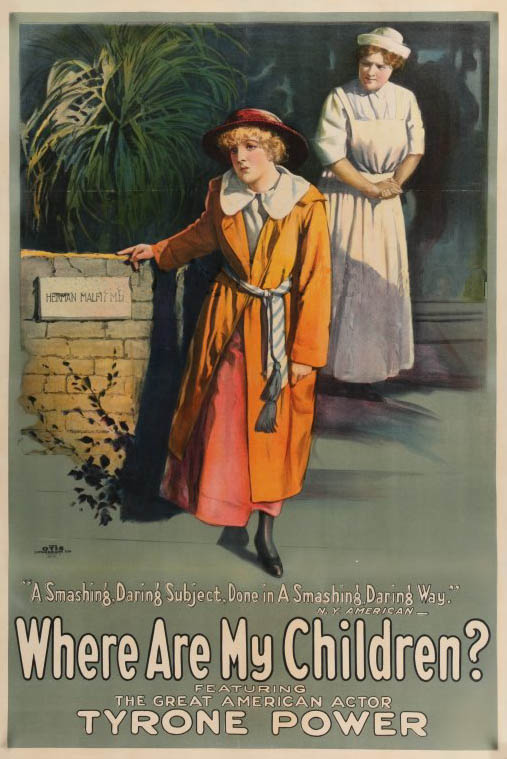
“…children should not be admitted to see this picture unaccompanied by adults, but if you bring them it will do them an immeasurable amount of good.”
What is the oldest surviving American feature film that was directed by a woman? Well, some say it’s 1916’s Where Are My Children? No director is credited on screen, but we know that the film was written, produced, and directed by the wife-husband team of Lois Weber and Phillips Smalley. Released by Universal, the production company is credited as Lois Weber Productions, something Weber insisted upon partly because she meant to attract other projects that were both socially relevant and formally daring.
Florence Lois Weber was born in 1879 in Pennsylvania, toured as a young singer, pianist, and evangelist, and worked as a repertory and stock actress for years until meeting the head of an acting troupe. Phillips Smalley, graduate of Harvard and grandson of Oliver Wendell Holmes, proposed to, and married, Lois when he was 38 and she was 25. Keeping her surname, Weber began writing spec scenarios for film companies. In 1910, Weber and Smalley started making short pictures and were hired by the New York-based Rex Motion Picture Company, where Weber wrote, acted, directed, edited, made sets, and sewed costumes. In 1912, Rex merged with four other companies to form Universal Film, prompting Weber and Smalley to move to Los Angeles. The merged company’s chief, Carl Laemmle, distinguished Universal from other studios by virtue of its female directors and producers. After Laemmle incorporated the Cahuenga Pass gateway from the valley to L.A. as Universal City, Laemmle encouraged Weber to run to become its first mayor, a job she was elected to in 1913. Weber barely had time for mayoral duties in 1914 as she directed 27 films, establishing herself as one of the industry’s most reliable, most interesting directors. In summer of 1914, Weber hired a new writing assistant named Frances Marion, and mentored her into the most prolific, best-known screenwriter of the silent era, male or female. Weber’s films became increasingly complex and layered, from The Jew’s Christmas to The Merchant of Venice to Hypocrites, the latter of which featured actually naked actresses to demonstrate the hypocrisies of religion and, well, encourage the kind of publicity that would draw both over-prurient audiences and over-prudish lawsuits.
The scenario for Where Are My Children?, written by Lucy Payton and Franklin Hall, was meant to capitalize on, but not plagiarize, the sensational stories around the obscenity trials provoked by Margaret Sanger’s work. Nurse Margaret Sanger was an activist alongside the likes of Emma Goldman and Upton Sinclair whose personal experience with fatally flawed family planning led Sanger to publish, in a socialist magazine, columns on sex education that evolved into her monthly newsletter, The Woman Rebel, in which she coined the term “birth control,” explained contraceptive methods in detail, and asserted every woman’s right to be “the absolute mistress of her own body.” By sending The Woman Rebel through the post office, Sanger provoked a 1914 over-prudish lawsuit in the form of her challenge to federal anti-obscenity laws, although the press around her trial seemed more interested in her estrangement from her husband, which is where Where Are My Children? more or less picks up.
Where Are My Children? begins with title cards forewarning that the forthcoming film is a fantastic idea but showing it to children is not. A card says “Behind the great portals of Eternity, the souls of little children waited to be born” to show abstract golden gates opening to smoke and clouds and columns and…maybe heaven? The next card says “Within the first space was the great army of ‘chance’ children. They went forth to earth in vast numbers.” We see a painting of dozens of Raphaelite angel cherub babies three times, the first adorned only by billowing smoke, the second laced by fire and brimstone after a card proclaims the “sad unwanted,” and the third glowing as a cross appears above them after a card hails a group sent forth “only on prayer.” Finally, the film’s first non-abstract imagery introduces us to eugenics believer and District Attorney Richard Walton telling a court that criminals are simply ill-born. Richard greets his wife, Edith, as she tends her dogs on a Versailles-like garden patio where a card says Richard “concealed his disappointment” over their lack of children, “never dreaming it was her fault.” Outside, Walton watches kids play, including his sister’s kid, and shakes his head with frustration. In court, D.A. Walton confronts one William Homer because of distributing his book “Birth Control,” from which Walton reads aloud the first sentence of Chapter Five: “When only those children who are wanted are born, the race will conquer the evils that weigh it down.” We flash to Homer’s experiences in slums, where one woman with a sick infant jumps off a bridge, and another woman physically battles her drunk husband. Homer’s Chapter 10 asks if “unwanted children should be born to suffer blindness, disease, or insanity?” A title card declares curtly, “A jury of men disagreed with Mr. Homer’s views.” After a bevy of blueblood ladies leave a lavish garden tea party, Edith murmurs to one that if she doesn’t want to be a mother, she might see Dr. Malfit, and soon Edith accompanies this woman to the doctor’s office, where Edith describes her friend’s condition as a “serious ailment.” We see those abstract golden gates close as a card discloses that an “unwanted one” has been returned so that a social butterfly can return to parties. The Walton mansion receives two guests, Edith’s rapscallion brother Roger and their housekeeper’s young adult daughter Lillian, whom Roger courts in the manner of “men of this class.” A month later, Lillian is pregnant, as symbolized by the golden gates opening and an abstract cherub angel alighting on the shoulder of Lillian, who agitatedly asks Roger for help, who turns to his sister Edith, who is coming to regret her previous abortions and reluctantly gives Roger the name of Dr. Malfit, who botches Lillian’s abortion. Lillian staggers out of his office, lies prostrate on the car ride home, wobbles out of the car, and collapses, discovered by the distraught district attorney. On her deathbed, Lillian tells her mother the truth, leading to an angry physical confrontation between the housekeeper, the Waltons, and Roger. Later, Walton comforts his housekeeper as she mourns over the intensely blue-lensed shroud of her dead daughter. Walton expeditiously brings Dr. Malfit to trial, but we cut from the courtroom to Edith’s common room where she sees, then burns, a letter that reads “Mrs. Walton, Call your husband off this prosecution or I will draw you into the case. Herman Malfit.” Edith asks her husband to go easy on Malfit, prompting Walton to forbid him bringing his books or other patients into trial. When the judge pronounces the sentence, fifteen years of hard labor, a bitter Malfit dumps his book in front of Walton and warns he should see to his own household. Walton opens Malfit’s book and learns the truth about Edith’s abortions. The Walton housekeeper, quitting and leaving, staggers past a society social of ladies, which Walton soon sunders by storming in and saying, “I just learned why so many of you have no children. I should bring you to trial for manslaughter, but I shall content myself with asking you to leave my house!” The women blow away, but not before some of them blame Edith, and after they’re all gone, Richard demands of Edith, “Where are my children?” As she breaks down sobbing, Walton laments, “I, an officer of the law, must shield a murderess!” Walton mourns his lost legacy and lost love at, uh, his beautiful stone fountain. Edith prays for pregnancy, but, as a card tells us, “having perverted Nature so often, she found herself physically unable to wear the diadem of motherhood.” The final title card says “throughout the years she must face the silent question, where are my children?” which cuts to a somewhat remarkable final shot of Richard and Edith sitting apart in front of their fireplace as ghostly kids come to snuggle with them and then Richard and Edith notably age, yet remain in place, as young adult ghosts visit.
It’s hard to disentangle the film Where Are My Children? from the contemporary politics of eugenics, a word that appears in many of Weber’s title cards. Sir Francis Galton coined the term eugenics in 1883, one year after his cousin Charles Darwin died, a date worth denoting because Darwin disagreed with Galton’s ideas about human-directed evolution. By the time Galton died in 1911, eugenics had become an academic discipline at many universities, the official policy of many governments, and a recommended methodology of many ministers. Eugenics gave scientific justification to ancient practices of infanticide of the disabled, and in practice, its focus on developing traits deemed desirable worked to legitimize racism. Today, from our esteemed universities that have each excised any eugenics departments, we commend the film Where Are My Children? for its anti-eugenics politics even as we wonder if it could have been a little less clamorously anti-choice. One could argue that Weber’s real target is wealthy women, or that Sanger’s position, as expressed by a man named Homer, gets its, ah, day in court…but the game is given away by the title, not Where Are The Children but Where Are My Children, as though the man has possessive rights to any progeny. Another factor is the nascent star system – Tyrone Power was the film’s star, whose privileges extended to getting his new-ish wife cast as Edith.
Stylistically, Lois Weber’s work on Where Are My Children? is utterly assured, moving breathlessly and confidently from plot point to plot point and from artistic scenery to theatrical spectacle. Weber certainly shared with Margaret Sanger a presumption that censorious officials’ attacks on her work would bring it more publicity, and indeed that plan worked well enough to result in packed houses in New York and New Jersey, but less well in Pennsylvania, where Where Are My Children? was banned for immorality. The one-two punch of Weber’s film Hypocrites and this film gave Lois Weber the reputation of America’s first female director.
Influenced by: Susan B. Anthony; prevailing, Griffith-era codes of style and decorum; Lois Weber is not credited as director but scholars have named her the film’s lead creative force
Influenced:Weber stood next to Griffith and Chaplin as one of the period’s most influential directors
~
C2. Within Our Gates (Micheaux, 1920) BO clip imdb LB RT trailer wiki
stream on criterion watch analysis by Robertson read analysis by Brundage listen to my podcast
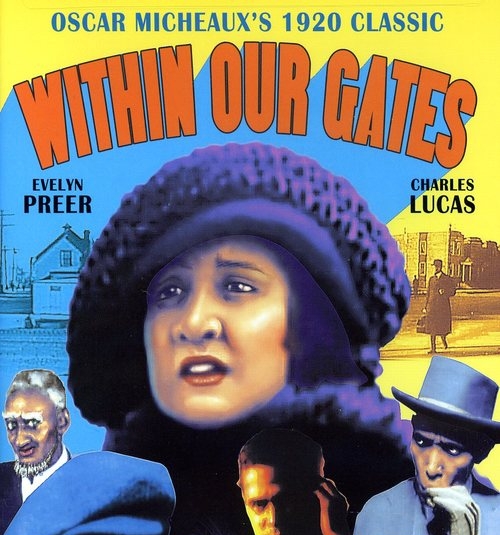
“It is my duty and the duty of each member of our race to help destroy ignorance and superstition.”
Before turning 25, Micheaux worked as a marketer, a stockyard hand, a shoeshine boy, and a Pullman porter, the latter granting the gregarious gentleman grace to meet many sorts of men and to travel West, where he used two thousand dollars he’d saved to buy land in South Dakota and work as a homesteader. Micheaux wrote letters to at least 100 of his African-American friends to encourage them to join him at farming, but only his brother ever took him up on it. At the age of 29, in 1913, Micheaux used his pastoral profits to publish a thousand copies of a biographical-ish novel he wrote called “The Conquest: The Story of a Negro Pioneer,” and walked around South Dakota and Chicago selling his book to friends and acquaintances and strangers.
After years of producing more modestly profitable grain and novels, in 1918, Micheaux received a letter from the Lincoln Motion Picture Company; after many negotiations throughout 1918, Micheaux decided he would ask his network of supporters for money for him to direct The Conquest into a film. Retitled The Homesteader, the film is about a Black farmer who resists many white women out of race loyalty while having terrible difficulties with his Black wife, eventually leading to her patricide and suicide and her husband being blamed for both. Released in 1919, considered the first feature directed by an African-American, The Homesteader did decent business amongst carefully targeted Black communities throughout the Northeast. Sadly, Micheaux’s first feature is now thought to be a lost film. We are lucky enough to be able to watch his second feature, the oldest surviving film directed by a Black person, Within Our Gates.
We don’t know much about the production of Within Our Gates other than to say it was made very cheaply, with actors barely paid, no reshoots allowed, and sets, costumes and props liberally borrowed and re-used. That said, the film condenses so much information into every minute that it never feels repetitive or overdrawn.
Within Our Gates begins with a title card placing us “in the North, where the prejudices and hatreds of the South do not exist – though this does not prevent the occasional lynching of a Negro.” Sylvia Landry, a Southern mixed-race schoolteacher, on a visit to Boston to her cousin Alma Prichard, reads with her a letter from Canada, dated June 1920, from Sylvia’s fiancé Conrad whom Alma secretly loves. Alma eavesdrops as her stepbrother Larry tries to court Sylvia, who tells him she doesn’t love this Larry whom titles tell us is also known as “The Leech,” is on the loose, and is a “notorious member of the underworld.” Alma intercepts a telegram from Conrad intended to inform Sylvia of his Thursday arrival in Boston before the army ships him to Brazil. A cheating scam in a poker game ends in a shootout where Larry kills a player named Red…which turns out to be Sylvia’s dream…or was it? Upon Conrad’s arrival, Alma tries to seduce Conrad who rushes to Sylvia’s bedroom only to find, thanks to Alma’s machinations, Sylvia in the arms of a white man. Conrad starts to strangle Sylvia, sighs “I loved you so!” and skedaddles. Now fifteen minutes into the movie, a title card takes us to “the depths of the forests of the South, where ignorance and the lynch law reign supreme, we find the hamlet of Piney Woods and the school for Negroes.” We meet Reverend Wilson Jacobs, “founder of the school and apostle of education for the black race,” alongside his sister Constance, as they meet Sylvia applying for a job. Later, Constance tells Sylvia that Wilson can’t bear to turn pupils away, but the state doesn’t provide enough for Negroes and they’ll have to close if they don’t get $5000. Sylvia tells the Reverend that it is the duty of “each member of our race to help destroy ignorance and superstition,” so she’ll go up north and try, with God’s help, to raise the money. In Boston, Doctor V. Vivian looks out his window, sees a thief mugging Sylvia, runs to cut off the thief, collars him, hands him over to a cop, hands Sylvia back her purse, and returns with her to his office for a pleasant chat. A rich racist, Geraldine Stratton, nods while reading an article quoting anti-Black-suffrage Senator Vardeman (who is real) saying “from the soles of their flat feet to the crown of their head, Negroes are, undoubtedly, inferior beings.” A week into fruitless fundraising, a fretting Sylvia gets flattened by a car carrying one Elena Warwick, who helps bear Sylvia’s body to the car. Elena interviews Sylvia in the hospital where Sylvia shows Elena a telegram from Jacobs saying the school will need to be closed in ten days. On Elena’s invitation, Sylvia visits her mansion, where Elena professes to be interested in her race and promises to help the school however she can, but when she asks her Southern friend Geraldine for advice, Geraldine laments “Can’t you see that thinking would only give them a headache?” Instead of granting Sylvia $5,000, Geraldine recommends giving $100 to a Black preacher named Ned, whom we see made up like a devil animatedly telling his nodding congregation, “The white folk, with all their schooling, all their wealth, all their sins, will most all fall into the everlasting inferno! While our race, lacking these vices and whose souls are more pure, will most all ascend to heaven!” Later, when two of Ned’s old racist white friends show him the article about Black voting, Ned bows his head, shuffles his feet, smiles sheepishly, and tells the whites his sermons always say “this is a land for the white man and Black folk got to know their place.” As Ned leaves them delighted, Ned says only to himself, “Again I’ve sold my birthright…As for me, miserable sinner, Hell is my destiny.” Geraldine apparently convinces Elena, who horrifies Sylvia in their next meeting, as she knows, as we see, Jacobs is receiving her telegram message to keep the school open because funds are coming. This is a misdirect, because Elena re-meets with Geraldine to tell her that based on what she said, instead of giving the school $5000, she’s going to give the school $50,000. After Dr. Vivian dreams of Sylvia and Sylvia dreams of Dr. Vivian, the two meet and hold hands warmly just before she returns to the South, where Reverend Jacobs proposes marriage and Sylvia refuses, venerating vivacious Vivian. On the lam, Larry the Leech locates the lavishly funded school, corners Sylvia on a bench, and tells her to steal from the school or he’ll tell everyone what sort of person she really is. Sylvia hits him, calls him a liar, storms off, cries alone, comes to a decision, and leaves the school in a torrential rain. Larry returns to Alma’s where a cop finds him, mortally wounds him, and prompts the arrival of Dr. Vivian, who learns from Alma that her cousin Sylvia was raised by the long-ago lynched Landrys. Alma confesses the casuistic cuckolding of Conrad, and we cut to a title saying “Sylvia’s Story” in a deep forest of the Gridlestone estate. Jasper Landry, uneducated and disenfranchised, lives on the hope of an education for his kids, hangs out at a kitchen table with his wife and Sylvia, and finds they have just enough saved to send Sylvia and Emil to school. We meet the rich white patriarch Gridlestone, a “modern Nero,” and Efrem, his shifty servant, “an incorrigible tattletale,” who warns his master of the insecurity of Sylvia sensing his swindles. On rent payment day, Jasper and Gridlestone argue angrily as, outside the window, a disgruntled white farmer shoots dead Gridlestone knowing Landry will be blamed for it. After Efrem spreads this fiction around the town, a hillbilly-looking lynch mob develops into a weeklong manhunt as the Landrys leg it into the large forest. Two yokels accidentally assassinate Gridlestone’s actual killer as Efrem laughs at these forest escapees compared to him sitting pretty with whites, a laugh that arouses the anger of the hayseeds. A newspaper calls Efrem a “recent victim of accidental death at unknown hands,” while expressing Efrem’s version of events, a fabrication we watch enacted as a cackling plastered Jasper blasts shot after shot at Gridlestone. A title card reads in full, “Meanwhile, in the depth of the forest, a woman, though a Negro, was a [all caps] HUMAN BEING.” A tired fugitive, Jasper’s wife wonders how long before justice arrives, with more all caps reading HOW LONG? The lynch mob belatedly locates the Landry parents, hang them with nooses, and sets their bodies afire, which is cut with an old white Gridlestone brother attempting to rape Sylvia in a far-off safehouse. As the violence becomes more vicious, we cut to Vivian hearing the narration of Alma, whose dialogue card says “A scar on her chest saved her because, once it was revealed, Gridlestone knew that Sylvia was his daughter – his legitimate daughter from marriage to a woman of her race – who was later adopted by the Landrys.” Alma explains that the brother didn’t explain himself to Sylvia, stopped hurting her, started helping her, and paid for her education. Somehow, Dr. Vivian finds Sylvia and somehow says, “Be proud of our country, Sylvia.” Vivian mentions Roosevelt in Cuba and soldiers in Carrizal and World War I. He tells her, “we were never immigrants!” He says he knows of Sylvia’s hard feelings, but “In spite of your misfortunes, you will always be a patriot – and a tender wife. I love you!” Sylvia goes with this all the way to a wedding canopy when a title says “The End.”
The Johnsons and Micheaux had argued about The Homesteader blaming Black people for their problems, and so there’s a slight irony in the fact that, after Micheaux had found success without them, he went on to make a film with the reformist values the Johnsons wanted. Despite the ubiquity of D.W. Griffith’s blockbuster The Birth of a Nation, Micheaux didn’t want Within Our Gates read only that way; despite Micheaux’s protests, it often is. Both films have an overarching structure of a North-South marriage that might re-bind the country in a manner that the writer-director considers, uh, enlightened. Within Our Gates’ rich, racist, anti-suffrage lady resembles the Lillian Gish character from Griffith’s film, here transformed from a heroine into the villain. Birth of a Nation culminates in innocent whites fending off a home invasion by Black savages; Within Our Gates culminates in Sylvia fending off a home invasion and rape by a savage rich white man, a scene intercut with a lynch mob hanging two innocent Black people and burning their bodies. Local censoring boards singled out these two vignettes, particularly in the wake of what were called “race riots” in the summer of 1919 in many American cities especially Chicago. That summer of white violence against Blacks was its own sort of reaction to the validation given to the Ku Klux Klan by The Birth of a Nation, which was still playing to packed houses in 1919 four years after its release. Micheaux explained he was reacting not only to Birth of a Nation but to everything: Jim Crow laws, suffrage, the Great Migration, peonage, Black criminals, and especially the savagery and hypocrisy shown by whites against Black people. Reacting to the Chicago board, Micheaux did make a few superficial cuts, but chose to premiere Within Our Gates in Chicago anyway, where it began doing reasonable business in carefully targeted theaters in urban America – the sort of theaters where whites rarely ventured. Ronald J. Green felt the title “Within Our Gates” was a warning to white marauders coming into Black communities, although it can also be read as a proto-for-us-by-us solidarity.
Influenced by: The Birth of a Nation; W.E.B. DuBois-era literature, resistance
Influenced: Micheaux created the “race film” (made for and by black people), which would remain a minor and low-budget subgenre until about the 1950s
~
C3. The Sheik (Melford, 1921) BO clip imdb LB RT trailer wiki
stream on YouTube watch analysis by Bunhead read analysis by Hammond listen to my podcast
“When an Arab sees a woman that he wants, he takes her.”
The man renamed Rudolph Valentino would later credit June Mathis for “discovering” him as she cast him as tango-dancing Argentinian Julio Desnoyas in Four Horsemen, but other than Mathis, the rest of Metro found Valentino hard to work with and shunted him into smaller roles for the rest of his four-movie contract. In 1921, Rudolph Valentino moved to Famous Players-Lasky, where Jesse Lasky had many things ready to go: a distribution deal with Paramount, a marketing plan, a star named Agnes Ayres, and a script based on Edith Maude Hull’s novel “The Sheik,” which surprised Hull and the publishing world by becoming a best-seller upon its 1919 release.
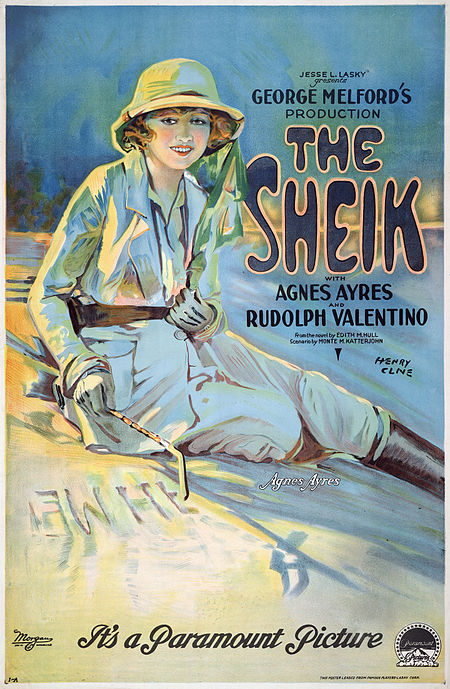
A bit more about that marketing plan: the film’s poster already appeared as we now see it, with a photo of only Ayres in a pith helmet smiling on the sands, and her name above Valentino’s, despite his recent notoriety for Four Horseman of the Apocalypse. However, Valentino knew he was getting the title role and a plan to begin marketing him as “The Latin Lover,” a brand-new coinage. Oh, about that plot: in Hull’s novel, the Sheik clearly rapes Lady Diana, but Lasky had no intention of beginning his relationship with Valentino quite so sordidly. To that end, Lasky hired reliably pliable director George Melford, who had a somewhat interesting career that doesn’t require detail here. As for Edith Maude Hull, she never expressed regrets about her novel’s celebration of misogyny, only saying she regretted selling the film rights for too little to Lasky.
The Sheik begins with camels and desert canopies and oasis markings and praying Arabs in tunics and a title card saying “where the children of Araby dwell in happy ignorance that civilization has passed them by.” Another card introduces us to “maidens chosen for the marriage market – an ancient custom by which wives are secured for the wealthy sons of Allah.” We meet the young Sheik Ahmed Ben Hassan smiling broadly while granting a desperate chief an exception to losing his daughter to the market. A title card reads, “On the way to the harems of the rich merchants, to obey and serve like chattel slaves.” Drinking tea at a souk in Biskra, a real city in Algeria, wealthy white women disapprove of Lady Diana Mayo’s “wild scheme” of a tour into the desert “with only native camel-drivers and Arabs!” We meet Lady Diana and her brother, Sir Aubrey, who fails to persuade her to call off her adventure. At an evening party in Biskra’s “Monte Carlo,” Arabs perform with prancing ponies and upcast spears as a young tuxedo-clad man begs Diana to remain with him, to which she answers, “Marriage is captivity – the end of independence. I am content with my life as it is.” Sheik Ahmed enters, commands his retinue into the casino, and shares a brief warm eye contact with Diana, who is told, by a white guy, that the casino is Arab-only. When she objects to such savage rules the white guy objects that the Sheik is no savage, but a Paris-educated Arab. Diana sees a belly dancer performing, returns to her room, and instructs a servant to bring the dancer to her room whereupon Diana obtains the woman’s full uniform. Veiled, Diana sneaks into the casino to observe a belly dancer performing for the sheik and other bidders, but when a host grabs Diana by the hand, we’re misdirected into believing we’ll see Diana perform and/or sold as chattel. Instead, the Sheik inspects Diana, rips off her veil, and smiles broadly while declaring to his fellows, “The pale hands and golden hair of a white woman!” (Agnes Ayres’ hair is brown throughout the film.) The Sheik removes Diana’s outer burka to reveal her ornate bedlah and a gun she is pointing at him, causing him to grinningly ask who invited her, to which she answers she wanted to see the savage that would keep her from the casino. The Sheik cheerfully bops the burka back on Diana, asks if he the savage can escort her to the door, sees her off, and hears from one Mustafa Ali that he is booked to escort her to the desert. At dawn, not unlike in Disney’s Aladdin seven decades later, Sheik Ahmed scales her balcony and hops into her chambers, in this case to creepily watch her sleep before escaping, awakening, and serenading her with a song about loving pale hands. In pith helmets, Diana and brother Aubrey ride horses into the desert until she tells him she’ll see him in a month in London, and roughly a second after he absconds, Mustafa smirks as he signals a score of soldiers on horses who storm over the hill and induce Diana to panic, flee the other way, shoot back at them, and drop her pistol. Sheik Ahmed leads the posse, sidles up alongside Diana, jumps onto her horse, grabs her, and says “Lie still, you little fool!” as the regiment, rejoicing, raises its rifles. A card says “Her exultant dream of freedom ended – a helpless captive in the desert wastes.” In the Sheik’s desert village, Diana delivers a defiant glance as Ahmed walks her into his massive tent complex and introduces her to Zilah, her barefoot female servant, as well as Gaston, his be-suited French valet who is told to attend to Diana’s every need. When she asks why he brought her here, he smilingly replies, “Are you not woman enough to know?” Ahmed leads her into her private room and disparages her pants, saying it wasn’t a boy he saw in Biskra. Diana tries to escape in a strong sandstorm, but the Sheik brings her back inside to be rewarded by her blade, at which he laughs, disarms her, and claims he could make her love him. Later, Diana cries at her bed as Ahmed comes in, clearly considers clutching her by force…and then reconsiders and cuts out, in a colossal change from Hull’s novel. Zilah enters and gives Diana a comfort hug and an uncomfortable burka to wear. Sheik Ahmed is thrilled to learn of a coming visit from his novelist friend Raoul from Paris, but when Diana distresses of Raoul discovering her in Arab accoutrements, Ahmed arranges for her attire to return before he returns from Biskra with Raoul. Seeing her joy, Ahmed attempts a goodbye kiss only to see her distaste so he says “You hate them so much – my kisses?” While the Sheik is in Biskra, on an excursion with Gaston, Diana fools him into dismounting, hits his horse, and escapes. Elsewhere, Ahmed winsomely warns Raoul not to be bewitched by Diana, Raoul replies “Does the past mean so little to you that you now steal white women and make love to them like a savage?” Ahmed thinks, smiles, and responds, “When an Arab sees a woman that he wants, he takes her!” A caravan of bandits led by the villainous Omair almost seizes the runaway Diana, but Sheik Ahmed’s entourage arrives in the nick of time to save Diana’s life. After a shared dinner between Diana, Ahmed, and Raoul, the latter pulls aside the Sheik to remand him for “the humiliation of meeting a man from her own world.” With Diana and Raoul dressed for British high tea, Diana returns to Raoul the rough draft of his manuscript with praise and skepticism that his novel’s heroic man can be found anywhere as an eavesdropping Ahmed despairs of her antipathy…until an assistant runs up to Raoul for medical help and Diana’s cry of “Ahmed!”, though mistaken, proves her affection. Ahmed prepares to leave Diana with Gaston, asks her not to run away again, warns of Omair, returns to her her pistol, and confides that he trusts her. On the road, Raoul tells Ahmed that Diana is a liability that he could escort back to Biskra, causing the Sheik to laugh that Raoul wants her too before admitting that making her suffer isn’t giving him the pleasure he expected. Raoul ripostes “Because you love her” as the films cut to Diana in the desert lazily writing “Ahmed I love you” just before she and Gaston are attacked by Omair, Mustafa, and their fellow marauders. Diana and Gaston hold them off until most of their ammo runs out, when Diana asks Gaston to kill her rather than let her be captured, but just before Gaston pulls the trigger to kill her, someone else pulls his and kills Gaston. After Omair takes Diana away, Sheik Ahmed shows up and scans her words somehow preserved in the sands. In a room in Omair’s gargantuan stone palace, Diana gets roughed up by Omair’s noticeably darker servants until they are interrupted by Omair’s assistant who has been told to “bring forth the white gazelle.” In disturbing imagery, Omair assaults Diana, who futilely fights back…when Sheik Ahmed’s battalion storms the palace. The Sheik and Omair fight man to man, and both men seem mortally wounded. Back at the Sheik’s village, while praying “Tribal hearts appeal to Allah,” Diana states that the sleeping Sheik’s hands are small for an Arab’s, to which Raoul replies, “He is not an Arab. His father was an Englishman, his mother a Spaniard.” Raoul tells Diana that the former Sheik found Ahmed abandoned by his parents, raised him, sent him to Paris, and died with the arrangement that Ahmed would return from Paris and lead the tribe. Ahmed wakes up and embraces an affectionate Diana as a praying Arab outside gets the final word: “All things are with Allah!”
The Sheik was absolutely understood to be problematic at the time, which was part of its appeal, perhaps comparable to “50 Shades of Grey.” Several critics took issue with the removal of the novel’s rape because it turned the story into a sort of regressive wish fulfillment for 19th-Amendment-resisting men and women. As with 50 Shades of Grey, these audiences came out in droves, turning The Sheik into a substantial hit for Paramount in 1921 and 1922. Metro’s Four Horsemen of the Apocalypse, in which Valentino plays a tango-dancing Julio, remained in theaters at the same time as both films were among the early 20s’ highest earners. Valentino would never again be second-billed or not pictured on the poster. June Mathis, then Metro’s first female executive, broke her Metro contract to join Valentino at Paramount, become Hollywood’s highest-paid executive of any age (she was 35), and put Valentino in more Latin-lover-flavored leads, beginning with being a bullfighter named Juan Gallardo in Blood and Sand.
The Sheik was by far the most influential silent film regarding two important ethnic groups, Arabs and Latinos. Scimitars and sand tents had certainly been seen on screens before, but maybe because Britain lost most of its Muslim holdings including the nation newly called Turkey, The Sheik rode or set off a wave of cultural appropriation-slash-appreciation that could be heard in popular songs, seen in new architecture, or just noticed every time the press covered Jazz Age parties using words like “harem” and “sultan” and “sheik.” Every studio found space for an apparently Algeria-analogous area of the backlot to support the suddenly successful sub-genre, including United Artists’ and Douglas Fairbanks’ 1924 film The Thief of Bagdad, which pioneered several effects as well as the fledgling career of Anna May Wong. Arab culture was treated with both reverence and revulsion, something that would trickle down to Hollywood’s eventual portrayals of Arab-Americans, which comes up in much greater detail later in the C-list. For now it’s enough to say that in the 1920s, Muslim/Arab culture was both regarded and disregarded, which is something we now also say about the “Latin Lover” archetype. To modern sensibilities, the awkward appropriation of Arabia may sound far removed from the term “Latin Lover,” but in fact, Latin didn’t yet mean Latin American or Latino. When newspapers of the 1910s spoke of Latin influence, it referred to languages that derived from Latin, including Italian, Spanish, and French, not excluding the French that was Algeria’s official language; Latin and Mediterranean were often used interchangeably. Of course, it’s true that the Italian Rudolph Valentino was not what we now call Latino, but it’s not true that in 1921 Italian-Americans had anything like the white privilege they could assume a century later. It’s not only that Italian-Americans were then regularly described with epithets like “dago,” “wop,” and “guinea,” the latter an association with kinky hair that sought to equate Italian- and African-Americans. Official prejudice against Italian-Americans went all the way to the top, to the State Department that forced Italy to accept restrictive emigration protocols, and to Congress, that passed the Johnson-Reed Act of 1924 which rolled back the Italian immigration rate to the group’s percentage of the population in 1890, essentially defining Italian-American as non-white even as Valentino had arguably become America’s biggest movie star.
Influenced by: colonialist ideas about Arabs and white women, though the novel’s rape scene was removed
Influenced: Latin Lovers, “sheik” as a very popular type/name of the period
~
C4. Body and Soul (Micheaux, 1925) BO clip imdb LB RT trailer wiki
stream on YouTube watch analysis by Glover read analysis by Blakeslee listen to my podcast
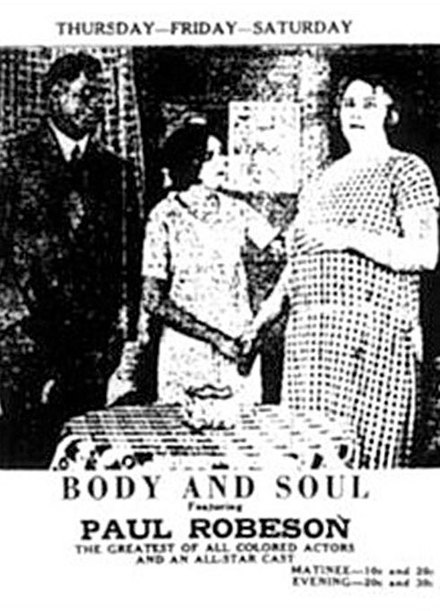
“You white-livered, lying, hypocritical beast – to steal my poor mother’s money!”
Body and Soul is sometimes called Micheaux’s masterpiece; it’s the only one to survive with all its original title cards, though that may be partly because it starred and debuted a 27-year-old future star and anti-racism activist named Paul Robeson. There have been no fewer than three big-budget bio-pic feature films about Valentino, but so far none about Robeson, despite, ahem, the following.
Robeson’s father William was a slave who escaped in his teens to, eventually, Princeton, New Jersey, where he became a church minister and fathered Paul in 1898. In 1915, Robeson became Rutgers third, and then-only, African-American student, where he went Phi Beta Kappa while collecting awards in debate, singing, basketball, track, and football, the latter including first-team All-American as a junior and senior. After Robeson’s classmates elected him valedictorian, his address was not unlike some of his winning debate oratories in that it questioned Black soldiers fighting in the Great War while being denied commensurate opportunities at home and exhorted the audience to fight for equality for all Americans. In the early 20s, Robeson attended law school, sang at the opening of the Harlem YWCA, and began his, yes, career with the National Football League, playing for the Akron Pros in 1921 and the Milwaukee Badgers in 1922 before quitting football, finishing law school, starting as a lawyer, and quitting law because of structural racism. In 1921, Robeson married Essie Goode, who encouraged him to pursue theater, where he landed several theatrical roles to the point of Eugene O’Neill asking for him, and soon, not unlike June Mathis, Essie Robeson negotiated and arranged for Paul to star in dual roles in his film debut.
In the five years between Within Our Gates and Body and Soul, Oscar Micheaux somehow wrote and directed ten films with mostly African-American casts. By 1925, the press referred to his movies as “race films,” a term that his distributors encouraged because it drew Black audiences to his movies. By 1925, Micheaux had already adapted the seven novels he’d written before making his first film, but he well knew how many more African-American stories had never been seen onscreen. Micheaux had a plan for a Black Priest and the Pauper, if you will, and when he learned that Eugene O’Neill’s favorite Black actor was the son of a preacher man, he only needed to know if Robeson could risk offending his father. Robeson replied that his dad was dead and Robeson would be proud to play a false prophet. New York State, however, claimed the “immoral” and “sacrilegious” result would “tend to incite to crime” and Micheaux wound up making many cuts before the film’s exhibition. Based on the trenchant testimony that sustains, I would have loved to have seen what New York State saw.
Body and Soul begins by introducing us to Reverend Isaiah Jenkins, “Jerimiah, the Deliverer” – “still posing as a Man of God,” as a newspaper article confirms. A “Negro in business,” Rogers, welcomes Jenkins into a Prohibition-prohibited speakeasy where Jenkins samples and approves of Rogers’ liquor. A cut to two women seems at first like a mistake, but I ask you to put a pin in that moment. Speakeasy proprietor Rogers informs Jenkins that he normally asks for payment, but he’s a Reverend…who pockets a full flask of moonshine and successfully demands payment from Rogers if he doesn’t want to hear about his speakeasy in a sermon soon. As the drunk Jenkins staggers home, we return to the house of the women as mother Martha takes savings money out of a Bible, sits in her chair, and sleeps. Her young adult daughter, Isabelle, awakens at 1:30am to see her mother stressing over a dream, standing, stashing the cash back in the big Bible, stuffing the book in a dresser drawer, and shoving into bed. “Yellow-Curley” Hinds of Atlanta arrives in Tatesville and proceeds to Rogers’ speakeasy, where Rogers charges Hinds to check out Jenkins’ church. On Sunday morning, while preaching from the pulpit, Jenkins spies Hinds in the pews and flashes back on the prison time they shared together. In a private room, Hinds tells Jenkins he isn’t looking for him, but instead for girls for “Cotton Blossom’s Shoulder Shakers” like, say, Isabelle. Jenkins’ dead-ringer look-alike, Sylvester, courts Isabelle, who brings him home to get her mother’s permission for them to marry. Martha refuses permission, casts out Sylvester, and insists that Isabelle should marry Jenkins, whom Isabelle calls a drunkard and a sinner, calumnies that cross-cutting confirm. Amidst photos of Booker T. Washington on the walls, Martha promises Isabelle a fortune if she marries her pastor, but upon her continued refusal, the mother calls the daughter an ungrateful sinner and pushes her down on their bed. With Isabelle gone courting Sylvester, two neighbors come calling in frilly Sunday clothes, Sis Caline and Sis Lucy, who are soon joined by Reverend Jenkins. When Isabelle returns home, Martha offers her daughter to the preacher, who prompts the prissy ladies to leave so that he can save this young woman’s soul. Isabelle refuses Jenkins and opens the door to hug her mother, upon which Jenkins blames her attitude on the devil, his “no-account brother,” and Martha for “letting this child become worldly.” After Martha closes the door on them again, Jenkins literally twists Isabelle’s arm followed by an ominous title card with one word, “Later.” Martha re-enters to see her stiffly standing daughter and smiling Reverend, who saucily sounds off, “It was a great struggle, Sister Martha; but the Lord’s Will be done. He won.” As Martha clutches a shell-shocked Isabelle, Jenkins shouts, “And now as I must carry his work into the byways for other sinners, I’ll be moseying along.” With him gone, Isabelle cries in the arms of Martha, who makes many wrong guesses about what’s bothering her daughter, and title cards bring us inside her thoughts, “something vague, disquieting, bewildering – but of course, it was only the work of the Lord!” Believing Isabelle wants fresh food to cheer her up, Martha goes to the store, buys some, runs into Sis Caline and Sis Lucy, and laughs with them as we cross-cut to a disconsolate Isabelle packing up all her possessions, writing a note, feeling “crushed – body and soul,” leaving home, stumbling around lost, and boarding a train. On the street, Jenkins runs into Yellow-Curley Hinds, who lost money to Rogers and demands some from Jenkins, who refuses only to be threatened with exposure as a faker. At the speakeasy, when Hinds accuses Rogers of rigging all of his games, Rogers grumbles “Mah money, mah liquor” as he pays Jenkins who gives some to Hinds. Martha returns home with Sis Caline and Sis Lucy, aims to show them Isabelle’s dowry, opens the Bible, gets stunned to find it cash-less, and finds the note reading: “Dear Mama, I have taken your money and am running away. Don’t attempt to follow for I shall hide. Please try to forget your heartbroken daughter, Isabelle.” In a very appealing modern Atlanta, Isabelle ambles her suitcase into a very unappealing alley near Decatur Street. Months later, in the same Atlanta neighborhood, Martha spies on a pitiable Isabelle as a stranger takes pity upon her by buying her some street food. Martha follows Isabelle to her small apartment, knocks on her door, opens it, says “Mah baby!”, embraces her daughter, sits down with her, and continues to rebuff any bad beliefs about Jenkins. Isabelle says she never took any money, knew her mother wouldn’t believe her, but “the time has come when you must hear my story.” We flash back to Jenkins driving Isabelle in a horse and buggy through a forest in a fierce rainstorm that stops their buggy, starts the horse to run away, and strands the pair wandering in circles until they find a deserted, multi-room cabin. Inside, Jenkins leaves Isabelle at a fireplace to dry her wet clothes, but after she undresses, he returns with a lustful look and a title card telling us “half an hour later” before he leaves. Back in the present, Isabelle explains that all things considered, Sylvester understood her best, but when Mama refused to let her marry him, that opened the door for more of Jenkins’ assaults. We flash back to an extended version of the arm-twisting scene, with Jenkins contorting Isabelle’s limbs until she finally confesses, and draws from, the stash of the secret savings. Complex extreme close-up cuts between cotton, a kitchen iron, and the cash. Isabelle and Jenkins each accuse the other of stealing the money, but he adds that Martha will never believe her daughter, and so he’ll “be moseying along.” Isabelle makes one last lunge for the lucre, but he knocks her to the floor while boasting Martha won’t believe that either. When he advises her to gather her things for the 4:30 train to Atlanta, she protests she doesn’t have a cent, and so he gives her ten dollars just before Martha returns. Back in the Atlanta apartment, Martha accepts Isabelle’s truth and cares for Isabelle as she lies in bed, lapses into severe illness, and looks…at a divine presence? A title card says “Reverend Jenkins had promised to preach that sermon which is every black preacher’s ambition – ‘Dry Bones – in the Valley.’” In the Tatesville church, the happy townspeople, including Sis Caline and Sis Lucy, gather, tithe, and cheer as Jenkins orates “Dry Bones” so drunkenly and raucously that he repeatedly punches one of his assistants, who touches his bleeding nose and says “Hallelujah!” The church party stops upon the entrance of Martha, who reports having just come from an Atlanta funeral, continuing with a card reading “Yes mah brudders an’ sistahs! Isabelle is dead – and there stands the man who killed her!” The congregants believe Martha and converge on Jenkins with fury, but he manages to escape. That night, as Martha tries to rest at home, a bedraggled Jenkins staggers in her door, begs her for mercy, and pleads, “you coddled me – and you – ruined me!” When they hear a door knock, Jenkins tells Martha that with her prayers she can now save him. Jenkins hides as Sis Caline and Sis Lucy enter, tell Martha a police bloodhound led them here, and somehow fail to convince Martha to reveal him. Jenkins crawls away, hides in the woods, and beats to death an approaching vigilante. In her chair, Martha rests, opens her eyes, and sees Isabelle and Sylvester enter with a title card telling us “All a dream – only the night-mare of a tortured soul!” Isabelle beams, “Oh, mama! Sylvester’s discovery has been accepted, and he is to be paid three thousand dollars, advance royalty, in sixty days!” Martha hugs Isabelle as the kind-hearted Sylvester looks on sheepishly. Martha goes to get Isabelle’s dowry from inside her hidden Bible, sees that it’s where she expected, and faints with happiness into the couple’s arms. In a brief coda, the happy, smartly dressed couple return to Martha’s “Home again after a honeymoon up North.”
Let’s be clear that some films are renowned for the effect they had right away, like The Sheik, and others are here for their larger legacy. Oscar Micheaux’s films were mostly unseen and unknown to studio moguls of the silent era. Only later did they take their place as some of the best films of the period…whether or not critics have placed them on their all-time lists.
Body and Soul is either a scathing critique of church-sanctioned corruption and violence and rape, or, uh…all a fanciful fantasy? Normally, I’m not a big fan of the “it was all a dream” school of filmmaking, but Body and Soul is more complex than that. We saw Martha awaken in her chair in the second-to-last scene, but when exactly did Martha’s dream begin? We first saw Martha sleeping in her chair about 7 ½ minutes into the film, with her daughter nudging her into awakening and gasping “Ah done had a ter’ble dream!” But do you remember me telling you to put a pin in that glimpse of Martha and Isabelle before we knew who they were? In fact, we saw seven minutes of action before Martha sat down in her chair to sleep…suggesting that that action may well have been real. That suggests that Sylvester, or someone looking a lot like him, really did lean on the speakeasy proprietor for corrupt kickbacks. Instead of reading Body and Soul as merely a fever dream about disbelieving one’s daughter’s tale of assault before happily marrying her to a nice young man, I prefer to see that young man as having some of the darker side we so exhaustively saw. After the way Micheaux showed Robeson’s ruthless side for an hour, it’s hard to easily buy him as a sheepish angel.
Influenced by: Micheaux’s remarkable ambition and perspective on many parts of society
Influenced: Robeson became a star and eventually an almost Marcus Garvey-like figure, but this film was mostly only seen by Black people, codifying the “race film”
~
C5. Ramona (Carewe, 1928) BO clip imdb LB RT trailer wiki
stream on YouTube watch analysis by comicpencil read analysis by Worden listen to my podcast

“Your mother was an Indian. Your father was a white man. He married her after my sister refused him.”
Helen Hunt Jackson’s very popular novel “Ramona,” published in 1884, had already been adapted into two films, the first a short directed by D.W. Griffith in 1910, but Edwin Carewe had several personal reasons to make what came to be considered the canonical Ramona. For one, American audiences had demonstrated their empathy with Native Americans, most recently with the 1925 hit film The Vanishing American, and Carewe felt that within the confines of soapy melodrama, he could create at least one scene that showed the true brutality and violence of white settlers against Natives. Another reason was that Carewe saw certain parallels with Jackson’s story and his and Dolores Del Rio’s actual life. Del Rio was born with mixed ancestry and grew up under wealthy, yet reduced circumstances, much like the novel’s Ramona. When Carewe met Del Rio, she was living with an attractive man and a mother figure, just like the novel’s Ramona, and he was instantly smitten with her, just like Alessandro, the Native American co-lead of the story. (Jaime was 18 years her senior, Edwin all of 21.) In Jackson’s novel, Alessandro waits, then spirits away Ramona, at first to a village, then high up in the California hills where her former friend can’t find her. Carewe spirited Del Rio as far as Hollywood; maybe if he kept making movies with her, he could convince her to leave Jaime and join him in the high hills. Carewe might have even played Alessandro, but UA demanded a star, and found Warner Baxter, a white guy who, in Valentino’s wake, had steadily been playing Latin Lovers, yet wasn’t dark enough for a Hollywood Injun and so realized the role in repulsive redface.
Working with his brother, screenwriter Finis Fox, Carewe wound up mostly removing the novel’s elements of conflict between Mexicans and Americans. The novel justifies Señora Moreno’s anger because the white American invaders have cut up her land; in the movie, she’s an evil Spanish aristocrat with contempt for her brown employees, more like the malicious caballeros in the then-popular Zorro stories. In the novel, despite Alessandro’s native heritage, he is very piously Catholic; although the movie’s Father Salvierderra does marry Alessandro and Ramona, we don’t hear Alessandro say anything Catholic and instead presume Ramona has converted to Temecula. After things go horribly wrong, the film’s Ramona prays to Mother Mary saying “Forgive me!” suggesting she’s sorry she suspended her Catholic faith. You’ll forgive me if I read this as one of several somewhat mixed messages from the movie, to wit:
Ramona’s first narrative title card reads “Early California in the colorful days of the Spanish Dons,” as we cut to mission bells, monks in repose, and miners pickaxing a river. At a massive hacienda, we meet Señora Moreno, “owner of the greatest rancho in all California,” who rules with an “iron hand” over “feudal grandeur.” Staunchly severe Moreno enters the kitchen, strides imperiously amongst the noticeably browner women, and asks one of them, Marda, “Have you seen Ramona and my son?” A pigtailed Ramona cheerfully rides a burro on country grounds as a card tells us of the mystery in her dark eyes and her adoption by Señora Moreno. Don Felipe Moreno begrudgingly holds the mule’s tail as a card tells of his proud Castilian blood. Ramona pulls Felipe onto the mule, sees his happiness, playfully pushes him off the mule, sees his anger, prods the mule, and loses the race as Felipe stops the mule who throws Ramona over his head. Felipe puts her on his back for the walk back to the hacienda, where the two of them mischievously sneak around staunchly sour Señora Moreno, who affectionately kisses her son and sends him to wash up for supper, then criticizes Ramona’s tomboyish outfit, manners, and lack of love for her. Ramona flips the question back, asking why Señora Moreno has never shown even an adoptive mother’s love. When the Señora falls asleep at dinner, Felipe gathers a plate of food, sneaks out of the dining room, sneaks into Ramona’s room, gives her dinner, and shares nose-to-nose affection that might be fraternal…or more. After three years at a Los Angeles Convent, Ramona returns to sneak a flower under the nose of a guitar-strumming Felipe, who embraces her and asks her to dance. Ramona’s energetic courtyard dance inspires Marda and a club of her colegas to clap along, but when staunchly surly Señora Moreno arrives, the workers scatter. Ramona finds the fulsomely Franciscan Friar-ish Father Salvierderra in the woods, kneels, kisses his hand, and gets his blessing. At least a dozen Native Americans ride horses across a river until we meet Alessandro, “the captain of the sheep shearers, son of the last chief of the Temecula Indians.” Alessandro quarters his men, greets Señora Moreno, requests and receives Father Salvierderra’s blessing, salutes Don Felipe like an old friend, stops by the river, spies Ramona doing washing, and is smitten. In cuts of people looking offstage right, we see the entire cast singing “the sunrise hymn,” followed by Ramona asking Felipe to explain the mysterious beautiful voice which he identifies as Alessandro’s. Well before any such thing as Disney princesses, we, and Alessandro, see Ramona’s amorous affinity with animals, including birds that ride on her shoulder. As Alessandro’s men shear the sheep, Alessandro sneaks off to leave a small pot of small flowers on Ramona’s barred window, which she places in her un-pig-tailed hair as she accepts his hand-kiss. Weeks later, Felipe ardently reveals to Ramona that he often thinks of their happy childhood, but “You have grown into a beautiful woman – and I would like to tell you…” She interrupts, “Felipe you know I love you – as a brother.” Ramona meets Alessandro at a thick oak, where he reminds her he’ll be leaving tomorrow, declares his love, hears her gladness, and asks, “Señorita, do you mean that you are mine? That you will marry me?” Staunchly sullen Señora Moreno shows up, demands to know why Ramona is dishonoring her, and hears “Señora, we have done nothing wrong. Alessandro and I are going to be married.” Moreno takes Ramona to her private bedroom, locks the door, pulls out a chest of “precious jewels,” and explains “your father gave it to my sister, Ramona, whose name you bear.” Somewhat like Martha in Body and Soul, Moreno promises the young woman the treasure if she marries a man “who is not beneath you,” but if not, the jewels go to the church. Ramona says she’ll give up everything to marry Alessandro, and Señora Moreno slaps her and threatens to return her to the convent. Kneeling, crying, Ramona asks why she can never know who her mother was, and staunchly saturnine Señora Moreno says, “Your mother was an Indian, your father was a white man. He married her after my sister refused him.” Randomly, Ramona rises, raises her arms, roars, berates Señora Moreno, runs out of the room, and relegates Marda and Felipe with, “have you heard? I am an Indian!” While Alessandro waits at the oak, Ramona wraps up all her stuff in a rug, but can’t walk away because Moreno locks her in her room. Felipe opens it and tells Ramona he’ll sing to distract his mother while she gets away. Ramona replies, “Goodbye, dear Felipe, I will love you always,” and kisses his mouth, causing him to take her in his arms and declare his non-platonic love. When she keeps treating him like a brother, he reluctantly blesses her journey, steps out of her room crying, and tearfully sings to his mother, who compliments his beautiful voice. Ramona successfully sneaks past the Morenos to rendezvous with Alessandro, who departs with her on horseback into a “dark, secluded canyon.” Ramona holds Alessandro, declares herself at home for the first time, speaks (according to him) “in the language of our people – the stars – the flowers…,” lies down, and receives a kiss as the film flashes forward to their wedding, officiated by Father Salvierderra. A title card welcomes us to the couple’s home in a village several years later, where Ramona prepares food, looks over their bountiful farm, and shares affection with her husband and toddler. At the hacienda, Marda laments that Felipe hasn’t been the same since Ramona left and his mother died. At the Temecula village, Alessandro arrives with the awful news that the doctor won’t treat their sick son because they’re Indians. Ramona holds her child in her arms as he dies, prays to a statue of Mary, “Holy mother, forgive me,” and screams to hear Alessandro sawing together a miniature coffin. A card says “Marauders motivated by hatred and greed, descend upon the defenseless Indian village,” and we witness a rather impressively filmed scene of swarthy beardy white guys on horseback overrunning the village and iniquitously liquidating the indigenous, seen in forlorn, blood-soaked close-ups. Holding her Mary statue like a baby, Ramona escapes to a distant hill with Alessandro as they weep to watch the whites burning their home to the ground. A card tells us Felipe failed to find Ramona and Alessandro “in all the Indian villages between San Diego and San Francisco.” Father Salvierderra informs Felipe that since the massacre, no one has heard from them, but we see them in the couple’s high mountain cabin. When an exhausted Alessandro returns riding an unfamiliar horse, Ramona warns that he’ll be accused of stealing, but he assures her he only traded their old horse and sends her to the stream for water. Sure enough, a white on horseback turns up, calls Alessandro a thief, and shoots him dead, Ramona arriving just too late to save him. Ramona goes mostly mental, screaming while pushing through scrub brush that cuts open her face, and lying comatose in an “Indian hut” for ten days. Felipe finds her there with blank open eyes, where another Native American tells him she’s not ill, but has lost her memory. The hacienda help happily hails the homecoming of Ramona until they see she’s awake but catatonic. In the courtyard, with the staff watching, Felipe recalls “every happy incident of their youth,” moments we see in flashback. Ramona flutters, flickers, spins, dances, and falls into her step-brother’s arms, saying “are – are you Felipe?” As he answers affirmatively, he appears more than ready to kiss her lips, but she turns her head and says “Why, why, it is just as though I had never been away.” Instead of Jackson’s ending of marrying Felipe, Ramona perhaps more realistically keeps him in the friend zone.
Despite the soapy aspects, Ramona sustains as perhaps the best surviving silent feature directed by a Native American, and as a relatively nuanced look at indigenous-slash-Mexican-slash-white relationships. The white slaughter of the Temecula village is almost better for being less motivated than it is in the book; the imagery remains fierce and uncompromising for any era, especially considering we well-nigh witness the white-caused deaths of two indigenous infants. Also, Ramona was one of a few movies to make Dolores Del Rio into a star, but it was arguably her signature role, an impression abetted by a certain bit of music.
In March 1928, two months before Ramona was to be released, Dolores Del Rio appeared on a radio show along with Charlie Chaplin, Douglas Fairbanks, Mary Pickford, Gloria Swanson, John Barrymore, and other stars to show they could still star in the sudden new era of sound cinema. Del Rio’s accent was as thick as that of anyone who’d been speaking English as a second language for less than three years, but on the show she wowed listeners by beautifully singing a new song written for the film called “Ramona.” A few days later, Del Rio recorded two studio versions, one in English and one in Spanish, that were used in radio promotions and on a Vitaphone record soundtrack, but neither in the film itself. Accounts differ: some say that United Artists shoehorned part of her recording some versions of the film, but those is lost; others say UA didn’t have time to slip anything in; still others say Carewe looked for an artistic way to use the song but couldn’t find the right spot or perhaps…didn’t want to?
If Edwin Carewe was hoping truth would emulate fiction, he may not have been happy with the results. I told you that indigenous sophisticate Carewe saw similarities in the Helen Hunt Jackson’s story of the indigenous sophisticate Alessandro who came along to sweep this poor little Mexican rich girl off her feet. However, Dolores may have seen Jaime as her Alessandro and Edwin as her Felipe. In mid-1928, Dolores divorced Jaime, killing their relationship as surely as the film’s redneck killed Alessandro. I mentioned the altered ending’s relative friend-zone realism, and Dolores Del Rio arguably emulated that realism with the press after her next film under contract with Carewe and United Artists, Evangeline, when she told reporters, “Mr. Carewe and I are just friends and companions in the art of the cinema. I will not marry Mr. Carewe.” Del Rio didn’t need to add that she was contradicting many rumors that Carewe had planted in the press, but with her under contract, Carewe threatened to make her onscreen life hell, much as he had planned to make his then-current wife’s life hell. Del Rio fought back, canceled her contract, received his lawsuit, and they settled out of court. Carewe’s ramped-up revenge was remake a 1927 hit of Del Rio’s, the Russian-set Resurrection, as a film starring Hollywood’s second-biggest Mexican star, Lupe Velez. The 1931 film did mediocre business, and Carewe directed one more film, ever, in 1934. It’s hard to avoid the impression that Edwin Carewe threw away his career out of frustration for his unrequited love of Dolores Del Rio.
Influenced by: Two previous versions, one directed by D.W. Griffith (!), both of which Carewe improved upon with more authentic indigenous culture; this was UA’s first film with synchronized sound and music, but not dialogue, marking this as a transitional silent
Influenced: suffered from timing, because by 1928 everyone wanted dialogue, but Del Rio proved her chops, partly by singing the theme song, and soon became Hollywood’s biggest Latina star of the 20th century (until Jennifer Lopez)
~
C6. Hallelujah (Vidor, 1929) BO clip imdb LB RT trailer wiki
stream on amazon watch analysis by Wilson read analysis by Reinhardt listen to my podcast
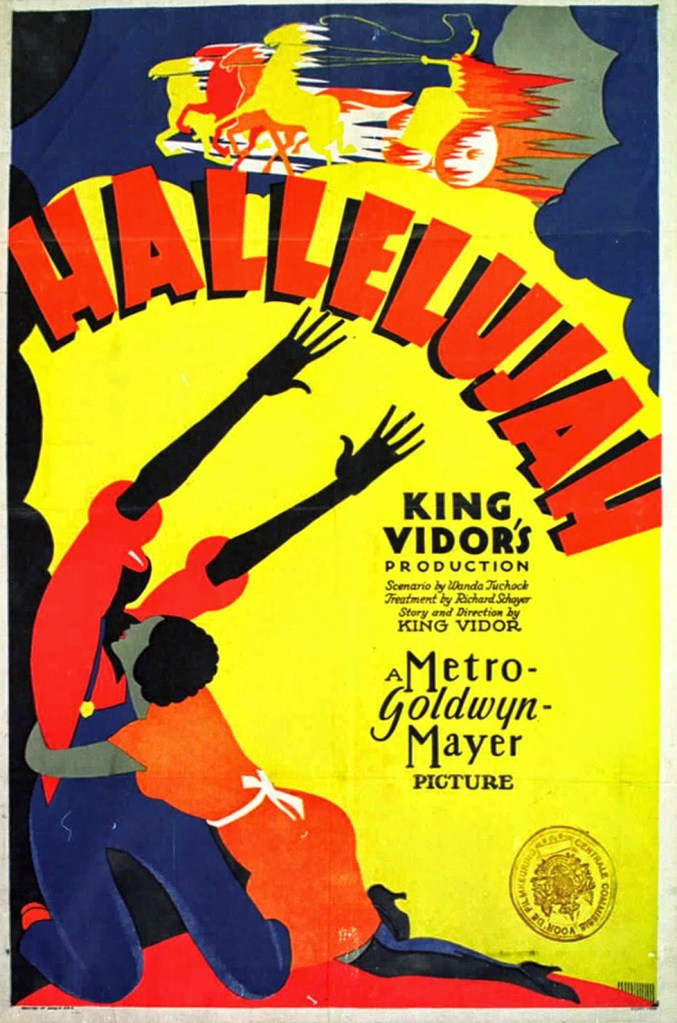
“Seems like you made it mighty late to get ’round here to be married. The damage is all done!”
By the standards of the 1920s, King Vidor was another ally who also happened to be one of the most powerful and successful directors of the 20s. Vidor said, “For several years, I had nurtured a secret hope. I wanted to make a film about Negroes, using only Negroes in the cast. The sincerity and fervor of their religious expression intrigued me, as did the honest simplicity of their sexual drives.” Despite Vidor’s tremendous track record, MGM resisted until Vidor promised to invest his own salary, dollar for dollar, with that of the studio, whose then-head of production, Nicholas Schenck, reported told Vidor, “If that’s the way you feel about it, I’ll let you make a picture about whores.” It’s not clear if he meant that hypothetically.
Donald Bogle recounts how the Black press, uh, pressed MGM into making crucial hires behind the scenes for Hallelujah. Vidor sought realism by moving parts of production to Tennessee and Arkansas – the distance from L.A. to the Deep South by far the furthest an all-black cast had traveled to make any kind of film – and there they consulted black leaders on “everything from river baptismal services to revival meetings.” The real Curtis Mosby performed while the real Eva Jessye supervised choral sequences, including one that needed 340 black extras who all had to know how to sing. Bogle writes, “That Sunday morning, black church choir benches in the city were said to be practically empty.” Bogle goes on that “though sequences of black crapshooters and rowdy cabaret folks were familiar images, nonetheless the film sometimes attained a highly moving cultural authenticity.”
Hallelujah begins with the MGM lion, but instead of hearing his roar, we hear a mashup of tribal drums and choral vocals taking us through bits of “Sometimes I Feel Like a Motherless Child,” “Hallelujah,” “Let My People Go,” and “Way Down Upon the Swanee River.” In a cotton field, we meet Zeke happily teasing kids and a woman he calls Mammy as they finish for the day and haul in the cotton singing “Cotton, Cotton.” After the sharecroppers finish their picnic-table dinner that evening, Zeke’s brother Spunk plays banjo while some of the boys tap dance. When one Missy Rose plays an indoor piano for the group, Zeke sneaks in and seeks to sneak a kiss that Missy clearly does not want, and Zeke seeks forgiveness by speaking, “it looks like the devil’s in me here tonight.” In glimpses, we see life on this rural plantation consisting of women hustling after children who say good night in a large room full of single beds. Hearing passing troubadours, Zeke sings “At the End of the Road,” a chorus stops and joins in, and Spunk uses machines to lathe the cottons into bales. We hear another song about what we’re watching, cotton bales getting rolled into a paddle steamer riverboat, as we wander to the payment office, where Zeke collects his plantation’s full cash payment. A nearby woman, Chick, dances high-step jigs in the middle of an appreciative crowd that comes to include Zeke, who tries to pull Chick aside, hears her throw shade that he’s poor, and flashes his money wad. In a surprisingly legit juke joint/dance hall, Chick performs a spunky, spirited “Swanee Shuffle” then settles in to a slow dance with Zeke, who hears Chick tell of how lucky her last beau got with a sucker named Hot Shot whom she just happens to spy. After Hot Shot insults Zeke as a buck-and-a-half cotton-picker, Chick successfully persuades Zeke to shoot dice with Hot Shot…and lose all $100 of the cash he was holding. When Zeke demands to see Hot Shot’s dice, Hot Shot insults him, Zeke pulls a knife, Hot Shot pulls a gun, Zeke fights him for the gun, and Hot Shot just happens to shoot Spunk who just happens to walk in the door. As Zeke holds his dying brother in his arms, we see Hot Shot and Chick hiding in a nearby room arguing over percentages of the take. When Zeke brings home Spunk’s corpse, he prompts all the plantation people to chant, cantillate, cry, and croon, until Zeke’s “pappy” staggers outside, points out the parting of clouds, and inspires Zeke to sing with open outstretched arms of the coming of the Lord. The rest of the plantation joins Pappy on his knees as Zeke gestures heavenward, hails Hallelujah, and segues into a reverent “Swing Low, Sweet Chariot.” A title card says “And Zekiel became a Preacher,” and a berobed, redubbed Zekiel rides a donkey in an elaborate town parade attended by a poshly dressed Chick and Hot Shot, who push through the paradegoers to heckle Zekiel until Mammy, riding along near Zekiel, says “ah shut up, you yellow hussy…all you want is to get after my boy!” Zekiel stops his donkey, wags his finger at Hot Shot, claims to be an instrument of the Lord, assaults Hot Shot and Chick, and gets back on his donkey. At an outdoor revival meeting, on a raised wooden stage, Zekiel offers some of that old time religion, calling the people “friendly and kind,” on their way to the next station of faith, where they’ll “surely” avoid the devil. Chick joins the crowd to fire off libels and taunts, but most of the crowd ignores her in their elation at the sermon, and by the time Zekiel revives the song “At the end of the road,” Chick is crying to be saved as well. At least 200 believers gather for a river baptism, where their splendid singing is, uh, swamped by wailing from Chick, who gets baptized in the water, falls into Zeke’s arms, cries that she’s sanctified, and tempts Zeke into carrying her into a tent before Zeke rebukes himself better. Back at home with Pappy and Mammy, Zeke asks Missy Rose to help him drive out the devil by marrying him, to which she accepts through tears of…ambivalence. Elsewhere, Chick sings hallelujah to a cracked mirror until Hot Shot turns up, guffaws at her falling for that fake preacher, sees she means it, and grabs her, prompting her to beat him with a poker. Chick sees a second sermon where Zekiel sanctifies, purifies, and saves the sinners with word and song, but Missy Rose and Mammy aren’t happy to see him mesmerized by Chick to the point of following her outside as though ensorcelled. Missy runs into the woods for him, fails to find him, and returns to the enraptured and supportive congregation. Months later, Zeke works at a log mill, walks home, and notices a buggy outside his new shack, as we cut inside the shack to see Chick hold a kiss on Hot Shot, hear Zeke approach, and hustle Hot Shot out the backdoor. When Zeke enters with accusations, Chick takes him outside to show him no buggy, then inside to speak tenderly to him, sit in his lap at the kitchen table, caress him, and assuage his doubts until she’s sure he’s asleep. Chick tiptoes into the bedroom, packs a suitcase, and sneaks out the window, but the suspicious Zeke lifts his head and dashes into the bedroom to see her gone, whereupon he seizes a rifle, jumps out the window, sees her jumping into the buggy with Hot Shot, and fires upon them. Hot Shot and Chick seem to escape, but their speeding buggy hits a rough patch of mud and loses a wheel and Chick, who Zeke catches up with in a mud puddle begging for forgiveness and salvation before she dies. Without a rifle, Zeke chases Hot Shot through a tree-lined swamp, finally catches him, and maybe kills him. We next see Zeke breaking rocks on a chain gang until the title card “Probation,” leading to Zeke strumming a guitar singing “coming home” on a cotton bale on the river and on top of a train. Zeke hides behind a tree and surprises his family, who welcome him back with open arms and Missy Rose’s kisses and promises of chitlins and an invitation to help with the picking. Sharecroppers lug bales of cotton to the plantation over music as the film ends.
Hallelujah has accounted for many academic arguments. For every person who lauds its “freshness and truth” that wouldn’t be seen for 30 more years, another person calls it paternalistic, promoting of stereotypes, and, uh, pretty racist. Pioneering African-American scholar Donald Bogle sent his own mixed messages, praising its cultural authenticity in one book, reviling Chick as the uber-tragic mulatta in another book.
Warner Bros. now owns the film and puts a disclaimer on it that says it: “may reflect some of the prejudices that were common in American society, especially when it came to the treatment of racial and ethnic minorities. These depictions were wrong then and they are wrong today. These films are being presented as they were originally created, because to do otherwise would be the same as claiming these prejudices never existed. While the following certainly does not represent Warner Bros.’ opinion in today’s society, these images certainly do accurately reflect a part of our history that cannot and should not be ignored.”
Film critic Kristin Thompson objects to that warning because it basically labels the film as racist, and for her, “Warner Bros. demeans the work of the filmmakers, including the African-American ones. The actors seem to have been proud of their accomplishment, as well they should be.”
When Melvin Van Peebles died in September 2021, his son Mario, also an accomplished filmmaker, said, “Dad knew that black images matter. If a picture is worth a thousand words, what was a movie worth? We want to be the success we see, thus we need to see ourselves being free. “ I think Hallelujah sometimes shows this, although it’s not consistent. So it’s essential without being sufficient. It at least moved the conversation forward – if this, why not that?
As it turned out, Hearts in Dixie and Hallelujah both did reasonable but not boffo business, their Northern receipts not quite making up for the absence of Southern ones. Hollywood would not attempt another all-black film for…wait for it…wait for it, Black people certainly did…seven years. Of course, Black people were in films, from Stepin Fetchit vehicles to Imitation of Life, which we’ll discuss in a few minutes. But Hearts in Dixie and Hallelujah established the pattern: a white producer would feel strongly about the relative novelty of exploiting black music as part of an all-black cast, a studio would agree but cut corners, the resulting film wouldn’t smash box office records, and white Hollywood would shake its head and use the film as a cautionary tale for any future all-black-cast projects. After 1929, the same thing would happen in 1943, with Cabin in the Sky and Stormy Weather, and then again in the 50s with Carmen Jones and Porgy and Bess, and then in the 70s with The Wiz, and, yes, in 2006 with Dreamgirls.
Influenced by: jazz, Stephen Foster, Vidor’s interest in “negro spirituals,” prevailing racism
Influenced: mainstreaming of both African-American culture and stereotypes, but because it and Hearts of Dixie (also 1929) bombed, 14 years passed until another major studio film with an all-black cast
~
C7. Freaks (Browning, 1932) BO clip imdb LB RT trailer wiki
stream on amazon watch analysis by Weathers read analysis by Eggert listen to my podcast
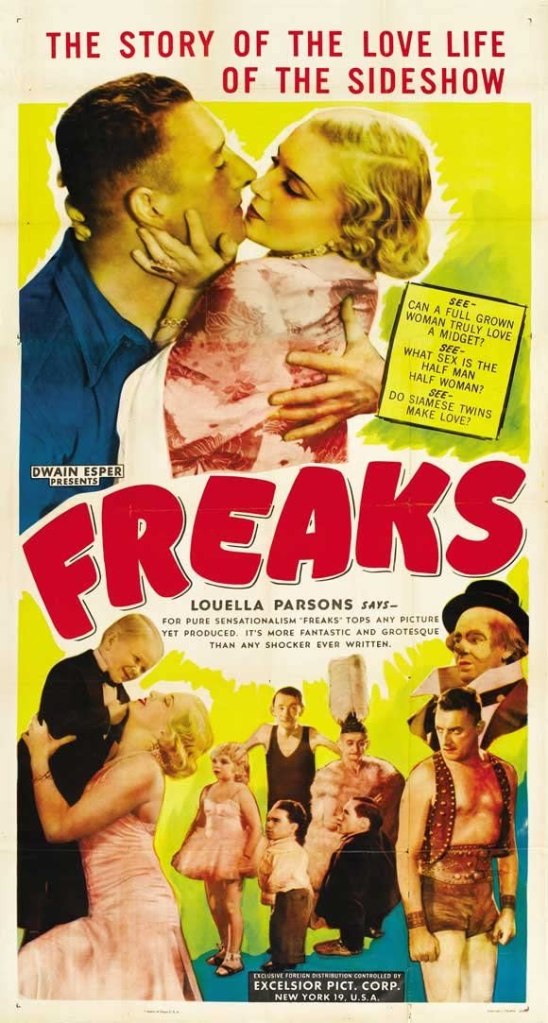
“We accept her, we accept you, gooba-gabba, one of us, one of us.”
MGM bought the rights to Tod Robbins’ story “Spurs” back in the silent era, but was spurred to make it by director Tod Browning after the success of Dracula, which spurred Universal to re-orient toward the horror of characters like Frankenstein, the Invisible Man, the Mummy, and maybe a werewolf or phantom or hunchback or whatever Universal might have available. In that context, the idea of a single film about unusually formed circus sideshow performers looked like the more mature take on a trend, exactly the kind of film MGM’s then-director of production Irving Thalberg preferred to make. By then, MGM was trying to become classier, and no longer had Nicholas Schenck vocally approving of pictures about whores, although that didn’t stop the adaptation of Spurs from centralizing a gold-digging woman.
Thalberg was the named producer on Freaks who by all accounts closely collaborated with Browning on every aspect of pre-production, from set design to planning the 24-day shooting schedule to casting. At first, Thalberg wanted to cast stars as the full-size humans, but Thalberg came to agree with Browning that stars would overshadow the film’s real stars, who were the so-called Freaks. That said, Thalberg didn’t trust the foreign accents of the contract players he did cast, and was worried that MGM’s pre-existing carnival set would look too American, so he moved Robbins’ story from France to the U.S. Thalberg also wound up moving some of the principal actors from the MGM commissary to a special tent for their meals, because some MGM stars were disgusted by having to eat next to the sideshow attractions. They had something in common with test audiences from January 1932, who supposedly ran out, became ill, fainted, and/or threatened MGM with lawsuits. Louis B. Mayer was ready and willing to destroy the negatives, but Thalberg fought his boss and supervised an edit that severed 30 minutes of Browning’s 90-minute cut, ironically truncating Freaks into the sort of two-thirds-stature creature that the film was celebrating. (To make sure it ran at least an hour so as to play at proper venues, they had to add the carnival barker frame story and the epilogue.) As was then custom, the removed footage was destroyed.
Freaks begins with a title card that an unseen hand rips off the screen, cutting to an umbrella-closing by a host telling a small crowd, “we didn’t lie to you folks, we told you we had living, breathing monstrosities. You laughed at them, shuddered at them. And yet but for the accident of birth, you might be even as they are. They did not ask to be brought into the world, but into the world they came. Their code is a law unto themselves, and you offend them all.” The host ushers the crowd to view something unctuous but unseen to us, apparently an individual in an open crate that’s set up for viewing like a coffin. The host reports this person was once presented as The Peacock of the Air as the film flashes back to a trapeze artist, Cleopatra, that Hans calls the “most beautiful big woman I have ever seen.” We meet Hans and his fiancée Frieda, who are both little persons, as she questions his loyalties and he reaffirms them. During a costume change, Cleopatra condescends to Hans’s moony eyes as Frieda watches with cagey eyes. In a pastoral glade, one man complains to another that such people are supposed to be smothered at birth, and we meet them dancing in a ring, making clear their physical abnormalities, from microcephaly to missing legs. When the angry man accuses them of trespassing, a full-bodied woman introduces herself as Madame Tetrallini and her charges, whom she hugs, as “children” that God looks after. Back at the circus, two full-bodied male trapeze artists make fun of Josephine Joseph, half-woman half-man, laughing, “Don’t get her sore, or he’ll bust you in the nose.” Cleopatra thanks Hans for the flowers and asks for another thousand francs, which he says he’ll bring “with pleasure” to her wagon that night. Venus breaks up with Hercules, moves out on him, and rants at clown Phroso, who pep-talks her and cheerfully greets conjoined twins Daisy and Violet, one of whom is readying to marry stuttering comedian Roscoe, who acts as though he can be with one without the other. Hercules enters the wagon of Cleopatra, hits on her, kisses her, spies Josephine Joseph spying, and comes out and collars Josephine to Cleopatra’s cackles. Frieda warns Hans not to smoke so much, and a barely-listening Hans says no woman tells him what not to do. Hercules and Cleopatra enjoy the fruits of Hans’s fruit basket, but when Hans knocks on the wagon, she shushes the shady Hercules, lies to Hans that she’s in the bath, gets him to agree to come back later, and in a hush, howls with Hercules at Hans’ expense. Venus tells Frieda she need not worry because Hans doesn’t love Cleopatra, but Frieda admits Cleopatra’s persistent, over-flattering demands for gifts have her worried. In the big tent, when Hercules and the two male trapezers play cards and make jokes about midgets, Hans objects and Cleopatra asks him for a back rub, which he delivers as she and the big men share scornful snobbish stares. Phroso rehearses his missing-head clown act with Venus while telling her about his dream of the two of them, but Half-Boy and Koo-Koo the Bird Girl interrupt because the bearded woman is giving birth. We don’t see the baby, but Phroso congratulates the mom on a girl who will have a beard while the baby’s father, the Human Skeleton, passes out cigars to the sarcastic snobs at the big top. In two separate scenes, two different women use feet as hands in a quotidian manner. Roscoe speaks with the Human Torso, a Black man with no arms and no legs, as he uses his mouth to light himself a cigarette. Venus looks on with admiration as Phroso kindly compliments three women with microcephaly. A swarthy man, Mr. Rogers, hits on Violet and eventually kisses her, a sensation we see the conjoined Daisy feeling. Daisy introduces her fiancée, Roscoe, to Violet’s fiancée, Mr. Rogers, as each man invites the other to come see them sometime. In an emotional private scene, Frieda warns Hans he won’t be happy with Cleopatra, but he assures her otherwise even as he asks for, and receives, her forgiveness. While Hercules and Cleopatra are laughing at Hans but not his latest bracelet, a knock prompts Hercules to hide as Frieda enters, remonstrates Cleopatra, warns her not to marry Hans, but lets slip about Hans’ inherited fortune. After she leaves, Cleopatra schemes with a chuckling Hercules, “Yes, he would marry me. Midgets are not strong. He could get sick. It could be done. I know it.” A title card says “The Wedding Feast,” cutting to a large table under the big top where one man swallows a sword, another fire. Cleopatra pushes a drink into Hans, laughs, calls herself lucky, calls Hans a “little green-eyed monster,” and kisses Hercules for way too long. Dwarf Angeleno, standing on the table, suggests a loving cup as Josephina Joseph begins a rousing, thumping chant of “we accept her, one of us, we accept her, one of us, gooba-gobble.” Angeleno walks around the table with a bowl-sized goblet of festive drink that most of the guests are happy to swig from, but when he hands it to Cleopatra, she stands, stares at the chanting crowd, and shrieks at them “Dirty, slimy, freaks, freaks!” She splashes Angeleno with the drink, orders them to get out of there, and says, while watching them go, “Make me one of you, will you!” When Hans says he’s ashamed of her, she calls him more baby than man, asks what kind of things they can possibly do together, and takes him on a “horseyback ride.” Later that night, Hercules and Cleopatra apologize and pretend they were joking to Hans, who answers yes, we’ll laugh in divorce court at Hans the fool, ha ha…and collapses. The so-called freaks watch from the wings as Cleopatra says “I know what I’m doing” and takes him to a doctor who blames ptomaine poisoning and credits Cleopatra’s mustard water for saving his life. When a less credulous Venus demands Hercules reveal the wine formula to the doctor or she’ll tell “the coppers,” Hercules accuses her of betraying her own people, and Venus answers, “My people are decent circus folk, not dirty rats what would kill a freak to get his money.” After a week, a convalescent, reconciliatory Hans thanks Cleo, who carefully prepares his medicine, spoon-feeds it to him, and steps out of the room, whereupon he spits it out. When he tells her “I’ll never forget what you are doing for me, Cleo,” she replies, “But it is what I want to do, my darling,” not realizing his subtext or that he knows hers. Cleo departs while noticing several of the so-called freaks spying on her, but not Angeleno, who confirms with a broadly grinning Hans that tonight is the night. As rain thunders down, as horses bear the train of circus wagons, Cleo tells Hans’ friends to leave their wagon, but they brandish weapons at her – Half-Boy points a gun – until she surrenders her little black bottle of poison to Hans. Worried about Venus, Hercules smashes into her wagon, Phroso battles him hand-to-hand, the horse train collapses, and Hercules strangles Phroso until a little person throws a knife in his chest. In one of cinema’s more evocative minutes, a supine Hercules slithers and squirms under the stopped wagons as the weapon-bearing, ahem, freaks slowly close in on him…and, nearby, Cleopatra, whose scream sends us back to the frame story. At the display box, the host tells the carnival patrons “how she got that way will never be known” although “the code of the freaks” is a possibility. Finally, we see Cleopatra squawking as her head is somehow on a duck’s body, with her human arms stretching to duck’s feet. In a coda that not all audiences saw, a sad, mansion-bound Hans receives a spiffily attired Phroso and Venus and Frieda, who tells Hans nothing was his fault and, as the other two go, Frieda hugs Hans and says “I love you.”
I tend to side with the scholars who say that Freaks forces us to rethink how we think of horror. It’s all in the brilliant title: who are the freaks, is it the sideshow performers, or the contemptuous full-sized people who judge them, or maybe…us? I quote Eugenie Brinkema: “Freaks is a horror film because the gaze itself is horrific, because locating the gaze is a work in terror.”
Andrew Sarris calls it “one of the most compassionate films ever made” and Ed Gonzalez praises “the film’s blistering humanity and the audacious aesthetic and philosophical lengths to which Browning goes to challenge the way we define beauty and abnormality.” Still, what survives as the final ten minutes certainly shows…something freaky? I’m rooting for the sideshow performers all the way, but I wonder if Cleopatra and Hercules have somehow caused them to lose some of their humanity? Maybe not.
At risk of bias toward the full-sized, I would have loved to have seen the full-sized movie. Some parts feel incoherent; for example, we are meant to believe in dramatic naturalism but also that men could date conjoined twins while believing they could get one alone. I’m fascinated at the notion of a circus movie without a circus, without a single shot of circusgoers seeing a trapeze artist in motion or a clown car or a lion being tamed or what have you. Would such shots have then required us to have seen the “Freaks” in their sideshow boxes and cages? It’s not clear Browning ever filmed any of the characters, full-sized or otherwise, doing their jobs, and so scholars understand the missing circus activity as a structuring absence. Probably it’s part of the film’s radical humanism: it only has the running time of this one film to show us the neglected aspects of these 15 or so “Freaks,” so no need to waste any of it on the aspects viewers already know. (Even during the one clown rehearsal, Phroso pretends to lose his head, thematically demonstrating his allyship with characters like The Living Torso.)
Here are some of the ableist reviews: In The Kansas City Star, John C. Moffitt wrote, “There is no excuse for this picture. It took a weak mind to produce it and it takes a strong stomach to look at it.”[66] The Hollywood Reporter called the film an “outrageous onslaught upon the feelings, the senses, the brains and the stomachs of an audience”
“Not even the most morbidly inclined could possibly find this picture to their liking. Saying it is horrible is putting it mildly. It is revolting to the extent of turning one’s stomach…Anyone who considers this [to be] entertainment should be placed in the pathological ward in some hospital.” — Harrison’s Reports, 16 July 1932
MGM first reacted to reviews like these with a press notice that said
What about the Siamese twins—have they no right to love? The pin-heads, the half-man, half-woman, the dwarfs! They have the same passions, joys, sorrows, laughter as normal human beings. Is such a subject untouchable?
Yet after more complaints from critics and distributors, Louis B. Mayer ordered Freaks pulled from release, making it MGM’s first film to fail to complete its prearranged engagements.
Tod Browning did direct four more films, but the financial failure of Freaks is blamed for him losing his independence and interest in moviemaking. Browning died in 1962, possibly too drunk to have noticed that Freaks had recently undergone a European revival that translated to the film being revived on American campuses and repertory theaters, becoming one of the first so-called “cult classics.” Speaking of so-called, I also believe that part of the legacy of Freaks is the re-orientation of that word into a badge of honor.
Influenced by: almost nothing; described as belonging to a subgenre of one
Influenced: reviewers were disgusted, but later artists loved it, e.g. the Ramones, Bertolucci, Scorsese, ‘The Simpsons,’ ‘South Park,’ Ryan Murphy
~
C8. She Done Him Wrong (Sherman, 1933) BO clip imdb LB RT trailer wiki
stream on amazon watch analysis by RazorWire read analysis by Skretvedt listen to my podcast
“Why don’t you come up some time and see me?”
Mary Jane West was born in 1893 in Brooklyn and broke into Broadway at a young age, singled out at the age of 18 by the New York Times as “a girl named Mae West, hitherto unknown, pleased by her grotesquerie and snappy way of singing and dancing.” Yet the show closed after a week. West had various supporting theatrical roles for the next 15 years, and finally decided to write the sort of risqué, ribald, radical-ish roles she wanted to play. Like Lois Weber, West well understood the value of press controversy, as demonstrated with her play Sex, starring herself, which in 1927 caused the police to raid the theater, arrest the cast, and charge her with “corrupting the morals of youth.” West might have paid the fine, but instead did the time, telling reporters she dined with the warden and rejected the burlap sack uniform in favor of wearing panties. West’s next play, The Drag, looked sympathetically at homosexuality, and criticized police beating men for being gay, but despite West’s best efforts, the vice squad’s best efforts prevented the play from opening. Her next play, Diamond Lil, about a vivacious victorious vamp of the 1890s played by herself, was a boffo Broadway blockbuster in 1928. West wrote three more plays over the next three years, some bigger than others. In June 1932, needing money, West went west to Hollywood, arriving there for the first time at age 39, something almost no other major female movie star has done before or since, although West hid her true age during her golden age. On that front, Paramount Pictures was her ally, considering they had hired her out of Depression-caused desperation while the studio was facing bankruptcy.
In 1932, the Hays Office pre-emptively reproved Paramount per any poster or title that reminded the public of the notorious play Diamond Lil, so West simply changed her character’s name to Lou and the name of the movie to She Done Him Wrong. Although Lowell Sherman is the named director of the film, and Sherman had an interesting career in his own right, no one should think him the auteur of She Done Him Wrong; West wrote it, honed it over hundreds of performances, chose which parts to cut, and chose which lines the censors would probably cut so she could keep the subtler lines she really liked. The card after the big title card that says “She Done Him Wrong” begins “by Mae West,” and that’s correct. If any novice film student reads about Charlie Chaplin and Buster Keaton and Harold Lloyd and their other comedian-creator contemporaries and wonders, when was the first female version?, Mae West is it. West always insisted she discovered Cary Grant by seeing him walking around the Paramount lot and telling Sherman, “If he can talk, I’ll take him!” West’s story doesn’t include the fact that Grant was on the lot because he had already been discovered by Joseph Von Sternberg to play opposite Marlene Dietrich in Blonde Venus. More credibly, following her stage work, West always insisted on at least one African-American performer in the cast, and that’s how Louise Beavers was enlisted to play Pearl, Lou’s servant.
She Done Him Wrong starts with a card saying The Gay Nineties was “a lusty, brawling, florid decade,” and a Streetcar Named Bowery brings us into bawdy, libidinous street life. At Gus Jordan’s saloon, men nudge each other over a new nudie painting while a greedy glutton gorges on grub from the free buffet. One Dan Flynn confides in a second man that he can prove the crimes of one Gus Jordan, whom we meet across the bar accusing one Mister Cummings of acclimating his mission next door at the expense of Jordan’s saloon. Flynn needles Jordan about how popular Lady Lou has become, about his jealousy, and about what he might do if someone tried to take her away from him. In a private room, Gus rendezvous with the Russian Rita and Serge and swears them to secrecy, although we’re not sure what about. A well-heeled horse and buggy delivers the legendary Lady Lou, at whom rich woman sneer, rich men genuflect, and a lady beggar compliments as a fine woman, prompting Lou’s first line, “one of the finest women to ever walk the streets.” When Serge links up with Lou with a long hand kiss and lauds that he’s heard so much about her, Lou claims, “Yeah, but you can’t prove it.” Lou cracks many other quips, caprices, and coquettish comments on her way upstairs to her boudoir, where a very mammy-ish Pearl waits on and laughs with Lou. After a patron, Sally, attempts suicide, Lou has her brought to her boudoir, where Lou tells Sally that the guy is alive, prompting Sally to ask how she knew there was a guy and Lou to reply, “There always is. You know it takes two to get one in trouble.” After Sally mentions she didn’t make out he was married, Lou mutters, “Married or single, it’s their game. I happen to be smart enough to play it their way.” Lou gets Pearl to dress Sally in finery while Lou reassures Sally that when women go wrong, men come right after them. Gus and Rita sit on either side of glammed-up Sally who doesn’t want her parents to know where she is, so Rita suggests she study how to sing, dance, and move to the Barbary Coast. A big tough palooka called Spider Kane warns Lou that things may go badly if she doesn’t visit her ex, Chick Clark, in prison. A spendthrift stumbles into the saloon seeking sanctuary, so Cummings hides him and tells an approaching Officer Doheney he hasn’t seen him, a fiction that Lou corroborates as Jordan ousts the officer. Cummings and Lou trade japes until she supplicates, “Why don’t you come up sometime and see me?” Entering the upstate prison with Spider, Lou gives familiar ribs to each of the occupants of six separate cells before she enters the seventh, home of Chick, who warns Lou he has ways of finding out and getting out. Lou says she’s only been singing at Gus Jordan’s, but Chick directs her not to double-cross him during his scheduled remaining year of prison time. As Lou leaves, she lets Spider know Chick’s concern about Dan Flynn, and Spider replies Flynn landed Chick in prison. Back in her boudoir, Lou meets with one Ike Jacobson to propose she buy his blessed building next door, something he refuses until he sees the necklace she offers. After a company of chorus girls creates anticipation, Lady Lou comes on stage and croons “I wonder where my Easy Rider’s gone” to tumultuous applause. Back at the boudoir, Dan Flynn warns Lou that Gus Jordan is in legal jeopardy for what he did to women like Sally, but he, Dan, could let Lou off if she’ll let him love her but she lets him down. Next, Cummings declares Lou’s diamonds to be devoid of soul, mentions Sally’s mother is at his mission, and accuses Lou of knowing where Sally resides, but Lou denies this and tries and fails to redirect Cummings to her. During someone else’s number, Chick sneaks into the boudoir, says he “had to croak a guard to get out,” demands Lou come with him, reacts to her refusal by really strangling her, stops himself, and for the first time in the film someone successfully kisses Lou…but when Serge’s knock interrupts, Lou chases him off by promising to meet him at another club later. In the saloon’s main room, Sally’s mother fingers Rita, freaks out, and finds herself flustered by security as Dan Flynn tells a refusing, refuting Rita where he saw Serge going. Serge enters Lou’s room, attempts to seduce Lou, offers diamonds, and says “I shall die to make you happy,” prompting Lou to answer, “But you wouldn’t be much use to me dead.” Rita enters with the fury of a lover so jealous that even after Lou dismisses an unrepentant Serge, Rita pulls out a knife to stab Lou, yet in the scuffle, Lou accidentally kills Rita. While Lou onstage performs “A guy what takes his time,” in the District Attorney’s office, Sally and her mother testify against Serge, Rita, and Gus, as the camera dolly-pans out to reveal that Cummings is more than he appeared to be. Lou and Gus trade admirations as Lou quotes Cummings on soullessness, leading Gus to laugh that she located a lad she can’t land. After Gus leaves, Spider’s declarations of love for Lou imply he let Rita have it. While Lou is trilling “Frankie and Johnny,” Chick is sneaking back into the boudoir and cops are descending on the saloon, including Cummings, who speechifies while arresting Lou, more stealthily shoots Chick as Chick threatens Rita, and brags Lou will “be well taken care of.” Instead of the regular paddy wagon, Cummings places Lou into a private buggy with him, where he discusses her prison term, names himself as her long-term jailer, places a diamond ring on her finger, and says “you bad girl.” Lou cants “You’ll find out” as the film cuts from their carriage canoodling to the card saying The End.
The idea of Mae West often trumps the reality of watching her films.
If her persona’s materialism cautions us against too much admiration nowadays, consider the context. The shock of the stock market collapse, the 20% unemployment, the blocks-long queues for bread and job applications…this removed a lot of the stigma about getting what you could when you could, particularly for women. If in the land of the blind, the one-eyed man is king, well, in a land decimated by desperation, Mae West represented something like the new American Dream.
How different was West from what America was already used to? In January 1933, days before She Done Him Wrongcame out, Motion Picture Herald named, as America’s top star, Marie Dressler, who was then 64 and enjoying a second career peak as a somewhat Melissa McCarthy-ish bawdy comedienne, but not a sex symbol or envelope-pusher. Greta Garbo, as Queen Christina onscreen and a queen of the press and rumored lesbian offscreen, and Marlene Dietrich, as the gender-fluid icon I described when discussing Morocco on the B-list, were powerful and transgressive sex symbols but also European. Mae West was all-Yankee, all-naughty, all-racy, all-raunchy, yet also sexy, at least according to West, no matter how non-tall, non-skinny, non-ingenue-aged she might be. F. Scott Fitzgerald called West “The only Hollywood actress with both an ironic edge and a comic spark.”
Everyone wanted to be in on that comic spark, or just in. She Done Him Wrong was released in January 1933, and America welcomed both Roosevelt’s New Deal and West’s Lewd Deal with open arms. She Done Him Wrong and I’m No Angel turned Cary Grant into a star and turned around Paramount Pictures, rescuing the company from Chapter 11 bankruptcy and beginning a legacy now symbolized by the Mae West Building standing today inside the only studio in geographical Hollywood. She Done Him Wrong earned a Best Picture nomination in 1934, and a year later, Mae West officially became America’s highest-paid woman. In 1934, West found herself saluted by artists as varied as Frida Kahlo, in her painting “My Dress Hangs There,” and Cole Porter, whose list in “You’re the Top” included “Mae West’s shoulder.”
Mae West was so powerful that Hollywood had to make a new Motion Picture Production Code to stop her, which is only a slight exaggeration. With the battle over Prohibition lost, America’s religious and moralist crusaders turned their attention to a more winnable battle, shaming and punishing Hollywood’s moguls, who as Jews always worried about being branded anti-Christian. Mae West and the gangster cycle that included Little Caesar and Scarface demonstrated the problem with simply praying studios would punish onscreen depravity without more of a proactive enforcement mechanism. On June 13, 1934, the Hays Office announced that as of July 1, 1934, every studio film would be required to bear a seal of approval from the new Production Code Administration. The PCA was not created or enforced by any government; the studios chose self-regulation over government regulation. Gore Vidal, who had to hide his queerness from the censors, memorably called the Code “a Jewish owned business selling Catholic theology to Protestant America.”
At first, Mae West could afford to joke that she created the PCA as surely as she’d created Cary Grant; eventually, the jokes wore a lot thinner, off screen and on. West’s films were too watered down to be winning anymore, and when she rallied toward ribaldry, no studio rushed to distribute her racier rawness. West continued to perform in films for decades, but the Code criminally curtailed the career of America’s first off-color comedienne-sex symbol-writer-star. Mae West walked (in trick-platform heels for height) so that Madonna and Roseanne and others could run.
Influenced by: character comedy like that of W.C. Fields; West’s Broadway career, which was pro-feminist and pro-LGBTQ
Influenced: Hays Code enforcement; helped make Cary Grant a star; generations of funny and brassy women
~
C9. Imitation of Life (Stahl, 1934) BO clip imdb LB RT trailer wiki
stream on amazon watch analysis by Carlotta read analysis by Schudson listen to my podcast

“Go amongst your own. Quit battlin’! Your little head’s sore now from buttin’ against stone walls. Open up and say, ‘Lord, I bows my head.’ He made you black, honey. Don’t be tellin’ Him His business. Accept it, honey. Do that for your mammy, your mother, dear.”
Producer Carl Laemmle Jr. and director John Stahl hoped to slip Imitation of Life under the wire before the Code could try to control the role of Peola or its actress. However, Joseph Breen’s office had no intention of letting Universal off that easy. Peola’s very existence implied miscegenation, or as Breen’s note put it, “Hurst’s novel dealing with a partly colored girl who wants to pass as white violates the clause covering miscegenation in spirit, if not in fact!” With his left hand, Stahl kept, uh, stalling Breen, but with his right, Stahl and Laemmle began principal photography on Imitation of Life on June 27, four days before the PCA would become industry law. They knew their film’s poster would be the first dedicated to Claudette Colbert after her star-making turn in It Happened One Night, a film that had been doing boffo box office since its February 1934 opening and would likely win Best Picture (which it did).
Frankly, Laemmle was sparing no expense; he got Louise Beavers (Delilah) and Rochelle Hudson (as teenage Jessie) on loan from Paramount after their smaller roles as Pearl and Sally in She Done Him Wrong. And yet by July 17, Breen still hadn’t approved the script, and threatened to make Imitation of Life the first test case of a studio film without Code approval. Ultimately, Stahl and Laemmle removed several of the novel’s elements. Laemmle entirely eliminated a scene of a Black man being nearly lynched for approaching a licentious white woman. Although Universal had advertised Peola as a Black woman who would kiss a white man, the film cut that plotline entirely, though it was revived in the 1959 version. In the novel, Peola runs away for good; in the movie, she returns to remorse and responsibility in more typical Code fashion. As usual, the Hays Office also complained about language – though maybe not as much as Stahl himself, who deleted every n-word in the script.
Imitation of Life begins with Bea Pullman bathing her toddler Jessie, who begs for her duckie and begs not to go to the day nursery. A phone call tells us that Bea lost her husband but keeps up his maple-syrup-can-selling business. When Delilah knocks at the kitchen back door looking for a job, Bea explains that Delilah has the wrong address, dashes upstairs for Jessie, and returns to the kitchen to see Delilah has made them breakfast. Delilah introduces her light-skinned daughter Peola, explains that she’s well-qualified but won’t be separated from Peola, and offers to work for next to nothing but room and board. On a different day, after Bea devours Delilah’s delicious pancakes, Delilah discloses that down South whites came from miles around to taste pancakes made by her grandma, who passed the recipe to Delilah’s “mammy,” who passed it to Delilah where it will discontinue…until Delilah decides to whisper it into Bea’s ear and loan Bea a lucky rabbit’s foot. On the boardwalk, Bea negotiates with a landlord to rent his house and abandoned storefront to sell Delilah’s pancakes and Bea’s syrup. As the family foursome finds its way into living in the store’s ample back, Bea meets with contractors and shrewdly drives hard bargains, including on a sign she dreams of Delilah delightfully smiling next to the words “Aunt Delilah’s Pancake Shop.” Now that Bea has invented Aunt Jemima, the film cuts to the Aunt Delilah sign, pans up to Delilah in baker clothes pouring pancakes, dollies over to Bea in pin-stripes at the counter finishing her final fees to her fixture contractor, and cuts to a prepubescent Peola and Jessie studying happily together, telling us about five years must have passed. Peola re-enters sobbing, explaining that Jessie called her black, that she won’t be black, and that it’s her mother’s fault for making her black, causing Bea to tell Jessie to apologize for this “mean, cruel thing.” Delilah waves off Bea, saying it’s better Peola, like Delilah, accepts the ways of the Lord. On a rainy day, Delilah brings Peola’s rubbers and umbrella to a schoolroom with a mystified teacher until Delilah suggests her daughter may have been passing, causing the kids to murmur “I didn’t know she was colored” as Peola runs out of class shouting at her mother, “I hate you!” Back home, Delilah tells Bea that Peola was passing, that Peola’s father was broken by the struggle of being a light-skinned African-American, and no, Bea, Peola can’t just keep changing schools. Out of the rain comes a scruffy Elmer, who eats pancakes and entreats Bea to trade more of them for his two-word idea, “box it.” In the next scene, sitting next to Elm, Bea tells Delilah that their boxed flour has earned $15,000 in a few months and will earn $100,000 next year, so Delilah should sign the papers to earn 20% of the Aunt Delilah corporation to get her own house. Delilah refuses to sign, worries she’ll be sent away from Bea, and reacts to Bea’s promise to put her share in the bank by suggesting she save it for her, Delilah’s, funeral. A lighted rooftop sign brags of 32 million packages of pancakes sold last year above a swanky society soiree in Bea and Delilah’s New York City mansion, where we learn that Peola is now a young adult who still wishes she were white to her mother’s worry. Elm’s friend Stephen, a handsome ichthyologist, arrives at the party and has a meet-cute with Bea, and finishes the party with Bea’s kiss and promise for future bliss. Bea insists that Delilah approach Peola about going to an HBCU, and as our two leads separate, the camera lingers on Bea going upstairs and Delilah going down. Delilah describes the idea to her daughter as mingling with other high-toned people so that her cross will be a little less heavy to bear, but Peola hates the idea as much as she hates Delilah calling herself Peola’s “mammy.” Stephen proposes Bea see Brazil, then just proposes, and Bea accepts on the condition that Jessie, who is coming back home for a break from boarding school, gets to know Stephen as a friend not a fiancée, to which Stephen jokes, “I’ll be so nice to her that by the time you’re ready to break the news, she’ll be begging you to marry me.” Teenaged Jessie surprises Stephen, and then her mother, with her height, and looks up the word ichthyologist while Bea tells Stephen they should both chaperone Jessie to all New York’s best eateries and shows. However, Delilahshows Bea a letter from the HBCU that Peola, an excellent student, left unexpectedly four days ago but they “trust she arrived home safely.” Delilah and Bea know that she didn’t, prepare to travel South to leave no stone unturned, and leave Jessie in Stephen’s care. When they find Peola working as a restaurant hostess, Peola denies her name and asks her manager how this woman could possibly be her mother, prompting Bea to enter and ask how she could possibly say such cruel things to her mother, at which Peola runs out of the store as Delilah hangs her head in shame. Back at home in New York, Peola tells Delilah she wants her mother to truly let her go, even to pass her by if she sees her on the street, and when Bea says no, Peola retorts, “You don’t know what it is to look white and be Black.” Delilah begs her baby not to make her bear that cross as Bea also tries to block her, but Peola is adamant and absconds. Bea tries to console the inconsolable Delilah, and soon tells an agreeable Jessie that nothing must ever separate the two of them. Jessie proclaims she’s been having a grand time around New York with Stephen, doesn’t want to return to school, cites algebra as useless for a girl, and says she has to go out but will return in an hour or two. Bea calls Stephen, who asks when he can come over, so Bea gives him 30 minutes while she takes a bath. As Stephen hangs up, Jessie arrives at his place and confesses her love for him, so he clarifies he thinks of her as a great child. Bea promises to stay next to a convalescent Delilah until she recovers, but Delilah, a longstanding lodge and church member, tells Bea how to arrange her funeral with a “long procession,” with “plenty of bands playing,” with horses drawing “a white silk velvet hearse,” with “purple satin inside the coffin,” hoping “colored folks’ eyes bulge out.” Crying, Bea overhears an odd colloquy between Stephen and Jessie, and Jessie soon asks to finish her boarding school years in Switzerland. Delilah cries out for a missing Peola and tells a grief-stricken Bea to find Peola and then, with her last words, Delilah says, “just tell her a right sweet goodbye, tell her to be a good girl, why, Peola ain’t little more than a baby now.” Delilah’s funeral is as grand as commanded, with a brass band and colored color guard outfitted with sabers and feather-corner hats as a woebegone Peola shows up moaning, “Mother! Please forgive me. I didn’t mean it…Miss Bea, I killed my own mother…Always thought of me first, never herself.” On Bea’s terrace, Bea breaks up with Stephen because Jessie will resent them, but Bea swears that if and when Jessie truly forgets, Bea can return to him. After Stephen leaves, Jessie arrives with the news that Peola is going back to the HBCU and a question about the day Bea met Delilah, and Bea reminisces about baby Jessie begging for her quack-quack.
In real life, of course, every rich white person is wealthy because of something a Black person was underpaid for, and Stahl’s version does more than Sirk’s version to acknowledge this, at least as metaphor. Yes, Bea offers Delilah the stock shares, but Delilah chooses to live as a dependent – and we all know people who make unnecessary walls for themselves. From a writer’s perspective, Delilah’s choices are necessary partly to explain why Peola hates her mother.
In 1934, almost no white people had seen a funeral for a black woman on anything like the scale of Delilah’s, and not enough Black people had either. Universal had hired Freita Shaw’s Etude Ethiopian chorus and Sarah Butler’s Old Time Southern Singers. I struggle to define this; on the one hand, it’s a step forward in representation, on the other hand, Delilah has to die for it to happen.
Louella Parsons wrote that everyone including her cried in the theater, and “I felt that a new high in humanitarianism had been reached among those great thinkers, and a better condition for the Negro is bound to come.” Donald Bogle quotes Black reviewers who similarly lauded the film, and then quotes one, Sterling Brown, who didn’t, writing at the time that it required “no searching analysis to see in Imitation of Life the old stereotype of the contented Mammy and the tragic mulatto; and the ancient ideas about the mixture of the races.” But Bogle’s very next sentence is “The criticism marked a shift in attitude within the African American community. Roles for black performers were now being examined more closely.” In the era of Stepin Fetchit, that counts as crucial progress.
At its best, Imitation of Life gets into genuine, granular female struggles and Black struggles as the distinct and different problems that they are, but also shows how they reflect some of the same oppression. It deserved its Best Picture nomination.
Influenced by: the original novel and film
Influenced: Hollywood’s pivot to literary work; its approaches to race and to women; Micheaux’s God’s Step Children (1938) was a response
~
C10. Bride of Frankenstein (Whale, 1935) BO clip IMDb LB RT trailer wiki
stream on amazon watch analysis by Draper read analysis by Jameson listen to my podcast
“To a new world of gods and monsters!”
Despite being more Hays Code-monitored than Frankenstein, Bride of Frankenstein is more confident and more intersectional. Where Frankenstein began with an actor warning the audience of horrors before jumping into the story, Bride of Frankenstein restores Mary Wollstonecraft Shelley’s centrality by beginning with her, Lord Byron, and Percy Shelley dreaming up nightmarish ideas in the year without a summer, 1816. The same actress, Elsa Lanchester, plays both the story’s scribe and the story’s bride, a choice that is open to multiple interpretations. In Shelley’s actual novel, Dr. Frankenstein does create a mate for his great formulate, but he destroys it before it can live, which is not so different from what we see onscreen.
In their lab, Bride of Frankenstein doubles down on what we now call “raygun gothic,” the sort of laboratory lightly lifted from Lang’s Metropolis. A lightning bolt generated by one of the Kenneth Strickfaden-designed machines has now passed into legend, or at least stock footage, regularly appearing briefly on shows and movies. Bride of Frankenstein doubly doubles down on German Expressionism, with various twilight vistas of twisted branches and twirled gravestones. For example, when the monster first finds freedom, the forest is full, but after, when the lynch mob chases him, the same forest turns barren, the shadowy branch-less trees already resembling a prison even before the monster is formally placed into one.
I like to think that all that outdoor atmosphere, filmed on Universal’s indoor sets, sets up the scenes between the Monster and the hermit, whose long robe and white beard sets him apart from the mob. James Whale had to shut down production for at least a week while waiting for legendary Australian stage actor O.P. Heggie to do the role, despite Laemmle’s firm opinion that Whale could have recast it with a stock player. 30 years before the film A Patch of Blue, which is about the love between a white blind woman and a black man, here a blind man sees what no one else in this village can, the humanity of this ostensible monster. Granted, this alliance between the persecuted has its own problems, for example the notion that blind people are gifted with a sort of sixth sense, but I believe it does provide some kind of model of allyship, however oddball.
The hermit teaches the monster how to speak, as if to suggest that only a fellow subaltern can teach a subaltern to speak. In fact, Boris Karloff hated the idea of uttering words, but I find it interesting that the British actor does the words in more or less an American accent, as though the monster is an American abroad. I do wonder if Frankenstein’s monster really works as a sort of ur-other, a metaphor for all the persecuted non-whites out there.
Bride of Frankenstein begins with an extreme long shot of a Gothic castle on a dark, stormy night as the camera dollies into the window to reveal Lord Byron extolling by name himself as well as guests Percy Shelley and his wife Mary, whose story of a monster Byron was sad to see end. Mary Shelley at first says the night is too awful for horrors, but quickly changes her mind to correct Byron that her story, about the follies of man playing God, didn’t end, and now she continues it. On top of a hill, through tangled fallen logs, we see the villagers cheer the fiery death of Baron Henry Frankenstein and his monster. One man wants to see the monster’s fire- blackened bones, descends into the pit, and gets drowned by the monster, who makes his way to the hill, seizes another person, tosses her into the pit, and scares an older gypsy lady, Minnie, whom no one takes seriously. Minnie and the villagers deliver the ostensible corpse of Baron Frankenstein back to his gothic castle and fiancée Elizabeth, but as she mourns over him, he comes to life and soon tells Elizabeth he may have been meant to create more life. Baroness Elizabeth says that God never meant for people to do His work and that she had a vision of a ghost that would punish him. Minnie permits into the Baron’s bedroom his former mentor Dr. Pretorius, who begs to make a colleague of Henry, who, like Mary Shelley, suddenly changes his mind, in this case about doing more experiments. Henry finds persuasive Pretorius’s portentous threats of murder charges on behalf of the monster’s victims as well as Pretorius’s claim to have also created life. The Baron and Doctor strike out that night to Pretorius’s lab, where he offers Henry gin, raises his glass, and says “to a new world of gods and monsters!” Dr. Pretorius unveils his creations, which are homunculi, or action-figure-sized humans, in glass jars, something the Baron slights as less science, more black magic. Dr. Pretorius suggests that he and Frankenstein work together to bring forth a new race on the planet by creating for the monster a female mate. In the woods, the appearance of the monster causes a shepherdess to fall into water, but in a reversal from the first film, the monster rescues her, yet her screams alert nearby hunters who shoot at and wound the monster. An enormous lynch mob gathers, chases the monster through the woods, surrounds him, uselessly fires at him, wraps him in ropes, throws him in a barrow, drags him down to the town dungeon, and binds him in many chains. Not long after, Frankenstein’s monster snaps the chains, breaks out of the dungeon, gets fired upon by guns that didn’t exist in 1816, attacks everyone who attacks him, scrambles out of the medieval village, burns his hand on a campfire, and becomes interested a cabin where a man is playing “Ave Maria” on violin. The gray-bearded hermit introduces himself as blind, welcomes the monster inside, touches the monster’s burnt hand, walks him into the cabin, sits him down, and offers him food, healing and rest while offering God humble thanks for sending him a friend. Later, the hermit teaches the monster many words that we hear him say, like “alone, bad, friend, good.” As the hermit plays violin, two lost men approach the cabin, but when they see the monster, the ensuing fight knocks wood out of the fire and the hermit’s house burns down as the monster sounds out, “friend!” In gorgeous, macabre twilight vistas of graveyards, shadows, and torches, the mob reassembles. The monster manages to make his way into a crypt where he waits watching Dr. Pretorius and his assistants open the coffin of a woman who died in, uh, 1899. After the assistants leave with the corpse, Pretorius meets the monster, who likes the doctor’s mating plans for him, confirming his approval with “hate living. Love dead.” Dr. Pretorius arrives at Frankenstein’s castle to be rejected by both Baroness and Baron, but to the latter, he brings the monster, whom Henry recklessly rebuffs from his room. The monster finds Elizabeth, kidnaps her, and gets away, followed by Pretorius telling the Baron that if he wants to see her alive again, he must help create the monster’s mate. Working and sweating in the lab, Henry claims to need the heart of a victim of sudden death, and so Pretorius has one of his hamstrung henchmen kill a random woman, bring her to the lab, and lie to Henry that it was a police matter. After the monster shows up to hurry Henry, Pretorius waves him off with wine “drink, good” as Henry demands to speak to Elizabeth, so Pretorius hands him a 20th-century-looking wire-speaking device upon which Baron and Baroness share brief bon mots. In increasingly canted angles, Frankenstein and Pretorius put the finishing touches on their mummified, fabricated figure, note the approaching thunderstorm, and behest a henchman to raise higher the kites as they lower into their lab a “cosmic ray diffuser,” which is a many-circled, many-wired, many-fixtured conductor antenna. Throughout the lab, electricity crickles and crackles, sparks fly, smoke poofs, and vibrating shadows intensify the scientist faces’ as they send the sheet-covered figure up to the roof via gurney. They lower her down and rip off her eye bandage, causing Frankenstein to say, “She’s alive! Alive!” One discreet cut later, the woman stands maskless in white gown and frizzy white-streaked hair, as Pretorius increases everyone’s confusion by saying “The Bride of Frankenstein.” The monster arrives, offers his shaking hands along with the word “friend,” hears her scream, and says “She hate me. Like others.” Henry dances the Bride away, sits her down, and brings over the monster, but when the monster holds her hand she screams again. The monster gets angry and breaks things until Pretorius warns him not to pull a certain lever or he’ll “blow us all to atoms.” As Elizabeth shows up, the monster chases the Baron and Baroness out of the tower, and they barely do escape just before the Bride hisses at the monster pulling the lever and the story ends with just the jouissance of the exploding tower.
Compared to the ending of Frankenstein, this ending is more explosive. In some ways it riffs off of King Kong, which had come out after Frankenstein, because the climax takes place around a phallic symbol, but Kong was merely knocked off; by finishing with the phallus exploding, Bride of Frankenstein prefigured everything from Die Hard to…uh, all of pornography.
Considering she’s the title character, the film brings us the bride only briefly, but arguably, iconically. Her hairstyle resembling Nefertiti, her hissing, and her hardy rejection of this world of men have been hailed by future generations. That said, it’s difficult to consider Bride of Frankenstein a feminist film; the actual, real wife of Frankenstein, Elizabeth, keeps getting shoved out of the room because the men are talking. At its best, the film knows this is an issue. I will say that unlike in the first film, the Hays Office insisted that no one in the film pretend to be playing God, but watching Pretorius with Frankenstein, the general gestalt of genesis aspiration remains in play.
Some feel the Pretorius character was specifically created by Whale to be played by Ernest Thesiger. Benshoff and Griffin write, “For an attuned spectator, it is easy to see Whale’s homosexual sensibility at work in his films…Whale cast his old friend, female impersonator Ernest Thesiger, as a decidedly odd fellow who steals Henry Frankenstein away from his bridal chamber so that the two men may continue their secret experiments in the queer creation of life.”
Influenced by: German Expressionism, obviously, although half the cast speaks in American accents; unlike many sequels, this was clearly justified by the source material, and Hurlbut and Balderston’s script, as well as John Mescall’s camerawork, built the best of all possible creations
Influenced: horror; noir; the representation of the freaky monster; often considered Whale’s masterpiece and one of the best sequels; then there is the ubiquitous iconography of the lead creations
~
C11. The Women (Cukor, 1939) BO clip IMDb LB RT trailer wiki
stream on amazon watch analysis by Hayes read analysis by Ecarma listen to my podcast

“There’s a name for you ladies, but it isn’t used in polite society, outside of a kennel.”
When Clare Boothe turned her attention to playwriting, she came up with a scathing satire of the sort of high-society women she knew all too well. Boothe, probably like yourself, had seen plenty of romantic comedies where the jilted man gets a pep talk from a male friend, but less where the jilted woman gets the kind of catty reception she knew her friends to be more than capable of. From there, the story evolved into a sort of answer to all or almost all-male stage plays, and not only the ones about war, but also less genrified dramas like “The Iceman Cometh.” “The Women,” the play, debuted in 1936, and ran for two successful years on Broadway. A Hollywood adaptation was almost too obvious; the industry had already demonstrated itself to be overflowing with female talent even before the heavily promoted search for the right actress to play Scarlett O’Hara accidentally made a household name out of the man David O. Selznick hired to direct his adaptation of Margaret Mitchell’s smash-hit novel Gone with the Wind, Mister George Cukor.
If E.J. Fleming is right that Cukor was fired for being, uh, a “fairy”, one wonders if that’s exactly why the town’s most powerful mogul, Louis B. Mayer, hired Cukor, after his old job went with the wind, to direct The Women. It wouldn’t have been the first welcome to a group of women a gay man had received with a sort of knowing wink and nod. I nonetheless wonder what Dorothy Arzner’s version of the same film would have looked like. We’ll discuss Dance, Girl, Dance in a few minutes, but Arzner could have fit in well with a play written by Booth, a script written by Anita Loos and Jane Murfin, and, yes, in a 130-minute movie, 130 speaking parts all played by women and girls. The dogs were female; the faces in the table-set frames were female. However, if Cukor thought he could fill a cast with Scarlett O’Hara’s auditionees, most of them seemed to remember he hadn’t cast them. In the end, Cukor and MGM assembled the distinctly distinguished distaff staff of Norma Shearer, Joan Crawford, Rosalind Russell, Paulette Goddard, Joan Fontaine and many other well-regarded wonders to play The Women.
The Women starts with two symbolic small dogs meeting and barely remaining on leash as they yap yap yap above the sidewalk plate saying Park Avenue Sydney’s Salon. Fur-coat-fronting society doyenne Muddy Van Adams picks up her be-ribboned terrier (who appeared in another 1939 MGM movie as Toto), opens the salon door, complains about other dog owners, says “but my little Lilykins is different,” and hands off the terrier and its bottled water to a Black woman named Olive. In brief vignettes, transitioned by wipe cuts and leftward pans, we see various white women undergoing varied beauty treatments, resting on slabs, stretching in a gym, and biking in a bike room. Sylvia hears gossip from her manicurist Olga, dashes to a pay phone, and calls her friend Edith Potter, an apparent housewife in a deluxe mansion with many little girls, who luxuriates in schadenfreude after Sylvia tells her “Stephen Haines is stepping out on Mary.” We meet Mary Haines and her maybe-10-year-old, little Mary, literally prancing with ponies, taking goofy pictures, bantering with chef Ingrid, preparing for a two-week trip to Canada with Stephen, and having a heart-to-heart about romance and who mother loves best. Women gather in the Haines’ front rooms for a lunch party, with the Dali-design-dressed Sylvia composing catty comments: first about Nancy’s professional writings, Nancy being the only one in the room with a job, second about women like the manicurist who babble, babble, babble and don’t care whose lives they ruin, third to her cousin Mary about Stephen’s fidelity, and fourth about her fabulous manicurist and nails, jungle red, nails Nancy notices looking “as if you’ve been tearing at somebody’s throat.” Prompted by Sylvia, Mary sojourns to Sydney’s and sits with Olga, who indeed names Stephen Haines’ cuckold as Black’s cosmetics counter-maid Crystal Allen and continues complimenting Crystal’s cleverness until Mary identifies herself as Mrs. Stephen Haines. Mary’s mother, Mrs. Morehead, makes her way to the manse, flashes Mary her jungle red nails from Olga, posits that most men stray this way, offers a mother-daughter trip to Bermuda, and strongly advises her daughter say nothing about the affair to Stephen nor her girlfriends, who, if they know she knows, will see to it she loses her husband and home. (“I know my sex.”) Mary answers that was one thing when women were weak chattel as in her mother’s generation, but Mary won’t live with Stephen on these altered terms. Sylvia and Edith venture to Black’s to spy on Crystal, whom we see backroom-browbeating Lulu, who is Black, for belittling the dinner Crystal expects her to impress Stephen with, prompting a work pal, Pat, to riposte, “she thinks because Lulu’s dark, he won’t be able to see her.” Sylvia and Edith grill Crystal with insinuating comments, but only get Crystal mistaking Sylvia Fowler as “Mrs. Prowler.” Mrs. Morehead and Mary show little Mary home-movie footage from Bermuda, and later, Mary maintains that since the trip she’s been with Stephen every night and is “divinely happy.” Mary, Peggy, Sylvia, and Edith attend an elaborate fashion show that is presented in six minutes of Technicolor before the film returns to black-and-white and their chary chitter-chatter, especially when Sylvia spots Crystal Allen and chases Mary into her private fitting room and persistently presses Stephen’s perfidy to the point of Sylvia reflecting in four mirrors recounting a recent rumored date when Crystal kissed Little Mary. Big Mary stops being big and strides into another fitting room to confront Crystal, who bandies barbs about bliss and blessings. At Sydney’s, Sylvia and Peggy are completing catty calisthenics, including Sylvia’s cold-shouldering a woman who jumped off a building – a reference to the real Dorothy Hale. Edith enters to explain she’s equipped the exquisitely named gossip columnist Dolly Dupuyster with an exclusive based on Sylvia’s exaggerations. The next day’s New York Dispatch blares “Wife K.O.’s Love Thief” as Jane and Maggie, two of Haines’ employees, eavesdrop and examine the Haines’ exchanges right up to the ender, “Stephen, I want a divorce.” Later, Mary scoffs at her mother’s pleas to call it off, signs the final papers with her attorneys, sets up to travel to Reno, and sits down with Little Mary, who doesn’t understand how her parents can fall out of love with each other but not her. Peggy joins Mary on the train to Reno, with its dining car full of divorcing women, including the lively Countess De Lave and Miriam Aarons. At the Double Bar T Ranch in Reno, the acerbic Lucy laughs over her husband beating her being no grounds for divorce as Lucy banters with Peggy, the Countess, and Miriam, the latter two confiding that Miriam’s current lover is one Howard Fowler. We hear that after six weeks, Mary’s divorce came through that morning, as an epistle from Edith reveals the birth of her eighth daughter, something that spurs the Countess to sing a song. Surprisingly, Sylvia shows up, spills her squabbles with Howard, sees a letter from him with an attached article about Miriam Aarons, puts two and two together, literally yanks Miriam off her horse, and causes a calamitous combat, carnage, clash – call it anything but a catfight. After, Sylvia calls Mary ungrateful, breaks dishes, and gets dragged kicking and screaming by Lucy. Peggy appertains she’s pregnant, phones Johnny, and makes peace. Miriam makes manifest to Mary all the many reasons she, Mary, might remain married, and when the phone rings from New York, Mary seems ready to swallow her pride and call off the divorce until she learns that Stephen just married Crystal. Eighteen months later, in an opulent tub, Crystal chats up a new beau on a private phone yet hangs up to browbeat Little Mary until the girl finally admits how awful she finds Crystal. Sylvia enters, deduces Crystal’s affair with Buck Winston, but agrees to keep mum so as not to give Mary the satisfaction. Mary, Peggy, Miriam, and Edith gather in New York to drink and hear the Countess say that Buck Winston is cheating on her. Little Mary snuggles with her mother, worries about Crystal’s “lovey dovey” phone talk with another man, and inspires Mary to rise, dress, and announce to her mother, “I’ve had two years to grow claws – jungle red!” In a nightclub’s ladies’ lounge, Mary tricks Sylvia into spilling the name of Crystal’s inamorato, Buck Winston, leading to hijinks and low-jinks until Crystal tells off Mary and her friends with her happiness leaving Haines because she’ll have Buck…as the Countess reveals she’s been bankrolling the untalented Buck. Crystal admits she’ll be returning to the perfume counter but quits the room with a final quick quip, quote, “By the way, there’s a name for you ladies, but it isn’t used in high society outside of a kennel.” Mary tells Peggy a woman in love doesn’t bother with pride and leaves the lounge with the look on her medium-closed-up face telling us she must be looking right at Stephen…as the film cuts to the card saying The End.
I believe the film exudes a kind of fascinating energy that isn’t really imaginable in most movies. In The Women, women become what Homer Simpson called beer: the cause of and solution to all of life’s problems. If you squint hard enough, it can almost feel like Themyscira, the home of the Amazons so vividly brought to life in the recent Wonder Woman films. I’m also reminded of the intentional all-female space of the Michigan Womyn’s Music Festival, which fell apart because of its exclusion of trans-gender women; 1939’s The Women excludes not only the trans, but also the Asian, the noticeably indigenous, and essentially, the African-Americans who are reduced to servants. Perhaps Boothe doesn’t want to lose the villainization of the white Upper East Side? Rosa? Elyce Rae Helford, in her book on Cukor, wrote that “in The Women, the serious, sympathetic central character detracts from the biting social critique of wealthy, catty wives.” I understand and agree with much of Helford’s critique, although in our current day and age, we ask for minority voices to tell minority stories, which is another way of saying that we want artists to tell stories they would know better than anyone else, and in a sense, play author Clare Boothe IS focusing on her expertise by telling us about upper-class women as opposed to, say, the Joads of Oklahoma.
George Cukor and sometimes Howard Hawks maintained a 30-year reputation as Hollywood’s foremost director of women. On the one hand, it’s a disgrace that no woman ever held that title. On the other hand, Cukor sometimes turned that title into terrific pictures, as in The Philadelphia Story, Gaslight, Adam’s Rib, Born Yesterday, the Judy Garland version of A Star is Born, and others. Cukor wasn’t out to the world but he was out amongst his peer community, and I don’t know of an out gay American who accomplished more before 1954.
Influenced by: related to his queer status or not, Cukor was known as Hollywood’s best “woman’s director” thanks to films like Little Women and Sylvia Scarlett (where Katharine Hepburn plays a woman pretending to be a man), leading to him being hired to direct Gone with the Wind, but he and producer Selznick fell out, freeing Cukor to make this film
Influenced: on one level, this film demonstrates the glamour and surfeit of female stars (and wedding-ready sets) of late-30s Hollywood; on another level, this was a road not taken with any other disenfranchised group
~
C12. Mexican Spitfire (Goodwins, 1940) BO clip imdb LB RT trailer wiki
stream on amazon watch analysis by Noriega read analysis by Canote listen to my podcast

“When I think of Dennis jilting a lovely girl like Elizabeth to marry that little Mexican wildcat, I can hardly contain myself.”
Maria Guadalupe Villalobos Vélez was born in 1908 in San Luis Potosi, Mexico, was sent to a school in San Antonio, Texas, for a couple of her teenage years, returned to Mexico, broke into Mexican vaudeville, went to Los Angeles at the age of 18, was promoted by Fanny Brice, impressed Douglas Fairbanks and Cecil B. DeMille, got signed to MGM, became a featured player in films like Wolf Song with Gary Cooper, dated Cooper, transitioned to talkies quite well considering her accent, broke up with Cooper, continued to star in roles promoted as “ethnic” or “exotic,” worked on Broadway as well, lost her MGM contract in 1934, found herself shunted to supporting roles, and did two years of roles in England and Broadway. Owing to her forceful personality onscreen and her rumored forcefulness offscreen, in the 1930s, Lupe Vélez was regularly referred to in industry papers as “The Mexican Hurricane”, “The Mexican Wildcat”, “The Mexican Madcap”, “Whoopee Lupe,” and “The Hot Tamale.”
When three white men Joseph Fields, Lionel Houser, and Leslie Goodwins dreamed up their story of a white man bringing a volatile, mercurial woman of Mexico City back to America where she would start fights and wreak havoc on white people’s lives, they drew upon the biography, or at least legend, of Lupe Vélez and her emotional and physical clashes with Cooper, Johnny (Tarzan) Weismuller (whom she’d married and divorced), and some fellow female stars. By most accounts, Lupe Vélez did not object to the “spicy” type, and in fact enjoyed making fun of, and imitating the voices of, Dolores Del Rio and other stars that she considered too hoity-toity. Upon turning 30 in 1938, she was greeted at Mexico City’s airport by a reputed 10,000 applauding fans. There, Vélez starred in her first Mexican film, La Zandunga, which was a critical and financial success that had her planning to star in four more Mexican films just as that industry was reaching its artistic peak. But then… Vélez got the phone call from RKO to star as the title role in The Girl From Mexico, leading her to abandon those four Mexican films and return to the U.S.
Just a couple of pre-production notes: After The Girl From Mexico was a surprise B-movie hit for RKO, the studio quickly assembled the same team, but allowed Goodwins to focus less on bland bohunk Donald Woods and more on the actor playing his uncle, Leon Errol, who had starred in many of Goodwins’ other comic films. Errol was upgraded to playing two roles, one as Velez’s comic foil, the other as a Monopoly-man-type plutocrat. With Errol’s screentime upgraded, Mexican Spitfire perfected the formula that best served Velez’s persona and performances.
Mexican Spitfire begins at a New York airport where Matt and Della Lindsey establish their Brooklyn-banter bona fides as they await the arrival of their nephew Dennis and his new wife, Carmelita. Della exalts the Plymouth Rock stock of their son’s jilted lover Elizabeth, who arrives and conspires with Della to break up the new marriage, calling Carmelita “a wildcat” whose “claws” they’ll “clip.” Entering, Carmelita introduces her new male Chihuahua Elizabeth, but sees her dog’s namesake necking with Dennis until Carmelita has them knock it off. Dennis says he had to abort the short honeymoon to sign a contract with two clients who have flown from Britain, and tells Carmelita to take a taxi home, but Elizabeth offers a ride, buries the hatchet, suggests they go shopping, and responds to Carmelita saying she has no money by advising they stop by Dennis’ office. There, Elizabeth prompts Carmelita to pretend to be Dennis’s secretary as a joke, and she agrees, striding in and scribing notes and behaving like a strumpet with Dennis and his upper-crust, aristocratic clients Mr. Chumley and Lord Epping, whom Dennis has already invited to a home dinner. Back home, when Carmelita realizes that Della and Elizabeth are conniving to present Elizabeth as Dennis’s wife, she sweetly says “you know what I think?” and fires off a barrage of Spanish insults. Carmelita seizes Uncle Matt for support, travels to Epping’s hotel, and sees him in the lobby, but before she can explain she’s married to Dennis, Epping says they won’t be coming to dinner and departs, leaving Uncle Matt to imitate the posh pretentious plummy Epping. Carmelita gets inspired, brings Uncle Matt to a costume shop, and sees Matt perfectly resemble the monocle-wearing, foppish Epping. Carmelita returns home, claims to have been a fool, and agrees for this one dinner to pretend to be Dennis’ secretary while Elizabeth pretends to be his wife, though Uncle Matt declares the whole farce immoral and storms off. Soon, Matt re-arrives, impersonates Epping, fools Dennis, Della, and Elizabeth, sits to dinner with the four, fake-flirts with Carmelita, repeatedly insults Della and Elizabeth, and retires to another room. The real Epping appears, parks at the seat his impersonator just vacated, supplies mixed signals to the butler, and points out they have to sign the contract tonight because in the morning they make for Mexico. Carmelita believes the real Epping is Matt about to commit forgery, so she follows Epping and Dennis into a private room where she tries various ways to wink-signal Epping and sabotage the signed contract, leading to lighting it afire. Della catches her husband in half-costume as the real Epping breaks off the deal and sets off to the front door, where Della confronts him as her horrendous husband in disguise, only to see Matt, as he really is, escaping with Carmelita, causing her to faint and Epping to facetiously feel grateful to the Lindseys for a lovely night. At a restaurant called Mexican Pete’s, Carmelita confers with Matt, calls the house, and comes upon Elizabeth, who claims that Dennis doesn’t want to talk to her ever, spurring another spurting of spirited Spanish slights and slanders. Carmelita confesses she’s not good for Dennis, prompting Matt to call the house pretending to be a German inspector, but Della, hip to him, answers that Epping has called the cops to arrest her husband. Believing this fabrication, Uncle Matt flies with Carmelita to Mexico City, where she files for divorce, culminating in Carmelita’s Spanglish, “Am I loose?” to which the clerk answers, “Definitely.” After they leave, Mexican cops arrest this clerk for charging for fake divorces, check his recent log, and go looking for Matthew Lindsey. At the lobby desk of their Mexico City hotel, Matt overhears a cop looking for Matthew Lindsey, and turns his sombrero down to stealthily sneak out with senorita Carmelita. Matt re-disguises himself as Epping just to get to the airport, but sees the real Epping, runs from him and a cop, and bumps into Chumley. After a few comic reversals with Chumley, Uncle Matt learns Epping never sent any cops after any Lindsey and manages to obtain a truly Epping-signed contract to bring back to New York so that his nephew can complete the business deal. In New York, the unhappily divorced Carmelita returns to Mexican Pete’s, where Dennis is having his bachelor party for his next day’s wedding…to Elizabeth? By the time Uncle Matt arrives, Carmelita and Dennis are back in each other’s arms and a Mexican police telegram informs them Carmelita’s divorce wasn’t legal. The next day, everyone awakens at Dennis’s, where a large party gathers for a wedding, and Della tells Elizabeth that she’s invited Lord Epping to let Elizabeth secure the contract. However, as Elizabeth re-enters in her splendid white wedding dress, she and Della get to see the Mexican police telegram, causing Della to cry and Elizabeth to push Carmelita’s face into a parfait. One pushed pastry leads to another, and soon the entire sophisticated wedding party devolves into an unsophisticated food fight, culminating in Carmelita using Elizabeth’s bridal veil the way a matador uses a cape as Elizabeth almost throws the main massive wedding cake at her, but instead, in the final shot, erroneously upends Lord Epping.
On the one hand, in the film’s name and nature, here’s the feisty firecracker stereotype in full bloom, setting expectations for all Latinas to be scrappy, spunky, unstable, over-sensitive, and explosive. On the other hand, in a time when Hollywood and America admired assimilation, there’s something great about Carmelita’s refusal to fully assimilate, to insist on her truth and her distinction from these Anglos. And besides, Lupe Velez is there, on center stage, loud, proud, and unallowed in a society like the one in The Women, which only makes her intervention more important.
This film established the first franchise to star a woman of color. What do I mean by franchise? Well, Mexican Spitfirewas an even bigger hit than The Girl From Mexico. RKO made six more films with the same crew and characters over the next four years, namely Mexican Spitfire Out West, The Mexican Spitfire’s Baby, Mexican Spitfire at Sea, Mexican Spitfire Sees a Ghost, Mexican Spitfire’s Elephant, and finally, Mexican Spitfire’s Blessed Event in 1943. The formula got a little tired, especially in comparison to full-color films featuring Carmen Miranda, which we’ll get to in a few minutes. But RKO hadn’t quite shut the door on more from the store when Velez took a break to make a couple of other films, including one in Mexico called Nana that would wind up her final film. On December 14, 1944, 36-year-old Lupe Velez was found dead in her house in Los Angeles after having swallowed 75 Seconal pills and leaving a suicide note addressed to her then-lover, Harald Ramond, claiming it was better that she kill herself and the baby inside her rather than live without his love. This story, often claiming that the baby was really Gary Cooper’s, would get reshaped, revamped, revised, and rewritten by sources from Clara Bow to Johnny Weismuller to Kenneth Anger to The Simpsons to the pilot episode of Frasier. On some level, Lupe Velez died as she lived, divisively, defiantly, audaciously, and denying easy categorization.
But back to Lupe’s largest legacy, namely the Mexican Spitfire series that bottled, bowdlerized, and bolstered her spitfire persona. From today’s perspective, stylistically, Goodwins’ films seem rather TV-ish to me. But remember that this was World War II when almost no one had a TV. In fact, I think you can make an excellent case that the success of the Mexican Spitfire franchise was a crucial, necessary antecedent to the TV show that basically established great fictional TV ten years later, namely “I Love Lucy.”
Influenced by: some of Dolores Del Rio’s comedies; prevailing norms, although it was its own breakthrough
Influenced: perpetuated the hot-blooded, temperamental Latina stereotype; some felt these films influenced “I Love Lucy”
~
C13. Dance, Girl, Dance (Arzner, 1940) BO clip imdb LB RT trailer wiki
stream on amazon watch analysis by Nobre read analysis by O’Malley listen to my podcast
“What’s it for? So you can go home when the show’s over, strut before your wives and sweethearts and play at being the stronger sex for a minute? I’m sure they see through you. I’m sure they see through you just like we do!”
Dorothy Arzner was born in 1897 in San Francisco but mostly raised in Los Angeles by her parents who owned a restaurant often frequented by the first great silent-film stars. Arzner told a biographer that after World War I, almost anyone could break into the film business if they were smart and young and willing to work hard. (She probably meant anyone white.) She also said that after watching Cecil B. DeMille work, she knew she wanted to direct, “because he was the one who told everyone else what to do.” Arzner worked her way up in the ranks, editing and script doctoring, eventually working side-by-side director James Cruze on a number of projects at prestigious Paramount. In 1927, Arzner wrangled an offer from B-studio Columbia to direct a picture, which she leveraged into a negotiation with Paramount to let her direct or lose her, and sure enough, in 1927 she made a picture called Fashions for Women, despite the fact that, as she later told an interviewer, “In fact I hadn’t told anyone to do anything before.”
Arzner directed twenty films between 1927 and 1943 as Hollywood’s only woman director, and was known for introducing to the public great female stars from Clara Bow to Katharine Hepburn to Rosalind Russell to Lucille Ball. As with almost all studio directors of this period, Arzner was not encouraged to articulate themes or idiosyncracies, but scholars have found Arzner’s anyway, particularly regarding unconventional romance and upending gender expectations. Within the Hollywood community, Arzner did not hide her queer sexuality, most often wore pants and/or suits, and beginning with Fashions for Women maintained a long, longstanding relationship with choreographer Marion Morgan that seems to have been mostly maintained until Morgan’s death in 1971. Arzner’s partnership with Morgan was one of the reasons Arzner was interested in making Dance, Girl, Dance, for which Morgan did the choreography and the onscreen characters exhibited…something that some scholars see as lesbian leanings.
The script came from a story by Vicki Baum, known for the Best Picture-winning Grand Hotel; RKO bought Baum’s newer idea and hired Frank Davis and Tess Slesinger to make it into a movie screenplay. Women dominated studio screenwriting in the twenties and thirties, though that was evolving and worsening by 1940 for many reasons, including moguls hiring more and more Broadway writers, and the fact that most of those who could leave their families to travel 3000 miles west happened to be men. This is part of the context of Dance, Girl, Dance: although burlesque shows had always existed on Broadway, during the Depression, as many writers fled to wealthy Hollywood, New York’s burlesque scene became steadily more legitimate and lucrative, attracting even accomplished and adept dancers who, ten years earlier, might well have remained part of the Martha Graham Dance Company or similar. Every film director who tries to make a movie about professional dancers runs into the same problem, finding actors who can act as well as they dance. Outside of Rogers and Astaire, Arzner did about as well as any director when she cast as her leads Lucille Ball and Maureen O’Hara, particularly the latter, who brings a certain unfakeable gravitas to her role as struggling dancer Judy O’Brien.
Dance, Girl, Dance begins with the sign for Harris Tires of Akron Ohio and a pan down to a gamblers’ nightclub in Akron, Ohio, where eight showgirls, including Judy and Bubbles, sing and dance in harmony with the Black musicians until the arrival of the police, who break up the club and tell the showgirls they’re lucky not to be arrested. Judy retorts they’re no worse than the customers and can’t leave until they get paid, causing lingering audience member (and secret tire-company owner) Jimmy Harris to stand up, applaud Judy, fend off Bubbles, somehow successfully take up a collection for the women, dance with Judy, flirt with Judy, compare her to a morning star, get thrown off by Judy’s blue eyes, and allow Bubbles to steal him away. At their all-female flat, Sally and Judy kvetch until Bubbles returns with a story about a good date with Jimmy until he found a cat-sized stuffed bull, handed it to her, and skedaddled. Jimmy arrives at Elinor’s, reveals he gave away Ferdinand but not to whom, and their chat reveals to us that they’re divorcing and she’s leaving for Reno. In New York, in Times Square, Judy reconnects with her aged dance teacher, Madame Basilova, who can’t sell Judy’s morning star dance, but may have a Hoboken hope for a hula dancer. At the audition, the club owner isn’t interested in Judy’s hip-shaking, but Bubbles hustles on in, hulas in a come-hither fashion, and gets handed the $25 a week job as Basilova fails to convince the owner to hire the other hard-luck hula girls as background. On her way to bringing Judy to an audition, Basilova gets hit by a car and can barely breathe her last words to Judy, “remember, Steve Adams, Dance, dance, dance.” Judy explains the car-killing calamity to Mr. Adams skeptical secretary, who offers a waiting room seat to Judy, who instead peeks into the rehearsal space to see exceptional professional dancers doing ballet to then-modern Broadway-style choreography. In another room, Steve dictates to Olmy, who actually appears age-appropriate as Steve lovingly calls Olmy the only woman who understands him. Judy, embarrassed by her lower caliber, flees for the elevator, but Steve shares it with her, notices her, steps out into a very rainy day, sees Judy lose a dime in a rainy puddle, offers her an umbrella, sees her unable to afford her bus, and offers her a taxi ride. Not recognizing him as Steve Adams, Judy insists she prefers walking in the rain, and steps swiftly on sidewalk nubs as Steve notices her nimble feet. Bubbles, now going by Tiger Lily White, offers Judy a job at a burlesque club, where Bubbles wows the all-male audience with a sexy, slinky, seductive number, and Judy’s more traditional toe ballet gets her booed offstage. In a montage, the Bailey Bros. Burlesque Show conquers Broadway, with posters blaring the success of Tiger Lily White and her “stooge,” Judy, whom customers blithely boo between Lily’s numbers. In one audience, we see Steve Adams enjoying Judy’s performance as Jimmy Harris heckles Judy’s hecklers on his way to Judy and Lily’s shared dressing room. After Lily reveals Judy’s been carrying the stuffed Ferdinand everywhere since Akron, Judy spends all night with Jimmy, kisses Jimmy goodnight, goes up to her flat, sees the last star of the night, and wishes to become a real dancer. The next night, Jimmy brings Judy to a posh, high-society club where the white-tuxedo-wearing singer sings “morning star” in front of a massive bull statue as Jimmy calls Judy “Irish” only to be interrupted by Elinor, who trades accusations with Jimmy that neither would come there again. Jimmy beats up Elinor’s beau and begs Judy to stay, but Judy responds he’s obviously still in love with Elinor. After the story makes headlines, Lily/Bubbles bangs on Judy’s door, but Judy refuses to see anyone, including an intoxicated Jimmy, inspiring Lily to pose with Jimmy for paparazzi pictures and lickety-split leave in his limo. That evening, in the dressing room, Lily lets Judy know this is her last show because she just got married to Jimmy, and something comes over Judy during her act’s usual heckles when Steve and Olmy just happen to be there. Judy stops dancing, stands firm, and states, “Go ahead, laugh. Get your money’s worth. Nobody’s going to hurt you. I know you want me to tear my clothes off so you can look your 50 cents worth. 50 cents for the privilege of staring at a girl the way your wives won’t let you. What do you suppose we think of you up here? With your silly smirks your mothers would be ashamed of. We know it’s a thing of the moment for the dress suits to come and laugh at us too. We’d laugh right back at you only we’re paid to let you sit there and roll your eyes and make your screamingly clever remarks. What’s it for? So you can go home when the show’s over and strut before your wives and sweethearts and play at being the stronger sex for a minute? I’m sure they see through you just like we do.” Olmy starts a round of applause that the whole crowd joins in, embarrassing Judy off the stage where she gets slapped by Lily, who begins to perform only to receive unusual boos, an unusually forced retreat, and an unusual counter-strike from Judy, until the pair collapse fighting on the stage. A reporter calls the drunk Jimmy Harris to inform him of his new marriage he doesn’t want. In night court, the judge is taken aback by Judy admitting her lethal intentions and what he calls her Irish temper. As Steve Adams watches, Judy gives another, more personal speech, about what Bubbles, Jimmy and herself have really wanted this whole time – respectively, everything, Elinor, and to dance – and the judge gives Judy ten days in prison for disorderly conduct. Lily blesses the reunion of Jimmy and Elinor – on account of an annulment that Lily announces will cost Jimmy $50,000. In the final scene, Judy enters Steve Adams’ office, realizes who he is, and gets imprudently impudent before Steve tells his staff to clear the decks for his latest discovery. In the film’s final line, Judy laughs and cries at how simple it could have been and collapses in Steve’s arms, but not romantically.
Reading So Mayer in The Guardian and elsewhere, one would think that the matter is settled: Judy and Basilova have feelings that go beyond mentor-mentee, Judy and Bubbles are a sort of bickering couple, and the fact that neither Judy nor Bubbles finish the film with any sort of romantic attachment signifies…something.
It doesn’t surprise me to learn that Dance, Girl, Dance was not a hit for RKO during the same year, 1940, that RKO had hits with two different Mexican Spitfire films. Dance, Girl, Dance doesn’t exactly play to audience expectations, particularly after Judy puts Jimmy and Elinor back together and chooses to be with Steve professionally, not romantically. Remember that 1940 was the peak of the screwball comedy, sometimes defined as the comical mismatching of a naïve rich person with a more world-wise working-class person, as seen in previous podcasts in contemporary films matching Cary Grant with Katharine Hepburn. Mexican Spitfire was a minor twist on the formula, but Dance, Girl, Dance entirely refutes it as surely as Judy refutes her own audience members. I like Richard Brody’s take:
“The movie lives up to its title—its subject really is dancing. Arzner films it with fascination and enthusiasm, and the choreography is marked by the point of view of the spectators and the dancers’ awareness that they’re being watched…he very raison d’être of these women’s performances is to titillate men, and that’s where the story’s two vectors intersect—art versus commerce and love versus lust. This idealistic paean to the higher realms of creative and romantic fulfillment is harshly realistic about the degradations that women endure in base entertainments.”
Judy might have chosen to marry into New York’s posh high society with Jimmy, in a manner that other dancers seem to be trying to do. Instead, she chooses a life of relative professional hardship to maintain her dignity. By the standards of many of the women in The Women, Judy is less like her story’s Elinor and more like Eleanor Roosevelt.
Influenced by: Arzner’s skill, deploying yet subtly challenging Hollywood codes
Influenced: this was Arzner’s last completed film; unfortunately Hollywood did not rush to hire other female directors
~
C14. Stormy Weather (Stone, 1943) BO clip imdb LB RT trailer wiki
stream on amazon watch analysis by Garage read analysis by Large listen to my podcast
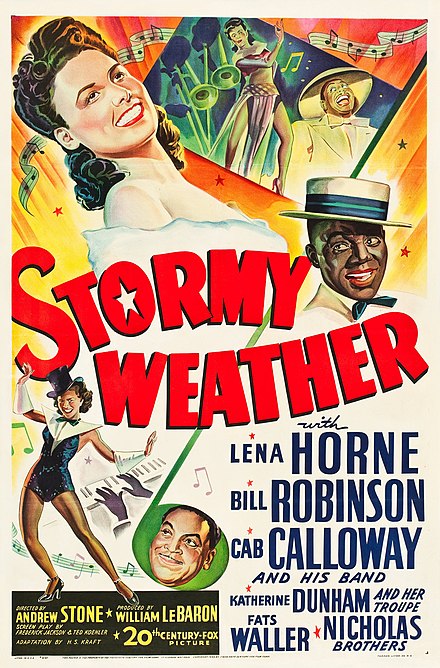
“Dancing, but on account of the bartender being sick, the cook had to take the bartender’s place, the waiter took the cook’s place, and I had to take the waiter’s place.”
Bill “Bojangles” Robinson become a movie star at the age of 57 when he danced up and down stairs with Shirley Temple in 1935’s The Little Colonel, and sashayed with Shirley through three more pictures during which the duo became Hollywood’s only inter-racial dance partners or, uh, pairing. Yet these scenes were routinely cut from film prints that were distributed in the South, and 20th Century Fox had difficulty finding a lead role for Bojangles. Liberal studio chief Darryl F. Zanuck certainly wanted to find something better for Bojangles, not least because his contract had made him the highest-paid Black performer in Hollywood.
Fox’s William LeBaron well knew that MGM was prepping Cabin in the Sky to co-star its contract player Lena Horne. When LeBaron asked MGM to loan Horne to Fox for Stormy Weather, both studios understood the arrangement, like all studio-loans, to be mutually beneficial, as the publicity generated by one studio would redound to the other’s benefit. Perhaps that’s why LeBaron didn’t cast Horne’s mentor Adelaide Hall, whose life the Selina character was roughly based upon, although it must be said the film is hardly the real biography of Horne, Hall, or Robinson. More than anything, Stormy Weather is an excuse to string together a succession of songs and performances by legendary African-American performers, showcasing samples of 25 years of some of the greatest music ever made. MGM’s Cabin in the Sky may have a more coherent narrative – or not, based on your views of angel-devil-driven stories – and it does feature Ethel Waters, Duke Ellington, and Louis Armstrong, but if you only have time for one, Stormy Weather features 20 songs in 77 minutes, several by stone-cold legends doing showstopping setpieces. Sean Griffin writes “the integrated structure of Cabin in the Sky leaves little room for the minority performer to disrupt the unified concepts of the white screenwriters, songwriters, director, and producer; the looser vaudeville structure of Stormy Weather creates more leeway for individual creativity.”
We start with the title card Stormy Weather over stormy, thundering credits. Bill Williamson is dancing “oh the rang tang tang” on his front porch with Black children when one of them brings Bill a magazine with his face on the cover, celebrating “the magnificent contribution of the colored race to entertainment of the last 25 years.” The kids gather round Bill reading, so two minutes into the picture, Bill flashbacks us to real footage of returning World War I soldier parades intercut with younger Bill bearing and beating a drum saying “Jim Europe’s 15th Infantry Band.” Bill’s army buddy Gabe brings Bill to a big, bluesy, blowsy New York bash where Bill is thunderstruck to meet and dance with the beautiful Selina Rogers, kid sister of his fallen troop-mate Clem and an emerging singing star in her own right, as she demonstrates with her performance of “There’s No Two Ways About Love.” Selina introduces her piano accompanist, Chick Bailey, who bears blues at befriending Bill and Gabe as Jim Europe introduces an elaborately choreographed number, “The Cake Walk,” during which Bill promises Selina he’ll return from Memphis after he becomes somebody. On a riverboat, an exhausted, cotton-sickened Bill finds his feet refreshed by the sounds of a scat band, sings to the other performers “I can do some shuffling too,” shuffles, and hears one commend Bill to a job at one of Memphis’s Beale Street cafés. At Ada Brown’s Beale St. Café, Bill waits tables while Ada Brown and poster headliner Fats Waller perform the frisky Dixieland duet “That Ain’t Right” including Fats singing, “Sister, I was born ballin’ and I’m gonna keep ballin’ all my life.” Ada and Fats scramble to look their best for the arrival of Chick Bailey, Selina Rogers, and their band, for whom Fats performs his song “Ain’t Misbehavin,” its first appearance in a movie. Chick invites all of Ada and Fats’ band to join him on tour, putting Bill out of a job, but Selina, happy to see Bill again, convinces Chick to let Bill join their tour and even start on top. Back in the frame story, the kids ask Bill if Chick kept his promise to put Bill on top, and we see that he did, making him wear tribal African clothes and a feathered wig as he beats a Zulu drum sitting on a stage’s tree branch to accompany Selina leading their troupe in the African-themed “Diga Diga Doo.” Backstage, Chick blows off as bourgeois both of Bill’s brainstorms, one to take Selina out for a sandwich, the other for Bill to dance when he should focus on drumming. During their next number, while Chick performs in a lei and straw hat in front of a dozen African-dressed drummers pounding barrel-sized drums, Bill puts down his sticks and begins dancing on his drum and the other drums to wild applause from the crowd. In the frame story, the kids hear about Chick learning the deal, firing Bill, getting punched by Bill, and later taking credit for discovering him. Bill tells the kids that he ran into Gabe again, shining shoes in New York, where Bill is trying to open a show in New York facing mutiny from the unpaid chorines, and soon, Gabe arrives at Bill’s rehearsal wearing a tux and tails, impressing the showgirls as a guardian angel of greenbacks. One chorine, Mae Johnson, performs the surprising song “I Lost My Sugar in Salt Lake City.” The troupe’s two comedians get suspicious of Gabe, put on blackface (yes, they’re African-American), and perform their “indefinite talk” “Bum Garage” routine. When they recognize Gabe as a bootblack, the chorines threaten him, but a lucky windfall to a random driver allows the show to go on, and Selina and Bill lead a swanky, splashy, stylish, sumptuous ensemble in “I Can’t Give You Anything But Love.” After landing a Hollywood contract in 1936, Bill offers Selina a home for her to settle in while he keeps performing, but she insists upon her independence. Bill and Selina go their separate ways, her to a successful career in Paris, him to that house where Bill is talking to the kids, who see a ritzy car approach and greet its driver with “Cab Calloway!” When Cab gets out calling “Hi-de-hiii-de-ho,” the kids, as is customary, call back “Hi-de-hiii-de-ho.” Bill corrects Cab that the kids aren’t his, but he keeps the house in case Selina ever comes back from Paris, and Cab invites Bill to the downtown club for its serviceman send-off. At the club, Cab Calloway renders “Geechy Joe” wriggling in a roomy white suit in front of his orchestra. Bill sits at a small table stunned to see Selina perform “Stormy Weather” with emotion attached to the lines “since my man and I ain’t together, keeps raining all the time”; the instrumental includes an intricate, abstract dance number performed by Katherine Dunham and her troupe. Backstage, Bill wishes Cab’s son well on his way to war and also wishes he had such a son only to see Selina agree and say she wants a future with Bill, leading to the two plus Cab reprising “There’s No Two Ways About Love” with feelings bursting through the artificial trappings. A large dance troupe finishes off the song before Cab Calloway takes center stage again to perform “The Jumpin’ Jive,” accompanied by his orchestra and, crucially, the Nicholas Brothers, who perform arguably the greatest duo dance captured in a 20th-century film. Wisely, the film recognizes that it can’t really follow that with anything but one more shot, and what a shot, 90 seconds of a roomful of recruits rumba-ing with women as we dolly in on center stage where Cab, Bill, and Selina sing “My, my ain’t that something to shout about.”
It’s true that there are stereotypes here, for example during the cakewalk scene with its Little Black Sambo figures. It’s also true that by 1943, Hollywood still hadn’t made an all-Black drama film, and wouldn’t for 18 more years, musicals being Hollywood’s favorite way to contextualize and distribute African-American culture. But with all that, I might love this film. Every time you turn around, there’s something sensational, spectacular, surprising, even stirring. I love that this ends with two such different and distinguished dances, one a modernist critique of white America by Katherine Dunham, the other an eyeball-popping duet by the Nicholas Brothers that Fred Astaire called “the greatest movie musical number” he had ever seen. (The Nicholas Brothers had been literally showstopping musicals since they signed with Fox; in a film before Stormy Weather, audiences would applaud so loud that the reels would need to be rewound.) Watching Dunham and the Nicholas Brothers in Act 3, one thinks that Stormy Weather couldn’t have asked Bojangles to pass the torch any better than that. In fact, now that he had finally headlined a major film, Bojangles didn’t feel like returning to stand-alone scenes, and Stormy Weather wound up as his final film; he died of heart failure at age 71 in 1949, his funeral attended by almost every then-famous and prestigious African-American.
In theory, 20th Century Fox’s decision to promote Stormy Weather with Lena Horne’s name and face appearing first – in Bojangles’ biopic! – should have represented another sort of torch-passing. However, Stormy Weather wound up as Horne’s first and last full lead role of the decade. MGM never quite knew what to do with her outside of guest-star roles, particularly when the studio failed to cast her in the role of Julie LaVerne in the 1951 remake of Show Boat, instead casting and song-dubbing Ava Gardner in blackface. Horne went on to a terrific career of recordings and performances, but was never quite the movie star she should have been.
Cabin in the Sky and Stormy Weather, both released in 1943, did decent but not spectacular business in the North, which wasn’t enough to make up for not being released in the South. Not for the first nor the last time, we see that the bar is set too high for all-African-American films: first, Hollywood cuts corners during their production and publicity campaigns, second, the films under-perform, and third, Hollywood shrugs and says such films aren’t profitable. This happened in 1929 with Hearts of Dixie and Hallelujah, in 1943 with Cabin in the Sky and Stormy Weather, and then in 1954 with Carmen Jones, and then more later.
Influenced by: Bojangles’ life, but very loosely; black music for 25 years
Influenced: as with the two all-Black musicals of 14 years before, Stormy Weather and Cabin in the Sky did well, but not well enough for skittish white moguls to take another chance like that for another 11 years, with Carmen Jones (1954); nonetheless this film reverberated, particularly with later dancers like Gregory Hines and Savion Glover
~
C15. The Gang’s All Here (Berkeley, 1943) BO clip imdb LB RT trailer wiki
stream on amazon watch analysis by Brody read analysis by Brody listen to my podcast
“Some people say I dress too gay, but every day I feel so gay, and when I’m gay I dress that way, is something wrong with that?.”
Fox’s habit of having Carmen Miranda perform a pastiche of pan-Latin-American, white-written versions of Mexican, Cuban, Portuguese, and Argentinian dances and cultures soured many Brazilians on Miranda. Carmen recorded a song meant to explain herself to her countrymen called “Bananas is my Business”; the song may not have helped her with Brazilians, but it sure helped Busby Berkeley as he was putting together his full-color, full-camp “Lady in the Tutti-Frutti Hat” segment for The Gang’s All Here. Berkeley knew he had to observe Miranda’s contract, which included her backing band and a restriction against ever cutting from her face while she sang. Berkeley leaned into this in more ways than one.
For everything 20th Century Fox paid for Technicolor film and Berkeley and the chorines, there didn’t seem to be a lot left in its record budget for music or strong lead male actors. Granted, many of the studio’s best men were then enlisted men, but James Ellison practically sleepwalks through his role as the young romantic lead, and Phil Baker, as our host comedian, is never funny; the least Marx Brother or Stooge or silent genius would have done more with the role. Benny Goodman carries Ellison’s and Baker’s same sense of bemused entitlement as well as none of Benny’s better songs, as though the self-appointed “King of Swing” didn’t want to risk Fox laying claim to his most swinging things. After watching Stormy Weather, knowing it was just filmed on the same lot, one can’t help but wish LeBaron would have rehired Cab Calloway or Fats Waller or Ada Brown to truly earn the title The Gang’s All Here.
The Gang’s All Here begins with the darkest actor in the film, medium-shaded Nestor Amaral, crooning softly in Portugese in complete darkness until the camera pans over to a ship, the S.S. Brazil, where uptempo female voices carry the “Brazil” melody. Into New York, the ship unloads passengers and one car-sized net of assorted fruit, which the camera pans down until it comes to the hat of just-disembarked Dorita, who descants in Portugese, receives the city key from Fiorello’s rep, and continues cantillating in colloquial English “you discover you’re in New York.” We discover we’re noton New York’s docks but on an obvious set at a ritzy club where some dinner patrons turn out to be blue-eyed blondes a la Busby Berkeley, singing one line each in close-up as the camera pans along. At the song’s conclusion, host Phil Baker quips “well, there’s your good neighbor policy” while wealthy Andrew Mason brings his jittery business partner Peyton Potter to the risqué show where he laughs at Peyton’s prudish personality alongside his son, Andy Mason. Phil Baker introduces a “new sensation,” the “Uncle Samba,” signifying sweethearts samba-dancing with soldiers, interrupted by Andrew Mason Senior, who dances with Edie Allen, whom Andy fancies from afar. When Phil offers $50 that Andy will go down swinging like Casey at the bat, Andy takes that bet and follows Edie to the Broadway Canteen, where we soon see Benny Goodman and his orchestra performing “Minnie’s in the Money” for a crowd of hundreds of troops and other white people. (In real life, New York’s Stage Door Canteen was known for being integrated, especially during the war; none of that is suggested in The Gang’s All Here.) Andy dances and flirts with Edie, but lies that his name is Casey, because he doesn’t want a woman who only cares about wealth, even as she lies that she expects him to spend $50 on their night, because she doesn’t want a man who cares about wealth…but she comps him a sweetheart seat for the Club New Yorker’s show. The extensive, extravagant, extraordinary exegesis of “The Lady in the Tutti Frutti Hat” begins with at least fifty chorines lying around an exaggerated tropical island set wearing yellow-and-black outfits that expose their shoulders, midriffs, and legs. They run over to Dorita, who is beset by closer-clothed bandoleros and her own very fruity attire as she sings, among other lyrics, “Some people say, I dress too gay, but every day, I feel so gay, and when I’m gay, I dress that way, is something wrong with that? N-o.” The chorines hold human-sized, plastic bananas in plenty of positions, including swinging them up and down in various stances like a six-pointed star made by other supine chorines. As Dorita sings of Brazilian señoritas being sweet and shy, the women return to their tropical layabout positions. Edie hits the town with Andy, arrives at a ship, sings “A Journey to a Star,” lets him kiss her goodnight, and looks at the stars hopefully. At a pool party at the Potter’s Westchester house, we meet Vivian Potter, Andy’s girlfriend, and her mom, Blossom Potter, who sees a newspaper photo of her husband Peyton awkwardly dancing with Dorita and dramatically dances with a young dude as retaliation. At Grand Central Station, Edie promises Andy she’ll write every day, kisses him goodbye, watches him leave, and runs into Phil and Dorita, who describes her first horse race as mostly a matter of wasted tickets that she throws into the air, landing on a passing woman’s newspaper segueing into a rather up-to-the-minute montage of headlines blaring defeats of “Jap Ships” double-exposed with Andy, who earns medals and a trip back home. Mason Sr. wants to do something special for his son, grabs Potter, goes to Phil’s club, and proposes, to Potter’s chagrin, Potter’s Westchester house as a rehearsal space for a war-bond fund-raising show, to Dorita’s definite delight and disfigured English. Phil shows Potter and Mason his latest stage number, Edie solo-singing “No love, no nothing, ’til my baby comes home,” a song we’re meant to see as more than faked for Phil. Dorita, Phil, Edie, and Vivian share a car to Westchester, where Vivian and Edie realize their men, Andy and Casey, are both returning from Australia, not realizing, as we do, that they’re the same person. At the country estate, Blossom Potter cordially welcomes Benny Goodman, Edie, everyone else, and Dorita, whom Blossom characterizes as a dangerous element. Italian-American dance legend Tony DeMarco, playing a temperamental Spanish-speaking stage manager named Tony DeMarco, extirpates in explosive Español at Peyton Potter’s roses and rudeness, but when he sees Vivian, the two share an enchanted dance duet that has Tony demanding the young chanteuse in his pageant. Blossom conspires with Phil to fake-threaten Peyton with revealing Blossom’s former nightclub identity, and Peyton curiously and furiously falls for it. Vivian shows Dorita a framed picture of Andy whom Dorita recognizes as Edie’s beau, and so when Edie enters, Dorita hides the framed photo behind her back, steals it out of the room, sleeps with it under her pillow, gets woke by Edie, and lies it was Andy’s surprise. Dorita brings Peyton Potter mint juleps, japes in jumbled jargon, asks for investment advice, kisses his face with a big lipstick smear for each recommendation, and inspires him to come on to her. Peyton watches his wife wander in, chases Dorita out, and tells his wife they were merely discussing investments, to which Blossom replies “No wonder you come home from the office so tired” causing him to wipe off his brow, see the lipstick, call it ketchup, and for her to reply, “No doubt. And from a Brazilian tomato.” Cornered, Dorita confesses to Edie that she and Vivian share the same sweetheart, as Dorita moves from reversals to rehearsal”ing”s. Andy comes home, reunites with Vivian, sees Edie, pretends not to know her, watches Vivian run to rehearsal, and tries to make up with Edie, who curses her writing him every day and leaves Andy to Vivian. An embroidered message invites us to a War Bond Garden Party which opens with Benny Goodman’s orchestra playing “Paducah,” sung sedately by Goodman, then spicily by Dorita who also samba-dances with Tony and a band of bubbly bandoleros. Edie reprises “A Journey to a Star” with a Greek chorus (of singers) and Tony and Vivian’s spotlighted dance, after which Vivian confides in Edie that Tony is taking Vivian to New York as her new dance partner and so she’ll end her relationship with Andy which was just kid stuff anyway? Edie gets onstage with ballroom-dancing children in polka-dot bow-ties and polka-dot dresses to perform the 1880-themed “The Polka Dot Polka.” From her song-ending vocals, the film transitions to surreal neon pink circles in blackness that become glowing hula hoops held by scores of futuristically dressed dancers…moving into more Dali-esque, kaleidoscopic imagery that culminates in longshot-to-closeups of each cast member taking turns on “A Journey to a Star,” ending on a shot of dozens of detached heads harmonizing over a blue background as pink fountain-water surges from the bottom to signal The End.
Pauline Kael wrote, “those who consider Berkeley a master consider this his masterpiece.” Shari Roberts wrote, “while Carmen Miranda’s parodic star text offers various negative images of Latin Americans and of women, her persona also reveals these images as stereotypes, allowing for negotiated reading by fans.” In interviews, Miranda often seemed to wink at anyone who was taking her bombshell status too seriously.
I have mixed feelings about the number The Lady in the Tutti-Frutti Hat. I think aspects of it are fine. The sexualization of the women and the bananas seems calculated to test the audience’s Puritanism. I understand why some scholars see a commodification or fetishization or sexualization of Latin American women, for example Griffin writing with Harry Benshoff that the number “presents Latin America almost like a theme park for US tourists to revel in, without any real sense of the region’s economics, politics, or culture…overflowing with abundance just waiting to be sampled by the North American male spectator.” But that would actually bother me less if it wasn’t for the matching peaches-and-cream skin tone of the scores of chorines in the number. Is this supposed to represent Latin America, Brazil, or Bahia, the mostly African-descended area that inspired Miranda’s association with bananas? To me, the beauty of all of those places involves a much wider spectrum of colors. I would enjoy an update of this iconic number where the color palette of the chorines more closely resembled that of any of Brazil’s soccer teams. But, oh well.
Some critics now call the ending proto-psychedelia. Contemporary reviewers compared the ending of the film to Fantasia, which is interesting because of all the studios, Fox and Disney seemed most interested in Roosevelt and Rockefeller’s Good Neighbor Policy, Disney making Saludos Amigos and The Three Caballeros about Donald Duck traveling around Latin America with his Mexican bird friend Panchito and his Brazilian bird friend Jose, the latter of whom takes Donald to Bahia to meet Aurora Miranda, Carmen’s real-life sister. If you’re introducing kids to the Good Neighbor Policy, you might start with one of Disney’s 40s films, but for adults, I believe The Gang’s All Here is probably the best filmic example of the policy as well as of Miranda’s star image.
Influenced by: though this was his first film in color, Berkeley’s long history with objectifying yet glorifying women is worth discussing, particularly as the scores of “Brazilian” female dancers are all as white as paper; Miranda’s “Lady in the Tutti Frutti Hat” wasn’t quite original to this film, although this took it to its campy extreme
Influenced: long considered a camp classic and a sort of gay totem, this also influenced ideas about Latina women
~
C16. Gentleman’s Agreement (Kazan, 1947) BO clip imdb LB RT trailer wiki
stream on amazon watch analysis by Hayes read analysis by Cabin listen to my podcast
“Because the world still makes it an advantage not to be one. Thus it becomes a matter of pride to go on calling ourselves Jews.”
Darryl Zanuck read Laura Hobson’s new novel Gentleman’s Agreement and found himself relating to it as a Gentile often mistaken for Jewish, perhaps because he was the only non-Jewish studio mogul. Perhaps that’s why Zanuck felt he could ignore Jewish friends like Samuel Goldwyn and Louis B. Mayer who warned him that the film version would only stir up trouble.
Journalist and novelist Laura Hobson said she was inspired to write Gentleman’s Agreement not because she knew of any Gentile reporter who had gone undercover as a Jew, but because in 1944, Congressman John Rankin called Walter Winchell a “little kike” and was applauded in Congress. No one should believe anyone retconning World War II as Americans fighting to save Jews; instead, people should read the story of the SS St. Louis, when Florida refused to take a ship full of 900 Jewish refugees who were returned to Europe and, in many cases, slaughtered by Nazis. American soldiers were as surprised as anyone else to learn, in 1945, what Hitler was actually doing in the concentration camps, and for years afterward, many denied or repressed the truth.
Darryl Zanuck had already told the press, “We are in this business primarily to provide entertainment, but in doing so we do not dodge the issue if we can also provide enlightenment.” He was not a denier or represser, something Laura Hobson knew when she sold him the film rights shortly after her book hit #1 on the New York Times bestseller list. For the adaptation Zanuck hired the Jewish writer Moss Hart, friend of Dore Schary’s and likely the most prestigious playwright/screenwriter on both coasts. When Moss Hart wondered about the screenplay actually naming anti-Semitic politicians like Rankin, Zanuck told Hart he hoped they got the publicity of a lawsuit. As for a director, Zanuck felt he could rely upon Greek-American Elia Kazan.
Gentleman’s Agreement begins with journalist and widower Philip Schuyler Green and his eleven-year-old son Tommy newly arriving in Manhattan and meeting up with Phil’s mother, Ma Green. Phil takes an elevator up to Smith’s Weekly to meet with his new editor Mr. Minify, who pitches him on an anti-Semitism article for a couple of hours, takes him to his mansion for dinner, and introduces him to his niece Kathy, who had suggested the anti-Semitism essay. At breakfast with his father, Tommy asks for and receives definitions of Jews and anti-Semitism, but his dad struggles to explain why Jews are hated. Later, Mrs. Green says she’d like to live in a world where such conversations were unnecessary for kids like Tommy or, long ago, Phil. Eschewing his prior reluctance, Phil praises the premise to his editor, who tells him he expects a wide scope that includes interviews with ingratiating people who don’t think they’re anti-Semitic…and Phil and Kathy share a pleasant dinner bantering about assumptions. Phil brainstorms with his mother, hits upon asking his army buddy Dave Goldman what it’s like to be Jewish, and then decides to write Dave a more anodyne letter. Ma Green has serious heart pains that scare her family, though the doctor advises they may only be false angina. While caring for her, Phil remembers his reporter experiences of living as an Okie and coal miner, and realizes the angle he needs is pretending to be Jewish, a conceit assured by his anonymity in New York and his dark eyes and hair. Phil invites Kathy over to explain his idea, excitedly says “I know there will be stumbling blocks, but I don’t care,” and then at the last second…expresses his enthusiasm with a kiss as though that were the surprise, and even escalates to a marriage proposal. Mr. Minify loves the Jew-face idea and hosts a posh luncheon where a person proposes Minify pay no mind to the problem, ironically proving the need for the piece. When Phil tells his new secretary to prepare job applications under two different names, Green and Greenberg, she admits she changed her own name to Wales because Smith’s Weekly turned her down under her Polish name. Phil gets more comfortable living with the pretense as it provokes petty anti-Semitism from his family doctor and landlord. At a patio dinner, after Kathy learns more about Phil’s story angle, she insists on knowing if Phil is really Jewish, a question that hangs like a dark cloud over their evening until Phil leaves, returns, and they forgive each other in a warm embrace. In front of Phil, Mr. Minify condemns a subordinate for failing to hire any Jewish secretaries, and as he leaves, Minify decries “the sloppy notion that everybody’s doing bigger things, there isn’t anything bigger than beating down the complacency about prejudice.” Miss Wales worries to Phil that the new hiring guidelines will hurt her if a “kikey” girl is hired, leading to Phil dressing her down about that word and any other racial slur (he says some) from a Jew or a Gentile. At Phil’s lunch with liberal fashion editor Anne Dettrey, a third reporter presumes that if Phil served, it must have been in public relations, causing Phil to question why he couldn’t have been a G.I., the man to begin “Some of my best friends are…” and Anne to cut him off with “Some of your best friends are Methodist, but you never feel the need to mention that, do you?” Anne invites Phil and her fiancée to a society party, where she introduces them to Dr. Lieberman, a physicist who, at Phil’s prompting, discusses Palestine, Zionism, race, science, and his opinion that secular Jews still avow their Jewishness out of pride because anti-Semitism persists. At Kathy’s place, she admits she confided in her sister that Phil is only faking Jewishness prior to them coming to Connecticut for a pre-nuptial party, making Phil upset at Kathy making any loopholes or assurances. When Tommy tells Dad kids want to know if he’s Jewish, Phil says he’s pretending for a story, but asks Tommy to tell curious kids Dad said he’s partly Jewish. Dave arrives for a surprise visit, eats Ma Green’s pancakes, explains that a great job offer has him searching for a place in New York big enough for Carol and his kids, accepts Phil’s offer to crash at Phil’s, and listens with fascination about Phil’s fake Jewishness and real problems with Kathy. Later, Dave, Anne, and Phil enjoy a laugh-filled lunch until a stranger sees Dave’s military uniform, asks him his name, hears Dave say “Dave Goldman,” says “I don’t like officers, especially if they’re Yids,” and provokes Dave to stand and snatch the stranger’s collar until his friend breaks it up. Kathy calls Phil to say that he’d be so proud of her for straightening out her relatives, although at the party in ritzy, recherche Darien, Connecticut, Kathy grills her sister why only the “safe” families seem to be there. Kathy shows Phil a lovely cottage she made that looks like something from a Katharine Hepburn screwball comedy, with Kathy saying she and it have been always waiting for Phil. When Kathy gives away that they’re honeymooning at the Flume Inn, Anne tells the couple it’s restricted, and Dave says knowingly the hotel will never directly admit it but instead exaggerate some excuse for exclusion. When Kathy resists Phil’s idea to stand up to such snobs, Phil speechifies, “They’re persistent little traitors to everything this country stands for and stands on, and you have to fight ’em.” At the hotel, Phil signs in and says “One more thing, is your hotel restricted?” leading the manager to ask why he wants to know, Phil to demand a simple answer to a simple question, and the manager to mention some mistake because there isn’t actually an available accommodation. Phil shouts in the crowded hotel lobby “Do you or do you not accept Jews?” as the manager leaves and, to several stony stares, so does Phil. After Dave says he can’t take his dream job because he can’t find a place big enough for his family, Phil privately grills Kathy why Dave can’t live in her cottage, and she cites a “gentleman’s agreement” about not renting to Jews in Darien. Tommy says he was beaten up at school and called a dirty Jew and kike, but when Kathy comforts him by saying “it’s not true! You’re no more Jewish than I am!” Phil reprimands Kathy, pulls Tommy away, gets Tommy’s full hateful story, and praises Tommy for not declaring himself Gentile or pretending there’s anything wrong with being Jewish. Phil and Kathy have it out, with Phil saying she assured Tommy of his superiority, Kathy saying “they” turn friends against each other, Phil saying he now sees how prejudice thrives among the supposedly non-prejudiced, and Kathy, on her way out, saying she admits being glad of not being Jewish, comparing it to preferring youth to oldness or health to sickness or wealth to poverty. When Phil hands Miss Wales his story with its suggested headline “I was Jewish for Eight Weeks,” she’s shocked that he’s Christian and Phil upbraids her for self-hatred and being shocked that anyone would give up Christianity for two months. Phil quits Smith’s Weekly even though everyone is thrilled about his piece, with the photo editor joking to Phil that “you Christians are so loud and pushy.” Phil eats a private dinner with Anne, who excoriates Kathy for “clucking her disapproval” and speechifies that more citizens need to assume more stands against soft bigotry. At a restaurant, Kathy assures Dave she’s not anti-Semitic because she first suggested the story, and yet she tells another story about a man at dinner telling an anti-Semitic story with no active resistance from Kathy. Ma Green reads aloud some choice quotes from her son’s article about what it’s like to feel the shame of jobs supposedly filled and kids knocked around and how the founding fathers felt that and fought to fix such favoritism. Dave arrives with the news that Kathy bravely gave Dave her cottage, causing Ma Green to make her own rousing speech about how maybe this won’t be the American century or Russian century or atomic century but instead, “when people all over the world – free people – found a way to live together? I’d like to be around to see some of that… even the beginning. I may stick around for quite a while.” In a final coda, Phil returns to Kathy’s embrace.
On the one hand, some people should absolutely never be forgiven. But I do think some people, sometimes, should have some kind of path to forgiveness. However clunkily, this movie actualizes a version of this. Gentleman’s Agreementwould be a very brave movie if it came out now with major stars in the main roles. It would be canceled before it began.
In later years, Kazan, Peck, and Zanuck would all describe this movie using adjectives like “quaint,” so it’s now hard to believe that in 1947 other moguls had cautioned against making it. Let’s be very clear that the notion of a straight cisgender WASPy man “stooping” to understand a marginalized group can be very different depending on the codes of the group; what may seem funny in Some Like It Hot may be coded very differently in films like Black Like Me, Little Big Man, and many others. Prejudice is no simple topic; on the one hand, different groups absolutely experience different very specific forms of prejudice, and so if you’re changing a queer man into a straight Jew, as Crossfire did, it’s hardly enough to simply rewrite a few terms. On the other hand, it would be naïve to suggest that the experience of American discrimination can’t be generalized at all. At its best, Gentleman’s Agreement is both specific about anti-Semitism and also generalizable about prejudice in America. After Gentleman’s Agreement earned a lot of money and won the Best Picture Oscar for 1947, making this the third and most politically conscious Best Picture in a row, a small section of Hollywood felt emboldened to make films to help bring forth the world that Ma Green describes at the end of Gentleman’s Agreement.
Influenced by: Kazan’s life in theater
Influenced: validated the “social problem” film which flourished for a few years
~
C17. Home of the Brave (Robson, 1949) BO clip imdb LB RT trailer wiki
stream on amazon watch analysis by Bogle read analysis by Astell listen to my podcast

“Divided we fall, united we stand, coward take my coward’s hand.”
In early 1949, Stanley Kramer sought a way to differentiate his upstart independent production company from John Ford’s and Howard Hawks’s and Humphrey Bogart’s, etc. As Kramer put it, “Instead of relying on star names, we pinned our faith in stories that had something to say. If it happened to be something that other movies hadn’t said before, so much the better.”
This pitch worked on the obviously wealthy father of their friend Robert Stillman, who came up with the entire small $250,000 budget for Home of the Brave. The budget included a hefty fee for the rights to Arthur Laurents’ play “Home of the Brave,” because it had run on Broadway for 69 performances in early 1946. Having spent that much money, Kramer told Laurents that the lead character would change from Jewish to African-American, because “Jews have been done,” and maybe because President Truman had just ordered the Armed Forces to be racially integrated. Foreman, as white as Kramer, worked on the script to make sure that their Peter Moss would speak of experiences specific to an American Black man.
Kramer hired Mark Robson, RKO B-film director, as he had on Champion, because Kramer could trust Robson to work efficiently, not require too many takes, and manage three locations simultaneously for 30 days to keep the union guys from going over-schedule. (Those three locations were an RKO indoor backlot of a jungle set, an RKO indoor backlot of a tin-shack hut set, and an unused beach north of Malibu.) Kramer also trusted Robson to work in secret, using the phony production title High Noon, which Foreman and Kramer would use for real three years later. Kramer felt he had to keep under the radar of the Hays Office for many reasons, not least the film’s frequent use of the n-word, a term Peck’s character had only spoken quickly in Gentleman’s Agreement as part of a list of many slurs his secretary shouldn’t speak about others or herself. Yes, forgiveness is easier than permission: the Hays Office saw the film just before its release, and made it the first film officially permitted to use the n-word since the stricter rules began in 1934. The title now went way beyond Laurents’ play: this celluloid was the Home of the first movie Brave enough to truly take on that term.
Home of the Brave begins with real footage of the war in the Pacific. On a base in a tropical hut, an army psychiatrist tells two officers that because Private Peter Moss has lost use of his legs and memory, he needs the officers to offer more information about the mission. In Major Robinson’s flashback, lower officers Finch, Mingo, and T.J. gather in a tropical hut where Robinson tells them of a four-day mission for four men to survey an island that “Japs” half-control. The mission is voluntary, but they are three of the four best-qualified, and they are all stunned to meet the entering fourth, Private Moss, an African-American whom Finch embraces as an old school friend. In a private room, Robinson calls his colonel to complain that the engineer he sent is colored, and the colonel counters citing a manpower shortage saying “I wouldn’t care if he was purple all over and had green stripes down his back…What do you think this is, a war or a country club tea dance?” Mingo and T.J. trade accusations of being scared, prejudiced, or just reluctant to work with someone unfamiliar, but when Robinson returns to ask who’s volunteering and who isn’t, only Finch and Moss step forward. Back at the shrink’s office, the doctor says his narcosynthesis is helping but may never solve the root problems, and soon T.J. wheels in Moss, who doesn’t recognize Robinson or the names Finch and Mingo. Privately, the Doctor sedates Moss and asks what he can recall of the other men on the mission, and a half-conscious Moss gives the men half-compliments, except for Finch who hates him like all whites hate him…Moss says to forget that as he flashes back into a college basketball game where Moss and Finch play as teammates. In flashback one evening, Finch comes to Moss’s porch where Moss admits he missed dinner because most of Finch’s friends don’t treat him as well as Finch does. After the doctor pushes, the groggy Moss recounts the mission on a PT boat arriving in darkness worrying about a rumored 15,000 Japs on the island. After they’re dug in, when the men complain bitterly about the C-rations, Moss breaks out some fried chicken that the men greedily devour as T.J. notes that colored men are great cooks and comedians, for example his janitor in Chicago, whom he imitates saying “I is so tired, I spose I was born tired” without noticing Moss’s disgust. Finch and Moss share bush patrol and discuss after-war plans that Finch thinks to combine into a great restaurant-bar. The men do their surveying, mapmaking, and ground-sampling work for four days; Robinson orders TJ to bring him a compass, TJ walks a click to order Moss to get the compass, Finch says he’ll get it, TJ stops Finch, Finch calls out TJ’s behavior since they arrived, TJ calls Moss a shoeshine, and TJ calls Finch an n-word-lover, although unlike me he says that n-word. When Mingo breaks up TJ and Finch’s fistfight, he says to save it for the Japs, causing TJ to answer Finch is more interested in saving his yellow-bellied n-word friend. Mingo sends TJ away to ask Finch and Moss to understand that a 36-year-old civilian hasn’t caught up to the world or the army, but Moss asks them to understand childhood episodes of slurs and bullying and fights and Moss blurts, “what do you want us to do? What do you want us to be?” As Finch asks if they’re still friends, as Moss calls him a corny dope, they hear gunshots and quickly move into combat readiness. TJ and Robinson rejoin them, Moss shoots an enemy out of a tree, and Mingo takes a bullet. On their retreat, Finch insists on going back for the map case as Moss insists that he forget it until an exasperated Finch turns to Moss and says “shut up you dirty yellow-bellied ni—” uh, “nitwit.” Finch takes another bullet, falls, sees Moss hiding, throws him the map case, and says he’s sorry for his slur before more gunfire makes Moss retreat. The men hear Finch crying out in pain, but forbid Moss from going after him, because the enemy is torturing Finch hoping to lure and kill more of them. Mingo tries to comfort Moss with a poem that ends, “coward, take my coward’s hand.” Later, Moss sits alone in a clearing hating and repeating the n-word, sees Finch crawling to him, tells him “I missed you dope,” and…watches Finch die in his arms. The platoon’s rescue PT boat arrives on time as the men find Moss trying to bury Finch, but when they prompt him, he says he can’t walk and doesn’t know why, so TJ bears him on his back as they scramble out of the jungle onto their dinghy to the PT boat. Back in the doctor’s office, the doctor asks the hazy-eyed Moss why he can’t walk and Moss says the incident with the “nitwit” innuendo told him Finch had lied and “hated me because I was black.” When Moss admits he was at first glad that Finch was shot, because of the nitwit insinuation, the doctor contradicts him: “Every soldier in this world who sees a buddy get shot has that one moment when he feels glad…I’m glad it wasn’t me. I’m glad I’m still alive.” Calling him Peter, the doctor tries to convince Moss his guilt is normal, not racial, not part of the same guilt that came from 150 years of slavery leading to second-class citizenship and the sort of people calling him names who actually need more mental help than Moss does. The doctor repeatedly orders Moss to walk, but when Moss repeatedly refuses, the doctor calls him a dirty n-word (yes, he says it) and inspires Moss to truly take a few angry steps forward. A one-armed Mingo bickers with TJ until Moss walks in and TJ claims Moss, going home as a war hero, will soon attract all the high-yellows with long hair. After Mingo and Moss remove TJ from the room, Moss falls apart making Mingo admit his own breakdown when he woke up without an arm, thinking back to all the times he’d felt glad when other buddies had fallen. Moss asks who told him to say that, but when he realizes Mingo is on the level, Moss accepts that they have something important in common. In the final moment, Mingo asks Moss if he, Mingo, can become Moss’s new business partner as their transport arrives to start their voyage home.
Spike Lee put it on his short must-see movie list. One thing I like about Home of the Brave is that it’s as sensitive to Black issues as it is to disability issues. There are several films about a paralyzed person who learns to put mind over matter and walk by the end, like one we’ll be looking at in a few minutes, but I appreciate that after Moss can walk, he forms a bond with now-one-armed Mingo. In other words, instead of ending with the magical elimination of disability, the story invites us to remember that some wounds won’t be healing.
The low-budget-ness of the film is somewhat obvious, but I think it’s saved by tremendous performances from Jeff Corey as the doctor, Lloyd Bridges as the friend, and especially James Edwards as Peter Moss, who is called upon to express almost every emotion a person could possibly express in a film.
In Donald Bogle’s short history of Black Hollywood, “Bright Boulevards Bold Dreams,” Bogle devotes three pages to the fascinating biography of James Edwards, including a hospital stay after a debilitating injury in which a racist soldier in the next bed gradually warmed to him, something Bogle says could have easily been written into Home of the Brave. Edwards played a few of the supporting roles that were, before 1949, the only ones offered to black men not named Stepin Fetchit or Bojangles, and because of two of them, Stanley Kramer offered him Peter Moss if he would work for wastrel wages. Per Bogle, Edwards said, “I told Mr. Kramer, I’d play the part just for three meals a day and a place to sleep. Money was unimportant. This is the kind of role that happens only once in any actor’s life.” Bogle goes on, “Home of the Brave transformed Edwards into a symbol of a new era for African Americans in movies.” Diahaan Carroll felt he had become the only really famous black actor, “who had done the undoable by creating the image of the black man as a sensitive, intelligent, articulate human being who had to be reckoned with.”
Influenced by: the sense that extant World War II stories were missing something
Influenced: if nothing else, started Stanley Kramer’s career, which would prove the standard of Hollywood liberalism
~
C18. Border Incident (Mann, 1950) BO clip imdb LB RT trailer wiki
stream on amazon watch analysis by Muller read analysis by Danks listen to my podcast
“What is cheaper than time, señor? Everybody has the same amount.”
One reason MGM hired Dore Schary was his association with B-film director Anthony Mann and his favorite director of photography John Alton; the pair had impressed many with the semi-documentary look of 1947’s T-Men. MGM got the men making noirish movies up to and including Border Incident, the film that pivoted both men from B-films to A-films. Border Incident begins with bright daytime scenes, but eventually dives deep into Alton’s characteristic palette of greys and blacks that well suit the material. Elsewhere, I expanded on how Mann planned but was canned from Spartacus, but it’s odd that this director’s director isn’t more directly responsible for canonized films. Maybe one reason is that after Border Incident, Mann made some of the 50s’ best westerns that starred but did not exactly compliment white men, or as Benshoff and Griffin put it: “The Westerns of director Anthony Mann often figured their white heroes as obsessed neurotics.”
Border Incident was the first Hollywood film to examine the bracero program, which began in 1942 because American farmers had been drafted for war and needed willing Mexicans to till the crops and fill the jobs. Braceros were granted temporary work permits and living wages, but some criminals attempted to take advantage of these on both sides of the border, leading to restrictions from Mexico through 1947. After the U.S. promised to punish U.S. companies who hired illegal workers, Mexico lifted many restrictions in 1948, leading the total number of braceros to rise to about 200,000 a year…despite the fact that the U.S. didn’t really pursue its promised punishments. During the 1940s, the bracero program was a win-win enthusiastically endorsed by most Americans and most Mexicans; the spirit of boisterous bilateral relations in the film is maybe a bit overdone, but also somewhat representative of the period.
Border Incident is remarkable for casting an actual Mexican-American, Ricardo Montalban, as its Mexican hero, instead of casting a white star in brownface as, uh, Elia Kazan did three years later when Viva Zapata brought forth a remarkably bronzey Brando as, uh, Emiliano Zapata. Even more remarkable was Montalban’s career up to that point, marketed by MGM as the latest Latin Lover supporting those splashy sunny films Mayer favored. Border Incident represented Montalban’s first lead role, the first time his name appeared first in the credits, and, when it was released in late 1949, Montalban became the first Latino actor to appear on the cover of Life magazine.
Border Incident opens with aerial shots of the U.S.-Mexico border and farmlands as the newsreel narrator explains the bracero program feeds Americans, mostly employs law-abiding Mexicans, but as we see, it also employs illegals who do the labor, get paid, dash back across the border, and get robbed and killed and buried by bandits. On an airplane from Mexico City come Rafael Alvarado and Pablo Rodriguez, two of Mexico’s top criminal investigators, while another airplane from Washington brings John McReynolds and Jack Beanres. In a government office in Mexicali, on the southern side of the border, the four men agree that Jack will secretly trail Pablo as he goes undercover presenting himself as a bracero trying to be smuggled from Mexicali to Calexico. Pablo wears a sombrero and denim, mingles with the enormous crowd seeking permits, befriends one Juan, sees Juan get rejected, learns Juan has done this every day for six weeks, and asks Juan if there’s a fleeter, less legal way. Juan sends Pablo to a man who takes Pablo’s 70 pesos and tells him to meet in front of La Fortuna Barberia at 10pm. Juan prays at a church, says goodbye to his mother, and joins Pablo at the meeting point. Juan, Pablo and others are “pssst”ed into a building where a gypsy-ish woman checks their hands, lets Pablo pass, makes sure he’s out of earshot, tells an associate he doesn’t have bracero hands and should be observed closely, watches all the men leave, sees Jack tail them, and asks her own man to tail the gringo, but Jack tails his tail and takes him out. At the backroom of the Perla de Oro, when supervisor Hugo accuses Pablo of faking it, Pablo suggests reasons why a non-bracero might want to be one, for example being on the run for handling money for a convicted drug dealer. After Jack tips off the police, their banging on the door prompts Pablo to beg Hugo to keep him from the Tres Marias island prison, so Hugo agreeingly hustles Pablo with the others into the truck, and the police charge in to find an empty bar. In a hidden compartment under the fake truck floor that looks like a brutal middle passage, Pablo rides with Juan and an old man who has a heart attack and dies, so the drivers take his corpse and leave it in the desert. At the next junction, the men file into a trailer camper as their Mexican driver accepts $330 ($30 per head) from Jeff, a new white man who wants a cut of their return fee and asks what happened to the 12th man. At the next junction, Parkson’s farm, Jeff learns Parkson has no faked permits for these people, leading to an argument about where else they might go, leading to Parkson reluctantly agreeing to temporarily mix in this group with his legal workers. When Juan asks why he is being paid 25 cents an hour compared to the 75 cents an hour he was promised in Mexico, Jeff calls him a law-breaker who should be happy with what he gets. Undercover, Jack leaves an immigration permit on the bar at Perla de Oro, so that night Hugo sends his men, Zopilote and Cuchillo, to wake up Jack, search him and his safe, threaten him, bring him to Hugo, and torture him. Jack gives up his Jack Bryant ID, shows his criminal record, and tells Hugo that he’ll have to pay top dollar for the other 400 permits he’s hidden. Zopilote and Cuchillo cross the border to Parkson’s to offer him the 400 work permits from Hugo’s prisoner Jack Bryant, but Parkson surprises them by unveiling Jack Bryant, brought over by Jeff. Jack dismisses Zopilote and Cuchillo, haggles with Parkson, agrees to $10 per permit, writes a wire to Kansas City, and reluctantly agrees to remain in Parkson’s water tower until the permits arrive. Juan’s stray comment causes Pablo to realize where Jack is, sneak off to see him, obtain whispered instructions to contact Neely in Calexico, run through a lettuce patch, and barely avoid being shot by Jeff, to whom he pretends he was just going to mail a letter to a sweetheart. Parkson’s man Clay seizes Jack’s driver’s license, rides a motorcycle to the Calexico Post Office, asks for a package for Jack Bryant, shows them the ID, gets spotted by smart cops, rides back, gets chased by a cop car, and loses the tail on a train trestle. Parkson purloins the package of permits, makes arrangements with Hugo on the phone for a hundred more braceros, negotiates with Jack, and that night commands Jeff to distribute permits to a hundred braceros and ships them in separate trucks to various southwestern ranches. At the last moment, a phone call from Kansas City tells Parkson that Jack must be a cop, resulting in a brief fight that Jack loses. In the covered flatbed of a departing truck, Pablo sees Jeff and Clay leading Jack to execution, cuts open the cover, jumps on the truck running board, beats up and ejects the driver, takes over the truck, U-turns it, reveals his true identity to Juan, and explains they need to help Jack who is a “friend of all braceros.” Juan and Pablo cross a river to sneak onto a field that Clay covers with a rifle, meaning they can do little but crawl and watch in claustrophobic low-angle shots as Jeff kills Jack by driving a harvester over him. However, Pablo does manage to drive the truck some distance, stop at a friendly house, tell Juan to tell the ten other riding braceros what’s happening, enter the house, order a frazzled Mrs. Amboy to let him use the phone, call agents in Calexico, and tell them to come arrest Jeff and Clay for Jack’s murder…only to be told, at gunpoint from Jeff’s wife, to hang up the phone. Mrs. Jeff Amboy warns Parkson, who soon arrives with Jeff, who puts a pistol in Pablo’s puss until Parkson proposes they chaperone Pablo and this truckload of braceros to the canyon, despite Pablo’s protests that they’ve done nothing wrong. Jeff double-crosses Parkson, forcing him to learn what it’s like to march in the deepening canyon de la muerte while holding the braceros at gunpoint. Pablo sneaks around, disarms Parkson, and places him at the front of the line, where he becomes easy pickings for Jeff, snipering from the top of the canyon and shooting Parkson dead into quicksand. When Zopilote and Cuchillo ambush the braceros, a brawl befalls them all as Juan fends off Cuchillo’s large knife and kills him with it. Pablo and Zopilote fight and fall into quicksand, with Juan and the braceros barely able to, uh, brace and bring up Pablo. The narrator takes us to a government ceremony where Jack is honored, Pablo is rewarded, and the camera pans out to a shot framed by an American and Mexican flag as the narrator thanks officers in both countries for “destroying and rounding up the human vultures who prey on unsuspecting victims” and the flags frame a final shot of a field as “food is brought from the earth by the hands of the workers now safe and secure living under the protection of two great republics and the bounty of God almighty.”
One issue with this film is that the braceros are treated as more or less helpless victims whom only police officers can possibly help. The idea of legal braceros banding together for better treatment is nowhere near this film’s horizon, and that may well be because of the very real fear of being labeled Communists. Eventually, three filmmakers who were labeled Communists would double down on defying McCarthyism by making Salt of the Earth, a more pointed look at Mexican labor exploitation that I cover next podcast.
I grant that Border Incident veers toward propaganda for police and the bracero program, but in retrospect I find that touching. Later studies have found that the 200,000 official braceros employed every year from 1948 to 1964 didn’t adversely affect America’s labor market.
This both-sides-of-the-border movie somehow proved both sides of Schary and Mayer’s argument about message pictures. When it came out in late 1949, Border Incident wasn’t a hit and was one more piece of proof Mayer could use against Schary’s social consciousness. Another piece came out a year later, when Schary oversaw Anthony Mann and John Alton’s film Devil’s Doorway, about a Native American who fought for the Union in the Civil War only to return to face prejudice in the home town he supposedly freed. Abbott and Costello comedies during this period could come and go, and the duo would just keep making more of them, but when a social-problem film like Border Incident or Devil’s Doorway failed, all the smart executives said people don’t go to movies to think, or that HUAC was making things too difficult.
Influenced by: noir; Schary and Mann’s desire to make something relevant
Influenced: not enough; proved Montalban could do more than Latin Lover roles
~
C19. The Young Lovers (Never Fear) (Lupino, 1951) BO clip imdb LB RT trailer wiki
stream on amazon watch analysis by Rosenzweig read analysis by Watson listen to my podcast
1948 was a key year for Ida Lupino: she turned 30, became an American citizen, married Collier Young, founded Filmmakers Inc with him, and co-produced and co-wrote a low-budget film called Not Wanted, about a young woman who gets pregnant, gives up her baby, and kidnaps another one. Their director, Elmer Clifton, fell ill on set, and Lupino finished the film but refused credit out of deference to Clifton. Also in 1948, Lupino completed her first film with her name as the credited director, Never Fear, later retitled as The Young Lovers. At the time, Lupino told a reporter she was interested in bringing to America something like the realism of Roberto Rossellini, saying “People are tired of having the wool pulled over their eyes. They pay out good money for their theatre tickets and they want something in return. They want realism. And you can’t be realistic with the same glamorous mugs on the screen all the time.”
Never Fear was a personal project for Lupino, who had contracted polio at the age of 16, perhaps from swimming at a Hollywood pool party. Afterward, Paramount canceled her contract, and she lived some of the fears of the film’s central character, Carol, although Lupino mostly recovered within about two years. Lupino’s health updates were published in industry trades, and she steadfastly helped raised money for polio research. By the time Lupino was in position to make a film about polio, in 1949, she knew the Kabat-Kaiser Institute well enough for them to trust her to shoot on location and even film some of the actual polio victims who were willing to appear on camera. Lupino knew of at least two dancers who had had polio experiences like Carol in the film, and despite the opening card, she combined their stories for melodramatic effect.
Never Fear opens with a title card that says “This is a true story. It was photographed where it happened.” Guy Williams arrives at Club 18 and taps his gardenia on a poster that advertises himself as half of the Carol & Guy dance team. On a large stage, Guy chats with his dance and romance partner Carol Williams about steps they can take, on stage and toward major successes. Cut to their show, in which they swordfight, swirl, swivel, slither, and smooch to the supper-goers’ kudos. To celebrate a new contract, they drive to the beach, watch the sunset in robes, and Guy surprises her with an engagement ring that she accepts. In a studio, Guy tries a song on the piano as Carol sits, cries, stands, looks at Guy looking blurry, clings to a stage rope, holds her throat, and falls to her seat as Guy scrambles over. After a few tests, Doctor Taylor calls a hospital to take a case of suspected polio. In a new hospital, Guy breaks the news that instead of going home or to the Wilshire, she’s got a great room at a lovely facility that she’ll soon walk out of, prompting Carol to snap, “I’ll never walk or dance again” and Guy to say lovingly, “you’re not the kind who gives up, are you?” As Guy rolls Carol into the Kabat-Kaiser Institute, we see other wheelchair-bound residents bantering happily with staff, but after Carol is left alone in her plush room, she has to cover her mouth to muffle her scream. Dr. Middleton tells her she’ll walk again but only if her mind and heart find the will to walk, a thought that makes her so sad that she gives the bum rush to Len Randall, a handsome wheelchair-bound man who stops by. In a montage, Carol undergoes physical therapy. Guy visits Happy Homes realty, speaks to its owner Mr. Brownlee, pitches his inexperience as a positive, volunteers to take a percentage instead of a salary, and somehow convinces the man to let him sell houses. We see polio patients performing peerlessly in the pool, then repose in a pasture as a mariachi sings of Mexico and Guy tells Carol of his new position and her excellent prospects. Alone in her room, Carol voice-overs to Guy about being better for him only to fall in music-amplified frustration. In an art room, as Carol defaces her sculpted face next to sculpted Guy’s, Len rolls over and tells her that the doctors and patients are worried because she began trying but now isn’t. Carol retorts she has time but Len asks her to think of the patients outside the hospital who could use the care and then, partly as apology, invites her to square-dancing Saturday, a suggestion to which she takes great offense. However, we cut to the auditorium where the band is by the square dance caller saying “everybody, forward and back, give those chairs a wiggity-wack” as Len and Carol do wheelchair-dancing with a dozen other couples. Guy sees her, takes her aside, and suggests they marry soon, escalating into Guy wondering what’s wrong that she can’t accept his love and her shouting back, “I’m a cripple, Guy! That’s what’s the matter with me!” A man on crutches walks by to feel sorry for her. Dr. Middleton pages Carol to insist that he take a drive in a convertible with Guy, but when they stop alone on a country road, Carol rejects him again and insists he find another co-dancer despite his protests about how he’d lose his arm if it would help her. At Happy Homes, Guy gets fired for poor sales, gets a pass from secretary Phyllis, invites Phyllis to dinner, winds up at her place, kisses her, falls asleep, and awakens to her explaining she’s not a good part-time girl and he needs to follow his passions professionally and romantically. At Kabat-Kaiser, Josie tells Carol that she married her husband Mac after her polio diagnosis and has loved him for them facing it together. After another brief montage, Carol is barely but briskly ambulating, and the institute throws her a big birthday party where she thanks everyone for putting up with her self-pity. Guy arrives, gives her a gift, says hi to everyone, accompanies her as she walks on crutches to the outdoor garden, compliments her, hears her ask for a drive, and breaks the news to her that after other jobs failed, he returned to hoofing and must leave for Las Vegas now. Carol throws herself at Len but Len says Carol is still in love with Guy and far too young to settle. Carol says long laborious goodbyes to Josie, Dr. Middleton, Red Dawson, and, with much difficulty, Len, as she staggers out the door, holds the building, watches people hustle and bustle past her, surrenders to despair, and sees, standing several feet away…can it be Len, telling her to walk? She manages to walk to him and they embrace amongst the busy sidewalk as the film dissolves to a title card saying “This is not THE END. It is just the beginning for all those with faith and courage.”
I absolutely recognize elements that might be considered typical of a “woman’s picture,” like melodramatic line readings, the motif of flowers, and the showcasing of dance. To me, these aren’t weaknesses, but instead strengths.
Never Fear’s production may have inspired Kramer to make the aforementioned The Men, about a ward of paralytics, and Kazan to make, as his fourth film, Panic in the Streets, about a plague epidemic. Kazan was also influenced by the real-life 1949 polio epidemic in which more than 42,000 cases were reported and about 2,700 people died. One may have thought this could have helped the box office of Never Fear, released at the end of 1949, but it wasn’t a hit, so perhaps people wanted to perceive polio as little as possible. However, Never Fear caught the interest of Howard Hughes, who signed a distribution deal with Filmakers Inc that gave them complete control over their next few films.
For a few years there, Lupino was as socially conscious as she was cost conscious. Lupino bragged of her flinty frugal filmmaking, saying that if she was once the poor man’s Bette Davis, as a director she was the poor man’s Don Siegel. (Listeners know him from Dirty Harry.) She would make deals with companies to put their brands in her films. She called herself a bulldozer for financing, but a mother on set, and the back of her director’s chair said “Mother of Us All.” She became the only woman to direct a film noir during the classic period, namely The Hitch-Hiker in 1953. After her production company shut down in 1955, she went on to direct more than 100 TV episodes in every genre as well as perform as an actor in various roles through the 1970s. By that time, Lupino was openly calling for more women in all phases of production. One reporter asked if she considered herself a feminist, and she answered that she was always careful about words like that as a director, because “keeping a feminine approach is vital. Men hate bossy females. Often I pretended to a cameraman to know less than I did. That way I got more cooperation.”
To me it sounds like the behind-the-scenes equivalent of Ginger Rogers dancing backwards and in heels. Lupino probably had to work twice as hard to be half as accepted. But I’m going to say it paid off in some marvelous movies and her inspiring of future female filmmakers.
Influenced by: Lupino’s acting career, experience with polio
Influenced: not enough, but eventually, evidence of what we forgot about marginalized filmmakers
~
C20. Broken Arrow (Dawes, 1950) BO clip imdb LB RT trailer wiki
stream on amazon watch analysis by ramboraph read analysis by Smallbone listen to my podcast
Broken Arrow was arguably the first post-Stagecoach film to treat Native Americans as three-dimensional humans and not stock villains. John Ford’s Fort Apache in 1948 had also humanized its Indians, but they’re not in the movie much; in Broken Arrow the indigenous assume center stage. This was a crucial intervention considering the context that, by 1950, Westerns had become arguably the country’s favorite genre or at least the one that most regularly defined how Americans became Americans.
Albert Maltz had already been named as one of the Hollywood Ten when Darryl Zanuck at Fox hired him to adapt Elliott Arnold’s 1947 historical novel Blood Brother; by the time the film was released in 1950, Maltz was in prison and the studios had been ordered not to hire any known Communists. In consultation with Maltz, Fox changed the name in the credits to Maltz’s friend and fellow screenwriter Michael Blankfort, although Maltz’s credit was restored in later prints. Broken Arrow was Delmer Daves’ first directorial effort for Zanuck, who signed the long-time director of Warner Bros.’ war and noir films to a long-term contract with Fox in 1949. From Zanuck’s perspective, Daves was the perfect director for Broken Arrow, experienced enough to do the job, but new enough to his contract not to second-guess Zanuck’s many pre-production decisions, as Elia Kazan had been…but now wasn’t.
Although other Westerns had been shot in Sedona, Broken Arrow was the first to really take advantage of the vibrant color contrasts between the rust-red rocks and the grass-green streams nearby. Films like The African Queen and Roman Holiday helped convert parts of Hollywood into travel agents for far-flung venues, but before those movies, Broken Arrowwas a proto-travelogue film for Sedona, then almost unknown to most of America. Of course, Sedona looked nothing like Tucson or southeastern Arizona, where Elliott Arnold’s historical novel was set. The idea of a Broken Arrow signifying peace was a Blackfoot tradition, not Apache. Following fellow white man and novelist Elliott Arnold, Zanuck and Daves tried for Apache authenticity in alternate aspects, as with the respectful presentation of the Social Dance and the Girl’s Sunrise Ceremony. After decades of American audiences becoming accustomed to grammar-challenged indigenous voices, led by Tonto on the popular Lone Ranger radio show, Broken Arrow broke precedent by eschewing broken English for all of its Indians, instead inferring in Tom’s opening that though we hear English, the words were spoken in Apache, something Native author Angela Aleiss applauds in her book “Making the White Man’s Indian.” Zanuck would brag that production hired 240 Native Americans from Arizona’s Fort Apache Indian Reservation, as well as Native actor Jay Silverheels, who gets at least one good scene where he assumes his Mexican moniker Geronimo.
However, Silverheels, or someone else, should have played the key role of Cochise instead of white actor Jeff Chandler in redface. Producer Julius Blaustein told the Los Angeles Times that he searched everywhere for the right actor to play Cochise; Blaustein should have searched harder. Bearing in mind that as late as the 60s, actors from Paul Newman to Laurence Olivier were following the century’s stage convention of whites darkening their faces to play ethnic, Jeff Chandler is excellent in the role, partly because Maltz gives Cochise the film’s best, most astute dialogue. However, on every level, there is absolutely no excuse for Fox casting 15-year-old white Debra Paget in redface as 41-year-old Jimmy Stewart’s love interest who kisses him in several scenes. As Tom, Stewart becomes attracted to this girl when he meets her at her ceremony for crossing the threshold into puberty. Beyond the redface, the pedophilia is unpardonable, unallowable, unjustifiable, and unforgivable. I will only say that contrary to other 21st-century-published books that discuss Broken Arrow, much less contemporary reviews, I’m at least mentioning the pedophilia and ridiculous age discrepancy between male and female love interests that became shamefully acute – I hate to say “normalized” – in the 50s when classical studio stars got paired with newer starlets.
Broken Arrow begins with Tom Jeffords explaining that his story will be presented as unaltered except for Apache speaking English. On a bright day during the tenth year of a whites-vs-indigenous war, Tom rides a horse, comes upon a wounded Apache boy, decides not to kill him, fends off his knife blow, and offers him water. The camera dissolves from a closeup of the Apache boy sipping to a longshot of a night campfire which Tom has made to heat the knife to dig the eight pieces of buckshot out of his back. After a few days, arrows suddenly thwack near them signifying an Apache attack, and when the boy tells Tom he had better give up his weapon, Tom finally does. When the Apache boy tells the warriors that this white man healed him, they call Tom a woman for not taking the boy’s scalp, but Tom counters that Apache don’t scalp and aren’t women, and they agree to let this gold prospector go just this one time. Then, the sudden appearance of a dozen white prospectors on horses causes the Apache to tie and gag Tom, ambush the whites, kill some, force Tom to watch as they torture others, and let Tom go with the warning that no white can live where Cochise lives. Back in a barroom in Tucson, after Tom corrects a cowboy’s calumnies about Cochise’s latest ambush, rancher Ben Slade asks why he didn’t kill the boy while a Colonel asks Tom to scout for him, and Tom answers both men with Cochise’s military advantages. When Tom says he is tired of fighting a war the Apache didn’t start, a man retorts that whites haven’t behaved perfectly but do bring civilization, “clothes, carpets, hats, boots, medicine” and “first-class whiskey.” In Tucson’s post office, when Milt complains to Tom about Apaches thwarting his couriers, Tom asks one Juan if he will teach him enough Apache to truly parley with Cochise, something Milt warns no white man has withstood and lived in ten years. After lessons, Juan smoke-signals to the Apache from a remote location where Juan leaves Tom with a warning not to lie to Cochise because his eyes will see Tom’s heart. Tom’s ride into Indian country gradually gathers gun-pointing chaperones right into the Apache village, where Tom dismounts, disarms himself, seeks a discussion with Cochise, and discloses to Cochise his proposal that the Apache permit post couriers safe passage, a plan for peace that the chief finds pretty problematic. That night, Tom observes a tribal dance ritual that he tells Cochise is the dance before the sunrise ceremony, and an impressed Cochise brings Tom into the wickiup of the temporarily holy White Painted Lady who blesses Tom’s old war wound. The next day, this girl, Sonseeahray, peeping-Toms the shaving Tom, who offers her his mirror, asks about courting rules, and says that after seeing her and returning to Tucson he’ll feel lonely for the first time in his life. In a Tucson town turnout, Tom tells them Cochise promised protected postal passage, and Lowrie counters that Chiricahua Apache recently slaughtered men on wagon trains and he bets that five postal riders won’t return safely. One by one, the five couriers travel to and fro intact, but then we watch an epic, dramatic military battle in which 50 whites are killed and 100 wounded. Back in a bigger barroom, white men call Tom an “Indian lover” and “copperhead” and transform into a lynch mob, but the one-armed “Christian General” Howard stops the mob, pulls Tom into a private office, and enlists Tom’s help because President Grant has authorized him to make a proper peace deal where Apaches remain sovereign over current territory. Sonseeahray and Tom share feelings, fondnesses, and a first kiss at an idyllic stream. We see Apache rituals of Cochise reading names of warriors “gone to join their fathers” and the Girls Sunrise Ceremony, including Sonseeahray, who chooses Tom, who joins her in a secluded grove where Cochise finds them wanting to be married, asks them where they will possibly live without prejudice from others, and yet agrees to serve as a go-between who soon brokers a marriage blessing from her parents. That night, in Cochise’s wickiup, Sonseeahray’s ex, Nahilzay, fails to kill Tom, and when Cochise sees Nahilzay unconscious and what has happened, he tells Nahilzay he honors their mutual battles as he shoots him dead. Tribal leaders gather on a promontory to listen to Tom and the Christian General lay out the plan, including the claim that when the current chief of white men dies or leaves office, his word is bond over the next chief. After the white men leave the meeting, Geronimo rises and challenges whites as unreliable and the plan for tending cattle as unrealistic. Cochise breaks an arrow, affirms the plan, and says he will step down as chief if a majority announce their opposition, but after only a minority do, Cochise sends them off with Geronimo as enemies. Cochise promises a testing period of a 90-day armistice that starts off well until Tom chaperones the first Butterfield stage in five years to cross a certain river…where Indians shoot at them and pin them down. Tom recognizes them as renegades, reasons with the stage men to remain pinned but protected, rides off to send smoke signals, and arouses Cochise’s men to ride out and scatter these separatists enough for the stage to go through. On Day 12 of the armistice, Tom and Sonseeahray are married in an ostensible Chiricahua ritual that includes a tribal chief saying “Now for you there is no rain, for one is shelter to the other. Now for you there is no cold, for one is warmth to the other. Now there is no loneliness.” Tom and Sonseeahray are told to “ride white horses” to their “secret place,” which turns out to be a pond in view of Cathedral Rock, where they get horizontal, kiss, and speculate about their free children riding white horses. Ben Slade’s son finds Cochise, Tom, and Sonseeahray and spins a yarn of stolen horses, a yarn Tom is eager to disprove, but when the kid takes them to the spot, he hi-yaaa’s his horse and the long-ago-lynch-mob leaders ambush them, wound Tom, kill Sonseeahray, but eventually fall to kick-ass action hero Cochise, excepting a few who flee to Mexico rather than face the U.S. military. As Sonseeahray dies in Tom’s arms, Cochise forbids Tom from taking revenge on Apache territory. After a brief scene of Milt and the Christian General paying respects, Tom voice-overs that “as time passed, I came to know that the death of Sonseeahray put a seal on the peace, and from that day on” wherever he went, and we see him riding into an un-Arizonan mountain range, “I knew my wife was with me.”
The movie vaguely suggests that Jeffords left Arizona, but in real life he stayed through the end of Cochise’s life to try to keep the treaty, which failed. More relevant to the veracity of this film, there is NO record of Tom Jeffords having a romance with any Sonseeahray or any other Native American woman or girl. This was made up by Elliott Arnold, embellished by Hollywood, and emulated by way too many future filmmakers.
Broken Arrow was made in the summer of 1949, released in the summer of 1950, and both helped and hurt at the box office by Anthony Mann’s western Winchester ’73, which was released at the same time, also starring Stewart in a more stunt-driven, action-hero-type role. By that winter, Zanuck was determined that Academy voters would not forget Broken Arrow. He paid for an hour-long Lux Radio Theater presentation of the story in January 1951, with Burt Lancaster replacing an ill James Stewart. Zanuck either won or basically bought a special Golden Globe Award for “Best Film Promoting International Understanding.” Zanuck’s campaigning got the film three Oscar nominations, one for Ernest Palmer’s color cinematography, more or less assured by simply situating Sedona scenically, one for the script given to Michael Blankfort pretending to be Albert Maltz, a laurel restored to Maltz after the blacklist ended, and one for Jeff Chandler for Best Supporting Actor as Cochise, something that Kim Newman credits as establishing “the 1950s model of an Indian hero,” and a fashion “for westerns to be pro-Indian,” with a reinvigorated retail market for respectful posters of rebels like Sitting Bull and Crazy Horse.
Key to all this was Zanuck hiring Rosebud Yellow Robe to travel the country giving interviews about the film. Born in 1907, Lakota Indian Rosebud Yellow Robe attended President Calvin Coolidge’s 1927 ceremony in South Dakota honoring Coolidge’s support of the Indian Citizenship Act of 1924 that assured full U.S. citizenship and land rights to Native Americans; in one photo, Coolidge and Yellow Robe stand beside each other wearing traditional headdresses. Cecil B. DeMille asked Yellow Robe to play Ramona, but she turned him down and the role went to Dolores Del Rio, as explained on an earlier podcast. Rosebud Yellow Rose became more interested in acting, moved to New York, and lived there most of her life, performing, writing books, and educating people about Native American customs and traditions in places like the summertime Indian Village in Jones Beach. Some say that Orson Welles named Rosebud after her. In interviews given in 1950 and 1951, Rosebud Yellow Rose noted that Broken Arrow didn’t name Sonseeahray as a princess, “princess” being a term and a disposition white men had mistakenly made up for Pocahontas. The Pocahontas story, by then familiar yet bowdlerized to most Americans through stage, story, and screen, was here distinguished from Broken Arrow in many ways, not least because it took place 250 years before the U.S. Civil War. If Pocahontas was a problematic creation myth, Broken Arrow was, uh, an also problematic story of reconciliation that had ostensibly happened during the lifetimes of most living Americans’ grandparents.
So now it’s Broken Arrow, not Pocahontas, that gets remade/reinvented every twenty years, first in 1970 with both A Man Called Horse and Little Big Man, then in 1990 with Dances with Wolves, then with the 2009 remake Avatar, the highest-grossing film of all time. If those films didn’t influence American perceptions of the indigenous, I don’t know what else did. Some or all of them might be considered white-savior films. Another pernicious influence of Broken Arrow was the gradual, organic cultural metastasizing of the films’ wedding blessing, called the “Apache Wedding Prayer” at thousands if not millions of Caucasian weddings. This prayer wasn’t Apache, but instead Arnold, a fantasy from his novel that we now know not as folklore, but fakelore. “Now for you there is no rain, for one is shelter to the other”? Now for you there is no fake cultural appropriation, for you need a better shelter than that.
Influenced by: 40s western codes, partly as contrast
Influenced: Little Big Man, A Man Called Horse, Dances With Wolves, Avatar and its sequels
~
C21. Glen or Glenda (Wood, 1953) BO clip imdb LB RT trailer wiki
stream on amazon watch analysis by StyleisSubstance read analysis by Tunc and Prescott listen to my podcast
“Most transvestites do not want to change their lives, their bodies.”
Today scholars agree that Glen or Glenda is the first feature film-level positive representation for the trans and gender-fluid, and considering the ongoing violence against trans persons, I believe this is a must-see film. Besides, I believe many of its 50s critics were a bit myopic. I mean, on one level, yes, it’s poorly staged and acted, but I believe this is offset by its unflinching advocacy for the de-stigmatizing and decriminalization of the “deviant.” Glen or Glenda was prompted by, and clearly complicating, the 1952 headlines made by what was presented as the world’s first sex change case of Christine Jorgensen.
I wonder if any struggling 30-year-old director could be quite as chipper and cheerful as Johnny Depp plays him in Ed Wood. It’s probably just as well that we remember the real Edward Wood that way when we think of what was likely a difficult negotiation with low-budget schlock producer George Weiss and a more difficult four-day shoot to make what became Glen or Glenda.
Glen or Glenda begins with a title card that reads “In the making of this film, which deals with a strange and curious subject, no punches have been pulled – no easy way out has been taken. Many of the smaller parts are portrayed by persons who actually are, in real life, the character they portray on the screen. This is a picture of stark realism – taking no sides – but giving you the facts – All the facts – as they are today… You are society – JUDGE YE NOT…” A scientist sits amongst antiquated Gothic artifacts and old books, warns us that things may not be so new as we suppose, and comes to combine compounds in a white-smoking beaker while conveying “life has begun!” In a split screen, the scientist pansophically watches over city pedestrians as he talks about right, wrong, a new baby, and a new death as cops break into the flat of a corpse as he narrates from beyond the grave that he can now rest in death in the women’s garments he was arrested for wearing too many times in life. A police inspector visits the office of Doctor Alton, who distinguishes a person who has a successful sex change from one who cannot but wants to, as in the case of the suicidal transvestite Patrick or Patricia. Shots of airplanes and cars are voice-over’d by yokels finding them contrary to God’s plan, contrasted to a Waspier woman whispering, “If the creator had meant us to be boys, we certainly would have been born boys.” We flashback to Patrick/Patricia on a sidewalk in full drag observing a store mannequin as Dr. Alton, in voice-over, comments on this person’s greater happiness and productivity as well as “there but for the grace of God go I,” “Many a transvestite actually wish to be the opposite sex,” and “Most transvestites do not want to change their life, their bodies.” We meet Glen, a seemingly traditional man, romancing Barbara, a traditional woman. Dr. Alton says, “Just for comparison, let’s go native,” and we cut to, uh…African bongo players as Alton continues, “back to the animal instinct. There in the lesser civilized part of the world, it’s the male who adorns himself with fancy objects such as paints, brills, and masks.” Dr. Alton brings up a boy bird’s bright plumage as one masked African man lifts up an unmasked dancing African woman, puts him on his shoulder, and carts her away. After a person dressed in female clothes drops his newspaper and reveals his beard, Alton chides us for laughing. Seeing suited Glen on the street, Alton says Glen is “not half man, not half woman, but nevertheless man and woman in the same body.” Alton adds Glen wore a dress to a Halloween party, took first prize, continued in drag after Halloween, and was discovered that way by his disapproving sister, whose friend rebukes her that her censure is the problem. Alton asserts, “Glen is a transvestite but he is not a homosexual,” hailing Glen’s healthy heterosexual sex life. We see men in jobs like traffic light installer, milkman, and judge as women voice-over complaints that their lovers have stretched their own female undergarments out of shape. Alton announces “all the hundreds of thousands of other Glens across the nation face quite the problem,” as we watch Barbara tell Glen that they are two “normal people” in contrast to the person making headlines for having a sex change, yet she presses him about what’s troubling him. Back to the scientist seated, seeing us, strangely double-exposed with stampeding bison, and saying “pull the string! A story must be told.” Glen weighs revealing to Barbara his more feminine side, and then weighs in at a department store where he asks to see a black nightie with sheer material. We see images of a working steel-mill as a man voice-overs to another man that we should be more understanding of men who want to change their sex. Glen tells his friend Johnny that he tried to quit wearing women’s clothes for two weeks, but couldn’t quit, and he’s ambivalent about revealing his secret to Barbara. Johnny flashes back to when his wife came home early to discover him in drag and, uh, dragged him to court and end his marriage. Alton adds that a psychiatrist may help, but to remove transvestitism “away from them might do as much harm as taking away an arm or a leg, or life itself.” We flash back to Glen and Barbara’s happy early days of dating, as a distracted Glen recovers by saying that when Barbara looks at him she ties him up in knots, to which Barbara says “I love to tie you up in knots.” Glen, in drag, collapses at home double-exposed with the scientist warning us to “beware” a doorstep dragon who eats snails and puppy dog tails segueing into a dream of Barbara’s discovery of Glen as Glenda landing on her like a house that Glen, but not Glenda, can lift off of her before they appear in front a preacher and a devil smiling beside Glen as he’s taking his wedding vows. In Glen’s apparent abstract dream/nightmare of heterosexuality, the scientist watches with bemusement as a man whips a woman on a couch, a woman in lingerie beguiles, a woman rips off her dress, a woman wiggles with enticement, one woman ties another’s arms to a bamboo pole, another writhes with pleasure until yet another woman binds her wrists and ankles and covers her mouth, a woman brushes her hair, and finally another woman gyrates with pleasure on a couch until a devilish-looking man appears and rapes her. As dissonant voices contrast puppy dog tails to everything nice, a crowd of people point at Glen until he emerges happier as Glenda, but then, the devil won’t let Glenda be happy as Barbara and the rest of the crowd laugh to see Glenda, their busy fingers double-exposed with unhappy Glenda. Alton announces, “Glen has decided to tell Barbara of his dual personality,” something we watch as Barbara feels deep ambivalence until she finally says “Glen, I don’t fully understand this, but maybe together we can work it out.” Responding to his longstanding desire, she takes off her Angora sweater and hands it to him with a flourish. Alton cautions the cop that each transvestite’s problem is different, corrects him that Glen isn’t a hermaphrodite, confirms some cases are “cured,” and contemns concerns about Glen’s kids by saying “transvestitism is not hereditary.” Alton apprises us of Allen, whose mother wanted a girl. Allen preferred girl sports to boy sports, got along with neither boys nor girls, did “woman’s work” e.g. the dusting we see, was “becoming a woman and didn’t realize it,” was drafted into World War II, brought there a suitcase of women’s clothes, and received medals of honor. Later, Dr. Alton discovered Allen was a “pseudo-hermaphrodite,” with organs of each gender, some more developed than others, who could choose surgery to favor one or the other, with the “fair complexion” the doctor favors for a woman. Dr. Alton describes two years of work, including hormone shots and plastic surgery, to make Allen into Anne, “created almost as a Frankenstein monster.” Dr. Alton tells the detective that though there have been hundreds of sex changes, the media picked up on this one. Dr. Alton explains that being a woman and acting like one are different, because “a lady is a lady whatever the case may be” and Anne is much happier now, “Anne was indeed meant to be a woman.” We see Dr. Alton consulting Glen and Barbara not to put her foot down over Glen favoring female fripperies because that would only push him behind closed doors, and she agrees to love him as he is. Glen and Barbara step out of a church, arm in arm, into a car, and into their apartment where they snuggle as Dr. Alton extols their happy “end that’s just a beginning.” The inspector says, and the scientist repeats, “What of the other less fortunate Glens the world over?”
The casual white-privileging, as in the “fair complexion” line and the African sequence, is all the more atonal in a film that is otherwise so empathic to the most persecuted.
I quote Stella Bruzzi in Undressing Cinema, picking up where the ostensible “dream sequence” leaves off: “in this moment, as the conservative hordes disperse, Glenda embodies the notion of the ‘third term’ and challenges the absolute belief in fixed gender identities the others represent. The comic portrayals of cross-dressing generally repress anything so transgressive.” Bruzzi goes on to compare Tootsie, Mrs. Doubtfire, and Victor/Victoria unfavorably to Glen or Glenda on this count. For Bruzzi, comparing these figures to other “sites of ambiguity and change” in Bringing Up Baby and Some Like It Hot, we as the audience are presumed to wait for the cross-dresser to rip off the wig and show who they really are, because that “is reassuring for both the audience and the character coming out of disguise.” Glen or Glenda denies that reassuring quality.
There I agree with Bruzzi. Where I don’t agree is where she wrote that Glen or Glenda “is probably not remembered as one of cinema’s very few attempts to offer a serious analysis of transvestitism.” A quarter-century later, I don’t believe this observation quite holds up. I would argue that concepts of quality have shifted, for example in AMPAS’ recent announcement that going forward, every Best Picture nominee would have to meet a certain threshold of inclusivity of marginalized groups. In other words, what we think of as “the best” is no longer some Olympus-level pantheon, but also that which incorporates some support for the most vulnerable.
Influenced by: Ed Wood’s various favorites and peccadilloes
Influenced: at first, no one, because no one saw it; eventually, evidence for advocacy of trans human rights from the 1950s
~
C22. The Salt of the Earth (Biberman, 1954) BO clip imdb LB RT trailer wiki
stream on amazon watch analysis by cami00rene read analysis by Kumar listen to my podcast
“Together we can push everything up with us as we go.”
After writer Herbert Biberman got out of prison, he contacted allies, screenwriter-producers Paul Jarrico and Michael Wilson, who had also been blacklisted by studios and who, like Biberman, wanted to forcefully repudiate McCarthyism. They founded a company they called the Independent Production Corporation. The three white men read the headlines about the ongoing Empire Zinc strike in Silver City, New Mexico, traveled there, and began working on a script based on the events. Biberman and Jarrico hired Auxiliary 209 Women and Local 890 Miners to round out the film’s non-professional cast. Ellen R. Baker, in her book On Strike and On Film, writes “Mining families brought to the project more than their stories; they also collaborated on drafting the script, played most of the dramatic roles, and organized much of the off-camera production.”
Biberman’s wife, successful and Academy Award-nominated actress Gale Sondergaard, was supposed to play Esperanza. Camila Torres Camillo writes that, “However, in consultation with other members of IPC, Biberman concluded that choosing white actors to play Mexican-American roles would mirror the kind of exclusion that had resulted in their banishment from Hollywood.” Camillo quotes Biberman as saying, “Culturally and socially, as well as politically and economically, vast numbers of our American people had been blacklisted for centuries. Were we, the new blacklisted, to blacklist the older ones?”
Production tried unsuccessfully to contact Dolores Del Rio. They learned of Rosaura Revueltas because her 1951 film, Muchachas de Uniforme, made headlines and drew Catholic protests as the first Mexican film to portray a lesbian romance. When they contacted Revueltas, they learned she was a daughter of miners and part of a progressive and artistic family who was happy to travel to New Mexico to make the film. There, Revueltas encouraged Biberman to cast local Grant County union president Juan Chacón as the sexist lead character Ramon, despite his lack of acting experience. However, in the middle of production, Revueltas was arrested by immigration officials based on an alleged passport violation and forced to return to Mexico forever; Biberman and Jarrico were forced to use a body double to complete her scenes and also to travel to Mexico to record her voice for the narration. Also during production, anti-Communist vigilantes fired rifle shots at the set, crew members received anonymous death threats, a mysterious plane flew overhead ruining takes, the trade press called it a subversive plot, and members of the House of Representatives denounced the film on the floor of Congress. The labor union IATSE, on strike as I write these words, barred its members from working for IPC.
Title cards start Salt of the Earth situating us in the “Land of the Free Americans Who Inspired This Film, Home of the Brave Americans Who Played Most of Its Roles.” Miner’s wife Esperanza Quintero explains that her people’s roots go deeper than any of the pictured landscapes or manmade objects we see in San Marcos, which the Anglos renamed Zinc Town, New Mexico, USA. Esperanza says her husband has worked 18 years for the mining company, “living half his life with dynamite and darkness.” Though she can’t say when her story began, she remembers one day “as the beginning of an end.” On her 35th birthday, pregnant seven months, Esperanza prays to the virgin that her child won’t be born and reproaches her preteen son for school-fighting with Anglos. Ramon Quintero leads a group of mostly Mexican-American miners arguing against a new policy of working alone to their Anglo supervisor, who says he’ll find a replacement that Ramon calls a scab and the Anglo calls an American. At home, Esperanza asks Ramon for money for the rented radio and red-hot water in sanitary pipes as Anglos have, but Ramon replies the union can’t request everything at once. Esperanza says no hospital will take her as a miner’s wife and that she requires the radio when Ramon is with his fellow rummies, something we soon see, although the friends aren’t happy to hear Ramon say “no raise, no seniority, no safety code, nothing.” A white ally mentions the mine company motivates Anglo miners by maintaining them earning a bit more than Mexicans, to which Ramon replies that yes, Anglos are also hurt by discrimination, but he’s hurt more and he’s sick of it. Ramon gathers his friends outside the Quinteros to sing a mañanita for Esperanza’s saints day, a memory Esperanza finds lingering a week later, helping her “lighten the long day’s work.” Women arrive to recruit Esperanza into a ladies’ picket line for improved plumbing, yet Esperanza hesitates as they apprehend the mine’s alarm bells announcing an accident and a miner gets ambled into an ambulance. The mine owner commands the men back to work, Luis tells the men it’s up to them, we hear a chorus of “si”s, Ramon calls out, “Gente! Apagalo!,” and the mineworkers muzzle the machinery. Esperanza and a few women slip into a union meeting to hear the leader explain, in Spanish, that the company will try to divide them by promising one man more money to betray his brothers. Consuelo asks the men to demand sanitation, and the assembled men scoff, but some of their significant others scoff right back subsequent to the meeting. The strike starts as a truck full of scabs surfaces, sees the thirty men marching with picket signs in a circle, and skedaddles. Mrs. Salazar, a widow of a long-passed miner, shows up, brings food, begins marching with them, and inspires other women to come bringing coffee, tacos, and other amenities. One white man tells Ramon that the owner made him an offer and a slur about hanging out with tamale eaters, but he replied he likes tamales. A white owner tells another one that you have to treat them like children, sometimes by humoring them, sometimes by taking away their food. The picket line breaks up because they hear of and confront a desperate Sebastian whom Ramon calls “Judas,” “bloodsucker,” “traidor a tu gente,” and “rompehuelgar,” but this turns into a trap as cops bind Ramon’s hands, bring Ramon into their backseat, beat him, berate him with slurs, and BS that he belted Sebastian. Painful labor troubles are double-exposed with painful labor troubles as Esperanza barely gets to a doctor in time. Esperanza narrates over the baby’s baptism about Ramon’s month in jail segueing to a fiesta at the Quinteros where Ramon reproves their white ally for failing to recognize a portrait of Juarez and the women interrupt to remind them of their sexism. Privately, Esperanza pleads with Ramon that the baby needs him out of jail, and Ramon feedbacks that the baby needs the strike to succeed to get “something bigger, hope, hope for our kids.” When a cop arrives to repossess the radio, Esperanza restrains Ramon from overreacting, so Ramon instead throws a guitar to a friend requesting real music. As the strike enters its sixth month, snow covers the landscape, the papers print lies, and one miner says, “how can I go back where I come from when the shack I was born in is buried under company property?” In a montage, Esperanza walks us through miners running away, distributing food to the worst-hit, suffering near-starvation, and subsisting on locals, national unions, women stepping up into correspondence, and letters/cash from all around the country. A local court passes a Taft-Hartley injunction that criminalizes strikers, but at the despondent union meeting, Consuelo communicates that the court can only arrest striking miners, meaning that the women couldlegally picket. The hall’s men and women argue heatedly, with every opinion represented including Esperanza insisting on women voting, and the motion passes. Dozens of women strike, although Esperanza’s voice-overs some husbands prevented their wives from striking, including, we soon see, Esperanza, who argues on the sideline with Ramon about Anglo and Mexican hypocrisy. A white policeman wolf-whistles, asks a woman if she wants to see his pistol, conjectures they’ll scatter like quail, hits one woman with a car, and, with fellow cops, provoke a physical battle with the women, including Esperanza, who uses her shoe to knock the rude cop’s pistol from his hand. After arguing with Ramon at home, Esperanza leaves the kids with him, joins her sisters on the line, endures catcalls and tear gas, sings “the union is our leader, we shall not be moved,” and yet gets arrested and thrown in jail with most of her leading sisters. At the jail, the women prisoners chant “queremos comida, queremos camas, queremos baños, we want the formula,” fierce demands that the cops finally, finally favor. At home, Ramon hangs clothes on the clothesline telling another man that the demand for plumbing that can heat water in under three hours should have been a demand from the beginning. Esperanza returns from jail with big smiles because the sisters refused to give up, but loses her smile when Ramon runs off to the beer parlor where he refuses to look, with his bar buddies, at the big picture…of the mining president in a magazine managing a rifle readying for safari. Ramon returns home to have it out with Esperanza about not going on that way or returning to the old way, and much more back-and-forth that comes to Esperanza admitting that Anglos look down on Ramon as a Mexican but she doesn’t want anything to be lower than she already is. She says “I want to rise, and push everything up with me as I go” and won’t let him sleep with her. Ramon goes hunting with a rifle like the company president’s, but Esperanza’s words haunt him and hearten him into turning around. In quick cuts, village women shout “eviction!” as the cops and company come to confiscate everything from the Quintero house, only to be confronted by kids, the Quinteros, and suddenly, the whole non-white town, who move to put all the Quinteros’ stuff back in the house. Seeing their resolution, the white guys walk away and privately agree to settle. Ramon tells the enormous crowd that Esperanza was right that “Together we can push everything up with us as we go.” Esperanza narrates that they had won something the bosses could never take away, “something I could leave my children, and they, the salt of the earth, would inherit it.”
I want to mention Elia Kazan’s 1952 film Viva Zapata, starring Marlon Brando in brownface as Emiliano Zapata and Anthony Quinn as his brother, for which the latter won an Oscar, as well as Elia Kazan’s 1954 film On the Waterfront, about dockworker unions and, uh, the virtues of snitching and non-solidarity that won the Best Picture Oscar. I don’t think those two Kazan films are bad films, but Salt of the Earth, made around the same time, often offers more impressive and nuanced observations about Mexican culture and labor movements. Salt of the Earth is attuned to some kind of Native American “talking story” and Latin American magical realism, for example when Esperanza begins the story by saying she doesn’t know when her story begins.
In 1954, Howard Hughes and J. Edgar Hoover and others worked so zealously and effectively to suppress the film that one has to conclude the industry wanted to make an example of how well they could kowtow to McCarthy if given the opportunity. Salt of the Earth did have a very limited American release in 1954, but fizzled quite quickly. It did well in Europe and in Communist countries like China and Cuba and the Soviet Union, but Congress and others worked to make sure that no American involved with the film ever saw any of its foreign profits. Biberman and his allies went from town to town with prints of it, but made no real money on it.
Personally, I wonder if they would have worked so hard if the script weren’t so good. Baker writes, “The film, unique among movies of the period, connected women’s domestic labor with men’s ‘productive’ labor in a way that presaged later feminist analyses of class and gender.” Nothing is more counter-canon than this sort of intersectional counter-model of counter-studio filmmaking.
Salt of the Earth was revived in the 60s after the blacklist was officially declared dead, and it helped to inspire and solidify Cesar Chavez’s United Farm Workers movement. Because its makers couldn’t afford to maintain the copyright, the film fell into the public domain, but that became a mixed blessing as the publicly available film inspired a making-of documentary in 1982, a videotape release, and sporadic college and specialty revivals.
Tucson Arizona has a “Salt of the Earth Labor College” which isn’t an accredited college but is southern Arizona’s leading pro-labor institution, advocating for unionism and economic justice alongside recognition of historic disparities between white and Latinx workers. As Camila Torres Camillo puts it, film “continues to create alternative spheres of public discourse.”
Salt of the Earth was added to the Library of Congress’s National Film Registry in 1992, only five years after that registry was founded. If you look at the classic older films that were inducted after 1992, the induction stands as quite an accomplishment, the Library of Congress moving expeditiously to put Salt of the Earth in their picture pantheon. Ellen Baker writes somewhat aspirationally, “Salt of the Earth has become a part of the film canon. Its ability to bring the story of Zinctown to generation after generation represents a victory for the blacklisted artists and for the mining families in Grant County, albeit a victory far removed from the film’s immediate origins.”
Influenced by: 1950s’ conventions in staging, lighting, acting
Influenced: eventually, a lodestar for labor movements, feminism, and Chicanismo
~
C23. Carmen Jones (Preminger, 1954) BO clip imdb LB RT trailer wiki
stream on amazon watch analysis by RetroNerdGirl read analysis by Parkinson listen to my podcast

“Accelerate me all you want. The harder I get bumped, the more of me bounces.”
In Donald Bogle’s telling, “the story of how Dandridge would ultimately play Carmen Jones would be told time and again and would become part of Black Hollywood’s legend and lore, similar to the story of how David O. Selznick finally found his Scarlet O’Hara.” The very brief version is that Preminger thought Lena Horne and Dandridge were too classy to play the, uh, “earthy” Carmen, but while Horne took that as a cue not to audition, Dandridge “walked in seductively, working her hips overtime, with a sexy new wardrobe (tight skirt and low-cut blouse), a tousled hairdo, and a more sensual makeup” from Max Factor. Dandridge became the first black woman to play the title role in a Hollywood film and the first Black woman to appear solo on the cover of Life.
One thing that had bothered Otto Preminger about the 1943 stage musical of Carmen Jones was that the actors were singing opera in English and dancing on stage without the range and depth of professional, non-dancing opera singers. For the film, Preminger decided to hire opera singers to perform Hammerstein’s lyrics and then to have the actors lip-synch their performances. Pamella Lach usefully interrogates many of the problems with this approach. One: Belafonte and Dandridge were known as singers, so it seems odd not to hear them sing. Two: although dubbing was common, admitting it was not, and this film proudly boasted of its dubber voices in the opening credits. Three: two of these credited dubbed voices were black, but one, Marilyn Horne, was white, and it’s a strange silencing for a black woman, Dandridge as Carmen Jones, to be sung by a white one, something Lach calls “vocal blackface.” (Pearl Bailey and Olga Smith, as Frankie and Cindy Lou, are allowed to sing for themselves.)
Preminger presented a premise of Carmen Jones to United Artists, but UA turned down the idea flat. Darryl Zanuck at Fox came up with some unused Cinemascope color stock left over from The Robe and a budget of…$750,000, so Preminger prepared to do the unprecedented and shoot a color-film musical in about ten days, or as Harry Belafonte later put it, “We barely had time to learn the lines.” As per usual for Black Hollywood, it would do more on a shoestring than A-films did with ten sound stages. Most of Carmen Jones looks like master shots that were staged and filmed as efficiently as possible. This may be the only all-black musical with almost no dancing, although perhaps that’s meant to suggest that black people could do opera? Zanuck and Preminger showed the script and film to Walter F. White, the powerful chair of the NAACP, who expressed no objection to it. Then again, after it came out, he didn’t promote it either.
Carmen Jones opens with offscreen singers urging “send them along” to war as a bus arrives to deposit young adult Cindy Lou, wearing a pink-gingham dress and walking to the Gardner Manufacturing Corp. Parachute Division, where she is refused entry until the appearance of Corporal Joe, who warrants her, walks her in, and whispers soft sentiments with his sweetheart. Alighting late to the lunch hall, Carmen Jones fends off haters and suitors, notices Joe, and sings “Dat Love,” changing Bizet’s aria loving love into a libidinous lament, “You go for me, and I’m taboo, but if you’re hard to get I go for you.” Carmen tossing Joe a rose arouses Cindy Lou’s suspicions, but she and Joe soon share a private, romantic song “You Talk Jus’ Like My Maw” and Joe’s proposal that they get married now, before he leaves for flying school the next day. Carmen fights with a fellow seamstress who tattled, causing Sergeant Brown to force a very reluctant Joe to drive Carmen to civilian authority in Masonville as Brown lies to Cindy Lou that Joe wanted to be alone with Carmen as the chorus cheerfully chimes in, “Carmen Jones is Going to Jail.” As Joe drives the jeep, a nimble-limbed Carmen aims to seduce and redirect Joe with “There’s a Café on the Corner,” but when that fails and the jeep stops for a train to pass, Carmen leaps onto and off the train as Joe pursues, catches, and hog-ties her. Joe’s shortcut lands the jeep in a ditch, to which Carmen pitches walking to her hometown and taking the train from there to Masonville. There, Carmen hails her farmer friends, accepts their dinner fixings, brings Joe to her mother’s, hears her bad buzzard omen, chats up Joe, and trades with him cantaloupes, compliments and kisses. After a discreet cut, Joe finds Carmen’s note saying goodbye and “I love you.” After two weeks in the stockade, Cindy Lou visits Joe, assures him she knows he still loves her, and opens a package for him…that contains a flower from Carmen. Joe works digging ditches, but loses his lakeside lunch hour lovelornly looking at Carmen’s now-crushed rose and singing “Dis Flower.” At the bayou-based Billy Porter’s Café, Carmen drinks, Max Roach drums, and Frankie dramatically sings Bizet’s Gypsy Song as a more percussive “Beat Out That Rhythm on a Drum.” The crowd of bar patrons runs outside to approach pugilist Husky Miller and hear him change the “Toreador Song” into a boxing-based “Stand Up and Fight.” Husky meets Carmen and falls hard, but meets skepticism from Carmen and Rum Daniels, his manager, whom Husky charges to chaperone Carmen to Chicago, something Rum drums up by promising Frankie and Myrt a vacation in Chicago if they can persuade Carmen, so they all sing “Whizzin Away Along the Track,” but Carmen responds with “There’s a Man I’m Crazy For” and finally turns them down on behalf of waiting for Joe. Joe arrives, dances with Carmen, says he looked at her flower every day, rejects her idea of going to Chicago, suggests she stay 400 miles from the airbase, gets teased by Sergeant Brown, watches Carmen accept Brown’s offers, fights with his superior officer, injures him badly, and agrees with Carmen to hide his body and run for the train rather than face four years in prison. After a week in their modest Chicago apartment, Joe bemoans being broke and Carmen counters that she’ll cruise Chicago and whatever she collects, they’ll divvy fifty-fifty. Carmen enters Husky’s gym, sees Husky dinging a dude, asks a diamond-and-fur-fronting Frankie for a loan, gets rebuffed and redirected to Husky, and entreats Husky even as she excludes romance, a dead-end for Husky and the one he calls Heat-Wave. On a Chicago sidewalk, Carmen clarifies to Frankie that “two-timing ain’t” her speed, but Frankie figures love won’t last and gives her Husky’s hotel number. Although Carmen was faithful, she refuses to tell Joe that or where she got groceries, instead resisting his intense inquisition to the point of deciding to go out again, saying “Carmen’s one gal nobody puts on a leash.” Carmen heads to Husky’s high-falutin hotel where she’s hot and heavy on Husky until card players hand her a nine of spades, exhorting her to harmonize about bad luck and fate. Cindy Lou saunters the familiar Chicago sidewalk singing an internal monologue about Joe’s former fidelity until she finds Husky’s gym to grill Carmen about Joe’s whereabouts. Joe busts in on Cindy Lou and Husky’s crew while Husky and Carmen are pitching woo, but Joe’s challenge only makes Husky pulverize him until Carmen makes M.P.’s nearing and makes Joe make haste out the back. After Carmen tells Cindy Lou to bait her hook for fish she can fry, Cindy Lou lands on the roof cantillating the lovelorn lament “He Got His Self Another Woman.” At a boxing match attended by thousands, including Carmen, Frankie, Myrt, and a sneaky Joe, Husky eventually knocks out his opponent, gets crowned champ again, and kisses Carmen as the jubilant crowd reprises “Send them along” to boxing-like lyrics. Leaving the ring, Joe makes Carmen join him in a stock room, makes his final singing plea, makes her offer her final resistance, makes it clear she must choose him or death, and…makes her dead by strangulation. As the MPs arrive, he sings it’s time to string him high on a tree.
Ed, what do you think of this film?
The film was a reasonable hit, grossing about $10 million. Belafonte says. “Love and caring and black people had just never been seen in that rhythm before.” Perhaps he means that this was the first all-black film made with color film stock.
John McCarten of The New Yorker wrote, “It is Mr. Hammerstein’s cloudy notion that Negroes—and the cast of this movie is entirely Negro—can speak fairly good English up to the moment they break into song, but then instantly abandon syntax, substitute ‘d’s for ‘th’s, and indulge themselves in an old-fashioned minstrel show.” Ouch.
Robert Clark lauds the film for showing life in the time before President Truman integrated the armed forces. But many weren’t so complimentary. African-American writer James Baldwin, writing for The New Yorker in what Arthur Knight called the first nationally published film review by a black writer, lambasted the lyrics as “tasteless and vulgar in a way, if not to a degree, which cannot be called characteristic of Negroes…even Negro speech is parodied out of its charm and liberalized, if one may so put it, out of its force and precision. The result is not that the characters sound like everybody else, which would be bad enough; the result is that they sound ludicrously false and affected, like ante-bellum Negroes imitating their masters.” Baldwin wrote that the lack of white actors “sealed the action off, as it were, in a vacuum in which the spectacle of color is divested of its danger. The color itself then becomes a kind of vacuum which each spectator will fill with his own fantasies.” Yet for Lach, Marilyn Horne’s white voice pushes Dandridge’s character outside the film’s color vacuum, twisting her relationship with Joe and Husky Miller into an inter-racial possibility. And this could not be allowed in 1954, when Jim Crow was only just beginning to crumble with Brown v. Board of Education, a decision that was handed down in May 1954 while the film was in post-production.
Pamella Lach: “Ultimately, the reliance on racial archetypes and stereotypes undercut the filmmakers’ vision of racial tolerance and cultural cooperation. But Hollywood’s complicated approach to non-white characters also hinted at the ways in which race was something that could be molded, changed, and overcome.” Preminger was allowed to make more high-budget, popular films, but the rest of the cast mostly wasn’t. This included Preminger’s new girlfriend Dorothy Dandridge, who in 1955 became the first woman of color nominated for the Best Actress Oscar. Shortly after the nomination, Dandridge signed a three-year contract with Fox to earn $75,000 per year per film, by far the largest contract then offered to any woman of color. Shortly after the contract, Dandridge was offered the supporting role of the slave Tuptim in Fox’s filmic adaptation of the Broadway hit The King and I. As Lach put it, “Against her better wishes, Dandridge followed Otto Preminger’s advice and refused the part, which she later came to believe prevented her from being cast in any major films until 1957’s Island in the Sun.
Influenced by: “Carmen” and World War II, but almost as contrasts to this musical social realism
Influenced: proved black verisimilitude, but so-so BO prevented all-black studio films for another 15 years
~
C24. The King and I (Lang, 1956) BO clip imdb LB RT trailer wiki
stream on amazon watch analysis by Troop read analysis by Dirks listen to my podcast
“Et cetera, et cetera.”
It is true that no actors in the film are known to be of Siamese/Thai origin, a problem that endures for as long as the film endures. However, Yul Brynner burns a hole in the screen and in film history, permitting others to follow him through. Back in 1951, Brynner was not Rodgers and Hammerstein’s first, second, or even third choice for their role of the King, who were all white. Brynner may have hoped to be something like the new James Wong Howe, working his way up through TV camerawork to TV directing or film directing or director of photography, but Brynner was pushed to audition by friend Mary Martin, who had an in with Rodgers and Hammerstein as their friend and original lead in “South Pacific.”
At first, Yul Brynner’s name could barely be seen on the program, in small print under the title, quite unlike Gertrude Lawrence’s in large print above it. After previews and reviews in 1951, however, Yul Brynner quickly became the reason people went to see The King and I. In 1952, Brynner won the Tony for Featured Actor – not lead actor. Lawrence won for Lead Actress, then tragically died, replaced by several different actresses whom Brynner began to view as potential film-mates. The play ran on Broadway for 1,246 performances over about four years while the soundtrack’s hit status assured that America would want to see Brynner as lead in any film. By the time of those conversations, Brynner had seen Hollywood actress Deborah Kerr’s Broadway debut in the 1953 play Tea and Sympathy, and began thinking of Kerr as the perfect actress to play the onscreen Anna.
Every studio wanted to make The King and I starring Yul Brynner as soon as possible; Fox and Zanuck won those sweepstakes by offering Brynner his choice of Anna, an enormous $4.5 million budget (about six times that of Carmen Jones), and a relatively new process called Cinemascope 55 which brought out detailed colors in the silver screen’s then-vastest vistas. (Walter Lang was chosen to direct because he was a reliable studio craftsman, not because his career began with The Red Kimono.) Prior to The King and I, Brynner had been in one film, from the 40s, where he was fourth-billed. And yet the fact that Brynner would soon star in a musical film of The King and I was reason enough for two other major productions to cast Brynner in two other lead roles, one as a romantic Russian general opposite the title role of Anastasia, and one as Moses’ arch-nemesis Rameses in The Ten Commandments. Both of these films were serious risks, one being the post-scandal comeback of Ingrid Bergman, the other being the most expensive film ever then made (about $13 million), but Brynner was understood to offset these risks if the films were released in late 1956 after The King and I had been released over summer 1956 but while it was still in theaters making a star of Brynner, as indeed happened, et cetera, et cetera, et cetera.
The King and I begins with a passenger ship arriving in Siam in 1862 where we come upon the consistently-crinoline-clothed British widower Anna and her preteen son Louis, who feels afraid of a welcoming party of Siam’s court until his mother teaches him to “whistle a happy tune.” When Anna tells the king’s right-hand man, Kralahome, that the king must honor his written promise that she live apart from the palace or return to Britain on the boat that brought her, Kralahome scoffs and reluctantly lets her follow on foot his palanquin through the colorful streets of Bangkok into the palace’s throne room packed with prostrate peons. Anna beholds the hoop-earring-wearing, polka-dot-adorned King, feet akimbo and fists on hips, receiving, from an emissary from Burma, the gift of a lovely young slave named Tuptim. Anna insists on talking to the King, who grills her, decides her non-fear will make her a good teacher, and yanks her by the hand into the room of dozens of his wives, like lilting head wife Lady Thiang. When Anna presses on her promised separate house, the King ripostes that the palace will be a pleasure and Lady Thiang adds what a nice view she’ll have, causing Anna to predict the view to be “iron bars, guards at the doors, et cetera, et cetera, et cetera,” a term the King often repeats. The extended ceremony of meeting the King’s score of adorable favored children (and not the 67 ones out of favor) causes Anna to remove her hat and agree to temporarily reside in the palace. At first out of empathy with Tuptim, then with wives she considers too subservient, Anna sings a paean to young love and her love for her deceased husband Tom. The King shows off his exterior chest and interior monologue with the song “A Puzzlement” about negotiating knowledge and nations. Anna presents a modern map to students along with the song, “getting to know you, getting to know all about you,” but when the kids rebel against notions of Siam’s true size, snow, and walking on frozen water, the King appears, prompts all but Anna to prostrate, instructs them to believe her, learns Anna has given to Tuptim “Uncle Tom’s Cabin,” laughs that a book is written by a woman, chats about America’s current civil war, and agrees that he hates slavery as he snaps Tuptim into formation. Teen Prince Chulalongkorn disputes Siam losing all the slaves he stands to inherit, and after Anna breaks up the class, Kralahome predicts Anna will become a slave like all the rest. In the middle of the night, Anna is summoned to the King’s chamber to explain Moses’ supposing the world arose in six days, to learn not to hold her head above the king’s, and to take a letter promising “his royal President” Lincoln male elephants to reproduce in America. Burma’s emissary Lun Tha has a forbidden meeting with Tuptim and the lovers sing “We Kiss in a Shadow.” When the King learns that countries are debasing Siam, the King breaks up Anna’s lessons about home which prompts Anna to insist on his royal promise because her boy can’t grow up in a harem. When the King refuses, Anna says he and Siam reject modernity and she must reject him and leave on the next ship out. However, Lady Thiang privately begs Anna to advise the King without sounding like she’s advising him, explains the British consider the King a barbarian who needs a protectorate, and sings a hymn to putting up with bad men, “Something Wonderful.” Carefully, cautiously, Anna manages to talk the King out of a military response and into a more diplomatic banquet for the expected English envoy, something the King “naturally” considers his idea all along, saying “You will tell me which of my ladies are most like Europeans for dressing like same.” As Anna and the King delve into details of a dinner party that will include local rich Europeans, Anna asks if knives and forks aren’t better than chopsticks, to which the King chides her, “British not scientific enough for the use of chopsticks…oh and spoons. Why you not think of spoons?” When Anna says they can’t possibly prepare in a week, the King reminds her Moses says that was enough to make the world. The petticoat-popping wives worry over the envoy Englishmens’ evil eye and cannibalism, an odd moment of Orientalism and something like Orientalism’s opposite. Edward spins Anna into a pre-prandial promenade and proposal until the King interrupts and escorts Anna to the extravagant banquet where everyone bows to the couple. Outside, Lun Tha walks warily away from what has to be the world’s first filmed view of Muay Thai fighting. The King receives a toast, responds with a toast to the queen, and raises the curtain on a rather remarkable “Siamese” ballet of Uncle Tom’s Cabin that culminates in Buddha helping Eliza cross the frozen river and Buddha melting the river so as to drown the wicked King Simon Legree, when narrator Tuptim goes off-script to agree that Legree-like rulers who keep slaves should die. After Lun Tha and Tuptim escape, to Anna, the King privately execrates the show’s ending, conjectures about love, females, fidelity, and fond bee-blossom metaphors, and provokes Anna’s reminiscence of English courting rituals through her singing “Shall we dance?” which leads her to lead the King to lead her in a memorable, sexually tense pas de deux. Soldiers bring back runaway Tuptim for the king to flay to Anna’s horror, her blaming him for heartlessness, and her insistence on beholding what she labels barbarian behavior, causing the King to remove his shirt, declare his manhood, hold up the whip and…at the last moment, throw aside the whip and run off, but Kralahome’s blaming Anna assures her ambition to abscond from Siam. Lady Thiang stops Anna’s departure with the secret that since the banquet, the King stopped eating and is dying. When Prince Chulalongkorn says he doesn’t know how to be King, Lady Thiang says he’ll recall what Anna taught him. Alone with her own son, Anna admits her deep feelings for the King, and the two go to His Majesty on his deathbed, where she says her final goodbyes…until the children turn up, including a young girl who begs Anna to remain even as her ship blows its final call…and Anna removes her hat, tells Louis to get the porter to bring back their things, and induces the children to cheer. The King passes rule to Prince Chulalongkorn, who proclaims a future proclamation against unprompted prostration, something the King holds over Anna as he dies and her head bows low into his hand.
I’m not sure I’ve ever seen this film considered in conjunction with The Ten Commandments, although I think they make an interesting (if ponderous) double-bill, even if Yul Brynner has no business playing an Egyptian. I can’t help but wonder if Rodgers and Hammerstein’s many references to Moses weren’t one reason that Cecil B. DeMille decided to remake his old 1920s film The Ten Commandments and release his remake a few months after The King and I. Both The King and Iand The Ten Commandments films have an Act Two that culminates in a divine drowning, a deus ex machina of sorts, where a merciful God lets innocent slave refugees escape and then turns wrathful and punishes those who would pursue and keep slaves by drowning the slavers. Moses isn’t normally blamed for writing Genesis the way that the King of Siam blames him, but The King and I evokes Moses partly because he is so foundational to American mythology, which generally maps the tale of Exodus onto that of the Pilgrims.
Pamella Lach wrote of the Small House of Uncle Thomas that it takes place not in “a representation of Asia, but a representation of what the West imagined Asia to look, feel, and act like. This racialized vision was further complicated through the process of adapting an American classic, itself a problematic text for its minstrel-like depiction of slaves. “Small House of Uncle Thomas,” then, repackaged questions of slavery and freedom, race and humanity as an appeal for self-determination in a post-colonial neo-imperialist Cold War climate. As told through the white-painted faces of the “Siamese” dancers, this fifteen-minute production number is laden with layers of symbolic yellowface, all of which, like Carmen Jones, ultimately reaffirmed white cultural superiority and pointed to a veiled postwar colonial impulse.”
You don’t point to people in Asia, period. That’s why there are many hand emoji but none that point to you the way that Uncle Sam pointed to you on the old recruitment poster. I counted: the King points to Anna at least 21 times. Kralahome points another three times. The King also pats Tuptim’s head, another Asian no-no. One often hears that the film is banned in Thailand because it is considered offensive; it is much more rare to hear what exactly about the film is so offensive. Pointing out the pointing makes the point more clearly than saying that the film’s production designer came up with “Hollywood Siamese” which must automatically equal colonialist violence.
Kerr Houston: “The King and I proposes that American nervousness regarding a potential loss of Asian influence can be dissolved by remembering that Asia is our cup of tea: by sympathizing, but also by buying. Such assertions can work only partially, however, because the maps remind us, if we look closely, of the other related projects: of a residual oriental- ism, of English colonialism, and of inscribed, gendered positions” that Houston otherwise complicates.
For Houston, pointing out the film Orientalism is necessary but not sufficient; the film also allows for readings that are more cross-cultural, hybridized, intersectional.
Interestingly, the real Anna Leonowens was part-Indian, part-subcontinental, and worked to hide this fact, a work that worked so well that no one knew this tidbit until the 21st century. Yul Brynner was definitely part-Mongol and more proudly part-Romani; Romani have a healthy contingent in India. I’m not sure how much that alters readings of The King and I.
Delia Malia Konzett edited a recent (2019) Rutgers-published collection called Hollywood at the Intersection of Race and Identity, in which she herself wrote an essay, not about the King and I, but in which she cites Yul Brynner’s performance as King Mongkut as one of several examples of ongoing yellowface in the 50s. I’m sorry, but I have to object to this. Would she say the same if Keanu Reeves played King Mongkut tomorrow? Konzett is only following other scholars, who somehow thought they were doing us a favor after Brynner’s 1985 death by re-defining Brynner as more of a white Russian than an east Asian? Is this an attempt to rhetorically win the Cold War again?
But even if Konzett and those other scholars were right, the larger point is that Brynner was received as Asian, or Oriental, in 1956 and 1957 when he won the Best Actor Oscar, proof that a person with an epicanthic fold, an orientalized Other, could break down Hollywood’s previous barriers of bias. Too many textbooks are missing the pivot that Brynner spearheaded not just for himself, but for others. In 1955 and 1956, America’s two biggest Oscar-winning under-40 male stars, William Holden and Marlon Brando, starred in ostensibly Asian-empathetic films that also centralized egregious yellowface, Love is a Many-Splendored Thing and The Teahouse of the August Moon. At the Oscar ceremony that occurred in 1956, James Wong Howe won his long-deserved Oscar for Best Cinematography, and a few months later, The King and I was released to raves and riches, and a few months after that, Holden and Brando signed on to Asian-empathetic films without the yellowface, Bridge on the River Kwai and Sayonara, both of which won multiple Oscars. At the Oscar ceremony in 1957, the undeniable Brynner became the first person of Asian descent to win the Best Actor Oscar, for The King and I, while half of America learned of a double-nominee that night called Seven Samurai. Sensing the Eastern winds, publishers got in on the game, like the one that in 1957 published C.Y. Lee’s novel “Grant Avenue,” retitled Flower Drum Song in collaboration with Rodgers and Hammerstein who turned it into Broadway’s first all-Asian musical (yes, with some yellowface) and, in 1961, Hollywood’s first all-Asian film. (During its production, Brynner led the cast of the American remake of Kurosawa’s film, a hit called The Magnificent Seven.) Bottom line: we can consider The King and I and Yul Brynner problematic even as we also recognize the doors they helped to throw open at a time of ongoing American meddling in Asia, before the Chinese Exclusion Act was finally fully repealed in 1965.
Influenced by: Cinemascope staging, Hollywood’s version of a Thai aesthetic
Influenced: midwifed a minor revolution in Asian casting and interest (on Broadway in 1958, suddenly there were more Asian roles than Asian actors) at least until the film of Flower Drum Song
~
C25. Tea and Sympathy (Minnelli, 1956) BO clip imdb LB RT trailer wiki
stream on amazon watch analysis by Hayes read analysis by Sharrett listen to my podcast
“Years from now when you talk about this – and you will – be kind.”
By 1953, other films and plays had interrogated America’s postwar treatment of Black people, Latino people, Jews, Native Americans, women, and others, but in 1953 the play of “Tea and Sympathy” brought the struggles of queer people to the New York Times and Time magazine and CBS News in a way that Glen or Glenda never could or did.
But could Tea and Sympathy be a film? The Hays Code forbade even mentioning homosexuality, reported to be one reason Elia Kazan didn’t want to direct the film. However, equally A-list director Vincente Minnelli was more than happy to take up the job right after he finished directing Lust for Life, which had a lush, elaborate color scheme befitting a film about impressionist painters that Minnelli didn’t really downgrade for Tea and Sympathy. The luxuriant look of Tea and Sympathy, which also feels inspired by Ross Hunter’s glamourous production design for 1955’s All That Heaven Allows, cues us to feel sympathy for Laura and Tom and yet…how queer is Tom?
Tea and Sympathy begins in front of a posh prep school where previous classes gather under signposts like the one above the table for the Class of ’46, from which we watch Tom Lee stand and spur three random alum to ask each other why Tom would ever attend a class reunion. Tom enters his old student house, reminisces, and his view of the garden below his window morphs into ten years ago where the housemaster’s wife Laura Reynolds tends the garden as 17-year-old Tom serenades her with “the joys of love are but a moment long.” Over tea, Tom tells Laura about gardening, his absent mother since he was five, his overweening father, his good fortune at escorting Laura to the school dance (though he can’t dance), and his upcoming role as a woman in the school play, for which Laura fits him for a puffy dress and says he should take it up to his room to get used to it. Laura goes to her golf game but gets met in the parking lot by Tom, who tells her of his hiding place near the sixth tee, offers to caddy, gets refused, and leaves a packet of forget-me-not seeds on her car’s dashboard. In Deborah Kerr’s first bathing-suit-bearing beach scene since a famed one in From Here to Eternity, Tom sidles up to Laura and two other faculty wives, sits with them, shows one how to sew better, and sees two fellow students approach with a football, whom Laura pushes Tom to join, but when he does, they exclude him. Down the beach, a dozen male students, half without shirts, are showing their Coach Bill Reynolds a magazine article quizzing readers on their masculinity when they laugh to learn that Tom Lee was sewing, so one calls him a “sister boy” as his roommate Al supports him. Later, Coach Bill lets his wife Laura know his letdown that Tom was sewing with the ladies, countered by Laura’s letdown that Bill didn’t let the kids learn a lesson and that his planned getaway with them won’t let Laura and Bill have their own romantic getaway. Tom’s dorm door gets defaced with “Sister Boy Lee,” but the minute Tom wipes it off, six schoolmates pile into his room to peeping-tom a nude nubile neighbor over Tom’s dress, which they wrinkle, and his vocal objections, to which they respond “just because you’re not interested, sister boy…” and scuffle with him until they’re shuffled out. Tom’s father, Herb Lee, comes to campus, watches Tom winning his tennis match, observes Tom’s effeminate male friends, leaves early, enters the locker room, overhears the “sister boy” sobriquet, praises Tom on his win, tells Tom he wants to be his friend, takes Tom to an ice cream parlor, encourages Tom to join in some teens’ manhandling of a waitress named Ellie, follows Tom out, forces him into a barber shop, goes to the student house, meets Laura, reunites with Bill, expresses his humiliation over Tom wanting to be a folk singer, and feels frustration over Tom failing to be “a regular fellow” despite Bill sending him to “boys camps, boarding schools” and being “associated with regular guys.” Laura tries to defend Tom, but Bill pulls her aside and sternly warns her to stick to “tea and sympathy” and stay away from rituals that may help Tom become like other boys. Herb goes to Tom’s room, finds his hair uncut, criticizes his epicene curtains, discovers the dress, uncovers the reason, warns Tom to put up a good fight at the pajama bonfire, and mentions maybe missing his train, but pushes Tom to use the house phone to call the play’s director to call off his performance. Laura finishes the phone call, makes a good excuse for Tom’s canceling, accepts a book of poems from him, and offers Tom a young girl to take to the dance instead of herself saying “we can lick this thing” which deeply upsets Tom. That night at the pajama bonfire, a postgame ritual of stripping the other team members’ pajamas for horseplay, Tom’s house weirdly defends him, shouting the others can’t touch their sister boy, until Al interferes by fraternally stripping Tom, who runs away in a panic. When Al tells Laura of his intention to change houses, they heart-to-heart about Tom, love, girls, Laura’s lack of investment, and how easy it might be for Laura to start a rumor about Al’s lack of manhood. Al meets Tom in the music room, offers his help, learns Tom has never been alone with a girl, shows Tom how to walk, suggests Tom see and seduce Ellie to improve his reputation, and says sorry he’ll switch houses next year. Bill gives Laura a book, learns Tom already gave it to her, rips up his copy, reproofs Laura’s lament of their lack of affection by saying they can’t always be on their honeymoon, warns her not to have tea alone with Tom, and deplores losing Al yet endorses losing Tom because their house can’t have singles. Laura accuses Bill of anger and jealousy toward Tom, watches him leave, overhears Tom on the house pay phone asking Ellie for a Saturday date, goes to the café to check out Ellie, hands her one of Tom’s flowers, brings Tom in out of the rain, thanks him for the flowers, explains her ex-husband died in war, and laments that “In trying to prove he was a man, he died a boy,” but Tom believes he died happy proving his courage and being married to her. After a lot more, Tom grills Laura about liking him because no one else does, kisses her, gets rejected, and runs off, despite Laura’s protests, just as Bill returns with the boys anyway because their mountain-climbing trip got rained out. In the pouring rain, Tom goes to the apartment of Ellie, who offers coffee, turns on the radio, suggests dancing, deals with Tom’s oddball manner, laughs at his amateurish kiss and soft hands, remembers the boys call him “sister boy,” sees Tom find a large kitchen knife, screams as Tom enters the hallway, and prompts her neighbors to disarm him and get the police. Herb happens upon Laura and happily harps that Tom has been expelled for dallying with Ellie, as Bill enters to elaborate that Ellie laughed at Tom’s hands and Tom tried to kill himself. After Herb leaves, Laura asks Bill if he or his boys don’t bear some blame and blurts, “this whole thing is judgment by prejudice and I resent it. He’s not like me, therefore he is capable of all possible crimes. He’s not one of us, a member of the tribe, so the tribe has to find a scapegoat to reaffirm your shaky position.” Laura also admonishes Bill’s mantras of masculinity by maintaining “manliness is also tenderness and gentleness and consideration,” but when she wishes Tom had used her as he’d planned to use Ellie, Bill erupts that she’s been giving Tom all the affection she should have given to him. After Bill breaks away, Laura reads Tom’s half-finished letter, drives, finds Tom near that sixth tee, hears him wish his suicide had worked, tells him he just needs love, reports his was the nicest kiss she ever had, holds his head in her hands, and says, “Years from now, when you talk about this, and you will, be kind.” She kisses his lips and puts his head on her shoulder as we return to the frame story, where we learn the now-28-year-old Tom has published a book in the school library. Tom finds Bill, asks about Laura, learns she’s gone but that she left Tom a letter, and reads it as Laura’s voice-over corrects Tom’s gauzy gaze at her, regrets that after Tom she couldn’t remain with Bill, beseeches him to tell good and true stories, and admit he was right that she “kept her affection for the boy.”
Some reviews of this say it’s obvious that Laura slept with Tom after the “be kind” line. Another self-evident thing is that Ellie is the town whore. I don’t see any moment of the film that suggests people pay her for sex. That could be a Hays Code thing, but other 50s films made that clearer (when the character was never redeemed or rooted for). I think it’s interesting that the two main female characters are often read as more sexually open than the text actually sustains. Yes, maybe Laura and Ellie are coded as Tom is coded; or maybe Laura never slept with Tom and those teenagers were molesting Ellie at the diner.
Partly to allay anxieties, MGM hired playwright Robert Anderson as the film’s sole screenwriter and also used him and Deborah Kerr as spokespersons for the film to tell reporters that “the play was about the persecution of a minority” and that theme remained central to the film, even if Tom was mostly now charged with being a “sister boy.”
Christopher Sharrett, writing in Film International in May 2011, opposes the general view of the film as “naïve or not sufficiently contentious” by calling it a remarkable portrait of repression as basic to postwar American life, the importance of channeling homosexual feelings into violence, and the hatred of women inherent in masculinist culture.” … “But the notion that Tom can be “saved” contains the typical pathologizing of gayness still very much with us, a current of thought that the film challenges. The Code thus asserts the issue it wants to suppress.” Sharrett usefully points out some quick quips in the rowdy beach scene that resist McCarthyism, e.g. “our witness before the special subcommittee on masculinity is Mr. Reynolds,” and “I think I will decline to answer on the grounds that this will tend to degrade or incriminate me.” “Minnelli’s direction of Anderson’s play provides us with a “third text,” a work that can be read as condemnation of a rigidly conformist society, but also as a straightforward assault on those who joke at sexual confusion, and who view alternative sexuality as an unforgivable transgression…This is a film that challenges virtually every assumption of American life.”
Influenced by: Minnelli’s surety, feel for the material
Influenced: nudged the gates of the Hays Code closed and better representation open
~
C26. Sayonara (Logan, 1957) BO clip imdb LB RT trailer wiki
stream on amazon watch analysis by Old read analysis by Dirks listen to my podcast
“What would they be? They’d be half Japanese, half American. They’d be half yellow, they’d be half white. They’d be half you, they’d be half me.”
In 1955, any script starring a man under 45 went first to the two most recent Best Actor Oscar winners, Marlon Brando and William Holden, then to others if Holden and Brando turned it down. In 1955, Love is a Many-Splendored Thing co-starred, as cross-racial lovers in Hong Kong, William Holden and Jennifer Jones in yellowface. In 1956, The Teahouse of the August Moon, in many ways empathetic to the Japanese, also starred Marlon Brando in yellowface. One would like to think that both Holden and Brando were somehow aware of some combination of James Wong Howe winning an Oscar, the Broadway successes of South Pacific and The King and I, the latter’s summer 1956 film version, and the nascent civil-rights movement, and realized they’d erred or could at least do a lot better. Holden soon signed on to the all-male TheBridge on the River Kwai, which isn’t free of stereotypes, but it is something of a masterpiece and Asian roles are at least played by Asians including the triumphant return of Sessue Hayakawa.
White director Joshua Logan was “South Pacific”’s original director and was slated to direct its film adaptation after the musical had finished touring, but in the meantime, Logan made his first Hollywood feature films, 1955’s Picnic, based on a play Logan had directed and starring William Holden, and 1956’s Bus Stop, based on another play and starring Marilyn Monroe in her first dramatic lead. Though based on plays, both Picnic and Bus Stop were set and made in flyover Western states that Hollywood considered so exotic to American audiences so as to deserve presentation in full-color Cinemascope. The massive Cinemascope cameras led to a sort of sluggish, slothful, slackened cinema style that Logan also brought to his third film, Sayonara, which was shot in Technirama, Warner Bros.’ brand-new competitor to CinemaScope. To be fair to Logan, Warner Bros. wanted to roadshow Sayonara, and a roadshow film couldn’t be shot like The Defiant Ones. Roadshows were Hollywood’s idea of how to compete with television in the 50s: full-color, widescreen adventures, usually showing exotic places, and presented in downtown movie palaces at premium prices, sometimes with programs, ushers, intermissions, and the like. The King and I and, especially, The Ten Commandmentshad proved very successful roadshows starring (at least partly) Asian Yul Brynner during the six months before William Goetz’s production of Sayonara began principal photography in January 1957 in Japan, which continued for four months, overlapping with the same time Sam Spiegel and David Lean were filming The Bridge on the River Kwai in Sri Lanka.
Sayonara begins with a modified traditional Japanese font spelling out “Marlon Brando,” “Sayonara,” and the rest of the card credits over shots of a Japanese tea garden. In Korea in 1951, Air Force Major Lloyd “Ace” Gruver lands his plane, reports two kills, and gets examined (Brando’s naked chest fills up the Technirama screen within the film’s first four minutes) by a doctor who tells Gruver he’s being shipped to Japan. Gruver meets with his friend Airman Kelly, who tells Gruver about Katsumi, the Japanese woman he loves, causing Gruver to reveal a photo of his own girlfriend, adding, “I believe that maybe you’ve forgotten what an American girl looks like…a girl with fine character, a girl with good background, good education, good family, good blood.” After listing the forces arrayed against his marriage to Katsumi, Kelly claims that for her he’d give up his U.S. citizenship if necessary, causing Gruver to call him stupid and ignorant and her a “slant-eyed runt,” but Gruver apologizes and shakes Kelly’s hand. As their transport plane approaches Kobe, Japan, Kelly informs Gruver about all-male Kabuki, all-female Matsubayashi, and asks if Gruver will be his best man, to which Gruver very reluctantly agrees. At Kobe’s airfield, General and Mrs. Webster surprise Gruver with their daughter Eileen, who kisses Gruver in their car’s backseat while they share racy comments about going in and out. Captain Mike Bailey attempts to bring his Japanese girlfriend into an officers club but gets obstructed by General Webster and Gruver, who blames Bailey for “insolence through manner.” At a Kabuki, Eileen reads from the program to Lloyd that Nakamura is a “male actress, it says here they’ve been trained since childhood to have the grace of a woman and yet the power of a man.” After a twilight gazebo dinner overlooking Kobe, Eileen grills Gruver over the possibility of turning into his isolated parents, asks if she’s merely a type or an expectation, and challenges him “haven’t you ever felt like grabbing me and hauling me off to a shack somewhere?” In a perfunctory military ceremony, Joe Kelly marries Katsumi, kisses Katsumi, and calls for Katsumi to kiss Gruver, who does, after learning from the presiding officer that about 10,000 GIs have become spouses in this semi-secret sort of ceremony. In Webster’s office, Webster reprimands Gruver because his presence at the ceremony reflects poorly on him, Webster, as area commander, and we also see Eileen refusing to set their next date. After Gruver and Bailey bond warily over Gruver’s ambivalence about marriage and the air force, Bailey shows him the Bitchi-bashi, the marine term for the bridge that Matsubayashi girls use, including Mike’s girlfriend as well as Hana-ogi, who catches Gruver’s interest. After Bailey and Gruver watch the Matsubayashi perform, near the Bitchi-bashi, Gruver prompts Katsumi to approach Hana-ogi, but Katsumi returns to tell Kelly, who tells Gruver, that Hana-ogi refuses to speak to any American because American bombs killed her family. Gruver takes to hanging around near the Bitchi-Bashi and creepily observing Hana-ogi, until Kelly walks up and invites him to a dinner with special guest Hana-ogi at his house. Gruver arrives early, acknowledges workers dyeing kimono fabric in a canal, and awkwardly participates in Japanese traditions, like removing his shoes, kneeling on a tatami, using an oshibori, and drinking hot sake. Hana-ogi tells Lloyd she has seen Americans as savages, has seen he is no savage, has a life planned as first dancer and eventual teacher, yet has a willingness to risk love with Lloyd. Eileen spends time with Nakamura and eavesdrops when Colonel Crayford complains to General Webster about Gruver becoming one of the men “shacking up” with the “indigenous.” At Kelly and Katsumi’s house, now dressed in house robes, Gruver cooks for and kisses Hana-ogi, watches her make a puppet sing Irving Berlin’s “Sayonara,” sees her leave, and welcomes her back, but it’s Eileen, warning Gruver that Crayford is on the warpath and many enlisted men look up to Lloyd. After Tanabata fireworks and a Jidaigeki drama, Nakamura takes Eileen to a tea garden, tells her many Japanese feel mutual contempt for whites, but tenders that he doesn’t feel that way and would like to see Eileen another time. After Lloyd learns of a list of men being transferred stateside, including Kelly, Gruver and Kelly storm into Crayford’s office where they are rebuffed even after Kelly tells the Colonel Katsumi’s pregnant; Crayford adds that no soldier is now permitted in the house by the canal. Gruver meets with the Webster family, fails to convince the General to intercede, and announces his own intention to marry a Japanese girl, an idea that, back at Kelly and Katsumi’s, comes as a surprise to Hana-ogi, who tells Lloyd she can’t marry anyone as she’s obligated to Matsubayashi because they let her return honor to her family after her father sold her. Nearby, Kelly freaks out at Katsumi because she planned to surprise him with an eye-widening procedure and Kelly loves her exactly the way she is. The two pairs of lovers attend a puppet show which dramatizes what Hana-ogi calls the custom of lovers to die together if they cannot live together. At the end of the evening, Katsumi discovers soldiers have boarded off her home and her husband is headed back to the U.S. General Webster arranges for Hana-ogi to be confined to the Matsubayashi and Gruver to be confined under house arrest until he, too, is soon shipped stateside. When MPs can’t find Kelly, they solicit the help of Gruver and Bailey, who break into their boarded-off house to find Kelly and Katsumi dead, in each other’s arms in a shroud, as Hana-ogi secretly watches from a window whispering, “Sayonara, Kelly-san. Sayonara, Katsumi-san. Sayonara, Lloyd-san.” An enormous crowd has gathered around the house, many with signs saying “Go Home Yankees” and the like, and some begin to beat up Bailey and Gruver, but others defend them and the pair of white men manage to make their way away from the melee. Gruver searches all around the Matsubayashi quarters but other dancers inform him Hana-ogi is gone. General Webster expresses regret over everything, especially because the U.S. is about to pass a law to permit Americans to bring home Japanese brides. Gruver flies to Tokyo, sees Hana-ogi in a new show, finds her backstage, tells her he’s being forced to leave Japan the next day, asks if she loves him, and insists they get married. When she says they’re of different races and asks what their kids will be, he answers they’ll be “half-Japanese, half-American, half-yellow, half-white, half-you, half-me.” In the crowded lobby, Japanese and American reporters descend upon Hana-ogi and Gruver as she explains she plans to marry and raise kids with Gruver, and when Stars and Stripes asks if Gruver has any comment for the American military, he says, “Yeah, tell them we said sayonara.” Roll credits.
Kabuki banned women during the 17th century, to which Nakamura alludes. In the early 20th century, the Takarazuka Revue rose as a sort of all-female response, although Lorie Brau points out that the office that controls it is “overwhelmingly patriarchal.” The dancers in Sayonara are the Shochiku Kagekidan Girls Revue, a competitor to Takarazuka.
Sayonara was designed to refute decades of Madame Butterfly stories, and it mostly did. Madame Butterfly stories are generally very gendered; most of the men are white, and conquerers; most of the women are Asian, and being conquered in some way. Tales of the South Pacific and Sayonara may simply represent Michener writing what he knew, but they don’t help that fundamental imbalance the way that, say, The King and I does. The only real Asian male role in Sayonarais played by a Mexican actor, Ricardo Montalban, in whiteface and a bit of an eye pinch. I wish I could say Joshua Logan was the last person to cast a Mexican as an Asian; Jon Stewart did that as recently as 2014, when Gael Garcia Bernal played an Iranian in Stewart’s film Rosewater.
I’d love to see a story where an American soldier goes to Asia and falls in love with a doctor or a lawyer or business executive instead of someone whose position in Asia already depends on performing femininity for men.
For the record, Sayonara was released in December 1957, the same month as The Bridge on the River Kwai, which wound up making many more roadshow engagements and becoming a much bigger hit and more of a must-see for movie fans to this day. Perhaps ironically, of the eight Oscars The Bridge on the River Kwai was nominated for, the only one that it lost was for Sessue Hayakawa for Supporting Actor. Instead of taking the rare opportunity to thank Hayakawa for the 40 silent films he’d led as almost a genre unto himself, the Academy awarded Red Buttons for his role as Joe Kelly, alongside Miyoshi Umeki winning Best Supporting Actress for her role as Katsumi Kelly. These were two of the four Oscars won by Sayonara; twisted Oscar logic might suggest that the Academy was blessing the Kellys’ onscreen interracial marriage, or perhaps blessing the fact that it ended in mutual seppuku.
Influenced by: a half-century of Madame Butterfly stereotypes, as contrast; Brando and Cinemascope’s deliberate, plodding style
Influenced: probably did help the (minor) Asian renaissance and hurt “miscegenation” coding
~
C27. The Defiant Ones (Kramer, 1958) BO clip imdb LB RT trailer wiki
stream on amazon watch analysis by Vazquez read analysis by Massie listen to my podcast

“Y’all can’t lynch me! I’m a white man!”
After five years of middlebrow melodrama, after McCarthyist anti-Communism came to be look less important than civil rights, Kramer was determined to restart a more social-value-conscious career by casting Poitier. With Brando out, Kramer cast Tony Curtis, whom UA considered a big enough star to put his name above the title. Curtis insisted that Poitier share the honor, marking the first time Poitier’s name appeared above the title of any film.
Bahamian-American Sidney Poitier broke through during the heyday of the social-problem film as a young doctor in Darryl Zanuck’s No Way Out. After two or three little-seen films, Poitier broke through again at the age of 28 as the leading high school student rebel in The Blackboard Jungle. Poitier next made several interesting films – including The Mark of the Hawk, where he stars as an African named Obam – that did not do especially well with critics or audiences until The Defiant Ones, based on a story by Nedrick Young and Harold Jacob Smith that Kramer supervised, produced, and directed during the winter of 1958. The Defiant Ones wasn’t made with CinemaScope-style photography, partly because it was shot in a Southern California that looks nothing like the South it’s supposed to be, partly because, you know, black and white, and partly because Sam Leavitt’s jittery camerawork feels true to the nervous main characters as well as years ahead of most of what Hollywood was then doing. Without that shaky, organic camera, I would argue that the chain would come to look like an over-emphasized metaphor.
The Defiant Ones begins on a rainy Southern night in a prison transfer truck where Noah Cullen sings “Long Gone (from Bowling Green)” to a warning from the driver and a fellow prisoner, Joker, who names Noah not Noah but another n-word, inciting Noah to threaten Joker just as a fruit jalopy nearly collides with the prison truck and runs it off the road. Police draw together deputies, dogs, and designs on how to get the only two escapees, though one notes the warden chained them together because of his sense of humor and quotes that warden that these two will kill each other before they go five miles. Cullen and Joker try to break the chain connecting their wrists, but failing that, they argue where to get it off, when they’ll brutally tangle, and which way to run, with Cullen winning with his plan for them to run 60 miles north to catch a train to Ohio. Cullen and Joker kill and eat a frog, argue over Joker’s racism and vocabulary, and get caught in a cloudburst in a clay pit that they must work painfully together to finally escape, though Joker’s wrist gets infected. Cullen and Joker arrive at night at a general store with food and tools, wait as the local work village residents go to bed, and bond over makers and takers as well as pre-prison practices, prejudices, and pretending to be Charlie Potatoes. Cullen says Joker’s face shines “like a full moon,” smears mud on it, and says now only the meanness shines through, inducing Joker to declare “then we sure look alike.” Cullen and Joker sneak in to the general store via the roof, screw up, pound out loud sounds, wake up the camp, smash through the window, run, and get caught by the camp’s men, who threaten to string them up as Joker protests “You can’t lynch me. I’m a white man.” One man, Big Sam, breaks up the mob, orders the prisoners tied up for the night, claims he’ll drive them to the police in the morning, but later cuts them loose as they see his wrist’s chain gang scar. With Joker and Cullen barreling through the brambles, tensions boil over into a brawl until a boy, Billy, points a gun at Cullen but gets buffaloed and bonked unconscious. Cullen seizes the gun, refuses to let Joker leave Billy, and wakes the kid, who runs to the side of Joker, assumes Joker is chaperoning a prisoner, and tells them he was hunting alone because he lives alone on a large farm with his mom. Cullen and Joker chaperone the kid home, where Billy’s mom gives them food and information about the next day’s train. Billy brings a hammer and chisel for Cullen and Joker to finally break their chains, but Joker collapses from fever. Sheriff Max grills the turpentine camp workers because he can see the escaped cons didn’t bust themselves out of camp, but gets nothing from Sam, the workers, or his deputies and dog-handlers, really. At Billy’s, after Cullen falls asleep, Billy’s mom seizes the gun and wakes a shirtless Joker as the two warily share dreams and nightmares. In the morning, Joker wakes, takes the gun, learns there’s a busted car, fixes it, and listens to her plan for the two of them to leave her kid at her brother’s while they escape as a couple to Southern cities. When Cullen overhears all this, she says they’ll be less conspicuous apart, and directs Cullen through the swamp to the 1:00 train, to which he gradually agrees, departing. Joker keeps asking Billy’s mom why she’s so sure Cullen won’t be caught until she admits Cullen will die in the boggy swamp because she wanted to keep him from giving them away. Joker flips out on her that she doesn’t know who he (Joker) is, pushes her away from the door, gets shot in the shoulder by Billy, escapes, careens into the swamp calling Cullen, catches up to him, and accompanies him around the bog where they see a train torpidly moving across a trestle. Cullen jumps onto the train, reaches a hand back for Joker, sees the wounded Joker can’t quite make it, holds his hand, and…in one of cinema’s most famous moments, Cullen jumps off the train rather than be separated from Joker. As Cullen holds onto Joker on the hill, they see the bloodhounds coming, and Cullen sings “Long Gone” again, not stopping even a little bit as Sheriff Max approaches these not-so-defiant ones.
The Defiant Ones was released in September 1958 and became a hit, surprising United Artists by playing in some Southern theaters. The Defiant Ones was nominated for nine Oscars, including Best Picture, Best Director, and Best Actor nominations for both Tony Curtis and Sidney Poitier, Poitier’s representing the first time any Black man had been nominated for Best Actor. (They both lost to David Niven in Separate Tables.) The film won two Oscars, for Sam Leavitt’s camerawork and for the script by Harold Jacob Smith and “Nathan E. Douglas,” which was, on Oscar night, corrected to his real, non-blacklist name, Nedrick Young. Hedda Hopper, still trying to be relevant, claimed that now that Oscars were being awarded to known Communists, she knew several patriotic Oscar winners who were going to give theirs back. Well, nobody did. Looking at The Defiant Ones’ screenplay and shaky-cam today, we may see both as a little dated, but they helped move Hollywood toward scripts and shots that now hold up a little better.
After The Defiant Ones re-established his reputation as an effective and socially conscious director-producer, Kramer made three defiant films in the next three years, namely On the Beach, Inherit the Wind, and Judgment at Nuremberg. By the time of his Guess Who’s Coming to Dinner?, which was in the AFI 100, Kramer was Hollywood’s premiere activist director. Of course, Guess Who’s Coming to Dinner? also inadvertently demonstrated how many more anti-racist voices were needed.
Influenced by: social problem films, although the fluid, organic camerawork likely came from more independent films
Influenced: Kramer’s career as lead liberal; this became Poitier’s signature film role as Poitier became Hollywood’s signature black man for about a decade
~
C28. A Raisin in the Sun (Petrie, 1961) BO clip imdb LB RT trailer wiki
stream on amazon watch analysis by Natasha read analysis by Cannon listen to my podcast
“I’m a volcano. I’m a giant, and I’m surrounded by ants. Ants who don’t even know what I’m talking about.”
The official poster hung at Broadway’s Ethel Barrymore Theater was altered about two weeks before the play’s debut on March 11, 1959, to now read “Academy Award Nominee” Sidney Poitier. A Raisin in the Sun was the first Broadway-produced play to be written by a Black woman or directed by a Black person, namely Lloyd Richards, who called it the first play to draw Black audiences in large numbers. Outside of musicals, A Raisin in the Sun was the first time most Broadway audiences had seen an all-African-American cast. The New York Drama Critics’ Circle named it the best play of 1959, and it was nominated for all of the major Tonys. Later audiences and reviewers would reckon Raisin as one of the best and most influential plays of the century.
None of this assured that A Raisin in the Sun would be made into a Hollywood movie, because the story was somewhat confined, Hansberry and Poitier demanded that the movie feature all the unknown actors who starred on Broadway, and Hansberry wanted to use the ability to shoot exteriors to show the ugly character of both miscreants in the Youngers’ current neighborhood and the white busybodies in their new neighborhood. Columbia Pictures rejected Hansberry’s first two drafts, forced Poitier star in two other films, limited the budget to $1.5 million, and finally required its “own” director, Daniel Petrie, a white man with mostly TV credits. We can’t do what ifs, partly because it’s painful to imagine the amazing work that the play’s original director, Lloyd Richards, might have brought to cinema over the next three decades had he been given his due in 1961. What we have instead is the poignant, precious, nonpareil two hours of the motion picture A Raisin in the Sun.
A Raisin in the Sun begins in a cramped apartment on Chicago’s South Side with the 7:30 alarm that awakens Ruth Younger, who awakens her son Travis and her husband Walter, who complains about the shared hall bathroom, scrambled eggs, Ruth’s looks, and the timing of a life insurance check for $10,000 to his mother. After sending Travis off with more money than he should have, Walter tells Ruth about Willie, Bobo, and himself coming up with $10,000 each to start a liquor store, but Ruth saying “eat your eggs” leads to his lecture about how the colored woman refuses to build up the colored man. Beneatha, Walter’s sister, wakes to a lecture from Walter that becoming a doctor is too expensive and Bennie should instead become a nurse or get married like other women. Without words, we watch Walter work as a chauffeur. Lena, Walter’s mother, meddles with the way Ruth’s raising Travis partly by repeating, “I ain’t meddling!” Ruth advises Lena to use her husband’s life insurance money to have a ball in Europe or South America like a rich white woman, but Lena makes Ruth laugh when she says, “something always told me I ain’t no rich white woman.” When Lena says she’s thinking of setting part of the windfall aside for Beneatha’s medical school and part for a down-payment on a two-story, Ruth regards their flat as a rat-trap, causing Lena to look back on acquiring the place and other memories with the just-departed Big Walter, quoting him with tears in his eyes, “Seems like God didn’t see fit to give the black man nothing but dreams, but he did give us children to make them dreams seem worthwhile.” Bennie enters, brags about her date with George, and argues with her mother about flitting versus experimenting and Bennie’s avowed atheism, which prompts Lena to slap her daughter across the face and force her to repeat, “In my mother’s house, there is still God.” After Bennie bounces, Ruth bids to persuade Lena that colored people need to take chances and move forward, but Lena won’t let Big Walter’s legacy be left to a liquor store, and Ruth faints. In a bar, when Willie and Bobo warn Walter they’ll need the money by Friday, Walter answers that he’s got three women at the barricades, and we all know how hard it is to get women to see the bigger picture. When Bennie mentions a caller from Nigeria, Lena confuses it with Liberia and claims she donates to missionary work only to save souls, inducing Bennie to interject that real Africans need salvation from foreigners on their lands. Ruth returns to reveal to Lena and Bennie that she’s pregnant. Bennie at first freaks out, then shoves an ailing Ruth into the next room because of the arrival of Asagai, who brings her African records and an African dress, touches her face, and charms Bennie by saying “this is not so much the profile of a Hollywood Queen as, say, the Queen of the Nile.” Lena enters, meets Asagai, surprisingly repeats Bennie’s general critique regarding Africa, invites Asagai back for home-cooked meals, and hears him explain, on his way out, that his nickname for Bennie, Alaiyo, means “one for whom food is not enough.” Travis brings the $10,000 check upstairs to his grandma, who inhales hard and says if it wasn’t for the family, she might give it to the church. Walter enters, fingers the check, and shows Lena paperwork that she crumples up, causing Walter to comment he just wants to do better than Big Walter did so that she and Ruth don’t have to sneak off and be servants to families. As Walter threatens to leave, Ruth says she wants to come with, to tell him something, but when Walter blows her off, Ruth closes herself in their bedroom as Lena presses Walter on why he’s become so materialist. Lena stops Walter from leaving by telling him that Ruth is pregnant and may well be seeing the wrong person about it, and when Ruth opens the door to say she just gave the abortionist a $5 deposit, Lena wants to witness Walter be the man his father was and testify to giving children life, not destroying them, yet Walter does no more than depart desultorily. Later, Bennie rejects assimilation by changing Ruth’s pop record to tribal drums that she and Walter groove to, until George walks in and hypothesizes Bennie’s next harangue about heritage. Walter doesn’t want to hear anything from Ruth, so she says they’re broken and she should finish what she started with the specialist. Lena shares the news that she used the money to buy a three-bedroom house in Clybourne Park, a white neighborhood, to Ruth’s euphoria and Walter’s dysphoria; when Lena asks Walter to say she “done the right thing,” he says she butchered his dream and walks out. Later, after a phone caller tells Ruth that Walter hasn’t been to work in three days, Lena goes to the Kitty Kat, finds Walter drinking and drunk, hears him ask why she didn’t give him the same chance she gave herself when she left the South forty years before, and then, haltingly, hands him her remaining $6,500 while telling him to put $3,000 away for Bennie’s medical school, to use the rest however he sees fit, to become the man of the house, and to believe she never stopped loving or trusting him. The Youngers visit the nice house and give Lena gardening gifts in boxes, including from Travis, a, um, Tutti-Frutti straw hat, which Lena loves but Bennie laments by saying we were going for Mrs. Miniver not Scarlett O’Hara. Back at home, Walter and Ruth rumba to a jazz record and reconciliation as Walter reproaches Bennie for reading race into everything. Mark Lindner, the white leader of Clybourne Park’s welcoming committee, comes calling for Lena, posits that problems only come when people can’t talk them out, often says “you people,” explains that the community is prepared to buy back the house at a profit to the Youngers, and gets bounced out, braying as he beats it, “you can’t change what’s in people’s hearts.” Bobo arrives in tears explaining, finally, that Willie skipped town with all of their money, and after he’s gone, Lena makes fists and speaks of how hard Big Walter worked year in and year out for his son to give away all of it in one day. Later, Asagai arrives, hears Bennie’s bluster of blame, defends Lena, and proposes to Bennie that she come with him to Nigeria. Ruth keeps packing but Lena stops her, suggests canceling the movers, and speaks of some lovely improvements for the house. Walter walks in with a windy speech about takers, getting tooken, the way the world is, and everyone preparing to put on a show for The Man, yes The Man, in this case Mark Lindner of Clybourne Park. When Lindner arrives, Lena tells her son to show his son what five generations of toil have come to, and so Walter hesitates but finally refuses his money because the Youngers are moving into Clybourne Park. The movers arrive and start moving things as Lena says Walter “found his manhood today” and allows herself a long, last, reflective look at the apartment.
I like the traces of Black culture that seem almost accidental, but would be unimaginable in any other film before this, for example, Ruth: beating Travis, “Miss Thing” and “it ain’t got nothing to do with me” and “That’s the way the crackers crumble.” The film was nominated for zero Oscars, which makes me wonder how many Academy members bothered to see an all-Black film with (almost) no singing.
Sarita Cannon acknowledges that the final reification of Walter’s masculinity is somewhat problematic; her comment on it is “Some twenty-first-century viewers may chafe at the film’s focus on triumphant masculinity (it also includes Walter’s comment to Beneatha, as the family leaves their apartment for the last time, that he will decide whom she marries), but this also underscores the limited opportunities for asserting black manhood within a racist and materialist patriarchy.”
Hansberry insisted, in a piece of writing included in her posthumously published book To Be Young, Gifted and Black, on the particularity of her vision: “I have told people that not only is this a Negro family, specifically and definitely culturally, but it’s not even a New York family or a southern Negro family. It is specifically South Side Chicago.” The race, socioeconomic class, and geographic location of the Younger family indelibly influence the experiences and outlook of its members. Moreover, even within this very specific milieu, Hansberry depicts a variety of black perspectives through her different characters, a diversity that was rarely represented in mainstream American culture at the time.
After TV began mining film dramas for sitcoms, for example M*A*S*H and Happy Days and Alice, Norman Lear developed “Good Times,” set in a Chicago housing project. “Good Times” is not directly based on A Raisin in the Sun but is unimaginable without it, and this groundbreaking showcase of black poverty is part of Hansberry’s legacy.
Influenced by: spare, Kazan-like work; a half-century of repressed Black voices on film
Influenced: not enough; now stands as Hollywood’s only non-musical all-black cast before 1970
~
C29. Flower Drum Song (Koster, 1961) BO clip imdb LB RT trailer wiki
stream on amazon watch analysis by Rachel read analysis by Kim listen to my podcast

“Hula hoops and nuclear war; Doctor Salk and Zsa Zsa Gabor; Bobby Darin, Sandra Dee, and Dewey; chop suey.”
The evolution of Rodgers and Hammerstein, along with films like Sayonara and The Bridge on the River Kwai, caused a bit of an Asian flowering, which probably helped San Francisco writer Chin Yun Lee, who was having trouble pitching his novel “Grant Avenue” about a mistakenly arranged marriage in S.F.’s Chinatown until one publishing house took a chance in 1957. Thanks to their friend, writer-producer Joe Fields, Rodgers and Hammerstein purchased the adaptation rights and made Chin Yun Lee’s retitled book “Flower Drum Song” into a major hit.
Casting the play, Rodgers and Hammerstein offered any of the three leading male roles to Yul Brynner, who was busy in Hollywood; they offered him the chance to direct, which would in theory only take three months of his time, but even that was dominated by Fox. Worried that the show needed more famous talent to soothe its financial backers, they asked the one and only Gene Kelly if he would direct, even though he had never directed a stage play (but had co-directed films). Kelly said yes and flew around the country in summer 1958 looking to cast the male roles; in L.A., he got Keye Luke, well known as Charlie Chan’s Number One son, to play Master Wang; in San Francisco, he found Jack Soo, a comic host, to play comic host Frankie Wing; in Honolulu, he discovered Hawaiian Ed Kenney to play leading man Ta; and in Boston, he…uh, well, he cast his white choreographer Carol Haney’s white husband, Larry Blyden in yellowface as club owner Sammy Fong. What that adds up to is that of the eight main roles in this breakthrough Chinese-American musical, only two were played by people of Chinese descent, namely Arabella Hong and Keye Luke.
Somehow, Universal’s Ross Hunter had observed the original cast and decided that only two of them would be offered reprises of their roles in the movie, obviously one being Miyoshi Umeki, who had an Oscar, and the second being Patrick Adiarte, the Filipino-American who played Ta’s very American kid brother. Yul Brynner was again offered his pick of leads, for which Hunter was prepared to considerably rewrite the script, but by 1960 Brynner had, in many ways, moved beyond East Asian roles. Having upgraded Sammy Fong’s role in hopes of getting Brynner, Hunter allowed one original cast member an upgrade, moving Jack Soo from comedy host to club owner. Hunter offered Madame Liang to Anna May Wong as her sort of valedictory role, and she accepted, but tragically died a month before principal photography, handing the role back to (non Asian) Juanita Hall. Hunter’s metier d’etre was set decoration and production design: that winter, on Stage 12 of the Universal Studios lot, a 52,000-square-foot set was built to resemble San Francisco’s Chinatown, and for all its artifice it exuded elegance, grace, and even glamour.
After four minutes of elaborate Chinese-print-style credits, Flower Drum Song begins with a cargo steamer passing under the Golden Gate Bridge as Mei Li and her father Dr. Han Li sneak in on crates, gape at the beauty of San Francisco’s Chinatown, hand their intended address to an Asian man who says “Sorry, I don’t read Chinese,” and perform the flower drum song “A Hundred Million Miracles” in St. Mary’s Square. An Asian police officer breaks up the applause, finds someone who can read their note, and escorts them to Celestial Gardens, where they and we see Linda Low and her chorines performing “Fan Tan Fanny” with an emphasis on paper fan motifs. Backstage, the cop presents Mei Li to club owner Sammy Fong, who hesitates until Han Li presents a more familiar photo, then brings them backstage to feed them what Mei Li calls great American food. Sammy corrects her that it’s the best Chinese food in San Francisco, learns they were smuggled in, wonders how to keep them “on ice,” and claims he’ll honor his commitment, something Linda overhears and over-erupts about until Sammy privately claims to her that this new immigrant is for someone else and besides, he’ll buy her that convertible. Sammy goes to the restaurant of Madame Liang, interrupts her mah-jongg, shows her a photo of Mei Li, and convinces her to convince her brother-in-law, the phlegmatic Master Wang, to marry Mei Li to his son Wang Ta, something we see her trying in the next scene at Master Wang’s spacious estate that resembles a Chinese palace. Yet when Master Wang begins to arrange a marriage with his son, Ta leaves while laughing that’s not how it’s done in the U.S., prompting Dad and his younger siblings to sing “what are we gonna do about the other generation?” After Wang is robbed on the street, he goes home, where Madame Liang asks what the thief looked like to Wang’s answer, “How do I know? All white men look alike! Money is like a wife, other men shouldn’t put their hands on it!” Sammy presents to Master Wang Dr. Han Li and Mei Li, whose teeth and chin and belly Wang finds satisfactory; when Wang hears Mei perform “a 100 million miracles,” he’s convinced he’s found his daughter-in-law, yet Liang convinces him to give Mei and Ta a week to fall in love the American way. Ta pay phone-calls Linda Low to ask her on a date, and Linda accepts, hangs up, and sings to her mirrors, “I enjoy being a girl.” In her new convertible, Linda transports Ta to Twin Peaks where Ta tells her he’s going to law school but his wealthy father wants grandchildren, and after kissing, he gives her his fraternity pin which she claims means they’re going steady. Ta meets Mei Li in Wang’s courtyard, leaves, and inspires her to sing of her affection for him in “I Am Going to Like It Here.” Liang persuades Wang to bring his box of savings to a bank, but Wang remains skeptical of the manager and the bank’s security until he presses a button next to a teller that causes the cages to lower, police to scramble in, and the manager to shout “false alarm!” After Ta’s kid brother San tells Wang that Helen Chao has a “yen” for Ta, she gives him a gift for his college graduation party doubling as Liang’s citizenship party, an event to which he also invites Linda, who tells Ta they must break up or tell her brother at the party they’re getting married, so he agrees to the latter. At the courtyard party, Liang says she’s proud to be both Chinese and American, causing Wang to compare her to chop suey, something she spins into a six-minute song of assimilation. Linda shows up with a comedian friend pretending to be her brother “Commander Low” who tells Wang he agrees to let Linda marry Ta, a notion that throws the party into chaos, with Wang tut-tutting Ta and Sammy tut-tutting his comedian and Linda. At a balcony overlooking the Chinese New Year parade, Sammy invites the Wang family to Celestial Gardens as Linda leads a showstopping “Grant Avenue.” After Sammy and Linda have a backstage fight, Linda tells a chorine that no, Ta doesn’t know what she does for a living, which is why she’s quitting after tonight to get a ring on her finger. At Sammy’s club, Mei Li, uh, recognizes “Commander Low” singing of the many Asian European nationals “Gliding Through My Memory” until Linda appears, performs, and perturbs the Wang family who run out, leaving Linda to land a bucket of ice on Sammy’s head. Helen catches up to street-drinking Ta, takes him home, lets him fall asleep in her bed, and performs a song of unrequited love, “Love, Look Away,” which morphs into a very impressionistic ballet with undulating polypropylene. Mei Li drops off a burned dress at Helen’s but flees after seeing Ta’s coat and shoes, and Helen can’t convince Ta to stay either. Back home, Ta tries to serenade Mei Li with “You Are Beautiful” but after what Mei Li saw in the past day, she tearfully tells Ta she cannot love him anymore. Upon the appearance of his mother, Sammy proposes to Linda, who happily accepts as the two of them sing and strut through “Sunday,” on surreal sets surveying San Francisco with over-forced-perspective. Mei Li chooses to follow her original plan to marry Sammy, a notion Sammy’s mother loves to the point of signing the marriage contract and sending out wedding invitations that infuriate Linda, and soon Sammy sojourns Mei Li around Chinatown singing all the reasons she shouldn’t marry him. Ta visits Mei Li, congratulates her, sees her watching TV, discusses American kisses on TV, demonstrates one or two, and they mutual declare their useless love before Ta leaves to let Mei Li watch a TV show where a Mexican character calls herself a “wetback.” At the massive wedding, Mei Li explains to Sammy’s mother that her back is wet because she entered the country illegally, causing Sammy’s mother to declare the contract invalid. Sammy assures mom that Linda entered the U.S. the right way, through her mother, while Ta says he’ll risk any deportation to marry Mei Li, and the double wedding commences with much rejoicing.
One interesting thing about Sayonara and Flower Drum Song is that although they apparently exist in a world without Black people (Juanita Hall is not representing that), Latinos provide a sort of crucial discursive support, first with Mexican Montalban as Nakamura, and then second via Flower Drum Song’s “wetback” deus ex machina. One might ask if on some unconscious level, white writers and producers were seeking the transitive properties of the Latino immigrant experience to be transferred onto Asians. I know that the Latino American and Asian-American experiences are different, but I understand white people in the 50s conflating them on behalf of a larger assimilation.
As with Sayonara, perhaps the most remarkable thing about Flower Drum Song is the budget, roughly $4 million, about the same for The King and I. This was medium-to-high at the time, because there was no way to make musicals cheaply. The movie did reasonable but not tremendous business; critics didn’t like it. Some Asians complained that Kwan’s character’s sexuality did not represent Asian women; some also complained that Shigeta and Umeki were Japanese people playing Chinese people, arguably an insult to Asia’s most violent rivalry of the century. Flower Drum Song was nominated for five below-the-line Oscars and didn’t win any. In 1961, Flower Drum Song became the first Hollywood feature film with an all-Asian-American cast, and the last one for 32 more years, until The Joy Luck Club. In some ways, it feels like Flower Drum Song was both the culmination of the 1950s Asian-American flowering and a sort of jump-the-shark moment for it; after the extra attention, Broadway and Hollywood got nervous about criticism and scaled back on Asian representation.
Influenced by: much more Rodgers and Hammerstein than Chinatown
Influenced: Not enough; its perceived failure prevented more studio all-Asian films for three decades
~
C30. The Children’s Hour (Wyler, 1961) BO clip imdb LB RT trailer wiki
stream on amazon watch analysis by TCM read analysis by Brathwaite listen to my podcast
“I guess every word has a new meaning. Child, love, friend, woman. There aren’t many safe words anymore. Even ‘marriage’ doesn’t have the same meaning anymore.”
Writer Lillian Hellman was both ahead of her time and poorly timed: the play “The Children’s Hour” debuted on Broadway in 1934 at the same time that the more rigorous Hays Code came into effect, making any movie adaptation impossible…or did it? Hellman was eager enough to break into Hollywood that she made a deal with Samuel Goldwyn to alter the story’s central rumor into one having slept with the other’s fiancé, and it was released in this denuded form as These Three in 1936. As director, Goldwyn hired the efficient, anonymous William Wyler, who moved from there to more A-list material.
After, Lillian Hellman’s career was canceled because she refused to name names to HUAC, later memorialized in the book “The Julia Wars.” Then, William Wyler sojourned to Rome, realized it didn’t look like neo-realist movies, and made Roman Holiday, which introduced Audrey Hepburn, made her a star, and made her the beau ideal for post-screwball romantic comedies like Breakfast at Tiffany’s. Roman Holiday also inaugurated the so-called “Hollywood on the Tiber” era of runaway production and travelogue films like Sayonara, which reached its apogee in 1959 with William Wyler’s Ben-Hur, which cost $15 million, earned almost ten times that, got nominated for 12 Oscars, and won a record 11, making Wyler the first and still only person to win Best Director and Best Picture on three separate occasions. At that point, Wyler could have done almost anything he wanted. The fact that he, along with Hepburn, chose an almost unedited The Children’s Hour has the feeling of a long-kept promise fulfilled to Lillian Hellman and the larger LGBTQ community, then mostly underground.
One more thing, quickly: After Wyler had more or less conducted a Roman military campaign to make Ben-Hur, he was by all accounts happy to return to the “normal” directing of a movie that would, he knew, serve as its own kind of campaign. As a gesture to his then-25-year-old film These Three, Wyler cast that film’s Martha, Miriam Hopkins, in the crucial role of Aunt Lily Mortar. The shoot, mostly conducted on location at the Shadow Ranch in the San Fernando Valley, went well, and The Children’s Hour was released in Christmas 1961.
At the rural Wright-Dobie School for Girls, Karen Wright and Martha Dobie happily observe a full room of parents observing a student music recital. Pre-teen Mary plays a prank on Rosalie, complains of stomach pains, and despondently attends the recital’s outdoor picnic until she sees and hugs her doting Grandma, Amelia Tilford. After, in the kitchen, when Karen and Martha muse over what to do with their school’s first-ever surplus, Martha insists that Karen needs new clothes because she’s sort of a Fifth Avenue type, something she noticed the first time she saw her in college and thought “what a pretty girl.” As Karen walks the dorm putting the girls to bed, her boyfriend, Dr. Joe Cardin, helps himself to school food, earning Martha’s reprimand. Martha and Karen are about to take a walk together, but Joe says he doesn’t want to take two girls, so he takes Karen on a drive where he’s quite grumpy about Karen’s many postponements…until Karen asks if they can have a baby in 12 months and says “oh, I love you I love you.” When Karen returns to school and tells Martha of their newly impending nuptials, Martha drops an iron in frustration that Karen’s marriage will ruin everything, but as Karen opens the door to go, Martha wishes her all the best while Mary, woken by the iron, discreetly observes her teachers air-kissing each other’s ears in forgiveness. The next day, Mary gives her teacher, who is Martha’s Aunt Lily, the gift of flowers that Karen recognizes from the trash, leading to a post-class grilling of Mary who insists she picked them at the lake, so Karen takes away many of Mary’s privileges, and Mary collapses as though of heart failure. While Joe examines Mary, Lily accuses Martha of always having been jealous and unnatural, so Martha suggests Lily live her long-festering dream of moving to New York, but they open the door to find Mary’s friends eavesdropping. Joe mentions his coming matrimony to no comment from Martha, so he cordially communicates his concerns until Martha makes him back off and mentions to Karen that they need to be even stricter with Mary. Mary hears from her friends about Lily and Martha’s chat, bullies Rosalie for money and an engraved bracelet, gets into her Grandma’s car, and ascribes everything to Wright and Dobie hating her and moving Mary’s room so that they can keep secrets and Mortar calling Dobie jealous and unnatural and also…something whispered that shocks Amelia Tilford. Mrs. Tilford enters the school, asks for Wright or Dobie, waits, and chats up a motion-filled, moving-out Miss Mortar, who confirms there’s something unnatural about both her niece refusing men as well as being obsessed by Karen Wright. Tilford leaves, gets into her car, and tells Mary she’s never going back to that school to Mary’s exhilaration. Soon, 1950s tailfin-tip cars fill up the parking lot as parents pull their girls out of the school while Karen and Martha ask why, why, why, to no answer from anyone…until Martha watches as Karen inaudibly corners the last dad out the door. With Rosalie’s parents having stuck her at the Tilfords, Mary bullies Rosalie into an oath of allegiance by threatening her that she’ll be sent to a home for delinquent girls for borrowing an engraved bracelet Rosalie took from Helen Burton in order to look nice. At the mansion of Amelia Tilford, she warns Joe not to marry Karen as Karen and Martha storm in, demand answers, learn that Tilford told the town they were lovers, and call her a liar who is destroying their lives, even as Joe sides decisively with them and demands to see Mary. In front of all of them, Mary stands by what she said, claims she’s always being punished for knowing too much, and says she saw them kissing through Miss Dobie’s keyhole, but when Martha says her door has no keyhole, Mary cries, scrambles, and says Rosalie saw them and she didn’t want to tattle on her. Brought into the room, Rosalie says she never told Mary anything about Dobie and Wright doing anything but Mary says “Don’t you remember?…It was the day Mrs. Burton said whoever took Helen’s bracelet would go to jail,” and Rosalie cries “yes, yes, yes, I said it!” Autumn leaves blow on, but mostly rest all over, the unused playground equipment of the Wright-Dobie School as Karen and Martha sit around and mope. When Aunt Lily arrives, Martha blows up at her that their unsuccessful slander lawsuit couldn’t counter the defense that Martha’s own aunt never responded to a summons or sought to explain her damning remarks that, the judge said, meant the plaintiffs were in “sinful sexual knowledge of one another.” Lily says it wouldn’t have helped for them all to get mixed up in it, and Martha kicks her to the other side of the complex until the arrival of the next train going out of town. After Joe gets fired, Joe finds a new doctor job far away, comes to the school, and insists the three of them move to Martha’s verrrrry reluctant agreement. After Martha leaves and Karen says, “There aren’t many safe words anymore,” she and Joe go back and forth on changes and hidden feelings and Karen insistence that Joe leave for a few weeks to test that they truly both love each other, leading to Joe’s verrrry reluctant agreement. Rosalie’s mom stumbles upon the bracelet, uncovers the truth, and confronts Amelia Tilford, who confronts Mary. And then, 91 minutes into the film, with great difficulty, Martha admits that she loves Karen but never meant to, saying “I never loved a man. I never knew why before. Maybe it’s that.” Martha can’t stand to have Karen look at her, feels responsible for ruining both their lives, and says, “I feel so damn sick and dirty I can’t stand it anymore!” Karen opens the door to Amelia Tilford, who says Mary and Rosalie admitted the lie and Judge Potter will reverse the decision and the damages will be paid in full. After Karen kicks out Tilford, Karen tells Martha she wants to leave the town with Martha, and Martha says she’s tired and will sleep on it. Martha grimaces as she watches Karen walk outside in her overcoat, and Karen thinks at the gate until she hears Lily calling out for Martha, realizes it’s been too long, runs back, finds Martha’s door locked, clangs on it with a candlestick crying “Martha!”, and finally opens it to find Martha hanging from a self-drawn noose. At the funeral, Karen pledges love for Martha and walks away solo, head held high, as Joe and others watch her go.
Like Truman Capote, Lillian Hellman lived to see her post-HUAC reputation restored to that of queer trailblazer; both of them died in the summer of 1984. Partly because of its A-list director and stars, The Children’s Hour now stands as groundbreaking representation and…also something unfortunate, because Martha rather unnecessarily kills herself in the end. (In Hellman’s play, she shot herself, but hanging comes to the same thing.) This helped to validate something that is now known as the “Bury Your Gays” trope, where the gay character’s death often assures the heterosexual coupling of other characters, as when Plato dies at the end of 1955’s Rebel Without a Cause permitting the Jim-Judy-Plato friend triangle to end in a more traditional coupling. That said, Karen does finish The Children’s Hour without collapsing into Joe’s arms. Another brave but also “Bury Your Gays” film was Britain’s Victim, released in 1961 there and 1962 here, known as the first film seen in America to use the word “homosexual,” and also known for killing its central gay character. After The Children’s Hour, gay characters showed up alive and dead in several films, like Advise and Consent, The Best Man, Inside Daisy Clover, arguably Lawrence of Arabia, and others.
Influenced by: Wyler, Hellman, new realism, the aching need for better representation
Influenced: certainly reduced the stigma, although not enough
~
C31. The Miracle Worker (Penn, 1962) BO clip imdb LB RT trailer wiki
stream on amazon watch analysis by Weiselberry read analysis by Gibson listen to my podcast
“And some of the kind that keep after other girls, especially the young ones. And some were just insane. Some had the DTs. Then there were girls in another ward to have babies they didn’t want. They started at thirteen, fourteen. They left afterwards, but the babies stayed. We played with them, too. There were a lot of them, with sores all over from diseases you’re not supposed to talk about.”
In 1957, partly inspired by the 1954 documentary Helen Keller: In Her Story, writer William Gibson wrote a teleplay for CBS’s Playhouse 90 that he turned into a Broadway play debuting that starred 12-year-old Patty Duke as Helen Keller and won Tony Awards for William Gibson for Best Play, for Arthur Penn for Best Direction of a Play, and for Anne Bancroft for Best Performance by a Leading Actor for her role as Annie Sullivan. After more than 700 harrowing performances, The Miracle Worker closed in July 1961 and became one of the period’s plays to go almost immediately from stage to screen development, partly because of awareness how much more fantastic the project would be with filmic closeups and flashbacks.
Casting was an issue: United Artists felt Patty Duke, now 15, was too old to play seven-year-old deaf-mute Keller in a film, and UA wanted a star as Annie, preferably Elizabeth Taylor. However, Gibson and Penn’s deal with UA gave them veto power over casting, and they insisted on Anne Bancroft as Annie, and Bancroft basically insisted on Duke even if she was 15. The one thing UA could do was pare down the budget, which they did to about a million dollars, or roughly what Taylor’s salary would have been. Penn had mostly directed TV and plays, but on the one film he’d directed, The Left-Handed Gun, his arguments with Warner Brothers earned Penn the reputation of being difficult and, per Penn, lost him jobs over the next couple of years. During production of The Miracle Worker, on the Simi Valley set during summer of ’61, and in post-production, Penn behaved more like a saint, a fastidiousness that accentuates the aura around Annie.
The Miracle Worker starts with a doctor who says “she’ll live” before we realize we’re in an oddly Gothic domestic interior space with a crib that the doctor and father depart from, leaving us with a baby who doesn’t respond to her mother, who in turn screams in horror. The enigmatic credits etch out an urchin exploring. The first extended dramatic scene establishes the deep empathy of mother Katie Keller, the frustration of father Captain Arthur and his grown son James, the danger to the new baby, the recurrent failures of varied treatments, and Helen Keller’s desires, like for her doll to have eyes, along with her violence, like slapping her loving mother in the face after she says “I’m losing her more every day.” At the ten-minute mark, on an 1880s-era train car in Boston, we meet Irish-American Annie Sullivan, whom we learn to be unruly, unladylike, and unable to fully see but able to flashback on the childhood loss of her brother James. Upon her arrival in Tuscumbia, Alabama, James says she looks like half a governess and sends her to Katie, who cautiously welcomes Annie into her buggy and drives them past the graveyard to the large Keller estate, where Helen meets Annie by smelling and touching her and her wicker suitcase. Annie starts right in by teaching Helen sign language for “doll,” and Helen mimics her in appearance and then in deed, slaps Annie hard enough to knock out a tooth, and locks her in the room, causing Keller commotion as the Captain ceases searching for the key and uses a ladder to carry Annie out of the room. At the 30-minute mark, Helen knocks over Annie’s ink and Annie redirects her to sewing, where Annie pricks her finger and reacts furiously. Annie puts Helen’s hands on her sad and happy expressions, causing Helen to imitate them, happily arrange her doll, happily smash a water pitcher, intentionally stab Annie with the needle, and receive Katie’s treat as reward, as Annie warns Katie they may need to sign a million words into Helen’s hand before she knows what a word is. At dinner, the Captain and James argue over the South losing the Civil War as Helen liberally strides around the table hand-sampling from every plate until Annie stops her, binds her hands, yells at the Kellers that this tyrant gets everything she wants, and casts them out of the dining room. In a nine-minute incomparable combat-conflict-contest, Annie makes Helen sit for and spoon her supper, something Helen resists with leaps, spits, hair-pulls, and punches. Annie flashes back to her past, reads a book about the zeal men will show to save a girl trapped in a pit to compare that to the zeal and patience needed to save a disabled girl’s soul, and comes upon the Keller estate’s freestanding hunting lodge. The Captain calls Miss Sullivan incompetent, impertinent, immodest, and ineffectual, but Katie answers Annie’s not ineffectual because Helen folded her napkin. With the Captain about to fire Annie, Annie agrees that she can’t teach Helen under that roof, describes in brutal detail the asylum where she was raised, hears Katie’s story of Helen’s pre-affliction, infant speaking of “wah-wah” for water, and proposes Helen move into a refurbished hunting lodge with one of the Kellers’ young houseboys so that Helen will become utterly dependent on her, Annie. At about the one-hour mark, the Kellers take Helen on a long ride that ends in the hunting lodge, where a provisional two weeks begins with Helen realizing she’s been left alone with Annie, continues with Helen near-destroying the lodge, and concludes with Helen sleeping while Annie sings to herself “Hush little baby, don’t say a word, mama’s gonna buy you a mockingbird.” James swings by to preach acceptance, pity, giving up, letting things be, and the impossibility of opening Helen, all rationales that Annie roundly rejects. Annie awakens African-American Percy, prompts Percy to pat Helen, pivots Percy to play with herself, and prompts Helen’s jealousy and astringent acceptance of Annie. Annie puts her pupil through a punishing program, starving her if she won’t dress, washing her hair, making her lift weights, and climbing and wading with her, all the time signing words into her hands like milk, tree, thimble, doll, water, and egg. Helen feels a chick come out of its shell as Annie asks Helen to come out too. Annie beseeches God because no one can teach her how to truly reach Helen, and despairs when the Kellers insist on honoring the two-week deadline, taking back Helen housebroken and obedient but ignorant of language. The Captain happily pays Annie what he hopes will be the first of more months’ salary, to Annie’s lament that she doesn’t even love Helen but wanted to give her a world beyond what’s easy. After the main house doors are all unlocked, at the homecoming dinner, Annie insists on Helen’s manners to fierce resistance from the Kellers, and in the ensuing struggle, Helen throws a pitcher full of water in Annie’s face, so Helen drags her outside to the well to refill the pitcher. There, Helen proves she understands the word “water” to Annie’s amazement and a few other test words, so Annie yells to the Kellers to come and meet their lingual child, who given the choice now also chooses teacher. In the final scene, Helen cuddles up with Annie who signs and says “I love Helen.”
If you watch closely, you’ll hear about the men who went after the young girls, the girls who gave birth at 13 or 14, the not keeping herself clean, Helen’s rejection of a kiss…ultimately this film may somewhat sanitize the world of the severely disabled, yet it signals that it’s well aware of the worst parts.
In Harry Benshoff and Sean Griffin’s abbreviated history of Hollywood films about the disabled, The Miracle Worker, from 1962, is the first film they discuss after the social problem films of the late 40s, to make the point that The Miracle Worker challenged at least a decade of Hollywood stereotypes of handicapped people. They write: “A major set piece of the play and film occurs when Annie demands that Helen behave properly at the dinner table. In a lengthy and highly physical skirmish, they engage in a battle of wills and wits that shows both women as strong, determined individuals rather than Sweet Innocents or Tragic Victims.”
Keller lived, not exactly to see The Miracle Worker, but to enjoy renewed esteem and higher speaker fees; born in 1880, Keller lived until 1968, dying at the ripe old age of 87. The Miracle Worker was a hit. Anne Bancroft and Patty Duke won Academy Awards for Best Actress and Best Supporting Actress, assuring that the Miracle Worker would be perhaps America’s premiere film about disability until maybe the 80s. 1962 was decades before any print debate about disabled people playing disabled people. I respect that debate, but Bancroft and Duke were known for decades only for helping draw attention to some of society’s most marginalized.
Influenced by: drama conventions of the time, e.g. in The Children’s Hour or To Kill a Mockingbird
Influenced: remains in many ways THE film about hope for the severely disabled
~
C32. The Pawnbroker (Lumet, 1965) BO clip imdb LB RT trailer wiki stream on amazon watch analysis by FOLCS read analysis by Wilshire listen to my podcast
“You have a mercantile heritage! You are a merchant. You are known as a usurer, a man with secret resources, a witch, a pawnbroker, a sheenie, a makie and a kike!”
Edward Lewis Wallant’s novel The Pawnbroker was published in 1961. Rod Steiger read it and negotiated to play Sol Nazerman if he could, like the novel’s main character, make a good deal, in this case with a proper studio and director on filming what would no doubt be difficult material. United Artists was willing if the director were right, but Stanley Kubrick, Karel Reisz, and Franco Zeffirelli considered it and then passed. UA liked Sidney Lumet, who had by then directed seven features, on time, on budget, and often on point. Steiger courted him, liked him, and had worked with him on TV, but Lumet worried that Steiger would make the character more epicurean than epicene and hoped for James Mason or even Groucho Marx. However, Steiger demonstrated repeated willingness to restrict his mannerisms and salary, and the deal got done.
The making of the Pawnbroker is almost ignored in Sidney Lumet’s book Making Movies yet extensively described in Ralph Rosenblum’s book When the Shooting Stops, the Cutting Begins: A Film Editor’s Story. Borrowing from the French New Wave, editor Rosenblum well knew that no prior Hollywood film had featured such quick flashback edits, some of which were two-frame shots that only gradually revealed the concentration camp horrors as Sol’s memories become less repressible. Some people would give Lumet and Rosenblum credit for inventing “subliminal editing,” although William Friedkin, who is coming later on this podcast, once said that there’s no such thing as subliminal editing because you can still see the shots. In his book, Rosenblum says he found Lumet’s first choice for composer to be “too cerebral” which is why they hired first-time score composer Quincy Jones; when you consider the depth and breadth and influence of Jones’ career in films, The Pawnbroker might merit inclusion on this C-list only on the basis of establishing Jones’ career.
As everyone on production knew, The Pawnbroker was the first Hollywood film to portray the Holocaust in any kind of intimate way, or from a victim’s perspective. Less spoken about on set was the fact that the real Harlem had never been extensively embodied in a major fiction film. Lumet well knew that West Side Story was a cartoon version of working-class New York, including the casting of Greek George Chakiris in brownface as Maria’s brother Bernardo; Lumet would cast a real Puerto Rican, Jamie Sanchez, as Jesus Ortiz, and expand on the novel by giving Ortiz an aspirational immigrant backstory with a mother yet unable to speak English. (Their apartment would be less Billy Wilder’s The Apartment, more bath-in-the-kitchen.) Jesus with his African-American girlfriend represented Hollywood’s first sustained look at an inter-racial couple where neither person is white, and Lumet made sure to show them in bed and happy, in contrast to Sol’s more monastic life. In Wallant’s novel, the Mafia controls the pawnshop and surrounding small businesses; Lumet and his writers changed that only partly to avoid trouble with the actual Mafia. The character of Rodriguez, played by Brock Peters, who had played Tom, the defendant in To Kill a Mockingbird, is often considered Hollywood’s first openly homosexual character. Although the novel didn’t demand it, Lumet chose black actors to break two important taboos, one about gayness, and one about bare breasts, which Thelma Oliver shows to get money but only gets Sol flashing back to Nazi depredations. Because of the context, the Hays Code made a special exception and gave its first seal of approval to a film with naked breasts, but inevitably, everyone else expected the same exception and the Code was arguably ended by Oliver and The Pawnbroker.
The Pawnbroker begins in a lakeside pastoral as children let go butterflies in high grass, sunlight dapples leaves, women laugh, rabbinical Jews languish, and the kids leap into Sol Nazerman’s arms, but everyone hears a chilling sound. In the 60s, in the backyard lawn of a New York suburb, Sol lounges on a chair, lightly flashes back on the lake, and listens to his sister-in-law reminisce over her dead sister, his grown niece’s rock-and-roll, and his brother-in-law’s call to travel to Europe, a place Sol recalls for its stink. Credits over Sol driving to work to East 116th Street in Harlem, where Sol opens up his pawnbroker shop, soon entered by the exuberant, ebullient Jesus Ortiz. Working-class, ethnic customers come in and out of the pawn shop, giving Sol more information than he wants and asking him for more money than he gives. On a phone call, Sol’s boss, effeminate African-American Rodriguez, tells him a new man named Savarese will soon come to the shop and offends him by calling him Professor. After a customer named Tangee asks about the five digit number tattooed on Sol’s arm, Jesus Ortiz asks how to get into the secret society, so Sol says to Jesus “you learn to walk on water” as the film cuts to the rainy exterior of an elevated train passing. As Sol shows Jesus how to tell if something is really gold, Savarese enters and trades Sol a check for a small package of apparently $5,000 that Sol quickly locks in his safe. As Sol gets in his car to go home, he sees a crowd of men beating up a black man who tries and fails to escape on a high wire fence near Sol, causing Sol to flash back to when inmate Sol wears the star of David and watches as another man fails to escape such a fence. At a jazz club, Jesus tries to impress beautiful black Thelma, so when Tangee makes fun of him, Jesus blurts that there’s $5,000 in Sol’s safe. Sol’s quiet domestic life sleeping on the couch and playing cards with Tessie is intercut with Jesus rolling around in bed kissing Thelma and scheming on the 5 grand. On Monday, one customer calls Sol a money-grubbing kike, a second, Marilyn Birchfield, propositions him for a lunch date, and a third, desperate and pregnant, tries to pawn a glass ring as a diamond, cueing Sol’s flashback of hands on barbed wire being relieved of their rings. That evening, Jesus asks “So how come you people come to business so naturally?”, so Sol says “you people?” and cites centuries of poverty, faith in a man with a beard, scraping and scrapping with cloth, and then, when you discover your mercantile heritage, “you’re known as a usurer, a man with secret resources, a witch, a pawnbroker, a sheeny, a mockie, and a kike!” Jesus sits in a tub in his kitchen telling his mother, in Spanish, that Mr. Naverman is teaching him what he needs to run his own business, and teaches her to say “I am a good boy” in English. Sol takes care of Tessie’s father, Mendel, who calls out Sol’s feeling of sharing the dignity of death with those who really died, “you are a fake, you breathe, you eat, you walk, you make money…no love, no passion, no pity, dead. Sol Nazerman, the walking dead!” Sol rebukes Birchfield for her story of loneliness, Savarese for changing the calendar and wanting a signature, Jesus for not minding his business, and a philosophical customer for his scattered-ness, causing Jesus to later ask “why do you call him creature? Because he’s black?” When Sol answers “black white or yellow, they’re all…scum, rejects,” Jesus counters that they’re children of God, only to hear Sol refuse to believe in God or anything other than money. Alone in their affection, Thelma tells Jesus she can get the money they need so he shouldn’t return to “poison” guys like Tangee, but Jesus goes straight to a pool hall to tell Tangee that if it happens, there can be no shooting. As Sol opens the pawn shop, Thelma runs there, begs for more money for a real gold watch, warns him not to tell Rodriguez, removes her shirt, and tries to arouse Sol to look, but only rouses Sol’s flashback of similarly insistent Nazis pushing Sol’s head through glass to see where they abuse other naked women, including Ruthie from the lakeside pastoral, now stripped and humiliated. Sol puts a shirt on Thelma and sends her away with the same dismissiveness he gives to Tessie on the phone saying Mendel is dead. In a rich residence, the berobed Rodriguez praises Sol, hears that Sol is opposed to profit from “filth and horror,” insults Sol, informs him all their money comes whorehouses and other iniquitous businesses, and insists on Sol’s yes to signing the papers the next day. Sol walks late-night lonely streets and tenements, arrives at Marilyn Birchfield’s in the morning, walks on to her apartment terrace, sits, confesses to recent fears and flashbacks from before Europe was a “graveyard,” and says today is an anniversary of the day they took everything from him as there was nothing he could do. Though reluctant, she reaches, but he refuses to reach back and leaves. Riding the subway causes Sol to flash back on being packed like sardines in the train to a concentration camp, as he and Ruthie’s son falls and Sol can do nothing to keep him from dying. That day at the pawn shop, Sol behaves erratically, even overpaying for bronzed baby shoes, but when Ortiz says he has to look out for his teacher, Sol tells Jesus he’s nothing to him. To percussive jazz music, Jesus uses his lunch to run through Harlem to meet with Tangee and his men to remind them that there can be no shooting in the plan. At the pawn shop, Rodriguez and Savarese arrive, demand Sol’s signature, fail to get it, and punch him, but when Sol begs for death, Rodriguez says he won’t die when he wants. Sol flashes back on the lakeside pastoral as Nazis arrive…as the Tangee crew arrives in the pawn shop to demand he open the safe, but when Sol refuses, Tangee’s white stooge pulls out a gun, which Jesus runs to block only to get shot in the stomach. The men scramble away as Jesus crawls out of the shop, a crowd gathers, and Jesus’ mother cries but is shoved away. Sol cries, hears Jesus’ last words, looks at the blood on his hands, staggers back into his shop, shoves the pawn ticket spike into his own left hand, and lurches down the sidewalk as credits roll.
Is The Pawnbroker meant to be some kind of Jewish experience of the New Testament in miniature, whereby the Jew refuses to love the loving Jesus, watches him die for him, and knows he will likely be unjustly blamed for that death? Just asking.
In her essay on the film, Annette Insdorf notes the scene of the black man trying to leap the fence: “While it is admittedly a facile distortion to posit a one-to-one analogy between the Harlem ghetto in 1965 and the camps of the early forties, Nazerman treats his predomi- nantly black customers with the same disdain that char- acterized the Nazis’ attitude toward Jews.”
I agree with Insdorf and would go further: the movie compares oppressions, but is aware of their specificity, certainly in the case of working-class Jews and working-class Latinos. At one point, Tangee says Then this jive cop, he said, “Mon, I’m sympathetic to the problems of your race.” And I think that throwaway line actually says a lot: Lumet recognizes that it’s a joke for anyone like him to try to sympathize, yet ironically, there’s some sympathy in even having African-American Tangee say that line. I also like the visit to Marilyn’s tenement home; her very urbanized, industrial view of the river seems to indicate that this white woman immigrant is further from Sol’s lakeside pastoral and closer to her non-white neighbors in Harlem.
I can’t think of a pre-Pawnbroker picture that looks and feels the way The Pawnbroker does in terms of its ethnic amalgamation, with crucial representation of Jews, Latinos, Blacks, and even a gay man as the most powerful person in the picture. We almost expect this from current films about the urban working-class; as far as I know, there was nothing like it prior to The Pawnbroker.
Influenced by: European representations of the Holocaust instead of American ones; the real New York
Influenced: editing; flashbacks; Holocaust films; better minority representation (eventually)
~
C33. The Boys in the Band (Friedkin, 1970) BO clip imdb LB RT trailer wiki
stream on amazon watch analysis by Gill read analysis by Mattheis listen to my podcast
“You’re a sad and pathetic man. You’re a homosexual and you don’t want to be, but there’s nothing you can do to change it. Not all the prayers to your god, not all the analysis you can buy in all the years you’ve got left to live.”
Natalie Wood played leads in 1961’s Splendor in the Grass and West Side Story, and this annus mirabilis afforded her enough cash to hire a full-time assistant; Wood chose Mart Crowley because she knew he wanted to write a play about gay men and she wanted to give him enough downtime to do it. Crowley based his Harold character on Wood’s personal dance choreographer, Howard Jeffrey, and based the rest of the play’s characters on his other friends, seemingly an easy task that actually took him most of the decade. Perhaps Crowley’s biggest problem was that his friends, along with everyone else, absolutely refused to perform the material. Even after civil rights, after so many barriers to representation had seemingly fallen, the notion of an all-gay play sounded like a career-killer. Eventually, the play was championed by Richard Barr, the head of the Playwrights Unit, and Edward Albee, whose play Who’s Afraid of Virginia Woolf? being made into a great film had made him Broadway’s hottest playwright.
Finally, actors signed on with the explicit understanding that they would never be asked to admit their true sexuality by the production. The Boys in the Band premiered off-Broadway on Easter Sunday, April 14th, 1968 and did well, getting great notices and running for exactly 1000 performances. Nonetheless, its six gay actors remained closeted andunchallenged for the film version of their roles; it was as though they were the only six talented gay actors willing to play their roles on screen.
Everyone understood that there was a certain moral imperative in making the play The Boys in the Band into a film, comparable to that of A Raisin in the Sun; a movie, captured on celluloid forever, might reach a hundred times as many people as a play. Podcast listeners will remember my lamenting the fact that although A Raisin in the Sun imported its full cast from stage to screen, the studio didn’t trust its black director, and something similar happened with The Boys in the Band, whereby Cinema Center Films, owned by CBS, refused to let the play’s gay director, Robert Moore, direct the film. Cinema Center entrusting the film to the young William Friedkin who had barely done more than Moore, but his film of Harold Pinter’s The Birthday Party was arguably comparable. As we’ve seen in other cases, the one above-the-line straight white male uses this breakthrough in representation to move on to bigger and better-reviewed things, while the all-minority cast doesn’t get quite the same springboard.
The Boys in the Band opens with Cole Porter’s “Anything Goes” over a montage of men doing jobs and/or errands in New York City. From a pay phone in a parking garage, Donald tells Michael his analyst canceled, asks if he can come early, receives permission, arrives at Michael’s large apartment, chats about Harold’s birthday party, showers, and confesses he was groomed to be a failure. Michael ripostes his nice clothes aren’t all paid for, speaks of avoiding the “icks,” sings a bit of “Get Happy,” slams the cliché of a queen doing a Judy Garland impression, explains that he stopped drinking, and wearies of worthless one-night stands. Alan calls Michael, cries on the phone, and cajoles him into letting him come over for a drink. Michael worries to Donald about Alan being straight at a gay man’s party, about Michael not wanting to come out to Alan, and about possible rain on his paper-lanterned outdoor terrace. Swishy Emory and the more normcore Hank and Larry arrive, banter, argue over past affairs, and hear Michael ask them to “cool it” around Alan for the few minutes he’s there, but the doorbell turns out to be Bernard, an African-American whom Emory hugs while calling him the queen of spades. From another pay phone, Alan calls off his drop-by and calls on Michael to forget he ever asked. To Martha and the Vandellas’ “Heat Wave,” Bernard, Emory, Larry, and Michael, in sensational monochromatic tops, eagerly and rhythmically revive a Fire Island dance formation when they are interrupted by the unexpected arrival of Alan, anyway, in an awesome tux, aghast at this frisky behavior. Michael makes excuses, offers Alan a drink, restarts drinking, and rushes Emory into the kitchen after too many Alan-aimed catty caustic comments. Hank tells Alan about tennis, his tenure as a teacher, his marriage and divorce, and being roommates with Larry. Michael takes Alan into his bedroom, where Alan calls Emory a goddamn pansy and a butterfly in heat and Michael presses Alan on the reason for his first phone call. At the front door, Emory’s “Midnight Cowboy” arrives, far too early, singing and kissing the wrong person when he’s supposed to be for the delayed Harold, and says he wants to be home early. As Alan says goodbye to everyone, Emory asks if he’s got a hot date in a DC gay spot, hears of Alan’s wife, and claims his friends “would love to meet him, her, I have such a problem with pronouns,” so Alan says “How many s’s are in the word pronoun?” so Emory says “How’d you like to kiss my ess? Got two or more esses in it” so Alan says “How’d you like to blow me?” so Emory says “What’s the matter? Your wife got lockjaw?” so Alan says “Faggot! Fairy!”, seizes Emory, and slugs, slaps, swats, and socks him. After the men separate them, the doorbell rings, Harold enters, receives the Midnight Cowboy’s gift kiss, song, and card, laughs hysterically, gets browbeaten by Michael for being late, and backtalks, “What I am, Michael, is a 32-year-old ugly, pockmarked, Jew fairy.” Harold loves Emory’s gift but refrains from kissing Emory because of his blood, so Emory goes to the bathroom, cleans, and runs in terror when Alan comes to the bathroom to throw up. Harold and Michael snipe at each other as Emory serves a lasagna and salad dinner, culminating in Michael accusing Harold of storing pills for death though he won’t have the guts when the time comes, since “not all faggots bump themselves off at the end of the story.” A cake comes out with a crowd of candles, and Harold thrills to blow out the candles and open and compliment his many gifts. As Burt Bacharach slow music comes on, Harold enjoys his tete-a-tete with Cowboy until a storm blows onto the terrace and blows the boys inside. Michael claims Alan can’t get a cab in this weather, says he can go after he plays a game, and posits that if he really wanted to leave he would have already. Michael explains the game of phone-calling whomever you have ever truly loved and the points system based on who answers and what’s said. Alan asks Hank to leave with him, but Michael comes up to Alan’s face to inform him Hank and Larry are lovers. Bernard reflects on an old crush that Emory says he “loved since he was a pickaninny,” and finally works up the courage to call, but doesn’t reveal himself to the crush’s mother. Emory tells the story of his teenage love for Delbert Botts that ruined him at his school. Michael wants to get the same racism pass that Bernard permits Emory, but Michael’s racist joke causes Bernard to angrily lunge at him until men stop him. Hank makes a show of calling he and Larry’s answering service to leave a message that he loves him, scoring seven points to take the lead, and telling an incredulous Alan about his journey from “was I drunk last night” to his more honest self. As Larry protects his proclivity for promiscuity, Michael slurs his friends from calling Emory a “flaming little sissy” to calling Harold “Quasimodo” and singing at him “no matter how you figure, it’s tough to be a jigger, but it’s tougher to be a Jew.” (He didn’t say jigger.) Alan apologizes to Emory as Michael pushes Alan to take his turn in the game, calls him a closet queen, and accuses Alan of being in love with their old friend Justin, but Alan answers that when Justin asked Alan to be his lover, he told him he pitied him and ended the friendship. After many minutes of Michael’s manipulation, Alan dials a number, chats, says “I love you,” gets awarded the most points, but hands the receiver to a hostile Michael who barks into it, “Justin, did you…” until he realizes it’s Alan’s wife Fran and that he, Michael, has made a massive mistake. After Alan leaves, Harold accuses Michael of being gay but not wanting to be, something he’ll never change with “all the analysis you can buy in all the years you’ve got left to live.” Harold leaves with his cowboy gift, and Emory escorts Bernard out. Michael freaks out, breaks down, begs Donald not to leave, says “I feel like Old Man River, I’m tired of living, and scared of dying,” and “If we could just learn not to hate ourselves quite so very much” and “show me a happy homosexual and I’ll show you a gay corpse” and, making his father’s last words into the film’s last words, “I don’t understand any of it. I never did.”
By the time The Boys in the Band entered film production, a few things had changed since April 1968, for example, the queer-adjacent Midnight Cowboy had come out, so they tweaked the dialogue to refer to Cowboy Tex as the Midnight Cowboy. More important was the week in which Judy Garland died and a collective gay refusal to be arrested for being gay came to be called the Stonewall uprising. Peter Filichia felt that the play had led to the riots, writing,
After gays saw The Boys in the Band, they no longer would settle for thinking of themselves as pathetic and wouldn’t be perceived as such any longer. Now that [characters] had brought their feelings out of the closet, this new generation would dare to be different.
It would be very hard to take time to do justice to all the published gay reactions to this film, other than saying that those reactions run from love to hate to historicization and compartmentalization.
The Boys in the Band was not a huge hit; some newspapers, including the Los Angeles Times, refused to run its ads. In later years, Joe Mantello called Mart Crowley “the first person to take up the challenge to write about gay men’s lives in a way that was completely commercial.” Whether or not Peter Filichia was right about the play giving precedent to Stonewall, the movie did give precedent to Hollywood. Now that an entire movie had consisted of seven gay men, none of whom died, we could pivot to other forms of representation.
That “Old Man River” line at the end of Boys in the Band was interesting to me, because after a whole movie of casual film and cultural references, Michael at his bleakest finds something in common with a black man.
Influenced by: drama conventions of the time; the aching need for better representations of the LGBT
Influenced: not enough, right away, but served as crucial precedent eventually
~
C34. Cotton Comes to Harlem (Davis, 1970) BO clip imdb LB RT trailer wiki
stream on amazon watch analysis by Archibald read analysis by Pop listen to my podcast
“Ain’t now, but it’s gonna be, black enough for me.”
Ossie Davis began in a time and region of routine race-based lynchings, rural Georgia in 1917, grew up there, excelled, attended Howard University, served in the Medical Corps, pursued acting, made his name by capably replacing Sidney Poitier onstage in A Raisin in the Sun, likewise followed Poitier in refusing to play Stepin Fetchit-like roles, helped organize and MC the 1963 March on Washington, gave a eulogy at the funeral of Malcolm X, and worked his way up to major roles in three 19th-century set films released in 1968 and 1969, The Scalphunters, Sam Whiskey, and Slaves. In the 1971 movie Shaft, the title character walks under a movie marquee showing The Scalphunters, which is Gordon Parks’ clever way of both saluting and going beyond that film, as Ossie Davis had already done by then.
Davis knew that Gordon Parks had achieved something like the impossible when he talked Warner Bros. into adapting his semi-autobiographical novel and making Parks the first Black man to direct a studio feature. All Davis had to do was prove that lightning could strike twice, while expanding the proof of concept to modern times with the novelized crimes of Chester Himes, who had, in 1965, published “Cotton Comes to Harlem,” which Davis and his friend Arnold Perl pitched to several studios before Samuel Goldwyn Jr. arranged a deal with United Artists. Cotton Comes to Harlem was distinct from The Learning Tree in its modern Harlem cops-and-criminals setting, which would set the tone for Shaft and Super Fly, as well as by the fact that Cotton became a big hit.
Anyone who has seen Questlove’s outstanding documentary Summer of Soul has a sense of New York City north of 110thStreet in May and June of 1969, when a major studio (in this case MGM) came to Harlem for what seemed like the first time. Ossie Davis got in touch with John Shabazz, brother of Malcolm’s widow Betty, and Shabazz helped organize what he called the Black Citizens Patrol to protect production from some of the neighborhood’s less savory characters. The film’s gold-jacket-wearing street warriors thus exist somewhere on the boundary between life and art.
Cotton Comes to Harlem begins with prescient words, written by Ossie Davis and sung by the fabulous Melba Moore, “Ain’t now, but it’s gonna be, black enough for me” (later repeated by Uncle Budd) as a Rolls-Royce rolls languorously through Harlem trailed by a golden armored car. The Rolls stops and deposits young, handsome, sparkle-robed Reverend Deke O’Malley, who wades through a large appreciative rally crowd, takes a stage and a microphone, disrobes to reveal a handsome white suit, and speechifies that the “black enough” listeners will let him lead them home, like Noah, in an ark called Black Beauty that looks like a table of young women accepting donations. On the margins of the crowd, five gold-uniformed Black Panther-esque peacekeepers confront two police detectives, Digger Jones and Coffin Ed Johnson, who throw one of them in the air and defuse the confrontation. Out of the back of a black van comes an attack from men wearing gas masks and orange Hazmat suits, who open fire on the crowd, cause a panic, steal from the armored car, and drive away. Deke runs into the gold van’s back door and directs its driver, who chases the armored car even as both vans are followed by the green Pinto of Gravedigger and Johnson through many, many Harlem streets until the cops are finally foiled by falling into a watermelon truck, the black van loses a refrigerator-size cotton bundle, and the gold van hits the overturned black van to end the chase with an enormous explosion. Digger and Johnson crash O’Malley’s ritzy apartment but find only Iris, who won’t talk despite Ed throwing her into a wall, so they leave her with a white beat cop, Jarema, for when Deke returns. Uncle Budd asks an older woman for help hauling the random cotton bale into his cart, but she calls him an Uncle Tom and harrumphs away. At the site of the explosion, Ed and Digger meet with two white detectives who salute O’Malley and slam Ed and Digger for being too loose with their fists and guns; Ed connects a corpse with a pusher whom they visit, but he’s got no more than Swahili and bad Japanese moves. Deke visits the widow of his slain assistant, Mabel Hill, offers her money and resources, and succeeds in manipulating her offering her place. Iris gay-shames and seduces Jarema, getting herself naked in bed, getting him to take his clothes off, and running into the hall, where naked Jarema is humiliated by laughing neighbors. In a tenement, Ed and Digger find and rough up Lo Boy, who saw the explosion, Barry Waterfield running, and two men in orange hazmat suits running after them in a white way. Apollo Theater headline performer Billie complains about her wardrobe, saying, “Balloons, fans, feathers, I’m sick of em all. They’re out of style and don’t say a damn thing about my people…We’ve got to set people’s minds to thinking, get our own thing together.” Iris says hello to Billie, picks up a new dress, goes to Mabel Hill’s, finds her kissing Deke, fights with Mabel, knocks her out, and gets knocked out by Deke, who hears knocking on the door and ducks out through the fire escape. Ed and Digger collar numbers runner Casper, who takes them to a Chinese restaurant where the three of them meet a mafia man, who claims he would never have jeopardized his Harlem business over the $87,000 lifted from the gold van. Uncle Budd negotiates with junk dealer Goodman for $25 for the cotton bale, but begins a bit of baleful buyer’s remorse when a slicker white man, Calhoun, comes to his ramshackle river residence requesting the cotton. At night on the docks near Goodman’s junk dealership, Digger and Ed bear witness to a shoot-out between Deke’s militia and the orange-hazmat dudes, interfere, and watch as survivors of both teams manage to scramble away. As beat cops clean up the scene, Goodman tells Ed and Digger that Uncle Budd sold him the bale for $25 yet later returned to buy it back for $30, and they tell him they suspect $87,000 is hidden inside. Deke turns up and gets brought to a police station where Ed and Digger, supervised by white Detective Anderson, grill Deke about his “Back to Africa swindle” and the planned $87,000 switcheroo until a beat cop brings in Iris, who says she spilled everything including Deke’s beating of Mabel Hill, but Deke denies this and returns defiantly to his cell as Ed recommends keeping him there as a message to his followers. Ed and Digger visit Budd’s waterfront shack, where evidence suggests Budd was killed and dumped in the river when the cotton bale was taken. Black women dressed and marching as suffragettes are only the first of a crowd of hundreds to gather around the police station chanting “Free Deke O’Malley,” but Ed and Digger promise they’ll get repaid and defuse and diffuse the crowd with firecrackers and chickens, including a Jarema-looking cowboy wearing a pink female insignia sticker, an apparent false-flagger whom Digger pie-faces and shoots the hat of. Captain Bryce brings in Ed and Digger, browbeats them, bumps them off the case, and releases Deke O’Malley, who quickly jumps into a car of apparent allies who promise the cotton and the $87k in cash. With a bit of Digger’s help, incarcerated Iris impersonates an old disabled woman, threatens Jarema, escapes, removes her disguise, enters a church, twists the pulpit, activates a secret door, makes her way down a passage, and gets…captured by Calhoun, who grills her and equally captive Deke about the money, revealing that both men are responsible for both the film’s shootouts. Calhoun and his white stooges prepare to kill Deke, hear noises, go back up the passage, and firefight with Ed and Digger, who break into the passage to find Iris but no Deke. That night at the Apollo, over a familiar cotton bale, Billie performs a spirited “When cotton came to Harlem, we kicked cotton’s ass” as a partial striptease until Calhoun appears backstage in coonish blackface and gets shoved onstage and de-black-faced by Deke who tells the fully packed, fully black audience that Calhoun stole $87,000. A crowd clusters upon Calhoun yet gets de-congested by Digger who arrests Calhoun, binds him to a set of a plantation shack, sends him up to the rafters, and starts the next number, “gospelodeons.” Meanwhile, backstage, Deke fishes in the prop cotton until Ed stops him, beats him badly, and tells him “you steal money from white folks, that’s your business, but when you steal from blacks, that’s my business.” Iris breaks in shooting and gets captured by Jarema and cuffed by Digger, who tells Jarema to find the money in the cotton bale and joins Ed chasing after Deke, who scrambles onto the stage, bleeding and disheveled, begging the people to think of him as a new Malcolm even as the people bounce while Digger literally brings down the curtain on Deke. Jarema finds the bale empty while Ed and Digger, alongside Caspar, at the Chinese restaurant, threaten the mafia don with black capitalism and black-owned businesses unless he comes up with $87,000. Back at the police station, Bryce and Anderson pull cash out of the cotton bale as Jarema protests that it was planted later by Ed and Digger, to whom he says, “I don’t know how you two black bastards did it, but you tricked me.” Back in their car on the streets of Harlem, Ed reads to Digger a strangely live-video picture postcard from Uncle Budd, in tribal clothes next to tribe-mates who tells them not to further drag the river because he’s living well in Africa, to which Digger laughs and laughs.
Cotton Comes to Harlem was released on the same weekend as The Watermelon Man, also starring Godfrey Cambridge. The Watermelon Man almost didn’t star Cambridge because Columbia Pictures wanted to cast someone white as the white character who wakes up and finds himself to be black, but after they hired African-American Melvin Van Peebles to direct, Van Peebles pushed the idea of Cambridge. The Watermelon Man is a fine film, but doesn’t have a mostly-black cast, isn’t about modern cops and criminals, and wasn’t a huge hit, all in contrast to Cotton Comes to Harlem, which minted a new formula.
Amongst scholars, there’s an argument over whether Cotton Comes to Harlem truly counts as the first blaxploitation film; in some ways, that depends how you define blaxploitation. Are the actors exploited any more than in other films? Is the film stridently asserting a new Black identity? Do Black characters get revenge on whitey?
The recent, Ava Duvernay-produced, Simon Frederick-directed Netflix documentary They’ve Gotta Have Us ignores Cotton Comes to Harlem and proceeds directly to Sweet Sweetback and Shaft. Well, sorry, but I’m calling that erasure. I will certainly have more to say about Sweet Sweetback and blaxploitation in a few minutes, but for now, I’m siding with those who consider Cotton Comes to Harlem to be foundational. Cotton Comes to Harlem contains most of everything that blaxploitation films would go on to have. It was Shaft before Shaft, although I’ll certainly concede that thanks to Isaac Hayes and Gordon Parks, Shaft has better music and grittier, rawer images of Harlem. Cotton Comes to Harlemoffers an oddly cleaned-up vision of Harlem, perhaps because Hollywood had so rarely been there, or perhaps because the film’s DP, Gerald Hirschfeld, hadn’t yet seen Midnight Cowboy, which came out a few days after Cotton’s principal photography wrapped.
Influenced by: glaring need for contemporary black representation, especially in the wake of 60s changes
Influenced: set most of the precedents for what became known as blaxploitation
~
C35. Wanda (Loden, 1970) BO clip imdb LB RT trailer wiki
stream on amazon watch analysis by Bagshaw read analysis by Taubin listen to my podcast

“What did you do that for? That hurt.”
Barbara Loden was born in 1932, raised in Appalachian North Carolina, and called beautiful by enough people by the age of 16 to convince her to try her hand at modeling by moving to New York City, at a time when a Southern accent helped open doors. Loden, to her credit, wanted to know how well she’d come off without that accent, and strung together just enough modeling and dancing gigs to afford acting classes, eventually at the Actors Studio, where she met and married Larry Joachim. Joachim helped her book two off-Broadway shows in 1957, including one with a young Robert Redford, but her big break was the Ernie Kovacs Show, where she got to be both sexy and funny.
Elia Kazan, multiple Oscar winner, Actors Studio manager, and basically Broadway and Hollywood’s most lauded creator of realist drama, cast Loden in a couple of his films and oversaw “After the Fall,” Arthur Miller’s thinly veiled post-mortem play about his ex, whereby Loden won a Tony for channeling Marilyn Monroe. At some point in there, Loden cheated on her husband with Kazan and ultimately married Kazan in 1967, but this didn’t keep her from being cut out of what was supposed to be her film debut in the transgressive Burt Lancaster film The Swimmer. Intrigued by an article about a woman who thanked a judge for putting her in prison, Loden wrote the screenplay for Wanda, but no established director was interested, including Kazan, which didn’t keep him from taking later credit for helping with the script and costumes. The small, $100,000 budget for Wanda came about because Loden’s friend Harry Shuster had the money and wanted to break into the film business as a producer.
Shuster and Loden were both smart and right to note that many of the old rules of Hollywood were changing, from filmmaking style to themes. Loden claimed to be influenced by Andy Warhol and Jean-Luc Godard; others have noted her stylish similarity to John Cassavetes. Wanda may also owe something to Vera Chytilova’s film Daisies, perhaps acknowledged by the character Wanda’s daisy crown in a few scenes.
**
Wanda was not a huge hit and in fact barely received distribution. If Kazan could have helped more, he didn’t, although in his defense, at the time, many of the old masters like himself were being consciously rejected by the baby-boomer generation that wanted films with a younger sensibility – like Bonnie and Clyde, The Graduate, and Easy Rider. Ironically, Wanda is such a film – sort of. Wanda, the character, is more Appalachian, more hooked up to an older man, and ultimately more passive. But one reason the films holds up so well is that it was made at just this time, when American color films went on the road and captured the fading American dream without undue polish. Another reason is that the film doesn’t talk down to Wanda or any other female character in the film – quite unlike the most popular films of the period, like M*A*S*H and Carnal Knowledge. Part of the poignance of Wanda is this context – just when Hollywood was ignoring and dismissing women as it never did in either Hepburn’s era (Katharine, Audrey), here’s this lone voice centering female despair and ennui. And “realistically,” this woman isn’t exactly the hero of her own life. As Loden put it, the women’s movement happened after she’d finished shooting; she didn’t consider Wanda a feminist person.
When Wanda came out, very, very few American women were working as film directors. One of the only other ones was Elaine May, who chose to make films about men – which is fine, but leaves Loden as pretty much the decade’s only American female director focused on a female character. And yet, because it wasn’t successful, Loden never made another feature, and died of cancer in 1980.
Influenced by: Warhol and general post-Godard experimental realism; Loden’s Appalachian life
Influenced: not enough; later recovered as almost America’s only woman director-directing-a-woman in a 30-year span (1953-1983)
~
C36. Little Big Man (Penn, 1970) BO clip imdb LB RT trailer wiki
stream on amazon watch analysis by Karaszewski read analysis by Lindbergs listen to my podcast
“Can’t you get it through your head I’m a white man?”
Thomas Berger’s 1964 novel Little Big Man is best compared with Winston Groom’s 1986 novel Forrest Gump, because most people are familiar with the film made from that later novel, and most people do NOT expect the “history” of Forrest Gump to be strictly accurate or to reflect the actual life of any individual. Indeed, the real Little Big Man was a Native American leader that had nothing to do with General Custer; Custer did employ a Cheyenne scout named Curley who may have betrayed him and become the last survivor of the Battle of Little Big Horn, but the novel’s character of Jack Crabb isn’t based on him either. Having read the book, I can tell you that it’s a very Forrest Gump-like fanciful picaresque peripatetic alternate-history that never really asks to be taken seriously. And I would argue that one strength of the film Little Big Man is that it preserves that formal and thematic absurdism in many, many ways, quite unlike the relatively sincere film Forrest Gump.
By early 1969, Bonnie and Clyde and The Graduate had clearly heralded the arrival of a new, invigorating, and profitable sort of motion picture, and so Arthur Penn and Dustin Hoffman, as the director of one and the unlikely star of the other, wanted to leverage all that esteem into something special, and sure enough, they did. In fact, at a budget of $15 million, Penn was no longer overseeing insurgent films but instead making an absolute A-picture, even helping to redefine what an A-picture was. Filmed in sumptuous Panavision and Technicolor mostly during summer 1969 mostly in Alberta, Canada, except for Act 3, which was very close to the real Little Big Horn site.
The superficially similar A Man Called Horse came out around the same time, but didn’t quite achieve the notoriety of Little Big Man, partly because it had no role like Old Lodge Skins.
The outstanding role of Old Lodge Skins was offered to Olivier and Brando and only after they turned it down did production manage to find Chief Dan George, who had performed at Canada’s centennial in 1967 and had, on that basis, been hired for a Disney project. Little Big Man was this close to repeating the mistakes of Cheyenne Autumn and undermining its central message through casting. Even with Chief Dan George, the rest of the film’s casting is what Old Lodge Skins might call “strange,” not least because a Chinese actress, Aimee Eccles, plays Little Big Man’s main Cheyenne wife. Pauline Kael claimed that Penn cast Asian actors as most of the victims of the Washita massacre to analogize that scene to what America was then doing in Vietnam, and it’s hard to argue with that logic. Considering how much was necessarily cut from the book, it’s also somewhat remarkable that Penn and his screenwriter, Calder Willingham, made room for a character that is absolutely not in the book, namely Little Horse who is clearly coded as gay (and played by the indigenous Robert Little Star). The fact that Little Horse is accepted by his Cheyenne tribe even as the white soldiers know no equivalent is a rather progressive statement all on its own that more films should have heeded, and didn’t.
In a rest home, Jack Crabb introduces himself as the 121-year-old last white survivor of the Battle of Little Big Horn to a young skeptical historian. Flashing back to the Midwestern plains, we see the bloody, brutal aftermath of an Indian attack whose two survivors, 10-year-old Jack and his androgynous teenage sister Caroline, encounter a Cheyenne named Shadow That Comes in Sight, quite unlike the Pawnee who attacked their wagon train. Shadow puts the kids on horseback, takes them to his village, and introduces him to their chief, Old Lodge Skins, who shares a peace pipe with Caroline, who expects to be raped, but, Crabb narrates, “poor Caroline never did have no luck with men” as Caroline escapes without her brother. Old Crabb narrates that the Human Beings adopted him as we see the young boy learn to use a bow and arrow, to stalk game, to use mud to protect his skin from sunburn, and, personally from Old Lodge Skins, to read both trails and the Cheyenne language. Out hunting, when a Pawnee man tries to kill Younger Bear, Crabb stops him but loses a scuffle as the man, about to kill Crabb, sees that he is white, sucks up, and gets distracted as Crabb kills him. In a night ceremony, we learn Younger Bear owes Crabb a life and sees him as a lifelong enemy, while Old Lodge Skins, in reference to an old small-but-brave dead Cheyenne, rechristens Crabb “Little Big Man.” At the aftermath of a battle, Crabb asks why anyone would kill women and children, and as the Cheyenne tribe prepares for battle, Crabb quotes his new namesake by noting “it is a good day to die” and Old Lodge Skins replies his heart soars like a hawk. The Human Beings badly bungle the battle to the point of a beefy soldier isolating and slashing at Crabb until Crabb sputters “God bless George Washington” and “do I have to get to cut your throat to get it through your head I’m a white man?,” words that just popped out of his mouth according to Old Crabb. Teenage Crabb gets handed to Reverend Silas Pendrake, who reviles Indian heathenism and hands this adolescent to his young wife, who bathes Crabb, sings “bringing in the sheaves,” preaches the Gospel, and advises him to avoid temptations of the flesh as she does. Crabb narrates that he avoided Jezebels, was saved, and we see him singing hymns in church, being baptized in a river, and falling in love with Mrs. Pendrake “spiritually,” but when he catches Mrs. Pendrake having a lustful affair with a soda jerk, he narrates “that was the end of my religion period.” Young Crabb takes up with Allardyce Meriweather, a traveling snake-oil salesman who uses a fake-crippled Jack to prove his potion’s therapeutic properties, who loses parts of himself to disgruntled customers, and who disabuses Jack of Old Lodge Skins’ moral order in favor of agnosticism or promoting preposterous propositions. A peevish posse descends upon them, demands the contents of the potion that has left seven persons half-dead, opens the jug to find snake heads, and tars and feathers Jack and Allardyce, who says “life contains a particle of risk.” The posse’s leader, adult Caroline, realizes Jack is her brother, cleans him up by the next day, welcomes him to family life, and, by a river, teaches him how to use a gun by using “snake eyed concentration” before he shoots. Crabb dresses as a cartoonish cliché of a gunfighter known as the Soda Pop Kid who intimidates most of a bar other than Wild Bill Hickok, whose half-cocked kill of a random man convinces Crabb to hang up his guns, causing Caroline to decamp, complaining “Men!” Crabb marries Swedish Olga, becomes a “respectable storekeeper” with a partner who turns out to swindle Jack and Olga, who bemoan their possessions being sold at auction as General George Armstrong Custer appears, advises the couple to Go West, and assuages nervous Olga that Indians are nothing to fear…as the film smash-cuts to Indians raiding Jack and Olga’s stage, resulting in Olga being seized and Jack being left back bawling “Olga!” After searching “hundreds of square miles,” Jack returns to the Cheyenne, who almost kill him until he names enough of their shared history for them to bring him back to Old Lodge Skins, who says his heart soars like a hawk, smokes to his return, and announces to the tribe that Little Big Man has returned. Little Big Man learns Little Horse has become a gender-fluid Heemaneh, “for which there ain’t no English word,” and Younger Bear has become a Contrary, doing things absurdistly backwards. In Old Lodge Skins’ teepee, Little Big Man praises his white wife’s skills and General Custer for helping free the black man, prompting Old Lodge Skins to reflect “a black man once became a Human Being.” Crabb returns to the white world to find his wife but finds Custer and asks him for a job as a scout, but Custer labels and hires him as a mule-skinner, a job that relocates Crabb into a regiment of ruthless recruits who soon rampage into an Indian village despite Crabb trying to stop them and a white soldier reacting by shooting at him. In the bush across the river, Crabb tussles with Shadow until that soldier shoots dead Shadow saving Crabb for hanging, but Crabb finds an indigenous woman giving birth who turns out to be Shadow’s daughter Sunshine, whom he brings back to the tribe of Old Lodge Skins, who has been made blind and bereft of allies, causing Little Big Man to sputter, “do you hate them? Do you hate the white man now?” Old Lodge Skins says Human Beings believe every single thing is alive, but the white men believe everything is dead, even their own people. Winter and the Cheyenne come to the Washita river, to Indian Nations, forever ceded to Indians by Congress, where Sunshine, pregnant with Little Big Man’s baby, asks him to accept her widowed sisters in their bed in the picture’s peculiar apparition of polygamy. Younger Bear brags of his wife, who is Olga, full of fire and forgetting Crabb, so Little Big Man refuses to get closer to them and more politely turns down Little Horse when he asks Little Big Man to be his wife. As flutes and drums play “Garry Owen,” Custer’s 7th cavalry descends upon the Cheyenne camp, killing and maiming, and Little Big Man can only convince Old Lodge Skins to move by telling him the spirit says he’s invisible, which he…somehow is as the two of them scramble to the river, from where Little Big Man watches as the men slaughter the village including Sunshine and their infant son. Captured as a renegade, Crabb code-switches like crazy, recalling for Custer his mule-skinner ways, yet later, sneaking into Custer’s tent, Crabb fails to summon the nerve to kill Custer who calls him no Cheyenne brave and releases him back to a frontier town because Crabb’s life isn’t worth reversing a Custer decision. On a rainy street, Wild Bill Hickok assists drunk Crabb, cleans him up, asks him to give train-ticket money to Lulu Kane, and gets shot and killed. At a bordello, Lulu Kane turns out to be the former Mrs. Pendrake, who shamefully admits her current job, tries to seduce Crabb, and gratefully receives Hickok’s money. After rejecting a severed-up Meriweather’s latest business idea to track buffalo, Jack becomes a grizzled hermit who decides to climb a high rock and jump off…but then hears “Garry Owen,” sees Custer’s distantly marching troops, and decides “it was time to look the devil in the eye and send him to Hell.” Custer spares Crabb’s life because, as Custer privately tells a major, Crabb’s desire to save his Indian friends will make his words a “reverse barometer,” so sure enough, after the major protests Custer’s impetuousness, Custer demands Crabb’s advice, and when Crabb tells him the truth that advancing will mean doom, Custer insists on believing it to be a lie. In an epic battle, the gathered Cheyenne and Sioux surround and defeat Custer’s cavalry, leaving Custer desperate, ranting, and ready to kill Crabb, but at the last minute, Younger Bear kills Custer and later, in a familiar teepee, exults that he has paid off his life debt. Old Lodge Skins tells the recovering Little Big Man that he is readying to die because the white man just keeps coming, saying “We won today. We won’t win tomorrow…It makes me sad. A world without Human Beings has no center to it.” Up at the top of a mountain, as Little Big Man watches, Old Lodge Skins ululates, dances, calls it a good day to die, thanks the great spirit for his victories and defeats, asks that this son doesn’t go crazy, lies down to die, feels rain instead, and says “Well, sometimes the magic works, sometimes it doesn’t.” Little Big Man returns to the village with Old Lodge Skins as we return to the frame story and Crabb’s frustration.
When Little Big Man came out, the press favored it with headlines like “The Good Guys Wear War Paint: Dustin Hoffman and Arthur Penn turn Hollywood Upside Down.” Instead of hiring a Native American, Hoffman was hired to tell the press things like, “when the whites won a battle, it was a victory. When the Indians won, it was called a massacre.” Fair enough. But the Pocahontas problem lingers over Broken Arrow and Little Big Man and A Man Called Horse and all of their successors, from Dances With Wolves to Ferngully to The New World to James Cameron’s Avatar and its sequels. At some point, we will need a big epic starring a Native American man and a white woman.
At some other point, we will need a film that tells the story of the Old West through an actual Native American lead. In Little Big Man, Dustin Hoffman is our star and rooting interest and the one who sends Custer to his doom, letting his white audience feel a certain unjustified innocence. I would complicate that by noting at least a dozen scenes that prove that Little Big Man, the film, is meant to be absurdist. Jack Crabb repeatedly finds the world too crazy to live in, yet lives to be 121 anyway. The slight problem there is that absurdism doesn’t quite absolve the film of white-savior readings. In my book, I talk about how Hoffman’s wildly different acting choices – including different vocal registers and ranges of movement – result in “the film implies that things just happen, and no one can explain them, which is absurdist at best, anti-progressive at worst” or “a sort of quixotic journey or [a] postmodern series of unconnected events.”
I must mention that the movie mobilizes “noble savage” stereotypes; in case you’re wondering how “noble” could ever be bad, I refer you to Steven LeBlanc and Katherine Register’s book “Constant Battles: The Myth of the Peaceful, Noble Savage” where the authors make the case that when Indians are only seen as peaceful Luddites, modern Indians experience more discrimination for wanting things like plumbing and cars.
All that said, I can see why Little Big Man is celebrated by at least some Native Americans, like those in the documentary Reel Injun. Clearly, the film means to indict the whites and fight for native rights. In many ways, it takes the vaguely pro-Indian sentiments of the counter-culture and turns them into something more concrete.
Influenced by: westerns and the need to revise them; the Hollywood Renaissance
Influenced: proved that the new “rebel” generation could succeed on a wide (and expensive) canvas
~
C37. Sweet Sweetback’s Baadasss Song (Van Peebles, 1971) BO clip imdb LB RT trailer wiki
stream on amazon watch analysis by Rhodes read analysis by Gillespie listen to my podcast

“Now you go on and hibernate like that ol’ bear and don’t go nowhere, can you dig it? Yeah? Ha! Mellow. Go out the back door, now. Speed along and don’t let nobody know where you at. Let sleeping dogs rest. You dig it, baby? Ha, ha, yeah.”
Nobody took the pro-ethnic sentiments of the counter-culture more seriously than Melvin Van Peebles, who was born in Chicago in 1932, grew up working-class, served in the Air Force for four years, worked as a cable car gripman in San Francisco, made very short films, brought them to Hollywood, failed to find work, moved to Europe, met various figures from Ralph Ellison to Lotte Eisner, pulled a Stroheim/Sternberg and put “van” in his name, found jobs in Paris writing and short-film-making, became friends with Chester Himes around the time Himes published Cotton Comes to Harlem, wrote plays, novels, songs, and stories in French, and finally made his first feature in France, The Story of a Three-Day Pass, which won an award at the San Francisco International Film Festival in 1968 and attracted Hollywood producers who saw Van Peebles as a French auteur. Of the scripts Columbia had in development, Van Peebles chose The Watermelon Man, which he tried to make into a Black Power film, but he was curtailed because the book’s author maintained certain filmic rights. After The Watermelon Man made back its money in 1970, Columbia offered Van Peebles a three-movie deal, so Melvin went into the Mojave desert, thought, and decided to make a film “about a brother getting the Man‘s foot out of his ass.” He later told the press he wanted “a victorious film … where n-words could walk out standing tall instead of avoiding each other’s eyes, looking once again like they’d had it.” His eventual script, a personal story of a sexually prolific black man on the run from police, failed to attract Columbia or any other studio. So Van Peebles tabled Columbia’s offer, took the $100,000 he had left from his Watermelon Man directors’ salary, cajoled a $50,000 loan out of Bill Cosby, and made Sweet Sweetback’s Baadasssss Song.
For the full story of the making of the film, I direct you to Baadasssss!, the 2004 documentary by Melvin’s son, Mario Van Peebles. We often speak of someone like Steven Spielberg “making” a film, but few people “made” a film the way that Melvin Van Peebles made Sweet Sweetback’s Baadasssss Song: he wrote it, produced it, directed it, starred in it, edited it, and wrote much of the music along with an unknown group of guys calling themselves Earth, Wind and Fire. His cameraman Bob Maxwell wound up his main partner; Maxwell didn’t like using different kinds of lighting on the same shots, but when he saw the results, he was happy for the rest of the shoot. Van Peebles insisted on “half of his crew to be third world people.”.
Van Peebles knew about Cotton Comes to Harlem, of course, and hoped to make something messier, making a virtue of his shoestring budget. Nonetheless, it’s not easy to make any kind of feature film on 1/100th the budget of Little Big Man, and the stories from the 19-day shoot of Sweet Sweetback have passed into cinema legend. Probably the most famous one relates to the fact that Van Peebles couldn’t afford stuntmen and did his own stunts, including in some sex scenes, leading to gonorrhea, leading to a workers’ compensation claim (to the Directors Guild) for on-the-job injury that resulted in more money for the film. Another person doing his own stunt was Melvin’s son Mario, then 13, who plays young Sweetback having simulated intercourse with an adult in the scene that plays under the film’s opening credits.
Sweet Sweetback’s Baadasssss Song begins with black and white women watching a welted black child hungrily eating, cutting to a man running with a title card that evokes the dark ages by saying “these lines are not a homage to brutality that the artist has invented, but a hymn from the mouth of reality” and “This film is dedicated to all the Brothers and Sisters who had enough of the man.” A black woman calls this pre-teen boy into her bedroom, takes off her and his clothes, lays him on top of her, apparently initiates him into sex/child rape, and calls out “you’ve got a sweet sweetback” as the title card pops onto the screen followed by “Starring the Black Community.” During the credits, the woman and bed remain the same as the boy literally becomes a man, to the applause of an audience who turns out to be watching intimate community theater of two women apparently re-enacting the Sweetback sex scene. Backstage, two white cops ask the black stage manager for help while that audience applauds an effeminate-male fairy godmother with sparklers encouraging the real Sweetback stripping and mounting the actress. Sweetback puts on black cowboy clothes, gets into the car of the two cops, watches as they bust and capture a black guy, rides with them to a dark oil-drill platform, watches them beat the black guy, and uses his broken cuffs to beat the two cops into unconsciousness. Through kaleidoscopic shots of the oil platform, night transitions to day and leg silhouettes linger over shots as Sweetback runs through what feels like half of Los Angeles and a half-dozen cops break up Sweetback’s safe house including shirtless Beetle, who, in the next scene, greets Sweetback with smiles, reassurances, and advice to go out the back door, where Sweetback meets two white cops who discover his handcuff. One cop returns to his car, fends off black solicitors, tells the commissioner about the probable murder weapon and Sweetback’s injury, and returns to the other cop with “commissioner says, get the information out of the n-word before we get him down to the station” and “let’s take him someplace we can really work on him.” After they put him in their police car, locals randomly set the car afire, and in the jauntily edited chaos, Sweetback manages to escape. As cops uselessly torture and even deafen Beetle, Sweetback scrambles to a rundown church, where an animal-print-adorned preacher interrupts his sermon to privately warn Sweetback he’s “as hot as little sister’s twat,” but when Sweetback says he’ll hide at the farm, the preacher warns against it and gives him a “black Ave Maria.” A couple of large black men pull Sweetback and his friend Mu-Mu into a car, say “you’re the guy that got my buddy in all this trouble,” drive around double-exposed with a neon “Jesus Saves” sign, and drop off Sweetback and Mu-Mu in the woods way outside of L.A. saying “buy yourself a last supper, you’re dead man.” In the night, Sweetback awakens to a smokily lit motorcycle gang who bully Sweetback and push him to make an unpleasant choice until he finally says “fucking.” The biker gang lays down lots of leather coats for a lie-on of a redheaded nude woman who says “well? Well well” As Sweetback has intercourse with her, the bikers cheer and jeer until Sweetback proves his prowess. Sweetback and Mu-Mu hide in an abandoned pool room until two white security guards enter and wave guns around, but Sweetback and Mu-Mu overpower and tie them. A black biker in a stripey helmet like Peter Fonda’s in Easy Rider says he only has room for one and was told to pick up Sweetback, but Sweetback insists this biker take Mu-Mu because he’s the future. In artistically avant-garde shots, Sweetback runs through the empty L.A. River. The commissioner demands action on these cop-killers and n-words, but then apologizes to his department’s two black cops for his language and suggests they might turn this situation into a credit to their race. The search intensifies in extreme-long-shot/close-up pairings, vertiginous zooms and pans, dissonant music, assonant edits, brief on-the-street interviews, and much, much more until the cops finally, finally arrest someone who turns out to be a white man in Sweetback’s clothes. Under police questioning, this white guy admits Sweetback paid him five dollars to switch clothes, asked him to run if pursued, and reminded him of a friend in Denver. Out amongst the yucca trees, Sweetback bleeds, writhes, listens to an offscreen chorus of black advisors, and then an onscreen chorus of Latino advisors who point him onto a train. Eventually, cops locate a now-headbanded Sweetback at a minor hippie music gathering, but when they find him mounting a woman, they laugh so hard that Sweetback gets away again. Two cops fret that Sweetback will cross the border before they can catch him, fight with each other, and finally release their bloodhounds, whom we find, after many unusual shots, lying dead in a river. Jazz bangs hard, the camera shakes up to the hills, as title cards say “WATCH OUT, a baad asssss n-word is coming back to collect some dues…” and credits roll.
Huey P. Newton, devoting an entire issue of The Black Panther to the film, celebrated and welcomed it as “the first truly revolutionary Black film made […] presented to us by a Black man.”[26] Newton wrote that Sweetback “presents the need for unity among all members and institutions within the community of victims,” contending that this is evidenced by the opening credits which state the film stars “The Black Community,” a collective protagonist engaged in various acts of community solidarity that aid Sweetback in escaping. Newton further argued that “the film demonstrates the importance of unity and love between Black men and women,” as demonstrated “in the scene where the woman makes love to the young boy but in fact baptizes him into his true manhood”.
For others, this is unforgivable child rape – on screen and apparently off.
Donald Bogle’s mixed feelings: “With the glamourization of the ghetto, however, came also the elevation of the pimp/outlaw/rebel as folk hero. Van Peebles played up to this new sensibility, and his film was the first to glorify the pimp. It failed, however, to explain the social conditions that made the pimp such an important figure. At the same time, the movie debased the black woman, depicting her as little more than a whore. His film remains, however, a striking social document of the nature and certain attitudes of the new era…Throughout Sweetback was aided by members of the community wherever he went, and surely, at the conclusion, the community had contributed to the individual’s triumph as much as the man himself.”
For the record, Van Peebles worked hard for the record. What I mean by that is that he worked hard to get a soundtrack record into stores before the film’s release as a way to promote it. Sure enough, that worked, and the film wound up earning roughly 100 times its budget, by that measure one of the most profitable films ever made. Sweet Sweetback proved that a black filmmaker could survive and thrive outside the system. Oscar Micheaux had proved it already, but Van Peebles showed up in a lot more magazines, leading to many more public debates and certainly increasing Van Peebles’ personal stature as folk hero.
Later, Steven Higgins, curator at MOMA wrote: “Not since Oscar Micheaux had an African-American filmmaker taken such complete control of the creative process, turning out a work so deeply connected to his own personal and cultural reality that he was not surprised when the white critical establishment professed bewilderment…[it] depends less on its story of a superstud running from the police than it does on its disinterest in referencing white culture and its radically new understanding of how style and substance inform each other.”
Spike Lee said, “Sweet Sweetback’s Baadasssss Song gave us all the answers we needed. This was an example of how to make a film (a real movie), distribute it yourself, and most important, get paid. Without Sweetback who knows if there could have been” his films.
When I look back on this film, I am so grateful for the near-decade that Van Peebles spent in France, getting immersed in avant-garde techniques. Let’s go to S. Torriano Berry, who writes that the film’s “odd camera angles, superimpositions, reverse-key effects, box and matting effects, rack-focus shots, extreme zooms, stop-motion and step-printing, and an abundance of jittery handheld camera work all helped to express the paranoid nightmare that [Sweetback’s] life had become.”
I’m sure there are many who would disagree with Berry and say that the mannerisms date the film; for me it’s more like the opposite. The many stylistic flourishes give it a timelessness that I wish were shared by more of its contemporaries.
Influenced by: French films; need for better black representation; Black Power movements
Influenced: blaxploitation, as a possibility
~
C38. Shaft (Parks, 1971) BO clip imdb LB RT trailer wiki
stream on amazon watch analysis by Jones read analysis by Fulwood listen to my podcast

“Warms my black heart to see you so concerned about us minority folks.”
In the late 60s, Hollywood’s decades-old business model was declining even as American crime rates were rising. One apparent solution to both problems were detective crimefighters who were more street-savvy than 007 – particularly since TV had already re-situated James Bond to death via “I Spy,” “Mission: Impossible,” “The Man From U.N.C.LE.” “The Avengers,” “The Green Hornet” and many more. What studios liked best about 007 was his string of profitable sequels, so their new detectives would certainly not die at the end of movies like Harper with Paul Newman, Point Blank with Lee Marvin, Tony Rome with Frank Sinatra, and Coogan’s Bluff with Clint Eastwood. Ernest Tidyman was a white wannabe novelist who wanted in on this action and wrote a novel about a white detective named John Shaft negotiating between the black and Italian crime families of the top half of Manhattan.
Stirling Silliphant had just won an Oscar for writing the Best Picture-winning In the Heat of the Night. MGM was making Cotton Comes to Harlem, which was vying with Warner Bros’ The Learning Tree to be marketed as the first studio-made black-led production. Through Silliphant, MGM approached the latter film’s director, Gordon Parks, and asked it he would like to direct the first modern, post-60s film about a detective in Harlem. Parks wavered, wanting to make more personal and political films. Parks asked if he could cast a black actor as John Shaft even if Sidney Poitier said no. At first MGM hesitated, but Silliphant and others supported the idea because a black detective would well differentiate their product from Harper and Tony Rome and the rest. They got back to Tidyman just in time for him to change John Shaft to black just before publication of the novel in 1970.
Parks insisted on, and received, a lot of creative control, which he used to hire many above-the-line African-Americans. MGM was willing to grant this because executives had seen The Learning Tree, which gives a sense of both Parks’ photographic acuity and his amazing life on society’s margins. The Learning Tree is well worth your time, but Shaft wound up as a far more famous and influential film. One key hire was Isaac Hayes, whose “Theme from Shaft” would, incredibly, wind up winning an Oscar and setting up a whole decade of wah-wah-pedal-driven funk.
In January 1971, private detective John Shaft is informed that some gangsters are looking for him. He spots one of the men waiting for him in his office building and ambushes him. At gunpoint, he brings him to his office, where the second gangster is already waiting. During a short fight, Shaft dodges one of them, who falls out of a window. The other one reveals that Bumpy Jonas, the leader of a Harlem-based organized crime family, wants Shaft brought uptown to Harlem for a meeting. At the police station, Lt. Vic Androzzi and a detective question Shaft about the gangster’s death, which Shaft calls an “accident”. Androzzi allows Shaft to return to the streets for 48 hours to gather more information. Shaft meets with Bumpy, who tearfully reveals that his daughter has been kidnapped. Shaft is at first dismissive, accusing her of being a runaway or on drugs, until Jonas says she was on her way to college when she got abducted. He asks Shaft to ensure her safe return, and Shaft agrees to help. Bumpy advises that Shaft should seek out Ben Buford, a black militant leader.
Shaft tracks down Buford, and a shootout ensues with an unknown assailant. Afterward, Shaft is told by Androzzi that Shaft, not Ben, was the target, and that tensions brewing between the uptown hoods belonging to Bumpy Jonas and the downtown Mafiosi have culminated in other murders. Androzzi laments that the issue is seen as black-against-white to the general public and worries about the escalation into a full-blown race war. He shows Shaft some pictures of Mafia men who just arrived in New York. Shaft and Ben meet with Bumpy and accuse him of setting up the shootout. After agreeing to pay $10,000 for each of Ben’s men who died, Ben and Shaft join forces to find Bumpy’s daughter.
Later, Shaft surmises that mobsters are watching his apartment from a local bar. Shaft pretends to be a bartender and calls Androzzi to have the mobsters arrested. Shaft then confronts the arrested mobsters about Bumpy’s daughter, and he sets up a meeting. When he gets home, Vic arrives and tells Shaft that the room at the station house was bugged and his superior wants to bring Shaft in for questioning regarding the kidnapping. Instead of taking him in, Androzzi leaves. Shaft is escorted by a Mafia member to the apartment where Marcy Jonas is being held, and Ben and two of his men tail them. Once there, a shootout ensues: two Mafia men are killed, and Shaft takes a bullet in the shoulder. After receiving medical attention, Shaft tells Ben to round up his men and meet him at the hotel where Marcy has been taken. He calls Bumpy to tell him his daughter is fine, but that he needs cabs at the hotel for the getaway.
At the hotel, Shaft, Ben, and Ben’s men dress as hotel workers and slowly infiltrate the hotel. Shaft gets to the roof of the hotel, and swings into the room where Marcy is kept. He kills the gangster guarding her and brings her outside. Meanwhile, Ben and his men kill the gangsters in the surrounding rooms, and exit. After the taxicabs take Marcy, Ben, and Ben’s men away, Shaft calls Androzzi from a phone booth, telling him that his case has just busted open. Androzzi asks him to close it, and Shaft replies, in reference to an earlier scene, “You’re gonna have to close it yourself, shitty!”, then hangs up the phone and walks away laughing.
Compared to Cotton Comes to Harlem, the Harlem in Shaft doesn’t look like a scrubbed movie set; instead it revels in its grime, a little closer to the feeling of Midnight Cowboy. Ultimately, Shaft would prove more influential – perhaps the most influential – over what became known as blaxploitation.
Wikipedia says, “Shaft had an enormous impact on the way Black men were portrayed in American film. Shaft was the first Black man depicted in film as strong, confident, decisive, and capable. It showed a Black man who was not the least intimidated by the white men in the film. Prior to Shaft all depictions of Black men showed them as servile, mild-mannered, and in positions of low status such as servants or janitors.” All of this is wrong, as anyone who has read this entire page can attest. Sidney Poitier did much to break down barriers, and following after him, Jim Brown and others portrayed proud, unapologetic Black men. Nonetheless, Richard Roundtree’s performance set a new benchmark for the tough, no-nonsense proud black hero.
Shaft‘s ability to generate major box office returns ran parallel with its ability to generate controversy. Some didn’t like that Shaft was dressed in leather and turtlenecks; some didn’t like that he lived outside of Harlem; some didn’t like that the apparent Black Panthers were used as simple muscle with no reference to their politics. Authors like Matthew Henry have connected the sexism and misogyny in Shaft to the writings of important civil-rights leaders who apparently reacted to centuries of oppression by oppressing women. Although this is a compelling frame, when one considers that Shaft is based on a white man created by a white novelist, the sexism in Shaft may be better understood as influenced by the sexism in 007 films and evident throughout white male-led hit films of the time, for example M*A*S*H, Carnal Knowledge, Straw Dogs, and many others.
Influenced by: then-modern detective pulp; the need for a street-smart black hero
Influenced: blaxploitation, more than any other film
~
C39. Coffy (Hill, 1973) BO clip imdb LB RT trailer wiki
stream on amazon watch analysis by Hill read analysis by Larsen listen to my podcast

“She’s a wild animal! I’ve got to have that girl, George! Tonight!”
This is basically the first black-female-led film that isn’t a musical. It came about because black critics, coining “blaxploitation,” chastised the movement’s sexism, spurring this film and Cleopatra Jones; Coffy came out first and did slightly better at the box office.
Pam Grier may be some kind of living proof of the virtues of inter-racial coupling; Grier claims to be of Black, Latino, Chinese, Filipino, and Cheyenne heritage. Grier was born in 1949 in North Carolina, moved around with her father’s military postings, relocated to Los Angeles in 1967, got a job at the switchboard at American International Pictures, and was soon importuned into AIP’s films by director Jack Hill. Cursory histories of the period often mention AIP in terms of providing the breeding ground for vital films like Easy Rider and Five Easy Pieces and The Last Picture Show; less often do we hear about how AIP pioneered more minority-friendly trends like the women-in-prison film. In three such films released in three years, 1971, 72, and 73, The Big Doll House, The Big Bird Cage, and Black Mama, White Mama, Pam Grier’s roles got bigger even as her character broke out of prison earlier in the film’s running time. By the time Jack Hill was ready for a full-on blaxploitation heroine, Pam Grier was more than ready to do the job. As far as anecdotes allow, the month-long, $500,000 shoot was a lot more uneventful than, say, the one for Sweet Sweetback. Ruben Moreno, who played the important role of Shadow That Comes in Sight in Little Big Man, plays Captain Ruben Ramos in Coffy.
Coffy begins in a strip club where a young man named Grover walks in, calls over drug dealer Sugarman, and tells him that he’s got a strung-out desperate woman in his car, causing Sugarman to step out to the car, see Coffy lying languorously in his back seat, like what he sees, and command Grover to chauffeur them back to his place. Coffy begs for the dope, distracts Sugarman, pulls out a shotgun, blows a big hole in Sugarman’s head, threatens Grover, says his dope got her 11-year-old sister addicted, and sticks a needle of his own dope in his leg. At a hospital, Coffy arrives late in nurse’s scrubs, gets bounced from OR for shaky hands, meets an old cop friend, Carter, in the hallway, offers him jokes and coffee, and listens to Carter speculate that the crime scene she created was possibly a murder-suicide or maybe new mob violence. Carter insists on a date, so Coffy takes him to Juvenile Rehabilitation Center, where she describes decimated drug addicts and brings Carter to her sister Lubelle. On their drive back, when Coffy says anyone would want to kill the man who addicted her sister, Carter responds that he’s only part of a long chain to a foreign farm, and Coffy answers she’d want to kill them too if no one will arrest them because cops are crooked, cueing Carter to cavil. In a private club, black businessman Howard introduces a well-dressed Coffy to Deputy Commissioner Ruben Ramos, who tries what Howard disparages as “Latin machismo charm” on the “liberated” Coffy only for Coffy to joke, “not that liberated, let’s hear what he has to say.” Howard announces he’s running for Congress, and he and Coffy return to his place and make love and talk about future vacation plans. Outside the hospital, Officer Carter chases off a white hoodlum who threatens Coffy in her car, then takes her to his modest apartment for a great cup of coffee and the revelation that his partner McHenry is on the take with a mafia don, Arturo Vitroni, working with one King George to control the black narcotics trade. Two men in ski masks break into Carter’s apartment, beat him badly with bats, fend off Coffy’s counter-attack, and leave Carter with what a doctor later calls severe brain damage. At the modest house of white Priscilla, whom Coffy met at the hospital after George cut her face, Coffy shakes Priscilla down for information, learning that Arturo and George are sexually kinky and that George keeps drugs in a box under his fireplace before Priscilla’s black female roommate browbeat-battles Coffy out of the place. Accompanied by Curtis Mayfield-like music, the pimped-out King George steps out of his luxury car, swaggers his way to a hotel pool, and sits down next to Coffy, who lounges in a bikini, puts on a fake Jamaican accent, and claims to be the best at boffing. In a luxuriant apartment full of young near-naked women, one of them answers the phone to send another out for a blow job in an office, and George arrives with Coffy, whom he introduces as Mystique and takes to a more private room, with the fireplace, to “check her out” sexually. Later, the same apartment hosts a party that includes Arturo Vitroni where the jealous Meg “accidentally” spills red drinks all over Coffy’s white dress, giving Coffy an excuse to sneak into George’s room and replace his fireplace box’s smack with sugar, as well as an excuse for Coffy to start a bruising brawl with Meg and then half of George’s ladies, arousing Arturo. Coffy privately sneaks a pistol into a stuffed lion in her purse, rides to Arturo’s estate, enters, seduces him, feels him bend her hands back and call her the n- and b-word, pulls out the gun, claims she’ll be pissing on his grave tomorrow, gets jumped by Arturo’s henchman Omar, and falsely confesses that King George sent her on behalf of black people. Back at his flat, King George mollifies Meg, makes his way into his luxury car, and gets jumped by Omar and another goon, who wave pistols at him and his driver Studs, take them to a rural road, tie one end of a rope to George’s neck/hands and the other to the car, and drag him along to his death as Omar gloats, “this is the way we lynch” n-words. Howard communicates to campaign cameramen how white power leverages the black community, later arrives at Arturo’s estate, amiably chats with Arturo, identifies the prisoner Coffy as “just some broad I f,” disclaims his own speeches because the only color he cares about is green, and recommends that Arturo kill Coffy. In his police car, Carter’s corrupt partner McReady drives Coffy and goons under a freeway, but Coffy seduces Omar, brings him away from the cop car, stabs him in the neck, runs, gets pursued, engineers the cop car’s crash and explosion, boosts the cop’s shotgun, sits at a bus stop, gets picked up by a naïve white guy, tells him to pick up liquor for them, and steals his car. Back at the estate, Arturo tells Ruben and Howard, “It does my heart good to see the various races getting together in such a spirit of cooperation,” but after Howard leaves, Coffy drives her car right into the house, gets out and blasts Ruben, chases Arturo to his pool, and shoots him dead in the name, she says, of her sister and Carter. Coffy goes to Howard’s beachside house and trains a shotgun on him, but Howard claims he did all of it for black people, that he still loves her, and his words seem to impress her…until a naked white woman walks out of the bedroom asking for Howard, causing Coffy to blow Howard away and walk down the beach in the setting sun as credits roll.
I like the use of “coffee” as motif, in the film and in the marketing (“they call her ‘Coffy’ and she’ll cream you!). I’m reminded of something Cheech Marin said about the only way to sneak messages into entertainment, like a taste-free additive to coffee. In some ways I think Coffy also resonates with Cheech Marin’s sort of coffee. Coffy is built as entertainment but sneaks in certain messages. Nelson George states that Pam Grier has been embraced by many feminists for her roles that not only display her beauty, but also her fearlessness and ability to exact retribution on men who challenge her.
Pam Grier said, “The 1970s was a time of freedom and women saying that they needed empowerment. There was more empowerment and self-discovery than any other decade I remember. All across the country, a lot of women were Foxy Brown and Coffy. They were independent, fighting to save their families not accepting rape or being victimized… This was going on all across the country. I just happened to do it on film. I don’t think it took any great genius or great imagination. I just exemplified it, reflecting it to society.”
I don’t pretend this is an all-time great film. However, considering its unequivocal milestone status for women of color, it could be a lot worse. In later years, it resonated with Tarantino and the grindhouse crowd.
Jack Hill prepared a sequel, but just before the cameras began to roll, AIP decided that sequels didn’t do as well. It is also possible that AIP wanted a character who began with ironed, non-Afro hair. In any event, the would-be sequel, 1974’s Foxy Brown, is also a fine film.
Influenced by: blaxploitation and its critics, who, while coining the term, criticized the movement’s sexism, spurring filmmakers to make Coffy and Cleopatra Jones
Influenced: not enough; we would later hear that Aliens invented female-led action films, ignoring films like this one
~
C40. Enter the Dragon (Clouse, 1973) BO clip imdb LB RT trailer wiki
stream on amazon watch analysis by punk read analysis by Sragow listen to my podcast

“A good fight should be like a small play, but played seriously. A good martial artist does not become tense, but ready. Not thinking, yet not dreaming. Ready for whatever may come. When the opponent expands, I contract. When he contracts, I expand. And when there is an opportunity, I do not hit. It hits all by itself.”
From Hong Kong to Seattle, young Bruce Lee faced discrimination from Chinese persons for his bullying ways and for advocating teaching martial arts to non-Chinese. In Oakland, California, Lee overcame this by challenging and defeating some local sifu (masters). One such sifu and friend entered Lee in the 1964 Long Beach International Karate Championships, where Lee impressed judges, contestant Chuck Norris, and a movie producer, with, among Lee’s specialties, two-finger push-ups, the side kick, and his later-famous “one-inch punch.”
After the 007-derivative “I Spy” broke TV’s color line, Lee was cast as Kato on another actioner, The Green Hornet, but the show was canceled after a season. With the unanticipated extra time, in 1967, Lee created Jeet Kune Do, what Lee called “the style of no style,” less like how he had been trained and more ready for street-fighting, incorporating both Northern Chinese kicks and Southern Chinese close fighting, with an emphasis on “practicality, flexibility, speed, and efficiency.” Over the next four years, while teaching his ecumenical techniques to students ranging from Anthony Quinn to Kareem Abdul-Jabbar, Lee also landed many minor acting roles, leading up to meetings for a TV show starring a martial artist during the Old West that, finally, a network decided to make as Kung Fu and star white David Carradine in yellowface. In 1971, partly at the prompting of producer Fred Weintraub, a frustrated Lee flew to Hong Kong, where he was surprised to be recognized as the star of what was known as “the Kato show,” and soon negotiated lead roles in martial-arts films. His first three leading-role films, The Big Boss, Fist of Fury, and Way of the Dragon, made increasingly more money in Hong Kong and abroad, including in the United States, with producer Fred Weintraub finally attracting the notice of Warner Brothers.
Screenwriter Michael Allin was charged with writing a 007-ish script about Lee (naming the character Lee saved time) being Brit-recruited to check out an evildoer on his own island…only this evil man would be running a martial-arts tournament. For maximum crossover appeal, Weintraub cast black Rockne Tarkington and white John Saxon, who were both proficient in martial arts, but Saxon had a black-belt and insisted on playing the American contestant who lived until the end, so Allin switched the Roper and Williams roles. When Tarkington heard about this a week before flying to Hong Kong, he dropped out, putting Weintraub in a panicky scramble to the first black dojo he could find, in Crenshaw, where he met Jim Kelly, who entirely impressed everyone he met. Kelly would enter his film career with Enter the Dragon and move on to movies as the leading hybridizer of martial-arts with blaxploitation.
Warner Brothers had seen trends come and go in little more than a year, from spy comedies to spaghetti westerns, so the studio didn’t want to risk waiting on its first martial-arts film, going so far as to interrupt production on Lee’s fourth leading-role film so that WB could pay Lee to star in Enter the Dragon. Not willing to spare an A-list director, Warners and Weintraub sent Robert Clouse, who had directed Lee on TV, to manage the $800,000, six-week shoot in Hong Kong from February to April 1973. No dialogue was filmed on-set; it was all dubbed later, including Keye Luke dubbing Han’s voice for English-speaking markets. Argentinian composer Lalo Schifrin incorporated jazz, funk, the music of China, and other styles into the rather hybridized mix.
Enter the Dragon begins in a forest with dozens of cross-legged, berobed monks observing a one-on-one proto-MMA contest that Lee wins. A British intelligence broker named Braithwaite recruits Lee, brings him into Hong Kong, and reveals film of Han, his lieutenant O’Hara, and Han’s nearby island. Braithwaite breaks down that he enrolled Lee in an island tournament but Lee is to work with his double-agent Mei Ling to gather evidence of Han’s criminal drug trafficking and prostitution of young women like Mary King, whose body was discovered in the harbor. Lee flashes back to a village where a group of Han’s men attack Lee’s sister who fights, runs, fights, runs, and instead of getting caught, kills herself, prompting Lee to visit her grave before his departure. In Hong Kong’s harbor, white Roper flashes back on a golf game where goons grabbed him in a glen and tried to get his gambling debt of $175k, but Roper fought them off, returned to the next tee, and prepared to go to Hong Kong. In the harbor, ruddy-red-rocking Jim Williams flashes back on his all-black martial-arts class, leaving, getting stopped by white cops for no reason, and stopping them and grabbing their car on his way to his hop to Hawaii and Hong Kong. Roper and Williams board a junk, reminisce about their shared Vietnam duty, decry the nearby Chinese ghetto, and note Lee, whom neither knows. On the junk’s ride out, Roper unsuccessfully bets Lee that a bigger cricket will beat a smaller one, Lee names his own style as “Fighting Without Fighting,” and Lee tricks a big British bully into a rowboat, which flails and fills with seawater as the ship’s kids laugh. On the island, the guests disembark, see scores of martial artists training, bring their luggage up to the palace, and attend a lavish, well-scored, Chinese-fixture-full dinner that gets graced with a gong and the ingress of Han, who freezes his wrestlers, welcomes his guests, and expresses his gratitude and aptitude. White Tania visits the guests’ rooms and offers ladies for, uh, escort services, to which Williams chooses several, Roper chooses Tania, and Lee chooses Mei Ling, who confides that after girls have private dates with Han, they’re never seen again. With pomp and ceremony and Han on a throne, the daytime tournament begins with Williams and Roper separately demonstrating their skills in the large grass arena…and then, at night, in the bedroom. Meanwhile, like a more catlike 007, Lee sneaks into an underground series of mysterious rooms, gets discovered, knocks out a few guards, and escapes, observed by Williams who dubs Lee a “human fly.” At the start of the next day’s tournament, Han announces that last night four of his guards failed him, so he brings out the muscular Bolo, who crunches each to death in turn. In the tournament, O’Hara faces Lee, who grounds him roundly and soundly until a defeated O’Hara insists on breaking two bottles together and lunging, for which Lee delivers a death blow to hear Han lamenting O’Hara disgracing the competition. Han brings Williams to his office, accuses him of knocking out his guards, grills him about the interloper, bars him from leaving the island, sics four guards on him, watches Williams knock them out, and fights Williams himself, crashing them into a harem and using his secret fake metal hand to knock Williams out as the women laugh. Han gives Roper a personal tour that starts with pulling a guillotine rope that actually activates an elevator into the underground lair, where Han introduces his daughters and personal guard (who roll over Roper), reveals his opium production, asks Roper to represent him in the U.S., points to cells full of wastrels, expresses awareness of Roper’s gambling debts, and shows Williams, strung up, bloody, and, for not answering questions, suspended above a deadly pool until Han signals the rope cut and Roper signals he’s on board. Lee bags a deadly cobra, sneaks into the lair, clears a radio booth by throwing in the cobra, and sets off a loud alarm, spurring one of cinema’s longest, greatest action scenes as Lee fights and defeats a couple of dozen guards one by one but gets duped into a cell as Han gloats. At the next day’s tournament, Han commands Roper to fight Lee, but Roper refuses and is redirected to fight Bolo even as Mei Ling goes downstairs and frees the dozens of prisoners. When Roper defeats Bolo, Han sends almost all of the white-robed spectators after Roper and Lee, who tug, tussle, and take turns ass-kicking until a full melee ensues of white robes versus black robes. Han unscrews his hand, replaces it with a sort of bear-claw, and attacks Lee, who sticks his claw in his throne, comes close to defeating him, but sees him escape inside his temple where he screws on a new hand that looks exactly like a four-blade version of Wolverine’s signature triple claw (this film came out a year before Wolverine was created). Lee accuses Han of disgracing his family and Shaolin, fights, endures several claw marks, fights, follows Han into a hall of mirrors, fights, breaks the mirrors to remove Han’s advantage, fights, and finally kicks Han onto an impaling spear. Far too late, Braithwaite’s helicopters approach the island as Lee and Roper give each other exhausted thumbs-ups.
Enter the Dragon’s Hong Kong release was scheduled for July 26, 1973; six days earlier, on July 20, Bruce Lee shockingly died at the age of 32. Probably, Lee died from cerebral edema, a condition he had evinced a couple of months earlier, but the swelling of his brain may have also been aggravated by his consumption of Equagesic. Lee’s funeral in Seattle took place on the same day as the world premiere of Enter the Dragon. Meanwhile, Warner Bros. ramped up its already-expensive marketing campaign to include sponsored karate classes, thousands of illustrated flip books, comic books, posters, photographs, and dozens of news releases, interviews, and public appearances for the stars. After the film was released in the United States on August 19, 30 days after Lee’s death, the film became one of the U.S.’s biggest hits of 1973, earning more than $100 million on its initial release, something very few films had then done. But then it went on to do tremendous business in Britain, France, Germany, Greece, Japan, Korea, India, Iran, and other countries throughout the 1970s. Warner Bros. was obviously smart to cast white and black actors in a Hong Kong production, increasing the curiosity factor around the world. In non-adjusted dollars, Enter the Dragon earned more money than any other spy film until 1995’s Goldeneye; Scott Mendelson argues that if Lee had lived, Enter the Dragon would have served as his Dr. No (which it resembles), the foundation of a franchise that could have rivalled or even surpassed the James Bond franchise. Indeed, Lee was 10 years younger at his death than Sean Connery was when he began playing Bond.
If one criteria for any canon is influence – and it surely is – then no film canon is really complete without Enter the Dragon, which can lay fair claim to the most influential martial-arts film ever made and one of the most influential action films, period. Enter the Dragon created mainstream worldwide interest in the martial arts as well as inspiring numerous fictional works, including action films, television shows, fighting games, comicbooks, manga and anime. Many believe that the opening fight, against the renowned Sammy Hong, founded mixed-martial arts, or MMA. Even just inventing Wolverine’s claws would qualify as a considerable influence. As it happens, there’s not a single gun in Enter the Dragon, which influenced modern (not wuxia) martial-arts films in all kinds of ways including making them less gun-heavy. This was demonstrated in the later catalog of Jackie Chan, who appears as one of Han’s goons in Enter the Dragon.
Reading how often Enter the Dragon is cited as the best martial-arts film made me wish it was just a little better. A lot of information comes to nothing, like Roper’s seven suitcases, the British bully on the junk out, or Mei Ling’s big secret about girls going to Han but never coming out again. Later films starring Jackie Chan didn’t suffer from so many dangling, undeveloped details.
In the documentary The Slanted Screen, several Asian male actors salute Bruce Lee while also problematizing his influence, because – and I’m paraphrasing – they felt that they let people down when they didn’t have Lee’s martial-arts skills. One tiny, tiny issue I have with Enter the Dragon is that while Roper and Williams are frolicking with women, Lee is sneaking into the underground opium factory to kick some ass. Lee isn’t 007 not only because he doesn’t need a gun, but also because he doesn’t even entertain the notion of kissing a woman. This is also the case in the Way of the Dragon, the only film for which Lee also served as writer and director. The true Bruce Lee fan will of course also watch this film that concludes with an epic gladiatorial struggle, in the Roman Colosseum no less, between Lee and young Chuck Norris. But Enter the Dragon has the edge in terms of influence and reputation.
Influenced by: Lee’s evolving style; Dr. No
Influenced: only all martial-arts films; many international action films
~
C41. Blazing Saddles (Brooks, 1974) BO clip imdb LB RT trailer wiki
stream on amazon watch analysis by Scott read analysis by Schlesinger listen to my podcast
“Hey, where the white women at?”
As early as 1938, Richard C. Kahn directed Two-Gun Man from Harlem, starring the great Herbert Jeffrey as an African-American cowboy wrongly accused of murder who flees to Harlem, a film that was barely distributed as most “race films” then were. In 1960, the higher-profile John Ford directed Sgt. Rutledge, about a black cowboy wrongly accused of murder and rape who is court-martialed at a Western fort, but it also performed poorly. During screenwriter Andrew Bergman and Mel Brooks’ meetings about Blazing Saddles, they likely saw 1972’s Buck and the Preacher, the directorial debut of Sidney Poitier, in which Poitier and Harry Belafonte play cowboys who come to the aid of freed slaves under attack by whites. As film professor Rick Worland wrote, “The savages are essentially the white racists,” Worland said. “They rape women and kill children. They’re doing all this stuff that Indians traditionally are portrayed as doing.” And yet, Buck and the Preacher lost so much money that Columbia Pictures terminated its contract with Poitier. I heartily recommend these revisionist westerns, but the counter-canon is an introduction, not a catalog, and can’t really justify more than one version of the tables-turning black cowboy, so you may as well start with the best-reviewed one that was also the highest-grossing film of 1974 to be released in 1974, which is Blazing Saddles.
Bergman had hoped to write and direct the “Tex-X” script himself, but no studio was willing to trust a rookie with such incendiary material. Warner Bros. was willing to trust Oscar winner and budget-conscious Mel Brooks as director, although Brooks didn’t entirely trust himself, so for the first time since “Your Show of Shows,” Brooks assembled a writing team, in this case including Bergman and the man he hoped to cast as Bergman’s “Black Bart,” Richard Pryor. Because of Pryor’s bad set history with drugs, Warners refused to insure the production with Pryor as lead, so the Bart role eventually went to Cleavon Little while Pryor remained as co-writer. The name “Tex-X” was rejected as sounding like porn, “Black Bart” for being a bad joke about a real white guy; Brooks claims he thought of “Blazing Saddles” during a morning shower. Brooks posted a large sign in the writers’ room that said “please do not write a polite script,” although when Warners complained, he assured them Pryor and Little approved of every word including every n-word. The script took square aim at the pieties and conventions of westerns as much as films like The Wild Bunch and Little Big Man and High Plains Drifter had done, which may be why Brooks thought he could offer the Waco Kid role to John Wayne, who felt the script was too blue. Brooks signed another Oscar-winning western actor, Gig Young, but the then-60-year-old Young collapsed on set, causing Brooks to call Gene Wilder in London, where Wilder was scheduled to shoot a shore-up role in a film musical of The Little Prince. Brooks had made Wilder a star by casting him in The Producers, had loved his turn as Willy Wonka, and was then working with Wilder on the latter’s Young Frankenstein script, though no studio had yet committed to it.
Blazing Saddles opens in 1874 with an on-the-nose theme song followed by white overseers demanding that mostly Black railroad builders sing a good old-fashioned n-word work song, but (ahem) Black Bart fools the whites into singing a spirited rendition of “Camptown Ladies.” Big boss Taggert shows up, sends Bart and a buddy on a handcart to investigate quicksand, laments almost losing the handcart to the muck, tells the boys “break’s over” after they barely save themselves, and gets bonked with Bart’s shovel. In a government office, Taggert meets with corrupt, conniving attorney general Hedley Lamarr, who hustles the hangman outside, promises to hang the n-word who bonked Taggert, and schemes with Taggert over the railroad reaching Rock Ridge and how to reroute the town’s residents. Taggert’s men raid Rock Ridge, beat and pillage the residents, and are accompanied by another on-the-nose song begun by offscreen singers but concluded by Rock Ridgers standing solemnly in church, Bibles open, harmonizing “our town is turning into shit.” The town’s many Johnsons reaffirm each other and decide not to risk one of their own men by asking the governor to send them a new sheriff. Idiotic Governor Le Petomane incompetently instructs cabinet officials as Lamarr brainstorms a new scheme to drive out the locals, but later, when the governor hears of it, he says “have you gone berserk? Can’t you see that that man is a ni?” once accidentally to Bart, then again to Lamarr, who persuades the governor he’ll be a hero. As the new Sheriff Bart rides, “April in Paris” plays, a song we learn to be diegetic when Bart rides by Count Basie’s orchestra playing randomly in the desert. The town of Rock Ridge gathers for a platformed, bunting-bedecked brass-band welcome of their new sheriff until they see he’s Black, when the band fizzles, the mayor slurs, and Bart scares them by saying “excuse me while I whip this out.” As Bart reads his prepared speech, people point guns at him until he points one at himself with the threat that they better back off or he’ll kill this sheriff, and when Bart ducks safely into the police station he says to himself, “baby, you are so good, and they are so dumb.” Bart opens the cell of a drunk named Jim, who demonstrates the fast hands that once caused people to call him The Waco Kid. Bart flashes back to riding with his parents’ wagon train way behind a white wagon train that gets assaulted by the Sioux nation, but upon approaching Bart’s family, the redfaced Native American chief speaks Yiddish and German and lets them go, telling a lieutenant, “they’re darker than us! Wuh!” At Taggert and the boys’ campfire full of farts, they figure to commission the massive Mongo against Sheriff Bart. Bart has trouble talking to the Rock Ridgers until the arrival of Mongo, who crushes a half-dozen men with a piano until Bart arrives with a “candygram for Mongo!” that blows up in Mongo’s face while Bart toodles off tapping his toes to a looney tunes tag. A Rock Ridger apologizes to Bart as Lamarr realizes that because the beast failed, he must bring in the beauty, so he soon sees the Marlene Dietrich-esque Lili von Shtupp, who welcomes him with “Wilkommen, bienvenue, welcome, come on in,” takes the job of crushing Bart’s spirit, and performs, onstage, the inspired, satired, heck-fired “I’m tired.” Lili beckons Bart to her boudoir, but there, Bart’s prowess changes Lili from honey-trap to horny and attached. Because of Lamarr’s telegram, Bart frees Mongo, who really frees himself by stretching his arms free of chains, but Mongo refuses to leave because he likes Sheriff Bart, yet can’t explain Lamarr’s plans beyond routing the “choo-choo,” the big man moaning, “Mongo only pawn in game of life.” Bart’s triumphant return to his fellow rail workers is interrupted by Taggart and his cronies, who attempt to kill Bart but get their guns shot off by Jim, who receives high-fives from Bart’s buddies. A more desperate Lamarr tells Taggart to round up “mugs, pugs, thugs, nitwits, half-wits, dimwits,” and many more malcontents, whom we soon see in a long signup queue that ends in a couple of fully dressed Ku Klux Klan, whom Jim hails with an “oh boys!” and an unveiling of Bart, who says “Where the white women at?” When the hooded Jim and Bart approach the signup table, Bart accidentally shows his hands, and Jim chides Bart for not washing after cross-burning, but Bart’s next impression, “Jesse Owens,” gets them away. In a night assembly of Rock Ridgers, Bart suggests they build a Potemkin village to fool the Taggart posse by using the manpower of his fellow rail workers, willing to work for a promise of land to homestead, and one Johnson says yes to the Blacks and Chinese, but not the Irish. (He recants on that.) Taggert’s posse raids the Potemkin village, rejoices, realizes its error, and gets reduced to a fistfight with the Rock Ridgers as the camera cranes up and out and widely watches…the Warner Brothers lot?! On one sound stage, a Busby Berkeley-ish musical rehearses until the Rock Ridger/reprobate rampage crashes into their, uh, fourth wall, and soon everyone on the lot is scuffle-skirmish-scrapping with everyone else, through the commissary and out onto the streets. Hedley Lamarr escapes in a taxi to Grauman’s Chinese Theater, playing Blazing Saddles, and he buys a ticket and grabs a seat only to watch onscreen as Bart arrives on horseback to that theater’s box office. In the gun battle outside, Bart successfully shoots down Lamarr and joins Jim to jut inside for the end of the movie, where Bart says a fond farewell to the now integrated Rock Ridgers and, accompanied by Jim and more on-the-nose music, rides off into the sunset…though Bart and Jim get off their horses and take a limo.
I said I would circle back to Wilder’s casting, and to that point, Blazing Saddles’ ending turned out to be more influential than Mel Brooks could have possibly imagined. If sexagenarian Gig Young hadn’t collapsed during his first day of shooting, if Young had played the Waco Kid, the film would have played as a sort of torch-passing from the Gunsmoke era to something newer and hipper. Instead, the ending and much of the movie plays as the Easy Rider/Butch-Sundance paradigm updated to black-white allyship led by the black man. Such imagery wasn’t entirely unknown, but wasn’t familiar either. Sidney Poitier’s films hadn’t commenced or concluded with such chummy Caucasian cooperation, and certainly not when Poitier played Mr. Tibbs. Consider the moment of Blazing Saddles when the Waco Kid shoots the guns out of the hands of the racist posse then holds out his own two hands for high-fives and slaps from Bart’s black buddies. This moment is all the approbation the Waco Kid needs or asks for in the film, getting black approval and becoming Bart’s capable backup, like Tonto to Bart’s Lone Ranger. This had certainly never happened in a film that became its year’s highest-grossing film of that year.
As an immediate hit upon its release in February 1974, Blazing Saddles helped bolster the budget and boldness of Young Frankenstein, which was filmed from February to May and released that December. This annus mirabilis of Mel Brooks assured the rest of Brooks’ career, confirmed the viability of parody comedy for a Vietnam-Watergate-weary nation, and may have had something to do with NBC’s greenlighting of a new show called “Saturday Night Live.”
Influenced by: some black-cowboy films; the anti-western cycle of the early 70s
Influenced: parody/satire comedy; the black/white buddy film
~
C42. Dog Day Afternoon (Lumet, 1975) BO clip imdb LB RT trailer wiki
stream on amazon watch analysis by Tyler read analysis by Eggert listen to my podcast
“You know I can call anybody, they’d put it on the phone? The Pope, an astronaut, the wisest of the wise…”
A Brooklyn branch of Chase Manhattan Bank was robbed on August 22, 1972; one month later, in one of its final weekly issues, Life magazine published P.F. Kluge and Thomas Moore’s account of the events titled “The Boys in the Bank.” The title was obviously a cheeky reference to Matt Crowley’s 1968 play “The Boys in the Band” that was made into the 1970 film. One thing we can be fairly sure of is that the heist’s leader, John Wotjowicz, used $2,500 of Warners’ money to pay for the sex reassignment surgery referred to in the film’s title card before the closing credits. Wotjowicz received this money while serving time at Lewisburg Federal Penitentiary, but Wotjowicz claimed that Warners’ overall payment to him, maybe $7,500, was way too low, which is why he refused prison visits by screenwriter Frank Pierson. By then, Pierson and master director Sidney Lumet were provisionally attached to the project by producers Richard Shepherd, Martin Elfand, and Martin Bregman, who were making deals with the principals that included paying for the funeral of the one victim, Salvador Naturile as well as wrestling with how much to play up, or play down, the queerer elements of the story. Ronald Gold, leader of the National Gay Task Force, approved of the script he was sent, but that script did evolve.
Wotjowicz resembled Al Pacino or Dustin Hoffman, so both men were approached, but Bregman strongly preferred Pacino, and returned to Pacino after Pacino backed out of the project not once, not twice, but three separate times, something Bregman later related to method acting and the fact that “no major star had ever played a gay.” Lumet, Pacino’s director in Serpico, told Pacino that Sonny’s “last will and testament” speech was the main reason he, Lumet, wanted to make the movie, and production got Pacino’s participation when Lumet promised to structure the film around that speech’s human working-class emotion. Pacino was also promised an almost free hand to fill the cast with actors he trusted from New York theater; for example, Lumet didn’t want to cast 39-year-old Cazale as 18-year-old Naturile, but Pacino insisted. Lumet cast Charles Durning as the bank manager, but Pacino moved him to the crucial role of Moretti. Perhaps Lumet’s best idea was changing the somewhat strip-mall-ish real one-story bank to a more urban, claustrophobic city street location that could be clearly seen from inside the bank, allowing Lumet to use long lenses and walk in and out of the bank and the street as the mood suited him.
It’s not clear how much Al Pacino had to do with the project’s de-queer-ing; some changes might have happened without him. The Boys in the Bank was the working title, but near-parodic and misleading if Sal was straight; Dog Day Afternoon made more sense. No trace of overt queerness is evident until the film’s almost exact halfway mark, presumably so as not to lose already-invested audiences. Pierson’s script, finished over Christmas 1973 while Pacino was in Lake Tahoe filming something else with John Cazale, had Sonny and Leon kissing; Pacino called the moment “exploitative.” Pierson came to agree with Pacino that even if Sonny and Leon made physical contact on the day of the robbery (that’s disputed), the dissolving of their relationship played better if they got no closer than the phone. Production paid for the actual footage of Wotjowicz’s wedding to the real Leon, with the intent of having the hostages watch it broadcast by Channel 5 on the bank’s mini-TV. However, Lumet ultimately reduced this to a brief shot of Leon in a bridal dress, because, as Lumet said in 2005 on the DVD commentary, after the gay wedding footage, “We’re not gonna be able to take his reading of the will seriously…because it gets so campy. And people get defensive about that sort of thing.” Whether or not Lumet was right about that, I would argue he still made one of the best films of the 1970s.
Dog Day Afternoon begins with the title card “What you are about to see is true – it happened in Brooklyn, New York on August 22, 1972.” The first shot is a passenger ferry near a luxury cruise ship, the second a desperate dog eating from sidewalk scraps, segueing to scenes of summertime working-class Brooklyn ending on a car parking next to First Brooklyn Savings Bank. As Elton John’s “Amoreena” ends, so do the film’s final notes of music. Three young men leave the car and enter the bank as it closes, and one of them, Sal, sits next to the branch manager Mulvaney, makes manifest a machine gun, and mumbles to act normal. Sonny awkwardly unwraps a long gift to reveal a rifle that he uses to wave the bank tellers, all women, away from the alarms while Sal and Sonny’s third accomplice bails out of the operation, handing Sonny his unused gunny. As Sal covers the tellers, Sonny demonstrates his fluency with hidden alarms and post-robbery protocols, but learns the hard way that the branch has far less cash than he forecast. Sonny prepares to leave, burns the day’s register in a wastebasket, alerts a neighbor whom Mulvaney waves off, hesitates at bank tellers who don’t want to be locked in a vault, and is surprised to get a phone call from anyone, much less Sergeant Eugene Moretti as sirens herald the arrival of dozens of cop cars and hundreds of passersby. Mulvaney and lead teller Sylvia scold Sonny for lacking a plan as Jenny’s husband calls and Sonny answers Jenny, “tell him, whatever you tell him.” On the phone with Moretti, Sonny warns them not to approach or he’ll throw bodies out of the door, so later, Sal asks Sonny if he meant that, and Sonny stammers it’s what he wants them to think. Sonny blocks the back entrance with Mulvaney, whom he warms to and warns that cops may well shoot him as they did in the Attica prison riot when they killed 42, “the innocent with the guilty.” Snipers and CBS set up shooting sight-lines as Moretti, from the barber shop across the street, calls Sonny on the new direct line, persuades Sonny to release a hostage, and gets Sonny to admit his name and the fact of his single accomplice, Sal, though Sonny adds “We’re Vietnam Veterans, so killing don’t mean anything to us.” Because Howard is asthmatic and struggling, he’s released, but pugnacious police pounce as if this Black security guard is a criminal. Moretti convinces Sonny to leave his guns with Sal, come out with Sylvia, and stare at all the men holding guns on him, although when a few get too close, Sonny and Moretti both brush them back with Sonny yelling “Attica! Attica! Attica!” Raucous civilian cheers cause Sonny to command “put their guns down!” as Moretti and Sonny induce dozens of white dudes, many not looking like cops, to back off and lower their weapons in something not really seen in any film before or since. Sylvia tells the press Sonny is a quiet guy, asks Moretti “what’s with the hands?” refuses to stay out because those are her girls inside, and proudly tells her girls she was interviewed. Sonny also looks happy to see himself on Mulvaney’s mini-TV until a reporter grills him about why he can’t just get a job if he wants money and Sonny gets vulgar about wages and work. When Sal warns Sonny he won’t return to prison, Sonny says he and Sal are seeing this the wrong way and should become the ones making the demands, like a helicopter and a jet; when Sonny asks Sylvia if she feels like going to Algeria, she says “yeah sure,” and he tells the group, and Sal, that they’re headed to sunny climes and they should call whomever they need to call. Sonny pops out to passionate applause, presses his populist advantage, and puts more guns down, but gets startle-pummeled by teller Maria’s boyfriend until the cops back him off and Sonny tells Moretti he wants aircraft and pizzas and his wife brought there. With the air conditioning off, Sonny checks the back, hears someone sneaking in, and fires a rifle, with the film’s first gunshot followed by many quick cuts of everyone’s over-reactions leading to a shouting match of mistrust betwixt Moretti and Sonny. Back inside, Mulvaney criticizes Sonny and asks when the ball will get rolling, so Sonny says, “What does it look like? You think it’s easy. You know, I got to keep them cooled out, I got to keep all you people happy, I got to have all the ideas, and I got to do it all alone. I’m working on it. You want to try it?” When the pizza man arrives, Sonny walks out, pays him with bank fakes, hears the crowd, throws wads of bills all over, causes a ruckus, and goes back inside with help from the pizza man, who leaps in the air and says “I’m a fucking star!” When Sonny’s wife Leon Shermer arrives from Bellevue, Sonny shouts a hello, Leon faints, and cops snicker. Leon recovers, warns Moretti of Sonny’s anger-slash-danger, speaks of Sonny’s wife Angie and their kids, and reveals that after he and Sonny’s wedding, a psychiatrist told him he was a woman trapped in a man’s body, causing Sonny to offer $2,500 that he didn’t have for Leon’s sex change operation. A TV anchor reports on Leon’s wedding attended by “the whole gay community” and shows Leon in his bridal dress, but when Sal hears the anchor say “two homosexuals” are holding hostages in the bank, he tells Sonny to correct them but Sonny refuses because it’s just a freak show to them anyway. When night falls and lights go out, Sonny goes out to talk to FBI Agent Sheldon, who demands to enter, causing Sonny to advise the hostages, “nobody give your right name, it’s the FBI.” Sheldon sees the situation, returns to the front, and whispers not to worry because they’ll take care of Sal, spurring Sonny to say “You think I’d sell him out, you fuck!” Sal and Leon have a phone heart-to-heart about everything from Leon’s suicide attempt to not giving up to inviting Leon onto the jet, but Leon believes Sonny could do better than Algeria. Sonny supposes to Sal he could call a Pope or astronaut but instead must call Angie, at whom Sonny blows up in mere moments, compared to his long dialogue with Leon. On the edge of the police barrier, apparently gay protesters shout “out of the closets and into the streets” and “Sonny all the way.” Sonny’s mother arrives to give him false hopes and his father’s disapproval, but Sonny tells her he’s right: “Look, Ma, I’m a fuck-up and an outcast, and that’s it. You come near me, you’re gonna get fucked up and fucked out.” Sonny dictates his will to Sylvia, says that he loves Leon “more than any man has loved another man in all eternity,” leaves money for Leon’s surgery and Angie’s life, and apologizes to his kids. Sonny examines the transport vehicle and asks for its civilian, reluctant black driver, but when the driver says “When you shoot, aim for white meat,” Sonny sees through the ruse and asks for Sheldon’s original suggestion, his assistant Murphy. In a very tight circle, Sonny, Sal, and the hostages somehow sidle out of the bank, onto the sidewalk, and into the long car, where driver Murphy spins to warn Sal to point his gun upward in case of a bump as the other cops spin their cars to begin escorting them out of the area to close car catcalls of “maricon” and “criminal.” At the airport, Sheldon asks for one more hostage, Sonny asks his group who goes, and Sylvia picks Angie, who promises to pray and gives Sal rosaries for his first flight. Murphy reminds Sal to keep his gun up, pulls a pistol from a hidden area, shoots Sal in the head dead (only the film’s second shot), and places the gun to the temple of Sonny, who surrenders, says “don’t shoot me,” watches as the hostages are rounded up, and cries to see Sal’s corpse carted off. Final title cards tell us Sonny is now in prison, Angie is on welfare, and, the last one, “Leon Shermer is now a woman and living in New York City.”
Dog Day Afternoon was a hit and a Best Picture Oscar nominee and a Best Original Screenplay Oscar winner. One could read the ending as Sonny sloughing off his homosocial friendship to more fully commit to his homosexual one.
Fredric Jameson wrote a long Marxist critique of Dog Day Afternoon in which, to over-summarize, Jameson claimed that the movie is more or less told from FBI Agent Sheldon’s perspective, but that gets complicated by the star system and Al Pacino’s performance. I don’t know that I agree; without taking anything away from Pacino’s protean performance, I feel Pierson wrote maybe the most empathetic bank robber we’ve seen in a film. To me, the only reason Jameson can even begin a Marxist analysis of Dog Day Afternoon is that Sonny is written as relentlessly worried about the feelings of the tellers and even the police officers. I mean, compared to say, Tom Hanks’s Andy in Philadelphia, who is almost entirely self-obsessed, Sonny is a saint.
I would compare “Attica!” To “You talkin’ to me? Are you talkin’ to me?” Even non-film fans have some vague sense that Al Pacino and Robert DeNiro are often called the two best or most explosive actors of their generation, and after they wrapped up their work on Godfather Part II, each committed to a more contemporary portrait of what was wrong and right with New York. Each plays a working-class, only-in-New-York vigilante, more or less. But while Sonny in Dog Day Afternoon is endlessly empathetic, even trying to help the cops with his name and list of allies, Travis in Taxi Driver moves relentlessly inward to his own alienation. With 100 guns pointed at him, Sonny yells “Attica!” to find common ground with a crowd to defuse the situation; with zero guns pointed at him, Travis imagines a worthless punk and how he’ll feel when Travis’s gun surprises him out of nowhere. “You talkin’ to me?” coined the song of the new urban psychopath who needs violence and vindication; “Attica!” was already the solution, if we ever wanted to hear it.
I do think the “Attica!” moment goes beyond queerness or most famous shouts in cinema, from “Stella!” to “Freedom!” I’m glad “Attica!” is famous, because it’s about a populist reaction to police brutality, about a crowd of mostly white Brooklynites cheering against the cops who slaughtered mostly black and Latino prisoners. Attica today, Attica forever.
About 15 years after Dog Day Afternoon, screenwriters Scott Alexander and Larry Karaszewski began shopping a script called Ed Wood, eventually signing with Tim Burton, whose film starring Johnny Depp as Ed Wood initiated Alexander and Karaszewski’s mini-genre of what they call “biopics for people who don’t deserve them.” Dennis Bingham has written about how Alexander and Karaszewski flipped the bio-pic genre on its head after standard biopics like, say, The Pride of the Yankees or Patton or Gandhi; instead, Alexander and Karaszewski’s films tend to focus on the person’s least redeeming qualities. (Alexander and Karaszewski now dominate this limited field; they developed and are executive producers of the “American Crime Story” series also produced by Ryan Murphy.) It’s hard to think of a major film before Dog Day Afternoon that could also be considered such a biopic for the undeserving.
Influenced by: Lumet specialized in naturalism that broke surprising boundaries
Influenced: “playing gay” was considered a career killer; here, Al Pacino became the first major star to prove otherwise, but the lesson was lessened by this film’s convoluted plot as well as Pacino’s later Cruising (1980)
~
C43. The Rocky Horror Picture Show (Sharman, 1975) BO clip imdb LB RT trailer wiki
stream on amazon watch analysis by Netzel read analysis by Ivan-Zadeh listen to my podcast

“Give yourself over to absolute pleasure. Swim the warm waters of sins of the flesh – erotic nightmares beyond any measure, and sensual daydreams to treasure forever. Can’t you just see it? Don’t dream it, be it.”
Unemployed British actor Richard O’Brien was an extra in Andrew Lloyd Webber’s “Jesus Christ Superstar,” so he knew that that show and “Hair” had proved the viability of the rock musical. What had not been proved was the viability of a glam rock musical that might incorporate the styles of early-70s Brit musicians like T-Rex, Roxy Music, Gary Glitter, and David Bowie. Some glam-rockers were more into horror/sci-fi culture than others; O’Brien adored 50s genre films’ unintentional humor and built a musical around their most trenchant tropes and, uh, transvestitism. O’Brien got his script to his “Jesus Christ Superstar” director Jim Sharman, and the two of them prepared it for a 60-seat theater in Chelsea, a sort of experimental new-works space. Just before its July 1973 debut, Sharman changed the title from They Came from Denton High to The Rocky Horror Show, a show that became an immediate critical and audience smash hit. In August it moved to a 230-seat theater, and in November it found a home for the next six years in the 500-seat King’s Road Theater in the West End.
Enter Mr. Lou Adler, one of those hyphenate personalities who could quickly work his way up to almost any sort of entertainment-industry job, from writer to producer to manager to label owner; he had success after success throughout the 1960s, enabling him to found his own record company, to whom he signed the comedy duo Cheech and Chong as well as Carole King; Adler produced King’s album Tapestry which sold 25 million copies, won multiple Grammys, and is now considered one of history’s best albums. In the afterglow of that achievement, in December 1973, Adler saw The Rocky Horror Show in London, purchased the cinematic rights, and arranged for the stage musical’s U.S. debut at his Roxy Theater in Los Angeles in 1974 to try to attract studio interest.
Within six months, Adler came to terms with Fox, although Fox wasn’t going to give the production anything like the $9 million it had just thrown away on some sci-fi epic dreamed up by the director of American Graffiti, George Lucas; nor would Fox come up with Warners’ modest budget for Dog Day Afternoon of about $3.5 million. No, this queer film of non-stars would get by on less than half that, or about $1.5 million, not much more than scale for most of the cast, which had been brought from London’s stage show, including Tim Curry, who felt Frank N Furter needed to sound as posh as the (or a) queen. In 1975, George Lucas would fly to Elstree Studios to define for dozens of designers his idea of a “used-future aesthetic,” but several of Elstree’s employees had already manifested an outrageous, cabaret-ish, highbrow-lowbrow, used-future aesthetic the year before, 1974, when they helped make The Rocky Horror Picture Show. The paltry budget meant that production had to scrap a plan to open the movie with a montage of sci-fi films or even some more shopworn version, settling for cast member Patricia Quinn’s lips mouthing Richard O’Brien’s singing, which helped set up the film’s glorification of androgyny. Costume designer Sue Blane said that in the original stage show, actors tended to make their own costumes, and yet the $1,600 allotted for the film’s costumes was a paltry sum that required her to stretch her options in more ways than one. Nonetheless, Blane would later take credit for punk rock fashion from queer fishnets to flamboyantly shaded hair to male nail color.
The Rocky Horror Picture Show begins with an extreme close-up of a pair of stop-sign-red lips, floating in blackness, singing “Science Fiction Double-Feature,” situating us in a pro-B-film, po-mo potpourri. The lips retreat and cross-fade into a church’s steeple cross, panning down to a wedding where we meet creepy deacons and guest couple Brad and Janet, the latter of whom catches the bridal bouquet as the getaway car arrives shaving creamed with “Wait Til Tonite, She Got Hers, Now He’ll Get His.” In and around the church, Brad sings “Dammit Janet I love you” to the joyful Janet, and their proposal/pas de deux ends by fading into the dimly lit reading room of a criminologist, who wheels around to face us, tells us “I would like, if I may, to take you on a strange journey,” and reviews the criminal files of Brad and Janet as well as that of their Denton High teacher Dr. Everett Scott. Slimy-wipe transition into a rural, rainy, wayward night drive of Brad and Janet as the car radio reveals Nixon resigning while the car’s tire resigns itself to a blowout, causing Brad to recall a recently passed castle that might have a telephone. As Brad and Janet soggily step to the Gothic, barely-lit castle, Janet sings “There’s A Light in the Darkness of Everybody’s Life,” joined by a man in the castle window, Riff-Raff, and a chorus who chime in “over at the Frankenstein place.” The Igor-ish Riff-Raff welcomes Brad and a reluctant Janet in out of the rain, informs them how lucky they are, and initiates the song “Let’s do the Time Warp again,” abetted by Magenta, Columbia, the criminologist in cuts, and the colorful-yet-formal sunglass-sporting “unconventional conventionists” of the “Annual Transylvanian Convention.” Just as Janet urges Brad that they go, Dr. Frank-n-Furter arrives in a cloak, rips it off to reveal himself in black lingerie, sings “I’m just a sweet transvestite from transsexual Transylvania,” gets backup from his now-obvious cronies, and invites Brad and Janet to “stay for the night, or maybe a bite” and “come up to the lab” and see his experiments. The servants strip Brad and Janet to their underwear and escort them into the rickety elevator to the raygun-gothic-ish lab, where a pink-triangle-fronting Frank-n-Furter furnishes them with lab coats, flirts, finds some favor with Janet, formally announces to the crowd that he’s discovered the secret to life itself, flips levers, flings knobs, and pours fluid into a coffin-sized tank containing a mummy, Rocky, who springs to life, rips off his wrapping to reveal a muscular physique, and sings “The Sword of Damocles” with cooperative conventionists as chorines. Frank-n-Furter sings to Rocky “In just seven days, I can make you a man,” but gets interrupted by Eddie, who drives his motorcycle out of deep freeze, rekindles Columbia’s clear closeness, sings “Hot patootie, bless my soul, I really love that rock and roll,” and provokes Frank to kill him with a pickaxe and tell Rocky it was a “mercy killing.” The criminologist explains that Brad and Janet were remanded to separate rooms, in one of which we see a bed-shroud where Janet welcomes, uh, Brad, who reveals himself to be Frank-n-Furter, who seduces the virginal but finally compliant Janet and then…does the same thing to Brad, kissing Brad’s underwear until an interruption which Frank answers, “Coming!” The coitus interruptus is Riff-Raff, whom we saw release Rocky, now warning his master of the escape of Rocky, whom we see run from dogs and get discovered, injured in the lab, by a distraught Janet, who also sees, on another octagonal monitor, an obviously post-coital Brad and Frank, and sings to Rocky “Touch-a-touch-a-touch me, I want to be dirty,” observed by a frisky Columbia and Magenta and culminating or climaxing in Janet imagining each cast member in close-up cantillating “creature of the night.” Frank whips Riff-Raff re Rocky’s release until a monitor reveals the castle arrival of the wheelchair-bound Dr. Scott, causing Frank to accuse Brad of colluding with Scott’s anti-UFO agenda and to activate an electro-magnet that captures Scott’s chair and catapults Scott up the castle staircases and into the lab. After Scott asks for his nephew Eddie, Janet and Rocky emerge from his birth-tank to a round of surprised name-calling and Magenta announcing dinner. Brad, Janet, Rocky, Columbia, and Dr. Scott sit solemnly at the red-tablecloth’d table as Frank electric knife-cuts the meat, offers a toast to absent friends, sings Happy Birthday to Rocky, and parries Scott’s queries of Eddie as “a rather tender subject.” Scott sings a song of sympathy to Eddie, joined by the rest of the room including Riff-Raff and Magenta but not Frank, who ends it by yanking the tablecloth to reveal Eddie’s carved up corpse. Janet runs screaming, Frank follow-pushes her up the stairs singing “You better wise up, Janet Weiss,” Brad wheels Scott to follow them, and everyone returns to the lab, where Frank signals Magenta to pull a Medusa lever that morphs Brad, Dr. Scott, Janet, Rocky, and Columbia (in that order) into naked statues of themselves. Frank compliments the brother-sister-lover team of Riff-Raff and Magenta, but the latter demands to know when they’re going home. Frank places the statues on a large indoor stage, bedecks them in corsets and fishnets, and pulls the de-Medusa lever on each in turn as Columbia, Rocky, Brad, and Janet perform “rose tint my world, keep me safe from my trouble and pain.” Frank descends from the RKO tower down a lowering diving board into a swimming pool while singing “give yourself over to absolute pleasure,” and “don’t dream it, be it,” joined in a pool orgy by the other four. Dr. Scott de-Medusas, sings of defying the decadence, but reveals his stocking-adorned legs and combines with the others, out of the pool, in “wild and untamed thing” medleyed with a rocking reprise of “rose tint” that gets interrupted by a rebooted Riff-Raff and Magenta threatening Frank with a pitchfork-shaped anti-matter laser. When Frank begs that he can explain, Columbia follow-spots Frank as he trills a lament to lost lust and libido called “I’m Going Home,” but nonetheless Riff laser-blasts Columbia, Frank, and, repeatedly, Rocky, killing them. Magenta, her hair looking like the Bride of Frankenstein’s, joins Riff-Raff in time warping, touching elbows, throwing Dr. Scott, Brad, and Janet out of their house, and blasting off the house “to the planet Transsexual in the galaxy Transylvania” as the criminologist warns that the human race may have lost its meaning.
Unlike Dog Day Afternoon, Rocky Horror was panned by critics in September 1975 and experienced an unsuccessful first release. Roger Ebert wrote in his 2 ½ star review: “The Rocky Horror Picture Show would be more fun, I suspect, if it weren’t a picture show. It belongs on a stage, with the performers and audience joining in a collective send-up.” In early 1976, Reefer Madness and Pink Flamingos were doing decent midnight business, so a Fox executive, Tim Deegan, pushed distributors to try the same thing with RHPS. New York City’s Greenwich Village’s Waverly Theater claims credit as the site that reclaimed this film from the critics and claimed it as a midnight movie in April 1976, with word spreading quickly around the country. During Halloween of that year, a week before Ford lost to Carter, audiences all over America proved willing to turn a cultural page by dressing up for midnight screenings of The Rocky Horror Picture Show; many of the post-Halloween screenings were free if you were willing to wear a costume. This was something new under the cinema sun. Within a year, many major cities and college towns boasted a semi-regular Rocky Horror midnight screening along with a costumed live cast performing, lip-synching their roles, and leading the entire audience in the Time Warp.
Technically, 20th Century Fox has never “pulled” The Rocky Horror Picture Show out of release – not even when Disney took over Fox in 2019 and seized back many or perhaps all of Fox’s other extant film prints (like Fight Club). Some have joked that Frank N Furter is now a Disney Princess. The more important point is that The Rocky Horror Picture Show continues to extend its lead as the longest-running film of all time. If anyone reading this is a newer viewer unable to understand why anyone can enjoy anything like this, I recommend googling “Susan Sontag notes on camp.”
As Iain Robert Smith, Kings College Professor and scholar of cult film, has said, any definition of “cult film” that doesn’t include Rocky Horror is really a definition of something else. RHPS casts and cultures survived and thrived for decades before anything like an internet could make it easier for them to find each other. The conventions and cottage industry remain consistent for any misfits and outcasts who are still wondering if they’ll ever fit in. As Larushka Ivan-Zadeh speculated for the BBC, we will never know how many queer kids and other fringe kids’ lives were literally saved by the phenomenon of The Rocky Horror Picture Show; one suspects that the number is well into the thousands, in many ways the greatest legacy of any film, ever.
Influenced by: glam rock, Bowie, B-movie history, cabaret (and Cabaret)
Influenced: camp; punk (ripped fishnets, hair dye); as this became the ultimate midnight movie, as its screenings became interactive spaces, its theaters became unprecedentedly safe spaces for genderqueer teenagers and other “othered”
~
C44. Killer of Sheep (Burnett, 1978) BO clip imdb LB RT trailer wiki
stream on kanopy watch analysis by F&MS read analysis by Marshall listen to my podcast
“You wait just one minute. You talk about ‘be a man, stand up’; don’t you know it’s more to it than just with your fists? The scars on your mug? You talk about an animal, and what, now, you think you’re still in the bush some damn where? You *here*, you use your brain, that’s what you use.”
In the late 1960s, social unrest and the need for better black representation found its way to the University of California, Los Angeles. Several students, among them Charles Burnett, pushed UCLA to begin an ethnographic studies program run by UCLA Film School’s only black instructor, Elysio Taylor. Eventually, Burnett, his peers at UCLA Film School, and many other students who came later, would become known as the L.A. Rebellion. They were known for eschewing Hollywood traditions and instead trying to emulate Cuban, African, South American, and other non-Western cinema.
Burnett actually admired the Italian neo-realists, and made his thesis film in their tradition, finding the virtues in black-and-white cinematography. Killer of Sheep was mostly filmed in 1972 and 1973 in Watts, California. After years of editing, including music that was meant as a sort of catalog of Afro-American music, Burnett submitted the finished film as his Master of Fine Arts thesis in 1977. Burnett managed to debut it at the Whitney Museum in 1978, which is why the film’s date is traditionally given as 1978. However, because of music rights, the film did not debut on American screens for decades. In that time, Burnett screened his print to anyone whom he could interest, and indeed this did lead to sporadic, inconsistent work. Finally, a group of filmmakers worked to buy up the music rights and properly release the film…in 2007, 35 years after it was filmed.
(Killer of Sheep synopsis)
The greatness of Killer of Sheep is that it captures working-class black life in a way that no film ever had. A Raisin in the Sun is a great film, but Killer of Sheep has two important things it doesn’t: life pictured outside one cramped apartment, and post-1960s context. A Raisin in the Sun makes sense in Chicago, which is such a cramped city that its characters likely can’t express themselves fully outside their flat. Killer of Sheep, by contrast, feels like a Los Angeles that we should have known, but didn’t. We see the lead character, Stan, at his slaughterhouse job, and wonder how anyone, including Stan, can maintain his demeanor doing such thankless work. But the alternatives aren’t necessarily better in a post-60s black community where violent black men are more lionized than ever before.
Influenced by: neo-realism, the L.A. rebellion’s feeling of resisting dominant paradigms
Influenced: not enough, but later recovered and placed on enough best lists to appear here
~
C45. Up in Smoke (Adler, 1978) BO clip imdb LB RT trailer wiki
stream on amazon watch analysis by EOM read analysis by Vago listen to my podcast
“Dope, drugs, weed, grass, toot, smack, quackers, uppers, downers, all arounders. You name it we want it!”
Richard Anthony Marin was born in L.A. in 1946 to Mexican-American parents and was nicknamed “Cheech” by an uncle who thought he looked like a chicharron, which is a fried pork rind. Although Cheech’s dad was a cop, Marin didn’t want to go to Vietnam, so he escaped to Canada in 1967, where he met his future comedy partner. Tommy Chong was born in Edmonton, Alberta, in 1938, to a Scotch-Irish mother and a Chinese-Canadian father, and tried on several musical careers in the 1960s, including renaming his band “Four N’s and a C” after flopping with its fuller name, which rhymed with, uh, four triggers and a think. Upon meeting Cheech, the duo created a certain cannabis-boosted onstage chemistry in Vancouver clubs, and in 1971 Lou Adler produced their debut comedy album that included their famous routine “Dave.” Adler worked with Cheech and Chong to release one album per year so as to be consistently nominated for the Grammy for Best Comedy Recording, and sure enough, Cheech and Chong’s first four albums were nominated for the honor in four consecutive years, winning the 1974 honor for “Los Cochinos.” Everyone else in the annual comedy category – from Bill Cosby to Lily Tomlin to Flip Wilson – were making movies or TV shows, but Cheech and Chong couldn’t smoke pot on TV, so an R-rated film was almost inevitable.
As Cheech and Chong worked on the script, they reworked a lot of that Grammy-nominated material into a mega-marijuana-movie idea: smuggling a van made of pot from Mexico into the United States. With Adler determined to direct his first film, he ran into the tiny problem that no studio wanted to provide the same budget as Rocky Horror, about $1.5 million, that Adler knew he needed for Up in Smoke. Finally, he reached a deal with Michael Eisner, CEO of Paramount Pictures, for distribution and the (ah) seed money of exactly $1 million. Shooting during 1977, Adler and Cheech and Chong blew through all of Paramount’s money, but Adler wasn’t worried because he planned to show the hilarious rough cut to Eisner which would convince Eisner to give up the roughly $600,000 in finishing funds. However, Eisner hated what he saw and was also worried that such a reefer-filled film would be banned in too many markets. Adler took some of his profits from Rocky Horror midnight screenings, some of his profits from Cheech and Chong albums, and paid $800,000 himself, confident that his new 40% stake in Up in Smoke would pay for itself many times over. As it turned out, Adler was no dope.
Up in Smoke begins with Pedro de Pacas waking up on a couch in a crowded room of kids watching cartoons, stepping in a bowl of Cheerios, and peeing in a hamper he realizes he mistook for a toilet. The man known as “Man” makes a smoothie as his plutocratic apparent parents warn him that even if he has to pick strawberries “like the Mexicans,” he needs to get a job by sundown or go to military school like the “Finkelstein shit kid.” Man drives the family Rolls-Royce smoking into a ditch as Pedro and the film fetishize a tricked-out low-riding 1964 Chevrolet Impala “Love Machine,” which the opening credits appear upon in graffiti font. On the Pacific Coast Highway, Pedro unsafely spins his car to pick up what he believes to be a voluptuous woman but is actually Man saying that’s the only way anyone will stop, yet Pedro gives him forgiveness, a ride, and even a joint, suggesting they get high enough for “Chinese eyes.” Man unveils a burrito-sized joint that they smoke, clouding up the entire car which they soon realize is parked on a road divider where police approach them and, after many minutes of marijuana-fueled muddle, arrest them. As Pedro and Man are hauled into court, Pedro voice-overs a song of being framed, camera angles come to be canted, and Man takes the judge’s water and reveals “echh, it’s vodka, man.” Released on a technicality, Pedro takes Man to the fairy-tale-looking house of his cousin Strawberry, who doesn’t appreciate Man staring at his vitiligo-marked face and forces Man to remain at his house where Man mistakenly makes Ajax into cocaine lines that a woman smokes with delight as she ushers Man into a large drug party. Looking for drugs, Strawberry drives a motorcycle with Pedro in the sidecar until Strawberry flashbacks on Vietnam, and despite Pedro saying “Ain’t no paddies, they’re just Chicanos, man,” Strawberry falls off and Pedro crashes the sidecar. Pointing guns with both hands, Sgt. Stedenko breaks up the party at Strawberry’s, but a disguised Pedro manages to help Man escape. Pedro sees a very pimp-looking friend, Curtis, who promises him weed from Turkey strong enough to put a hump in a camel’s back, but later, the band is arguing over how much the stuff is really working when a cop busts in the door, points his gun, and says, “Freeze, you chili-choking pepper belly!” As dozens are marched into a bus that says “U.S. Immigration,” Pedro voice-overs to Man that his cousin, who is getting married in TJ, called la migra himself to get everyone a free ride and free lunch. In Tijuana, Pedro phones his Uncle Chewie and tells Man that Chewie upholsters furniture cheaply in Mexico and has people drive it north like the two of them. Sgt. Stedenko instructs three young white cops with a slideshow of footage of an upholstery plant that makes “fiberweed” into objects like a television, and the young cops repeat the mantra “the bigger the bust, the better the boost.” Pedro warns Man away from eating a local burrito that could be made from dog, but Man mutters “that’s good dog” as a stray dog chomps the end of his burrito. Desperate to use the bathroom, Pedro ambles through the plant overflowing with, uh, a plant, culminating in the construction of a marijuana-made UPS-van-sized vehicle. As Pedro and Man approach the US border in the green pot van, at the last minute, Man throws out his last joint, which lands in a car full of nuns, who are invasively searched as Pedro and Man pass through in full view of a news camera filming, uh, Toyota Kawasaki interviewing the over-confident Sgt. Stedenko. Back in Los Angeles, when Pedro sees two lovely ladies hitchhiking on an overpass, he reroutes to gather them, causing Stedenko’s car of cops to scramble and finally come around the cloverleaf, but a cop shooting at Pedro and Man winds up shooting his own’s car tire. Pedro and Man play around with the women, who suggest that they enter a Battle of the Bands contest. A cop pulls over the pot van, inhales a lot of exhaust, finds our leads in the front seat desperately changing places so that Stoner is in Pedro’s lap, laughs, and asks for a bite of their hot dog, so Man says “you can have the whole thing” and the cop takes the (real) hot dog, leaves, and soon staggers to explain the non-bust to Stedenko and his stooges. As Pedro waits outside the van next to dozens of young people sitting waiting to compete in the “Rock Fight of the Century,” inside the van, Jade describes a former orgasm while Man moves to lessen a cramp, causing the crowd to cackle and then clap when Man stands out of the van. When Man freaks out at the competition, he takes the wrong drug, and Jade explains she was saving the antidote for after the show, saying “we could, you know, party later or try to start his heart.” When Stedenko and staff dressed as Hare Krishnas angrily try to force their way into the venue, one bouncer quips, “jeez, no wonder Anita Bryant’s pissed off.” The Krishna-looking cops bust two drivers trying to tow the THC van, but as they hold them waiting for their accomplices, they become so stoned and hungry that they don’t notice as the drivers sneak away or when someone throws a lit cigarette under the van. Speaking of things on fire, our heroes’ band tears up the stage as Pedro plays guitar in a ballerina’s tutu, singing, “my daddy disowned me cause I wear my sister’s clothes, he caught me in the bathroom, with a pair of panty hose, my basketball coach, he kicked me off the team, for wearing high-heeled sneakers and acting like a queen.” As the crowd applauds, Pedro holds the mic in his mouth. In the final scene, back in Pedro’s car, Pedro dreams of their tremendous future until Man accidentally drops hash in his lap, causing Pedro to shout “my cuevos!” and swerve the car as Man pours beer on his pants and an extreme longshot shows us back where the film more or less started, on the Pacific Coast Highway.
One of Eve Sedgwick’s points about homosocial couples is that they are often anti-women and anti-gay. One could certainly argue that Pedro is at least creepy, if not exactly anti-female. But I’m not sure if they’re anti-gay.
Cheech and Chong came up with the novel idea of advertising the film with comic strip-like posters on bus benches, a strategy that was successful and (ahem) trail-blazing. Cheech and Chong gave away tickets to some of their most ardent fans, filling theaters in Texas and California that led to strong word of mouth that led to what Cheech and Chong champions might call a hit release. Up in Smoke earned $20 million in its first month, a number that would have been massive prior to Jaws and Star Wars, and eventually a little more than $100 million worldwide. More than half of that was international and Up in Smoke performed particularly well in Latin America; prior to this film, outside of Bruce Lee, Hollywood apparently hadn’t noticed that browner lead actors might play better in browner countries.
Up in Smoke is now considered foundational of the stoner film subgenre, but also pioneering of a certain normalization of Latinos and Asian-American men that didn’t happen for gay people until much, much later. Up in Smoke was the first very successful film in which a clearly Chicano lead was just another person in a room, a guy anyone could know. Interestingly, you could argue that Tommy Chong is “playing” a white person; certainly, Man’s parents in his opening scene are not only white but blueblood. The Man character seems a long way from the persona Chong adopted onstage when he called his band “Four Ns and a C.”
Influenced by: buddy road-trip films after Easy Rider; marijuana; Cheech and Chong’s TV work
Influenced: “normalized” Chicanos and Chinese-Americans; created the “stoner comedy” subgenre
~
C46. Stir Crazy (Poitier, 1980) BO clip imdb LB RT trailer wiki
stream on amazon watch analysis by S&E read analysis by Harris listen to my podcast
“I’m gettin bad. You better get bad, Jack, ’cause if you ain’t bad, you’re gonna get fucked.”
In 1977, Richard Pryor starred in two comedies, Greased Lightning and Which Way Is Up; in 1978, he played a dramatic lead in Blue Collar. After 1979, after the hit of his first concert film Richard Pryor: Live in Concert, Pryor needed to headline a new splashy fiction comedy, behavior rumors be damned, but the landscape had changed with the failure of The Wiz and the successes of Up in Smoke, Animal House, and the first generation of SNL stars moving into film. In the altered landscape, studios weren’t clamoring for Sidney Poitier to make a fourth Poitier-Cosby comedy, but if Poitier were willing to vouch for Pryor and team him with Wilder, Columbia was willing to listen. Technically, Pryor had been third-billed in 1976’s Silver Streak after Gene Wilder and Jill Clayburgh, but he and Wilder walked away with the movie and the wish to hit the road together again in something more buddy comedy-ish. By June 1979, Midnight Express and Escape from Alcatraz were both in theaters, causing Poitier to take a second look at a prison buddy comedy written by Bruce Jay Friedman, who had a reputation for incisive black humor of both varieties: nihilist and African-American.
The stories around the making of Stir Crazy in Spring 1980 are crazier and maybe better than the film itself. Two quick anecdotes: according to Gene Wilder, crew members had cut up a watermelon and used it as a frisbee, and when it landed next to Pryor’s feet, he stood up and said he would never return to the set. Wilder says that two days later, Pryor returned with all smiles and not a word about the incident, which had resulted in the slice-throwing camera specialist being sacked. The other making-of-Stir-Crazy anecdote is from Pryor himself, one that he used in many of his subsequent comedy routines: while freebasing, Pryor doused himself in rum and set himself on fire. Pryor’s bit often ended with him waving a lit match saying “What’s that? Richard Pryor running down the street.”
Stir Crazy begins with random moments in New York City, with the over-song is “Crazy” sung by Gene Wilder. At a high-society lunch, cooks confuse for oregano the African ganga ’65 stash of waiter and part-time actor Harry Monroe, and the rich guests get rude, racy, and ribald. At a department store, detective and playwright Skip Donahue accuses an actress of shoplifting and wearing nothing under her coat. Meeting Harry in a bar, Skip conjectures that everyone just needs understanding, confirms that both men got fired today and are free, complains about New York’s problems, curtails a fight between a cabbie and a fare, and convinces Harry that the two of them should drive to California doing odd jobs on the way. Their old Dodge van breaks down in a small town in Arizona, where Skip is almost punched to death but instead persuades a bank branch to let himself and Harry perform a promotional dance dressed head-to-toe as woodpeckers. While Skip and Harry are on break outside, two men steal their woodpecker costumes, dance in the bank, and rob it, so when Skip and Harry return from break, cops arrest “the New Yorkers.” Entering jail, Harry affects a strut to Skip’s confusion and explains, “I’m getting bad, you better get bad, Jack, cause if you ain’t bad, you’re gonna get fucked. You’re bad, they don’t mess with you.” As they enter the common lockup of at least thirty people, Skip over-shakes his shoulders and horribly imitates Bruce Lee, to everyone’s indifference. In the common lockup, Harry shivers at scary characters, warns Skip to drop his Count of Monte Cristo fantasies, and asks their court-appointed lawyer, Len Garber, to file more motions to get them out. In court, the judge finds the defendants guilty as charged and sentences them to 125 years in prison. On their way into Glenboro State Prison, Skip gets lyrical, complains about the medieval chain braces on his wrists and ankles, introduces himself to Jesus Ramirez, protests a written test, confides in Harry that he may not make it, and fakes insanity by jumping piggyback on a sadistic guard saying “Hi ho, silver!” One inmate, the effeminate Rory, introduces himself as a friendly resource to Harry, the white-Hulk-like prisoner “Grossberger,” as “the biggest mass murderer in the history of the Southwest,” Blade as the second-biggest, and Jack Graham as the inmate that runs the place. When Skip and Harry come to Warden Beatty to complain, the Warden puts Skip on a mechanical bull to find he can ride it much better than professional riders. When Jesus and Rory hear of Skip’s skills, they scrape together an escape plan that requires Skip to refuse the warden’s entreaties to ride in a statewide bull-riding competition until the warden makes concessions. Jesus predicts that the warden will torture Skip and Harry, and sure enough, we see them digging, hauling, pickaxe-ing, and coming to bed sore and sad. When Deputy Wilson hangs Skip from the ceiling and binds his feet, Skip thanks Wilson for fixing his back problem; when Wilson puts Skip in a River Kwai-ish hot box for five days, Skip asks for another day because he was just getting into himself; when Wilson sticks Grossberger into Skip and Harry’s cell, they play cards with this Mongo update. Skip meets with Len Garber and his beautiful, social-worker cousin Meredith, who tells Skip a child witness ID’d the robber as having a tattoo, that she’ll try working at a club known for patrons with tattoos, that she won’t date a prisoner, and yet she believes Skip and Harry are innocent in another case of the “repressive criminal justice system coming down on society’s bottom layer.” The warden concedes to Skip his own team and a bigger cell, but privately commands Deputy Wilson to have guards watch Skip at all times, to have Graham keep an eye on Skip, and have Blade keep an eye on Graham. At rodeo practice, Wilson and Graham smile to see a horse quickly throw Skip, Blade gives Harry the lowdown on bulls, Rory sneaks equipment, and a bull almost kills Harry until Grossberger steps in front of and scares the animal. Jesus sees his Teresa, Skip gets Meredith to promise to attend his next opening night, and Grossberger sings a surprisingly soulful “down in the valley (Birmingham Jail).” At the local strip club, Meredith finds and fingers the men she figures to be the real robbers, but because she reckons the rodeo to be rigged against Skip and Harry, she rushes her cousin there. At the rodeo, Skip arrives with his friends in rodeo-ish clown costumes, and as Skip and others ride horses and bulls, Rory and Harry linger in his pit and use stolen wrenches to open sideboards into the barn area. Harry slips into Teresa’s massive popcorn vending cart, changes clothes into those of a cowboy, and enters the rodeo with Teresa, where they each open vents in bathrooms, one for Jesus to descend into, one for Rory to descend into looking just like a woman. Warden Beatty watches smugly from a sky box until the final competition, where Skip loses to Caesar Geronimo, who, on Skip’s earlier suggestion, takes the winnings his warden will confiscate and tosses them into the crowd, which turns into a nice distraction for Skip to do as Harry did and sneak into Teresa’s big van. In an abandoned hangar, the rainbow crew of refugees spills out of the van as most of them prepare to abscond to Mexico, although not before Rory kisses Harry goodbye. Harry and Skip drive their own car away but are intercepted by Len and Meredith, who tell them the real robbers were apprehended and now they’re free, truly free. As Harry and Skip get set to skip the state, Harry stops the car for Skip to remind Meredith of her opening-night promise, and Meredith leaves her cousin and joins the boys driving into the sunset.
I think the idea of Stir Crazy is often better than the film itself. I can see why people responded to the commercials, where Pryor schooled Wilder on how to be bad and Wilder was badly bad; it’s just too bad that the actual film doesn’t have more such scenes. I have wondered about a counter-factual: what if Harry was the surprisingly expert bull rider? We could have had a movie about a black man succeeding in a traditionally white, even redneck field. Would such a film have earned $100 million?
Based on what little I’ve read, I don’t know that such a film was ever an option. In Sidney Poitier’s book “The Measure of a Man: A Spiritual Autobiography,” a terrific audio book if you ever want to hear it, Poitier speculates in his usual self-deprecating way that Stir Crazy was his biggest hit because, probably, black audiences didn’t have as many options in 1980 as they had had a few years before. He’s not wrong, but I think he downplays his role in getting us toward the interracial buddy-comedy formula that would basically become Eddie Murphy’s star career, Murphy becoming the African-American movie star of the 1980s.
Stir Crazy is the first film directed by an African-American to earn more than $100 million at the US box office. This record would hold for twenty years, until Keenan Ivory Wayans broke it with Scary Movie. If adjusted for inflation, as of 2021, Stir Crazy stands as the second-highest-grossing film directed by an African-American, after Black Panther.
Influenced by: Poitier and Pryor’s extant films; dominant codes
Influenced: Pryor and Poitier’s shambolic, shaggy style came to seem dated with the emergence of Eddie Murphy
~
C47. 9 to 5 (Higgins, 1980) BO clip imdb LB RT trailer wiki
stream on amazon watch analysis by Saeed read analysis by Murtha listen to my podcast

“You’re a sexist, egotistical, lying, hypocritical bigot.”
9 to 5 is notable for how it denudes the Jane Fonda persona both off and onscreen; in her book, Fonda says she removed from the script several jokes and scenes that she felt would alienate too many men. Though Fonda easily could have insisted upon a producer credit, that honor was left to exactly one person, her producing partner Bruce Gilbert, Fonda feeling that her name only needed to appear once in the opening credits, and first only because studios need stars to star. As timid housewife Judy Bernly, Fonda plays the audience’s entry into the office building as well as the only one of the three main women not directly wronged by boss Franklin Hart; in other words, Fonda and Resnick and Higgins saved the juiciest parts for Tomlin and whomever they could get to play Hart’s sexually-harassed secretary.
These days, when 9 to 5 is performed as a musical, it’s almost never cast with three white women in the leads, so it’s worth mentioning that in the 70s, Southerners were their own kind of diversity hires (my white dad, from Texas, felt that was one reason he was lucky enough to get into Harvard), and the fact that is no longer true is a rarely spoken reason for current white resentment. In 1980, a wisecracking Southerner in an urban Northern office offered affable, gratifying, satisfying diversification and sometimes the kind of reflection and articulation the Northern nabobs needed, as personified and exemplified by no one so much as Dolly Parton, in her debut film role, who strummed her character’s fake nails on a washboard, reminded herself of the clacking of typewriters, and conjured up a song that was equal parts Southern, Northern, and feminist working-class kick-ass all-time anthem. As a personal anecdote, when I was clubbing in Britain in 2005-07, between then-current songs, it was common for DJs to get young people back on the dance floor by playing “9 to 5.” The song both transcends the film and also serves as the pluperfect preamble overture for it, like so.
9 to 5 begins with Dolly Parton’s titanic title tune trilled over a montage of women waking, wayfaring, walking, and arriving at downtown offices. The song fades as prim, mousy Judy Bernly approaches her building, stumbles out of the elevator, and meets her reluctant trainer Violet Newstead, who rocks a Japanese-patterned coat and introduces her to African-American mailroom clerk Eddie Smith, who isn’t happy that Judy has been hired over him. On the 12th floor, Roz greets Judy and browbeats Violet, who mutters she knows “right where to stick” Roz’s memo, confides in Judy that Roz spies for Mr. Hart even in the ladies’ bathroom, and reveals that she trained Mr. Hart on his way to becoming her supervisor. In Mr. Hart’s palatial, windowed office, Franklin Hart extols teamwork, compliments Judy’s looks compared to “some of the crones,” disclaims a mounted deer head as a lucky shot, and orders Violet to violate her job description by buying his wife a scarf. Doralee Rhodes warmly meets Judy outside Hart’s office, sits alone at the cafeteria, prompts Violet to tell Judy of Doralee’s rumored affair with Hart, confirms she can sign Hart’s signature better than he can, and takes a memo in Hart’s office while Hart stages a pencil spill to get her on the floor. Hart grabs her, woos her, gives her the scarf Violet bought, apologizes for his behavior yesterday and at a faked convention, and responds to her “I’m a married woman” with “I’m a married man, that’s what makes it so perfect!” though Mrs. Hart’s arrival breaks up the harassing scene. Violet trains Judy on the copier, but when Judy mismanages it and makes a mess of papers, Mr. Hart hectors her “any moron could operate this” and causes Judy’s lower lip to oscillate. Judy meets her ex at her apartment, receives her final divorce papers, sees his new girlfriend in a sports car, returns to the office the next day, gets more used to the routine, and deals with Doralee with diffidence, inducing Doralee, at home, to ask her husband why people treat her like the “bastard at a family reunion.” At the office, as Violet complies with Hart’s command for coffee, she asks if he’s seen her conclusion that color-coding accounts would enhance efficiency by 20%, but Hart is cagey on the concept…until Violet and Roz, in the hall, happen into Hart and his boss Mr. Hinkle who hails Hart’s color-coding conception and recommends Hart run the floor as he requires. In Hart’s office, after Hart verifies he promoted over Violet a man with 5 years less experience because clients want to see a man, Violet warns him not to call her his “girl” because she’s not his wife, mother, or mistress, and raises her fist as she declares, “I expect to be treated equally, with a little dignity and a little respect.” Because Doralee presses, Violet reveals on her way out that Hart has been spreading lies of a Doralee liaison, leading Doralee to lecture Hart with her frustrations of his harassments and finally a threat to use the gun in her purse to turn him from a rooster to a hen. When Roz tells Hart Maria has been asking about salaries, Hart says “fire the bitch” as we cut to Maria cleaning out her desk and Judy finding the fiasco unfair and fleeing to find Violet at Charlie’s Bar, where Doralee says she can’t quit and Violet answers it’s the same everywhere, “let’s face it, we are in a pink-collar ghetto.” After Violet finds her son’s joint in her purse, Doralee invites her and Judy to her place for a pot party where the three ladies light up, laugh loudly, learn of Doralee’s pistol, and hallucinate over handing Hart revenge, first with Judy hunting and shooting at Hart, second with Doralee hog-tying and harassing Frank as he’d harassed her, and third with Violet’s Snow White-ish fantasy of foisting poisoned coffee on this “sexist, egotistical, lying, hypocritical bigot” and freeing the medieval fiefdom for her fellow employees. The next day at the office, Violet becomes so infuriated at Hart’s order for coffee that, as she speechifies to a fellow worker her frustration, she fails to notice that instead of his usual skinny and sweet supplement she pours rat poison in his cup which Hart almost drinks but instead falls while bonking his head. Violet finds the rat poison and Judy, hauls them into her car, drives to the hospital, finds Doralee, and explains that she believes she, Violet, poisoned Hart, though we see Hart awaken from his mere head bump and leave an emergency room to be replaced by an actual victim of poison who soon dies. While Doralee and Judy pay-phone-call lawyers, Violet watches the ER’s doctor tell a policeman he suspects poison but needs an autopsy, so Violet decides to wheel the sheet-covered corpse outside into her trunk and dash away from the scene, Doralee and Judy in tow. After Violet crashes into a dumpster, the women realize Violet accidentally took the wrong body, Judy repeatedly preaches “don’t panic,” and they hoodwink a traffic cop on their way back to the hospital where Doralee wheels the corpse in on a wheelchair and leaves it in a bathroom stall where a black janitor rolls her eyes as though to say “again?” The next day, at the office, the trio get stunned by Hart’s healthy return, scramble to the restroom for review and relief, and fail to see Roz, her feet squinched up on the toilet seat, taking notes that she soon gives to Hart, who at 5:00 privately tells Doralee that she must sleep with him or he’ll call the police. Doralee hog-ties Hart, seeks Violet, and leaves Hart with Judy, who loosens his bonds, loses him, finds Doralee’s purse, pulls out the gun, and shoots at Hart, so the trio toss Hart in Violet’s trunk and take him to his mansion that Doralee says is too far from the road for anyone to hear any yelling including Hart’s vow that the trio will each see 20 years in prison. Though Mrs. Hart is away on a month-long cruise, the trio can’t think of a long-term trick to turn the tables until Violet examines enough papers to unearth Hart’s embezzlement scheme confirmed by an empty warehouse, and despite Hart’s protest that he can’t be outwitted by “three dumb broads,” Violet orders dispositive inventory invoices which may not come for another month. Because Roz persistently insists on seeing Hart, Judy brainstorms Hart sending her on a month-long executive language training course in France, even as Violet brainstorms Hart’s bondage-wear and Doralee brainstorms permissive/flexible office reforms that we see implemented in a montage, from Office Décor to New Salary Policy to a Daycare Center to Part-Time Work to Job-Sharing. At the mansion at night, where Judy monitors Hart every night, Judy’s ex-husband knocks, tells Judy she’s beautiful, hears commotion, finds Judy trying to keep Hart from escaping, accuses her of being into bondage, and stomps away but prompts Judy to say his leaving was the best thing that ever happened to her as she slams the door on him. Mrs. Hart arrives early, finds Frank tied up, gets sent to a hotel, and calls Doralee three days later to thank her for gifts, which prompts Doralee to warn Judy and race to the mansion where Hart trains Doralee’s gun on both of them. Violet drives to the warehouse, sees Hart refilled it, drives to the office, gets the incriminatory invoices, drops them on Hart’s desk, and admits they’re now useless as Hart prepares to send all three women to prison. However, the Colonel-Sanders-looking Chairman of the Board clocks in, causes Hart to cower, congratulates Hart for a 20% rise in productivity in six weeks, compliments the colorful, disability-friendly open-floor plan, and confounds Hart so much that he introduces Violet, who explains the job-sharing program and walks the Chairman into the day-care center, where he whispers to Hart that equal-pay won’t work but blusters he’s bringing Hart onto his Brazil team immediately and for years. In Hart’s office, with Violet in red, Doralee in white, and Judy in blue, the ladies cheerfully share the Chairman’s champagne, stay chary that salary remains an issue, but toast the beginning as Roz enters and says “Monsieur Hart…Holy merde.” Typed titles tell of their futures as the 9 to 5 tune takes us into credits.
Critics didn’t really love this film, and I’m sorry, but reading through the notices from all the then majors – Times, Time, Newsweek, the networks, almost all of whose critics were then guys – there’s a powerful energy of men not getting it. Yes, 9 to 5 is a caper, but this was before anyone had heard the term “sexual harassment,” and that final half hour remains heart-rending in its specificity about everything from day-care to job-share. However dismissive the period’s Vincent Canbys and Gene Siskels were, nowadays no one can be so dismissive about a film that was so prescient about still-un-supplied social justice. And yes, a strong argument can be made that Fonda’s instincts about the appeal of comedy were vindicated; people saw and absorbed 9 to 5 in a way that they would not have seen and absorbed Norma Rae 2.
9 to 5 was the first film to earn $100 million in the United States while not featuring a white male in any of its three lead roles, an important milestone in an industry increasingly attuned to nine-figure-earning films. In more ways than one, 9 to 5 proved women could do it, a lesson Hollywood lamentably learned to forget. 9 to 5 becoming a hit during the Christmas just after Ronald Reagan was elected President feels like a protest against the approaching patriarchy, a rebelling against the return of the repressed.
Meanwhile, one often hears that 9 to 5 “made” Dolly Parton’s mainstream career. One thing you don’t hear is that 9 to 5 was by far Lily Tomlin’s most successful movie, and likely something of a pre-requisite for her increasing use of male drag (e.g. her black but non-blackface character Pervis Hawkins), as well as her one-woman show written by her partner Jane Wagner, “The Search for Signs of Intelligent Life in the Universe,” for which she earned the 1985 Tony Award for Lead Actress. Lily Tomlin was a queer icon before anyone was called a “queer icon” in any major media. Unfortunately, we don’t see a lot of better or better-known queer representation out of Hollywood during the first half of the 80s, which is a particular shame as such allyship could have altered American perceptions during the start of the AIDS era.
Influenced by: Jane Fonda, then Hollywood’s biggest star actress, wanted her production company to make a film about working women that was less preachy than a Norma Rae (she eliminated filmed scenes that she found too strident)
Influenced: the role and title song made Dolly Parton a legend, which eventually helped millions; despite Fonda’s best efforts, she couldn’t prevent the Reagan-era backlash
~
C48. Zoot Suit (Valdez, 1981) BO clip imdb LB RT trailer wiki
stream on amazon watch analysis by Chewy read analysis by Ibarra listen to my podcast
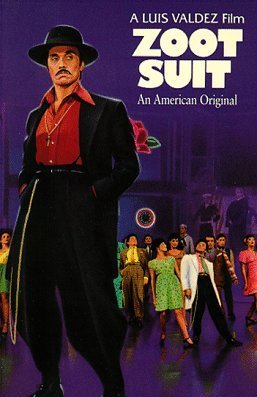
“The idea of the original pachuco is to look like a diamond, to look sharp, hip, bonaroo, finding a style of urban survival in the rural skirts and outskirts of the brown metropolis of Los, cabron.”
The writer-director of Zoot Suit, Luis Miguel Valdez, was born in 1940 in Delano, California, was the second of ten children, began working in the fields as young as six, moved from harvest to harvest, settled in San Jose, attended San Jose State University, debuted there his first play “The Shrunken Head of Pancho Villa,” joined the legendary San Francisco Mime Troupe, returned to Delano in 1965 to help Cesar Chavez and the United Farm Workers movement, founded the didactic-yet-delectable El Teatro Campesino with Cesar Chavez’s enthusiastic support, established a Chicano cultural center in Fresno, made a short film in 1969 based on Rodolfo Gonzales’ poem “I Am Joaquin,” founded a national Chicano theater group and production company in San Juan Bautista (reclaiming that town’s cinematic legacy from the end of Alfred Hitchcock’s Vertigo), and published poetry that connected Mayan and Aztec philosophies to Chicano identity. It’s worth mentioning that Cesar Chavez was open to allies of all races to achieve the goals of his labor movement, yet because so many of his allies wound up slandered as spics and wetbacks, they sought another term for Mexican-American, and Chicano pride and identity became more valent and vital to Chavez and Valdez and, in the 70s, the many colleges that adopted El Teatro Campesino and students who wrote Chicano plays. The wind firmly at his back, Luis Valdez became determined to stage the first Chicano play on Broadway.
By 1977, Valdez was working on a story of an unfairly accused Chicano, as part of what Valdez felt was the first time Mexican-Americans had articulated their own distinct, lucid identity on the same level that African-Americans had long had. In the early 1940s, in Los Angeles and New York, young Blacks, Latinos, Italian-Americans, and Filipinos began dressing in zoot suits, meaning bright, wide-shouldered suit coats that often reached the knees even as the arms and ankles were tightly tailored for a triangle effect. The point was to rebel against the Protestant-white style of formal wear, perceptions of urban poverty, and their parents’ drab, conventional tendencies. Although all races wore zoot suits, only Mexican-Americans wearing them called themselves pachucos, and soon the pachuco pose became the pluperfect expression of bold, dissident, non-conformist Chicano identity, especially after Los Angeles’s Sleepy Lagoon murder trial and the so-called Zoot Suit riots, events that Valdez endeavored to emulate in his play Zoot Suit.
Obviously, no one should get their history from a musical; one should instead read a book, for example Mauricio Mazon’s “The Zoot-Suit Riots: The Psychology of Symbolic Annihilation,” or Rachel Rubin and Jeffrey Melnick’s “Los Angeles, 1943: Zoot Suit Style, Immigrant Politics.” That said, Luis Valdez understood that his play needed to be a musical, partly because the events involved swing and big-band music, but also because, the very brief history of all-ethnic casts was mostly musicals, from Carmen Jones to Flower Drum Song. Lalo Guerrero, often called the father of Chicano music, agreed to write new music for Valdez. Valdez never planned an all-Chicano musical; his story would need plenty of naïve, well-meaning white people, as well as a variegated rainbow of all races for the dance floor. Luis’s younger brother Daniel Valdez helped Lalo and Luis with the music, and after Daniel had also appeared in the Richard Pryor film Which Way Is Up? and the Jane Fonda film The China Syndrome, Luis felt he could cast his brother as the play’s lead, Henry Reyna. After ridonkulous rewrites and rehearsals, finally Zoot Suit premiered at L.A.’s Mark Taper Forum in 1978, ran to sold-out crowds and standing ovations, debuted on Broadway in 1979, and earned a Tony Award nomination for featured actor Edward James Olmos as El Pachuco. Not content with becoming Broadway’s first Chicano director or with making Broadway’s first real Latino play, Luis Valdez set his sights on actualizing America’s first autentico Hispanic or Chicano feature film. Paramount was interested, but balked at Valdez’s insistence on directing; eventually, Valdez set up a deal with Universal. Valdez felt a little trepidation at casting his then-30-year-old kid brother as the 20-year-old Henry Reyna, but the film version would lean into Olmos’s magnetic El Pachuco figure, as though Valdez were turning Jiminy Cricket into the lead of Pinocchio.
Zoot Suit begins with a title card telling us this is a true story segueing into 1940s-ish swing music over credits placing us in Hollywoodland during the apparent 40s movie premiere of Zoot Suit, attended by glamorous guests in gussied-up clothes and cars. As the camera pulls in on a poster of El Pachuco, he slides out of the spotlight and into an obvious stage full of 40s hep cats dancing to “Zoot Suit.” The movie or stage audience applauds as El Pachuco cuts through a curtain-sized war headline and admits his story’s fabulisms by saying, “Our pachuco realities will only make sense if you grasp their stylization” because every vato wanted to wear the zoot suit and live the myth. El Pachuco tells Henry Reyna that despite his successful application to the Navy, he can forget about the war abroad because the mayor of L.A. has declared war on him and anyone like him. A white reporter tells us it’s August 1942, watches a jail full of about 300 suspects, observes white police search mostly browner suspects, ignores El Pachuco, and reports ostensible victims of “assaults, rape, robbery, purse snatching, and similar crimes.” Cops grill Henry Reyna over the mysterious murder at the Sleepy Lagoon, but their tortures knock him unconscious and summon a dream memory of Henry’s house where his mother serves food and judgment while his father reminisces over his role in the Mexican Revolution, tells Henry to use his switchblade to cut up his zoot suit, and strongly disapproves of his grown daughter Lupe’s mini-skirt…until a honked horn leads Lupe, Henry, and zoot-suited brother Rudy out the door. After Reyna is thrown into a cell with José, Smiley, and Tommy, a white reporter asks blond, petulant Tommy what he’s doing with these “beaners,” and a self-described “people’s lawyer,” George Shearer, gets little but belittlement from the frustrated foursome until finally Henry, consulting El Pachuco as his conscience, decides to trust Shearer. At the Sleepy Lagoon Saturday, dozens of hep cats dance fast to “Vamos a Bailar,” and then slow to a sleepy song as Bertha tries to cut in on Reyna’s intimate moves with his girlfriend Della. A sailor in uniform along with drunk Rudy push too many too hard, leading to harsh threats and drawn switchblades between Henry and Rafas, but El Pachuco’s conscience stops time and Henry with words like “don’t hate your raza more than you love the gringo.” Someone jokes about buying war bonds as Rafas and his ruffians revel to a revived “Vamos a Bailar.” At the prison, one Alice Broomfield meets Reyna, offers the support of working people via the CIO, blames William Randolph Hearst for “Mexican crime wave” propaganda, and provides cover for Shearer sneaking something to Reyna. In court, after the judge dismisses Shearer’s complaints that his clients haven’t been permitted clean clothes or haircuts, Shearer also objects to a prosecutor’s witness blaming violent bloodlust inherited from Aztecs combined with liquor and marijuana, but the latter leads El Pachuco to perform the marijuana boogie with three chorines. Della’s witness stand story transports us to a classic car, a moonlit lagoon, swing music over crickets and frogs, she and Henry kissing, intimate thoughts, awkward accusations of amity, and the arrival of Rafas and his gang who badly beat Reyna and roam to a nearby ranch party. Per Della’s voice-over testimony, Reyna gathers his own gang who get back to the ranch, get mistaken for Rafas rambunctious gang, and get into a big brawl where Reyna fails to stop one vato from using a 2by4 to badly beat another. Over Shearer’s objections, the prosecutor explains that because the jury is having trouble telling the difference, each suspect must stand as his name is called, causing El Pachuco to piano-play a lively rag as the four men rise and fall. Despite or because of Shearer’s assiduous citations of bench misconduct, the jury finds José, Smiley, Tommy, and Henry guilty of murder, and the Judge sends them to San Quentin for life. In May 1943, Alice testifies to the appeal of the newly anointed Sleepy Lagoon Defense Committee, arrives at San Quentin with gifts, hears Tommy call himself pachuco, and then hears much worse from Henry, who excuses himself from the appeal and says “you’re just a white broad using Mexicans to play politics.” After Alice cries over inter-office arguments, admits to being hated as a Communist Jew, and pretends to hate enchiladas and mariachi music, she and Henry share a laugh, a suggestion that he write an op-ed article, and an agreement that he’ll start by writing to her. In prison, El Pachuco warns Henry against that ruca, saying “a Latin Lover’s nothing but a f-ing Mexican.” In an apparent genuflection of the 1975 musical Chicago, Chicano prisoners, men and women, perform “Handball.” Alice visits Henry, apologizes for not replying to his love letters, says she can’t be his huisa, projects that after this she’s onto the next fight, and accepts his long kiss as she goes. El Pachuco tells Henry he begs for gringos’ attention, which inspires Henry’s ire against a “paddy” guard, which leads to Henry’s months in solitary talking to El Pachuco even as he hallucinates his family in the cinematic audience. A clubby conflict is interrupted by a newshound’s June 1943 bulletin about the Navy’s knocking around the barrios, which is in turn interrupted by El Pachuco, who accuses the journalist of using “zoot-suiter” as a less offensive synonym for Mexican, so the reporter responds his clothes look ridiculous, take fabrics away from the war effort, and only cover someone who was naked when he came out of the jungle. Soldiers/sailors abstractly attack El Pachuco who turns out to be Rudy, who is fetal, naked, and angry at Henry for not fingering him for the Sleepy Lagoon violence. Less abstractly, Della visits Henry in prison but stands at his indifference until he asks her to please wait. The reporter announces that it’s now November 1944 as the Court of Appeals agrees to “Freedom!” and we see Henry, José, Smiley, and Tommy walk out of a prison hallway and into the arms of their loved ones to victorious confetti and cheerful comity. El Pachuco appears, claims the Navy can’t wipe him out, questions this happy ending, brings on the reporter who gives sordid details of Henry’s postwar life, and says “there’s other ways to end this story,” snapping us back to a very active club where Rudy and Alice spin alternate lives and the other cast members spin alternate identities for Henry Reyna, concluding with El Pachuco saying “Henry Reyna, El Pachuco” as the entire cast does a final, coordinated slant of the body and credits roll.
It’s remarkable and reprehensible that it took until twenty years after West Side Story, and ten years after the rise of blaxploitation, for anyone to attempt anything like an all-Latino film. In another sense, the failures of blaxploitation may have contributed to Hollywood’s skittishness with anything overtly ethnic. Admirably, in the early 70s, Ricardo Montalban founded the watchdog group Nosotros, which did convince several companies to discontinue use of offensive anti-Latino imagery. Nosotros was also unhappy with the 1970s TV show “Chico and the Man,” groundbreakingly about East Los Angeles, partly because its star, Freddie Prinze, wasn’t Chicano. Less admirably, the message that studios seemed to receive from Nosotros and other groups was not to bother for fear of offense.
In 1980, a spokesperson at Universal told the Los Angeles Times that the studio hoped that Zoot Suit would serve as the first in a series of films aimed at the Hispanic market. Only then, in the wake of Star Wars, had studios done the extensive audience research that proved that Hispanics made up a disproportionate amount of moviegoers, an unevenness that continues to this day. Whatever Universal may have hoped, the poor critical and audience reception that greeted Zoot Suit seemed to squelch any sort of immediate plans for more Hispanic-based films.
I asked Curtis Marez, former chair of UC San Diego’s Ethnic Studies Department, for the first majority-Latino film directed by a Latino, and he emailed me that there’s no Oscar Micheaux equivalent Latino, partly because Hispanics were more closely integrated within Hollywood. Apparently, some consider the first feature directed by an avowed Mexican-American to be Anthony Quinn’s directorial debut, 1958’s The Buccaneer starring Yul Brynner, a film with almost no Latinidad. I’ve looked around, and I’m just going to go ahead and say it: Zoot Suit was Hollywood’s first mostly-Latino feature film directed by anyone Latinx.
Influenced by: Brecht; Cantinflas; Latino music; Valdez’s experiences working with Cesar Chavez and running El Teatro Campesino
Influenced: carved out space for Latino-authored and -focused work; established Edward James Olmos
~
C49. Chan is Missing (Wang, 1982) BO clip imdb LB RT trailer wiki
stream on amazon watch analysis by Merritt read analysis by Wang listen to my podcast
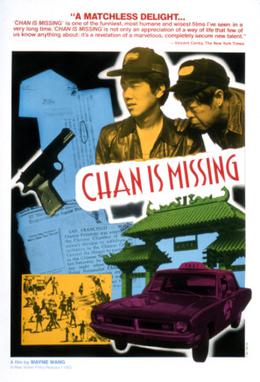
“This mystery is appropriately Chinese: what’s not there seems to have just as much meaning as what is there.”
Wayne Wang benefitted from San Francisco’s extraordinarily under-used Chinese artistic community. Knowing they would be working on what was apparently the first all Asian-American film, they worked for essentially nothing, including composer Robert Kikuchi-Yngojo and cinematographer Michael Chin, who borrowed the cameras from San Francisco State’s film department every weekend during summer of 1979, when most other film students were out of school. Wang spent most of the budget on 16mm black-and-white film; they could rarely afford more than two takes of any one shot. Cued by Eric Rohmer, if Wang felt a scene wasn’t working in the first take, he simply stopped shooting it and went straight to the next set-up.
However, like many inexperienced filmmakers, Wang didn’t leave enough money for post-production, and his editing house held onto his negative prints after Wayne “overextended his credit.” Per the New York Times, Wayne Wang worked “writing bilingual science curricula for San Francisco State University” to try to earn back the money, failed to earn enough, wrote for more grants, failed to get those, and finally, in 1981, persuaded the National Endowment of the Arts to grant him $12,000, which covered the lab fee, the sound mix, the final edits, and the title cards, but not the subtitles for the scenes in Chinese, an issue that Wang presented as a virtue. Decades later, Wang told one reporter, “Sometimes the specifics of a language are not as important as the music of the language and the body language of the language.”
Chan is Missing begins with Jo driving his taxi through San Francisco’s Chinatown to a version of “Rock Around the Clock” with Chinese words about high prices and greed. When a fare stops Jo to ask him for a good place to eat in Chinatown, Jo voice-overs that he frequently answers that frequent question with comparisons of Mandarin and Cantonese food that frequently result in a big tip. At home at the kitchen table, Jo, his nephew Steve, and his niece Amy discuss Taiwan, the PRC, Ho Chi Minh, Communist money, and Chinese versus gay candidates. Jo narrates that he and Steve recently decided to obtain a $4,000 cab license, but oddball bureaucratic hurdles compelled them to give all of the money in cash to a friend named Chan Hung who has now been missing for two days. At a Chinese café, Chester’s, a graduate student explains to Jo and Steve the cultural and lingual differences between a white policeman and Mr. Chan just after Chan’s car accident. When she reveals that Chan missed her court date, Jo and Steve knock on Chan’s door at the Hotel St. Paul to no avail, and at a diner, Steve tells Jo he just saw a Chinese version of “Saturday Night Fever” that went “You can tell by the way I use my wok, I’m a Chinese cook, I’m a Chinese cook.” In the cooking kitchen of the Golden Dragon restaurant, we meet Henry in a Samurai Night Fever T-shirt drinking milk, smoking, complaining that tourists only order sweet-and-sour pork, and telling Joe that Chan recently ran away from rivals. Steve tells a story of Chan behaving like an FOB, that being Steve’s term for someone Fresh Off the Boat, but Jo voice-overs that FOBs come off jumbo jets and Chan only half-pretends to be one as humor that doesn’t translate into English. At the Manilatown senior center, gray-hairs dance to Mexican canciones while Jo and Steve ask two Filipinos about Chan. They reveal Chan’s jacket with a few cut-out clippings, remember that Chan spoke of splitting something between three people, and relate the story of a missing mariachi musician who Chan loved. Jo wonders why Chan carried a clipping of a fatal fracas between Chinese persons at the New Year parade over flying Taiwan’s flag or the PRC’s. On a rooftop, Henry tells Jo that Chan went back to China because he couldn’t relate to mainland Chinese from 8,000 miles away, and that after 100 years and half a million people in America, Chinese still fight for recognition and need to do something more significant. At the Hotel St. Paul, Jo and Steve’s knock prompts Chan’s neighbor to roar through his door, reference Dragnet and Rockford Files, refuse to see anyone Chinese, and recommend they find a woman who took a certain photograph he won’t describe. In voice-over, Jo describes returning to the hotel, getting the landlord to loan a pass key, searching Chan’s, and finding little but clipped articles about the fatal flag fight and what looks like a missing photograph. When Steve reads an article about Latinos fighting Filipinos, he says it shows cops to be useless, so Jo asks why Steve wants to tell the cops about Chan. Jo goes alone to a language school to talk to George, who says Chan had the immigrant problem of trying to remain Chinese, which he contrasts to the problem of trying to assimilate all at once, leading to his middle course, taking the good parts of Chinese culture to be a hybridized Chinese-American. When Jo and Steve run into Chan’s daughter Jenny on the street, Steve makes so many number one son jokes and jive-talks about mah-jong that Jenny asks if he thinks he’s Richard Pryor, says she hasn’t seen her dad, and explains that they’re poor unlike Mr. Lee whom they should see to find Chan. Jo meets Mr. Lee, who compares Chan to an immigrant whose car hit a black man’s car and was afraid to leave even after giving the man his insurance information. Jo voice-overs about his non-cooking, about Marco Polo stealing from Chinese, about watching Charlie Chan reruns for cheap laughs, and about cleaning Chan Hung’s cab, where he finds a letter and a gun that may have shot a neighbor. Seeing that the letter was to a former address, Jo visits it and finds a landlord who says Chan moved out when he left his wife for another woman. Jo receives a phone call from a mysterious female voice that tells him to stop asking questions about Chan Hung and hangs up. We see a montage of Jo walking and driving around Chinatown feeling more and more paranoid, accentuated by creepy music. Jo says that he doesn’t think the police will help because there’s too many missing Chans and that his picture won’t help. At a Presidio pier, when Jo tells Steve he relates to Chan being important in China and coming here and having trouble with money and identity, Steve rejects “identity crap” because he fought in Vietnam and there are Chinese all over SF. Jo and Steve meet Jenny where she works, at a Japanese restaurant, where she returns to them all of their $4,000 but apologizes that she doesn’t know where her father is. Jo voice-overs that on TV, we would now come upon a clarifying clue, but instead he meets Mr. Fong who names many conditions of Chinese culture. Thinking of the many missing pieces in this case, Jo voice-overs that he’s not Chinese enough, because he can’t accept so many questions without answers, but what really bothers him is that he no longer knows who Chan Hung is, citing ten collected contradictory accounts of Chan. In conclusion, “Grant Avenue” plays over shots of Chinatown that are grittier, grainier, and less glamorous than anything in that song’s source picture, Flower Drum Song.
Wayne Wang’s choice to end with the title song from Chinese-American author C.Y. Lee’s source novel for the film “Flower Drum Song” would make it easy for me to say that Chan is Missing is the first all-Chinese-American film since the first one, Flower Drum Song. But I’m not going to say that, because the principal roles of Flower Drum Song are all written as Chinese-American, but only two of eight are actually played by Chinese-Americans. So what I’ll say instead is that Chan is Missing is the first mostly-Chinese-American film, as well as the first mostly-Asian-American film directed by an Asian-American.
Scholars love Chan is Missing because it gives us a chance to discuss “structural absence,” a fancy-schmancy term that lets us talk about how what’s missing or offscreen is just as important as what’s on. Obviously the film is also in conversation with film history, and after Chan is Missing we obviously don’t need more, and haven’t had, Charlie Chan films.
I think Chan is Missing is an excellent film that just wasn’t seen by enough people in 1982. Chan is Missing failed to get into several festivals, but the Museum of Modern Art chose to premiere it, where it did quite well and even earned a great review from The New York Times’ Vincent Canby, which convinced New Yorker Films to distribute it nationally, but it was never an enormous indie hit. Sadly, that meant that it took a very, very long time for the very, very under-served Asian-American community to see anything like Chan is Missing’s level of representation again, and that’s a damn shame. Wayne Wang blazed a trail, but no one could follow him on it for way too long, essentially not until the “S”s, and by the “S”s, I mean Spike Lee, Steven Soderbergh, and Sundance had established a route for independent films to succeed in the larger marketplace.
Influenced by: the Charlie Chan-Fu Manchu corpus; noir; absence as a theme; concerns over Taiwan
Influenced: began Asian-American cinema, which took a long time to get going
~
C50. El Norte (Nava, 1983) BO clip imdb LB RT trailer wiki
stream on amazon watch analysis by Kurt read analysis by Holtmeier listen to my podcast

“In Mexico, there is only poverty. We can’t make a home there either. And here in the north, we aren’t accepted. When will we find a home, Enrique? Maybe when we die, we’ll find a home.”
Gregory Nava was born in 1949 in San Diego, grew up there, and often visited his relatives on the other side of the border, wondering who were the people who lived in Tijuana’s many aluminum-siding-style-shacks. Nava went to film school at UCLA, where he won awards and met Anna Thomas who became his wife in 1975. After graduation, Nava taught classes in cinematography at Moorpark College, made very low-budget films that got some attention, and spent much of the late 70s and early 80s with Thomas interviewing Spanish-speaking immigrants in Los Angeles to learn who they really were. Nava later told the New York Times, “In our own research, we came across a community of Mayans from Guatemala—5,000 from one village—now in Los Angeles. The original village, which is now dead, had 15,000.” Nava was likely referring to one of the 1970s’ many Che Guevara-like protests/insurgencies and the over-reaction by paramilitary groups that were generally funded by the United States, as seen in Guatemala as well as Chile, Nicaragua, El Salvador, and many other places.
In that same NYT interview, Nava said, “The border is unique—the only place in the world where an industrialized first-world nation shares the border with a third-world country. In California, it’s just a fence: on one side are the Tijuana slums, on the other side—San Diego. It’s so graphic! This was the germ of the story.” Gregory Nava and Anna Thomas might have chosen to highlight the plight of Mexican-American immigrants like their own family members. Instead, they set themselves a larger challenge, trying to give authentic expression to two young indigenous K’iche Guatemalans who would eventually be mistaken for Mexican migrants. Nava and Thomas were a bit more established than Wayne Wang, and after a few fits and starts, the married couple convinced a consortium to come up with the capital, including PBS’ American Playhouse and Britain’s Channel Four Films. The total budget was about $800,000, but thanks to cinematographer James Glennon, the film looks like it was made for at least 10 times that amount.
Although the beginning seems to represent real Guatemala, Nava found it cheaper and easier to get permits to film in just two parts of Mexico, Tijuana and Chiapas, the latter near the Guatemalan border. However, filming in Mexico didn’t go as planned; Nava says Mexican police kidnapped his accountant for ransom and his parents had to pose as tourists to smuggle film back into the U.S. Further, per Nava, “We were filming in Mexico during the end of the López Portillo presidency, one of the last of the old-fashioned caciques to rule Mexico. One day, men with machine guns took over the set. I had guns pointed at my head. We were forced to shut down production, bribe our way out of the country, fight to get our costumes back, and start shooting again in California. Ironically, in the United States our extras were real Mayan refugees. They were the people the movie was about.”
El Norte begins with a title card that says Part 1: Arturo Xuncax. In scenic, lush, rural Guatemala, an armed chief oversees restless, indigenous laborers bringing berries and beans back to the village where we see Rosa, in colorful traditional garb, bearing a head jug and returning to the modest house of her mother Lupe. In his private office, the chief bribes a traditional-looking Mayan to tell him that Arturo’s organization meeting will be in the old hacienda. As night falls, a street musician harps, camo-clad commandos gather near the old hacienda, Arturo’s family eats dinner, Rosa’s godmother talks of amenities in the U.S., and Lupe warns Arturo who still insists on going out. Near a lakeside, Enrique catches up to Arturo who tells his son why poor indios must fight for their land and dignity against rich interlopers, yet he instructs Enrique to return home that night. At the meeting, Arturo’s ideas get disrupted by the commandos, who shoot machine guns at the laborers, pursue them, and kill them. Enrique awakens, grabs his machete, searches, finds his father’s severed head in a tree, climbs the tree, gets attacked, and desperately machetes this man dead. At the group funeral, amidst just-carved pine boxes and crosses, Rosa sings a sad, sorrowful song in Mayan, “We came only to sleep, to dream. All things are lent to us. We are only on Earth in passing.” As soldiers arrive in jeeps, the villagers call out and scramble, and Rosa soon learns that her mother has been “disappeared” as Rosa’s godmother helps her find refuge in a distant glen, where she reunites with Enrique, who asks Rosa to ask their godmother for money to travel north and meet him at their house the next evening. Near a mill, Ramon instructs Enrique on pretending to be from Oaxaca, recommends liberal use of “chingar” when speaking like a Mexican, and gives him the name of a good coyote, Raimundo Gutierrez. Rosa obtains the money from her godmother, lights dozens of candles, prays to the virgin Mary, mourns her mother and village, and convinces Enrique she must travel north with him. A title card says Part 2: El Coyote, Mexico, where a truck driver changes his truck’s blown tire, discovers Rosa and Enrique sneaking aboard, sees through their bluff, plays them Mexican music, and drives them to Oaxaca where they board a green bus to Tijuana. As Enrique and Rosa disembark in Tijuana, multiple coyotes offer services while the film shows shots of local scanty shanties contrasted to shots of bountiful, beautiful blocks over the border. As locals deride Enrique and Rosa, double-denim-clad Jaime derides the deriders, introduces himself to Enrique and Rosa, asks about their unfindable coyote, advises them to save their money for the north, welcomes them on his journey north that night, puts them in a “lost city” shantytown for the day, sneaks Enrique and Rosa across that evening, escorts them through brambles, attacks Enrique, tussles, and stops at the flashlights of American border guards, who grill them in their station but can’t decide on their nationality and so return them to Tijuana. At Restaurant La Popular, Enrique finds Raimundo, who recalls Ramon, feeds Enrique, and agrees to coyote the pair if they can get him $100 and if they skip the dangerous mountains and instead crawl through an unused sewer. For the money, Rosa offers their mother’s silver rosary necklace to which Enrique reluctantly agrees. At the sewer entrance, Raimundo tells them he’ll see them on the other side as the pair put bandanas on their mouths – Enrique’s is red, Rosa’s is blue – and crawl, crawl, crawl, through the long, long pipe, happening on a herd of rats and a helicopter’s searchlight at the end before they eventually emerge, re-meet Raimundo, and witness the astonishing night lights of San Diego. Titles tell us, Part 3, The North, Los Angeles, at the Lazy Acres Motel, where Montezuma, wearing a Fernando Valenzuela T-shirt, jokes with Raimundo that with all the Latin Americans staying with him, Mexicans like him are becoming a minority. Rosa finds work in a sewing sweatshop, where Mr. Chung orders Nacha to train Rosa on ironing, but “la migra” arrives and arrests the scattering sew-ers as Nacha helps Rosa through her secret escape route. A white guy in a tuxedo and white BMW picks up Enrique off the street, dresses him as a busboy, and sends him to collect dishes trailing a man named Carlos at a posh restaurant where Enrique looks doe-eyed at the dapper diners. At a dirtier diner, Nacha tells Rosa their barrio looks like Mexico City because gringos don’t want to live with Mexicans, and Nacha believes cleaning their houses is safer and she’d like to start doing it with Rosa if Rosa can clean up to look more American and learn English in a free school, where we soon see her and Enrique learning from an Asian-American woman. In a wealthy house, a blue-blooded blonde, Helen, trains Nacha and Rosa on a washing machine with dozens of buttons, but later, a befuddled Rosa winds up washing by hand which vexes Helen who insists on doing it the American way. Enrique improves at English, gets promoted at the restaurant (to Carlos’s frustration), shows off his new tuxedo to Rosa, gets introduced by “Don Monte” to patrician Alice who offers a green-card-granting foreman job in Chicago, refuses to leave Rosa, but agrees with a friend to go out drinking while Rosa gets a bad fever and relies upon an indigenous witch-doctor. Rosa dreams her mother makes tortillas in her modest motel kitchen and her father gives her a basket of flowers with a dead fish, but awakens to collapse with fever at Helen’s as Nacha yells “Rosita!” Tipped off by Carlos, la migra descends upon the restaurant causing Enrique and his Mexican friend to run, escape to a bar, and discuss Carlos and surviving without legal papers. Nacha takes Rosa to a hospital that won’t see her without proper ID, but a doctor comes out, examines her, sees a serious rash on her stomach, diagnoses her with murine typhus from rat bites, and asks Nacha to find Enrique. Enrique apologizes to Don Monte, goes to Alice’s hotel that evening, begs her for the green-card-worthy job, and receives it on condition that he pack quickly and accompany her on the red-eye to Chicago that night as Alice adds, “I suppose if you could find your way to Los Angeles from your village in Mexico, you can find your way to the right gate at the airport.” As Enrique packs, Nacha arrives to tell him that he must come now because his sister may die, but he answers he must leave and he’ll call from Chicago. Cunning cross-cutting between Rosa’s hospital writhing and Alice’s airport waiting extends the suspense until Rosa turns, looks at the moon, sees Enrique, gets relieved, but then holds forth about why America isn’t really free and they aren’t accepted. Enrique admits that American life is difficult but that things are improving and not to lose faith…until he notices Rosa just croaked. After a difficult, empty night, Enrique sees a man standing on a truck flatbed asking for men with strong arms, volunteers with many other brown men, and spends the day digging a ditch, reflecting on Guatemalan memories as the film ends in a sunset on Arturo’s severed, suspended head.
Nava and Thomas wound up making America’s first nationally-released film to centralize indigenous persons. Although indigenous-descended persons like Anthony Quinn had certainly starred in films, they had not played indigenous persons in the way Mexican actors Zaide Silvie Gutierrez and David Villalpando play indigenous persons in El Norte. Even so-called revisionist westerns like Little Big Man and The Outlaw Josey Wales, however empathetic to Native Americans, didn’t dare tell their stories through any eyes but white ones. Another remarkable aspect of El Norte is that it articulates and centralizes indigenous voices of the present, not ones sealed off as part of America’s past. Even empathetic older directors eschewed subtitles and asked us to accept that we were hearing Native dialect while actually hearing English; Nava and Thomas insisted on lingual accuracy. Because of the way the story goes, El Norte is also one of, or perhaps the, first American film to be spoken in Spanish for a majority of its running time. El Norte would belong on the C-list for those reasons alone, although I would also argue it happens to be a great film.
These would all be good reasons to add El Norte to any curriculum, but El Norte is regularly taught in high schools and I believe the main reasons go beyond what I just said. In El Norte, Enrique and Rosa basically go through the stations of the cross of the experience of the Latin American immigrant to los Estados Unidos. What is perhaps most striking about El Norte is it gives just enough weight to each episode so that you, the viewer, feel you’re receiving a revelation about the experience just before you move on to the next thing.
Just as Vincent Canby’s review made Chan is Missing, Roger Ebert’s made El Norte, particularly when he called it a “Grapes of Wrath for our time,” a quote that would appear on all of the marketing material all the way up to the film’s Oscar nomination for Best Screenplay, shared by Nava and Thomas, and now considered the first Latino or Amerindian film to be Oscar-nominated.
Influenced by: Zoot Suit; magical realism; Nava’s experiences growing up bicultural in San Diego
Influenced: set standards for films about modern immigration, Latinos, and the effects of Central American civil wars
~
C51. Yentl (Streisand, 1983) BO clip imdb LB RT trailer wiki
stream on amazon watch analysis by Anton read analysis by Warner listen to my podcast

“Why is it people who want the truth never believe it when they hear it?”
n 1978, two of Barbra Streisand’s friends, the songwriting couple Alan and Marilyn Bergman, suggested Streisand turn “Yentl” into a musical by converting half of Yentl’s musings to musical interior monologue. Now nascent producer-boyfriend Jon Peters came up with 7-figure offers for Barbra to do her first live performance in years in London or Las Vegas, but Streisand turned them all down to focus on Yentl. Streisand hired one of Peters’ hairdressing acolytes to dress her as a man, causing Peters to believe a stranger had broken into their home and that she could pull off the role if the age weren’t mentioned, so they signed with Orion to make the film. When Streisand wasn’t working on the 1979 film The Main Event, she spent her time researching every aspect of Ashkenazi Judaism, hiring Rabbi Lapin to supervise the religious aspects.
In 1980, Orion announced the production of Yentl while Streisand was in Czechoslovakia scouting locations and taking pictures of herself as Yentl, but her return to America was through, ah, Heaven’s Gate, a film that imploded United Artists and caused Orion to indefinitely postpone all projects with eight-figure budgets. Jon Peters and his producing partner Peter Guber – who would make Batman at the end of the Reagan administration – began that period by forming Polygram Pictures partly to give Yentl a home, but after Streisand’s film All Night Long failed, Streisand and Peters broke up and the film broke up yet again. Ailing United Artists merged with MGM, appointed new leadership that included Streisand’s agent from the 1960s, and finally, finally, after at least 20 published script drafts, Yentl began production as Streisand’s directorial debut with a budget of $14.5 million, at least double that of any film, anywhere, ever directed by a woman. Cameras began rolling in London on April 14, 1982, 10 days before Streisand’s 40th birthday. Streisand went $1.5 million over and paid the overage out of her salary, so the official budget is $16 million.
Yentl begins on a shot of a basket of unsorted books, being borne into a Fiddler-on-the-Roof-like village, or shtetl, as a title card tells us “In a time…when the world of study belonged only to men, there lived a girl called…Yentl,” but just in case, the next title says “Eastern Europe 1904.” In the bustling market, rabbis pray, scholars chat, vendors hawk, and a bookseller riding a horse calls out, “Lovely picture books for women, sacred books for men,” only to argue this over with Yentl, who finally gets the book she wants by saying it’s for her father. In Yentl’s family house, Yentl cooks while reading, overhears Papa’s Talmudic lessons to a village student, interrupts, and cues the student to say that a woman who knows the Talmud is a demon, which cues Papa to hustle him out, hook closed the drapes, and happily play chess and read the Talmud with his daughter, who soon puts Papa to bed while singing/internal monologuing “Why have the wings unless you’re meant to fly?…Where is it written what it is I’m meant to be? That I can’t dare to have the chance to pick the fruit of every tree?” Papa muses how small a family tree was when Yentl’s brother Anshel died, urges Yentl to marry against her wishes, apologizes for raising her like a son, dies offscreen, and prompts Yentl to speak Kaddish at his funeral to the horror of mourners mandating that Kaddish must be made by a man. Yentl looks in a cracked mirror, cuts her hair, and next appears as a male, carrying her wicker suitcase on a road outside her shtetl, catching no ride, camping for the night, and cantillating “Papa can you hear me?” Yentl walks, walks, walks, runs to a riverboat, arrives in Koszerna Karczma, enters a dining commons full of hundreds of Jews, and impresses a chess-player named Avigdor, who, along with his friend Shimmele, invites Yentl to eat, talks up his yeshiva, and asks Yentl her name, so she names herself Anshel. “Anshel” accompanies the men in a group wagon, rides the rural road, debates the Talmud with Avigdor, and arrives in Bechev planning to be tested by a rabbi for yeshiva admission. Avigdor arranges Yentl’s lodging with a friend that can only start the following night, leading to Avigdor insisting Yentl sleep one night in his bed which turns into quite the awkward scene. Rabbi Zalman interviews Yentl as Anshel, accepts her/him into the yeshiva, and assigns him Avigdor as a study buddy as we montage into Yentl’s learning as she sings/thinks “This is one of those moments.” Yentl and Avigdor eat at the posh Vishkowers, whose deferential, beautiful daughter, Avigdor’s fiancée Hadass, prompts Yentl to sing/think “No wonder.” By the lake one day, “Anshel” argues at Avigdor that correctly translating Genesis – “side” not “rib” – means Adam and Eve both share masculine and feminine qualities. Avigdor strips naked, plays in the lake with other nude men, insists “Anshel” strip and join in, but finally lets go of her as Yentl runs and sings/thinks “I Like the Way He Makes Me Feel.” Yentl arrives at the distraught Vishkowers and goes to find Avigdor, who explains the rabbi and Hadass’s father have called off the wedding because they learned Avigdor’s brother committed suicide. After “Anshel”’s awkward dinner with the Vishkowers, he/she returns to Avigdor who invokes Jewish conventions of quick re-engagement and brothers of dead men marrying their widows and suddenly begs “Anshel” to wed Hadass so the three of them can be together, insisting “nothing’s impossible.” Yentl strenuously objects, visits an amorous Hadass, sings/thinks “No Wonder (Part Two),” returns to find Avigdor leaving Bechev forever over this, but stops him at the last second by shouting “nothing’s impossible.” Yentl sings/thinks “Tomorrow night” over a montage of tailor fittings, hora sittings, family flittings, and Yentl shitting herself over marrying Hadass, who, after the wedding, is immediately placed in a private bedroom with “Anshel,” who explains that the Talmud allows a wife to refuse her husband and that because Hadass is still in love with Avigdor, for now, they must abstain and sleep in adjacent single beds. At the lakeside the next day, Avigdor demands truth from Yentl, who lies that Hadass said “I adore you Avigdor” in her sleep. “Anshel” tells Hadass of “his” headache, but lights up when a chance comment leads to instruction over the Talmud and orations and exhortations that exhaust Hadass’s endurance. Avigdor comes to the Vishkowers for dinner, notices Hadass’s increased affection for “Anshel,” stares/stalks a sewing Hadass, and spurs Yentl to sing/think “Will I ever live to see the day when by some miracle of miracles, he’ll turn around and look at me that way?” Privately, Hadass seduces “Anshel” but “he” pushes her away and walks out singing/thinking she must be herself and “no matter what happens, it can’t be the same anymore.” The next day, Yentl loads up her wagon for a trip, kisses Hadass goodbye on the forehead, hears her genuine “I love you,” responds with “I love you,” and sings/thinks a reprise of “No wonder” that concludes Hadass is a real woman and “so am I” (meaning Yentl). Yentl drives a carriage with Avigdor, previews a secret, rents a room for them in Lublin, sits him down there, asks what he would do if he wasn’t allowed to study, says “I’m not Anshel, I’m Yentl,” and finally shows him her breasts which aggravates his abundant anger and acrimony and assertions of “why?” until she after all admits “I love you.” After Yentl declares her marriage is null and void, Avigdor kisses her and suggests they marry, but Yentl realizes Avigdor needs/wants a traditional wife who doesn’t study, and despite her love for him she needs more out of life. They share a tender goodbye segueing to the reunited couple of Avigdor and Hadass reading a letter from Yentl, whom we see amongst the steerage passengers on a ship, likely to America, as she sings one last interior/exterior monologue, “A Piece of Sky,” that finishes efflorescently and flourishingly, “Papa, watch me fly!”
Yentl was an innovator: never before had a musical film’s songs consisted entirely of one character’s interior monologue. At that point one might argue if Yentl actually is a musical; there are 11 songs here, 10 of which are three or minutes long. That’s equivalent to Singin’ in the Rain or South Pacific or almost any other movie musical; that’s an album.
I would argue that Streisand’s visage as young yeshiva-bound Yentl is not very distracting; one is already suspending one’s disbelief regarding the language, American accents, and dissonant cuts between her singing and thinking, so her slightly aged face simply exists as one more element of expressionism. Strangely, Streisand benefitted from the sudden cultural ubiquity of MTV (which had only begun in August 1981) and the many 40-year-old faces then alternately lip-synching and not lip-synching through their lyrics during their videos.
If you watch Yentl to the end credits, it’s dedicated to “my father, and all our fathers.” Here was Hollywood’s most powerful woman at the top of her game, worried that she might bother too many men. You could also argue that in the case of Yentl, Streisand was worried about her lead female’s, ah, fluidity.
Beyond MTV, Yentl seems to speak to a minor trend in cross-dressing work that I’ve discussed before, including the TV show “Bosom Buddies,” with Tom Hanks in drag, the Blake Edwards/Julie Andrews film Victor/Victoria, and Best Picture nominee Tootsie. In her book Undressing Cinema, Stella Bruzzi mentions these films, as well as A-listers like Some Like It Hot and Bringing up Baby, as “sites of ambiguity and change” that are nevertheless eventually comforting to the cisgender heterosexual spectator, because they are structured for that viewer to anticipate the big reveal and relief of the lead character admitting they were just kidding and they’re really a cishet person that their straight consort can safely romance. In accordance with Singer’s story and play, Yentl consciously contravenes that kind of closure, arguably starting with the song “no matter what happens, it can’t be the same anymore.” The Hollywood ending would have had Yentl ride her horse-buggy into the sunset with Avigdor; instead, Yentl has decided, and sung, that she has to be who she is, a person that does not wind up in the paid-for bed with her movie-long crush.
In some ways, in the first half of the 80s, Yentl was Hollywood’s best or biggest non-binary or queer representation. Making Love was a film about gay men that left critics and audiences indifferent. Better received were Personal Best and The Hunger, which had lesbian scenes, but after those scenes happen, the movies move on to the next thing.
Yentl ends on that decisive non-binary note. And it seems worth noting many critics seemed repulsed at the film’s ending, not least of them Janet Maslin in the New York Times and Roger Ebert in the Chicago Sun-Times, the latter of whom wrote of the film’s great “middle 100 minutes” but bad denouement.
John Huston: “I’m impressed with her choosing Yentl; it was extraordinary. But for some reason, Hollywood turned against her … there was a lack of sympathy toward her … Christ, she could have played Cleopatra better than Liz Taylor, with her enormous power and the subtlety of her singing … She is one of the great actresses and she hasn’t been well used.”
Huston said this in 1985, a scant two years after Yentl came out. And he was right: somehow, Streisand’s legendary career never quite returned to the rails after Yentl. Her next film, not made until 1987, might have summarized what Hollywood thought of her; it was called Nuts. Her next film, 1991’s The Prince of Tides, did get a Best Picture nomination, though Streisand herself failed to get a Best Director nod. Would a male director have been treated this way, over Yentl or The Prince of Tides? Or am I being nuts?
Influenced by: Streisand’s 15-year struggle to make it; Fiddler on the Roof; Ashkenazi Jewish traditions
Influenced: the $14 million film made $40 million in the U.S., proving that women could direct big-budgeted films into big hits, a lesson that Hollywood would be slow to learn, even slower for non-star-actresses (Elaine May, Streisand, Penny Marshall, Jodie Foster)
~
C52. The Color Purple (Spielberg, 1985) BO clip imdb LB RT trailer wiki
stream on amazon watch analysis by Chic read analysis by Shipp listen to my podcast
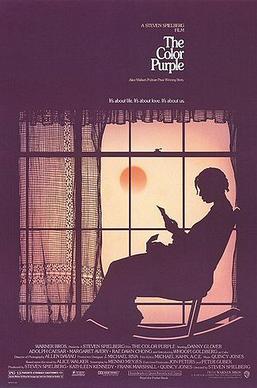
“I’m poor, black, I might even be ugly, but dear God, I’m here. I’m here.”
Quincy Jones convinced Steven Spielberg that he was the perfect director to adapt Alice Walker’s book “The Color Purple” – indeed, few other directors could have asked audiences to accept those unprecedented first ten minutes as written – and that the material was perfect for him because Spielberg had wanted to pivot to non-popcorn pictures anyway. After Quincy Jones arranged a screening of E.T. for a skeptical Walker, she said she felt that Spielberg would probably be too expensive; Spielberg read her book twice and offered to work for scale and, based on the rest of Walker’s contract, basically for her and Quincy.
One of the things that Walker loved about E.T. was that it didn’t have or need stars; Spielberg’s name was enough draw for moviegoers and, crucially, talent. Walker felt strongly that the film should consist of unknowns because stars would distract or detract from a story about rising from obscurity. Eventually, Walker agreed to Danny Glover as the one modestly known name that Spielberg and the studio preferred, partly because in auditions Glover added a vulnerability to Mister that arguably improved upon the book. After Walker saw a stand-up routine of unknown Whoopi Goldberg, Alice pushed her two co-collaborators, Steven and Quincy, to cast Whoopi as Celie, but the men still required an audition, where Goldberg came up with a routine of E.T. being arrested for drug possession. Shug Avery may or may not have been based on Margaret Avery; Walker won’t say. There simply weren’t very many black roles in Hollywood in the mid-80s, so when word got around that Spielberg was making an all-black film of unknowns, everyone and their uncle Tyrone sent in a reel. One of these people was a Midwestern local talk show host named Oprah Winfrey whom Walker felt was perfect for Sofia, right down to her unusual name being a mirror reflection of Harpo.
Eventually, Walker became convinced that screenwriting was an unfamiliar art form, and permitted Jones to hire a professional (and Dutch!) screenwriter, Menno Meyjes, although Walker maintained her veto power. Walker wanted E.T.’s cinematographer, and they got him, Mister Allen Daviau. Walker also served as dialect consultant before and during production, which by all accounts went so smoothly in North Carolina during the summer of 1985 that editor Michael Kahn had the film ready by that Christmas.
The Color Purple begins with the pastoral splendor of purple flowers in a high-grass pasture as young teen sisters Celie and Nettie frolic and play hand-clap games singing “Makidada you and me us never part.” As titles say winter 1909, Celie presents as pregnant, gives birth, walks behind Pa in the snow in the funeral train of her mother, and voice-overs “Dear God” to explain that her Pa told her to do what her momma wouldn’t, impregnated her twice, and took away both babies. Widow Mister Johnson rides up to their house asking for Nettie to become his wife and watch his ill-behaved young’uns while he runs his farm, but Pa says Nettie is off the table and offers Celie because she’s older (all of 14) and a good worker even if she is ugly and has been twice “spoiled.” At the ten-minute mark, Mister ferries Celie to his home, introduces to his kids their new mammy, sees Harpo smash her head with a stone, chases after Harpo, and in his bed rapes Celie, who voice-overs to God she’s thinking about Nettie and the lovely woman in a nearby picture frame, whom we will come to know as Shug. Celie commences cleaning the catastrophe of a kitchen, clears it to spotlessness, combs the daughter’s extra-nappy head, causes her to scream in pain, confounds Mister who says to keep combing, and conveys “I can’t, it hurts her,” which cues Mister to slap her for back-talk. In Spring 1909, in a white-run dry-goods store, Celie believes she sees her baby Olivia, particularly because the baby’s suspicious “mother” calls her Olivia, a name Celie had stitched into the clothes that her Pa took away with her baby. Nettie arrives at Mister’s house, gets his permission to live there because “she’s kin now,” confides to Celie she ran away from Pa trying to touch him, says she’d die before returning, hears Mister compliment her dress, and suggests to Celie they both practice reading/writing – which they do, with labels on kitchen items – so they can write letters if and when Mister drives her off. After Nettie roughly refuses Mister raping her, at minute 26, Mister physically pulls Nettie off of Celie, off of a tree, and off of his land, though Nettie hand waves “Makidada” and hand-warns “nothing but death can keep her from” Celie. Mister happily receives a letter from Shug but warns Celie never to expect mail and that he’s fixed the mailbox so that he’ll know if she touches it. In minute 34, Celie reads “Oliver Twist” better and better behind a veil to show the transition of years to 1916 when we meet young woman Celie sheepishly helping Mister dress nicely for him to attend a performance by Shug Avery. Harpo brings home the robust Sofia, asks for Mister to bless their marriage, endures his skepticism over her prospects and pregnancy provenance, and in a clever cut, marries her in Reverend Samuel’s church ceremony as she holds their baby. Celie visits Harpo and Sofia’s to see Harpo failing at roof repair, child care, and marriage workshare, so Celie, agreeing with Mister, recommends Harpo beat Sofia. Moving like a dynamo, Sofia hoes her crops, feeds her baby, lashes out at Celie for the beating advice, recommends Celie forget heaven and start hitting Mister, settles into a life of violence and pregnancies with Harpo, and finally takes the kids and leaves him. During a stupendous storm, Shug Avery stumbles into the home, laughs at Celie’s ugliness, and tells “Albert” she wants a man who can cook, prompting Mister to burn a big breakfast that Shug bandies out of the room, prompting Celie to cook more copacetic comestibles. Mister’s Daddy shows up, shares the porch with his son, and shit-talks Shug as a “juke joint Jezebel,” nudging Celie to voice-over people don’t like people to be too proud or too free. In 1922, Harpo and friend Swain complete construction of a juke joint where we see Shug, in a peacock feather-headdress and a red sequined hip-hugging frock, performing and enchanting a crowd jam-packed with men, including Mister who smooches Squeak, but Mister is less smitten when Shug performs to Celie the semi-seductive “Miss Celie’s Blues.” Sofia shows up, smiles at Celie, introduces her boyfriend, dances with Harpo, gets slapped by Squeak, and punches Squeak into the lake. In Shug’s bedroom, Shug dresses Celie like her, prepares to go on tour, learns how awful Mister is to Celie who fakes it with him, declares Celie a virgin, assures her she was just jealous to call her ugly, and kisses her on the cheek, then lips, then more as the camera pans aside. Shug tries to reconcile with Reverend Samuel her father, fails, finds Celie following her but frustrated by Mister, flees town anyway, and effects Celie to faint. In town, a well-to-do white woman, Miss Millie, wants Sofia as her maid, but when Sofia replies “hell, no,” Millie’s husband hits her, Sofia hits back, a crowd of angry whites gather, and the sheriff knocks Sofia flat. Titles find us in Fall 1930 as a defeated Sofia is signed out of jail and assigned to Miss Millie as maid and helpmeet, but Millie cheerfully drives Sofia home for Christmas for her first visit with family for 8 years…but when Millie can’t make her car work without Sofia, she refuses to ride with a colored man and sojourns Sofia speedily away. 100 minutes in, in 1936, Shug returns, introduces husband Grady, finds a letter in the Johnson mailbox, takes Celie upstairs, shows it to her, and they both read Nettie revealing her missionary life in Africa with, by God’s grace, Celie’s kids Olivia and Adam raised with all the love Nettie feels for Celie. While Grady and Mister jaunt to the juke joint, Shug and Celie search and excavate Mister’s hidden cache of Nettie’s decades of letters. Celie reads Nettie describe many, many aspects of Africa, including the military’s road-builders destroying their church and Olivia’s African pal being kept from school because, as Olivia astutely notes, the Olinka tribe treats girls as American whites treat blacks who want to go to school. In artful, African-beat-backed cross-cutting, Olivia and Adam’s genital mutilation ceremony is seen alongside Celie almost killing Mister with a razor that Shug just barely holds back. At dinner, after Shug quietly tells Mister she and Grady are leaving for Memphis with Celie, Celie finally unloads on Mister for everything, and Mister responds, “you’re black, you’re poor, you’re ugly, you’re a woman, you’re nothing at all!” As Squeak and Celie board Shug’s car, Celie’s curse hand stays Mister’s beating one, and as the car goes, she hands him, “I’m poor, I’m black, I may even be ugly, but Dear God, I’m here!” A title card tells us 1937 as everything else tells us that in little more than a year, Mister’s life has fallen apart other than Harpo and Sofia joint-dredging the long-shunned juke joint. Celie comes to her Pa’s funeral, voice-overs Nettie’s reveal that Pa wasn’t actually Pa, and soon learns that her real father left her a huge house she moves into. Celie begins a pants-sewing business that results in Sofia wearing pants as Celie tells Harpo “one size fits all.” In a high-grass field, Shug tells Celie that God doesn’t want us to pass by the color purple in a pasture because everything wants to be loved. At the revived juke joint, Shug sings Miss Celie’s Blues, hears the nearby church gospel singers, leads her juke jointers into her father’s church, and father and daughter hug and reconcile as two different 1930s musical traditions mash up “God is Trying to Tell You Something.” In the film’s final scene, for which the phrase “four-handkerchief” was made, Celie steps slowly onto her porch, staggers by Shug and the others, squints in disbelief, screams “Nettie!” steps to her, embraces her, meets her African-robed children, and hand-clap “Makidada” sororally as the sun sets.
The film was slammed as being against black men. In the book, Mister is unseen after Celie gets away from him, and he absolutely gets no redemption. In the movie, Mister is made instrumental in Nettie’s immigration. He observes the final reunion from a hillside somewhat beatifically; if you watch the final shot carefully, as the sun sets behind Celie and Nettie playing patty-cake, Mister walks his donkey behind them. So, anyone calling this film anti-black-men needs to start by acknowledging that the film is much less that manner than the novel.
Not least because of its direct engagement with Africa, The Color Purple as a combined literary-cinematic text is a profound spiritual descendant of A Raisin in the Sun. While A Raisin in the Sun compresses a colloquy of black concerns into a couple of days in one family’s life – as many plays did in the Arthur Miller/Edward Albee heyday – The Color Purple folds outward, dares to ask what happens to many of the same concerns over years and then decades. The two films are a great and dare I say necessary double-bill.
I already mentioned that Walker doesn’t put any dates in the story – despite this being an epistolary story – but Spielberg certainly does. I believe this is to give people a sense of just how long Celie’s journey is taking. I think he wants people to remember that she was 14 in 1909, so that by 1937 she’s in her early 40s; the grey in Whoopi’s hair isn’t quite enough to mark the time. Because the story is ultimately about hope that any of us can journey from despair to delight, Spielberg makes that hope just a little more real by explaining that it can take about 30 years.
Many claim no one else could have made the movie in 1985. I’m not sure of that, but it is true that another studio might have had a lot more notes like “can we eliminate the incest rape?” If Sidney Poitier had made this film, after the bomb that was 1982’s Hanky Panky, the studios probably would have tried something in the editing room. By 1985, Spielberg had earned the right to work without studio interference, or as he often says, he always kept final cut.
The novel certainly makes clearer the queerer love between Shug and Celie. Spielberg has taken personal responsibility for that, although he claims he worried that had he presented more than a kiss, he would have failed to preserve the film’s PG-13 rating. (The implication is that censors are fine with a father raping his 12-year-old girl as long as it happens offscreen.) Walker’s response has been to this has been to fold the queer omissions into other omissions from her novel. Walker told the BBC she’d been naïve in her contract, because although Jones and Spielberg had filmed everything she’d required, she hadn’t stipulated supervision of, or appreciated the significance of, the editing. Yet in her next breath, Walker told the BBC that the story is robust enough to stand up no matter how you cut it.
The Color Purple was a big hit, the highest-earning all-black film until Eddie Murphy made Coming to America. Famously, The Color Purple was nominated for 11 Oscars – Best Picture among them, Best Director not – and lost all 11, tying a record of ignominy set by The Turning Point from 1977. The glass-half-empty version goes: the Academy hates black people and hates a white director for taking on a black story. The glass-half-full version goes: if nominations count as garlands, The Color Purple remains the Academy’s most garlanded all-Black film. Certainly those nominations helped the careers of Whoopi Goldberg and Oprah Winfrey, who, like the film more generally, at least proved a certain level of possibility for other women and persons of color.
Influenced by: Spielberg’s adroit use of Alice Walker’s novel, Quincy Jones’ score, and the actors
Influenced: it gave the world Whoopi Goldberg, Oprah Winfrey, a more mature Spielberg, and a timeless story of overcoming abuse, racism and sexism
~
C53. Aliens (Cameron, 1986) BO clip imdb LB RT trailer wiki
stream on amazon watch analysis by Gamboa read analysis by Hodges listen to my podcast

“Get away from her, you bitch!”
In early 1984, 20th Century Fox might have chosen not to make the sequel to Alien at all; Fox might have insisted on Ridley Scott (who later asked why he wasn’t asked); Fox might have insisted on a different director who was more seasoned or immediately available. Instead, Walter Hill and David Giler apparently persuaded Fox that James Cameron would be worth waiting for, and that if they weren’t sure, they could just watch The Terminator that fall. Sure enough, The Terminator was so good and successful that Cameron was soon fielding offers all over town, with people now warning him not to try to follow up a beloved film like Alien. However, Cameron was so deep into the script and process on the film he now called Aliens that he felt that he didn’t want to spend a year doing all the hardest parts only to let some other director take the three easiest months and credit for everything.
By the time Fox got serious in negotiations, after The Terminator, Cameron learned that no one had yet approached Sigourney Weaver even though Cameron’s script was based entirely around her. By then, Ghostbusters becoming a huge hit gave Weaver very little reason or desire to return to science fiction, although she was willing to listen to Cameron, especially when he explained that he couldn’t and wouldn’t make the film without her name above the title, a distinction Weaver hadn’t yet enjoyed and one that gave her considerable salary leverage with Fox. For their part, Fox felt that they could cast another actress and/or make Ripley’s role less important, notions Cameron felt to be so ridiculous that he and Hurd walked away from the project. Eventually, Cameron’s hardball paid off, although Weaver insisted on veto power over her own lines, which worked out because she and Cameron generally agreed on most of what she would say.
Not everyone knows that James Cameron wrote both The Terminator and Rambo: First Blood Part II (though he did not direct the latter). Therefore, Cameron arguably is responsible for the top two titanic testosterone-based icons of the decade, and yet…Cameron was a bit more complicated than that resume would suggest. Yes, Cameron absolutely loved playing with military hardware, but he also loved warrior women like his then-wife and writing/producing partner Gale Ann Hurd. With Reagan re-elected, with Rambo an instant cultural touchstone, with political cartoon males routinely holding barstool-sized machine guns, given the opportunity with Aliens, Cameron was happy to cast two flamethrower-bearing bad-ass babes; in fact, Jenette Goldstein was cast without an agent on the spot by showing off some superb biceps.
Aliens begins in deep space, where a floating laser breaks into a floating ship, enabling the entry of space-suited men who find the active hibernation pod of one Ellen Ripley, who later awakens in sick bay at “Gateway Station” where she meets Carter Burke, who hands her her orange tabby cat Jonesy, claims to be the nice kind of company man, and tells her she’s been asleep for 57 years. Ripley feels something in her stomach, convulses, smashes things, tells the doctors to kill her, sees something fist-sized pushing out of her belly, wakes up, realizes it was a dream, and tells a drug-offering nurse that she’s slept enough. In a futuristic boardroom, executives blame Ripley for destroying company property and claim no evidence of any hostile organism on LV-426 or 300 other mapped worlds, but Ripley rudely replies that’s because she blew the beast out of the airlock and that there remains a real risk to the 60 or 70 families terraforming LV-426. In Ripley’s cramped quarters, Burke arrives with Marine Lieutenant Gorman, explains that LV-426 has stopped responding, asks her to accompany the military operation as an advisor, hears her “no,” says he knows of her night sweats, praises her new job as a forklift operator, promises to reinstate her as a pilot, and finally offers his word that they’re going to kill any alien they find, getting her cautious yes. African-American Sergeant Apone awakens Ripley alongside the other pod-bound, racially and sexually integrated Marines, who quickly begin bantering and blustering, including Bishop stabbing the table between Hudson’s splayed fingers, causing Bishop’s thumb to bleed white goo, which cues Ripley to freak that an android is on board. At Gorman’s briefing in a hangar, Ripley stumbles explaining what the alien did to Kane, prompting the female Vasquez’s machismo, which cues Hudson to joke about “illegal aliens” and Ripley to not-joke, “I hope you’re right, I really do.” As the troops prep, Ripley helps in the hangar by donning a double-human-sized exoskeleton with large pincers that allow her to lift large crates. Female fighter-pilot Ferro flies the troops’ airship to the rainy planet, where she lands on the compound, where the advanced team disembarks in a modern tank and dispatches on foot the first team led by Apone, Vasquez, Hicks, and Hudson holding human-wide machine guns. Ripley watches on displays as the first team finger-codes their way inside the compound to finds no signs of life other than holes that hark back to Ripley’s description of “acid for blood.” Despite Ripley’s vocal protests, Gorman declares the compound secure enough for the rest of the tank crew to walk in where they find fridge-sized tubes, each with an alien body floating in water, as Bishop reports “two are alive, the rest are dead, surgically removed before embryo implantation,” and the colonists had to kill a human to remove the alien from him. Gorman and Ripley’s company follows a signal of an unknown bogey, who turns out to be a little girl, Newt, who bites a marine’s hand, runs, gets caught by Ripley, exhibits PTSD, won’t talk, but eventually tells Ripley everyone’s dead and she won’t be safer with them. On internal computers, Burke finds signs of life that prompt the crew including Ripley and Newt to drive the tank to another part of the compound that Ripley reminds them is a big fusion reactor, so the first team removes their bullets but not flame fuel. The team passes hatched alien eggs alongside the increasingly gooey, dripping, slime-covered, organic walls, some preserving as if in amber human corpses…until a desiccated human awakens, begs for death, and begins spouting a baby alien until they both get flame-incinerated. Abominable aliens attack the first team in fire and mire, so Ripley dismisses Gorman and drives the tank to where the team is, barely rescuing Hicks, Hudson, and Vasquez. After Ripley drives them as far away as she can without breaking the tank, away from the compound, they argue about going back for survivors or nerve-gassing or what, and Ripley recommends, “I say we take off and nuke the entire site from orbit. It’s the only way to be sure,” an offer that operating officer Hicks agrees with over Burke’s financial and research-based objections. However, after Hicks calls Ferro to come pick them up, a stowaway alien reveals its vagina dentatta to Ferro, causing her airship to nearly crash into Ripley’s group, the soldiers to scramble, and Hudson to say “game over, man, game over!” In a sealed compound control tower, Hicks spells out their meager artillery inventory and Ripley clamps down on Hudson by tasking him for maps. Later, Ripley suggests where to seal off the ducts, gets support and a transponder from Hicks, and affectionately puts Newt to bed. After Bishop blabs his bio-work still hasn’t revealed who’s laying the eggs, Ripley orders him to destroy the samples, so he answers that Burke ordered him to preserve them, so Ripley goes nuclear on Burke for that and for the 157 colonists he killed through negligence that she promises to tell the government about, so Burke says “I thought you’d be smarter than that,” so Ripley replies “I’m happy to disappoint you.” Bishop says Ferro’s crash damaged the power-plant’s cooling system, which means the whole place will soon explode anyway if they can’t remote call their mothership’s other ship (airship) for rescue, for which Ripley and Hicks send Bishop down a long pipe. As Ripley and Newt rest near the medlab, they get attacked by two unsecured face-hugging aliens, causing Ripley to call for help, get her video feed cut by Burke, bang uselessly on the glass, and then use her lighter to activate the ceiling sprinklers, which cues the troops who barely free them and frak the face-huggers. Ripley tells the team Burke planned for the face-huggers to impregnate herself and Newt and throw the pods of the other soldiers into space, but just before Hicks can kill him, the aliens kill the main lights, back them into a tight chamber, descend upon them from the ceiling, and commence a crazy calamitous combat conflict that kills Burke, Vasquez, Gorman, Hudson, and alotta alarmin’ aliens. On their way through the ducts to Bishop, Hicks and Ripley lose Newt, touch her fingers, lose her again, get slimed by an alien, and reconnect with Bishop, who has successfully summoned the second ship but states they have 19 minutes until the station’s power plant makes a Nebraska-sized blast radius. Nonetheless, with Hicks wounded, Ripley mounts a flamethrowing rifle and takes a long, long, long journey back within the compound to look for Newt, whom she finally finds barely alive deep within the egg chamber colony controlled by the elephant-sized alien queen. Ripley grabs Newt, pauses, then blasts flame all over the queen and her eggs just before running and barely getting into the elevator to the hangar in time. As flames erupt over everything, the queen appears and Hicks and Bishop seem to have left…but reappear in the getaway ship just in time to pick up Newt and Ripley and fly them off the planet as the blast explosion rattles their ship. Ripley reconciles with her robot, Bishop, just as a surprise tentacle cuts him in half as the queen proves to have stowed away, but Ripley distracts it from Newt – hiding in the vents – just long enough for her to put herself back in the forklift exoskeleton and say “Get away from her, you bitch!” In eight-figure filmmaking’s first female-versus-female finale, the woman scrap, scrape, and scramble until Ripley finally lands them on an airlock, manages to open it, hang on, watch as the queen finally falls out, and barely crawls out in time to save herself, Newt, and what’s left of Bishop. As they prepare to go into hibernation for the trip home, Newt asks Ripley if she can dream, and she says maternally, “I think we both can.”
Jenette Goldstein’s brownface performance as Vasquez is a relatively small part that is somehow both entirely unfortunate and also rather great in its own way. The Los Angeles Times compared Vasquez favorably to the other non-Ripley adult female character from the first Alien film, played by Veronica Cartwright doing a lot of helpless screaming. By contrast, Vasquez is utterly in control, and sacrifices herself for her team and for humanity, not unlike what Ripley is ready to do.
Any scene with Ripley and Newt is golden, and the film’s last half-hour achieves something primal, sublime, and new in the world of blockbuster cinema. Ripley is both mother-figure and death-bringer. Critics called her Rambette or Fembo; Weaver called herself Rambolina. The bottom line is that here’s a flamethrower-packing woman fighting for a fellow female by fending off another female. Because Aliens is firmly set in the future, it speaks to the dream or nightmare of a future of lab-generated sperm where men have become superfluous. I’m personally fine with us not even knowing what happens to Hicks and finishing with Ripley and Newt tucking themselves into bed for a few years, a restored and beneficent all-female family.
Although the 60s brought cinematic distaff super-spies after the advent of James Bond, although the 70s brought martial-arts experts and blaxploitation heroines and “Final Girls” (arguably including Ripley in Alien), the complete package of Ripley in Aliens is generally considered the first three-dimensional kick-ass blockbuster heroine, not least because Weaver earned herself a Best Actress nomination from the Oscars, a first for any science-fiction or fantasy actress. As I write in Blockbuster Performances, the tragedy is that with the exception of Sarah Connor in Cameron’s first sequel to The Terminator, Ripley wasn’t emulated enough. Instead, in the 2000s, Hollywood trotted out many more two-dimensional, more sexualized heroines, from Lara Croft to Charlie’s Angels to the Resident Evil franchise. Only in 2012 with The Hunger Games did Hollywood produce a new blockbuster heroine truly worthy of Ripley, and that helped lead to characters like Rey in Star Wars and the modern Wonder Woman. But Weaver’s Ripley had been sitting there as an example of a proactive strong bad-ass babe all along.
Influenced by: H.R. Giger; post-Blade Runner design trends, Cameron’s takes on Vietnam politics (e.g. burning the village in order to save it)
Influenced: per Henry Jenkins, most FPS games; eventually, all “bad-ass” “kick-ass” heroines, although it took decades for them to be worthy of Ripley
~
C54. She’s Gotta Have It (Lee, 1986) BO clip imdb LB RT trailer wiki
stream on amazon watch analysis by JMO read analysis by Swafford listen to my podcast
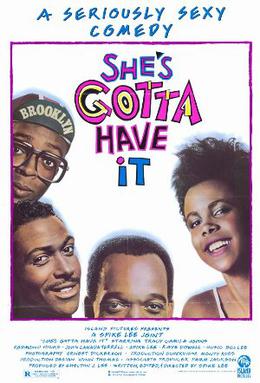
“It’s really about control, my body, my mind. Who was going to own it? Them? Or me? I’m not a one-man woman. Bottom line.”
For an engaging version of the story of the making of She’s Gotta Have It, I recommend John Pierson’s book “Spike, Mike, Slackers and Dykes.” To pare this down, Spike Lee’s senior thesis at New York University’s Tisch Film School, Joe’s Bed-Stuy Barbershop: We Cut Heads, dated 1983, won a few awards and even got screened in some unlikely places around New York City, like MOMA, to considerable praise and notoriety. Spike Lee managed to make a deal with Larry Fishburne, post-Cotton Club and pre-Color Purple, to play a bike messenger, but after Lee told everyone he knew about his next film, Messenger, financing hit the skids. Spike Lee would later say that the lesson he took was to commit himself to a script he could actually make, so he circled back to an idea he had had about a cosmopolitan black woman who owns her promiscuity.
Lee worked with his Spellman classmate Tracey Willard to create a questionnaire they would circulate among 35 Black women, on everything from preferred eyes to penis size. Spike Lee convinced the New York State Council of the Arts to transfer its $18.000 grant for Messenger to this new film idea, She’s Gotta Have It, but the American Film Institute refused to make the same deal with their $20,000. Although the AFI writes that Lee cast himself as Mars Blackmon because he couldn’t afford another actor, the truth is that most of the actors were working for next-to-nothing anyway, and Spike was already thinking about how putting himself in his movies might eventually give him more control over his projects and his career.
One has to consider the filmmaking atmosphere of those post-Star Wars, pre-Sundance days, when Spielberg-style films had led to growth in America’s mall multiplexes that led to empty screens in spring and fall seasons, meaning that there was just enough room for the right sort of Coen Brothers or Jim Jarmusch film to become a small word-of-mouth hit. She’s Gotta Have It was made on the aglet of the shoestring. Nothing was insured or permitted or done with union labor, remarkable considering all of it was made in New York City, specifically Fort Greene, Brooklyn. The film was shot during summer 1985 on 16mm black-and-white over a 12-day period with little space or time for reshoots. Spike Lee premiered a rough cut at a special NYU event, and then told the audience, “I’m Spike Lee and I hope that you liked the film. I’ll be calling you soon about becoming financially involved in helping us complete it.” Spike struck out with members of NYU faculty, but that warm reception did help him secure finishing funds from film financiers who were used to betting on who would become the next big thing.
She’s Gotta Have It begins with a title card quote from Zora Neale Hurston about men believing in ships of dreams and women remembering the rest and acting accordingly, kicking off jazzy credits of title cards alternating with photos of black life in Brooklyn. Nola Darling rolls over in bed, tells the camera she needs to set the record straight, gets called the soulmate of another man, Jamie Overstreet, and makes love to him in her dark, candle-lit bedroom. Clorinda Bradford tells the camera she and Nola had a falling out over her promiscuity, and Nola tells the camera about a lot of foolish men, whom we see in cutup closeups trying pickups. The bespectacled, basketball-shoe-rocking, big-chain-bearing Mars Blackmon bikes into frame, busts thoughts on Nola being a freak, and ambles amiably into Nola’s apartment. Opal Gilstrap, of indeterminate ethnicity, tells the camera about lesbian life yet is more reticent when Nola privately asks her. Greer Childs pulls up in a sportscar, calls himself the best thing that ever happened to Nola, and flashes back to himself pumping iron in Nola’s place, warning her he’ll leave if she gets fat, eating red meat, calling Jamie and Mars hoodlums, telling her he’s about to appear on the cover of GQ, and making love to her in an unprecedented series of bird’s-eye-view quick cuts of black bodies on white sheets. Sonny Darling plays piano, tells the camera how Nola couldn’t focus despite the love he and his wife gave her, and Nola tells us she was lonely as an only child and looks forward to raising “five rusty-butt boys.” Jamie tells Nola to click her heels and say “there’s no place like home,” and her doing so triggers the black-and-white film’s only color sequence of a pas de deux in front of a banner that says Happy Birthday Nola that makes Nola smile. Mars calls while Nola is with Jamie, gets blown off, tells the camera Jamie is soft like ice cream in summer, causes Nola’s close-upped belly to quiver with laughter, causes Nola to make Mars’ Nike shoe quiver with laughter, lies in bed with Nola, puts her panties on his face, and gets her to delve into his dirty, dandruffy hair. Jamie and Greer each express frustration with Nola’s promiscuity, with Greer sending Nola to a sex therapist, Dr. Jamison, who soon tells Nola that her most important organ is between her ears, not her legs, and that Nola’s friend is confusing a healthy sex drive with sickness and addiction. As snow falls over Brooklyn, Jamie, Greer, and Mars gather at Nola’s for a Thanksgiving dinner, bicker, argue, insult each other, eat, squabble, play Scrabble, and eventually wind up with Jamie lying clothed in Nola’s bed as Mars and Greer leave. Nola dreams that three women crash into her apartment, call her a home-wrecker, and light her on fire, but when she wakes with Jamie, he tells her he’s also seeing a dancer, Ava, and she can hardly complain about it. On a rooftop near the Brooklyn Bridge, Greer sunbathes with Nola, invites her to the Caribbean for two weeks, tells her he needs to know now, and after she says no gives her days to think about it. Mars interrupts Jamie talking to the camera to make Mars’ own complaint about Nola’s non-attendance at a Knicks-Celtics game, which devolves into an argument about Larry Bird’s skills. Jamie defends Nola, blows off Mars, but presses Nola at her apartment and walks out when she won’t commit to him. Nola kisses Opal, kicks out Opal, masturbates, calls Jamie, convinces Jamie to discard his companion and come over, whereupon Jamie either rapes Nola or has extremely rough doggie-style sex with her and quickly leaves the apartment. Nola invites over Clofield and re-bonds with her over Jamie being over in both senses. Greer tells the camera that Nola saw himself, Mars, and Jamie as one organism, and when Nola officially breaks up with him under the Brooklyn Bridge, he blurts that Nola could have had it all and he’s gonna find a white girl. Near the same spot, when Nola breaks up with Mars, he says “please baby please baby baby baby baby please.” Nola tells Jamie she broke it off with the other two and wants to be with him, but celibately, a pose he opposes. Nola tells the camera celibacy and Jamie didn’t last long because she’s not a one-man woman, and who’s going to control her, them, or her? Nola gets back into the bed where the movie began as credits begin with the main actors holding slates and saying their real names.
I like the beginning with Zora Neale Hurston. We take Hurston for granted now, but in the 1980s, she was something of an obscure author. For black women, Spike is sort of a complicated ally. Spike Lee has affirmed that he regrets the rape scene, specifically saying “If I was able to have any do-overs, that would be it.”
Probably the key award for She’s Gotta Have It was at the 1986 Cannes Film Festival, a laurel called Award of the Youth, Foreign Film. After Spike won that, Island Pictures promoted the film as a Cannes winner, which gave other awards bodies permission. She’s Gotta Have It was released in August 1986 and became a modest indie hit amongst white and black audiences that fall, grossing about $7 million in the US. A.O. Scott wrote in the New York Times that the film “ushered in (along with Jim Jarmusch‘s Stranger Than Paradise) the American independent film movement of the 1980s. It was also a groundbreaking film for African-American filmmakers and a welcome change in the representation of blacks in American cinema.”
When I was a teaching assistant for Todd Boyd’s History of Hip-Hop class at University of Southern California, we framed Spike Lee’s emergence as part of a more general response to the somewhat stratified, high-falutin’ black culture of the time as personified by A Soldier’s Story, The Color Purple, and especially “The Cosby Show,” which was a cultural supernova from its debut in Fall 1984. It was as if to say, okay you white people think that black culture is the Huxtables? Try this instead. And Spike wasn’t the first hip-hop filmmaker; there were already movies like Krush Groove, Breakin, AND Breakin 2: Electric Boogaloo. But Spike was arguably the first to push any kind of hip-hop sensibility into the art-film or independent-film circuit. Yes, the overall film is more jazz than hip-hop, but the dialogue, particularly from the Mars character and compared to Cosby, sounded more like listening to mid-80s rap artists. After two-plus years of regular water-cooler discussions of Eddie Murphy and The Cosby Show, She’s Gotta Have It represented a sort of necessary intervention, an expansion of the conversation about and around African-American sensibilities.
She’s Gotta Have It may have benefitted from Run D.M.C.’s “Walk This Way” becoming the first rap song to crack the Top 5 of the Billboard 100 in September 1986, basically making it okay for white people to enjoy the new brash black culture.
It is worth mentioning that about a year after She’s Gotta Have It was released on video, Spike Lee thought one of his friends was pranking him when he got a phone call from Nike to turn his Mars Blackmon character into a pitchman for a new series of shoes with Michael Jordan, leading to ads that began in 1988, directed by Lee and starring himself and Jordan, featuring the line “It’s gotta be the shoes.” By then, Lee had met with Alice Walker and many other black intellectuals to discuss the virtues and vicissitudes of working within the system for change. Certainly, hawking Air Jordans isn’t exactly raging against the machine. However, Spike parlayed his new notoriety not only into films like Do the Right Thing, but also into regular TV appearances on NBC News and CBS News and CNN and whoever else was willing to book him during whatever latest so-called “black controversy.” It’s fair to say that outside Mars Blackmon, Spike’s on-air personality was, ahem, a little more militant than Bill Cosby’s. In the late 80s, this was what America had “gotta have.”
Influenced by: New York University’s curriculum, which Lee both used and constructively criticized
Influenced: established Lee’s career, early persona (Mars Blackmon), and ability to tell uncomfortable truths; lifted other minority filmmakers
~
C55. Children of a Lesser God (Haines, 1986) BO clip imdb LB RT trailer wiki
stream on amazon watch analysis by Marchbanks read analysis by Skudra listen to my podcast
“Here you go! Hear my words! Hear my voice! Ah, you want more than that? I’m gonna scream!”
Deaf actress Phyllis Frelich and her relationship with her hearing husband Robert Steinberg were the original inspirations of Mark Medoff’s play. Medoff tailored the role specifically around Frelich’s personality, and the play was first workshopped in 1979 at New Mexico State University. Medoff’s title came from Alfred Lord Tennyson’s poem The Idylls of the King, Children of a Lesser God premiered on Broadway in 1980 and won three Tonys, including Best Play. From there began an awkward six-year development process in Hollywood. Paramount Pictures president Ned Tanen shopped Medoff’s script to stars, and the film might have been Alan Pakula’s follow-up to Sophie’s Choice, to star Meryl Streep as Sarah and Robert Redford as James. However, that financing fell apart, so Streep and Redford traveled to Africa to make Out of Africa instead. Al Pacino expressed interest in Children of a Lesser God, then didn’t. The main problem for producer Burt Sugarman was that the film he envisioned needed a Color Purple-sized or at least eight-figure budget but any major star would immediately use a fourth of that budget. Another slight problem was that Phyllis Frelich turned 40 in 1984 and was probably too old to play Sarah as written.
Just when it looked like the project was going to jump the shark, Henry Winkler, better known as the Fonz, happened to see Marlee Matlin in a performance of the International Center on Deafness of the Arts, or ICODA. Winkler knew the heads of Paramount and knew of their efforts to make Children of a Lesser God into a film, so he contacted Ned Tanen and Burt Sugarman, who were both amazed at Matlin but wondered if the 19-year-old could really play 25-year-old Sarah. Sugarman arranged auditions with Matlin and William Hurt, who in 1985 was a much-praised actor who had not quite yet ascended to full-leading-man status. Essentially, Sugarman got Hurt and Matlin on the cheap as well as director Randa Haines because she was making her own breakthrough from TV directing to cinema. Haines lobbied for the job by advocating what she called “total communication in the deaf community” and finally, by summer 1985, the film was greenlit by Paramount with a $10 million budget.
Children of a Lesser God was shot at a posh Victorian-looking school in New Brunswick, Canada, that emulated the real-life Beverly School for the Deaf in Maine. Haines, actor William Hurt, and new co-screenwriter Hesper Anderson all learned sign language. Early on, Haines made the decision that subtitles would distract too much from Matlin’s performance, and so much like John Rubinstein onstage, William Hurt would speak most of Sarah’s lines as she signed them. This was more controversial than it may appear: when the film was released in 1986, deaf groups complained that there was no widely released subtitled version. Ned Tanen, still running Paramount, worried that too many subtitled prints would put off hearing audiences. After the controversy, Tanen authorized about 30 closed-caption prints to be distributed around the country.
Children of a Lesser God begins with abstract billowing lace curtains at night near a vibrating rain-spattered window near sleeping Sarah Norman. On an overcast day, a car ferry brings young ambitious teacher James Leeds to Kittridge Island, where he drives his beat-up Ford truck to the Governor Kittridge School for the Deaf. During Leeds’ job interview, Dr. Curtis Franklin commends Leeds’ remarkable resume but reminds him the job is only to help deaf kids get along better. In his classroom of deaf older teenagers, Leeds quickly demonstrates unconventional pedagogy, falling down, testing lip reading by lipping class dismissed, standing on his hands, and responding to one kid’s reason for speaking – picking up hearing girls – by shoving the desks of the boys and girls together. At the staff cafeteria, Leeds meets staff members and notices the outspoken sign language of Sarah, whom Franklin describes as an employee. In his seaside villa, Leeds lazily listens to Bach, and in a classroom, Leeds tutors a student by asking her to feel the speaker as the song plays “boom-a-rang-rang” so loudly that Franklin comes to turn it off. Later, James sees Sarah mopping the hall floor, brings her into his classroom, and offers to help her to speak, but she signs back that she’d rather teach him to mop the floor. On a forlorn football field, Franklin tells James that Sarah was diagnosed as retarded until age 7 and was taught by them to fulfill her potential, but since James insists otherwise, Franklin soon brings Sarah into James’ office for a speaking-showing session that soon ends with Sarah storming off. In class, Leeds uses up-to-the-minute references as teaching tools from Twisted Sister to Terminator. On a rocky beach on another overcast day, James insists to Sarah that she could do more in the world and somehow convinces her to have dinner with him. At an Italian restaurant, Sarah smiles to see James sign that only stupid hearing people think deaf people are stupid, says she can feel music in her nose, insists on dancing, dances with him, but refuses his entreaties for tutoring, saying she doesn’t do anything she doesn’t do well. James drives 60 miles to knock on the home of Mrs. Norman, who reluctantly lets James in, disclaims any blame or shame, explains that Sarah can only speak poorly, and describes Sarah’s hearing sister Ruth bringing boys back home. Back at school, Sarah elaborates to James that she was better at sex than hearing girls, meaning boys were lining up to have speechless sex with her, meaning James can forget his fantasy of the deaf virgin happily hailing the hearing hero. At night at the school pool, James uncoolly enters, sees Sarah swimming stark naked, says “Sarah, I am falling in…” she swims away “…into the pool with you,” prompting abstract, wah-wah-scored shots where she kisses him, strips him, and lets him hug her. Inside a movie theater showing Some Like It Hot, Sarah enjoys the film and James signing so much that we smash-cut to Sarah’s bedroom where she makes love to James, calls him the nicest person she ever met, asks about his historic heartbreaks, and denies others have hurt her. James lips but doesn’t sign “what am I saying?,” offends Sarah, and promises not to do that again. At the fall festival, with parents gathered in the auditorium, five of James’ students, wearing shirts that say “The No-Tones,” dance and sorta sing “Boom-a-rang-rang-rang” as James smiles and Sarah skeptically scopes the scene. Franklin frankly informs Jim that “these things” don’t work, but James fires back that he loves Sarah and she’ll be quitting and moving in with him, something we see only after James tells Sarah he wouldn’t want deaf children, but if they are, that would be fine. James’ kinetic teaching style yields results with most kids except Johnny. James and Sarah clean up in nice clothes to attend a poker party at Franklin’s, where, without a broom or mop, Sarah cleans up in quite another way. During sex on their couch, James blurts that he needs Sarah to say his name, an accidental promise-breaking that upsets Sarah. Another time at home, James plays Bach but tells Sarah he can’t enjoy it because Sarah can’t, prompting Sarah, at night, to play Bach, ask Jim to describe it, watch his shirtless flailing, and sign that he shouldn’t be sad for her. On a dock full of working fishermen, James asks what Sarah really hears other than silence, but when Sarah signs no one has ever known, James answers “will you ever let me in?” At a house party hosted by Marian Loesser, a deaf economist with two PhDs who never speaks, Sarah lights up but Leeds feels less comfortable, leading to them later lashing words over James wanting her to be anything but what she is. After this leads to awkward sex, Sarah explains that everyone who ever spoke for her was usually wrong about what she wanted and that until he gives up on his ideas for what she should do and lets her be an “I” as he is, he can never come inside her silence. James accuses Sarah of being afraid to speak, screams at her to read his lips, and prompts her to push him away, cry, and flee after she gutturally utters “hear my voice” and “I’m not afraid.” Sarah returns home to sign to her mother, who offers her house and help with work, admits that she hated Sarah for driving her father away, and lies to James on the phone about Sarah being there. In a montage, James moodily, broodily does alone everything he used to do with Sarah. James returns to Mrs. Norman, who tells him Sarah won’t see him but she’s working, saving money, and preparing to go to college. At a school dance, James smiles to see friends and students dancing to “Jump (For My Love)” until he is shocked to see Sarah, resplendent in a white dress, and the two walk out to a nearby bench, where each sign their sorries and James suggests meeting in a spot not in silence but not in sound. Sarah signs her sign of indubitable independence-based intimacy, and the two hug as credits roll.
Children of a Lesser God stars a well-meaning white guy who could have been Redford or Pacino trying to help the deaf woman get along in the world. And yet she deconstructs him all the way, piece by piece. At the end, it still seems unlikely that Sarah will compromise all that much. It’s the kind of steady, slow, complicated comeuppance for a lead-role white savior that we very rarely saw in 20th century filmmaking. In that way, Children of a Lesser God goes beyond disability and is more universally applicable.
Marlee Matlin won Best Actress, but it’s worth saying that the film was also nominated for Best Picture, yet Randa Haines was not nominated for Best Director. That year’s other four Best Picture nominees all got the corresponding Best Director nomination; Randa Haines was edged out by David Lynch for Blue Velvet, which is also an excellent film, but still.
Children of a Lesser God is a distinctly excellent film about difficult choices around disability. But it also represents a certain road not taken by Hollywood during the 20th century. Shortly after Matlin won her Oscar, Dustin Hoffman signed to play the lead in Rain Man, and Daniel Day-Lewis signed to play the lead in My Left Foot. The consecutive (and probably deserved) Oscar wins of Hoffman and Day-Lewis led to the disabled figure becoming kind of the 1990s version of Hamlet, something every serious star-actor decided they needed to play, from Robert DeNiro in Awakenings to Al Pacino in Scent of a Woman to Jodie Foster in Nell to Tom Hanks in both Philadelphia and Forrest Gump. Arguably, these actors helped shine a helpful light on the disabled, but what they also did was take jobs away from the genuinely disabled. If Meryl Streep had been willing to make Children of a Lesser God for free, she would have been the spearheader of this trend. As it was, Marlee Matlin stood for decades as a counter-example of a movie that centralizes a disabled person to actually star a disabled person. Like her fellow 1986 Best Actress nominee Sigourney Weaver, Matlin’s example sat there for decades mostly unheeded until the 2010s. That’s a shame.
Influenced by: 70s and 80s TV films about disability, although Haines finds a voice all her own
Influenced: not enough; after Rain Man, major actors playing disabled became the 90s’ version of Hamlet, leaving behind the actual disabled
~
C56. Stand and Deliver (Menendez, 1988) BO clip imdb LB RT trailer wiki
stream on amazon watch analysis by Thai read analysis by Culina listen to my podcast
“There will be no free rides, no excuses. You already have two strikes against you: your name and your complexion. Because of those two strikes, there are some people in this world who will assume that you know less than you do. *Math* is the great equalizer… When you go for a job, the person giving you that job will not want to hear your problems; ergo, neither do I. You’re going to work harder here than you’ve ever worked anywhere else. And the only thing I ask from you is *ganas.* *Desire.*”
UCLA classmates Ramon Menendez and Tom Musca wrote the film version of the story of Jamie Escalante and reached out to Edward James Olmos, who was receiving the best reviews of his life and of the show “Miami Vice” for playing Lieutenant Martin Castillo, leading to an Emmy for Supporting Actor. Looking around at other dramas like “Hill Street Blues,” Olmos well knew that even the best ethnic actor could get trapped on TV, never considered for leading roles for movies. As a role, Jaime Escalante represented a chance for Olmos to spearhead the kinds of movies about the Latino community that just hadn’t yet been told…but not if it premiered on PBS. Olmos wanted a major studio that would push the film as a “stand up and cheer” film a la Rocky and push his name for an Oscar nomination. Three little problems: 1, Olmos wasn’t a star, 2, any studio’s high-school set would cost at least a million dollars just to maintain for the month of filming, and 3, the funding sources were expecting a PBS release and required a lot of back-end points if the film were to be released theatrically. For a time, the project was stalled; Menendez and Musca considered handing over their script to a more established director.
Garfield High School agreed to stand in for itself, as a matter of pride, without charging production a set fee. Olmos recommended an actor from “Miami Vice,” Lou Diamond Phillips, after he was cast in the lead role of Ritchie Valens of La Bamba, a movie whose rough cut impressed Musca and Menendez enough to overcome squeamishness about rumors that Phillips wasn’t Hispanic. Musca and Menendez hired a mostly non-union crew, most of whom would be paid just a bit less than Olmos and Phillips, and made the gutsy decision to proceed without a distributor. If they were lucky, the film would do well in festivals and a studio would agree to distribute it so that it wouldn’t just be another PBS film.
Some actors refuse to meet the real person they’re playing; Edward James Olmos insisted on Escalante being on set every day, because he wanted to imitate him as closely as possible. Olmos gained 40 pounds, had his hair cosmetically thinned, and even lived in Escalante’s house for a month. The film began shooting in April 1987, when the working title of Stand and Deliver was still Walking on Water, which everyone hated. Musca and Menendez workshopped “just do it”-like titles until someone thought of “Stand and Deliver” at the last minute.
Stand and Deliver begins with Jaime Escalante driving through East Los Angeles on his way to the front office of James Garfield High School, which he finds to be vandalized with graffiti and fecal matter, where he tells an admin he was hired to teach computer science, but his supervisor, Raquel Ortega, says the school keeps failing to find funds for computers and directs him to a classroom to teach Math 1-A. There, students test him, joke about sex, and leave early because some of them have learned to rig the school bell. Jaime returns to his car to find his radio stolen and returns home to reveal, through a conversation with a neighbor, that he left a good computer job to teach at high school. Back in class, Jaime wears a McDonald’s hat, jokes that smart people are supposed to be better lovers, and reacts to the late, rebellious Chulo’s middle finger by calling Chulo and himself the “finger man” and using his (Jaime’s) fingers to multiply by nine. Angel stands by as Chulo’s friends show up after class to intimidate Jaime, but out on the courtyard, when Jaime sees Chulo in a fight, he grabs Angel to keep Angel from interfering. In class again, Jaime calls himself a cyclone from Bolivia, sees Chulo and Angel bring friends into class, declares the scheduled course to be a ticket to low-wage work, begins to teach algebra, compares negative numbers to a hole at the beach, pries an answer from Angel, informs the students that Mayans invented zero, jokes “you burros have math in your blood,” and gets the class loudly repeating “a negative times a negative equals a positive.” Jaime joins a raucous staff meeting where Molina warns of probation and loss of accreditation, Raquel Ortega answers “you can’t teach logarithms to illiterates,” and Jaime claims students rise to the level of expectations. In class, Jaime recognizes bias against names and complexion but extols math as the great equalizer if you have ganas, or desire, which he will now enforce via a daily quiz. In the halls, Angel demands from Jaime separate books so that the homies don’t see him carrying any, so after Jaime provides these, he asks what he’s getting in return, and Angel says “proteccion.” To each other, students react to Jaime’s South American heritage by alternately calling him Kemosabe or Nazi. After Lupe refuses to take the daily quiz, the class says “chair, chair, chair” until Lupe is made to sit in a chair facing the class, and we see Lupe’s life at home negotiating between studying and helping her exhausted mother. Angel lives in a small flat with his mom, rides with the homies at daybreak, watches them throw cans at windows, looks exhausted, gets dropped off by Chulo who jokes about Kemo, arrives at class late, gets sent to woodshop by Escalante, pleads for pity on a taco-bender like him, splays his arms like Jesus on a chalkboard, and gets Jaime’s reluctant permission to let him remain in class. At the taqueria of Mr. Delgado, who has removed his daughter Ana from class to work at the restaurant, Jaime, flanked by wife Fabiola, tells Delgado Ana could be his family’s first kid in college or, as Ana hopes, medical school, causing Delgado to get insulted and kick the Escalantes out of the place. As Ortega and Molina pop into class, from the blackboard, Jamie asks the students how many girlfriends a given gigolo has, but the students have trouble converting the wording to an equation until Ana surprisingly walks in and solves that x = 3. Jaime field-trips the class to his neighbor’s computer lab, demonstrates the class’s real-world applicability, learns that his neighbor’s daughter is taking calculus, and soon, at a staff meeting, Jaime demands to teach calculus to hear Ortega’s calculus that when the kids try and fail, Jaime will shatter the little confidence they do have. In sweltering summer classes, Jaime tells the groaning students he doesn’t want to be there either but the Japanese are paying him because they’re tired of making everything. As the school year begins, after Jaime fends off a trashcan attack, he passes out contracts to his new calculus class for their parents to sign off on the kids dedicating afternoons and Saturday mornings. In their small place overlooking the freeway, Claudia’s mom says boys don’t like a girl who’s too smart, but Claudia earns mom’s signature by saying she’s doing this to not depend on a guy. When Garcia says he’s dropping class to work a forklift earning time-and-a-half on weekends, Jaime drives Garcia’s car, uses turns as metaphors, and asks if Garcia wants to build these cars or design them. Jaime jokes that the students are movie stars, but a joke comparing Claudia to Elizabeth Taylor’s promiscuity goes too far as she walks out and Jaime chases her down to hear her weepy troubles. In class, over his wife’s objections, Jaime announces Christmas week classes and then refuses to give up on a despondent Garcia, but he does eject a tardy Angel…who brings his abuela to Jaime’s house near Christmas. Jaime also teaches a night English class out of which he stumbles, staggers down a staircase, and suffers a heart attack. As Fabiola tells Jaime he can’t have job stress for a month, Molina gives the kids their new music teacher sub only two weeks before the AP exam…but after only two days, Jaime replaces him and grills the kids, who take the AP exam and then celebrate at the beach. At an assembly, Molina cites the rareness of taking or passing the AP calculus exam, but that the kids of Garfield High School passed more students than any other school in Southern California – all 18 of 18, all of whom present a surprise plaque to Jaime. Yet the same 19 persons gather at the high school bleachers as Jaime reads that because of that unusual achievement, ETS must investigate, and we soon see two ETS agents checking Molina’s safe to ascertain that the tests were secure. Pancho treats Lupe like a summer fling to Claudia’s outrage; Angel treats a cop like a ding-a-ling to Chulo’s outrage, and so Angel takes a long walk home. In the classroom without Jaime, an ETS agent, Ramirez, tells the 18 kids he’s from the barrio and knows how things go, but none of the kids admit anything other than Angel’s facetious fabulisms. After Ortega implies to Jaime she believes the kids cheated, Jaime takes a long walk home, where he confesses to Fabiola teaching calculus may have been a miscalculation as the kids have lost faith in the system they’re now qualified for. At a tony downtown L.A. office, Jaime confronts the two ETS agents, but when they refuse to show him the tests and recommend a redo, Jaime shouts, “those scores would have never been questioned if my kids did not have Spanish surnames and come from barrio schools!” After the kids agree to the redo, with a day to prep, in class Jamie is both more practical – no pockets, no staring off, no causes for downgrading – and more philosophical, saying quote, “you are the true dreamers, and dreams accomplish wonderful things. You’re the best.” At a late-night session at Jaime’s, he cooks as his kids study and Pancho leaves in a huff, goes to Lupe’s, makes up with her, and comes with her, along with the other 18 kids, to a large library-ish room where the two ETS agents administer the makeup, harder AP Calculus exam. After a long, drawn out misdirect, over the phone in the admin office, Molina receives the passing grades name by name – we see the students one last time – and Jaime strides into the empty school hall as a title card says “In 1982 Garfield High School had 18 students pass the A.P. Calculus Exam.” And then the numbers improve each year for 1983, 1984, 1985, 1986, 1987 as Jaime pumps his fist to the song “Stand and Deliver” taking us into the credits.
Escalante commented that the film was “90% truth, 10% drama,” although he probably only meant his part; the students’ lives were more or less made up by Musca and Menendez. I’m not sure that Stand and Deliver is the sort of film that can be interpreted in seven or eight different ways, or one that contains many hidden meanings. Like Rocky, Saturday Night Fever, or a few other films, it’s simply about underdog achievement.
Having missed deadlines for Berlin and Venice, the filmmakers submitted to the Mill Valley Film Festival in October 1987, where studios were impressed and offered distribution deals. According to an article in LA Weekly, the filmmakers chose Warner Bros. because of its record promoting “long-shot successes” like Chariots of Fire. On February 26, 1988, Mann’s Chinese Theater hosted a benefit premiere with proceeds going to the “Jaime Escalante Calculus Program and Garfield High School Alumni Association Scholarship Fund.” The film opened in March on 30 screens and in April on almost 750, after the Oscars were over.
A year later, Olmos became the first American-born Hispanic to earn an Academy Award nomination for Best Actor. At the Independent Spirit Awards, held the night before the Oscars, Stand and Deliver won six out of the ten awards for which it was nominated, Best Picture, Best Director (Menendez), Best Screenplay (Menendez and Musca), Best Actor (Olmos), Best Supporting Actor (Phillips), and even Best Supporting Actress for Rosanna DeSoto, who played Fabiola Escalante.
As a modest hit, Stand and Deliver convinced some studios that after about a decade of anti-authority teen movies, audiences existed for some counter-programming, and Lean On Me and Dead Poets Society were fast-tracked, put into production, and released in 1989. Of the three, the Latino one, the Black one, and the white one, guess which one landed a Best Picture nomination? Nonetheless, part of the legacy of Stand and Deliver is delivering a modern, post-rebellion sub-genre of teacher-exalting that would last for decades, emulated by films from Mr. Holland’s Opus to The Great Debaters.
Olmos leveraged that Oscar nomination into his directorial debut, American Me, a sort of Chicano Goodfellas or Godfather that was not handled well by its studio. Olmos found critics and audiences to be more receptive when he went to work for Gregory Nava in two films, Mi Familia and Selena. After Selena became a big hit in 1997, Olmos founded the Los Angeles Latino International Film Festival, Latino Literacy Now, and Latino Public Broadcasting. I can’t think of a Latino who has done more in the last 30 years for Hispanic-American culture and Latinidad. Maybe he could have done all this without Stand and Deliver. Maybe.
Influenced by: Edward James Olmos nurturing Latino talent; Olmos received his only Oscar nomination for his work here
Influenced: likely, the many high school students forced to watch it
~
C57. Hairspray (Waters, 1988) BO clip imdb LB RT trailer wiki
stream on amazon watch analysis by Zayd read analysis by Billson listen to my podcast
“I would imagine many of the other home viewers are also pleasantly plump or chunky.”
John Waters’ initial pitch to studios, in early 1987, focused on the weirder dance crazes of the early 60s, not The Twist but instead “The Roach” and “The Bug” and “The Fly.” (The period’s famous Vincent Price horror film The Fly had just metamorphosed into David Cronenberg’s excellent remake.) For the first time in Waters’ life, at least minor studios seemed interested, particularly New Line, which had scored an unexpected hit with the Nightmare on Elm Street franchise and was looking for a David Lynch or Spike Lee to get some of that arthouse Woody Allen money. Waters promised Bob Shaye at New Line no feces-eating or cannibalism or any of his other previous outrages; to be clear, he was even willing to share final cut.
Reports on the budget vary from $2 million to $5 million. Certainly, the most expensive single line-item was the music rights. After putting together what would be a soundtrack full of novelty songs, Waters realized he needed at least a few of the period’s more mainstream songs, and his team managed to license a few at a lower cost just for the film, not for the soundtrack, like Lesley Gore’s “You Don’t Own Me” and Chubby Checker’s “Let’s Twist Again.” Waters would also need a doo-wop-ish song ideally called “Hairspray,” a job Debbie Harry was happy to manage alongside minor pop artist Rachel Sweet. In June 1987, at the height of mania for the U2 album “The Joshua Tree,” Waters told the L.A. Times that Sonny Bono was an internationally known rock and roll star who had guaranteed his international financing.
Encouraged by his friends, Waters also cast himself for the first time, leading to a minor dispute with the Screen Actors Guild, who already had a John Waters, but this Waters refused to add a middle initial because he claimed he was “firmly established on a national basis as John Waters.” Waters meant to cast his stalwart Divine as both mother and daughter Turnblad, but Bob Shaye talked him out of it after auditions turned up Ricki Lake, who could both dance and act. After decades of radical gestures, Waters saved one of his most important, and subtle, for Hairspray: plus-size Tracy Turnblad would never have any kind of “why don’t they like me?” scene. This wasn’t a John Hughes film. Instead, Tracy would confidently advocate for herself as TV-worthy and cute-jock-worthy over the objections of blond shills calling her a “dumptruck” and “fat retard.” The same confidence would sell Tracy’s approach to civil rights as seemingly self-evident, another thing John Hughes hadn’t bothered with.
Hairspray begins with the song “Hairspray” played over many, many teens and young people applying Hairspray and other makeup backstage at the Corny Collins show. In 1962, at a modest Baltimore house, plus-sized teen Tracy Turnblad and pal Penny burst in and blast past Tracy’s not-thin mom Edna on their way to the TV room to watch and dance to the Corny Collins show where Corny reads requests, profiles favored young persons, and cues them to dance. Edna breaks up Penny and Tracy’s party, throws shade on her daughter’s “ratted” (raised, or “feathered”) hair, gets called “so fifties,” and peruses Penny’s over-protective mom picking her up and promising her a scarlet P for punished. One of Corny’s dancers, pretty blond Amber Von Tussle, gets chaperoned by handsome Link to her spacious home to get an earful from her mom about dancing closer to the TV camera, avoiding black music, their troubles if the neighborhood gentrifies, and listening to her dad, who tells Amber to pass out flyers that say “Let Amber Take You for a Free Ride.” Corny Collins hosts a dance party welcoming enough for randos like Penny and Tracy (but not black people), where Tracy cuts an impressive rug while joining the front line of dancers doing the Madison. Corny introduces the host of “Negro Day,” African-American “Motormouth Maybelle,” who introduces the “boogedy boogedy shoo,” a dance contest where Amber calls Tracy “fatso,” but Tracy’s dance beats Amber’s at the applause-o-meter, earning her a next-day audition for Corny’s show, where Amber’s fat-shaming causes Corny to suspend Amber and Tracy cheerfully supports integration as well as “pleasantly plump” viewers who might like her. Penny enters the Turnblads to beg them to turn on the TV, where Edna is mortified but Wilbur is pleased to see a dancing Tracy, whom Corny introduces as the latest member of the Corny Collins Council as he importunes her to start the next dance with a ladies choice, and hers is Link, observed on TV by a distraught Amber who yanks off her friendship ring. Back at home, Edna fields phone calls, claims to be her agent, and tells an arriving Tracy she’ll take her all the way to the top, as Tracy extols “Fame, fortune, glamour,” and being “big, blonde, and beautiful” and also in love. Tracy and Edna shop at Hefty Hideaway House of Fashion, whose head, Mr. Pinky, asks Tracy to model, and Edna’s savvy negotiating secures both of them nice new clothes. After Tracy’s hair height bothers a kid behind her in a very un-Escalante math class, the school principal transfers Tracy to special ed, to which Tracy protests, “but that’s for retards! And the black kids you try to hold back.” On a field, the special ed class meets another group of teens for dodgeball, and during play, Link tells Amber to grow up, Tracy shows Penny her new friend Seaweed son of Motormouth Maybelle, and Amber brain-beans “fat retard” Tracy, who wakes to see Penny flirting with Seaweed and Link asking her, Tracy, to go steady. On the Corny Collins Show, Tracy shows off Link’s ring, dances with him, and models as runway-announced by Mr. Pinky, who broadcasts “big is beautiful!” Link takes Tracy and Penny on a bus to Cherry Hill, a black neighborhood, where they meander into Motormouth Maybelle’s record store, get cheerfully welcomed by a dozen black partiers, try on new dance moves, and get interrupted by Penny’s rather racist mom waving a knife and mistaking black people as criminals. At kids day at the Corny Collins show, Penny and Seaweed and his kid sister Inez are turned away, so Inez says she has a dream and they all begin chanting “segregation never, integration now”, a call that Tracy picks up inside the studio, shouting “2 4 6 8 TV’s gotta integrate” as Amber’s mom accuses Tracy of being mulatto to Edna’s fury. In an integrated auditorium, Tracy, Link, Penny, and Seaweed dance low with mostly black people, and during a slow song, as Tracy kisses Link, she says “I wish I was dark-skinned” and (white) Link answers, “Tracy, our souls are black, even though our skin is white.” Seaweed declares his love with Penny to be taboo, but when the Turnblads turn up, the foursome hide in a beatnik pad where a painter gets abstract and the “beatnik chick” gives life advice. Penny’s parents turn up with a spiral-wheel-spinning shrink who tells Penny to remember cute white boys as Penny’s dad wraps her in a straitjacket and she shouts “I love you Seaweed!” At the Tilted Acres Amusement Park, as protestors at the entrance shout “tilted acres is not fair, racist people everywhere,” the news interviews the owners, Amber’s parents, who say exclusion is merely economics, oh and also, “segregation today, segregation tomorrow, segregation forever.” Tracy, Link, Amber, and others ride the rides as the Corny Collins show broadcasts live from the middle of the park, although the show’s producers warn Corny that if even one black face appears on camera, the show is canceled. Amber leads the crowd of teens in the “limbo rock”; Tracy leads them in the “waddle.” Out at the gates, after a white lady’s cherry bomb sets off a melee, black people storm into Tilted Acres, causing Amber to warn her parents of a race riot, in which purse-swinging white women cripple Link while Tracy shouts “police brutality!” joined, in her bedroom, by Penny while being subjected to the shrink’s outrageously racist remedies. Tracy is hauled to prison, where she and the inmates watch a TV where the hospitalized Link tells the camera “I love you Tracy” cutting to Amber calling Tracy roach-infested, and our film cuts to Amber’s parents smugly building a bomb. At the 1963 auto show, Corny Collins and Maryland’s governor smile for photos until Tracy’s parents surprise them and start a chant of “Free Tracy Turnblad!,” words the governor is equally surprised to hear from protestors at the front door of his own mansion while he pushes past them and reporters and becomes handcuffed to Inez and Maybelle as the three push into the manse. At the auto show, to a crowd of teens, the racist producer announces Tracy Turnblad as technically the winner of Miss Auto Show – to the delight of many including Corny and Link leaping from his wheelchair – but because Tracy is in “reform school” Amber is declared winner, causing her pompous stomping of a new dance “the roach,” and her mom leaving aside her hair-weave-hidden bomb for the time being. However, at the manse, Inez and Maybelle keep cheek-kissing the governor until he agrees to pardon Tracy, and as if by magic, Tracy dances “the roach” with her supporters outside the governor’s mansion all the way into Corny Collins’ studio to adoring applause and the full integration of the Corny Collins show. Leaning into Amber’s insult, Tracy’s tony-tailored pink dress features dozens of roaches, as she leads the crowd in “the bug” while Amber’s mom’s hair bomb gloms onto only Amber and mom. Tracy assumes her throne and says “let’s dance!”
With a film like Hairspray, I always direct my students to read Susan Sontag on Camp, or at least the first few pages for her first few definitions. Very, very briefly, Sontag defines camp as less serious than high drama or high art, as interested in the epicene and attenuated and androgynous, as obsessed with the artifice of surfaces and styles e.g. clothing, and as putting everything in quotation marks, so if I therefore might quote Sontag, “the love of the exaggerated, the ‘off,’ the things-being-what-they-are-not.” Hairspray is camp without Waters’ usual strident grossness, replaced by a strident integrationist message.
Most critics were happy to welcome Waters into the relative mainstream; Waters, a voracious reader, claimed that his favorite review was from Rolling Stone because David Edelstein called the film “a family movie both the Bradys and the Mansons could adore.” Later, in Waters’ book Mr. Know-It-All, he wrote,
“It had the power to sneak into middle-class homes and espouse gay marriage and teenage race mixing without anybody noticing,” writes Waters. “We were soon to find out that the test results were wrong. Even racists loved Hairspray!”
I want to separate these two points about “gay marriage and teenage race mixing.” On the first point, Waters must be referring to Edna and Wilbur. Although Edna presents as a woman and is referenced with female pronouns, we are not told Edna’s gender. Thus Waters is inviting us to “read” Edna as a man living as a woman, a rather radical reality for 1962 or even 1988 for a film industry that hadn’t presented anything similar.
On the second point, “race-mixing,” the strange thing about seeing Seaweed and Penny passionately lock lips is that there really hadn’t been that many films with even a supporting black-white relationship. As with positive gay representation since the mid-60s breakup of the anti-“miscegenation” Hays Code, this was something that Hollywood could have done for decades, but mostly hadn’t bothered with. (And it wasn’t just mainstream Hollywood: John Waters’ peers on the independent-film scene, like Woody Allen, David Lynch, Jim Jarmusch, and the Coen Brothers also weren’t helping.) When Spike Lee’s Jungle Fever came out in 1991, the media covered it as though there had been pretty much no films about interracial romance, which was almost true.
15 years after Bruce Lee had died days before the international premiere of Enter the Dragon, Divine died on March 7, 1988, from a heart attack at age 42, just as Hairspray was going into international release. Waters was one of the funeral’s speakers and pallbearers; apparently Whoopi Goldberg sent flowers with a note that said “See what happens when you get good reviews?”
Hairspray opened around the same time as Stand and Deliver; the proceeds from its premium-ticket premiere in Baltimore went to benefit AIDS Action Baltimore. Hairspray was a minor hit in 1988 that did better later on home video. It was made into a 2002 musical which won eight Tony Awards, including Best Musical, and which was in turn was made into a 2007 musical movie not directed by Waters, who in fact hasn’t made a fiction feature since 2004, although I do highly recommended listening to any of his AudioBooks. No one narrates quite like Waters.
Influenced by: Waters’ style, which ranges from abject art to high kitsch; potential allyship between straight women, black people, and the LGBTQ, but less so the disabled (like many in the 60s, Tracy dismisses them as retarded)
Influenced: Waters kept the indie flame burning for decades before this film helped the fire spread to the New Queer Cinema
~
C58. Coming to America (Landis, 1988) BO clip imdb LB RT trailer wiki
stream on amazon watch analysis by FDS read analysis by Roland listen to my podcast

“When you think of garbage, think of Akeem!”
Art Buchwald had copyrighted a fish-out-of-water African-in-America story. After Trading Places (1983), Eddie Murphy and John Landis heard about Buchwald’s treatment, revised it, and watched it fall apart after Beverly Hills Cop became the highest-grossing film released in 1984, highest-grossing comedy ever, and highest-grossing R-rated film ever. After some odd career choices, Murphy circled back to the African prince idea, writing an entire treatment himself that Murphy considered substantially different from Buchwald’s idea. However, Buchwald disagreed, sued Murphy and Paramount, and Murphy was forced to testify in January 1990 under oath.
Perhaps Murphy hired Landis because he expected, after Landis’s own serious legal troubles, that Landis would behave professionally, and indeed he mostly did during principal photography over the first three months of 1988 in New York City, where a real Queens Boulevard Wendy’s substituted for McDowell’s. Rick Baker did some of his most elaborate, thorough makeup work in designing different character faces for Murphy and co-star Arsenio Hall, setting the tone for Murphy’s future forays into films playing multiple characters.
Coming to America brings us over the Paramount mountain logo and into the lush, verdant savanna of Zamunda and its capital castle, where Crown Prince Akeem Joffer is awoken by a team of violinists, three beautiful rose-petal bearers, and his aide Oha, who wishes him a happy birthday but still won’t let him go to the bathroom alone as we cut to Akeem in a large pool from which a lovely royal bather emerges saying “the royal penis is clean.” At an opulent breakfast with his parents, King Jaffe and Queen Aoleon, Akeem complains about all the rose-bearing and pampering and sheltering and bride-arranging, but the queen assures him she was nauseous when she first met the King and the King assures Akeem there’s a fine line between love and nausea. The ingratiating Semmi arrives to take Akeem to his daily pole-fighting, where Semmi questions any wife but a slave and Akeem replies if you love a woman you want her opinion. In the throne room, at the elaborate, cross-cultural wife-presentation ceremony attended by hundreds of African diplomats in dashikis, accompanied by an awkward acapella from Oha, Akeem meets his bride-to-be, takes her into a private room, and learns that she is so supplicant as to never express any preference beyond what Akeem prefers. King Jaffe wraps up the ceremony, walks with his son on a private lawn graced by zebras and elephants, asks about Akeem’s awkwardness, and agrees that because Akeem has never left Zamunda, he should take 40 days to see the world, sow his royal oats, and circle back to Zamunda for his wedding day. Semmi is fired up to fancy “forty days of fornication,” but Akeem confides in Semmi that he wants his loins and mind stimulated, so he plans to find a bride in America, and they look at a map of the United States and find a place called “Queens.” As they arrive at New York’s airport, Akeem reminds Semmi that they must appear to be African students who are no richer than anyone else as they are trailed by their porters wheeling a dozen large trunks that somehow get placed in and on their taxicab, whose driver is incredulous but agrees to take them to the most common part of Queens, where their trunks get stolen the moment Akeem and Semmi are distracted by setting up what Akeem calls “meager accommodations,” a room with rats, bloodstains, spring-popped mattresses, and chalk outlines. At a local barbershop, we meet colorful characters, including the owner Clarence, considering sports stars and blackness when Akeem walks in, asks for a haircut, explains he’s been growing his braid since birth, asks to look neat, and sees Clarence cut nothing but the braid and say “that’ll be $8.” Dressed like Americans, Akeem and Semmi go to bars in a reverse-gender salute to the “dogs” vignette of She’s Gotta Have It showing a series of fallible women, ending with a man in drag saying “I want to tear you apart, and your friend too.” At a large auditorium hosting hundreds for Black Awareness Week, Akeem and Semmi watch as Reverend Brown celebrates and ogles seven bikini-clad women and introduces the band Sexual Chocolate fronted by Randy Watson whose atonal performance of “The Greatest Love of All” fails to impress the crowd as much as young professional Lisa McDowell, who asks for contributions to help Lincoln Park and gets a big wad from Akeem. Cued by Brown’s plug of Lisa’s father’s business, Akeem and Semmi get entry-level jobs at McDowell’s, where owner Cleo McDowell rather unconvincingly explains differences between his restaurant and McDonald’s. Akeem mops floors near the executive office of Lisa, cheerfully introduces himself as the new supervisor of garbage, and beams, “when you think of garbage, think of Akeem.” The heir to the geri-curl-generating Soul Glo empire, Darryl, turns up in a sports car, accepts Cleo’s free strawberry shake, kisses Lisa, pretends to have given Akeem’s money to the collection plate, and throws what’s left of the shake at Akeem causing Semmi to laugh at the pink spilled all over Akeem. After Akeem anonymously gives Lisa half-million-dollar earrings, Lisa and her sister Patrice invite Akeem to a St. John’s basketball game, where Lisa and Darryl see a random Zamundan citizen fawn all over Akeem, ask him who that was, and Akeem replies, “Just a man I met in the bathroom.” At McDowell’s, a rough man in a shotgun attempts a robbery, but Akeem uses his mop and pole skills and assistance from Semmi to disarm and desist the thief, daze Lisa, and impress Cleo enough to invite the African twosome to a party at his expensive house in Jamaica Estates…where Semmi is made to valet and Akeem to tend bar. Amongst the dozens of partygoers, Cleo gathers Darryl’s parents to make a big announcement that Darryl and Lisa are engaged, and in an echo of Akeem in Africa, Lisa pulls Darryl into a private room to express her objections at being ambushed. When Lisa asks Akeem to dinner, Akeem insists on testing Lisa’s affection by taking him to his poor apartment, but when they get there, Semmi has converted their roach motel room into a posh hotel room, so Akeem redirects her to a restaurant where he claims to be a goat herder but she praises his inner glow and kisses him. Wearing a sash made of (real?) lion, King Joffe arrives, leaves rose petals on the barbershop floor, sees an employee of the month plaque telling him his son works, browbeats and blames Semmi, and punishes him with confinement at their royal suite at the Waldorf where a royal bather can work him thoroughly. Akeem and Lisa kiss at a museum as the King visits McDowell’s and gives Cleo his Waldorf information and some Zamunda money with Akeem’s picture. After Akeem takes Lisa home, Cleo insists that the two stay as he surreptitiously calls for the King at the Waldorf, but Akeem scoots off home, where he finds Semmi’s note, leading him to the Waldorf, where he finds Semmi having a royal bath. The King arrives at Cleo’s with his Queen and retinue, deals with Cleo’s sycophancy, goes to Lisa’s room, and tells her Akeem is already engaged and only in America to sow his royal oats, causing her to leave. Akeem arrives, learns his father drove off Lisa, tells his family he loves Lisa, gets his mother’s approval and father’s disapproval, finds Lisa descending into the subway, follows her into it, pledges his love, renounces his throne to the scores of spiritless subwayers, but Lisa walks away anyway. In the cab on the way to the airport, the King says she said no and besides, who is he to challenge tradition, and the Queen replies “I thought you were the King.” Back in the great hall in Zamunda, an aloof Akeem stands at the front waiting for his veiled, long-trained bride to finally reveal her face…and it’s Lisa, causing Akeem much happiness and peremptory kissing and, later, riding with Lisa amongst the adoring throng of thousands, saying if she asks he can still give all this up, to which Lisa says “Nah!”
Andy, what do you think of this one?
Coming to America was the highest-grossing all-black film for 30 years. Let me say that in another way. At $128 million in North America and about $300 million worldwide – at a time when black movies were considered box office poison internationally – Coming to America was the highest-grossing all-black film until Black Panther. And arguably it also represented a bit of a shark-jump or pivot for the Murphy persona, for good and for ill.
I think Coming to America is kind of a perfect film for Eddie’s star persona at the time. He was the guy that people fawned over in line at the restroom, wanting him to smile broadly. In a way, he was giving us what we were asking for. This also marked Murphy’s first cinematic attempt at multiple roles, allowing him to be both the “straight man” and the goofy SNL voice-maker. (He even revived “Mr. White.”) Going forward, Murphy became Hollywood’s most frequent essayer of multiple roles in a single movie.
Coming to America proved that white audiences would turn out in droves for all-black screen content that wasn’t highbrow like “Roots,” Bill Cosby or Steven Spielberg. It expanded possibilities, certainly leading to debut of “The Arsenio Hall Show” in 1989, probably assisting the debut of the so-called “Black SNL” “In Living Color” in 1990. The list of all the headline-worthy comics of all colors influenced by Murphy would be too large to fit in the Apollo Theater.
And yet, there’s something about the fact that Coming to America was released on June 29, 1988, one day after the release of Public Enemy’s second album, “It Takes a Nation of Millions to Hold Us Back,” and two weeks before N.W.A.’s single “Straight Outta Compton,” the title track of an album released about a month later. Yes, Coming to America was a huge hit that summer, but Eddie Murphy was no longer the voice of young angry black male America. That summer, that crown was seized by Chuck D or Ice Cube or perhaps conscious, angry hip-hop more generally, in the process leaving behind Murphy’s “heh-heh-heh-heh.”
In March 1989, in an interview with Jet, Spike Lee asked why Eddie Murphy wasn’t using his power to help black actors break into film. This was either unfair or a spur or both. Each year of the mid-1980s produced at least one must-see all-black film: A Soldier’s Story (1984), The Color Purple (1985), She’s Gotta Have It (1986), and Hollywood Shuffle (1987). But despite or because of Spike Lee, starting with Coming to America, Murphy used his exclusive contract with Paramount for more all-black films than not, which were Harlem Nights (Murphy’s first and only directorial effort), Boomerang, and Vampire in Brooklyn.
Certain things happen with all-black films that just don’t happen otherwise. One example is the sight of hundreds of black people in formal dashiki-adjacent designs that Deborah Nadoolman derived from Ivory Coast, Gambia, and Senegal. Another example is that perhaps Samuel L. Jackson’s stardom doesn’t happen if he isn’t first cast in small roles in Coming to America and Do the Right Thing (in that order). To return to Vampire in Brooklyn, that film turned into such a fiasco in 1995 that Paramount declined to renew and Murphy mostly stopped making efforts toward all-black films after the next year’s The Nutty Professor, which marked Murphy’s next pivot into mostly family-friendly territory. It’s easy to see Murphy now as merely Shrek’s Donkey or a dragon in Mulan or the lead in Dr. Doolittle, sanitized and safe. But the dangerous Murphy was once the right thing that got us to the next thing.
Influenced by: Art Buchwald’s treatment (later part of a famous lawsuit); Murphy’s fish-out-of-water persona
Influenced: helped possibilities for shows like “In Living Color” and films like those made by Tyler Perry
~
C59. Rain Man (Levinson, 1988) BO clip imdb LB RT trailer wiki
stream on amazon watch analysis by Derrat read analysis by McCarthy listen to my podcast

“K-Mart sucks.”
According to producer Roger Birnbaum, he said yes to Barry Morrow’s pitch for Rain Man the first time he heard it. Someone at Creative Artists Agency was supposed to give the script to Bill Murray and his brother Brian Doyle-Murray, but instead sent the script to Bill Murray to play Raymond and to Dustin Hoffman to play Raymond’s entitled brother Charlie. After Hoffman declared he wanted to play Raymond, the producing team of Jon Peters and Peter Guber got involved. At the time, 1986, Bill Murray was in self-imposed semi-retirement, while Tom Cruise had contacted Dustin Hoffman and asked how they might work together. Of course, lots of people wanted to work with Hoffman, but Tom Cruise had just become the biggest star since Eddie Murphy via that summer’s Top Gun, and Martin Scorsese recommended Cruise based on The Color of Money. Peters and Guber got Morrow to rewrite the script to account for the age gap and got Cruise to take second billing under Hoffman.
And then, Hoffman and Peters and Guber decided they didn’t like the script, which was borderline jokey and silly and didn’t seem appropriate in the wake of 1) Children of a Lesser God; 2) a 1986 film called The Boy Who Could Fly, the first feature to centralize a person with autism, who flies and evolves to speak; 3) Temple Grandin’s first book, “Emergence: Labeled Autistic.” If Rain Man would wind up as the first time people heard of autism, Hoffman didn’t want people to trivialize the condition or feel anything less than empathy for people with it. To Peters and Guber’s credit, they agreed, and held off on production for months while Ron Bass rewrote the script. Dustin Hoffman stayed busy, visiting “with consultants from the Institute for Child Behavior Research in San Diego, CA, and the University of California Los Angeles (UCLA) Neuropsychiatric Institute, as well as meeting with autistic people and their families.” He later said he based his performance on many people but especially Kim Peek, Joe Sullivan, and the real brotherly relationship between Peter and Kevin Guthrie.
Research failed to unearth exactly what words were said to who in early 1988, but Sydney Pollack left production, leaving Guber and Peters nine weeks to find a director. Hoffman and Cruise were committed, but didn’t want to work for a rookie or an indie-maker. Peters and Guber somehow convinced another Baltimore native director, Barry Levinson, and his producing partner Mark Johnson, around the same time that their film Good Morning Vietnam earned both $100 million and Robin Williams’ first Oscar nomination. Levinson and Johnson had two months to prepare for United Artists’ hard start date of May 2, 1988, with the goal of using the summer weather and somehow having the film edited by Christmas for an Oscar run. One of the key production decisions that Levinson did not make was production making four locations look like more; almost all of the film was made in and around Cincinnati, Oklahoma, Las Vegas, and Los Angeles, but arguably Oklahoma stands in for a lot more than that. One of the key production decisions that Levinson did make was to hire Hans Zimmer, basically unknown at that time, having come to Levinson’s attention through scoring the anti-apartheid drama A World Apart. Zimmer later said, “The Raymond character doesn’t actually know where he is. The world is so different to him. He might as well be on Mars. So, why don’t we just invent our own world music for a world that doesn’t really exist?” I would argue that the music actually comes to feel more like a part of Charlie’s world that he didn’t know existed, just enough to feel like a long-suppressed epiphany.
Rain Man begins with “Iko Iko” played over a Lamborghini chassis being hauled over Los Angeles to land near Charlie Babbitt, whom we soon see in his garage/warehouse, with his two employees, Lenny and Susanna, working a $75,000 deal to flip four Lamborghinis that, we soon learn, is in jeopardy because the EPA hasn’t cleared the cars and the swing loaners are threatening to repossess while the buyers are getting cold feet. On the rural highway to a Palm Springs hotel, Charlie and Susanna are exhibiting clear relationship tension when Lenny’s call to Charlie’s car phone reveals Charlie’s father’s death in Cincinnati which causes Charlie to remark upon he and his father’s relationship tension. Charlie U-turns, flies to Cincinnati, brings Susanna upon her insistence, attends the funeral distant from the other mourners, brings Susanna to his father’s mansion, and looks at his dad’s cream-colored 1949 Buick Roadmaster convertible. At Susanna’s urging, Charlie tells her of the Rain Man, an imaginary friend who comforted him as a toddler, as well as the story of the day he, as a teen, presented great grades to his father, asked for the Buick, got refused, stole it anyway with his pals, got pulled over, and unlike his pals was left in jail for days to rot, after which he ran away and never spoke to his dad again. At a legal office, attorney Mr. Mooney reads to Charlie his dad’s final letter and the part of the will leaving Charlie the Buick while the other $3 million is to go to a private trustee Mooney won’t name. Charlie lies at a local bank and learns the name and location of Dr. Bruner, so he and Susanna drive to Wallbrook, and as they wait for Bruner, they soon realize Wallbrook is an institution for patients with severe intellectual disabilities. When Bruner refuses to help Charlie, Charlie threatens legal action. As Susanna sits in the Buick, a stranger gets into it and claims to drive it well until Charlie arrives, kicks him out, hears him know the previous upholstery, and grills the stranger, Raymond, who claims to have the same parents as Charlie. Soon, Raymond and Susanna are watching Judge Wapner while, in an adjacent hallway, Bruner tells Charlie that Raymond is an autistic savant with deficiencies, abilities, routines, self-protective rituals, and an inability to understand emotions or money. In Raymond’s room, Charlie pushes at Raymond, asks if he can recall books he’s read, unarranges the books, and provokes Raymond to say “ohhhh, Vern,” who reassures Raymond and tells Susanna he knows Raymond better than anyone yet Raymond wouldn’t notice if he, Vern, left. Charlie asks to take Raymond on a walk, where he gets a reluctant Susanna to move the Buick to near the estate gate, and then Charlie takes Raymond on a long, long walk to the car so that he can kidnap him and lie to Susanna that Bruner wanted them to spend time together. In a hotel, though Raymond has a hard time adjusting, they eventually get him pizza, Wheel of Fortune on TV, a phone book to read, and a bed near the window, so they can have sex, but after Charlie yells at Raymond, Susanna says Charlie lied about Bruner and Charlie admits he’s keeping Raymond until Bruner gives him his half of $3 million, so Susanna absconds. At a diner, just before Charlie makes a pay-phone threat to Bruner, Raymond’s rising panic over maple syrup and toothpicks causes Charlie to grab his neck and say “stop acting like a f-ing retard” which Ray notes in his serious injury journal while the waitress spills the box of toothpicks and Ray correctly counts all 246 on the floor within seconds. At the airport, when Charlie demands that Ray get on their flight to L.A., flight-phobic Ray has a self-abusing full-blown panic attack, so Charlie angrily concedes they’ll have to drive to L.A. On the highway at night, the brothers are held up by an accident, so Raymond worries over their safety and will only walk, so Charlie considers giving up and leaving Ray by the road but instead takes him along a backroad. At a hotel in “bum-f” Missouri, Ray refuses to leave while it rains, so Charlie makes phone calls and labors to provide substitutes for Ray’s routines. Driving top-down on a rural heartland road, Ray insists that he needs underwear from K-Mart in Cincinnati, causing Charlie to stop the car, get out, and have his own kind of panic attack, yelling “I think this autism is a bunch of shit, cause you can’t tell me that you’re not in there somewhere!” Parked in a small town looking for a psychiatrist, Charlie on a pay phone loses Ray, and in a possible call-back to Midnight Cowboy, Raymond crosses the street at the “Walk” but stops at the “Don’t Walk” that begins before he’s crossed, so people honk at him blocking traffic until Charlie finally pulls him away. In a psychiatrist’s office, the doctor tests Ray’s calculator-esque skills and declares Raymond to be very high-functioning, so Charlie interprets the doctor’s advice as “so I just gotta deal with this stuff.” With Ray panicking over missing Wapner in the middle of nowhere, Charlie knocks on a door, lies to the woman about being from the Nielsen company, gets discovered, begs/pushes, and watches as Ray watches Wapner with this family. At that night’s cheap motel, Ray’s stray comment causes Charlie to realize Raymond was his childhood Rain Man who sang the Beatles to him, but Ray’s panic attack at bathwater makes Charlie realize Ray was institutionalized because “they thought you’d hurt me” as Ray mutters to himself “Never, never hurt Charlie Babbitt.” Charlie buys Ray a portable TV and learns from a pay phone call to Lenny that the swing loan company seized the cars and demand $80,000 or, as Lenny says, they’re out of business. At a diner near Las Vegas, Charlie realizes something, tests Raymond’s ability to count cards, and says “you are beautiful, man.” Charlie pawns off his watch for enough capital to dress himself and Ray in matching grey suits – he tells Ray “K-mart sucks.” The brothers begin betting blackjack, which goes quite well, eliciting an enthusiastic crowd, an $86,000 profit, and the casino’s surreptitious attention, but they can’t figure out the cheat. At the bar, Ray meets a “sparkly” woman who suggests a 10pm date but feels insulted by Ray’s random responses. In their palatial suite, Charlie readies Ray for his date with Iris by showing him to dance, but at the end, when he goes in for a hug, Ray freaks. Susanna shows up, says Charlie’s treatment of Ray makes her sad, accompanies both brothers to the date, watches Iris stand up Ray, sees Charlie get taken into a chat by security (but only briefly), accompanies Ray into the elevator, stops it, and shows Ray how to kiss. In the Vegas hotel front driveway, after Ray calling himself an excellent driver all film, Charlie lets him prove it, and they all laugh. In L.A., Charlie shares an affectionate ciao with Susanna, situates Ray in his apartment, gets called by Bruner, meets Bruner alone at Bruner’s hotel, argues, turns down his $250,000 check, asks why nobody told him he had a brother, and goes home to find Ray freaking out over a smoke detector that Charlie destroys. At the climactic meeting, Charlie, Raymond, and Dr. Bruner meet with a court-appointed doctor who asks Charlie if he really wanted to trade his brother for $1.5 million, asks Charlie if after a week he wants to take care of Raymond forever, and asks Raymond to choose between Charlie and Wallbrook so many times that Ray freaks and Charlie surrenders. As Charlie gets emotional, Ray calls him “my main man” and allows their foreheads to touch. At the Amtrak station for a train to Cincinnati, Bruner meets the brothers, asks if Ray wouldn’t prefer K-mart clothes, hears Ray say “K-mart sucks,” lets them have a final moment, where Charlie says he’ll see Ray in two weeks and quivers his lip as he says goodbye.
Watching it for this site was literally the first time I’ve seen it in full since before my first son was born in 2009. He was diagnosed with severe autism at the age of two; he’s never spoken and is far lower-functioning than Raymond. Also, he has a neurotypical younger brother. I only realized just now that I may have named my only two kids after the two brothers in Rain Man, although I switched the names and slightly changed them; I’m not going to explain that further, but it was quite a stark realization.
Rain Man was the highest-grossing film released in 1988, something that certainly hasn’t been true of any comparably dramatic film for quite some time. Probably the box office helped Rain Man win the Oscar for Best Picture; probably that win was also aided by the sure-shot win of Dustin Hoffman for Lead Actor. Early predictions said that Dangerous Liaisons would win Best Picture, but early predictions were wrong. The previous four Best Picture winners had been period films taking place entirely outside the United States; Rain Man was practically a hymn to America in 1988, the year being spoken several times in the film. But I do think there was more to that in everyone doing Raymond imitations in a pre-woke early 1989; there was some kind of empathy with this new scary disease called autism (an empathy that should have come much sooner in the case of AIDS).
Wherever Rain Man lands on the, uh, spectrum of Best Loved Films, it’s certainly as influential a film as any when it comes to the disabled. After Rain Man’s box office and four Oscars were followed the next year by Daniel Day-Lewis’s surprising win as the cerebral palsy-afflicted lead character of My Left Foot (a great film with no place on this list because it isn’t American), playing a severely disabled person became the 1990s version of Hamlet, with Robert DeNiro playing such a role in Awakenings, Al Pacino following suit in Scent of a Woman, and Tom Hanks, to some degree, in Forrest Gump. This minor trend gave rise to a joke by the very un-woke character played by Robert Downey Jr. in Tropic Thunder when he said “you never go full retard.” That said, ever since those post-Rain Man days, there have been groups like Wry Crips that have vocally objected to abled persons playing disabled people. Anyone from a marginalized community knows the familiar refrain: how much work did the production do to find an actor who was actually of the community? Was no one else available?
About five years ago, I reunited with a college-educated friend who was honest enough to admit that everything she knew about autism came from Rain Man. Rain Man is a huge enchilada in the autism community, both blamed for careless distortions and praised for awareness promotion. It’s certainly not one thing or the other, and I’m not sure that it would help to haul out a heap of contradictory quotations from my community.
The irony or painful reality is that Rain Man arrived two years after deaf Marlee Matlin won an Oscar for playing a deaf person, in a role that Meryl Streep might have had if a few other things had gone differently. So in other words, Randa Haines’ counter-example was sitting right there, mostly unheeded, for decades, because of Rain Man. As someone close to the disabled community, I would agree with those who say that it would be hard for someone as afflicted as Raymond to actually play Raymond. The short version is that Rain Man was influential, for good and bad.
Influenced by: Cruise, Hoffman, and Levinson’s commitment to literate, humanity-exploring drama
Influenced: perceptions of autism; the film’s Best Picture Oscar and Best Actor Oscar established the disabled man as a new Hamlet
~
C60. Daughters of the Dust (Dash, 1991) BO clip imdb LB RT trailer wiki
stream on amazon watch analysis by Herbert read analysis by Scott listen to my podcast
“I am the first and the last. I am the honored one and the scorned one. I am the whore and the holy one. I am the wife and the virgin. I am the barren one and many are my daughters. I am the silence that you can not understand. I am the utterance of my name.”
Julie Dash was born in 1952 in Queens, New York, and raised in the Queensbridge Housing Project. Dash earned a B.A. in film production from City College of New York in 1974, after which she moved to Los Angeles for graduate school at UCLA and a fellowship at the AFI conservatory. In 1975, inspired by stories from her father, she began making notes about an African American family from the Sea Islands at the start of the 20th century. However, Dash’s attention was then drawn to directing or leading three excellent short films in three years, Four Women, Working Models of Success, and Diary of an African Nun, which won acclaim and a few awards. Dash later said, “I stopped making documentaries after discovering Toni Morrison, Toni Cade Bambara, and Alice Walker. I wondered, why can’t we see movies like this? I realized I needed to learn how to make narrative movies.” In other words, it wasn’t enough to simply replicate the style of the white patriarchy; her ideal films would speak some kind of dissonant method, mode, form, language, that couldn’t necessarily be understood by or fit into the dominant culture.
Julie Dash’s 1992 book, “Daughters of the Dust: The Making of an African American Woman’s Film,” describes the difficulty she had describing to white-run institutions her reasons why the richness of Gullah culture required the film to be a feature. Grant-writers saw The Color Purple; Dash saw all kinds of other colors. Finally, in 1987, using film stock from friends like Charles Burnett, Dash shot a sample on St. Helena Island in South Carolina when she was still calling the Nana character “Great Mother Palmer.” Four of the actors in the sample told Dash they would absolutely reprise their roles whenever Dash got the full feature funding. For another year, that failed, but finally, in 1988, American Playhouse granted Dash about $800,000 to make Daughters of the Dust.
For another year, Dash concentrated on finding and scheduling actors, costumes, cameras, film stock, permits, and lighting equipment. The last point became moot when the Sea Islands, as part of a national park, refused to allow Dash to bring four-wheel drive vehicles on the island, meaning they couldn’t move an electrical generator. Dash was dismayed at losing her night scenes, but husband Arthur Jaffa, who was working as co-producer and director of photography, felt he could make up for them with the use of only natural light. For a while, the plan was to film during summer to take advantage of longer days, but heat, mosquitoes, and summer winds were counter-vailing issues, and eventually Dash scheduled the four weeks of principal photography to begin in mid-September. However, as production gathered and rehearsed on Hunting Island, the approach of Hurricane Hugo forced them to evacuate to Charleston…which is exactly where the hurricane redirected itself to. Recovery of equipment and talent took more than a month. Finally, on the same day as a devastating earthquake on the West Coast, October 17, 1989, the peaceful East Coast hosted the first day of Dash’s principal photography that lasted about a month. Dash knew even then that scoring and editing would probably take a long time, and indeed it consumed the better part of a year, with the goal of submitting the film to the now-prestigious Sundance Film Festival. Dash made it, and the film premiered at Sundance in January 1991, where Jaffa won the Cinematography prize.
Daughters of the Dust starts with credits that end “Produced, written and directed by Julie Dash,” followed by this title card: “At the turn of the century, Sea Island Gullahs, descendants of African Captives, remained isolated from the mainland of South Carolina and Georgia. As a result of their isolation, the Gullah created and maintained a distinct, imaginative and original African American culture. Gullah communities recalled, remembered, and recollected much of what their ancestors brought with them from Africa…” Over abstract visuals, Nana Peazant calls herself honored, scorned, whore, holy, wife, virgin, and “the silence you cannot understand.” Twilight extreme long shots of what a title card calls Ibo Landing, The Sea Islands of the South, 1902. In a rowboat approaching the island, Viola introduces her photographer, Mr. Snead, to Yellow Mary, who laughs with her companion Trula who appears yellower than her. A young female narrator, the Unborn Child, says her story began before she was born with her great-great-grandmother Nana Peazant, “her flowers to bloom in a distant frontier.” She can still hear Auntie Haagar calling to her daughters, Iona and Myown, whom we sorta see in abstract visuals. On the rowboat, Snead argues that slave importation was outlawed 50 years before the Civil War, but Viola counter-argues that an exception was made for “saltwater Africans” sent to these islands. Nana Peazant says the word “north” wets the lips of her family as they box up and ready to move. Some girls gather to read the love letter to Iona of St. Julian Lastchild, a “son of the Cherokee nation” whom we see laboring with black men and finally sitting in the bend of a thick willow tree. The film cross-cuts between two scenes, an abstract one of girls in white dresses ritualistically dancing on the beach, cut with Nana Peazant and her grandson Eli, next to family graves, arguing over legacy and life and Eli’s wife Eula’s dubiously conceived pregnancy. Abstract, non-narrative visuals of routine work are eventually accompanied by Nana’s voice-over cataloguing miseries of the 19th century, followed by the Unborn Child voice-over-ing this time as one of hope and beginnings, as Gullah girls goggling through kaleidoscopes are cross-cut with 1902-ish images of crowds on urban streets. On the sandy white beach, Viola arrives and gets embraced by the large family including Haagar, who leads the family in their contempt of Yellow Mary and Trula, even or especially after Yellow Mary presents store-bought biscuits to Haagar. Viola gathers the youngers to tell them about her life up north, about faith and food and found things, and about Jesus Christ, the Lord. Resting on the branch of a beachside willow, Yellow Mary calls Eula a “real Geechie girl,” calls Ibo the most desolate place on Earth, calls her family “living like savages,” calls for good gumbo, calls “the raping of colored women as common as fish in the sea,” and calls out for a man she could depend on – not that she’d always want to depend on him. After Eula nods, Yellow Mary advises her to remain with dependable Eli and never tell him the baby’s real father, cutting to the Unborn Child voice-over-ing that she had to convince Eli she was his child as Snead shoots all the men at the beach, one of whom explains Bilal coming on the very last slave ship. Yellow Mary explains having a stillbirth leading to a damaged breast leading to Cuba and working there with a family that kept her until she finally “fixed her tittie” and was able to return home. To synthified tribal music, Yellow Mary, Trula, and Eula find a large umbrella on the beach. On a windblown, tree-shaded sand bar, Haagar advocates leaving Nana and her root potions and hoodoo behind, hailing “the new world we’re moving into” with fewer Africans acting “fresh off the boat.” Over shots of men and women over stone cauldrons stirring and using hot tar, the Unborn Child says “We left our markers in the soil in memory of the families who once lived here.” Affectionately, Yellow Mary and Trula present a then-modern catalog to small boy Ninnyjugs, advising him to narrow down his wish list from “everything.” The Unborn Child speaks memories and tributes over abstractified visuals of ponds, kids playing, gulls, and a beach bike ride. Viola speaks to Snead that old souls “spoil their children with dreams, wishes, magic,” and though it’s been 50 years since slavery, “here we still give our children names like Myown and Iownher, Unita, Iadorher, Euadorher, we even have a Pete and Re-Peat,” and a dozen colorful nicknames over shots of kids gathering and Eli collapsing over graves. Nana voice-overs that there weren’t good records kept of births, deaths, or slave sales, which meant that sales could provoke incest, which meant black people worked harder to keep the records themselves. Eula stands by a river, holds her pregnant belly, tells the Unborn Child what chained Ibo saw as they arrived a century before, speaks of walking on water, and watches Eli wade through water to push to sea a bobbing tribal statue. After a sumptuous feast, under the umbrella on the beach, Yellow Mary tells Trula and Eula how she never needed nobody’s help to make a dollar and now knows she’ll know a nice life in Nova Scotia. Haagar tells Nana where they’re going they won’t need glass bottles on trees, instead growing gardens of fresh flowers and vegetables. Snead takes various pictures of various groupings, asks the largest to say “Ibo Landing,” and privately interviews Bilal Muhammed, who tells Snead “Women are the sweetness of life” and also that no one walks on water and the fallen middle-passengers never came up. On the sand bar beach, when tensions come to a head between Yellow Mary, Nana, Haagar, and Eli, Eula speechifies “As far as this place is concerned, we never was a pure woman. Deep inside, we believed that they ruined our mothers…and we live our lives always specting worse cause we feel we don’t deserve no better.” Eula implores her extended family to love Yellow Mary as they love themselves no matter what roads they take and deserve, to let scars heal, and to see themselves as “the daughters of those old dusty things Nan carries in her tin can.” Nana ties an old diadem to Viola’s Bible to sanctify the old with the new, but as the family bows their brows for blessings, Viola cries “it ain’t right!” and Haagar browbeats the hoodoo and ways of yesterday and stomps away, but Viola does bend her head to her bowed-up Bible. Sunset passes with Lastchild riding his horse through the beach’s surf and, in the morning, through a field to the boat dock to collect Iona and spirit her away. At that same dock, Trula and many family members board the rowboat and float away, but not with, surprisingly, Snead, Viola, Yellow Mary, Eula, as the Unborn, or perhaps born, Child explains, saying that Eli got involved in anti-lynching while her daddy and the rest of we “remained behind growing older, wiser, stronger.”
I think I was very lucky in college that a professor assigned Toni Morrison’s “Beloved” two years after it was published. I’m not going to pretend that I understood every chapter of Beloved the first time I read it. However, the overall experience of the book opened me up to new ways of approaching the traumas of generations of forced migration and chattel slavery and systematic abuse. We often quoted Audre Lorde’s dictum, “the master’s tools will never dismantle the master’s house,” as a way of saying that white male language will never cure these traumas and may even reinforce them.
In some ways, it’s almost patriarchal to insist that there be a first film to be directed by an African-American woman. Perhaps power or significance doesn’t or shouldn’t work that way. Instead of variously assigning that honor to Tressie Souders, or Zora Neale Hurston, or Liz White, or Kathleen Collins, or Neema Barnette, or Euzhan Palcy, perhaps we should see that they all deserve that honor. In any event, Daughters of the Dust is commonly known as the first film directed by an African American woman to see a nationwide theatrical release. And in many ways that’s a more meaningful intervention than if, say, Dash had been hired to direct Coming to America. Because Dash’s film challenges and disrupts much of what we then knew and expected from cinema, many of my students still don’t really like it or get it. I like that.
In the decade after Daughters, most films directed by African-American women would be a little more conventionally drawn, like Eve’s Bayou and Love and Basketball. But Dash’s film remained there, resisting, for anyone who wanted to listen. Eventually, this included Beyonce for her visual album Lemonade, which opened Dash’s film up to a whole new generation.
Influenced by: Dash’s 15-year process; Toni Morrison, Alice Walker
Influenced: at first, not enough; later, everyone from Beyoncé to Duvernay
~
C61. My Own Private Idaho (Van Sant, 1991) BO clip imdb LB RT trailer wiki
stream on amazon watch analysis by Villin read analysis by Taubin listen to my podcast
“I really want to kiss you, man.”
As a gay artist in his 30s during the 80s, Gus Van Sant lost his share of friends to AIDS and was well aware of the arguments about aggressive representation as regularly aired in The Advocate. Van Sant was wary of being sectioned off as only a gay filmmaker, which was one reason he made the non-gay Drugstore Cowboy. After that film resulted in dozens of offers, Van Sant became determined to take what might be his only chance to make something more personal and in fact too difficult for the major studios. Based on his wealth of experiences, Van Sant had so, so many ideas, including 1) John Rechy’s 1963 novel City of Night about gigolos who did gay activity for pay but disclaimed being gay; 2) centralizing a narcoleptic, which would make disability and dream-logic more prominent; 3) a story of two Latinos who look for their heritage and travel to Spain where one leaves the other behind; 4) a middle-aged mentor to street hustlers who reminded him of Falstaff, which in turn made him think of 5) Orson Welles’ Chimes at Midnight and 6) a modern Henry IV. Van Sant combined all six of these ideas into an original script that was rejected by so many executives that Van Sant came close to casting actual street hustlers. As with Drugstore Cowboy, Van Sant would probably need to get some kind of star on board, preferably two stars, but compared to Cowboy, Van Sant’s story leaned more queer, causing the entire “Brat Pack,” as well as Drugstore‘s Matt Dillon, to lean the other way. Perhaps their agents simply wouldn’t show them the script, as was later reported in the case of young star River Phoenix. Current students don’t always understand that in 1990, same-sex kisses onscreen were not the only taboo; merely starring in a gay-themed film was considered career suicide.
Fresh off Bill and Ted’s Excellent Adventure, Keanu Reeves refused to rely on agents, read his own scripts, and liked Van Sant’s, assuming he could play Scott, the straight-man, would-be Prince Hal. Either Van Sant or Reeves somehow got the idea for Reeves to personally deliver the script during the 1989 Christmas holidays by driving his Norton Commando motorcycle from Reeves’ Canadian home to the recently purchased Florida home of River and Joaquin Phoenix. At that point, River Phoenix knew Reeves’ amiability and sincerity from two films, one where they’d played together, and one in which Reeves had acted with Joaquin; River was impressed enough with Reeves’ drive to agree to play the riskier role of Mike, the one who admitted to gayness. Phoenix and Reeves each feared the other leaving the project and shook each other’s hands, while Van Sant promised never to embarrass either or make them do a shot they didn’t want to do.
As Van Sant does not typically explain, his story of male street hustlers was saved by another story of male street hustlers, namely the first film called Teenage Mutant Ninja Turtles, a huge hit for New Line Cinema during spring of 1990. New Line CEO Robert Shaye earned that capital, felt inspired by the profits of indie films like sex lies and videotape and Do the Right Thing, founded Fine Line Features, and made deals with directors Jane Campion, Hal Hartley, and Gus Van Sant. My Own Private Idaho was mostly filmed in autumn 1990 in Portland and other parts of the Pacific Northwest. Van Sant and Phoenix bonded over their love for Werner Herzog, with Van Sant using a few Herzogian techniques while Phoenix based his performance on that of Bruno Schleinstein in Herzog’s 1977 film Stroszek. Phoenix had been born in Oregon to indigent circumstances and based some of Mike on his own life. Everyone on set was impressed with the 20-year-old Phoenix’s full commitment to playing the messy mucky over-medicated Mike, but armchair critics would have more to say three years later.
My Own Private Idaho begins with the dictionary definition of narcolepsy, a title card saying Idaho, and Mike, on a rather desolate northwestern highway, timing things, yelling at a rabbit, and suddenly falling asleep. As Mike dreams of his mother, titles say Seattle, where Mike receives fellatio and a fee that he manages to inflate by $10. Mike’s clothes, face hair, and demeanor mark him as a scruffy hardscrabble who we soon see scrubbing the sink of his next trick. Standing on a street corner at night, Mike gets picked up by a rich middle-aged woman who takes him to her mansion where Mike is made to hang with another hustler who happens to be his pal, Scott Favor. As the woman seduces Mike, he muses on his mom and crumples narcoleptically, so Scott and another gigolo take him outside to a posh front yard, where Scott covers Mike, speaks of his upbringing in such a neighborhood, speculates his father sees him as a threat, and leaves Mike there while he departs in a cab. In a certain sort of store, the many, many, male models on covers of magazines come alive led by Male Call’s cowboy-hat-rocking, shirtless Scott adorned by a subtitle saying “homo on the range,” praising getting paid compared to Mike yet admitting at Mike’s prompting that he is going to inherit a lot of money. Below a statue near its placard “The Coming of the White Man,” Scott tenders Mike like a Pieta, tells him that during his latest sleep episode the shady Hans drove them to Portland, takes him to a red-walled diner, denies selling Mike’s body when he sleeps, hears Madonna’s “Cherish,” and looks forward to seeing Bob, whom Scott claims to love more than his mother or father. As Mike, Scott, and pals awaken on a Portland rooftop, Bob emerges from under a freeway along with backup Budd, falls asleep in his large dilapidated well-ventilated flophouse, gets awoken by a playfully prose-appropriating Scott, searches angrily for stolen drugs amongst his many gigolo acolytes (probably the drugs we see Mike surreptitiously snorting), and asks Scott what he’ll do after his coming inheritance. At night under a freeway, wearing matching over-large pink robes, Bob and his acolytes mug some men for a box of cash, but Mike and Scott disrobe the robes, put on sack hoods, and mug the muggers with panache and fake swords, causing the cash and Bob and abettors to scatter. The next day in the flophouse, Bob exaggerates the events with florid Falstaffian fabrication only to endure Scott’s taunts, humiliations, score-setting, and the returning of the stolen cash to Bob. Police raid the flophouse, cause the dispossessed dissidents to disperse, and find Scott, who pretends to be in flagrante with Mike, lies that he hasn’t seen Bob, and blows off a message from his father. In a wealthy office, Scott’s father browbeats his son as a degenerate, but Scott responds with repentance and rhetoric redolent of Prince Hal in Henry IV. In Idaho, on the apparent remote road of the opener, next to a sign warning tourists not to laugh at locals, Scott fails to start his motorcycle as Mike recognizes the road as one that, if you narrow your vision, looks like “a f-d up face” saying “have a nice day,” a phrase that Scott repeats, that night at a campfire with Mike, as one that Scott’s maid lived by. At that campfire, after Scott claims a guy can’t love a guy, Mike insists he does love Scott, so Scott hugs him platonically. The next day, a Native American cop scares Mike into a dash and sleep but helps Scott start his bike. Scott carries Mike into the cement-block-raised trailer of Richard, who we soon learn raised the person he calls his brother Mike, though Mike insists Richard is his father even as he learns that his mother Sharon worked in a nearby Family Tree Inn. There, Mike and Scott receive Sharon’s forwarding address in Italy and run into Hans, who brings them into his hotel room, arranges for their baths and meals, behaves histrionically, and has a menage a trois, which we see as though in medium-shot photos, although the actors are vibrating as with breaths held. At Boise Airport, apparently with Hans’ money, Mike and Scott book a flight, and we soon see Mike awakening in Rome, stunned at the scenery of centuries-old structures. Mike and Scott take a taxi to a rural farmhouse, where Scott meets Carmela, who shares that Sharon taught her English but returned to America, prompting Mike’s tearful breakdown and willingness to leave Italy, but Scott gestures he needs to linger with Carmela, whose sex with Scott is shot in that same style as if suspended in photographs. Mike is obviously overwrought over Carmela and Scott’s budding romance, particularly after each, separately, tells Mike “I fell in love,” followed by Scott riding away with Carmela in a taxi and reading an important letter. Mike joins other male hustlers outside the Roman Colosseum, flails in front of a john, awakens at Portland airport, returns to that diner, shakes his head at straight lovers kissing, re-connects with a trick, watches The Simpsons, and falls asleep next to broken bottle glass on the sidewalk as Scott rides by in the backseat of a limousine. Bob sees Scott with Carmelita, both dressed to the nines, entering a swanky party, which Bob and acolytes crash, but Scott tells Bob that despite what he once learned from him, Bob must now leave him alone, and a bouncer bounces them out. Two funerals are contrasted, one for Scott’s father in which Scott looks as composed as a callow Corleone, and one for Bob that the mourners turn into a pagan mosh pit of pandemonium. On the rural road of the beginning, Mike says that his life has been on such roads that go around the world…as he falls, gets his stuff stolen by a car of passersby, and then, in an extreme long shot, gets picked up by another driver and hauled away.
I do think a film like this well underlines B. Ruby Rich’s points about formal edginess underlining thematic edginess. These characters aren’t accepted by bourgeois society, so bourgeois filmmaking doesn’t tell their story. Not sure how well that vibes with Shakespeare, who was also formally challenging.
When Phoenix died of a tragic drug overdose on Halloween in 1993, some would blame Van Sant for introducing Phoenix to a life of barbiturate-boosted bliss. Whatever happened to Phoenix on that set in 1990 cannot and should not be separated from the extraordinary bravery Phoenix showed during the filming of simulated threesomes, simulated oral sex from a man, and the campfire scene when Phoenix decided to make Mike’s love for Scott far more explicit than Van Sant’s script had implied. When Phoenix agreed to play Mike during that Christmas in Florida, he was then the sixth-youngest-ever nominee for Best Supporting Actor (for Running on Empty, 1988), Spielberg’s choice as the young Indiana Jones in that franchise’s third film, and a name that had appeared above the title of three films. With the exceptions of Al Pacino in Dog Day Afternoon and William Hurt in Kiss of the Spider Woman, no one on Phoenix’s A-list level had come close to what Phoenix did in My Own Private Idaho. (Should an out gay man have played Phoenix’s role? Well, sure, but such men were then missing from the A-list, for obvious reasons.) Compared to the rest of the New Queer Cinema, 20-year-old Phoenix blazed what I consider the most important trail, showing other major actors that they didn’t have to be afraid.
Influenced by: “Henry IV”; Chimes at Midnight (1965); Midnight Cowboy (1969); real street hustlers (and their gay denials) in Hollywood and Portland; Phoenix’s method acting
Influenced: serves as a landmark/signifier for New Queer Cinema; also influenced Matt Damon and Ben Affleck to ask Van Sant to direct Good Will Hunting
~
C62. Thelma and Louise (Scott, 1991) BO clip imdb LB RT trailer wiki
stream on amazon watch analysis by timbs read analysis by Heller-Nicholas listen to my podcast

“I don’t know, you know, something’s, like, crossed over in me… and I can’t go back. I mean, I just couldn’t live.”
The road to making Thelma & Louise had many twists and turns. Callie Khouri was a music video producer who dreamed up the idea in 1988, spent six months writing a script, shopped it, got no interest, and planned to make a super-low-budget film with a few friends when a friend of a friend showed her script to Mimi Polk Gitlin. Gitlin was running the production company of Ridley Scott, who loved it and paid $500,000 for the film rights. Gitlin recalled that Scott didn’t think he himself should direct it, but that the people he asked were other A-list directors who…yes, were all men. In retrospect, why didn’t Scott ask Gitlin, or perhaps Elaine May or Barbra Streisand? There’s no one great answer for that, although in 1989 no one was on the internet asking for more female directors; ten years later, when CBS dedicated hours of prime-time to A-list female stars to narrate the American Film Institute’s Top 100 and many Top 10s, not one single commentator mentioned that every single film had been directed by a man. I would say that in the 90s, that level of inclusiveness wasn’t yet in any kind of popular consciousness, and yes, it should have been.
Scott’s production company went looking for a studio, and none were willing to commit to what looked like a weird rape revenge yarn. The 1989 Oscars which celebrated the films of 1988 wound up as determinative. Similarities between Twins, Midnight Run, and Best Picture winner Rain Man served to emphasize the fact that men teamed up for road movies all the time, so why not women? Michelle Pfeiffer earned her first Oscar nomination, in this case for Best Supporting Actress, an award she lost to fellow newcomer Geena Davis. Meanwhile, the Best Actress Oscar went for the first time to Jodie Foster. Pfeiffer got wind of the Thelma and Louise script and contacted Foster, the two signed on enthusiastically, Pfeiffer convinced Scott to direct the picture, and…studios kept wavering on the budget and the script until Pfeiffer finally left for another project. Jonathan Demme had begged Pfeiffer to play Clarice Starling, but Pfeiffer found the script of The Silence of the Lambs too sordid, unlike Foster, who lobbied to play Clarice for more than a year before Demme cast her, causing her to walk away from Thelma and Louise. Geena Davis had been lobbying for the role of Thelma for more than a year, offering to take a lot less money than Pfeiffer or Foster wanted, and they ultimately cast her and fellow low-baller (and 1988 Oscar nominee) Susan Sarandon.
MGM’s $15 million sounds like a lot of money, but Ridley Scott had to stretch it by working relatively cheaply during that summer of 1990, filming almost all of the first half in California, with places like Bakersfield and Tehachapi filling in for Arkansas and Oklahoma. The big expenses came when production moved to Moab, Utah, to fill in for New Mexico; Scott wanted to echo John Ford’s geographic flexibility as well as evoke Ford’s allusive American ambition. Scott also had the much less defensible idea of trying to release Thelma and Louise during the same Valentine’s Day 1991 weekend as The Silence of the Lambs, but MGM nearly went bankrupt and wound up pushing all of its product until the summer.
Thelma and Louise begins on a lonesome, power-blues-infused, black-and-white-rendered western highway that becomes colorful as we cut to an Arkansas diner where Louise serves customers, warns two young women about smoking killing your sex drive, smokes on her break, and calls her friend Thelma to confirm weekend plans. Thelma tells Louise she’ll ask her husband Darryl for permission, chickens out, gathers her mess in a music montage, greets Louise who has pulled up in her turquoise 1966 convertible T-bird, takes a Polaroid selfie with her, gets in the car as Louise pulls out, puts Darryl’s pistol in Louise’s purse, and confesses that she didn’t ask his permission after all. Thelma insists on stopping for a drink, so Louise pulls into a lively honky-tonk roadhouse bar, where they drink and discuss letting their hair down. A hard-charging hombre, Harlan, hits on Thelma, dances with her, takes her out to the parking lot for fresh air, puts her on a car hood, demands a kiss, demands more, gets resisted, slaps her while saying he isn’t going to hurt her, and reacts to her slap back by punching her, flipping her over, and pulling her legs apart until Louise shows up with the gun in his face. As Thelma skitters away, Harlan says “we were just having a little fun” prompting Louise’s “In the future, when a woman’s crying like that, she isn’t having any fun.” When Harlan says he should have f-d her and “suck my cock,” Louise loses it and shoots Harlan once as Thelma trembles, retrieves the car and transports them away. Arkansas State Police Detective Hal Slocumb ties up Harlan’s body bag and interviews waitress Lena, who tells him neither woman is anything like a murderer. When Thelma suggests they call the police, Louise retorts that a room full of witnesses will say Harlan was partying with Thelma. Louise pukes, drives them to a motel, argues with Thelma that given enough time the police will find them, calls her boyfriend Jimmy, and persuades Jimmy to loan and wire her $6,700 (which she’ll repay from her savings) to an Oklahoma City Western Union. Thelma’s knee bruises bulge visibly as she lies recumbently poolside until Louise picks her up, drives her away, explains she’s going to Mexico, and asks Louise what she’s going to do. At a truck stop, in contrasting pay phone calls, Louise confirms the telegram hotel with an indulgent Jimmy while Thelma calls her indignant husband who, between football plays, demands Thelma’s immediate return and gets told to go f himself. A handsome grifter, J.D., hits up Thelma, but Louise chases him off to get gas and Thelma’s decision to come to Mexico. Louise wants a way from Oklahoma to Mexico without going through Texas and without explaining to Thelma why she can’t go to Texas. At Thelma’s insistence, the duo pick up J.D., who asks Thelma many personal, flattering questions, remarks that Darryl sounds like an asshole, and points out an approaching cop, prompting Louise to divert the T-bird through enigmatic twilit shots of oil derricks. At the Oklahoma City motel, as it begins raining, Louise gives J.D. the heave-ho and Jimmy a surprise hello as Jimmy handles booking a second room, hands over the $6,700, and heart-to-hearts with Louise over many things. Thelma, in charge of the money, reluctantly lets J.D. in out of the rain, plays games, asks about his past, and watches as he uses a hair dryer to re-enact the robbery that put him in prison. At the motel diner the next morning, Louise promises Jimmy to try to find him later, watches him leave, sees Thelma arrive looking rather post-coital, and learns that Thelma made love to J.D. and…left him alone in the room with the money, something Louise is soon sobbing over. Hal and FBI Agent Max enter Darryl’s home to ask if he loves his wife, but when he states he’s as close as he can be to a nutcase like that, Max advises talking sweet to her when she calls. Pulled over to a rural roadside market, Louise appears despondent as Thelma leaves the car, enters the shop, and runs out shouting for Louise to start the car because, as we soon see in a surveillance video watched by Hal, Max, and Darryl, Louise has used J.D.’s words to commit armed robbery, something Louise proudly recounts for Thelma on the open road. The police bring J.D. into an interrogation room, where Hal tells J.D. the girls had a chance that J.D. took away when he stole their money, meaning Hal will follow J.D. around forever if he doesn’t spill everything. Louise wants Thelma to pay-phone-call Darryl but warns her to listen for signs of police, and when Darryl answers “Thelma! Hello!”, Thelma hangs up and deadpans to Louise, “He knows.” Louise calls back, asks a disingenuous Darryl for a detective, and speaks to empathetic Hal, who says they’re only wanted for questioning and they probably can’t make it to Mexico, causing Louise to hang up and explode at Thelma for telling J.D. where they’re going. In Arch-esque National Park, the duo fight about Thelma’s guess that Louise was raped in Texas and get pulled over for doing 110 miles per hour by an officer who pulls Louise into her car and…gets surprised when Thelma puts a gun in his face and puts air holes and the cop in his trunk. At another rural road market pay phone, Louise calls Hal who says if she won’t come in, they’ll charge her with murder, and he knows what happened to her in Texas, which has her hanging up, but not before they get the trace. Thelma affirms Louise isn’t making side deals, declares she can’t go back, says “something’s crossed over in me,” and conveys “I feel awake. Wide awake.” The duo finally agree to pull over with the obscene trucker, ask him to apologize for his behavior, receive obscenities, shoot at his large gasoline truck, cause it to explode, and whoop and holler as they triumphantly drive away. The duo get pursued by about a dozen cop cars, but get lucky going under a low train trestle that traps the lead cop car, leaving Louise and Thelma one last lull to love their new life and lament their old one. Louise almost drives the pair into a canyon that may or may not represent the border as a helicopter surprises them and causes them to back up a few hundred feet to be surrounded by police cars who warn them to surrender or be shot. Thelma tells Louise, “let’s keep going,” meaning over the cliff, causing Louise to cry “you sure?,” kiss her, and push her foot to the gas pedal, leaving Hal running for the car even as it goes over the edge in one of cinema’s most famous freeze-frame finishes.
As summer counter-programming, Thelma and Louise was a modest hit, earning around $45 million domestically and a Time magazine cover, dated June 24, that said “Why Thelma & Louise Strike a Nerve.” Richard Schickel wrote:
Does it offer suitable ‘role models’? Is the ‘violence’ its heroines mete out to their tormentors really ’empowering’ to women, or does it represent a feckless sacrifice of the high moral ground? Is its indiscriminate ‘male bashing’ grossly unfair to an entire sex?
An accompanying op-ed by Margaret Carlson argued the film “can hardly be called a woman’s movie or one with a feminist sensibility.” For one, she wrote, Thelma is married to a man who treats her like his personal slave: “Thelma and Louise are so trapped that the only way for them to get away for more than two days is to go on the lam.” And then, after a near-rape on the road trip, Thelma feels all better after sleeping with another stranger, who ends up walking off with the duo’s money (a hitchhiker played by Brad Pitt, in what’s widely considered to be his breakout role). Thelma and Louise, she wrote, “become free but only wildly, self-destructively so—free to drive off the ends of the earth.”
Sarandon parried many of the criticisms with well-wielded whataboutism. She said that some objected to the final shot, but that she never heard anyone make a similar complaint about Butch Cassidy and the Sundance Kid. She said that some complained about rape revenge, or even not-quite-rape-revenge, without ever complaining about the reasons for violence in James Bond films, Rambo films, or their dozens of descendants. Some people called the film anti-men, which Sarandon found laughable. The credits belie that argument; the cast is mostly men, with the two largest male roles, Hal and Jimmy, entirely supportive of Thelma & Louise. Sarandon was also asked about the kiss at the end, which she took credit for instigating in an improv; to paraphrase her, “when you’re about to go over a cliff with someone, I don’t think you’re making a pass.” I like to think that the moment transcends notions of queerness and binary disruption, if that’s possible; it’s more about absolute unconditional love, whether we feel that for a sister or lover or friend or whoever.
In academia, Thelma & Louise struck like a thunderbolt, far surpassing the significance of summer 1991 films that doubled or tripled the box office total of Thelma and Louise, like Robin Hood, City Slickers, and Naked Gun 2 ½: The Smell of Fear. Thelma & Louise – or as it is often called by the fifth or sixth paragraph, just Thelma in italics – took an outsized role in textbooks that focused on the disenfranchised. The twosome turned their turquoise T-bird into countless classes and curriculums.
Writer Callie Khouri said, “As a female moviegoer, I just got fed up with the passive role of women. They were never driving the story because they were never driving the car.” Khouri won the Oscar for this, her first film, and went on to many other impressive projects, from “Mad Money” to “Nashville,” as well as a long time serving on the boards of the Writer’s Guild of America, the Hollywood Women’s Political Committee, and the Fairness and Accuracy in Reporting Women’s Media Watch Project.
Before the 90s, a handful of Women’s Studies departments existed in American universities, but they grew exponentially after 1991, thanks to the Clarence Thomas-Anita Hill hearings, Susan Faludi’s book “Backlash,” and several movies that seemed almost made in response to Faludi’s case that Hollywood went from independent single women of the 70s to revenge on career women in films like Fatal Attraction. Cinematically, 1991 was sometimes called the year of Women with Guns, from Sleeping with the Enemy, starring Julia Roberts, to V.I. Warshawski, starring Kathleen Turner, to Terminator 2 to The Silence of the Lambs to Thelma and Louise.
And then…well, Thelma & Louise was not followed by nothing, but it was followed by nothing close to what should have happened. Susan Sarandon and Geena Davis became the last two persons to be Oscar-nominated for Best Actress for the same film. In the decades after, it was rare to see anything like Thelma and Louise, a real-world film drama of adult women companionship partly through confrontation of chauvinist conventions. For all the patriarchal hallmarks that Thelma and Louise covered – from date rape to decals from Playboy – dozens of others remained for other films that never materialized. Arguably, some Clarice Starlings and Thelmas and Louises found their way to some television shows, but movie studios mostly stopped investing eight-figure budgets in anti-patriarchal female characters.
Influenced by: John Ford’s western iconography, as a canvas for a confrontation of Ford-level masculinity
Influenced: despite Callie Khouri’s script winning an Oscar, partisans well know that Hollywood failed to follow with many successors, so it’s up to this film, alone, to resonate through the ages
~
C63. Boyz N The Hood (Singleton, 1991) BO clip imdb LB RT trailer wiki
stream on amazon watch analysis by inco read analysis by Baqqi listen to my podcast
“It’s the Nineties. Can’t afford to be afraid of our own people anymore.”
John Singleton was born in L.A. in 1968, raised in black neighborhoods, attended University of Southern California, and while there worked as production assistant on “Pee-Wee’s Playhouse” and as an intern on “The Arsenio Hall Show.” In the midst of all this, Singleton applied for USC’s Filmic Writing Program by submitting three ideas for scripts. One of Singleton’s ideas eventually became Boyz n tha Hood, accounting for one of the two Jack Nicholson Writing Awards that Singleton won while at the school. By the time Singleton graduated in 1990, he was working as an intern at Columbia Pictures, where he submitted the script to Stephanie Allain, who showed it to new studio chief Frank Price, who offered Singleton $100,000 “to walk away.” But Singleton later said “I wasn’t going to have somebody from Idaho or Encino direct this movie.”
In mid-1990, Singleton was fortunate that Price and Columbia were looking around for a sort of West Coast Do the Right Thing and willing to listen to Singleton’s pitch and optimism that he could cast Laurence Fishburne and other upcoming black talents based on his having met them in his recent entry-level jobs. With Fishburne on board, Columbia agreed to the same budget as Do the Right Thing, namely $6 million, an eye-popping number for a first-time director fresh out of film school. Fishburne helped with casting, suggesting, among others, the unknown Angela Bassett to play his estranged wife. Other than Fishburne, most of the other actors worked for the union minimum; half of the budget went to camera stock and equipment.
Singleton said that the studio hadn’t heard of Ice Cube or N.W.A. or that band’s song “Boyz n tha Hood,” which was probably just as well. Like Singleton, Ice Cube based his work in the film on what he knew from growing up in South Central L.A. Boyz n tha Hood featured former gang members serving as consultants on wardrobe and dialogue authenticity, as well as a predominantly African-American crew including on-set security provided by the Fruit of Islam.
Wasting no time, Boyz N Tha Hood lets us hear the pernicious people and place of its title even during the Columbia Pictures logo, segueing into a title card saying “One out of every 21 Black American males will be murdered in their lifetime,” a second saying “Most will die at the hands of another Black male,” a stop sign, and then “1984, South Central Los Angeles” as one of four black pre-teenagers detours his buddies to study the bloody evidence of last night’s gang shooting under Reagan-Bush posters. During a colonialist class lecture on Thanksgiving, one of the four kids, Tre Styles, makes snide remarks, is penalized to teach the class himself, instructs them that because the first person was from Africa everyone is from Africa, gets challenged by the detouring kid who says he’s no African booty-scratcher, and escalates that into a physical fight, which causes the teacher to call Tre’s mother, Reva, who informs Tre that per his written agreement, he must now go to live with his father, because, as she tells him on the drive to his dad’s, “I just don’t want to see you wind up dead. Or in jail.” At Furious Styles’ modest house in Crenshaw, the transition becomes emotional for Mom, Furious, and eventually Tre, who turns from his Crenshaw friends to ask Mom when she’s picking him up. After Furious forces Tre to rake all the front yard’s leaves, he reminds him of the weekend rules regarding cleaning to teach him more responsibility than their street’s rugrats. Late at night, an intruder breaking into the house causes Furious to get up, pick up his pistol, shoot at the man, blow two holes in his front door, call the cops, wait for them outside in the cold with Tre for an hour, see them, hear the black cop lament that Furious missed the n-word, and lament that this cop doesn’t know what’s wrong. Tre, Doughboy, and Ricky walk along local train tracks with Chris who asks if they want to see a dead body, but at the stinky body, young men approach, insist on Ricky’s football, get it, and play around with it until Doughboy scrambles to get it back, evincing a beat-down but also the ball’s eventual return. At a beach, Furious tests a stone-skipping Tre on the three rules that Tre tells: always keep eye contact, ask Dad for help because stealing isn’t necessary, and never respect anyone who doesn’t respect you back. Furious says any fool can make a baby, but only a man can raise children, and never to enter the army as he did because that’s no place for a black man. Police arrest Doughboy and Chris for theft while Doughboy’s mother Brenda, and Tre and Furious, watch the cop car carry them away. A card says Seven Years Later as we bust into Brenda’s backyard barbeque party, where adult Ricky hands his kid to his mother and recently released adult Doughboy drops dominoes, plays cards, and reunites with adult Tre, who shows off clothes he sells at Fox Hills Mall, runs shoddy game on Brandi, shames the men into letting ladies get BBQ first, snatches an errant toddler from the street to her crack-soliciting mother, and barely skirts getting hit himself by Ferris fronting in a red fiat. At Furious’s kitchen table, as he cuts Tre’s hair, Tre unfolds a fabrication of having wholesome sex with a woman with a “body out of Jet centerfold” without a condom because she said she was on the pill, disappointing Furious. In the next scene, rolling in Tre’s VW bug, Tre admits to Ricky that he lied to his father and that he’s still a virgin because he’s afraid to become a daddy like Ricky. In cross-cuts, Tre argues with Brandi that she should have sex before marriage while Doughboy beats up a minor thief, hits on a passing woman, and drinks 40s. In a strained phone call, Reva derides Tre’s phone etiquette and demands from Furious that Tre come to live with her, to Furious’ opposition. Doughboy and his passive pals are pushed off Brenda’s couch and onto the porch because of the arrival of a football recruiter from USC, who tells Ricky he likes him and only needs him to take the SATs, which we soon see him sweat in a library alongside Tre and Brandi. When Tre and Ricky visit Furious, he takes them to an empty lot with a billboard hyping Korean loans, where Furious recommends keeping ’hood home sales Black “just like the Jews, the Italians, the Mexicans and the Koreans do,” but when a man responds crack wars depress home values, Furious retorts “we are not the people who are flying and floating that shit in here” and that guns and liquor are so easily available because whites want Blacks to kill each other. At a Crenshaw street party at night, Doughboy defends his atheism, ableism, and sexism until Ferris pushes over Ricky causing Doughboy to confront Ferris and his red-fronting friends, who walk away until Ferris fires a machine gun into the air to break up the crowd. On the way home, Tre tells Ricky how badly he wants to leave the chaos of L.A. until they are pulled over by police, one of whom we recognize from Tre’s childhood now seeing Tre only as a young punk, pushing his pistol into Tre’s face to feel his fear. At Brandi’s, Tre punches air as part of a nervous breakdown until Brandi calms him down and they have their first copulation. Furious and Reva meet at a posh restaurant where she upbraids him that as a father, he only did what most mothers do. Doughboy and Ricky have a fraternal fight that results in Ricky running away, telling Tre he’s joining the army, and buying a lottery ticket, but the Bloods see the two of them, chase them in their car, and blow a massive hole through Ricky’s chest. After a blood-soaked Tre and Doughboy carry Ricky’s bleeding corpse to Brenda’s house, she freaks at Doughboy as Tre crosses the street to his house, shoves away Brandi, finds a pistol, and gets stopped at the front door by Furious, who finally prevails upon his son to give him the gun. That night, Doughboy and his deputies drop off Tre and drive around until they find Ferris and friends at a fast food place where they gun them down. The next day, a newly ruminative Doughboy sits on Tre’s stoop musing about network news ignoring his neighborhood and the brother he no longer has, but Tre hugs and assures him that he still has a brother. Titles tell us Doughboy was murdered two weeks later, that Tre and Brandi wound up at Morehouse and Spelman, and, in blackness, “Increase the Peace.”
For the very first time in history, not excluding the 70s, as many as five African-American directors’ films were released in one calendar year, 1991. This Black renewal prompted by Spike Lee, hip-hop, and post-Reagan pluralism. However, if you get all your history from Wikipedia, you’re missing a critical, tragic, and bitterly ironic aspect to it, for which we can turn to the American Film Institute’s entry on the film:
A 2 Jul 1991 Hollywood Reporter brief reported the Coalition Against Media Racism in America (CAMRA) had called for a boycott of Boyz N the Hood, Spike Lee’s Jungle Fever, Bill Duke’s A Rage in Harlem, and Mario Van Peebles’s New Jack City, claiming they were a “spate of violent, stereotypic and inflammatory films…launching the second era of Blaxploitation.” Coalition members included Southern California chapters of the National Association of the Advancement of Colored People (NAACP), the Nation of Islam, the Coalition Against Black Exploitation, and the Rastafarian Community.
Following 1988’s Colors and 1991’s New Jack City, which saw violent incidents among moviegoers and outside theaters showing the films, Boyz N the Hood was expected to be another “gang film” that would likely attract gang members. Columbia remained adamant that it was not a gang film, and instead carried a “strong anti-violence message.” Nevertheless, the studio acknowledged the need for preventative security measures and offered to pay for exhibitors’ extra security costs, while some theaters refused to show the film altogether. According to a July Daily Variety item, a San Francisco, CA, police Gang Task Force arranged a June advance screening for 350 youths involved with gangs, followed by two days of counseling which stressed the film’s anti-violence message. An August “Hollywood Report” column noted that Columbia arranged similar screenings in conjunction with youth counselors and organizations dealing with gangs.
As a result of opening weekend violence, Boyz N the Hood was pulled from nineteen theaters, but Columbia maintained plans to expand to eighty more screens on 19 Jul 1991. Singleton spoke out against accusations that the movie was to blame for the incidents, as reported in a 14 Jul 1991 NYT article, stating, “I didn’t create the conditions under which people shoot each other…there’s a whole generation of people who are disenfranchised.” Singleton also argued that to pull the film from theaters would be “an act of ‘artistic racism.’”
If you get all your history from Wikipedia and the AFI, you would also be missing what I consider a very important part of this story, which is that a few miles away from where Singleton was then editing and finishing his picture lock, on March 3, 1991, four white officers of the Los Angeles Police Department brutally beat motorist Rodney King in the second-most-seen single video of all time (after the Zapruder film of JFK’s killing). What the AFI, Wikipedia, and way too many textbooks left out is that in 1991, the civil unrest at movie theaters was directly related to the Rodney King video and the increasing sense that white America could make any excuses for those four officers. The AFI does make it clear that many black organizations were essentially forfeiting their leadership, so it shouldn’t be surprising that movie theaters were becoming rallying points, like mini-Fergusons, proto-BLM convocations. Another tiny detail that Wikipedia and the AFI omitted was that there was then a gang war between the Crips and the Bloods, a fact that Boyz n tha Hood treats somewhat ellipitically. Had the Crips and the Bloods been fighting back in 2014, I’m sure the Ferguson protests would have seen a lot more violence.
The spate of violence that the AFI associates with the first-ever contemporaneous foursome of black-directed films is a case of the fallacy post hoc, ergo propter hoc, or “after, therefore because.” When Spike Lee, Mario Van Peebles, Bill Duke, and John Singleton were making their movies to be released in 1991, sure, they were well aware of a rise in black consciousness, “The Arsenio Hall Show,” “In Living Color,” rappers regularly saying the year, dashikis, Africa medallions, X hats, et cetera. They were not, however, aware that a white guy named George Holliday would make a film that would become more seen than any of theirs when he taped the four white cops beating Rodney King.
Partly inspired by Stand By Me, Boyz n tha Hood had a certain Stand By Me-ish sobriety and urgency that earlier hip-hop films lacked. As with Do the Right Thing, it felt like a story only a local African-American could tell.
Sony had just acquired Columbia Pictures and hired Frank Price, Jon Peters, and Peter Guber to run it, and you have to say that those three white guys showed some kind of allyship by refusing to back down with Boyz n tha Hood and even paying for more security for it. Eventually, the film did quite well, grossing over $55 million in North America. All of that context likely had something to do with the Oscar nominations announced on February 19, 1992, where John Singleton became the first Black person, as well as the youngest-ever person, nominated for Best Director. (He lost to Jonathan Demme.) Validating the faith of Academy voters, Singleton went on to a fascinating, pathbreaking career until he sadly at the very young age of 51 in 2019.
After the success of Boyz n the Hood, Hollywood greenlit other “mature” takes on gang violence, like Menace II Society and Clockers, but those films came out after the unfathomable not-guilty verdict for the four officers who beat Rodney King led to the Los Angeles riots of April 1992. It takes nothing away from those films and others’ originality and artistry to say that their box office may have been hurt by the white backlash after those riots (despite the Bloods-Crips truce of the same weekend).
Influenced by: the studio wanted a West Coast Do the Right Thing, although Singleton’s vision was of ordinary people surviving the Bloods and Crips
Influenced: Singleton became the first African-American, and youngest person (24), nominated for the Best Director Oscar; this film presented South Central’s beating heart, reminding people of soulfulness behind the bluster of gangster rap
~
C64. Mississippi Masala (Nair, 1992) BO clip imdb LB RT trailer wiki
stream on criterion watch analysis by Sarah read analysis by Gwee listen to my podcast
“I know you and your folks can come down here from God knows where, and be ’bout as black as the ace of spades, and as soon as you get here, you start acting white. And treatin’ us like we your doormats. I know that you and your daughter ain’t but a few shades from this right here.”
After spending most of her 1980s in Bombay, Mira Nair was keen to make something in her adopted country of the United States. A New Yorker story about Ugandan-Indian expatriates to America led Nair to Uganda in 1988, where she met a husband, bought property, and began to assemble details about Idi Amin’s forced expulsion of “Asians,” as Amin called them, in 1972. Nair and Taraporevala traveled to Indian-owned motels throughout the Southern United States in early 1989, eventually meeting a carpet cleaner in Mississippi named Demetrius, whom they decided to make into the Romeo of the Romeo and Juliet story they had begun to envision. The real Greenwood, Mississippi was chosen partly because “Mississippi Masala” was an obviously appealing title, but also because Greenwood’s river separated its residents into richer and poorer. In May 1990, Nair told Variety about an exchange with a studio executive, who requested she add a “white protagonist” to the story. She declined while promising that all of the waiters in the film would be played by white actors. These anecdotes show how films evolve: the river is barely in the film, a black actor plays the most prominent waiter (and Demetrius’ dad), and after Taraporevala spent a year writing the Jaybhai role for Ben Kingsley, Kingsley committed to but then eventually dropped out of the project.
For a decade after winning an Oscar for the title role in Gandhi, Ben Kingsley never played his own actual subcontinental heritage. As late as the early 90s, great actors of color were facing the same challenges faced by actors like Anthony Quinn, Yul Brynner, and Omar Sharif in the 50s and 60s. If you played your “ethnicity,” you were pigeonholed as your ethnicity. Though playing ethnic wasn’t exactly the career-killer of playing gay, it was related to the reason that Keanu Reeves didn’t insist on any Asian person playing one or both of his parents in films like My Own Private Idaho. Passing as a white straight cishet male remained the beau ideal. In 1990, before Ben Kingsley was Sir Ben Kingsley, he eventually decided not to play an Indian for Mira Nair, instead playing a more supporting, white Jewish Meyer Lansky for Barry Levinson in the film Bugsy, for which he was nominated for a second Oscar and proved able to pivot to playing Itzhak Stern in a picture called Schindler’s List.
Kingsley’s departure from Mississippi Masala caused the film’s financial backers to walk away…until Denzel Washington, fresh off his own Oscar, fully committed to playing Demetrius. One poignant difference between black actors and many other actors of color is that black actors cannot “pass” in that beau ideal and are forced to make a virtue of their pigmentation. In the case of Mississippi Masala, Washington found a very willing ally in Mira Nair, who well understood the problems with merely casting a black person in a role written as white, as for example Clint Eastwood was then doing with Morgan Freeman in Unforgiven. No, instead, Nair and Taraporevala worked closely with Washington to essay specific Southern black culture, from backyard barbeques to R&B clubs, a culture she needed to be as fully distinguished as the one of the diasporic disenfranchised Indian without a place to call home. Mississippi Masala was made in autumn 1990 almost entirely on location in Mississippi and Uganda; Nair claimed it was the first film made in Uganda in four decades, since The African Queen. I claim Mississippi Masala was the first American-made, American-set, nationally released film to centralize a cross-racial romance in which neither race is white. In this way, Nair mashed up a much-needed milestone movie masala.
Mississippi Masala begins in Kampala, Uganda, in November 1972, at night, where soldiers stop Jaybhai’s jeep to the radio sounds of Asians being forced out of Uganda…to Jay’s lament of displacement to his Black confidant, Okelo, who tells him “Africa is for Africans, Black Africans.” At their hillside house, Jay, his wife Kinnu, and 6-year-old daughter Mina deplore problems, pack up, and prepare to go as Mina plants an unreciprocated kiss on a boy who breathes bye, a word that echoes in Mina’s head as their car peels out. As they board a bus to the airport, Mina is likewise affectionate with Okelo while Jay is diffident; soldiers stop the bus and put separate guns at the heads of Jay and Kinnu, forcing the latter outside in the rain to open her suitcase. At the 15-minute mark, the camera pans slowly across a global map, like an airline’s flight display, from Uganda to Greenwood, Mississippi. Starting at the Piggly-Wiggly, 24-year-old Mina purchases a cart’s worth of cartons of milk for her friend Anil’s wedding, drives Anil’s car fast and unobservantly, and crashes into the carpet cleaning van of Demetrius, who exchanges angry words with a cop and driver in front of him and more pleasantly exchanges insurance information with Mina. Kinnu derides Jay’s efforts to sue Uganda for his property even as Anil’s friend Pontiac frets that Demetrius will sue Anil for whiplash. Dexter plays with street corner buddies until Demetrius appears, admonishes him, asks about unemployment, parries Dexter’s “crackers” comment by castigating Dexter’s “crackhead” friends, and chucks away Dexter’s Flavor-Flav-ish chest clock. At Anil’s wedding, Mina calls herself a “darkie daughter” while one woman says to another, “You can be dark and have money, or you can be fair and have no money, but you can’t be dark and have no money and expect to get Harry Patel.” However, handsome Harry asks Mina out to the only open club in Greenwood, where Mina dances along to very early-90s beats and very African-American patrons, including Demetrius, who responds to her hi from the car accident, leaves her, hugs his ex Alicia, learns Alicia is now famous, watches her blow him off, and asks Mina to a slow dance. After an incensed Harry departs and the music changes, Demetrius introduces Mina to his brother and colleague Tyrone, who asks if Mina is Mexican and seems surprised that an Indian would be in Mississippi. As Demetrius drives Mina home, she confirms his carpet-cleaning job as well as her own at the motel where she lives where he leaves her, platonically. When Jay’s friend laughs that Jay is suing a black government, despite being the dominant defender of blacks in Uganda, Jay comebacks with, “cruelty has no color.” As Demetrius and Tyrone clean Anil’s motel’s carpets, Kanti offers them tea and sympathy like “your people are very good at sports, no?” and “black, brown, yellow, Mexican, Puerto Rican, all the same, as long as you’re not white, you are colored, isn’t that so?” Demetrius laughs, drinks the tea, and says he has no intention of suing, while Tyrone offers cross-racial slogans like “power to the people.” Mina asks her Mom about Okelo, calls Demetrius, thanks him for the ride, accepts Demetrius’ idea of a meal date with his family, and accepts a lunch with her own dad, who feels he’s failed her as a father if she cleans bathrooms all her life. As Demetrius drives Mina, she says she’s lived in Africa and England and calls herself a “mix Masala,” which she defines as having a lot of hot spices. At the backyard barbeque, Mina meets and re-meets members of Demetrius’ family, including Tyrone, who flirts with her by recounting his Hollywood days watching Eddie Murphy stay straight while others did cocaine. During outdoor lunch, Dexter pines to meet Nelson Mandela in Africa and pushes Mina to explain her family’s roots, cuing Mina to describe how Indians were brought by British to build the railways and then remained, but rue that she’s never been to India, cluing Dexter to say “you just like us, we from Africa but we never been there before either.” As Alicia arrives, Demetrius pointedly pivots away with Mina asking her if she’s been to the bayou, and when they walk by-and-by a bayou river, Demetrius quotes his dead mother than one can never walk through the same river twice. At the film’s halfway mark, the camera jitters closer as Mina and Demetrius share their first kisses, after which he jokingly quotes Kanti, “all us people of color must stick together, you know?” In Mina’s hotel’s lobby, she wears a Bob Marley T-shirt while her colleague says sayonara to a Chinese client as a disguised Demetrius beseeches Mina to come to Biloxi, so she lies to her dad that her pal Nitu has invited her for a night and gets his approval. On a twilight beach stroll, Mina discloses her displeasure with discrimination, so Demetrius responds, “Well, miss Masala, racism, or as they say nowadays, tradition, gets passed down like recipes, the trick is you gotta know what to eat and what to leave on your plate.” On a tilt-a-whirl, the lovers shout world destinations to which they’ll travel as Pontiac spies them and apprises Anil and Kanti. In a sex scene without precedent in mainstream American cinema, bi-racial black and brown body parts are beheld and beloved as Demetrius and Mina consummate their relationship. Mina brings up her birthday, prompting Jay’s flashback of young Mina’s birthday in Uganda while the family watches Idi Amin on TV expel all Asians from the country, saying “Asians have milked the cow, but not fed it…They have refused to let their daughters marry Africans.” Mina is traumatized by these memories but healed by waking up with Demetrius…until Anil breaks into their room, fights Demetrius, prompts Pontiac to pull over some police, and cues a crazy combat that culminates in a courtroom. Later, in Greenwood, Mina tells a generally judgmental Jay and Kinnu “I love him, that’s not a crime.” In a montage of phone calls, members of both black and subcontinental races feel let down, but Indians reach out to the carpet-cleaning business’ white lenders, leading to Tyrone and Demetrius in a bank office asking for flexibility only to hear the young white guy behind the desk commend “character, collateral, capital,” that he’s worked hard for what he has and he wants them to see them work hard, and that for whatever reason they’ve lost most of their clients and if they don’t pay their debt in full the van will be repossessed. Walking out, Demetrius comments that the “c” the man omitted was “color,” but Tyrone commits to coming back to L.A. Demetrius’ father, a waiter, browbeats him, but his stepmother and brother Dexter express their support, the latter naming as “insane in the brain” those who say “Your brother thought he got himself a white chick.” Demetrius makes for the motel for Mina, but instead gets Jay, who forbids him to see her though he was once like them “but the world is not so quick to change” and he doesn’t want Mina to struggle, only for Demetrius to riposte “I’m a black man born and raised in Mississippi, ain’t a damn thing you can tell me about struggle” and migrants like Jay come there and act white but aren’t except when they take away all his business. Jay flashes back to his final night in Uganda, where Jay is yanked out of a party at gunpoint and thrown in a trunk because he broadcast on the BBC that Idi Amin is evil, but Okelo managed to pry him out of prison only to privately pooh-pooh Jay’s claim of Indians calling him a boot-licker and calling him Ugandan first, Indian second. Back in 1990, against Kinnu’s objections, Jay tells her they must move back to Uganda because 1, to get Mina away from “that man,” 2, they’re not wanted in America, 3, Jay has a coming court date for his petition, and 4, he doesn’t want to grow old in a stranger’s country. Mina sneaks off, steals Anil’s car, drives it badly again, finds Demetrius’ father, persuades him to admit his son is searching for work in Indianola, drives there, sees his van, waits for him outside a hotel, watches him blow her off, chases him, and pulls him over on a rural highway, where he blames her for ruining his life and business. Mina says he was only using her to make Alicia jealous and she only came to say goodbye, and Demetrius admits he never thought he’d fall in love with her. She asks if she can come with him wherever he goes as his business partner, and that night, Demetrius pay-phones Dad, who lovingly promises that himself, Dexter and the van debt will be okay. From the same pay phone, Mina calls Anil to tell him where to pick up the car and to tell her Mom and Dad sorry, but if she comes back now, she’ll never leave. After Kinnu gets her to promise to call every two days, Kinnu privately tells Jay that Mina is just like him and he must go to Uganda by himself, to see for himself what it’s like. In Uganda, outside an elementary school, Jay learns that Okelo died in 1972, probably because of defending Asian teachers like Jay, and Jay mourns, walks amongst the ruins of his house, and writes to Kinnu that home is where the heart is and his heart is with her. Southern harmonica blues segue to African music as Jay watches Ugandans street dance and Demetrius and Mina kiss and spin as credits roll.
It’s true that Mississippi Masala was not a large hit in the winter of 1992, not quite making back its $8 million budget. Some people blamed the marketing.
This is going to sound like a minor point, but I noticed that Nair hired an actor, Joseph Olita, to play Idi Amin, but his only scene is on TV, telling the Asians to go “back” to Asia. Surely it would have been easier just to pull stock footage of the real Amin? Surely she couldn’t have been concerned with copyright or offending Amin, based on the rest of the story’s bravery? I haven’t been able to confirm this in my research, although I did learn that a costume mailed from the U.K. labeled “Idi Amin” got stuck in Ugandan customs for weeks. The point I’m trying to make is that Nair went out of her way to cast an actor as Amin and I can only think that at some point, she planned for Amin to share scenes with Okelo or something. This is all to point to Nair’s radical humanism that refuses to see villains – even in a story with one of history’s most notorious villains. I’m guessing that at some point, someone said, Mira, trying to humanize Idi Amin can’t be shoehorned into this Romeo and Juliet story, so at some point she restricted Amin’s role to the man on the TV and radio, but the effort fascinates me.
I love Nair’s approach to class. I mean, how many films do you know about a carpet cleaner or a hotel bathroom cleaner? Never mind a romance between them? I can think of Maid in Manhattan, which is in the Cinderella-ish subgenre, along with Pretty Woman, of a young poor woman getting swept away by a rich white guy. I respect that for what it is, but I think of Mississippi Masala as closer to the way most Americans really live.
I love the specificity about immigrant issues. I believe Nair’s treatment of certain themes is so specific that it also generalizes, and I mean themes of displacement and disruption and missing another country and not feeling home in America or anywhere. “Asians,” as Idi Amin calls them, experience different sorts of other-izing in different places, and I admire the film for trying to address those differences.
Mississippi Masala was planned as Denzel Washington’s first onscreen appearance in a year and his only film of summer 1991, but its American distribution company, Cinecom, went bankrupt. Luckily, the film won a screenplay award at the 1991 Venice Film Festival, received limited releases later that year in France and the U.K., and was picked up by the Samuel Goldwyn Company for release in the United States in February 1992. Nair became the first female director of color to boast a modern-set story in general American release. Mississippi Masala is also likely the first American-made film to boast any South Asian-descended women as director, writer, and/or co-lead actress. Perhaps the record-keepers have been wary of Nair because Nair is chary about when exactly she became an American citizen; although Nair has maintained residences in the United States since the 70s, when asked, she calls herself a citizen of the world. Julie Dash and Mira Nair were also basically the first women of any color to direct nationally released films without having established themselves first as famous actresses.
Influenced by: Nair’s international influences; her refusal to cast white leads, despite intense financial pressures; “Romeo & Juliet” and likewise
Influenced: expanded possibilities for woman directors and representations from the subcontinent
~
C65. A League of Their Own (Marshall, 1992) BO clip imdb LB RT trailer wiki
stream on amazon watch analysis by Middleswarth read analysis by Bernard listen to my podcast

“You got yourself into the league. I just got you on the train.”
In summer 1990, Fox almost made A League of Their Own as directed by…wait for it…David Anspaugh. Fox refused to pay any particular actor more than $1 million, which is why Anspaugh wound up in Indiana with the cast of Demi Moore, Daryl Hannah, Laura Dern, and Jim Belushi as Jimmy Dugan. And then, in July 1990, just as the actors began their “spring training” – pitching, catching, sprinting, and rehearsing lines – the film Ghost opened to rave reviews and smash-hit box office. Demi Moore would no longer be working for peanuts, one thing led to another, and the film fell apart at Fox. In the wake of Awakenings, however, Columbia Pictures was happy to pick up the film’s option when it became available the following year. In spring 1991, building on relationships nurtured through Boyz n tha Hood, Columbia hired College World Series-winning coach Joe Russo and his assistant William Hughes to run drills at University of Southern California’s ballfield for whichever actresses Marshall was thinking of casting. We know that Ally Sheedy, Brooke Shields, Demi Moore again, Madonna, and Debra Winger all turned up, with Madonna cast as Kit Hinson and Winger as Dottie Hinson by June.
The nice way of putting it is to say that Winger and Madonna played rival sisters a little too well, with Winger objecting to the “stunt casting” of Madonna and agitating to move her over to the role of Mae, the outfielder and former stripper. Although principal photography was supposed to begin in mid-June, the AFI wrote that at the last minute, “Winger left due to an increasingly restrictive contract set forth by Columbia, which included punitive measures if the actress caused filming delays or “stepped out of line.”” Winger left on the exact day that Time magazine published its cover “Why Thelma & Louise Strikes a Nerve,” featuring a photo of the person who had given the greatest performance in any baseball movie, Susan Sarandon, as well as now obviously A-list Geena Davis. Probably Davis wasn’t quite as hard to get as the character she would play, Dottie; Davis had been waiting to sign with any film until after Thelma & Louise, and was happy to be called up to the lineup of A League of Their Own, making a kind of feminist one-two punch that no star-actress had achieved since Jane Fonda’s heyday. (It was 1991, so Fonda herself was busy tomahawk-chop-rooting the Atlanta Braves to their first World Series.)
Madonna came to prefer the role of all-the-way-Mae anyway, and so Marshall moved unknown Lori Petty forward in the batting order. Tom Hanks hesitated to play a washout – he felt he was too young – but stopped hesitating when his Big director Marshall assured him that was the whole point and Columbia assured him a salary of $5 million. Debra Winger was paid $2 million even though she left; Geena Davis and Madonna were each paid somewhere around that number. Principal photography was pushed forward a month and began in mid-July at the real Wrigley field while the Cubs were playing away games. Wrigley was renamed Harvey field, which made sense, because the film’s character of candy-bar tycoon Walter Harvey was based on chewing-gum tycoon P.K. Wrigley. The other characters were composites, not based on any particular players. Penny’s brother Garry cheerfully played Harvey, and after the arrival of Davis, who had been featured on the TV show “Buffalo Bill,” the cast settled into a familial and familiar 80s TV vibe, with roles for Squiggy, the Big Ragoo, Jon Lovitz, and Marshall and Reiner’s daughter, Tracy. Production wrapped up at the real Cooperstown, where 65 of the real AAGPBL players gathered to play ball and re-enact the 1988 opening of their wing of the Hall of Fame.
The film A League of Their Own begins with seasoned senior Dottie Hinson reluctantly agreeing with her daughter that she was part of something special for which she’ll attend the big reunion. Dottie arrives in Cooperstown, steps onto Doubleday Field, watches her aged colleagues play ball, and flashes back on newsreel footage of Major League Baseball players being drafted and a room full of men, including Ira Lowenstein, charged with keeping baseball going. In full color, in Willamette, Oregon, in 1943, we watch an all-female softball game in which young adult Dottie advises her sister Kit to avoid this pitcher’s high ones, but she strikes out on them anyway, leaving Dottie to come to the plate, smash a long one, bring runners home, and win the game. Later, at the Hinson farm, Kit complains about Dottie’s advice and general approbation, something confirmed as they’re milking cows when a scout, Ernie, recruits Dottie, but certainly not Kit, to play ball for $75 a week in a new league gathering in Chicago. Though Dottie refuses, Kit begs to come, which Ernie dismisses until touching her pitching arm and saying if her sister gets on the train, Kit can at least come with her to try-outs. In their kitchen, Dottie says she’s happily married to her man overseas, but Kit implores her, saying that there, she’s nothing. Dottie and Kit run for and only barely make the train, where Ernie tells them they’ve got a stop in Fort Collins, Colorado, where they watch Marla Hooch judge and crush balls even as a switch-hitter, but Ernie decides she’s too ugly until Kit, Dottie, and her father protest, although Marla barely boards the train worrying how her father will get along without her. At the Wrigley-ish Harvey Field, after Ernie fades into the ivy wall, Dottie, Kit, and Marla meet the New York-ish Doris and Mae, who make fun of the newcomers until Dottie’s bare-handed catch of Doris’s fastball inspires respect. The women run through drills as a woman on the radio voice-overs that women playing baseball is a “disgusting example of sexual confusion.” Of the 4 teams of 16 players each, our heroines become Rockford Peaches, but when Doris and others object to the mini-skirt-style uniform, Lowenstein appears to warn them he can still track down the dozens of “girls” who didn’t make the cut, and furthermore there will be no smoking, drinking, men, or unsupervised outings. We soon see the ladies in charm and beauty classes, walking, pointing, eating, drinking, book-balancing, and eyebrow-plucking. On the grounds of a vast estate, club owner and candy bar mogul Walter Harvey lists the career lowlights of limping Jimmy Dugan before letting him have the manager job. Dugan staggers into the clubhouse, pushes past the players, takes a long pee, and pushes back through the players without saying a word or setting a lineup, so the players have Dottie do it. During their first game’s introductions, Dugan smiles, tips his cap to the crowd, and mutters this is bullshit even as the crowd laughs at the ladies, something they very much notice. A newsreel celebrates the “diamond gals” for their beauty and traditionally feminine pursuits off the field, omitting Evelyn beseeching Dugan to let her obnoxious boy come to bus rides and ballgames. Mae poisons the dinner of their chaperone Miss Cuthbert, enabling some of the women to party at Willie’s Suds Bucket, where Mae shows off marvelous dance moves, Marla badly belts “It Had to Be You” to a man, Kit laughs with her new pals, and Dottie drives up to gather them so Lowenstein doesn’t catch them. At night, Jimmy Dugan hits balls pointlessly; at a ballgame, an awakening Jimmy competes with Dottie’s hand-signals, but Dottie’s advice to Mae’s base-running trumps Jimmy’s and wins the game. On a night bus, Doris discusses lifelong demeanings and devaluings because she desired to play ball. Between innings, Dugan berates Evelyn for a blown decision, but when she tears up, he blows up, bellowing “there’s no crying in baseball!,” yet when an umpire abases him, Jimmy’s blistering comeback gets him bounced from the game. In a nearly-empty ballpark, when Lowenstein says the league may close, Mae cries she won’t return to stripping, Lowenstein replies they might try something special for the Life reporter, and Dottie eyes an easy foul, does the splits while catching it, and catches the eye of the photographer, who soon puts that pic on Life’s cover as part of a montage of audience-enticing gimmicks like kisses for caught foul balls and pitches pulverizing posters of fascists. Big-band swing music helps these shots blend with headline photos of players playing, new-bride Marla waving goodbye til next season, Mae catching a ball in her cap, fireworks exploding above a sellout night game, and, during practice, a black woman shooting a fastball into a player with “we got next” energy. On a night bus, Mae paints Kit’s nails while Dottie disappoints Jimmy by disclosing she has no intention of playing baseball after her husband returns from the war. At a ballgame, in the stands, after Harvey tells Ira the league ends when the boys return, Ira compares his players to Rosie the Riveters being forced back into the kitchen and insists there’s an audience for women’s baseball, while on the field, Jimmy, abetted by Dottie, pulls Kit off the mound, leading to barbs becoming a brawl between Doris and Kit, who eventually cries to her sister that when Dottie is there, Kit is not. When Dottie privately tells Ira she plans to quit, Ira scrambles and suggests some kind of trade, but soon, in the ladies’ Rockford house, Kit smashes a window near Dottie’s head at the news that she, Kit, is being traded, leaving Dottie to plead that she thought she, Dottie, would be traded. In the ladies’ locker room before the start of the World Series, the surprise arrival of a telegram stops the room cold until they learn the dead husband is Betty’s, and later, in Dottie’s house room, Dottie sobs until the surprise arrival of her husband Bob. When Jimmy sees Dottie in civvies getting in her car to Oregon, he argues she’s a real baseball player, but she says it got too hard, so he says, quote, “It’s supposed to be hard. If it wasn’t hard, everyone would do it. The hard is what makes it great.” We watch the Women’s World Series in a montage of double-exposed action headlines and active hemlines, coming down to a winner-take-all Game 7, where the women sing a song and Jimmy uncharacteristically leads the ladies in a pre-game prayer and gets his prayers answered when Dottie surprises him by returning. Between innings, Dugan shows he’s evolved from “there’s no crying in baseball” when his barely-controlled criticism of Evelyn’s cut-off work is more courteous and conciliatory. Kit pitches a 1-0 shutout for Racine into the top of the 9th inning, when Dottie smashes one of Kit’s pitches to bring home Mae and Doris, pulling Rockford ahead 2-1 into the bottom of the 9th even as catcher Dottie observes Kit crying in the bullpen. After two outs, Kit bats, gets two strikes, goes yard, brings in a runner, blows off the stop call at third base, runs for home, sees her sister has the ball, smashes into her at home plate and…we see the ball roll out of Dottie’s hand. While Racine’s home crowd raucously cheers Kit as well as their team winning the World Series, amidst the throng Harvey says “all right, Ira, we’ll stick with it.” In the locker room, Kit finishes autographs and advice for young girls by turning to her sister, imploring her to remain in the league next year, and, failing that, hugging her as part of a series of goodbyes between her, Mae, Doris, Bob, and Jimmy, who tells Dottie he signed up to do this job next year. Back in the frame story, elder Dottie greets her old teammates and people like the grown obnoxious kid, who quotes his passed-on mother that it was the best time of her life. At Cooperstown’s Hall of Fame, elder Lowenstein cuts the ribbon on the opening of the women’s section, the women file in to stare at the many displays, and Kit and Dottie reunite with big hugs and a picture taken by Kit’s grandchild, little Dottie.
I was always struck by how much the older versions resembled their younger counterparts, but I suppose that’s a testament to how many older actresses there are, simply waiting to be used. The meta-textual Madonna jokes – for example, her confession stunning the priest, or “you think there are men in this country who ain’t seen your bosoms?” – show that director Penny Marshall was echoing Ira Lowenstein, using what she had, however she could, to draw a crowd. That vague sense of peddling is part of why this film isn’t on The Lists, just like female baseball players aren’t on the lists.
In the decades since its release, I would argue that the film has almost taken on the sort of hallowed status that it shows accruing to the AAGPBL. The simple fact is that women are not often enough allowed to be in their own spaces with each other, laughing with each other, making fun of the Bechdel Test. Add to that places where groups of women can be routinely cheered by audiences of all genders. This sort of thing is still not nearly normal enough. And as the Nike advertisements told us long after A League of Their Own came out, the more often girls and women play sports, the more money they make, the fewer diseases they get, the less likely they are to be victims of domestic violence.
Fox hadn’t wanted to spend more than $15 million; with star salaries factored in, Columbia probably spent three times that. And yet, the film earned three times that in the summer of 1992. A crucial piece of information that isn’t on this film’s Wikipedia page or its AFI page: A League of Their Own is history’s highest-grossing film about baseball, in adjusted and in non-adjusted dollars. So yes, A League of Their Own is a best-loved film, whatever reviewers might say.
Influenced by: Marshall’s style, which one critic described as keeping both eyes on the audience
Influenced: hard to know how many girls play sports because of this movie, but it is known that the more sports girls play, the more independent, confident, and high-earning they will be as women
~
C66. Malcolm X (Lee, 1992) BO clip imdb LB RT trailer wiki
stream on amazon watch analysis by Matthews read analysis by Carson listen to my podcast
“Brothers and sisters, I am here to tell you that I charge the white man. I charge the white man with being the greatest murderer on earth. I charge the white man with being the greatest kidnapper on earth. There is no place in this world that this man can go and say he created peace and harmony. Everywhere he’s gone, he’s created havoc. Everywhere he’s gone, he’s created destruction. So I charge him. I charge him with being the greatest kidnapper on this earth! I charge him with being the greatest murderer on this earth! I charge him with being the greatest robber and enslaver on this earth! I charge the white man with being the greatest swine-eater on this earth. The greatest drunkard on this earth! He can’t deny the charges! You can’t deny the charges! We’re the living proof *of* those charges! You and I are the proof. You’re not an American, you are the victim of America.”
For two decades, various producers took various meetings about a Malcolm X movie; among the temporarily attached talents were Sidney Lumet, David Bradley, Billy Dee Williams, Calder Willingham, Richard Pryor, Eddie Murphy, David Mamet, and finally Charles Fuller, an African-American who had blazed a trail with many of his plays, especially the Pulitzer-winning “A Soldier’s Play.” The rise of conscious hip-hop led to a ninefold increase in sales of books by Malcolm X by the time, March 1990, of a certain Glory-filled Oscar win for Denzel Washington, who wanted to play Malcolm. These factors convinced Warner Bros. that they had the, ahem, means necessary to adapt Fuller’s script with the, ahem, white director who had adapted “A Soldier’s Play” into the excellent 1984 film A Soldier’s Story, and who had also directed In the Heat of the Night to a Best Picture Oscar, Mr. Norman Jewison.
However, when Spike Lee got wind of Warners’ whims in May 1990, he caused a public stink that was, in many ways, without precedent. Spike was already often on CNN; now he was using that platform to demand that a major studio hire him to direct a major film. At the time, there was absolutely no conversation regarding movies about a marginalized group being directed by a member of that marginalized group; when it did happen, as in the case of, say, La Bamba, it was usually because the movie was small and no one else particularly wanted the job. Unlike Spike Lee, Warner Bros. was not about to negotiate in public, though some said the studio was waiting for the late-August 1990 release of Mo’ Better Blues, Lee’s first film after Do the Right Thing and first with Denzel Washington. Lee says Norman Jewison bowed out gracefully. Even as Warner Bros. cautiously took on Lee as director, the studio remained concerned that Lee was most enamored of the old Baldwin-Perl adaptation which preserved so much of Malcolm’s pre-prison, criminal life. Over the next 12 months, prominent African-Americans also voiced concerns, including the estate of James Baldwin, who had died in 1987; Baldwin’s name came off the film. Amiri Baraka led protests, including one of at least 200 people, where Baraka demanded to review the script to no avail. Proving he could do some things privately, Spike Lee consulted with Francis Ford Coppola, who recommended that Lee “get the movie pregnant” by moving production so far along that Warners would have little choice but to go along with the budget.
This strategy worked until it didn’t. When Lee demanded $40 million and Warners countered with $20m, Spike managed to sell the foreign distribution rights to earn himself an extra $8.5m. In September 1991, production began with Spike, a prolific producer, presuming that production expenses in Egypt, Saudi Arabia, and South Africa would likely push the budget north of $30 million. During Lee’s principal photography, Warner Bros. released its big Christmas Oscar contender for 1991, Oliver Stone’s JFK, boasting a $40 million budget and three-hour running time, both points that Lee often publicly cited to the effect of Malcolm being just as important as John Kennedy. (Stone’s JFK wasn’t exactly a biopic of the President, but that hardly stopped Lee.) Warners wasn’t wild about Lee’s public words or the project being $4 million over budget by mid-December when Warners said it would distribute the film if Lee ever finished it, but it would no longer pay one more dime for production or post-production, handing over the film to the Completion Bond Company. Studios generally used bond companies for smaller films; for bigger films over budget, studios generally replaced the director, but in this case Warners felt that was impossible. For a time, Lee paid the crew out of his own $3 million salary and other money he’d saved, but that more or less ran out by March 1992, with months of post-production editing still to go. At that point, Lee broke precedent again, reaching out to prominent black entertainers, including Bill Cosby, Michael Jordan, Magic Johnson, Oprah Winfrey, Stevie Wonder, Prince, Janet Jackson, and Tracy Chapman. As Lee said to the press that summer, “This is not a loan. They are not investing in the film. These are black folks with some money who came to the rescue of the movie. As a result, this film will be my version. Not the bond company’s version, not Warner Brothers’. I will do the film the way it ought to be, and it will be over three hours.”
Malcolm X begins with credits over Malcolm X describing democracy’s hypocrisies over imagery of four white officers beating Rodney King and the U.S. flag burning itself into an X. Under Boston’s Dudley Street Station during “the war years,” zoot-suit-sporting Shorty tips his shoeshine, swagger-strides into his barber shop, and conks the teenage Malcolm Little, who jumps in pain, recovers, compliments his reddish straightened hair for looking white, swagger-strides alongside Shorty, and voice-overs about Klansmen terrorizing his childhood home in Nebraska. At the Roseland club, Shorty and Malcolm, with many other hep cats, dance and get propositioned, Malcolm by white blonde Sophia. Malcolm blows off his black puritanical girlfriend Laura to meet Sophia, make out with her in a car, and make love later in her bedroom, where she kisses his foot as Malcolm asks “so when are you gonna holler rape, sister?” On the beach with Laura, Malcolm flashes back to police declaring his father’s murder a suicide, his mother losing the family to a state agency, his placement in a white detention home, his indifference to being called the n-word so often, and his mother falling apart. Adult Malcolm works as a white jacket waiter on a train that pulls into Harlem where Malcolm celebrates Joe Louis’ hallowed glory with half of Harlem. In a bar, after Malcolm defeats a fight-fomenter, West Indian Archie calls Malcolm over, observes his origins, offers him work, outfits him with garb and a gun, and shows him the ropes, including consuming copious courses of cocaine. In a club, after Archie keeps Malcolm from hitting a woman for no reason, Malcolm and Archie argue over whether Archie was asked to place a certain winning bet, and their absent agreement leads to Archie approaching and threatening Malcolm as he sits by Sophia in a formal club listening to Billie Holiday, but Malcolm manages to make his escape through the men’s room window. Shorty brings Malcolm back to Boston to introduce him to Rudy, who suggests robbing his client and claims to be the H.N.I.C., so Malcolm humiliates him with a rigged round of Russian roulette (Shorty later demands to see Malcolm’s palmed bullet), robs the place with Shorty and their two white girlfriends, gets a conk from Shorty the next day, and waits for Rudy only to see…the police. Malcolm narrates that all four of them were first offenders, so the white women got the usual two-year sentence, but since he and Shorty’s real crime was sleeping with them, they received a minimum of ten years hard labor in February 1946. In prison, Malcolm Little resists, gets thrown into solitary, cries in darkness, finally showers, and gets a nutmeg-infused water from Baines, who begins showing Malcolm some non-con ropes, like discovering dictionary definitions of white, black, and uh, every other word. On the prison ballyard, when the men celebrate Jackie Robinson joining the Dodgers, Baines blows off one bone obviating 400 years of oppression of the original man as the camera pans over a bullpen full of proud, nodding black men. Baines pushes Malcolm to see “Little” as a slave name and to pray to Allah, a struggle through several scenes, but after Malcolm receives a righteous letter from the honorable Elijah Muhammed, he prays, shaves his head, copies out the dictionary, and writes prostrating letters to Elijah Muhammed and proselytizing letters to Archie, Shorty, the mayor, the governor, and the President. In the prison chapel, Malcolm challenges the chaplain’s conjecture that God is white. Out of prison, Malcolm stagger-sobs into the office of the honorable Elijah Muhammed, and we soon see Malcolm preaching on street corners, pulling black people away from churches, presuming to black women street-meeting white women for nanny work, and finally pounding a meeting-hall pulpit to a half-filled, receptive audience as he paraphrases Cole Porter, “We didn’t land on Plymouth Rock, Plymouth Rock landed on us.” Malcolm sees Shorty in a back row, calls him an example of a slave mind, hugs him, takes him to coffee, and tries to convert him, but Shorty gives him no favor other than updates about their old gang, including Archie, whom Malcolm visits in a wretched apartment, finds to be strung-out, and thanks for saving his life. To a now full meeting hall, Malcolm speaks of the many horrors that the white man visited on black men and especially black women, one of whom, Betty, afterward approaches and lunches with him, where Malcolm parrots Elijah Muhammed’s mixed messages on women. Malcolm’s awkward flirting gets interrupted by a man reporting the beating and jailing of one Brother Johnson, on whose behalf Malcolm soon organizes dozens of methodically militant Muslims, convincing cops to allow Malcolm to see the grievously injured Brother Johnson and call for both an ambulance and a much larger protest that rankles the police but raises Malcolm’s profile. After an above-the-fold headline blares “Malcolm X Files Million Dollar Suit,” Elijah Muhammed privately tells Malcolm to serve as national minister, build temples all over the country, avoid the narcotic effect of cameras, and watch for the white devil. On a pay phone call, Malcolm successfully proposes to Betty, who later tells him she wants them to have many children just before their friends surround and cheer their matrimony. On a podium in Harlem Square, before hundreds bearing signs reading “We Must Have Justice,” Malcolm explains that the black man precedes and supersedes America; in an ample auditorium, he answers accusations of “black supremacy” with advocations of black intelligence, black independence, black love, and black business ownership. Malcolm watches a hotel TV’s images of Dr. King and fire-hosed, baton-beaten black men as his voice-over belittles black apologists for white betrayals. Flanked by the dapperly dressed devout on a TV talk show, at Harvard, and in front of a Citizen Kane-like mural-sized portrait of Elijah Muhammed, Malcolm evangelizes white hypocrisy and black separation. In their apartment, Betty and Malcolm’s first fight is about rumored adultery, Malcolm never being there for the kids, and Baines’ back-biting. When Malcolm confronts Baines, he cites Biblical sinners remembered for better deeds, but Malcolm quotes back to him Baines’ prison sermons. When Elijah Muhammed privately confesses his own hypocrisy, Malcolm labels himself lost, but when President Kennedy is killed, Malcolm tells reporters the chickens have come home to roost, causing headlines that cause an ailing Elijah to forbid Malcolm to perorate to press or pews for 90 days. After menacing phone calls, an acolyte admits he was told to rig a bomb in Malcolm’s car, and we soon see Malcolm giving a press conference declaring his independence and attempt to mend fences with other black leaders. Malcolm visits the pyramids of Giza, Mecca, and other parts of the Arab world, feeling whole, voice-over-ing Islam as the cure to racism, praying in Arabic, and being tailed and bugged by whites. Back in the States, the fire-bombing of Malcolm’s house reminds us of a similar incident from Malcolm’s childhood. When reporters ask Malcolm about disarming black people, he parries to disarming whites, but to his lieutenant, Malcolm warns against bringing guns to an event at the Audubon Ballroom, to where we cut, hearing Junior Walker & the All Stars’ “Shotgun,” seeing Harlem youth dancing and a sign anticipating Malcolm’s appearance there on February 21. We hear Sam Cooke’s “A Change is Gonna Come” as Malcolm X, in close-up, floats along a Harlem sidewalk on his way to the Audubon, where nothing seems to be going right other than his wife and kids in their usual front row seats. As Malcolm takes the podium, a man rises and blasts his chest, two other men riddle Malcolm’s body with bullets, and chaos reigns throughout the ballroom as Betty bawls and holds her husband’s dying head. Dr. King is briefly seen, but the film is given over to Ossie Davis’s extensive eulogy over stock footage of the actual Malcolm and evidence of his legacy. To a classroom of young students, Nelson Mandela – not an actor, Nelson Mandela – says, “As brother Malcolm said, we declare our right on this Earth to be a man, to be a human being, to be given the rights of a human being, to be respected as a human being in this society on this Earth in this day which we intend to bring into existence” and the films cuts to the real Malcolm saying “by any means necessary” to cue credits rolling.
Obviously, Lee made choices. As a fan of the book, the thing I miss most is Malcolm’s sister, Ella, who is in the book about 20 times longer than Betty, and whom Malcolm describes as black as night. When I saw the film in 1992 I was excited to see which dark black woman Spike Lee had cast. Well, he cut the role.
At first, Lee asked Black people to take off school to see the premiere. Lee went back on that after Atallah Shabazz told Newsweek in October 1992, “I do not request nor do I think my father would want you to play hooky….Stay in school and learn. Stay at your job and feed your family.”
Violence had been breaking out at movie theaters in 1991, causing some black leaders to condemn gang movies. The film Malcolm X was its own refutation and problem. George Holliday sought an injunction against Lee using the Rodney King footage because Holliday didn’t want to be blamed for any theatrical riots. Eventually Lee and WB settled with Holliday for an undisclosed amount. Extra security was hired, but unlike those 1991 films, there weren’t major security problems.
One of the reasons I truly believe this is a must-see film is the extreme paucity of mainstream feature films about Muslim-Americans. There are next to none, certainly none in the usual canon or any popular film site’s Top 100 films. I think there’s a tiny, bitter irony in the fact that Thanksgiving 1992 saw two of history’s only three major American films to centralize Muslims – they both cost around $35 million – and one of them, Aladdin, is so much more popular and well-known and, in many ways, best-loved.
I sometimes wonder if Lee tried almost too hard to stick it to the haters by doing a full hour on Malcolm’s pre-prison, often lowlife sort of life. I suppose the hour is justified as reminding us of the long journey Malcolm took from street dealer to street preacher. Yet this also feels like one of those biopics that got family approval; we never really see Malcolm doubt himself or wish he had done something differently.
Other than that, I consider Malcolm X a great film, up there with the great biopics like Lawrence of Arabia and Gandhi. As with those films, I’m not sure how much the “real” history matters.
When Spike Lee made this film, part of the context was the recent adoption of MLK’s birthday as a holiday. MLK had become the accepted secular saint; to remind people of Malcolm was to remind them that MLK’s sainthood wasn’t the only way to, uh, do the right thing. (The ending of Do the Right Thing quotes from MLK and Malcolm, the latter naming “self-defense”-type violence as “intelligence.”) One thing that strikes me decades later is that MLK and Malcolm remain singular figures of black life and black identity. They don’t just happen every 20 or 30 years or something; someone like Al Sharpton isn’t just the new MLK or Malcolm. Every generation doesn’t produce a JFK or Beatles either.
Influenced by: the long, long, production process; Lee caught in the crossfire between black critics (led by Amir Baraka) and Warner Bros, the latter of whom wanted a cheaper, shorter film
Influenced: among other things, this was the first time that a non-white director successfully insisted he should tell a non-white story (despite the studio preferring a white one, Norman Jewison), establishing a very significant precedent
~
C67. The Joy Luck Club (Wang, 1993) BO clip imdb LB RT trailer wiki
stream on amazon watch analysis by EQM read analysis by Rahman listen to my podcast
“I tell you the story because I was raised the Chinese way. I was taught to desire nothing, to swallow other people’s misery, and to eat my own bitterness. And even though I taught my daughter the opposite, still she came out the same way.”
When, in 1991, Spike Lee agitated that an underrepresented community’s stories should be told by an appropriate director, the first white director who seemed to hear him was then one of Hollywood’s most powerful. When Oliver Stone’s Platoon came out in 1986, the narrative of Stone as the first Vietnam Veteran to make a Vietnam film helped Platoon win Best Picture and Stone Best Director. By the time Stone won his second Best Director Oscar three years later, for Born on the Fourth of July, critics had noticed that his Asian-set stories didn’t grant Asians a lot of agency. Even as Stone prepared his response film, Heaven and Earth, he also looked around for something that might better represent the obviously underrepresented Asian-American community.
Stone reached out to Wayne Wang, whom had made Chan is Missing, Dim Sum: A Little Bit of Heart and, in 1989, Eat a Bowl of Tea. As it happened, Wang had an idea for Stone, based on having introduced himself to author Amy Tan shortly after the somewhat sensational 1989 release of her novel, “The Joy Luck Club.” Compared to other filmic suitors, Tan appreciated Wang’s uncertainty of his own abilities to deliver the epic sweep he felt the film deserved. Stone knew epics, felt sure that Wang should direct the film, and liked Tan’s enthusiasm for writing the screenplay but, knowing how novelists usually adapt their own work, asked if she wouldn’t mind a more experienced writing partner. Stone had won an Oscar for writing Midnight Express, but he connected Tan and Wang to a more recent winner of the Best Original Screenplay Oscar, Mister Ron Bass.
For The Joy Luck Club, Bass was credited with the voice-overs and the idea of a farewell party for June. Ron Bass’ and Amy Tan’s script for The Joy Luck Club didn’t stimulate much studio interest; no Hollywood film had ever starred eight women of color, which is related to the reason that the film couldn’t star, well, stars. Carolco had a deal to make The Joy Luck Club, then went bankrupt. Oliver Stone brought The Joy Luck Club over to Disney, doing business as Hollywood Pictures, which agreed to produce and distribute the film for about $10 million. The principals were working far beneath their usual rate, but the lead women were happy to be working, for once, on a project that wasn’t far beneath their dignity. Of the sixty roles, about fifty were played by women; about thirty were played by Mandarin-speaking actors. Wang and Tan encouraged the cast to bond by arranging large dinners after rehearsals. Wang and Tan arranged for production designer Donald Graham to visit many Chinese-American houses in San Francisco to grasp the typical hybridized designs. Production began in November 1992 in San Francisco, lasted for ten weeks, and then moved to China for six difficult weeks.
The Joy Luck Club begins in dark credits as June tells the parable of the duck that stretched its neck, became a swan, and was brought to America by a hopeful Chinese woman only to see the swan reduced to a feather that yet symbolizes emigrant hopes. At a Chinese-American party at Suyuan’s San Francisco apartment, June reluctantly poses for a photo with her late mother’s friends and their daughters and takes a mah-jong seat with Lindo, Ying-Ying, and An-Mei who, she says, her mother joined with her to make The Joy Luck Club. June flashes back to her childhood as a poor piano player, outed at a recital, and rebelliously spouting she wished her mother had left her by the side of the road like she did those babies, a scene we see as Suyuan, on a wartime march to Chungking, places her twin babies next to a tree. In Golden Gate Park, next to another tree, in the present, Lindo presents June with a letter from the former babies, although later, at mah-jong, when June steps out, Ying-Ying and An-Mei lambaste Lindo for lying to June and lying to the twins that Suyuan is still alive. Lindo flashes back to her girlhood in China, where she is raised traditionally to the point of meeting, as a 15-year-old bride, her husband, who laughs at Lindo and sleeps with her only as brother and sister. Older women hit teenage Lindo for not making babies until Lindo hits upon the idea of crying to the god ancestor and claiming that the god showed her that her husband made another girl pregnant whom the matchmaker had greedily ignored, fooling the older women long enough to get a ticket to Shanghai and eventually America. As Lindo meets her daughter Waverly in a beauty shop, Waverly flashes back to her childhood as a chess champion, where her mother showing off her daughter’s Life cover prompts Waverly to rebel at her mother, escalating to the point of Lindo denouncing her daughter which makes her lose her composure, confidence, and chess-playing skills. In more recent times, Waverly brings Lindo to her panorama-view apartment with her white fiancé Rich, whose gifts Lindo finds fault with, and then Waverly brings Rich to dinner at her mother’s, where Rich makes several cultural gaffes leading up to seeing Lindo’s prime dish and saturating it with soy sauce. In a symbolic shot, Lindo and Waverly together see themselves in the beauty shop mirror as Waverly cryingly admits Lindo’s power over her and they somewhat reconcile. Ying-Ying flashes back to her young adulthood in a more cosmopolitan part of China and her whirlwind romance with tall, handsome Western-suit-wearing Lin-Xiao, who marries her, makes her pregnant, sleeps around on her, and returns to slap her around, cuing her to “take from him the one thing she could” – although the little-bath drowning of her baby is filmed as though it might be accidental. In San Francisco, middle-aged Ying-Ying voice-overs that she never explained this trauma to Lena which made Lena grow up without a spirit, as we see in Lena’s present in the spacious, grey, antiseptic modern house she shares with her Chinese boss and husband Harold, who itemizes their expenses, splits everything exactly in half, but also forces them to keep a symbolic lopsided table where, as Ying-Ying puts it, one more thing will cause it to collapse. When Lena admits to Ying-Ying he doesn’t give her tenderness or respect, she flashes back on Lin-Xiao as she advises Lena to leave until she gets those things, and we see Lena at June’s party happy with a new man. An-Mei flashes back to China where she, at the age of 9, is being raised by her grandmother who becomes sick, prompting the arrival of An-Mei’s exiled mom, who cuts open her flesh to help heal her mother, then grabs some of her flesh, or really her daughter, to relocate. In the present, An-Mei’s daughter Rose meets newspaper-empire heir Ted in college, impresses him, and, at a tony garden party, meets Ted’s aristocratic mom, who asks her to understand that Ted will be meeting important clients and Vietnam was so unpopular…but Ted interrupts, calls his mother an asshole, and tells Rose “we’re outta here.” Rose walks us through loving being rescued, getting married, making Ted grow bored of her, trying harder, having a baby to save the marriage, him cheating on her, and dividing assets, prompting An-Mei to say Rose, like her own mother, never learned her own worth until it was too late. An-Mei flashes us back to China, where her 9-year-old self joins her mother’s new house, learns of her humiliating life as Wu-Tsing’s Fourth Wife, steals a pearl necklace from Wu-Tsing’s beloved Second Wife who provided his only son, and watches her mother shatter the balls to show that what she prized was only glass. An-Mei’s mother tells An-Mei she was the daughter of a first wife, but when her husband died, Wu-Tsing raped her, her family failed to believe her, she reluctantly became a fourth wife, and yet Second Wife claimed the male child as her own. In the same flashback, An-Mei’s mother consumes copious opium to commit suicide on a carefully chosen day that curses Wu-Tsing; in the present, in a rainy yard, Rose rejects Ted touching her daughter or house or knowledge of herself, saying “I died 60 years ago, I ate opium and I died for my daughter’s sake. Now get out of my house!” However, Rose also says that much of this wasn’t Ted’s fault and we return to June’s party where we see Ted for the first time, clearly with Rose and enjoying her cake. June flashes back to a year-ago dinner where Waverly describes June’s ad-copy-writing work for her, Waverly’s, prestigious firm as unacceptable and Suyuan supports Waverly claiming she has a style that can’t be taught. Later, June confronts her mother’s expectations to hear Suyuan say, “never expect, only hope,” but June says it hurts, and Suyuan says “I see you, I see you,” holds her face in her hands, gives her a treasured necklace keepsake, prefers June’s heart to Waverly’s, and says June has a style that can’t be taught. June thanks everyone at the party, especially Lindo, but later, Lindo confesses she lied to the twins and is leaving it to June to tell them their mother is dead. In the final flashback, June’s father explains that in wartime China, on that trail to Chungking, Suyuan thought she was dying when she left her babies, a note with instructions on how to get to their father, and all her possessions by that tree, because she knew no one would adopt babies with a ghost mother following them around, but as she staggered away, a truck picked her up and she awoke in a hospital wanting to die. June’s father hands June the swan feather with the explanation that Suyuan never felt herself worthy to give it to June because all of her hopes lay with June and a mother can never give up hopes for her child. June gets off a boat in China, holds the swan feather, meets the twins, admits their mother is dead, says she was hoping to take their mother’s place, pulls them into a surprising hug, and as the camera pans up June narrates “it was enough for them, and for me. Because really she was there, and I’d finally done something for her. I found the best of myself, what she kept for all of us, her long-cherished wish.”
The Joy Luck Club was a modest, not tremendous, hit. The Joy Luck Club has an extensive SparkNotes section that I try to avoid when teaching the film, but it does handily summarize a lot of ways of approaching the story.
The Chinese mothers strive to instill their American-born daughters with an understanding of their heritage, yet also attempt to save them the pain they felt as girls growing up in China. The daughters, on the other hand, often see their mothers’ attempts at guidance as a form of hypercritical meddling, or as a failure to understand American culture. The daughters thus respond by attempting to further their mothers’ assimilation. Both the mothers and the daughters struggle with issues of identity: the mothers try to reconcile their Chinese pasts with their American presents; the daughters attempt to find a balance between independence and loyalty to their heritage.
The Ying-Ying-Lena section is rather abbreviated compared to the book. Perhaps the drowning of the baby overwhelms it; at that point you can’t stay with it. But Lena is the only one of the four daughters to wind up with an Asian-American man – he never gets his own close-up – and I wanted to see a little more of that.
The film gets credit for never using the word “concubine.” At its best, The Joy Luck Club speaks to specific-yet-general immigrant trauma and female trauma. I’m not sure the film is sure that America is better than China. Maybe. I don’t believe the women regret that they moved, exactly, but are also concerned that their daughters have it too easy.
Influenced by: Wang’s fastidious style; Tan’s outstanding novel; Oliver Stone and Ron Bass’s ideas; committing to the ensemble, not a lead person
Influenced: not enough, unfortunately; 25 years would pass before Hollywood would commit to another all-Asian-American cast (Crazy Rich Asians)
~
C68. Philadelphia (Demme, 1993) BO clip imdb LB RT trailer wiki
stream on amazon watch analysis by Baume read analysis by Deramin listen to my podcast
“This is the essence of discrimination: formulating opinions about others not based on their individual merits, but rather on their membership in a group with assumed characteristics.”
In early 1991, Jonathan Demme’s film The Silence of the Lambs premiered, became a smash hit, and incensed the LGBTQ community to the point of protests in the street because of its queer villain (no, not Hannibal Lecter). Demme, who was planning to adapt a novel called At Risk, wondered if an AIDS movie without a gay lead might be something of a copout. Demme asked his writer Ron Nyswaner to circle back to news clippings they had seen about two lawyers, Geoffrey Bowers and Clarence Cain, gay men with AIDS who had been fired and sued for wrongful termination. In a way, Demme and Nyswaner were lucky that they knew of two separate, distinct cases, not just one, because neither family could sue…although Bowers’ family did anyway, securing an undisclosed settlement and the defense’s admission that the film “was inspired in part” by Bowers’ story. After The Silence of the Lambs “swept” the Oscars in early 1992, Jonathan Demme had the closest Hollywood ever comes to a blank check, so what did he do with it?
Demme felt sorry he had hurt the feelings of his gay friends. Working with Nyswaner, Demme radically changed their AIDS script, renamed it Probable Cause, and got the project revived at TriStar Pictures. Casting would be crucial, as Demme knew, having spent a year in pre-production on The Silence of the Lambs insisting that Clarice Starling and Hannibal Lecter be played by Michelle Pfeiffer and Sean Connery. Technically, anyone of any age might have played Andy Beckett or Joe Miller, although there was an elegance in having them be around the same age, and younger was better, because it implied that the twin tragedies of AIDS and homophobia didn’t only happen to the older generation. Demme and Nyswaner had basically written a Frank Capra movie, and needed to cast as Capra’s generation had done: their ideal actors for Andy and Joe would be under 40, immensely talented, handsome, and, to borrow the title of Demme’s next movie, beloved. The bigger the stars, the clearer the film’s message against gay hatred, which is why casting an actually out gay actor like Ian McKellen didn’t get anywhere near the contract paperwork stage. Remarkably, Andy Garcia and Daniel Day-Lewis both came close to playing Andrew Beckett. Then, in July 1992, A League of Their Own came out to boffo box office, re-verifying Tom Hanks’ stature as having all of those old-school star qualities, but also something else that Hanks would joke about it on camera to the makers of the documentary The Celluloid Closet: he called himself “little Tommy Hanks,” the least scary person in Hollywood, perfect for demystifying and de-monster-izing the purportedly promiscuous gay boogeyman. When production began in October 1992, Demme mostly shot in chronological order to help both Hanks’ acting and his weight loss; Hanks would lose about 35 pounds by the end of the shoot. As a title, Probable Cause started to sound a little limited to legal thrillers; when they changed it to People Like Us, rumor had it that someone had misheard Probable Cause and Demme liked the mis-hearing.
As for the role of Joe Miller, TriStar seriously considered Robin Williams, Bill Murray, William Hurt, Nick Nolte, and Tim Robbins. Jonathan Demme approached Denzel Washington not just as an actor-for-hire, but as a collaborator who would have veto power over any and all aspects of African-American culture. This was around the same time that Warners was negotiating with Washington to star in another legal thriller, The Pelican Brief, based on a John Grisham novel whose lead characters were very obviously white. Washington well understood the mixed compliment of being offered roles originally written as white, but he and Jonathan Demme agreed that the AIDS script would offer a chance to say more than John Grisham had about Black people. Anyone listening to hip-hop in the early 90s had some idea of what we might kindly call the uneasy relationship between the black community and the gay community; Washington got Demme to promise he wouldn’t cut the scene where Joe’s wife, Lisa, lists her many gay friends, nor the scene where the white bartender happily hails Joe’s homophobia. Now titled Philadelphia, the film also made regular reference to disability in the context of common cause amongst the marginalized, a theme and practice that would only become normal in Hollywood decades later. Demme cast as extras at least 50 people diagnosed with AIDS; five years later, less than ten of them remained alive.
Generally, when white straight directors have been criticized by women or a particular ethnic group, they lash out, claim they were misunderstood, and return to “safer” filmic territory. But Jonathan Demme modeled the post-lambaste pivot, a lean-in to the issues that arguably helped change the larger conversation.
Philadelphia begins with a loving, thorough montage to its title location that ends in a judge’s chambers, where two attorneys argue about the toxicity of a construction site’s soil sample, but Andrew Beckett prevails over Joe Miller and shares with him an elevator whose doors close revealing a scrawled “No justice, no peace.” Andy visits the doctor, arrives late at his white-shoe legal firm, phones his Mom to report his good blood results, works past 10pm, and gets called upstairs into a room of tuxedo-clad, cigar-smoking partners, led by Charlie Wheeler, who quizzes Andy about Highline’s current copyright case, likes his answer, and announces Andy’s promotion to senior associate to huzzahs and hearty handshakes and Andy hiding a hairline lesion. Nine days later, in a loft of friends, Andy submits Highline work by fax and submits himself to makeup work to blotch out the blemishes but begins to be sick and begs for the hospital. Miguel runs there, briefly kisses Andy, and grills the doctor over Andy needing a colonoscopy, but Andy tells his partner to relax, sees a beep, calls the office, and learns that the Highline case is falling apart. A month later in a hospital, Joe watches his wife gives birth to their daughter, celebrates in the hall, and learns from his admin Iris of a message from Andy Beckett. In Joe’s humble, cluttered office, unshaven Andy appears, shakes Joe’s hand, elicits Joe’s surprise at his appearance, and says “I have AIDS,” causing Joe to back up somewhat. Andy sits, admits he tried nine lawyers before Joe, and tells his story that the Highline case mysteriously disappeared, he barely got it to court in time, and he was nonetheless brought in front of the partners who, in flashback, apprise him of his faulty attitude problem, his fogginess lately, and his being fired. Joe asks for Andy to explain this like Joe’s a 4-year-old, wonders why he was concealing his illness, doubts Andy’s story of being sabotaged, fails to see a case, but also admits he won’t take it for personal reasons, which his wife Lisa grills him about in a subsequent kitchen scene where Joe extensively evinces his prejudice and worries over AIDS. In a library, Joe sees the librarian trying to move an ailing Andy to a private room, but Joe steps in and asks Andy for an update, so Andy shows Joe a book that Joe reads aloud, “The Federal Vocational Rehabilitation Act of 1973 prohibits discrimination against otherwise qualified handicapped persons who are able to perform the duties required by their employment,” and that later rulings held that having AIDS qualified under the law, because as Joe goes on, “This is the essence of discrimination, formulating opinions about others not based on their individual merits, but rather on their membership in a group with assumed characteristics.” In the VIP suite at a Sixers game, Joe serves a summons to Charles Wheeler, who steps into the hall with his partners to explain why he refuses to settle: he didn’t know Andy had brought a deadly disease into their office and Andy dares to call him a bigot in front of Philadelphia society. Miguel’s home movie brings us into Andy’s family home reunion, where Andy asks if the trial will be hard on what turns out to be 1993’s most loving possible family, including a mom who says she didn’t raise her kids to sit in the back of the bus. In a magisterial courtroom, during opening arguments to the jury, Joe claims Andy was fired because he has AIDS, and the firm’s attorney, Belinda Conine, claims Andy was incompetent and is now angry because he’s dying. During cross-examinations, Conine implies that Andy brought his disease upon himself; in a bar, Joe watches himself on TV leave the courtroom extolling the words of Philadelphia’s founding fathers but confirms for his fellow barflies he still hates gays. In a drugstore, a black law student tries to pick up Joe, who says “I ought to kick your faggedy little ass, that’s exactly the kind of bullshit that makes people hate” people like him. Soon in court, Joe shifts gears with a witness to ask if he is gay, causing a court uproar that Joe quells by explaining that we have to bring sexual orientation “out of the closet” here because it was part of the climate of fear and hatred that led to Andy’s firing. At Andy’s apartment, Miguel’s frustration over Andy blowing off himself and his AZT shots leads Andy to consider planning his own memorial service and then, instead, what he calls a “gay party” as dozens of Halloween-costumed friends fill his loft, dance, sing, revel and introduce themselves to Joe and Lisa Miller. After the party, as arranged, Joe lingers to review Andrew’s next-day Q&A, but instead, Joe mentions how most people like him are brought up to see gays as monsters, and Andy parries Joe’s trial rehearsal with post-mortem matters for Miguel and letting himself speak and feel all of Maria Callas’ aria “la mamma morta”; as Andy’s close-up goes red he balls his fist, quotes “I am love,” and prompts Joe to go home, where Joe hugs his baby girl. On the witness stand, Joe prompts Andy to relive a story of partners in a sauna telling sexist and homophobic jokes that made Andy feel relieved not to have shared his sexual preferences; Andy says he loves the law because of sometimes becoming part of justice being done, and “that really is quite a thrill when that happens.” As Belinda grills an ailing Andy, he sees her in increasingly shaky Dutch angles as she besmirches his lifestyle and brings a hand mirror to his face to show that he can’t see any so-called lesions, but Joe grabs the mirror, approaches Andy, asks if he could still show his torso lesions like the ones the partners saw, waves off the defense’s objection with a wheelchair analogy, and causes everyone to gasp at Andy’s visible lesions. On the witness stand, Charles Wheeler vehemently maintains that Andy’s work was subpar, eliciting Joe’s sarcastic applause and, suddenly, Andy’s collapse, as we cut to a manic hospital room of tubes and nurses and monitors and Miguel shouting “It’s not working!” In a private room, the jury debates, deliberates, and in court decides to award about $5 million in punitive damages to Andy, causing Andy’s half of the court to erupt in cheers. At the hospital, Joe arrives to ample approbation from Andy’s allies, but the way he carefully replaces Andy’s oxygen mask tells us Joe has evolved. The family tells Andy they’ll see him tomorrow, but after they’re gone, a barely-there Andy tells Miguel, “I’m ready.” At Andy’s loft post-mortem, Neil Young’s high tenor “I won’t be ashamed of love” plays over friends and Joe and Lisa gathering as the camera pans in on home movies of Andy as a boy.
Demme got in trouble with some of his gay friends because he filmed but cut at least one scene of Miguel and Andy shirtless in bed together. In general, some activists felt the film wasn’t quite gay enough, was a little too cleaned-up for the breeders.
It is a Capra movie, and if you love Capra movies, this is a great movie. I almost wonder if that was one of the reasons for the final title change – to salute (George Cukor’s) The Philadelphia Story. I’m not sure if Demme changed the title to Philadelphia before or after asking Bruce Springsteen and Neil Young to write songs for the film. In any event, the theme of the “city of brotherly love” resonates as vocalized by both Young and Washington as Miller. Making the city into a character makes sense.
Philadelphia was not the first film about AIDS; there was 1990’s Longtime Companion and several films of the New Queer Cinema. Nonetheless, Philadelphia was a hit and even rose to the #1 position at the box office, unthinkable for any previous film that even touched upon AIDS.
Philadelphia didn’t act alone. There was the fact of Magic Johnson admitting his HIV-positive status and then playing on the 1992 Olympic Dream Team anyway. There was the AIDS quilt and increasingly visible PRIDE marches, especially in 1993. There was the simple fact of Bill Clinton’s election, which suggested turning the page on 12 years of repression. But yes, when America filed into theaters to see Philadelphia en masse, the film played a part in removing the stigma surrounding AIDS and gay men. Arguably, another chapter in this, uh, blemish reduction occurred on March 21, 1994, when Tom Hanks won the Oscar for Best Actor and dedicated the award to a couple of his gay mentors, outing them and inspiring a 1997 film called In & Out.
In January 1994, The New York Times called Hanks the “first front-line movie star to play a leading gay role in a major studio film.” This wasn’t true; arguably, Al Pacino, William Hurt, and River Phoenix had each earned that distinction. However, there was something about the 1-2-3 punch of the Times saying that, Hanks winning the Oscar, and, that summer, Hanks starring in one of history’s best-loved, best-received dramas, Forrest Gump. Agents were finding it harder to tell their A-list clients that playing gay was a career-killer. No, not everyone rushed to kiss a same-sex partner on screen, but some did, like Robin Williams.
Influenced by: Reagan-era neglect, ACT UP, years of activism; half of the cast and crew were AIDS sufferers, and half of that half were dead before the year 2000
Influenced: on some level, pre-1993 gay AIDS sufferers were deviant monsters, but partly because Tom Hanks, the least scary famous person in America, gave a splendid, Oscar-winning performance, the monster stigma subsided, and secondarily, some A-list actors stopped being afraid to play gay
~
C69. Pocahontas (Gabriel and Goldberg, 1995) BO clip imdb LB RT trailer wiki
stream on amazon watch analysis by BWB read analysis by Bodenner listen to my podcast
“You think I’m an ignorant savage and you’ve been so many places/I guess it must be so/but still I cannot see if the savage one is me/ How can there be so much that you don’t know?”
The Disney Renaissance was both calculated and something of a lucky break for Jeffrey Katzenberg and Michael Eisner; if the two men running Walt Disney Studios had had any idea that princess movies would be such cash cows, they would have been making one a year since 1984, when Disney came close to filing Chapter 11 bankruptcy. That said, after Beauty and the Beast became history’s first animated Best Picture nominee, Katzenberg enthusiastically pursued whatever might be their next prestige princess project. Aladdin and The Lion King and Toy Story were well into development and seemingly targeted toward boys; Disney needed its next girl movie.
Eric Goldberg, Joe Grant, and Peter Schneider were all pitching various Romeo-and-Juliet-ish pieces; Mike Gabriel, director of Rescuers Down Under, took a picture of Peter Pan’s Tiger Lily and labeled it Pocahontas as part of a pitch that got, uh, reappropriated into cross-cultural courtship/conflict. From there, Katzenberg assembled the many moving parts, like using supervising animator Glen Keane to turn the title character into what Katzenberg called “the most idealized and finest woman ever made.” Like Ariel and Belle, Pocahontas would become a sort of statuesque teenage striver with sidekicks. That said, Katzenberg repeatedly asked his directors, Gabriel and Goldberg, to tone down the kooky animal hijinks; several animators were disappointed that the animals lost their dialogue. The relative seriousness extended to casting; eventually, American Indian Movement leader Russell Means was cast as Chief Powhatan, James Apaumut Fall as Kocoum, Gordon Tootoosis as Kekata, Michelle St. John as Nakoma, and Irene Bedard as the title character. Persons of color had never before dominated any animated feature’s voice cast – never. Considering the budget for Pocahontas (about $55 million) was well over double that of Dances with Wolves, it’s also fair to say that indigenous-descended Americans had never played such major roles in such an expensive production…and, uh, never would again.
Robin Williams’ stint as the genie in Aladdin meant that Katzenberg could pitch Pocahantas’ male lead role of John Smith to A-list actors, and he got Mel Gibson, who said he wanted to make something for his kids. For Pocahontas, Katzenberg pushed Alan Menken to partner with lyricist Stephen Schwartz, causing some creative tensions. Schwartz traveled to Jamestown, Virginia, during summer 1992, researched sea shanties and Native American music, and was inspired by Chief Seattle’s famous letter to the U.S. Congress as he wrote the lyrics to “Colors of the Wind.” After Schwartz and Menken presented this, their first song together, Gabriel and Goldberg would regularly refer to “Colors of the Wind” as the “heart and soul” of the film, the essence of what the film was trying to say.
Pocahontas begins in 1607 in London where we see sailors boarding a ship to the sounds of a song gushing about God, gold, glory, and the Virginia company. At sea, the wild waves gushing pull a man named Thomas overboard, but young long-blonde-haired John Smith jumps in the ocean and pulls Thomas back on board, to the commendation of the overfed, overbearing Governor Ratcliffe, who mutters to his small dog that he’ll need pawns like Thomas and Smith to dig up his gold. In Tsenacommacah, Virginia, the Powhatan tribe cheerfully sings “Steady as the Beating Drum” as they work and gather. Chief Powhatan notes the absence of his teenage daughter, Pocahontas, whom we soon see standing like a statue upon a sunrise-lit cliff. Pocahontas vibes with her sidekicks Flit the hummingbird and Meeko the raccoon, dives off the cliff, plays with her pal Nakoma, tells her of a dream of a spinning arrow, returns to the village, and chats with her dad, who wants her to marry the sturdy, strong, serious Kocoum, a notion Pocahontas equates to ending her dreams as she sings “Just around the riverbend.” Pocahontas consults with an old face in a tree, the Grandmother Willow, who sings to her to “Listen with your heart.” Upon the arrival of Ratcliffe’s ship, John Smith courageously observes movement in the forest, while Pocahontas clandestinely observes Smith and the other whites, who, cued by Ratcliffe, begin to dig out Jamestown while singing that any gold or resources will be “Mine, Mine, Mine.” In the mist of a waterfall, John Smith points his musket at Pocahontas, who moves evasively, gets followed by Smith, fails to understand Smith’s English, but finally listens to her heart, which apparently teaches her English as she tells Smith “My name is Pocahontas.” In nascent Jamestown, Ratcliffe works his diggers to the bone, throws a half-eaten bone to the woods, hits a Native, arms the men for battle, starts one, shoots an indigenous man, and watches as the Powhatan retreat. Next to a distant river, John Smith offers Pocahontas coquetry and colonial concepts about improving the lives of “savages,” so she corrects his colonialism with her cantillation of “Colors of the Wind” accompanied by an awesome array of scenery, and, at song’s end, goodbye. In Jamestown for days, John Smith works with soldiers building the fort, but leaves it just before Ratcliffe decides that the Indians must be hiding the gold. Smith finds Pocahontas lingering at the edge of the village, takes her on a private stroll, admires the land, asks about gold, shows her a coin, and learns that she’s never seen anything like gold. Pocahontas returns to her village to see that another tribe has arrived and her people are winding up for a war on the whites. John Smith returns to Jamestown to a similar situation and asserts the Indians can help them navigate rivers and such, but Ratcliffe claims that anyone who even looks at a gold-hording, lying, murderous savage “without killing him on sight will be tried for treason and hanged.” Pocahontas and John Smith each sneak out of their respective villages to find each other near Grandmother Willow, where Smith warns her to warn the Powhatan that whites are on the warpath, but she and the Willow convince Smith to try to stop them through diplomacy. As Smith and Pocahontas kiss on it, Kocoum war-whoops, attacks, pins Smith, and…gets shot dead by Thomas whom Ratcliffe had sent to follow Smith, who cues Thomas to scatter before the arrival of Kocoum’s allies, who carry Smith to the village, where he is imprisoned and visited by an apologetic Pocahontas. Both armies rile themselves up by singing “savages, savages, barely even human,” as Pocahontas finds Smith’s compass, reflects on her dream of the spinning arrow, and agrees with Grandmother Willow that she knows her path and must follow it. As the British enclose the Powhatan, they prepare to kill Smith, but Pocahontas barely, successfully argues for Smith’s life as her father puts down his weapon. Ratcliffe senses treachery, fires at the Native leaders, and hits Smith, who intercepts the bullet, causing the other English soldiers to turn on Ratcliffe, argue that Smith was right all along, and put Ratcliffe in chains despite his threats. Thomas tells Pocahontas that the wounded Smith will die if he does not return to London for medical care, and when Smith invites Pocahontas to come with him, she…says she’s needed at home but that she’ll be with him in spirit, kissing him goodbye tenderly. Pocahontas runs to that one high cliff and looks again like a statue as she watches the ship sail away.
How might Pocahontas have been different if directed by a Native American, or a woman, or both? We’ll never know; during the Disney Renaissance, such options were nowhere near the table.
According to Chief Roy Crazy Horse of the Powhatan Renape Nation, the film “distorts history beyond recognition” and “perpetuates a dishonest and self-serving myth at the expense of the Powhatan Nation”. Roy claims that Disney refused the tribe’s offers to help create a more culturally and historically accurate film. In the Los Angeles Times, Angela Aleiss said that Pocahontas and other portrayals of the Indian princess rarely show her having anything more important in her life than her relationships with men.
Conversely, Native American activist Russell Means, who portrays Chief Powhatan in the film, said that the film marked “the first time…that a human face has been put on an Indian female,” dubbing Pocahontas “the finest feature film on American Indians Hollywood has turned out.” Sophie Gilbert of The Atlantic concurred, stating that the film’s narrative “had a progressive attitude when it came to interpreting history”, portraying the settlers as “plunderers searching for non-existent gold who were intent upon murdering the ‘heathen savages’ they encountered in the process.”
The story of Pocahontas is basically about rape, or literalizing and excusing white rape of what was here when whites got here. The story was told many times before 1950, when the story was moved 250 years forward into the Old West in Broken Arrow, then redone 20 years later as A Man Called Horse and Little Big Man, then redone 20 years later as Dances with Wolves. In the 21st century, Avatar became history’s highest-grossing film while flattering many of the same tropes. When do we get a white woman romancing an indigenous man on her way to white-savior-ing her people? Oh no, that wouldn’t make sense.
Pocahontas was Disney’s first attempt at a true story, and as you might guess, it was a lot more story than true. Many, many liberties were taken with Ratcliffe, Smith, the Powhatans, and lots of circumstances (never mind the animal sidekicks).
Ebert criticized the film’s deviations from history, writing “Having led one of the most interesting lives imaginable, Pocahontas serves here more as a simplified symbol”. Animator Tom Sito defended the film’s relationship to history, stating that “Contrary to the popular verdict that we ignored history on the film, we tried hard to be historically correct and to accurately portray the culture of the Virginia Algonquins.”
In the movie Reel Injun, Angela Aleiss points out that Pocahontas was 10 when she first met John Smith. She also takes issue with her shoulder-revealing sexuality. On the one hand, Aleiss is absolutely right; on the other, this is part and parcel of the Disney machinery not just for Pocahontas but all its 20th century leading cartoon females with the exception of Mulan.
I once reviewed a book by Annalee Ward called Mouse Morality: The Rhetoric of Disney Animated Film, which uses Pocahontas as one of its case studies. Among the larger conclusions of Ward’s book: “for example, females can be leaders—but male leadership ought to be the norm; females can be strong, but generally should look like teenage models; historical truth is valued—but only tell what one can sell.”
The longer this 21st century goes on, the more influential animation seems to be. If one is to make a list of, say, the 100 most influential films over people alive today, every year the major Disney animated features stake a larger claim over that list. I don’t claim that Pocahontas is the best-loved Disney animated feature, although apropos of this American-focused list, it is one of the best-loved of the American-set, the first of two or three to centralize an American, ahem, princess.
We need far more stories of far more Native Americans told by far more Native Americans. As a half-indigenous-cast film with a $55 million budget, seen by so many more people than saw Dances with Wolves, Pocahontas shouldn’t represent the high watermark of Hollywood-financed Indian representation – but as of this writing, it does.
Influenced by: the Disney Renaissance, as in Aladdin (1992) and The Lion King (1994), and uneven attempts at representing non-European cultures
Influenced: although Dances with Wolves led to films with Native Americans, most of them did not make an Indian the lead protagonist and were less-seen and lower-budgeted (e.g. Thunderheart, 1992, Geronimo, 1993, Last of the Dogmen, 1995), while this film had as splashy a promotion as The Lion King and is now part of Disney’s “princess industrial complex”
~
C70. Waiting to Exhale (Whitaker, 1995) BO clip imdb LB RT trailer wiki
stream on amazon watch analysis by FTN read analysis by Yanney listen to my podcast

“Does he think he just did something here? Shit, I coulda had a V-8.”
As he had done with Amy Tan, Ron Bass was happy to share screenwriting and producing duties with novelist/novice-screenwriter Terry McMillan, making sure the novelist kept veto power over the script and every other aspect of production. As with Amy Tan, Bass sought a director who understood the community, and after a series of meetings, they were happy to make a first-time director of brilliant actor Forest Whitaker. Of course, with Whitney Houston onboard, the budget would have to get a little higher than The Joy Luck Club’s $10.5 million; Fox’s final number was around $16 million, about the same as Steven Spielberg and Quincy Jones had spent on The Color Purple exactly ten years before.
As referents, The Color Purple, Julie Dash’s Daughters of the Dust, and the novels of Toni Morrison were more historical, histrionic, and myth-making than McMillan meant for her story to be. One of McMillan’s major points was that her characters NOT have the sort of incest-instigated existential crises of someone like Celie; Savannah, Bernadine, Robin, and Gloria would have small-scale modern problems previously reserved (on screen) for white people. Prior to this film, outside of supporting roles, lonely, unhappy, middle-class black female professionals were basically invisible in theaters. The idea was for something closer to the wit, wisdom and wistfulness of the one sisterhood scene from Jungle Fever – but for an entire movie.
Fresh off revelatory turns as Betty Shabazz and Tina Turner in two Christmas films, Angela Bassett was a logical co-lead to Houston, although she was almost too strong a presence for anyone to believe Bernie had so long been cuckolded. Mostly African-American films were one thing; literally every speaking part in Waiting to Exhale was spoken by a Black person, even as Kelly Preston showed up uncredited just so that Angela Bassett could knock her out. In other words, a decade before Tyler Perry began to change the game, Waiting to Exhale projected a modern world that did not have or need non-Black people. Everyone involved understood the special and unprecedented nature of the project, and many of Hollywood’s black male stars came to work for relatively cheap, including Wesley Snipes, Gregory Hines, Giancarlo Esposito, Dennis Haysbert, Mykelti Williamson, and Wendell Pierce. Whitney Houston offered a song, of course, but she also helped produce the soundtrack consisting only of songs by African-American women with the exception of one song by Prince.
Waiting to Exhale begins with New Year’s resolutions voice-over-ing initial impressions of Savannah, driving through Thelma & Louise country to Phoenix, Bernadine, already there busy working and parenting, Robin, walking, causing rubber-neckers, and Gloria, big-box-store shopping. Bernie’s husband John dumps her for a white woman as each woman looks at herself in the mirror in readying for New Year’s, with Savannah arriving at a party, dancing with the handsome Lionel, seeing a woman treat him as a boyfriend, and leaving to be home in time for Dick Clark. At a hair salon, a stylist tells Robin and Gloria that John left Bernie, but they and Savannah fail to get her on the phone because she is busy emptying John’s closet, dumping all his stuff into his BMW, and setting it ablaze. Robin has awkward sex with Michael, whose body she compares to a submarine sandwich, but afterward, his enthusiasm and promises make her forget his looks and remember feeling young and alive. Gloria’s ex, David, comes to her house to see their son and comes out of the closet; later, after Gloria finds her teen son Tarik in flagrante with a young girl, she uses this as reason he can’t go to Spain and blurts his dad’s secret causing Tarik to shout “my dad’s a f(aggot)!” Bernie garage-sales John’s stuff with their kids, arrives at his office, and slaps his mistress, but he insists on keeping the business, the settlement, and their kids. To the sounds of Whitney Houston-ish music, Lionel behaves like an animal in bed with Savannah. After Bernie insists that Gloria chop off most of her (Bernie’s) hair, Gloria, Bernie, Savannah, and Robin go out to a bar together, where Bernie dances flirtatiously with a new man, Herbert, while Robin is outraged to see Michael with a new girlfriend. Robin goes to a party with a new beau named Russell who assumes she wants space and wine, but later, his enthusiasm for her to meet his mother makes her think well of him. At a carnival, Bernie and Gloria ride a Ferris Wheel, watch ostrich and llama riders, and chat about the inadvisability of marrying. As Robin dumps Troy, he drunkenly staggers under her balcony claiming that black women complain too much and drive black men like him to white women. Gloria sees Marvin moving furniture, introduces herself, learns he likes women like his ex “with a little meat on their bones,” invites him to dinner, gets him to agree that Tarik will bring him a plate, and twitters as she feels him watch her walk away. In court, Bernie loses what her lawyer calls Round One and calls John an Uncle Tom, but he calls her reductive and foolish for trying for $300,000. In the bar downstairs, civil rights attorney James Wheeler chats up Bernie, seems to hit on her, explains why it hurts to slowly lose his wife to cancer, goes up to her hotel room, and confesses that he loves his white wife and would never do anything to hurt her, so they “make something beautiful” by spooning that night. Savannah produces her first segment at her TV station and goes to an open-air mall with the married Kenneth, who calls her the only woman he ever loved, leading to a rather erotic congress. The four ladies gather in Gloria’s living room for her birthday where they sing, dance, laugh, listen to music, get drunk, complain about men, and just barely stop Bernie from a bad phone call to John. On the phone, Savannah’s mother says she’s been reduced to food stamps but she wants her to romance the still-married Kenneth, whom Savannah watches doting on his daughter on the phone. Married Russell comes to Robin, who gets fed up with him, gets rebuked by him, and gets a phone call from Troy, making Russell jealous and Robin joyous. In Gloria’s kitchen, Marvin surprises her by siding with Tarik’s wish to go to Spain, but soon, in a full church, the preacher surprises Tarik by announcing he’ll soon be off to Spain as Tarik hugs his mom gratefully. At a water park, Robin admits to Savannah that she had an affair with a married man who convinced her to have an abortion. Bernie reads an emotional letter from James and goes to court to receive an eminently reasonable divorce settlement that Bernie and Savannah cheer at John’s expense. At her condo’s swimming pool, Savannah uses some choice words to break it off with Kenneth, then later shouts on the phone at her disapproving mom that she should ask more about her job and friends, but calls her back and apologizes for disrespecting her. Similarly, Robin refuses Russell a repeat ingress. With Tarik gone from the house, Gloria confesses to Marvin that she’s treated him terribly, but he says he loves her and they kiss as we see a wet purple Arizona sunset behind them. Presumably a year after the beginning, as a DJ mentions New Year’s Eve and Roberta Flack sings “It Might Be You,” the four women drive together, skip a party, drive to the waterfront, light a bonfire, pop champagne, and hug.
I believe this film’s strengths are very closely related to its weaknesses. Yes, McMillan and Whitaker succeeded in making a film about the lonely modern professional black woman. But at the same time, the lack of high stakes makes the film feel a little too polished or easy. Neither Savannah, Bernadine, Robin nor Gloria have just lost a close friend or relative to death. No one is talking to any parent or really invested in them, Savannah’s mother excepted. No one is having trouble getting pregnant or about to have a baby. No one is a victim of sexual assault. No one is getting married. Relationships aren’t really going anywhere despite all the discussion – the film barely passes the Bechdel Test because of how often the women chat about men. The film ends with the four of them pretty much back where they started, their four-person team more important than any other relationship. On the one hand, white men and even white women had any number of films with these sorts of TV-level stakes. On the other hand, how good were those films?
Public Enemy wrote “By The Time I Get to Arizona” in 1991 because at that point, Arizona still hadn’t ratified MLK’s birthday as a holiday; the state did so in November 1992, the same month that Bill Clinton was elected. Waiting to Exhale acts utterly unaware of this history. Perhaps that’s the whole point: black people can live and even thrive in Arizona without any need to discuss the state’s recent racism. If so, it’s a tricky point. It’s almost like proving that Indian food can be bland. Okay, thanks for proving it, but I miss spicy Indian food.
Influenced by: despite the cultural ascension of Walker and Morrison, the need for contemporary representation of black females
Influenced: a new subgenre of films about black females, e.g. Set it Off (1996), Eve’s Bayou (1997), How Stella Got Her Groove Back (1998)
~
C71. The Watermelon Woman (Dunye, 1996) BO clip imdb LB RT trailer wiki
stream on amazon watch analysis by Awake read analysis by Oloukui listen to my podcast
“Let me assure you, the hip swinging lesbian style isn’t my forte.”
During The Watermelon Woman, when Cheryl says that black women’s stories have never been told on film, the astute audience member can point to perhaps a few exceptions, like some classic musicals, a few 70s films like Claudine and Cleopatra Jones, and maybe The Color Purple and Daughters of the Dust. But Cheryl’s larger point, made in summer 1995, stands: black women had rarely been centralized in cinema. When Waiting to Exhale was released in late 1995, it was broadly received as the first film about a group of contemporary, almost ordinary black women, dealing with contemporary, ordinary problems. The Watermelon Woman is also about contemporary, ordinary black women, dealing openly with Hollywood’s problems with black female representation, but without all that money.
Cheryl Dunye was born in Monrovia, Liberia, in 1966, raised in Philadelphia, and educated at Temple University. The idea for The Watermelon Woman came to Dunye in 1993 when she was doing research on film history and found that black actresses were often left out of the credits of their films. After more archival research clearly dramatized in some of the eventual film, Dunye eventually decided to address the gaps in the record by creating a person, Fae Richards, and creating a story of an, um, fictional filmmaker named Cheryl, played by herself, unearthing Fae’s record. At first, Dunye hoped to shoot and even use archival material from the Lesbian Herstory Archive and the Library of Congress, but when costs and paucity proved prohibitive, she wound up staging scores of her film’s archival photos.
While fundraising, Dunye emphasized different gaps to different donors, sometimes citing the influence of 70s black films like The Watermelon Man and Norman…Is That You?, at other times citing recent New Queer Cinema like Swoon and Go Fish. The film’s title also came from the frequent practice of associating black people with watermelons. The budget for The Watermelon Woman was about $300,000, covered by a grant from the National Endowment from the Arts as well as many of Dunye’s friends and colleagues. If Waiting to Exhale sometimes comes off as almost too polished, The Watermelon Woman makes a virtue of its micro-budget grunge, as though we’re on the streets with Dunye and her friends.
The Watermelon Woman begins in Bryn Mawr, Pennsylvania, with grainy video of Tamara walking a bounce pad around a wedding to get better footage for Cheryl, who eventually appears on screen, picks up payment from the client, asks Tamara if she can use the equipment this weekend, quotes the Go Fish book, argues over money, and shoots Philadelphia B-roll on the way home. Cheryl tells us, the audience, that she borrowed, from the video store where she works, “Plantation Memories” featuring a beautiful slave, Elsie, credited as “The Watermelon Woman.” At that video store, Cheryl and Tamara banter and blast each other’s preferences, although Tamara invites Cheryl out on a double-date. In a club, a white dude’s karaoke-butchering of “Boogie Oogie Oogie” gets followed by, uh, Yvette’s karaoke-butchering of “Lovin’ You” after dedicating it to Tamara, Stacey, and Cheryl in their double-date that here resembles a Waiting to Exhale out-take. Cheryl street-interviews many Philadelphians about the identity of the Watermelon Woman, and hears ignorance or worse. Cheryl travels to Winnfield to present a videotape’s cover photo to her mother Irene, who believes she may have once attended clubs with the Watermelon Woman. At the video store, Cheryl recommends Repulsion and Cleopatra Jones to a white woman named Diana, who checks out Cheryl as Cheryl checks out Diana’s videos and trains a new white clerk named Annie. Cheryl visits a collector of pre-1950s race films, Lee Edwards, who presents her with memorable memorabilia, muses on the better black nightlife of yesteryear, and comments over clips that back then, sisters’ roles were usually limited to domestic servants. Cheryl sees Diana in line at a farmer’s market, says hi, but gets a death stare from a black woman who fronts as Diana’s girlfriend. Cleaning out her mother’s basement leads Cheryl to meet Shirley Hamilton, who identifies The Watermelon Woman as Fae Richards, says she used to sing in clubs “for all us stone butches,” finds photos of her with white director Martha Page, and causes Cheryl to tell us, the audience, that Richards is “a Sapphic sister, a bulldagger, a lesbian.” As the video store boss, Bob, tells Diana her special-order “Big Black Ballbusters” hasn’t come in, Cheryl and Tamara hand-signal her to play along, but later, when Cheryl apologizes, Diana says now Cheryl will have to come over. At Diana’s enormous loft, Diana serves wine, dinner, compliments, and passes, as one thing leads to another in Diana’s bed. Cheryl tells us, the audience, that Diana isn’t necessarily her type but that Diana has really thrown her for a loop. In Swarthmore, Camille Paglia, introduced as a cultural critic, criticizes the critiques of the mammy figure as somehow desexualized when in fact size symbolizes abundance and fertility, and Paglia also wonders why watermelons are viewed negatively when her Italian family proudly ate watermelon for dessert. At a double-date dinner, Diana says she needed a mental health break when she chose to move to the city of brotherly love, cueing Tamara to add “and the city of sisterly affection.” Tamara and Cheryl bring Annie to help videotape a roots band whose lead sings what being a black woman is like. On a stoop, Cheryl smokes pot and shares a 40 with Tamara who clowns Annie for having BDSM style and Diana for pretending to be Black. At the Center for Lesbian Info and Technology, the curator apologizes for the general level of disorganization, although when Cheryl prompts camera-person Annie to surreptitiously shoot Fae’s note to a special friend, June Walker, the curator rebukes Cheryl to respect her sisters in this “safe space.” Cheryl brings Diana with her to interview Martha Page’s sister, who denies her sister was ever in any kind of relationship with “the help,” although as she kicks them out, we see her apparent black maid. Cheryl calls June Walker, who confirms that Cheryl is a sister but can’t speak on the phone or be visited in the hospital. June sends Cheryl a package explaining that Martha shouldn’t be included, that it hurt Fae’s soul to play mammy roles, that Fae paved the way for people like Cheryl to have a career, and that in the end, the sisters only have each other. Cheryl happily lies in bed with Diana until Diana says she’s had three black boyfriends, causing Cheryl to call Diana a mess and get up and get out. Cheryl tells us, the audience, that she, Cheryl, will go on to make other great films, but here is her short documentary of Fae Richards, The Watermelon Woman, whose life is told between end-credit titles in still photos and brief clips.
The Watermelon Woman is considered the first released film directed by a queer black woman. It was one thing for The Color Purple to present, or not quite present, such a person as lead, quite another for such a person to write, direct, and star in their own film. Cheryl Dunye stands in the middle of a Venn diagram of out-groups, excluded in three distinct ways from America’s dominant narratives of maleness, whiteness, and heteronormativity. Nonetheless, The Watermelon Woman is generally “claimed” as part of the New Queer Cinema.
Influenced by: Julie Dash’s Daughters of the Dust, queer cinema, the Sundance-led independent boom
Influenced: helped make possible other black female directors, like Kasi Lemmons, Gina Prince-Bythewood, Dee Rees, and Victoria Mahoney
~
C72. The Birdcage (Nichols, 1996) BO clip imdb LB RT trailer wiki
stream on amazon watch analysis by Mansfield read analysis by Eggert listen to my podcast
“Yes, I wear foundation. Yes, I live with a man. Yes, I’m a middle-aged fag. But I know who I am, Val. It took me twenty years to get here, and I’m not gonna let some idiot senator destroy that.”
The La Cage Aux Folles-became-Birdcage story is best detailed in Mark Harris’ book “Mike Nichols: A Life.” Producer Allan Carr prepared to remake La Cage as a Broadway musical, got the remake rights to the source play, failed to get the remake rights to its French film version, hired Mike Nichols to direct, decided Nichols was asking for too much money, fired him, hired others, and in 1983 made his musical La Cage Aux Folles into Broadway first successful show centered on a gay relationship. United Artists held the film adaptation rights and waited for Carr to pay what UA thought they were worth, a process that stretched out for more than a decade. In the mid-90s, Mike Nichols’ longtime friend and creative partner John Calley took over UA, quietly renewed the studio’s option on La Cage Aux Folles, hired Nichols as director and sole producer for the first time in Nichols’ life, hired their longtime co-collaborator Elaine May as sole screenwriter, and made a big splashy announcement that caused Nichols to privately half-joke “The best route to revenge is to sit around and wait.”
Now that Robin Williams was one of America’s ten highest-paid actors, the San Francisco-based artist felt he needed to do a little more than Mrs. Doubtfire for his many gay friends in this world and the next. Nichols envisioned Robin Williams as the flamboyant Albin, renamed Albert, but having just played Doubtfire, Williams felt the more restrained role of Georges – renamed Armand – might open up a different sort of challenge for him. To play Armand’s husband Albert, Nichols turned to Nathan Lane, a mostly Broadway-based actor who had just caused 100 American zoos to order meerkats on account of his Timon in the 1994 film The Lion King. Lane wasn’t out, but his sexuality wasn’t really a secret on Broadway, and Nichols may have understood that his movie needed at least one gay person amongst the principals. Harris’ book details a shoot day when Albert was asked to say “Well, Alexander the Great was a fag,” and Lane told Nichols, “As the only fag in the room, let me tell you, it’s making me uncomfortable.” They tried other dialogue, but the line remained in the movie. They also tried a few versions of Agador, but ultimately cast Jewish-Greek Hank Azaria as a somewhat swishy Guatemalan, though Azaria claimed he had grown up with Puerto Rican street queens and received a seal of approval from one of them.
With the film remake of La Cage Aux Folles having missed the worst of the AIDS era, writer Elaine May was almost obligated to bring its references up to the minute, and certainly she did – from gays in the military to the murder of abortion doctors to OJ Simpson. The conservative foil, played by Gene Hackman, was obviously a member of the Moral Majority, but the script treats him empathetically and permits him a final redemption. At one point the movie was to be set in New Orleans, but moving to Miami made for many advantages including multiple references to nearby Jeb Bush, then the presumed next Republican presidential nominee. Harris quotes Nichols as having comforted Calley by confiding, “By the time the movie comes out, you won’t be able to parody these guys anymore – they’ll be parodying themselves.” This was true.
The Birdcage begins with an artful tracking shot from the Atlantic Ocean into South Beach into the club The Birdcage to the raging stage, where diversely cast drag queens perform “We Are Family.” When flamboyant Agador brings word that Albert refuses to go on, club owner Armand Goldman ascends the stairs to his condo, arrives in his lover’s changing room, scares Albert into several shrieks, and insists how much he’s loved, but Albert’s self-pity trumps that until the stage manager reveals the roue who will replace Albert, at which point he changes into Starina and takes full command of the stage. When Armand chases his Guatemalan “faithful houseman” Agador out of his condo with a green card threat, Agador complains that his father was the shaman of his tribe and his mother was the high priestess. For a while, the film misdirects us into believing that Armand is meeting with a side boyfriend, but he turns out to be Armand’s 20-year-old son Val with the news that he’s getting married, a notion that Armand rejects even after Val says he’s the only one in his fraternity not to come from a broken home. In Ohio, Val’s teen fiancée Barbara has even more trouble with her father, conservative Republican Senator Kevin Keeley, who says he can’t deal with this until after the election, so Barbara lies that Val’s father is a cultural attaché to Greece who lives a couple of miles from Jeb Bush. After Val’s awkward phone call to the Keeleys, Kevin curtly confides in his wife, “Louise, I’m the Vice President of the coalition for Moral Order, my co-founder has just died in the bed of an underage black whore!” As the media parks outside the Keeleys, Kevin sneaks in a window despairing, so Louise suggests a white wedding invoking hope and tradition to, as Barbara lies, the Colemans. Although Armand is busy choreographing and dispute-settling Albert and a hot young dancer, Val pulls him away to beg him to temporarily send Albert away, fix the condo, and pretend to be a straight cultural attaché for one night of dinner with the Keeleys, but Armand says, “Yes, I wear foundation. Yes, I live with a man. Yes, I’m a middle-aged fag. But I know who I am, Val. It took me 20 years to get here, and I’m not going to let some idiot senator destroy that.” As Senator Keeley prepares to travel to Florida for both families to bless the union, he tries to sneak down a ladder, but a dozen journalists pounce, and he announces himself “shocked and saddened” by his colleague’s passing and in a hurry to plan an…uh, event that may “help.” Reluctantly, Armand commands Agador to begin renovating the house and to wear a tux, but when Armand rebuffs Agador’s complaint he’ll look like a “fag,” Agador mutters “don’t ask, don’t tell.” Armand’s efforts to keep Albert away from the flat include beach lazing, shopping for anything he wants, and faking an injury, but when Albert returns to what looks like a robbery, Val and Armand admit the truth to which Albert says “The monster, the freak, is leaving. You’re safe.” Armand chases down Albert, apologizes, absconds them into a café, explains, and eventually agrees that Albert can play Val’s uncle if he can play as straight as Armand now coaches him to do. At the condo, when Val hates the idea, Armand says they could sell it with a woman, thinks of Val’s mother Katharine, gets Val’s approval, calls her from his car phone, meets her at her gorgeous office, and talks her into it. Armand and Katharine’s reunion includes singing and dancing from the show they once did as well as Katharine touching Armand’s ample chest hair just as Albert marches in and marches out. After more condo drama, Albert seems to have left for good when Armand catches him at a rather scenic dockside bus stop where Armand hands Albert a long-postponed palimony agreement that makes them partners in everything. Armand fails to reach Katharine, leaves her a message telling her not to come, dresses in a handsome suit, and fails to adequately compliment a similarly dressed Albert, who goes hiding in the bathroom. Val hears Katharine begin to leave a message to confirm she’s not supposed to come, but Val picks up to “confirm” she’s not supposed to come late. Agador barely maintains any kind of straight pretense as the Keeleys arrive and compliment the interior, uh, severity that Armand “Coleman” likens to a monastery as he sits them all on church chairs for awkward pre-prandial palaver that gets worse and worse…until Albert appears looking and speaking as a conservative woman which entirely fools and charms Kevin and Louise, who change partners to dance and sing to “I could have danced all night.” However, after Agador sets tables with obscene bowls, before the Keeleys get their glasses, Armand rushes to fill them with soup which turns out to be the only entrée. Val rushes to leave a note on the door telling Katharine not to enter, but an intrepid National Enquirer reporter pulls it off as other reporters follow him to follow Keeley. When Albert’s wig goes wrong, Val, Barbara, and Armand rush into the bathroom, leaving Kevin to tell Louise how much he loves “Katharine” but hates the way pretentious Armand treats him and “that beige savage.” The real Katharine arrives to introduce herself as Val’s mother to Kevin and Louise before the rest show up and fail to mitigate the damage, so Val admits everything, including their name being Goldman, not Coleman. When Barbara tries to remain, her father talks her into coming to the car, opens the door, sees a press mob, and retreats. The families come to some mutual understandings as Kevin despairs that at some point, the press will recognize him leaving, to which Albert says “not necessarily.” As drag queens finish the club’s evening’s entertainment with “We Are Family,” Kevin and Louise and Barbara appear as ostensible drag queens, shimmying and shaking and shuffling their way to the door to the street, where they jump into the real Katharine’s BMW as Kevin tells his actual driver where to meet him in 20 minutes and he says, “Lady, not on your life.” As credits roll, Val and Barbara’s Jewish wedding’s guests are divided by the aisle into vividly obvious Goldman side and Kenney side as Albert yelps as the bride and groom kiss.
Shakespeare liked to end with double weddings. What he didn’t do was end with one of the weddings literally being between two men – or at least a palimony agreement. This was a step forward. One of the big problems with a lot of well-meaning medium-budget gay-themed films is the “Bury Your Gays” trope – the queer person always has to die. Of the ten people who have won Oscars for playing gay or queer, 9 out of 10 of them play characters who die as part of the story. (The only exception is Philip Seymour Hoffman for Capote.) But The Birdcage ends happily for everyone, and yes, we also need that.
When The Birdcage became an even bigger hit than Philadelphia, Robin Williams proved, along with Tom Hanks, that A-listers needn’t fear playing gay. The Birdcage had it both ways because it had, uh, both gays: the flamboyant glittery sparkly drag queen type as well as the humdrum domestic type that still had to work to be truly conservative.
Of course, a better Birdcage would have cast an actual gay person as Armand and an actual Guatemalan as Agador. In some ways, The Birdcage’s largest engagement with any actual person of color is with Gloria Estefan, whose music is featured mid-movie and in the credits.
Influenced by: La Cage aux Folles; GLAAD; Mike Nichols’ lifetime of professionalism, not underestimating the audience
Influenced: proved that broad entertainment could be built around a middle-aged gay couple, though Hollywood was slow to learn
~
C73. Selena (Nava, 1997) BO clip imdb LB RT trailer wiki
stream on amazon watch analysis by Latin read analysis by Resto-Montero listen to my podcast
“We have to be more Mexican than the Mexicans and more American than the Americans, both at the same time! It’s exhausting!”
Hollywood had no plans for a film about Selena Quintanilla-Perez until March 31, 1995, when the singer was shot to death by Yolanda Saldivar. After that tragedy, the mid-90s, O.J. Simpson-boosted, sensationalized media suddenly planned at least a dozen Selena-based biographies and/or documentaries. Selena’s father, Abraham Quintanilla, felt that he needed an authorized movie that would “put an end to all the false rumors” and tell the world Selena’s real story. Quintanilla had friends of friends of Hollywood producer Moctesuma Esparza, who flew to Quintanilla’s home in Corpus Christi to describe the Hollywood process and assure his ability to set up the project at a major studio. Right off the bat, though, Esparza brought in a director, Gregory Nava, who rubbed Quintanilla the wrong way by insisting on sole screenplay credit and veto power over several other production aspects. Quintanilla suggested Luis Valdez, who had directed Zoot Suit and La Bamba, and Edward James Olmos, who was already everyone’s first choice to play Abraham Quintanilla. Ultimately, Nava’s Mi Familia, then in theaters, was the trump card, as an unprecedented medium-budget tale of three generations of Mexican-American struggles.
Eventually, Nava ceded veto power and producer duties to Quintanilla and Esparza, even with the risk that the movie might come off as over-sanitized and over-hagiographic. Arguments ensued, for example over Quintanilla’s story that Chris Perez browbeat Selena into marrying him; after Perez claimed Selena browbeat him, Nava fought for and preserved that version in the film. Mexican-descended Salma Hayek refused the title role in early 1996 because she felt the movie was happening too soon. When Jennifer Lopez was cast as Selena, many Hispanics complained that a Puertorriquena was playing a Mexican-American. In a way, this protest was proof of progress; ten years before, during the heyday of Meryl Streep doing accents, it was rare for the media to even ask such casting questions. Latinos and Latinas were used to playing supporting roles in all kinds of places – as Jennifer Lopez had done pre-Selena in movies like Money Train, Jack, and Blood and Wine. What was new was, one, for a Latina to unambiguously lead an all-Hispanic cast, and two, for a Latina to earn seven figures, as Lopez did for playing Selena.
Principal photography began in September 1996, mostly in the real locations all over Texas, including the San Antonio Alamodome, with an audience of 35,000 consisting mostly of people who had signed a protest about Lopez playing Tejano. That’s how confident Nava felt that seeing was believing, and sure enough, his gamble worked for the film in more ways than one, ending the protests. Principal photography went so well that the film was ready to be released in March 1997, on the 2-year anniversary of the singer’s death.
Selena begins with some nervousness backstage, some paparazzi chatting with Abraham, and a long tunnel walk just before Selena Quintanilla-Perez appears before a sold-out crowd of tens of thousands who cheer rapturously as she performs disco songs in a sparkly criss-cross purple jumpsuit. In Corpus Christi, Texas, in 1961, the Dinos, a doo-wop group including Abraham, find they’re too Mexican to audition for a white club, and then find that their songs are too white and slow for a club full of Mexican-Americans who throw beer bottles until the Dinos barely escape. In Lake Jackson, Texas, in 1981, after 8-year-old Selena proves she has serious vocal chops, her father Abraham overturns their family’s life to turn Selena and her two siblings, A.B. and Suzette, into a band that he forces to sing doo-wop. At first, Abraham tells his wife Marcella that the band will only be a hobby, but in bed, he tells her that the many gringos in Lake Jackson need a Mexican restaurant, where we soon see Selena and the Dinos performing, but the under-performing restaurant soon forces them to sell their house and move in with Uncle Hector. Despite Selena’s reluctance, Abraham commands Selena to learn songs in Spanish, but proves less commanding when a gig underpays. Abraham calls in a favor to let Selena y los Dinos perform on a Harlingen stage, where the crowd furrows its brows, Abraham browbeats the band afterward, and Marcella browbeats Abraham because only men can succeed in Tejano music. On the waterfront, Marcella teaches Selena how to move her hips like a washing machine. At a carnival at night in El Paso in 1989, the now grown-up Selena performs Tejano music in Spanish to an enthusiastic crowd, but after she strips down to a bustier, Abraham freaks out for a few scenes until Selena hugs him to calm him down. When their tour bus breaks down into a ditch, a couple of young men in a tricked-out car see “Selenas” asking for help, pull over, claim their car can pull anything, hook up a hitch, hit the gas pedal, lose their bumper, but feel ready to mount their bumper on their wall as a memorial to meeting “Selenas.” Selena’s brother brings by Chris Perez, who looks and plays like Slash (the soundtrack plays “Sweet Child of Mine”) to Abraham’s clear indifference. Suzette trims his bushy hair into a sleeker pony tail as Chris is accepted into the band and by Selena, who privately asks Chris to dance, bumps in cumbia rhythm, and kisses him. Separately, Chris to A.B., and Selena to Marcella, confess that their new lover is different and makes them feel something they never felt before. In the car, when A.B. and Selena are excited about the possibility of performing in Mexico, Abraham gives a memorable speech about assimilation that ends: “We gotta be more Mexican than the Mexicans, more American than the Americans, both at the same time, it’s exhausting!” Chris calmly tunes his guitar as his bandmates trash their hotel room, causing Abraham to demand Chris’ firing and Selena to privately demand Chris explain himself, though she refuses to accept his opinion that he’s no good for her or the band. In Monterrey, Mexico, their local contact stresses over Selena’s subpar spoken Spanish, but during the press conference, her “me siento, me siento…excited!” charms the media. Despite expecting 10,000, 100,000 show up to hear Selena perform “La Carcacha” and the stage nearly collapses, but Selena rallies to perform “Como la Flor” to everyone’s delight and clever split-screens confirming Selena has come into herself. After Abraham reads a Mexican article calling Selena “the genuine artist of the people,” on a seaside dock, Selena confides in Chris that she’s always felt she shared the dreams of the people watching her from the audience. When Chris says he knows why the people love her because he loves her too, they mutually compliment and kiss each other. Abraham stops the tour bus to break up Chris and Selena, despite their claims of love and wanting to get married, so Chris storms off the bus before he can be kicked off. Selena sneaks encounters with Chris and does a big bungee jump at a carnival after the operator says “all you have to do is let go.” Despite being due on the bus to El Paso, Selena goes to Chris’s hotel to convince him to clandestinely marry her, and they do, but in their convertible, they hear the radio report their betrothal. Selena gives her Dad a day, then comes home to face the music, but Abraham surprises her by coming to terms with it, and the Quintanilla family welcomes and embraces its newest member. On the San Antonio river walk, Selena says she feels free for the first time. On a stage erected in front of the Alamo, with Chris reinstated as lead guitar, Selena plays “Bidi Bidi Bom Bom” in a series of edits through costume-changes and day and night as Abraham confirms she’s ready to make a major English-language album. During a press conference for Selena opening her own clothing store, we meet Yolanda Saldivar, whom Selena calls her fan club president and store manager, although later, in a beauty salon, Selena keeps paperwork from Yolanda and invites a different employee to the Grammys. At a Verona store in an L.A. mall, the white store manager presumes the casually dressed Selena can’t afford an $800 dress, but after a fan stumbles in and alerts dozens of people who swarm around Selena for autographs, Selena tells this white lady she’s decided not to take the dress. At the Grammys, Selena wins Best Mexican-American album, and thanks her family and fans. A montage of models of Selena’s apparel concludes with the press asking about her boutique plans while her employees’ discussion causes Yolanda to say she’ll take the pooled gift money to get Selena a ring she knows she’ll love. Abraham proudly cites barriers – like women in Tejano music, and Mexican-Americans in Mexico – that Selena blew by as if they didn’t exist. Yolanda tells Selena how proud she is of her, and gives her a ring that she claims she bought, solo, for Selena. On their front lawn, Selena tells Chris she wants kids, a ten-acre farm, and her music career, and Chris laughs and suggests they get started. Late at night, Abraham brings Selena to the office to show Yolanda’s suspicious absence of receipts and correspondence with fans who’d sent money, so they summon Yolanda, who denies everything, even when Selena privately asks how Yolanda could do that to her and her fans. During a big-stage, night performance of “Dreaming of You,” a white rose gets hurled near Selena, and some abstract cuts suggest that this symbolized her slaying, something confirmed as Yolanda Saldivar holds a gun to her own head. “Dreaming of You” keeps playing over slow-motion, dialogue-free shots of the family in the hospital hearing the awful truth and many large candlelight vigils as we see the real Selena Quintanilla-Perez and credits roll.
Nava made it clear that he was more interested in her life than her death. I think that makes sense. But the argument lingers that the film was too sanitized, simplified, too approved by the family. Lopez did not sing; she lip-synched. Since then, you can barely stop her singing.
Selena is a special film. The major Hispanic-directed Latino milestones up until this point – Zoot Suit, El Norte, Born in East L.A., La Bamba, Stand and Deliver, American Me, Mi Familia – are all male-centered narratives set largely in California (and Mexico). Selena represented several sides of Latino culture that Hollywood had previously minimized or ignored. Maybe that’s why it’s become a mainstay on Spanish-language TV.
In a bizarre, inexplicable act of transference, Lopez became the star that Selena should or would have been if she had lived.
Influenced by: Abraham Quintanilla’s desire to tell his daughter’s “real” story immediately; Nava’s pre-established Latinidad
Influenced: Tejano culture, which it amplified; by making a star of J-Lo, this film diversified the 2000s
~
C74. Smoke Signals (Eyre, 1998) BO clip imdb LB RT trailer wiki
stream on amazon watch analysis by Schuster read analysis by Oravec listen to my podcast
“How do we forgive our fathers? Maybe in a dream. Do we forgive our fathers for leaving us too often, or forever, when we were little? Maybe for scaring us with unexpected rage, or making us nervous because there never seemed to be any rage there at all? Do we forgive our fathers for marrying, or not marrying, our mothers? Or divorcing, or not divorcing, our mothers? And shall we forgive them for their excesses of warmth or coldness? Shall we forgive them for pushing, or leaning? For shutting doors or speaking through walls? For never speaking, or never being silent? Do we forgive our fathers in our age, or in theirs? Or in their deaths, saying it to them or not saying it. If we forgive our fathers, what is left?”
Dances with Wolves – history’s highest-grossing western, history’s highest-grossing film to be told half in subtitles, and winner of seven Oscars including Best Picture – lingered over 1990s Native American-themed films. For years before and after that film, the Sundance Institute had dedicated special workshops and prizes to Native American talents, but other than Powwow Highway, Sundance hadn’t managed to foster a breakout all-Indian film. Then along came Native American author Sherman Alexie, inspired indigenous short-filmmaker Chris Eyre, and a film made entirely outside the United States called Once Were Warriors. Many fans of Boba Fett and The Mandalorian don’t know where Temuera Morrison comes from; George Lucas cast him based on his explosive lead performance as the bitter, violent Maori father in New Zealand’s highest-grossing film. Once Were Warriors reached the U.S. in 1995 and proved that indigenous storytellers – like Riwia Brown and Lee Tamahori, that film’s writer and director – could deal honestly and frankly with the fights, furies, and failures of their fathers.
After publishing more than 22 short stories, Sherman Alexie picked four of them, particularly “This is What it Means to Say Phoenix, Arizona,” to adapt into the screenplay for Smoke Signals. At first, he presumed he’d have to make the cheapest possible kind of feature, which he reckoned to be either Clerks or Easy Rider, so he chose something more road-trip-based because “you can let the landscape tell a lot of story.” At Sundance, Alexie saw a documentary about Waldo Salt, and his first draft for Smoke Signals contained many overt references to that writer’s 1969 Best Picture winner Midnight Cowboy, especially regarding Victor, a Joe Buck caught up in flashbacks that were really flashforwards in terms of moving the story forward. Alexie also loved Callie Khouri’s script for Thelma and Louise, named two characters Thelma and Lucy, and had them drive a rez car backwards in the kind of joke he figured non-Indian audiences wouldn’t get. For Alexie, humor was crucial; he felt he could get away with any modern statement as long as most of the movie was funny.
Alexie almost directed, but as the project moved from Sundance to producers Larry Estes and Scott Rosenfelt, everyone was enthusiastic about Chris Eyre’s eye for filmmaking. Alexie and Eyre ended up collaborating on almost everything from music to editing. As the budget climbed into seven figures, they were able to pick some of the hottest Indian talent – like Gary Farmer, who had just played the main Native American in Dead Man, and Irene Bedard, who had just played the title role in Pocahontas. Everyone involved knew that if Smoke Signals worked, if an indie house like Miramax came on board as distributor, Smoke Signals could be compared to Within Our Gates, Zoot Suit, or Chan is Missing – the first all-indigenous production to achieve anything like national distribution.
On the Coeur d’Alene, Idaho, Indian reservation in 1976, on the Fourth of July, our narrator Thomas, then a baby, flies out of a burning house to be serendipitously caught by Arnold Joseph, who disclaims any heroism, cuts his long hair, spends years practicing “vanishing,” and one day gets into his yellow pickup and vanishes. In 1998, at 8am Indian time, Randy, KREZ radio host, checks in with Lester at the traffic/weather van that since 1972 has sat still next to the highway. When Thomas, dressed in a nerdy suit, observes the jockish Victor playing basketball, Victor’s taunts of Thomas flash us back to when they were kids when Victor asked what color Thomas’s parents were when they died in a fire and Thomas asked Victor how it feels to know his father, Arnold Joseph, will never come back. In the present, Victor and his hoop-mates name-check Custer, Geronimo, and Little Big Man by saying sometimes it’s a good day to die but sometimes it’s a good day to play basketball. Victor’s mother Arlene gets a phone call from Phoenix that Arnold is dead and that someone should come pick up his stuff. In a rez bodega, Thomas offers Victor enough money to get to Phoenix if Thomas can come with, so Victor tells Thomas to go find himself a girl. Outside the bodega, in a flashback, Arnold drives young Victor home, says he feels so good he could make white people disappear, asks for his beer, and hits Victor when Victor accidentally spills it. In the present, Victor allows Thomas to pay for their mutual trip as long as he doesn’t wear his stupid suit or tell a million of his stories. Two young indigenous women, Thelma and Lucy, driving a car that seems only to go in reverse, stop for Victor and Thomas and offer a ride if the men have something to trade, so Victor tells a story about Arnold’s hippie days that Lucy laughs to label “a fine example of the oral tradition.” On the Greyhound-style bus to Phoenix, Victor and Thomas meet a limber blonde woman who blames Jimmy Carter for keeping her out of the Olympics, causing Thomas to compare her to Indians, but Victor calls her an alternate who Carter cheated out of nothing. As night falls, we flashback to many memories of Arnold, one in which he is incensed to hear young Victor call his favorite Indian “nobody,” one in which he takes young Thomas to Spokane’s river and its Denny’s Grand Slam breakfast, and one in which young Victor throwing bottles at the wall prompts Arlene to declare an ultimatum which prompts Arnold to well and truly leave, despite Victor running after him and later beating up an over-inquisitive Thomas. In the present, Victor insults Thomas’ smile, shamanic stories, and scarcity of fashion sense, so at the next bus stop, Thomas de-braids his hair and removes his suit in favor of a T-shirt that says Frybread Power. When Victor’s scowl fails to recover their seats, Victor claims John Wayne never smiled, leading to them improvise-singing “John Wayne’s teeth” to the other passengers’ befuddlement. With the bus stopped in Phoenix, Thomas and Victor leg it, cueing Thomas to monologue about people forcing the indigenous to walk, from Columbus to Custer to Harry Truman to Neil Armstrong to Victor’s dad. At the trailer home, the sociable Suzy Song welcomes them, hands them Arnold’s ashes, sees Victor try to leave, offers food and drinks, and winds up as hostess. After Thomas tells a Jesus-like story of Arlene’s fry bread serving a whole community, Thomas asks for reciprocation, and when Suzy asks if he wants the truth or lies, Thomas says he wants both. Suzy tells stories with specious stories in the middle, including Arnold’s account of the one day that he and 12-year-old Victor, together, beat some Christian ballplayers, prevailing over the whites just that one time. When Victor calls Suzy’s story a lie, Suzy tells him that every day, Arnold spoke of the Fourth of July party where he accidentally set the house ablaze, killed Thomas’s parents, but went back to save Thomas and Victor. Suzy says if she shoots the next basket, Victor has to go in to recover his father’s things, although when she makes it, he disparages her as knowing nothing, refuses to go in, and then…does go in to recover a few items and cut off half his hair. Early in the morning, Victor puts Thomas into his dad’s yellow truck and drives them away through beautiful Arizona scenery. That evening, on a narrow two-lane highway, while Victor and Thomas argue over Arnold’s real qualities and Victor leaving Arlene while being there, their argument distracts Victor from a stopped car in the middle of the highway. Cut to three cars fallen off the highway as injured people blame each other and Victor’s run for help prompts a flash back to when his father ran back to the burning house to do one good thing. In the hospital the next day, a white accident victim, Penny, calls Victor and Thomas heroes, like the Lone Ranger and Tonto, so Thomas says “more like Tonto and Tonto.” A white policeman brings them in to hear their stories, but Victor’s scowling and Thomas saying “we were framed” seems to secure their freedom. Victor and Thomas drive back to the Coeur d’Alene Indian reservation to hugs as Suzy sets fire to Arnold’s trailer. As the camera pans down a river that Victor finally drops his father’s ashes into, we hear Thomas voice-over-ing, How do we forgive our fathers? Maybe in a dream. Do we forgive our fathers for leaving us too often, or forever, when we were little? Maybe for scaring us with unexpected rage, or making us nervous because there never seemed to be any rage there at all? Do we forgive our fathers for marrying, or not marrying, our mothers? Or divorcing, or not divorcing, our mothers? And shall we forgive them for their excesses of warmth or coldness? Shall we forgive them for pushing, or leaning? For shutting doors or speaking through walls? For never speaking, or never being silent? Do we forgive our fathers in our age, or in theirs? Or in their deaths, saying it to them or not saying it. If we forgive our fathers, what is left?
I like stories that centralize the Fourth of July, 1976. I’m reminded of Steven Spielberg’s script for Poltergeist, which vaguely suggested a sort of indigenous revenge. In this case, the indigenous are a lot less mythical and a lot more real.
Smoke Signals was a successful indie, although Chris Eyre and Sherman Alexie weren’t handed the keys to the kingdom like their 1998 breakout peers Darren Aronofsky and Wes Anderson. I wonder why?
Influenced by: Indiewood, roughly; Sherman Alexie’s storytelling savvy
Influenced: not enough; nothing explains the decades-long mainstream culture gap between this and “Reservation Dogs”
~
C75. Boys Don’t Cry (Peirce, 1999) BO clip imdb LB RT trailer wiki
stream on amazon watch analysis by Bagshaw read analysis by Kamal listen to my podcast
“Look, I don’t care if you’re half monkey or half ape, I’m gettin’ you out of here.”
In 1996, Kimberly Peirce auditioned about a hundred women, most of whom had a few TV credits. Peirce did see some trans actors, but they were true unknowns, partly because Hollywood had afforded them almost no opportunities in the 20th century. Legend says Peirce prepared to abandon the project until she saw a tape sent in from Hilary Swank, who had the titular role in the 1994 film The Next Karate Kid. Chloe Sevigny, who had become known because of the previous summer’s Kids, wanted to play Brandon, but Peirce claims she never considered Sevigny because she couldn’t picture her as a man. Peirce said that Swank’s tape was “the first time I saw someone who not only blurred the gender lines, but who was this beautiful, androgynous person with this cowboy hat and a sock in her pants, who smiled and loved being Brandon.”
An actual trans actor may not have had to work as hard as Swank. Swank cut off her hair, almost fooled her husband Chad Lowe, dropped her body fat to 7%, lived and dressed as a man for at least a month before filming, never let the crew see her out of costume, and earned $75 a day, which was not enough to qualify for health insurance. Any Monday morning quarterbacking has to factor in the budget, bare bones for actors, but still enough to make a beautiful film. Would Peirce have received $1 million from IFC films with an unknown trans actress, instead of the star of The Next Karate Kid? It’s very unlikely.
Peirce hoped to film in Nebraska, but logistics and budget constraints found them mostly in and around Greenville, about 50 miles northeast of Dallas, Texas. The film has a remarkably consistent mood of what Peirce called “artificial night” drawn from long-exposure night photography that de-emphasizes moonlight. Peirce cited many, many filmic influences, from The Pawnbroker to Bonnie and Clyde to A Woman Under the Influence to Taxi Driver to Raging Bull.
Where was trans representation prior to Boys Don’t Cry? Drag is simply drag; during Shakespeare’s lifetime, every one of his female roles was played by a man in drag. Ever since women were allowed to perform Shakespeare, there’s been drag in at least every performance of Twelfth Night. If you’re looking for drag, you see it throughout the 20th century, from World War II soldiers onstage wearing coconut bras to Some Like It Hot to Tootsie to To Wong Foo, Thanks for Everything, Julie Newmar. Trans is something else, first seen in any American movie in Glen or Glenda. I made a hesitant case for the first eight-figure-budget, eight-figure-earning film directed by a woman, Yentl, not because Barbra Streisand’s character is truly trans but because in the end, she rejects heteronormativity and binary coupling and more or less declares herself something other than a traditional woman. Ten years later, about a year before the tragic death of Brandon Teena, the documentary Paris is Burning and the British/Irish collaboration The Crying Game were both landmarks. But after that…I’m struggling. This was Kimberly Peirce’s crucial intervention.
Boys Don’t Cry begins with Lonny giving a very short and masculine haircut to his cousin, young trans Brandon Teena, who goes to a roller rink, picks up a girl, roller-skates with her, and kisses her. Outside a trailer home on a heavily rainy night in Lincoln, Nebraska, in 1993, Brandon runs from assholes who call him fag and dyke and chase him to Lonny’s home, where they somehow survive, but Lonny empties Brandon’s wallet and kicks him out. In a roadhouse bar, Brandon picking up Candace inspires the ire of another patron, leading to a brawl joined by Candace’s friend John. Afterward, when John notes Brandon’s tiny hands, he says Joe Louis had small hands as he gets in the car with John who drives them into the night. Brandon wakes up in Candace’s outdoor shed, has no idea where he is, calls Lonny, complains about the price of surgery, sees Candace, and treats Candace’s toddler affectionately. Brandon shows up on another night where he meets Lana, who sings “The Bluest Eyes of Texas” with Candace and Kate on karaoke, considerably charming Brandon. John’s crew almost leaves without Brandon, but at the last minute, they take him along to a large field where people, uh, water-ski behind trucks, which Brandon eptly attempts. Brandon watches Lana drift in and out of a gas station’s Kwik Stop, goes in, steadies Lana, fends off a creepy suitor who’s twice her age, successfully uses a fake ID to buy her beer, steals her a ring, walks her home, puts her to bed, and admires her sleeping. At Lana’s house in the morning, her mother Linda drinks, hears “Who’s That Lady?,” dances, solicits John, cranks the music, and pisses off Lana who’s trying to sleep. As Candace makes breakfast, Brandon wakes up and goes through a morning routine of tying down his breasts and making his groin area look masculine. Outside on the lawn, John tells Brandon that Lana was the only one, including his mother, that wrote to him in prison. In Linda’s kitchen, she calls over Brandon for a nice close look at his head, concluding that yes, his sister could be a model. That night, Brandon mildly flirts with Lana with a Polaroid. Because John is drunk, Lana gets John to give the car keys to Brandon, who drives them through Falls City leading to people in the next car taunting them, leading to a drag-race, leading to a police car chasing them down a featureless non-road leading to John telling Brandon to kill the lights leading to “you’re flying.” A police officer interviews them, peruses Brandon’s phony ID of Charles Brayman, asks where he’s staying, hears Lana pipe up with her address, warns the group they nearly drove off a 100-foot cliff, but lets them off with a warning because his computer is down. Back in the car, John and Brandon’s argument over who got them busted results in John booting from the car Candace, Tom, and Brandon, who bond over a campfire. The next day, after her work shift weighing spinach, Lana comes to Candace’s to find Brandon, who says he has to return to Lincoln, but kisses Lana anyway just before his long walk away. At Lonny’s, Lonny tells “Teena” (as he calls Brandon) he hopes authorities do lock him up, and in surreal edits, we see Teena Brandon’s Grand Theft Auto stamped Failure to Appear. Brandon finds Lana after work at the spinach plant, takes her to tall grass, lies her down on her jacket, takes her shirt off, and performs effective cunnilingus based on the long close-up of Lana. Small moments suggest Lana may suspect that Brandon’s anatomy isn’t traditionally masculine, but Lana shares with Candace and Kate only the fact of their great sex. At another festive evening at Linda and Lana’s, Brandon’s mini-birthday party gets broken up by an aggressive John, who takes Lana aside, demands any romantic details about Brandon, gets refused, but warns Brandon “this is my house.” Lana privately tells Brandon she quit her job and wants to run away to Memphis with him, where maybe she can make money singing karaoke. Brandon intercepts mail to Linda’s house addressed to Charles Brayman, lies that it’s his first paycheck, goes to the Falls City courthouse to take care of it, and gets himself intercepted by a police officer and thrown in prison. After a letter to Candace, Lana finds Brandon in the Falls City women’s holding cell, where Brandon emotionally, finally confesses to being, well, a hermaphrodite, with both boy and girl parts, but Lana calls that his business and says, “I don’t care if you’re half monkey or half ape, I’m getting you out of here.” As a cover of “Boys Don’t Cry” plays, Brandon and Lana descend the court stairs hand-in-hand, walk outside, find a nicely interior-lit American car, and make out or make love with fewer inhibitions. John and Tom descend upon Linda’s, show Linda a news blotter about Teena Ray Brandon, invade Lana’s room, search Brandon’s stuff, and find a pamphlet that John reads aloud to Tom, Kate, Candace, and Linda with the words “Cross-dressers and transsexuals: the Uninvited Dilemma, sexual identity crisis” before crumpling the pamphlet in disgust. Lana walks in to wild stares from everyone, calls it a night, sees her room a mess, asks her mom what happened, hears Tom say he called her work where she wasn’t, tells Tom he’s not her dad, and when Brandon walks in, warns him to turn around out of this madhouse. John calls Brandon a liar, calls him a fag, demands to know if he’s a boy or a girl, agrees there’s an easy way to be sure, but finally allows Lana to check and report back. Alone with Lana in her bedroom, Brandon starts to strip until Lana stops him and says he has a weirdness like a birth defect that doctors are working on, but Lana says she has really weird stuff too. After Lana tells them Brandon’s a guy, Linda freaks out on Brandon, but John and Tom freak out worse, dragging Brandon into the bathroom, assaulting him, stripping him, seeing his lower anatomy, and forcing Lana to look at that part of him accompanied by surreal hot-light imagery. The next day in court, Lana asks for the police to charge John and Tom even as Linda demands Lana leave without Brandon, while in another room, cops interview Brandon, who lies to the cops that nothing happened but flashes back to John and Tom driving him out to a remote industrial site, beating him, and joyously, savagely raping him. Still in flashback, John and Tom leave Brandon in a bathroom, where Brandon uses the shower noise to barely escape and run to the house of Linda, who says “I don’t want it in here” but Lana says he’s hurt and demands an ambulance, which brings us back to Brandon’s testimony where he explains he has a sexual identity crisis. Brandon walks to Candace’s, apologizes, gets taken in for his injuries, and makes a bonfire of Polaroids near Candace’s shed. Linda goes to John and Tom to warn them that their rape has been reported. In Candace’s shed, Lana finds Brandon, holds him, says they can still escape, asks about his past life, kisses past his confessions, and says “I don’t know how I’m gonna do it” so Brandon says “I’m sure you’ll figure it out.” Post-coitally, Lana tells Brandon she’s ready to go with him and goes home to pack where Linda is telling an armed John to find Brandon at Candace’s house. As John and Tom leave, Lana sees them and proposes they go for a drink, but they just grab her, drive, say they’re going to take care of a couple of dykes, arrive at Candace’s, and push down Lana as she yells “Candace!” Candace pleads for the life of her toddler as John shoots and kills Brandon, Tom grabs his gun and kills Candace, and the toddler cries and toddles away. Lana spends the night with Brandon, finds his letter, and drives confidently into the night lights as “The Bluest Eyes of Texas” plays.
Boys Don’t Cry doesn’t suffer from under-analysis, that’s for sure. Where to begin? I don’t always recommend wikipedia, but the wiki page does connect to helpful essays by Brenda Cooper, Jack Halberstam, Rebecca Hanrahan, Janet Matlin, and Donald Moss and Lynne Zeavin.
To very much over-summarize, writers have placed Brandon Teena in the tradition of other Plains-based, plainspoken cinematic icons played by the likes of Paul Newman, Steve McQueen, and Clint Eastwood. Yet if those characters (say, Hud) had trouble accessing the American Dream, Brandon’s trouble clearly goes further.
Many writers admire Kimberly Peirce’s adroit use of seemingly borderless landscapes. These speak to a larger porousness that Brandon feels. And yet…ultimately Brandon cannot quite transcend other people’s binary thinking. The story is more powerful for the dissonant filmmaking and lived-in acting than, many feel, the documentary The Brandon Teena Story. Unlike most films about mind-numbing tragedy, this one manages to be full of hope.
Nowadays it’s easy to ask why Peirce didn’t cast an actual trans person, and even easier to ask why Peirce cut out the real story’s disabled black third victim. That said, this was a crucial 20th-century intervention of consciousness. In the non-purist world, it’s a good thing when a $2 million indie wins a Best Actress Oscar and that winner, during her speech, gets Brandon’s pronouns right despite the parents’ wishes. Hilary Swank and Kimberly Peirce gave us a gift. Do not look it in the mouth.
Influenced by: Peirce cited Scorsese, Cassavetes, Mizoguchi, Penn, Lumet; Hilary Swank lived as a man for a month prior to filming
Influenced: Swank’s well-deserved Oscar assured that this film would remain a frequent touchstone during conversations about LGBTQ; Peirce, who is openly gay, is the head of the Diversity Committee for Directors for AMPAS, a board member of the DGA, and has received awards from GLAAD, the Lesbian Anti-Violence Project, and likewise
~
C76. Love and Basketball (Prince-Bythewood, 2001) BO clip imdb LB RT trailer wiki
stream on amazon watch analysis by Tini read analysis by Gay listen to my podcast

“That’s what you think, is it? Because I’d rather wear a jersey than an apron?”
Of course, there had been basketball movies before the 1990s, but the decade saw a sub-genre surge around the same time that the NBA Finals on NBC registered record ratings not seen before or since. It’s worth noting that studio-made films had starred, as their leading basketball player, a male rabbit (Space Jam, 1996), a male dog (Air Bud, 1997), and a male ghost (The Sixth Man, 1997) before ever centralizing any kind of female. That says something about the presumed sexuality of any woman who dares to present as athletic.
Gina Prince-Bythewood was born in Los Angeles in 1969, raised in middle-class circumstances, and educated at UCLA, where she also ran competitive track. She worked as a TV writer on shows like “A Different World” and “South Central,” but also nurtured a somewhat autobiographical script about her experiences in college doing sports – uh, in both senses. For Prince-Bythewood, basketball films were only part of the context of exclusion; she also felt that there hadn’t been a Black When Harry Met Sally. Prince-Bythewood developed her Sally-Harry-hoopy script with the Sundance Institute, shopped it around Hollywood, and received rejection after rejection until Spike Lee’s 40 Acres and a Mule production company brought it to New Line, who would come in if Omar Epps were cast as the lead. By that point Epps had been playing college students for almost a decade, but he liked the script and agreed to it. New Line asked Spike Lee to direct it, but Lee had just finished his own basketball film, He Got Game, and also felt Prince-Bythewood should direct her own script.
As she put it, “I think Spike’s involvement was probably the thing that allowed New Line to say, ‘Just let her direct her script’ because I’m sure in their minds if I started messing up, they knew Spike could step in and ‘save me.’ Thankfully I didn’t need that.”
Gina Prince-Bythewood was the third non-Lee director, and the first woman, whose film was made under the auspices Lee’s 40 Acres and a Mule production company. The alliance of 40 Acres and New Line no doubt helped to account for the $17 million budget and the expensive, non-TV-like production. This is also remarkable because that budget would remain the record budget controlled by a black woman for more than a decade.
In a hilly L.A. suburb, titles read First Quarter 1981 as the camera cranes from a truck moving furniture to one of its basketball courts, where Monica approaches three boys shooting informal hoops, plays, shows herself to be a girl, outdoes them, promises to be in the first girl in the NBA, and inspires the ire of Quincy, who says she’ll be his cheerleader and pushes her so hard as to injure her cheek. Quince’s materialistic mother Nona welcomes Monica’s over-protective mom Camille to the house next door to hers, causing Quince and Monica to chit-chat about ambitions and schools and Magic Johnson and Quince’s dad Zeke, who plays for the Clippers. After staring through their respective bedroom windows, Quince asks Monica to be his girl, so they kiss, but when she refuses to ride behind him on his bike in favor of riding her own, he pushes her again and they brawl. Titles tell us Second Quarter 1988 as a Lady Cougar game at Crenshaw High School sees Monica’s competitive nature getting her benched and, back at Monica’s house, getting her stern warnings from her mother and father Nathan to get into non-basketball interests. Monica sees Quince making fast moves with a girl on their street and in court, at a Crenshaw High men’s game, where Quincy causes a reporter to beg to hear Quince’s college choice, but Zeke assures the man he’ll find out with everyone else. On a drive back to their neighborhood, when Monica chides Quince’s promiscuity, Quince responds that Monica’s bad attitude is the reason she’s not getting recruited. After Nona learns that Zeke has another late-night meeting, when Zeke returns, she blows up at him over his infidelity and insidious influence over Quincy. At the season’s final game, with Quince and a USC recruiter watching, we live inside Monica’s head as she competes hard, misses a crucial late shot, fouls out, and cries on the sideline. With her older sister’s help, Monica elegantly makeovers her hair and clothes to attend the senior formal, where she and Quince slow-dance with their dates while eyeing each other. Late that night in the yard between their bedroom windows, Monica and Quince review their abortive consorts, learn that they’re both planning to attend USC, kiss, and…go upstairs and consummate their relationship. Titles tell us Third Quarter, 1988-89, as we see Monica at various USC facilities training and meeting her point guard rival, a junior named Sidra who stops spotting her barbell to almost trap her under it. On USC’s college grounds, Quince strolls with his arm around Monica like a lover, but isn’t bothered by random female attention because of his stature as a freshman sensation. At practice, Monica gets repeatedly humiliated, once on-court as coach Ellie Davis punishes her encroachment by forcing her to stand on the sidelines like the Statue of Liberty, and once in the locker room as Sidra insults her by saying she was only a last-minute recruit because another girl was pregnant. Back in Quince’s room, Quince cheers up Monica with a 1-on-1 game on his Nerf-style room hoop where the loser has to remove an article of clothing. After more of Monica losing and Quince winning, at a bar, Zeke advises his son against a fast-track to the NBA, considering that Zeke is currently fending off what he puts forth as a false paternity suit. After Quince arrives at his family home to see his mother crying and presenting pictures of his pop in some hanky-panky, Quince privately apprises Monica he never figured on infidelity from his father. Fortunes are reversed on court as the USC men’s team loses and the USC women’s team wins with key help from a subbing Monica, whom Coach Davis pulls aside to promote to starter over Sidra. Quince flirts with someone named Kerry at a party, over-kisses Monica as make-up, returns home, finds his dad, argues, calls his father a liar, ignores his justifications and wishes, and declares he’ll declare himself eligible for the NBA Draft. Monica arrives at Quince’s to see Kerry stumbling out of his bedroom, leading to the college grounds at night where Quince and Monica trade accusations of ignoring the other and Quince breaks up with Monica because he’s preparing to turn pro. Title card says Fourth Quarter, Barcelona 1993, as Monica runs around the Catalan city on her way to the IWBA Championship, where her coach pep-talks her locker room in Spanish and Monica bumps into Sidra in the hall wearing an opposing jersey. Later, at a local restaurant, Sidra and new champion Monica share sangria, feelings about European men, and reasons to continue playing and not return to the U.S. While playing as a Laker, Quincy tears his ACL, so we soon see him lying in a hospital bed dismissing his father’s well wishes but willing to stand to see Monica, who tells him she’s back from Spain but holds her next thought when lovely Kyra arrives and introduces herself as Quince’s fiancée. Monica and her mom heart-to-heart about Mom never working or attending her games or flinching from being a “traditional housewife.” After Monica gets a job at her dad’s bank, her Mom and Quince separately ask her when she stopped fighting for what she wanted. At night on the lawn between their childhood windows, two weeks before Quince’s wedding, Monica confesses to Quince that she still loves him and challenges him to a 1-on-1 basketball match for his heart. After a closely fought contest, Quince wins, but when he asks for double or nothing, the tension breaks and they kiss and hug. In the final scene, at Great Western Forum, Monica suits up with the L.A. Sparks as Quincy and their baby beam from the sidelines.
In a way, the conventionality of the filmmaking somewhat underlines the film’s feminist and pro-black messaging. Personally I expect edgier-looking films, like Go Fish or The Watermelon Woman or Boys Don’t Cry to be more vocally feminist and in-our-face. This movie has a surface palette closer to When Harry Met Sally, which arguably helps its themes about black female empowerment seem almost conventional.
I think I would like this film even more if Monica had a gay best friend. I don’t say every lead in a heterosexual romance movie needs a gay best friend, but in this case, considering the context of African-Americans in a sports milieu in a film where Monica mopes around a lot, the friend could have played a lot of the right notes.
I already said that Love and Basketball’s $17 million budget represented a high watermark for black female filmmakers for at least another decade, but that isn’t only because Love and Basketball did mediocre box office. The film was made before the 2000 recession caused retrenchment all over Hollywood, especially regarding all-black films. Yes, Sanaa Lathan would go on to star alongside Taye Diggs in the somewhat similar Brown Sugar in 2002…made at half the budget, like the next year’s Love Don’t Cost a Thing.
Influenced by: increasingly slick/suburban Black films; Sundance; Spike Lee (this was 40 Acres and a Mule’s 3rd film not directed by Lee)
Influenced: not enough, but Prince-Bythewood was ready when Hollywood decided it was
~
C77. Ali (Mann, 2001) BO clip imdb LB RT trailer wiki
stream on amazon watch analysis by Brown read analysis by Bernardelli listen to my podcast
“I ain’t draft dodging. I ain’t burning no flag. I ain’t running to Canada. I’m staying right here. You want to send me to jail? Fine, you go right ahead. I’ve been in jail for 400 years. I could be there for 4 or 5 more, but I ain’t going no 10,000 miles to help murder and kill other poor people.”
Leon Gast had been trying to assemble his footage of the so-called “Rumble in the Jungle” into a documentary for, uh, 20 years. Sony was worried that if Gast ever finished his movie, audiences might not want to pay to see an actor play Ali if they could just watch the real thing. When When We Were Kings was finally released in theaters in 1996 to universal acclaim, Sony observed not only that the Ali legend was thriving but that the Rumble in the Jungle provided their biopic the Act 3 they needed. During the same winter of 1997 that When We Were Kings won the Best Documentary Feature Oscar, Sony was readying its extensive ad campaign for its summer film Men in Black. After that film’s smash success, Will Smith was a bona fide star with a passing resemblance to Ali assuming he were willing to bulk up his body. As Allah willed, Will had the will and the way, but Will wasn’t quite willing to make Ali his very next film.
In late 1997, Smith was offered every single script in Hollywood that might star a 30-year-old, yet Smith instead took a minute for his music, including making “Gettin’ Jiggy With It” (he had Jerry Seinfeld mention it on “Seinfeld” before the single was even out) and his album “Willennium.” While on the set of Wild Wild West, Will Smith presented the Ali script to that film’s director Barry Sonnenfeld, and he and Smith worked on the project together for a while…until Wild Wild West came out, flamed out, and made Sony seek out a new director. We have no record of how many if any black directors were approached; Spike Lee certainly had no interest in re-fighting the battle I described regarding Malcolm X. In fall of 1999, The Insider was released to its own universal acclaim, and its director, Michael Mann, declared himself interested in the Muhammed Ali biopic. After Mann’s name was announced as a Best Director nominee for The Insider, soon Mann’s name was announced as the Director of Ali. Will Smith was signed to play the lead role for the then-premium rate of $20 million.
Like the Champ himself, Will Smith gave his backers their money’s worth, spending a year studying Islam, imitating Ali’s accent, bulking up, and learning to box. On the last point, Michael Mann was frustrated with boxing movies where the boxing looked fake, so Mann cast real boxers in all the boxing roles except Ali’s. Jabs, swings, and upper cuts looked profoundly real especially thanks to Emmanuel (El Chivo) Lubeski’s vibrant cinematography. By the time production began in January 2001, the budget was about $105 million, which was roughly triple that of Malcolm X and triple that of Aladdin, Hollywood’s only other premium films about Muslims. This was also then history’s highest-budgeted all-black, or mostly-black film, a record it held until Black Panther (2018). It’s not that Sony had become more profligate in the decade since Malcolm X and Aladdin; it’s that by 2000, major location-driven drama with a major director and a $20 million star – say, Cast Away, or The Patriot – simply had to cost nine figures. Only after Ali left the ring did Hollywood tighten its, uh, belt.
In Ali, on February 24, 1964, Sam Cooke croons to clubgoers as Cassius Clay jogs at night, ignores impertinent cops, whaps at a punching bag, and flashes back on his childhood walking to the colored back of the bus where he sees headlines about black kids being lynched. Adult Cassius boxes in the ring, listens to Malcolm X speechify, and receives traditional boxing training from white Angelo Dundee and less traditional training from African-American Drew Bundini Brown who tells him to float like a butterfly and sting like a bee. Clay charges into the press room, trash-talks Sonny Liston with a dozen japes, saves a jeer for Howard Cosell, and fends off questions about religion and Malcolm X, but next door, away from the press, Clay and Malcolm carry on a cordial companionship. In ten screen minutes of energy and intensity, Clay fights Liston, receives a swollen eye, but achieves an unlikely world championship. On the streets of Harlem, Clay walks with guards and Malcolm, gets adored by a throng, vibes out some rhyming jibes, but tells a reporter that Clay is his slave name and prefers to be called Cassius X. After Malcolm privately tells Cassius about his rupture with Elijah Muhammed, the Nation of Islam’s leader meets Cassius and redubs him Muhammed Ali, later deeply offending his father, Cassius Clay Senior. After Malcolm gets a phone call not to expect Ali in Africa, Ali travels there solo anyway, is amazed to see a black man flying his plane, waves to crowds in Ghana, runs into Malcolm outside an embassy, tunes out as Malcolm reviews his recent revelations, and rebukes Malcolm that he shouldn’t have fought with the honorable Elijah Muhammed. In a club, Ali slow-dances with Sonji Roi, brings her back to his hotel room, makes love to her, and floats, like a butterfly, the idea of her converting to Islam both to her and to his skeptical managers, the next day, in a diner. In a hotel room, Sonji complains about attire and answering to all of Ali’s entourage all the way until they get a private room together, where they considerably make up. Malcolm takes the stage at the Audubon Ballroom, gets blown away, and, in a parallel to the movie Malcolm X, “A Change is Gonna Come” plays while Ali hears the news on the car radio, pulls over, cries, and bangs his dashboard. Ali fights Liston again, pummels him, defeats him in the first round, notices a dolled-up Sonji, confronts her backstage, and loses her, with Herbert Muhammed soon saying how to divorce like a proper Muslim. On ABC’s Wide World of Sports, Ali corrects Howard Cosell that his name isn’t Cassius, clarifies that he flunked the draft test but without a new test was shifted to 1A, colloquys how they need each other, and cradles Cosell’s toupee to Cosell’s considerable offense. At the gymnasium holding the draft board hearing, Ali refuses to step forward at the name Clay, and soon finds himself on his hotel room’s phone telling a journalist “ain’t no Vietcong ever called me” the n-word. Next to his black lawyer Chauncey Eskridge, at a Congressional hearing, Ali refuses to apologize for any unpatriotic remarks, and doubles down in the hall outside, telling reporters they’re more his enemies than any Asians considering how they deny him his rights and religious freedoms. On TV, a dishonorable Elijah Muhammed expels Muhammed Ali from Islam and forbids him to speak to other Muslims. Despite Chauncey’s warnings about his prime boxing years, Ali’s resistance continues into a courtroom where the judge strips Ali of his boxing license, title, and passport. Chauncey’s appeals to various courts and to Ali to earn money by licensing his name to a burger chain. Ali meets teenage Belinda Boyd, who says he once called her little Indian girl, marries him in the Muslim fashion, has his baby, and warns him that he needs a less parasitic entourage. On a pay phone, Chauncey warns Ali that if the next Supreme Court appeal fails Ali may do five years in prison just as, uh, Martin Luther King is assassinated. From his home, Ali calls Cosell live on the air to have him relay to Joe Frazier that Joe can’t really be champ until he fights Ali, something Ali would do anywhen, anywhere, if he wasn’t broke, a comment causing Cosell’s casuistry over Ali making more cash than any previous champion ever earned. Ali visits a down and out Drew Bundini Brown who admits he sold Ali’s title belt for $500 he put into his arm. On a TV special with Cosell, Ali more or less invents hip-hop with his fanciful, rhyme-ful fantasy of fighting Frazier. In Philadelphia, undefeated Ali jumps into a car with undefeated Joe Frazier, explains how he can still fight in Georgia, and proposes a qualifier with Jerry Quarry if Joe declares himself willing to fight a follow-up for the title. With Joe good to go, the film flows Ali’s way: Brown rejoins him in training, Ali defeats Jerry Quarry, Herbert Muhammed apologetically reinstates Ali with the Nation of Islam, and, as Cosell tells Ali in an affectionate phone call, the Supreme Court rules unanimously in favor of Ali. However, Ali loses the big heavyweight championship with Joe Frazier, whom he soon sees on TV losing to George Foreman as the announcer shouts “down goes Frazier!” At a press conference, sitting next to Ali, colorful promoter Don King announces the Rumble in the Jungle, a fight in Zaire that he explains will somehow lift up the “discouraged, dispirited, denigrated, denizens of the demimonde that is called the ghetto.” In Kinshasa, Ali waves to the crowd shouting “bumaye” but wonders what it means until his assistant translates, “kill him.” Ali jogs around Kinshasa, gets followed by lots of locals lifting fists, and observes African street life almost meditatively or mesmerically. In their seaside hotel room, Belinda berates Ali for Brother Herbert and Mobutu’s greed and hypocrisies, but Ali declares as insufficient Muslims formally marching in Chicago, where Belinda decides to go to take care of their daughter. In a large arena at night, Don King tells Ali that Foreman may back out, so at a Zairean press conference, Ali calls upon Mobutu and armies to watch for Foreman sneaking out in all the planes and boats out of town. In an outdoor café with his entourage, one Veronica Porche approaches Ali to thank him for keeping the fight in Zaire and to romance him on a rural road. Belinda returns from Chicago and confronts Muhammed about what she’s read from reporters, but receives more respect from Howard the photographer than from Ali, who affirms he must focus on the fight. In an arena packed with 60,000 fans, Ali works out while waiting for Foreman, who finally finds the ring and fights Ali, who resists the recommendations of his trainers, rope-a-dopes Foreman, tires him out, knocks him out, and regains the Heavyweight Championship at the age of 32. African music, ample rain, and Ali himself all swell as the credits appear.
By September 11, 2001, Ali was on picture lock, ready to be released over Christmas as part of Will Smith’s first concentrated Oscar push. Obviously, Ali wasn’t promoted as a film about a Muslim, but instead a Will Smith-led biopic about a great American. Sony didn’t blame Ali’s under-performance on suddenly ascendant Islamophobia; they instead grumbled about competing with the first films in the Harry Potter and Lord of the Rings franchises. Nonetheless, thanks to 9/11, Americans wouldn’t be seeing any avowed Muslims headlining films, or really on any screen other than ones playing Fox’s new show 24. Decades later, I’m not sure that’s changed. In some ways, Ali is a road not taken, Hollywood’s singular hallowing of a Muslim figure before it pulled up the drawbridge.
Influenced by: Mann’s “Miami Vice”-ish style
Influenced: not enough; this was made before 9/11, after 9/11 Muslim Americans would wait 15 years for lead representation in TV and movies
~
C78. Better Luck Tomorrow (Lin, 2002) BO clip imdb LB RT trailer wiki
stream on amazon watch analysis by Veloso read analysis by Cho listen to my podcast
“You know how you make decisions that lead to other decisions but you don’t remember why you made those decisions in the first place.”
Despite Wayne Wang’s best efforts, at the start of the millennium, all-Asian-American films were basically unknown to most American moviegoers. That said, Asian films (without the dash-American) had become increasingly popular. Just before and after Hong Kong’s 1997 changeover to Chinese rule, several Hong Kong filmmakers were embraced by Hollywood, particularly ones known for a certain stylish violence, like Jackie Chan and John Woo. Meanwhile, smart moviegoers had known of Ang Lee since 1993, when he made Wedding Banquet, a remarkably intersectional terrific portrayal of a queer Chinese-American wedding. In 2000, Ang Lee’s Crouching Tiger, Hidden Dragon, became the highest-grossing subtitled film, ever, in the United States.
At the time of Crouching Tiger, smart writers tried to account for its success by pointing to the brisk video business for Asian titles like Chungking Express, Drunken Master II, and especially movies by John Woo like A Better Tomorrow. Nobody understood this context better than Justin Lin, who was born in Taiwan in 1971, raised in Orange County California, and educated at UCLA, where he co-directed a low-budget feature called Shopping for Fangs starring a young John Cho. By 2000, Justin Lin had become weary of explaining to potential investors that his film, Better Luck Tomorrow, would eventually earn on rentals based on its name and Asian-looking poster, and audiences would remain engaged seeing young Asian-American adults breaking all the stereotypes. Nobody cared, so Justin Lin wound up maxing out every credit card he could pay for to the tune of about $200,000.
Justin Lin was ready to shoot in digital video, but at the last minute, a connection landed Lin a deal with FotoKem and Fujifilm. The actors didn’t even work for scale; they worked for back-end points. And then, in post-production in 2001, Lin ran out of money. He called everyone he knew or had met, and, as legend has it, received a bridge loan from none other than MC Hammer, whom Lin happily credits with saving the film.
Better Luck Tomorrow begins on a slow, sweaty, 95-degree day in Orange County suburbs where Virgil and Ben share plans for early college admissions, hear a mysterious phone beeping, dig up a grass plot, and find a dead body. Beginning four months before, Ben narrates his SAT studying, his work ringing orders at a fast-food restaurant, hanging with Virgil’s conceited cousin Han, gazing at beautiful cheerleader Stephanie, and envying the extracurricular work and popularity of Daric. At a big-box store, Virgil awkwardly hits on the clerk as he and Ben buy junk, Han and Ben return it with half-filled boxes, and the trio receive cash refunds. As Virgil, Ben, and Han toilet-paper someone’s house, Ben voice-overs that their straight A’s were alibis for their boredom-based behavior. In biology, where Ben is matched with Stephanie as a partner, Ben pricks his finger, drops his blood, and does their duo assignment, which annoys Stephanie, who says they’ll meet later to do it as she climbs onto the back of her boyfriend Steve’s motorcycle. Ben tries out for his high school’s basketball team, makes it, finds he rarely plays, but tells Stephanie he plans to be a doctor only if he doesn’t become a pro basketball player. On the court sidelines, Daric asks Ben how it feels to be the token Asian and a bench-warmer, publishes an incendiary school article about affirmative action, and prompts students to come to the game with signs saying “Put Ben In!” until the coach finally does. At the fast-food place, Ben tells Daric the article was bullshit even as Daric offers Ben fifty dollars to do cheat sheets for students. Daric organizes the academic decathlon tryouts, something we see in quick cuts of buzzer-dinging answers, and soon Daric plays host to students drinking and studying. In Stephanie’s room in her house, she and Ben study biology; in a café, Steve laughs when Ben asks if he’s taking Stephanie to the senior formal. Daric pays a kid, Jesus, to steal tests from the school office, and soon Ben, Virgil, Han, and Daric run a very profitable felonious operation. At a debate at a private school, Ben sees Steve with his arm around a white girl, and at a miniature golf course, he, Virgil, and Han watch as Daric intercepts Steve, Stephanie, and the white girl. Virgil screens for Ben a certain porno that he insists stars Stephanie. At a house party, when white bullies talk trash to our crew, Han pulls out a gun, scares the crap out of their leader, inspires Virgil to kick the white boy while he’s down, and gets Ben to join in before Daric hustles the three of them out. Afterward, in Han’s car at night, Virgil proclaims that experience better than sex as a Latino gang rides alongside them, flashes a gun, and cues Han to…let it go. Stephanie pulls Ben aside to ask if, as Steve said, Ben is really taking her to the formal, and Ben gets offended, walks away, rides with his crew to Steve’s school, pushes Steve down, and says he doesn’t want to get caught up in their drama. Ben voice-overs that as their reputation grew, scams started coming to them, as we see a kid meeting them in a parking lot suggesting an easy theft of school computer parts, something we soon see the crew doing at night. Over shots of students passing surreptitious packages to each other, Ben narrates that based on the laws of supply and demand, drugs became the next obvious scam. The camera becomes very jittery as the crew comes to crazier parties where Ben finds his reputation preceding him but Virgil still strikes out. At a batting cage, while Steve takes whacks, he tells Ben that he, Steve, has everything including Stephanie but still wants to break the cycle. After Ben wakes up on his 17th birthday with his sheets covered in blood from ODing, Ben goes to the beach where his crew is picking up litter, tells them he wants out of all of it, cues Daric to withdraw with him, and prompts Virgil to call them pussies while assuring them that he and Han will be happy to make more money. Nonetheless, Daric gives Ben his birthday present, a pistol that Virgil seizes, plays with, and spins to freak out his friends. Ben hangs out with Stephanie in a skate park, on a hoops court, in an arcade, and in a CD store, where her purchase of “Music to Hump To” serves as her laughing comment on the porn rumors about her. In a slow-motion, wide shot of Han beating Virgil, Ben voice-overs than Virgil bragged so much that he and Han got suspended for distributing cheat sheets. Ben and Stephanie dress formally on their way to a beach pier where she admits to not having met her real parents, on their way to the senior formal where they slow dance tenderly, if not romantically, until the evening ends with Steve picking her up outside the formal. At the academic decathlon nationals in Vegas, the dudes dabble in debauchery leading up to Daric and Han bringing a prostitute, Rachel, into the hotel room for Ben, who narrates that he had been praying every day to have sex before he died. Rachel scrambles out of the room because of the pistol pulled by Virgil, who claims she wanted it rough, points the gun at Han’s face, and barely backs down to everyone’s relief as Ben voice-overs that his virginity loss was soon followed by their nationals win. Despite Ben’s insistence that he’s retired from crime, a more insistent Steve importunes Ben to bring Daric, Virgil, and Han to his palatial ocean-view mansion to suggest that the four of them rob it to give his parents a wake-up call. At a pool-room without Steve, Daric convinces Virgil, Ben, and Han to take the job with the plan to beat up Steve and turn him into the police for trying to rob his own family. Steve accedes to Daric’s request for a semiautomatic and walks the foursome through the plan again and again until he feels certain they have it down. At a party, Steve alpha-dogs Daric and Ben for their interest in Stephanie before privately telling Ben that he was right and she is the one. With Ben complaining about the plan, Daric agrees to let him serve as lookout as Daric, Virgil, and Han meet Steve in his garage, ambush him, and beat the shit out of Steve until Steve pulls out a gun. Hearing the gunshot, Ben rushes in, sees Steve dying, and beats the crap out of him with a baseball bat. Jesus arrives, says this isn’t what they agreed to, finally agrees to hide the body, and notes that Steve is still wiggling, so the camera circles Daric and Virgil holding Steve and his stuffed mouth until he’s snuffed and stiff. At a party with Stephanie, in tight flash cuts, Ben keeps flashing back on these events as well as digging a hole for Steve. And now, the film arrives at the opener as Ben and Virgil find Steve’s phone in Jesus’s lawn, open it up, and see Stephanie trying to reach Steve. Virgil attempts suicide, causing his nose to bleed out as Han bangs on his door, but Virgil survives as far as the hospital where Daric asks Ben if Virgil’s now going to be a retard. Ben walks away from Daric, meditates at school, considers going to the police, and gets picked up by Stephanie, who asks him about Steve, offers him a ride, gives him a kiss, and drives them off as Ben voice-overs there’s no turning back.
At Sundance in 2002, a critic stood up during a Q&A with the cast and asked, “Why … make a film so empty and amoral about Asian Americans?” And then Roger Ebert, also from the audience, strongly dissented, pointing out the double standard implicit in that question: “Nobody would say to a bunch of white filmmakers, ‘How could you do this to your people?’ … Asian American characters have the right to be whoever the hell they want to be. They do not have to represent ‘their people.’” It was a moment that many Asian American cultural critics remember well, for the vociferousness with which Ebert defended the right of a filmmaker of color to make art without bowing to the demands of respectability politics.
After that moment, after a few more festivals, MTV Films made Better Luck Tomorrow its very first acquisition, ever, providing finishing funds and a platform release. Of all descendants of Quentin Tarantino, BLT is one of the best.
Better Luck Tomorrow is the first well-known pan-East-Asian-American film. Previous Asian-American films were specifically trying to be about Japanese-American culture, or Chinese-American culture. But Better Luck Tomorrow doesn’t declare any of that. If you catch the moment when Ben speaks Spanish in the hospital, you might realize he’s Filipino; you might not. Although the boys deal with Asian stereotypes in many, many ways (including those imposed by them by other characters), they never bicker with each other about what might be a Chinese or Korean thing to say.
Jane Yong Kim in The Atlantic:
“Watching the movie in a theater in Cambridge, Massachusetts, in 2003, I remember noticing the way the light caught their cheeks and hairlines and noses—the faces of young Asian American actors—with what felt like a radical sort of affection….as worthy of attention and warmth and time…The white world that exists around the boys may see them as nerds or benchwarmers, but at no point in the camera’s eyes are the boys ever the other. The marginalized world is the primary one. If Lin had cast Macaulay Culkin in the lead role, as he was asked to do, it would have been, needless to say, a completely different film.”
Justin Lin managed to parlay this film into directing a film that nobody else wanted to make, The Fast and the Furious: Tokyo Drift, and eventually turned that film’s sequels into the world’s leading majority-minority franchise.
Influenced by: Quentin Tarantino and his many imitators; Hong Kong cinema before 1997; Asian under-representation
Influenced: helped influx of Asian talent on and offscreen; Lin turned the Fast & Furious films into the largest majority-minority franchise
~
C79. Real Women Have Curves (Cardoso, 2002) BO clip imdb LB RT trailer wiki
stream on amazon watch analysis by Nava read analysis by Alaniz listen to my podcast
“Pretty dresses aren’t just for skinny girls.”
Real Women Have Curves began as a play written by then-21-year-old Josefina Lopez in 1990 and set very specifically in 1987, before and during the passage of the Simpson-Rodino Amnesty Act, when the threat of La Migra went from existential to inexpressible, or as Lopez put it, “They, like me, couldn’t believe that after hiding and being persecuted for so long they were finally going to have the freedom to live and work in this country.”
Lopez and her friend George LaVoo developed their play for years, hoping to interest someone like Gregory Nava or Luis Valdez into making it into a film. In 1997, they also tried to pitch the film as a star vehicle for Salma Hayek or Jennifer Lopez, who said no, but may have helped the production in a roundabout way. The late-90s conversation around Jennifer Lopez’s, uh, backside, along with ongoing ogling beer commercials and the objectification of teen sex symbols like Britney Spears and Christina Aguilera, caused some film-fan feminists to despair that America had regressed from whatever slight progress may have been made in the early 90s, during the heyday of Thelma and Louise and Sarah Connor and Clarice Starling. Josefina Lopez and George LaVoo began pitching Real Women Have Curves as just the statement the culture needed.
In 1999, the writers met Patricia Cardoso, who had grown up in Colombia and won a slew of awards when she attended UCLA (at the same time as Justin Lin) for her film The Water Carrier. Cardoso used connections, scheduled meetings, and eventually, in 2001, Cardoso made a deal with Colin Callendar and HBO Films to provide a $2 million budget for Real Women Have Curves. This was an average number for an HBO original film without stars; HBO’s subscribers were accustomed to regular airings of slightly edgy family films. However, Cardoso’s deal didn’t rule out a theatrical release; instead, HBO would submit the finished film to festivals and see if there was enough interest to try for box office. When they put out casting calls for a George Lopez type and a Lupe Ontiveros type, they got Lopez and Ontiveros, who didn’t have a dozen other film scripts coming to them in 2001. The hardest part, of course, was casting Ana, and they got lightning in a bottle with the then-17 year-old America Ferrara in her film debut.
Real Women Have Curves begins with a seasoned woman singing in Italian over 18-year-old Ana using newspapers to wash her home’s windows. Ana’s mother Carmen calls Ana into her room, moans from bed, and tells Ana she’ll have to make breakfast, but Ana refuses to miss her last day of high school. Ana walks many, many blocks through East Los Angeles to a bus stop where she boards the Beverly Hills 14 which takes her to a mostly white school where her Latino teacher, Mr. Guzman, encourages her to try for college despite her misgivings. Back home, Ana gets surprised by a backyard party where she is congratulated and celebrated by her family except for her mother, who says she shouldn’t eat cake, grills her over quitting her job, and insists over Ana’s sister Estela’s objections that Ana come to sew at their factory. Mr. Guzman drops by the party to press Ana’s parents on college, but later, in Raul and Carmen’s bedroom, Carmen tells her husband that she was working at 13 and that she, Carmen, can teach her how to sew, find a man, and raise children. To the sounds of mariachi music, Ana and Carmen ride in the front of a truck with a back full of gardening supplies on their way to the factory, where Carmen proclaims Ana too heavy for the dresses made there. Carmen and eventually Estela introduce Ana around to the garment workers, all of whom are Latinas, including Pancha, who prompts Ana to say she’s just temporarily helping, which prompts Pancha to say yeah, she’s just there until she wins the lottery. Estela, the floor boss, shows Ana how to work the iron, but her mother’s catty comments about her weight cause Ana to lose track of the iron, give the dress a scalding, earn herself a scolding, and scatter, although Carmen follows after her, falls out of breath, and feels sorry for herself after all she’s done for Ana. At school, Mr. Guzman checks out Ana’s application, reminds her he knows someone at Columbia, and insists she write a personal statement, to which Ana agrees just before she walks out of school, bumps into Jimmy, chats with him about deferring her dream of traveling in Europe, refuses to make plans with him, and lets him write his number on her hand. At home, Ana gets tenderness from her grandfather, remonstrations from her mother, and on the phone with Jimmy, who sits in bed with his iMac and a program that teaches Spanish profanity. At the factory, Norma and her three relatives quit to return to Mexico, Estela proclaims she can’t make payroll, and the overheated room plays host to an overheated argument between sisters about sweatshop labor and the value of hard work. At home late at night, Carmen confides in Ana that she’s pregnant, but Ana tells her she’s imagining things. At factory lunchtime, when Ana says young girls get pregnant because they don’t use contraceptives, Carmen warns Ana that men don’t like girls to be as smart as Ana is. When Estela frets to Ana that she can’t make payroll, Ana insists on accompanying Estela to the downtown office of their corporate boss, Mrs. Glass, who says a woman like her should help a woman like Estela but she doesn’t pay advances despite Ana’s backtalk. Ana’s grandpa takes her out as a cover story for her date with Jimmy, who is awkward, nerdy, weird, but very interested in Ana, whom he tenderly kisses goodnight just before she returns to abuelo. After Ana sees the landlord pressuring Estela for the rent, Ana approaches her father during one of his gardening gigs, and Raul reluctantly agrees to lend Estela some money. Ana meets Jimmy for another secret date and confesses how her mother treats her, so Jimmy calls her beautiful, kisses her, and reminds her that he leaves for teacher’s college in two weeks. Ana apologizes to Estela for pausing to appreciate dresses, and in a subsequent scene, Estela says she’s cut a dress especially for Ana. When Mr. Guzman comes to the house with the news that Ana has been accepted into a full scholarship at Columbia University in New York City, Raul and Carmen say, over Ana’s objections, that they can’t break up the family right now and they show him out. After an awkward purchase of condoms, Ana has happy, contented, first-time sex with Jimmy. The next day, when Carmen sees Ana, she senses she’s lost her virginity, calls her a puta, and, when Ana says there’s more to her than what’s between her legs, Carmen slaps her. During one of the sweatshop’s sweatiest swelters, in one of cinema’s bestiest scenes, Carmen’s fat-shaming leads to Ana’s stripping which leads the other dress-makers to one-up each other’s fat-owning which leads to Carmen marching out in disgust at four plus-sized women in underwear which leads to Ana’s admiration of “real women” and some work dancing. Ana comes to her father to announce they finished their order, to pay back his loan, and to…well…without her asking, Raul says “you have my blessing.” Ana fruitlessly bangs on the door of her mother, who watches surreptitiously from the window as Ana gets in the garden truck, which takes her to the airport. The only shot in New York City is the film’s final pre-credits shot as Ana emerges from the subway, walks along an artery of Times Square, and adjusts her stride.
After Real Women Have Curves won an audience award at the 2002 Sundance festival, Newmarket Films, flush with cash because of Memento, came in with an extra million in finishing funds and a distribution deal. Real Women Have Curves was released in October 2002 to a modest success.
Is this the first American-set film directed by a Latina? Good luck googling that; prepare for plenty of google clutter about plenty of Latinas and plenty of non-American films. We know it’s the first film directed by a Latina to be accepted into the National Film Registry. If the point of these “first” milestones is to inspire future generations to say, yes, she did it, thus I can do it, well then, yes, Patricia Cardoso is the first Latina to succeed on anything like that level.
What I love about Real Women Have Curves is that its take on Mexican culture is so inextricable from its take on feminism. Sometimes intersectional is an unfortunate term; here, it’s appropriate and even applause-worthy.
Influenced by: Cardoso’s Colombian upbringing, degrees in anthropology and archeology
Influenced: carved out a terrific 21st-century space for indie Latin@ drama; led to “Ugly Betty” (TV)
~
C80. Harold & Kumar Go to White Castle (Leiner, 2004) BO clip imdb LB RT trailer wiki
stream on amazon watch analysis by MGP read analysis by Fenzel listen to my podcast
“Then graduation day came, and we went to college, and you went nowhere, and you thought, ‘Hey, how can I still give them shit? I know, I’ll become a cop.'”
Writers Jon Hurwitz and Hayden Schlossberg attended New Jersey’s Randolph High School, went to major colleges, sold a script to MGM in the late 90s, moved to LA, and watched as their script went unmade. They decided to write a “stoner comedy” in the vein of Cheech and Chong based partly on their real-life friend Harold Lee. John Cho was wary of the cliché of the wound-too-tight Asian, but he had just played a cool Brando-ish Asian in Better Luck Tomorrow, so this was a way to show Hollywood what he could do. And it’s not like there were a lot of other roles for him to choose from.
Having decided to cast one Asian-American, Jon Hurwitz and Hayden Schlossberg now really wanted to cast two, and began pitching their film as Harold & Kumar Go to Dunkin’ Donuts. Where had South Asians been, prior to this film? Certainly not in the title of any studio-financed motion picture. The answer is mostly TV, or to be more specific, mostly medical shows, and those only because shows like “ER” and “Chicago Hope” and their derivatives had, during the 90s, come to seem unrealistic when they routinely presented 20-person medical professional teams without anyone of subcontinental heritage. Mississippi Masala is the first South Asian-American film to be widely distributed that starred Indian-Americans living in America. Over the next decade, rarely, other films popped up; perhaps the best-reviewed was Chutney Popcorn. In the 90s, America’s most famous Indian-American was Apu from “The Simpsons,” and he was played by a white man, Hank Azaria. NYU graduate M. Night Shyamalan came out of basically nowhere to make The Sixth Sense into a smash hit in 1999; Shyamalan’s occasional presence in his films served to underline the rarity he represented. The 2001 movie American Desi, about Indian college students’ problems with assimilation, was partly a reaction to all this; it is probably the first American film to feature almost all South Asian-Americans. American Desi led to a more comedic version of a similar story, eventually called Dude, Where’s the Party? in a transparent attempt to appeal to audiences of the 2000 Dude, Where’s My Car? Both of these all-Indian-American films featured Kal Penn as a cool well-assimilated college student, bringing Penn to the notice of Hurwitz and Schlossberg.
Jon Hurwitz and Hayden Schlossberg had begun to pitch their film as another Dude, Where’s My Car?, and eventually, that film’s director, Danny Leiner, agreed to direct the film and so New Line agreed to finance it. During 2002, Leiner and the writers negotiated with Dunkin’ Donuts and White Castle, playing them off each other trying to get a better deal. New Line promised that the eventual campaign could even include a temporary promotional Los Angeles version of their franchise – neither was then in L.A. – a promise that was realized. After White Castle agreed to partially finance the $9 million film, it maintained a measure of script approval, and so a scene of White Castle closed was changed to a Burger Shack having taken it over. Kal Penn, a vegetarian, thought he was making a movie about getting late-night donuts, but onscreen he cheerfully ate veggie sliders. Cued by the 1999 film Being John Malkovich, Jon Hurwitz and Hayden Schlossberg wrote a role for Neil Patrick Harris without knowing if he’d do it; he liked the script and said yes.
The film begins with one young white corporate hotshot promising another that he’ll get him laid that Friday night if he leaves his work projects, which he does, to junior analyst Harold, who watches forlornly from the window as the two hotshots speed off in a convertible sports car. Harold calls his roommate Kumar, who says he’s not doing anything important as he turns his back on the dean of a prestigious medical school to inform Harold he’s procured terrific weed which Harold is required to smoke with him that evening. At his Hoboken condo building, Harold gets cut off parallel parking (by a bonehead who says “better ruck tomorrow”), dreams of chatting up pretty Maria in the elevator, fails to do it, and walks in on Kumar using his nose hair scissors to trim his pubic hair. The two of them get high, watch TV, become hungry, and see a completely convincing commercial for White Castle. Harold and Kumar try and fail to rope in neighbors Rosenberg and Goldstein, step outside the building, and get homophobically harassed by boneheads who like to say “extreme.” When Kumar drives Harold’s car to a tollbooth, neither can find change, cars honk, Kumar pushes through anyway, and a panicky Harold tosses out their last joint and yanks the wheel to get them off the road in Newark, where they see their doppelgangers randomly beaten. At the drive-thru of a New Brunswick Burger Shack, a helpful employee explains that the White Castle hasn’t been there for years but they could still go to the 24-hour one in Cherry Hill, which he would advise considering the flavor-crystal taste of White Castle onions compared to the Burger Shack burgers he and his co-worker have flavored with animal semen. Kumar detours to Princeton to take advantage of a party offer from Cindy Kim, who crushes on Harold and brings him into her East Asian crew. Kumar haggles a hemp price with the local hippie, hits on two argyle-clad preppies, and runs from them, Harold by his side, when the preppies play “battle shits” in the girls’ restroom. When Kumar pulls over to pee, while Harold works on his laptop, a raccoon sneaks into the car, waits until they’re driving again, sneaks up on both men, and bites Harold before he can throw it out of the car. Frazzled, they almost hit another car, which turns out to contain Rosenberg and Goldstein on their own late night fast-food mission. At a hospital, Harold and Kumar see their roughed up doppelgangers, Harold learns he doesn’t have rabies, Kumar’s dad and brother hassle him about his bad interview, Kumar swipes his dad’s card, and Harold and Kumar dress as surgeons and get pulled into surgery. Kumar begs for medicinal marijuana, fails to get it, and pushes past that problem to pull shrapnel out of a massively bloody chest belonging to a man who cheerfully gives them directions to the Cherry Hill White Castle. When they pull up in a town to see Maria outside a movie theater, Kumar’s calls to her freak out Harold to the point of pushing the gas pedal down, swerving them off the road, and blowing their tire, prompting Kumar’s memory of the time he got high and threw Harold’s spare in a river to see if it could float. The pus-and-boil covered, aptly named Freakshow offers to tow them to his shop, listens as they whisper how disgusting he is, brings them to his place, and tells them he can have sex with his wife, who is traditionally attractive, causing the duo to trade offers with her until Freakshow enters, offers a four-way, and freaks out our fleeing friends. Harold and Kumar pick up a hitchhiker, who turns out to be an ecstasy-boosted Neil Patrick Harris, a celebrity Kumar feels he can leave in his car as he and Harold enter a gas station for directions, run into the “extreme” boneheads, confront them, back down, hear “thank you, come again,” walk outside, and see Harris drive off with their car. Harold considers crossing the street to a pay phone, waits for the light, gets goaded by Kumar, steps off the curb, and instantly meets a cop who complains about Kumar’s name compared to Harold’s nice American one, cueing Kumar to condemn the cop cueing Harold to swing at Kumar and collar the cop. As Harold stews in a classic local jail cell in a small police department, he meets a black man who explains and transcends many black stereotypes. After Kumar, hiding in an air duct, calls out a crime that causes the cops to scramble to stop it, Kumar falls out of the vent, starts to spring Harold, gets distracted by a confiscated five-pound bag of weed, and hallucinates about his love affair with the bag. The white cops return, see the key in the lock, and swarm all over the black man, distracting them as Harold and Kumar sneak into the woods, get high, meet a runaway cheetah, and somehow mount and ride the cheetah. When Harold falls off the cheetah, he dreams of himself in a cartoon with a seductive Maria, happy hopping burgers, and an easily shootable cop. Kumar wakes Harold up, tells him his laptop is broken, reluctantly agrees that they’ll now have to call him a cab to his office, and pauses as they see their car drive by, scrape its chassis, bump beats, and sport Neil Patrick Harris dancing out of the sunroof snorting coke off a naked woman. When Harold and Kumar see Rosenberg and Goldstein enjoying their hot dogs at a hot dog place, Harold decides he wants the satisfaction they have, which means renewing their mission to White Castle. In the parking lot, the “extreme” boneheads call them “Apu” and “Mr. Miyagi” until they slunk away…to where Harold carjacks their muscle truck as they say “this is so not extreme” and Kumar says, with a goodbye middle finger, “thank you, come again.” However, as Harold and Kumar enter Cherry Hill, a police officer chases them, causing them to off-road the truck to the very edge of a cliff that overlooks the valley from where glows White Castle. When Kumar points out the truck’s mounted hang-glider, Harold says hamburgers aren’t worth risking death, causing Kumar to speechify, quote, “Our parents came to this country escaping persecution, poverty, and hunger. And they wanted to live in a land that treated them as equals. America, Harold, America! Now, this is about achieving what our parents set out for. This night is about the American Dream.” When the cops approach, they find enough pot to put the “extreme” guys in prison for years, but they don’t find Harold and Kumar, who are hang-gliding over the valley – “dude we’re so high” – before crash-landing near White Castle. At the counter, ordering 30 burgers each, they realize they don’t have any money, but Neil Patrick Harris approaches, apologizes, hands them their car keys, pays for their meal, and gives them a fee for the, uh, love stains he left in their car’s backseat. As Kumar shares his epiphany that he now does want to attend medical school, Harold sees his hotshot co-workers, confronts them on the lie they told him, berates them for giving work to the quiet Asian, and warns them if that happens again he’ll tell their boss everything he knows about them. Kumar praises the new courageous Harold, who drives them home, sees Maria, gets her alone in the elevator, hesitates, but then does make a move that Maria very much reciprocates before saying she’s leaving for Amsterdam but will see him when she returns in ten days. Minutes later, Kumar insists that he punt his latest medical school interview so that they can get on the next flight to Amsterdam, partly because of what’s legal there.
Harold and Kumar function in film history as the proper heirs to Cheech and Chong after a 90s dominated by Bill and Ted, Wayne and Garth, and Beavis and Butt-head. Nothing against those dudes, but Cheech and Chong in the 1970s represented America’s first exposure to a Mexican-American and a Chinese-American who were, well, just people you might bump into, not crimefighters or special agents. Cheech and Chong served a crucial normalization function for Mexican-Americans and Chinese-Americans and thus paved the way for Harold and Kumar to do likewise for Korean-Americans and Indian-Americans almost three decades later.
As Hurwitz and Schlossberg’s eventual script made clear, the roles of Harold and Kumar are not written for white people, like the leads of, say, Anchorman, which also came out in 2004. Harold and Kumar suffer specific prejudices based on their specific races, and eventually overcome these abuses and biases while vocally affirming the American dream.
One of the stranger legacies of this film was the career revival of Neil Patrick Harris, who had been in career limbo since the cancellation of Doogie Howser a decade before. After the minor success of this film proved he could play a knowing Lothario, Harris got cast in just such a role in a CBS show debuting in 2005 called “How I Met Your Mother.” After the hullabaloo around the release and Oscar campaign of Brokeback Mountain, in 2006, Harris came out as gay, becoming the first avowedly homosexual person to regularly play an avowedly heterosexual person on TV. Harris might have almost been daring America’s then #1 network, CBS, to fire him from their hit show; they didn’t.
Influenced by: Cheech and Chong
Influenced: “normalized” Korean-American and Indian-Americans, mainstreamed the stoner comedy, brought back Neil Patrick Harris
~
C81. Brokeback Mountain (Lee, 2005) BO clip imdb LB RT trailer wiki
stream on amazon watch analysis by Focus read analysis by Suton listen to my podcast

“So what we got now is Brokeback Mountain! Everything’s built on that! That’s all we got, boy, fuckin’ all. So I hope you know that, even if you don’t never know the rest! You count the damn few times we have been together in nearly twenty years and you measure the short fucking leash you keep me on – and then you ask me about Mexico and tell me you’ll kill me for needing somethin’ I don’t hardly never get.”
By early 2003, no A-lister other than Tom Hanks and Robin Williams had risen to the challenge of playing a gay male lead who would, if Hollywood would move forward, regularly kiss his partner during the film. Another problem was that after the 2000 recession and the 2001 terrorist attacks, Hollywood had become more risk-averse than it was during the decade that saw My Own Private Idaho, The Watermelon Woman, and Boys Don’t Cry. In 2002, Republicans and Democrats introduced the Federal Marriage Amendment to define marriage as between one man and one woman, an idea that failed to achieve supermajority support in 2003 and 2004, yet succeeded in becoming part of George W. Bush’s re-election strategy. Everyone considering making Brokeback Mountain entirely understood the new stakes, these being a reason Ang Lee got over his exhaustion after Crouching Tiger, Hidden Dragon and Hulk and signed up to direct what Hollywood was snarkily calling the “gay cowboy movie.”
Screenwriters Diana Osanna and Larry McMurtry liked Heath Ledger because of his work in Monster’s Ball; Ledger loved the script and gave his ironclad commitment. The producers were willing to consider him as Ennis or Jack, but he preferred Ennis because Ennis was both masculine and homophobic, both a physical bull and a lonely inarticulate soul who barely knew himself. After several well-received dramatic films, by early 2004, Jake Gyllenhaal had just missed being cast as Spider-Man and Batman, though he had landed his biggest payday as the lead of 2004’s The Day After Tomorrow. Add in his friendship with Heath Ledger and his friend Tobey Maguire’s praise for Ang Lee, and Gyllenhaal knew he couldn’t say no to the role of Jack Twist even if he might become cinema’s most famous “bottom.” Ang Lee would later say that every other actor under consideration was afraid to play Ennis and Jack as written.
Remarkably, producer James Schamus managed to assemble a budget of $14 million, much more than for any other queer-themed drama since Philadelphia. Although Annie Proulx drove Ang Lee around her intended locations in Wyoming, Lee and Schamus ultimately decided to film primarily in Alberta, Canada, for tax and aesthetic reasons. Cast members were repeatedly injured on set, although the Humane Society worked to make sure that none of that cast included the animals, something that almost happened during Ennis’s elk-shot. The cast lived in Airstreams and hung out in a summer-camp-ish atmosphere that Gyllenhaal cited as a lasting bond between all of them. Ledger fell in love with his co-star, the woman playing his wife, Michelle Williams, with whom he had a baby, Matilda Rose, who was born in autumn 2005 just before Brokeback Mountain was released.
In 1963, in Signal, Wyoming, Jack Twist pulls up his beaten Ford truck to where Ennis Del Mar is standing outside a trailer where Joe Aguirre pulls up, brings them in, and curtly explains the summer job he has for them on Brokeback Mountain. Outside, Jack introduces himself to Ennis and walks them to a bar, where Jack’s questions lead to Ennis curtly covering his troubled childhood. In picturesque, panoramic visuals, we see Jack and Ennis herd sheep and retreat to separate campsites where Jack sleeps knee-deep with sheep and Ennis maintains a fire-permitted outpost with weekly contact with a Latino man who brings groceries. On his way to Jack one day, Ennis’s horse and mules bolt from a nearby bear, causing Ennis to turn up at night without groceries and Jack to mop Ennis’s bleeding head. Sick of beans and unwilling to kill even one of the 1000 sheep they’re caretaking, Ennis successfully uses a rifle to kill an elk, which the two of them skin and feed on. Jack complains of his higher, more remote outpost with the sheep, so Ennis swaps with him and heads up the hill. When Jack talks of his rodeo past and future, Ennis disclaims rodeos but looks forward to buying a house with Alma. After getting thrown from his horse, Jack plays a dented harmonica, hears Ennis’ complain, sings to the hills, and says his mama believes in a Pentecost he explains as when guys like them will go to hell, but Ennis claims he hasn’t yet had the chance for that much sin. After Ennis gets too drunk for his usual ride back, he tries to sleep outside, but Jack persuades him that it’s warmer inside the tent. When Jack awakens to Ennis’s erection, Jack begins to disrobe and hold Ennis’s shoulders as though to kiss him, but Ennis flips him over and enters him from behind. The next day, Ennis mounts his horse, ignores Jack’s “see you for supper,” finds one sheep dead, broods, finally approaches Jack, and says this is a one shot-deal, to which Jack says it’s nobody’s business but theirs. After they each claim not to be queer, Ennis enters the tent of a sleepless, shirtless Jack, who awkwardly, eventually kisses him face front. From far away Joe Aguirre sees Jack and Ennis frolic, approaches, finds Jack chopping wood, tells him his uncle is sick, and leaves. Jack and Ennis get caught in a hailstorm that scatters their sheep amongst those of another rancher, so they work to sort out whose are whose. After Ennis awakens in a snowdrift, he comes down off the mountain, finds Jack breaking camp because Joe has reported an even more powerful coming storm, complains that Joe is cheating them out of a month’s pay, gets play-lassoed by Jack, and rassles Jack enough to cause blood and tenderness. When Jack and Ennis bring the sheep back to Joe, Joe grouses about the count and condition and complains, “you ranch hands ain’t never no good.” In Joe’s lot, when Jack asks if Ennis will return the next summer, Ennis says he plans to marry Alma and probably find another kind of ranch work. After Jack watches Ennis fade into his rear-view mirror, Ennis leans into a lean-to crying and moaning. Ennis marries Alma, sleds with her on a snowy hill, and spreads tar on a sunny field. Jack asks Joe for work, but he refuses Jack any kind of work – or the whereabouts of Ennis – because of how Jack and Ennis spent time on Brokeback. Ennis and Alma bicker over care of their two young daughters, over not moving, and over loneliness, but Ennis pivots to Alma, kisses her, says she ain’t so lonely now, and then flips her over to enter her from behind. In rodeos, Jack rides bulls, and in a bar, he hits on his clown who looks to gather friends to hurt Jack. At a field watching fireworks on the Fourth of July, two rednecks make sexist comments near Ennis, who gives Alma their younger baby so that he can fight these guys. At a Texas rodeo, Jack meets rider Lureen Newsome, whom he eyes from across the bar, so she approaches him, and they soon sweetly slow-dance. In a market where Alma works, Ennis shows up to hand Alma their daughters because his ranch’s heifers are calving, but Alma Jr. pulls a jar from a display that falls apart in a calamity of spilled beans and shattered glass. In a hospital, Lureen looks very happy with her new son and his proud grandparents, but Jack just turns away. Ennis receives a postcard from Jack, lies to Alma that Jack is an old fishing buddy, and goes to the post office to affirm he’d like to see Jack when he gets to town. When he arrives at their house in the day, Ennis walks outside, pulls Jack away from the street view, and kisses him with aggression and abandon indicated by the fact that Alma can, and does, open her door to surreptitiously see them and be stunned. Ennis brings Jack into the house to introduce him to Alma on their way out the door, and we cut to them at night in a hotel, naked, post-coitally, with Ennis calling himself “stuck” with his work and wife. As Ennis hustles home to gather sundries for a fishing weekend with Jack, Alma asks why Jack can’t come in for coffee, wonders if Ennis’ foreman won’t be upset, holds her daughter tightly, and trembles and sobs to watch Ennis dash into Jack’s truck. After they dive naked into a mountain river, Jack suggests they run a ranch together, but Ennis tells a story of two such men who were killed, says they can rarely meet in the middle of nowhere, and points out “if you can’t fix it, you’ve got to stand it.” Years pass as we see the kids get older and the wives get more bent out of shape at what Lureen calls two or three trips a year. During sex, when Ennis asks Alma to choose between non-protection or him leaving her alone, she answers she’ll have what he’ll support, and so he pulls out and we smash cut to a courtroom where a judge sets the terms of Alma’s custody and Ennis’ alimony. Jack drives past the “Entering Wyoming” sign happily singing “King of the Road,” but when he finds Ennis’s remote, dilapidated house, Ennis introduces his girls, claims the divorce doesn’t really change anything, and sends Jack back to the Lone Star State in a state of sobbing shock. Jack pushes past El Paso into a part of Juarez where Jack nods at an idle man and the two of them disappear into shadows. In contrasting turkey carvings at holiday meals in different states, Jack asserts himself over Lureen’s dad’s desire to let his grandson watch football, to Lureen’s hidden happiness, while after their dinner Alma privately tells Jack that she once laid a note on a fish-hook that came back untouched so she knows what Ennis has been doing with Jack “nasty,” which prompts Ennis to threaten her, storm off on the family, cause a fight downtown, and get pummeled. During another Brokeback rendezvous, when Ennis asks Jack if he ever feels like people see and know, Jack suggests Ennis move to Texas to Ennis’s sarcastic suggestion that Lureen adopt Alma’s kids and her father rain money on their love ranch. At a honky-tonk, waitress Cassie gets Ennis to give her a dance and a foot rub. Jack and Lureen double-date with a chatty woman and a man who, alone with Jack on a bench outside the restaurant, invites him on a private fishing trip. Ennis brings Cassie along on his weekend time with his now-teen-daughter Alma, who tells Cassie she’s enough for her dad, asks Ennis if she can live with him, and tries to take his rejection politely. On Brokeback, Jack tries to do likewise when Ennis reduces their annual schedule, but finally blurts that they could have had a good life together but because Ennis didn’t want it, “what we got now is Brokeback Mountain!” and “you count the damn few times we’ve been together in nearly 20 years and you measure the short f-ing leash you keep me on and then you ask me about Mexico and you tell me you’ll kill me for needin’ something I don’t hardly never get!” and, most famously, “I wish I knew how to quit you.” Ennis in turn blames Jack for being “like this, nothing, nowhere.” In a café, Cassie comes upon Ennis, asks about all her messages, claims not to understand him, and when he says he wasn’t fun, she cries, “Girls don’t fall in love with fun.” When Ennis’s postcard to Jack comes back stamped deceased, Ennis pay-phone calls Lureen, who tells a story of a blown tire exploding into Jack’s face that is accompanied by visuals of three men in a field beating Jack to death. Lureen tells Ennis that she kept half of Jack’s ashes but sent the other half to his parents in Wyoming, despite his wish to have them spread on Brokeback Mountain, because she figured he made up the place. Ennis visits Jack’s parents, volunteers to spread the ashes on Brokeback, gets informed that they know Brokeback but his ashes are going in the family plot, and gets their permission to take home a shirt that he privately caresses tenderly. When 19-year-old Alma Jr. arrives at Ennis’s new trailer-park home to invite him to her wedding, Jack says no, then says yes, drinks to Kurt and Alma, sees her off, arranges Jack’s shirt and photo of Brokeback, and mutters Jack’s name.
Are Ennis and Jack gay? Bisexual? Asexual? Does it matter? Maybe it doesn’t matter. To me, I just think they’re lonely, but lonely in a very recognizable way if you were in any way non-heterosexual in a Rocky Mountain state in the 60s, 70s, or 80s. To me that recognition is part of the film’s power. Some people say that the film should have said something about contemporary LGBT movements before and after Stonewall; I would say that those are almost a structuring absence. Jack likely died without ever having heard of Stonewall or even AIDS.
Brokeback Mountain is both understood and misunderstood as an attack on or response to a century of Hollywood westerns starring two men who, uh, like each other. On the one hand, you will sometimes hear people say that Brokeback Mountain isn’t really a western, because yes, it takes place over two decades beginning in 1963. The people who say that never acknowledge that by 1963, most ranchers in campsites were using plastic tents (for better insulation) and something that Americans call flashlights. Ennis and Jack don’t use visible plastic; their tents and cooking utensils could have easily come from 1863. In other words, Ang Lee used production design to deconstruct long-familiar western codes, or perhaps to reveal them for what they always were. On the other hand, Brokeback Mountain isn’t “only” a western (if any movie is).
Rush Limbaugh called the film “Bareback Mountain”; Don Imus called the film “Fudgepack Mountain.”
One measure of the success of Brokeback Mountain is that in the United States it made considerably more money than its queer-friendly contemporaries Capote and Transamerica. All of the leads of the three films were nominated for Oscars; when Heath Ledger lost to Philip Seymour Hoffman, Hoffman set a benchmark that still stands as history’s only person to win an Oscar for playing a gay character who does NOT die before the closing credits.
Ang Lee won Best Director, but Brokeback Mountain lost Best Picture to Crash at the Oscars. By early 2006, white Academy voters were still far more comfortable with Stanley Kramer-level platitudes about racism than they were about gay people. In 2008, Barack Obama ran in favor of civil unions but against same-sex marriage. Nevertheless, alongside Ellen DeGeneres’ talk show, Brokeback Mountain is often given credit for increasing mainstream acceptance of gay coupling to the point of Obama changing his stance by 2012 and the Supreme Court following suit in 2013 and 2015.
Influenced by: Ang Lee’s startling humanism and ability to dramatize repressed emotions
Influenced: to some, this normalized gay movies and gay people; to others, this relied on queer pain and the Oscar loss to Crash signified lingering homophobia
~
C82. The New World (Malick, 2005) BO clip imdb LB RT trailer wiki
stream on amazon watch analysis by Atun-Shai read analysis by Gunning listen to my podcast
“Mother, where do you live? In the sky? The clouds? The sea? Show me your face. Give me a sign. We rise… we rise. Afraid of myself.”
Terrence Malick had written drafts of The New World during the 1970s. After his second feature, Days of Heaven, resulted in his producer partner’s bankruptcy, Malick went into something like exile for the next 20 years. In 1998, Malick’s comeback film The Thin Red Line scored a Best Picture nomination that let Malick work on a Che Guevara biopic that he hoped would star Benicio Del Toro. However, during 2003, in a post-9/11, Iraq-invading America, a biopic about Cuba’s heroic terrorist was becoming a harder and harder sell. Malick didn’t want to wait another twenty years to make a movie, not after having seen Emmanuel Lubeski’s photography on Y Tu Mama Tambien. In March 2004, two unusual things happened: number one, Mel Gibson’s The Passion of the Christ’s record fortunes demonstrated Americans’ apparent appetite for historical authenticity; number two, The Lord of the Rings: The Return of the King swept 11 out of its 11 nominated Academy Awards on the film’s way to earning about $2 billion around the world. With its studio, New Line, holding one gold ring to rule them all, New Line head Toby Emmerich was apparently open to Malick’s pitch of a $30 million budget for the first-ever Passion-ish realistic take on the founding of Jamestown, Virginia.
Malick pivoted quickly to his notes on The New World, expeditiously hiring Blair Rudes, linguistics professor, to translate the dialogue he had written in English into the extinct Powhatan language for his Native actors to read and, furthermore, to speak under Rudes’ coaching. Malick somehow roped in something like a perfect ensemble. He almost cast Keisha Castle-Hughes, from Whale Rider, but ultimately decided on a different 14-year-old, Q’Orianka Kilcher, as Pocahantas. Kilcher is of Quechua-Huachipaeri background and grew up in Hawaii and California learning hula, West African dance, hip hop, and wushu kung fu.
The New World was filmed at the exact same time as Brokeback Mountain, in the summer and fall of 2004. Just as Ang Lee felt he had to film in Canada, the producers of The New World guessed that only Canada would have enough untouched rivers and forests to suit a story set 400 years ago. However, the latter’s production designer, Jack Fisk, a Virginia resident, brought Malick and his team around some of the real locations, and everyone was surprised that they could make it work if they just removed a For Sale sign here and there. Virginia governor Mark Warner loved the idea and arranged just enough tax breaks to make it happen.
The New World begins “Come spirit, help us tell the story of our land” voice-overed a fertile swamp that cuts to a young woman’s arms raised heavenward that prompt opening credits over maps and legends. British ships arriving in Virginia, 1607, prompt stares of wonderment from the ships’ sailors, the Patawomecks in the nearby forest, and bedraggled John Smith, who is carted from the ship’s hold to a hanging post, where Captain Newport takes mercy on him. Newport instructs his sailors that the site is sufficient, warns them not to offend the “naturals” with whom they may need to trade if crops fail, and orders them to cut down an acre of trees to make their colony settlement. The locals surround the Englishmen, touch them, whoop, linger, climb their erected logs, and one who is known in the credits as Pocahontas makes a long eye contact with John Smith, whose voice-over indicates existential crisis yet hope in this land’s abundance. Newport notes the dwindling of supplies, compares their situation to a shipwreck, says they’ve “lost the favor of the naturals,” explains he’s going to England for supplies to return by spring, puts Radcliffe in charge of camp, and sends the only proper soldier, John Smith, upriver to meet the tribal king and try to trade with him. There, in a swamp, John Smith is attacked, bound, and brought before Chief Powhatan and dozens of other indigenous, where he demonstrates the trade value of gunpowder by throwing some of it in fire where it makes a small explosion. Just as the natives are about to kill Smith, Pocahontas throws her body upon his, prompting an inter-indigenous debate about killing the whites or letting them keep their minor swampland. In their village, John Smith teaches Pocahontas English, plays around with the locals, and voice-overs the benevolent virtues of the Patawomecks especially Pocahontas, whom he calls everyone’s beloved and favorite and superior in “feature, proportion, wit and spirit.” As Pocahontas and John Smith touch each other more intimately, each narrates over abstracted natural images, he of not denying love, she of offering herself to gods like him. Per Pocahontas’ pleas, Chief Powhatan frees prisoner John with the condition that springtime will mean the departure of him and his people, who must be made to understand that there is no sea beyond the mountains and the peaceful tribes yet will not suffer to be attacked. Back at the colony, after Wingfield accuses Smith of mutiny, he provokes a mutiny against his own rule as well as the popular appointment of Smith, who orders the men to build a well and forget about dreams of God and gold, just as he tries to forget what he narrates as the “dream” of living with Pocahontas. With winter snows starving the 38 remaining colonists, Pocahontas leads a Patawomeck delegation into their camp, brings them food and supplies, corners Smith, asks why he hasn’t come back to her, gets told not to trust him, and tells him “remember” as she slowly walks away. In the spring, more contact with Pocahontas has Smith voice-over-calling her “my America” and dreaming of giving up the name Smith and his false life to live a true one with her in the real world. In an almost moonless night at the entrance to the English fort, Pocahontas warns Smith her father knows they won’t sail away, he intends a melee, and they should run away, but when he suggests she stay, she chooses to amscray. A massive daytime engagement ensues, ending with many mutual casualties and Chief Powhatan’s permanent exile of Pocahontas for the crime of warning the whites, telling her “you are no longer my child.” One Samuel Argall argues with Smith’s tactics, mutinies, takes command of camp, tortures Smith, sets him to slave labor, voice-overs “conscience is a nuisance, a fly, a barking dog,” and captures as a hostage Pocahontas, who tenderly reunites with Smith. Captain Newport returns, fires cannons into the harbor, forces the locals back, tells Smith that King James wants him back in England to execute an expedition for the Northwest passage, and speechifies to scores of settlers that they are unshackling the Old World and unlocking the future of a “new kingdom of the spirit.” An older white woman, Mary, dresses Pocahontas in western clothes and shoes in which she presents herself to Smith as they splay in springtime splendor. However, Smith asks Ben to wait two months after his departure to tell her that he died during the ocean crossing, and when he does, she narrates he’s “killed the god in me” though Mary claims her spirit can rise above her wounds. One John Rolfe notices her, narrates that his own losses made him understand hers, invites her to work in his tobacco plantation, notes she “weaves together all things,” stares at her, prompts her to ask “are you kind?”, holds her affectionately, proposes to her, asks why she cries, hears “I suppose I must be happy,” smiles as he says “you do not love me now, but you will,” and marries her with Newport officiating. Pocahontas laughs with Rolfe, bears him a son, narrates her thanks, asks a spiritual mother to guide her path, raises the child for about five years, learns that Britain’s King and Queen wish to meet her there, overhears from settlers that John Smith lives, and tells Rolfe that she remains “married” to Smith. Rolfe, Pocahontas, their son, a familiar Patawomeck named Opechancanough, and others board a ship to what is, for them, a New World, an England that amazes Pocahontas as her gaze lingers on a black man. After seeing the King and Queen, on a vast immaculately curated estate, Rolfe regrets trying to make her love him and permits her reunion with John Smith who walks awkwardly through the grounds with her. Pocahontas says, “Did you find your Indies, John? You shall,” and Smith replies, “I may have sailed past them.” Smith says he thought their time was a dream, now sees it as the only truth, and remarks that this feels like his first honesty with her. Pocahontas seizes John Rolfe’s arm and asks “could we not go home?,” and his face alights as he says “as soon as possible.” However, the film ends with his voice-over-ing an April 1616 letter to his son, as we see that son and his mother happily playing amongst the grounds, that his mother fell ill and died in Gravesend while reminding Rolfe that it was enough that their son should live. John Rolfe and son board a ship bound for the setting sun.
Several major critics consider this one of the five best or maybe the best film of the 2000s. (It’s Malick’s only film of that decade.) To me, the best case for it is that it finds a somewhat new cinematic language that somehow parallels the Algonquin language, basically teaching us to see the world anew, just as the film’s Smith and Pocahontas felt they were doing. Rarely has one title, “The New World,” worked so well as a triple or even quadruple entendre.
Malick has never admitted this aloud, but I do think that one of the many texts that he was influenced by was Pocahontas. The two films share cast members – Irene Bedard and Christian Bale – and also a little raccoon, although in Malick’s version, the raccoon isn’t a sidekick but is instead locked in a cage by the English. The New World isn’t un-problematic, but it works to improve the record.
Historians disagree on this, but the real Pocahontas probably would have been about 12 when she met John Smith in 1608. Technically, kings and nobles of the period consorted shortly after females got their, uh, period. Even more technically, the movie carefully preserves the possibility that their love was not quite romantic but more of mutual appreciation. Kilcher is 14; I don’t see any fondling nor her kissing anyone squarely on the lips.
I confess to weariness of these archetypes: a wonderful white warrior meets a beautiful Indian princess, loves her, and with her turns against his countrymen in a bit of a white savior-ism. This runs through Pocahontas myths that far predate Disney or even the 20th century; it also runs through movies like Broken Arrow, A Man Called Horse, Little Big Man, Dances with Wolves, Avatar, and the presumed sequels to Avatar. I get it, but I’d like to change it up more. Maybe a white woman and a Native American man? As it stands, the “rape” of the land crosses over too easily into the sexual relations and imbalanced power relations of the two main characters.
Influenced by: Malick’s idiosyncratic, syncretic style, which all real filmmakers study
Influenced: after this and Apocalypto (2006), one hoped for more indigenous epics with authentic language, but that didn’t happen
~
C83. Dreamgirls (Condon, 2006) BO clip imdb LB RT trailer wiki
stream on amazon watch analysis by Jay read analysis by Travers listen to my podcast
“That’s right Curtis. You stopped me once, but you’ll never stop me again.”
In 2002, the film Chicago shocked Hollywood by earning $150 million at the US box office and the Best Picture Oscar. The film’s director, Rob Marshall, and its writer, Bill Condon, were basically given credit for reviving the Hollywood musical for the 21st century, although some “purists” complained that they edited the dancing so much that one could never know if any performer actually danced for more than 3 consecutive seconds. Bill Condon, who is openly gay, began asking around about what he called his dream project, directing Dreamgirls. But what about a black director, a female director, or even a black female director? The short, true answer is that at the turn of the millennium, nobody was even thinking about these possibilities. The most money ever allotted to a black director had been $30 million for Spike Lee to make Malcolm X, which had barely earned Warners back its money; Dreamgirls would likely cost closer to double that. The very very few black women in the director conversation were on the level of Julie Dash, Kasi Lemmons, Gina Prince-Bythewood – what you might call indie film-level.
Because of Condon’s connection to Chicago, both Warners and DreamWorks were willing to come on as co-financiers. Condon saw Ray, the Ray Charles biopic, and liked the idea of Jamie Foxx as the Berry Gordy-ish Curtis Taylor, but Foxx was winning award after award for that performance, right up to the Oscar, and pushed for more pesos than production was willing to pay. Geffen’s studio partner Jeffrey Katzenberg reached out to the man he had convinced to play an animated donkey right after he’d played an animated dragon in Mulan – namely Eddie Murphy. Now routinely receiving $20 million-plus for each week in sweatpants Murphy did for a Shrek movie, Murphy let Katzenberg convince him that playing Jimmy Early in Dreamgirls would land him a Supporting Actor Oscar. Meanwhile, Murphy’s Shrek co-star, Mike Myers, had cast Beyoncé in her film debut as Foxy Cleopatra in Austin Powers: Goldmember, and now Beyoncé wanted to play another kind of Cleopatra, Deena Jones, so much that she was willing to screen-test. With Beyoncé and Eddie Murphy on board, production considered everyone from Will Smith to Denzel Washington as Curtis, a process that made Jamie Foxx reconsider and accept their low offer (but first billing). Probably production’s hardest casting was Effie; after auditioning at least 750 actresses, they narrowed it down to two American Idol contestants, Fantasia Berrino and Jennifer Hudson, but Condon finally went with the one who didn’t win the Fox TV singing contest, Hudson. Geffen pushed for the characters to more closely resemble the Supremes; Condon pushed to move most of the story to the actual Motown, Detroit, instead of the location of the stage show, Chicago, because, you know, Condon had done Chicago.
By 2005, in a happy comparison with 20 years before, all-black films were no longer a once-a-year rarity for Hollywood. However, black casts still rarely headlined top-budget projects. In mid-2005, director Bill Condon and producer Lawrence Mark submitted their budget for Dreamgirls that included all the years of development, and the number, $73 million, was far more than had ever been spent on an all-black cast, and far more than would be spent for 12 more years, until Black Panther. Warners got scared and walked away again; Geffen wouldn’t let Dreamworks leave, but instead set up a new partnership with Paramount to share the costs. This along with a few other DreamWorks failures caused Paramount to buy the studio outright in 2005, although DreamWorks Animation maintained its independence thanks to Shrek. Acting, singing, and dancing rehearsals began after Thanksgiving 2005 and lasted five weeks. The film was shot on soundstages in Los Angeles from January through March of 2006, going slightly over budget to come in at a final number of $75 million, which doesn’t include the marketing or the extensive roadshow campaign. Doing roadshows was Dreamgirls’ way of emulating films like West Side Story and The Sound of Music. When Dreamgirls opened as $25 roadshow engagements, it became the first (so-called) “black” film to do so, and the first film of any kind since 1972.
Dreamgirls begins on a Detroit stage contest showcasing a Shirelles-like group, a Four Tops-like group, and a BB King-like singer as we also watch the backstage drama of two women walking out, two other women, Deena and Lorrell, walking in late, Curtis Taylor Jr. conniving them a booking, and Deena suggesting she, Lorrell, and their bandmate Effie stylishly turn around their wigs just before they take the stage as the Dreamettes, perform “Move right out of my life,” and bring the audience to their enthusiastic feet. Cadillac dealer and aspiring impresario Curtis discreetly pays the organizer to assure that the Dreamettes lose the contest, finds them backstage, offers them jobs as Jimmy Early’s backup singers, assures them of an auntie on tour, and overcomes Effie’s reluctance that singing backup is a trap. The James Brown-ish Jimmy Early tells Curtis he only needs two girls, sees the trio, decides he wants them all, gets on his knees to thank them, hits on Lorrell, and teaches them “Fake Your Way to the Top” which we see them performing in a montage of stages and costumes. At a club, when Curtis introduces Effie’s brother C.C. to Jimmy as the composer of “Cadillac Car,” Early’s manager Marty mocks that music, but Early hears the Dreamettes’ rhythms, records the song, and finds himself with a crossover hit confirmed in a lively montage that ends with an American Bandstand-like show and its white singers performing “Cadillac Car.” When C.C. gets frustrated at this Elvis-like appropriation, Curtis claims they need cash for payola and collects the capital by selling most of the Cadillacs on his lot to nurture relationships that pay off with Jimmy Early and the Dreamettes’ single and powerhouse performance of “Steppin’ to the Bad Side.” After Curtis presses Martin Luther King’s “I Have a Dream” speech into a 45, Effie complains that despite patiently awaiting her turn, Curtis moved ahead of her the non-singing MLK…but she’s kidding. Effie’s recording of “Love You I Do” ends on her kissing Curtis who promises, but delays, making her into a star. Instead, Curtis argues with Marty on how to handle Jimmy, announces an audition at the ostensibly all-white Paradise in Miami, and attracts the attention of the “all new Jimmy,” making Marty march out. At the Paradise, a racy, half-racist raconteur comedian introduces Jimmy Early and the Dreamettes’ performance of “I Want You Baby,” which annoys a few white patrons while we flash-cut to Jimmy and Lorrell’s off-stage romance. Backstage, Curtis tells the Dreamettes that they no longer work for Jimmy…because they are now doing their own act, the Dreams, with Deena singing lead, infuriating Effie who accuses Curtis of finding Deena more beautiful than her. The Dreams stage show singing “We’re your dreamgirls” is followed by Curtis leading a confident press conference. In the Detroit studio, however, Effie feels sidelined and shunted during 30 takes of “Heavy,” storms toward the door, accuses Curtis of lying to her and with Deena, and walks out into riotous carnage. After the Dreams perform “Heavy” onstage, Effie leaves in a huff, sees an obstetrician, comes to a closed nightclub early on New Year’s Eve 1966, apologizes for missing rehearsals, sees the new third Dream Michelle, and sings her frustrations only for the others to sing their frustrations right back in “It’s All Over.” With just Curtis left with her onstage, Effie belts out an epic “And I Am Telling You I’m Not Going” that ends “you’re gonna loooooove me” just as the film cuts to the Effie-free trio performing “Love Love Me Baby” to, uh, riotous applause. Deena sits in a screening room seeing a montage of six years of Effie-less success that carries over into Taylor’s other music acts, Deena’s marriage to Curtis, and her nascent movie career, but when the montage ends, Deena informs Curtis she hates the Cleopatra role, so Curtis reminds her how many black girls this will inspire and sings “When I First Saw You” she was his dream. As a 70s-fied Lorrell and Jimmy record “Patience,” Deena files for unemployment, rides on the bus through the fire-husked streets of Detroit, puts her daughter Magic to bed on her old couch, and reunites with Marty. After Curtis criticizes Jimmy’s song and shirt, Jimmy prepares to snort something serious, causing Lorrell and Michelle and C.C. to leave him. At an empty loft club, Effie auditions, Marty excoriates her prima donna behavior, and Effie pivots to belt out “I Am Changing,” so the film pivots to her finishing the song at night with the loft full of happy clubgoers. Though Lorrell tries to pin down Jimmy on leaving his wife, Jimmy leaves Lorrell, takes the stage at Curtis’s big anniversary show, begins a slow “I Meant You No Harm,” stops the music, cues the big sounds, returns to his full-funk-fusion style, drops his pants (keeping on his boxers), stops the music again, walks backstage, and gets jilted by Curtis and Lorrell to leave him looking, alone, at Deena and the Dreams doing a dynamite “Family” reprise. At a ritzy poolside, Deena tells an old white film producer and his young white screenwriter that she prefers their gritty film to any Cleopatra film. After C.C. argues with Curtis over Curtis’s over-disco-ing his songs, Jimmy Early’s heroin-overdose suicide prompts C.C. to walk out on Curtis and find Effie at Jimmy’s funeral and wake, where he persuades her to record the hit song he’d promised her long before, “One Night Only.” However, Curtis deploys payola privileges to re-record “One Night Only” with Deena and the Dreams who denature it into a disco hit that drowns out Effie. At a private opulent dinner, Curtis dumps on Deena’s dream of making the gritty film to force her to make Cleopatra, which we see her reluctantly promoting even as we hear Deena, and then see her, singing “Listen to the song here in my heart.” Marty, C.C., Effie, and a white lawyer warn Curtis that they know about his payola and many other illegal dealings, but won’t report him to the feds as long as he distributes Effie’s record. When Curtis asks who sold him out, the film cuts to Deena apologizing and claiming ignorance to Effie, who tells Deena that Curtis doesn’t know Magic is his daughter. Deena tells Curtis she no longer fears his lawsuits, walks out on him, takes a Detroit stage with the Dreams for their farewell performance, sings “Hard to say goodbye,” brings Effie onstage, and lets her sing lead on a four-woman reprise of “Dreamgirls.”
This film is suffused with music, but I personally get frustrated that we don’t often get to hear them end. The film is in love with editing in a way that an 80s version would not have been.
Despite the roadshows and publicity and Beyoncé, Dreamgirls barely made back its money. It bears repeating: the $75 million that Hollywood spent would stand as the most spent on any all-black film until Black Panther. All-black films were returned to the, ahem, ghetto of Spike Lee and Tyler Perry-level budgets.
In 2007, the Oscars proved unready for an all-black musical to even be nominated for Best Picture when Dreamgirls missed that particular honor. (Jennifer Hudson did win Best Supporting Actress in her debut role; Eddie Murphy lost an award that many thought would be a shoo-in to Alan Arkin from Little Miss Sunshine.)
Influenced by: trends in music videos and Broadway adaptations; colorism and weight-ism
Influenced: Jennifer Hudson won an Oscar, and then she and we waited another 15 years for another all-(or “most”)black musical, Respect
~
C84. The Hurt Locker (Bigelow, 2009) BO clip imdb LB RT trailer wiki
stream on amazon watch analysis by LIAS read analysis by Hamid listen to my podcast
“As you get older… some of the things that you love might not seem so special anymore, you know? Like your Jack-in-a-Box. Maybe you’ll realize it’s just a piece of tin and a stuffed animal, but the older you get, the fewer things you really love, and by the time you get to my age, maybe it’s only one or two things. With me, I think it’s one.”
After K-19: The Widowmaker underperformed, director Kathryn Bigelow was not exactly flooded with top-shelf offers, but instead, like most other female directors in Hollywood, was pitched D-list films or TV projects. In 2003, there were no Twitter or Facebook campaigns for more opportunities for female directors; there was no Twitter or Facebook. Kathryn Bigelow’s ex-husband James Cameron was now in his 6th year of not making a fiction feature, and she didn’t want to wait as long as he had. In 2004, Bigelow was in touch with young writer Mark Boal, whose Playboy article she had adapted into the TV show The Inside, and who was writing her emails about his extraordinary experiences embedded with U.S. soldiers in Iraq. In 2005, between other journalistic assignments, Boal and Bigelow fashioned a screenplay that was meant to take you inside the Humvee, inside the boots of the men on the ground.
Hollywood wasn’t at all convinced that audiences wanted to pay to see a war that they were already avoiding on their TV screens at home. In late 2005, the superficially comparable Jarhead was released and didn’t come close to earning back its $72 million budget in the US. Bigelow wasn’t going to control anywhere near the $90 million budget of K-19: The Widowmaker; in the end, she was lucky to get a sixth of that for the film she and Boal began enigmatically calling The Hurt Locker. Bigelow cited the benefits of unknown cast members to increase audience identification, although she also cast relatively known actors, namely Guy Pearce and Ralph Fiennes, to increase the sense that we’re looking at the alternate, less mainstream version of the war. Following Brian DePalma’s low-budget film Redacted, Bigelow decided to do as DePalma had done and film in Jordan, only a few miles from Iraq, whose war refugees signed up to play most of the film’s extras.
The shoot began in July 2007 and lasted for about three months, during which the average temperature was about 120 degrees Fahrenheit. Lead Jeremy Renner broke his leg in one shot, learned to wear the real EOD bomb suit, saw a 2-by-4 with a nail hit his EOD’s helmet, saw rocks thrown at him, heard bullets coming near him, and got food poisoning and claimed he lost 15 pounds in three days. Everyone felt a little like they had gone to war; the actors didn’t have private bathrooms or air-conditioned trailers. All the major scenes were filmed at the same time with four different jittery Super-16mm cameras, usually the POVs of or on our three leads, leaving the editors about 200 hours to sift through, which they wanted to do in L.A. while Bigelow was shooting, but had internet connectivity issues. They and Bigelow edited over most of the next year and premiered it at the September 2008 Venice Film Festival, where it received a ten-minute standing ovation.
The Hurt Locker begins with a title card reading “The rush of battle is often a potent and lethal addiction, for war is a drug.” In Baghdad in 2004, three soldiers send a bot to carry away a bomb, but when the wheel pops off the wagon, Staff Sergeant Thompson dons the bomb suit known as an EOD, redoes the charges, steps away, and hears his fellow soldiers yelling at a bystander who uses his phone to activate the bomb which kills Thompson despite the suit. Sergeant J.T. Sanborn confirms Thompson’s personal effects and introduces himself to Sergeant William James, who says he can’t fill Thompson’s shoes but he’ll do his best during the 39-day rotation. When James, Sanborn, and Specialist Eldridge are summoned to a probable IED near a mosque, James forgoes the bot, dons the EOD, sets off a smoke bomb, oddly attracts a taxi, stops the taxi with his pistol, shoots the driver’s windshield, and finally gets the driver to back up his car to where US soldiers swarm him causing James to joke “if he wasn’t an insurgent, he sure is now.” James refuses to chat with Sanborn, defuses one bomb, assumes he’s cleared the situation, finds a secondary wire, picks up a spider-web of bombs, and successfully defuses them, but fails to defuse Sanborn’s anger at his failure to communicate. Later, Eldridge confesses his obsession with death to army psychiatrist Cambridge, James buys a DVD from a hustling Arab kid, and Sanborn castigates James for being redneck trailer trash. A suspected bomb inside a car finds US soldiers clearing civilians while James commands Sanborn to watch topside, ignores his urgent pleas to leave, ignores the dozens of spectators, ignores a guy videotaping, throws off his headset, carefully pulls the radio out of the car, opens the hood, clips out the mechanism, yells that it’s time to go, and receives a smack in the head from Sanborn who warns him to never again remove his headset. One Colonel Reed wants to shake the hand of the man who defused almost 900 bombs, and James shakes it, but he’s more interested in the Arab kid who calls himself Beckham, offers more DVDs, asks for his soccer ball back, and prompts James to wager the ball on if he, James, can get it into the goal, but Beckham blocks to earn five bucks. In the desert outside of town, as James defuses another bomb well out of earshot from his squad, Sanborn asks Eldridge if they should “accidentally” trigger the explosives. Later, driving their Humvee through the same desert, they come upon British mercenary contractors with a flat tire who reveal that they have two prisoners from the deck of cards, but a surprise attack from a nearby old fort lets the prisoners escape and kills three Brits before Sanborn and James rally, shoot at the fort, nail some snipers, and get Eldridge to work on his fear by shooting a guy hiding behind goats. At night at barracks, Eldridge, James, and Sanborn fight and bond over Sanborn’s reluctance to become a father, James’ estranged wife, and James’ penchant for keeping souvenirs. On another day, Cambridge insists on accompanying the bomb squad on a mission where they find a kid’s corpse that James believes to be Beckham as he cuts him open to remove and defuse a bomb. As the team prepares to leave the area, an IED goes off that kills Cambridge and discourages Eldridge. // James’ revenge for Beckham takes him to Beckham’s co-merchant, who takes him to Professor Nabil, who even at James’ aggressive gunpoint welcomes the CIA but knows nothing of Beckham, leaving James to scramble away, run through Baghdad at night, and get searched at the compound entrance like he’s a hostile. Summoned that night to the fiery remains of a petrol tanker detonation, James commands Sanborn and Eldridge into an ill-advised lights-off rabbit hunt through nearby alleys that results in Eldridge’s capture and James’ reckless rescue of him whereby James shoots Eldridge in the leg. The next day, ostensible Beckham approaches a diffident, surly James approaching the helicopter readying to evac Eldridge, who eviscerates James’ foolhardy rabbit hunt that will keep him from walking for at least six months. When an Iraqi appears with beaucoup bombs bolted to his chest, James dons the bomb suit and tries his best, but can’t break enough bolts and must bolt away just before the man violently explodes. Driving in their Humvee, Sanborn declares himself done, wanting a son, and stunned at risks that James doesn’t seem to mind. Back in the United States, James goes shopping with his wife, who asks him to grab some cereal, and James seems stunned at the hundreds of bright-box choices. At home, James tells his wife they need more bomb techs and tells his infant son that jack-in-the-boxes are stupid and that these days he, James, only loves one thing. That thing becomes clear as James, in the EOD, strides into a Baghdad street to begin a new 365-day rotation.
There are a lot of famous movies where white people go to sandy foreign countries and live their little white dramas while ignoring the local Arabs, from Casablanca to Raiders of the Lost Ark. On the one hand, The Hurt Locker is squarely in that tradition; on the other hand, I see Bigelow complicating it in at least two ways. One is African-American Anthony Mackie’s tremendous performance as Sanborn who is in many ways the co-lead character next to James; Sanborn is the one who changes while James doesn’t. Another is that we don’t get to know the locals as villains as much as we know them as sympathetic figures, from “Beckham” to the Professor to the man with all the bombs bolted to him. In some ways, The Hurt Locker is less a war film than a horror film where the unseen enemy is never directly confronted.
After The Hurt Locker’s September 2008 premiere at the Venice Film Festival, it was released in Italy later that year. Summit Entertainment picked it up for its non-Italian release with the feeling that it needed many, many more festival accolades before being released in the United States, and so the production brought it to festivals in Zurich, Toronto, Montreal, Mar del Plata, Dubai, Tallinn, Goteborg, New York, Austin, Dallas, Seattle, and Philadelphia. Finally, Summit gave it an arthouse release in a few theaters in New York and Los Angeles in June 2009, only very gradually expanding to more screens, but never cracking the box office Top 10. That said, months later, The Hurt Locker cracked almost every critics’ Top 10 films of the year, and landed at #1 on lists made by J. Hoberman, Kenneth Turan, Lisa Schwarzbaum, Claudia Puig, David Denby, Roger Ebert, and at least ten of their peers.
2009’s awards-season evolved into a narrative that was equal parts David v. Goliath and Kramer v. Kramer, whereby the expanded Best Picture field’s lowest-grossing film, The Hurt Locker, directed by Kathryn Bigelow, squared off against the highest-grossing film of all time, Avatar, directed by Bigelow’s ex, James Cameron. Avatar was in its own way also about the Iraq war, about understanding the grunts while problematizing America’s imperialist tendencies. Although both films had been long-planned, their arrival in 2009 felt well-synched with the first year of the presidency of Barack Obama, who represented both a new approach to Iraq and increased pluralism. We had had white male presidents for 220 years; maybe it was time to listen to another kind of leader? The rather gorgeous Avatar heralded a new 3-D era, but the story was familiar to anyone who had seen Dances With Wolves or Little Big Man; The Hurt Locker, by contrast, began to feel like the Iraq War narrative we needed. In another needed narrative, in the end, the Academy awarded Best Director to Bigelow and Best Picture to The Hurt Locker, making Kathryn Bigelow the first non-white-man to direct a Best Picture winner in the Academy’s, ahem, 82-year history.
During the rare pre-2009 occasions that female directors won awards, their films would, like most films, usually focus on men, from The Triumph of the Will to The Hitch-Hiker to Mikey and Nicky to Big. On the one hand, The Hurt Locker is no exception; on the other, because it pivoted the conversation to why-not-more-female-directors, it also made us ask why not more films centering women made by women, like for example Bigelow’s next film, Zero Dark Thirty.
Influenced by: Middle East war films like Three Kings (1999), Black Hawk Down (2001), Jarhead (2005)
Influenced: Bigelow became only the second American woman nominated for the Best Director Oscar, and the first to win it (the film also won Best Picture), in a case of the Academy improving itself and pivoting toward a more inclusive 2010s
~
C85. Tyler Perry’s Madea Goes to Jail (Perry, 2009) BO clip imdb LB RT trailer wiki
stream on amazon watch analysis by BTT read analysis by Propes listen to my podcast
2009 was not only the first year of Barack Obama’s presidency but also the year that Tyler Perry became something like undeniable. The year began with the debut of his spinoff show Meet the Browns, meaning that Perry now had two successful sitcoms on TBS. In February, Madea Goes to Jail opened at number one with a $41 million weekend that was double that of Perry’s previous record. At the request of J.J. Abrams, Perry did his first role outside his own work, a cameo in that summer’s Star Trek reboot. September brought his film I Can Do Bad All By Myself, less of an adaptation of his original stage play than a complete reimagining starring Taraji P. Henson in her first lead role, featuring another Madea cameo. In November, Perry teamed with Oprah Winfrey to produce the film Precious based on the novel Push by Sapphire. On an October 2009 segment devoted to Perry on “60 Minutes,” the host read a recent quote to him by Spike Lee: “Each artist should be allowed to pursue their artistic endeavors but I still think there is a lot of stuff out today that is ‘coonery buffoonery’” Perry responded: “I would love to read that [criticism] to my fan base. … That pisses me off. It is so insulting. It’s attitudes like that that make Hollywood think that these people do not exist, and that is why there is no material speaking to them, speaking to us.” Perry also stated that “all these characters are bait – disarming, charming, make-you-laugh bait. I can slap Madea on something and talk about God, love, faith, forgiveness, family, any of those.”
Perry went on to make one or two films in each of the 2010s. In 2015 he purchased the 330-acre former military base Fort McPherson and converted it to studios that now house Tyler Perry Studios and just about every kind of standing set imaginable, from 50s diner to hotel to mansion. 12 of the sound stages are named for prominent black entertainers; one of them hosted the filming of Black Panther.
If I were to have chosen my personal favorite film that Perry directed, that would have been the poignant drama For Colored Girls from 2010. However, I did feel some obligation to pick one of the Madea films for the same reason that you couldn’t make an all-time list with one Charlie Chaplin film in which Chaplin didn’t play the Little Tramp. Madea is Perry’s most recognized, most iconic, and frankly best-loved character. Ultimately, I chose Madea Goes to Jail because it is the highest-earning Madea film, because it has the highest Rotten Tomatoes rating, because it helped Viola Davis’ career, and because the scene with Dr. Phil represents both a comic/character pinnacle for Madea as well as Perry’s rising alliance with Oprah Winfrey.
Madea Goes to Jail begins with Dekalb County’s district attorney presenting footage of Mabel (Madea) Simmons’ recent arrest, shows slides detailing her criminal record, asks for a volunteer for the case, and dumps the massive file on Linda Davis, who is both a top assistant D.A. and the fiancée of fellow assistant D.A. Joshua Hardaway, who parries his pal Chuck’s offer to best-man with an offer to usher. Young lawyer Brian Simmons comes to his father Joe’s house to gather Cora and David for court and sees Joe smoking pot, eating Viagra, and claiming to be so high that Brian looks like his real father. In court, during Judge Mablean Ephriam’s arraignment of a prostitute named Candy, Josh recognizes Candy and quickly hands the case over to Linda. Madea appears, compliments Judge Mablean’s hair, tells her she got religion, gets told she’s going to jail, but manages to get off on the technicality of not being Mirandized during her arrest. On the courthouse steps, Josh introduces Ellen, a crusading anti-trafficking minister, to Candy, but Candy insults Ellen and treats Josh like just another john. In Brian’s car, Cora and Mr. Brown warn Madea to respect their church, her anger management assignment, and her own health. Josh takes Candy to a diner where Candy eats, blames Josh for something in their past, yells at him, sees his fellow lawyers enter, meets them, proclaims that Linda’s marriage to Josh won’t work, and leaves to follow a fellow street-walker, leaving Linda to warn Josh to stop trying to help a person like that. After Madea arrives home to find zonked-out Joe throwing a huge house party to celebrate Madea’s, uh, freedom, Madea finds and fires off a Glock that causes dozens of partygoers to scatter. Ellen finds Candy on the street, offers her advice and vouchers, and goes as she is vouched for by Candy’s trusted fellow prostitute Donna. At Josh’s flat, Chuck and Linda separately try to plan Josh’s honeymoon, but Josh is more interested in finding Candy’s family until Linda tells him she never wants to hear Candy’s name again. On the street, Donna and Candy are agreeing to get each other off the street when a brutal pimp shows up in a muscle truck, corners them in an alley, and badly beats them both. Closeup of Candy’s face as she wakes up under a pimp who threatens her, tells her a slave has to earn her freedom, and has her clean up in a bathroom that she escapes out of. In the pouring rain, Candy pay-phone calls Josh, who leaves a sleeping Linda to pick up Candy, bring her home, put Linda’s robe on her, and infuriate Linda even as Candy joneses for a fix and tells Josh her hard-luck story. As Cora drives Madea to an anger-management class, a driver rudely cuts them off, and so Madea leans over into the pedals and steering wheel to push the rude driver off the causeway to crash into the church marquee. Candy wakes up to Ellen and Josh arranging a job interview that she reluctantly agrees to badly do. Dr. Phil runs Madea’s anger-management session, finds her unable to let go of her anger, kicks her out, and tells Cora he won’t see her again. At the job interview, after the young white manager asks Candace “how bad do you want it?”, the film cuts to Candy stomping out of the room and Ellen stomping in to browbeat the supine, genital-clutching manager for how far he set her back. In the parking lot of a K-Mart, a white entitled woman cuts off Madea for her parking spot and refuses Madea’s calls to move her Porsche, so Madea uses the store’s forklift to lift and dump the Porsche. Linda forgives a repentant Josh as they come home…to find a strung-out Candy whom Josh treats tenderly, triggering Linda’s outrage and walkout. Helicopters and SWAT vans surround the house of Madea, who still does not go quietly. Josh tearfully tells Ellen that when he and Candy were teens he brought her to a party, left with his date, and missed her being gang-raped. In court, Madea gets a harder judge, Greg Mathis, who asks the bailiff what time it is, hears 5 to 10, and sentences Madea to 5 to 10 years. After Chuck sees Linda falsifying Candace’s record, Linda reminds Chuck she has proof of his bar cheating, so Chuck must hold his tongue when Linda tells Josh that thanks to her the judge has sentenced Candy to 17 years. After Candy and Madea arrive in prison, Madea meets her cellmate, a demure Latina named T.T., who offers “brownies for her brownie” and sweetly explains she murdered 18 men. Candy reunites with Donna, fends off an aggressive pass from a large blond woman named Big Sal, refuses to read mail from Josh, befriends Madea, and works with Madea to beat down Big Sal. During Ellen’s sermon, Madea interrupts to complain that everyone’s got problems and even convinces Big Sal. After a montage of prison activities in which a page-a-day calendar flips from February 2 to July 20, Candy meets Josh in the prison common room, asks if he knew what would happen that night, but forgives him through her tears. On Josh’s wedding day, when Josh can’t get dressed because of researching the Candy case, Chuck admits the truth, which leads to Josh changing his vow in front of the altar and hundreds of friends to call Linda a conniving bitch who ruined an innocent person’s life. Josh comes to prison, promises Candy her freedom and his love, and kisses her. After a montage of talk-show hosts discussing Madea and the popular outrage against her conviction, while the prisoners watch The View, an officer enters to explain that a change in the D.A. office has resulted in commuting some sentences and our heroes are free to go. On the way out of prison, Josh and Candy kiss and Madea way too smugly gets into a car with Cora, Brian, and Mr. Brown.
As of this writing, the Rotten Tomatoes gap is 29% for critics vs 95% for audiences. Not sure I’ve seen a gap larger than that. Some people hate the Madea character. Is it “coonery buffoonery”? Does it hurt black women? Is the drag good or bad or neither?
Somehow, some way, white people need to be aware of Tyler Perry Studios in much the same way that they should be aware of Motown Records. Both are black-owned, black-run, mostly-black-starring mega-successful businesses in an industry and country that is usually incredibly hostile to black people owning or running anything. We can certainly argue if Dreamgirls and Madea Goes to Jail represent the best possible engagement with those two businesses; maybe they don’t. But ignoring their influence is not an option.
Before Tyler Perry, I’m struggling to see where we consistently saw suburban Southern black people, as opposed to the regular perception of them as urban Northern. I really think Perry helped a whole region feel a little more seen. Perry not only moved a lot of Hollywood production to Georgia; he played some role in Stacey Abrams’ amazing outreach that flipped the Senate from Republican to Democrat in late 2020.
When Perry officially christened his 330-acre Tyler Perry Studios outside Atlanta in 2019, minting his status as the world’s only African-American studio owner, his guests at the reception included Oprah Winfrey, Samuel L. Jackson, Cicely Tyson, Will Smith, Halle Berry, and…Spike Lee. They made up!
Influenced by: Perry originated Madea by writing (but not directing) Diary of a Mad Black Woman (2005), brought her back in his own film a year later, made four non-Madea, modestly successful films, and then followed with this, its unmatched success reflecting audiences’ desire to see Madea (locked up?)
Influenced: Perry’s recurrent world of mostly black people has no other modern cinematic equivalent
~
C86. The Princess and the Frog (Clements and Musker, 2009) BO clip imdb LB RT trailer wiki
stream on amazon watch analysis by T1J read analysis by mrsc listen to my podcast

“I would do it. I would kiss a frog. I would kiss a hundred frogs if I could marry a prince and be a princess!”
In 2006, Pixar heads Ed Catmull and John Lasseter took over Disney Animation and surprised everyone by hiring back the traditional animation unit which included the directing team of Ron Clements and John Musker, who had made The Little Mermaid, Aladdin, and the ill-fated Treasure Planet. The Pixar digital wizards gave Clements and Musker their choice of traditional or digital animation, and they chose computer-rendered traditional as part of a style and story intended to salute classic Disney fairy-tale musicals…in a new American setting via E.D. Baker’s 2002 story “The Frog Princess.”
Disney’s best-selling merchandise of the new century was consistently the “princess”-themed apparel, backpacks, bedsheets, and other such swag that often showed three or more smiling teenage beauties like Ariel, Belle, and Cinderella. By 2006, at the dawn of social media, the absence of any African-American appearances amongst these ABCs had become more glaring, particularly in the wake of Hurricane Katrina, which proved that racism in America was hardly a thing of the past. Since that disaster, Brad Pitt, Angelina Jolie, and others had encouraged Hollywood to move much production to New Orleans, causing conversation amongst creatives that found its way to Clements and Musker. At the March 2007 Walt Disney Company shareholders meeting, Clements and Musker presented a draft of The Frog Princess that…found its way to the public. Back in 1989, when (white) Clements and Musker were developing an all-white-voiced Aladdin, there was no non-Disney voices making any suggestions, but in 2007, African-Americans on social media objected to a maid named Maddy (being too close to “mammy”), and the rich heroic prince being white while the villainous voodoo doctor was black. John Lasseter, now running Disney animation, might have ignored these Black voices on these new outlets called Facebook and Twitter; instead, he added another seven-figure line-item to the budget when he hired Oprah Winfrey as technical consultant, spokesperson for any questionable choices, and eventually Eudora, the mother of the newly named lead, Tiana.
There were at least some tweets asking for an African-American director; the unfortunate reality was that the extant Pixar-Disney pipeline had produced no obvious black candidates, and besides, Disney hadn’t had an animated hit since Lilo and Stitch and sought to offset risk with trusted hands. There were no tweets about Tiana spending more than half of the film as a frog; this only became an issue later. Clements and Musker took two weeks in the Crescent City, where they met Leah Chase, the so-called Queen of Creole Cuisine, who wound up inspiring a re-“imagineered” Tiana. Animators were told to emulate Lady and the Tramp for the New Orleans scenes and Bambi for the bayou backgrounds. The “Almost There” sequence and Tiana’s dream/nightmare with Facilier were based directly on the art of Harlem Renaissance Aaron Douglas. Fresh off Dreamgirls, one of that film’s trio, Anika Noni Rose, was cast as Tiana, while a Brazilian actor, Bruno Campos, was cast as the intentionally ethnically vague “Maldonian” Prince Naveen. Although Alan Menken was originally slated to write the score, Lasseter wound up giving the job to his Toy Story stalwart, Randy Newman, because of Newman having grown up in New Orleans. When The Princess and the Frog premiered in December 2009, there wasn’t much at stake…other than Walt Disney Animation Studios and the hopes of every African-American parent who ever showed any Disney film to their kids.
The Princess and the Frog starts with a shot of a familiar evening star that pans down into a wealthy New Orleans mansion where African-American seamstress Eudora reads “The Frog Prince” to her young daughter Tiana and white friend Charlotte, the latter promising to kiss 100 frogs to become a princess, though she already dresses like one thanks to her finery made by Eudora, bought her aristocratic father Eli “Big Daddy” La Bouff. At Tiana’s home, her father compliments his daughter’s cooking, shows her a drawing of his own eventual restaurant, annotates it “Tiana’s place,” reminds her food brings people together, and tells her never to give up on her dreams. After a montage set to Dr. John singing “Down in New Orleans,” in a local greasy spoon, Big Daddy and adult Charlotte come for adult Tiana’s beignets and order thousands more for a welcoming party for young hunky Prince Naveen of Maldonia whom “Lottie” hopes to meet, make, and marry. Tiana meets her war-widowed mother Eudora at the abandoned warehouse that, thanks to Charlotte’s cash, she is now close to morphing into Tiana’s Place, as we see and hear in Tiana’s aspirational anthem “Almost There.” At a street music party, Prince Naveen’s private prattle with his valet, Lawrence, spells out that he’s broke and needs to marry rich just before one Dr. Facilier pulls him aside, brings him into his voodoo-enabled courtyard, and sings “I’ve Got Friends on the Other Side.” At Big Daddy’s big party, Lottie dances with the apparent Prince Naveen while the warehouse owners stuff their faces with Tiana’s beignets, tell her she was outbid, and note that such a responsibility would be too hard for a woman like her. Charlotte chaperones the chuffed Tiana to her boudoir, credits her wish on an evening star for Naveen, dresses Tiana like a princess, and leaves Tiana to clutch her drawing, make her own wish on the evening star, look down, and see…a talking frog? Between moments of Tiana crushing him with a copy of The Frog Prince, the frog calls himself Prince Naveen, notes the logic of the book, promises her her restaurant, finally receives her kiss and transforms…her into another frog while he remains a frog himself. They fall into the party and escape trouble by sailing away holding the strings of runaway balloons, ruefully observed by Dr. Facilier, who pulls “Naveen” into a private room and reveals him to be Lawrence working with Facilier to get Big Daddy’s fortune by morphing into a Naveen doppelganger with a voodoo talisman full of Naveen’s blood. Buoyed by balloons over the bayou, both Naveen and Tiana reveal that they were poorer than they appeared as they fall into the swamp, where alligators chase them into a tree for the night. The next day, on a raft, Tiana suggests Naveen row more and pluck his DIY guitar less when a monstrous alligator appears and…loves Naveen’s song, plays his own horn, calls himself Louis, and fears the voodoo of a swamp magician named Mama Odie. Yet Louis agrees to take the frogs to her because she might also make him human enough to play in a jazz band which he and the frogs simulate while singing “When We’re Human.” In a gazebo, Lawrence-as-Naveen barely manages to propose to Charlotte and receive her acceptance before he re-becomes Lawrence because the talisman runs out of blood – forcing Facilier to face up to his friends on the other side, who offer him some demons in exchange for the souls Facilier’s money will eventually control. When Louis gets Tiana and Naveen lost, they meet cajun-zydeco-bayou-expert firefly Ray, who chaperones them to Mama Odie’s while a thousand fireflies perform “Gonna Take You There.” Three human hillbilly poachers capture Naveen and Tiana, but after Ray attacks one, Naveen and Tiana enable each other’s escapes with estimable estuary expertise. Tiana and Naveen squabble about each other’s faults, although an impromptu swamp gumbo for Louis elicits Naveen’s appreciation of Tiana’s practical skills and shame about his lack of same. Just as Ray finishes his song to his beloved Evangeline, the evening star, demons almost carry away the frogs until they get stopped by Mama Odie. When Tiana and Naveen ask Mama Odie to make them human, she mobilizes her massive animal chorus to sing “dig a little deeper to know who you are” to learn what you need. Mama Odie’s gumbo pensieve reveals that because today is Big Daddy’s last day as King of the Mardi Gras Parade, Charlotte is technically a princess who can kiss them back to human status if they get to her by midnight. Louis gets them onto a show boat where a besotted Naveen provides Tiana with dinner and prepares to propose until he realizes he can’t make her restaurant dream come true, shuffles off, and gets snatched by a demon who brings him and his blood back to Facilier. As the show boat docks, Tiana feels confused until Ray spills Naveen’s proposal plans, at which point she happily hops into the parade peering for Charlotte whom she sees atop a wedding-cake-style float…getting married to now-human Naveen? Ray listens to Tiana’s bitterness, flies to the float, and unlocks the box containing Naveen, who stops the ceremony just in time, pulls the doppelganger Naveen into the St. Louis Cathedral, grabs the talisman, and throws it to Ray, who flies it to Tiana, attempts to explain the voodoo, fends off some demons, and warns Tiana not to let the talisman land with Facilier, who crushes him like a, uh, bug. Facilier casts a spell that projects Tiana into her human body into her fully realized Tiana’s place, yet featuring Facilier offering the culmination of her father’s dream in exchange for the talisman. Tiana refuses the deal, reverts to a frog, but rends apart the talisman anyway, causing the demons to revenge themselves and render Facilier into a grave. Charlotte charges into the church to find Lawrence-as-Lawrence and Naveen, who explains everything except his love for Tiana, who emerges to stop him, but even after understanding their mutual love Charlotte is happy to try to kiss him just after the clock strikes midnight…and the kiss fails. Naveen and Tiana resolve to remain with each other, which means remaining as frogs, even as Louis shows up with the remains of Ray, whom everyone accompanies to the bayou for a big funeral that ends in ebullience as the evening star gets an unexpected partner. Half the swamp animals gather for the Mama Odie-officiated nuptials of Naveen and Tiana, who kiss as frogs, activate magic light, and emerge as humans realizing that Tiana becoming a princess returned them to human status. As Tiana reprises “Down in New Orleans,” we montage through her and Naveen’s human wedding, Charlotte dancing with Naveen’s six-year-old brother, the conversion of the warehouse into Tiana’s place, Louis performing with the house band, and our lovers dancing near the river as the camera pans up into the new night sky.
The Princess and the Frog is generally considered a reasonable fixture of the princess pantheon. At the box office, The Princess and the Frog was neither big miss nor big hit. Everyone involved blamed Avatar, which came out during the same month – December 2009 – and, despite some predictions that James Cameron would flop after making history’s highest-grossing film, Titanic – his follow-up sank Titanic and became history’s new highest-grossing film. Among other things, Avatar augured a new era of 3-D, a development followed closely by Walt Disney Pictures.
The Princess and the Frog was always developed as computer-rendered traditional animation, but Disney actually had two versions of its new Alice in Wonderland movie ready to go. Tim Burton had shot the film in 2008 in 2-D, but plans to release it in 2009 were bumped to 2010 while Disney converted one version to 3-D and waited to see what happened with Avatar. After Avatar earned $300 million worldwide in its first seven days – more than The Princess and The Frog earned worldwide during its entire run – Disney moved the 3-D Alice in Wonderland’s release to March 2010, from where it earned a worldwide billion that pivoted the larger studio to more pre-branded live-action fantasy green-screen-heavy adaptations and deals with Marvel and Star Wars. But Princess and the Frog suffered from inattention and the sense of not being high-tech enough. Nonetheless, in later years, Princess and the Frog became something of a must-see, and Tiana as well-known as Mowgli or Mulan.
Influenced by: classic Disney style e.g. musical numbers and 2-D mattes a la The Lady and the Tramp; the public weighed in on many, many leaked details
Influenced: finally, the “princess industrial complex” merchandise looked a little bit more like America
~
C87. The Kids are All Right (Cholodenko, 2010) BO clip imdb LB RT trailer wiki
stream on amazon watch analysis by TYT read analysis by Dolan listen to my podcast

“So, sometimes, you know, you’re… you’re together so long, that you just… You stop seeing the other person. You just see weird projections of your own junk. Um, instead of talking to each other, you go off the rails and act grubby and make stupid choices, which is what I did, and I feel sick about it because I love you guys, and I love your mom, and that’s the truth. Sometimes you hurt the ones you love the most. I don’t know why.”
Lisa Cholodenko was born in Los Angeles in 1964 and attended San Francisco State University. In the 90s, she worked as an apprentice editor or assistant editor for several progressive projects, including John Singleton’s Boyz N The Hood, Beeban Kidron’s Used People, and Gus Van Sant’s To Die For. After Cholodenko enrolled at Columbia Film School, her thesis film there, the queer-themed High Art, won awards at Sundance and received mainstream distribution through October Films. Her next film was 2002’s Laurel Canyon, after which she worked in TV and began drafts of what became The Kids Are All Right. She and her writing partner Stuart Blumberg shopped the script around the studios and received very little enthusiasm from anyone other than Julianne Moore, for whom the role “Jules” had been named and written.
After Brokeback Mountain became a big hit in 2006, several indie houses expressed interest; during that same year, Cholodenko and her partner Wendy Melvion became pregnant via sperm donation. After a couple of years of early maternity and rewriting, Cholodenko went back to Julianne Moore, who brought on her co-star of the film Blindness, Mark Ruffalo, and together they all managed to persuade Annette Bening; most of the actors worked for little more than scale. The film was financed by a consortium of seven producers and six production companies to the tune of about $4 million, enough to shoot for 23 days in July 2009 and edit the film just in time for the next Sundance Film Festival.
The Kids Are All Right shows Joni, 18, with her pals Sasha and Jai checking out her new college’s website, and Laser, 15, skating with grungy chum Clay. Joni and Laser eat with their moms, one of whom, Nicole, asks about Clay, Joni’s birthday thank-you notes, and the truck Jules just bought for what Nic calls gardening but Joni calls the new landscape design business. That night, Laser asks Joni to make a call, Joni refuses, and Nic and Jules have sex accompanied by gay-male-porn on a TV whose volume suddenly shifts to embarrass them and drown out Joni’s snooping around the family records. Paul Hatfield works in a garden, hauls vegetables into a professional kitchen attached to his restaurant, and receives a phone call that the result of one of his long-ago sperm donations wants to meet him, something he asks Tanya about while having sex with her. As Joni refuses to let Jules play the scrabble word “zoomer,” Paul calls the cell of Joni who walks away from Jules and tells Paul that he’s the father of her and her half-brother through each of their moms. Joni drives herself and Laser to meet Paul at his restaurant, where they awkwardly meet, chat, and reveal that Joni is a national merit scholar and Laser loves team sports quite unlike Paul. After Nic and Jules suspect Laser of having an affair with Clay, Jules walks in on Laser and Clay watching her gay-male-porn, and the resulting grilling of who Laser might be seeing leads him to blurt that Joni set up the one meeting with Paul. During the next grilling, when Joni says she wants to meet Paul again, Nic insists that the moms meet him first, and they privately review the risks but resolve to “kill him with kindness.” At the big lunch, Nic grills Paul about leaving college and working in the “food service industry,” and Paul asks Jules if she can come by and landscape his forlorn backyard. At a hardware store, Jules rolls along with Nic’s criticisms of Paul, but in Paul’s backyard, Jules is as open to Paul’s ideas as he is to hers, which is to let more be more be more flowering, fertile, and fecund. Paul and Laser hang with Clay doing a “jackass”-style stunt and lambasting Laser, something that Laser doesn’t like Paul later calling out. Alongside Jai, Sasha looks at Joni’s phone pic of Paul, calls him a hot dad, gets dissed for turning everything into sex, and walks away from her Scrabble game leaving her letters to the “lovebirds.” At Paul’s, his rhubarb and compliments of Jules’ landscaping abilities lead to their awkward kiss that Jules breaks off and breaks away from. In an LA connector alley, when Clay wants to piss on the head of a friendly dog, Laser stopping him leads to physical fisticuffs and an unfond farewell. During gardening, after Paul advises Joni to work to make up with Nic, her ride home on Paul’s motorcycle prompts Nic’s freakouts at Joni and, separately, Paul, who wants Nic to loosen up on restrictions. At Paul’s, Jules apologizes for Nic’s and her own behavior which cannot happen again until it very much does, as she and Paul kiss, dash out of sight of Jules’ gardener, and make love in many different positions in Paul’s bed. At Paul’s outdoor barrel-table restaurant, Sasha asks black Tanya where she’s from (she answers here), watches Paul take Tanya away, claims Paul is sex-vibing her, and argues with Joni. At a white-tablecloth dinner with friends, Nic’s complaints about over-composting and hippie conformism cause her to quit the table, get chased by Jules, confess that Paul makes her crazy, and cue Jules to accuse her of never supporting her career and ceasing being attracted to her. At Paul’s, Jules has great sex, hears a phone call from Joni, scrambles from bed, fires her Latino gardener just for looking at her, suggests to Paul that they break up, and again has sex with Paul who says he’s falling for her. In her mindful way, Nic apologizes to her family and suggests a family dinner at Paul’s despite Jules’ worries that her garden work isn’t done. At the dinner at Paul’s, Nic and Paul unexpectedly bond over Joni’s namesake, Joni Mitchell, until Nic uses Paul’s bathroom to find Jules’ distinctive long red hair there and in the bedroom. Back at home, Nic confronts Jules over the affair, beginning a shouting match over feeling appreciated that the kids overhear, leading to Jules sleeping, and not-sleeping, on the couch. Paul breaks things off with Tanya, calls Joni, gets an earful of abuse about Jules, calls Jules, asks what happened, learns, ignores Jules saying “I’m gay,” suggests they go for it, and gets hung up on. Joni goes to a party with Sasha, gets drunk, fulfills Jai’s desires by kissing him, drives herself home, pushes away both her moms, and says she’s so sick of both of the women she got all her A’s for so they could claim “this perfect lesbian family.” At the family home, Joni answers the door to be surprised to see Paul, who sotto-voce apologizes again, expresses shame, says he cares, and asks if he’ll see her again, but Nic comes out, calls him an interloper, and commands, “you want a family so much, make one of your own.” Jules stops an evening of TV watching to speechify about the difficulty of marriage and her love for Nic and many other things that may or may not fall on deaf ears. The four of them pack up the car for Joni’s trip to college, drive there, and walk onto campus, though in her new dorm room Joni pushes them away while she gets used to it. After an emotional final farewell, in the car ride back, Laser declares his moms too old to break up.
The title “The Kids are All Right” might go a little too well with the narrative family surname, Allgood. If ever a film was meant to de-fang queer people, to make them seem something other than scary or deviant, this is that film. The production design is relentlessly sunny, bright, spirited. When Jules tells Paul “more is more” and “fecund” these are thematic statements.
I praised The Birdcage, the remake of La Cage Aux Folles in which the central gay couple is middle-aged, newspaper-reading, and even a little boring, as opposed to films about young queer love and pain. This collection also deserved a middle-aged boring lesbian couple, and Nic and Jules fit the bill fine…well, mostly.
Not during its release, but in the years since, we would hear much about straight women seeming inauthentic while playing in lesbian movies. This film probably helped prompt the pivot toward actual queer people playing queer roles.
The Kids Are All Right was a minor summer 2010 hit and Best Picture nominee early in the same year, 2011, when Oprah Winfrey retired to, in effect, make Ellen DeGeneres the new queen of daytime TV. A year later, in 2012, at Joe Biden’s prompting, President Barack Obama reversed his stance on same-sex marriage and won re-election. The Supreme Court ruled in favor of his revised stance in 2013 and 2015. We shouldn’t give an arthouse film like The Kids Are All Right too much credit, but on the other hand, its title remains the All Right attitude.
Influenced by: Cholodenko’s warm humanism from High Art onward
Influenced: first Golden Globe winner (Comedy Picture, Comedy Actress) about LGBTs who survive the movie; increased normalization helped legalize same-sex marriage
~
C88. Machete (Maniquis and Rodriguez, 2010) BO clip imdb LB RT trailer wiki
stream on amazon watch analysis by Joe read analysis by Eggert listen to my podcast
“Machete don’t text.”
In an interview with Rolling Stone magazine, Robert Rodriguez said that when he cast Danny Trejo in Desperado, “I wrote him this idea of a federale from Mexico who gets hired to do hatchet jobs in the U.S. I had heard sometimes FBI or DEA have a really tough job that they don’t want to get their own agents killed on, they’ll hire an agent from Mexico to come do the job for $25,000.” After watching Trejo exceed expectations during filmmaking, Rodriguez says he thought, “When I met Danny, I said, ‘This guy should be like the Mexican Jean-Claude Van Damme or Charles Bronson, putting out a movie every year and his name should be Machete’. So I decided to do that way back when.” The first Spy Kids film marks the first appearance of Danny Trejo as Isodor Machete Cortez, a role that Trejo reprised in other Spy Kids films and in a trailer that played during the Grindhouse double feature that Rodriguez created with Tarantino. Depending on response to the trailer, Rodriguez might have written off a solo Machete movie as a joke; as it was, he prepared to make the film.
Rodriguez’s career sometimes engaged Latino themes, even with adaptations of non-Latino work like Sin City, but Rodriguez took a lot of this into overdrive on Machete. For one thing, Danny Trejo does not exactly resemble Antonio Banderas or Andy Garcia, with the type of traditionally handsome Latino visage that can almost be made to look white on a poster. For another thing, Machete is all about Mexican orgullo, from its janitorial and gardener tools made lethal to its tricked-out cars to McLaughlin’s campaign ads to the storyline about illegal immigration. Rodriguez told a reporter, “There weren’t any action movies that with a Latin flavor that could play to a broad audience. When I watched John Woo‘s movies, they made me want to be Asian. Woo and Chow Yun-Fat‘s Hard Boiled and The Killer really inspired me to make films that would create that feeling in the Latin arena.”
Rodriguez also promoted his longtime editor Ethan Maniquis to co-director status. After casting the actors from the fake trailer – Trejo, Jeff Fahey, and Cheech Marin – the directors’ first call went to Michelle Rodriguez of the Fast and Furious franchise, who agreed to play an immigrant mentor and revolutionary. Rodriguez asked Chris Cooper to play State Senator John McLaughlin, got a rejection, and then got a surprise acceptance from Robert DeNiro. Rodriguez said, “From the moment you get Robert De Niro in your movie, all the other actors come running.” One of them was Cheech Marin’s castmate and friend from “Nash Bridges,” Don Johnson, whose only American film of the century so far was the barely-released Moondance Alexander. Another was Steven Seagal, who hadn’t been in a theatrically released film since 2002. Yet another was Lindsey Lohan, arguably the most famous person in America in 2006-07, whose films of that period performed terribly and kept her out of future projects until Machete came along. They joined a cast that was otherwise almost entirely Latino for what would no doubt be almost entirely exploitation-driven in both senses: titillating shock-gore as well as ripped from the headlines. Machete was made in and around Austin, Texas, in two months of summer, 2009.
In Mexico, Machete ignores a call from his Chief, drive into a hideout, loses his partner, slaughters about a dozen people, picks up a naked woman like a potato sack, and shows her his machete which she shoves into his leg. Machete’s chief emerges with Rogelio Torrez, who commands the naked girl shot, brags about controlling authorities on either side of the border, brings out Machete’s wife, slices her head off, and burns down the hideout on his way out. Three years later, in the “day labor” area of Texas, ICE agent Sartana Rivera takes discrete pictures of Luz working her taco truck next to the interesting Machete. At the US/Mexico border at night, self-appointed vigilant vigilante Von Jackson shoots border-crossers, joined by State Senator John McLaughlin, who lets loose a shot and a proud look at his cameraman that segues us into one of his campaign ads against the infestation of illegals and parasites in favor of an electrified fence. At the taco truck, Sartana and Luz act as if they know what the other is doing undercover while Machete eats his taco while faking out a strongman to win a contest streetfight. Suave blue-suited Michael Booth picks up Machete, drives him to his mansion, explains that McLaughlin will deport people like him, offers him $150,000 to kill him at tomorrow’s 1:00 rally, pushes past his refusal, threatens to kill him if he says no, and shows him weapons like an AK-47 that Machete takes, along with a machete “for backup.” Booth responds to a missed-call from April by invading a hotel room, killing every man in it, grabbing April off an old mattress, taking her into his car, and hearing her say “Sorry Daddy.” Near McLaughlin’s big rally against “scavengers, leeches” in front of Austin’s capital building, Machete dresses like a janitor, ascends a nearby building, gets McLaughlin in his scope, and notices Booth’s wingman, who shoots Machete in the neck, pivots to shoot McLaughlin in the leg, and gets away before Booth, in the crowd, can point to Machete as the shooter. Although Machete uses several janitor tools to kill several goons, two ostensible cops stop him, arrest him, and place him in their caged backseat as one of them, the movie’s only black character, says “we’re going to kill you like Saddam.” The driver gets Machete’s machete in his back and crashes the car as Machete barely escapes the explosion. Booth video-calls Torrez that the shooter was a “day laborer” who “won’t be missed,” but Torrez tells this “puñeta” to find his body or else. Machete awakens in a Spanish-speaking hospital of friendly nurses and a doctor claiming to be part of the network, but Booth’s wingman turns up bearing flowers, walking with six goons, faking out the front desk girl, revealing his flowers to be a gun, getting faked out by an empty ICU bed, and then watching as Machete shoots most of his goons, grabs one of their intestines, rapells into the next floor, and escapes. In a professional kitchen, as a TV announces McLaughlin’s rising poll numbers, a Latino tells a white that since he’s here in the US, he’s happy for them to close the borders. Luz takes Machete to her dilapidated shack, heals him with eggs and tenderness, shows her walls of revolutionary clippings, but claims that “She” is a myth she invented to give hope to the people now being hunted like dogs by vigilantes like Von. Booth’s wingman tracks Machete to Luz’s shack, sends in goons, sees them die, and throws in a bomb, which explodes just as Machete escapes out the back window, walks into an alley, and gets picked up by Sartana Rivera, who drives him away promising protection and patriation if he tells her everything he knows. On a video call with Torrez, Booth kills his failure of a wingman and blames Torrez for not telling him Machete was an ex-federale; Machete refuses Rivera but promises to bring her the man responsible for all this “because we’re both cops.” Rivera finds Luz’s hidden headquarters of the network that Luz explains she developed because the people of all races and professions who risked everything to be there entered a broken system and needed one of their own. Machete visits the church of his brother Padre Del Toro, who hands him video evidence of Booth’s confessions, explains Booth’s drug trade empire, and wonders why Booth would hire Machete to kill his own boss McLaughlin. Machete visits Booth’s house as a gardener, knocks out two guard goons with gardening tools, sees his wife and daughter June and April filming themselves naked, makes out with them, somehow knocks them out, leaves the video for Booth, puts June and April’s naked bodies in the hearse, and brings them to Padre Del Toro. Machete and Rivera’s laptop review of Del Toro’s evidence reveals that Torrez is actually funding McLaughlin’s re-election campaign so that they can build an electrified border fence with entrances that only they will control alongside Booth. Von finds Luz emerging from network headquarters, recommends an eye for an eye, shoots her in her right one, and says “you burned your last burrito.” At his church, as “Ave Maria” plays, Padre Del Toro fends off and kills several of Booth’s goons until the tables turn and Booth hoists Del Toro on his own cross, tortures him, asks for whereabouts, gets nothing, and leaves him to die on the cross, where Machete and Rivera find him after fending off even more hapless goons. Rivera smiles that Machete said “Machete don’t text” as he now “improvises” a text to Booth that says “You just f-d with the wrong Mexican.” On the phone with Rivera, her boss dismisses her evidence, encourages her to arrest Machete, and prompts Rivera to hand over her ample evidence to the young anchor of the Exactamundo network. At a press conference with Booth by his side, McLaughlin manipulates the press against Machete until the anchor asks pointed questions supported by videotape proving Booth killing Del Toro and other crimes, and so McLaughlin scrambles away with a “no comment,” gets in a limo with Booth, shoots him, and gets away in a taxi, something that April and June learn as they wake up in the nun’s chambers of Del Toro’s church. Rivera comes to the day laborer area, stands on her BMW’s hood, speechifies “we didn’t cross the border, the border crossed us!”, gets the burly men to agree “viva Machete,” but then gets captured by a now-in-town Torrez. Machete finds the network ready to assemble weapons and bombs into a dozen tricked-out automobiles while Von, at an old lumber yard, assembles his team of vigilantes who pull guns on McLaughlin because they’ve learned of his corrupt deal with Torrez, but just as they’re videotaping his pre-execution confession…the dozen tricked-out cars arrive and attack. In the mayhem melee pandemonium, an ambulance arrives with the network’s nurses, doctor, and Luz, in an eye-patch, who frees McLaughlin, permits him to join the Mexican side, and puts a laborer’s hat on him. However, April arrives in a nun’s habit and shoots down McLaughlin “in the name of my father.” After Luz kills Von, Torrez arrives with Rivera, threatens her, and gets into a climactic blade fight with Machete, who sticks a blade into Torrez that he twists to his own death while Machete holds up a victorious blade that is emulated by dozens of victorious allies. An injured McLaughlin, still wearing the hat, manages to escape to an electrified fence where he’s spotted by leftover vigilantes who mistake him for Mexican and kill him. As Machete motorcycles through the night, Rivera pulls him over in a cop car, offers him legal status, gets rejected because he’s already a myth, volunteers to go wherever he goes, kisses him, reverse straddles his bike, and rides off with him into the night leaving the police car behind.
Exploitation films may feature suggestive or explicit sex, sensational violence, drug use, nudity, gore, the bizarre, destruction, rebellion, and mayhem. “Exploitation” is loosely defined and has more to do with the viewer’s perception of the film than with the film’s actual content. Titillating material and artistic content often coexist, as demonstrated by the fact that art films that failed to pass the Hays Code were often shown in the same grindhouses as exploitation films.
I am sure every film enthusiast should know Robert Rodriguez. I am not sure Machete is his best film. I am sure it’s his most enjoyable and even effervescent engagement with Mexican-American issues and identities. And the fact that Rodriguez was making this pivot in 2009 and 2010 was both a mirror and spur to what was happening in the larger culture.
Influenced by: exploitation films, Rodriguez’s pre-existing audacity and style
Influenced: a sequel, Machete Kills; Rodriguez’s El Rey Network on Univision; general greater Latinidad
~
C89. The Hunger Games (Ross, 2012) BO clip imdb LB RT trailer wiki
stream on amazon watch analysis by nellie read analysis by Caldwell listen to my podcast

“May the odds be ever in your favor.”
To give a sense of the bias against female-driven action in 2009, consider that during that year, when Suzanne Collins’ book “The Hunger Games” was topping best-seller lists, every major studio – Disney, Fox, Paramount, Sony, Universal, and Warner Bros – all said no to the film adaptation. In their defense, the film would probably cost something like $100 million, and well-known names would be a problem because the main characters were teenagers. That teen-adverse logic had kept the studios away from the Twilight movie, which had just become a sizable hit for Summit Entertainment on a much smaller budget, $37 million, than anyone could imagine for The Hunger Games. Following Summit’s lead, Lionsgate scrambled together all the profits it had made from Tyler Perry’s films, and then some, to offer an $88 million budget to make The Hunger Games.
For the next year, Suzanne Collins worked on the screenplay with two established screenwriters, Billy Ray and Gary Ross, the latter of whom campaigned for and eventually won the job of director. (Among other films, Ross had directed the Best Picture-nominated Seabiscuit.) Of all the young adults who might have played Katniss, only one had an Oscar nomination, Jennifer Lawrence, for a 2010 film, Winter’s Bone, where she played someone very much like Katniss, an Ozark-based teenager managing disparate family obligations. On February 27, 2011, Lawrence lost that Oscar to Natalie Portman for Black Swan, but this was probably somewhat offset by the announcement, 18 days later, that Lawrence had been cast as Katniss.
Because it was 2011 and not 2001, social media chimed in on every aspect of the film’s casting, and Lawrence came in for particular criticism for not looking “hungry” enough or like Collins’ “olive-skinned” heroine. On the first point, many feminists counter-chimed in to chide the fat-shaming; on the second point, Collins herself said that because the book is set hundreds of years in the future, there would be a lot of race mixing. (This controversy doesn’t exist on the film’s 10000-word wiki; never trust wiki to tell the whole story.)
In the future, titles tell us, twelve districts annually offer two tributes, between ages 12 and 18, each to compete in a death arena-set, winner-take-all contest called The Hunger Games. In rural, Appalachian-like District 12, older teenager Katniss comforts her pre-teen sister Prim, runs to gather her secret bow, goes hunting, almost nails a deer, yet finds her hunt interrupted by hunky guy Gale, who fires arrows with her, chats about the games, offers her rare bread, and suggests they run into the woods, but she feels they’d get caught and are obligated to their families anyway. In view of her skeptical mother, Katniss gives Prim a mockingjay that she says will protect her; in view of the world, game-builder Seneca Crane and master of ceremonies Caesar Flickerman chitchat about the coming contest. In the large ceremonial reaping, powder-white-faced Effie chooses Prim, gets surprised when Katniss volunteers over her sister, brings her up on stage, also chooses one Peeta Mellark, and asks the crowd to cheer their tributes. On a train to the capitol, when Peeta tries to chat up Katniss, she refuses to speak until the appearance of older, former District 12 winner Haymitch who drinks too much to serve as a proper mentor but eventually recommends being likable enough to get in-game, life-saving gifts from sponsors. In the busy, bawdy capitol, Katniss ends up in a hospital smock in a sort of de-lousing station where she meets Cinna, who wants to dress her far beyond her district’s usual coal-mining costumes. At the tribute parade, where each district’s pair rides a roman chariot into an arena of cheering sponsors, Katniss and Peeta wear luminous snakeskin, hold and raise hands at Peeta’s prompting, and get trailed by “fake flame” as they arrive to hear President Snow wish the 24 children “may the odds be ever in your favor.” Katniss and Peeta train in the large training room where they regard the ruthlessness of the tributes from richer districts as well as notice a young “shadow,” a District 11 admirer named Rue. At a lunch, Haymitch recommends that Katniss be memorable, so when the time comes for her to demonstrate deftness to the decadent dining directors, she shoots arrows at a target, gets ignored, and instead shoots and hits the apple in their roast pig. In their district’s prep room, Effie frets that Katniss has alienated the sponsors, but Katniss pre-game score is a mighty 11, prompting Cinna to toast the “Girl on Fire” and President Snow to warn Crane to contain her spark. At the MC’s bombastic pre-game individual interviews with tributes, Katniss twirls a flaming dress, admits she’s trying to win for her beloved sister, and watches on TV as Peeta tells the MC he’s crushing on Katniss, something Katniss scorns but Haymitch and Cinna score as solid strategy. Katniss shares final pre-game praises with Peeta, Cinna, and someone from the tech team who implants a tracker in her arm. Katniss and the other 23 tributes enter pneumatic tubes that level them up to the arena, a miles-wide forest with a central fortress where, after a countdown, the hunger games begin with tributes scrambling for supplies and some quick kills. Katniss considers a ready bow and arrow, sees Peeta wave her off and run away, dashes for a backpack, fends off two near-kills, runs into the woods, bangs into a red-headed girl who leaves her, finds her own space, hears 12 cannon booms meaning 12 deaths already, checks her pack’s meager contents that include a large knife, and sets up camp in a tree whose knot camera observes her. From there, that night, unobserved, she sees that Peeta has joined the alliance of the rich-district tributes because he’s leading them to her. The next day, the tech team in their NASA-like headquarters manipulate Katniss closer to other contestants with forest fire and flung fire until she runs face to face with the preppie players who pursue her into a tree where Glimmer fails to bring her down with arrows and so they decide to wait her out. Early the next morning, from a few trees over, Rue signals a waking Katniss to the presence of a hive of tracker-jackers, wasps with deadly, hallucinogen-causing venom, some of which infects Katniss as she laboriously chops down the branch of the hive that lands amongst the sleeping preppies, causing them to scream, scatter, scramble, and for Glimmer to be scuppered by jackers. Katniss falls off the tree, hallucinates, grabs Glimmer’s bow and arrows, gets a friendly warning from Peeta, staggers, and falls asleep. Two days later, Katniss awakens alongside a caretaking Rue, who tells Katniss that the alliance has piled up all the food and supplies at the opening clearing, so Katniss and Rue make a plan that includes using mockingjay calls to signal each other from afar. Katniss hides in woods near the clearing, watches most of the preppies run to Rue’s decoy fire, sees the red-head draw out a pack and the attention of the only guard, and fires arrows at a bag of apples that fall and trigger the booby traps that blow up most of the stockpile. Katniss runs back to the rendezvous with Rue to find Rue trapped in a net that Katniss cuts open only to see another tribute that Katniss slays by arrow as he throws a spear that hits Rue, to whom Katniss sings a final song as she dies. Katniss buries Rue ceremonially, cries, and flashes the three-finger resistance sign to a camera that projects her to the poor people of District 11, who flash back the three-fingers, rebel, destroy machinery, fight cops, and get overwhelmed by authority. Snow and Haymitch convey conflicting advice to Crane, who seems to favor Mitch’s love view when the game-wide PA announces that there can now be two winners if they come from the same district. Katniss finds Peeta injured, takes him to a cave, and nurses his wounds not entirely effectively as he admits his true crush on her. When the PA announces morning gifts at the fort, Peeta demands Katniss not go, so she kisses him, lies with him, waits for him to sleep, leaves for the fort, sees the redhead scramble away with her package, runs for hers, but gets intercepted by preppie Clove, who tortures Katniss with Rue’s name until Rue’s also-black District 11 ally Thresh intercepts Clove and kills her telling Katniss “this one time, 12, for Rue.” Katniss returns to the cave with medicine that overnight heals both herself and Peeta, who soon find the redhead dead from nightlock berries and, per announcement, Thresh dead from a panther-like beast who chases the pair through the woods to the starting fort which they barely climb in time to find Cato, the ruthless last remaining contestant, who threatens to push Peeta to the passel of panthers, but Katniss manages to shoot her arrow to Cato’s hand so that Peeta can throw Cato to the cruel cats. When the PA revokes the double-winner rule, Katniss hands Peeta berries for them to mutual-suicide but the PA suddenly presents them to the world as double winners of the 74th Hunger Games. After Haymitch warns Katniss that she humiliated them, she goes on the MC’s show with Peeta declaring their mutual love to the dismay of Gale and Snow.
Is this a feminist film? Would it have been more feminist if a woman had directed it, as Catherine Hardwicke directed Twilight?
The Hunger Games was released in March 2012 to avoid the summer and Christmas crunch seasons, achieved the best opening weekend ever for a non-sequel, and became the first film since Avatar to remain at the #1 position for four weeks on its way to becoming the highest-grossing film ever released between January and April. Not only did Lionsgate win its bet, but women finally got a worthy action movie heroine who wasn’t in various states of undress. One partial exception had been the Bride in Kill Bill Vol. 1 and Vol. 2, although her feet still got a fetishization. As Tom Long wrote in 2012, of the Top 200 highest-grossing films (in non-adjusted dollars), not one had been built around a female action star. Katniss is in no way objectified; with the exception of a hospital smock during the de-lousing, she’s dressed from neck to foot for the entire film. This is not the same thing as saying that Katniss comes off as masculine; she is instead maternal with her sister and with Rue, and allows herself to sob after Rue dies.
Essentially, Katniss finally countered Carolyn Heldman’s “fighting f-toy” archetype, clearing the way for other YA heroines (e.g. Divergent) and Rey in Star Wars: The Force Awakens.
Influenced by: slight whitewashing, because Katniss has “olive skin” in the novel, though Rue is made black; the young adult literary genre
Influenced: the sequel was the highest-grossing film in the U.S. in 2013; the franchise proved the viability of young adult sci-fi stories, leading to franchises like Divergent and The Maze Runner
~
C90. Django Unchained (Tarantino, 2012) BO clip imdb LB RT trailer wiki
stream on google watch analysis by TWV read analysis by Denby listen to my podcast
“Seventy-six years, Stephen. How many niggers you think you seen come and go? Seven thousand? Eight thousand? Nine thousand? Nine thousand nine hundred and ninety nine? Every single word that came out of Calvin Candie’s mouth was nothing but horseshit, but he was right about one thing: I am that one nigger in ten thousand.”
Quentin Tarantino explained: “I was writing a book about Sergio Corbucci when I came up with a way to tell the story. … I was writing about how his movies have this evil Wild West, a horrible Wild West. It was surreal, it dealt a lot with fascism. So I’m writing this whole piece on this, and I’m thinking: ‘I don’t really know if Sergio was thinking [this] while he was doing this. But I know I’m thinking it now. And I can do it!'” Tarantino was inspired by at least two Corbucci spaghetti westerns – Django and The Great Silence – as well as Mandingo, the 1975 film about slave-fighting. After Tarantino finished the script on April 26, 2011, the Weinstein Company did what it did for none of its other clients – more or less promised Tarantino a nine-figure budget.
Leonardo DiCaprio and Tarantino met in the 90s at industry functions where creatives tell each other they’d love to work with the other someday. But they maintained the aspirational relationship for 15 years until Tarantino called to say he finally had a role for him – a plantation-owning, racist slaver villain who wasn’t even the lead of the movie. This would mark the first time DiCaprio wasn’t first-billed in almost 20 years. The role of Stephen was written for Samuel L. Jackson without much thought of who they could possibly cast if Jackson said no. “Uncle Tom” doesn’t even begin to cover Stephen, a fact that was part of Tarantino’s pitch to his pal, that he could play a role that no one had ever really seen or performed. Tarantino wrote the two main roles for his discovery from Inglourious Basterds, Christoph Waltz, and whatever great black actor they could find. Will Smith turned it down, saying Django “wasn’t even the lead.” Jamie Foxx said yes.
Many famous actors almost took small roles but then didn’t, including RZA, Kevin Costner, Kurt Russell, Sacha Baron Cohen, and Joseph Gordon-Levitt. Once production began in November 2011 in California, where the final scenes and interiors were shot, the schedule carried right through to a snowy Wyoming in February and a temperate March for exteriors at the Evergreen Plantation in Wallace, Louisiana. They shot on anamorphic 35mm for a nice warm, old-western look.
Django Unchained begins with an all-black chain gang in 1858 marched by the white Speck Brothers on horses through rocky terrain into a forest glen on a cold night, where they encounter a horse buggy driven by King Schultz who asks about a particular slave, confirms his ability to recognize the Brittle Brothers, gets a Speck pointing a rifle at him, shoots him dead, and shoots the other’s horse which lands on the Speck’s leg. Schultz unshackles Django, pays the trapped Speck, asks for a receipt, gets told to go to hell, orders Django onto the dead man’s horse, and gives the chain keys and the location of the North Star to the remaining men, whom Django, riding away, observe brushing off the last Speck. In Daughtrey during the day, Django and Schultz arrive, startle the townfolk to see a black man on a horse, enter a bar, get themselves beers, and come to an agreement that after Django points out the three Brittle brothers to the bounty-hunting Schultz, and after they’re dead, Django earns his freedom as well as $25 per brother. After the sheriff brings Schultz outside, after Schultz shoots him dead, the town gathers a gaggle of guns pointed at the saloon door led by Marshal Gil Tatum, who promises not to cheat the hangman and permits Schultz to emerge from the saloon unarmed, holding his warrant, explaining that the dead sheriff is actually a wanted impostor and demanding $200. On the way from Texas to Tennessee, Schultz discovers that Django’s German-speaking wife is named Broomhilda and also helps coach Django into his new blue-suit-wearing, shorn-headed identity as his valet. At a weeping-willow-weighted plantation, Schultz charms the Colonel Sanders-esque Big Daddy into anticipating a big sale as he sends Django on a grounds tour, where Django sees a Brittle, flashes back to the man torturing he and Hilda, stops him torturing another slave, shoots him, and says “I like the way you die, boy.” After Django and Schultz kill the other two brothers, Big Daddy arrives with his rifle drawn to hear Schultz’s careful, hands-up explanation of the Brittles being wanted for murder dead or alive. That night, Big Daddy assembles a 30-man proto-Ku Klux Klan posse who complain about their hoods but raid the parked dentist buggy anyway only to learn it’s a trap as Schultz, hidden far away, shoots and explodes his own buggy, causing the cowards to bolt away as Schultz hands his rifle to Django who kills Big Daddy. Eating at a rocky hideout, Django relates so well to Schultz’s story of Siegfried and Broomhilda that Schultz offers Django a winter of earning one-third of Schultz’s bounties while Schultz teaches him quick-drawing and reading on their way to rescuing Broomhilda. The now cowboy-dressed Django shoots, at Schultz’s insistence, his first bounty Smitty Bacall in front of his son, saves the handbill as part of tradition, and rides with Schultz into gorgeous mountain vistas as part of their long, profitable winter. In a small restaurant in Greenville, Mississippi, Django and Schultz review strategies for rescuing Hilda from Calvin Candie, a notoriously cruel slaver, plantation owner, and fan of Mandingo fighting. At the multi-story Cleopatra Club, Schultz introduces his Mandingo expert Django Freeman to Mr. Moguy, who escorts them to a tony upper-floor room, gets them drinks, and introduces Schultz to Calvin Candie, who brings Schultz over to watch two black men brutally batter each other until one is bereft of breath. During negotiations, Calvin and Django’s measuring each other leads to Django asking about the n-words that Candie doesn’t want to sell at a price that Schultz figures at about $12,000, causing Candy to conjecture, “Gentlemen, you had my curiosity, now you have my attention.” On the long ride to Candyland, Django antagonizes white employees and black slaves of Calvin Candie, causing Schultz to privately question his tactics and offer to buy a runaway fighter, D’Artagnan, but Django opines the pickaninny isn’t worth a penny and doesn’t flinch as Calvin sics his German shepherds on him. At the entrance to the Candyland mansion, head house slave Stephen strenuously objects to treating Django as a guest and to getting runaway slave Broomhilda out of the hot box for Schultz’s pleasure, but upon Candie’s insistence, his whites throw water on Hilda and unearth her as Django stares incredulously. After Calvin’s widowed sister, Southern belle Lara Lee, brings Broomhilda to Schultz’s boudoir, he gets her German promise not to scream before opening the door to the adjacent room to reveal Django to her. At a formal dinner, after bargaining, Schultz finally offers Candie $12,000 for Eskimo Joe, but the eyes between Django and Hilda cause Stephen to pull Candie aside to privately presume the truth about Django and Schultz. Back at the dinner table, Calvin’s lecture about African inferior phrenology culminates with his white servant Butch Pooch popping in to point guns at our pair of heroes while Candie demands $12,000 for Hilda, which Stephen pulls out of Schultz’s billfold. Calvin invites everyone to the parlor for white cake and paperwork, where Schultz flashes on the dogs on D’Artagnan, discloses Dumas is black, tries to leave, gets stopped by Candie demanding a handshake, and…surprise shoots Candie dead and says his last words, “I couldn’t help myself” as Pooch pivots and polishes him off. Django pulls Pooch’s pistol, puts him to death, and shoots almost every white person in the mansion until Stephen says Billy Crash has a handgun at Hilda’s head which causes Django to surrender. Just as Billy is about to castrate a foot-suspended Django, Stephen interrupts to tell him of his sale to the Dickeys, Australians who ride him to their ranch until he shows them the Smitty Bacall handbill that he claims as evidence of $11,500 they can get if they return to Candyland and let Django help them kill them. After the Dickeys free him and give him a gun, he quickly shoots them all dead, frees their cart of slaves, rides back to Candyland, and kills the henchmen in the outer houses with a “auf wiedersehn” to Schultz’s body. When Lara Lee and her retinue return to the mansion from Calvin’s funeral, Django comes out guns blazing, kills Lara Lee, kills other whites, and chases off most of the black people except Stephen, whom he asks about all the black people Stephen saw in 76 years while kneecapping him, lighting a fuse, leaving, walking away from the mansion exploding, and getting on a pair of horses with Hilda.
If Django Unchained is a western (and not a Southern), then it’s the highest-grossing western of all time. Like Brokeback Mountain and Blazing Saddles and Little Big Man, it actively deconstructs western mythology by centralizing an identity or group that western mythology actively diminished and debased as part of building up the cowboy myth. Working movie critics mostly loved it.
This is a white slaver movie, but also maybe a white savior movie. Depends on how one reads Schultz. As it happens, there’s an entire academic journal issue of Safundi that deconstructs the film. So it doesn’t exactly suffer from under-analysis.
One of the more interesting arguments is whether Tarantino’s intense stylization help or hurts the film or any of its messages. I’m not coming down one way or the other, I just appreciate the arguments.
Spike Lee said he wouldn’t see the film, because it disrespected his ancestors. “American slavery was not a Sergio Leone Spaghetti Western. It was a Holocaust. My ancestors are slaves stolen from Africa. I will honor them.” Jesse Williams, on the other hand, did see the film and criticized Tarantino’s portrayal of slaves as looking like they’re strolling around Versailles with no solidarity or desire to escape other than Django.
In some ways this film returns to some of the same questions around films like Carmen Jones and The Color Purple – can a white male writer-director tell a black story? Although black directors like F. Gary Gray had made mainstream fare like The Italian Job, it’s hard to imagine any studio in 2012 trusting any African-American director with $100 million to make Django Unchained. The superficially comparable 12 Years a Slave, made around the same time by a black director, had a budget of $20 million – and that much likely only because Tarantino was making Django Unchained.
Influenced by: spaghetti westerns, Django (1966), Mandingo (1975), hip-hop, revisionist westerns, corrected histories of slavery, Tarantino’s pre-existing audacity and style
Influenced: Tarantino appeared surprised to win a screenplay Oscar, but the award spoke to both his script’s excellence and a widening cultural acceptance of re-evaluating foundational American cinema/history
~
C91. Fruitvale Station (Coogler, 2013) BO clip imdb LB RT trailer wiki
stream on amazon watch analysis by Locker read analysis by Clark listen to my podcast
“Daddy’s gonna give you hecka tokens and we gonna play all the games, okay? And then we’re gonna get your favorite pizza, and we’ll eat it all up.”
Ryan Coogler was born in Oakland, California, in 1986, moved to Richmond at age 8, attended St. Mary’s High School in Berkeley, and played football at St. Mary’s College in Moraga, where the team was encouraged to enroll in creative writing, bringing Coogler into contact with one Rosemary Graham, who admired Coogler’s sense of visuals and encouraged him to take screenplay courses. After St. Mary’s disbanded its football program in 2004, Coogler transferred to and won a scholarship from Sacramento State, where he took film classes, including under Steve Buss, who recommended Coogler to Buss’ alma mater, University of Southern California, where Coogler enrolled in the MFA for Cinematic Arts. As a USC grad student, Coogler made award-winning short films and heard about the police killing of Oscar Grant. Through mutual connections, Coogler met with members of the Grant family as well as, eventually, Forest Whitaker, who was looking for new young filmmakers to mentor. Whitaker helped connect Coogler to the Sundance Screenwriters Lab as well as to actor Michael B. Jordan, whom Coogler knew from “The Wire” and hoped to cast as Grant.
Perhaps the most difficult aspect of Fruitvale Station was the tone; was this movie going to glorify Grant, vilify Grant, or steer a tenuous middle course? As Coogler put it, “I wanted the audience to get to know this guy, to get attached, so that when the situation that happens to him happens, it’s not just like you read it in the paper, you know what I mean? When you know somebody as a human being, you know that life means something.” Investors remained wary until The Help arrived, or more specifically, in late February 2012, Octavia Spencer won an Oscar for Best Supporting Actress for The Help. Spencer and Jordan met with Coogler and Whitaker and agreed to star as mother and son, and when another producer pulled out, Spencer contacted Kathryn Stockett, author of the novel “The Help,” and got her to agree to, uh, help a project that might do more to, uh, help the black community. The total budget was about $900,000.
Coogler reached out to the Bay Area Rapid Transit system, or BART, and their willingness to give him and his team full access was surprising considering the ongoing lawsuits related to the BART police killing of Grant. Because BART was closed every night anyway between about 1am and 6am, BART allowed Coogler to film in the exact location of Grant’s murder, Fruitvale Station, for as many of those late-night four-hour windows as production could afford (three). Production was also permitted to film in and around BART at other times, and Coogler’s composer, Ludwig Goransson, practically turns the subway noise into a sort of Greek chorus of mournful commentary.
Fruitvale Station begins in the dark, with Oscar Grant and Sophina Mesa giving New Year’s resolutions, smash-cutting to shaky, grainy, bystander-captured footage of the capture, harassment, and in a fade to black, murder of Oscar Grant. In a very modest bedroom, after midnight on December 31, 2008, Sophina and Oscar argue about his infidelity, Oscar begins talking about “forever,” and their kid Tatiana arrives and climbs into bed with them. Sophina asks Oscar if they’re still going to “Frisco” for fireworks, to which Oscar says yes, drops off Sophina at her work, barely gets a “bye,” calls his Mom, invites her out for her birthday, gets scolded about driving while on the phone, promises to pick up crabs for her birthday, goes to Farmer Joe’s, chats with his homeboy at the counter, flirts with a blonde woman finding fish for a fry, puts her on with his grandma Bonnie, and begs for work from his Latino supervisor who firmly informs him the position’s been filled. Oscar threatens him, walks away, lies to people that he still has his job, goes home, and gets a phone call from his sister, who tells him to get a black birthday card for their mom and $300 for her rent. Oscar calls his Asian homeboy Marcus, apologizes for last night, sets up a meeting, gets gas, pets a friendly stray pit bull, texts Sophina, misses a car running over the dog, yells at the driver, cradles the canine, calls for help, and comforts the dog during its dying breaths as a BART train passes in the distance. In a flashback in San Quentin, Oscar’s mom visits Oscar, shares Tatiana’s brilliance, shares the girl feeling unloved while her daddy is in prison, watches Oscar verbally challenge an inmate to the point of near-violence, and asks where Oscar got his scar, but when he won’t answer, she announces this as her last visit and stalks off without the hug Oscar desperately wants. At a remote bayside car park, Oscar holds his soccer-ball-size bag of weed, dumps it in the bay, meets Marcus anyway, and by way of apologizing that he no longer has the zip, lights him up with a joint that he doesn’t share. Oscar picks up Sophina, invites her to live with him, invites her frustration at the car’s smelling like “trees,” and affectionately picks up Tatiana at pre-school. In that modest bedroom, Oscar confesses to Sophina that he lost his job two weeks ago and he dumped his zip, causing Sophina’s upbraiding and pleading not to make her go through this alone again. Holding a carrot cake and Tatiana, respectively, Sophina and Oscar arrive at Oscar’s mom’s for her big birthday celebration, where women cook and men chat convivially. Oscar’s mom leads the group in a hand-held-prayer, thanks Grandma Bonnie for her gumbo, washes dishes with Oscar, asks about his evening plans, and suggests they take BART to avoid hassles and parking. Although Oscar wants to call it a night, Sophina is determined to go out, so Oscar agrees, arrives at Sophina’s sister’s, hugs his sobrinos, and allays Tatiana’s fears about distant gunshots with a promise of Chuck E. Cheese and the words “I love you.” Oscar and Sophina meet their friends at the South Hayward BART station, barely board an SF-bound train, watch as two of their homeboys haplessly hit on two gay women, get the whole train dancing to an impromptu amplified “Feelin’ Myself” by Mac Dre, and chant with the whole festive car, “three, two, one, happy new year!” In downtown San Francisco, under the fireworks, Oscar sweet-talks a liquor store proprietor into letting women use his closed bathroom, leading to Oscar connecting with a white web designer who long-ago stole his wife’s wedding ring and well got away with it. On the crowded BART train back into Oakland, of all people, Katie calls Oscar’s name, which leads to smiles until the inmate from the flashback recognizes Oscar and starts a vicious fight that stops the train at the Fruitvale station. Although Sophina leaves the station as their friends spread out, the BART police grab Oscar off the train to place him sitting on the back wall of the platform with his homies while bystanders, including Katie, cell-phone-film the increasingly intense insults and interactions. Oscar tries to film, is informed he’ll be arrested, gets his hands cuffed behind his back, finds his face shoved into the platform, slightly resists, and…is shot by a blond male officer. The lead officer yells to get the train moving, shoves Katie and the other bystanders into it, calls an ambulance, and privately asks his assistant what happened, who mumbles that he thought he was firing a taser. From below the platform and out of the BART system, Sophina hears the shot, calls Oscar’s mom, sees Oscar leaving the BART system on a stretcher, cries to stay with her baby’s daddy, but is brusquely told Grant is being taken to Highland Hospital. There, Sophina, Oscar’s mom, and several homeboys arrive, cut red tape, wait in a room, and hear from the black doctor that he’s stable but bleeding internally. As Oscar’s mom leads the group in prayer, the film cross-cuts with the doctors working and what may be Oscar’s final thought, a magic-hour memory of him piggybacking Tatiana. After the doctor comes to the waiting room to tell them Oscar didn’t make it, Oscar’s mom insists on seeing her baby, and does, lamenting that she had tried to keep him safe by putting him on BART and that he didn’t like to be alone. Sophina picks up Tatiana, takes her into a shower, and hears “Where’s Daddy?”, which cues us into intertitles about the case and its resulting protests and guilty officer released from prison after a year, concluding with real footage of a New Year’s Day 2013 vigil attended by a downcast Tatiana Grant.
Coogler said that at first he planned not to use the evening’s actual cell phone footage, but then he felt that audiences who never heard of Grant would need a way into understanding Grant’s significance. During America’s 200 years of police brutality against black people, Oscar Grant was the first victim whose slaying was extensively captured by many cameraphones, representing a pivot to the changed reality of the 2010s.
Some creative license was taken. December 31 is not the birthday of Oscar Grant’s mother. The names of the white BART police officers were altered, possibly to curtail lawsuits from their families. Oscar Grant probably didn’t throw out a zip bag of weed on the last day of his life. The internet didn’t erupt in controversy over the film’s minor revisions, perhaps because Fruitvale Station was seen as a small-scale film that didn’t need to be attacked. If anyone were to make a film about, say, George Floyd today, parts of the current internet would be much more interested in fact-checking it.
Fruitvale Station – under its original title, Fruitvale – premiered at the Sundance Film Festival in 2013, where it won a Grand Jury Prize and an Audience Award. In May at the Cannes Film Festival, it won the Camera d’Or, the festival’s award for first-time filmmakers. The Weinstein Company released the film in select theaters in the United States on July 12, where it became a very modest indie hit. One day after the film’s release, on July 13, George Zimmerman was acquitted of his slaying of Trayvon Martin, and in response, Patrisse Cullors, Alicia Garza, and Opal Tometti went forward with their plans to promote the phrase Black Lives Matter as a hashtag, a slogan, and if possible a decentralized organizing principle that could carry the work of the civil rights movements into the 21st century. BLM would have become BLM without Fruitvale Station. However, because absolutely no studio or TV network has made or is planning to make a non-documentary film about the real life of Michael Brown, Eric Garner, Sandra Bland, or a hundred other black persons famously slain by police in the 2010s, Fruitvale Station stands as the unofficial non-documentary film of the BLM movement.
Influenced by: Coogler’s Bay Area upbringing, lessons at USC; Oscar winners Forest Whitaker and Octavia Spencer, who saw potential here
Influenced: Coogler as director; Hollywood’s non-plans to make a movie about other police brutality victims adds luster and resonance to this
~
C92. 12 Years a Slave (McQueen, 2013) BO clip imdb LB RT trailer wiki
stream on amazon watch analysis by JMR read analysis by Ball listen to my podcast
“I don’t want to survive. I want to live.”
Steve McQueen’s parents emigrated to London from Grenada and Trinidad and may not have heard of the white American movie star when they named their baby Steve McQueen in 1969. British schools moved McQueen into a remedial track because of his black skin and lazy eye, but McQueen overcame to excel at three different art schools in London before briefly attending New York University, which he saw as insufficiently experimental, saying “they wouldn’t let you throw the camera up in the air.” McQueen’s first reviewed work was “Bear,” in which two naked men, one being McQueen, exchange glances that could be flirts or threats. McQueen’s work found its way into several museums throughout the 1990s, culminating in the Turner Prize in 1999. Eventually, he traveled to Iraq as an official war artist, which resulted in his project that cast the faces of slain soldiers into British stamps. 2008 saw McQueen’s first feature film, Hunger, about the 1981 Irish hunger strike, winning many major honors including the Camera D’Or, with McQueen the first Brit to win that prize. Even as he prepped his next film, Shame, McQueen also got in contact with an American novelist, screenwriter, director, showrunner, and NPR blogger named John Ridley.
The African-American Ridley’s work had theretofore focused on the 20th-century experiences of African-Americans, from World War II to the blaxploitation era to the first Iraq war. Ridley and McQueen shared a desire to tell some kind of unconventional slave narrative, but the notion remained stuck until McQueen’s partner, Bianca Stigter, found Solomon Northup’s 1853 memoir “Twelve Years a Slave.” For McQueen, a resident of Amsterdam, Northup’s words reminded him of Anne Frank’s firsthand accounts – but written during another holocaust from a century before. However, the notion remained stuck again by uninterested studios, until April 2011, when Quentin Tarantino submitted his script for Django Unchained to Harvey Weinstein who committed $100 million if Tarantino could get both Leonardo DiCaprio and an A-list black star. Brad Pitt, star of Inglorious Basterds, kept up with his friend Quentin and figured to leverage Weinstein’s Django budget into at least a fraction of it for 12 Years a Slave. Pitt and Dede Gardner’s production company, Plan B, bought the rights to McQueen’s film and brought other shingles on board to bring the budget up to about $22 million.
The budget might have increased if McQueen, had found an A-list star to play Solomon Northup. However, McQueen well knew of Chiwetel Ejiofor from his supporting work in many 2000s films, and told the press, “Chiwetel Ejiofor was always going to be Solomon Northup for me. I was looking for someone that had that genteelness, that kind of humanity.” Production hired not just Henry Louis Gates but several other experts on antebellum slavery, resulting in a film that was mostly lauded for its historical accuracy. Most of the filming was done around New Orleans, making particular use of four historical plantations in the area. Early on, McQueen and cinematographer Sean Bobbitt decided to use 35mm film and a 2:35 to 1 ratio, also known as widescreen, eschewing any kind of gritty documentary-ish look for more of an epic feel. McQueen compared the film to Goya’s paintings, which were beautiful because they were horrible, or perhaps vice-versa. Some of the costumes had been worn by slaves; some of the scenes were shot less than a mile from where the depicted events took place.
12 Years a Slave begins with rituals of slave life on an antebellum plantation that come to a nighttime focus on the shanty of one slave, Solomon Northup, discreetly allowing a white woman to mount him even as he looks blankly at her while flashing back on an intimate moment with his black wife. In Saratoga, New York, in 1841, Solomon wears fine livery, tunes a violin, plays it to a rapturous audience, strolls through a park, and gets hailed by an acquaintance who introduces him to a duo who offer him considerable compensation for every night he plays violin with their troupe on their way to Washington where he’ll make even more money. In Washington, in complex cuts, we see Solomon happily toasting his two benefactors, awakening in chains, puking, getting accompanied to bed, and being informed that no, he has no free family in Saratoga, but is instead a runaway slave from Georgia. As Solomon is carried from a DC cell to a wagon to the bowels of a steamship, a fellow slave, Clemens, advises Solomon that his exalted fellow artists aren’t coming to help him and that he shouldn’t admit his identity or ability to read and write if he wants to survive, prompting Solomon to say “I don’t want to survive. I want to live.” As Solomon lands on a Southern auction block, he flashes back to shopping with his wife in a Saratoga dry-goods store run by an obsequious Mr. Parker where a random black man staggered in, stared at Solomon, and was summarily strongarmed out by his white master. During the auction, the auctioneer commands slaves to stand at their name, slaps Solomon for failing to stand at “Platt,” negotiates with buyers, and refuses to let one buyer, William Ford, get a girl for free, and so Ford buys Solomon and the girl’s mother, Eliza, who screams and hollers and cries at the loss of her children all the way to Ford’s plantation, where Ford’s overseer, John, maliciously instructs the slaves and capriciously sings “run jigger run, the paddyroller’ll get you, run jigger run, you better get away” (he doesn’t say “jigger”) as the slaves perform several painful projects and procedures until they happen upon some Native Americans who party with them. By a waterway, to John’s racist skepticism, Solomon suggests to Ford a certain sort of construction, cites his engineering and hiring experience in the Erie Canal, receives Ford’s impressment and approval, and completes the job, for which Ford gives him a new violin. At slave quarters, Eliza whimpers and simpers over her lost children and chides Solomon for his lack of emotion and sycophancy toward Ford, but Solomon’s stoicism seems smart when whites drag Eliza screaming off of the plantation. As Solomon builds a structure, John reproves his technique, demands the impossible, gets refused, orders Solomon to strip, and finds himself fighting and feeling Solomon’s whip on his back. Soon, John returns with two white field hands who help him hang Solomon from a thick willow branch until a higher-ranking overseer arrives, cites Ford’s debts, runs them off, calls for Ford, but doesn’t free Solomon, who dangles with his feet barely touching the earth for exactly four excruciating film minutes until Ford arrives and cuts him down. In Ford’s mansion, Ford holds a rifle, guards the door, and explains to Solomon that because of John, Ford had to sell him to the allegedly evil Edwin Epps, so Solomon beseeches Ford to see he’s not a slave only to feel Ford’s frustration that he’s trying to save his life. On Epps’ plantation, Epps reads scripture that contrasts from Ford’s readings in its ginned-up justifications for hundreds of slave lashings. After a long day picking cotton, Epps reviews the day’s hauls, scolds Solomon for his low weight, and “luxuriates” (his word) in the plentiful poundage procured by Patsey, whom we see inside Epps’ mansion with the other slaves dancing to Solomon’s fiddling and Epps’ smiling until Mary Epps brains Patsey with a bottle and demands a sale of Patsey that her husband absolutely refuses. When Mary sends Solomon off with a shopping list, Solomon claims not to know how to read it, walks off-trail, and finds whites hanging blacks who tell him to continue as ordered, which he does, shuddering. On a Sabbath day, Solomon breathlessly arrives at an estate where a black woman named Harriet Shaw insists that Solomon remain for porch-poured tea as she explains to Solomon and Patsey how being her white master’s regular mistress is a small price to pay for living decades without lashes and field work. At Epps’ plantation, Solomon tells Epps he brought back Patsey as ordered, but Epps calls Solomon a liar, chases him around the pigpen, and almost kills him until Mary intervenes to shame Edwin for his lust for Patsey even on the Sabbath. By moonlight, Edwin is close to raping Patsey, but her indifference earns Edwin’s slap and a turn away. On another night of dancing, Mary distributes her home-cooked treats to everyone but Patsey, hits her, and admonishes her husband that his mercies will have these, uh, jiggers killing them in their sleep. (Not “jigger”) Late at night in slave quarters, we finally hear Patsey’s voice as it implores Solomon to kill her but Solomon refuses the sin. In concupiscent closeups, cottonworm comes to Epps’ cotton causing Epps to send a half-dozen slaves to one Judge Turner, who hears Solomon’s fiddle-playing and sends him to play music at a neighbor’s celebration and keep whatever tuppence he earns. With the cottonworm gone, that group of slaves returns to the hard work at Epps’ plantation, where Solomon meets a white named Armsby whose private confession of his drunk journey from overseer to field hand prompts Solomon’s explanation of his situation and proposal that he pay his pennies to Armsby to take his letter to the town post office. At night, after we see Solomon scribing, a drunk Epps brings a knife to Solomon’s throat and confronts him with the scheme only to have Solomon somehow convince Epps that Armsby invented the story in order to become an overseer. A Canadian named Samuel Bass calls on Epps, constructs part of a shanty for him, and castigates Epps for his treatment of slaves. When Patsey arrives after a prolonged absence, Epps refuses to accept her explanation that she only went to Shaw’s for the soap that Mary refuses her, and so Epps ties Patsy to a whipping post and forces Solomon to whip her with increasing ferocity or he will shoot every jigger in sight. Later, Patsey’s recovery includes a closeup of perhaps the most torn-up back ever put on film. Working on the shanty, Solomon decides to confide his story in Bass, who confesses his own fear for Solomon and himself but consents to mail his letter to New York. After an existentially long closeup of a forlorn Solomon, Mr. Parker arrives with a sheriff whose questions permit Solomon to affirm what only he would know of his wife and children, and the sheriff and Parker push away an enraged, epithet-spewing Epps as they hasten to place Solomon in a wagon to freedom, though Solomon takes a moment to hug Patsey goodbye. Back in Saratoga, Solomon enters his home, trembles, and apologizes to his family, including his adult children, his son-in-law, and grandson, Solomon Northup Staunton. Title cards describe Solomon’s unsuccessful suits against his captors, his more successful work as an abolitionist, and the mystery surrounding his death.
12 Years a Slave was successful, earning about $180 million worldwide on its $22 million budget. Despite or because of the authority of Henry Louis Gates, critics took issue with McQueen and Ridley’s creative license, with one critic saying that Northup’s book presented William Ford as a much nicer person, and another one taking issue with a slave ship incident from the movie that isn’t in the book. A blog called Information is Beautiful gives itself the authority to atomize awards-bait historical films for their accuracies; this blog decided that 12 Years a Slave was 88.1% accurate.
During that year’s awards season, I wrote a piece for the largest independent Oscar-watching site, Awards Daily, called “The Unbearable Stillness of Being a Slave.” Writing it, I felt the need to counter a narrative advanced by some of the film’s advocates that voters “owed” the film Best Picture to make up for years of neglect of Black issues and Black history. My article scrupulously avoided all talk of owing or reparations or “great for a Black film” or the like; instead, I focused on McQueen’s virtuosic technique of consistently presenting slaves in near-frozen outdoor tableaus without birdsong, implying that the system had always been and would always be in place. The site’s editor, Sasha Stone, published my piece a second time on the eve of final voting; I like to think we helped give 12 Years a Slave the final push it needed to win Best Picture. That night, McQueen became the first Black person to direct a Best Picture winner.
I don’t believe there have been a LOT of films centralizing slaver brutality since this one, although there was Harriet and some excellent TV shows, like Underground Railroad.
~
C93. Selma (Duvernay, 2014) BO clip imdb LB RT trailer wiki
stream on amazon watch analysis by Kermode read analysis by Brody listen to my podcast
“Who murdered Jimmie Lee Jackson? Every Negro man and woman who stands by without joining this fight as their brothers and sisters are brutalized, humiliated, and ripped from this Earth.”
Ava Duvernay was born in 1972 in Long Beach, California, raised in Lynwood, and spent some of her childhood summers in her father’s childhood home near Selma, Alabama. Duvernay graduated with a double-BA from UCLA, began working in journalism, became disillusioned after the O.J. Simpson trial, found work as a junior publicist, founded her own public relations firm in 1999 for movies and TV shows, and launched web platforms for millennial women of color. In 2005 and 2007, Duvernay used her own time and meager resources to make short documentaries that found their way to Showtime’s Black Filmmaker Showcase. Her first feature, a hip hop documentary called This is The Life, won several awards, which she leveraged into getting a few name actors to work for almost nothing for 14 days to make her $50,000 dramatic debut, I Will Follow, an official selection of many 2010 and 2011 festivals.
Duvernay began aggressively shopping her script Middle of Nowhere to various investors, one of whom happened to see British actor David Oyelowo on an airplane and, with Duvernay’s texted approval, handed him the script. Duvernay had admired Oyelowo’s work on many British projects of the 2000s, and Oyelowo liked that his role in Middle of Nowhere let him transcend stereotypes of the incarcerated black man. After Middle of Nowhere debuted at the 2012 Sundance Film Festival to rave reviews, Oyelowo asked Duvernay about the Selma project, to which he had committed back in 2009 before Lee Daniels walked away. (Not every thirtysomething black actor could resemble the civil-rights leader.) Despite her direct link to the Selma region, Duvernay dithered, not least because Steven Spielberg had the rights to the speeches and an apparent inside-track to the King estate. At some point in the middle of 2013, after Brad Pitt and Dede Gardner had finished their post-production on 12 Years a Slave, Duvernay agreed to direct Selma for them as long as she could rewrite Paul Webb’s script and receive co-author credit. Duvernay recounted hours hiking L.A.’s canyons listening to King’s speeches and estimated that she rewrote 90% of Webb’s script, but his contract guaranteed him sole writing credit and Duvernay never talked him out of it.
In early 2014, fresh off her turn as the female lead of The Butler, Oprah Winfrey signed on for a small role and a larger producer credit on Selma, and with both Winfrey and Pitt onboard, Paramount agreed to a $20 million budget, far less than Duvernay had hoped, but far more than any African-American female filmmaker had theretofore overseen. Paramount also insisted on a quick turnaround to get the film ready for both the Christmas 2014 Oscar season as well as the 50th anniversary of the depicted events. Beginning in May 2014, Duvernay filmed most of the interiors in and around Tyler Perry Studios in Atlanta, and, much like Ryan Coogler, filmed the Selma exteriors in the actual locations, notably the Edmund Pettus Bridge.
Selma begins with Dr. Martin Luther King practicing his Nobel Peace Prize acceptance speech to his mirror and his wife Coretta, who wryly refers to their hardships with money and the black community. As King orates at the podium in Oslo, the film flashes back to small black girls tracking down a staircase of the Birmingham 16th Street Baptist Church just before, and during, the Klan-caused bomb explosion that claims their lives. When African-American Annie Lee Cooper attempts to register to vote, the white registrar demands she cite the preamble (she does), demands she cite the number of Alabama county judges (she does), and demands she name all 67 of them, prompting a “DENIED” stamp. In the Oval Office, President Lyndon Johnson hails Dr. King’s Nobel, calls the ’64 Civil Rights Act his proudest achievement, repeatedly puts his hand on King’s shoulder, asks for King’s help with the war on poverty, and parries away King’s insistence on federal legislation that would guarantee all African-Americans the right to vote and make them eligible to serve on juries which are all-white and all-forgiving of people like the bombers of the Birmingham Baptist church. When Dr. King arrives in Selma with activists Ralph Abernathy, Andrew Young, James Orange, and Diane Nash, they’re met by a cheerful organizer, Reverend James Bevel, who escorts them into a hotel where a white man punches King and gets swiftly subdued. In the Oval again, FBI Director J. Edgar Hoover names King a degenerate, hears the President demand that non-violent King remain civil-rights leader compared to “these militants,” and suggests “weakening” King by exacerbating the tension between Martin and Coretta. At their Atlanta home at night, Coretta answers the phone, hears her children threatened, hangs up, hails Martin, hears he’s leaving for Selma again, and hints he should be careful. Historical FBI memos of King’s activities appear as title cards over scenes like that one and the next one, where Dr. King calls and awakens Mahalia Jackson to hear her sing to him, a song that carries into the next scene where Dr. King and fellow activists of the Southern Christian Leadership Conference arrive and eat at the welcoming house of Amelia Boynton Robinson. At the podium at Brown Chapel, King makes the case for a federally guaranteed right to vote to tumultuous cheers as well as a historical FBI memo made into a title card that reads “King and SCLC incite local Negroes in Selma. Approximately 700 present. 6:22pm. LOGGED.” In the church cafeteria, when two leaders of the Student Non-Violent Coordinating Committee, John Lewis and James Forman, confront Dr. King’s half-measures, King defends his methods as maintaining headlines and asks them if the local sheriff, Jim Clark, is the provokable kind like Bull Connor. In sumptuous, sung-over, slow-mo shots, SCLC leaders, Selma residents, and King march to the registration office and kneel in front of it, prompting Sheriff Clark to physically clear the sidewalk, prompting a man to confront Clark, prompting Annie Lee Cooper to swat Clark away from him, prompting white cops to converge on Cooper and bring this Oprah Winfrey-played woman to the ground as Oprah was in The Color Purple almost three decades before. Days later, in front of the same courthouse and Confederate flags, Governor George Wallace defends segregation and attacks the movement as President Johnson watches on TV with disgust. In prison, King despairs of their road and tells Abernathy “they gonna ruin me so they can ruin this movement,” but Ralph replies with reassurance and relief. After a pep talk from Amelia Robinson, in Brown Chapel, Coretta King meets Malcolm X hoping to help drive people to King, but when Coretta tells this to her imprisoned husband, King quotes X’s worst criticisms of him and levels a few of his own. When George Wallace learns of King and X’s alliance, he sends state troopers into a march in Marion, Alabama, and one of them kills young activist Jimmie Lee Jackson, prompting King’s hyperbole at Brown Chapel that bemoans the slaying of Jackson and Malcolm X and cues the SCLC, backstage, to talk tactics and goals. Back at the White House, King tells LBJ that he’s planning a 50-mile march from Selma to Montgomery as a protest for voting rights, which infuriates LBJ and causes him to call in Hoover again. Back in the Atlanta house, after phone calls exposing King’s infidelity, Coretta questions Martin on who he loves, complains of the constant closeness of death, and cues King to later call Abernathy to postpone the march for a day to let King care for his family, but Abernathy insists on keeping the schedule. In a pre-march montage, we see Wallace speechifying about free roads, cops preparing to bust heads, activists preparing to have their heads busted, King eating with his family, and the two SNCC leaders, James Forman and John Lewis, bitterly breaking apart over the new blueprint. A white reporter voice-overs what we see, namely 525 African-Americans calmly, firmly walking in formation from Brown Chapel to and over the Edmund Pettus Bridge where they meet 300 armed troopers who call them an unlawful assembly, order them to disperse, don gas masks, hit the protestors with gas, whips, horses, bats, batons, and more as the movement scatters back across the bridge and the reporter – we now see him in a phone booth – says an injured John Lewis asked why Johnson can send troops to Vietnam but not Alabama to cheers. One injured man prepares to get a gun, but Andrew Young convinces him that an armed response, however righteous, wouldn’t get the right results. King watches the botched march on TV, speeds to Selma, tells reporters he wants more good clergy and persons to join the next march, and prompts an angry conversation between LBJ and his trusted white advisor Lee White that results in their white lieutenant, John Doar, begging King to postpone the march to no avail. An FBI title card claims one-third of marchers are Caucasians as King leads thousands over the Edmund Pettus Bridge to see troopers stand and suddenly stand aside, causing King to kneel in prayer, cue the marchers to kneel, and for King to…turn around. The consequent combative conference at Brown Chapel blames King, but on the night streets of Selma, a white preacher/protestor named James Reeb confides in a colleague that he understands King’s decision was probably guided by God…until white thugs descend and kill Reeb. After King shares another contentious phone call with Johnson, he shares a more conciliatory car ride with John Lewis, who speaks of ongoing beatings and beliefs. In an Alabama courtroom, lawyers accuse King of breaking the law, but Black attorney Fred Gray successfully convinces Judge Frank Johnson to legally sanction the march, which the activists begin planning in earnest. In the Oval Office, Governor Wallace says blacks are never satisfied and he has no power over county registrars anyway, but the President replies by using King’s language on Wallace and deciding he won’t be grouped in history with weasels like Wallace. We cut to many of the established activists’ reactions as they see, on TV, Johnson announcing the Voting Rights Act. King confides in his white security detail that even though he may not see all his people’s sunny days, he can keep going knowing that they will have more sunny days ahead. The film cuts to real archival footage of the actual Selma-to-Montgomery march of 1965, attended by everyone from Harry Belafonte to Dixie-bearing thugs, culminating in the film’s characters arriving at the capital and King giving an uplifting, principled speech while titles inform us of the fates of the foregrounded.
Selma opened to strong reviews and strong box office for a $20 million film. However, only days after its December release, a former Johnson administration aide named Joseph Califano wrote a scathing editorial in The Washington Post that accused the film of making LBJ look more interested in using the FBI against King than he was in passing the Voting Rights Act, an editorial that included the words “Selma was LBJ’s idea.” Califano’s piece sparked a conflagration of heated debate among historians and film critics and influencers, many of whom objected to one white man defending another white man’s virtues while discussing a film by and about Black heroes who triumphed over white intransigence. In Grantland, past and future Pulitzer winner Wesley Morris concluded that a “cultural rebalancing has upset people” because “Johnson’s not only the president of the United States here. He’s also the help.” The blog Information is Beautiful weighed in on Selma, giving it an accuracy rating of 100%.
Some felt that the LBJ-MLK controversy amounted to a smear campaign against Selma in the height of awards voting season. When Academy Award nominations were announced in January, Selma wound up scoring only two, for Best Picture and Best Song. The exclusion of director Ava Duvernay and lead actor David Oyelowo were two of the main reasons that activist April Reign coined, that year, the hashtag #oscarssowhite, which wound up moving the Academy toward more diversity in years to come.
Thanks to Selma, Ava Duvernay became much more than a director. She’s an action figure, she’s the director of Netflix revisionist histories and African-American museum projects, and she’s the referent of the “Duvernay test,” like the Bechdel test but for black characters. I don’t think we realized how much we needed Duvernay until we had her.
Influenced by: a particularly sensitive development process, for example: King’s estate sold the film rights to King’s speeches to Spielberg/DreamWorks, so this Paramount film had to write around his more famous remarks
Influenced: secondary school and undergrad classes studying King
~
C94. Tangerine (Baker, 2015) BO clip imdb LB RT trailer wiki
stream on amazon watch analysis by Runquist read analysis by Johnson listen to my podcast
“Merry Christmas Eve, bitch.”
Sean Baker was born in Summit, New Jersey in 1971, attended NYU, and credits as influences directors like Ken Loach, Mike Leigh, Spike Lee, Jim Jarmusch, John Cassavetes, and Hal Ashby. Baker spent most of his early career at the fringe of both the industry and American society. His 2004 film Take Out, about a Chinese immigrant in trouble in New York, was co-directed and co-produced by Shih-Ching Tsou, a woman who has gone on to produce many of Baker’s other films. His 2008 film Prince of Broadway was about a Ghanaian immigrant in trouble in New York. In 2012, at a film festival that included foreign films about trans sex workers, well-established actor/producer Mark Duplass approached Baker asking if the two of them might collaborate on something about their society’s most marginalized.
Mark Duplass and his brother Jay were then in the process of ramping up Duplass Brothers Productions, then collaborating with different studios to produce the 2012 films Safety Not Guaranteed and The Do-Deca-Pentathlon as well as the 2013 film Bad Milo! However, major studios weren’t exactly champing at the bit to become the first to make a film starring actual trans women as trans women, particularly as prostitutes. The Duplass Brothers felt they could personally devote $100,000 to the project, and Baker proceeded as though that would be the final budget, which is what happened. In early 2013, Baker went to the Los Angeles LGBT Center to find naturally dynamic trans personalities who would be willing to work for, uh, scale, and was lucky to find Kitana Kiki Rodriguez and Mya Taylor.
The budget required making a virtue of necessity – beyond anyone else’s pre-existing virtues. After watching a few short iPhone films from festivals, Baker and his co-cinematographer Radium Cheung made the rather radical decision to film a feature on three iPhone 5Ss. Using Duplass’s name, they got discounts on the FiLMIC Pro app, a video app (to control focus, aperture and color temperature, as well as capture video clips at higher bit-rates) and three anamorphic adapters from Moondog Labs (to capture widescreen). They also used Tiffen‘s Steadicam Smoothee to capture smooth moving shots. The result was Tangerine, a film whose organic, vital, nitty-gritty, almost unprecedented street-level style absolutely underlines its themes and messages. Taking a page from Joel Silver producing Die Hard, Baker set the story on Christmas Eve in Los Angeles hoping for future December rentals.
Tangerine begins at a Donut Time at the corner of Santa Monica and Highland where sex worker Alexandra offers Sin-Dee Rella a Christmas Eve day donut, accidentally tells her Chester cheated on her with a “white fish” whose name begins with D, chases Sin-Dee-Rella as she storms out of the donut shop, passes out flyers to her show, and calms Sin-Dee-Rella by accidentally redirecting her fury against Chester to the white fish. An Armenian taxi driver, Razmik, drives around several fares, including a Cherokee Indian who explains why his name, Mia, isn’t feminine. Sin-Dee Rella, fresh out of 28 days in jail and able to enjoy her renewed estrogen, enters a bakery to accost a contact for the whereabouts of Chester or his lover, a drama-causing that causes Alexandra to decamp. Somewhere in L.A., two men vomit in Razmik’s cab, so he stops, drags them out, lies them on the sidewalk, and says “who’s going to clean this?” Alexandra gets into the Passat of a john who wants head but settles for a ball-cupping for $40, but when he fails to get hard or come he also fails to pay, leading to a fight in the street that only gets settled by a female cop who orders the parties to go their separate ways. Razmik picks up an African-American prostitute whom he attempts to go down on, but kicks her out of the car when he realizes she’s not trans, has no penis, and was on a misleading corner. Sin-Dee smashes her way into a seedy motel brothel, finds Caucasian dyed-blonde Dinah, pulls her off of an old man in a shower, and drags Dinah out while freaking the brothel out. Razmik gives Alexandra head in his cab in a car wash, drops her off, and hops home to a wholesome Armenian family Christmas. While Alexandra waits at an empty club, Sin-Dee learns the location of Chester, drags Dinah into a bus, realizes the time – 7:08 – reroutes to the club, and arrives just in time for the club owner to permit Alexandra to perform for her, ah, friends. In the bathroom, Alexandra rips Sin-Dee for how she’s treating Dinah while Sin-Dee preps Alexandra for her performance, which we soon see, in a silky red dress singing “Toyland” to the enthusiasm of, uh, about 4 or 5 people. To the considerable consternation of his mother-in-law Ashken, Razmik leaves the Christmas table, ostensibly to work, although we see him arriving at the club learning that Alexandra and Sin-Dee have bounced. On the bus, Dinah tells Alexandra that her singing sounded old. Finally, Sin-Dee reunites with Chester, asks about a Christmas present, gets an excuse, but presents him one, namely Dinah, leading to a lot of shouted counter-accusations hushed by Mamasan, the Asian store manager, though Chester acts much more devoted to Sin-Dee than to Dinah. Ashken finds an Armenian cab driver who is part of Razmik’s network and can take her to Razmik, who shows up at Donut Time to proposition Alexandra and Sin-Dee. When Ashken arrives, however, voices elevate over what Ashken calls gay prostitutes and what Sin-Dee considers cheating. Ashken calls her daughter, who arrives with her and Razmik’s baby girl and even more drama and cross-accusations that Alexandra views bemusedly but Mamasan views as reason to call the police and kick everyone out. Although Razmik’s wife rebukes her mother as needing to mind her own business, Razmik returns to a lonely, empty, Christmas-decorated living room. Outside Donut Time, when Chester learns Alexandra started all this, he tells Sin-Dee he slept with Alexandra as well, resulting in a scattering that Dinah finds funny at first until she returns to the motel brothel and no work. Alexandra accosts Sin-Dee to apologize as Sin-Dee accepts her sorry so she’ll leave her alone, but Alexandra remains a block away watching Sin-Dee covering her corner until a car of possible tricks throw a 32 ounce cup of urine on her while also throwing transphobic slurs. Alexandra rushes over, drags Sin-Dee into a laundromat, helps her undress, puts her clothes and wig in a dryer, sits with her there, and loans her her wig.
Tangerine is not the first American fiction feature to centralize trans persons; this gallery already features Glen or Glenda and Boys Don’t Cry (and Yentl, depending how you read it), and the A-list arguably afforded more monstrous representation with Psycho and The Silence of the Lambs. But with Tangerine’s 96% Rotten Tomatoes score a good twenty points higher than that of 2005’s Transamerica, it’s fair to call Tangerine the best-loved 21st century film centralizing the transgender. Also, all those other films star cis actors playing transgender persons; Tangerine is the best-known, best-loved film to feature trans actors playing trans persons.
Influenced by: Cassavetes and successive attempts to make life look like it just happened to happen
Influenced: allyship between all groups of disenfranchised people
~
C95. Furious 7 (Wan, 2015) BO clip imdb LB RT trailer wiki
stream on amazon watch analysis by Stuckmann read analysis by Gemmill listen to my podcast

“I used to say I live my life a quarter mile at a time and I think that’s why we were brothers – because you did too. No matter where you are, whether it’s a quarter mile away or half way across the world, you’ll always be with me. And you’ll always be my brother.”
2001’s The Fast and the Furious starred Vin Diesel as Dom, Paul Walker as Brian, Jordana Brewster as Mia, and Michelle Rodriguez as Letty, and was a big enough hit to justify a sequel that Diesel refused to do, namely 2 Fast 2 Furious starring Walker and Tyrese Gibson as Roman. Both films earned reasonable returns but reprehensible reviews, and Walker walked away from any third entry. Jeremy Lin of Better Luck Tomorrow was happy to take a job almost no one else wanted when he signed up to direct The Fast and the Furious: Tokyo Drift, which retconned Better Luck Tomorrow’s character (and actor) of Han into the Fast/Furious franchise. The Chris Morgan-scripted Tokyo Drift, starring Lucas Black as Sean and Bow Wow as Twinkie and featuring Vin Diesel in a last-minute cameo, was the franchise’s least successful film. Was Universal just going to find a young white actor and young black actor every couple of years and get them to solve crimes around racing subcultures? Universal cautiously prepared to do just that with Morgan’s next script, but when Diesel and Walker watched the full range of Lin’s talent directing Tokyo Drift, they signed up to work with him, reprise their roles, and obtain the other original cast members as well as Sung Kang and Gal Gadot. Part of the attraction for the actors was that the Fast and Furious films were the only major-budget racially integrated films to get premium releases abroad; weirdly, they were the only blockbusters sending a consistent message about scruffy American diversity and can-do-ism. Of all franchises, only the Fast cast could equally pass in action scenes and at the MTV music awards.
This helps explain why Chris Ludacris Bridges returned, and Dwayne “The Rock” Johnson signed up, for the next film, Fast Five, in roles that both carried over into that film’s sequel, Fast & Furious 6, a movie that demonstrated a certain confidence by having its villain’s brother kill the Han character during its credits. This moment more or less promised a sequel starring none other than Jason Statham as well as resolved the franchise’s time-loop – Han would now be dead and Letty recovering from amnesia. In four films, then, director Justin Lin and writer Chris Morgan had set the franchise on enviable territory, especially in a Hollywood that by 2013 refused to spend more than $50 million on any film that wasn’t pre-established intellectual property. That said, Jeremy Lin had grown a wee bit weary of wheels, and was happy to hand off directorial duties to James Wan, theretofore mostly known for horror.
The cast of Furious 7 was rather remarkable: in addition to series now-regulars Diesel, Walker, Rodriguez, Gibson, Brewster, Bridges, and Johnson (were they the 7 people in the title?), the new film found room for Jason Statham, Kurt Russell, Djimon Hounsou, Ali Fazal, Lucas Black, Iggy Azalea, T-Pain, Romeo Santos, UFC fighter Ronda Rousey, Thai martial artist Tony Jaa, Game of Thrones’s Nathalie Emmanuel, and archival footage of Sung Kang and Gal Gadot. Principal photography for Furious 7 began in Atlanta in September 2013 and continued for ten weeks until November 30, when lead actor Paul Walker unthinkably died in a single-vehicle accident outside production. At first, the internet blamed life imitating art and Universal indefinitely postponed the film; after a few weeks, cooler heads prevailed and decided to finish the film “for Paul.” Although actors had died and been replaced by computer graphics going back to Gladiator (2000), Walker still had about one-third of his scenes left to film. Universal hired WETA, the wizards of Middle-Earth, who pulled extant footage of Walker from five films and superimposed it onto Walker’s two brothers, Cody and Caleb, and another stand-in. The easy thing would have been for writer Chris Morgan to kill Brian; the harder thing was for Morgan to keep Brian alive but retire him from active work with the crew. The final five minutes of Furious 7 are an almost-fourth-wall-breaking tribute to an actor and character without any kind of precedent in nine-figure filmmaking.
Furious 7 begins in a London hospital room where Deckard Shaw promises his comatose brother that he will, as usual, clean up his mess, and the camera turns to see the mess Shaw apparently left on the way in, with dozens of shot-up walls and bodies as Shaw elegantly exits a crumbling edifice. In the middle of Nevada, Dom brings Letty to “Race Wars” to remind her of her memories and skills, but after she wins a race, her flashbacks prompt her to punch a punk and storm off. In the suburbs, Brian has trouble finding minivan buttons as he drops off his young son Jack, whose errant throw of a toy causes Brian to say “cars don’t fly.” At a graveyard, Letty stops Dom from sledgehammering her grave and explains that she needs to find herself even as they both mourn the loss of Han (as seen in the credits of Fast & Furious 6). In an LAPD office, when Officer Luke Hobbs hails Shaw hacking his computer, the following fistfight finishes with Shaw tossing an explosive puck which blows Hobbs and his assistant Elena several stories onto a parked car. At Brian and Mia’s house, while Brian plays with his son, she privately reveals her second pregnancy to her brother Dom, who gets a warning phone call from Tokyo that points him to the porch’s package from Tokyo just before it explodes, destroying the house and nearly – but not – knocking off Dom, Brian, Mia, and Jack. In an L.A. hospital, Hobbs hands Dom extensive files on Shaw, gives him the formal command to stand down, and informally advises him not to miss. In the Dominican Republic, Mia settles into Mando’s safe-mansion, tells Dom on the phone that they have to keep the pregnancy from Brian if he’s to be of any use, and gets Brian to promise that this is truly the final job before retirement. Dom goes to Tokyo, meets Sean Boswell, brings a necklace cross along with Han’s body to L.A., attends the funeral, sees his crew-mates Roman and Tej chit-chat with Brian, notices Shaw on the periphery, chases his sports car with a muscle car through Los Angeles, and plays a game of chicken where they crash into each other. Shaw almost shoots Dom until the arrival of a group of special forces led by Mr. Nobody, who fire at Shaw, seem to let him escape, and bring Dom into an off-the-grid warehouse where Mr. Nobody reveals the “God’s Eye” world-ubiquitous surveillance system that Ramsey invented but took with her when she was kidnapped by Shaw’s terrorist friends led by Moss Jakande. Mr. Nobody explains why Dom needs his resources and why he needs an off-the-books guy like Dom and his crew, whom Nobody gestures to – Brian, Roman, Tej, and surprisingly, Letty, who also wants to avenge Han. When Roman makes a big stink out of never being able to lead, Nobody lays out the map and Roman chooses Shaw’s associates’ most invulnerable spot because that’s where they won’t expect to be attacked. Roman is less enthused about the resulting plan as most of the crew falls out of the airplane “piloting” muscle cars, so Roman tries to remain in the plane until Tej activates his chute which yanks his car into the sky. After a long dramatic fall, just before touching the ground in the Caucasus Mountains in Azerbaijan, each team member activates a secondary heavy-duty chute that stabilizes their cars enough for them to land just behind Jakande’s convoy as Mr. Nobody coaches from his warehouse. During a thrilling car chase, Brian fights Kiet and almost falls with a bus off a cliff, but escapes as Dom recovers Ramsey, fends off Shaw, faces off with Moss Jakande, and escapes by driving himself and Ramsey off a cliff. Later, apparently by an Azerbaijani lake, Ramsey shows she well understands the crew as she reveals that she left the crucial God’s Eye chip inside a flash drive with a friend in Abu Dhabi. On the ride there, when Brian admits he missed the feeling of bullets, Dom tells him the manliest thing he ever did was make a family with Mia and not to lose that. On an Abu Dhabi beach, the crew meets Safar, who explains that the flash drive is being kept too safely in a supercar in a billionaire’s 100-floor penthouse but he can get them into the man’s party tomorrow if they change their clothes. At the sybaritic revels, after Tej’s hacking and Letty’s rounds with Ronda Rousey, Dom and Brian find the car with the flash drive, but when bad guys including Shaw come after them, Dom drives the supercar off the 100th floor – as Brian, in the passenger seat, pleads “cars don’t fly” – over to the next skyscraper and then the one after that before they barely jump out with the chip to see the car fall a thousand feet to the street below. After the crew return the chip to Mr. Nobody, he hands it right back to them for their search for Shaw, so Dom hands it to Ramsey, whose full-tech God’s-Eye mapping soon finds Shaw’s hideout in a remote desert, but when the crew arrives there, they find themselves outmanned, outgunned, and out of there. Mr. Nobody warns Dom that Shaw and Jakande know they need Ramsey for full God’s Eye access and won’t stop until they get her. Overlooking their city from Dodger Stadium, the crew hatches a plan to play hot potato with Ramsey while counter-hacking the bad guys’ hack, which will only work within a two-mile radius. Dom puts Han’s cross on Letty, promises to come back for it and her, and privately tricks out his kit muttering “one last ride” while Brian calls Mia, learns of their daughter on the way, and promises to be a full family man after this. At night in and around downtown L.A., Jakande’s Blue-Thunder-ish helicopter and aerial drone pursues the crew in a series of spectacular stunts as Ramsey’s hacks and counter-hacks fail to foil each other’s systems. Dom finds Shaw on a rooftop, plays chicken again, bounces his car on top of Shaw’s, gets the upper hand, and considers shooting Shaw, but chooses to street-fight him in an epic one-on-one. Brian has his own extended one-on-one with Kiet that results in Kiet falling down an elevator shaft and Brian renewing Ramsey’s connection to God’s Eye. Hobbs, in hospital, watches the news, looks outside, rips off his cast, triple-fist-bumps his daughter, and, just when an aerial drone following Letty driving Ramsey through a tunnel is about to land on them, Hobbs instead drives an ambulance off a land bridge and lands on the drone. Jakande’s copter strafes Dom and Shaw’s rooftop so completely that Dom can kick the right plate and watch Shaw fall with and through several stories, but Jakande is about to deal a death strike to Dom when Hobbs howitzer-fires on the copter. Dom scrambles for his ride, re-uses the rubble as a ramp, projects his car toward Jakande’s copter, but only scrapes it enough to hang a package on it before he and his car fall several stories. Hobbs sees the package on the copter, fires at it, and watches as it explodes and falls to the street. As the panicky crew gathers around an unconscious Dom, Letty pushes away Brian’s CPR to tell him how much she now remembers, as flashbacks bring us memories, moments and matrimony until Dom awakens by saying “it’s about time.” Hobbs locks Shaw in a Supermax as they exchange caustic comments. On a beach, the crew watches Brian play with his wife and kids and remark that Brian is where he belongs, although Dom says “it’s never goodbye,” walks away, gets in his car, and drives, only to see Brian pull up asking if he thought he could leave without saying goodbye. The two of them drive side by side on a coastal highway as Dom flashes back to major moments of Brian throughout the previous franchise films, Dom voice-overs “you’ll always be my brother,” and the road divides as the cars separate and the camera follows Brian’s car into the sunset.
“It’s never goodbye” would have played so differently if Walker were alive. It would have been a sort of wink and nod, as if Walker had already said no to the next film but hey, we bet he comes back later. Arguably, “it’s never goodbye” could refer to the franchise’s computer-augmented ability to bring back Brian at some point. But somehow it doesn’t play that way. It plays more like Rose saying “I’ll never let go” when she lets go of Jack’s hand to send him to his watery grave – in other words, it embraces a contradiction even as it understands that death is final.
Wesley Morris more or less won a Pulitzer for writing about The Fast and the Furious movies. Here’s an excerpt:
“Movies about race still tend to be self-congratulatory (Crash) or mine tension for comedy, the way 48 Hours and its offspring have. As a rule, a movie starring a white guy and a black guy is a movie about a white guy and a black guy. The enormous success of 2009’s The Blind Side, in which Sandra Bullock makes a black teenager one of the family, demonstrates that America isn’t post-racial. It is thoroughly mired in race — the myths that surround it, the guilt it inspires, the discomfort it causes, the struggle to transcend it…
“The Fast and Furious movies, by contrast, are free of this angst. They’re basically a prolonged party for a ring of street-racing urban car thieves… It was a place the movies had never precisely seen before: gangs of young people of different races unified by automotive exhilaration. There were blacks, Asians of all kinds, Mexicans, Michelle Rodriguez, and whatever Vin Diesel and Jordana Brewster are. Friction exists among the factions, but it’s just the organic sort you expect from a bunch of marginal kids engaged in a variety of illegal hobbies.”
However, the sexist objectification in Fast and Furious films isn’t great. The crowd scenes do play like mid-90s hip-hop videos…an aspect that got cringier with each film.
Furious 7 is blockbuster filmmaking, but done well on that scale. Likely, Walker’s death gave the film a certain gravitas that helped enable the franchise’s record box office, much as Heath Ledger’s death had done for The Dark Knight.
Influenced by: Justin Lin’s work turning the franchise into a sort of turbo-charged Sesame Street, a “family” of many colors
Influenced: rainbow families in blockbusters (one would hope)
~
C96. Moana (Clements and Musker, 2016) BO clip imdb LB RT trailer wiki
stream on amazon watch analysis by Katia read analysis by Herman listen to my podcast

“I have crossed the horizon to find you. / I know your name. / They have stolen the heart from inside you. / But this does not define you. / This is not who you are. / You know who you are… who you truly are.”
After the modest success of The Princess and The Frog, its directors, Ron Clements and John Musker, worked on ideas and brought three to the pitch stage. Disney head of animation John Lasseter liked what Musker had to say about Polynesian myths, but felt that both he and Clements needed to do a lot more research, so he sent them not to the new Aulani resort near Honolulu but to Fiji, Tahiti, and Samoa. At first informally, and then with Disney money, the directors recruited what came to be called the Oceanic Story Trust, to confirm authenticity, especially considering the story would likely center around wayfinders, thousands of years ago, stopping their first-in-the-world star-navigating voyages only to restart them about a thousand years ago.
The more Ron Clements and John Musker spoke with the Oceanic Story Trust, including Taika Waititi, the more they felt the story should center around the young headstrong daughter of a chief. Of course, it didn’t hurt that Disney was seeking to further diversify its princess merchandise in the wake of Peggy Orenstein having coined the phrase “princess industrial complex,” in her 2011 book “How Cinderella Ate My Daughter.” Not that anyone at Disney would ever admit to having read Orenstein’s book, but thanks to social media and dozens of daytime talk show interviews, more and more people were echoing Orenstein’s point that every Disney female lead had a heterosexual coupling imperative with the exception of Mulan. Clements and Musker knew that Frozen was planning a clever twist on that formula, and began thinking of Moana’s journey as one of self-discovery and tradition restoration. There was a certain Inigo Montoya-like simplicity to having their lead repeat, to herself and Maui, “I am Moana of Motunui. You will come with me to restore the heart of Te Fiti.”
As a word, Moana means “ocean” in Samoan and other Polynesian languages. Robert Flaherty’s seminal 1926 documentary Moana was about a Polynesian chief’s son with that name, and the moniker has notoriety in other Oceanic contexts. The Oceanic Story Trust blessed this name as well as Motunui for a non-specific Polynesian island. As usual with Disney development, the character of Moana went through many iterations, first as the only sister amongst five brothers, second as having a father who was lost at sea, third as having a father who wanted to wayfind, the latter resolved by adding a grandmother who could connect Moana to the past.
Moana begins with the story of Te Fiti, a living island that rose from the ocean to create all other life until the shapeshifting Maui came along, stole a green glowing stone that is her heart, ran, was confronted by Godzilla-sized fire demon Te Ka, and lost the heart, his warrior hook, and himself to the ocean. Grandma Tala elaborates to several kiki – children – that legend says someday someone will find Maui, return him to Te Fiti, restore her heart, and prevent the darkness trying to overtake their island, Motunui. Toddler Moana approaches the ocean which bends its surf to make a sandy peninsula where she steps, finds Te Fiti’s heart, loses it, finds the ocean nudging her back to shore, and gets recovered by Tui, her dad, who begins singing “Where You Are,” about the great bounty of the island, the happiness of the fief, Moana’s eventual role as chief, and the impossibility of ever going past the reef. Sina mom-splains to now-teenage Moana that Tui once ventured beyond the reef with his best friend where they met waves big as mountains and Tui couldn’t save his friend’s life, prompting Moana to sing the aspirational “How Far I’ll Go.” Tala bemoans a blight on their fish, hands Moana the heart, notes she saw the ocean choose her as a toddler, and presents a hidden cave that promises to reveal “who she was meant to be,” where Moana bangs a drum which cues candles alighting ships and visions of a flotilla of voyagers singing “oh way oh way, We Know the Way.” When Moana hurries to tribal council, Tui turns down her idea of wayfaring until they both get distracted by a dying Tala, who hands Moana the perfect necklace to hold the heart-stone and encourages her to go, which she does on a camakau guided by Tala’s reborn spirit of a stingray toward a constellation that resembles Maui’s hook. Out on the wide ocean, Moana encounters her island’s dim-witted rooster Heihei and a severe storm that shipwrecks her on an island, where she meets the egotistical Maui, who sings “You’re welcome,” brags of creating much of what Moana knows, locks her in a cave, and takes her boat. Moana scales a rock-hewn statue of Maui, frees herself, leaps to the departing boat, gets an assist from the ocean, lands on her boat, gets flicked off by Maui, gets more ocean help to return, shows him the heart that she wants him to return to Te Fiti, and learns of his fear of the heart as well as his preference to recover his hook. Moana and Maui are attacked by ships controlled by a thousand kakamora, coconut pirates with arms, legs, and angry attitudes, that the two manage to fend off and barely escape. After more arguing abetted by sidekicks – Moana’s is Heihei, Maui’s is his Jiminy-cricket-ish tattoo – the pair agree to secure Maui’s hook and subsequently sail to Te Fiti. After the ocean paralyzes Maui with one of the kakamora’s darts, he has little choice but to teach Moana wayfinding all the way to an island where the two scale a vertiginous rock face, dive into a deep pool, somehow breathe underwater, and meet Tamatoa, a blue-whale-sized crab who sings of his majesty, magnitude and materialism in “Shiny.” Although Moana and Maui manage to outwit Tamatoa and emerge from the ocean, Maui touching his hook results in him morphing into random glitched animals, and so he and Moana soon float on the boat aimlessly. Moana enumerates her own flaws to elicit Maui’s confession that ever since his human parents threw him into the ocean as a baby, his efforts have concerned subsequently gifted powers used to impress humans to no avail. When Moana’s pep talk restores Maui’s confidence, he successfully re-trains himself to use his hook even as they both wayfind toward Te Fiti. There, Te Ka’s lava-blasting attack breaks the hook of Maui, who tells Moana one more hit will break his hook, proclaims the ocean chose her wrong, and flies away. In a moment of existential crisis, Moana is visited by her grandma’s spirt, who sings “Know Who You Are” and prompts Moana to reprise “How Far I’ll Go” with reinvigorated insight and inspiration. As Moana approaches Te Fiti, Te Ka’s attacks almost sink Moana until Maui returns to clear the way for her to face off with Te Ka, but when Moana sees Te Fiti’s long-abandoned cavity, she uses the heart to signal Te Ka away from killing Maui and part the ocean so that Te Ka can cross it and see Moana remind her “who you really are.” Moana bumps foreheads with the giantess, puts the stone in the middle of her spiral of a chest, and watches her transform from volcanic red to the verdant green of Te Fiti. After Godzilla-sized Te Fiti picks up Maui and Moana, Maui’s apology prompts the goddess to hand Maui back his restored hook, and he and Moana share a sentimental goodbye. Back at Motunui, Moana’s parents observe blight-free, blooming life, see Moana returning in her camakau, embrace their daughter, and help her bring boats out of the secret cave onto the ocean, where singers sing “oh way oh way” as groups of wayfinders lean toward the wind led by Moana.
The movie Moana was a major hit that was soon integrated into every possible canon, apparently including mine.
Like Dwayne Johnson, Lin-Manuel Miranda admired The Little Mermaid and Aladdin – particularly the songs – and was more than happy to be paid less as part of Musker and Clements’ team of composers, the others being Mark Mancina and Opetaia Foa’i, of the Polynesian group Te Vaka. During 2015 and 2016, Miranda sometimes Skyped his notes into Moana’s recording studio after performing the title role of “Hamilton” – sometimes while still in costume. Foa’i and Miranda share vocals on the wayfinding track “Oh way oh wayyy.”
There was never any question of hiring mostly Polynesian actors, and yet it’s still worth mentioning; Disney’s budget, around $160 million, was probably at least ten times the budget of history’s second-most expensive mostly-Polynesian-cast fiction feature. After auditioning about a thousand actresses, Clements and Musker finally chose Native Hawaiian high school freshman Auli’i Cravalho, who even looked like the character that the animators had already drawn, something she said was a coincidence.
One could make the case that Moana doesn’t deserve to be in this gallery because it’s not really set in or amongst Americans – it probably takes place 1000 years ago. On the other hand, Hawaii, Samoa, and Guam are American by many measures. I am painfully aware that the usual milestones of inclusion mostly ignore Pacific Islander-Americans. After some research, it became fairly clear that whatever else Disney’s Moana is, it’s the best-loved film about Pacific Islanders who might, from their accents, be gleaned as American. What can Moana say except “you’re welcome”?
For all the work that Ron Clements and John Musker have done, I suspect that they will be remembered best for their work to diversify the Disney pantheon with distinction and distinguishment, from Aladdin to The Princess and the Frog to Moana.
Influenced by: Music beyond the Disney stand-bys, including from Lin-Manuel Miranda; Clements/Musker’s work since Aladdin
Influenced: one would hope this would set the standard for future animated female-empowerment stories
~
C97. Wonder Woman (Jenkins, 2017) BO clip imdb LB RT trailer wiki
stream on amazon watch analysis by Joel read analysis by West-Knights listen to my podcast

“I understand enough that I’m willing to fight for those who cannot fight for themselves.”
Through 2010, only one female director had ever been trusted, once, with as much as a $100 million budget, and that was Kathryn Bigelow for making K-19: The Widowmaker starring Harrison Ford. Although men can spend nine figures and fail and be given many more chances, Bigelow was remanded to some kind of Hollywood jail for years until her next film, the seven-figure The Hurt Locker, became the first woman-directed film to win either, or both, the Best Director Oscar and the Best Picture Oscar. Catherine Hardwicke publicly asked why she was hired to direct Twilight and excluded from its sequels after it became a hit. The Hunger Games franchise was always directed by men, and when the first sequel, The Hunger Games: Catching Fire, became America’s highest-grossing film of 2013, some asked if or why that stat would have changed if a woman had directed it. When Lana Wachowski came out as a trans woman during the 2012 release of the ensemble-cast Cloud Atlas – her sister would come out as trans four years later – some asked if a woman would have been pre-approved with Cloud Atlas’s $128 million budget. Nine years after Bigelow made The Widowmaker, the second female director got trusted with a nine-figure budget – in this case $150 million for Jennifer Yuh Nelson to make Kung Fu Panda 2, which obviously did not star a woman. Only after Nelson’s film broke even did Disney rearrange personnel and promote Jennifer Lee – whose writing was crucial – to co-director status on Frozen, a $150 million film which certainly did star two women and became 2013’s highest-grossing film worldwide. All these milestones point to the fact that no female director had ever been trusted to direct, by herself, a premium-budget film centralizing a woman. One reason for this, of course, was that “women’s films” were generally small-scale dramas, nothing that took up too much space, and here I mean the most famous woman-centered work directed by people like Jane Campion, Sofia Coppola, Lynne Ramsay, Andrea Arnold, Debra Granik, Lisa Cholodenko, Sarah Polley, and Amy Heckerling.
Even while Zack Snyder was deep in prep in 2014 – the name of the 2016 film Batman v. Superman: Dawn of Justice was only revealed in May 2014 – definitions of “justice” seemed to be changing all around him. The world rallied around Malala Yousefzai’s call for girls’ education, culminating in her 2014 Nobel Peace Prize. After Katy Perry, Taylor Swift, Beyonce, and other divas on their level had for years refused to answer the question “are you a feminist?”, by late 2013 they were embracing the label. Sheryl Sandberg’s “Lean In” became the top book of 2013. Terms like “rape culture” and “safe spaces,” previously confined to academia, metastasized to TV talk show ubiquity. Hashtag feminism became an actual thing, for example when the #notbuyingit hashtag basically stopped cold the routine male-gaze objectification in Super Bowl commercials in 2014. In the first four months of 2014, hashtaggers seemed to directly influence the re-casting of two of America’s most venerated institutions, “Saturday Night Live,” and “Star Wars,” when the former was forced to add two black women to its cast (for the first time ever) and the latter scrambled, after an early cast photo of The Force Awakens, to announce the casting of two more women, one of color. If anti-racist, anti-sexist internet activists could recast SNL and Star Wars, what couldn’t they do, or undo?
Zack Snyder and Warner Bros. came to understand that a female director for any solo Wonder Woman movie wasn’t just “woke,” but also good promotion. One problem they suddenly had was that in late 2014, many of the female directors I just named understood Warners’ situation and demanded a salary and level of creative control that Warners wasn’t ready to surrender. In early 2015, the studio came to terms with Patty Jenkins, who hadn’t directed a feature film since 2003’s Monster. (Around the same time, Warners went forward with the TV show Supergirl, starring Melissa Benoist as the title character, which debuted on CBS in October 2015.) Patty Jenkins did prep work throughout summer and fall of 2015; principal photography began in November 2015 in England, France, and Italy. By then, four Hunger Games films, three Divergent films, five Resident Evil films, four Underworld films, Supergirl, and Rey in the new Star Wars had all proved that a centralized woman could be tough and sometimes tender. Jenkins went above and beyond all that by proving that a woman could direct just such a woman while controlling a budget north of $100 million, in this case about $150 million.
Wonder Woman begins with Diana narrating “I used to want to save the world,” a place we see in a longshot that descends into the present-day Louvre, in Paris, where an inscribed photo of herself alongside her fellow World War I warriors prompts her flashback to her childhood on Themyscira. Diana’s mother Hippolyta won’t let her train with Amazons but instead tells her a story of how Zeus’s creation of man created jealousy from Zeus’s son, Ares, the god of war, who infected men’s hearts with jealousy and hatred until Zeus created Amazons to fill men’s hearts with love and peace. However, Ares struck back killing every god right up until Zeus who, with his dying breaths, stopped Ares, drove him away, and furnished the Amazons with a secret island home as well as a “god-killer” sword to use if and when Ares returned. When Hippolyta finds her sister Antiope training Diana, she breaks it up but reluctantly agrees that Diana must learn combat to protect herself, so the film speeds through her years of training to find Diana crossing swords with several Amazons, winning, fighting Antiope and losing until putting her wrist-plates together causes an unexpected force wave that blows back bevies of battlers. Diana stands on a cliff, watches a wounded biplane fall into the ocean, dives in, rescues the plane’s drowning pilot, and swims Steve Trevor to shore, where German soldiers in boats, in pursuit, push through the pea-soup fog to see daylit Themyscira. When the soldiers attack they get assailed by arrow-shooting Amazons, who finally win even as some fall to bullets including Antiope, who stops a bullet from hitting Diana, and whose final breath beseeches Diana “god-killer.” Although Steve is dressed like the Germans, the Amazons let him live to tie him with the lasso of Hestia which forces him to tell the truth that, as a spy, he entered a German bunker – we see this in flashback – from where he stole a notebook from the Germans’ chief chemist, Dr. Isabel Maru, who is trying to engineer deadlier mustard gas. Trevor begs the council of Amazons to let him get his notebook back to British intelligence in time to stop a war that in four years has decimated villages, slaughtered women and children, and left a total of 25 million dead in what people call “the war to end all wars.” Apart from Trevor, Diana insists his lasso-truthful testimony is evidence of Ares and their obligation to confront him, but Hippolyta forbids her to go. Diana visits Steve Trevor, who bathes nude, prompts awkward dialogue, but turns out to be more impressive with his pep talk. Diana scales the tower of artifacts, grabs the lasso, shield, and god-killer sword, offers Steve his freedom in exchange for being led to Ares, leads Steve to the dock, and gets intercepted by her mother, who reluctantly offers a final blessing. On the night boat ride, Steve and Diana trade more awkward ascertainments about sex, love, marriage, and procreation. Behind German lines, General Erich Ludendorff murders a subordinate, waves off Maru’s concerns that the Kaiser is about to sign an armistice, and receives from her a potion that apparently increases his strength. Alongside Steve, Diana arrives by boat in London, declares it hideous, agrees to go clothes-shopping, meets Steve’s secretary Etta, compares her job to slavery, and tries on several outfits before settling on a trenchcoat. German goons go to grab the notebook, but Diana’s agility and bullet-proof wrist-plates turn the tables on these Teutons. As one Patrick Morgan advocates for an armistice at a Supreme War Council meeting, Diana follows Steve into the meeting causing them both to be shoved out. When they present the notebook to a room of just generals, they fail to translate it, leaving the very multi-lingual Diana to tell them of its new type of mustard gas that can kill through gas masks. The generals insist on doing nothing to disturb the armistice, Diana insists that they’re cowards, and Steve later insists to her that they’ll go to the front undercover. Steve and Diana enter a bar, recruit Sameer and Charlie, get secret financial assistance from Patrick Morgan, hear about a high council gala, walk through a train station to a ship, and pass the woefully un-walking wounded who evince Diana’s warm empathy. Ludendorff and Maru test the new gas on their peace-pursuing compatriots. In Belgium, Steve, Diana, Sameer, and Charlie rendezvous with Chief, learn things about each other, and push past many dying and wounded at the front until Diana tires of abandoning innocents, dons Antiope’s headband, climbs the trench, ventures into No Man’s Land, draws the fire of a dozen Germans, and gets support from the Trevor troop, who help trounce the Krauts in an assembly of amazing action scenes. In the freed Belgian village at night, Steve realizes they can do nothing until daylight, watches his mates party, teaches Diana to dance, finds them a private room, and kisses her. At the big castle gala, Steve dons a German uniform, sneaks in, seduces Maru, sees Diana has entered in a blue dress, loses Maru, and watches as Ludendorff drags Diana into a dance, directly quotes Thucydides, disagrees with Diana’s interpretation, and drives her away. Steve stops Diana from killing Ludendorff who activates a castle turret that fires deadly gas onto that Belgian village, killing everyone in it, for which Diana blames Steve. Cued by Chief, Diana races to the airfield control complex of Ludendorff, fights through a few flunkies, battles the enhanced Ludendorff believing him to be Ares, triumphantly kills him, and tells Steve she’s surprised that the war hasn’t just ended. Patrick Morgan reveals himself to be Ares, according to him the God of Truth, in this case that humans are jealous and weak without his help and that the sword, which he melts, isn’t the real “god-killer” because that’s actually Diana. When Ares asks Diana to join him in genocide just to restore Earth to paradise, she refuses, and Ares unleashes his full telekinetic powers by throwing half the airfield at her. Steve sees the only way to stop the large airplane full of hydrogen mustard gas, but on his way to it, he stops to tell Diana he loves her, then boards the plane, knocks off some Germans, flies it high in the sky, and blows up himself and all the gas. Wonder Woman, held in a metal cocoon, sees Steve die, becomes enraged, breaks out of her physical and mental cocoon, joins her wrist-plates together, apparently absorbs Ares’ energy, admits humans are everything he says “and so much more,” floats, and uses his own energy to blow him away. In a sea of raised Union Jacks in Trafalgar Square alongside Sameer, Charlie, and Chief, Diana celebrates the Allied Victory but also looks wistfully at Steve in the group photo that brings us back to the present, where Diana voice-overs that only love can save the world before jumping heroically off a building.
Both Moana and Wonder Woman centralize a girl who grows up to be a robust teenager who dreams of leaving and saving their paradisical island. Everyone tells her not to, but she goes solo anyway, teaming up with an above-average kind of guy to marshal magic to bring peace back to the world. Even bearing in mind Joseph Campbell’s monomyth, there are some surprising similarities there. I doubt Warners and Disney were spying on each other; it’s just interesting how, working at roughly the same time, they wound up on such comparable wavelengths.
Wonder Woman premiered in June 2017 and became a big critical and commercial hit, often positively contrasted with some of DC’s more somber cinema. At more than $800 million worldwide, Wonder Woman is as of this writing the highest-grossing film directed by a woman working alone.
During summer of 2017, Wonder Woman became something of a cultural earthquake, often associated with Hillary Clinton’s 2016 election loss and the so-called “pussy hat” protests of January 2017. The BBC wrote that some thought the film was too feminist, and some thought it wasn’t feminist enough. Many, many feminists chimed in on the film, with some bemoaning a perpetuation of the male gaze and others defending Wonder Woman’s right to appear in form-fitting clothes in the same manner as Superman. Some found the Diana-Steve Dionysian dialogue a little cringe; others enjoyed Diana’s befuddlement that anyone would not treat all genders as equals. At the Women’s Media Center, in October 2017, when Gloria Steinem presented the first-ever Wonder Woman Award to Hillary Clinton, Clinton praised the film and “loved the outfit.”
Some critics of color felt that the film typified white, blinkered feminism in its failure to give black women anything much to do. Others pointed to the persons of color in Diana’s war squad, or even made the case that the Israeli Gal Gadot is herself a person of color. During summer 2017, when the Alamo Drafthouse arranged women-only screenings of the film, some wrote that such screenings were discriminatory against men. I agree with Alamo, who offered anyone who filed a formal complaint compensation in the form of a free DVD of the film.
Influenced by: development for decades; William Marston; Warners’ mixed signals on the DCEU; The Hunger Games, Star Wars Episode 7
Influenced: ended many of the sexist arguments about women action heroes, pivoted the conversation
~
C98. Black Panther (Coogler, 2018) BO clip imdb LB RT trailer wiki
stream on amazon watch analysis by Take read analysis by Johnson listen to my podcast

“In times of crisis the wise build bridges, while the foolish build barriers. We must find a way to look after one another, as if we were one single tribe.”
By 2014, Kevin Feige well understood the hashtag activism that had influenced the wider culture in the form of hashtags like #blacklivesmatter, #oscarssowhite, and #ferguson. One way of understanding the problem was to contrast the $100 million budget controlled by Quentin Tarantino for Django Unchained and the $22 million budget controlled by the black director Steve McQueen for 12 Years a Slave. Only one black director had ever controlled a 9-figure budget, namely Tim Story, for each of two Fantastic Four films of the mid-2000s that somewhat underperformed. Meanwhile, all-black or mostly-black casts, whether directed by black persons or not, were never budgeted over $30 million or so – this was the range in which Spike Lee and Tyler Perry and Lee Daniels and others were expected to work. Kevin Feige might have looked at these statistics and despaired over any solo film for Black Panther or decided that the character had never been as central as, say, The Hulk. Instead, Feige saw opportunities. In late 2014, Feige negotiated for Black Panther with several A-list black directors – like Tim Story, Steve McQueen, Antoine Fuqua, F. Gary Gray, and others – who could afford to say no. In July 2015, months after her high acclaim for Selma, Ava Duvernay told the press she was offered Black Panther but said no because she didn’t want to compromise her vision of the story. This put Feige in an awkward position for a few months as he scrambled to either promote an unknown or get a black “name” that would still give him final cut. The role of Black Panther had already been cast with Chadwick Boseman having already filmed his scenes for Captain America: Civil War, a film with a post-credits scene in Wakanda and a moment of killing Black Panther’s dad to set up the solo film as one of reluctant succession; one way or another, Feige had to make Black Panther.
In a roundabout way, the pivot turned out to be Sylvester Stallone; after saying no for months because he imagined more iterations of Rocky Balboa as a sexagenarian, he finally said yes to Ryan Coogler to write and direct him in the torch-passing-film Creed, which became a big critical and commercial hit in early December 2015. Coogler had already been negotiating with Kevin Feige before Creed, but now Feige was suddenly willing to give Coogler everything he wanted, including a shared final cut, his preferred DP (African-American Rachel Morrison), his preferred production designer (African-American Hannah Beachler), several field trips to Africa, and a storyline based on Christopher Priest’s re-imagination of the character as well as Ta-Nehisi Coates’ then-current work on the comic. Oh, and Coogler negotiated a budget of something like $200 million, at least $60 million more than any black director had previously controlled and roughly $160 million more than had ever been spent on a predominantly black-cast film? With profits from films like Avengers: Age of Ultron, Kevin Feige was all in in a way that no studio head had ever dared be, and made sure that he, Feige, oversaw every single aspect and would be the only person named as the film’s producer. Feige already envisioned two campaigns, one during Black History Month of 2018 for the film’s release, and a second during Black History Month of 2019 for the film’s Oscar prospects, including areas like makeup, costumes, and production design. Feige wouldn’t let money stand in the way of possibly doing something that Superman, Batman, Spider-Man, Iron Man, and the rest had failed to do: earn the first-ever Best Picture nomination for a superhero film.
Hannah Beachler was inspired by designs from Uganda, Rwanda, Burundi, Congo, Ethiopia, Lesotho, and Mali amongst many others, taking care to incorporate distinct traditional tribes as well as Afro-futurism. Winnie Mandela’s looks inspired the way Ruth Carter dressed Angela Bassett. Carter created about 700 distinct costumes for the film. John Kani, who plays the slain father T’Chaka, had spoken a bit of Xhosa in Captain America: Civil War, so Coogler expanded that into Xhosa lessons for many cast members and Xhosa lettering in the title cards and in certain writings that appear onscreen. African-American executive producer Nate Moore described the film as a love letter to Africa in a time of difficult racial conflicts in the United States. Most of Black Panther was made in and around Atlanta, in and around Tyler Perry Studios, in the first three months of 2017. Even the scenes set in Oakland were filmed in Atlanta. When reporters asked Coogler if he understood the special-ness of what he did, he joked that when you have 200 actors in full regalia standing around a waterfall set that took four months to build, you think more about getting your shots then you do about any kind of film history – but on the other hand, it’s never that far out of your mind.
Black Panther begins with a narrated story of a meteor of vibranium landing on Wakanda, five tribes warring, Panther Goddess Bast leading a man to eat a plant that provides him powers as the first Black Panther, four tribes agreeing to peace though the Jabari tribe retreats into mountains, and Wakandans developing world-class technology while withdrawing from that world. In a housing project in Oakland in 1992, King T’Chaka visits his undercover brother N’Jobu and accuses him of helping black-market white mercenary Ulysses Klaue sell Wakandan tech, a suspicion substantiated by secondary spy Zuri, who leaves with the King in an aircraft that glows green through dark night clouds observed by boys banging the basketball below, including N’Jobu’s young son Erik Stevens. In the present, within an aircraft floating through similar night clouds, T’Challa observes a news station reporting on his father’s slaying, nods to fellow warrior Okoye, descends into Nigeria, kills warlords, disrupts an anti-trafficking mission, and tells Nakia that he’s there to bring her to his crowning ceremony. The aircraft passes through a cloaking field into Wakanda to a city with trickier tech than Tokyo where T’Challa, Okoye, and Nakia greet the Queen Mother and her daughter Shuri, who talks trash about her brother T’Challa’s tech naivete. In London’s Museum of Great Britain, adult Erik asks a white docent about the provenance of her African collection and her coffee as she falls, causing Erik to summon EMTs who are really his accomplices who fire at people, filch the museum’s misidentified vibranium, and flee. At a Wakandan waterfall, in a spectacle without precedent in mainstream cinema, hundreds of colorfully, traditionally garbed Africans ritualistically celebrate as Zuri checks in with tribal leaders who decline to challenge T’Challa for the throne…until M’Baku, of Jabari, appears, challenges him, fights him, nearly finishes him, yet finally yields to him and Zuri’s ceremony of crowning him while T’Challa chants to cheerers, “Wakanda Forever!” In the enclosed garden of the herb, Zuri submerges T’Challa in pebbles and feeds him a purple plant that prompts very vividly realized visions of a savanna where T’Challa re-meets his father to ask how to best serve Wakanda. Strolling through a high-tech-low-tech market, T’Challa asks Nakia to remain in Wakanda, but she insists on helping the world and asks why Wakanda can’t do more. Upon the news of Stevens’ theft and Klaue’s intention to sell the stolen metal in South Korea, Wakanda’s council of elders argue while Border Tribe leader W’Kabi, whose parents were slain by Klaue, secures T’Challa’s promise to kill Klaue or carry him to Wakanda. Shuri echoes yet upgrades 007’s Q as she walks her brother through his field tech hardware, including a new suit that can emerge from a toothy necklace and absorb and re-dispense kinetic energy. In Busan, in fluent Korean, Nakia sneaks an undercover Okoye and T’Challa into a fancy club where T’Challa recognizes American agent Ross and warns him to stand down. Klaue enters with an eminent entourage, fails to come to terms with Ross, cues his followers to fight the Wakandans, fires his vibranium artificial arm cannon at T’Challa, and finagles an escape with his henchmen into the streets of Busan. Their black SUVs get chased by Nakia and Okoye, in one car, and T’Challa in a second car remote-commandeered by Shuri, whose tech advantages bring Klaue’s SUV crashing into a public square where T’Challa brings his claws to Klaue’s collar until Nakia and Okoye and Ross turn up and point out the dozens of cameraphones. In a CIA safehouse, T’Challa, Okoye, and Nakia discreetly observe Klaue reveal to Ross secrets of Wakanda…until Erik blows up the back wall, lets his people pull Klaue to the getaway van, machine-guns the safehouse, hits Ross jumping in front of Nakia, and uses superior tech on T’Challa to turn tail. T’Challa stabilizes Ross’s spinal injury with a tech bead and, over Okoye’s objections, insists on delivering him to Wakanda. There, when W’Kabi learns they failed to kill or capture Klaue, he calls T’Challa as ineffective as his father. At a getaway plane junkyard, Erik turns the tables, triggers a new bloodbath, reveals his true heritage, and kills Klaue. Zuri tells T’Challa the outcome of the opening Oakland flashback: N’Jobu wanted Wakandan weapons wielded by the world’s oppressed, so when N’Jobu pulled a pistol on Zuri, T’Chaka killed N’Jobu and left his son in Oakland “to maintain the lie.” In Shuri’s lab, Ross awakens, cues Shuri to say, “Don’t scare me like that, colonizer!,” gazes through the glass into the machine-mined mound of a mountain of vibranium, hears about their newest visitor, and winds up briefing our heroes about the CIA JSOC who racked up so many kills they called him “Killmonger.” Killmonger hands Klaue’s body to W’Kabi, gets cuffed and carted to the elder council, asks for the throne, proves he’s N’Jobu’s son, claims to have found his father killed by panther claws, and exercises his blood right to challenge T’Challa for the throne. In a waterfall reprise without the wealth of Wakandans, Zuri uses an herb to drain T’Challa of his Panther powers, watches as the two battle, sees Erik gain the upper hand, claims the sole blame, and hears “I’ll take you both Uncle James!” as Killmonger seems to take all that, thrusting a spear into Zuri and throwing T’Challa off the waterfall. Nakia hastens Shuri and the Queen Mother away, meets Okoye later, and begs her to help overthrow Killmonger, but Okoye says she must remain loyal to the throne. In a familiar ceremony, Killmonger eats the purple herb and flashes back to his father, who is in their Oakland apartment praising Wakanda’s weapons and sunsets until Erik returns to the present and commands his reluctant lieutenants to burn down the garden of the herb. However, Nakia escapes with a bit, shepherds Ross, Shuri, and the Queen Mother into the snow-covered mountains, and offers the herb to M’Baku that he might lead the rebellion against Killmonger, whom we see on the throne, commanding Okoye, W’Kabi, and the others to send their weapons to overseas spies to overthrow governments over-oppressing brown people. M’Baku shows Nakia’s group the body his fishermen found, now lying in snow to keep him alive, and so the Queen Mother gives him the herb and prompts T’Challa to awaken in the otherworldly savanna, excoriate his father, and insist on righting wrongs as he awakens in reality. Shuri puts the suit necklace on a recovered T’Challa, who begs M’Baku for help to no avail. As Killmonger stands atop the rocket hatch, a rogue ship turns up, randomly explodes, recedes to earth, and reveals T’Challa, who attempts to renew the challenge, but Killmonger responds that’s over, causing a rift between the throne-loyal Border Tribe and the T’Challa-loyal Dora Milaje led by Okoye who attacks Killmonger. The massive battle is frenetically fought for filmic minutes until Killmonger almost kills Shuri, causing T’Challa to throw him into the rocket hatch, where they land on a train track upon which Shuri can, and does, eliminate their suits’ powers. W’Kabi calls in the rhinos and runs over the rebellion until M’Baku’s Jabari tribe show up and force W’Kabi to decide if his lover Okoye would truly select Wakanda over him – so he surrenders. Finally, T’Challa overcomes Killmonger, who speaks of being a kid in Oakland believing in fairy tales, gets brought to the surface to see a Wakandan sunset, and refuses to be healed and likely placed in prison, asking instead to be buried in the ocean with his ancestors who chose death over bondage. T’Challa brings Shuri to the Oakland building where their father killed their uncle, where he explains that Nakia will be leading their first international outreach program and he wants Shuri to head up the science and tech division as he reveals their spaceship to the nearby boy ballers, one of whom asks T’Challa, “who are you?” After a couple of minutes of credits, T’Challa addresses the United Nations blessing bridges not barriers, but when a diplomat blusters what Wakanda can give to the world, Okoye, Nakia, and Ross share T’Challa’s knowing grin.
Black Panther debuted in the middle of Black History Month of 2018 to rapturous critical praise. Kids were pulled out of school to see it. Within eight days, Black Panther earned more than any superhero film had done in that much time, $300 million, which also broke records for the total gross of any black-directed film or all-black-cast film. (Coming to America, directed by John Landis, earned about $300 million worldwide and held the record of top-grossing all-black film for – I hate to say this – 30 years.) Black Panther went on to set many other records as it went on to earn about $700 million at the North American box office, a bit more than half of its worldwide total of about $1.35 billion. Black Panther briefly became North America’s highest-grossing film of the Marvel Cinematic Universe, although it had to cede that title to Avengers films while still remaining superhero-dom’s highest-grossing so-called “solo film.”
As one could say about feminists and Wonder Woman nine months earlier, did any major black intellectual fail to comment on Black Panther? It was received as a watershed of positive representation as well as a fascinating engagement with important issues. Certainly, not everyone loved it; while some called it everything we were waiting for, others felt it was “regressive, neocolonial.” Generally, Black Panther was understood as at least important antecedent – that Hollywood should no longer be afraid, or make bad excuses not, to spend major money on black directors, black stories, and/or black casts. Almost as importantly, Coogler proved or re-proved that something like artistic distinction was possible within the imperatives of franchise-blockbuster filmmaking.
Quite unlike any other Marvel movie, Kevin Feige spent at least $50 million on Black Panther’s Academy Awards campaign, and indeed secured that first Best Picture nomination for a superhero film (and his personal first nomination). No doubt that BP nod helped Black Panther to win the three Oscars it did win: Beachler, the first black person to win for production design; Carter, the first black person to win for costumes; and Ludwig Gorannson for Best Original Score.
Influenced by: Christopher Priest; the MCU machinery; African and African-American culture
Influenced: inclusion; verified that some kind of auteurist signature remains possible in America’s largest franchise
~
C99. Crazy Rich Asians (Chu, 2018) BO clip imdb LB RT trailer wiki
stream on amazon watch analysis by QC read analysis by Hu listen to my podcast

“I can’t believe this airport has a butterfly garden and a movie theatre. JFK is just salmonella and despair.”
The Crazy Rich Asians production sought an Asian or Asian-American director, someone like Ang Lee, John Woo, Wayne Wang, or Jeremy Lin, none of whom they managed to interest. In early 2016, Jon M. Chu, known for directing two Step Up films, two Justin Bieber live concert films, and the 2015 box-office bomb Jem and the Holograms, stepped up to present to the Crazy Rich Asians team a short audition video about his experiences as an Asian-American. After they hired him, he negotiated for a Malaysian-American screenwriter, Adele Lim, to fix the script and share screenwriting credit. During summer 2016, Netflix offered “artistic freedom, a greenlighted trilogy and huge, seven-figure-minimum paydays for each stakeholder, upfront.” Granted, Netflix and other streaming services were and are known for low or non-existent back-end payments, but considering the later power of those services, the fact that Kwan and Chu and Jacobsen and Penotti chose Warner Bros. and the splashy impact of a wide theatrical release seems somewhat poignant and unlikely to be repeated.
Casting Crazy Rich Asians presented a few more twists. Some actors were just happy to work on such an unusually all-ethnic project, like Ken Jeong, who worked for less per day than he made on “Community.” But production had difficulty with the central roles of Nick and Rachel. The Young family had been written and cast as ethnically Chinese, and if a non-Chinese actor were to play Nick, production expected social-media firestorms or even trouble with Chinese distribution. Nonetheless, Chu sought a Hugh Grant-ish amount of humility, confidence, Britishness, and romantic ardor that he couldn’t quite find from anyone who auditioned, so he finally took the advice of his accountant, Lisa-Kim Kuan, and met with British-Malaysian Henry Golding, a presenter on the BBC’s “The Travel Show” who had never made a fiction film. Constance Wu was long considered a natural fit for Rachel – smart, beautiful, and obviously talented based on the accent she regularly faked on Fresh Off the Boat – but then that show exercised an option that kept her from leaving the U.S. for the planned start date of January 2017.
Constance Wu wrote a memorable letter to director Jon M. Chu: “Dates are dates, and if those are immovable, I understand. But I would put all of my heart, hope, humor, and courage into the role. What this could do means so much to me. It’s why I advocate so much for young Asian-American girls so they might not spend their life feeling small or being commanded to feel grateful to even be at the table.” In the end, to accommodate Constance Wu, they moved production forward four months, to begin when Fresh Off the Boat took a break for summer in April 2017. And if you’ve seen the film, let me answer one more obvious question: yes, they did also work with the Singapore Tourism Board.
Like Black Panther, Crazy Rich Asians begins in the 90s with kids and their headstrong parents. In London in 1995, Asian kids enter a posh hotel and make it muddy as their mom, Eleanor Young, enters, asks for her reserved room, gets refused, gets told to check Chinatown, asks for a phone, gets refused, makes a call from a rain-covered phone box, re-enters, and gets warned about police until the surprise arrival of the hotel owner who hugs her and makes her the new owner. At a classroom in New York University in 2018, Rachel Chu defeats her teaching assistant at poker, tells her classroom full of economics students that he made the mistake of playing not to lose, assigns homework as class ends, and eats at a diner with her handsome boyfriend of one year Nick Young, who invites her to a wedding in Singapore where she can meet his family. Fancy split-screens splice together eavesdroppers with about a hundred phone messages asking why the great Nick Young is bringing unknown Rachel Chu to Singapore, where Nick’s mother Eleanor leaves her Bible study group to call Nick and suggest that if he must bring Rachel, she’d be more comfortable sleeping elsewhere. In Rachel’s warehouse loft, Rachel’s mother suggests she wear red, despite the baby-making connotations, because while Rachel speaks and looks Chinese, she’s not Chinese the way that Nick’s family will expect. As Nick and Rachel step into an airplane’s first class cabin, Rachel realizes that Nick is rich, or at least his family is, leading her to ask about said family, so by way of Nick’s explanation, we visit Taiwan to see cousin Alistair moviemaking, Hong Kong to see cousin Eddie posing with his family for Vogue, and Shanghai to see cousin Astrid running a corporation kindly. After Nick tells Rachel that he booked a hotel because he wanted her to himself, they arrive at Singapore’s amazing airport, where Araminta and Colin, the bride and groom, warmly greet their best man and his girlfriend before driving them to the street food market where they feast and confirm bachelor and bachelorette party plans. Wearing the red dress, Rachel visits her college friend Goh Peik Lin at her family’s tremendous, tacky mansion where she meets Peik’s father, who warns his kids to eat up because “kids are starving in America,” and compliments Rachel on her useful degree compared to Peik returning as “the Asian Ellen.” When Peik’s family learns Rachel is dating THE Nick Young, everyone freaks, including Peik, who insists on changing Rachel into a more suitable dress and driving Rachel to the party hosted by Nick’s grandma, whom everyone calls Ah Ma. On a hill-perched zoo-sized estate inside a palace overflowing with ostentatious opulence, Rachel meets many relatives including Eleanor who is polite and Oliver who calls himself “the rainbow sheep of the family.” At an airplane hangar, Nick says goodbye to Rachel for 36 hours as the genders separate, the men to a cargo ship saturated with sybaritic splendor, the women to an island with a zen beach, an all-expense-paid shopping spree, and a massage area. Rachel connects well with lawyer Amanda, who plants doubts about Nick as the film cross-cuts to Nick revealing an engagement ring to Colin, who predicts Nick will find it tricky to square Rachel’s happiness with her job and life in New York with Nick’s family’s plans for him to run the empire. Rachel exits Amanda’s toxicity only to enter her cabana to find a dead swordfish on her pillow near windows covered with bloody letters reading “Catch this you gold-digging bitch.” Longtime trusted cousin Astrid helps Rachel bury the fish, bonds with her because her husband is middle-class, but confesses that Michael is cheating. After the parties, at their private hotel, Rachel updates Nick and confesses her disappointment how little he’d told her, so he confesses he loved her not knowing and who he is when he’s with her. At a dumpling-making activity at the estate, Ah Ma acclaims Rachel’s auspicious nose, Eleanor claims Americans only care about happiness and not about building legacies, and Eleanor privately takes Rachel aside and disclaims: “you will never be enough.” On the car ride back, Nick confirms that because Eleanor wasn’t favored, she had Ah Ma raise him so that he would be. Rachel meets with Peik Kin, who convinces her to aim less for Eleanor’s affection than her respect and, to that end, gets Oliver and company to give her a full makeover and extended dress-testing montage set to a Chinese-language “Material Girl.” At the wedding, Rachel’s updated look impresses everyone except Eleanor, who says there’s no room in their row, so Rachel relocates to a row set aside by a princess whom Rachel charms as Eleanor seethes and a singer begins “Can’t help falling in love with you,” cuing Araminta down the aisle while Nick and Rachel mouth “I love you” to each other. At a celebration in the Supertree Grove, Ah Ma and Eleanor pull Rachel and Nick aside to present paperwork showing Rachel lied about her father’s death and criminal record, but when Eleanor forbids Rachel from being near her family, Rachel declines the idea anyway and departs despite Nick’s protests. After a day or two wallowing in Peik’s guest room, Rachel’s mom shows up, explains why she lied about Rachel’s abusive father, and suggests, since Nick asked for and paid for her coming, that Rachel see Nick before they leave Singapore. After that, Rachel meets Eleanor at a public mah-jong game, tells her Nick proposed, says she turned him down, and advises her that when Nick does marry someone, that will be because of this poor, single-mother-raised woman. To the sounds of a Chinese-language version of Coldplay’s “Yellow,” Astrid leaves Michael, Rachel and her mom board a New York-bound plane, and…Nick gets on, pushes past plenty of passengers, gets down on one knee, and proposes…with a ring Rachel recognizes from Eleanor’s finger. As fiancés, Nick and Rachel step into a night party of their Singapore friends, giving most of the characters one last chance to celebrate before the camera pans out to reveal that Nick has, impossibly, with a day’s notice, reserved the top of the Marina Bay Sands, complete with synchronized swimmers in the infinity pool as we pan out to a picture-perfect Singapore.
Crazy Rich Asians was an international hit and the highest-grossing romantic comedy of the 2010s with earnings of about $240 million. In America, the press often noted that it was the first modern-set all-Asian film produced by a major studio since The Joy Luck Club – 25 years before. Before that, the first and only other one was Flower Drum Song. If we’re not counting Asian-centralized films like those of Sessue Hayakawa or historical films like Crouching Tiger or Memoirs of a Geisha, that means Crazy Rich Asians was the third modern-set all-Asian film, ever. Good thing we didn’t have to wait 25 more years for another.
One effect of a film like Crazy Rich Asians is to increase the box-office viability of non-white people who hadn’t been previously associated with big hit movies set in the present, like Constance Wu, Gemma Chan, Awkwafina, Jimmy O. Yang, and Michelle Yeoh.
Some criticized the film for excluding non-Chinese-descended persons from its vision of Singapore, or worse, using the few presumed ethnic Malays as scary guards. And yet if some found the film too Chinese, the Chinese themselves didn’t seem to think it was Chinese enough. At minimum, the film wasn’t a hit there. Some blamed the lack of Chinese stars – only Michelle Yeoh and Lisa Lu when they could have cast a Chinese person as Nick – while others felt the film was tone-deaf regarding how Chinese people spend their excess income. This was all despite the producers spending a pretty penny promoting the film in China, hoping that the sequel, China Rich Girlfriend, could be filmed in Shanghai as a possible co-production. To date, it hasn’t happened. Another reason was that in September 2019, Adele Lim left the new production because she had been offered $110,000 to co-write the sequel while her co-screenwriter from the original, Peter Chiarelli, who is white, was offered $900,000 to partner with her. So the conversation continues.
Influenced by: years of Asians making inroads in Hollywood, particularly behind the camera
Influenced: increased possibilities for representation
~
C100: Spider-Man: Into the Spider-Verse (Rothman, Ramsey, Persichetti, 2018) BO clip imdb LB RT trailer wiki
stream on amazon watch analysis by Dryden read analysis by Bishop listen to my podcast

“Okay, let’s do this one last time.”
After six Spider-Man movies, what was there left to say? After a hundred great animated features from America and abroad, what new way was left to say it? Phil Lord and Christopher Miller felt that despite some noble attempts, there hadn’t really been a movie that felt like walking into a comic book – or really a hundred comic books, because they wanted their film to have the pace and dynamism of their film The Lego Movie. To that end, eventually, Sony promoted three established animators to co-director status – Peter Ramsey, Rodney Rothman, and Bob Persichetti. Lord and Miller wrote the treatment, Lord wrote the story, and then Lord and Rothman wrote the screenplay. During the two-year writing process, during 2015 and 2016, Lord and Rothman struggled with acknowledging audience Spider-Man fatigue – for example, with a joke that went “with great power comes great – don’t you say it!” while also introducing Spider-Man to younger kids permitted to watch cartoons but not PG-13 live-action films. At some point, they decided their real audience was teenagers like Miles and Gwen, who were video game-literate, hip to current music, and with any luck, disillusioned with being disillusioned. Instead of the usual power-responsibility thing, Miles’ journey would center on helping his reluctant mentor, middle-aged Peter Parker, and learning anyone could be behind the mask – even himself, Miles.
The animation style of Spider-Man: Into the Spider-Verse is not easily explained, but to vastly over-summarize, artists took rendered frames from the CGI animators and worked on top of them in 2-D (only to have their work later redone into 3-D). Instead of the standard motion blur, they used motion smearing and varied the frame rate in some scenes – between 12 frames per second and 24 frames per second for a sometimes herky-jerky effect. For depth of field, they often used misaligned colors that resembled the misprinting that sometimes happens in real comics. With real comics as the overriding aesthetic, they used ample halftones, Ben-Day dots, crisscrossed lines, Kirby Krackle, and onomatopoeia to cheekily comment to the audience about sounds and motions. They were also inspired by anime like Akira and Princess Mononoke.
At one point, Spider-Man’s three cinematic live-action actors – Tobey Maguire, Andrew Garfield, and Tom Holland – were going to make cameo voice appearances, but Sony decided that would be too confusing. (This decision may have earned the studio an extra billion dollars in winter 2021-2022, when the three actors appeared together for the first time in Spider-Man: No Way Home.) At another point, Maguire was going to play Peter B. Parker, the reluctant mentor, but Sony also felt that was too confusing.
Spider-Man: Into the Spider-Verse begins with Peter Parker voice-over-ing “all right, let’s do this one last time” while spinning the web of his ten years of saving the city as the one and only Spider-Man. Miles Morales high-fives his neighborhood pals, changes into prep school clothes, and gets a ride from his policeman dad Jefferson Davis, who disses Spider-Man, his own deadbeat brother Aaron, and his son’s doubts about the prep school where he drops him off while using his car’s loudspeaker to demand a departing “Dad, I love you.” At school, Miles shows up late, makes a joke about Einsteinian time, impresses a blonde girl, and receives a 0/100 from a teacher who also gives him an essay assignment because she knows he knows the answers and is trying to flunk back to his old school. Miles’ ultra-cool Uncle Aaron advises him to touch the girl’s shoulder and takes him through subway tracks to a wall where Miles can actualize one of his graffitos, which he does, twisting the word “expectations” even as Miles receives a bite from a glowing spider he swiftly kills. The next day, Miles finds his pants too tight, we find his thoughts in comic-book-esque corner letterboxes, and the blonde girl finds his hand on her shoulder and then sticking to her hair like bad gum, embarrassing both of them until the school nurse can shave them apart. Miles bolts from them and security to, uh, the security office, which he bolts shut, but the guard begins breaking down the door causing Miles to panic, fall outside, realize his feet can stick to walls, and run. Miles returns to the dead spider, hears a nearby commotion, sees Spider-Man fighting a Godzilla-sized Green Goblin, falls, and gets rescued by Spider-Man who recognizes Miles as a fellow spider-powered person and promises to help him after he destroys the observatory-sized machine. However, the Goblin and Prowler stop Spider-Man long enough for Kingpin, in a control room full of scientists, to activate the collider, which opens a portal to another dimension, flickering the city lights and fluctuating reality’s stability until part of the collider explodes. Spider-Man lies trapped by wreckage, sees Miles, gives him a thumb drive, makes him promise to take it to an upper panel and shut down the machine permanently, sees Miles scamper at the bad guys’ arrival, warns Kingpin his plan to recover his wife and son from another dimension won’t work, and feels Kingpin pound him to…death. Miles escapes, goes home, gets comfort from his Mom, goes to sleep, and awakens to text alerts that Peter Parker, aka Spider-Man, is dead, news we soon see shocking the world. Miles buys a Halloween-class Spider-Suit at Stan’s collectibles, wears it, attends Mary Jane’s eulogy, hears her say it could be anyone behind the mask and Peter’s counting on you, leafs through his comics, tries imitating them by jumping off a building, chickens out, falls anyway, smashes the thumb drive, apologizes at Parker’s grave, turns at a stranger’s voice, feels a strand of web hit his chest and somehow electrically knocks out…it can’t be Spider-Man? Peter B. Parker voice-overs “all right, let’s do this one last time,” narrates us through 22 years of Spider-life with and without Mary Jane, gets yoinked from his dimension into this one, sees Times Square blaring that Peter Parker is dead, guesses that whatever killed Parker also brought him here, but admits to having no idea how this kid just electrically knocked him out. As the police arrive, Miles finds himself unable to separate from unconscious Spider-Man who accidentally (implausibly) web-shoots a passing subway which pulls the two of them away. Peter B. Parker awakens tied to Miles’ punching bag, breaks out, breaks away, and almost breaks off relations, but Miles follows Peter walking along the alley walls and eventually convinces him that they need to work together to stop Kingpin from using the collider to destroy New York. Peter sees the broken thumb drive and suggests Miles look up Alchemax, which his phone finds in Hudson Valley, so the two of them take a bus there, where Peter tells Miles to stay put while Peter breaks into the industrial-park lab and downloads what they need. However, when Miles sees Kingpin arrive at the lab, he rushes to join him, finds him in the air ducts, overhears Kingpin berating his female lab leader over the dimensional dangers, falls with Parker into a nearby lab, and oddly finds he can turn invisible. The woman enters, confronts adult Spider-Man, pulls off his mask, misses Miles sneaking into and off with her computer, straps Peter into a chair, warns him that his glitching extra-dimensional body will soon painfully disintegrate, identifies herself as Doctor Olivia Octavius, and reveals her four extra tentacles but fails to stop Miles and Peter from leaving Alchemax with the computer. Peter poorly coaches Miles’ web-swinging through the forest until Doc Ock catches them, recovers the computer, and gets surprise-overcome by another arachnid-ish hero who recovers the computer, reveals herself to Peter and Miles as Gwen from school, and voice-overs, “all right, people, let’s start at the beginning one last time” which takes us through Gwen’s origin story before she also fell into a dimensional portal. Miles, Peter, and Gwen take the bus to Queens to the house of Aunt May, who hugs Peter, guesses at his dimensional status, and walks the trio to the backyard shed, where they all descend via elevator into a bat-cave-ish Spider-Cave full of tools and costumes and…three other dimensional travelers who thought to come there, namely Peter Noir, who lives in black-and-white, Peni Parker, a young Japanese girl who controls a Juggernaut-sized Spider-robot, and Peter Porker, aka Spider-Ham, really more of a bipedal Spider-Pig. As they plan to return home, Miles warns them that any would die if they remained, volunteers to get them home and then kill the collider, prompts their deeply skeptical confab, leaves up the elevator, walks home, cries, sees and hears messages from parents, goes to Uncle Aaron’s, and learns that his uncle is…the Prowler?! At Aunt May’s, Peni finishes the new thumb drive as Miles busts in, warns the Spider-friends, and realizes he was followed as Octavius, Tombstone, Scorpion, and Prowler enter and begin a big bruising brawl. Prowler demands the thumb drive, suspends masked Miles over a few stories, pulls off his mask to see Miles, shows he’s Uncle Aaron, walks away, gets shot by Kingpin as Peter warns Miles to go, gets hoisted by Miles to a nearby alley, calls Miles the best of us, and dies just before Jefferson shows up. Peter and the rest of the Spider-People show up at Miles’ place to get the thumb drive and tell him he’s not ready, leaving him webbed to his chair until he can take the leap of faith and control his invisibility or electricity. Through his door, Jefferson gives Miles a pep talk that inspires Miles to break out, go to May’s, get a proper costume with web-shooters, and take more than that leap of faith. The Spider-People minus Miles gather at Roosevelt Island, see a formal gala keynoted by Wilson Fisk (Kingpin), notice the waiters dressed as Spider-Men, pretend to be them, and run into Mary Jane, whom Peter can’t help but tell that he wished he’d done more for her. Going underground, the Spider-People break into the gala’s collider chamber and attempt to shut it down when they run into the Kingpin’s bad guys just as the collider opens a much larger portal that lets in a half-dozen dimensions all at once, turning the chamber into a lava-lamp-y, boca-ball-gooey, building-glitchy arena. After fighting, Miles proves himself, earns some Spider-respect, and sends his Spider-friends home one by one until Peter resists, keeps fighting, but then sounds like Miles just before he takes the leap of faith back into his own dimension. Kingpin proves more difficult than Miles thought, strangles Miles, sees his wife and son glitching into view, hesitates, and loses as Miles manages to install the thumb drive, flip a switch, watch all the gooey-glitch get sucked back into the collider, watch it seal, and then watch it blow up. As police comb the wreckage, Jefferson cell-calls his son, chats, confirms what he said at the door, and hangs up because, of all people, the new Spider-Man hugs him, uses a fake Brooklyn accent to confirm they may not always see eye-to-eye, and walks away saying “I love you!” One last time, a narrator says “one last time,” in this case Miles Morales, two days as Spider-Man, but already knowing anyone could be behind the mask.
Final titles had long dedicated the film to Steve Ditko, who died in June 2018, but when Stan Lee also died in November 2018, they were able to quickly expand the title card to dedicate the film to Spider-Man’s two creators. It’s hard to imagine how the “multi-verse” concept could have been better mainstreamed by another character. There’s just something about Spider-Man: he’s powerful enough to be interesting in many contexts, but he’s also vulnerable and populist and pizza-eating enough to rarely wear out his welcome.
Spider-Man: Into the Spider-Verse was a hit and was described by most critics as either the best animated American picture, the best Spider-Man film, the best comic-book movie, or all three. Some compared it to 2001: A Space Odyssey; others felt it was the first to finally give the feeling of being immersed in comics in all their inter-referentiality and inter-dimensionality. People in the industry bent over backwards to praise it, including Tom Holland, Kevin Smith, Patton Oswalt (“I’m seeing it again tomorrow!”), Barry Jenkins, Rian Johnson, and Kevin Feige, who wasn’t involved in it at all, saying “I loved it.” The movie surprised some when it won the Oscar for Best Animated Feature.
Fans wanted to know: did this Spider-Verse movie exist outside of established Marvel cinematic continuity, or within it, or what? These fans may have been the last to appreciate the narrative revolution that the film represented to mainstream audiences, who hadn’t been asked to deal extensively with “alternate universes” prior to this film’s release in December 2018. By doubling down on the multiverse in the title and style, Lord, Miller, Ramsey, Rothman, and Persichetti did more than revive Spider-Man for ethnic and ethnic-aware audiences; they also established where blockbuster Hollywood could go over the following decades.
Influenced by: Brian Michael Bendis and Sara Pichelli, who created Miles Morales; Lord and Miller’s process; Sony needing animation
Influenced: demonstrated cinematic superhero art beyond the MCU and DCEU; verified video-game-level pacing at this level
 BEST LOVED FILMS