
Who’s ready to dive into the world’s most divine documentaries? The first three seasons, or lists, had an American focus, but I’m now excited to expand the lens to cover the entire world. But we have to start with the elephant in the room: how did I decide on these particular 100 documentaries as history’s most important?
As usual, I didn’t. I just narrowed down other people’s lists. In the case of documentaries, my populist authority was Letterboxd, from which I took all of their Top 25. My elitist authority was the 2012 Sight and Sound poll, from which I took all of their Top 55. And my more general, authority of authorities was Metacritic. With caveats, I managed to include all of Metacritic’s Top 170. You wouldn’t be crazy to ask how I made a list of 100 films from a list of, uh, 170 films. All the major sites, including imdb, Rotten Tomatoes, and many others, suffer from overwhelming recency bias when it comes to documentaries, perhaps because in the algorithm era, critics ranking a strong documentary 100 out of 100 has never been more urgent – or easier. While I agree that technology has improved, I don’t agree with the way major sites agglomerate the critics because the results suggest that more than half of history’s best documentaries were released in the 2010s. In what I consider a very generous compromise to recency bias, I decided my Top 100 documentaries list would consist of no more than 25 films from the 2010s – a quarter.
Five other criteria: 1, no short films, one hour minimum. 2, no TV shows per se, like Nova and Frontline, although movies that debuted on TV are okay. 3, for the sake of my guests, the film has to be available for streaming (paywall or not) on something like Amazon, Apple, Kanopy, HBO, Criterion, or Netflix. Yes, I realize that prejudices against certain great docs that need our help the most, but I’ll be back to get those films on the N-list – the non-fiction 100. Rule 4, no more than two films made by any particular director – their third-best film will just have to wait for that N-list. And finally, 5, based on my decades of reading scholarship and a bit of curator discretion, I squeezed in ten films that somehow missed the best-of lists but are historically crucial, e.g. Fahrenheit 9/11 and An Inconvenient Truth. (Had I not squeezed in Why We Fight: Prelude to War and instead relied entirely on the critics, there would have been NO films between 1938 and 1956.).
~
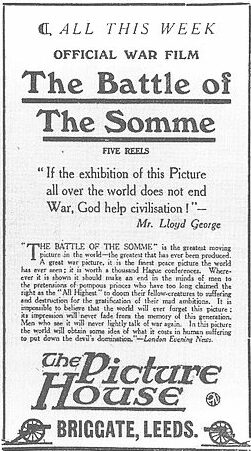
D1. The Battle of the Somme (Jury, 1916) BO clip imdb LB RT trailer wiki
stream on YouTube watch analysis by IWM read analysis by Clouting listen to my podcast
“Industrious French peasants continue their activities just outside the firing line. Care of artillery horses. The mascot of the royal artillery field caught in France.”
There are two conventional ways of beginning the history of documentaries. One is to start with the very first theatrically presented films, made by the Lumiere Brothers in the 1890s and well known to every real cinephile. Because of this list’s criteria about feature-length films, I leave the Lumieres and Dickson and the rest to another list. The second traditional method of beginning the history of documentaries is to start with Nanook of the North; if you google the words “first documentary feature” you will see plenty of Nanook. As a film historian, my problem with that is that there were popular documentary features before Nanook. No, they weren’t called documentaries, and no particular one had quite the sureness of form, or influence, of Nanook of the North. No doubt, Nanook deserves its place early on in this list, but I also wanted to complicate that picture just a bit, to remind my digital museum’s visitors that Nanook’s director, Robert Flaherty, didn’t exactly invent everything.
Several popular feature documentaries were made before 1922, although not so many as to merit more than one place on this list. After a good deal of consideration, I settled on The Battle of the Somme.
By summer of 1916, after nearly two years of war, many Western citizens had become accustomed to viewing short newsreels about the calamitous conflict. In a time before television and indeed before radio for most people, nickelodeon newsreels made the carnage unprecedentedly visual and vivid. The antecedents for filmmaking the film called The Battle of the Somme were related to the antecedents for warmaking the conflict called the Battle of the Somme. In 1913, few Britons could have told you where the Somme was; two years later, most knew it as the notorious “front,” the deadly demarcation between Allies and Axis powers. In that year of 1915, the Allies privately agreed that sometime during the following summer, the Somme would see something like an all-out assault from the allies. The world’s first extensive trench warfare had mostly resulted in a frustrating stalemate, and Britain, France, Belgium, and the Netherlands steadied themselves for an attack unlike anything the world had ever seen, an offensive of hundreds of thousands of troops directly into German-occupied territory.
As journalists and filmmakers followed the troops collecting near the front, the phrase “the battle of the Somme” elevated from whisper to sotto voce. The British Topical Committee for War Films sent several cameramen; Geoffrey Malins and John McDowell wound up leading the teams starting with movements and preparatory artillery bombardment on June 26, 1916. Within two weeks, Malins and McDowell shot about 8000 feet of celluloid. Sometime around Bastille Day, the War Films’ office’s lead editor, Charles Urban, suggested that the footage be formed into a full feature instead of the usual short newsreels. At that point, D.W. Griffith’s three-hour anti-war epic The Birth of a Nation had been playing to packed British audiences for almost a year, expanding possibilities for “reelers” and attention spans. While Griffith was trying to set his version of the past into amber, the British Topical Committee was trying something new, a feature that would play like a live feed, a 77-minute film titled “The Battle of the Somme” that would play in theaters while that very same battle was raging.
The Battle of the Somme begins with a title saying “Preparatory Action June 25th to 30th Showing the Activities Before Fricourt-Mametz,” while assuring us this was representative of much of the British Front. We see many disassociated troops, horses, and cannons at a muddy intersection. A title card tells of a general addressing fusiliers, followed by the visual of an officer on horseback delivering an address surrounded by orderly soldiers standing in a circle. A title card praises munitions workers for making shells just before showing the so-called “dump” of munitions shells by a 1916 version of a truck; we see a massive pile of hundreds of arm-sized shells passed along as a fire brigade would do. As platoons march in formation, most soldiers cheerfully look at, acknowledge, or even wave to the camera. Cannons are prepared and fired between shots of troops marching and other troops munching. Title cards tell us that the larger-shell “flying pigs” killed “two dumb victims” whom we see – the corpses of two unfortunate horses. A title card heralds the morning of the attack, July 1st 1916, and cuts to firing cannons giving way to many men standing around laughing, followed by an officer hustling soldiers into a trench. A title card braces us for a no-man’s land whose subjects endured heavy machine gun fire 20 minutes after the next shot, causing us to wonder how many of the dozen enlistees looking at us were giving some of their last looks. The front of the front isn’t quite we expect from narrative cinema; instead, we see walls of sandbags without another wall to make a trench. The film presents many ragged open fields, a few explosions, a lot of scrambling, and a card that tells us the following soldier died 30 minutes after being filmed. During the next sequence, many wounded men are carried on stretchers as the bearers still tend to smile at the camera. Horses drag wagons of artilleries; battalions march over hill and dale. In one extreme long shot from atop a hill, we and soldiers look to the distant horizon where at least twenty different smoke flumes indicate a fiercely contested battle. A doctor examines a wounded man near a half-dozen men on stretchers to show, according to a card, how quickly the wounded are attended. More wounded are walked into the front accompanied by the title cards’ descriptions of “Tommy” kindness to captured Germans. A card declares soldiers assembling for roll call, possibly meant to ironically describe the many soldiers pictured resting. The next sequences might as well have been titled “at ease,” mostly groups of soldiers relaxing or polishing arms between assignments. One final marching battalion cheerfully tips their helmets to the camera just before the film cuts to a map and ends.
On August 10, 1916, The Battle of the Somme, the film, premiered for royalty. On August 17, a recommended musical medley for the film by J. Morton Hutcheson was published in the newspapers. On August 21, the 77-minute film went into general release, where it enjoyed “unprecedented” popularity, likely viewed by as many as 20 million Britons during August and September while the actual battle of the Somme was very actively happening. In an effort to guide the film’s many viewers who had never seen a film, critics warned about the depicted violence even while contextualizing it as a difficult moral necessity. One review praised its recruiting power, calling it “a powerful spur to national effort”; another review said if the film’s exhibition “does not end War, God help civilization.” Thus began debates over war-based feature documentaries’ propagandistic value in continuing or ending wars.
More than 100 years later, we’re still arguing about this. This was probably the first documentary feature film whose audience could be measured in the tens of millions; this was one of the first films to demonstrate the range and power of feature-length propaganda.
Influenced by: a lot of wartime “actualities” (not yet called documentaries)
Influenced: films like this set the standard for “actualities” until Robert Flaherty came along
~
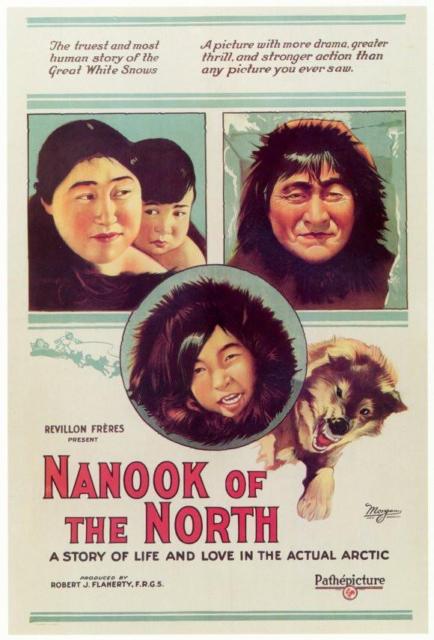
D2. Nanook of the North (Flaherty, 1922) BO clip imdb LB RT trailer wiki
stream on criterion watch analysis by Rud read analysis by Zimmerman and Ayuash listen to my podcast
“As soon as I showed them some of the first results, Nanook and his crowd were completely won over.”
It is now time to also acknowledge the influence of a century’s worth of historiography that established the list’s next film as the most popular silent documentary and the first well-known ethnography, blazing a trail that led to, among other things, most of National Geographic’s filmic content.
All this began with a man born in 1884 in Michigan to an iron ore prospector who eventually sent him looking for minerals in Canada’s Hudson Bay. In 1913, Mister Robert Flaherty took Eastman/Kodak’s new class on movie camera operation to do his job better, but when he returned to Hudson Bay he found himself more interested in filming the local Inuits, or as whites then called them, Eskimos. Flaherty spent the better part of the next three years filming Inuits. He edited it into a film, showed it to enthusiastic friends, dropped his own cigarette on the original negative, and lost all of it, something Flaherty would later credit for saving the world from a boring travelogue-like film.
With America and the world at war, Flaherty found difficulty fundraising to re-film his, uh, Eskimo adventure. One film that both helped and hurt him was Edwin Curtis’s In the Land of the Head Hunters, from 1914. Although I considered putting Curtis’s unusual docudrama on this list, three things worked against its inclusion here: it was a spectacular failure at the box office, its title is racist and misleading, and it’s arguably not documentary considering how much of it is scripted and staged. To be clear, as I’ll discuss at some length, every single documentary contains scripted and staged scenes. Nonetheless, In the Land of the Head Hunters, which is both the first feature made with an all-indigenous cast and the oldest surviving feature made in Canada, is an unacknowledged stylistic antecedent to Nanook, as well as a financial failure that Flaherty saw as a cautionary tale.
Flaherty spent much of the second half of the 1910s trying to convince someone to let him remake his Eskimo film as something more focused on one family, and eventually, by 1920, Flaherty convinced top French fur company Revillon Freres to fund the film. Over the next two summers and winters, Flaherty allied himself with the First Nations (as Canada now calls them) to stage scenes and re-enact events that he didn’t capture quite so well the first time. He put the focus not only on one family but on one charismatic warrior, Allakariallak, who apparently named himself Nanook for the sake of unsophisticated white tongues.
In the film’s current opening titles, Flaherty spends maybe too much time explaining how inspired he had been between 1910 and 1916 – as though the Inuits have changed a lot since then. He also apologizes that Nanook wanted him to remain another year – and then tells us that Nanook went searching for deer in the woods and starved to death. The film more formally begins with a card saying “The mysterious Barren Lands – desolate, boulder-strewn, wind-swept – illimitable spaces which top the world.” Cards praise “Eskimos” as patient, kind, happy-go-lucky, and the only race who could survive eating no more than the animals they hunt on the east side of Hudson Bay, in Ungaya, an area about the size of England that is home to 300 people. As he parks his kayak, we meet Nanook, the Bear, as well as his wife Nyla, “the smiling one,” and some kids and a husky. We watch Inuits burning moss to hollow out seal skins, draping skins over the kayak, carrying it to the river, and piloting it to a white man’s trading post, where Nanook and family trade bear and fox pelts for knives and candy. Human babies pose with husky babies, Inuit children eat wafers and alcohol, and the white trader shows a gramophone, or phonograph, to Nanook, who bites at the vinyl record. Nanook embarks on a village-saving hunt that includes graphically successful ice-fishing with a spear. Soon, we see a large group of warriors attacking a larger group of walruses, who back-and-forth with the men until one beast is harpooned, contested by its mates, and finally hauled to shore, where the hungry men cut up and devour the walrus parts. Winter falls in the form of human-high snowdrifts, which seems sad and intimidating as Inuits push a sled up a hill…but less sad when they cheerfully ride it down. Nanook finds and kills a white fox that he pulls out of a hole as if by magic. Titles tell us, then visuals show us, that Nanook licks his knife to make it ice over before he cuts ice to build his itinerant family an igloo. While the children sled down the ice, Nanook and friends work the ice into an igloo, culminating in the movie’s money shot: Nanook carving out a microwave-sized ice block window, popping it off, smiling widely, and crawling out through it. Nanook walks over to a diaphanous section the ice, carves out a window, and firmly sets it into the microwave-size gap where Nyla wipes off its frost. Inside the igloo, the family compiles its inventory; outside, one young child adorably tries to fire a small arrow from a small bow. We watch the way Nanook’s family boils seal oil to heat up seal meat in a hearthstone set outside the igloo so that the home walls don’t melt. We see the family sleeping cuddled together. Nyla chews Nanook’s boots to soften them, bathes a babe with a lot of wiping, and kisses him by touching noses. We learn that, at night, igloos keep puppies and kayaks safe from ravenous full-size dogs. For a long time, Nanook plays tug-of-war with a hooked seal who is beneath the ice…until four other family members show up and help pull up the line and the large dead seal. The forlorn, tied-up huskies can only observe as humans scarf down half of the seal, but eventually the Inuits give the dogs some meat which they ruthlessly fight over, causing what a card calls a “dangerous delay.” Nanook and his family charge across a rather wind-swept, mist-covered ice floe until they finally find another igloo, and this time the dogs’ exile outside at first seems deserved…until they seem to endure the worst night of anyone’s lives. After a closeup shot of Nanook sleeping, we see the card “The End.”
Unlike most of the documentaries on this Top 100 list, Nanook of the North does not suffer from inattention, but instead, many articles and even books. How to summarize? In the Library of Congress’s official essay on the film, Patricia Zimmerman and Sean Auyush present Jay Ruby’s argument that Flaherty’s film must be understood in context as well as Fatimah Tobing Rony’s counterargument that the Inuits are presented as “cuddly primitive” and that the film’s mode is less ethnographic than taxidermic, i.e. seeking “to make that which is dead look like it is still living.” The American Film Institute’s official entry peddles in gossip about what the onscreen women were doing offscreen with both Flaherty and Nanook (whose real name was Allakariallak). More significant is the fact that Nanook’s death, shortly after the film’s release, and the ongoing displacement of the film’s subjects were probably both catalyzed by the film’s popularity.
Nanook of the North became a sensation upon its 1922 release and throughout the 1920s, establishing a sort of Eskimo chic evidenced everywhere from pop songs to children’s books (“I” would now be for igloo, “k” for kayak). Nanook’s influence could be felt even in fiction film, but that influence was more profound over the nascent field of non-fiction; afterward, every would-be documentarian had an example to serve as a, ahem, “North Star”. Nanook cast a shadow as long as that of an Arctic sunrise. Anyone approaching the subject of documentary should see it, try to enjoy it (in many ways, that’s not hard), and then think about it. Ah, if only Nanook hadn’t been so staged and paternalistic.
Influenced by: some Orientalism; In the Land of the Head Hunters; Flaherty said “one often has to distort a thing in order to capture its true spirit”
Influenced: cannot be overstated – became known as the first documentary and the first ethnographic film (though it was neither), and validated slippage between fact and fiction
~
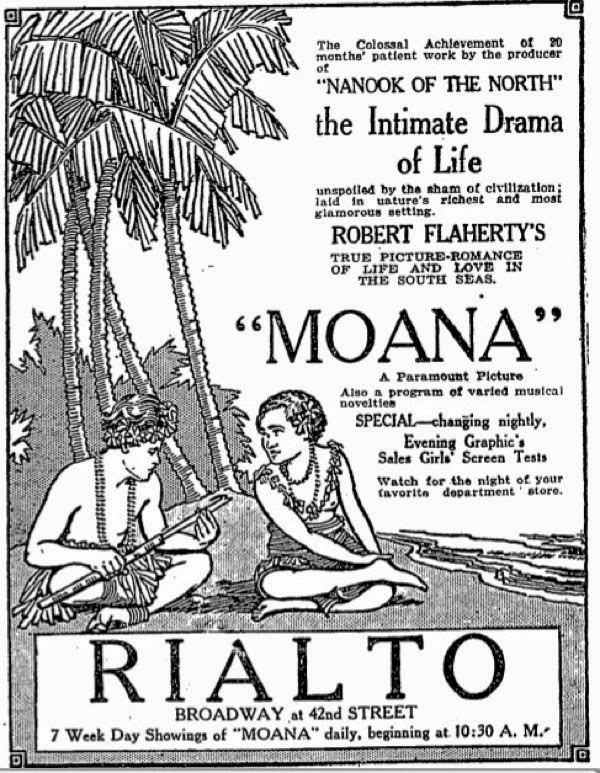
D3. Moana (Flaherty, 1926) BO clip imdb LB RT trailer wiki
stream on YouTube watch analysis by Safune read analysis by Rosenbaum listen to my podcast
“Among the islands of Polynesia there is one where the people still retain the spirit and nobility of their great race.”
If Nanook had failed, Flaherty might have gone looking for a job with National Geographic or a similar organization; as it was, in early 1923, Jesse Lasky (of Famous Players-Lasky) signed him and assigned him a sizable budget to make the next Nanook. Having spent years in frozen Canadian tundra, for some reason, Flaherty chose to make his next film a lot closer to the equator. After more than a year in the Polynesian island of Samoa, after Lasky and Paramount sent letters asking for footage, Flaherty repeatedly replied that he couldn’t film anything yet because he was still earning the trust of the locals. He elided his concern that he didn’t really have a story and that the Samoans didn’t have to struggle against nature as much as the Inuits. Finally, he decided to structure the film around a boy’s initiation into manhood, eventually naming the film after that boy, Moana, a word that translates to “deep water.”
As with Nanook, Flaherty encouraged his subjects to revive pre-modern practices – to dress and behave as their ancestors had, instead of in the then-current clothing and customs assimilated from colonialists and other change agents. Once again, a paternalistic Flaherty staged and restaged supposedly spontaneous situations. If you’re hoping that Flaherty might have received some kind of karmic payback, well: he used a local cave to develop the rushes, where the silver nitrate spilled into the water, found its way into traces of Flaherty’s drinking water, and almost killed the filmmaker. However, Flaherty did survive that, 20 months in Samoa, and another year editing back in California, releasing the film in early 1926.
The opening credits present the full title Moana: A Romance of the Golden Age. The two credited director/producers are Robert Flaherty and his wife, Frances Hubbard Flaherty, here finally properly acknowledged. An opening card states, “Among the islands of Polynesia there is one where the people still retain the spirit and nobility of their great race. This is the Samoan island of Savaii. In one of its villages the authors lived for two years, and the generosity, the hospitality, and kindliness of its people made possible this drama of their lives.” The cards also single out Fialelei as interpreter and sympathist who brought forth her people’s “confidence and cooperation.” We watch what the titles tell us is Fa’angase, “the highest maiden of the village,” bundling leaves. A few other Polynesians gather food, including young man Moana, who strips taro root to make bread and cuts down a vine that can and does proffer a friend fresh water. A long line of Samoans bear food and resources through jungle fields to their village, presented to us through postcard-worthy extreme longshots of seaside palms. Back in the jungle, Moana and his fellow hunters cut bamboo and vines into a trap that ensnares a boar, whom the titles call “the jungle’s one dangerous animal.” The boar strikes back against the Safune hunters until they tie the boar’s legs to a long, thick bamboo pole that two bear back to the village. After Samoans venture out on canoe, we watch a rather long medium shot of two of them free diving in clear water until one does spear a fish. A woman gathering food at the shoreline brings up a head-sized clam and puts it, and herself, into the hunters’ kayak. Mother Tu’ungaita makes a dress, called a lavalava, by stripping and smoothing and interlacing mulberry tree bark with some coconut water. We watch a boy, P’ea, climb a palm that towers over other palms, at least 40 feet high, from where P’ea drops coconuts down to Moana who smiles at him from the beach. We witness blowholes, towering waves, a rainbow, and other signs of the South Seas. In closeup shots, we watch P’ea light a fire, trap a crab, and tell the crab he won’t bother his coconut trees no more. In a scene that may amaze modern Hawaiian snorkelers, young Samoans work hard to drown a sea turtle, whose corpse they transport, display, and break apart into jewelry. We watch food prep of breadfruit, taro, and green bananas. Moana practices dances with a woman in a grass hut. We watch a tattoo applied to Moana’s back, punctuated by a title that reminds us that the practice preserves the dignity of his race. Titles continue by telling a witch to drive out evil spirits, and we see…something like that? Another title assures us “Manhood shall be won through pain” as we see weeks’ worth of tattooing on Moana intercut with a choreographed assembly of dancers. We watch kava prepared, offered to elders, and poured over Moana’s tattoos as he has now transitioned into manhood. The choreographed dancers become more elaborate and celebratory.
Released in 1926, Moana was not a hit in the United States, a fact some blamed on the absence of a character as compelling as Nanook. However, that hardly explains why the film did so well in Europe. Perhaps Americans felt literally closer to what they called Eskimos; for movie-going Europeans, perhaps Polynesians and Inuits were more equally exotic and interesting. Another possibility is that religious censors learned of a film with bare-breasted females and managed to keep it out of many American theaters; Europe had no such powerful censorious religious groups. Moana inspired later-legendary British non-fiction filmmaker John Grierson to coin the term “documentary.” Perhaps aspects of it eventually inspired the 2016 Disney film Moana; what can the old silent film say except you’re welcome?
Influenced by: Flaherty’s success on Nanook
Influenced: documentary as a concept; ethnographic films; National Geographic; first ethnographic feature made outside Canada; first film made in panchromatic B&W film; this also became known as the first “docu-fiction” film
~
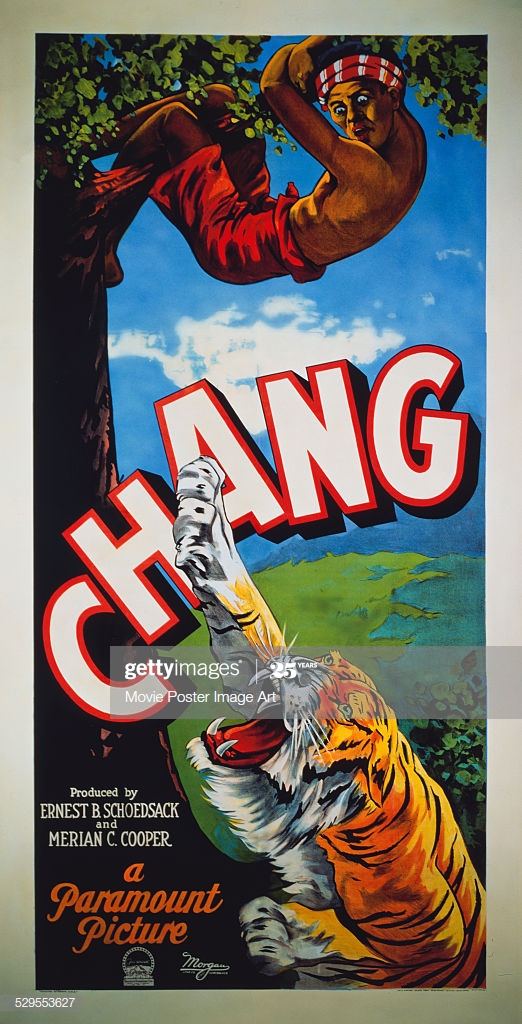
D4. Chang: A Drama of the Wilderness (Cooper, Schoedsack, 1927) BO clip imdb LB RT trailer wiki
stream on YouTube watch analysis by Schoedsack read analysis by Slattery listen to my podcast
“Man, the intruder, came into the jungle…He fought it…He never vanquished it…For strong is the jungle.”
The film’s two American directors, Merian Cooper and Ernest Schoedsack, met in Vienna shortly after the Great War, and established themselves as cameramen for hire to the point of being hired by an explorer named Edward Salisbury who brought them to Malaysia looking for a race of men with tails. Well, they failed to find that footage, but they did leverage that job into another gig in Ethiopia, filming Haile Selassie’s indigenous revolution, and then another job in Persia’s Zagros Mountains filming a nomadic Bakhtiari migration for food for their animals. The latter’s result was edited back home in the U.S., sold to Jesse Lasky while he was waiting for Flaherty to finish Moana, re-edited by Lasky with a new prologue and outtakes, titled Grass, and distributed by Lasky into a minor hit in a few select theaters in 1925. After, Cooper and Schoedsack pitched Lasky on a Flaherty-esque man-versus-nature docudrama set in the only place they knew to be home to bears, leopards, tigers and elephants, in the jungles of Laotian Siam. Lasky loved the idea but not their proposed budget, and they settled on roughly $75,000 to make their motion picture.
Now, does their film belong on a list of documentaries? Context is everything. The word “documentary” hadn’t even yet been coined by John Grierson. Chang is certainly saturated in realism compared to other 1920s representations of Asia, which feature white people in yellowface and Chinese restaurant-style kitsch. Perhaps most importantly, Chang moved the field of documentary forward after Flaherty had more or less founded it.
With Flaherty as role model, Cooper and Schoedsack spent more than a year in the Lao Province of Nan in a house they ordered built far from any other villagers, as Lao would never naturally do. The artifice continued through close-action encounters with tigers and elephants; Cooper wrote to his old boss at the American Geographic Society “Under the instructions of our head office, we are ‘working in’ a slight dramatic theme. The result will unquestionably be quite artificial; yet in its way, it will tell―even if caractitured ―the very real struggle of the jungle man.”
Lasky even hired renowned pulp writer Achmed Abdullah to provide suitably dramatic intertitles. As with Nanook and Moana, the point wasn’t documenting life per se but the excitement that only something looking like real life could provide.
Chang: A Drama of the Wilderness begins with a title card saying: “The Cast: Natives of the Wild: who have never seen a motion picture. Wild Beasts: who have never had to fear a modern rifle. The Jungle.” Abdullah is probably responsible for title rhetoric like “Time and again fields, towns, great Empires were hacked out of the jungle…they are forgotten…always the Jungle rose in its wrath and swallowed them. But man must live…so man fights on.” We meet “Lao tribesman” Kru successfully chopping down a tree that has a meter-wide trunk. We are introduced to his wife, kids, house on stilts, and kept animals like a water buffalo, goats, and a rascally white langur monkey named Bimbo. After a leopard leaps into their goat pen, Kru builds a higher wall and a low trap for the leopard. Kru’s kid gathers a litter of puppies into a basket that he takes into their raised dwelling so that the pups won’t become tiger food; Kru pulls up the ladder and closes a gate. At night, bears frolic, a tiger attacks a stray water buffalo, and that leopard gets ensnared in Kru’s trap. Editing gives the impression that Bimbo the monkey hears the leopard and leads the kids to the trap in the morning, where Kru climbs a ladder and shoots the leopard dead. In the village, locals discuss animal encroachment and make elaborate booby traps. Tree-swinging monkeys observe as one leopard gets ensnared by a rope and another attacks a scarecrow that causes him to fall into a covered pit. Kru uses another trap to kill a tiger and shows us the cat’s fearsome teeth. Kru’s kid moves various small animals around his house’s baskets. Kru hangs a lattice platelet that titles call a mantra, only for those same cards to gloat that the mantra failed and Kru’s rice was ruined the day before the harvest. Kru builds a pitfall large enough for the biggest Chang, a word the titles leave mysteriously untranslated. As hunters in a shallow stream taunt and kill an alligator-sized monitor lizard, Kru comes to ask them for their help in pulling the Chang out of the pitfall, and as we watch them, the Chang is very slowly revealed to be…a child elephant no more than four feet high whom they bind and bring to the village as a beast of burden. At the approach of the mother Chang, Kru’s family flees their raised residence which the mother, ahem, razes to the ground in an apparent rendering of revenge. Bimbo, left alone, scrambles through the forest apparently pursued by a leopard, leading the likewise scrambling Kru to turn, shoot one leopard dead, trap another in Chang’s pitfall, and take a canoe, with Bimbo, to safety as the film cuts to an apparently interested, hungry tiger. In the morning, after his family has arrived in the village, Kru tells them of Chang tracks signifying the return of a crop-destroying Great Herd of elephants. In classic fictional style, an elder scorns the notion with words like “there’s no way there could be…” when he double-takes to see a great herd of at least three dozen elephants who trample through the village, razing all its raised houses. The villagers get busy cutting large trees into big logs into a krall, which is revealed to be a rather massive cage that almost resembles a colonial fort. The villagers use fire-beaters to drive the Great Herd into a shallow lake on the way to the krall, where the “chosen twenty” warriors stand on the parapets and stick the elephants with spears. Older elephants are reported to be easily tamed after weeks in captivity, and sure enough we see Kru riding one of them, his “new slave,” as the beast helps him knock down a tree. Cards say that neither the jungle nor man is ever entirely victorious, but that Kru will “hack” at a renewed non-village life anyway. Bimbo and the kids play happily just before the titles remind us that the jungle is “unconquered” and “unconquerable.”
Chang: A Drama of the Wilderness was nominated for Best Artistic/Unique Picture at the first Academy Awards. Outfitted by Jesse Lasky with a snappy soundtrack, Chang became the first successful sound film of its kind…but what kind was that, exactly? Such films were promoted as real-life adventure or sometimes ethnography or travelogue. Most of them did not flaunt the boundaries of fiction quite as flamboyantly as Chang. Cooper and Schoedsack, for their part, became less interested in so-called “real life adventure” and moved to adopt the novel the Four Feathers and then use their jungle expertise to make the game-changing 1933 film King Kong. But Chang remained a paradigm of a certain kind of non-fiction filmmaking that found its descendants with Steve Irwin and a lot of what is now called reality TV.
This film proved Flaherty’s template could be successfully deployed by other filmmakers and thus broadened the range and dimensions of cinematic ethnography, a practice that can be useful, illuminating and culture-preserving but can also be patronizing and prejudiced (and is known for staging and re-staging “real” scenes)
Influenced by: Flaherty’s success on Nanook and Moana
Influenced: views of Siam and Southeast Asia; these two directors became leaders of ethnographic films until they turned that knowledge to fiction with a rather influential movie called King Kong (1933)
~
D5. Berlin: Symphony of a Great City (Ruttman, 1927) BO clip imdb LB RT trailer wiki
stream on amazon watch analysis by Davis read analysis by Thomas listen to my podcast
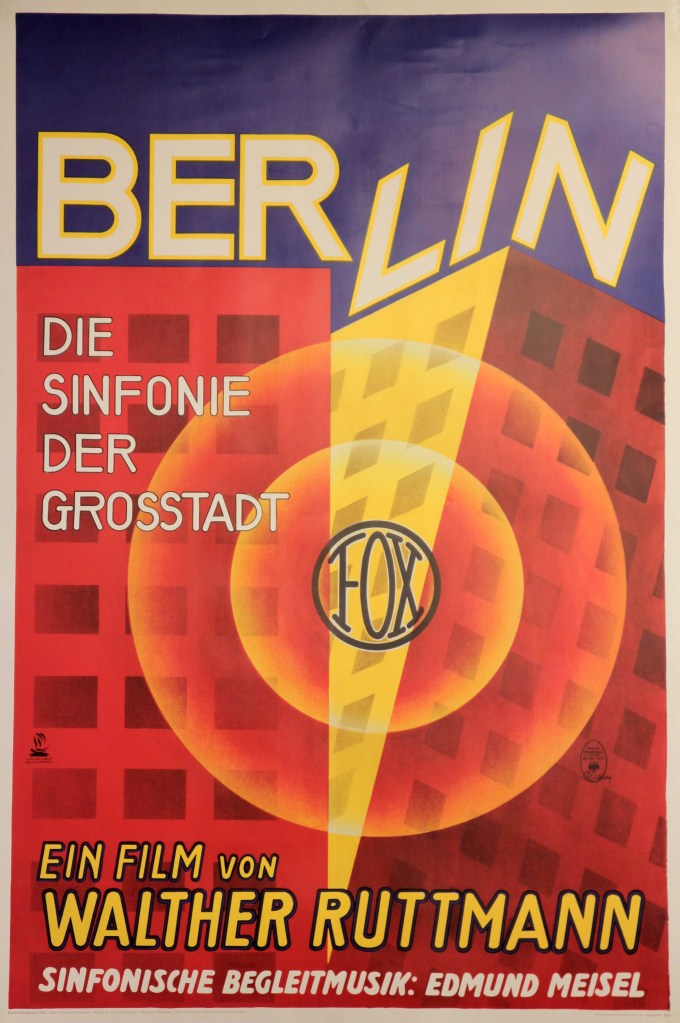
“Hermanntietz: Grosse Bekleidungs-Woche”
Berlin: Symphony of a Great City can be understood as a confluence or combination of many cinematic trends of the 1920s. One of these was simply the artistic ferment of UFA and Germany during the Weimar period, often studied by first-year film students through films like the Cabinet of Dr. Caligari, Nosferatu, and/or Metropolis. Experimentation was generally supported and encouraged, the abstract cartoons of Walter Ruttmann in the early 20s before Ruttmann went on to help Lotte Reiniger make the world’s first animated feature in 1926. By that time, several so-called city films had been made, shorts about places like New York City, Paris, and Moscow, the latter directed by Dziga Vertov, who was supported by Russia’s own experiment-friendly climate at least before Stalin asserted power in the Kremlin. Ruttmann saw these and worked with the Expressionist master Carls, namely Carl Mayer and Karl Freund, to create a film that would weave real-life shots into something like the throbbing pulse of the city, something that everyone began calling a “symphony.” On the brink of the sound era, Ruttmann, Mayer and Freund transformed the nascent “city film” genre into the “city symphony” genre, something that did not escape Vertov’s notice. “City symphony films” were a mini-genre that emerged in the 1920s trying to show, without use of titles or traditional story tropes, the greatness of certain cities;
Berlin: Symphony of a Great City begins with abstractions of water and shapes before landing us on a fast-moving train that whizzes by a sign saying “Berlin 15 km” as it moves steadily past rural trees and phone wires on its way to more suburban and industrial landscapes before landing in, as the railroad station sign says in darkness, Berlin. After aerial shots of the large buildings, we see several dawn-lit, dew-wet, deserted streets until finally seeing a few isolated early-morning walkers, like policemen and poster-appliers. A Potsdam-bound train rolls out of a round switch-rail station as the sidewalks begin to fill up with what look like workers of many shapes, sizes, stations, and sexes. Several board trains, and the trains segue into more industrial vignettes of bread and milk and other essentials being rolled off assembly lines. Kids stop and go on their way to school. A man atop a horse oddly emerges from an urban building, justifying the cut to several men riding horses in a forested glen. Back in the city, the next few minutes emphasize transport options, from trolleys to buses to horse-drawn carriages full of random materials. Popping elevators give way to popping desk doors (back when those existed) to take us to an office of keyboards and phone cables and shouting phone operators who are unflatteringly juxtaposed with howling monkeys and fighting dogs. As the next act begins, trains take us into shallow mines where men and cranes unearth eddies of earth, but the film soon returns to urban Berlin, which mostly consists of people and streetcars walking this way and that. A few curiosos cross our path, like two men quarreling with slaps, a bride and groom emerging from a cab, a recumbent horse slapped back into standing, a funeral, and royalty departing a palace with attendant pomp and ceremony. Planes, trains, trolleys, autos, and horse-buggies dither from hither to thither. Sometimes dolls or other store-window tchotchkes are seen almost nodding in unison; we also see a double-exposure-filled montage of newspapers. After a new act begins with a clock showing high noon, we see the lunch rituals of hardhats, plutocrats, kitchen workers, horses, an alley cat, and various zoo animals. A machine steam-heats dishes and places them back on a rack for new diners while specialists drag a river. Printing presses pump out papers which get wrapped and delivered to citizens as the camera focuses on a few choice words that set off certain sections of the news. The heady view from the front of a roller coaster barreling down its windy wooden track is juxtaposed with a woman, and then a crowd, staring into a river as if someone there has just drowned – though we never see such a person in water. Instead, after a few more anodyne minutes, rain falls, umbrellas pop out, cars drive down slickened streets, and…we find ourselves at a beachfront where scores of kids happily splash. That segues into all kinds of (sunlit) sporting activities, for example dozens of tank-top-toting Teutons running only to be intercut with a hundred pigeons getting sprung from cages. Shadows lengthen as people walk home from work, make up their faces, and lean into their lovers on twilit benches. The new act begins at night as the hoipolloi hit the town. In one particular live theater, we get a long look at long-legged dancers and other circus-ish performers. Some kind of inner ice arena features a fierce hockey match and skiers on a small ski jump. Elsewhere, a boxing ring plays host to boxers – and then, ballroom dancers? The Novelty Club Orchestra brings us into a posher throng of moshers Charlestoning the night away. But the film remembers the working class, both fixing the columns under the posh club and also making merry in a more modest pub. A casino roulette wheel spins into a street scene that spins into circular combustibles that spin into firework bursts that finish with a radio tower over the city as the film finishes.
I find it helpful to remember that no one had yet coined the term “documentary.” They weren’t trying to add a chapter to an expanding documentary field. They were trying to make art out of real-life, without asking the real-life subjects to move in any certain way (that we know of). I do appreciate this attempt toward an aesthetic of urban energy. I wonder if, in 1927, anyone ever got to see this on a double bill with Sunrise, another film Carl Meyer co-wrote, that one directed by F.W. Murnau as his first foray into American filmmaking, because one perspective on urban life is 180 degrees from the other: while Sunrise equates urbanity with vice, Berlin Symphony equates urbanity with something like virtue. Maybe Metropolis is about both, I’m not sure.
In later years, this film would be remarkable for celebrating modern Berlin just before Goebbels made that mandatory. In still later years, after Goebbels and Hitler overreached and Berlin was fire-bombed by the allies, this film would be remarkable for preserving on film buildings that would never be rebuilt, like the Hotel Excelsior, once Europe’s largest hotel.
Influenced by: other city films; Ruttman’s work in abstract (or “absolute”) cinema, although this is considered less abstract
Influenced: impressions of Berlin before, during, and after the Nazis; Man with a Movie Camera
~
D6. Man With a Movie Camera (Vertov, 1929) BO clip imdb LB RT trailer wiki
stream on amazon watch analysis by 100Years read analysis by Michelson listen to my podcast

“This experimental work aims at creating a truly international language of cinema based on its absolute separation from the language of theater and literature.”
Man with the Movie Camera was influenced by the political situation in the recently dubbed Soviet Union in 1927 and 1928. To vastly over-summarize, the Stalinist nationalists were fighting, sometimes openly, with the Trotskyite Communists for the future: would the USSR prioritize its own industrial production or continue trying to foment Communist revolution around the world? After many, uh, twists and turns, Stalin won and exiled Trotsky from the country during the same winter of 1929 when The Man with the Movie Camera was released. The point is that while Vertov may have wanted to make art a la Ruttman, he was more concerned with making something that wouldn’t run afoul of either Trotsky or Stalin…especially the latter, since Stalin was probably going to be soon controlling the means of production including film production.
Listening to Vertov explain this film, or really any of his films, can offer as much shade as light, because of Vertov’s goal of lifting cinema into the same discussions as paintings and sculpture. For example, Vertov writes, “The Cine-Eye plunges into the seething chaos of life to find life itself. The response to an assigned theme. To find the resultant force amongst the million phenomena related to a given theme.” After explaining his wife Elizabeth Svilova’s editing style, sort of, Vertov concludes “As the final result of all this blending, shifts and cancellations we achieve a visual equation or visual formula.” Author Graham Roberts seizes on the last five words of this quote and the fact that even Vertov can’t decide between “equation” or “formula,” with Roberts deciding that “Vertov’s cinematic language has become so rich that it can only be understood in cinematic terms.” Well in that case…
Man with the Movie Camera begins with many titles about the absence of traditional storytelling and the words “this experimental work aims at creating a truly international absolute language.” A cameraman stands atop a giant, uh, camera, steps down, and enters an empty theater which soon fills up with patrons and projectionists who smile at musicians apparently providing an overture. On a screen in the front, we enter a window where a woman awakens to begin her day, segueing to morning light on sleepy, still sections of this uncited Soviet city. Machines sit idle; streets are barely traversed; from high up in an apartment building, we see a convertible car approach and then pick up a man with a movie camera. The car drives the man out to a rural railroad crossing, where the cameraman’s head leans on the rail as a train approaches…followed by bizarre cross-cutting that seems to jar that lazy woman out of bed to start her morning routine. We see many of this city’s poorer people stirring, starting, spraying down street fixtures. World War I-style biplanes are rolled out of a hangar; streetcars and buses roll out of stations and into the urban center, where they are embarked and disembarked upon. The center of the city – marked by a banner that reads “Gorky Park” – rustles with morning-commute hustle and bustle. The cameraman is foregrounded, sometimes climbing scaffolding, sometimes walking through a crowded street, and sometimes with his eye seen through the (over-cranked) camera’s peephole, which creeps out a woman sleeping on a bench. One shot of a crowd surging into a gated area has sometimes been interpreted to signify the emergence of the masses. Many, many more morning shots include miners at work, a mail bicycle, shop-window automatons, spurting fountains, trains in motion, and the film’s first dutch-angle split-screen, which sets off the sidewalk/street against itself. The cameraman stands in a moving convertible, facing sideways, to capture a second car of relatively rich Russians being drawn by a white horse who pulls into a freeze-frame that segues into the editing booth itself, where Vertov’s editor/wife, Elizabeth Svilova, chooses some shots and dismisses others. At her discretion, the action re-starts, the horse-drawn carriage and streets come back to life, and a camera high above the boulevards pivots first to a couple registering their marriage and then turns to another couple registering their divorce. Many, many more urban vignettes culminate in a shot rotating around a female eye blinking intercut with actors, actions, activities. An injured man wipes blood off his brow as an ambulance crew speeds toward – him? Women get beauty treatments; women work as box-makers, typists, cigarette packagers, switchboard operators – one with a conspicuous happiness that is Communist propaganda for women working. We linger inside a steel mill to make out metal smelting. Suspended by cranes on a small platform, the cameraman films a large dam structure that symbolizes Soviet strength and fluidity with uh, fluid for electricity. Back in the city, cuts speed up and footage speeds up. Boats and clouds drift across the screen as we segue to a very crowded beach, where an Asian-descended man leads what may be a yoga class as well as a magic show that delights some kids. Men and women do decathlon events in slow motion as nearby viewers, not in slow motion, enjoy the spectacle. A happy working-class woman caking mud on her skin is contrasted to a disgruntled rich woman applying lipstick. The cameraman shoots the beachgoers and gets cut in half by his own split-screen. Outdoor athletics, like women’s hoops, gets cross-cut with indoor exercise, like women straddling mechanized horses rather erotically. Men, including the cameraman, riding motorbikes on a track are cut with women riding a carousel. In a beer pub, a woman happily drinks with men while the double-exposed cameraman rises from a filling beer glass. Another woman’s target practice includes wine bottles and a woman figure bearing a Nazi swastika. The cameraman walks into an edifice under the banner “Lenin’s Five-Year Plan” so we enter the future, with many, many, triple- and quadruple-exposed, split-screen-y shots of noisemakers. After almost an hour, we return to the frame audience, who delight at the animated movements of what may be a robot camera as well as women dancing to double-exposed piano keys. Shots get shorter and more effects-driven, but the audience members maintain rapturous interest in the summarized, quickened, heightened versions of all the urban activities. In some of the more famous moments, a worker woman smiles in the center of a whirling industrial wheel; the Godzilla-sized cameraman pivots himself over the multitudes; the Bolshoi Theater implodes on itself with angling split-screens. The film finishes with a crescendo of flash cuts, many of no more than 2 or 3 frames, of Svilova, a tram, a traffic signal, and several other impressions culminating in the eye in the lens as the iris closes and the film fades to black.
Man with the Movie Camera wasn’t the hit that Vertov had hoped for. Films without audible words struggled everywhere in 1929. But it was only too convenient for Stalin, now firmly in control of the USSR, to blame the failure of Man with the Movie Camera on Vertov’s artiness that somehow wasn’t quite propagandistic enough.
Universally considered to be the greatest documentary, the film is more avant-garde than that honorific implies; ostensibly a “day in the life” of a then-modern Russian city, this film adroitly innovates and deploys multiple exposure, split screens, tracking shots, various cuts, slow and fast motion, and various modes of self-reflexivity.
Influenced by: city films; Vertov’s wife Elizaveta Svilova edited it and probably deserves equal authorial credit
Influenced: “cinema vérité” was named after Vertov; considered a leading example of Pure Cinema; sometimes called Soviet propaganda
~
D7. Enthusiasm (Vertov, 1931) BO clip imdb LB RT trailer wiki
stream on amazon watch analysis by MacKay read analysis by Bradshaw listen to my podcast
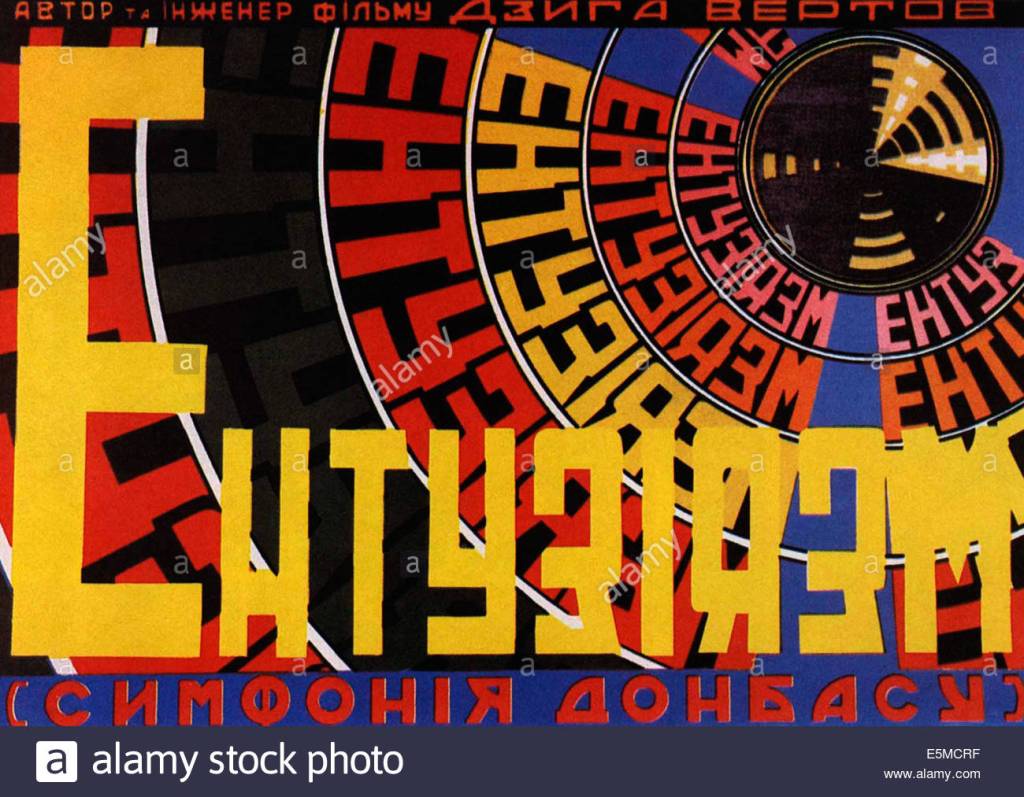
Joseph Stalin ordered Dziga Vertov to Ukraine to make a film about the great successes of his Five-Year Plan. This did not turn out quite the way Stalin expected. Vertov absolutely understood that his job was to show how well the Five-Year Plan was working in Ukraine’s Donbas region. But Vertov felt that some artistic creativity would make the film more, not less, appealing and therefore better propaganda. Specifically, Vertov wanted to make the microphone as much of a character as the camera had been in Man with the Movie Camera. Showing a rural woman hearing the story was a sort of fourth-wall-breaking way of revealing the power of industry, the efficacy of the Five-Year Plan, and the beauty of sound. Sometimes, this took the form of presenting sound as though it were out of sync, something Stalin apparently didn’t love.
Enthusiasm: Symphony of the Donbass begins with a medium shot of a young woman in some sort of rural repast putting on headphones. She seems to “hear” the subsequent visual scenes of people making the sign of the cross at a suspended statue of Jesus and an elaborate Russian Orthodox Church. On headphones, our young woman is told she will hear the Symphony of the Donbass, and we cut to a medium shot of a young conductor. Cuts suggest that the young woman sees – by hearing – churchgoers emerging outside, praying, genuflecting, and kissing the feet of a bas-relief of Jesus. Bolsheviks bearing banners march into the city, cross-cut with the church’s evident religious symbols. An organizer says “The Pope is chained to the cash drawers of the capital,” followed by a life-size puppet of an evil pope, followed by another man suggesting that the bell towers come down. Angling split screens mash together church edifices while the marching workers ransack the church and march out with paintings and crosses to their co-marchers’ ebullient cheers. With the help of ladders and cables, the peoples collapse the steeples to tumultuous applause. In effects shots supplemented by assonant noises, Communist stars and emblems rise where the high towers were. A workers club edifice gets a lot of emphasis as happy young females are seen in happy closeup, compared with a statue of a bold strong Communist. An art-installation assembly line rolls out suitcase-sized versions of cars, crops, and other staples adorned with the words “toward socialism.” At dusk, we see silhouettes of laborers coming from large industrial plants as a narrator says “this happened in Donbass in the Five-Year Plan era in 1930.” The proletariat fills up a 1000-seat movie theater which shows them one word onscreen, translated as “out of stock,” followed by a voice associated with the heroic statue that tells them to give the country the coal it deserves. About 30 minutes in, a middle-aged man delivers the film’s first (only?) monologue to camera, extolling the collective efforts of the best workers and, uh, all workers. Coal miners get trained while trained coal miners do many routine tasks. After many more shots of machines making and moving coal, we see a large group, heralded as the best of workers triumphantly enter Donbass. Miners do some of the more thankless tasks, like fire-suppression, as the narrator says, “It is about glory. It is about courage and heroism.” At ovens, men harden coal into steel rods, which get carried by trains out of the region. Abruptly, we find ourselves in agrarian fields, where women sing while piling hay and we join a rural meeting whose leader praises socialism. In some more urban setting, men march together in happy strides as a narrator says “long live collectivization.” We depart the proletariat parade to return to the rural gathering, where a wide shot of peasants dancing is double-exposed with close-ups of happy young women. An out-of-tune accordion plays over horses and workers happily marching past a rural combine that receives hay, in a new medium shot, from a sturdy, pretty woman. The final shot is the dissonant, assonant, rural parade.
The structure is interesting, because the first 15 minutes contain this somewhat shocking, at least to my modern eyes, proletariat sacking of a church, and only five film minutes after that sacking does a title tell us that we’re in Donbas. It seems like it might have suited Stalin better to present the church looting as though it were clearly in Donbas, but instead we are invited to think that it must have happened elsewhere, presumably closer to, or in, Moscow. One way of seeing this is that Vertov and Svilova simply wanted to present the truth as they filmed it. Another way is that they’re trying to tell us that the people of Donbas are as yet too simple to destroy a church, although maybe they’ll get there in the next movie.
So what is the propagandistic value? Was Stalin right to worry about the intentionally off-sync sound? How can we understand this film now that we know the terrible price Ukrainians paid for the Five Year Plan? To be clear, Vertov did not see the Holodomor, the 1932-33 Stalin-made famine, and because Enthusiasm failed, it’s hard to make a case that this film “excused” Stalin’s treatment of Ukraine. Not enough people saw it. However, should Vertov get debit for trying?This, the first Russian sound film, is a ground-level and underground-level (coal mine) view of Stalin’s first Five-Year Plan and its machinations centered around Donbass; compared to Man with a Movie Camera, this is both more avant-garde and more propaganda for Soviet Communism, which makes for a fascinating and singular combination
Influenced by: Man with a Movie Camera; Stalin; again, Vertov’s wife Elizaveta Svilova edited and probably deserves equal authorial credit
Influenced: cinema vérité, named after Vertov
D8. Triumph of the Will (Riefenstahl, 1934) BO clip imdb LB RT trailer wiki
stream on amazon watch analysis by Ideas read analysis by Hagopian listen to my podcast
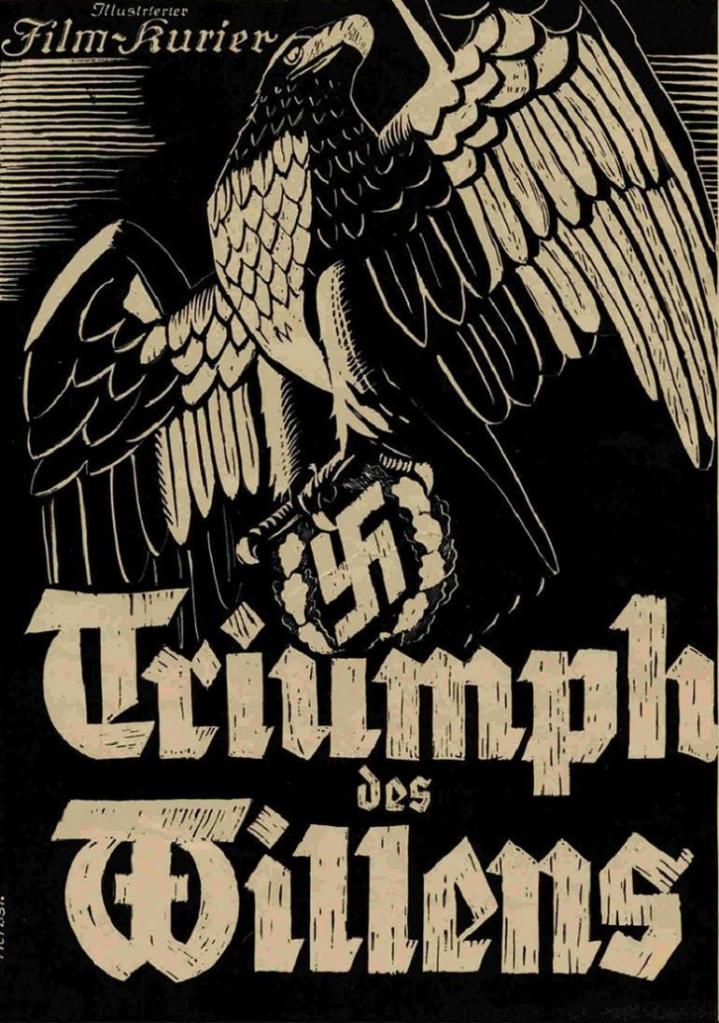
“The documentary of the Reich Party Congress, 1934, produced by order of the Fuhrer”
There’s no “great film” inside or outside the world of documentary quite as notorious as The Triumph of the Will. The Holodomor was part of the context; in January 1933, while Stalin was proving a new efficacy of dictatorship by killing millions of “his own” people, Germany found itself voting for heavy-handed reprisals by electing Adolf Hitler to power. However, Hitler had no intention of governing from the shadows like Stalin, but instead saw himself more like and more than Mussolini, making speeches and proving his power through pageantry, parades, and all that pomp and circumstance. Hitler needed the right person with a camera – talented but also something of a true believer. He probably half-fell in love when he watched The Blue Light, directed by and starring Leni Riefenstahl as a young, tall, Aryan-looking, sybaritic witch whom the locals ostracize but need anyway. (This was also co-written by Carl Meyer.) When the real-life Riefenstahl blamed Jews for some of the film’s bad reviews, Hitler knew he had his replacement for Walter Ruttman as his chief videographer.
Riefenstahl, for her part, described in her memoir the first time she heard Hitler speak at a rally in 1932, before Hitler took over the Bundestag: “I had an almost apocalyptic vision that I was never able to forget. It seemed as if the Earth’s surface were spreading out in front of me, like a hemisphere that suddenly splits apart in the middle, spewing out an enormous jet of water, so powerful that it touched the sky and shook the earth”
In the same memoir, Riefenstahl claims that she made documentaries about Nazi parties only to pay the bills and as a means toward other projects. She claims that she hadn’t really meant to make The Triumph of the Will, but did because international funding for a fiction film fell apart. She also claimed not to know about certain atrocities, starting with The Night of the Long Knives in 1934, when Hitler ordered the deaths of several close associates who had figured in both of Riefenstahl’s first two documentaries for the Fuhrer. I could go on and on about claims and counter-claims, but I think it’s time to get to the film. Essentially, Hitler expected, and received, about a million Germans turning up for a week of rallies in 1934 in Nuremberg, and hired Riefenstahl to make the best possible film of it. One might say that the results are the world’s worst best film.
The Triumph of the Will begins with a magisterial overture in darkness finally giving way to an eagle statue and teutonic-fonted title cards that situate us in September, 1934, 20 years after the start of the war, 16 years after the “beginning of the German suffering,” and “19 months after the beginning of the German rebirth” when the Fuhrer flew to Nuremberg to, uh, “review” his followers. The film’s first moving images are from a plane, moving through billowy cumulus clouds until we see its shadow over the medieval, swastika-bedecked buildings of Nuremberg. Enthusiastic crowds line up to cheer the plane’s landing as well as the motorcade that begins winding its way through the city. The film builds anticipation by showing us the back of the head of the Chancellor for about a minute while he recognizes the throngs, stands in a moving car, holds his hand held behind his upraised wrist, and nods approvingly. Finally, we get a good look at Adolf Hitler as his motorcade arrives in an overjoyed mass of people in the city center, and the sequence ends with Hitler waving from his hotel window over light bulbs that have been arranged to spell out Heil Hitler. At night, music and fire indicate more celebrating outside Hitler’s hotel. In the morning, worshipful shots of high buildings dissolve into a grid of hundreds of tents of German Youth, sometimes called Hitler Youth, who are soon seen playfully shaving and hosing off and wood-gathering and cooking to the sounds of an off-camera chorus singing heartily. In what look like boy scout uniforms with swastikas, the boys playfully wrestle, race, and get rambunctious. In daylight, Hitler emerges from his hotel to handshake a few hausfraus and handsomely dressed Hitler Youth. At night, in Nuremberg Hall packed with thousands of seats, German ministers take turns extolling the virtues of Hitler and the government’s current programs. One, Julius Streicher, says, “A people that does not protect the purity of its race goes to seed!” to loud cheers. During the day at the town-sized Zeppelin Field, trumpets blare to herald Hitler ascending a platform to “inspect” 52,000 “labor men” bearing shovels like bayonets, proclaiming loyal slogans, tasks, and aspirations, but also individually naming their various homes. Hitler speechifies that Germans will no longer look down on manual laborers and in fact be forced to do some labor themselves as the men march in unison. We visit the “Stormtrooper Night Rally” where singers bearing torches sing of “the cult of darkness and fire” and cheer on exhortations to victory. During the day in an enormous stadium, tens of thousands of young men line up, raise hands in the Nazi salute, and stoically listen to Hitler’s speech telling them to be both peace-loving and strong as they represent an eternal Germany. We pan down from the twilight clouds into the “Night Rally of Political Leaders,” where men bearing swastika flags march into Zeppelin Field to hear Hitler address recent German problems by proclaiming “the State does not order us, we order the State” and asks everyone to vow to commit to Germany to a chorus of “sieg heil”s. In perhaps the film’s most quoted clip, during the day, from 45 degrees above, Hitler, flanked by two lieutenants, walks past tens of thousands of quietly respectful Germans on his way to the tomb of the unknown soldier, where this trio pays their respects. Hitler turns, crosses back through the stadium, ascends to a concrete podium, gets dwarfed by building-size swastika flags, and claims that anyone who tries to do harm to the gathered army will harm only themselves. Cannons blast in salutes while Hitler is seen in medium shots shaking hands with officers. Nuremberg’s citizens line its streets with reverent salutes and cheers first of Hitler standing in a car at the front of a motorcade, and then of marching, militant, meticulously regimented Movement Men. To mutual longarm strongarm salutes, the Germans goose-step through a large square that has apparently been renamed Adolf Hitler Platz. Night in a Nazified Nuremberg Hall, under a sign saying “Deutschland Uber Alles,” begins with the now-standard pomp and circumstance leading up to one more speech from Hitler, who celebrates the strength and courage of millions of National Socialists whom he names as “the one and only power in Germany.” Hitler declares, “Because these are the racially best of Germany, they can claim the leadership of the Reich and the people,” and such race-based hierarchy will ensure a Reich that can last a thousand years. Rudolf Hess mounts the podium and adds a coda: “Hitler is Germany, and Germany is Hitler,” as the Nazis sing one final, creepy dirge about marching in spirit.
The movie played all over the world, won many awards, and firmly established Leni Riefenstahl as the world’s pre-eminent documentary filmmaker as well as its pre-eminent female filmmaker. After the war, for more than a half-century, Riefenstahl claimed that she never meant the film as propaganda and was disgusted that it was ever used that way. This explanation seemed sufficient for the many, many people who hired her and consorted with her, including many well-known names. Riefenstahl died at the age of 101 in 2003.
For decades, we have been grappling with the Triumph of the Will. Should students see it? Should anyone see it? Can art be made of this sort of subject matter?
Influenced by: the Nazi party’s considerable resources and willingness to stage things
Influenced: debates about film morality; Star Wars; also, Riefenstahl spent two-thirds of the 20th century as its most celebrated female filmmaker
~
D9. Olympia Part 1 (Riefenstahl, 1938) BO clip imdb LB RT trailer wiki
stream on YouTube watch analysis by Teng read analysis by Barber listen to my podcast
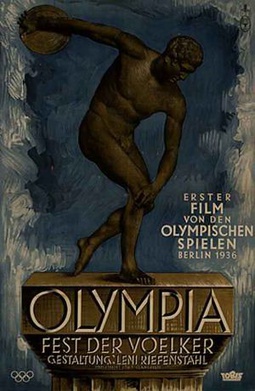
“The fastest sprinter of America, Jesse Owens, at the start.”
The story of the making of Olympia began four years before the release of the Triumph of the Will, when Leni Riefenstahl was a non-directing actress, in 1930 in Berlin, where several nations bid on hosting the 1936 games, and they were awarded to, uh, the host nation of Germany, partly as an endorsement of the Weimar Republic which…would be swept out of power in 1933 by Adolf Hitler, who was so impressed with the director-star of 1932’s The Blue Light, Leni Riefenstahl, that he commissioned her to direct a couple of pro-Nazi documentaries. Hitler and Riefenstahl both noticed that the 1932 Summer Olympics, despite taking place in the home of the movies, Los Angeles, were not filmed. (Those L.A. Olympics, taking place in the nadir of the Depression, tightened many belts for the few nations that did attend.) Hitler was happy to devote Nazi resources to the first-ever Olympic documentary. He built a 100,000-seat stadium specifically bigger than the Los Angeles Memorial Coliseum, organized the first-ever torch relay of the Olympic Flame from Greece to the host country, and commissioned Riefenstahl’s state-of-the-art filmmaking.
Many of Riefenstahl’s innovations became standard for capturing any sport on any screen. Cuts from closeups of athletes to closeups of happy spectators bridged the distance between Olympian and civilian. Riefenstahl organized tracking shots from bleachers, dollies on sprinters, cameras rising on balloons, and even an underwater camera that could change focus as it landed in the water. It’s hard to think of another documentary that so clearly surpassed the scale and scope of its antecedents.
Opening titles are engraved on a wall in the classical Roman font (think SQPR), recognizing the modern founder of the Olympic Games alongside film director Leni Riefenstahl. We begin on somber-scored, twilit shots of the Parthenon and similar ruins that gradually become better lit, more hopefully scored, and transitioned to statues of apparent athletes of antiquity who, at the 7:30 mark, segue into modern competitors posing and gesturing athletically and balletically. In abstract darkness, a man lights a torch and begins marathon-running through non-abstract stadiums and lined-up crowds, eventually passing the torch to another runner, whose running segues into a map that we trace, with the aid of titles, from Greece to Bulgaria to Yugoslavia to Hungary to Austria to Germany, signified by a genuine and gargantuan modern stadium, swastikas, a close-up of Adolf Hitler, and thousands giving him the “Sieg Heil” salute. During the parade of this event’s 51 nations, when the snappily attired athletes march through the stadium, the modern viewer cannot help but notice the countries’ athletes that “sieg heil” to Hitler: Greece, Italy, Austria, France, and of course Germany, but not Japan, India, the U.K., the U.S., or anyone else on camera. Hitler “sieg heil”s the heilers and declares the Olympic Games open. The torchbearer runs into the stadium to light the Olympic flame, which occasions a hymn to the greatness of competition, “Olympia,” perhaps sung by some of the attendees but certainly sweetened by an off-screen chorus. Announcers from a half-dozen countries introduce, in their respective languages, the men’s discus throw, which eventually concludes with a gold medal for the USA. Athletes’ movements are sometimes slowed and sometimes sped up; sound is sometimes presented as a cacophony of fans, and at other times hushed to silence as the athlete pivots. Second is the women’s discus throw, which ends with a new Olympic record and a gold medal for the German, whose discus travels about as far as that of the winning women’s javelin throw, 47 meters and change, presented third. The filmmaking offers very occasional abstractions; Germany wins gold and silver at both women’s javelin and men’s hammer throw; an Italian wins the women’s hurdles. Just before a men’s 100-meter heat, our German announcer points out Jesse Owens, of the USA, who goes on to win the heat in 10.3 seconds and then a later world-record heat that is disqualified because of a tailwind. After Owens wins the real 100-meter dash, he is seen smiling to his countrymen’s effusive cheers even as no Germans are shown. A Hungarian wins the women’s high jump, followed by a German winning the men’s kugelstoss, or shotput. String music is heard with more frequency as an American man wins the 800 meter race and a Japanese man wins the triple jump. The German announcer hails Jesse Owens as the fastest man alive as Owens proceeds to compete in, and win, the long jump, with a new world record. Sometimes we see closeups of a happy spectator; sometimes this pleased person is Hitler. In the 1500 meter race, Holland pulls ahead from the pack and sets another world record. In the men’s high jump, the bar is set to 1.85 meters during trials, then to 2.03 meters when the field is narrowed to four, one from Finland and three from the USA, who ultimately win gold, silver, and bronze. In the hurdles, the U.S. only win gold and bronze; the U.K. takes the silver. After the film slows to observe the javelin throwers, a German manages to triumph over two Finlanders, and when the Nazi swastika rises above two Finland flags, we hear the crowd singing “Deutschland uber alles.” However, the very next shown event is the rather dramatically presented 10,000-meter race, during which Finland wins bronze, silver, and gold. For the first time, an event stretches into nighttime as pole jumpers leap and bound until finally, an American man triumphs over a Japanese man. Sped-up footage makes runners appear even faster than usual in a relay race which Britain eventually wins. Quite appropriately, or not, the final event presented is the marathon, a 42-kilometer race that begins in the stadium and moves out to the hinterlands around Berlin, with music rising to the sight of closeups of road shadows of footsteps, until finally…Son Kitei of Japan re-enters the stadium to uproarious cheers and a gold medal and the sight of competitors’ suffering feet. At night, the stadium glows and flies flags and seems to sing “Olympia.”
During almost two years of post-production, Riefenstahl came to understand that she had two movies’ worth, and indeed many countries saw both Olympia Part 1 and Olympia Part 2, each about two hours long. Some histories say there were three versions of each film, in German, French, and English, but in fact there were many more if you account for Riefenstahl’s habit of re-editing after she regarded viewer reactions. Almost every version wound up winning an award, including at the Venice Film Festival in September 1938, where it won the Golden Lion over Snow White and the Seven Dwarfs. Harboring no hard feelings, Walt Disney went out of his way to show Riefenstahl around Hollywood when she arrived two months later just before the planned American premiere of Olympia…which was cancelled after news arrived of the brutal Nazi pogrom that would come to be called Kristallnacht. Olympia premiered in the States two years later, in specialized screenings in 1940, as a sort of substitute for the cancelled 1940 Olympics. One likes to think that Hitler didn’t start the world’s worst war just to ensure that Riefenstahl’s film would be the last film of the Olympics for 12 years – because of the war, the Olympics didn’t happen again until 1948 – but those circumstances probably also contributed to the film’s reputation.
So that brings us to: is this all Nazi propaganda? Scholars differ.
nfluenced by: the Nazi party’s considerable resources and willingness to stage things
Influenced: Olympics coverage and TV sports coverage, forever
~
D10. Why We Fight: Prelude to War (Capra, 1943) BO clip imdb LB RT trailer wiki
stream on YouTube watch analysis by McParland read analysis by Bohn listen to my podcast
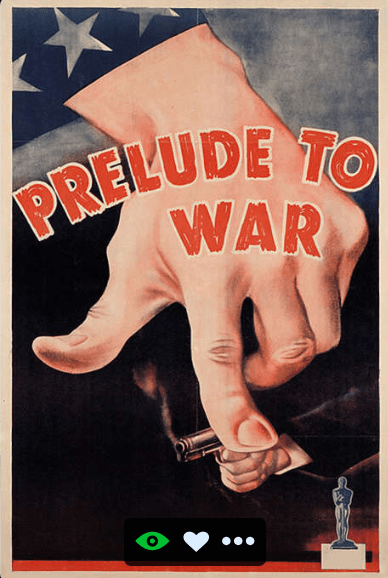
“How did it become free? Only through a long and unceasing struggle inspired by men of vision: Moses, Muhammed, Confucius, Christ.”
After the December 1941 attack on Pearl Harbor, American film director Frank Capra, along with about half of America’s then-famous men under the age of 45, enlisted in the armed services. Yes, Capra was 44, and yes, Capra was famous, despite “only” being a film director, as proudly explained in Capra’s autobiography “The Name Above The Title.” Capra was known for dramatizing quintessential American values, was already derided by some critics as “Capracorn,” and was likely endeared to General George Marshall for both reasons. Marshall, who was running America’s war effort, hired Capra to direct documentaries that would explain and justify the war to skeptical recruits. Marshall placed Capra in an office next to him in Washington DC, impressed upon him the sacredness of the job, and screened for him Leni Riefenstahl’s The Triumph of the Will. In his book, Capra said that the task of countering Riefenstahl without expensive studio machinery seemed close to impossible for several days until he thought of the Bible passage “Ye shall know the truth, and the truth shall set you free.” Capra planned to show American soldiers enemy propaganda films re-organized and narrated with a no-nonsense American sensibility. Of course, this would require, ahem, re-appropriation on a theretofore unseen scale, and in 1942 it wasn’t exactly easy to obtain enemy films without explaining why one wanted them. Nonetheless, eventually, a few heroes working a few unofficial channels managed to get Capra the footage he needed, although Capra still wanted to, ahem, “re-create” a few scenes and did.
As for Walt Disney, he may have been impressed with Riefenstahl’s technique, and some of his films may have taken advantage of anti-Semitic stereotypes, but make no mistake: after Pearl Harbor, Walt Disney put his mini-studio at the command of the U.S. government, not least because most of his animated features had yet to be released in Europe and he needed access to that market if he was ever going to break even. This is a long way of explaining why Disney fought, or why Disney Studios created the animation for all seven of Capra’s Why We Fight films. As for the blackness that represented enemies and the whiteness of Western powers, Disney didn’t invent that, but was following convention established in magazines like “Time” and newsreel producers like “On the March.” Shall we march into this?
The opening titles of Why We Fight: Prelude to War explain that its content is “an indispensable part of military training and merits the thoughtful consideration of every American soldier.” Our narrator, Walter Huston, shows U.S. soldiers marching and asks us why, or really, keeps asking if the reason is Pearl Harbor or country after country after country, each visualized by recent warfare, bombings, and carnage. Huston asks why our country, recently peaceful, has overnight become an arsenal “ready to engage the enemy” everywhere, and when the film quotes Vice President Wallace that this is “a fight between a free world and a slave world,” we are given the visual aid of a white free world and a black slave world. Regarding the former, Huston quotes men’s visions that gave us our freedom, namely Moses, Muhammed, Confucius, and Christ, whose insights found their way to “All men are created equal” and “That government of the people, by the people, and for the people shall not perish from the earth.” Regarding the latter slave world, Huston claims that after the devastating world war, unemployed, desperate people turned to leaders who took away their freedom in favor of cheap stunts and, eventually, militaristic imperialism. The film, made by an Italian-American, does not generalize about the Italian character but does note the “regimented discipline” of Germans and the “fanatical devotion” of the, ahem, Japs, as it cycles through a series of incriminating visuals, dissolves, effects, and stock footage. Huston explains that in Italy, Germany, and Japan, legislatures have become rubber-stamps, newspapers have been shut down, the press is controlled by a single party, and courts and juries and labor unions have been eliminated. In a jumpy, double-exposed montage of newspapers and dramatic vignettes, Huston shows how brute force has been suppressing dissent, even from churches, as children are instead now taught that the head of state is their God. Back in the white, I mean, democratic world, Huston presents multi-state anti-war treaties of the 1920s that resulted in the reduction of 60% of the U.S. navy, an army made smaller than Romania’s, and a prevailing attitude of peace through isolation, symbolized by several “men on the street” who want nothing to do with Europe. While Americans could read any book, worship at any church, vote for any man, and get a kick out of watching their kids grow up – as seen in Norman Rockwell-ish shots – the people of Italy, Germany, and Japan are seen overruled and overprepared for military conquest. Without a hint of irony, Huston excoriates foreign propaganda services that broadcast lies, lies, lies, about us being the haves while, they, the have-nots, took billions away from food programs to make the largest army the world had ever seen. Huston claims that the Tanaka Memorial, a 1927-written plan for world domination, began its activation when, as we see in lively re-creation, Japan took over Manchuria in 1931 and the rest of the world stood idly by as the League of Nations and communal responsibility became dead letters. Emboldened, in 1932, Japan attacks Shanghai, a city where we see women mourning graphically slain children and men beating back Japanese soldiers. Over in Italy, Mussolini apparently follows Japan’s example by invading and conquering Ethiopia, with its leaders correctly guessing we, the West, would not fight for mud huts in Ethiopia or Manchuria. As Huston promises more explanations in the next film, he summarizes by saying that this isn’t just a war, it’s the common man’s struggle between us or them, a free world or a slave world, and that 170 years of freedom “decrees” our answer as a Liberty Bell swings.
The Tanaka Memorial probably never actually existed, although many Americans honestly believed in it even before they saw Why We Fight. How many Americans saw any or all of the Why We Fight films? Marshall meant for the seven films to be seen by every single recruit, although colonels maintained some latitude over what was actually screened on their bases. President Roosevelt loved the films so much that he wanted them released in theaters, and the studios dutifully complied. The first one, Prelude to War, was the most financially successful; after a while, people tuned out 1930s’ geopolitics in favor of tuning in to the most recent battles. But there was another reason for the diminishing returns: some prominent critics, including Lowell Mellett, an aide to FDR, felt that the films were dangerous and might create hysteria that would be hard to manage after the war.
In a sense, Mellett was right, because Capra perfected many propaganda techniques that would be used for decades in a wide variety of contexts. Sometimes these techniques were mobilized for good causes, as in a short film that Capra supervised called The Negro Soldier, which was the first time any piece of cinema had acknowledged African-American contributions to U.S. history. More often, the Capra/Riefenstahl techniques would be deployed on behalf of more questionable enterprises. This is a big part of the reason why critics assembling their all-time-best lists have mostly ignored documentaries that came out during the decade after World War II. It’s also true that most of the documentary energy migrated to the new medium of television and its nightly news broadcasts.
Influenced by: The Triumph of the Will; Capra and Huston’s personalities; war imperatives
Influenced: propaganda; taught Americans how to hate
~
D11. On the Bowery (Rogosin, 1956) BO clip imdb LB RT trailer wiki
stream on criterion watch analysis by Turan read analysis by Wright listen to my podcast
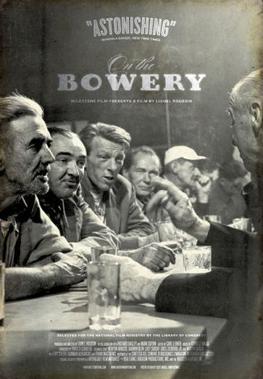
“Will you get out of here? Get out of here!”
American TV covered the news, but then, like now, TV was less successful at visualizing endemic problems, for example racism, sexism, health care injustice, or poverty. Enter Lionel Rogosin, a child of privilege, the Yale-educated son of a textile mogul who, while being groomed to take over his father’s business, detoured to serve in World War II, and wound up interested in, and traveling to, Eastern Europe, Israel, and Africa. He worked crew on a United Nations film called Out, about Hungarian refugees, during which he taught himself to use a Bolex. Rogosin wanted to make a film about African apartheid, but felt he needed to hone his skills a little closer to home where, it happened, there was apartheid.
Lionel Rogosin was inspired by at least two Roberts, Robert Flaherty, director of Nanook of the North, and Roberto Rossellini, director of Italian neo-realist classics like Roma Citta Aperta and Paisa. Their films gave off an air of spontaneity, as though life had just been captured on the fly, but in fact, critics have long pointed out that both of these filmmakers staged a lot more of their action than people thought at the time. Rogosin worked similarly. Although his subjects truly were indigent and did use their real names, Rogosin wound up staging many parts of the action. On the Bowery was received as a revelatory, ground-breaking documentary, but we now understand it as more of a docu-fiction.
On the Bowery begins, well, on the litter-strewn streets of the Bowery in Manhattan, where shirtless men walk by men who struggle to rise, other men pass a liquor bottle around, and police, uh, escort rough-looking people from place to place. A man in modest clothes, Ray, carries a weathered suitcase, crosses under the elevated-train tracks, and enters the Round House Bar and Grill, where he buys a beer for a bald man who compares recent brief stints of labor. After Ray sits with them, chats briefly with them, and most of them leave, Ray confesses his brokeness and asks the one remaining man, Gorman, if he knows where they can find a day job, but Gorman replies that they may need money to make money. Outside, searching through Ray’s suitcase full of clothes, Gorman suggests they hock his pocketwatch, but Ray answers that they can’t do that, and so Gorman settles for selling his pants, leading to a day of frustration. After Ray and Gorman awaken in an adjacent doorways, they wheel an old buggy toward a site that maybe will hire men with a cart – but doesn’t. In another bar, rough-looking men chat with Gorman about frustrations and aspirations. Gorman and Ray roll up cardboard, move boxes, and haul goods with the buggy. Gorman drinks, observes the scuzzy streets, goes into a flophouse, and chats up men in minor diners. In an alley, Gorman offers a drink to Ray, but Ray, happy with his day of truck work, refuses the drink. Ray attends an evening church service whose speaker says that despite the nature of Skid Row, there are no hopeless cases before God. After the service, Ray joins the men in a room serving soup and sandwiches, and learns that he can keep sleeping there as long as he doesn’t show up drunk or bring alcohol. Ray apparently decides against this deal, because we soon see him back at a rowdy working-class pub, drinking, slurring his words with Gorman, and awkwardly hitting on a woman. Ray walks out of the bar with the woman, loses her, and gets beaten by a couple of guys who take Ray’s wallet and leave him lying on the sidewalk. Gorman goes to a holding shop and convinces them to give him Ray’s suitcase, which he soon takes to another pawn shop, pawning the case and everything in it. With his new money, Gorman offers a drink to Ray, who says he wants to get out of New York and go to Chicago. Outside on the curb, Gorman gives Ray some cash, who says he can now afford to buy a new shirt and new pants and try for a job nearby. Gorman sits at a diner and tells other guys that he cleaned up Ray, whom we see still in the Bowery, looking for work, as the film ends.
On the Bowery became the first American-directed film to win the Best Documentary award at the Venice Film Festival. On the Bowery also earned a nomination for Best Documentary Feature, which helped it earn back its money in the face of a pan review by Bosley Crowther, the New York Times’ powerful reviewer, who called it “a shade too fictional to be believed.” In later years, most people have acknowledged its non-documentary, manipulative aspects, yet its partisans, like Martin Scorsese, still insist that it then represented some kind of revolution in form and content.
Influenced by: at least two Roberts, Flaherty and Rossellini
Influenced: provided visual language for postwar American poverty; was a new benchmark of realism
~
D12. I, A Negro (Rouch, 1958) BO clip imdb LB RT trailer wiki
stream on amazon watch analysis by Rouch read analysis by Hood listen to my podcast
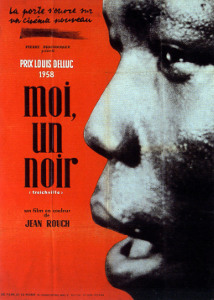
“Every day, young people similar to the characters in this film arrive in the cities of Africa.”
Jean Rouch considered himself an anthropologist and sometimes apologist, making sure to mentor African filmmakers even while making his first few ethnographic short films in the early 50s. While focusing on the rituals and customs of the people living next to the Niger river, Rouch generally avoided staging scenes, although he also found that subjects tend to perform for a camera. His mid-50s’ work is now commonly labeled ethno-fiction, although in this case, that term owes much to Rouch’s unusual choices regarding angles and editing.
Moi un noir, or I, a Negro, broke with contemporary documentary practice by allowing its subjects to voice-over both narration and apparent dialogue with fellow subjects, moving between internal monologue and external dialogue so often that subjectivity gets rather blurred for the viewer. The experience of seamless confession back and forth with friends and the camera draws us in, maybe closer to black thoughts than ever before experienced by a white viewer of a feature. Of course, one cannot forget that any claims to black subjectivity are tempered by the title card “directed by Jean Rouch.” Rouch also benefitted from recent innovations at the labs of Eastman Kodak; he was likely the first person afforded the privilege of walking around the Niger river with a portable 16mm Kodachrome color camera.
Moi, un noir, begins in medias res, dumping us on an urban African street much as its subjects have been dumped, according to the narration, which goes on to say that these recent immigrants to the city are caught between tradition and modernity, between Islam and love for the cinema. The film’s director, Jean Rouch, narrates that in Ivory Coast, his subjects and co-collaborators assumed aspirational names and activities – to the point of being arrested. After credits, the song “Abidjan of the laguna” plays over aerial images of Abidjan which set up our introduction to Edward G. Robinson, who narrates over his own moving image that we won’t learn his real name but he was given the Robinson name because of his resemblance to the film star. Robinson boards a boat from Abidjan to Treichville while narrating that he would never have come from Niamey, Niger, had he known how hard he would work for so little money. As Robinson walks to his modest home, Rouch names some of the many jobs done by Robinson and his friends, but points out that any day’s earnings will be increased or lost at cards that night. We meet Eddie Constantine, who sells fabrics, walks with confidence, calls himself Lemmy Caution, FBI agent, and tries to make a sale with a young woman he calls Dorothy Lamour. We hang out with day laborers, called “bozzoris,” as they hustle jobs moving logs or coffee sacks and sometimes stopped by authorities for no clear reason. Robinson walks around Treichville while walking us, via narration, through his life washing his hands and feet to stay at a special hotel for bozzoris, eating rice at a price for bozzoris, and lying down to dream of a non-bozzori life. Robinson tells his fellow bozzori, a man he calls Elite, that at the age of 18 he was an escort in capital cities in Europe meeting women who would let him do anything to them. Robinson narrates us into a dance club where he spurns the idea of dancing but praises the club’s boxing ring, and especially one boxer, Tarzan, whom he and we admire. Rouch narrates that Saturday afternoon is the time of rest and relaxation as we see Robinson get into Tarzan’s taxi and take it to a tremendous beach. After many shots of fun in the surf, Robinson narrates that he’s sad because every day can’t be like Saturdays. Robinson returns to the boxing ring and wins a staged competition so that he can live out, just for a moment, his dream of being world featherweight champion. Tarzan pays for Robinson to go dancing, but when a woman there expects him to pay for her drinks, Robinson storms out, narrating that he’s sick of that shit. During the day, Eddie Constantine narrates that he came to the pictured Catholic church to look at and talk to pretty girls, and that as a ladies’ man, he needs a new haircut that he calls a “cha cha cut.” Robinson resumes narrating that the many mosques in Treichville are too small, and we see dozens of men kneeling on the sidewalk and street outside them. Robinson narrates about all the nice clothes others have and wishes God would grant him more than 200 francs a day. Both Robinson and Constantine reject voting, ever, with the latter claiming only to care about women and sport as he observes and admires both at a 7-a-side soccer match. Robinson and Constantine narrate us through La Goumbe, a live music/dance show where hundreds gather to watch a few specialist performers, for example flipping bicycles. At night at La Goumbe, Eddie Constantine narrates us through his apparent dance victory, compares it to Edward G. who will go home with his friends from Niger, and later tells his dance partner, Natalie, that he loves her and they should drink more together. Edward G. narrates us through a club scene where an Italian man steals away his intended conquest, whom he calls Dorothy Lamour. Oddly, as he tells us his dreams of her, we see the actress live these out to some extent, taking off her top and reclining into a bed. Over a card saying Monday, Rouch tells us that yesterday’s dreams have a sour taste on Monday, when Robinson is no boxing champion and Constantine no FBI agent. Edward G. bangs on Dorothy Lamour’s door, prompting the Italian man to emerge and fight hard with him, which ends in Robinson staggering away. Edward G. learns from his fellow bozzoris that Constantine was put in prison for three months for hitting a policeman. Robinson sits on the river with his pals, commenting, or narrating, that they are in their own prison anyway living in Abidjan from day to day, not like growing up in Niamey, which we now see in idealized images of boys playing around a beach’s boulders. Robinson walks along the river while telling his friend, or maybe us, that he went to Indochina and shot Vietnamese but none of it did him any good. As they walk along and the film concludes, Robinson comments that God is everything and maybe something will come along to make them happy.
In some ways, Moi, un noir was the movie Lionel Rogosin wanted to make when he made On the Bowery instead. One difference between them was reception. While Rogosin’s film was mostly ignored upon release, Moi un noir was a huge hit in France in 1958 and given credit for everything from cinema verite to the French New Wave. Lightweight cameras hit the streets of Paris and filmed in Rouch-like ways.
Influenced by: the evolution of the field after Nanook
Influenced: cinema verite; was almost too much of a leap forward for docs, eventually considered ethno-fiction
~
D13. Primary (Drew, 1960) BO clip imdb LB RT trailer wiki
stream on amazon watch analysis by Tyler read analysis by Clubb listen to my podcast
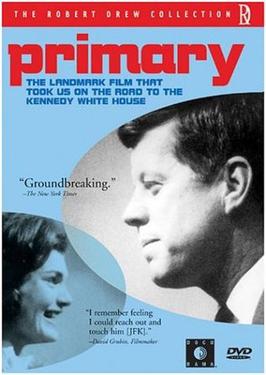
“This is the heart of Senator Kennedy’s strength.”
Robert Drew was born in 1924 in Toledo to a father who sold films and rides on seaplanes, both of which bade well for his son’s eventual career. By the time of Pearl Harbor, young Drew had flown so often that he qualified for officer’s training, which led to him flying more than 30 combat missions, which led to him meeting a prestigious journalist, Ernie Pyle, who, after the war, encouraged his friend to write an article about flying the P-80 which was accepted by Life magazine, which offered him a job. While at Life as a writer and editor in the mid-50s, Robert Drew asked why most documentaries were so dull, and developed a unit within Time Inc. to develop docs based on pictures more than words. At some point not long after, Drew founded Drew Associates, recruiting several like-minded experimenters who would go on to have rather renowned careers, including D.A. Pennebaker, Richard Leacock, Albert Maysles, and Terence MacCartney-Filgate, also associated with Canada’s National Film Board.
Issa Chubb writes in Criterion that this team “had a clear vision of the kind of documentary they wanted to make, and they had to commission the development of a camera to realize that vision.” Indeed, Kodak labs were working on 16mm handheld sync-sound cameras, but it was Drew Associates member Mitch Bogdanovich who helped them with the proper rig. Kodak and Bogdanovich’s tinkering timetable kicked into higher gear when the 1960 Democratic Presidential campaigns signaled their openness to being regularly filmed, partly to demonstrate their transparency compared to President Eisenhower’s almost allergic aversion to TV interviews. Perhaps candidate John Kennedy also sensed that the more he was seen, the better, although his less telegenic rival, Hubert Humphrey, was just as happy to green-light Drew’s camera crew. Drew’s problem was money; he would have to focus on one particular state’s primary, hopefully one that took place early enough that his team could finish editing and get the film released before the election, after which no one would care. They chose Wisconsin and they got it done.
Primary begins with a farmer holding court on his front porch, from which Hubert Humphrey emerges to warmly shake the man’s hand and board a bus that rolls down the highway as we hear the Davy Crockett song repurposed into “Hubert, Hubert Humphrey, the president for you and me.” Cut to a thick head of well-coiffed hair attached to the man making his way through an intimate crowd on his way to a hallway to a stage – a movement the camera captures in an astonishing single shot. On this stage, John F. Kennedy stands with his wife and waves to the enthusiastic crowd repurpose-singing “high hopes.” While men ride in cars, a narrator tells us these could be any men in any place in any election year, but this is 1960 and Kennedy and Humphrey are in Wisconsin. We see snippets of both men shaking hands, laughing with moms, giving speeches, attending dinners, and sitting for formal press interviews. Followed by a jittery camera, Humphrey amiably shakes many hands outside the Madison statehouse. After Kennedy prepares for a formal television appearance, the film cuts from a closeup of Kennedy’s handsome appearance to a poster of, uh, Humphrey. Outside, where Kennedy is surrounded by autograph-seekers, the camera cleverly makes his head bob in their sea of raised papers. In the pouring rain, Humphrey’s car entourage winds its way through the modest farm suburbs of Wisconsin. In a gym, Humphrey speechifies that current politicians have deprived farmers of millions of dollars and that he, Humphrey, is the only candidate concerned about agriculture. In a behind-the-scenes vignette at WEAU’s TV studio, Humphrey explains to the cameramen and his wife what will happen during his appearance. This cuts to Kennedy speaking from the TV set about how important the presidency is, observed by a large room full of campaign volunteers, many of whom are young women. An apparatchik mentions how much people like Kennedy, the narrator notes Kennedy’s strength in Wisconsin’s heavily Polish Catholic Fourth district, and we see an extended edition of the extraordinary opener of the camera following Kennedy through a hall onto a stage in front of an audience singing “Vote for Kennedy, vote for Kennedy, and we’ll come out on top. Oops there goes the opposition, oops there goes the opposition kerplop.” The crowd hears speeches from Jackie Kennedy, her husband, and his brother Robert. Shots of the post-rally handshake line linger on clasping hands and Jackie’s beaming face. Over shots of a Wisconsin street, the narrator announces election day; over abstract shots of feet in voting booths, random voters speak about Kennedy not taking orders from the Pope, Republicans voting for Humphrey, Kennedy’s farmer-like looks, and more. That evening in their private hotel rooms, Humphrey, Kennedy, and their closest campaign staff listen to results trickling in, sounding great for Humphrey and bad for Kennedy. In Wisconsin’s official Democratic primary headquarters, Humphrey and Kennedy finally appear together, privately chatting, just before the press asks them separate questions about the night’s results. The narrator explains that Kennedy’s urban votes overwhelmed Humphrey’s rural ones, but that even after Kennedy’s victory in Wisconsin, the candidates are pretty much where they were heading into the West Virginia primary. As Humphrey’s car drives away, we hear both campaign songs one more time.
Everyone now calls Primary “direct cinema.” According to critic Matt Zoller Seitz, Primary “had as immense and measurable an impact on nonfiction filmmaking as Birth of a Nation had on fiction filmmaking.”[14]
Issa Clubb wrote in Criterion “Primary was really the birth of what we think of as the modern documentary: observational photography based on access to an interesting subject, presenting “real life” as it is lived. I also knew that this new form required new technology—a mobile, quiet camera that could synchronize with a sound recorder.” More Chubb: “Although Primary is now acknowledged as having been crucial to the history of documentary film, it was not considered a revelation in its time—in fact, it was barely seen. Broadcast television executives did not know what to make of this documentary that featured occasionally blurry in-the-moment camerawork, did not lecture to its audience with a voice-over narration, and did not sum up its thesis with a moral.”
A shorter TV version was aired that nonetheless astonished with its “direct cinema” aspects. The Primary team would become the most in-demand of doc-makers, and doc-makers who hadn’t been part of Primary would find ways to watch it.
Influenced by: Rouch, lighter cameras, new “fly on the wall” ideas
Influenced: direct cinema, cinema verite, docs that didn’t preach
~
D14. Chronicle of a Summer (Morin, Rouch, 1961) BO clip imdb LB RT trailer wiki
stream on criterion watch analysis by Tyler read analysis by Di Iorio listen to my podcast
“People are bored everywhere now. But boredom comes from within. If you’ve got an inner life, you’re never bored.”
Moi, un Noir introduced Rouch to Edgar Morin, who was a sociologist, leftist agitator, and author who had coined the term “cinema verite” in a book in 1957 but had not yet put that idea into practice. Inspired by Rouch’s ethnographic films and others, Morin proposed they do something similar on the streets of Paris. Although French TV was already asking random pedestrians questions like “would you buy a French car?”, Morin hoped for something more broad-minded, more universal, about life, or love, or just how or why people did what they did. Crucially, they would need to interview people from every part of French society. They did a few camera tests, showed them to a producer named Anatole Dauman, and he provided the funds.
While Morin was most concerned with sincerely listening to people, Rouch was most concerned with form. Halfway through the shoot, the closeup interior interviews looked fine, but Rouch still wasn’t satisfied with the “man on the street” stuff compared to what he had seen on a few TV programs. Sam Di Iorio: “For Chronicle, Rouch and engineer André Coutant developed a prototype of the first handheld, sync-sound 16 mm camera ever used in France. The KMT Coutant-Mathot Éclair was lightweight, relatively quiet, and easier to use than the Arriflex Rouch relied on at the start of production, and it could be connected to a Nagra tape recorder to capture sound and image at the same time.”
However, Rouch was unhappy with the KMT’s footage as filmed by their regular DP, so he hired a Canadian associate of Drew Associates, Michel Brault. Rouch said: “Everything we’ve done with cinéma-vérité in France comes from the NFB in Canada. Brault brought over a new shooting style that we weren’t familiar with, and we’ve all been copying it since.”
Morin called it “pedovision,” and explained it as “filmers and filmees almost form one body, the normal movement of passers-by is almost undisturbed, the characters in movement feel at ease with the camera, their comments are directly related to the spectacle in the street.”
Chronicle of a Summer begins with an air raid siren in a rural twilight cutting to daylight shots of workers emerging from the Metro onto the streets of Paris in summer 1960 as a narrator explains that this “film was made without actors, but lived by men and women who devoted some of their time to a novel experiment in” – as the narrator then calls it “cinema-verite.” In a café, filmmakers Jean Rouch and Edgar Morin smoke, drink, and interview a woman, Marceline, who says that the camera may influence the realism of any answers. Marceline adds that her day is taken up with her job and we see many minutes of that job, which is Marceline and another woman accosting random pedestrians with their “sociological survey” about happiness and life. Standing under a car hood, one mechanic says that if he didn’t sometimes fiddle with the books on customers’ behalf, life would be impossible. In apartments, Marceline holds a microphone to a couple atomizing the difficulty of happiness through work; the man says happiness and unhappiness are the same. Men sitting in a bookish café agree that no one finds their own job interesting. In a factory, we watch dialogue-free shots of men working and men lunching. Wordlessly, we follow a white factory worker on his walking commute through various parts of Paris. He interviews a cheerful, perspicacious young black man who praises Renault, finds Frenchmen different in Africa and France, and explains his trick of knocking on doors – if they answer, he walks in, if they don’t, he walks on. Men and a woman sit in a bookish dining room discussing home ownership, happiness, work, belief, and self-fulfillment. In a close-up, a long-haired, passionate woman digs deep into many aspects of her life and concludes she can’t kill herself because that would be phony. Another interview subject, 20-year-old student Jean-Pierre, talks about the distance between ideals and reality, and we soon learn that Marceline is in love with Jean-Pierre and hopes to spare him some of the pain of her 20s. Now-familiar men in the bookish dining room argue about the best way forward for the war in Algeria. After shots of headlines from the war in the Congo, we cut to an outdoor lunch table where Marceline says, in front of at least two black men, that she’s not racist but wouldn’t marry a “Negro” because of the kids. One black man says “I wish people would like blacks for other reasons than dancing,” and white men grill him about any racial solidarity with Congolese as a national of Cote D’Ivoire. As a Negro nods to “Night and Fog,” Resnais’s breakthrough doc about concentration camps, we freeze-frame on a woman’s hand massaging a flower. Marceline walks through a mostly empty, daylit Place de la Concorde as she shares a sort of interior monologue about missing her father who helped her in the camps and how her heart is now stone. At night, we see familiar subjects slow-dancing in outdoor revels. We return to the long-haired, passionate woman who says she most fears winding up alone again. We return to the one white factory worker who shares some trouble at the Renault factory and claims he’ll never become a foreman. In Saint-Tropez, we see a now-familiar black man and white woman playing in the sea, emerging onto the beach, watching a bullfight, and walking along the docks. We meet a well-endowed bikini model who breaks down the hypocrisies around people discussing and visiting St. Tropez. In an extended sequence, kids rock-climb and then sing a song together. With self-referentiality, we move into a screening room where many of the familiar subjects weigh in on the film’s appeal and authenticity or absence of same. After, Morin and Rouch stroll through the Museum d’Homme arguing about how to achieve truth when people see their subjects as actors or exhibitionists. Morin says that their film about love has instead become a film about indifference or the inability to communicate.
Sam Di Iorio: “Godard was also the first to make a final, crucial point: Rouch and Morin’s film changed the way French cinema sounded. “Chronicle of a Summer,” he told Cahiers du cinéma in 1962, “was the first time I heard a worker speak in a movie.” By opening a medium dominated by trained actors and carefully scripted dialogue to the spontaneous speech of workers, students, housewives, and immigrants, the film laid the groundwork for a second sound revolution, a new talking cinema in which marginalized communities could express themselves in their own time, on their own terms.”
Sam Di Iorio: “The film’s innovations spread through cinema like wildfire. The KMT prototype passed quickly from hand to hand, immediately determining the look of such documentaries as Mario Ruspoli’s Les inconnus de la terre (1961) and Chris Marker and Pierre Lhomme’s sprawling, indispensible Le joli mai (1963), and influencing fictions as different as Claude Lelouch’s In the Affirmative (1964) and the Douchet-Pollet-Rohmer-Godard-Chabrol-and-Rouch 16 mm anthology film Six in Paris (1965). Almost as soon as they appeared, in fact, the mobile camera, real-time interviews, and real-world locations at the heart of Chronicle were codified as effects, as signifiers of authenticity. Before long, the film was generating its own parodies, from the decadent game of “cinéma-vérité” that Julie Christie’s character plays during a lost Paris weekend in Darling (1965) to Jacques Baratier’s must-be-seen-to-be-believed vérité musical Sweet and Sour (1963), in which an army of Éclair- and Arriflex-waving youths in V-necks and chinos twist maniacally before back projections of the Paris Opera while singing “I have my camera / You’ve got your camera / When will all of us / Have a camera?”
One reason that it would be hard, today, to make something with the power of Chronicle of a Summer is that 1960 was an unusually transitive time in French society, and a major reason for this was that majorities of French citizens were turning against French government goals in Algeria. As the decade turned, more and more colonialists were embracing post-colonial movements for justice and self-determination that could be seen from Cuba to Congo to Calcutta to Indonesia’s Bandung conference which proudly coined the term “Third World.”
Influenced by: advances in tech, making cameras lighter; new post-colonial and post-modern consciousness
Influenced: cinema verite; now often considered one of the 10 best docs ever made
~
D15. Le Joli Mai (Marker, L’homme, 1963) BO clip imdb LB RT trailer wiki
stream on kanopy watch analysis by L’homme read analysis by Di Iorio listen to my podcast
“Why search for beauty in a dove and poetry in poets? When you have owls, painters, cosmonauts, inventors, lovers…”
Chris Marker and Pierre L’Homme were keen to pick up where Chronicle of a Summer had left off. Marker had just made his mark, so to speak, with the tremendous short film La Jetee, and was keen to leverage that. Sam Di Iorio, again:
“Le Joli mai’s professed goal was identical to that of Chronicle: Marker and Lhomme wanted to use emerging technology to create a portrait of everyday Paris. While recognizing their debt to their precursors (in homage, they even include a brief shot of the self-proclaimed Martin and Lewis of ethnographic cinema), in practical terms they made a very different film. Whereas Chronicle tracks the personal journeys of a small group of protagonists over a number of months, Marker and Lhomme wanted to organize a shorter time span around a wider scope of events. If Rouch and Morin’s film focuses on individuals, Le Joli mai is edited around themes.”
As critic Roger Tailleur perceptively claimed, Le joli mai is not cinema verité, it is cine ma verité: not a cinema of truth, but one that expresses a personal take on truth. This individual viewpoint is primarily revealed through montage: when a pair of engineering consultants become insufferably pompous, images of yawning cats interrupt their conversation. The truth about Paris is revealed not through single images but through a combination of shots.
Le Joli Mai is dedicated “to the happy many” before beginning with siren-filled street sounds over an unusually cantilevered roof that gives way to a view of Paris that includes the Eiffel Tower and a narrator who says she’d like to come upon Paris for the first time like a detective with a telescope and a microphone. During more rooftop shots, the narrator continues that she’d like to return to Paris after a long absence to see if the same keys open the same locks. She goes on that this most beautiful set can only be explained by Parisians, and that some of the 8 million of them will explain Paris during this lovely month of May. After credits, the narrator quotes a man who ascended the Eiffel Tower in May 1923 and cited several superlatives about Paris and French culture, only for us to cut to a suit vendor on the street who says his wife only cares about money, he’s only happy when he makes a sale, and that he doesn’t believe in artistic movies or politics. Over shots of traffic congestion and bustling pedestrians, the narrator cites several statistics demonstrating that Paris is over-crowded and under-regulated. The narrator says “Work buys nothing but the possibility of forgetting work” and then walks us through the transformations in Rue Mouffetard, summarized by the word “friendliness.” A bartender smiles about moving from there and what he’ll miss. Over more rooftop shots, our narrator laments anarchy and greed governing Paris’s future and posits that at least slums had room for happiness. Two architects in an empty lot argue over visions, skyscrapers from New York versus Celesteville from Babar. In closeup in a doorway, a woman describes her thrill at being rehoused and sharing with her husband more space than they’ll know what to do with. We meet the woman’s many dirty-faced kids, who are contrasted with two boys in ties outside a stock exchange aspiring to have more money and power. Adult men gather around offering opinions on finance and material well-being and recent events in Algeria. The camera spins around a room full of shouting, graying white male stockbrokers. A woman strokes the head of an appreciative owl. We are introduced to Pierrot, or P.P., credited as a licensed tire repairman, who seems working-class but also paints modern art, abstract renderings of life from Jesus to the cosmos. As we hear spacey music, crowds line up to see and touch the spacecraft that John Glenn rode around the earth. Outside, we meet R.A., inventor of a car stabilizer, who talks about the virtues of his profession and of collaborating with his wife. A married couple, each of them only 21, stay tightly in frame as he prepares to ship off to Algeria and they claim disinterest in politics but interest in eternal happiness even after they have kids. Part two opens with the song “Joli Mai” in darkness. The narrator says that in May 1962 a gravedigger opened a grave and Fantomas rose to haunt Paris. We flashback to anti-fascist protests – identified that way onscreen – from February 1962 and then to a solemn march commemorating eight lives lost. The narrator says, “For the first time in the history of Paris, one could hear a bird sing at noon on the square of the Republique.” In on-the-street interviews, men speak of war, nukes, and plastic bombs, with a young blond handsome man saying that he only wants to marry and have a kid whom he claims will be happy if he doesn’t think about politics. In a group of women in a salon, one, pressed, admits to reading tabloids. A rowdy crowd at night agitates for justice for a soldier, which then cuts to a night party where revelers dance, especially a man, Ettie, who is breaking the record for twisting, an activity he says he’s focused on “like a scientist on a microbe.” At a train station, workers complain about their wages and contracts and current leaders. One older man blames recurrent strikes on a weak government. In a crowd on a sidewalk, a man confronts a liberal woman by suggesting she travel to Russia while he may return to America, so she answers that Kennedy should first help America’s illiterates and jobless. Men in a café argue over the future of work, leisure, automation, scarcity, morality, and a speculative 30-hour work week, occasionally smash-cutting to incredulous cats. An interviewer asks a black man if freedom and independence are merely Western temptations, and he wisely replies that Europeans sometimes say so, but also wryly notes that it was white Frenchmen who suggested to him that all French were white. He tells anecdotes of how white people have tried to demonstrate their lack of prejudice and, when pressed, says he has no white friends. A brunette in closeup explains how people relate to clothes and, separately, animals. Back at the salon, the women debate faith, religiosity, and Communists as the camera presents a union rally in front of a shop. In closeup, a blond man describes his gradual conversion to Communism, ending by saying he doesn’t have time to think about God. Comic book pages cross-fade into a rudimentary spaceship on TV as the narrator says that for many French, TV is their only window on the world. We watch an Algerian jackhammering a street as the narrator warns us that even the lowest proletariats among the colonizers tend to know sub-proletariats among the colonized. Over shots of destitute slums, a young man explains how DST agents came to him there and beat him up in front of his parents, yet he remains hopeful about Algeria’s independence and its close allyship with France in the future. With military pomp and circumstance, we watch a small street ceremony where Charles De Gaulle salutes citizens from an open car. In a time-lapse-sped-up shot of cars moving around the Arc de Triumph, the narrator gives many, many statistics about deaths, changes, and resources used during this month of May 1962, ending on a large prison and the spoken fact that for Paris’s 5000-odd prisoners, life was the same day after day. A car-mounted camera moves through a near-empty Paris as the narrator points out the freedom of most of the interview subjects and remarks that the prisoners would be amazed at the prisons of many of their minds. In final closeups of agitated on-the-street randoms, the film concludes with narrator acknowledgment of a voice within everyone that says, “As long as poverty exists, you are not rich. As long as despair exists, you are not happy. As long as prisons exist, you are not free.”
Sam Di Iorio again: “Le Joli mai attacks Parisians for their disengagement, for their racism and classism, for their self-obsession in the face of injustice, and for their silence. This distanced critique, however, is balanced with empathy: the film’s harsh conclusions are mitigated by unmistakable affection…This idiosyncratic verité portrait of 1962, then, can be considered a direct springboard to the militant cinema of 1968. One May contains the seeds of another.”
Influenced by: Chronicle of a Summer, the nouvelle vague
Influenced: cinema verite
~
D16. World Without Sun (Cousteau, 1964) BO clip imdb LB RT trailer wiki
stream on YouTube watch analysis by Scuba read analysis by Sezen listen to my podcast
“Starfish, despite their peaceful appearance, are carnivores specially adapted to eat shellfish. Scallops have many eyes to look out for their dreaded enemy.” Jacques-Yves Cousteau had one of the most fascinating lives of the 20th century. Born in 1910, he trained to become a pilot, broke both his arms in a car accident in 1930, switched to the ocean, became one of France’s best free divers, worked with and for the French Navy, married his business partner in 1937, worked on improving equipment, and helped create the world’s first Aqua-Lung, which was the first SCUBA gear with a demand regulator as all modern ones have. Cousteau was so concerned with film that in 1943 he bought hundreds of small still cameras so that he could cement together their film reels to bring underwater.
I could say much more about Cousteau’s innovations and impact, but let’s stick to cinema. In 1954, Cousteau’s BP-sponsored tour of the Persian Gulf was filmed by Louis Malle; Malle and Cousteau co-produced the resulting film, which was given the same name as Cousteau’s 1953 book The Silent World, a film that was the first documentary to win the Palme D’Or. He contributed to many innovations around the world over the next few years, including inventing the SP-350 Denise Diving Saucer which would figure prominently in his next feature, which was also the first feature Cousteau directed himself, Le Monde Sans Soleil, or World Without Sun. A year after that hit, Cousteau signed a contract that had him producing the international hit TV show The Undersea World of Jacques Cousteau from 1966 to 1976, followed by The Cousteau Odyssey from 1977 to 1982, shows that remain the world’s most-watched documentary series if we’re not counting news shows or “reality TV.”
Both The Silent World and World Without Sun won Oscars for Best Documentary Feature, and both should arguably be on the D-list. Jacques Cousteau has permeated the culture in ways that are not always easy to measure or compare with other figures – he validated science, conservation, diving, and some photographic innovations. World Without Sun plays almost like fiction, especially in the beginning, which seems patterned after 007 films, a favor the franchise repaid with much of Thunderball. World Without Sun is simply more audacious because it’s about establishing an underwater colony with a yellow submarine, an idea saluted by the Beatles when they sang “We all live in a yellow submarine.”
World Without Sun begins with a dramatic plunge into vague depths. As we watch the divers set up an underwater station, Jacques Cousteau explains the Continental Shelf Two, or Conshelf Two for short, meant to establish that people can live underwater for extended periods of time. Watching divers swimming alongside fish and other life, Cousteau continues narrating that they are “oceanauts” – not astronauts – ten meters below the surface of the Red Sea, near Sudan. The camera reveals the star-shaped structure as well as a submarine hangar that releases a two-person “diving saucer.” The men inside Conshelf live relatively normally, receiving letters and haircuts; one pulls a parrot out of a bucket and feeds it as the parrot looks at the fish swimming outside the window. Divers trap a lot of fish in clear plastic boxes and bags, “destine de la aquarium de Monaco.” We see a man at a table examining samples. The divers set up a specialized camera near a box which we see capturing different sorts of plankton and eels and other deep-sea life. Some of the men sit in a chamber that is lowered to a depth of 30 meters, a darker part of the water deep enough to bleach out many of the colors. One diver rides a propeller-propelled sort of tank as he chases sharks. Divers set up a camera on the ocean floor that can be rotated remotely, somewhat impressive for 1962. As the men smoke pipes in the main chamber, the parrot seems to object. In the dark depths, many surprises emerge, like clams who open and shut their “mouths” as they seem to propel themselves. A craft descends, descends, until we are 300 meters below the surface, where we see even more unusual fish, crustaceans, coral and rock formations. 280 meters below, Cousteau and a partner explore an underwater tunnel where they can open the Diving Saucer’s hatch and breathe the trapped air.
This is a revelatory film. One can see how it led to his TV show – it presented an unknown world on earth, sort of the final frontier outside of outer space. Because of this film’s ample footage of independently swimming divers, World Without Sun is said to have done more than any other single film to promote sport diving and, more intentionally, ocean conservation. Years later, Jacques Cousteau spoke more critically about the Conshelf Two project partly because it was funded by a French oil company to prove that their employees could work underwater mining for oil. Cousteau apologized and asked that future efforts focus on conservation.
Influenced by: innovations in SCUBA and travelogues
Influenced: scuba, ocean conservation, certain types of documentaries
~
D17. A Man Vanishes (Imamura, 1965) BO clip imdb LB RT trailer wiki
stream on apple watch analysis by Audiorain read analysis by Javadi listen to my podcast
“For 15 years, he worked for a plastic wholesale dealer in Tokyo.”
Shohei Imamura grew up in Tokyo as the son of a doctor and attended Waseda University, where he took classes on theater. He credited Rashomon as the film that inspired him to apply for film apprenticeships, and he worked his way up through the system, doing grunt work for Yasujiro Ozu among others. He broke through in the late 1950s and in the 60s became known for strong female protagonists and international acclaim. In 1965, he founded Imamura Productions, made his first film there, The Pornographers, and began thinking about the best way to approach making a film about Japan’s problem of tens of thousands of persons going missing every year. Ultimately, Imamura decided to make a film that…I don’t quite want to spoil yet.
A Man Vanishes begins on May 31, 1965 in the Honjo Police Station where a bald officer tells us that 32-year-old Japanese man Tadashi Oshima left on a business trip on April 12 and never returned as scheduled on April 18. A filmmaker speaks to Oshima’s boss, who offers that Oshima stole 400,000 yen two years ago which the company recovered by garnishing his wages, and that right now he may have absconded with about 60 or 70,000 yen. Yoshie, Oshima’s fiancé, claims that she may have only seen his good side, but the boss counters that he wasn’t smart enough to only show a good side. Yoshie’s father says that Oshima would never have let Yoshie know he stole. Six minutes in, the filmmaker begins an interview with Yoshie by saying “he’s been missing for a year and a half,” which leads to Yoshie on a beach recounting how hard all that time has been for her. Eerie percussion punctuates an enclosed, dark space, where a medium kneels with others on a tatami. In another enclosed space, concerned parties speculate about the medium’s efficacy and Oshima’s whereabouts. Trudging through a snowy field, people postulate that Oshima was the type of person who would be writing to his family. Through photos and some video, we learn more about Oshima’s career as a businessman selling the equivalent of Tupperware and embezzling funds. The camera black-bars a woman’s eyes who explains that Oshima was in a love triangle and didn’t want to pay for an abortion. More people give more reasons why Oshima may or may not have been escaping a lover and/or a debt. We see freeze-frames of Yoshie while Kimiko says Oshima loved her but wasn’t manly when he wouldn’t admit to also loving Yoshie. The filmmakers travel to Kunimi, in Fukushima Prefecture, to speak with people he met there and to confirm bank details about 150,000 yen he’d sent on April 16. One contact remembers asking herself why he would choose such an expensive cab to go to the train station. The filmmakers find what may be suspicious hotel records and an abandoned suitcase in a closet. Yoshie and her sister and the filmmakers delve into possible hidden motivations and what would prompt someone to suicide. The filmmakers travel to Oshima’s home prefecture, Niigata, and learn more about the contradictions of Oshima’s character. On an apparent local TV station, the interlocutor asks Yoshie if she would marry him if he turns up, and she calls that a complicated question. On a roof, worrying that they’ve lost their non-fiction plot, one filmmaker observes to his colleagues, “people are always observing themselves, but sometimes they fail to do so.” In a more private moment, one worries to another that Yoshie has changed and probably changed the direction of the film; on a beach, Yoshie tells the lead interviewer “you’re the only one that I love.” The filmmakers ask various parties about Oshima’s activities and conclude that Oshima had walked alone with Yoshie’s sister. A medium claims he was murdered and poisoned, likely by Yoshie’s sister because she couldn’t have him; the medium directs Yoshie to ask her sister for the full truth. During a tense dinner seen behind prison-bar-like-blinds, Yoshie does what the medium asked, but her sister denies anything to do with Oshima. Soon, a young fishmonger appears at the table accusing Yoshie’s sister of having had private walks with Oshima. After back-and-forth, the interviewer appears to peel back the curtain, as it were, calling out for the set to be dismantled, causing the walls to fall away as we see the “dinner” was a small part of a very large sound stage. The filmmaker appears on the street before the press admitting that this film was and is fiction designed to call attention to the fact that 91,000 Japanese persons a year, and growing, go missing despite Japan’s small size. In the film’s surprisingly long final scene, on a daytime street, the film’s “actors” gather to continue the dinner argument – considering the fishmonger has no reason to lie – and to offer a few more speculations about memory, God, belief, Oshima, and filmmaking. On the final freeze-frame, an offscreen man says yes, “the film is over, but not the reality. What’ll you do after this?” and a woman answers “I don’t know.”
In some ways, A Man Vanishes doesn’t belong on this list. But it was put here by the usual suspects – the Sight and Sound list-makers and other major list-makers. By now, that shouldn’t surprise my listeners. Going back to Nanook, we’ve seen that documentaries always involve staging and the centralizing of “truth claims.” In its own way, A Man Vanishes is trying very hard to tell a truth – by lying.
Even if A Man Vanishes were to be consigned to fiction, we would have to acknowledge its vast influence over the field of documentary because of foregrounding its interviewer, in this case Imamura’s colleague Shigeru Tsuyuguchi. In 1967, the ethic of Western documentary was very much “fly-on-the-wall,” whereby a documentary seemed more true the more it effaced the filmmaker. We’ll see later today that Shirley Clarke plays around with this rule by speaking up off-camera, but her intervention on this count can’t be considered as extreme as that of A Man Vanishes. A first-time viewer could be forgiven for thinking that Tsuyuguchi, the main interviewer, is in fact the film’s director, but Imamura actually does put himself in the film’s final scene, and besides, the film makes its point by having us question the need for a given film’s documentarian to stay above or beside the action. Most American documentaries would ignore this lesson for about 20 years, until Michael Moore made Roger & Me, after which we began to see a lot more camerapersons on screen.
Influenced by: prevailing documentary codes, which Imamura cleverly subverted
Influenced: the wide wide world of pseudo-documentary
~
D18. Dont Look Back (Pennebaker, 1967) BO clip imdb LB RT trailer wiki
stream on amazon watch analysis by Smith read analysis by Polito listen to my podcast
“If I want to find out anything, I’m not gunna read Time magazine, I’m not gunna read Newsweek, I’m not gunna read any of these magazines, I mean cause they just got to much to lose by printing the truth. You know that.”
After Primary basically brought cinema verite, sometimes called direct cinema, from Europe to America, D.A. Pennebaker found himself in high demand. He helped make nine more documentaries for Time Life’s TV show, called Living Camera, before he and colleague Richard Leacock, in 1963, founded their own production company which made several short films. One of these, profiling jazz vocalist Dave Lambert, got the attention of Bob Dylan’s manager, Albert Grossman, who asked Pennebaker to make a documentary of Dylan’s 1965 tour of England.
Pennebaker used a handheld 16mm-film camera and mostly direct sound, including the sound of people organically interrupting each other, something rarely heard then on American big or small screens. Pennebaker benefited from happy happenstances, including the willingness of experimental filmmaker Ed Emshwiller to loan uncredited his film of Dylan’s Greenwood, Mississippi performance of “Only a Pawn in Their Game,” as well as Dylan’s idea to film himself cycling through cue cards while “Subterranean Homesick Blues” was playing. Pennebaker decided to put it at the film’s beginning and use it as the film’s trailer. By the time the film came out in 1967, the title Dont Look Back could only be read ironically, and starting with Dylan’s most electric song up to that point was one way of cuing the audience that the film was in on the irony.
Dont Look Back begins with arguably the world’s first music video, of the song “Subterranean Homesick Blues,” a genre-bending-cum-blending of documentary and fanciful fiction. We hear Bob Dylan singing this lyric-rich song while we see Dylan standing in an industrial alley, mutely displaying and discarding cue cards that sometimes feature some of the lyrics we hear. In London, 1965, Dylan gets ready backstage, performs, walks through a bus terminal, and endures the press pressing him about his definitions, his demeanor, and Donovan. The British reporters photograph a woman making funny faces and ask for her name, prompting Joan Baez to spell her name B-A-E-Zed. A black reporter working for BBC Africa asks Dylan how everything began for him, and the film pan cuts to Dylan in a rural field, surrounded by black men, as he plays “A Pawn in Their Game,” about the death of Medgar Evers. Cut back to an apparent London club, where Dylan sings “The Times They Are a-Changin.” Backstage, Dylan tells journalists he doesn’t believe in anything; in a car’s backseat, Dylan’s manager reads aloud an account of one journalist who says that his teenage son claims that the fans that used to scream at the Beatles now love and listen intently to Dylan. The film follows one particular pretty starstruck groupie from her waving to Dylan’s hotel window through being bedazzled by meeting him. We see Dylan onstage for about two uninterrupted minutes performing “The Lonesome Death of Hattie Carroll,” a true story about a young white man killing a middle-aged black barmaid. Joan Baez performs “Percy’s Song” and “Love is a Four Letter Word” in a hotel room where Dylan is also hunt-and-peck typing words that we don’t see, but we do see Dylan finally play “Lost Highway.” In a car’s backseat, Dylan reads a newspaper emblazoned with the headline “Dylan Digs Donovan” as Joan Baez half-sings lyrics from “It’s All Over Now, Baby Blue.” Two older men in an office negotiate Dylan’s next few meetings and concerts, leveraging certain offers against others. Dylan engages with a Brit named Perry Ellis in a sort of intellectual sparring match about why Dylan should care about Ellis. After snippets of Dylan performances, we arrive in Manchester, where people scream in the street, which seems like Beatle-level enthusiasm until we see Dylan confronting a hotel room full of people about who threw a glass in the street. When no one will identify the culprit, we finally see Dylan as angry as a reporter had claimed he was. After a few more Mancunian vignettes, Dylan tells a reporter for Time magazine how insignificant and false his magazine is. On another dark stage, the camera segues between “The Times They Are a Changin” and a joke-filled “Walking through World War III” into “That’s All Right Ma, I’m Only Bleeding.” Backstage, Dylan suggests to a colleague that applause is “kind of bullshit,” and we return to the stage to hear him sing “Love Minus Zero.” In the backseat at night, Dylan and colleagues joke about virtues of anarchism and Communism as title card credits appear.
Pennebaker edited the film for the better part of two years. By the time in 1967 that it was finally ready for audiences, many felt that audiences were no longer ready for the film. Pennebaker finished filming in mid-May 1965, and it was only later that month, in Rhode Island’s Newport Folk Festival that Dylan “went electric” and, per legend, ruined folk music forever. It’s not so much that Pennebaker missed that epoch-shifting event by two weeks, but more that the culture had changed so much in the two years since: did the flower power generation really still care about folkies dressed like jazz musicians? As it happened, they did; the film was a documentary hit. Dont Look Back was quite simply vital, jittery, first-take-looking filmmaking; in later years, Kurt Cobain and Dave Grohl would call it the only “good documentary about rock’n’roll.” Reading between the lines, one can see Dylan almost consciously shifting the 60s from the JFK era to something more strident and militant.
Influenced by: direct cinema; folk-to-rock evolution
Influenced: may have created the modern music video; often considered the best music doc; a benchmark of vitality and creativity
~
D19. Titicut Follies (Wiseman, 1967) BO clip imdb LB RT trailer wiki
stream on kanopy watch analysis by Bagshaw read analysis by Sherwood listen to my podcast

“What do they call these people that talk about a new matter… Agitators! We agitate… do we start these troubles? I’m a communist because I expound my views about the world conditions? It’s the duty of every citizen to expound his views or her views of what goes on in the world. If more of them expounded their views about the conditions in the world, less chaotic conditions would exist.”
The pseudo-documentary The Cool World prompted two of its makers, Frederick Wiseman and Shirley Clarke, to each make their own real documentary. Wiseman had done some of his law school training at Massachusetts’ Bridgewater State Hospital for the Criminally Insane and wrote to the hospital’s supervisors, using glowing reviews of The Cool World as leverage. I believe that part of the context of this film is the fact that “Psycho” mainstreamed the use of that term – a film where Norman Bates speaks of why he won’t put his mother in one of “those places” – and Ken Kesey’s book “One Flew Over the Cuckoo’s Nest” was a big hit and even a play in ’62 and ’63. Spending his own money, Wiseman figured he could market the film as something like those but instead the real story. Eventually Wiseman received Bridgewater State Hospital’s separate written and oral permission to film for about a month on hospital grounds. Corrections staff followed Wiseman at all times and determined on the spot whether the subjects filmed were mentally competent, adding further confusion to an already fraught process.
A Massachusetts court tried to stop the film’s debut at the 1967 New York Film Festival, claiming that the film violated the patients’ privacy and violated Wiseman’s oral contract not to mislead audiences about the facility. The film did debut at that festival, but Massachusetts had more success censoring it afterward, which I’ll get to after summarizing the film.
Titicut Follies begins with something like a barbershop quartet onstage singing in front of a sign saying Titicut Follies. We watch several patients in an unnamed facility or institution. When an older man grills a younger man over his various crimes and sicknesses, the man answers that the 11-year-old girl he abused didn’t look particularly old, this was merely the first time he was caught, and that he needs help but doesn’t know where he can get it. In a room of a dozen patients, one stands out with a long incoherent ramble referencing current political figures and a lot of “pititakah.” Men get shepherded en masse into another room, though in the courtyard, a few wander just as listlessly while one plays a lonely trombone. In a dark room, in front of a TV playing an old film, an older man tunelessly sings “My Chinatown.” We begin to see the orderlies moving around individual men, who tend to be without clothes or cohesive sentences. The camera seems to trap one older naked man in an awkward corner until he mentions his former work as a math teacher. An apparent official complains about a gas smell. Back on stage in front of the Titicut Follies sign, a couple of men sing “I Want to Go to Chicago Town.” In a rather innovative (for the time) handheld one-shot, out in the courtyard, an apparent doctor grills a cogent patient, Vladimir, about his paranoid schizophrenia. A resident in the courtyard rants about world affairs for a while until another resident challenges him about Communism and terrorism in Southeast Asia, but the first man pretty much talks over him by saying things like, “America is the female part of the Earth World, and she’s sex crazy, her sexiness brings on wars.” The orderlies give a skinny man named Mr. Malinski an ultimatum, that he must take his medicine orally or through a tube in his nose, and we watch several men elaborately extend the tube at least several feet into his body before finally drawing it out and dragging him back to his room. Malinski is cut with a man in the morgue which is cut into a festive birthday party, where a woman fruitlessly tries to get the inmates to play some kind of pin the oatmeal into a target. Vladimir pleads with a review board that his medication is keeping him from improving, but the board makes him leave, reviews his case, and decides that the new paranoia is a result of catatonia that Vladimir may need to return to. Orderlies order a patient in a full soapy bathtub not to drink the water, though we don’t seem him start to. We see a priest blessing a quiet patient in bed. Back in the courtyard, a headstanding man speaks about the priest while the one political man rants some more. We see more of the protocol around the deceased as a man is placed into a coffin and six pallbearers bring the coffin out of a hearse and into a grave, where a priest performs last rites. For the film’s final scene, we return to the familiar stage, which now even features a few women in a convivial, warm finale.
In 1968, a Massachusetts judge ordered all copies of the film destroyed, citing concerns over the privacy of the patients. However, Wiseman successfully argued to keep a few extant copies for doctors and other medical professionals. Titicut Follies became the first film banned for reasons other than obscenity, immorality, or national security, although Wiseman would always insist that the Bay State’s governor, John Volpe, just wanted it banned because it portrayed Bridgewater in a bad light. “The obvious point that I was making was that the restriction of the court was a greater infringement of civil liberties than the film was an infringement on the liberties of the inmates.”[7]
After two decades, families of several inmates sued the hospital for their relatives’ wrongful deaths. One of their lawyers, Stephen Schwarz, wrote, “There is a direct connection between the decision not to show that film publicly and my client dying 20 years later, and a whole host of other people dying in between,” “… in the years since Mr. Wiseman made “Titicut Follies“, most of the nation’s big mental institutions have been closed or cut back by court orders” and “… the film may have also influenced the closing of the institution featured in the film.”
Generally, it is believed that mental institutions reformed because of Titicut Follies, some other news exposes, and perhaps the #2 highest-grossing film of 1975, One Flew Over the Cuckoo’s Nest. (1975’s #1 film, Jaws, had its own societal implications.) Even if Titicut Follies didn’t have that notoriety, it would be historically noteworthy as a beautiful, powerful, vital film, as well as the directorial debut of Frederick Wiseman, who is still working today and considered something of the documentarian’s documentarian. No one is better at warts-and-all visions of institutions.
Influenced by: direct cinema/cinema verite
Influenced: wound up reforming institutions for the mentally ill as well as movie practices
~
D20. Portrait of Jason (Clarke, 1967) BO clip imdb LB RT trailer wiki
stream on kanopy watch analysis by Cavanagh read analysis by Harris listen to my podcast
“Everyone in New York has a gimmick, so I found out that mine was hustling.”
After critics had hailed The Cool World as showing black people onscreen as they’d never been portrayed before, Clarke knew there was still more that most audiences hadn’t seen. As it happened, Clarke knew Jason Holliday through Clarke’s boyfriend, Carl Lee, who may or may not have been Jason’s former lover. Lee and Clarke remain behind the camera during all of Portrait of Jason, although they do pipe up from time to time, particularly in the final 15 minutes. Some critics disdained this kind of non-fly-on-the-wall filmmaking, although 21st century viewers tend to see this as refreshing honesty and smart meta-work.
Portrait of Jason begins with some focus shifts as we meet Jason, who explains how rejecting his given name Aaron and taking the name Jason helped him assume his preferred identity. Asked by an off-camera voice about his profession, Jason cradles a tumbler and laughs about his poverty and struggles breaking into the acting industry. Jason says his “head-shrinker” wants to talk about sex, but Jason says he’s been balling so much “from Maine to Mexico” that he hasn’t had time for anything else. Jason speaks of being a houseboy in San Francisco, including the unusual ethnic geography of “Neurotic Park,” where Jason felt like he was right in the middle. Jason tells of a rich woman who told him about “you people” – “I’m sure she meant colored” – get sent for six cans of soup and leave four in the cupboard. Prompted, Jason tells the story of a cop asking Louise Beavers why colored women snap their fingers so much and Beavers answering, “I’ll never tell.” Jason laughs at his former employers’ casual racism during rituals around cooking and holidays, and laughs as he tells a story about how it’s not smart to laugh at someone who’s mad and employing you. Smoking and moving from an easy chair to standing in front of a fireplace mantle, Jason ruminates on a nightclub act he’s developing, culminating in a song from “Funny Girl.” Jason speculates that he digs being the subject of a movie because after this he’ll have something that’s just his. Jason smokes some marijuana and continues telling stories about people making assumptions about him, from psychiatrists to police to people on the street. Jason dons what he calls a “picture hat” and begins a credible imitation of Mae West, whom Jason beloves as a “female faggot.” With a more feathery hat, Jason imitates Scarlett O’Hara, and then, from the same film, Prissy. With a feather boa, Jason laughs while performing a scene from Carmen Jones. Putting down the props, Jason becomes more reflective, eventually saying “I’m the bitch.” We hear many words in darkness, cutting to an image of Jason saying he can fall in love like turning on the lights. Jason comments on the kind of boy-boy marriage he wouldn’t want, for example what he’s seen in the East 50s, where anyone can “cop” to anything, but men accept you as soon as they know you don’t want a white girl. Jason asks if he can talk about spade queens and goes on about “girls” in furs and feathers often using “Miss Thing.” Jason describes staying in different Ys, which invariably have policemen who, if they hear two voices talking in a room, beat the door down. This segues into his time in Hollywood with his white, blond, muscly boyfriend who worked at the phone company and whom he taught to shop and to appreciate the “colored food” that Jason sat at home making for him. Jason laments the over-organized gay scene in San Francisco, ending the scene by deciding “I think it’s time I picked up my gay buns and swished out of here.” Jason names his father “Big Tough,” describes how he “got into his eyesight and made him sick,” and laughingly details the physical abuse he received every day. Jason often finishes stories with “I’ll never tell,” although as he reaches for another drink he quotes “One more drink and I’ll tell all,” in this case about sucking on his family’s moonshine tube, falling asleep, waking up, and helping himself to the biggest spare change from the night’s skin game. Jason says his mother protected him until the day she died, and that he tried to hate his mother, “but then I got pregnant.” Now apparently inebriated, leaned on a bed, Jason’s topics move from the first time he was forced to do it to “trying to be straight” to the humiliations of working for survival scraps to Dinah Lee, who spoke of “many a new daydream to me.” Though we can’t see him, the filmmakers apparently bring in Carl, who accuses Jason of lying and treating him and others terribly, to which Jason weeps and struggles to explain himself. After a few minutes, the director, Shirley Clarke, declares that it’s time to finish up, thanks Jason for saying he really enjoyed all of it, and says “The end, the end, the end” as the film dissolves into grey and black.
The New York Times’ Bosley Crowther, in one of his last reviews, loved the film. Ingmar Bergman called it “the most extraordinary film I’ve seen in my life.”
I see the hand of an artist here, in the pulse-pounding camerawork, dollies in and out, and the intentionally graying, fuzzy, sometimes black-leader transitions. But also, on the level of content, I don’t think you can under-estimate the level of homophobia in the African-American community of the time, although anyone who has listened to foundational 1990s hip-hop has some idea of what was then considered normalized disdain for gay men. I only bring this up to point out what a radical and daring intervention is this film. I get that in many ways it’s the simplest of today’s four films, but simple doesn’t always mean ordinary. For me, this film is an extraordinary expression of empathy that we can still learn from today.
Influenced by: Clarke’s increasing mastery with a camera
Influenced: not enough, but stands up today thematically and formally as an incredible voice in the wilderness
~
D21. High School (Wiseman, 1968) BO clip imdb LB RT trailer wiki
stream on kanopy watch analysis by Erin read analysis by Grant listen to my podcast
“It’s nice to be individualistic, but there are certain places to be individualistic.”
Between court dates, in early 1968, Wiseman managed to once again talk his way into nearly unfettered access into the next logical repressive institution – a high school. Wiseman didn’t, and didn’t need to, use the phrase “generation gap” – he could rely on a media that wouldn’t stop saying it. Instead, he could simply drill down on the concept with a direct cinema (or cinema verite) approach to a Philadelphia secondary school seemingly more concerned with its students’ self-control than their self-improvement.
High School begins driving through the streets of Philadelphia to Otis Redding’s “Sittin’ On the Dock of the Bay.” In closeups, students listen to a counselor giving advice on college applications. A Spanish teacher introduces existentialism in Spanish and a French teacher compares French and American food protocols; the film leaves both untranslated. One bullet-headed teacher excoriates a young man for coming to gym without his gym clothes; another such teacher argues with a student and finally convinces him to take his detention. An adult hall monitor chases delinquent boys out of the hall. In gym, girls doing calisthenics wearing shorts are filmed from behind and framed below the waist. A teacher reads “Casey at the Bat” to unexcited students. In an auditorium full of girls, a sort of fashion show is led by an older female teacher advising young women what to wear. We see a typing class, a biology class, and a woman telling an auditorium full of girls that they should be less promiscuous. In more closeups, a couple of teachers give a couple of students a dressing-down about dressing up for the senior prom. A younger teacher teaches poetry by reading and then playing “The Dangling Conversation” by Simon and Garfunkel. We get more disciplinary closeups, one of a boy who hit a second boy, and another of a girl who “disrespected” a teacher while other girls were “messing around.” In wider compositions, a counselor reviews post-high-school options with an ambitious girl. Four middle-aged white male teachers in dark suits eat at a cafeteria table and discuss world affairs. Different teachers appraise different classrooms of America’s problems with labor unions, income inequality, and racism. In one classroom’s Socratic discussion, led by a young female teacher, a white student in dark sunglasses and a black student in a seersucker jacket call the school a moral garbage can. Boys in drag perform the “northeast mambo” on stage. An administrator uses the PA to warn an auditorium full of boys that more pre-marital sex leads to less successful marriages and then gets graphic about his fingers in vaginas. A film picks up where he leaves off, explaining gonorrhea spreading into the fallopian tubes. Three boys dressed as astronauts leave their mock launch pad to be officially congratulated on their 193 hours of simulated flight. The film concludes on a closeup of an admin, Mrs. C, on the podium, reading a letter from an alum currently serving in Vietnam.
As Barry Grant adroitly points out, Wiseman uses cinema verite in the manner of his peers, but his editing tends to be more complex, partly because the focus isn’t on individuals but instead, institutions. With this film and Titicut Follies, Wiseman carved out a certain niche that he kept mining for more than a half-century.
Influenced by: doc trends; Titicut Follies
Influenced: firmed up the Wiseman style, a rather influential one
~
D22. Symbiopsychotaxiplasm: Take One (Greaves, 1968) BO clip imdb LB RT trailer wiki
stream on criterion watch analysis by NF read analysis by Taubin listen to my podcast
“The important thing is that I want to make sure that everything that happens on the set, I mean, whether its off – off camera or whether its among the crew, or whether its being shot, has thematically, I mean, we should be constantly relating to – sexuality.”
William Greaves was born in Harlem in 1926, attended City College of New York, worked for a time for the American Negro Theater, and in 1948 joined the Actors Studio, working alongside Marlon Brando, Anthony Quinn, and many others. After playing too many black stereotypes, Greaves looked for work behind the camera, but found better opportunities with the National Film Board of Canada, where, as explained last podcast, Robert Drew and others were innovating what would become known as cinema verite. Eventually, Greaves made a film called Emergency Ward that didn’t get released but garnered sufficient acclaim for him to be hired by the United Nations in 1964 and set up Greaves Productions in New York. For the UN and the United States Information Agency, Greaves made several documentaries, including one about the 1966 World Festival of Black Arts.
Greaves wanted to combine his documentary work with his acting associations with his envelope-pushing aspirations, specifically applying the Heisenberg uncertainty principle, i.e., to observe something is to alter it. For a story about a failing audition process, Greaves relied upon his older friends from the Actors Studio, especially one in particular who funded Symbiopsychotaxiplasm. The term symbiotaxiplasm came from a book by Arthur F. Bentley about social consciousness; Greaves added the psycho – so to speak. For Greaves, a documentary about a documentary wouldn’t be sufficient; he wanted a documentary about a documentary about a documentary, and may or may not have staged some of the “palace revolt” elements.
Symbiopsychotaxiplasm: Take One begins in medias res, with a man in a park, Freddy, arguing with a woman, Alice, about their love affair, although these characters are soon played by other actors, sometimes in a split screen, with the third version featuring dialogue like “abortion after abortion” that would have been unthinkable ten years before. Onscreen filmic apparatus around Freddy and Alice segues into an opening-credits montage of Central Park in 1968. Bill Greaves is directing and instructing a small independent camera crew when a dozen non-white high school students appear, ask questions, and prompt Greaves to say that the planned name of the film is “Over the Cliff.” A mustachioed crew member, Bob, shows their film permit to a horseback-bound officer as chaotic actor staging moves into film emulsion into an indoor studio where the crew members meet without Greaves sharing mutinous resentments. Back in the park, Greaves drills down on a scene of the now-firmly-cast squabbling couple on a small bridge, which wobbles in and out of split-screen and realism. Back in the studio, the crew unfavorably compares Greaves’ dialogue and directorial style to more professional work. Back on the bridge, the actor playing Freddy asks Greaves which kind of quote-unquote faggot he should play, and Greaves asks the actor to play it as he prefers. In the studio, the crew debates the virtues of the meta nature of the project and Greaves’ ability to edit it how he likes. Sitting in a circle in the grass, John explains that a “faggot” is not a homosexual but an ineffective man and also how to remove “faggotry” from the script with more direct, less banal dialogue. Greaves responds that the “palace revolt” is written into the project as a parallel to the current American situation but with he, Greaves, representing the establishment. New or revived actors play and sing Freddy and Alice as part of what Greaves calls “an experiment in musical comedy form.” The crew encounters a gravel-voiced homeless person who brings insight, says “I’m a lady too, and I’m a man,” autographs his painting, and explains love as “a penis in the cunt,” which prompts the crew to leave as he says “goodbye, I never like to say goodbye, ciao” as the camera pans over and up into the thick oak branches. During credits, we hear Miles Davis’ horn overwhelming Greaves as Greaves instructs a new Freddy and, in close-up freeze frame at the end, an African-American Alice.
Once again, we see another frequent occupant of “best documentary” lists that…may not really be a documentary. Perhaps the best response to that is that either way, films like this alter the way documentaries are made. Although Greaves’ film-within-a-film-within-a-film isn’t always successful, Greaves’ attitude suggests he knew that would happen and that the experiment was still worth running. I agree with him.
Influenced by: verite; verity
Influenced: proved a certain limit to meta films and self-reflexive films, which from this point on seemed to heed those lessons
~
D23. Salesman (Maysles, Maysles, Zwerin, 1969) BO clip imdb LB RT trailer wiki
stream on amazon watch analysis by Projectionist read analysis by Miller listen to my podcast

“I’ll tell you truthfully, I’m homesick.”
Drew Associates’ breakthrough film Primary made the term “direct cinema” trendy amongst filmmakers and put its filmmakers at the top of the hiring list for newer, hipper projects. Two of them were the Maysles Brothers, Albert and David, who were apparently inspired, or incensed, by Truman Capote’s claim that his 1966 book In Cold Blood was the world’s first non-fiction novel. After promoters made similar claims about the 1967 film adaptation, the Maysles brothers felt they could make a real non-fiction novel, uh, film. They had long wanted to make a film about the sort of people they grew up with and did sales with back in Boston, but they could never find the financing and…in 1967, they still couldn’t. So they self-financed to the tune of about $100,000 and saved a bit by promoting their editor, Charlotte Zwerin, to co-director. The four featured salesmen were each paid $100; customers who permitted the film crew to enter were told this was part of a “human interest story.” Indeed, it’s human, interesting, and a story.
Salesman begins on a closeup of a Bible being opened as we hear that the book is both history’s biggest seller and best work of literature, but the seller, identified in a title card as Paul Brennan, “The Badger,” fails to make the sale to a broke woman. We also meet Charles McDevitt, The Gipper, Raymond Martos, The Bull, and James Baker, The Rabbit, just before they meet up with and chat up some amiable fellow Bible salesmen in a hotel room. In a conference room full of at least 30 middle-aged white guys in suits, the boss hectors the salesmen that the money is out there waiting to be taken. At a modest home, a female customer asks two salesmen if she can call the FBI when she learns they’re conning her. After Baker drives through treacherous snowy streets, we see Brennan pitching customers on a Catholic encyclopedia and which payment plan would be best for them. Brennan and McDevitt and Baker commiserate in a hotel room. We cut from Brennan looking out a moving train’s window to apparent flashbacks of salesmen in the conference room declaring their sales goals and a speaker extolling the high self-esteem that his Bible salesmen should feel, which cuts to salesmen playing poker. We arrive in Miami Beach, see some of the buildings, and watch the salesman in a new hotel just before Martos shivers while emerging from a cold pool. Their boss brow-beats the foursome; they practice lines and Irish brogues on each other. A water tower tells us that we are in Opa-Locka, Florida, where we soon find another hotel where the men laugh as Brennan complains of the Muslim fairy tale aspects of the city. Brennan drives around Florida, seen in medium shot from his passenger seat, as he discusses sales and his fellow salesmen, whom we cut to on the job, mostly failing to make sales. Brennan has a long chat at a door with a woman whom he doesn’t quite let change her mind. In another house, Brennan plays all his cards, bringing together all his arguments: it’s the one thing that doesn’t lose value, it would make a lovely gift for her husband, people love looking at the pictures, he can accept many varieties of payment plans, he knows she’ll be happy with it in six months…but all to no avail. One night, Martos makes a sale to a woman in hair curlers. Back at the hotel, Brennan complains to Martos that he blew through all his leads and can’t sell to any of the local “Mickeys.” After one more failed dual sale, Brennan mutters in the hotel that he missed the chance to be a telephone operator or a police officer with a pension.
Timing matters; the Maysles and Zwerin deserve a lot of credit for humanizing people that the culture was then moving away from. One can see why they became so trusted in the decade to come.
Influenced by: direct cinema
Influenced: direct cinema’s descendants, as well as the worlds of religion and sales
~
D24. The Sorrow and the Pity (Ophuls, 1969) BO clip imdb LB RT trailer wiki
stream on kanopy watch analysis by Gates read analysis by Smith listen to my podcast

“France is the only government in all Europe whose government collaborated. Others signed an armistice or surrendered, but France was the only country to have collaborated and voted laws which were even more racist than the Nuremberg laws, as the French racist criteria were even more demanding than the German racist criteria.”
At first, the French-government-owned TV channel, Antenna 2, that commissioned a 30-year anniversary lookback at the German occupation probably congratulated itself on securing the services of the son of legendary director Max Ophüls. In retrospect, they probably wished they’d hired someone more pliable. Marcel Ophüls may well have begun the project thinking of nothing particularly controversial, but his own experiences growing up in Vichy France and the convulsions of French society, and particularly French film society, of 1968, may well have convinced him otherwise. In any event, after shooting and editing for two years, after trimming 50 hours of footage down to four, Antenna 2 refused to broadcast the film. In 1969, the film premiered in Germany, whose citizens were surprisingly open to hearing the French criticize themselves.
The Sorrow and the Pity begins on footage of a May 1969 wedding in a small town in Germany where an old Wehrmacht captain tells the guests how 30 years ago he hoped to spare everyone the suffering they knew was coming. We are brought to Clermont-Ferrand, in the Puy-de-Dome region, the Capital of Auvergne, 240 miles from Paris, 37 miles from Vichy, home to 134,000 residents, where an old resistance fighter admits that beyond the commonly cited courage, the emotions he felt most during World War II were sorrow and pity. As a comedian on stage dances and sings about soldiers’ bravery, the title of the film appears followed by “Part 1: The Collapse.” Interviews with former leaders are contrasted with that of a poor farmer who smiles recounting not knowing why he and others were sent to the front. Through maps, graphics, and interviews with soldiers, French leaders, and German leaders, the film recounts Germany’s swift conquering of France in summer 1940. In old footage, a German narrator presents a captured Black battalion “as a shame for the white race” and “medieval barbarians.” This archival propaganda continues that Britain and France began the war on behalf of English lords, fled with all the gold they could carry, and were allowed to live in South France because of the generous Fuhrer. A French leader recalls that after Paris fell, he saw a terrible rise in treason, cynicism, Anglophobia, and the desire to surrender. Clermont falls to tanks and SS in a few days. Frenchmen from all walks of life apparently listen to the radio as Hitler’s hand-picked prime minister, Marshal Petain, tells the French to lay down their arms with their honor intact. The interviewer presses the old ambassador to Britain if France had broken its word to the U.K. not to accept a separate truce. A bourgeois surrenderer lauds the better hunting in 1942. Old French officials considered themselves associates but saw themselves labeled collaborators. In an old propaganda, Petain is received like a rock star. The film interviews several principals about Britain’s attack on the Algeria-based French Navy that killed 1600 Frenchmen rather than allow Germany to control French Navy boats. Over footage of Hitler smiling traveling in trains, his old interpreter explains that Hitler considered France inferior and discouraged any German marriages to French women both on grounds of “individual happiness and racial purity.” German propaganda films extol France’s higher employment, better health care, blonde kids, and discipline to clean up the “French mess.” Germany revives horse-races and ballroom dances. A former captain remembers everyone shushing and spying on their neighbors. A Jewish former general, Pierre Mendes France, recounts waves of emigration to Africa in the context of a newly acceptable anti-Semitism, as personified by a French official who enjoyed his new power over his former superiors. Mendes France recounts being tried for desertion on the SS Le Masilia, defended by his colonels, but sentenced to six years anyway. Kids give drawings to Petain; people defend Petain’s ideas of “social revolution.” Mendes France describes jumping from his prison cell, avoiding suspicion by not growing a beard, and living where everyone is searching. One scholar claims that while 90% of Frenchmen are 100% white, Jews are admixtures of “Mongol” and “Negro” races. The film interviews a man named Klein who responded to the “Jewish decrees” by taking out an ad clarifying that he was not Jewish, but instead French. Mendes-France recounts hiding in movie theaters during the occupation, noticing Jewish names had been erased from the credits, and seeing German propaganda films made with French assistance, like Le Juif Suss, which we watch at some length. One interviewee admits that in many ways, occupied Paris was fun and that French films enjoyed a heyday because some French directors had fled to the USA. Part 1 ends with archival footage of crowds of hands in Nazi-ish salutes as Petain visits Clermont to end National Aid and approve the Peasants Union, in a sign of further integration with German goals. Part 2, called The Choice, begins on November 11, 1940, as the Wehrmacht confidently cross into so-called Neutral France in response to British aggression. A cyclist recounts being annoyed seeing French women dating German men, but assures us that those women paid a price after the war. He goes on that during the war he didn’t see many Germans in Clermont, but another Clermont resident strongly disagrees. The Wehrmacht captain from the initial wedding smiles to recall his easy access to all goods and the lack of local resentment, at least in 1942, before the 1943 “war of partisans,” when “terrorists” threw grenades at German soldiers at a movie theater and the Gestapo arrested and deported many innocents. We hear of more Resistance efforts, like the bombing of a Michelin tire factory, as one Frenchman declares he didn’t mind working with English to damage French property on behalf of the Resistance. Farmers give an account of Buchenwald. An old resister praises the help he received from workers, identifies himself as homosexual, and recounts hiding his theatrical background from allies who might not understand. We meet the Auvergne resistance leader, Gaspard, driving and telling war stories. A round table of aging resistance leaders convene, trade stories, and discuss missed opportunities. Peasant resistance fighters agree that other peasants got rich during the war. Various old resisters describe various problems, for example tensions between Communists and Catholics. One man says the better resisters tended to be failures; another describes defying London to commit more effective sabotage. One man remarks that Petain would have won 90% in a vote. Mendes-France describes meeting Charles DeGaulle in London about working around the Vichy government to attack Germany. We hear about Pierre Laval’s escapades as Prime Minister of France from 1942 to 1944. The wedding Wehrmacht captain claims not to know about Jews being persecuted or sent to camps. Comparisons of Jewish extermination rates of other European countries turn out to be less felicitous than some French officials had insisted. One former leader cites Jews rounded up like cattle in trains; another says everyone knew no children would survive. We visit the chateau where, apparently, Laval and Petain hid after the Liberation of France before the end of the war. One soldier describes the crumbling of the Eastern Front, the scrambling of S.S. Waffen to German cities, and the German giving of their daughters to French soldiers to keep them from being raped by Russians. Men tell us of women being horrifically tortured. To over-jaunty music, we see women, apparent collaborators, getting their head shaved and being branded with swastikas. For almost the first time in the four-hour film, a woman sits for an interview, in her case to explain how, in August 1944, her fellow Frenchmen imprisoned her without charge and brutally tortured her in a bathtub. We get a sense of some of the other reckonings and regrets of the period. Maurice Chevalier appears in archival footage in English clarifying that no, he never toured Germany, but instead only performed at one camp of French prisoners. He begins to perform “find your place in the sun up on top of a rainbow sweeping the clouds away” which plays over an end-credits sequence of Petain hailed as a hero.
For the first time on this list since the advent of direct cinema, this is a film that has very little to do with that movement. It didn’t need it; it was and is its own colossus of filmmaking.
The Sorrow and the Pity didn’t come out in France until 1981, long after Woody Allen had made a joke about it in Annie Hall – that his character couldn’t walk into a theater to watch a four-hour movie even two minutes late. The very fact of a four-hour documentary playing in theaters was its own kind of innovation, expanding the canvas for the world’s future Ken Burnses. I would argue that TSATP doesn’t even feel long; it moves quickly.
Influenced by: the ongoing imperative to understanding French collaboration with the Holocaust
Influenced: Holocaust awareness; long-form interview-based documentary
~
D25. Diaries, Notes and Sketches (Mekas, 1969) BO clip imdb LB RT trailer wiki
stream on kanopy watch analysis by Porto read analysis by Lanthier listen to my podcast
“Autumn came, with wind and gold.”
In some ways, this film belongs more on the E-list, the list of 100 ground-breaking experimental films. There’s a bit of a Venn diagram crossover between documentary and experimental, of course; a great filmmaker rarely insists that her work be pigeonholed into one category or genre. Man with a Movie Camera was already on the D list, although it could have been on the E list. In the case of Diaries, Notes and Sketches (also known as Walden), one factor for me is length. Of course, an experimental film can be longer than three hours – like Andy Warhol’s Empire – but the length of Walden makes it seem more like a documentary than other similarly made films. Including Mekas on this D-list as well as the E-list, as I do, is one way of acknowledging his profound influence over both categories and cinema in general.
Jonas Mekas was born in Lithuania in 1922, got stuck in a German camp during the war, emigrated to the US in 1949, bought his first Bolex camera in 1950, began curating avant-garde film screenings in about 1952, founded the Film Culture journal in 1954, began writing for the Village Voice in 1958, co-founded the Film-Makers’ Cooperative in 1962, started building avant-garde film’s largest archive, and mentored or worked with, uh, most of the crucial film writers and edgy artists of the period, for example Andy Warhol, Allen Ginsburg, Salvador Dali, John Lennon, Yoko Ono, and many, many more. Recall the definition of avant-garde, the front rank of resistance or insurgency, in the context of Mekas being arrested for supporting obscene films – Mekas becomes almost the point of the spear that brought down the studio system in the 60s.
It’s unlikely that Mekas felt like George Washington at the time; he was too busy recording things with his Bolex, often in the style of Marie Menken. In early 1967, the Albright-Knox Art Gallery asked him for a full film with the tremendous grant of, uh, $2,000, which wasn’t a lot even then. As it happened, Mekas felt ready to assemble the previous three years full of filmic footage into a full film, although it took another year to reshoot and re-edit portions; in one form, Walden premiered at Albright-Knox in March 1968. Jackie Kennedy used this cut for a Mother’s Day event she helped organize. That led to just enough money for Mekas to add more footage and re-shape other scenes, resulting in the 177-minute film we now see, completed and premiered in 1969.
Cards dominate the film’s opening like “In New York was still winter,” “But the wind was full of spring,” and “Barbara’s Flower Garden” where we watch very Bolex-flavored closeups of a garden being tended. Then, “Sitney is fingerprinted by the police, as director of the cinematheque.” “I cut my hair, to raise money. Having teas with rich ladies,” and “Sunday at Stones.” Very home-movie-ish sped-up footage of a large home meal. Spring arrives with blooms and people doing jumping jacks in shorts in the park, followed by a couple in their apartment building courtyard. “Photograph the dust falling on the city, on the windows, on the books, everywhere,” although the next image is of a man restless in bed. The title card Walden is associated with boats on a lake and a blonde teen schoolgirl touching flowers in high grass. We linger on a letter to Jonas handwritten with generous curlicues. A title tells of New York gloom, but we only see a normal, if dark, restaurant. “Burned, hot glass” is carded and shown, followed by a train station’s window’s shadows; double-exposed toddlers in city windows; teen girls eating at the dining room table. A card and audio fanfare announces a wedding where the ceremony and bride are presented with considerable shaky-cam, quick-cuts, and darkness. A card hails a wedding party that is even more jumpily presented, including a garter toss to Sitney. At an outdoor café, stray cats mob spare food. A lighthouse-adorned concrete pier of a popular seashore gets presented in fulsome time-lapse photography. “A fire on 87th Street” is presented via shots mostly less than 12 frames long. Twilight whip-panned longshots of industrial buildings, boats on a sun-dappled lake, a train ride. At a country estate in the rain, children and animals play accompanied by a didactic, near-mumbled voice-over. Organ music is improvised over many flowers. A bluesy song, “Storybook Ball,” plays over circus acts in time-lapse and whip-pan. Card says “Kreeping Kreplachs Meet to Solve World Problems” which we see in jittery closeups at a café. Having seen Stan Brakhage and Carl Dreyer, now we get Andy Warhol. Gregorian chants play over closeups of New Yorkers at first just outside, then protesting, then marching for Krishna and love. Card says “Autumn came, with wind and cold” segueing to blue-lensed, dark shots of park trees sometimes double-exposed with kids. The card says Sitney’s wedding; we see a large domestic dinner. For New Year’s Eve in Times Square, the neon lights are mostly made to blur. A “Coal Deliverer” brings coal to New York streets in more ways than one. An “Uptown Party” is presented in the film’s rushed gossamer style. The party music continues through shots of toddlers playing, the Empire State Building, and ice-skaters. The one-hour mark begins reel three, the Deep of Winter, as seen through vibrating closeups of fire, cats, and traffic. “Sweet, mad Naomi” visits from Bellevue and walks with others through snowy Manhattan streets. Women hold a sign saying Vigil against nuclear action, but a narrator tells us no one stopped. A card saying “Winter scene” is confirmed by lots of snowy shots. A night protest is followed by arrests in Times Square. A card saying Black Power is followed by black construction workers at work. Bebop jazz plays over outdoor winter workers of many types and stripes. After a card hailing Jean Cocteau, French is spoken over more winter pastorals and places. “Olmsted hike” precedes dozens of parka-clad Manhattanites trudging through much of snowy Central Park. A woman takes pictures of a model sitting on a carpet. Christmas Eve is true to the film’s form in swaths and swabs of shots. An accordion accompanies kids playing in the rural snow near a white donkey named Roscoe. Triumphant choral music plays over rural winter routines like snowy dogwalking and mail collecting. “Dog steels (sic) bird’s food, runs away, as we shout through the window, ‘Shame on you, shame on you!’” A card says Jane & Jonas decide to ride the donkey, something we see in the snow as a child also films them and makes noises blended with more accordion music. Then, choral chants resume, bringing us into twilight rural vistas. “At Tabor Farm, Lithuanians danced into sunrise” resembling the final shot of The Seventh Seal. A narrator asks “Am I really leaving everything I brought from the outside” in shots of springtime forests on the edge of the suburbs and extremely fast, extreme longshots of industry. We run speedily through a beautiful woman arriving in the city, double-exposed park shots, the director on a speedboat, a schooner drifting, the card “Pola and Mother in the country,” and assonant voices applied to a pastoral picnic. The narrator speculates about future cities and shorelines while people frolic in a dress-up event in Central Park. A card says Steve’s Wedding, prompting the film’s first vertiginous shot, high above a seaside mansion, where we spend many minutes on a massive, traditional wedding complete with bridesmaids in white, tastefully color-accented dresses. We finally leave the wedding to see many, many more middle-class vignettes scored by whooshing noises and then a lilting piano. The narrator returns to say what we see, such as road diners and hunting glades. Reel Six begins with cacophonic, disturbing noises over sometimes-strobed dark shots of attractive clubbers dancing. We see pink clouds near bridges as our narrator tells us that one never sees the sunrise when in New York. Returned to New York routines, the narrator says he got tired and started shooting just for himself – as though this might be more personal than what we’d seen up until now. He tells us cinema is light, movement, frames, as he and the film suggest a sort of symphony of subjects, sensations, and cinema. We rush through many more closeups and vibrant personalities that are sort of a condensed version of the prior two hours. After a card saying “To John and Yoko with love,” “Give Peace a Chance” plays normally while the film presents a sort of BTS, or sped-up, or speed-infused, version of the song’s famous bed-set video. After a few more quick random shots, the film ends with a woman sitting on a grassy field, thinking.
Vincent Canby wrote in the NYT, “Mekas has a remarkable gift for making us see, as if for the first time, what we’ve been looking at all our lives.”
I believe Canby’s observation holds up. I think in the YouTube era people do see experimental or experimental-adjacent films, but they tend to be shorts. Very, very few people I know have seen a two-hour-plus film like this one. It opens possibilities, sets up heretofore unimagined canvases. It’s a must. And…yes, it’s three hours long, but when you consider how much footage is played at 2x speed or speedier, you’re actually seeing something like six hours of “reality” condensed into those three hours, so you come away satiated from a very full meal.
Influenced by: the avant-garde
Influenced: Jonas Mekas is a filmmaker’s filmmaker, especially those with any “edge”
~
D26. Woodstock (Wadleigh, 1970) BO clip imdb LB RT trailer wiki
stream on amazon watch analysis by TCM read analysis by Rosenbaum listen to my podcast
“I’m very happy to say we think the people of this country should be proud of these kids, not withstanding the way they dress or the way they wear their hair, that’s their own personal business; but their, their inner workings, their inner selves, their, their self-demeanour cannot be questioned; they can’t be questioned as good American citizens.”
Woodstock, the film, appears on the D-list not because of critics, but because of audiences: it’s the highest-grossing documentary of the 20th century. This statistic owes something to interest in the counter-culture not only from its adherents but also from its loudest critics, who likely wanted to see and hear the counterculture without having to smell it or get wet in the rain. Director Michael Wadleigh, only 80 years old as we record this podcast, was a young cameraman in the 60s who worked on various independent films that barely saw distribution. These were enough to impress Bob Maurice and Dale Bell, who had worked in TV and managed to gather a few cameras, thousands of feet of stock, and a few other interested camerapersons to work under Wadleigh as overall director. Who was paid what is still contentious; Wadleigh and most of the crew claim to have been paid next to nothing, in the spirit of the event; Maurice and Bell told Warner Bros. they had spent $600,000 including editing costs. Warners covered that and more as part of its distribution deal.
Woodstock actually begins by blowing up the Warners logo, showing the film’s title, and knowing Sidney Westerfeld, an old man dressed in cowboy clothes, praising the kids and claiming the world never saw anything like this. “Long Time Gone” plays over farmland being tilled, prepped, and visited by hippies, who ride logs, cut 2 by 4s, and build a stage. “Going Up the Country” plays as more hippies arrive, park buses, pitch tents, commune, and dance into the night. “Wooden Ships” plays over a nighttime split-screen of cars arriving and ongoing construction. The split-screen continues into daytime large-crowd shots and interviews with attendees like Jerry Garcia and organizers like Michael Lang and Bill Graham. Gradually, the split-screens fill up with more and more people, until finally, thousands gather looking at the stage as the PA says “the brown acid that is circulating around us is not specifically too good.” After Ritchie Havens begins the show with “Handsome Johnny” and “Freedom,” we watch attendees widening a gap in the fence and breaking in, soon followed by one PA announcement that the show has become free and another that if you’re afraid of bad acid just take half a tab. Canned Heat plays “Leaving This Town.” Offstage and on, a pregnant Joan Baez jokes about her recently paroled husband; after night falls, Baez plays “Joe Hill” and “Swing Low, Sweet Chariot.” The Who are introduced impressionistically as Roger Daltrey sings “see me, feel me…” and then “Summertime Blues.” Daytime again as the film interviews a young couple who explain how their values differ from their parents. After the young man quietly questions if the crowd is lost, the film cuts to Ravi Shankar onstage telling the crowd that he recently told Gandhi’s grandson America is becoming a whole. Sha Na Na performs “At the Hop.” A blonde man explains ancient Indian yoga while, in the split-screen, some people practice it by a bus. Joe Cocker performs his distinct “With a Little Help From My Friends.” Bill Graham warns the crowd of rain, orders people off the towers, cautions about possible power problems, and says, “Hey, if you think really hard, maybe we can stop this rain!” What looks like a deluge brings forth caustic comments, conspiracy theories, communalists sliding in mud, and an ad-hoc percussion circle. Interviewed by NBC, Artie Kornfeld notes that this now-second-largest city in New York State doesn’t need police and proves utopian possibilities. We see various, various ways that attendees can smoke marijuana while Arlo Guthrie sings “Coming into Los Angeles.” Onstage at night, Crosby, Stills, and Nash acoustically perform “Judy Blue Eyes.” Ten Years After plays a medley of “I’m Going Home” and “Whole Lotta Shakin’ Goin On.” A title card says “Interfuckingmission.” In the morning, Grace Slick warmly preps the crowd before Jefferson Airplane plays their opener, “The Other Side of Life,” and later, “Uncle Sam Blues.” At a pay phone, younger attendees call home. An army chopper arrives as we hear the PA announce a woman going into labor and praise the medical assistance of the army and at least 45 unpaid doctors, one of whom says he knows of two deaths, one by heroin overdose and one having been run over. A woman freaks out that the site is too crowded; another woman happily shares amiable stories of the crowd. John Sebastian plays “Younger Generation”; Country Joe and the Fish get the crowd to sing along to “Fixin to Die Rag.” Some older people sell drugs; some are coy about earned money; some are proud to have offered free food; others are outraged about intrusions and young girls sleeping outside. Many young adults skinny-dip; one woman explains that everyone would do it except that their environment told them it was wrong. A cop says not to question the integrity of the attendees. While Santana plays “Soul Sacrifice,” we see the grooving crowd more than usual. At night, Sly and the Family Stone play “I Want to Take You Higher,” followed by Janis Joplin playing “Work Me Lord.” In the morning, Wavy Gravy tells the crowd about breakfast in bed for 400,000 and how their haven is like heaven. Gravy and Graham give forth greetings and instructions for individuals. A man cheerfully cleaning the portable toilets mentions his son attending the festival and his other son in Vietnam. The festival’s space provider, Max Yasgur, gets introduced, hailed, and enough time to bless the largest crowd ever assembled. A fulsomely double-exposed Jimi Hendrix plays an electrified instrumental version of “The Star-Spangled Banner,” followed by “Purple Haze,” followed by an improvisation juxtaposed with empty fields. Credits appear over replayed split-screens.
Woodstock earned at least $50 million, a record that stood for documentary until 2004. Warner Bros. was very happy with their modest investment.
I really think split-screens are an underrated reason for the film’s success. In the book “Cinema Speculation,” Quentin Tarantino goes on for some time about how revelatory split-screens were in the first Brian DePalma film he saw. But Woodstock was actually the first big hit film to use the device extensively. It’s all about timing: in every year of the 50s, Hollywood fell all over itself to present the latest widescreen format. But by the mid-60s, panoramas like Cleopatra and The Bible and The Greatest Story Ever Told came to stand for the bloat and excess of the studio system more generally. Yes, there were exceptions like 2001: A Space Odyssey, but generally, the emerging Hollywood Renaissance used long lenses and attempted to resemble the “reality” of TV news, and that tended to mean a 4 by 3 screen. Yet marquee theaters still had room – in fact, room for two TV-like images next to each other, if any filmmaker had only dared. Woodstockdared and also earned an unprecedented Best Editing Oscar nomination for a documentary. Perhaps the split-screens also spoke to the desire for omniscience, to see events from more than one angle, especially in the case of the counterculture, a thing that was considered fractal or fragmented or a trend many refused to fully embrace. Watching the film Woodstock, I wondered if anyone in 1969 had suggested the now-festival-standard multiple stages, so that people could watch or hear musicians while other musicians were setting up. Split-screens are kind of a first step toward that innovation.
Influenced by: direct cinema, polyvalence, counter-culture spirit
Influenced: besides establishing Thelma Schoonmaker and Martin Scorsese, the 20th century’s highest-grossing documentary must have influenced someone
~
D27. Gimme Shelter (Maysles, Maysles, Zwerin, 1970) BO clip imdb LB RT trailer wiki
stream on criterion watch analysis by YHBWF read analysis by Cheshire listen to my podcast

“You gotta keep your bodies off each other unless you intend love. People get weird, and you need people like the Angels to keep people in line. But the Angels also – you know, you don’t bust people in the head – for nothing. So both sides are fucking up temporarily; let’s not keep FUCKING UP!”
During the film Gimme Shelter, the Rolling Stones and their organizers don’t spend a lot of time comparing themselves to what happened in Woodstock, perhaps for obvious reasons, but in fact the Rolling Stones’ free concert in the San Francisco Bay Area would never have happened without the Woodstock concert, for several reasons. For one thing, after the Stones heard about the intended free concert at Woodstock, they gave a free concert in London on July 5, a commitment they kept even though their Brian Jones died two days before. The London branch of Hell’s Angels provided security; everyone was well-behaved. Second, in 1969, every other then-touring major folk or rock band appeared at Woodstock. Neither Dylan nor the Beatles had played any gig since 1966, but there were the Stones on tour in summer 1969, charging an unprecedented fifteen dollars for some tickets. Somehow, even in a pre-social media era, the Stones felt public pressure, especially since the British had enjoyed their largesse. For at least a week, a “West Coast Woodstock” was a topic in the alternative press, but seeing what had happened at Woodstock in terms of lost profits and damaged property, absolutely nobody in California stepped forward to host or organize any such event. The Stones privately discussed just showing up at Golden Gate Park unannounced; in fact, many of Woodstock’s musicians had done just that for years. But then, the whole point was to publicly, not secretly, give back to the fans as the Woodstock acts had done. Speaking of giving, unlike any particular band at Woodstock, the Stones would basically bear the costs of the show or shows, something their fans felt they could easily handle. As Gimme Shelter shows, sort of, the Stones couldn’t come to terms with Golden Gate Park, planned to hold it at one raceway, then moved it to Altamont at something like the last minute. In his book, Stanley Booth, who was there, says the Stones never paid or even hired California’s Hell’s Angels per se; he claims they just nodded yes to manager Sam Cutler and the Grateful Dead’s producer Rock Scully, who would have vouched for them as able to keep the peace for free.
Last episode, we discussed Salesman, the breakthrough documentary by Albert Maysles, David Maysles, and Charlotte Zwerin. Salesman opened to rave reviews in New York in April 1969, which the trio immediately used to suggest themselves to several more high-profile projects. Negotiations with the Stones stretched over months, completed only in time for the trio to film the final two shows of the scheduled tour – at the end of November in Baltimore and New York – and this supplemental show in California on December 6. Zwerin and the Maysles brothers wound up spending less than two weeks total with the Rolling Stones, and yet there are those who think that in that time, they made history’s greatest rock documentary.
Gimme Shelter begins with a bedraggled Charlie Watts dragging a donkey near the M6. Onstage at Madison Square Garden, Mick Jagger wears an Uncle Sam hat, praises the crowd, welcomes it to the breakfast show, and sings “Jumpin’ Jack Flash.” In a recording studio, the Stones listen to a San Francisco radio program reviewing the Altamont concert as “four births, four deaths.” One caller, Sonny Barger, speaks for the Hell’s Angels by saying they were made into security under false pretenses and that anyone who attacks an Angel’s motorcycle must expect a response. After Charlie compliments Sonny’s crowd skills, the DJ says the violence was utterly unexpected as the film’s title card appears. Back at MSG, the Stones play “Satisfaction” as attorney Mel Belli speaks to a skeptical property manager on the phone. Studio-bound Stones listen to “Wild Horses” and “Brown Sugar.” Onstage, close-upped audience members and Jagger are seen in slow motion as “Love in Vain” plays at regular speed. Belli and other organizers work Belli’s phones to move the planned concert to the Altamont speedway at the last minute – with attendees due to arrive the next day – and the press interviews Michael Lang, who laughs at the similarities to Woodstock, and Mick Jagger, who says the free event is less of a concert and more of an excuse for people to meet up and hook up. At MSG, Tina Turner belts a torchy “I’ve Been Loving You Too Long to Stop Now,” followed by Jagger quipping “It’s nice to have a chick occasionally.” At Madison Square Garden, the Stones perform “Honky Tonk Women” and “Street Fighting Man” as the film also shows the indoor and outdoor machinations behind setting up a stage and a parking lot at Altamont. From a helicopter, alongside the Stones, we see thousands of cars and tens of thousands of fans, one of whom hits Jagger as he walks from the landed copter to his trailer. Attendees gather, piss, kiss, deal drugs, spin, cuddle, freak out, climb scaffolding, strip, hold kids, and raise funds for the Black Panthers. Sam Cutler, the Stones’ manager, argues with Lang and other authorities about what to say and what not to say on the mike, but he eventually asks the crowd for medical supplies and introduces the Flying Burrito Brothers, who play “Six Days” as we see at least one Hell’s Angel hit someone with a pool cue. After a woman says no one will play until a doctor can be found, Cutler adds another condition, that 200 fans need to leave the stage. As Jefferson Airplane performs “The Other Side of This Life,” chaos breaks out in front of the stage, stopping the music. On the mic, Airplane member Paul Kantner sarcastically thanks the Hell’s Angels for hitting his bandmate Marty Belin, prompting one Angel to shout into a mic back at him. Grace Slick says, “You don’t hassle with anybody in particular. You gotta keep your bodies off each other unless you intend love. People get weird, and you need people like the Angels to keep people in line. But the Angels also— You know, you don’t bust people in the head for nothing. So both sides are fucking up temporarily; let’s not keep fucking up!” Outside the arena, Jerry Garcia gets information that makes him hesitate. After night falls, Angels on motorcycles seem to create a sort of moat gap in front of the stage where the Stones arrive and begin performing “Sympathy for the Devil,” but more chaos causes Mick to effectively shut up Keith Richard and less effectively ask the crowd to “cool out.” After Mick gets through most of the song, more chaos prompts him to stop, ask “who’s fighting and what for?,” and plead with the crowd to show how peaceful and unified they can be. The Stones get through “Under My Thumb,” but when chaos breaks out again, Mick threatens that the Stones will split if violence continues, singling out the Hell’s Angels as attacking too many people. However, after an Angel claims that one man has a gun, we return to the studio where Mick is watching the footage, and indeed we see the silhouette of a gun on the dress of a woman whom we soon see crying outside the arena as her friend is zipped into a body bag. A man explains that after the man in green pulled the gun, Angels stabbed him in several places, doctors were called, and he was pronounced dead at 6:20. In the studio, after lamenting this, Mick is caught in an enigmatic freeze-frame just before the song “Gimme Shelter” plays over shots of attendees walking in twilight around the yellow-grassed Altamont region.
Watching other rock documentaries from the period like, say, The Song Remains the Same, and then watching Gimme Shelter tells you just how talented Zwerin and the Maysles brothers were. If Altamont had gone off without a hitch, this would still have been the definitive record of the peak of the Rolling Stones’ career. Shot choices, editing, absence of a narrator, the film knowing how much we need to know of a given vignette – it all carries over from Salesman and it’s all working. But then the tragedy near Livermore gives it this extra poignance.
I would have liked more of the context: that the Stones felt pressure to deliver a free concert because of their then-exorbitant ticket prices and also the populist Woodstock-infused mood of 1969. On the other hand, such scenes would have slightly exonerated the Stones, and one strength of the film is that it doesn’t feel like it was overly approved or managed by the band.
Influenced by: Salesman, the counter-culture
Influenced: felt like it documented the spiritual end of the 60s
~
D28. Land of Silence and Darkness (Herzog, 1971) BO clip imdb LB RT trailer wiki
stream on amazon watch analysis by DDFS read analysis by Brayton listen to my podcast
“Vladimir Kokol is 22, deaf-blind by birth.”
The French New Wave was also a major influence on what came to be called the New German Cinema, which eventually elevated figures like Rainer Fassbinder and Werner Herzog. Apparently, two weeks after Herzog was born, during World War II, his house was bombed by allies, so his mother took refuge in a remote Bavarian village that didn’t have running water, electricity, or a telephone. He’s talked about how he picked up his first phone receiver at 17 and picked up his first movie camera two years later. “Picked up” may be a euphemism – he stole at least one camera from Munich’s Film School.
One of the underrated influences on Herzog’s early career was Forugh Farrokhzad’s 1963 short documentary The House Is Black, from Iran. The lesson Herzog took was that a spotlight on the severely disabled was both a moral good and, uh, a career good. Herzog didn’t know of any leper colonies in Munich, but in the wake of the film The Miracle Worker playing in Germany he had heard of an institute for the deaf-blind. One thing led to another; when Herzog met Fini Straubinger, he figured he had a film. He was right.
Land of Silence and Darkness begins in darkness with a woman’s voice saying, in German, “I see before me a road going across a bare field and clouds are flying overhead.” The first shot shows this as credits appear, including saluting the life of Fini Straubinger. In darkness, Fini recalls being a child able to see and hear, specifically seeing ski jumpers, whom the movie shows. On a park bench in broad daylight, a woman taps into Fini’s hand while vocally asking if Fini can talk about animals, and Fini responds with memories of stags and hares and birds. Prompted, Fini asks her friend Julie, another deaf-blind person, to recall animals, and she claims poor memory then recalls lions, tigers, crocodiles, and many others. A title card tells us The First Flight as Fini and Julie board a private plane where a man taps information into their hands. Another card, reading memories, leads in to family photographs and Fini reporting how difficult a child she was which led to her often off by herself. Sitting with a friend, Fini tells how when she was nine she fell down a flight of stairs, hurt her neck and spine, prayed that her mother wouldn’t punish her too badly, and explains that this led to her blindness at age 15 and deafness at age 18, the latter having led her to religion that didn’t help her loneliness any more than the people who said they’d visit but either flaked or spoke only to her mother. Fini discusses decades of paralysis, a hearing loss that is more like hearing a constant loud droning, and a blindness that sometimes features swaths of colors. At Fini’s 56th birthday party, Fini warmly greets old friends, guests sit with their translators around a large table, a woman reads a poem about disability, and guests visit a greenhouse garden where they touch cactuses and bamboo. A narrator explains Fini’s work for the Bavarian blindness institute; on a train, Fini describes rivers flowing calmly into a violent end as an analogy for how people feel when they become deaf-blind. At the institute, Fini tries to connect to a deaf-blind woman who has stopped speaking. A title card reads, “When you let go of my hand, it is as if we were 1000 miles apart.” We watch the German President give a speech about treating blind people better, followed by Fini on a park bench recounting holding the President’s hand asking him not to forget to help the deaf-blind and bring them out of isolation. Fini explains how the tactile language works – which hand touches signify which letters. Fini and other deaf-blind people visit the zoo and laugh as they interact with elephants and monkeys. When Fini visits a school, we meet deaf-blind preteen boys having difficulties understanding abstract concepts; in one long scene, a father slowly convinces his son to get into a pool. We meet 22-year-old Vladimir, who bangs a plush ball into his face and thupppps around his bed and floor until Fini enters, holds him, says his scratches aren’t meant to hurt her, hands him a banana, watches him eat it, and asks his caregiver many questions that reveal Vladimir can’t use a spoon or tell day from night. In the film’s final scene, out on the grounds, we meet the doting mother of a 35-year-old deaf-blind who touches a tree with his hands and embraces it.
Arguably, Herzog pioneers a new tone here, somewhere between empathy and exploitation.
Not sure we’re seeing inmates run the asylum as much as we’re seeing the absolute inadequacy of the asylum as currently constituted. I might even make the case that “style” is a lot less evident in this film than in many others on this list. Consider Herzog’s options: when Fini describes her deafness as a series of noises, Herzog might have provided those noises. When Fini and others describe vague colors and shapes, Herzog might have visualized those. Instead this is a very plaintiff, unadorned plea for empathy made stronger by its simplicity. It’s fascinating knowing that he’s going straight from this to Aguirre Wrath of God and the rest of his career.
Influenced by: The French New Wave; The Miracle Worker; Titicut Follies; new German financing
Influenced: reform; an ambiguous approach to the disabled; Herzog’s career was established
~
D29. The Murder of Fred Hampton (Alk, 1972) BO clip imdb LB RT trailer wiki
stream on max watch analysis by Facets read analysis by darknite125 listen to my podcast
“Black people, Mexican Americans, any kind of people, begins to learn that the social phenomena is that, in fact, U.S., racist, decadent, capitalist, imperialist America is a police state. And a police state exists here and that these pigs are doing nothing but protecting the average businessman and the demogoging politicians, protecting the exploiting system they got going. That, in fact, we are tire of it, we are sick of it. You’ve been brutalizing black people. You’ve been murdering and lynching us. Black people are tired of it!”
At the University of Chicago, Howard Alk met Elaine May and Mike Nichols and they all joined the Compass Players; after May and Nichols became their own comedy duo in New York, Alk graduated and helped apply Compass Players principles to the founding of Second City, a name Alk may have coined. After Alk met Bob Dylan in 1962, Alk often joined Dylan on tour doing odd jobs, some of these for D.A. Pennebaker when he was in London filming Don’t Look Back. Based on that name, we won’t look back on my podcast about the film, but we will say that when Alk returned to Chicago, his experience shooting and editing parts of Don’t Look Back made him quite attractive to Mike Gray and The Film Group, who fashioned themselves the cool production house in Illinois. All Alk and Gray needed was the right subject, and they found it in 1968 with the founding of the Illinois chapter of the Black Panther Party.
This doesn’t feel like the place to explain the history of the Black Panther Party. Read a book, not just Wikipedia. Bobby Seale and Huey Newton wrote books, you know. But one can also try Joshua Bloom and Waldo Martin’s Black Against Empire: The History and Politics of the Black Panther Party. Seale and Newton did all kinds of amazing work, especially when it came to attracting young, gifted, and black men like Fred Hampton.
Hampton didn’t get lucky, but in another sense, Howard Alk and Mike Gray did; after they filmed a few speeches by Fred Hampton and a few speeches by other Panthers, on December 4, 1969, police killed Hampton and gave them an easily documentary-worthy subject, if they didn’t screw it up.
The Murder of Fred Hampton begins with a man standing over a map of a crime scene, explaining how he moved a door, something that then happens at the actual crime scene. Deputy Chairman of the State of Illinois Black Panther Party, 21-year-old Fred Hampton, tells a full, enthusiastic auditorium that Bobby Seale stands up against capitalism and racism, something we soon see Seale saying and doing and defining as a struggle against exploitation and imperialism. Seale advocates a black army and a Mexican American army united with progressive whites to bring justice and power to the people. A white man tells a crowd how he found Bobby Seale bound, gagged, and tortured. On the mic at the hall, Seale explains that whites can join the revolution because racism is just a by-product of the real enemy, capitalism, and if you’re afraid of socialism you’re afraid of yourself. In a meeting, Seale reviews some of the issues with some of the world’s other black revolutionaries, like Papa Doc Duvalier, whom he calls so anti-white you couldn’t show him a white piece of paper. Chicago’s Panther headquarters is filled with medical professionals as well as support staff for, as one worker says, “teachers, sociologists, speech therapists, and social workers.” Fred Hampton introduces to a packed hall a fellow “bad motherfucker,” Bobby Rush, who explains why Fred isn’t guilty of recent accusations of assaulting an officer, prompting the crowd to chant “Free Fred” and Hampton to laugh “hey, I ain’t even in jail yet.” In court, when Seale cross-examines Officer Dunn about the incident, Dunn claims to know nothing about Hampton or what he stands for. In the streets, Hampton tells a crowd that his last words before bed are “I am a revolutionary,” so that they know in case he’s killed in his sleep. Seale’s closing argument to the jury amount to a white-friendly summary of black oppression and reasons for black revolution. Seale tells a different crowd that they are drawing a line and pigs can go no further. A card says “The Ice Cream Trial: The People’s Verdict vs. The State Verdict” just before a white jury chairman stands up and declares that the jury finds the defendant, Fred Hampton, not guilty. Nonetheless, we learn from one Panther that Hampton has been placed in prison anyway, and we learn from a narrator that police attacked Panther HQ, resulting in five policemen shot, three Panthers beaten, and the burned husk of HQ, where we hear offscreen people singing, to the tune of “Louie Louie,” “dead pig, oink oink, bang bang, you gotta go now.” On the street, blacks tell a white reporter that when the fire started, no one but police were in the building. After another incendiary auditorium speech, people sing, to the tune of “People Get Ready,” “You don’t need no ticket, just a loaded gun, I believe Fred and the people will all be free.” Hampton gives a long speech to the hall’s full crowd which concludes with them repeating after him, “I am a revolutionary.” Emergency workers roll a body on a stretcher out of a building just before we return to the crime scene seen at the film’s outset. A white TV news reporter claims that 2337 West Monroe, just behind him, was a depot for Black Panther arms, confirmed by police who described the recent shootout as “15 minutes of hell and a miracle” because not one policeman was killed though Hampton died in the confrontation. A white-looking speaker tells a sympathetic crowd you can’t kill Fred Hampton because anyone who kills him is forever an enemy of the people. Officers walk through their manicured, staged re-enactment of the apartment invasion; Panthers walk a long line of locals through events inside the actual apartment. As separate forensics teams come to different conclusions, a cop defends the cops by noting the surfeit of weapons, while Bobby Rush notes Hampton would have been crazy not to have weapons considering the “pigs’ ferocious tendencies.” One black woman with a young baby says that she was almost nine months pregnant yelling at the police to stop shooting at her, which they finally did, but they didn’t stop being happy with their gunplay. Illinois officials continue the TV news’ version; Panthers and others call the incident a premeditated murder, partly proven by a similar search the next night of the apartment of Bobby Rush, who assures reporters if he’d been home that night, he’d be dead. Cops claim that Brenda Harris shot at them as they entered, but no evidence of that shot can be found. A white investigator says the Federal Grand Jury found only one shot certainly fired by a Panther during the 12 minutes of officers shooting 99 bullets while sometimes asking for cease fires; he finds this meets Illinois’s definition of murder, which he reads out. In blackness, we hear Hampton and see, in cards, an exhortatory speech that predicts his death and concludes “Why don’t you struggle for the people, why don’t you die for the people?”
Influenced by: Black Panthers; 60s unrest
Influenced: not enough
~
D30. F for Fake (Welles, 1973) BO clip imdb LB RT trailer wiki
stream on amazon watch analysis by raparaptor read analysis by Rosenbaum listen to my podcast
“Our works in stone, in paint, in print, are spared, some of them, for a few decades or a millennium or two, but everything must finally fall in war, or wear away into the ultimate and universal ash – the triumphs, the frauds, the treasures and the fakes. A fact of life: we’re going to die. ‘Be of good heart,’ cry the dead artists out of the living past. ‘Our songs will all be silenced, but what of it? Go on singing.'”
I hesitate to speak with authority on the making of F for Fake, since such authority is automatically suspect by the terms of the film. The story on Wikipedia and on the most recent DVD release is that art dealer Francois Reichenbach decided to make a documentary about Elmyr DeHory and had Welles looking at his footage when they both learned that Elmyr’s biographer, Cliff Irving, was accused of faking an authorized biography of Howard Hughes, and Welles began to re-shoot, re-edit, and re-work many aspects of his film into a documentary unlike anything the world had really seen – the existential personal essay film.
F for Fake begins at a train station where our narrator asks for a common object, receives a coin from a boy, reveals himself as Orson Welles, and “changes” the coin to a key and back and back again. Welles nods to a beautiful woman, quotes Houdini that the magician is just an actor, and points to one Francois Reichenbach, who says hello while standing with his film crew, who set up a white board behind Welles, who tells the camera “this is a film about trickery and fraud and lies…almost any story is almost certainly some kind of lie. But not this time. No, this is a promise. During the next hour, everything you’ll hear from us is really true and based on solid facts.” Welles says that amongst the jet-setters, everyone knows Elmyr, but in quick cuts, we learn from several people that no one knows the real Elmyr, whom we see saying things like “how Jesuitic.” The film shifts gears to something like a video for “The Girl from Ipanema” – that isn’t the song, but many men crane their necks and sigh to see the strolling Oya Kodar, a scene Welles describes as from another picture as we watch a moment from yet another picture. In quick edits we find Welles and Francois, in Ibiza, finding an author, Clifford Irving, promoting a book about notorious fake Elmyr. Irving claims Elmyr is some kind of sincere fabulist, and Elmyr claims he came to love Ibiza because it’s more real than many places. Elliptically, Welles claims Irving is being sued for $55 million, perhaps for telling the truth. After Irving calls Elmyr the world’s greatest art forger, Elmyr states that if a painting hangs long enough somewhere, its value becomes real. Edith, Irving’s blonde wife, claims that Elmyr didn’t paint the masterpieces she saw, but even if he did, “fakes are as good as the real ones and there is a market and there is demand.” Welles asks if it says something about our age that Irving was a failure as a fiction writer but, turning his attention to hoaxes, became the most celebrated writer of the age? Welles says this isn’t the century of the hoax, because charlatans like himself have always been around, but what’s new is the ubiquity of experts, and Irving says people love to see experts proved wrong. After Irving claims Elmyr is our folk hero because he exposes elites and experts for their execrable hypocrisies, Elmyr says “I don’t feel bad for Modigliani, I feel good for me,” paint-slash-imitates at least a dozen greats, signs Welles name to one painting, challenges any museum director or art dealer to know which is real and which is Elmyr, and claims no museum has ever turned down his work. After Irving claims to be working on a book with reclusive billionaire Howard Hughes, we hear Hughes on an intercom on a TV telling reporters he never heard of Irving, leaving Welles to introduce the generalized, headline-making mysteries of Howard Hughes via location shoots in Los Angeles and Las Vegas. As Irving swears to the authenticity of his signed correspondence with Hughes, Welles returns to Irving’s story of MOMA believing three Elmyr fakes and Irving’s belief that Elmyr’s current esteem as the world’s greatest forger makes up for his failure as a painter in his own right because of a lack of personal vision. After speculations about the nature and rarity of art and pearls in oysters, Welles sits in a café table surrounded by Vertish paintings receiving oysters recounting how Vertish told him he faked and forged at first, but then, he never met a Hungarian, including Elmyr, “who didn’t want me to think of him as a king of con men.” We learn that Francois, an art dealer, bought fakes from Elmyr, that Elmyr lied about coming from wealth, and that despite the millions that dealers have indisputably earned from his paintings, Elmyr lives in one dealer’s house and has very little money himself. Welles sits on a bench near a rotunda, confesses his time as a teenage artist in Ireland, and explains that when he ran out of paint and money he lied that he was famous in New York and got a job on a Dublin stage. With visuals from 50s B-movies, Welles recounts his infamous 1938 “War of the Worlds” broadcast as leading to Hollywood contracting his first film, about a news tycoon, that Joseph Cotton claims was almost about another tycoon, Howard Hughes, which was scotched because Hughes’ life under any other man’s name would have seemed too implausible. Amongst fields and reels, Welles wonders, since Hughes was known to use doubles, if a double used Hughes when he or she contacted or conned Irving. Over shots of Los Angeles signs and shops like KFC and Orange Julius, Welles and Irving narrate that Elmyr barely stayed ahead of the FBI and authorities in four states before settling in Ibiza where he did some prison time, but Irving says French police told him they can’t prosecute Elmyr because one, no art dealer will take the stand, and two, witnesses can’t confirm any crime that would include a phony signature. Elmyr claims never to have signed anything; Irving says otherwise; Welles says Elmyr has achieved immortality through forgery. Welles muses about the unsigned masterpiece that is Chartres Cathedral and its implications for immortality. Speaking of millennia, after Pablo Picasso is named the greatest and wealthiest painter in 6000 years, Welles brings us to Touissant, France, for a re-enactment of Oya Kodar walking to the beach, back and forth in different outfits, as Picasso watches from a window and eventually asks Kodar to model for him, creating 22 large portraits of her that she, by the terms of their initial agreement, takes all for herself. Per Welles, when Picasso learns she has violated their agreement by exhibiting them in Paris, he flies there in a fury, sees the hung work to be none of his, meets Oya, goes with her to her grandfather, an old art forger who says he burned the 22 paintings. Welles now admits that he kept his promise to tell the truth for an hour but has been lying since that hour ended 17 minutes ago, meaning the Picasso story is all fake, so he apologizes to Picasso and quotes him as saying art is a lie that makes us see the truth as he bids us all good evening.
Did this invent a new form? Scholars didn’t think so then, but they do now.
One quibble I have with the film is that we never seem to find out why Elmyr decided to reveal himself as a forger after decades of getting away with it. Did the police find out? Did Cliff Irving? Why did he pivot to going public, exactly? This matters because I want to also piece together the timeline of Francois Reichenbach deciding to make a film out of him. It seems as though he read or at least heard of Irving’s book and thought perhaps he could get him on film admitting he’d swindled him, namely Reichenbach? Surely he never thought Welles would be his editor, and considering how it all went, he’s lucky Welles didn’t claim even more of the credit.
Watching the film, I assumed the young blond man was not his bodyguard, as the film says, but his lover. I didn’t realize until researching that the jail term he had done in Ibiza was for violating one of Franco’s anti-homosexuality laws. Welles didn’t “out” Elmyr, perhaps because he didn’t want to be outed? Nonetheless that’s a missing strain of fakery that would have been fascinating to follow.
There’s a weird way in which this movie is a sneaky love letter to Europe. We begin in Rome with girl-watchers, linger in Ibiza Spain, go on about Hungarians, genuflect to Ireland, speak a bit of German, comment on a Scandinavian trombonist, but settle in France for most of our lies and truths. I like it like that, although I also recognize that the Europe it portrays feels planets away from the populist and socialist revolutions happening all over the world at the time.
Influenced by: Welles’ outside-the-box thinking
Influenced: created the film essay and pioneered a new kind of unreliable narrator
~
D31. Hearts and Minds (Davis, 1974) BO clip imdb LB RT trailer wiki
stream on amazon watch analysis by Cinema Dolce read analysis by Brigham listen to my podcast
“The Oriental doesn’t put the same high price on life as does the Westerner. Life is plentiful, life is cheap in the Orient. And, eh, that’s the philosophy of the Orient. Expresses it – life is not important.”
Peter Davis was born in 1937 to a studio screenwriter but nevertheless grew up smart enough to graduate magna cum laude from Harvard and move into various journalism jobs. Having married the daughter of Herman Mankiewicz, he brought enthusiasm and film knowledge to CBS News, where he covered topics some reporters thought untouchable and won a Peabody award for his film The Selling of the Pentagon in 1971. This got him meetings with BBS, the cool company behind Easy Rider and Five Easy Pieces. Eventually, they agreed to fund what Davis pitched as the first real documentary feature about the Vietnam War, Hearts and Minds. It’s certainly the best one to have come out while the war was still happening.
Hearts and Minds begins with Vietnamese music sung over rural Vietnamese villagers tending to their lives and work. In a sumptuous drawing room, Clark Clifford, former Secretary of Defense, explains how America’s self-image and role in the world changed during World War II, accentuated by hundreds of Hollywood-choreographed “soldiers” singing during the 40s. On a podium, President Truman talks about America’s noble burden as the film flashes a card saying that by 1954, the US was paying for 78% of France’s war in Indochina. In official announcements, we hear of the dire consequences if Communists win in Indochina from Presidents Eisenhower, Kennedy, Johnson, and then Nixon. Lieutenant George Coker, prisoner of war from 1966 to 1973, arrives home to a brass band and hundreds of cheering people whom Coker informs that his faith kept him alive. Walt Rostow, former White House advisor, says that there’s no doubt about the reasons America went to Vietnam, but the present problem began after Sputnik made Communists too optimistic. Now-bearded former Captain Randy Floyd sits on his porch in Duncan, Oklahoma where he explains his high school conservatism, followed by anti-Communist diatribes by Ronald Reagan, soldiers, politicians, and movie characters. A couple of soldiers walk around a Vietnamese city spurning the locals. One veteran says he enlisted in ’67 because of patriotism; another says people like Rostow convinced him the war would be like World War II. Floyd and Coker tell the camera of the unusual prowess of their fighter planes and the deep satisfaction of hitting their targets. Twenty minutes in, we hear from Vietnamese persons, first from three victims standing near where their livelihoods were destroyed by bombs, and then from studio-bound Vietnamese who provide historical perspective. After one says this is their revolution, we see upstate New Yorkers doing a righteous re-enactment of America’s Revolutionary War. Studio-bound Americans offer wildly different perspectives on Ho Chi Minh’s purpose and popularity as the film shows him smiling surrounded by affectionate schoolchildren. Mui Duc Giang, a laborer, says his people are too afraid of the government to say they have been poisoned as the film cuts to US fighter jets dropping chemtrails on the marshland. A woman greeting the returning Edward Sowders cries saying that any American who’s lost a man in Vietnam has, in that deal, lost more than she’ll ever gain for the rest of her life. After clips of racism against Asians in old Hollywood films, a Native American veteran tells the camera his superiors called him squaw as he responded by saying he wanted to go kill gooks. Thich Lieu Minh points to Vietnam’s 5000 years of history to question who exactly are the savages. Veterans questioning the war’s ethics cut to Colonel George S. Patton III, near the battlefield, smiling and praising his soldiers as a “bloody good bunch of killers.” In Ohio, a preacher preaches prayers for life and football that segue into spirited cheerleaders and athletes at a high school football game. In a Vietnamese bordello, white men praise and denigrate the local talent. American soldiers gather villagers in a tight group as the GIs methodically burn down their village. Coker tells dozens of elementary schoolchildren that Vietnam is pretty except for the people, who are “very backward and very primitive,” and deserters to Canada shouldn’t be able to come back. One of them, Edward Sowders, comes out of the underground to accept his prison time and testify about the many ways the US dehumanized the Vietnamese, for example phrases like “kill ratios, search and destroy, and free fire zones.” Robert Westmoreland tells the camera Vietnam reminded him of a child that must crawl before it can walk. A half-dozen Americans separately tell the camera the war hasn’t affected them. An old Vietnamese man tells of death, destruction, and despair, concluding he and his countrymen’s lives are worth no more than those of flies, “you swat it dead, just like that.” After hearing some sexist joking amongst the “Political and Banking Leaders at a Saigon Country Club,” we hear from a local war profiteer who says that if Saigon can hold on five more years, many corporations will do quite well. US soldiers drag bloody dead bodies like they were sacks of rice. Clifford, the former SecDef, says no one at the Pentagon could quantify the war’s metrics or agree on how many men were needed to turn the tide of the war. At a peace rally, people sing “give peace a chance” and inveigh against American imperialism. Americans in front of monuments and, in one case, in a dashiki on a TV set, spurn the war. Lyndon Johnson resigns; Eugene McCarthy and Robert Kennedy call the war an error; Clifford calls his old philosophy about “domino theory” entirely wrong. One veteran who we’ve been seeing in closeup is now revealed to be in a wheelchair talking about his previous patriotism and current disillusionment. The World War I song “Over There” plays over soldier abuse of Vietnamese prisoners. Eisenhower and Nixon praise South Vietnamese leaders, Nixon wiping sweat from his lip as he promises American withdrawal from a position of strength. Studio-bound Vietnamese describe how their countrymen are imprisoned without cause. One Vietnamese woman describes American torture methods; another one describes prisoners as patriots and free compared to others. A mom fingers a model plane like the one her son died in as her husband explains all of America’s virtues. After we see the ruins of a hospital, near a pastoral field, a man describes the deaths of his family and offers his dead 8-year-old girl’s shirt to be thrown into Nixon’s face. After a long scene of children weeping over coffins, Westmoreland tells the camera “the Oriental doesn’t put the same high price on life as does the Westerner. Life is cheap in the Orient.” Bombs drop and drop and drop until we come upon a naked nine-year-old girl and tiny toddler, both losing their skin from napalm. Pilot Randy Floyd reckons with how, at the time, he never thought about the bombs he was dropping, but what he would now think if his children were napalmed. Floyd cries as he replies we’re trying not to learn Vietnam’s lessons, which cuts to a rather patriotic recent parade as card credits flash. A vet seeing protestors asks, “what the hell is this? We were the ones who got shot” as the film ends.
Obviously it’s hard to summarize 15, 10, even 5 years of this conflict in a 2-hour film. But I believe Davis did an admirable job. I can see why the film eventually found its way to Criterion and the Library of Congress.
Many critics came out against this film. In Bert Schneider’s Oscar speech in April 1975, he mused about how “we’re here just before Vietnam is about to be liberated” and read a telegram from Ambassador Dinh Ba Thi giving “Greetings of Friendship” and thanking the anti-war movement “for all they have done on behalf of peace.” Later in the show, Frank Sinatra read his own telegram, supposedly from Bob Hope, saying “The academy is saying, ‘We are not responsible for any political references made on the program, and we are sorry they had to take place this evening.”
Influenced by: TV news-style like 60 Minutes and NOVA, but with a feature sensibility
Influenced: humanized the Vietnamese when that was badly needed
~
D32. The Battle of Chile Part 1 (Guzman, 1975) BO clip imdb LB RT trailer wiki
stream on amazon watch analysis by Guzman read analysis by Borunda listen to my podcast
“History is ours, and the people make it to build a better society.”
Patricio Guzman attended University of Chile, studied history and philosophy, dropped out for economic reasons, but eventually found his way to film school at Catholic University. He worked his way up slowly, slowly, finally making The First Year, about Salvador Allende’s first year as the world’s first democratically elected socialist leader. This impressed French documentarian Chris Marker, who gathered just enough other investors to get Guzman the equipment to make what became The Battle of Chile.
The Battle of Chile begins with the sounds of airplanes over credits in blackness. The film begins in September 1973 with La Moneda palace aflame cutting to six months prior, as elections bring supporters into the street, the first of whom, a group supporting Socialist President Salvador Allende and the Popular Unity party, we see marching and singing “the left, united, will never be defeated.” The camera remains almost chaotically close to the crowd as Channel 13 prompts people to declare their party loyalty, praise elections, and predict results. Over scenes of people voting, the narrator speaks of the confidence of the opposition party, the 60% of Parliament they would need to impeach Allende, and the first test since Washington’s two-year boycott of Allende. Even though most of the votes are not counted, news reports of a victory by the opposition party encourage its supporters to party in the streets and exult to the cameras. However, at midnight, a very different electoral result results in people running through streets in terror, which the narrator credits to opposition-party troublemakers. Over views of Parliament, the narrator reports that days later the opposition party is obliged to report that in fact the governing Popular Unity party gained seats and power. We see on-the-ground hoarding and Black Market shenanigans that, per the narrator, the opposition party is promoting to make items scarce and make more Chileans turn against the socialist government, but one woman says she doesn’t mind going without if her children have a better future. The opposition invents charges against Allende’s ministers and manages to remove one every ten days. On April 17, when Allende nationalizes 49 industries who had been boycotting the socialist government, Congress responds by invalidating all such nationalizing expropriations and denying Allende the right to veto. In May, former President Frei assumes control of the Senate we are watching; Frei and his opposition party soon rescind or defund many pro-labor laws while demanding that industries be de-nationalized. The narrator calls some young men in formation bearing armbands and weapons a fascist “shock squadron” from the group “Homeland and Freedom,” which he calls a fringe of the right wing, notably funded by corporations and the U.S. State Department. In 1974, reporters learned that the CIA had as many as 40 officers advising Homeland and Freedom. On the streets, we see dozens scrambling, fire hoses spurting, and paramilitary troops firing as workers clash with students who, the narrator says, are being used by the opposition party. In a college hall meeting, the argument continues focusing on who can better solve transportation issues. After streets fill up with protestors and counter-protestors, shots ring out from somewhere in the Christian Democrat office, wounding six leftists and killing one, Jose Ahumada. On the streets of Santiago, Ahumada’s funeral is attended by, per the narrator, 300,000, whom the opposition effectively disperse compared to their ineffectiveness with finding or sentencing Ahumada’s killer. As we watch the transportation union meet, shout, go on strike, and alter city traffic, the narrator explains that because the US stopped shipping spare parts, the Popular Unity-supporting sector went on strike, compelling 600 state buses to do the work of Santiago’s 5000 and prompting socialist empathizers to offer packed flatbeds of trucks to transport workers. We see military maneuvers as we learn about $45 million in recently US aid to Chile’s military and of a general’s letter to Allende that the armed forces will be considered autonomous if the government violates the constitution. Showing us a stadium full of striking copper miners, the narrator calls copper miners the “aristocracy” of labor by way of explaining their leaders’ loyalty to the opposition party and its plan to bring the economy to a halt. In the copper mine, we find that despite the strike, half the mine’s 2000 miners showed up anyway to get the work done. For several scenes, we see “El Teniente” miners arguing with each other, arguments that morph into street conflicts. Anti-Allende forces throw rocks to force police to overreact, but the police have been coached by Popular Unity, and so the violent strikers uselessly seize the company offices. Allende gives a bombastic speech pleading with the miners to keep working to support the revolution and thwart the imperialists. For the first time, a labor leader is welcome in a Catholic college gym where the well-to-do students support the anti-Allende copper strikers. At a march, the narrator says some students are perhaps unconsciously becoming fascist as the camera pans down to goose-stepping. A movie marquee says “Ciudad Violencia” – violent city – as that’s exactly what we see through tear gas and debris and scrambling protestors and counter-protestors. However, in the end, we see overwhelming street support – per the narrator, 500,000 protestors – for Popular Unity and Allende, who addresses a crowd he calls unprecedented, present, combative, and able to move toward socialism. The narrator claims Allende’s adversaries have but one last resort, which we see on June 29 in the form of the Number Two armored regiment attacking La Moneda palace while hundreds run away in apparent terror. Argentinian cameraman Leonardo Hendricksen points at and to a bellicose soldier, records his own death, and captures, per the narrator, the “true face of a sector of the Chilean army.”
From an outsider’s perspective, this film seems to fulfill a promise made by Gillo Pontecorvo’s The Battle of Algiers, which is one of the best films partly because it makes you feel you are there on the streets as marginalized, non-white people are seizing power from the old white patriarchy. That film was a fiction, or at best a re-enactment; Guzman’s film is entirely real.
The Battle of Chile is a remarkable film, because of the sumptuous closeups and because it moves so fluidly from the streets to the halls of power. The style carries the implicit message that the politicians must, or should, represent the people, and vice-versa. This is so different from other films where the legislative body seems so removed from their constituents, or when protestors feel removed from their politicians…here it just feels like they’re all part of the same canvas.
Influenced by: Guzman credited film school in Spain; The Battle of Algiers; Third Cinema (eg Solanas and Getino)
Influenced: the three films together stand as the best filmed documentary of a popular uprising
~
D33. Grey Gardens (Maysles, Hovde, Meyer, 1975) BO clip imdb LB RT trailer wiki
stream on YouTube watch analysis by read analysis by listen to my podcast
~
D34. Harlan County, U.S.A. (Kopple, 1976) BO clip imdb LB RT trailer wiki
stream on YouTube watch analysis by read analysis by listen to my podcast
~
D35. The Last Waltz (Scorsese, 1978) BO clip imdb LB RT trailer wiki
stream on YouTube watch analysis by read analysis by listen to my podcast
~
D36. The Decline of Western Civilization (Spheeris, 1981) BO clip imdb LB RT trailer wiki
stream on YouTube watch analysis by read analysis by listen to my podcast
~
D37. Koyaanisqatsi (Reggio, 1982) BO clip imdb LB RT trailer wiki
stream on YouTube watch analysis by read analysis by listen to my podcast
~
D38. Burden of Dreams (Blank, 1982) BO clip imdb LB RT trailer wiki
stream on YouTube watch analysis by read analysis by listen to my podcast
~
D39. Sans Soleil (Marker, 1983) BO clip imdb LB RT trailer wiki
stream on YouTube watch analysis by read analysis by listen to my podcast
~
D40. Streetwise (Bell, 1984) BO clip imdb LB RT trailer wiki
stream on YouTube watch analysis by read analysis by listen to my podcast
~
D41. Stop Making Sense (Demme, 1984) BO clip imdb LB RT trailer wiki
stream on YouTube watch analysis by read analysis by listen to my podcast
~
D42. Shoah (Lanzmann, 1985) BO clip imdb LB RT trailer wiki
stream on YouTube watch analysis by read analysis by listen to my podcast
~
D43. The Emperor’s Naked Army Marches On (Hara, 1987) BO clip imdb LB RT trailer wiki
stream on YouTube watch analysis by read analysis by listen to my podcast
~
D44. Let’s Get Lost (Weber, 1988) BO clip imdb LB RT trailer wiki
stream on YouTube watch analysis by read analysis by listen to my podcast
~
D45. The Thin Blue Line (Morris, 1988) BO clip imdb LB RT trailer wiki
stream on YouTube watch analysis by read analysis by listen to my podcast
~
D46. Tongues Untied (Riggs, 1989) BO clip imdb LB RT trailer wiki
stream on YouTube watch analysis by read analysis by listen to my podcast
~
D47. Roger & Me (Moore, 1989) BO clip imdb LB RT trailer wiki
stream on YouTube watch analysis by read analysis by listen to my podcast
~
D48. Paris is Burning (Livingston, 1990) BO clip imdb LB RT trailer wiki
stream on YouTube watch analysis by read analysis by listen to my podcast
~
D49. The Civil War (Burns, 1990) BO clip imdb LB RT trailer wiki
stream on YouTube watch analysis by read analysis by listen to my podcast
~
D50. Close-Up (Kiarostami, 1990) BO clip imdb LB RT trailer wiki
stream on YouTube watch analysis by read analysis by listen to my podcast
~
D51. Brother’s Keeper (Berlinger, Sinofsky, 1992) BO clip imdb LB RT trailer wiki
stream on YouTube watch analysis by read analysis by listen to my podcast
~
D52. Black Is…Black Ain’t (Riggs, 1994) BO clip imdb LB RT trailer wiki
stream on YouTube watch analysis by read analysis by listen to my podcast
~
D53. Crumb (Zwigoff, 1994) BO clip imdb LB RT trailer wiki
stream on YouTube watch analysis by read analysis by listen to my podcast
~
D54. Hoop Dreams (James, 1994) BO clip imdb LB RT trailer wiki
stream on YouTube watch analysis by read analysis by listen to my podcast
~
D55. When We Were Kings (Gast, 1996) BO clip imdb LB RT trailer wiki
stream on YouTube watch analysis by read analysis by listen to my podcast
~
D56. 4 Little Girls (Lee, 1997) BO clip imdb LB RT trailer wiki
stream on YouTube watch analysis by read analysis by listen to my podcast
~
D57. American Movie (Smith, 1999) BO clip imdb LB RT trailer wiki
stream on YouTube watch analysis by read analysis by listen to my podcast
~
D58. The Gleaners and I (Varda, 2000) BO clip imdb LB RT trailer wiki
stream on YouTube watch analysis by read analysis by listen to my podcast
~
D59. Children Underground (Belzberg, 2001) BO clip imdb LB RT trailer wiki
stream on YouTube watch analysis by read analysis by listen to my podcast
~
D60. Winged Migration (Perrin, Cluzaud, Debats, 2001) BO clip imdb LB RT trailer wiki
stream on YouTube watch analysis by read analysis by listen to my podcast
~
D61. The Fog of War (Morris, 2003) BO clip imdb LB RT trailer wiki
stream on YouTube watch analysis by read analysis by listen to my podcast
~
D62. Capturing the Friedmans (Jarecki, 2003) BO clip imdb LB RT trailer wiki
stream on YouTube watch analysis by read analysis by listen to my podcast
~
D63. Super Size Me (Spurlock, 2004) BO clip imdb LB RT trailer wiki
stream on YouTube watch analysis by read analysis by listen to my podcast
~
D64. Fahrenheit 9/11 (Moore, 2004) BO clip imdb LB RT trailer wiki
stream on YouTube watch analysis by read analysis by listen to my podcast
~
D65. Los Angeles Plays Itself (Andersen, 2004) BO clip imdb LB RT trailer wiki
stream on YouTube watch analysis by read analysis by listen to my podcast
~
D66. The March of the Penguins (Jacquet, 2005) BO clip imdb LB RT trailer wiki
stream on YouTube watch analysis by read analysis by listen to my podcast
~
D67. Grizzly Man (Herzog, 2005) BO clip imdb LB RT trailer wiki
stream on YouTube watch analysis by read analysis by listen to my podcast
~
D68. Murderball (Rubin, Shapiro, 2005) BO clip imdb LB RT trailer wiki
stream on YouTube watch analysis by read analysis by listen to my podcast
~
D69. Street Fight (Curry, 2005) BO clip imdb LB RT trailer wiki
stream on YouTube watch analysis by read analysis by listen to my podcast
~
D70. Our Daily Bread (Geyrhalter, 2005) BO clip imdb LB RT trailer wiki
stream on YouTube watch analysis by read analysis by listen to my podcast
~
D71. An Inconvenient Truth (Guggenheim, 2006) BO clip imdb LB RT trailer wiki
stream on YouTube watch analysis by read analysis by listen to my podcast
~
D72. When the Levees Broke (Lee, 2006) BO clip imdb LB RT trailer wiki
stream on YouTube watch analysis by read analysis by listen to my podcast
~
D73. No End in Sight (Ferguson, 2007) BO clip imdb LB RT trailer wiki
stream on YouTube watch analysis by read analysis by listen to my podcast
~
D74. Man on Wire (Marsh, 2008) BO clip imdb LB RT trailer wiki
stream on YouTube watch analysis by read analysis by listen to my podcast
~
D75. Waltz with Bashir (Folman, 2008) BO clip imdb LB RT trailer wiki
stream on YouTube watch analysis by read analysis by listen to my podcast
~
D76. Nostalgia for the Light (Guzman, 2010) BO clip imdb LB RT trailer wiki
stream on YouTube watch analysis by read analysis by listen to my podcast
~
D77. We Were Here (Weissman, Weber, 2011) BO clip imdb LB RT trailer wiki
stream on YouTube watch analysis by read analysis by listen to my podcast
~
D78. This Is Not a Film (Panahi, Mirtahmasb, 2011) BO clip imdb LB RT trailer wiki
stream on YouTube watch analysis by read analysis by listen to my podcast
~
D79. The Act of Killing (Oppenheimer, 2012) BO clip imdb LB RT trailer wiki
stream on YouTube watch analysis by read analysis by listen to my podcast
~
D80. Stories We Tell (Polley, 2012) BO clip imdb LB RT trailer wiki
stream on YouTube watch analysis by read analysis by listen to my podcast
~
D81. First Cousin Once Removed (Berliner, 2012) BO clip imdb LB RT trailer wiki
stream on YouTube watch analysis by read analysis by listen to my podcast
~
D82. Out of the Clear Blue Sky (Gardner, 2012) BO clip imdb LB RT trailer (there is no wiki)
stream on YouTube watch analysis by read analysis by listen to my podcast
~
D83. Best-Kept Secret (Buck, 2013) BO clip imdb LB RT trailer wiki
stream on YouTube watch analysis by read analysis by listen to my podcast
~
D84. The Missing Picture (Panh, 2013) BO clip imdb LB RT trailer wiki
stream on YouTube watch analysis by read analysis by listen to my podcast
~
D85. Virunga (von Einsiedel, 2014) BO clip imdb LB RT trailer wiki
stream on YouTube watch analysis by read analysis by listen to my podcast
~
D86. The Look of Silence (Oppenheimer, 2014) BO clip imdb LB RT trailer wiki
stream on YouTube watch analysis by read analysis by listen to my podcast
~
D87. Sherpa (Peedom, 2015) BO clip imdb LB RT trailer wiki
stream on YouTube watch analysis by read analysis by listen to my podcast
~
D88. Tower (Maitland, 2016) BO clip imdb LB RT trailer wiki
stream on YouTube watch analysis by read analysis by listen to my podcast
~
D89. 13th (Duvernay, 2016) BO clip imdb LB RT trailer wiki
stream on YouTube watch analysis by read analysis by listen to my podcast
~
D90. I Am Not Your Negro (Peck, 2016) BO clip imdb LB RT trailer wiki
stream on YouTube watch analysis by read analysis by listen to my podcast
~
D91. One More Time with Feeling (Dominik, 2016) BO clip imdb LB RT trailer wiki
stream on YouTube watch analysis by read analysis by listen to my podcast
~
D92. Faces Places (Varda, 2017) BO clip imdb LB RT trailer wiki
stream on YouTube watch analysis by read analysis by listen to my podcast
~
D93. Let It Fall: Los Angeles 1982-1992 (Ridley, 2017) BO clip imdb LB RT trailer wiki
stream on YouTube watch analysis by read analysis by listen to my podcast
~
D94. King in the Wilderness (Kunhardt, 2018) BO clip imdb LB RT trailer wiki
stream on YouTube watch analysis by read analysis by listen to my podcast
~
D95. Amazing Grace (Elliott, Pollack, 2018) BO clip imdb LB RT trailer wiki
stream on YouTube watch analysis by read analysis by listen to my podcast
~
D96. Mr. Soul! (Haizlip, 2018) BO clip imdb LB RT trailer wiki
stream on YouTube watch analysis by read analysis by listen to my podcast
~
D97. Bisbee ’17 (Greene, 2018) BO clip imdb LB RT trailer wiki
stream on YouTube watch analysis by read analysis by listen to my podcast
~
D98. They Shall Not Grow Old (Jackson, 2018) BO clip imdb LB RT trailer wiki
stream on YouTube watch analysis by read analysis by listen to my podcast
~
D99. Collective (Nanau, 2019) BO clip imdb LB RT trailer wiki
stream on YouTube watch analysis by read analysis by listen to my podcast
~
D100. For Sama (Al-Kateab, Watts) BO clip imdb LB RT trailer wiki
stream on YouTube watch analysis by read analysis by listen to my podcast
 BEST LOVED FILMS