
Of all the collections on bestlovedfilms, this would be the easiest (and most enjoyable?) to attempt to view at home in a reasonable amount of time. Welcome to the avant-garde, the best-known films by the innovators who pushed the envelope on formal style, permitting larger-budget directors to follow in their wake. This gallery does not include lost films, popular music videos, or almost any feature-length films; the latter two have a greater purchase on the mainstream, while this collection attempts to tell the story of the forward-thinking filmmakers who mostly worked in obscurity.
E1. Dickson Experimental Sound Film (Dickson, 1895) clip imdb LB RT wiki
stream on youtube

The true film scholar will know about all the early breakthroughs from Muybridge to Marey to Lumieres. Mostly, these were what we now consider documentary (or proto-documentary). The spirit of experimental cinema, as this gallery will amply demonstrate, tends to exist somewhere between fiction and non-fiction although of course there are exceptions.
The Dickson Experimental Sound Film was chosen partly for having the word “experimental” in the title. But also, compared to many of its 19th-century peers, it was truly bold and innovative and about as far-seeing as one might hope for. Anticipating arguments that would find full flower more than 30 years later, Thomas Edison and William Dickson were the first to formally attempt to marry sound and image. The truth is that the sound portion was long lost, found only in recent decades, and its currently apparent synch with the picture is only provisional. Nonetheless, considering the parameters of the attempt, this makes a fine “first” experimental film. Edison’s Black Maria studio was unfortunately named in the sense that everyone working there was white and male, which is probably one reason that the pair of dancers are male. Nonetheless, it remains remarkable that this cinematic milestone was in any way queer-positive during the same year (1895) that Oscar Wilde was sent to prison for violating sodomy laws.
This 45-second film is one shot which consists of two men dancing on the right side of the frame while, at center, a third man plays a violin near a giant horn that presumably captures his music. A fourth man appears near the horn, but his activity isn’t very clear. That’s it.
A useful frame for understanding Edison and Dickson’s films was provided by Tom Gunning, among others, whereby the American innovators are compared to their French counterparts, the Lumiere brothers. The Lumieres’ films are generally filmed outside, welcoming spontaneity, capturing life as it apparently is. Edison films are generally filmed inside the Black Maria studio and elaborately choreographed. This shows two ways film could or would go. Of course, this isn’t the only narrative; Dickson and Edison would eventually get out in the world. But back in the Cleveland administration, films like The Dickson Experimental Sound Film were striking for their hermetic, forced qualities, and perhaps the humanity that shines through in spite of all that.
Influenced by: In about 1891, Edison and Dickson became two of the people who invented what we now call motion pictures, and they made dozens of shorts before and after this
Influenced: well…all of screen content
E2. Cinderella (Cendrillon) (Méliès, 1899) clip imdb LB RT wiki
stream on youtube

Georges Méliès made more than a hundred fictional shorts before he made Cendrillon, but it was his, and the, first to become a major success, paving the way for A Trip to the Moon. He advertised it as a “grand faerie extraordinaire” with 20 tableau – actually, it has about five, but this was four more than Melies had had. For Cendrillon, Melies made the first film to consistently use the dissolve as we know it now, to transition between space and a long amount of time.
Melies based the sets on then-current conceptions of Cendrillon via authors like Gustave Dore. The first shot’s rapid departure of Cinderella’s superior caretaker indicates that either the beginning of the film is lost or that Melies could rely upon his audience’s familiarity with the Cinderella story. As it turns out, the story dates back to Ancient Greece during the lifetime of Christ, although the modern version was written by Charles Perrault about 200 years before Melies’s film. Perrault coined “Cendrillon,” which was Anglicized in Britain to “Cinderella.”
Melies pioneered many of the conventions of fiction film, particularly of the fantastical variety. From a distance, it may be hard to appreciate how radical and experimental he was. Working in the 19th century, Melies innovated the sort of formal gestures now associated with the 20th, including elaborate effects, continuity editing, and the liberal use of pre-existing intellectual property. For certain premium versions, Melies used Elisabeth and Berthe Thullier’s color lab, which employed about 200 women, who, in the case of Cendrillon, hand-painted carefully chosen colors onto gowns.
Cendrillon, wearing rags, watches forlornly as one of her ostensible stepsisters, dressed in a resplendent gown, leaves. Out of nowhere, Cendy’s fairy godmother appears, turns three little mice into three coachmen, turns a pumpkin into a ornate carriage, transforms Cendy’s rags into a lovely gown, nudges her onto the carriage, sees it roll away, and disappears into the floor. This has all taken place in one frame, without camera movements, with felicitous editing, in one minute and 25 seconds. Dissolve into another minute-long shot, liberally cut, where Cendrillon attends the royal ball, dances with a handsome courtesan, sees the sudden “poof” appearance of an old long-bearded man with a clock who points to midnight and poofs away, sees her fairy godmother return and transform her gown back into rags, and feels the crowd bum-rush her offscreen even as the courtesan recovers her shoe. Dissolve to a bedroom in her humble home, where Cendrillon sees visions of clocks changing back and forth to dancing women as though to taunt her with time. After, in the same shot, two begowned stepsisters scold Cendrillon just before the courtesan enters, tries the slipper on the two rich women, tries it on Cendy, and gets a match, prompting the fairy godmother to reappear and magically re-gown Cendy just as she leaves with the courtesan. Dissolve to the last framing (with edits), with eight girls standing on the stairs outside a church, where Cendrillon and the courtesan appear, wed, and withdraw inside, prompting the girls to elaborately dance before the crinoline behind them is pulled back to reveal the whole happy cast.
The first four minutes of Cendrillon may well represent the most economical, most efficient, even best-told version of the Cinderella story that modern audiences have ever seen. And then, the last two minutes are almost entirely extraneous, or perhaps whimsical. Nonetheless, the film clearly demonstrates narrative fluidity combined with formal risk-taking. And audiences responded: after more than 100 films that barely broke even, Cendrillon was Melies’ first big success. Maybe it was the dissolves.
Modern audiences are sometimes put off by the histrionic performances and the proscenium staging – that is, every set is positioned as though to a 500-seat audience, without camera movement. But if one considers the other leaps that Melies was asking of viewers, one appreciates that he was smart not to alter dominant acting styles or move the (very heavy, refrigerator-like) camera all around the stage. Think if your favorite envelope-pushing filmmaker – say, Quentin Tarantino – were also filming half his movie upside down. You can only push people so much at one time.
Influenced by: magician Méliès saw the Lumière brothers’ actualities, made many of his own, began using the cameras for magic, and made an average of two short films a week for the next decade, developing his technique into this film’s level of mastery
Influenced: further experiments; the pivot toward fiction; specifically, Cecil B. DeMille
E3. Le Voyage dans la lune (A Trip to the Moon) (Méliès, 1902) clip imdb LB RT wiki
stream on youtube
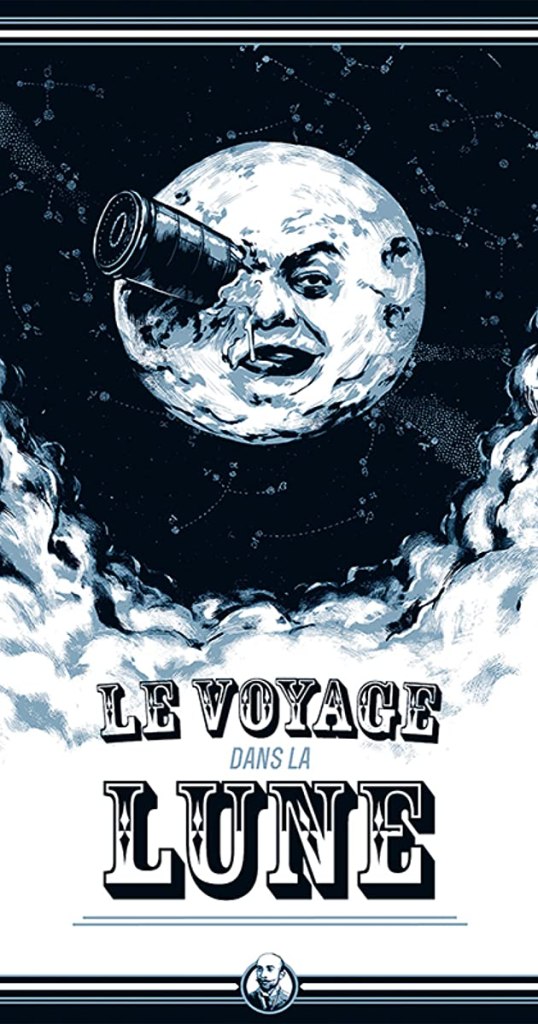
What inspired the most influential film ever made? Jules Verne’s “From the Earth to the Moon,” H.G. Wells’s “The First Men in the Moon,” Jacques Offenbach’s opera-faerie “Le voyage dans la lune” (an unauthorized parody of Verne’s books), and one of the first so-called “dark rides,” an indoor, tableau-heavy amusement park ride called A Trip to the Moon at the 1901 Pan-American Exhibition in Buffalo. But Melies also brought five years of his own innovations making literally hundreds of films; Ron Miller wrote that A Trip to the Moon used “every trick he had learned or invented.” Because Melies wanted this film to be special, he lavished considerably more time and money than he had on previous films, particularly on the sets, costumes, and masks. The finished film was also much longer than any of his previous films, at least 14 minutes depending how it was exhibited.
By 1902, Melies could be said to have the world’s first regular filmmaking routine. In his greenhouse-like studio, the morning would be spent on script revisions, the lightest part of the day would be used for filming, the late afternoon would be lab work, and then Melies spent most evenings attending Parisian theatre. It was there that Melies found most of his actors, paying them a franc a day for film work, which was more than they made on the stage.
The most famous shot of pre-1915 cinema was accomplished not with camera movement, but instead with an actor in a moon mask, his body covered by black velvet, on a track slowly approaching the camera just before the rocket hits the moon’s “eye.”
This site is not in the habit of recommending reading wikipedia; however, the wiki of Le Voyage Dans La Lune is rather excellent, and almost as much of a narrative triumph as the film it discusses. For devotees of this film, this wiki is basically the perfect introduction to and immersion into the film, without me really needing to add more.
A Trip to the Moon begins with the most complex static three-minute shot that most film fans will ever see. The complexity consists of the fanciful Astronomical Academy set, the 25 actors, or scientists, wearing conical hats (a clearly integrated group), the six girls who come on and off to hand telescopes to scientists in the front, the telescopes morphing into stools, the one scientist advocating a trip to the moon, another fiercely debating him, a hubbub, and a morphing of clothes as several in the room march offstage on their way to the moon. Dissolve into a one-minute shot of the building of the bullet-shaped spaceship. In the next shot, scientists on a balcony observe the heaving smokestacks of factories apparently providing the power for the rocket. In the next shot, young women dressed as sailors in short shorts help the elder male scientists board the rocket and then push it into a launching chamber. In the next shot, the lady sailors blare trumpets just before the launch is fired, causing well-dressed Parisians to enter and cheer the successful launch. Framed by clouds, the moon gets closer and closer to us making its face clear just before the rocket suddenly appears in its right eye, disturbing the face. In an example of elliptical editing – the same event being presented twice – we dissolve to the jagged lunar surface where we watch the rocket land and the scientists disembark, watch an Earthrise, watch the sinking of their ship and some stalagmites, and lie down to sleep. In the same frame, a comet rolls by, the Big Dipper appears with faces in each star, and more heavenly bodies appear, one of whom, sitting like a trapeze artist in a crescent moon, summons a snowstorm that causes the men to wake and seek shelter. In the next shot, in a fungus-filled cave, the leader places his umbrella on the floor where it morphs into a mushroom, grows, and seems to call forth Selenites, or moon men, who gesticulate wildly and get poofed into puffs of smoke by the leader with a new umbrella. However, the tables have clearly turned by the next shot, where in an alien, ornate throne room, the Earthlings are marched in as prisoners, but the leader somehow breaks his bonds, removes the alien king from his throne, throws him to the ground, poofs him away, and then leads his fellow humans to escape offstage. In the next shot, on the moon’s surface, the scientists run from the spear-brandishing Selenites, except for the leader, who turns back, bangs a couple with his umbrella, and poofs them away. In the next shot, the rocket clings to the edge of a cliff while the lead scientist confirms the others are inside, fights a Selenite, grabs a rope dangling from the rocket, and pulls it over the cliff, although a Selenite hitches a ride on the back while his cohorts look frustrated at the escape. In the next shot, the rocket falls from the Moon to Earth, cutting to a shot of the rocket splashing down in a body of water, cutting to underwater where the rocket plunges, lets off steam, and ascends. At a pier, a boat tugs the rocket into harbor even as the leader and the Selenite remain in their places. In a central square with a parade-like atmosphere, the female sailors roll in the upturned rocket and watch as the lunar explorers arrive and receive, from an official, plate-sized moon medals that they proudly wear as someone brings in the Selenite, who wears a chain around his neck, freaks out in protest, but then seems to join in the dance and merriment. In the final shot, revelers dance in front of a statue of the leading scientist having conquered the moon.
These days, A Trip to the Moon is read as anti-imperialism, perhaps a comment on France’s colonial adventures in Africa. However, I’m not sure current first-time viewers see it that way. Le Voyage dans la Lune, on a surface level, seems very much to celebrate its imperialist lead male. These contradictory readings, sutured together by state of the art special effects, is one measure of how this film proved foundational for science fiction and blockbusters more generally.
A Trip to the Moon was the hit that Melies designed it to be, proving popular all over the world, where it was often pirated. Melies chased the pirates for years, mostly unsuccessfully. Nonetheless, A Trip to the Moon was seen by many, many people who had never or barely seen a clearly fictional film, establishing new possibilities for the young medium. In many ways, Melies, who plays the film’s lead scientist, really was the first person to set foot on a new world.
Influenced by: the Lumières; Jules Verne’s stories;
Influenced: considering its effects, sensibilities, age, and renown, this is arguably the most influential film ever made
E4. The Kingdom of the Fairies (Le Royaume Des Fees) (Méliès, 1903) clip imdb LB RT wiki
stream on youtube

Many of Méliès’s 500-plus non-Moon films deserve a place in this gallery; this was chosen because some consider it his best, at least one considers it his “most intensely poetic,” and it is indicative of his post-Moon success: more stage machinery, rolling panoramas, miniature models, pyrotechnics, superimpositions, dissolves, and arguably, magic
Le Royaume Des Fees begins with a castle wedding where the prince and princess take vows and settle into new chairs as some sort of golem appears, gets physical with the lovers, and prompts the prince to beg him, but then jump up and beat the golem…into a puff of smoke? In the princess’s bedroom, six handmaidens in conical hats dress her for bed, place her in it, and leave her sleeping, which is when the golem reappears via stage trapdoor, touches the princess’s head, and calls forth a dragon-like carriage and six Selenite-like demons, who pick up the sleeping beauty, place her in the carriage, and push her away, just as the prince arrives, flails with his sword, and chases the demons offscreen as a dozen more pajama-wearing royals enter in a panic. On a Gothic castle balcony, the prince and other royals despair to see the demons move the bride up an unreachable ramp in the sky. A dozen royals clamor into a castle supply room, outfit themselves for battle, and leave how they came, with the prince coming up last…until the golem appears and magically alters the tableau to show demons using pulleys and ropes to haul the sleeping princess into a tower, which the prince attempts to stop, only to see the tableau return to his castle supply room, where the golem disappears and a magisterial fairy godmother appears and poofs the prince some kind of special helmet, sword, and shield. At a pier, the royals and our prince join nine lady sailors on a ship, but as it sails off for battle, the golem appears on the dock and laughs at them. On the open sea, horrible weather sinks the ship, which we see descend to the bottom. There, amongst the fish, squid, and passing mermen, a lead mermaid walks up to, revives, and escorts offstage the prince and three other royal soldiers. In the next tableau, an underwater cave, mermen and then four soldiers appear awkwardly riding fish and crabs as though they were horses. Several aquatic curtains give way to reveal Poseidon and his Botticelli-esque throne shell where several mermaids strike a pose just before the entrance of our soldiers, whose pleadings to Poseidon win them a whale, who enters, opens his mouth, patiently lets the soldiers enter his mouth, closes it, and drifts offstage. On the surface near a castle on an island, the whale opens his mouth, spouts his water, and watches as the prince and three soldiers scramble along the sea rocks. The prince takes off that helmet, sword, and shield to dive into the water near the island, but just as the golem appears to pursue him, the fairy godmother rises from the earth and points in the other direction, halting the golem and maybe the other soldiers. The prince arrives at the tower, sees the princess in a window waving a handkerchief, bashes in the door with a rock and big stick, and enters, but the golem appears, summons two demons with torches, and watches them enter and begin to burn the place. Inside, between the flames and smoke, the prince holds the princess in his arms and carries her outside. The prince scales the other shore’s cliff, delivers the princess to his colleagues, starts to join them, gets cut off by the golem, but then gets help from a suddenly appearing fairy godmother, who directs the prince to break the golem’s stick, which allows the prince to overpower him, stuff him in a barrel, and throw him over the edge. Soldiers bear the princess on a palanquin into the royal courtyard, where she is reunited with her father as the prince enters on a be-robed horse like a knight in 1000-year-old drawings. Cloud-curtains depart to reveal the final tableau, which changes all around the prince and princess as dancers dance and Greek-statue-like women stand at attention as petals fall and everyone seems to pose as though for a group photo.
The Kingdom of the Fairies was released a year after A Trip to the Moon; in the interim, Melies stayed busy making films and setting up pirate-fighting bases in a few countries, including the United States. Thus, The Kingdom of the Fairies was not seen by as many as A Trip to the Moon, and yet as an international hit, it probably earned Melies more money than his famous Moon film.
As with A Trip to the Moon, it is possible to read The Kingdom of the Fairies as a sort of self-aware, sarcastic critique of its main characters – in this case a modern twist on Sleeping Beauty. However, as with A Trip to the Moon, it seems likelier that most audiences, then and now, read the material without irony. For more than a decade, this film would stand as the first, and most famous, filmic representation of the honorable prince/knight rescuing the fair maiden from a tower.
Influenced by: Méliès’s previous films, his cumulative virtuosity
Influenced: Méliès created the land; everyone else colonized it
E5. The Great Train Robbery (Porter, 1903) clip imdb LB RT wiki
stream on youtube

Edwin S. Porter made cameras, film projectors, and related equipment until he lost his studio in a fire in 1901, when he took a job with the Edison Manufacturing Company as a cameraman. Porter saw British films from what would later be called the Brighton School, as well as films by Melies including A Trip to the Moon, and pushed Edison to make films more like these. One of Porter’s shorts, Jack and the Beanstalk, was clearly derivative of Melies; another one, Life of an American Fireman, was based not on Porter’s life but on a Brighton film called Fire!
The Great Train Robbery was based loosely on Scott Marble’s play “The Great Train Robbery,” which had been revived in New York in 1902. Porter also drew upon the 1901 Edison film Stage Coach Hold-Up as well as then-popular western lore on stage, screen, and pulp novels. The story may have also been influenced by the recent publicized exploits of Butch Cassidy and the Sundance Kid. Porter did not really invent any of the film’s form or content, but he did put together the pieces in a dynamic, fluid, thrilling manner.
The film was shot mostly in November 1903, quickly edited, and released in December 1903.
As with many prints of A Trip to the Moon, The Great Train Robbery has about 14 shots and is about 11 minutes long, depending what speed the film runs and what counts as a shot. The Great Train Robbery opens as bandits break into a railroad telegraph office and tie up the train officer while a train moves outside the window. In the next shot, bandits force an engineer to fill the tender at the water tank. One train’s car rides with its door open, letting us see the outside whizzing by as bandits tie up an engineer, kill a messenger, and open a box of valuables including a bit of exploding dynamite. On top of the engine car, bandits fight and kill a fireman and force the engineer to stop the train. In a wide shot staged 45 degrees from the resting train car, the bandits fleece the passengers, except for one who jumps away and is shot dead for his trouble. The bandits escape in the decoupled locomotive and arrive at a remote forest. Back at the train telegraph office, a girl enters and pours water on the operator to revive him. At a dance hall, people are shooting not near a tender but near a tenderfoot to make him dance until the telegraph operator runs in to report the robbery and form a posse. The posse rides through the forest. In the final shot of the narrative, the posse catches up to the bandits and eventually wins the resulting shoot-out. In the actual final shot, not related to the narrative, we see the film’s only close-up, a bandit looking at the camera and firing.
After The Great Train Robbery was met with an enthusiastic reception, Thomas Edison heavily promoted and distributed the film. By the time of that summer’s St. Louis World’s Fair of 1904, where the film played to full houses, The Great Train Robbery was a bona fide phenomenon and regularly given credit for aspects that Porter hadn’t himself invented. Still, the history of film is not only about innovations but also about reception and popularity, and The Great Train Robbery not only “mainstreamed” its style but also got people interested in the world’s first indoor theaters dedicated entirely to motion pictures – named nickelodeons because the program cost a nickel. The bandits in The Great Train Robbery may not have escaped with their loot, but the bandits behind The Great Train Robbery escaped with quite a few nickels.
Influenced by: Méliès
Influenced: all of pre-Hollywood American cinema
E6. The Consequences of Feminism (Guy-Blaché, 1906) clip imdb LB RT wiki
stream on youtube
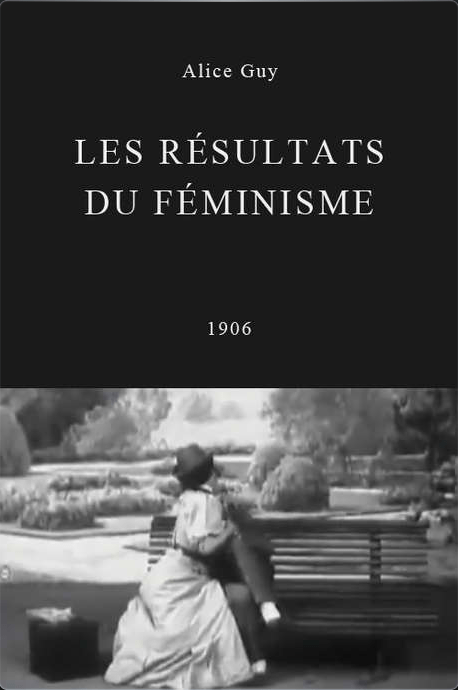
Alice Guy-Blachè, the world’s first, and for at least a decade only, female director founded narrative film at the same time as Méliès, but most of her early work is lost or unreliably dated, though we know she pioneered many techniques, including close-ups, sync-sound, color timing, and effects.
All of Alice Guy-Blache’s early films are somewhat transgressive in form, but this was chosen for being equally boundary-pushing in terms of content. Here, Guy-Blache executes a creative approach to casting and plot, as women take on the traditional roles of men and vice-versa
The Consequences of Feminism begins in a very fin-de-siecle parlor where men are sitting around a table behaving in a way that Americans would have then called effeminate. One of the men, let’s call him Taylor, puts on makeup, picks up a suitcase, sashays out of the room, walks around “outside” near a cafe, and gets propositioned and touched by a woman who is interrupted by an apparently more chivalrous woman who escorts Taylor to a park bench, where she foists herself on Taylor while two other men walk by and hustle away without helping. Cut to a living room, where Taylor sews while his apparent father irons and his mother kicks her feet up, smokes a cigar, and throws her weight around. Mom and Dad leave just before the park bench woman arrives, relentlessly pursues Taylor for a kiss, follows Taylor into another room, and pushes him so hard that he faints, causing her to rouse him with smelling salts. Taylor’s mom, or someone looking like her, enters a saloon where all the women are being macho and, when a man comes around collecting laundry, the ladies pull clothes out of his basket and throw them at him while laughing until he runs away. Men begin to enter with children and babies but the women’s yelling and bluster scare them off. Outside again, men escorting children and babies greet each other and kids with kisses, although one woman, sitting at a cafe table, gets up and objects to a baby in a carriage (perhaps it’s crying), and the dad at first begs her forgiveness then hits her with a fruit, blinding her and causing her to fall to her knees as the other men and kids jeer her. Back at the saloon, Taylor enters, makes a righteous speech, and cues the entrance of other men, who corral the women out of there and then celebrate with bottles up – they have cleaned up this unsavory element.
This film is a nice reminder that the term “feminism” far predates second-wave feminism. Furthermore, most of Guy-Blache’s jokes here hold up fairly well.
Influenced by: the Lumières; pre-suffrage feminist culture
Influenced: Guy-Blaché directed something like 1000 films, and pioneered techniques that later became mainstream
E7. Humourous Phases of Funny Faces (Blackton, 1907) clip imdb LB RT wiki
stream on youtube

In 1896, J. Stuart Blackton was a 21-year-old reporter assigned to cover Thomas Edison’s Black Maria studio; after, Blackton decided to found his own studio, Vitagraph, which did well enough for Blackton to leave journalism. Around 1900, Blackton made a film called The Enchanted Drawing that some consider the first animation on film. If you watch this 90-second film, you’ll see why it’s not really the first animated film; Blackton himself is on screen the whole time, drawing a picture of a face on an easel; occasionally, the film stops and restarts so that Blackton can take the drawn wine or cigar and morph it into its real-life referent as the face looks put out. After that, Blackton made lots of other films, mostly live-action, most of which are lost. At this time, Georges Melies more or less perfected stop-action: stopping the camera as often as ten or twenty or thirty times for a sort of transformational shot that might not run back longer than a second or two. In 1905, Blackton and his colleagues more or less invented stop-motion animation, perhaps by accident, first by augmenting stop-action effects with bits of hand-drawn ghosts or toys. As an experiment, Blackton decided to go further with this idea than he had seen from Melies or anyone else, with a three minute film entirely “set” on a chalkboard, as it were. So was animation invented – more or less.
Humorous Phases of Funny Faces begins with a visible hand and chalk drawing a male face and a female face on a chalkboard. For a moment, the faces seem still, but at about the one-minute mark, they come to life, as the man grows hair and a cigar whose smoke drifts into the woman’s face, disturbing her. The cloud effect grows as the hand returns to erase this drawing and replace it with a full shot of a plutocrat with coattails and an umbrella. Cut into another cloud of erasure that becomes two new faces that steadily lose their lines, making clear that the film is running backwards. The film’s final tableau begins with a fully formed clown who begins acting like a Wayang puppet, moving his hat and arms and then manipulating a poodle through a hoop before the hand intervenes to erase his entire right side, but the clown continues to use his left side until the film ends.
Later animators did study this, but Blackton himself considered this film and others like it to be so sophomoric that he omitted these cartoons from his autobiography.
Influenced by: the Lumières and Méliès
Influenced: influenced or even founded animation, at least in America; Blackton considered it puerile, which should give current fans of animation some pause (but won’t)
E8. Fantasmagoria (Cohl, 1908) clip imdb LB RT wiki
stream on youtube

Emile Cohl was inspired by Humorous Phases of Funny Faces and sought to make a cartoon with both more and less of a plot – more activity, to be certain, but also a salute to the Incoherent Movement which basically privileged stream of consciousness over, uh, any possible stream of consequences. Each drawing was actually done twice, and there were about 700 of them, adding up to about 90 seconds of film.
Fantasmagoria begins with a hand drawing, on a blackboard, a clown who quickly gives way to a top-hatted gentleman who soon lands in an apparent nickelodeon, where he oddly dispatches the clown sitting in front of him – does the clown become a spider? – only to see the clown replaced by a lady with a large-feathered hat, feathers that the gentleman plucks off one by one. The clown somehow emerges from her now bare head and dispatches the gentleman along with the rest of the tableau as he transitions through more little vignettes with larger people, plants, a bottle, an elephant, a house, and an inkwell that lies the clown flat until the hands re-emerge to revive him and place him on a horse as he waves goodbye to us.
Some consider Fantasmagoria the first animated cartoon, because it’s more deliberate and motivated than Blackton’s animated experiments. One might also call it the first film on this list to really embody the “experimental” nature of many of this list’s later films in the sense of being intentionally abstract and even abstruse, or, one might say, mirthfully random.
Many later animators studied and copied it.
Influenced by: Méliès, Blackton
Influenced: this is a (perhaps the) foundational cartoon
E9. L’Inferno (Bertolini, Padovan, Liguoro, 1911) clip imdb LB RT trailer wiki
stream on youtube
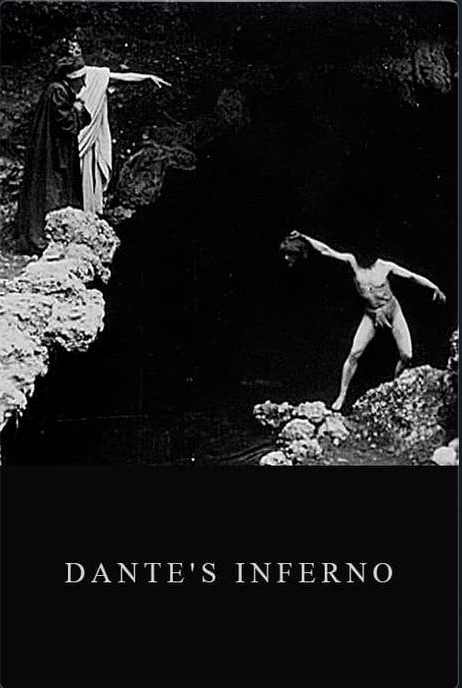
“After the torture he tears the bandage from his eyes, hoping to see the light once more…In his despair he dashes out his brains on the dungeon floor.”
Why did the world’s first well-known, well-received feature film come from Italy? In the first decade of the twentieth century, all big Western countries saw their film industries grow and expand beyond anyone’s expectations. France, Germany, Britain, Russia, or the US, might have been, but weren’t, first with a daring, successful feature film. It sounds a little trite or stereotypical, but Italians seem to enjoy spectacle. Also, more than those other countries, Italy happened to have a lot of classical and Neo-classical “sets,” or at least locations, sitting unused. As nickelodeons first became a thing in Italy, in 1906, a faithful period short of Shakespeare’s Othello proved a big hit. In 1908, a short called The Last Days of Pompeii proved an even bigger hit. This gave a few Italian directors the impetus of an even bigger scale – and what better to adapt than an all-time world classic by an Italian?
Dante’s Inferno turned into Bertolini’s Fiasco – setting a record not only for cost but also time between preproduction and film print – almost three years. However, when the film became a hit, as you might imagine, film industries took the lesson that more means more – a credo they tended to believe even a century later.
Although this is the first film on this list to feature inter-titles, in fact the practice had become more common in the years just before this, as audiences proved receptive to them.
L’Inferno begins with a terrific logo, that of an apparent female filmmaker and “Milano Films.” The first title card says Dante is in a dark wood looking up “the hill of salvation” but we soon see him blocked by animals representing greed, pride, and lust. In a limbo filled with casually chatting toga-wearers, the angel Beatrice convinces Virgil to help Dante, and so Virgil disappears, reappears near Dante, mystically tames a nearby wolf, and escorts Dante through rocky terrain to the gates of hell with a sign saying, among other things, “all hope abandon ye who enter here.” After the duo enter a cave, they come to the river Acheron, where an old bearded man, Charon, shakes his fist at our duo and at the naked souls gathered on a river bank, some of whom he gathers and ferries to the other side, causing the screen to tint red. Virgil reassures a fearful Dante as they continue into limbo where they pass many recumbent, naked souls before meeting, per a card, Homer, Horace, Ovid, and Lucanus, who stand in handsomely designed togas, wave-salute their hands, and introduce Virgil and Dante to some of the many blameless celebrity souls who live without hope in limbo because they died before Christ was born. Virgil and Dante watch a becrowned, corpulent man, King Minos, assigning trembling souls to their next place as a nearby tar-covered, pitchfork-bearing devil smiles. In a rather remarkable shot, Virgil and Dante stand as hundreds of horizontal naked bodies swirl in patterns all around them – though the titles point out only women going to hell, like Cleopatra, Dido, and Helen. One, Francesca de Rimini, alongside her lover Paulo, floats to our duo and explains how she was reading about Lancelot and was cursed by a kiss – something we see in the film’s first “flashback” – causing Dante to collapse with pity. Virgil and Dante meet the three-headed monster Cerberus, who looks like a llama-shaggy dog, and Virgil throws dirt that Cerberus chooses to eat rather than keep blocking their way. Virgil and Dante, whom cards sometimes call The Poets, walk through recumbent Gluttons enduring torrents of tormenting rain. The Poets pass a cranky, behorned, soot-covered Pluto watching misers and spendthrifts, whom we soon see, naked, rolling bags of gold around a craggy ground. A card tells us that what we next see is a Stygian swamp of the slothful and wrathful. In remarkable composite shots, Phleguyas puts the Poets in a small boat, bound for Dis, and ferries them past many desperately gesticulating bodies toward the other side, which looks like demonic smoke over rocks. At the Dis castle-like entrance, the Poets are blocked by an evil horde of at least 20 “evil spirits” who Virgil somehow disperses only to see the sudden appearance of the three furies, who may or may not get disappeared by a fairy, or angel, allowing Virgil to escort a trembling Dante through the Dis gate. In a red-tinted landscape, the Poets walk by Heretics in shallow, sometimes fiery pits. At the burial place of Pope Anastasius, surrounding dirt clumps vibrate, resembling medfly groups. In a thinning forest, men in the branches are introduced as suicides. One of them, Peter Vigna, prompts the film’s second flashback where we see him in royal garb in a dungeon where authorities enter, read a parchment accusation of treason, watch Peter tear it up, seize him, and use tongs to poke out his eyes, which leads to an extended scene of him struggling with his bandage and apparently bashing his own skull in. Human-bird hybrids that the film calls harpies, as well as dogs, more or less attack the trees to Dante’s horror. In the next tableau, fireballs rain down near blasphemers. The next shot is of a monster, Geyron, a sort of griffin-dragon descending with the Poets on his back. Now, amongst craggy rocks, the Poets watch as soot-covered winged demons whip naked souls who genuflect gingerly through giant rocks. Next, rather hellish rock formations surround a river of filth where flatterers “and dissolutes” wash in vain to get clean. Next, a more red-tinted version of the same tableau, but this time, Summonists, who sold church goods, are upside-down in pits, flailing their feet while they’re singed by fire. We dissolve to a similarly steamy region of “boiling pitch” where demons torture people who misappropriated money. Ten of these sooty demons escort Virgil and Dante into the next, and similar, tableau, where a demon uses a pitchfork to lift Ciampollo out of the boiling pitch until he somehow distracts them enough to dive into the pitch where demons fail to get at him. The now frustrated demons lunge at Virgil and Dante, who fall off a cliff into another circle where those demons can’t go. In this rocky terrain, the Poets meet hypocrites, moving like slow monks, wearing gold cloaks that are actually lead, including one, Caiphas, crucified for his role in crucifying Christ. In another hellish area, a blaspheming robber speaking to Dante is attacked by one of the area’s many serpents, who watch along with the Poets as “grafters” and faithless accountants are approached by crocodiles and transformed into weird hybrid creatures. Perhaps the most infamous moment of the film is preceded by the title card, “The sowers of discord and the promoters of dissension maimed by demons. Mohamed with his chest torn open.” In that shot, several condemned people walk by holding their own body parts, including Mohamed, with entrails falling out of his chest. The next tableau brings “forgers, falsifiers, alchemists, counterfeiters changed into lepers.” Virgil and Dante walk by two giants being tortured and a third, Antaeus, who they command to pick them up and place them in the next ring, which he does, and they find themselves near his giant feet looking at traitors mostly encased in ice, and after they walk by dozens of heads in the ice sheet, they come upon Count Ugolino, who takes a break from eating another soul to prompt a flashback to the Tower of Pisa where we see an Archbishop force him and his kids and grandkids to starve to death. Virgil and Dante walk toward the end of the ice floe, where the 100-foot tall Lucifer chews on bodies – titles tell us they are Brutus and Cassius. After genuflecting to this monster, Virgil and Dante walk through a narrow cave passage until they arrive at the cave entrance, which they pass through with relief. The film ends with a shot of a memorial to Dante in Trento.
Whether or not L’Inferno is the first hourlong film, the oldest surviving one, the best-received one, or some combination, one can see its influence in many, many ways, from the heedless appropriation of non-copyrighted intellectual property to the reveling in blasphemy somehow dressed up as a pious act to the, well, hero’s journey of sorts. One reason it’s on this list is that it marshaled the many experimental effects that Melies had pioneered and proved that such effects could support and even justify an hourlong narrative.
Influenced by: Méliès; Gustave Doré’s art; pre-World War I morality
Influenced: its success let theaters raise prices and proved people would watch hour-long films (some screenings had two intermissions), though later it went unseen or censored for many years
E10. A Fool and His Money (Guy-Blaché, 1912) imdb LB RT trailer wiki
stream on youtube
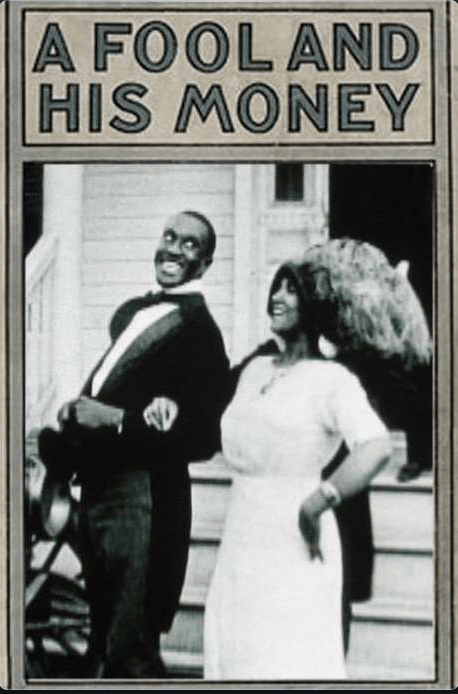
“Sam begins spending his money.”
Guy-Blaché was so successful that she began her own trans-Atlantic production company, and here she used it to make (what was probably) the first fiction film with an all-black, or mostly African-American, cast. At a few moments in the film, we see a full shot of at least 12 African-Americans together, a sight that Hollywood films would not replicate, outside of a few musicals, for nearly 60 years.
In her parlor, Lily entertains her father and a beau, but when Sam appears at the door, Lily prompts the two men to bum-rush Sam. Walking away down the sidewalk, Sam comes upon a lost wallet, so he grabs it and runs. In his flat, Sam dances, smiles widely, writes an overconfident note, and decamps for New York. He acts like a fat cat in a jewelry store where he buys rings, a clothing store where he buys a tux and tails, and a car dealership, which he leaves via his new car helmed by his new chauffeur, who drives Sam to the house of Lily, who runs up to the car, drags Sam into the house, invites Sam in for tea, accepts his ring, and watches approvingly as her father slams the door on the former beau. At a party of at least 12 people, Lily shows off her new ring and Sam makes new acquaintances, two of whom invite him to poker, where they cheat and fleece Sam for much of his cash. In the larger party, Sam expresses his stress to Lily, who is happy to move on to the main poker cheater, who escorts Lily out of the house to a waiting car that the two of them climb aboard while laughing at the newly destitute Sam, who is seen one last time back in his flat eating a banana as the film ends.
This film is not entirely free of stereotypes, but it proved the viability of non-white actors onscreen, and was experimental in the sense of not relying upon white actors. Sadly this was mostly a road not taken; three years later, The Birth of a Nation was released, and its hurtful, vicious racism dominated filmic representations of black people for decades to come.
Influenced by: in some ways, only herself; in other ways, the long history of female allyship with POC
Influenced: Guy-Blaché trailblazed a world we can now take for granted
E11. The Cameraman’s Revenge (Starewicz, 1912) imdb LB RT wiki
stream on youtube
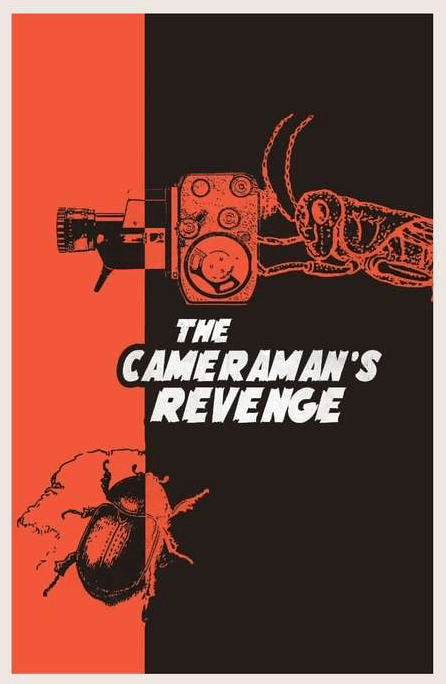
“Mr. and Mrs. Beetle have too calm a home life. Mr. Beetle is restless and makes frequent trips to the city.”
Wladyslaw Starewicz had a career as both an artist and naturalist, interests that eventually led him to Lithuania’s Museum of Natural History. There, he made some of that museum’s first short documentaries, including at least one about insects. Starewicz wanted to make a film about stag beetles fighting, but was frustrated that under stage light, they slowed or stopped or even died. Around 1909, Starewicz learned of the work of Emile Cohl, for example Phantasmagoria, and that of Arthur Melbourne Cooper, who was clearly influenced by Cohl when he made Animated Matches. Starewicz re-created the stag beetle battle by replacing their legs with wire and attaching wax to their thorax, turning them into puppets. Thus did Starewicz make the world’s first animated-puppet film, Lucanus Cervus, as well as the first Russian animation film. This film is lost.
Encouraged by his friends’ enthusiasm, Starewicz next made The Beautiful Leukanida, about two male beetles fighting over a female. This film was hard to find for about a century until it was restored. The film of Starewicz that traveled and remained in circulation throughout the 20th century was The Cameraman’s Revenge, a film that flattered Europeans’ cynical sensibilities.
Mr. Beetle, larger and darker than Mrs. Beetle, packs his suitcase, smooches his wife, and departs his house in the backseat of a cricket-driven car. At a club, “The Gay Dragonfly,” after a grasshopper seduces a performing dragonfly right off the stage, Mr. Beetle pushes aside the grasshopper, followed by a card that says Beetle should have known the aggressive insect was a cameraman. The grasshopper puts his camera and tripod on his motorcycle, follows the new pair to the Hotel Amour, follows them up the hotel’s stairs, films them inamorata through the keyhole, and gets noticed, knocked down stairs, and forced to flee. A card says “Mrs. Beetle is also restless. Her friend is an artist.” Bea Beetle sends her maid with a note to the studio of a cricket painter who, elated at the news, picks up his large painting of Bea and decamps. Bea’s maid makes a fire in the Beetles’ fireplace in front of which Bea falls asleep, but when her painter arrives, she joyfully kisses him. When Mr. Beetle arrives to see his front door locked, he breaks it down with his briefcase. Hearing him, the cricket escapes into the fireplace just before Mr. Beetle arrives, finds the cricket’s hat and painting, and bashes them over his wife’s head. The cricket emerges from the chimney, falls down the roof, and lies near the front door tired as Mr. Beetle emerges and fights him until the cricket absconds. A card tells us “Mr. Beetle is generous. He forgives his wife and takes her to a movie.” At the movie theater, the projectionist, who is the grasshopper, plays the incriminating footage, which causes Mrs. Beetle to beat Mr. Beetle with her umbrella until he jumps through the projection screen. Mr. Beetle finds the grasshopper in the projection booth, knocks him down a ladder, and burns down the booth. A card says it hopes the Beetles’ home life will become less exciting. The final shot shows Mr. and Mrs. Beetle in prison, getting used to each other again.
The nature of cinema gives immortality to the mortal, but few films animate the dead quite like this, which astonishes every first-time viewer. What exactly does it mean to see dead insects enact these human foibles? More than a century later, it’s hard to say why it remains so affecting, and that must be part of why it does.
This is precedent to the likes of Wallace and Gromit and Nightmare Before Christmas – which makes sense, since Starewicz made a version of The Night Before Christmas
Influenced by: Blackton, Cohl, Cooper
Influenced: pioneered stop-motion animation; thematically rich and not for kids, this cleared the way for other adult-targeting animators
E12. Gertie the Dinosaur (McCay, 1914) imdb LB RT wiki
stream on youtube

“I made ten thousand cartoons, each one a little bit different than the one preceding it.”
History buffs are familiar with the fact that we do not always know the year of a given luminary’s birth, and in that case, the birth year might be listed as “circa 1900 or 1901.” I’ve never seen a larger gap in the record than the one for Winsor McCay, whose birth is listed as circa 1866 to 1871. At the turn of the century, the boyish-looking McKay found employment in what was then considered a juvenile medium, cartoons, and worked his way up to the New York Herald, where he became best-known for the Little Nemo strip and some political cartoons. McCay found he could supplement his income by giving what he called “chalk talks,” vaudeville or stage performances where he drew on an easel with such efficiency and acuity that he seemed to be manipulating the drawings like puppets.
In 1911, McCay left the New York Herald over money, taking Little Nemo to the New York American, although a court ruled that the Herald could let another artist do his Little Nemo, and it did. During this same time, McCay claimed to be inspired by flip books that his son had brought from school, and he turned his Little Nemo into one of the world’s first animated cartoons. As it ran in nickelodeons, the short was mostly live-action set-up and then, finally, the characters mostly stretching. For his next animated short, McCay eschewed setup and inter titles and, in How a Mosquito Operates, simply showed a mosquito setting himself up on a sleeping man’s face. One could make the case that this is the film that should be on this E-list, although then 1912 would be represented only by cartoons about bugs. More importantly, it was his next film that was his most renowned, influential, and, in many ways, experimental. Legend has it that some accused McCay of tracing a real mosquito, so he responded by centralizing an animal whose movements could not be traced.
Strange that McCay would bill himself as “the first man in the world to make animated cartoons,” when these were made under the direct supervision of J. Stuart Blackton at Vitagraph, director of Humorous Phases of Funny Faces and the arguable bearer of that honorific. Nonetheless, McCay may have been onto something, because his cartoons were much closer to what the medium eventually became, and not only because of its lovable plushie-ready leading animal. The 5 animated minutes of Gertie the Dinosaur were the first to use keyframes and registration marks, or what they then called in-betweening, drawing the major frame “shots” and then filling in the gaps with more routinized loops. It was also the first to use tracing paper and the Mutoscope action viewer.
To summarize the film is awkward, because we are mostly concerned with its five animated minutes, yet audiences saw a 13 minute film. The first 7 minutes are a self-reflexive setup in which Winsor McCay hangs out with fat cat artists who, one day, go to a museum and bet that no one can make a dinosaur come to life. As with the Little Nemo film, this film stresses the necessary thousands of drawings by stacking them in piles like office work, although here, onscreen, McCay carries and then drops a human-sized stack of papers. At a dinner of plutocrats, McCay stands in front of an easel which finally takes up the film’s entire field of vision as the animated Gertie the dinosaur pokes her head out of a cave and comes into the foreground near a lake. The brontosaurus eats a rock and a tree and, cued by McCay’s voice (rendered as titles, because it’s a silent film), lifts her feet in turns and often swivels her head. When her look at a sea serpent makes her ignore a direction, McCay calls her a bad girl, causing her to cry. When a mammoth walks in front of Gertie, a card warns her not to hurt Jumbo, but she uses her mouth to pick up the pachyderm by its tail and hurl it into the lake, from which it watches her dance, sprays her with water, escapes, and almost gets hit by a rock she throws. A dragon, or perhaps four-winged lizard, flies by. A card encourages Gertie to get a drink, and she winds up slurping up the entire nearby lake. McCay himself, as an animated figure, enters the frame, and gets on Gertie’s back for a little ride out of the frame. Back in the live-action lunch, the plutocrats pay off the, ahem, real McCay.
Influenced by: Blackton, Cohl, Starewicz, McCay’s earlier work
Influenced: Walt Disney and his generation; this film laid out the template for commercially successful animation; El Apostol would become the first animated feature, but is lost
E13. Thais (Bragaglia, 1917) clip imdb LB RT trailer wiki
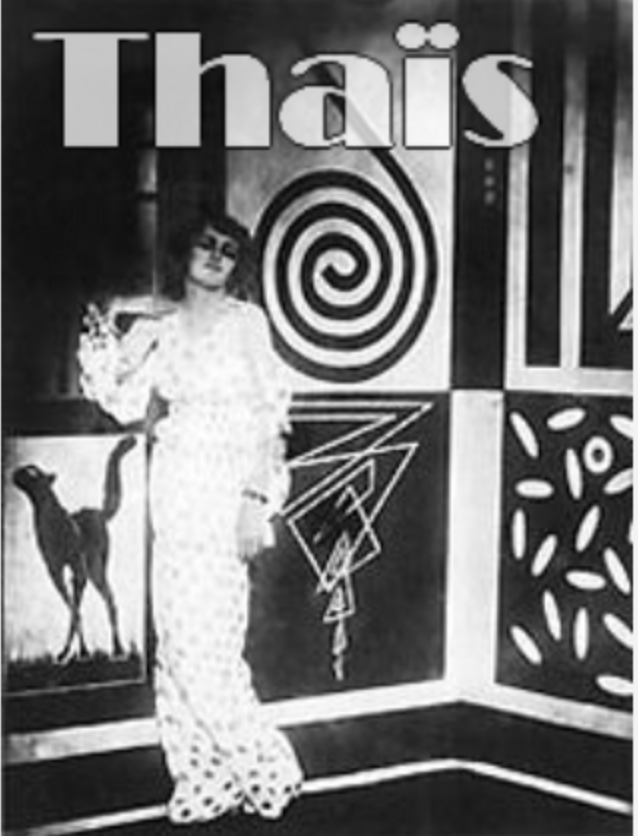
Anton Bragaglia had theatrical brothers and got a job as an assistant director in 1906 with Italy’s nascent film industry. The industry and Bragaglia grew up together, and a year after L’Inferno came out, in 1912, Bragaglia felt emboldened enough to publish a manifesto called Fotodinamica Futurismo about the sort of futurist photos and art that the world needed. Already, Picasso’s Cubist works were famous and Germany’s painters were experimenting with what would later be called Expressionism. The outbreak of the Great War interrupted him for a while, but then seemed to add to the urgency by 1916, a rather busy year for Bragaglia, when he founded an avant-garde magazine, wrote another major manifesto, and created a film studio that would exemplify these futurist works.
Thais was Bragaglia’s first attempt at a full-length avant-garde film and apparently his only surviving such film. For the film, Bragaglia centered Prampolini’s paintings, anti-realistic acting, and modern dance. He knew audiences would be more likely to accept such things in the context of a story that also featured outdoor shots of a picturesque estate, with that estate’s rich people in contrast to Thais, who could be eccentric in manner and taste.
Cards tell us the film includes images by Futurist painters to strengthen the classic narrative in order to evoke in the viewer stronger emotions than those created by mere film images. We meet Véra Probajenska, nicknamed Thaïs, a young countess dancing in front of doors and walls of unusual patterns. We cut to plutocrats puttering around the outdoor grounds of a large estate. Thais invites Count San Remo to her studio decorated in accordance with the most decadent art principles. After several subversively decorated rooms, Thais shows San Remo the secret Gate to the Mysterious Beyond where she says will escape when she will have lived enough. Thais goes riding with her friend Bianca, Count San Remo and her cousin Oscar during the day. That evening, Thais hosts a crazy dinner party. Bianca is apparently in love with Count San Remo while he only has eyes for Thaïs. Wearing an exotic dress, Thaïs is having tea with the Count when Oscar arrives with flowers. Thais sends him away, planning to drive the Count crazy with her flirtation.When the Count tries to kiss her, she sends him away as well. When Bianca arrives, she tells her that she doesn’t care for the Count and that Bianca can have him if she wants. At Thais’ place on another night, Thaïs continues her flirtation with the Count. When Bianca comes to his place, she finds the Count at Thaïs’ feet. Bianca decides to say farewell to Thaïs, but the latter mocks her and says she’ll come back soon. Bianca asks for a dangerous horse to be saddled for her. Out on the more normal-looking palace grounds, Bianca goes riding and is mortally wounded in a fall. Thaïs feels guilty for having taken away the Count from her. She sets in motion the plan she had arranged for her death, the film becomes markedly abstract, and Thais probably suffocates, delirious, in the fumes of fatal perfumes.
What survives of Thais is fragmentary and sometimes hard to watch, but it clearly blazed a trail that many avant-garde artists would follow.
Influenced by: then-modern art of many types, futurism
Influenced: German Expressionism, other futurism
E14. Das Cabinet des Dr. Caligari (Weine, 1920) clip imdb LB RT trailer wiki
stream on criterion

“What she and I have lived through is stranger still than what you have lived through. I will tell you about it.”
Is there a longer wiki on any film than on The Cabinet of Dr. Caligari? I only ask because those 220 footnotes are a great place to start. Like many other film instructors, I’ve been teaching this film for years, so how to summarize and synthesize everything into a few sentences here? Well, start with the fact that what we now call German Expressionism existed before the Great War in paintings and literature. In terms of cinema, Italian futurists were a partial inspiration, but so was the work of German filmmaker Paul Wagener. It’s not clear that unemployed, penniless writers Hans Janowitz and Carl Mayer knew much about this work when they wrote The Cabinet of Dr. Caligari in 1918; instead they cited Freud, psychology, medieval legends, and their own lives, for example the government’s psychological interviews of Mayer when Mayer avoided military service by claiming insanity.
Accounts differ, but probably, the head of the Decla-Film studio, Erich Pommer, was instrumental in not only buying the script but also turning it into a bold experiment – Pommer would later say that the way they filmed was cheaper than constructing more realistic medieval sets. The production designers were Hermann Warm, Walter Reimann, and Walter Rohrig, and they all encouraged what we see – sharp-pointed forms, oblique and curving lines, leaned and twisted structures, shadows and light streaks painted on sets. Arguably, under Robert Weine’s direction, the artists were just looking for visual referents to dementia or loss or insanity; they weren’t trying to create the ur-text of German Expressionism or likely the most influential of all radically experimental films. Yet they did.
A young man, Francis, sitting in a garden, tells an older man that he sees spirits, possibly including a dazed woman walking by them. Francis begins to recount Hollstenwall, a village that looks oddly bent and misshapen. A fair arrives, including a large man in a top hat, Dr. Caligari. Alan and Francis, who live in an apartment without right angles, walk to the fair down a street without right angles. Caligari gets a permit to display a somnambulist, but the clerk criticizes the idea and gets killed that night. In the oddly angled town, the fair commences and Caligari tells a crowd about Cesare, the somnambulist, who may wake for the first time in 25 years when he theatrically opens his cabinet, or coffin. At Caligari’s command, Cesare awakens, steps out of the cabinet, and answers Alan’s question, “how long will I live?” by telling Alan he’ll die at dawn. While the town searches for a murderer, Alan and Francis woo Jane but promise to stay friends. Creepy imagery of a night shadow creeping into Alan’s room is followed by Francis receiving news that Alan was murdered. Jane and Francis tell the local police while a shadowy figure staggers down oddly painted stairs. While police arrest a shady-looking man, two other detectives enter Caligari’s trailer, find Cesare hidden in the cabinet, and are about to awake him when they all get the news that the killer has been arrested. After the men leave, Caligari laughs and soon directs Jane to behold Cesare, standing in his cabinet. That night, Cesare slithers toward Jane’s room, clinging to the walls as though the floor is lava. After she struggles, Cesare carries her around some of the most unusually shaped parts of the town. With a mob in pursuit, Caligari lets go of Jane, staggers away, and then collapses. When Jane tells Francis Cesare kidnapped her, he refuses to believe her, walks to Caligari’s house that he’s been watching, storms in, and opens the cabinet to find…a dummy of Cesare. Caligari runs away as Francis follows him through the odd streets into a mental asylum, where Francis learns…that Caligari is the asylum’s director. Francis and several white-coated asylum employees search through the local books and learn – as we see partly through flashback – that the asylum’s director read about a mystic named Caligari who controlled somnambulists and tried to become Caligari partly through manipulating Cesare. When Francis and staff confront the director, he falls on Cesare’s corpse, stands, attacks a staff member, and gets subdued and then strait-jacketed, an inmate in his own asylum. Back in the frame story, or the present, Francis finishes as we see that he is in fact an inmate in an asylum that also contains the living Jane and Cesare, who look harmless if uninterested in Francis. When Caligari appears as a very normal looking museum director, Francis freaks out that he will kill all of them, but after the staff subdues him, the director says now that he knows Francis thinks he’s Caligari, he knows how to cure him, and the iris comes in on his last knowing look.
In certain quarters, people are still arguing over Siegfried Kracauer’s book “From Caligari to Hitler,” one of the first books that ever took cinema seriously, and one that argued that Germans’ pathology and love for irrational authority was somehow evident in the Caligari film and throughout the Weimar era before Hitler came to power. Kracauer’s thesis has been quite assiduously contested, not least because the frame story may well have been grafted on somewhat late in production. Does the frame story, which may have been suggested by Fritz Lang, make the film more conformist, more radical, or what? Not going to get into all that here, but more than a century later, it’s amazing that the film survives and maybe even encourages contradictory readings of itself.
Lotte Eisner’s book The Haunted Screen remains perhaps the best single text to understand the scope and scale of what the film is and became. But to over-summarize, let’s say that in the context of its period, quality, and success, The Cabinet of Dr. Caligari amounts to the largest-ever attack on “realism”; it also established cinematic German Expressionism and, per Roger Ebert, the modern horror film.
Influenced by: German Expressionist art in other mediums, especially painting and theater; Griffith-esque films as contrast
Influenced: by establishing that great cinema does not need naturalism, this has to be counted one of the most influential films ever made
E15. Manhatta (Strand and Sheeler, 1921) imdb LB RT wiki
stream on youtube

“When million-footed Manhattan unpent, descends to its pavements.”
The opening title card begins, “City of the world (for all races are here). City of tall facades of marble and iron. Proud and passionate city.” Shots of the city give way to a ferry carrying what look like thousands of commuters, who pour into the city, dominate the sidewalks, and thin out in front of a large building, leading to another card praising iron height. We watch construction workers assembling the foundations of the next mammoth. From higher floors, we see industrial steam rising from various edifices. From even higher floors, we see ships in the East River looking like toy boats. Trains and ships belch smoke, intertwining abstractly. The vertiginous perspective renders strange the rails and workers below. We see several Brooklyn ferries and then read a quote from Crossing Brooklyn Ferry that…weirdly doesn’t name the poem or its author, Walt Whitman.
This is a short documentary about Manhattan, but it is often called the first American avant-garde film because it is structured in a rather abstract fashion, including intertitles that quote Walt Whitman without naming him; pioneer of the “city symphony” subgenre
Influenced by: stirrings in documentary from America and avant-garde (or “absolute” or “pure”) cinema from Europe
Influenced: city symphony documentaries; abstract American films
E16. Fievre (Delluc, 1921) clip imdb LB RT wiki
stream on youtube
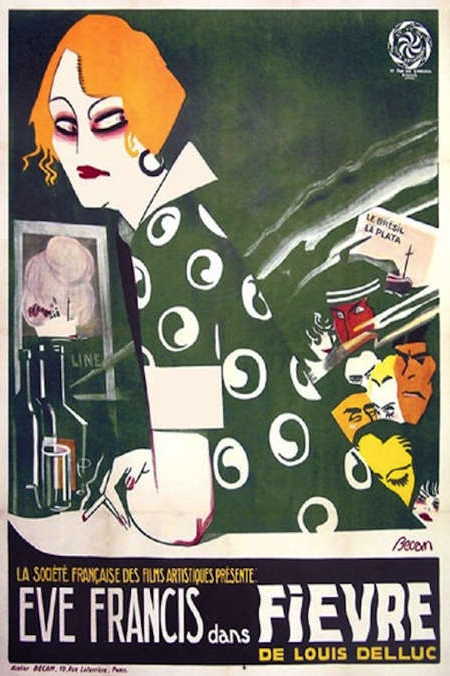
Louis Delluc began his career in film criticism in 1917, writing for several periodicals before making the leap to filmmaking. He was influenced by Abel Gance, but wanted to push the medium further than Gance had.
Fievre begins by cross-cutting, with many iris-outs, dock scenes of boats with pub scenes of locals drinking and playing cards. Women share drinks and stories of being with men. One barmaid goes to a supply room for more beer, where she fends off a man hitting on her. Right off a boat, a group of sailors come into the pub with their layers and bags and even a small monkey. A group of apparent, uh, prostitutes enter the pub and flirt with the new arrivals. One man describes, and the film flashes back on, his time in what looks like an Asian opium den. One man begins playing music and several of the men and women pair off dancing. The main barmaid watches skeptically, but finally approaches the storytelling sailor, who flashes on a picture of kissing her without actually doing it. He recalls a time he was sick in bed while an Asian woman cared for him, repelling and then attracting the barmaid. When a hatted man tries to assault a woman on the floor (she seems to be legless), the main sailor attacks this man, causing a fight that the main barmaid tries to stop by forcing the legless woman to say something. When that fails, the barmaid falls over her new beau’s broken body. Other sailors go into the alley and beat up the assailant. The seemingly paraplegic woman manages to rise to the occasion and pick up a flower in a vase off of the bar while the main barmaid leaves her beau’s dead body and walks off with police.
Several avant-garde filmmakers cite Delluc in general, and Fievre in particular, for inspiring them to focus less on plot mechanisms and title cards and more on emotion and feeling. No one film can be said to have begun the filmic French Impressionist movement, but Fievre comes as close as any.
Influenced by: filmmakers like Abel Gance
Influenced: innovative films of the period
E17. Lichtspiel: Opus I (Ruttman, 1921) imdb LB RT wiki
stream on youtube

After the success of Dr. Caligari, which needed a certain kind of music to make it make sense, the German film industry did what other countries’ industries had already done and made it routine for music sheets to be sent along with film reels. This opened a possibility for Walter Ruttman’s idea of a film that would be all music – well, shapes set to music. Again, it’s the early 20s, and every film is silent – but almost no film is experienced silently. Ruttman fashioned his film to be screened with very specific Mozart music played at a specific tempo.
Lichtspiel: Opus 1 begins with colored balloons apparently inflating in blackness. More fragmented colored shapes, many resembling falling paper, dance across the blackness. Sharper triangles and jagged leaves also poke or drift in and out of the darkness. Yellow globules make their way across the lighter background until they are seemingly threatened by orange triangles. White shapes take a turn. Blackness for a moment gives way to shapes swinging like pendulums. White boxes fall rapidly in a left-right pattern. Some kind of paisley shape slithers to and fro. A sort of light beam changes colors and swings back and forth from the top middle. The film ends with a red tear blob becoming a big red circle, almost as though the last shot is of the flag of Japan – except, with a black background.
This, a series of shapes moving on blackness set to music, was the first color abstract film as we now think of the concept, the cinematic equivalent of then-groundbreaking work of people like Picasso, Matisse, and Miro, the catalyst to other avant-garde work of the 1920s, and predecessor of everything from Fantasia to music videos
Influenced by: then-daring paintings; the Great War; animation experiments
Influenced: besides the wide influence already mentioned, Ruttman went on to make seminal avant-garde films and documentaries; he also served as Fritz Lang’s DP on Die Nibelungen and Metropolis
E18. Rhythmus 21 (Richter, 1922) clip imdm LB RT wiki
Hans Richter was a German artist who began by working at journals and in museums in the early years of the century. He liked the newer, bolder experiments, and came to advocate expressionism and Cubism even before the Great War. After he was wounded and discharged from that war, Richter returned to Berlin determined to oppose the war through art. After some of those experiments failed to gain much traction, Richter decided that abstract art was its own kind of anti-war revolution of consciousness.
Richter claimed that Rhythmus 21 was inspired by the desire to communicate the feeling of abstract art in a filmic format. He called it “absolute film,” as though he was the first to essay cinema’s absolute essence. For the remaining 55 years of his life, Richter also claimed that Rhythmus 21 was the world’s first abstract film, but there were Italian experiments – now lost – as well as Richter’s countryman Walter Ruttman’s film Lichtspiel. Whether or not Richter actually saw these, his film was often received as the world’s first abstract film and thus a marker of influence.
Frankly, Rhythmus 21 defies an easy summary of its sequencing. Basically, white parallelograms rise, fall, move left, move right, grow, shrink, and mingle amongst other white parallelograms to the dirge-like music. Compared to Lichtspiel, Rhythmus is, perhaps paradoxically, less reliant on rhythm or Fantasia-esque tableaus of beauty in motion; instead, this film is more deliberately dissonant, although not without harmonies.
More than a century later, it’s hard to appreciate just how radical Richter’s intervention was, whether or not he had seen other avant-garde films. Any modern museum goer has seen plenty of canvases that look empty, or nearly empty, causing some snarky tourists to comment that they could submit a blank white canvas and become a millionaire. In 1922, no one had seen such a thing even hanging on a wall. Thus, Richter’s film does count as a transformative break, a prompting of feelings and thoughts that no film had really attempted. Was it absolute film? In any event, it was absolutely radical for its time.
E19. La souriante Madame Beudet (Dulac, 1922)
Germaine Dulac was born in 1882 in Amiens, France, but her father’s upper ranks in the French military resulted in her spending much of her childhood in Paris. From a young age, Dulac showed interest in, and aptitude for, music, painting, theater, socialism, feminism, and journalism, writing for Paris feminist journals starting at the fin-de-siecle.
Eventually, writing about the theater awakened her interest in film. In 1915, with most of France’s men off to war, Dulac and her friend, writer Irene Hillel-Erlanger, founded D.H. Films, which over the next half-decade produced about a dozen films written by Hillel and directed by Dulac. 1920 was a big year for Dulac; she divorced her husband of 15 years, met Marie-Anne Colton who became her lifelong companion, and met Louis Delluc and collaborated with him on Le Fete Espagnole, considering a groundbreaking Impressionist work. Afterward, Dulac tried more and more experiments, in many ways culminating in La Souriante Madame Beudet.
The film begins in a provincial town where, we’re told, passions roil behind facades. We meet Madame Beudet as she plays piano and signs her name to Claude Debussy’s music sheets. We meet her husband, a cloth merchant, who comes home, sits next to madam, fiddles with threads, and opens a friend’s letter that offers the couple tickets to a Faust show. Madame Beudet turns down the idea, then fancifully imagines the Faust show, the purchase of a new car, and a handsome tennis pro carrying away her truculent husband. Mr. Beudet opens a drawer, sees a gun, laughs, and prepares a fake suicide note. On the phone, Mr. Beudet reaches a rather oddly behaving couple, who soon dress formally and come over to the Beudet house for the theater tickets. After a few dissonant moments, Mr. Beudet holds a gun to his head, but isn’t fooling his wife or the visiting couple, whom he soon leaves with. In her parlor, Madame Beudet reads “The Lovers’ Death,” which mentions sofas as deep as graves and prompts some unusual visuals. When the maid asks for permission to see her boyfriend, Madame Beudet visualizes a ghostly man hovering over her maid before she approves. Alone in her parlor, Madame Beudet’s thoughts are presented via enigmatic, abstruse visuals. She imagines Mr. Beudet, creepily grinning from ear to ear, entering via the window and behaving oddly around their house. A title card tells us the night has brought disturbing dreams and also passed. Madame Beudet apparently awakens to see her husband asleep in a nearby chair, but she is tormented by curious images and noises, like horses drawing carriages. Mister tries to kiss Madame, but withdraws at her withdrawal. We see a strange man with a cat walking downstairs and throwing fabric around. Alone, Madame Beudet rises, brushes her hair, lets in a cat, brings the cat into a hug on her bed, and throws the cat away. While Madame aimlessly brushes her hair, Mister looks around the place for a bill, instead finding and laughing at sheet music. Mister Beudet tells his friend that a woman is like a doll as he crushes a doll into his pocket. Madame Beudet tells the maid something important – we aren’t told what – but when Mister returns home to find Madame missing, the maid tells him to call his mistress. As Mister reviews the home expenses, Madame shyly enters as Mister brandishes the gun at her, tells her she deserves to be shot, and shoots a real bullet, scaring the cat and Madame. Mister hugs his shaken wife while asking if this means she tried to kill herself. She doesn’t quite answer as a card reminds us we don’t know what goes on behind these quiet street facades.
La Souriante Madame Beudet is not the first French Impressionist film, but many of the others are lost, and the fact that Beudet is not speaks to its reception and influence. Dulac created a story that was just realistic enough while also somewhat fanciful and transgressive. Although people weren’t really using “surrealism” to describe any films yet, one can easily see how Madame Beudet influenced much of what would later be called surrealism, from Salvador Dali to David Lynch.
E20. Return to Reason (Ray, 1923)
Although Man Ray spent most of his career denying this, he was born Emmanuel Radnitzky in 1890 in Philadelphia to Russian Jewish immigrants who wanted him to work in their garment business, but reluctantly allowed him, as a young man, to set up his room as an art studio. Arguably, tailoring left a lasting imprint on Man Ray’s eventual art. In the early 1910s, Man Ray worked occasionally as a professional artist and also took classes that turned him toward the nascent avant-garde, like that of Alfred Stieglitz, Pablo Picasso, and Marcel Duchamp, the latter of whom Man Ray befriended. Somehow, Ray and Duchamp both avoided military service, and instead promoted Dada and other radical approaches, like turning ordinary objects into art. In July 1921, Man Ray moved to Paris and immersed himself in the avant-garde scene. Man Ray managed to make enough money to afford to make a two-minute film, which he hoped would be like some of his paintings and sculptures come to life.
Return to Reason begins with a full cloud of vibrating pixels. It cuts between a shaky sundial, silhouettes of nails, and lattices of shadows that feel like full skies of black robot birds, or maybe TV static before that was a thing. Circles precede the film’s first shots of something like normal life – the lights of a carousel at night, rendered into abstraction and obscurity. An enigmatically ornamented title card reads dancer, or maybe danger. More abstract imagery flies across the screen in a manner that can only be described by freeze-framing. The camera may climb a sort of rope to arrive at a sort of dangling double-hashtag. Through fragmented, watery light, we watch the naked chest and torso of a woman with arms raised.
As a title, Return to Reason is probably meant ironically. Perhaps no preceding film had been quite so unreasonable. Following Manhatta and Rhythmus, Return to Reason more than doubles down on scattering randomness and playfully nonsensical imagery. More than its precedents, Return to Reason establishes the lightning-quick and mercurial attention span of the avant-garde.
E21. Sherlock, Jr. (Keaton, 1924)
Of all the American film creatives of the first half of the twentieth century, none was more revered by avant-garde artists than Buster Keaton, and no film directed solely by Buster Keaton was more revered than Sherlock Jr. Keaton has many envelope-pushing films, but Sherlock Jr. makes a fine introduction for the uninitiated, for reasons that will become clear.
By 1924, Keaton was a somewhat established film artist who could afford to take some chances. In the case of Sherlock Jr., some of these included hiring his disgraced former partner, Fatty Arbuckle, as well as doing some particularly injurious stunts, both chances that Keaton would come to regret. During editing, Keaton came to think the film was overlong, and trimmed it to 45 minutes, prompting his producer, Joseph Schenk, to beg Keaton to restore it to an hour to satisfy current consumer expectations. Keaton refused and wound up with one of his few non-hits. However, later history more than vindicated the decision.
Sherlock Jr. begins with a self-reflexive card: “Don’t try to do two things at once and expect to do justice to both.” We meet the unnamed lead, whom we may as well call Keaton, studying a book called “How to Be a Detective” while, uh, working as a movie theater usher and projectionist. Keaton sweeps the theater trash near the box office into a pile where, in a series of gags, two women each find a dollar and a big man finds a wallet, leaving Keaton just one dollar to buy a box of chocolates whose price, stenciled on the box’s bottom, Keaton alters from 1 to 4 dollars. In a very awkward, face-forward couch courtship, Keaton gives his intended girl the chocolates and a small ring. A man called the “local sheik” enters the foyer, steals a watch from a coat, pawns it, buys a painting, returns to the girl’s house, gives her the painting, sees an uncle entering looking for his stolen watch, and surreptitiously plants the pawn shop receipt in Keaton’s pocket. Based on his book, Keaton begins searching everyone, until the sheik suggests the uncle search Keaton, and when they find the receipt they kick him out of the house. Because the book says to shadow your man closely, he does so to great comic effect until the sheik turns the tables and locks him in a train’s water car to another few comic effects. The girl, as she’s called, learns at the pawn shop that the sheik pawned the watch while Keaton, back at his job, plays a high-society-style film called Hearts and Pearls and falls asleep, his astral form separating itself from his sleeping body. Keaton’s astral form sees, in the film within the film’s wealthy estate, the sheik and girl, dressed as though for New Year’s Eve, arguing like lovers, and enters the screen frame to stop them, but the sheik throws him right back out. Just as Keaton returns, the picture onscreen edits to a locked door that prevents his entry. Keaton adjusts to this just in time for the scene to shift again to a garden, then a street, then a cliff, each time causing Keaton to lose his bearings or footing. More edits bring Keaton to a jungle of lions, to a desert with a passing train, to a crag rock on a beach, to a snowdrift, and back to the garden as the film-within-the-film cuts out Keaton as it cuts back to the wealthy estate, where pearls have gone missing and the sheik and his fellow thief panic because the world’s greatest detective has been called. As Sherlock Jr. arrives, of course played by Keaton, the sheik and his accomplice find ways to kill him, including poison, a mounted battle-axe, and an exploding #13 pool ball, each of which Keaton avoids through increasingly outlandish contrivances. A title card says that by the next day, the mastermind has solved everything – except finding the pearls and thief. Keaton follows the sheik to a safe house, but the sheik, wise to him again, tricks him onto the roof, from where Keaton grabs the top of a long railroad crossing arm to lower himself into the back seat of a convertible car as the sheik drives it away. When the sheik arrives at the gangster hideout, Keaton finds, on the back of the car, his own assistant, Gillette, with a special package. The gangsters grab Keaton, reveal the location where they’re hiding the girl, show them another detective trapped in an Iron Maiden, and then get flummoxed as he escapes out the window into frumpy women’s clothes via the special package. After the gangsters split up, some of them find him until he leaps into Gillette’s, uh, open briefcase and disappears through a door that Keaton locks a couple of them behind. When another gangster chases Keaton into an open street, a cop on a bicycle pulls over Keaton for running too fast…but the cop is Gillette, so Keaton gets on the handlebars to direct Gillette to the girl. The gangsters, including the sheik, regroup and jump into the convertible. A road dip knocks Gillette off of the bike’s seat, but Keaton keeps riding the handlebars in and out of heavy traffic, assuming Gillette is still pedaling behind him. After many, many hijinks, like disrupting a tug of war and crossing a bridge via truck top, Keaton finally looks behind him to see no one pedaling, yet before he can possibly slow down, his bike crashes into the destination house, causing Keaton to fly through the window and knock out a gangster who is about to try to assault the girl. The other gangsters arrive, but Keaton sneaks himself and the girl out the window into a car to be pursued by the gangsters in another car. Keaton finds the old 13 ball in his pocket – never detonated – and has the girl take the wheel while he throws the ball into the other convertible, causing an explosion that pushes their car into a ditch. Keaton and the girl drive into a lake, but Keaton’s quick deployment of the roof as a sail keeps them moving until water finally sinks the car. Keaton treads water, supports the girl, and flails toward shore…until a match cut that finds a dry Keaton back in the projection booth, flailing but waking from his dream. Back in reality, the girl comes to the projection booth to tell Keaton that they realize they made a mistake by accusing him. Keaton looks at the film, Hearts and Pearls, and imitates the behavior of the characters, including putting a ring on the girl’s finger and even giving her a kiss. But when the film cuts to these onscreen lovers now married with two babies, Keaton looks a bit flummoxed.
The opening card, about not doing two things at the same time, gets proven wrong in more ways than one. Modern audiences often receive Sherlock Jr. as a revelation, not always knowing that comedy and action had been deftly combined long before, say, 007 or Jackie Chan or superheroes. But for the avant-garde, the sequence of the quickly changing tableaus was particularly influential. Keaton always maintained that section was the main reason he did the film. Over the years, Keaton has maintained his reputation as the most modernist of the silent comedy stars.
E22. Symphonie Diagonale (Eggeline, 1924)
Of all avant-garde films from this period, Symphonie Diagonale is clearly trying to visualize the almost mindless quality of listening to music. Unlike Ballet Mecanique, there seems to have been a calculation that too many visuals would distract from the feeling of, say, attending a live concerto. Of course, this being a film, it’s not like there are no visuals, but they seem to have been chosen as secondary to the audio, instead of as a full complement.
Symphonie Diagonale is a well-titled film. Basically, it consists of diagonals flashing on and off the screen, often looking like afro-pick combs coming in and out of shadow and reflecting or refracting other adjacent portions of afro-pick combs. This is most of the film. A few times, other types of diagonals intrude, but the Afro-pick style seems chosen for its similarity to sheet-music style. There is no kind of traditional conclusion; the diagonals just stop coming with the end of the song.
Symphonie Diagonale is both a peak and something of a dead end. Yes, in the name of modernism (or Dadaism, or whatever), music could and would be accompanied by barely changing visuals, but future filmmakers would usually find reasons to vary the program more than Eggeline had. Especially ones like the authors of the next film.
E23. Ballet Mecanique (Leger, Murphy, 1924)
In some quarters, there’s still controversy over who was the real artist of Ballet Mecanique, Fernand Leger or Dudley Murphy. We know that Murphy was the more accomplished filmmaker; Ballet Mecanique was his eighth film. Leger was mostly a painter and sculptor, and in fact Ballet Mecanique wound up being his only film. But perhaps it was the synergy between them that produced something neither could have done alone. Indeed, one also wants to credit the composer of the score, George Antheil, who parted ways with the directors before the film was released, but whose music was still used (if in truncated form). One also wants to credit the director of Return to Reason, Man Ray, who advised them, as well as just the general efflorescence of impressionism and Surrealism and Dadaism and the general transgressive feeling of Parisian art movements of the 20s. Anything and everything seemed possible – and never more so than after Ballet Mecanique.
Ballet Mécanique begins with a Cubist sort of Chaplin figure rising, tipping his hat, and sinking. In medium shot, we see a woman swinging giving way to a flurry of edits of shapes and numbers and objects and female smiles. A pendulum swings alternating with the same swinging woman seen from a playfully over-the-head angle. The pendulum shots become fragmented, presented in seamlessly split-screen layers, as through a kaleidoscope. Shapes vibrate and alternate in quick cuts and prismatic compositions. With occasional cuts to widening eyes, the film continues to present vibrating shapes swinging near parts of the same image in the honeycomb or fly-eye. The clear pendulum swings toward a camera that it shows in fish-eye. Carnival-style spinning objects alternate with stacks of dishes, footsteps, and cars driving over the camera. Prismatically seen gears alternate with toddler-friendly shapes. Egg-beaters and mechanical wedges seem to dance. A zaftig woman with a large sack on her shoulder ascends a staircase while kvetching; the clip is repeated about 20 times. A somewhat gender-fluid face goes from happy to sad as shapes drift over parts of it. Plates rotate; kitchen cookware is lined up and lingered over and back over. The frame edits quickly between disembodied legs, hats, and eyes. The woman from the swing picks a flower in the same garden. The Chaplin-esque puppet appears and sees his body fall apart. Bottles flip between bottles; zeroes flip between zeroes. Finally, the Chaplin figure returns for a bit of a curtain call.
For some critics, Rhythmus and Lichtspiel and even Return to Reason only hinted at some kind of complete articulation of abstract cinema; with its varied tableaus and abstruse sensibility, Ballet Mecanique was the ultimate modern statement, comparable to Picasso’s Les Desmoiselles d’Avignon or Stravinsky’s Rite of Spring.
E24. Entr’acte (Clair, 1924)
Rene Clair rose swiftly in the ranks of the Parisian avant-garde of the time, not least because he’d actually served in the war, driving an ambulance until a bad back led to a discharge. While working as a journalist in the early 20s, Rene Clair found himself attracted at first to acting but eventually directing. With a wealthy supporter, Clair was able to direct his first short, Paris qui Dort, but before it was even released, he was asked by some other artists to contribute a short to a larger project. This became Entr’acte, establishing Clair as one of avant-garde cinema’s leading lights. It absolutely helped that Erik Satie composed the score and so many major artists were willing to cameo, like Marcel Duchamp, Man Ray, and Jean Borlin.
On a modern Parisian rooftop, a Napoleon-era cannon rolls into view, at first by itself, then joined by two jumping men in slow-mo and not, who load a ball, which we see in close-up coming out of the cannon…until a cut to introductory title cards. We see roof edges in canted, almost upside-down angles. Inside a vehicle, three dolls with balloons for heads see those heads deflate and inflate. A white-skirted ballerina twirls on a glass floor that the camera is under, filming her from below. Disembodied, active boxing gloves are double exposed with city scenes which melt into streetlights dissolving into sticks that seem to land on a closeup of a man’s half-bald pate, making him scratch his itch. An acropolis is seen in blurry double-vibrato. A chess game is dissolved into obelisk-oriented city scenes until a deluge of water wipes out the chessboard. A paper boat in double-exposure drifts through shaky-shot rooftops. The ballerina is seen from the side, eventually revealed to be a bearded…uh, girl. A large body of water is double-exposed with enigmatic expressions. A man wearing a hat points his rifle at part of a carnival target with a suspended egg that somehow seems to act independently and even create multiples of itself that confuse the man for a moment, but he does manage to shoot the egg, which turns into a pigeon that flies onto his hat, where the man smiles at this bird…until another shooter shoots at both of them, knocking the man off a roof. A camel-led funeral procession includes a line of people who leap, in slow-motion, as they follow the hearse into some kind of circus arena. Another hearse, perhaps out of control, speeds through tree-lined streets, pursued at first by plutocrats and then by seemingly all kinds of people, even a man using his hands to roll a wagon. This scene continues through a placid town that becomes more agitated, as seen through jumpy cross-dissolves and split-screens that contrast dutch angles, making the road look as if it is bending into itself. Eventually, the view from the road cuts to the view from the front of a roller coaster, and the cuts get more intense to sideviews of roads and runners and rustling branches…until these are seen upside-down. A coffin falls off the hearse and lands in a field, where a half-dozen people crowd around it until a magician pops out of it and, waving his wand, proceeds to make everyone disappear, saving himself for last. After he’s gone, a title card says “FIN,” although a man tears through it and then, rewound, goes back through it a last time.
Just in terms of the canon, we’ve seen films based on abstract shapes and also more narrative-based films. Entr’acte is the first film here to really marry the forms, basically manipulating its human subjects into a series of unusual, or even Dadaist, spectacles via stop-motion photography and other tricks.
E25. Menilmontant (Kirsanoff, 1926)
Menilmontant
E26. A Page of Madness (Kinugasa, 1926)
A Page of Madness
E27. The Seashell and the Clergyman (Dulac, 1928)
I introduced Germaine Dulac when the E-list took a look at Le Souriante Madame Beudet. Dulac took up various projects during the mid-1920s. Meanwhile, Antonin Artaud had made a minor name for himself as a forward-thinking critic, writer, and actor, for example as the main young priest in Carl Dreyer’s The Passion of Joan of Arc. Artaud asked Dulac to film his script called The Seashell and the Clergyman, but they broke down over who deserved credit for what.
The film begins with a pan down, then pan up, to settle on a view from a dark hallway of a lit door that the camera approaches. Some enigmatic, inscrutable shots are followed by close-ups of hands picking up test tubes from a table and smashing them into the floor, causing chemical smoke to waft. A medal-bedecked general carefully enters to sometimes literally hover over the test-tube breaking. When we see the breaker, a clergyman, pour fluid into a tube from a head-sized seashell, the general seizes the shell, spins around in very slow-motion, and uses his sword to dissolve the shell. Blurry images of household items stretch and shiver. The clergyman walks on his hands, his torso dragging behind him, past the general and outside. As if from a car, we see several urban roads in dreamy dissolves. The clergyman continues crawling until he apparently sees the general in an open carriage with a woman, prompting the clergyman to rise and run through several streets until he enters a church where he sees the general and woman merely admiring each other. The clergyman attacks and seemingly strangles the strangely passive general until the general’s face cracks, bleeds, and splits. As the clergyman hugs the passive big man, the film also cuts to the woman and an ocean just before the clergyman lets go of the big man and he floats away like a balloon. As the clergyman stands on a cliff overlooking the ocean, the general suddenly appears before him, prompting the clergyman to throw him off the cliff and tumble as he falls. Back in the church, the clergyman assaults the woman by pulling off her top, revealing her breasts, which are mysteriously covered by a metallic wing-shaped bra, which the clergyman also pulls off and hoists in triumph. In occasional fast-motion, rich people dance in a ballroom until the general and the woman stroll through the dancers, sit on throne-like chairs, and receive the clergyman bearing the seashell. After the seashell is replaced with the winged bra, the clergyman raises it, causing the dancers to stop, the couple to disappear, and the bra to light aflame on the floor. The clergyman’s coattails grow to absurd lengths as he walks across the parquet floor. On a rural road sometimes near a river, the clergyman, gesturing oddly, follows or chases the woman. Her tongue out, the woman is seen in distorted frames. The clergyman walks around his church, maybe, gesturing even more erratically, including near a diaphanous sphere the size of a medicine ball. When the general and the woman reappear, the clergyman chases them through the building, but we soon see them half-running past the river having apparently escaped. Fists pound a table. The clergyman arises from his hammock and enters what looks like a ship’s cargo hold, where he sees the general kissing the woman. The clergyman’s half-drawn fingers are double-exposed with her neck, as though he is strangling her or wishes to. Fingers remain half-stretched in a new double-exposure with some kind of minor tower in water. In split-screen, the clergyman dreams, maybe, of a ship on that water in some kind of cave evidenced by crystalline stalactites. Cleaning women come in and clean the church floor and the diaphanous sphere, until the woman appears and stops them. Soon, maids and men and the clergyman and woman, presenting like a couple, all stand in front of that sphere while the general, maybe now a higher priest, performs a ceremony. After abstractions, the clergyman carries the hooded sphere down stairs, appears in the main room with the hooded sphere, and unveils the sphere, prompting a pan closeup of all the men and maids’ reactions. They all disappear, leaving the clergyman to accidentally knock over the sphere, which shatters revealing the clergyman’s distressed face. The clergyman seems to use the seashell to pick up shards, but then stops, sees his reflection in the seashell’s pool, and drinks its liquid.
For whatever reason, The Seashell and the Clergyman didn’t get booked into many theaters until after the release of Un Chien Andalou, a film that wound up overshadowing it as the great avant-garde film of the late 1920s. However, you can absolutely make a case that The Seashell and the Clergyman, which came first, is just as surrealist, and perhaps even impressionist and expressionist as well. The -isms don’t matter as much as the obviously formally and thematically provocative nature of The Seashell and the Clergyman; as the British Censor board put it, the film was “so cryptic as to be almost meaningless. If there is a meaning, it is doubtless objectionable.” Later scholars have named it one of the great avant-garde films as well as one of the great feminist films. Dulac saw Un Chien Andalou hogged all the credit for filmic surrealism both in 1929 and then in film classes for decades.
E28. The Life and Death of 9413: A Hollywood Extra (Vorkapic, Florey, 1928)
Robert Florey and Slavko Vorkapic came to Hollywood from France and Serbia, respectively, met, and brainstormed a film about a bright-eyed day player who succeeded, failed, and died. Legends differ about who was truly responsible for what became The Life and Death of 9413; at the time, Florey claimed most of the credit, but years later, when Vorkapic was running USC’s film school, he claimed to have done all the models, most of the lighting, and 90% of the editing. The real budget is also subject to dispute, but it was clearly done on a shoestring and promoted as having cost $97. And it was, indeed, promoted; after Douglas Fairbanks, Charlie Chaplin, and Joseph Schenck saw it and enjoyed it, they made sure that The Life and Death of 9413 enjoyed a release in something like 700 theaters.
The film begins with closeups of a wide-eyed, amazed face, intercut and sometimes split-screen with an abstractly rendered, almost art deco Hollywood that looks more like Fritz Lang’s Metropolis or at least New York than anything then in California. After a closeup of this man’s letter of introduction addressed to “Dear Mr. Almighty,” the recipient writes on his forehead “9413.” Cued by a gesture, 9413 sidles off-camera like a robot. Cuts between 9413 eating, a card shimmering “DREAMS,” and canted-angled shots of Hollywood buildings. After we see the model “SUCCESS” pyramid we see a man, likely 9413, ascending the stairs again and again much like Sisyphus or Ballet Mecanique. 9413 speaks lines to the direction of a foregrounded finger, which points up at a sign saying No Casting Today. An actress with 13 on her forehead is filmed rising up and down in contrapuntal motion with a foregrounded figure. A man resembling 9413 wears 15 on his forehead, puts on a paper mask, impresses the two executives watching him, removes the mask to reveal a star on his forehead, dons another mask whose visage is angrier and beaten, and enjoys applause and the flashing of the success pyramid. After more oddball imagery, 9413 stands next to this star, formerly 15, as he puts on and takes off a mask, something that 9413 duplicates, but without the same results. The camera pans up a long price list; 9413 speaks on his phone to someone, presumably back home, who doesn’t sound sympathetic. Bills get shoved through the door as 9413 reacts in a horror that begins to look like something from Caligari. Broken masks litter the floor as 9413 says something on the phone and then collapses. A gravestone reads “Here lies No. 9413, a Hollywood Extra.” Actors laugh uproariously; the gravestone is joined in split-screen by “no casting today.” Inside his grave, maybe, 9413 awakens to dream of himself on a pulley-car being pulled up, up, past despair, past a sign saying to heaven, past another sign saying casting, and dissolving into abstract crystals just before someone off-camera erases the 9413 off of his smiling face.
Although 9413 owed something to Dr. Caligari, Metropolis, and The Adventures of Prince Achmed, the truth was that most Americans hadn’t seen anything like it, and most Americans who did see it found it a rather enjoyable change of pace. The word “extra,” much like the word “celebrity,” had only really become known over the last decade; it would have been like using the word TikToker in a title a century later. The 11-minute film had the advantage of contemporary relevance blended with ancient archetypes. It is arguably the most important silent American avant-garde film. Florey and Vorkapic were quickly snapped up by studios, as was the film’s cinematographer, Gregg Toland, who went on to shoot The Grapes of Wrath and Citizen Kane and earn the reputation of the best DP of classical Hollywood.
E29. The Fall of the House of Usher (Epstein, 1928)
Jean Epstein was a Poland-born Jew who grew up in Switzerland and had the good fortune of an entry-level job with Auguste Lumiere, founder of cinema. One thing led to another, and Epstein made his first film in 1922, about Louis Pasteur. His 1920s were productive, as he filmed documentaries, made the world’s first films in Breton language and he popularized the concept of photogenie, or as he put it, cinema’s magic goes beyond resemblance and achieves “efficiency superior to forms.”
Luis Bunuel began as Epstein’s assistant director; they co-wrote their adaptation of Edgar Allen Poe’s The Fall of the House of Usher. It was probably Epstein’s idea to change the central female role from a sister to a wife, and this may have been why Bunuel left the project. The film had a reasonable budget, all things considered, but idiosyncratic films had been doing well enough in France and even sometimes abroad.
At night, a visitor in 18th-century finery and suitcase knocks on a hovel’s door. Three men inside rise, and one of them reads the letter from Roderick Usher asking for help because his wife is dying. The visitor asks the men for a coach to go to the house of Usher. The men say “Usher” back and forth in foreboding tones, but a boy does appear with a horse and coach that the man boards as the boy drives through a puddle into the night. A title card tells us that tyrannical, high-strung Usher kept his wife Madeline in “strange seclusion.” In a cavernous castle chamber, Roderick and Madeline exchange odd looks. The coach driver tells his passenger that even for his weight in gold he won’t take his passenger further, but the man doesn’t seem to mind, and instead walks the rest of the way into the foreboding castle where Roderick greets him…amiably. Roderick Usher and his visitor enter a dining chamber with a doctor, whom, a title tells us, is confounded by Madeline’s illness. As the doctor looks at a lifelike portrait of Madeline, Roderick comments that’s where she truly lives before uh, ushering out the doctor. At the dinner table, the visitor tells Roderick he has a fever. Wind blows through drapes, Roderick plays a guitar, and a servant says his ladyship is very fatigued and begs her table absence to be excused. Fast enigmatic cuts between Roderick on guitar, an ocean, and the nearby swampy landscape. A title card says Roderick wants to lose himself in painting but doesn’t know how to get rid of his visitor friend. After wind hits both of them in the face, we’re told the Usher family tree is so twisted as to threaten the last of its line, Roderick, with degeneracy. Roderick appreciates his only friend’s concern but tells him to take a walk, so the visitor walks out into the night. Roderick looks into the camera in closeup as he paints…and somehow his paints bring a paler Madeline to life. Roderick keeps painting, but after the visitor rings the tower bell, Madeline collapses near a column of candles. The visitor enters to see Roderick painting Madeline in movement and declaring to him, “This is life itself!” just before Madeline somehow lands in his arms. A card tells us Roderick had long been fascinated with magnetism. As Madeline lies comatose in a large fluffy bed, the servant displays a ready coffin while Roderick tells the doctor and visitor that she may not be dead. In enigmatic shots, we eventually learn that Madeline is in the coffin but Roderick insists on her being buried inside, in the family crypt. As the servant begins to pound a nail into the coffin, Roderick shouts that he forbids it. Therefore Roderick and his pallbearers – the doctor, the servant, and the visitor – carry the coffin, with her bridal train flowing behind it, across the giant room and outside down a path, double-exposed to make it look as though long lit candles are taking the place of trees marking the path. Roderick looks dreamily into the branches, double-exposed with candles and flowing bridal tresses. The pallbearers enter some kind of fantastical underground cavern like something out of a Melies film. In curious juxtapositions, the visitor escorts Roderick out of the cave as the doctor fast-pounds nails as mating frogs and an owl standby. A title says that after Madeline’s internment, days pass in “frightful monotony and overwhelming silence.” We see empty landscapes and roomscapes. Lonely gears turn; a lonely clock chimes; the lonely guitar’s strings pop of their own accord. As a storm rages outside, the visitor studies a book that offers enigmatic advice about silence, God, and death. Wind and odd noise call Roderick and the visitor to the open window, but the visitor drags away his friend promising to read to him. They sit near the walk-in fireplace, its logs blazing with fire and wind, as the visitor reads about the violence of Ethelred against a dragon. Candles wobble; drapes flicker. A statue of an armored knight falls as wind blows through many books. Roderick sees a vision of Madeline, emerging through veil and rock, and yells at the visitor, “we have put her living in the tomb!” Through the smoke, Madeline appears, to the horror of the visitor. The whole room is now ablaze, including the inside of Madeline’s portrait. The visitor, Roderick, and Madeline stagger out of the castle, which burns to the point of collapse as the owl looks on.
Troy Howarth commented that The Fall of the House of Usher was “one of the most renowned of experimental silent films” noting “The rapid cutting, fetishistic closeups and generally dreamy ambience bring the movie closer to the realm of filmic poetry than anything else”. Epstein made about three dozen films, but most have not survived, which is why some consider the Fall of the House of Usher to be Epstein’s “most enduring contribution to cinema”; based more on this than anything else, he remained beloved by avant-garde artists for the rest of his life.
E30. Un Chien Andalou (Buñuel and Dali, 1929)
Salvador Dali first came to Paris in April 1926 to meet Pablo Picasso, whom Dali revered. Not long after, Dali quit the Royal Academy just before taking his final exams, having proved he could imitate form well enough to sell his work. Back in Paris, Dali’s work became bolder and weirder. Dali came to know the Spanish expatriate artist community, which sometimes included Picasso and Joan Miró, but more often less famous people like Luis Bunuel, then working as an assistant director for Jean Epstein.
Legend has it that one day, at a restaurant, Bunuel shared with Dali his dream of a cloud slicing through the moon like a razor cutting an eye, and Dali then counter-shared his dream of a hand with a hole that ants were crawling in and out of. Bunuel said this could make a movie, and he was very lucky to have a mother rich enough to put up the budget.
By then, Bunuel was annoyed with Epstein and with other French impressionists partly because of their insistence on planning every aspect of their film. He wanted to scandalize them partly with a film that supposedly had no rhyme or reason at all. Bunuel later spelled out their modus operandi: “Do not dwell on what required purely rational, psychological or cultural explanations. Open the way to the irrational. It was accepted only that which struck us, regardless of the meaning.”
Bunuel could have insisted on sole directorial credit, but he seemed to understand that Dali’s modest art-world esteem would likely help any distribution. To be clear, Dali was not yet known as the great surrealist; Dali hadn’t yet painted hands with ants. André Breton had formed the Surrealists and refused to allow any filmmakers to use the label. Bunuel didn’t see himself trying to join any club; he thought of Un Chien Andalou as entirely against what was then passing for art. The title, which means An Andalusian Dog, is meant to be meaningless or at least unrelated to the content of the film.
Un Chien Andalou begins Once Upon a Time and cuts to a man sharpening a razor with the apparent intention of shaving a young woman. As a long, thin, horizontal cloud slices across the full moon, the film cuts to what looks like the barber slicing open the woman’s eye. After a card reading Eight Years Later, a young man rides a bicycle wears a nun’s habit and a striped box. The young woman from the first scene, both her eyes looking fine, seems to hear the bike rider and goes to her third-story window to see that he has crashed; she appears on the street to try to revive the young man. In her apartment, she lays out his clothes on the bed and concentrates. The young man appears in the doorway, somewhat interested in the hole in his hand, which ants are crawling around as though it is rotten fruit. We focus on the woman’s armpit hair, which dissolves into a sea urchin on a beach. Back on the established street, surrounded by a crowd, a gender-fluid woman pokes her cane at a severed human hand until a policeman puts the hand in that established box and gives it to the woman, who seems happy until a car runs her over. From up in the apartment, the young man observes this with apparent pleasure to the shock of the young woman, whose breasts he begins to fondle. At first, she resists, but she allows it as he seems to imagine her nude breasts and butt. As he drifts off, she tries to escape and fend him off with a tennis racket. The young man suddenly uses ropes to drag two grand pianos containing rotting donkeys, stone tablets, and two bewildered priests. As she escapes, he lunges, but she traps his ant-filled hand in the door…but in the next room, he’s there as well in the nun’s habit again. A title card reads “around three in the morning.” After the young man hears a buzzer, he rises, the young woman leaves, and the young man gets lectured and shamed by another young man whose face we don’t see. After a card saying “Sixteen years ago,” the scene picks up right where we left it, but the one young man turns in slow-motion to reveal he’s the same person. One tells the other to hold books as he faces the wall, but when the books suddenly become revolvers, he turns and shoots his doppelgänger. As this man dies in a meadow, he lunges for a nude woman who disappears, and some men walk the corpse away in a wide shot that suggests the film is ending. But no. The young woman comes to the flat, sees a death’s head moth, endures the young man’s sneers, and nervously puts on lipstick. The young man magically gestures her armpit hair into his mouth, sort of, but she sticks out her tongue at him as she leaves the flat in disgust. As she walks out onto the street, it’s replaced by a coastal beach, where the young woman meets a man we haven’t yet seen. On the beach, they see what’s left of the box and the nun’s habit and walk away like lovers. However, after one more title card, “In spring,” the couple looks frozen, or maybe dead, while buried in sand up to their elbows.
Un Chien Andalou was a hit, running for months. Andre Breton finally allowed filmmakers into his Surrealist club. Dali and Bunuel battled over their next collaboration, L’Age D’Or; Dali went on to become the world’s most renowned Surrealist painter. Bunuel went on to one of the greatest careers of any filmmaker, often informed by some kind of subversive, counter-intuitive feint in form or theme. Un Chien Andalou is maybe the most famous avant-garde film? Somehow, its rascally, ne’er-do-well, transgressive spirit survives almost a century later. Somehow, when most people describe their dreams, they’re boring; somehow, Un Chien Andalou works. We might not understand Freud, and therefore much of modern life, without it.
E31. The Blood of a Poet (Cocteau, 1930)
Jean Cocteau was one of the foremost modern novelists alongside people like Marcel Proust, T.S. Eliot, and James Joyce. In the 20s, he also became a renowned playwright, but he always called himself a poet and named his works as poems of whatever medium. Perhaps that’s why his first foray into feature filmmaking was a film with no obvious poets in it called The Blood of a Poet.
In 1929, Cocteau was well aware of Un Chien Andalou as well as the transition to sound; if he didn’t hurry up and make some kind of film, the medium was about to become prohibitively expensive, even without accounting for a worldwide depression that no one saw coming. Before that depression began, in 1929, based on his success as an author and playwright, Cocteau solicited a million-franc budget from a wealthy man named Charles, Vicomte de Noailles, who was also keen to play some role in the film. Cocteau cast him with some of his wealthy friends, dressed them for a night at the opera, and told them to applaud, but when they saw the scene in a screening, they realized they had been made to applaud a suicide. Charles forced Cocteau to recut the film at the same time that censors labeled it anti-christian, and so its release was postponed until 1930.
The film begins with title cards about all the things poetry encompasses, including a “realist documentary of the unreal.” We hear this is Episode One, the Wounded Hand, or the Scars of a Poet, as we see a smokestack crumbling. We meet a rather well-shaped man alone in his flat wearing a powdered wig but no shirt. This man paints a portrait that looks a bit like minimalist Picasso. It almost seems like a mistake in editing when successive shots of the portrait have slightly different mouths, but we soon understand the mouth is moving. The painter rubs out the mouth on the canvas only to discover a female-looking mouth in the palm of his hand. When a powdered-wig-wearing visitor comes to his flat, the painter tries to shake his hand, which somehow repels him – perhaps it licks him – as he leaps away and slams the flat’s door. The painter shrugs and removes his own wig. As the mouth fades away, he attempts to revive it by pressing it to his mouth and to other objects in his flat. The painter sleeps with open eyes painted on his eyelids. A mask spins in blackness – it’s light on one side and dark on the other. Cards say “The sleeper seen up close, or the surprises of photography, or how I was trapped in my own film.” The painter awakens looking more like a statue than the vibrant mouth in his hand. The painter puts his hand, and therefore the mouth, on a life-size replica of Venus de Milo that he happens to have in his flat, and the statue comes to life. The voice over says it’s dangerous enough wiping oneself on the furniture, and he is right to wake the statues after their centuries-long sleep. We’re told it’s Episode Two, Do the Walls Have Ears? Venus de Milo tells the painter it’s not easy to remove a wound, and encourages him to fulfill his own writing and enter the nearby mirror. After some effort, the painter suddenly falls into the mirror like falling into a mirror-sized swimming pool. After floating in Stygian blackness for a bit, voice-over says the inside of the mirror led to the hotel of dramatic follies. In a hotel hall, the painter approaches a door, listens at its voices, peeks in its keyhole, and sees a Mexican-looking man get gunned down in what looks like Mexican countryside. The painter holds the wall of the hall like he is moving underwater as he comes to the next room, peers in its keyhole, and sees an enigmatic puppet show of maybe a lock being twisted. In the next room, the painter sees a girl wrapped in jingle bells whipped by an angry woman until the girl ascends the fireplace mantle, rises onto the wall, and then rises to the ceiling, where she hangs out while taunting the woman. In the next room, the painter sees a spinning hypno-disk next to a chaise lounge that supports a sketch of a person, sort of, who keeps changing, adding and subtracting body parts as the voice-over says “desperate hermaphrodites” are meeting and the masked figure finally reveals, in their crotch area, a sign saying Danger of Death. The painter seems returned to his room where he finds a gun and a voice telling him to point it at his temple and fire; after he does, blood spills from his blood-wigged head until he pulls it off and says “enough.” He scrambles back down the hall the way he had come, finally emerging back through the mirror with a similar splash as the voice-over says mirrors should think before reflecting. Angry, the painter uses a hammer to destroy the Venus de Milo, but as the film cuts to a statue outside of a snowy building, it warns that if you destroy a statue, you risk becoming one yourself. Episode Three begins, called The Snowball Battle, which is exactly what we see near that statue amongst a half-dozen teenage boys. In voice over, we are told Dargelos is the top pupil, and we see his minions scarf-strangle a weak boy as well as Dargelos himself strike one boy with a snowball that hits him like a rock, leaving him lying almost dead, muttering. Episode Four begins, called The Profanation of the Host. We are told it was an elegant evening; plutocrats appear in an opera balcony as well as at a table next to the dying boy, where a couple plays cards until the woman says if he doesn’t have the ace of hearts, he’s lost. Her cards morph into a paper fan. The child’s guardian, a black man with angel wings and not much else, appears, places a cloak on the dying or dead boy, falls upon him, takes the ace of hearts from the man, and becomes a photo-negative image of himself. Back in normal imagery, this guardian angel slowly walks away, and the man at the table, stuck without that ace, slowly pulls a revolver, shoots himself in the head, and falls dead upon the table, bleeding from his star wound. The balcony plutocrats applaud politely. The woman turns back into the Venus de Milo, except for her long-gloved arms and hands, and walks into the nearby flat without leaving footprints in the snow. She emerges again in a cloak as she settles next to another statue. She appears now in blackness carrying a globe, a lyre, and flowing tresses. She becomes recumbent and perhaps more paper than plaster as the voice-over invokes “The deadly boredom of immortality.”
The film is a blend of Cocteau’s classical aesthetics and some aspects of Surrealism or what Un Chien Andalou seemed to innovate. Cocteau’s voice explores his character’s obsession with fame and death: “Those who smash statues should beware of becoming one”. Dissolution of personal identity is presented in contrast with Western emphasis on stability and repetition. Cocteau would later write that, when he made the film, he “avoided the deliberate manifestations of the unconscious in favor of a kind of half-sleep where I labyrinthed myself. I was concerned only with the lustre and detail of the images that emerged from this deep night of the human body. I adopted them forthwith as documentary scenes of another realm”.
E32. Borderline (Macpherson, 1930)
Although much filmic innovation of the 1920s was centered in Paris, ripple effects could not help but be felt in bordering countries. Two of these were Britain and Switzerland, and the best example of the non-French avant-garde of 1930 came from a Scottish filmmaker working in Territet, Switzerland.
In 1927, Macpherson married the heir to a British shipping fortune, Bryher, who was also a writer of some repute. They both wanted to make films that were transgressive in both form and theme – including about race and sexuality – and felt stifled in London, so moved to Switzerland. There, they founded the journal Close-Up, dedicated to “independent cinema and cinema from around the world.” This helped them meet people like G.W. Pabst and Sergei Eisenstein, whose work Macpherson sought to emulate as he prepared to make his own feature debut.
After somewhat normal title cards, Borderline starts with something of a bang, about 10 edits in as many seconds as a white woman, Astrid, reaches for what we assume is a ringing phone. It’s a silent film with a specific score. After barely catching its breath, the film cuts to Thorne, a white man, who is breaking things as part of his argument with Adah, a black woman. Their races are part of the plot. Astrid speaks anxiously on the phone with a friend in a bar-restaurant, one of whom, the bar’s manager, dances and walks upstairs to merrily tell Pete that Astrid is on the phone. Pete shakes off the call and looks out the window as the camera lingers on his open hands. After the bar manager rings off with Astrid, we watch Astrid warn Adah to leave Thorne; Adah turns her down flat and walks out of Astrid’s flat. Thorne menacingly fingers a knife; people dance and play music at the bar; Pete dreams of Adah. Pete wanders the streets for a while until he apparently runs into Adah; they share smiles and walk off together. At the bar, Astrid confronts the employees with the fact that Pete is an, ahem, racist euphemism for black man, and when Thorne shows up, Astrid calls him an, ahem, n-word lover, although she doesn’t literally say “n” and “word.” Paul and Adah hang out in a paradisiacal idyll near a complexly edited waterfall. In the bar, amongst various chattings, an older woman tells the piano player that if she had her way, not one Negro would be let into the country. In separate flats, Astrid and Thorne, and also Pete and Adah, are having trouble reconciling. In brief snatches, we see people in the bar flirting and being whimsical. Two bar patrons follow Thorne up the stairs to see him throw open the door to Adah and Pete – who are just talking. Pete looks worried, but as Thorne’s rage dissipates, Pete smiles, and Thorne leaves for a walk near some woods. Astrid plays solitaire, or perhaps tarot, as wind ominously blows through her drapes. Via complex edits, Thorne and Astrid go through layers of will-they-or-won’t-they before Astrid finally collapses. The racist old woman lingers outside, apparently judging. Astrid pulls a knife on Thorne, but in the struggle, Astrid is killed, while Thorne is only wounded in the face. As the pub-goers make merriment, Thorne thinks about how to cover his crime. When Pete and Adah knock on the locked door, Thorne imagines escape but crumples and looks at his killing hand. Pete looks at his own hand, but that, along with he and Adah, rest by the side of a mountain road. However, this may be a dream, because we next see Pete back in the bar, knocking down one patron in apparent reaction to the news about Astrid. Fire is edited alongside fists as people seem to seethe against Pete, who goes upstairs to find that Adah has left him and a note blaming herself. One white bar patron shows Pete a letter from the mayor asking him, Pete, to leave town in the common interests of all concerned, but this white person rips up the note and apologizes saying “sorry we’re like that!” Pete answers, “yes, we’re like that,” and walks out. Pete shakes Thorne’s hand and heads to the mountain train station; Thorne sits on a hillside; the people at the bar look at the rose Pete left behind.
In 1930, with audiences now refusing to see any silent film, Borderline was not a popular hit, but nor was it a critical hit. Macpherson shelved it for the rest of his, ahem, very colorful life. But Borderline was eventually recovered and now stands as probably the last great silent avant-garde film.
E33. L’Age D’Or (Bunuel, Dali, 1930)
L’Age D’Or
E34. Rose Hobart (Cornell, 1936)
Joseph Cornell was an American, New York-based found-object artist, although he differed from some of his peers in that he was less interested in garbage and refuse and more interested in the ostensibly beautiful, now discarded objects that he could combine in new ways to achieve some kind of hybridized transcendence.
Mostly, Cornell worked with detritus one might find in thrift stores, flea markets, or garage sales. A junk shop just happened to have a 16mm print of Universal’s 77-minute film East of Borneo, released in 1931. Cornell later said that he and his friends were bored viewing the film in Universal’s order, so he re-edited it, tinted it blue, and cranked it at 16 frames per second – the standard speed of silent films – supposedly to make it more interesting to watch.
Rose Hobart begins with the camera coming over an audience as it approaches a woman in the diaphanous cage of a mosquito net around her boudoir. This woman, whom we may as well call Rose Hobart, rises and looks concerned as she wanders around some kind of rajah-era tropical Indian palace. A rock falls into a body of water and we linger on the ripples. Only at about the five minute mark does another person interact, a swarthy white adventurer at a desk who looks to be dismissing some concern of hers. After more palace wandering and some odd shots of goblets and water, Rose, now wearing a trench coat, finally asks questions of someone, a Sikh, but as she does, the scene cuts to her pleading with the adventurer and cuts back to the Sikh’s jovial explanation. Rose talks, or not, to the Sikh, the now-tuxedod adventurer, and another woman in a sarong. After a volcano erupts, tribesmen use spears to push a crocodile into a river. At night, at least thirty tribesmen bearing torches form two long sides of a welcoming party as a few white people approach, including the adventurer, whom some of them attack as editing indicates that Rose is watching this with concern. Now during daylight, a happy Rose stands in the jungle watching a capuchin monkey who eventually approaches her and seems responsive to her kindness. Back to night, Rose, now dressed in man’s clothes, forms part of the party arriving to the lines of torch-bearing tribesmen, and walks past them carefully until she is greeted by the Sikh who kindly chats her up and escorts her into the palace. In disjunctive edits, Rose talks to the Sikh and projects concern about the palace situation. As a total eclipse begins, Rose may be taken prisoner; her arms seem to be held, but the shot is so tight that it’s not clear. After the sun passes across the moon, the rock lands in the lake again, almost as though it were the sun or the moon. We return to Rose between the arms again, her eyes downcast.
Rose Hobart, named after its lead actress, was screened for the first time at Julien Levy’s New York City gallery along with some of Cornell’s home movies. This was 1936, when The Museum of Modern Art first dedicated an exhibit to surrealism, and none other than Salvador Dali was in the gallery watching Rose Hobart. Legend has it that midway through the film, Dali knocked over the projector and accused Cornell of stealing an idea that, well, he said he only dreamt about. After the reaction from Dali, Cornell shelved the film for more than three decades. At that point, Jonas Mekas begged him to bring out Rose Hobart, and so he did, although he tinted the film pink, perhaps in salute to his lead character’s, uh, name.
E35. Porky in Wackyland (Clampett, 1938)
There were many, many somewhat transgressive cartoons between Rhythmus 21 and the next film on this list. Arguably, some of Disney’s silly symphonies might qualify for this list.
The inclusion of Porky in Wackyland here – and Duck Amuck a little later – could be misinterpreted. These were not Un Chien Andalou-like one-offs that scandalized elites and forever changed the course of certain artistic movements. Rather, Porky in Wackyland exists in a continuum of relatively similar films, none of which are really considered avant-garde milestones. On the other hand, particularly at a fallow time for the cinematic avant-garde, it’s worth saying that shorts like Porky in Wackyland were maintaining much of the spirit of the filmic avant-garde.
This is not the place to recapitulate the entire story of Looney Tunes and Warner Bros. cartoon division; there are several books for that. To generalize far too much, Jack Warner and colleagues wanted some of the money they saw Walt Disney earning, especially with cartoons that might appear before Warner Bros’ films. Porky Pig, introduced in 1935, was Looney Tunes’ first star character, and in his first few cartoons Porky could be angry, acerbic, antagonistic, or even an arch-nemesis. Bob Clampett, ah, clamped down on the Porky persona by making him a kind of innocent wanderer. Snow White and the Seven Dwarfs was released in late 1937, and by 1938 was such a huge hit as to indicate an entire new direction for Disney and perhaps all animation. This was why and where Clampett and Porky had to step in.
Porky in Wackyland, which is entirely in black-and-white, begins with the standard Looney Tunes scrawl. A newspaper headline blares that Porky Hunts Rare Do-Do Bird Worth 4 gazillion, give or take an illion. Porky flies a plane that looks about the size of a carnival ride’s plane across the Atlantic to Dark Africa, Darker Africa, and Darkest Africa, where he skins his feet while landing and reads a sign saying and off-camera speaking “Welcome to Wackyland, It Can Happen Here.” Porky meets some kind of snarling yeti that morphs into a sweetie, watches a sunrise supported by locals, sees another local playing the morning tune on his long nose, and comes upon a panoply of mismatched, weirdly combined creatures. Some kind of figure with a sandwich board offers directions to the do-do – by using fingers that point in all directions. The sandwich board opens a portal, which Porky jumps in, falling down a dark slide until coming out of a large faucet. A large set of double-doors promise the last of the do-do’s, and then give way to other weird doors on their way to a drawbridge which…doesn’t open because the do-do arrives afloat in a boat on the moat. After assuring Porky that he really is the last of the do-do’s, he takes Porky on a merry chase which eventually includes a rather Dali-esque door and window floating in a desert. The do-do rises in an elevator to nowhere, but returns in the WB logo to hit Porky with a slingshot. The do-do escapes to one vista, but replaces it, like drawing back a curtain, with a brick wall that stuns Porky. The do-do walks along, secure in victory, until seeing a bearded man selling a paper “extra extra!” that Porky captured the last do-do. The do-do says “when?” and Porky says “Now!,” hits him over the head, takes off his disguise, and says “Now I got the last of the do-do’s.” But a hundred more emerge from all sides just before the iris comes in – and back out, to show Porky saying “th-th-that’s all folks.”
In the 2001 Masters of Animation, John Grant writes that “this short, in its cumulative effect, is more wildly inventive than anything even [Tex] Avery had produced for Warners.”[8]
Animation historian Steve Schneider writes, “No mere Looney Tune, Porky in Wackyland was Warner Bros. Emancipation Proclamation. Building on the creaky liberties inaugurated by director Tex Avery, here Bob Clampett scoffs and shreds the conventions — realism, literalism, infantilism, cutesiness, and worse — that, with the ascendancy of Disney, had come to caramelize cartooning. By reminding us of animations’ horizons — namely, none at all — this anything-goes film illustrates Sigmund Freud’s notion that humor arises from breaking taboos. And breaking taboos is something that animation, with its limitless freedom, is uniquely gifted to do.”
It’s easy to see the influence of this film over future animation, from Bugs Bunny to, well, the Pixar film Up.
E36. Meshes of the Afternoon (Deren, Hammid, 1943)
Maya Deren has a deservedly long wiki that makes a reasonable introduction to her life and work. When I learned about Maya Deren at USC, I had never heard of Wikipedia. Deren and Meshes of the Afternoon were a recurring feature of all kinds of classes, from avant-garde cinema to feminist cinema to just 40s history. Every real film fan gets to Meshes of the Afternoon eventually, and then wonder why it took them so long.
There’s a bit of extra poignance to the Kyiv-born Deren now with the current existential war in Ukraine.
Maya Deren wrote “The film is concerned with the interior experiences of an individual. It does not record an event which could be witnessed by other persons. Rather, it reproduces the way in which the sub-conscious of an individual will develop, interpret, and elaborate an apparently simple and casual incident into a critical emotional experience.”
Meshes begins with a rather long feminine arm coming from the top of the frame to place a large flower on a walled-off sidewalk. A woman’s shadow approaches the flower; the woman picks it up. Though we don’t see her face, she clearly ascends a staircase, tries a front door, fishes for a key, loses the key down the stairs, recovers the key, unlocks the door, enters the spartan flat’s living room, looks to the kitchen table’s bread loaf that holds a large knife, ascends the flat’s stairs, and takes a needle off of a record, which momentarily stops the music we’ve been hearing. She returns to the living room, sits in a comfy chair, places the flower in her lap, touches herself, spies the sidewalk outside, and in extreme close-up, closes her eye, perhaps bringing on sleep. On the walk, a grim reaper-like wraith turns to reveal its face is literally a mirror. Our lead woman runs after this walking wraith but can’t seem to catch them, so she ascends that same staircase, and we now finally see her young face and curly hair. She easily enters the flat, sees the spartan living room, spies the knife on the internal stairs, and bounds past it in slow-mo steps. Upstairs, she hangs up a phone, moves through a diaphanous flag, and seems to experience vertigo at the edge of the stairs. Back in the living room, she sees her doppelgänger sleeping in the comfy chair, pulls the needle off of the record, looks out the window, and sees the wraith on the walk pursued by – another doppelgänger of herself, who likewise gives up and ascends the stairs to the front door. In a closeup that obscures which version of the woman we’re looking at, she pulls a key out of her mouth. The apparent third version of her easily enters the flat, sees the wraith ascend the stairs, follows, bangs into the staircase walls as though in a quake, and watches the wraith place the flower on a bed. The wraith looks at her and disappears, prompting the woman to also disappear, but also reappear, in several edits. Downstairs again next to her sleeping doppelgänger, she looks out the window, sees “herself” give up on chasing the wraith, spits out a key, and puts the key in her hand, where it changes into a knife. A doppelgänger enters the front door holding the knife only to see that the two other doppelgängers are seated at that kitchen table, sans bread or other weapons. She places the knife in the middle of the table, where it morphs into a key as she sits with her two doubles. The doubles each reach for the key, but as they each take it, it somehow pops back into the table’s middle. However, when this last-entering version touches the key, she shows her palm is black and the key morphs back into a knife, causing the other two versions to raise their hands defensively to their faces. In the comfy chair, she stirs, as though awakening. Cut to her standing in the kitchen, wearing space-age spectacles, wielding the knife as if to attack, and walking, her footsteps seen in edits on a beach and field and more. The space-age version brings the knife to the version in the chair, who awakens to see…a heretofore unseen man. The man gives her the key; she trades him the flower. He helps lift her up, hangs up the phone, and walks upstairs. After noting the empty kitchen, she ascends the stairs to see him placing the flower on the bed much as the wraith had. As he handles a hand mirror, she lies on the bed next to the flower. As he handles her, she touches the flower, which morphs into a knife that he throws at his face – which morphs into a sort of mirror-face that shatters. Shards of glass land on the seashore and get covered by a rolling tide. Back on the walk, the man ascends the staircase, picks up the flower, easily uses the key to open the front door, enters the flat, sees shards all over the floor, and observes, in the comfy chair, the woman, dead with a slashed throat.
This is sometimes considered the foundational “trance film.” P. Adams Sitney believes that Meshes has been too often compared with Un Chien Andalou, and shows how different they are. He considers Deren’s film neither surrealist nor Freudian. Un Chien Andalou, he says, presents a broken, unstable world without final reference to something more stable, while Meshes “offers us an extended view of a mind in which there is a terrible ambivalence between stable actuality and subconscious violence.” Sitney also finds that the space projected in Meshes is more rounded and linear, without much human movement into or out of frame, but instead actors moving across the screen, with depth only provided by hand-held shots.
To over-summarize, and with all respect to Life of 9413, Meshes of the Afternoon basically began the American avant-garde, and also set its tone – a dream unfolding via different perspectives.
E37. Ritual in Transfigured Time (Deren, 1946)
After Meshes, Deren made At Land and A Study in Choreography for the Camera, which are very interesting in their own right. But since this list is an introduction and not a catalog, we can’t and don’t cover everything. The next film on this list is Ritual in Transfigured Time, which P. Adams Sitney calls Maya Deren’s “most complex film, and the one that most fully contains her achievements, her theories, and her failures.” He also considers it prototypical of a later film type he calls the “architectonic film.”
We start in a dark hallway with two lit doorways; inside the one on the left, a woman, let’s call her Maya, plays with a circle of yarn. Another woman, let’s call her Rita, stands in the hall, holds up her right hand, considers Maya, but enters the other door, where she sees Maya frozen like a mannequin…until she smiles. Rita lowers her hand, sits next to Maya, begins playing with her own yarn, swivels her head, and sees a third woman, let’s call her Anais, entering and standing. Rita observes a mirthful Maya in slow-mo, her hair blowing from an unseen wind until she disappears, the edit to Anais indicating she may have somehow caused it. Rita stands, fondles her yarn, walks past Anais in the doorway, and sees a party of at least a dozen young adults that suddenly freezes. Rita, now holding lilies and dressed like a nun, walks through this unfrozen party and observes the people too often hailing each other with smiles and raised arms, like ballroom dancers too often switching partners. Rita, returned to civilian clothes, hails as well in the oddly time-lapsed photography and slicing music that makes the party weird. As Rita nears one well-built man’s face, she finds herself in a palatial garden, dancing with two women. The same man, who is shirtless, throws Rita into the air and they dance ritualistically near Neo-classical columns and those women. The shirtless man takes female hands and spins each woman around the grounds, but Rita seems alienated from this, rotating, looking back, then walking into a pastoral field. Rita returns to the kept gardens, enters a gate, sees the shirtless man frozen on a pedestal like a statue, and watches him move and freeze. Perplexed, Rita dashes away, but the man leaps off the pedestal and chases her with big, leaping strides through the pastoral area to a new courtyard, where they pass Anais. As he almost touches her, she becomes Maya and breaks away from him to wade under a pier into the ocean, not stopping as the water gets deeper. As her arms extend up and she submerges, she may be Rita or Maya as she seems to sink down into water or just blackness compared to the white negative image of her lifting a veil, which looks like a bride’s.
When Maya Deren spoke of the three women of this film, she called them the invoker, the widow, and the guide. The widow gradually becomes the invoker and then becomes a kind of bride. All dance, but particularly the modern dance that was somewhat famous in the 1940s, could be called rituals in transfigured time. Scholars of dance tend to come to this film and interpret it in varying ways. Deren may not have known herself exactly what she was saying about then-modern dance, but the film is some kind of reflection on and of it. Based on her later writing, she considered it a successful reflection.
Sitney calls the film “Maya Deren’s great effort at synthesis. There is, on the one hand, the transformation of somnambulistic movement to repetitive, cyclic movement…There is also the fusion of traditional mythological elements – the Graces, Pygmalion, the Fates – with private psycho-dram
E38. The Potted Psalm (Peterson and Broughton, 1946)
The Potted Psalm begins with cursive credits scrawled on weathered paper. The camera pans up from a field to show a city’s worth of houses. We linger in a cemetery. A profile on a grave is match cut with a living man, who carries a guitar into a thrift store. Kids scrawl on a follies poster. The bandolero ascends stairs and fishes a key out of a box of similar-looking keys. At an apartment party, one woman eats a leaf while another shares a drink with a headless man who pours his drink down his open neck hole. Enigmatic figures linger around rural ruins. Back at the party, a woman sews, leaving thread by her foot, part of a general privileging of feet inside pantyhose and jars. After one woman kisses a mirror, we see funhouse mirror closeups of other people. A naked foot plays with another. Faces look longingly at masks and mirror-faces. A woman dances in refracted images. A naked mannequin gets attention; another one gets submerged; another gets hung and looks to be bleeding. Fingers, tongues, figurines, keys, and a nutcracker are presented in unexpected ways. The bandolero leaves the party. Outside on grass, the headless man fingers a knife. Men are seen funhouse-style. A snail falls off a ledge. The headless man dances and sprouts a head that looks like a Guy Fawkes mask. A woman in heels runs through the cemetery in slow motion. Inside a church, a man pulls an accordion out of a hexagonal box. The running woman now runs in fast-motion time-lapse through rural repasts. The final shot is of some kind of net hanging from posts.
E39. The Cage (Peterson, 1947)
The Cage begins with credits on meeting-hall boards followed by bringing a top hat into focus. A painter is observing subjects, although sometimes that process is reversed. Subjects are observed with twisting perspectives. Photos on the lens disappear and are replaced with a book page that burns in reverse. While the studio remains in the background, drawings appear and disappear as in an improvised collage. A man, the apparent artist, pulls his eye out of his head and puts it back in. As the audio becomes alarmist, a nude female subject is seen in a funhouse mirror as her eyeline matches with oddly twisting objects. The camera pans quickly and repeatedly down her shins. A spinning camera view settles on a head in a birdcage. Convex images get merged, showing a procession of faces. Many art-studio objects fall on the eye-man, knocking his face into pie on the floor. A large bird pecks near the man until its head falls on him. The eyeball rolls to, perhaps, the soft part of a mop as a hollow-eyed woman knocks on a door and begins chatting with the thin man who answers. The mop has the effect of cleaning the clutter because the clutter moves in reverse time-lapse back into place. The head in the cage rolls its eyes as the man and woman look at the one-eyed man. As the eye rolls around the floor, a gun appears in the hands of the thin man, but the one-eyed man struggles with him and eventually seizes it as the camera twists to and fro. The eye rolls out the window and we see its POV as it apparently begins observing city street life. The caged head, now attached to a body, walks around as the view gets frenetic. Through iris edges, in pans, we watch carnival activities. The thin man points the rifle out his apartment window and seems to hit a spigot in the woods, increasing its water flow. The eye rolls around this rural region, showing quick-pan perspectives of trees and a recumbent man. A nude, running woman is repeatedly viewed from behind. A snail slithers on the resting eye; multiples multiply. In slow-motion, people do yoga and the partygoers we saw run out of the house. A close-upped eye is double exposed with pan views of the city; a man in a perch uses a telescope as the partygoers look at him, then run down a rural path, then emerge from a city alley’s gate. The double-exposed eye sees downtown and downtowners walking backwards. The camera spins and pans along turn-of-the-century houses. After a woman shoplifts chard, the partygoers seem to pursue her in a modified sprint, but as the chase continues downtown we see civilians walking backwards as the partygoers move forwards. Occasionally we cut to the head in the cage, who, with body attached, also appears on the sidewalk. The eye is double-exposed with the carnival, which is now connected to the partygoers and the urban street scene as the film cuts to night shots of rides from odd angles. After the shoplifter enters the fairgrounds, the partygoers pursue her to a 3-for-a-dollar-style kiosk where the eye sits on the wall next to an inflating balloon. The thin man knocks down the artist, who recovers, sees the eye, concentrates, removes his patch, reveals two normal eyes, knocks down the thin man, and walks off arm in arm with the woman. With some curiosity, carnival goers walk by this unconscious man who disappears. In reverse time-lapse, two people bury themselves in sand on a beach. The artist and the woman stand in a grove where she floats out of his arms and into a tree as a card reads THE END.
E40. Fireworks (Anger, 1947)
Fireworks begins with an abstractified closeup of rippling water that douses a flaming torch, cueing thunder, which plays over a sailor holding an apparently unconscious man in a darkness punctured only by flashes of distant lightning. A dark-haired, shirtless man lies on a bed, awakens, notices what looks like a hard-on, reveals it to be a small Buddha statue, rises wearing pants, collects various nude photos of himself from the floor, puts on a shirt, tosses away a used-up matchbook that says United States Navy, and enters a room with a large sign on its door reading GENTS. In the dark room, the man encounters the sailor, who shows off his well-toned upper body, play-slaps around the dark-haired man, and pulls a switch-branch out of the fire to light the dark-haired man’s cigarette. After an interval, the dark-haired, now-smoking man turns to see seven sailors brandishing weapons and eventually surrounding and beating him in a somewhat surreal or abstractly edited manner. In one closeup, hands dig through fleshy entrails to reveal a ticking clock face that may symbolize a heart. Apparent milk pours over a male body. The door saying GENTS opens. One sailor alights something emerging from his crotch area, which turns out to be a lit firework as music swells. A man with a Christmas tree for a head bends that tree into a fireplace where its candle-flames spread fire. In a closeup, the previously seen nude photos burn. With the burning fireplace in the blurry background, we see the dark-haired man, once again sleeping and shirtless, but this time accompanied in bed by another man whose face is obscured by hand-painted white imagery on the celluloid. A statue hand falls into the water and then reads END.
E41. Mother’s Day (Broughton, 1948)
After James Broughton and Sidney Peterson’s the Potted Psalm became an art-world sensation that led to Peterson founding a film department at Cal Arts, Broughton probably wasn’t bothered, because he had many of his own projects to do: poems, books, societies, and, eventually, his first film as a solo director, for which he did wind up using the free student help that his friend Peterson was also using.
Mother’s Day was obviously going to be about mothers, but Broughton was determined to approach the topic elliptically, sideways as it were. The result gets to emotions that Hollywood films about mothers almost never do.
After somewhat normal credits, we see a man curled in the lap of a female statue, somewhat like a living Pieta, then cards that read “Mother was the loveliest woman in the world,” “And Mother wanted everything to be lovely.” Through lace and spinning lenses, we see a woman wearing a hat and furs whom we will call the mother. Characters appear and disappear above a dug-up plot near the San Francisco conservatory, including a conductor. A couple that appears posed for a 19th-century portrait eventually move to kiss; we cut back to the mother. A card says “mother always said she could have her pick,” as we see the mother now in a window, wearing weirder hats, looking out and up stairs going nowhere, down to be eyeline matched with men offering gifts that the mother seems not to care for, dismaying the men and making them lose the gifts. In a playground, the mother sucks on a lollipop and spins as men linger looking elsewhere. A card says “And she picked father” as we spin a female portrait into a scene of the mother looking at a hand mirror that shows…the face of a man we’ll call father. After a card saying mother said she wanted girls and boys to be lovely, we see adults in an abandoned yard playing like kids – with things like swings, chalk, hula hoops, dolls. The mother observes them, a spinning mandolin, and herself in the mirror, which sometimes shows the father. After another card about lovely ladies and gentlemen, we see the actors who were playing outside now playing inside at something like a semi-formal party. A card says we learned to be lovely too. Bowls are measured. A woman, perhaps an older version of the mother, tries on a hat, admires herself in her boudoir mirror, and walks down stairs to the street. The actors who have been playing the adult children futz with objects in the alleys. Near a pile of dozens of discarded barrels, one man sits in one and takes notes. A young woman rolls a hoop into a ditch. Back inside, the mother figure and her older version try on hats. One adult kid puts empty boots in the hoop on the ground. Another does sleight-of-hand on a few hats; soon, many hats fall out of a second story window, some of which seem recovered to put on a doll. An adult daughter searches hatboxes; the mother puts on a bowler. A tall man wielding a spear approaches a tree with a teddy bear hanging, but this doll becomes a full-sized woman that causes the man to dismiss his spear and lift her out of the tree. Dressed as though for an ice cream social, these two walk to the entrance of the SF conservatory of flowers and sit on a Parisian-style wire table and chairs. Back inside, the mother looks at the wall portrait of the father, which is upside-down and alive with some kind of regret. The staging makes the mother look as though she’s in a funeral as a card says The End.
“Humorous, satirical, and overwhelmingly skillful, this ironic camera exploration of the artist’s world of memory, imagination and perception is among the finest, most challenging films yet produced in this country.” – Arthur Knight
“MOTHER’S DAY for me is one of the great films in film history.” – Peter Kubelka
Sitney: “They are hermetic images. These can be taken as metaphors for growth, to be sure. The sudden and unexplained development of a series of closeup details enriches the texture of Mother’s Day by intensifying its unpredictability.”
E42. The Lead Shoes (Peterson, 1949)
While Broughton was working on Mother’s Day, his old collaborator Sidney Peterson was keeping busy. His work at Cal Arts produced several interesting films that are worth your time, but The Lead Shoes is often considered the best of them; it’s the only one that was later made part of the National Film Registry. One reason for this is that Peterson integrated music into this film far more than he did his previous films.
One obvious inspiration for The Lead Shoes was the 1948 Archers dance-oriented film The Red Shoes, then earning acclaim as a daring experimental piece of cinema. It’s as though Peterson heard about The Red Shoes and said, “Oh, you want avant-garde? Here you go.”
The Lead Shoes begins with blurry-edged shots of feet at unusual angles on sidewalk plates that also contain the chalked, cursive credits. A woman in a plain white dress and bare feet comes to a window convulsing with despair. She jumps in slow-mo, but it’s a short hop to the ground, where she convulses more next to a man. A reverse shot makes it look as though a sidewalk is being de-chalked. Through an iris, we see the same woman on a shoreline sorta-dancing with a tall man in a scuba suit. Her lower half stands near a chair as shoes come up from the floor into her body and feet. She runs outside and down a curvy San Francisco street, in slow-motion, her high-heeled shoes visible. She runs onto Ocean Beach, where the iris-framed camera lingers on her feet having trouble with the sand. We see her kneeling and reverse-digging sand back into a pile. A different woman plays hopscotch in fast time-lapse. The white-dressed woman finds the scuba man on the beach, opens his helmet portal, drags him away from the waves, and puts him down next to a sign saying Museum Entrance. After a moment away, she takes rodents out of the empty scuba helmet. Someone confronts her and also washes their bloody hands on her dress. She pushes the scuba suit into an open laundry cart and wheels it around San Francisco until two women help her push the cart up a hill and even help her hoist the scuba suit, via ropes and pulleys, into her second floor flat. With some effort, she gets the scuba suit off, leaving the man lying in her flat. She goes out on her balcony, where she sees a different man pick up a bouncing piece of bread, begin to chew it, and watch it become a thermos-sized bone, after which it appears on a plate where a dog eats at it. After bone becomes bread again, the bloody-handed man reappears and gnaws at the bread.
In 1949, proto-Beat journals tried to explain shots and scenes of The Lead Shoes. As Kyle Westphal put it, Without quite disavowing his critics, Peterson did suggest that their approach was misguided: “Do you suppose movie audiences will ever learn to take works as experiences instead of merely as expression, what does it mean? etc.?” The filmmaker and lecturer Stan Brakhage later marveled that Peterson “exhausts all classical meaning intrin-
sic to the situation and thereby leaves the viewer at the mercy of the immediate imagery and language of the film itself. Every attempt at symbolic or historic understanding of ‘The Lead Shoes’ is bound to destruct against the multiplicity of meanings.”
Sitney: “The narration, such as it is, suggests eternally fixed cycles of behavior; it is aligned with ritual and myth.”
Although now The Lead Shoes is part of the National Film Registry, at the time, it didn’t do well even in art circles, and the budget for Peterson’s Cal Arts film program was curtailed to the point where they never really made another formidable film. In their defense, a lot had changed in just the three years since the program was founded in 1946, which even today remains the year that the most Americans ever went to the movies. Box office throughout America had been halved as GIs got married, moved to the suburbs, and bought televisions. Also, McCarthyite Congresspeople were busy blacklisting writers. One might think that would have little to do with the avant-garde, but in fact experimental artists sometimes relied upon investors who were getting skittish about giving money to filmmakers who would never swear some kind of patriotic loyalty oath. And the artists had been partly relying on largesse from the industry in terms of film stock and equipment; in the time of retrenchment that was the early 50s, that was harder to come by. Yes, there were avant-garde films in the early 50s, but not so many of the best-loved ones. Until one came from a surprising source: Warner Bros.
E43. Duck Amuck (Jones, 1953)
Why did Duck Amuck not appear until 1953? One reason is that Daffy Duck as a character hadn’t evolved into his “classic” iteration until about 1950. Around the same time, Looney Tunes became so popular on television that studios other than Warner Bros. were booking their cartoons to appear before their features. In other words, Looney Tunes was on a roll. Director Chuck Jones and writer Michael Maltese could stretch their legs and try things that they couldn’t have done a few years before.
In some ways, Duck Amuck merely fulfills the promise made by Buster Keaton’s Sherlock Jr. thirty years before. Yet if we just judge Duck Amuck’s seven minutes versus Sherlock Jr.’s comparable trans-textual seven minutes, Duck Amuck must be judged superior because of the delicious character work of Daffy Duck.
After the usual Looney Tunes opening credits, perhaps suggesting something Shakespearean; Daffy leaps into just such a tableau while dressed as one of the Three Musketeers, right down to the fencing foil he thrusts forward, along with his body, until the background shifts and becomes uncolored pencils and then…nothing. Daffy dashes offscreen, pokes his head out, asks the fourth wall for scenery, and jumps back out as a musketeer in American farm country. He dashes off, returns as a farmer, strides forward again, sings “Daffy Duck he had an igloo, e, I, e, I, ohhh” as he sees the scenery has now become a winter wonderland. He dashes off again, returns on skis, sings Jingle Bells while cross-countrying across the screen until it becomes a tropical paradise. Daffy returns hopping with a ukulele until blank space forces him to look again at the camera and demands the artist make up their mind. Using a frame-sized pencil and sometimes brush, the offscreen artist erases Daffy and draws him as a cowboy, so Daffy tries to play a guitar but hears only animal and horn noises until he throws down the instrument in frustration. After a freakout, the artist provides a colorless, first-grader-level cityscape. When Daffy demands color, he is himself colored, erased, and redrawn as a sort of rainbow griffin with a long tail whose flag has a screw and a ball. After seeing himself in the mirror and reprimanding the artist again, Daffy is redrawn as a sailor who…falls in an ocean, swims to a nearby island, demands a closeup, and gets one all the way into his pupils. Returning to his usual full shot, Daffy finds the ceiling and walls closing in on him until he goes wild ripping them apart. When Daffy says “let’s get this picture started,” an iris brings us the card The End until Daffy shoves it offscreen. Next, the frame rises a half-frame, so that Daffy’s lower half is at top and upper half at bottom, making two Daffys. One pulls the other into his frame, continues arguing with him, and swings at him, only to have the artist erase him and place a little plane around Daffy, who eagerly seizes the chance to be a “buzz boy,” flying until he crashes into a just-drawn mountain. Daffy falls with his trusty parachute until the artist replaces it with an anvil. When we find Daffy below, post-crash, he is hammering the anvil until the artist replaces it with a shell that Daffy then explodes. When a frazzled Daffy demands to know who is responsible, the artist draws and closes a door on Daffy as the camera pans out far enough for us to see over the shoulder of the artist, Bugs Bunny, who turns to us and says “ain’t I a stinker?”
There are those who would not include a film like this on a list like this. But I believe it’s important to establish that the fundamental spirit of the avant-garde is not restricted to adult-oriented films. Kids inherently understand cinema’s inherent ability to break all the rules and see what kind of truths remain afterward. Too often, mainstream film is content to present only conventional stories told conventionally; Duck Amuck understands better.
Duck Amuck has been ranked the #2 short cartoon of all time, after What’s Opera Doc? Those two, and One Froggy Evening, are the only three cartoons directed by Chuck Jones to be inaugurated into the National Film Registry. Duck Amuck came before the other two, suggesting that it was only afterward that Warner Bros, and perhaps Jones himself, understood what Jones was capable of.
E44. The End (MacLaine, 1953)
After serving as James Broughton’s director of photography on Mother’s Day, Frank Stauffacher did as much as anyone to facilitate and expand San Francisco’s nascent avant-garde cinema movements. Stauffacher directed a couple of short, impressionistic documentaries about Sausalito and San Francisco, one narrated by Vincent Price. Stauffacher also ran the Art in Cinema festival, which showcased new talents. In this role, he helped arrange for the financing of a project by a new filmmaker named Christopher MacLaine.
According to the project’s DP, Jordan Belson, MacLaine often showed up drunk and they were unable to get many of their planned shots, forcing MacLaine to cover much of the intended ideas via voice-over.
The first 3 minutes of The End consist of blackness and a male narrator saying cryptic things about finality, time, and deluded people. After this voice tells us we’re about to meet the first such person, we see closeups of many, many people. As one of them runs up park stairs and around San Francisco, the narrator describes a needy man who over-relied on friends who came to reject him. We also see flowers, parking meters, ice cream, a vein-filled forearm, and other abstractified imagery as we hear that the other adults retreated to distractions. Seeing “our friend” run through the city, seeing shoes in shop windows, we hear that the man couldn’t escape and should eventually lie down and dream without plans…but instead, he ran into and was killed by a person who had thought to blow away the next person he saw. In blackness, we hear about not knowing it is one’s last day and not having enough time for the story of this other man’s trial, imprisonment, etc. Over shots of many San Franciscans, but often a nerdy man, we hear of Charlie who one day murdered his landlady and daughter without a proper appreciation for death, time, memory, but with using his last dime to wipe the red-tape slate clean. In blackness, we’re told we must move on because time is growing shorter. In dark rooms, we meet John holding and removing a gun to his head; the narrator says John decided poetry was unworthy, became an entertainer, became popular, became unpopular, began believing in nothing. Over elliptical images, we hear that John promised an audience he would kill himself after he left. The audience briefly wished him well, didn’t believe him, moved on to other, living entertainers, then later found John dead with a suicide note on his chest that they should keep celebrating. We see the wall at Ocean Beach reading PRAY and a man falling as though dying. In blackness, the narrator says we the viewer don’t relate to these violent people even as we await the human race’s suicide. We see a blond poet named Paul walking and hear that he consorts with lepers so as to contract leprosy to prove if love is real. Paul walks to the beach, plays flute, turns, and walks to City Hall on his way to an island of disease where he will presumably perish. In blackness, the narrator makes cryptic observations about time, death, and meaning. Back in the San Francisco scenery, the narrator asks the audience to begin writing the story alongside “the most beautiful music on earth” – Beethoven’s “Ode to Joy” from his Ninth. We see a red-shirted man who is a “good boy” who nonetheless throws a knife at his flat’s wall. The man starts up a house’s stairs with some kind of deathly intention but finds himself struck blind and deaf, which he takes as a sign to walk away. We see images of the tide hitting rocks as we are told the man hears music again. A woman reads a poem over images of feet in loafers dancing or maybe losing balance on the steep San Francisco streets. In view of the Golden Gate Bridge, on a beach, a happy woman tries putting her mouth on a couple of random corncob pipes, only to reject them as they change colors. A man tries to light a small birthday candle only to see it washed away by the incoming tide. This man and woman meet each other, fall into a pile of sand, and gesticulate strangely. The camera moves on to a woman riding a horse intercut with random shots of downtown San Francisco. The title card THE END is followed by a rising nuclear mushroom cloud followed by another THE END title as part of breaking glass.
Sitney?
In 1983 J. J. Murphy wrote: “Like Vertov’s MAN WITH A MOVIE CAMERA (1929), which suffered neglect for 40 years, THE END has required a critical shift in perspective for Maclaine’s challenge to dominant narrative codes to be appreciated.”
E45. Inauguration of the Pleasure Dome (Anger, 1954)
Last episode, we covered Kenneth Anger’s life, early career, Fireworks, and the reactions to it. After the California Supreme Court declared Fireworks art, and not porn, Anger leveraged that esteem into two other projects…that went unfinished partly because of censorious film lab technicians. In 1950, Anger moved to the presumably less puritanical France, where he befriended Jean Cocteau, who had admired Fireworks. Cocteau and the director of the Cinematheque, Henri Langlois, commissioned Anger to do a couple of projects that wound up underfunded and unreleased.
In 1953, Anger’s mother died, bringing him back to California to make arrangements. In Los Angeles, friends invited him to a “Come as Your Madness” Party which inspired Anger to make a painting…that Anger eventually turned into one of his most celebrated films, The Inauguration of the Pleasure Dome.
The film begins by panning up from credits along a gem-studded necklace into a recumbent person’s hands and extensive jewelry collection. This person, who we will come to know as the vizier, swallows a large necklace (in an edit), rises, looks around his Fu Manchu-ish lair, opens a door, enters a room of mirrors, and sees in one of them a long-nailed, extensively bandaged-up man. In darkness, we meet a short-haired, kimono-wearing woman that notes call The Scarlet Woman, who wears a jellyfish-like headdress, rotates, concentrates, makes a thumb-size figurine appear in her hand, and offers it to the long-nailed man, who turns it into a flame and lights her cigarette. A greek goddess emerges from the flame and hands a golden apple to someone who looks like the vizier in altered clothes. The Scarlet Woman observes first two Pharaonic figures doing some kind of mouth-hand ritual, and second two modern women celebrating their hats and garments. Here at the 12th minute, for the first time, we see the vizier in pointed hat eyeline matched with a kind of royal veranda upon which appear guests and odd drawings. Someone gives a bunch of grapes to the vizier, who tosses them onto the foot of a lazy man with foot extended. The established guests all turn to look at a tall, strong, blond man who walks forward in musketeer boots. Through the gap in a curtain appears a blue-wrapped woman with her head in a birdcage double-exposed with an eclipse. Her bare feet alight on a bear rug. The vizier pulls the cage and blue wrap off this woman, who, now wearing a sort of gold tankini, motions with her hands which begin to conjure bigger and bigger metal balls. After she hands a beachball-sized one to the vizier, he somehow morphs it into a small pill and eats it, maybe giving him a fly’s wings, which he happily flaps. Between the scarlet woman and the long-nailed man appears a zombie – well, their face is painted white and they stagger forward with hands jutted all the way out and forward. This zombie walks to several curtains; the next few shots are double-exposed with many symbols. The zombie walks up to a heavily wrapped woman who gives the zombie a large ornate vase, or pitcher. The zombie returns to the main party and begins pouring the contents of the vase into the suddenly appearing goblets of the guests, who respond with vigor. We are told that much of the rest of the film was meant to be projected as a triptych, like Napoleon, but when Anger redid it in 1966, he layered many of the following shots together, so that they look triple and, uh, sextuple exposed. Guests laugh in closeup; a skirt or drape billows; masks are repeatedly placed on and off faces; the vizier slowly moves his arms as though controlling all of it; the tankini woman hoists a net and dances behind it; a pyramid-framed Egyptian eye observes all the frolicking; the Pharaonic woman holds up her hand as though to say stop; something burns in the middle of the ritual dances. Not everyone is thrilled; the strong blond man seems to be having trouble fending off assailants. Activity becomes more hectic and indecipherable; gnostic and other symbols appear; the music swells; the vizier puts his hands together and a card says END.
Doug Pratt: “Yes, it’s rich people, or people permitted in the company of rich people, dressing up in wacky costumes and parading about amid expensive furniture and exotic decorations, while acting out formalized emotional interchanges that suggest a story of desire and betrayal. It is a kitsch epic; a masterpiece of social apathy and insulation; an appropriately decorated, Hindu-like myth re-enactment, with its spiritual core utterly rotted away; a disturbed revelry of desperate souls clinging to the outdated fashions and orgiastic memories of their lost time; or a group of intellectually astute and gifted iconoclasts having fun at the behest of a ringmaster who not only could take any sow’s ear and turn it into a silk purse, but then make that purse not just fly, but soar.”
E46. No. 11 (Smith, 1956)
Harry E. Smith led one of the more fascinating lives of all avant-garde cinema artists, as a bohemian, mystic, gnostic bishop, and co-founder of what became known as the Beat Generation.
Disney’s Fantasia, which is on the AFI’s initial list, particularly the first of its eight cartoons, was clearly influenced by avant-garde animations that followed Lichtspiel and Rhythmus. Harry Smith was likely also influenced by all of it – basically, the idea of “seeing” music in something like its purest form.
His early film work is not reliably dated. He may have started as early as 1939 or as late as 1948. He may have revised all of them. Several of them used folk music. For a long time, they went undated and unnamed, but eventually, as when he began to show them at the Art of Cinema in San Francisco, people wanted them to have some kind of distinctive titles, so they became No. 1, No. 2, No. 3. Smith would use collages, stickers, glass slides, and whatever else he might throw into the mix.
No. 10 gained a lot of notoriety for being both religious and scored to music that is sometimes not considered music. The film known as No. 11, usually set to music by Thelonious Monk, is perhaps his best-known. It is truly not meant to be described, but instead experienced. Nonetheless:
An androgynous figure in white cape motions their arms in blackness while symbols and shapes swirl around them to the music. The person morphs into a garden fountain and then a door as the other symbols continue floating by. A silhouette dances on the door. A gymnast moves like wayang. Floating symbols include a trident, a caduceus, planets, a wheel, an eye crying, and a tulip. Bones join themselves into a skeleton and un-join as well. A man with muscles but no skin looks forward as smaller figures dance about him. A frame-width hand demonstrates several kinds of hand gestures as figures flit about it. The white-caped woman reappears and disappears. A Buddha, maybe, appears as many little lines vibrate around him. The small gymnast, in lotus position, hops around the big hand. A 19th-century-style portrait of a woman shifts her expressions. Many of the previous symbols reappear and interact with each other in new ways. The dancing silhouette at the door is matched by other female dancers on her sides. The white-caped woman returns for more gestures.
After this film went on to agreeable receptions in the art world, Harry Smith went on to make his magnum opus, a 6-hour black-and-white collage film that Jonas Mekas later named “Heaven and Earth Magic,” based on 19th-century platelets. Maybe this should be in the canon; maybe not. He next attempted a kind of collage mushroom-based adaptation of L. Frank Baum’s book The Wonderful Wizard of Oz, but it went unfinished. In any event, Smith remains important to the history of avant-garde film and especially animation set to music.
E47. A Legend for Fountains (Cornell, Burckhardt, 1957)
Earlier on this list, I introduced Joseph Cornell as the maker of the avant-garde film Rose Hobart. Cornell was much better known as a pioneer of an art form that came to be assemblage, matching objects that no one else had thought to match. Compared to his peers making such art, Cornell looked less for the grubby and gross, and more for the still-pristine, but discarded material, which he often converted into some kind of box form.
Cornell was entirely conversant with, and a well-known figure of, New York’s art scene throughout the 40s and 50s. His work was regularly found in galleries and MOMA.
Throughout the 50s, Cornell continued to make short films that expressed some kind of abstract or impressionist sensibility. Many of them might have found a place on this list. Anyway, in 1957, another artist, Rudy Burckhardt, asked Cornell to collaborate with him on a relatively simple portrait of a sad woman. Cornell more than rose to the challenge.
The film begins with repeated shots, sometimes from different angles, of a sad woman walking down stairs in an apartment building. In a blackness pierced only by a distant lit doorway, she walks toward that doorway, exits into the daylight, goes out of our sight, and seems to maybe reappear to drift back into the dark space. Outside, she walks alongside a brick wall as kids in a doorway watch. She runs alongside a building, turns a corner, and catches her breath. Kids goof around on sidewalks and vacant lots. Our main subject looks in a shop window. Random shots of New York City give way to a shot of one tenement building that our heroine appears in front of, tenderly holding a happy-looking cat. The camera looks up to rooftops where birds fly past. Now in a hotel room, our woman keeps holding and petting the cat; sometimes we see her face through a rainy window. The kids on the sidewalk linger near a shop window showing a baby doll. A boy carries slung over his back a white laundry sack that’s almost as big as he is. In this working-class neighborhood, the camera pans up and down parts of doors and walls. An old man walks by; kids get into various shenanigans; we get enigmatic shots of garbage cans, umbrella stands, and mannequins. Kids play in an alley as a policeman arrives, probably to disrupt them.
Is this film a 1957 film? Yes and no. It was first shown to the artists’ friends, and perhaps at museums, in 1957. But Cornell and Burckhardt kept tweaking and retooling it, making the film into its own experimental experiment. They finally stopped messing with it around 1965. One can make a case for its chronology in more than one place; I left it here in 1957.
Of all of Cornell’s films, this is the one that people often find to have the most soul. It feels close to the then-emotive spirits of the Beat Poets and the folkies, the sort of thing that the Coen Brothers tried to capture in retrospect in their film Inside Llewyn Davis.
E48. Glimpse of the Garden (Menken, 1957)
Marie Menken was an American original. Born in New York to parents who had emigrated from Lithuania, she went to art school, painted, worked as a secretary at the Guggenheim, got a scholarship, moved upstate, met an academic, married him, and founded the avant-garde club known as the Gryphon Group. In the mid-40s, while working as an assistant to Isamu Noguchi, she began filming in a way she, and few others, had ever done.
Visual Variations on Noguchi was Menken’s attempt to “capture the flying spirit of movement within these [sculptural] objects.” In an effort to express how she felt while looking at Noguchi’s sculptures, she began dancing amongst them, capturing her own movements, affections and rhythmic encounters with the environment. After seeing the film, Stan Brakhage explained that:
“Visual Variation on Noguchi liberated a lot of independent filmmakers from the idea that had been so powerful up to then, that we have to imitate the Hollywood dolly shot, without dollies – that the smooth pan and dolly was the only acceptable thing. Marie’s free, swinging, swooping hand-held pans changed all that, for me and for the whole independent filmmaking world.”
Menken continued making free-swinging films, which she said were just extensions of the spirit of her paintings. Her best-loved film, the only one that landed in the National Film Registry, was Glimpse of the Garden.
The film begins with chirping noises over luscious credits, giving way to shots of plants and garden fixtures that become increasingly abstractified, sometimes by overexposure, sometimes by surprising pan movements. The bird chirping continues to provide “normalcy” as the camera moves too quickly over potted plants for us to see which ones they are; a similar effect comes from closeups of overexposed sections of plants. Anticipating yet transforming the color close work of National Geographic photographers, the film gets in closer and sometimes blurrier. Back out to a wider, yet still abstract, vision of the garden before THE END.
Melissa Ragona felt that Menken’s films pushed painting toward the kinetic. Brakhage said Menken “made a translation of poetic possibilities into the language of cinema.” According to a 2006 film, Menken taught Andy Warhol how to use a Bolex; the film has footage of them using Bolexes on a rooftop. We know Menken appeared in many later Warhol films. Menken either mentored or hung out with many of the filmmakers of the main period of American avant-garde filmmaking, from the 40s to the 60s.
E49. Free Radicals (Lye, 1958)
Born in Christchurch, New Zealand in 1901, Len Lye went to school long enough to realize he needed to live in London, so at age 25, he learned the skills of, and worked as, a coal-trimmer aboard a steam ship bound for London. In London in 1926, he began hanging out with every Modern artist who would have him. His sculptures were embraced by the Seven and Five Society, where he exhibited for, uh, five to seven years. He wanted to explore the kinetic aspects of sculpture, and so he did, off and on, for decades, alongside other art projects. Sometimes he, and others, called his films “direct film” because they eschewed narrative for a more direct affect and effect.
Len Lye had many, many interesting films, for many reasons. Free Radicals is just one as an introduction, but not a bad one, because it used the radical strategy of scratching lines into the emulsion of the film to look as dazzling as a meteor shower. Also, it uses tribal music from Africa, which few Western films of any kind were then doing, and it is Lye’s only film in America’s National Film Registry.
The film begins with pulsating, staticky credits, each word taking up the screen like a chalkboard on the fritz, saying the title and “Music by the Bagirmi Tribe of Africa.” Accompanied by tribal drums, we see chalky bars vibrate and stretch in the blackness. These are replaced by somewhat squiggly lines moving this way and that. About halfway through, we get what feels like a group of lines, maybe 20 individual “ones” vibrating. A zigzag rotates on its center then gets joined by more zigzags set off by straight lines. The group of lines, or sticks, returns, doubles, moves swiftly across the screen. Eight sticks make a star and then unmake it. The sticks curl and wind around an invisible black pole, as though they’re parts of a barber pole. They re-form into roundish splotches, multiply into dozens, and make many different patterns.
In some ways, Free Radicals is just the latest film on this list to attempt to show what music looks like. But it takes that to a new, unprecedented level thanks to the African music and emulsion scratches, introducing many to two new worlds together, worth exploring together and separately.
E50. Bridges-Go-Round (Clarke, 1958)
In the 100+ previous episodes of this podcast, I’ve never said the following words about anyone: why in God’s name is there not already a biopic about Shirley Clarke? Maybe it’s because she was born into money as Shirley Brimberg, although those early scenes won’t seem so easy when we see her father beating her partly because she wanted to dance. Shirley wound up working to escape her father in four different universities, where she was schooled in four different modern dance techniques; her reasons for leaving each would surely make some more good biopic scenes. At the age of 24, she married Bert Clarke partly to get away from Dad.
In 1953, at the age of 34, Shirley Clarke made her first film, an abstract rendering of stage dance with beach dance that she called Dance in the Sun. People hadn’t seen anything like it; it won awards. Clarke studied filmmaking with Hans Richter, made more shorts, and joined the Independent Filmmakers of America, alongside people like Maya Deren, Stan Brakhage, Lionel Rogosin, and Jonas Mekas.
I’ve noticed that textbooks seem to favor Bridges-Go-Round, maybe partly because there are production photos of Clarke directing the camera. Nevertheless, the film absolutely succeeds on its own terms.
Bridges-Go-Round begins on sun-dappled water, shimmering and almost pulsing as the camera moves over it in closeup. This water, sometimes seen upside-down, is double-exposed with shots of New York bridges, sometimes zoomed in on, sometimes moved as though in a mobile collage. Cityscapes and bridges are double-exposed and moved over each other, and we understand we are seeing a dance of very large, inanimate objects. The music enhances the feeling of a sort of serene dance as we see little details of the wrought-iron sections. Around two minutes in, we see almost conventional shots of the city through the I-beams of a bridge. A dolly zoom, or something like it, is part of a sequence where we can’t tell if the camera is moving or if a still is being brought to us. Background colors shift from blue to yellow to red. Bridge arches get juxtaposed with other bridge arches. In the final shot, the camera moves as though on the roof of a car moving across a bridge that is double-exposed with several high skyscrapers as if to suggest the bridge brings people to a generalized 50th floor of the city. End.
When I said Clarke deserves a biopic, I barely scratched the surface of her life. The same year that Bridges-Go-Round was released, 1958, she shot Skyscraper, a more conventionally made documentary short that earned her an Oscar nomination. For her first feature, The Connection, she focused on heroin in the black jazz community, pioneering forms and themes that no one else was thinking to touch. When an interviewer asked her why, Clarke said,
“I happen to have chosen a field where I have to be out there, to constantly connect, to be in charge of vast amounts of money, equipment and people. And that is not particularly a woman’s role in our society…I identified with black people because I couldn’t deal with the woman question and I transposed it. I could understand very easily the black problems, and I somehow equated them to how I felt.”
During production, she divorced her husband and fell in love with her leading man, Carl Lee, who James Toback later called “the hip Sidney Poitier,” and whom she remained with until his death in 1986, of AIDS, from a dirty needle because of his continuing addiction to heroin. Some critics have named The Connection a crucial antecedent for blaxploitation. In 1961, Clarke signed the epochal “Statement for a New American Cinema,” and in 1962 co-founded the Film-Makers Collective. In 1964, she made The Cool World, which anticipated the Hollywood Renaissance and was the first independent film to premiere at the Venice Film Festival. In 1967 she made Portrait of Jason, the first feature or documentary entirely about a gay person, who also happened to be black. In 1972, she signed on to Ms. Magazine’s campaign called “We Have Had Abortions,” whereby women shared their stories in an effort to end archaic laws, which seemed to work the next year, with Roe v. Wade. Just saying, there’s a movie about Clarke’s life it someone would make it.
E51. A Movie (Conner, 1958)
This list has already covered two films directed by Joseph Cornell, who was actually better-known for what became known as assemblage, basically putting together discarded objects in new ways. One of the many artists influenced by Cornell and his peers was Bruce Conner, who came from Kansas and Nebraska and made a name with slightly risqué assemblages. Like Cornell, Conner was also interested in film; like Cornell, Conner’s first film was more or less entirely found footage.
A Movie begins with its director’s name card for almost 20 seconds. After a few shots of the traditional celluloid countdown – 9, 8, 7 – a half-naked woman disrobes and the countdown ends with the title card THE END. Men ride horses over a ridge into a valley, where they race alongside covered wagons for a while until those give way to antique race cars that skid and sometimes crash. A car falling off a cliff is followed by the title card THE END. A zeppelin and wirewalkers float over New York City. A submarine and its periscope spy a bikini-clad woman, fire a torpedo, and we see the nuclear detonation of Bikini Atoll. Surfers, kayakers, and other water-sporters ride waves and ramps, often to crashes. Bikes and motorbikes trudge through sludge. A biplane falls into a pond. In footage from 1940, the Tacoma Narrows Bridge collapses. Warplanes maneuver amongst smoke that may be natural, caused by attacks, or caused by the planes attacking fields. More explosions from volcanoes to cars. A parachutist’s peaceful descent cuts to a flaming husk hitting ground. Idyllic Indian rice paddies give way to the Tacoma bridge twisting. More disasters from crashed blimps to dashed boats. Men hang over crowds; corpses are piled en masse. Tribespeople gather around a dead elephant and tremble. The Hindenburg is cut with a large sea creature with the apparent intention of prompting the viewer to say, “oh, the huge manatee.” Scuba divers explore wreckage, and the film ends not with a card, but with sunlight seen from underwater.
“A Movie” found audiences that many avant-garde films did not. Perhaps it was the sly title, or the confrontation of western-genre codes during a time, the late 50s and early 60s, when the western genre was ripe for deconstruction. For whatever reason, a certain generation that knew and embraced Elvis Presley and James Dean also often knew and loved “A Movie” in a way that it didn’t, say, the next film, Eyewash.
E52. Eyewash (Breer, 1959)
Although Eyewash isn’t as well-known as A Movie, it’s better, and also well prefigures the 60s avant-garde. Michigan-born Robert Breer moved to Paris in 1949 and spent the next decade learning from artists on the E-list like Walter Ruttman, Hans Richter, Viking Eggeling, and Fernand Leger. He loved and studied with Mondrian and wanted to echo Mondrian’s affects in his films. His masterwork, Eyewash, was released in France in 1959 around the same time that people like Marie Menken, Len Lye, and Stan Brakhage were doing similar work in the USA. One can certainly make the case that Robert Breer fashioned a film that basically met and sometimes exceeded what they were doing: abstract shapes composed, shot, and cut with repeatedly pleasing artistic sensibilities.
Eyewash begins almost literally, with eye shapes and an abstract dark washing, followed by twirling paper shapes artfully double-exposed and whip-panned around. Paper knives crawl along flashing binary backgrounds. We briefly see a few actual people. A glove’s thumb pushes a cloth; shapes move in rhythms; wallpaper alternates rapidly. Shapes and patterns vary and flutter past camera too quickly to be discerned. The thumb’s glove pushes a cloth away. A child rolls a ball. Shapes flicker and flit, sometimes contrasted with stabler shapes. Working class humans are briefly seen, followed by eye shapes approaching camera. The previous shapes and patterns crescendo in vibration just before the title card FIN.
Eyewash hits with the immediacy and perspective of a Jackson Pollock painting; although it could be called over-stuffed, it also feels like it’s communicating exactly what we need to see and hear. Its sensibility would be felt in many other abstract collages that tried to push the experiential envelope.
E53. Window Water Baby Moving (Brakhage, 1959)
And now, finally, Stan Brakhage, who many consider the greatest of avant-garde filmmakers, Hitchcock and Kubrick rolled into one experiment-oriented maestro. Brakhage enjoys this reputation partly because of his deep enthusiasm for his fellow edgy artists, and partly because of his sheer output: he made about 380 films. Doubters will say, well, many of those were shorts. Doubters haven’t seen them. Most of them took as much care and attention as many features.
Brakhage grew up in Kansas City, went to Dartmouth, dropped out, made a film, and impressed…almost no one. He moved to San Francisco, met some of the early-50s artists that I discussed, and didn’t impress them either. He moved to New York City and got along better with those avant-garde artists, including Maya Deren, Jonas Mekas, and his future collaborators Joseph Cornell and John Cage. He would later say that Marie Menken was the most influential over his work. Unable to afford New York, he moved to Denver, where he solicited work on commercials and industrial films. Living at near-poverty, he considered suicide. Around this time, Brakhage met the woman who would become his wife, Jane, whom he married in 1957. This turned out well for many reasons, not the least of which was their first child, and the film about that child’s birth, Window Water Baby Moving, which became Brakhage’s breakthrough.
The vibrating title card of Window Water Baby Moving looks like chalk or pagan sticks. Although we don’t see any full shots, fragments make clear that a obviously very pregnant woman is lowering herself past a window into a small bath. She and her man share smiles of deep affection and contentment. Editing, lighting and camerawork serve to make the images abstract and assonant, especially the way water lingers on the pregnant belly. Minutes pass as the woman relaxes into a recumbent position and body parts are seen abstractly. Most of the film’s ninth minute consists of closeups of her vagina. In the tenth minute, she seems to be screaming in closeup (audio isn’t matched). In the eleventh minute, the baby’s dark head appears, emerging from her orifice. Soon, fingers smear cream on the lining to ease passage. Eventually, the head comes out! Some kind of doctor-looking person can be clearly seen helping the baby’s body out of the vagina as the baby splashes the water and finally emerges intact and beautiful. In abstract, almost lyrical shots, the umbilical cord is cut. Professional cleanup work continues on the baby and the mother’s genitalia. The film ends on faces: the relieved mother, the ecstatic father, the baby at breast.
In some ways, Window Water Baby Moving belongs on the documentary list; everything in it is clearly real. That said, its sensibility is clearly avant-garde and radical – but radically humanist. As with other films on this list that angered the right censors, this breakthrough gave its director more of a blank check to experiment further – and Brakhage took that blank check further than anyone else, before or since. In retrospect, some have given Window Water Baby Moving credit for everything from home births to making delivery rooms more accessible to fathers. Critic Archer Winsten described the film as being “so forthright, so full of primitive wonder and love, so far beyond civilization in its acceptance that it becomes an experience like few in the history of movies.”
E54. Arnulf Rainer (Kubelka, 1959)
If you know the era of advertising symbolized by “Mad Men,” you can imagine the world where Peter Kubelka first emerged – and first confronted the status quo. Kubelka’s Debar and Schwechater were commissioned by advertisers, and absolutely reflect a kind of Marie Menken or Len Lye sensibility of truth via flickering fragments, but for years these were harder to find because of the companies that had paid for them. During the 60s, Kubelka became better known, and more influential, for a film he made for a rich patron named Arnulf Rainer – so he named the film for him.
Of all the films to summarize on this list, this is in some ways the easiest – and hardest. White screens alternate with black screens, but not in any predictable patterns. And that’s about it.
Arnulf Rainer became well known, in certain circles, as pure film, or the purest example of structural film, or just the best film that incarnated what Robert Rauschenberg and others were then trying to do with painting – interest people in a sort of cleansing return to basics. As I speak these words, Kubelka is still alive, presumably still eating out on this film and a few other innovations.
E55. La Jetee (Marker, 1962)
That brings us to Chris Marker, who began as a journalist, but probably the most diversified 1950s of any filmmaker – he worked on everything from whimsical animation (Les Astronauts) to radical documentary (Night and Fog). He made films in, and about, Finland, China, Cuba, Russia, Poland, Korea, and Israel, and a film about how what France calls African art really means French colonialism (it was therefore banned in France). His most famous film, however, is entirely set in Paris – or is it? Somewhere along the way, Marker arguably perfected the film essay, and La Jetee stands as one of cinema’s best essays – or perhaps short stories. On the other hand, titles call La Jetee not a film, but a “photo-roman.”
La Jetee begins with odd choral/gothic music over credits over a still frame of a gate, or pier, or jetee, of Orly Airport that lasts more than a minute. Voice over says that the film is about a man marked by an image from his childhood that occurred sometime before World War III. More still shots of people at then-modern Orly are followed by a closeup still image of a woman which, voice-over says, our subject clung to during war and peace to the point of wondering if he dreamt it. Noise of jets accompanies stills of the woman, and others, panicking, as voice over says “only later did he realize he had seen a man dying.” Cut to black and to a citywide shot of Paris adorned by odd clouds as the narrator says curtly, “Paris was blown up.” Stills appear redolent of post-nuclear Hiroshima, with the exception of a split Arc de Triumph. Over stills of catacombs, we learn of victors, prisoners, radioactivity, rats, and failed experiments. Via more subterranean-set stills, we meet the man with the Orly memory, a prisoner who is corralled into a hammock and told, by a “relaxed” scientist, that the human race is doomed and they need supplies from other time periods. Over a throbbing heartbeat and more stills, we hear this man is chosen because his strong feeling for the past suggests he might be able to wake up there. Stills show the man wears an unusual wired blindfold as nearby scientists whisper and his heartbeat, and expressions, intensify. Over a still of a pastoral field, we hear “On the tenth day, memories begin to ooze like confessions.” Stills get paired with descriptions of peacetime and happiness and a young woman who looks like the one from before. Stills complement what we’re told is the 30th day where he fully arrives, sans blindfold, in her world of “fabulous” sundries even as we cut to stills of him blindfolded and the nearby scientists whispering. “The directors of the experiment tighten their control” as we see stills of the man and woman together in closeup. We’re told that she answers him. “They have no memories, no plans, time builds itself painlessly around them.” Music becomes more string-based, more high-noted. In stills, the pair walk through Luxembourg Gardens – “he remembers there were gardens.” In stills, he invents a reason for his dog tags but when she points at a sequoia stump, he points beyond the tree, says “this is where I come from,” and falls back to the time hammock, exhausted. In stills, he returns to watch her sleep, causing him to think that in his world, she’s dead. In stills, after she wakes, they develop more trust, but as he thinks of the future we see a still of her looking at his angry, partly shadowed visage. Back among the whispering scientists, we hear that this ended the first experiment, but that many more followed, as we’re told she calls him her ghost. In the film’s nineteenth minute, under noises of a busy bird flock, we see his presumed POV of closeup shots of her sleeping…until she wakes, her eyes opening in a shocking way that seems to violate the “photo-roman” aspect of the film until we realize it doesn’t. Back in stills at the hammock, his heart pounds. The voice-over says “around the 50th day, they meet at a museum filled with ageless animals” over stills of a natural museum of the taxidermied where the two people laugh and accept each other. In stills, the scientists tell him he is now to go to the future, which turns out to have better defenses, but after many failed experiments, he arrives on another planet of a rebuilt Paris, where he wears sunglasses and speaks to darkness-shrouded persons who wear forehead fixtures. After he says humanity cannot keep itself from surviving, “they gave him a power plant strong enough to put all human industry in motion again, and the gates of the future were closed.” With the film’s final hammock-set stills, we learn the man, having played his part, awaits execution, but the future people, who travel more easily through time, contact him to accept him as one of them, but he prefers the past. As stills shift from the future lattice to the jetee at Orly, the man appears, finds the woman, runs to her, recognizes a scientist, sees the woman scream, falls, and realizes that “there is no escaping from time” and the moment he always knew was the moment of his own death.
La Jetee has been screened in too many film classes to name, influenced too many filmmakers to count. It’s obviously directly responsible for The Terminator, which means we might thank or blame it for the career of James Cameron, and it was more directly remade by Terry Gilliam into a film called 12 Monkeys starring Bruce Willis and Brad Pitt. La Jetee has been with us since the Cuban Missile Crisis, and like that event, it has never really left us.
E56. Blonde Cobra (Jacobs, 1963)
As we move from the early sixties to the mid-sixties, we can see the influence of 50s avant-garde as well as a newer audacity. Blonde Cobra is a solid introduction to Bob Fleishner, credited onscreen as maker, Ken Jacobs, credited now as director, and star Jack Smith, whose sensibility suffused other experimental work at this time, and who during this same year completed Flaming Creatures, a film that seems to be lost. Both Blonde Cobra and Flaming Creatures were some of the earliest projects developed by The Film-Makers Cooperative after Jonas Mekas and others founded it in 1961.
Over black-and-white closeup imagery of sheets, or maybe a nursery, two men chat about apparent trivia until we hear an old record saying “let’s call the whole thing off” which pulls us into 30 seconds of white screen and needle-scratch noises. Young, well-coiffed men are seen in silent closeup, together. Voice over describes violence as hand-signs show “Blonde Cobra” and some other credits. In falsetto, a man sings of Gloria Swanson’s shoes and a mother’s wisdom. Over shots of urban gardens, we hear a bell tolls and a newscaster extol New York City. Some kind of ragas, alongside nonsensical blather, accompany shaky shots of men in unusual clothing smiling while lying around rooms. The voice over describes a boy who once lived in a ten room house as the subject men peer around drapes and hats. In darkness, the dyspeptic narrator describes a mother barely giving enough treats to her son, who finds another kid and lights afire his penis. Over ecstatic mizmar noises, a smiling man pulls a scorpion off of his face and plays with a larger kind of animal. For the first time, voice over describes something like what we see: Madame Nations on her couch dreaming of old musty memories. At least two men model in drag as the narrator describes an encounter between nuns in the girls’ lavatory. Over blackness, the narrator says Mother Superior demanded the removal of the habit for the whipping of 19 lashes via rosary. In continuing blackness, we’re told Madame Nations made a line of girls drop habits to receive bum-batterings via cross – “hahaha!” In blackness, more irreverent lunatic ravings about God, evil, practicality, and evidence. Random closeups of a pirate-y man possibly hurting himself. More interior-bohemian imagery accompanies more gibberish. A version of “Let’s call the whole thing off” is played in its entirety as the subject men dance around the apartment. More dissonant, inscrutable personal closeups as the VoiceOver says “six is a pain in the ass and sex is a pain in the ass.”
Current film lovers who have grown up with YouTube may find it hard to imagine the revolutionary nature of a film like this. The queer-friendliness and graphic anti-religious imagery – even if not explicit – assured this film would not see the light of day in half the country. In 1963, Hollywood was turning out movies like Cleopatra, How the West Was Won, It’s a Mad Mad Mad World, and Lilies of the Field; a film like Blonde Cobra represented everything those movies were not. As did the next film, Twice a Man.
E57. Twice a Man (Gregory Markopoulos, 1963)
Gregory Markopoulous came up in an almost normal way, through film school at USC, and shared sensibilities and priorities with the Film-Makers’ Cooperative. Of all of them, he was most willing to push the idea of one-frame or two-frame edits as consistent punctuation for a more-than-30-minute-long film. The result is the therefore influential Twice a Man.
The film begins with almost normal credits over a statue of a face like Zeus. Then almost four minutes of blackness paired with the sound of rain. In silence, at about the 5-minute mark, we see the film’s first moving visual, of a man on a ferry. Quick cuts show a brief face as well as other parts of New York City. A different man emerges from a ship as the film also cuts to people dancing – to music that begins and then abruptly ends. As the rain noise continues, eyeline matches suggest the man emerged from the boat to watch his leather shoe on the edge of a dock…until another man pats his shoulder. After unusual, fragmentary edits, the man seems to descend back into the ship. Wider shots of port transit buildings and dock workers and other parts of lower Manhattan. Though there’s no sound, a woman speaks to the now-recumbent man as if he’s in therapy, intercut, sometimes in two-frame cuts, with the ferry passing the Statue of Liberty. We see four young men in suits. Return to a closeup of the man riding the ferry while contemplating. The other featured man seems to walk aimlessly around the docks. One or two-frame edits regularly break up or establish the film’s rhythm. The land bound man enters a kind of commercial house. Eyeline matches suggest he sees a staircase and talks to two men in suits. Inside this house, the man seems to meet a woman, who speaks inaudibly. Alongside cuts to closeups of hands, the man also talks inaudibly, but like her, he is seen in his own closeup looking off-camera – as though he and she are talking past each other. During the 28th minute, we finally hear some audible words that nonetheless don’t synch with visuals, but sound something like “love homeward journey bursting barns help our air sent suns golden and descended moon evening comes left day moan not wish waste affect.” Words are intentionally clipped in portions. As we see men walking in lower Manhattan in rain, we hear rain and a voice saying “earth lies in darkness.” In the 30th minute, finally, this familiar woman’s face is matched with audio, in this case a sort of half-scream. Her clipped narration continues over dissonant visuals that begin to include a chandelier, curtains, the familiar man now seen in dappled window light, and the Zeus face, which may be part of a boudoir. A white cat looks up into the camera; the man and the woman both appear more invested in events. The man lies with another cat, who walks away. The film’s 38th minute happens mostly in a dark twilight, with occasional bursts of ponds, music, and the man lying on sheets. During minute 40, the voice over says “Paul, Paul” in a breathy, agitated way as the edits seem to summarize and put together what we’ve seen. The main man is cut with hands, lips, a radiator, a painting of a moon, a rainy window. The main man meets up with a different woman and dances by himself to no music. The film concludes with his face, eyes closed, horizontal, as it becomes a static image that gets rained on and cut into a dozen pieces that fall out of frame.
In the 21st century, movies like Twice a Man tend to be less directly influential over filmmakers and more over the better musicians who are seeking some kind of visual accompaniment to their music that doesn’t look entirely silly. If you’ve been to Coachella or similar, you’ve seen plenty of the descendants of Blonde Cobra, Twice a Man, and the next film, Mothlight.
E58. Mothlight (Brakhage, 1963)
Last episode, I introduced Stan Brakhage. The 60s was the peak period for Brakhage, who basically changed the way cinema could look or even be. Although one could easily make a case for this or that Brakhage film, the special-ness of Mothlight resides in the fact that it isn’t really a film in the conventional sense; it’s simply moth wings, leaves, and other natural detritus taped to celluloid.
It’s therefore difficult to “summarize” Mothlight even in the incomplete way that other films here are summarized. It’s not meant to be explained in the sense of “here’s a leaf, here’s a branch, here’s a wing.” Images roll forward in two- and three-frame bursts, far too quick to be atomized. By the end, we have seen three minutes of nothing like any other film – more of a meta-film whose results are more impressionist than those of the impressionists. One might use the Japanese word “komorebi,” which doesn’t really translate into English, but means “sunlight leaking through trees,” or the feeling of leaf-dappled light that can never quite be repeated.
E59. Sleep (Warhol, 1963)
This doesn’t quite feel like the time or space to explain everything about Andy Warhol. Like many of the other people on this list, Warhol succeeded at other forms of art before taking the leap to film. Having begun in advertising but featured in galleries by the late 50s, Warhol was actually somewhat famous, as artists go, before picking up a movie camera.
“The first real movie I made was, I put a camera on somebody sleeping, and that’s how it all started…. It just seemed so easy to do.” That was how Andy Warhol remembered the genesis of his film called Sleep. On several nighttime visits in the summer of 1963, Warhol trained his new Bolex camera on his lover John Giorno, a young poet who happened also to be the world’s deepest sleeper. Warhol edited his series of three-minute takes—as much film as the camera would hold—into a movie that lasted more than five hours, meant to be screened in (slightly) slow motion.
After having established “slow film” with Sleep, Warhol took the concept further with Empire, a famously eight-hour film consisting of seemingly one shot of the Empire State Building. One could make a case for Sleep and Empire on this list – that would be for a hypothetical viewer who is very patient with a very free schedule. Personally, I prefer Sleep, because it feels more, well, personal. If we have known love, we have known the feeling of loving watching our loved one sleep, a feeling we may not have wanted to end. I’m not sure I’ve ever felt, while looking at the Empire State Building, that I didn’t want the viewing to end. Your mileage may vary.
E60. Dog Star Man (Brakhage, 1961-1964)
And now, finally, we come to Dog Star Man, which some consider the pinnacle of individualistic expression in cinema. Brakhage attempted to do something radically unprecedented at feature-length – not so easy. In fact, he expected many wouldn’t be able to handle the feature version, so he broke them up into pieces for better museum acceptance. Nonetheless, the full Dog Star Man is worth your time. It’s a meditation, a cynosure, an immersion into primal forces. Once again, it’s entirely silent, because once again Brakhage feels that image is hard enough to get right without also trying to incorporate sound. Like Mothlight – but unlike Window Water Baby Moving – it’s not easy to summarize, but let’s try.
Dog Star Man begins with brief titles, including “Prelude,” and about a minute of blackness. After, light darts across the screen in bursts that usually give way to longer bursts of darkness. Eventually, we see fire and scratches on the lens. Shapes appear resembling what we see in the corner of our eyes when we close our eyes. Something like extreme closeups of organisms are double-exposed with a partial view of the sun as coronas ride its surface. We see the veiny, stemmy parts of life. Portions of human faces are barely glimpsed. Scratches, solid colors, eyes, solar flares, and speckles, among many other things, flicker the way a campfire might. We get emulsion stains, little lights, dots as though from rot, ooze, organic wrinkles, light slats, and brief nudity. Some images, like those of snowy pine trees, twist as we see them. In the thirteenth minute, we dwell on a house, maybe, which gives way to more solar flares and lens scratches. Clouds move past what could be a moon or just a headlight. We closeup on what looks like an internal organ exposed, as in surgery. We see all of the previous, but more often double-exposed with a steady branch or a twisting still of trees. The camera zooms quickly in and out. Mostly in extreme closeup, parts of humans get more screen time. Bleached colors, negative exposures, and rupturing lines join the cacophony. Wide, Colorado-style landscapes are double-exposed with vibrating emulsion. During the 25th minute, we see cards indicating the prelude’s end. Soon, Part 1 begins with a vague quarter-circle in fog, which swirls vaguely over several more unclear subjects before swooping over landscapes and then, maybe, closeups of organic matter. Solar flares give way to a snowy landscape, where a well-covered man and his dog clearly clamber up a snowdrift. Abstract closeup visions of a snowy forest. The low sun is seen through the trees. In slow-mo, the man and dog trudge up the snow. Abstract, indoor nudity whereby one can barely discern the body parts. Landscapes and nature viewed in sped up time lapse. Twisty organic matter flickers, contrasting with weird blue patterns. The snowbound man is seen, unclearly, juxtaposed with pine branches and more unusual abstractions. We might see coming on the lens followed by a male silhouette over a landscape. Now the bearded man is clearly seen, but followed by yet more lyrical, mystical imagery. Finally, nature changes; water surges, rocks fall, and trees tremble snow off their branches. The camera gets shakier and less interested in focus. Whip pans over close-upped organic matter, settle on something like an exposed human heart. A flurry of images, perhaps including flurries. The man clearly makes his way up a steep embankment. Closeup on a wintry tree. Titles clarify we finished Part 1 and are now moving to Part 2. The man and dog continue their clamber, sometimes in negative exposure or with unusual exposures. A baby gets double-exposed with many organic patterns and abstractions. The infant might react to some of the whip pans and emulsion; the climbing man might be climbing back down. Part 2 ends. Part 3 begins with more elliptically organic closeups, lens scratches, and flock-like patterns. Some twisty imagery is double-exposed with closeups of human parts. Gauzy abstractions and rust patterns flow over each other in stutters and stammers. Part 3 ends. Part 4 brings back solar flares and the climbing man, who is now naked against the sky and a series of familiar abstractions. Genitalia is contrasted with farmhouse landscapes and campfire. The sun pokes through pine branches and other forestry. We pan down into a grove as we dissolve back to the same man, now chopping wood with an axe. More indecipherable images, and then end.
E61. Scorpio Rising (Anger, 1964)
This list already discussed two films by Kenneth Anger, Fireworks and Inauguration of the Pleasure Dome. And I’ve already said that no single director can account for more than three films on this list. Anger continued making vital films well into the 21st century, but on some level this list must bow to his most popular work. Speaking of that, after Inauguration of the Pleasure Dome, his next few projects failed to earn much, and so, desperate for cash, he wrote a book called “Hollywood Babylon” that recycled a lot of Hollywood legends and rumors – all without footnotes. The book was an early-60s hit in France, but lawyers kept it from a release in the United States – until after the success of Scorpio Rising.
Kenneth Anger wasn’t the only one interested in California’s biker culture that seemed to have been both reflected and created by the film The Wild One. Journalists were also coming around, including, eventually, career-making books by Tom Wolfe and Hunter Thompson. Scorpio Rising may have inspired them, although if it did, the culture they later portrayed hardly seems as queer as Anger had it.
The film begins with closeups of motorcycle parts, and associated clothes. Against an orange backdrop, a man rises, his back to us, which wears a jacket that says, in studs, “Scorpio Rising, Kenneth Anger.” As the song “Wind Up Doll” plays, we see more garage work on a bike, occasionally interrupted by biker dolls and figures. As “My Boyfriend’s Back” plays, a man works on a bike and then reveres his work. As “Blue Velvet” plays, men dress in leather and other biker gear, like hats that looks like Brando’s from The Wild One. As “The Devil in Disguise” plays, a blond man lies on his bed, smokes, and reads biker literature as we see his room covered in 50s memorabilia and cuts to Lil Abner comic panels. As “Hit the Road Jack” plays, a biker dresses, intercut with cats and footage of people driving motorcycles. As “(Love is Like a) Heatwave” plays, a biker puts on rings, ingests some powder, and fiddles with a dead scorpion encased in glass. As “He’s a Rebel” plays, a movie about Jesus gets intercut with a kind of costume party complete with skeletons. “Party Lights” plays as the rebels become revelers. “Torture” plays as the games become sadistic; we see swaztikas, Jesus faces, and scorpions. As “Point of No Return” plays, the bikers bike around a rural dirt track with frequent cuts to enigmatic religious imagery. As “I Will Follow Him” plays, more biker kinetic action is cut with death-images. The film closes up on a drawing of a smoking skull as the music changes to “Wipeout,” which plays over motorcycles driving in the night in country and city. A few more oddball images conclude the film.
Scorpio Rising was ostensibly about 50s culture, but seemed utterly 60s in its sensibility. One could say it showed how the 50s could be portrayed with a messier, grungier, alternate sensibility. Kenneth Anger continued as almost a mode of the century, a sort of queer-friendly, celebrity-friendly avant-garde artist, not utterly unlike Warhol, but Anger was LA, Warhol was New York, and Anger came before Warhol anyway.
E62. Phenomena (Belson, 1965)
Jordan Belson began as a student of art and painting at UC Berkeley who saw many of the Bay Area’s late-40s, early-50s films that I already covered. Belson’s first attempts are now lost, but he impressed enough people to receive grants. In 1957, San Francisco’s Morrison Planetarium hired Belson, along with musician Henry Jacobs, to provide little visual/audio tags that were meant to air just before, or after, a planetarium presentation of outer space. These proved so popular that eventually, Belson and Jacobs were asked to create their own show, then shows, of audio-visual presentations, something that surely played a role in ushering in the 1960s.
Belson called his work “non-objective” – in the sense of not privileging any object or objective. His planetarium visuals, as well as his films, were meant to be meditative, immersive, inexplicable. A reasonable introduction for the uninitiated is Phenomena.
Phenomena begins with industrial noises over flickers or pulses of colors that veer into something like screams and edgier abstract images. An oddly jolly basso profundo is heard over prismatic slivers of glass. Rickety rattling and tea-kettle-like whining accompanies flashing-color patterns of scores of plastic-glass nodes, or cells, or something. Windy noises blow over red clouds that may be stains or goop. Distant thunder sounds over what looks like an EKG pattern frozen and smeared. The “bwahhh” sound over swirling watercolor clouds. Another tea-kettle pitch over whiteness that coalesces into clouds, or slight color patterns that become deeper-scored and darker-hued. A small circle, maybe the sun, emits prismatic loops.
Basically, Jordan Belson and Henry Jacobs created what became the Laserium shows of the later part of the century. If only for that reason, Belson’s legacy is secure.
E63. Peyote Queen (de Hirsch, 1965)
Storm de Hirsch was a poet and divorcee who made her first film when she was – wait for it, she did – 50 years old. She quickly became part of the New York Underground, helping Jonas Mekas found The Film-Makers Collective and promoting the work of Stan Brakhage, Shirley Clarke, Jack Smith, and others.
In the mid-60s, De Hirsch set out on a trilogy that would react to Brakhage and her own poetry. Eventually she would call it the “Color of Ritual, Color of Thought” trilogy; it became her most famous work, especially the second one, Peyote Queen.
Peyote Queen’s title card looks like a needlepoint square, but is actually full of buttons and ink smears. To the sounds of African drums, we see quickly scrolling scratch-like patterns, rendered artistically. The screen splits into four as we see more pulsing and patterns and what look like rolling bunches of beads. One quadruple screen shows a sort of eight-slice dinner plate with a female breast seen in each slice. Music shifts to something like a merry calliope as the patterns return to full-screen scratches that, eventually, resemble familiar symbols, like fish, lips, clouds, hearts, moons, flowers, eyes, and breasts. Drums return as the scratches get more abstract and then the dinner plate returns to show a set of eyes, and then more fractal patterns as though the eyes are seeing them.
When I took a class on avant-garde film at USC in the early 2000s, Storm de Hirsch wasn’t mentioned. To be clear, some women were discussed, like Maya Deren, Marie Menken, and Shirley Clarke. But de Hirsch didn’t quite get the same notoriety – for a while. Now we see that her contributions were also very valuable.
E64. The Hand (Trnka, 1965)
Jiri Trnka was a Czechoslovakian book illustrator and puppeteer and animator. By the late 30s, his work illustrating various children’s books had become well known in Eastern Europe and becoming known in the West. In the 40s, he worked on a few traditionally animated films which were fairly successful, but Trnka didn’t like them. He preferred clay animation and puppetry, and innovated in that realm over the next 20 years.
I meet a lot of fans of animation whose knowledge of animation is basically American work and Japanese work. That’s fine, but if they’d like to watch something that was made in a country that isn’t the US or Japan, they could do a lot worse than starting with The Hand. Trnka made it during a time when he was becoming far more cynical about his government and general society. The mid-60s was also the time of a great efflorescence of Czech cinema, partly brought about by Trnka, reflected in three Oscar nominations over three years.
The Hand begins in a static fog where appears a rectangle that grows into a large room dedicated to art and flowerpots. A man awakens, does calisthenics, waters plants, and hears a knock at the window. A white-gloved hand that is as large as the man enters and directs the man to redo his cup sculpture into a hand with its pointer finger isolated. The man manages to push the hand out of the window. The man hears a ringing, empties most of a box, finds a phone, and listens to the receiver as we see the hand, now hand-sized and ghostly, converting a ghost, or idea, of a plant into a pointer hand and coins even as the man rejects the idea. The man falls on his bed, asleep, dreaming of a plant becoming a flower. The man-sized white gloved hand returns and pulls a TV out of the box. The TV shows many important hands throughout history, from the Statue of Liberty’s to Napoleon’s. The man waves his hands in cryptic ways, to no obvious effect. The man pulls out, from under his bed, a large mallet, with which he bangs at the hand, until it retreats into the box, which he seals. The man sweeps up some detritus, sweeping the last bits under the front door. A newspaper comes in under the door’s crack. The man lets the newspaper flutter up, where it opens to a photo of a gray-gloved hand which suddenly becomes three-dimensional and angry. This gray-gloved hand becomes a fist and pounds and pounds the floor until the man submits to it. The hand picks up the man by his head and carries him to his sculpting table, strongly urging him to make his clay into a pointed hand. The man has become nearly immobile. The lights go out and the man watches as a hand with lacey fingers and painted nails does a little dance. Two nooses appear on either side of the man and…pick him up as a puppet and lower him into a birdcage with a very large stone marble, out of which the puppet, via the gray hand’s manipulation, carves a pointed hand. A candle’s wax burns to its nub; the man, or puppet, receives a medal and leaf-headband-Roman-style crown. Yet he seems to awaken just in time to use the flickering candle to burn off his ropes. He pushes his new marble hand over and it breaks the birdcage, allowing him to escape, yet he is chased by the white hand. He floats, falls through hands that turn out to tear because they are only paper. The man returns to the original room and tears apart his bed, using its boards to nail shut his door and window. He puts a flowerpot on his armoire, hears a noise from the armoire, bolts it shut, and jostles the flowerpot which lands on his head and knocks him cold, maybe dead. In what may be a dream, the gloved hand returns, checks the man’s reflection, turns his armoire into a coffin, and lays the man inside it with funereal decorations around.
Animators know The Hand; non-animators usually don’t, but that is slowly changing via YouTube. It’s a terrific example of what you can do with clay-mation that you can’t really do in any other way.
E65. Chelsea Girls (Warhol, 1966)
E66. Film in which there appear edge lettering, sprocket holes…(Landow, 1966)
George Landow got started filmmaking when he was a teenager. A lot of his early work is either hard to find or lost. In the early 60s, he tried a few experiments that got labeled as structural film. In 1965, he made the film that wound up as his most famous, the one with the longest title on this E-list, namely Film in Which There Appear Edge Lettering, Sprocket Holes, Dirt Particles, Etc.
The film is basically one six-minute shot of a piece of celluloid film as it rolls through, maybe, a projector. The image is what Kodak apparently called a “China girl” test leader – a closeup of a white brunette wearing a red dress. We see her in what amounts to two stills held on the left side of the screen; in the center, we see what celluloid can look like to the projectionist, with its edge lettering, sprocket holes, dirt, hairs, schmutz, etc.
George Landow had issues with his most famous film. Apparently bored during screenings of it, he would stand and point things out to any audience. He re-edited it to a 20-minute version where the China Girl can, maybe, be seen blinking. He changed his name to Owen Land, which is a modified anagram of his name. Although Film in Which There Appear Edge Lettering became a signature film of the structural film movement, Land made several films in the 70s that made fun of that movement.
In fairness to Land, a couple of years after his sprocket-hole film, the structural film movement would be altered by Michael Snow and Wavelength.
E67. Bottoms (Ono, 1966)
Yoko Ono was born in 1933 in Tokyo, grew up there, and during the war, found herself starving and homeless with her family’s possessions in a wheelbarrow. She would later say that this experience made her understand all outsiders. Her family left for the United States shortly after the war’s end, but Ono remained to finish school, joining them when she was 19, in 1952. She enrolled in Sarah Lawrence College and soon made many connections with its artistic scene. She supported herself with secretarial work and some lessons about Japanese art. Ono produced her own art and often found herself the only woman, or only person of color, or both, in a given exhibition.
Ono came to work with the Fluxus group, which emphasized process over result. She made some interesting films, but none became better known or more influential than No. 4, or Bottoms.
Bottoms is just one minute focused on an androgynous pair of buttocks. Audio helps; people are talking about And yet, think of how transgressive this was in 1966. For one thing, this would have been considered obscene maybe a year or two before. For a second thing, fashion models of the period are expected to have far smaller rear ends – and there is absolutely nothing in popular music or celebrity culture telling them otherwise. (We are almost 30 years before “Baby’s Got Back” and Jennifer Lopez.)
I feel that it’s worth saying that Bottoms had already been shown in galleries by the time Yoko Ono met a man named John Lennon, which was November 7, 1966. We don’t know or suspect that Lennon had seen that or any of Ono’s films by then; instead, Lennon was visiting London’s Indica Gallery just before Ono’s latest show was about to debut. Lennon climbed a ladder to a magnifying glass through which he saw the word YES, and said he was thrilled with the positivity in the context of all the other negativity in the avant-garde. They began a friendship that became a lot more. But it’s important to note, if there’s any doubt, that Ono was a vital avant-garde artist before she met any Beatles.
E68. Wavelength (Snow, 1967)
New York City at the time was full of interesting artists doing rather interesting work, as one might expect from the tumult happening in American culture in the mid-60s. But one film from that time came to tower over all other avant-garde work from roughly 1967 – which is really saying something, considering the work of the time of artists like Brakhage, Warhol, Mekas, and others. Michael Snow was a professional jazz musician in Toronto before he moved to New York to immerse himself, and then work in, other kinds of art. He met and married fellow artist Joyce Weiland and together they made auspicious pieces. Eventually, Snow combined the best of the structural film movement with something just a bit more like narrative with his film Wavelength.
Wavelength seemingly consists of one 45-minute wide shot (although there are hidden edits) of a nondescript, industrial-style room with frosted windows on the wall we face. As it begins, a woman in a fur coat enters the room accompanied by two men carrying a bookshelf or cabinet. The woman instructs the men where to place this piece of furniture and they all leave. We hear what sounds like traffic sounds as though this office, if it’s an office, is on a busy street. The colors and ___ of the shot change; the camera gets ever so slightly closer. The woman returns with a friend; one of them apparently turns on a radio, which plays about half of the then-recent Beatles song “Strawberry Fields Forever.” During the song, one woman leaves, and then the other stops the song just before she also leaves. Color patterns change rapidly in the room, but are never unrealistic – that is, they still seem like the kind of colors one might see, at different times, in just such a room. At about 8:30, though, the colors alter way beyond realism, with occasional staticky blinking. All the color goes away – the screen is white. Just the frosted windows can be seen in an otherwise bleached-out white landscape as a strange industrial hum dominates. After more absolute whiteness, the room is seen with a green tint that very gradually gets lighter. A man walks in and dies. After ten more minutes, the camera very slowly closes up on one photo on the wall, a nondescript shot of ocean waves or perhaps clouds. As the sound builds to a high crescendo like a tea kettle, the camera closes up on a cloud or wave or wavelength. Fade to white.
The screening of Wavelength in 1967 was, according to Jonas Mekas, “a landmark event in cinema.” The film won the Grand Prix at the 1967 Knokke Experimental Film Festival, Knokke, Belgium.[17] and in a 1968 Film Quarterly review, Jud Yalkut describes Wavelength as “at once one of the simplest and one of the most complex films ever conceived.”[18] In a 1968 L.A. Free Press review of the film, Gene Youngblood describes Wavelength as “without precedent in the purity of its confrontation with the essence of cinema: the relationships between illusion and fact, space and time, subject and object. It is the first post-Warhol, post-Minimal movie; one of the few films to engage those higher conceptual orders which occupy modern painting and sculpture.‘”
Wavelength ranked 102nd in the 2012 Sight & Sound critics’ poll of the greatest films ever made, and also received three directors’ votes.
E69. The Bed (Broughton, 1967)
I already told you about two films by James Broughton. He made many interesting films in the 50s and 60s, but in 1968 he made the film for which he would become best known. It seemed to say much about life after the Summer of Love and the new bohemian anti-repression. Let America come apart in 1968; within the world of this film, Americans would be coming together.
The Bed begins with a 19-century-style-framed bed rolling itself independently down one of Marin County’s rural hills. After it settles, a young man and then a young woman appear in it. They chase each other around it flirtatiously as we hear music…that becomes diegetic when we see an older man playing a saxophone in an oak tree. An older man is seen in the bed in lotus position sharing it with a snake. A woman comes to make the empty bed. Two young men in suits and three young women in white smocks stand solemnly around the bed. A naked, forthright man jumps over the bed in slo-mo. About a dozen people holding hands circle the bed and walk as though in a ritual. Various people do various things around the bed for several minutes, most of it non-pornographic. At one point, in sped-up motion, a woman in pajamas settles into bed as one normally would until she spies a man under it, causing her to freak out and flee. Men lay with men and women lay with women. One woman blows on a spider; another woman lies with a snake; a man seems to spit out or release from his mouth a lizard, which in editing is replaced on the bed with a woman who hugs the man. A sort of mermaid figure descends from a branch onto the bed to seduce a ginger-haired nude man there. A naked woman uses a cross and Bible to cover just her vagina. The two suited men and the three smocked women leap into the bed, clothed under its cover. The music becomes increasingly calliope-like. One couple tosses a ball back and forth; a second couple smokes pot; a third settles in with a mannequin; a fourth chases each other, the woman dressed in bondage gear and a horses tail, although she winds up riding him. One woman lazily reclines like Cleopatra as a suited man squeezes water onto her breasts. A man apparently dies, prompting a priest to perform some kind of last rites. One interracial couple also shares a single pajama top and turn and kiss each other. As one man humps the otherwise empty bed, we pan out to a long queue apparently waiting to do the same, or join him. We cut to at least a dozen pairs of feet, all hanging off one end of the bed while lazily turning. We briefly return to vignettes from new angles – the circle around the bed, the original chasing couple, and the guru with the snake. The now-empty bed seems to continue its journey from the beginning, rolling independently further down the hill.
The Bed was so graphic that, in 1968, Broughton actually couldn’t get any lab to process the prints – which probably assured it a certain avant-garde credibility. Eventually, with help from friends, Broughton managed to develop the film himself. Sure enough, The Bed was a big hit everywhere it played. Museumgoers would stop and take notice. Was the whole American century leading up to the Bed, or were Americans finally figuring out what so many other people already knew for centuries? In any event, The Bed was the rare avant-garde film that became something of an event.
E70. I Am Joaquin (Valdez, 1969)
Sometimes, an avant-garde artist would try to add images to a pre-existing poem. Often, this didn’t work. The best such attempt is arguably “I Am Joaquin.” If you listened or read this website’s C-list, you already know about Luís Valdez, so I don’t want to overly repeat myself here. But it’s fair to say that Valdez was working on the cutting edge of Chicano consciousness in the 1960s. Before El Teatro Campesino, there simply wasn’t doing anything like what he was doing before he did it – articulating Mexican-American identity before most Americans were thinking of such a thing. One person who was clearly ahead of Valdez was the poet Rodolfo Corky Gonzales.
Who basically was the first to establish a hybridized Chicano identity – not any one thing, not Mexican or American, not indigenous or white, but a Raza Cósmica that became better known as La Raza.
I Am Joaquin begins on a closeup of a sun rising with yellow sky around it. We see older and newer versions of faces just before the narrator begins the poem. Over its first few lines, we see a lot of photographs of Chicanos in indigent circumstances. We see American street signs like one saying “One Way.” We see a photo of Cesar Chavez holding a child and kids in hardscrabble lives. And then…the narrator hardens his voice, as though for a microphone, and says “I am Cuauhtémoc“ as we see photos of mural art of the indigenous and of Cortez, “the blood image of myself.” Painted images of war, of Aztec land, of the Spanish making the locals into serfs, of men naked but for their bondage. The images support the narrator, who says he was part of the 1810 revolution against the Spaniards but was also part of the problem – in lines like “I sentenced him who was me I excommunicated him, my blood. I drove him from the pulpit to lead a bloody revolution for him and me…I killed him.“ More paintings give way to a photo of Don Benito Juarez, whom the narrator compares to Moses, saying he fought and died for Juarez, who never gave any of Mexico’s land away. With more appropriate historical photos, sometimes zoomed in on (decades before Ken Burns), the narrator says he rode with Pancho Villa and “I am Emiliano Zapata.” Also, “I am the mountain Indian, superior over all.” Through a series of names we see photos of those names, but through descriptions of the nameless we see those nameless as well. More telltale imagery of a monologue that embraces all sides of being, the killer and the killed, the raper and the raped, the Indian, mestizo, and gachupin, the campesino and coyote – all these are Joaquin. At the end of the eleventh minute, a brief Anglo musical interlude. Back to the photos and talk of a melting pot and selling out his own brother for token leadership. Photos of boxers accompany talk of the ring. The photos now seem more modern – 1960s era – as we hear of men in prison, guilty for the glory of the raza, blood staining distant battlefields. Looking at current agricultural workers, we hear of muddy knees and making the Anglo rich. Current photos are edited with paintings as we hear about how Anglos have stolen from “our way of life.” With fierce images we hear of “the fierce heat of racial hatred” and a cry of pure anger. We see photos of musicians, hear music, and also hear that the music stirs the people toward revolution, “tramping feet, clamoring voices” and “soft brown eyes of expectations for a better life.” We hear protest singing over contemporary photos of protestors marching. At least one photo looks like a black man holding a black power fist. With a few different names shouted, the narrator says that whatever he calls himself, he is Joaquin, and the odds are great but his spirit is strong. We see a cross and Chichen Itza as the narrator promises to endure. End.
E71. Rat Life and Diet in North America (Weiland, 1968)
I mentioned Joyce Weiland; she moved from Canada to New York alongside Michael Snow and they both worked in New York’s avant-garde of the 1960s. Weiland made many interesting films, but perhaps the best introduction is her polemic about the war and immigration.
Rat Life and Diet in North America begins with two rats poking their head out of a large mug inscribed with the film’s title. Rats are seen on a windowsill with cats on the other side of the window, but the way it’s filmed, one can’t tell who is what a card calls “political prisoners.” An alarm sound gives way to a card saying “listen” and, presumably, the sound of panicking rats as we see them through crosshairs for two disconcerting minutes. A card says that with this much suffering they decided to escape. We see rats moving in desperate and sometimes fiery straits; we hear gun noises. A card warns us to full scale rebellion. Very close closeups on rat eyes and noses; some crawl under a small US flag. As they camp at night, they are juxtaposed with photos of other lost rebels like Che Guevara. To the sounds of breaking glass, a card says they broke into a millionaire’s house; to the sounds of whimsical violins and piano, we see quick close shots of rats eating from a well-endowed kitchen table. The rats seem to shiver at the sight of cats or sound of humans. A card says the rats escape to Canada where they take up organic farming. We see establishing shots of Canadian wilderness while we hear an instrumental of Canada’s anthem. The rats nibble on grass, apparently free from persecution. As rats stand to nibble on dangling cherries, titles say cherry festival, organic farming, no DDT used, and Canada. The eating rats seem to flashback on the film’s previous events. Title cards at the end indicate, perhaps, that following a leader has led to their betrayal and an American invasion.
Rat Life and Diet in North America would likely have been better received ten years earlier or later; at the time most people saw it, the late 60s, it was just one more wild political statement. However, it has held up better than many, considering how we continue to treat animals and each other.
E72. Our Lady of the Sphere (Jordan, 1969)
Larry Jordan was a high school friend of Stan Brakhage’s who went to Harvard in the 50s where he was active in their fledgling film society. After helping Brakhage with a few of his films, Jordan settled in San Francisco, where he and Bruce Conner founded the Camera Obscura Film Society. In the 60s, Jordan founded the Canyon Cinema Cooperative. He tried many things, but his best-received work was in animation.
Our Lady of the Sphere is mostly line engravings and cutouts of still frames – with other cutouts moving across them. It came out during the same year as, and shares aspects with, the Beatles’ film of Yellow Submarine, but takes the imagery in a more abstract, philosophical direction.
A blinking hand moves an egg; a young Mozart-like kid panics; a woman with a sphere for a head appears. Curtain comes up on Colette, or perhaps Genevieve. On the moon’s surface, with earth as background, many manmade objects pop out of craters – perhaps an homage to Melies. Bubbles become balls, or something, seen in various 19th century vignettes, like that of an academy. A globe-bearing Atlas pops between daguerrotypes. Calliope music begins as we see more stills of hot-air balloons and dancers and tumblers rolling, sometimes concluding with a sunburst. The sphere-headed woman passes through more futuristic tableaus and then a lighthouse, a forest, a country home. A scuba diver perhaps offers her flowers. Frozen donkeys watch an easel with a sort of TV-like, changing image. Light bulbs and other early industrial objects are double-exposed with the sphere-headed woman. She stands with another scuba-headed woman watching a lake which also reveals other oddities. The sunbursts sound like electric glitches as the couple of sphere-headed people are double exposed with, and drift through, 20 or so calm country vignettes. And The End.
The sensibility of Our Lady of the Sphere would get adopted by 70s animators like Terry Gilliam making interstitial segments for Monty Python. At this point, the double-exposed cutout style has now filtered to the point where any Tiktoker could and does use it. On the one hand, this diminishes the experience for a new first-time viewer of Our Lady of the Sphere; on the other hand, it is evidence of its influence. The film was inducted into the National Film Registry in 2010.
E74. Zorns Lemma (Frampton, 1970)
Hollis Frampton began in the early 60s trying to apply various scientific concepts to cinema, or trying to work through ideas in cinematic fashion. By far his most famous work became Zorns Lemma.
Zorns Lemma begins with two minutes of blackness featuring Joyce Weiland’s voice reciting from an abecedary, which is an old kind of book that taught immigrants English. In the blackness, letters appear, a through z. These are followed by slightly shakily photographed signs, one for each letter, in alphabetical order – commercial signs saying baby, cabinet, daily, each, fabric, gain, etc. After the first batch, we get a second batch of different signs – face, gallery, hair, etc. I/J and U/V are treated as one letter, and since each shot lasts exactly one second, or 24 frames, each batch is 24 seconds of 24 frames each. By the time of the seventh batch, a steam-stack replaces q, a fire replaces x, and a seashore replaces z, which keeps happening through more batches. By the tenth batch, a man painting a wall white replaces k and rolling wheat replaces y, which continues through more batches. (Apparently, q, x, y, and z represent air, fire, earth, and water, respectively, which are the elements.) A group of falling marbles replaces n, a boy bouncing a basketball on an urban court replaces o, and this continues through the batches. By the time of the 20th batch – beginning with alert, beer, charm – we have realized that we see many commercial signs in our daily lives. U comes back with signs like Unity and Unique and Universal. Grinding meat replaces I/J. A sort of split screen of a woman’s face – her face split and rendered asymmetrical – becomes the new e. After t, we see hands peeling a citrus fruit and then a vague night shot and then the fire, wheat, and seashore that mean x, y, z. Washing hands come in for g; a fleece-wearing man walking down a sidewalk comes in for h. By the 30th batch, after the painting man for k, we now see a boy on a swing coming toward us, who stands in for l. After the steam, we now see a stack of buttons as though for a seamstress to use. The marbles in the “n” slot seem to be filling up a container; they now take up half the frame. Around the 35th batch, the A slot is taken by hands turning pages of a book, and the M slot by construction-site workers. The D gets replaced by a large flag or blanket with blank space and stars. By the 40th batch, the fleece-walking man has come closer, and the grinding meat has gotten messier. In the F position, we see a photo of a dead tree; in the T position, a man at the East River changes a tire with the Brooklyn Bridge in the distance, but this is followed by the broken-up citrus on the grill, meaning that after the S sign we see tire change, citrus, vague lights, fire, rolling wheat, seashore. The B is replaced by a breaking egg. By the 45th batch, only three shots in the cycle reliably have signs: C, P, and S. Barely perceptibly, the fruit has been replaced by shrimp. Most of the other repeated shots have progressed in some way, for example, more stars on that flag and a wall now mostly painted white. Other things remain the same, like the woman’s split-screen face and the boy bouncing the ball. Around the 50th batch, the P position is replaced by a hand tying a high-shoelaced shoe; the S position is replaced by rhinos. The fleece man disappears around the corner; the grinded meat takes up most of the frame; the painter does a second coat; the balls fill up all of the frame. The C is the last to go, replaced by a pink bird in a cycle where we see the rest of our usuals. After that batch, we see something entirely new, a large, screen-wide snowdrift that two people and a dog approach, starting near the camera and walking away from it. Voiceover returns, sounding like a teacher and student in the midst of English lessons, where, each, word, is, emphasized, as, though, being, taught. The two female, voices, continue, as, the two figures can no longer be seen. Their final words are “boys, girls.”
One way of reading this film is that the opening is childhood, the main portion is most of the conscious life, and the ending represents old age and death. In any event, Zorns Lemma is a big one in the world of avant-garde film.
E75. Serene Velocity (Gehr, 1970)
Ernie Gehr happened to catch a Stan Brakhage film one day, and soon started his own experiments. He had one or two contacts at Binghamton University as it was beginning its film program. Gehr used the hallway of the college to, he said, examine the tension between representation and abstraction. He wanted people to notice what happens between frames, if that makes sense.
How to summarize Serene Velocity? To make the film, Gehr locked his camera down in the center of a hallway, shooting several individual frames at a time. After each set of exposures, he changed the focal length on the lens, zooming in and then out in increasing increments. What begins as a small difference in apparent distance several frames at a time expands to extreme closeups and wide shots jumping back and forth. By the end of the film, the zoom into the end of the hallway reveals a set of double doors with daylight filtering through.
Serene Velocity is celebrated wherever avant-garde film is celebrated; it is often spoke of as structural film or as a descendant of Warhol’s time experiments. Gehr talked about how the experience can change depending on the viewer’s focus, for example on the red exit sign at top. In any event, giving over to it is hypnotic and almost transcendental. Does it simulate sex, with the thrusting? Maybe. Does it condemn or celebrate the brutalist midcentury hallway architecture? In a word: yes.
E76. La Region Centrale (Snow, 1971)
After Wavelength, which was made in New York by expat Michael Snow, Snow was something of a hero in his native Canada, easily able to procure grants for a film as long as it was about Canada. In fact, Snow did have a few ideas; one concerned making a film with no human subjects; another concerned using robots for constant pan movements; another concerned angles that had rarely if ever been seen in any extended way; another concerned duration, as his film Wavelength had so meticulously explored. If we’re counting the fact that people in Andy Warhol’s Empire must have turned off and on the lights in the film Empire, La Region Centrale is surely the first 3-hour-plus film not to feature any life at all. One wonders if Snow had to reshoot if a bird appeared.
La Region Centrale begins with a mostly black screen punctuated by a white x that connects the frame’s corners. The first shot is of a rocky, uninhabited terrain, seen by a camera that is constantly, slowly, spinning, making spirals so that we are not seeing the same ground twice. Odd shadows and bugs are occasionally seen; a weird industrial hum comes and goes. In the 12th minute, the camera moves up a bit so that we can finally see some of the horizon, and what follows are more traditionally composed shots of a barren, beautiful wasteland as the camera continues its left-right movement. After many, many minutes looking at clouds, in the film’s 33rd minute, it cuts to an X exactly like the film’s opening. The film’s next shot begins with clouds upside down, as it were, and as the shot continues, it winds up rotating in a full 360 – that is, we see the land and sky spinning, alternating between the top and bottom of the shot. The spin and hum get faster, more intense, maybe inducing vertigo. In the 42nd minute, it slows, and we cut to another X. The next shot is another 360 rotation, but of the sort that winds up alternating between sky and ground taking up the entire frame in a disorienting spiral. Another X. The next shot is new in that the camera goes back and forth, that is left to right and left again, on a long-lens shot of the horizon until finally another X. During minute 54, a new shot begins with more left-right alternating on the horizon, but upside-down and slower. At the film’s one-hour mark, that shot begins spinning. After an adjustment, the shot rotates to show us the rotating world from the side. Even this changes, stopping when sky is on left and land is on right, as the camera now pans down – meaning, that if the shot were presented normally, it would be panning left. Another X. The next shot starts as a swirling shot of the clouds overhead, until the camera adjusts and we get more spins that bring us the horizon from overhead, land, and then the horizon from below, sky, and the horizon in a spin, a more erratic camera than any before, catching a lot more lens flare. Another X. The next shot puts the horizon in the middle, the land at left, and the sky at right, and pans down – what would be “right” in a normal shot. This goes on for more than a minute and then the camera swivels and places the land upside-down for another long, long pan that is often mostly sky, but also, often, mostly land – the same land, since this is a recurrent 360-degree pan. Another X. The upside-down, left-moving pan continues with a different, though just as barren, landscape. The camera rotates, settling on a spin that brings us sky and land approached upside-down. Another X. The next shot rotates up and down, stopping at a point on land and going back up, stopping at a point in the sky and going back down. Now the camera bounces as it crosses the horizon, yet slightly pans sideways, as though it is making a W, through the darkest twilight shots of the film so far. Another X. The next shot is abstract enough that it might be animated, nothing but blackness and a small white ball rotating in and out of frame in less and less regular patterns. Another X. The next shot is utterly black, with very occasional changes to indicate, probably, that this is unoccupied Canada at night. Just before the film’s two-hour mark, this darkness rotates into dimly seen rocks, brighter seen rocks, and then a pale gray sky. The camera continues rotating, but when it comes to land, the land is far blurrier than in prior shots. Another X. Compared to previous shots, the next long pan proceeds on a sort of extended diagonal. This rotation slows, as though we might absorb more of the landscape, until it tilts again to the film’s usual pace and perspective, with the horizon coming from top. A couple of quick Xs with a quick shot of landscape between. The next shot seems to twist more as it pans, catching more lens flare and maybe browner rocks. Another X. In the next shot, the pan goes hither, thither, and yon – without the consistent patterns we’d seen before, and a lot more shadows of the robot arms. Eventually, the X. A relatively brief, normally oriented shot that closes up as it pans, coming in on a rock face in a normal way until it becomes blurry. X. In the next shot, the same trick occurs until blackness and a pan out that oddly segues to a rather normal pan right of a typical view of a landscape…until the camera finally does rotate as the industrial hum rises.
La Region Centrale is a hard film to watch twice. That said, it’s a fascinating one-time meditation on many possibilities of film, causing us to rethink what we take for granted when we watch films.
E76. Reminiscences of a Journey to Lithuania (Mekas, 1972)
The film begins, per the narrator, in 1957, with images of people walking around rural Lithuania as the narrator finds, or loses, his home. Cards say we are in 1950, or 1951, showing the lower East Side of Manhattan, where Henry Miller lived and now many open-faced immigrants are seen, although the narrator says they wish they were elsewhere. The narrator presents color footage from his first Bolex, saying that at the time he felt the people he filmed didn’t know about suffering elsewhere. Despite this, he shows more of what he calls “displaced persons” who loved the world despite what it did to them. People dance hand in hand on a ship. Between shots, we see a white square off-center from the mostly black images. Part two begins with a card citing 100 images of a trip to Lithuania from 1971. The motion picture, which was mostly conventional, now becomes more avant-garde, with quick cuts of rural landscapes faster than the eye can process. We meet the filmmaker’s family, born in the 19th century, including his uncle who told him to go west. Relative offer berries. Numbers punctuate, like chapters, offering some structure; there are eventually more numbers than minutes of the whole movie. Seminiskiai is called the center of the world; the narrator takes credit for having planted seeds that grew into a forest. The images are shaky, sped-up, fragmented, experimental-style. August 7th in Seminiskiai; in fast fragments we see barns, bushes, farms, fields, combines, Communist workers. People sing over shots of an indoor feast. Outside a barn, we see the ritual measuring of height. An evening party is seen in sped-up quick cuts. Light fortissimo piano over people seen in brief snatches. Polka accordion over kids and wobbling pastoral footage. Over beautiful lakes and fields, the narrator tells of his war experience: editing an anti-Nazi underground newspaper, getting threatened, getting a pass to go to the university of Vienna, getting arrested on the way and getting placed in camps. Without narration, we see ducks, geese, chickens, apples, people, night in a small kitchen. One man mows with a scythe and hauls with a wheelbarrow as the narrator says this is no longer done but “it was real enough, as a memory.” A visit to the old school and farm prompts narration about old faces lost to war and to torture camps, but the narrator keeps them young in his mind as he grows older. Hands on berry bushes are seen in rapid camera snatches. Over shots of farmers hauling produce, the narrator wishes for people to come home. Mother insists on building a cooking fire outside – because inside is too hot and smoky – but has trouble lighting it. More fortissimo over more people in brief, shaky shots of typical farm activities. Over shots of adults posing in graveyards, the narrator says the women of his childhood always reminded him of birds, flying overhead and crying about their sad lives. In front of small stone buildings, people smile. Over shots of some lovely young women, the narrator quotes a friend that a man who still looks at women’s legs shouldn’t marry, leading the narrator to say “I guess I won’t marry soon.” The last day in Lithuania, at the airport, is rainy. Part Three, near Hamburg, keeps the same jittery aesthetic as Part Two (but not One). When well-off German children run from this “auslander,” the narrator tells us, not them, that he also ran in that spot, but for his life, and he hopes they never have to. In Vienna, we meet Peter Kubelka, who seems happy and droll, as well as Annette and two other adults that the narrator praises for their courage and vision. Accompanied by gothic choral chants, we see apples and a modest summer feast being served. In a large, wealthy Kremsminster monastery, the narrator tells us certain standards will be here after we’re gone. People drink from an outdoor fountain. They overlook the city, including people playing soccer, and feel at peace.
E77. Vertical Roll (Jonas, 1972)
Vertical Roll is named for, and absolutely consists of, a certain vertical rolling of the image like a broken TV where the thick black fuzzy line at top rolls down again and again, each time accompanied by cymbals crashing. The imagery is intentionally vague and blurred, but can be barely discerned. The first is of a face doing something with a sort of water sprite that remains after the face is gone. A hexagonal pattern, a bit like a honeycomb, expands and then goes. An upside-down woman reclines as though receiving pleasure. Seen from below them, bare feet dangle and move as though riding an invisible bicycle. A ninety-degree-spun naked woman floats by. A closeup on buttocks. Naked calves (aka lower legs) approach us, but we can’t see much above the knee. The feet begin to jump, a weird contrast with the ongoing vertical roll. A hand in closeup rotates on its wrist, seeming to tap the vertical roll. Seashell patterns, along with sequins that, after a zoom out, are clearly part of a woman’s skimpy outfit. An abstract image morphs into a human silhouette and morphs back out, leaving a vague off-white-ness scrolling through. And then, a woman’s face emerges in sumptuous closeup in front of the vertical roll we have been watching.
E78. Cinema Metaphysique (Paik and Yalkut, 1972)
This work is meant to be projected in a certain way in a museum and can’t be understood the same way if only seen in one’s living room. Nonetheless, here is what one sees. The first card says “Cinema Metaphysique No. 2, 3, 4.” The second card says Takehisa Kohuga’s ‘Mano dharma no. 8. the way of eiheiji’. If one could imagine the screen space broken up into eight vertical slivers, and seven of those remaining black, then the second one here shows a hand flexing and reaching. After a couple of minutes, a horizontal sliver near bottom shows a pair of eyes cast downward, but sometimes blinking, to sounds of a crowd murmur-chanting. After a couple of minutes, a full-screen close-up is actually a split-screen of two different Asian faces, as though they are one face cut down the middle. That combined face smokes a cigar and eats, but then a piece of bread eaten by the right side seems to upset the left side, who vibrates violently. Cut to the same right-side face in motion now accompanied by a still of half of a Native American face having just happily bitten his own bread. The right-side face eats a lot more bread, seemingly preparing to eat half a loaf. End.
E79. (nostalgia) (Frampton, 1972)
I introduced listeners to Hollis Frampton last time. (nostalgia) is part of a seven-film cycle that Frampton called Hapax Legomena. Frampton hired, or asked, Michael Snow to narrate the film, pretending to be Frampton.
The film begins in blackness. He presents a photo of his first movie camera, seen in a full shot that gradually burns as he describes it, and we now see that the photo is on a hot plate, although he narrates that he could never bear to destroy a negative so incriminating. After lingering on what is now a plate of ashes, the film finally cuts to the next photograph, of the filmmaker at 23 years old posing within a small picture frame, holding a metronome outside it. He describes sending it to a woman he never again heard from. After this one burns on the hot plate, it curls into a small black burned cocoon. As the film presents a third photo burning on the same hot plate, the narration seems to describe not the burning profile we see, but another photo and another life situation. The fourth photo is of, per the narrator, “junk and rubble,” rendered blurry and abstract even before the hot plate makes it into a thick circle of black as the narrator describes the junk as part of a scheme to impress a beautiful girl that may have partly worked. The fifth photo looks like the number 1000 drawn twice, yet the narrator describes a human face blowing smoke rings – something the burning photo sort-of eventually does. The sixth photo is of a man blowing a smoke ring, giving us the impression that we heard it narrated before we saw it. This makes us wonder while we see the smoke-ring photo but hear of James Rosenquist’s relationship to the author. Sure enough, the next photo seems to be Rosenquist while we hear of another photo, from 1963, from a chandelier-lit room above Wall Street. After a long burn, we finally cut to the slowly burning photo of the chandelier-lit room while we hear of another photo of two toilets with light bulbs above them that are suggestive of halos. When we eventually see this photo and its burning, we hear of a series of photos of spaghetti. When we finally see what the narrator calls the 18th photo of spaghetti, it looks a bit like a Jackson Pollock painting before the hot plate burns it up as the narrator describes a photo taken in Michael Snow’s studio. When we finally see the photo of Snow’s studio burn on the hot plate, we hear of Larry Koons reclining on a day the narrator felt “ecstatic.” Always, we get a long look at the burnt remains of the photo before moving on. We finally see the photo of Koons burn on the hot plate as we hear of an unusual photo of indeterminate origin and a subject confused by its alien spheres. The narrator guesses that the man is a Texas fruit grower dealing with errant grapefruit. As we see this man’s photo burn, the narrator describes not a photo, but his new practice of rarely taking still photos. He also tells a story of a man coming out of a truck which led him to an image so perfect that he never need make another photograph. As we keep looking at the burnt remains of the fruit photo, the narrator continues, speaking presumably of the next photo, “look at it! Do you see what I see?” as the movie fades to black and ends.
At one point the narrator says he wishes he could apologize to Michael Snow, which is a bit absurd if you know that the narrator IS Michael Snow pretending to be Hollis Frampton. In this regard and in others, the film asks us to consider the past, the present, and the future…it asks us to reconsider why we are so sure when these moments are.
Apparently this film may have abetted the filmmaker’s divorce. In any event, after finishing it, he made six more that are rather different, but lumped them all together as Hapax Legomena. Nostalgia is his best-received work. It was admitted into the National Film Registry and given a Criterion release.
E80. Film About a Woman Who… (Rainer, 1972-74)
As we hear a buildup of rain, title cards look like they were typed – what we now call Courier font. The first shot is of two men and two women on a couch looking stage left. The female narrator describes a woman’s existential crisis as we sometimes see the words, other times show slides. A nuclear family on a beach poses, breaks, poses, breaks, and so on. As a bearded man sits in a dark room watching TV with a pre-teen girl, the narrator describes a man manipulating a three-year-old girl like a puppet and being put off by her realizations. As we see lovers with distant expressions on the seashore, we hear, for the first time, a male narrator, who describes a man unable to connect with a woman. We watch another nuclear family at a dinner table, though not really eating, for a while, before we finally hear the female narrator describing her lover with a party of obnoxious male lovers. This narrator continues that she could only understand things through older art, and the film’s first color shots are stills from the Pantheon and other Roman and Parisian tourist sites. The narrator says she felt everything represented seduction or death. Back home, over shots of Vegas, the same narrator asks how she stood it all for so long. Over shots of the tide coming in appear typed titles about a man and woman in confrontation. A title card reads “An Emotional Accretion in 48 Steps.” Indeed, each step gets a card; I’m not going to summarize all 48. During the number cards, we see a man and woman in bed at first uneasy, then she asks him to hold him, then they make love (not shown) and sleep. Around card numbered 20, it’s the next day, with her in the shower and him eating breakfast. Sometimes the male narrator reads cards, sometimes not. At card 30, they join others at maybe an evening party as opera blares and continues as they go home, make love (not shown), and she awakens uneasy, knowing she should never have asked him to hold her. For a long time, we listen to opera and look at a card that includes “His performance was magnificent. Afterward she wept. Then she slept. As a pool of warm water spreading in the sunlight.” Opera continues as we read of albums and look at her, him, and a third person, a blonde woman, sitting in a stage domestic setting. The male narrator says, and repeats, “I don’t think she really wanted to die, I think she just wanted to escape the pain of that Saturday night.” Although no one onscreen is visibly speaking, voices sound more first-person as they discuss film – what is like 2001, how a shot might be different. Outside again, the narration again becomes more third-person, about her frustrations of life. A ferry leaves a dock, revealing the Statue of Liberty in the far distance. As two lovers lay and lolly on a beach, the narrator describes her memory of joy with him and wondering if he ever felt that. Over stills from the shower scene from Psycho, the narrator describes a woman having a difficult night in a car and hotel – though not as bad as Marion Crane’s. Back at the stage table, people are eating – but not normally, and not normal food. Around the film’s halfway mark, the lead woman, whom we have barely seen speak, launches into a cryptic monologue. The narrator says that she listens to the kind of woman she once found too lilting, too stereotypically feminine, but now finds herself interested. In a long silent scene, this same lead actress sits on a stage couch where a formally dressed man and woman slowly remove her clothes. After an edit, she apparently lies on the couch naked, though we can only see from her nipples to her vagina. In a very slow shot, the lead woman stands in front of the couch as the man pulls down her slip. Two women passively watch this from the couch; the camera closes up on one of them, who has cut-book paragraphs taped to her face, which are expressions of euphoric love that we get close enough to read – and the narrator even comes in to help us. Two women do a slow, abstract interpretive dance as titles appear rather despondent and the narration sounds almost jaunty. Thunder roars as a girl sleeps in bed and titles describe her self-sufficiency and alienated feelings, titles that continue as the shot becomes several females in a house as a man tries but fails to enter through the screen door. Back on the stage with the lead female, she dresses as the titles describe her hate for him and how quickly she can get away. Four people play-fight around a tumble-bed. On the couch, the lead woman listens calmly to a young man mansplain as the narrator describes her arousal and then non-arousal. Over outdoor winter shots of New York, the narrator describes her jealousy and bitterness. A title card elaborates on her fantasy; silently, we watch a man and woman maybe seduce each other. The same couple ride the subway, laughing at a memo from a third rider. The original audience watches a stage as a man and woman do an abstract dance with a child’s plastic ball. On the dock overlooking the Statue of Liberty, a man run-dances in circles. Back on that stage, more dancing and posing with that ball. At the seashore again, titles indicate his abuse and her ongoing fantasies about him. As the screen goes black it holds the final title, which reads, “You could always have an ocean ending.”
E81. Superdyke (Hammer, 1975)
Superdyke has no dialogue.
Superdyke begins with women springing out of houses in San Francisco holding signs that are really more like shields or badges that say “Amazon.” The music is almost jaunty piano. They all wear yellow tank tops that say “superdyke, though most of them have at least a shirt on under that. They march through San Francisco proudly bearing their shields. They board a school bus emblazoned with a banner that reads “Lesbian Express.” One woman in a crutch falls before the bus, perhaps to stop it, but as they go to help her she reveals her Super Dyke tank top and everyone smiles. The bus rolls along as some women read. Six women stand in a line on the steps of San Francisco City Hall and bear their Amazon shields. In fluid, handheld shots, they dance around in the square next to City Hall. Women ride motorcycles – some with two on one bike – to the beach. At the beach, they frolic with their clothes ON. After a title saying “Amazon Playground,” we see the tank-topped women in the park lifting their fists and cheering. In the film’s eighth minute, some women begin to kiss each other. In the ninth minute, in a museum, we see paintings of naked women and women kissing. At Macy’s, in very sped-up time lapse, a woman wearing a T-shirt reading dyke over a Superman logo shows some of the many uses of a vibrator. At a park’s statue, the camera zooms into many faces wearing helmets, as though preparing for battle. Women wearing helmets and the superdyke tank tops move forwards healthily bearing large bows, like Amazons of legend. But these Amazons huddle and then cuddle, dropping their bows and falling into a mutual embrace on the grass. Women massage other women’s faces and shoulders in a relatively chaste manner. In the 14th minute, a card reads “in the country” as we are somewhere that looks like rural Marin County. Inside and outside a teepee, women are stark naked, including at least two pre-teen girls. The women play with old dry animal bones, twisting them in the air in what seems like a ritual. A woman leads them out of the teepee; they walk in a line, naked. The final montage sums up the images we’ve already seen, mostly with the “Lesbian Express.”
E82. The Labyrinth Tale (Terayama, 1975)
The film begins with a blue-greenish image that is so bleached-out as to be indecipherable, but it comes into enough focus that we see it is two men holding a standard-sized door, carrying it through an alley and onto a deserted city street, where they place it down and open it, revealing a painting of the ocean that the camera zooms in on. Cut to one of the door-bearers, a partly masked man, laughing. The door, now placed in a rural field, is opened, revealing a naked woman making devil-like motions as the door opener kneels prostate before her. The door is placed in a park and opened, revealing a colonnade that wasn’t there before. One of the openers walks through it, mystified, while the other waves with smiling confidence. Perhaps this same man, perhaps another one, bears the door by himself, upstairs and through many tableaus, seeming to strain. Cut to the door stood up and being opened by a rather large white-gloved hand, when the camera zooms out to reveal that the door is plate-sized and stood up on a table where three people in fin-de-siecle attire speak, although we don’t hear them or any other dialogue. A girl plays with a ball on a porous dock, comes to the land, opens the stood door, and reveals a portrait of two of the three fin-de-siecle people, causing her to run away, but the camera pans from her run to the actual fin-de-siecle people slowly approaching the door. One of them, the woman, draws a small x on the door, and looks knowingly at us. After an edit, for the first time in the film, a door appears as it normally would, on the side of a house, where a woman sees that same x on it and seems to despair. Her melancholy face is held in closeup as the camera zooms out, revealing that the door is now stood on a city street, where the woman stands, her left arm holding her right elbow, as parade-goers or oddball artists walk by her. The image of them fades to white as the door and her are maintained in the center as credits begin.
E83. Crossroads (Conner, 1976)
Crossroads begins with a crosshairs followed by a title card: Bikini Atoll, July 25, 1946. For about a minute, we are on a shoreline seeing nothing, then, off-center to the left, the explosion that becomes a mushroom cloud in slow-mo, as most of the shots in the film are done. A second version is from the air, where the sky is dotted with several little cumulus clouds almost like God was setting a pattern. After another minute or so, the explosion again, with mushroom cloud building and crescendoing. As it goes, we actually do see it billow from other, slightly lower angles. Deadly smoke fills up the frame. The third version starts out at sea, and sure enough, this explosion begins much more in our face, continuing pushing smoke all around the frame’s edges. From this and similar angles the moment of the explosion repeats a few times. The screen goes black for a while. On the return, we are much farther up in the sky, so that when the explosion starts, it only takes up a small part of the middle of the frame, yet we see its shockwaves roll throughout the nearby ocean. The next few shots come in closer to repeat the explosion in a way that its smoke takes up most of the frame. Editing almost makes one think that we have panned off of the smoke into a deserted part of the ocean…but then the explosion happens again, lingering that we might see the reef behind it. A pan down and cut, and we return to a blinking-strobe continuation of where we had been, with the one vertical leftover cloud surrounded by a massive donut-shaped radioactive cloud vibrating over the ocean. The music becomes steadily more Philip Glass-like. (It’s by Patrick Gleeson.) After more shots with more expressive cloud tendrils coming from the explosion, a couple of clouds look like they’re lingering over many nearby battleships. Cut to a very wide shot of at least a dozen battleships and then, in the midst of them, the explosion, raining smoke and destruction on them. As the smoke clears, we see no battleships either, just empty water. Very gradually, a silhouette of a ship, or perhaps a ship, enters our frame along the waterline. Fade to black.
E84. New Improved Institutional Quality (Land, 1976)
We start with a closeup on an older gentleman who can hear the female narrator telling him about a test he is about to take. She tells him to put a 3 on the television, and we now see this same man in an oddly intense Norman Rockwell sort of room, where a finger comes from off screen to make a sort of dust-image 3 over the small TV. She keeps giving directions, mostly to put certain numbers on “what you would touch” – this turns out to be a lamp, a couch, a picture frame, an orange, and more. The man uses a sharpie to draw numbers on the objects. The narrator says “see if your face is clean, put a number 14 on what you would use” and he draws a 14 on a mirror. Her next instruction is to draw 15 on the bed if it is made, 16 if it is not, so he unmakes the sideways bed and draws 16 on it. A plus-sized woman sits on the couch as the narrator gives further instructions for number placement based on whether “she is looking at you,” or whether she is “wearing a coat.” As he bends down to her shoe, the camera cuts to a very similar shoe that turns out to be bigger than the man, who writhes through it trying to follow the narrator’s commands. She says to sit in the second seat in the row nearest the door and put the number eight on what you would go to. She says to open the window and put the number sixteen on what you would touch. After a phone begins ringing, she says to answer it and put a four on what you would touch. The man crawls out of the shoe, the phone keeps ringing, and the film cuts to a woman in a rainbow-striped frame calmly pointing at her own eye. As the phone keeps ringing, the man holds his arms all the way outstretched as he walks by the woman in the frame. Cut to a half-naked man jogging in place, wearing a bug’s feelers, and bearing a sign in front of him that says THIS IS A FILM ABOUT YOU that bounces as he jogs. The man with outstretched arms walks by him. The voice says to write your name on the paper as we cut back to the original close-up of the man; the voice says to put your pencils down.
E85. Riddles of the Sphinx (Wollen and Mulvey, 1977)
The film begins with a title card of a Gertrude Stein quote, “A narrative of what wishes what it wishes to be,” over a closeup of a book’s pages being turned. The final visible page is of Greta Garbo’s face superimposed on Giza with the title “Sphinx moderne!” In Part 2, Laura Mulvey appears as herself at her desk, sometimes talking over hieroglyphs and pre-modern paintings, explaining that their mother-child story needed a sphinx because it asks questions; “motherhood as mystery and resistance to patriarchy.” Mulvey invokes Oedipus to show how the Sphinx scrambles categories of gender, animal, even bird, thus challenging patriarchal constructions. Part 3 begins with mystical murmur music over slow-mo blurry pans of modern Giza. The camera flashes and pulses and doubles and closes up on the Sphinx’s mouth. Part 4 begins with a title card asking if Louise is too close to her child and not dealing with others. In a slow, waist-level, 360-degree pan from left to right, we see Louise’s modern English kitchen, eventually including her toddler in a high chair. A woman’s voice names typical female concerns, abstractly. After a card about sorting the end of the day, the camera does another slow, waist-level, 360-degree pan around the daughter’s room as the woman’s voice speaks, mostly in single words, about issues. After a card about Chris leaving, we see a third such long pan, mostly of transitional spaces, as a man packs up a car to go, even speaking at the end that there’s nothing more to say. After a fourth card about comfort with Maxine, the fourth long waist-level pan is of a preschool, or daycare center. The fifth such pan is of a telephone switchboard station. The sixth is of a cafeteria, whereby the camera is far enough back to make “full shots” of many of its subjects, who are almost all female. After a seventh card cites Union work on day care, we hear women chatting about Unions doing little about day care as the seventh pan, outside, shows a traffic circle. An eighth pan, at night, shows a mall or shopping center. A ninth pan, during the day outside, shows a park with kids play structures as a woman’s voice asks crucial questions for female and really all labor organizers. The tenth pan begins with an older woman bringing a toddler to, as she says, play in the garden, and indeed the pan focuses on said garden. The eleventh card mentions Chris at work on a film, preceding the eleventh pan which, unlike the first ten, goes from right to left, starting on white and revealing an editing bay where Louise and Chris discuss what Louise needs as well as Chris’ film. During this pan, lights go out as the screening begins, thus showing mostly blackness with occasional video as the female narrator explains her anxieties about work and patriarchal psychological syndromes. The twelfth pan, also from right to left, is of a backstage room with deep-red velvet curtains and theatrical props where women chat about some bad stories. The thirteenth pan is right to left in the Egyptian museum as the narrator describes a woman’s feelings about childhood and bodily limits. The narrator says the woman hears, from a box, a familiar Sphinx’s voice that causes her to smile and fling herself through the air. Part 5 offers the first non-pan shots in about an hour, which are abstract-ified shots of circus performers practicing things like juggling and trapeze. Back to Laura Mulvey at her desk, listening to recordings of her voice and another female voice describing anomie. Part 7 is a closeup of a 3-D maze puzzle with congealed drops of something like liquid gold being manipulated to the center. As the second drop joins the first one, the film ends.
E86. Powers of Ten (Mr. and Mrs. Eames, 1977)
Is Powers of Ten a documentary? An instructional film? Science-fiction? In many ways it is all and none of these. Not unlike Zorns Lemma, it only feels like a lesson from one perspective; like that film, it is made with nuance and fluidity. Powers of Ten belongs on the experimental list both because it scrambles these categories and takes the power of the zoom further than any film – arguably to its logical conclusions.
After you know Powers of Ten, the beginning seems more interesting: title cards about distance and adding a zero over a blurry shot of food that eventually yields to traditional medium shots of two people preparing a picnic. On repeat, this somehow has the effect of producing relief when the camera cuts to a birds-eye view exactly above the two people settling on the picnic blanket. The narrator, whose affect seems to almost twinkle like a beloved Santa type, tells us we are on Chicago’s lakeside on a lazy afternoon one October. The camera’s initial rise is almost jerky, but it settles into a smooth motion. The frame of the image is an exact square, but on the square’s sides, we see measurements – on the left in meters expressed as a whole number, on the right in meters expressed as 10 to the x power. “Every ten seconds we will look from ten times farther away, and our view will be ten times wider.” Little diaphanous squares come off the edge and shrink into the center. The narrator offers colorful commentary on distance, for example how far a man can run in ten seconds or how far a supersonic jet can travel in ten seconds. Music is spacey, even scary at some points. At 10 to the sixteenth power meters, or one light year, he notes we still haven’t come to the nearest star to our sun. At 10 to the 20th meters, he notes, as we see, that our chosen exit point of Chicago has brought us perpendicular to the Milky Way’s great spiral. At 10 to the 24th, the zoom finally stops at the “edge of our current vision,” a mostly inky view whose loneliness the narrator contrasts with the exceptional abundance of our own region of the universe. The largest zoom in cinema history begins. The direct way back to Earth changes powers of ten every two seconds, five times faster than the voyage out. Well before we return to the solar system, the narrator signposts the final goal, a proton within a picnicker’s hand. The narrator’s countdown is like a mirror of the space race, 7, 6, 5, 4, 3, 2, 1, 10 to the 0, which is one meter, which is where the zoom slows, and “now we reduce the distance to our final destination by 90%, each step much smaller than the one before.” He walks us through the skin, the capillaries, the DNA, the double-helix. The left side measures in angstroms; at one angstrom, the right side is at 10 to the negative 10. We pass through fuzzy electron clusters into a carbon nucleus made of six protons and six neutrons. “There are atoms bonded to every molecule out to the farthest galaxy.” At 10 to the negative 14, the narrator says, “As a single proton fills our scene, we reach the edge of present understanding.” The full journey has gone through 40 powers of ten.
E87. Technology/Transformation: Wonder Woman (Birnbaum, 1978)
The film begins with a lot of audible explosions supplemented by siren noises, with moving flame utterly filling the frame. We see the actress Lynda Carter, playing civilian Diana Prince in a pantsuit, holding a purse, arms outstretched, spinning six times, each time generating a fireball or explosion that starts in her torso and encompasses the frame. After the sixth spin, she becomes Wonder Woman and runs out of frame with the urgency of a hero called to action. As she runs through a wooded glade, she comes into a medium shot that is freeze-framed four times. Cut to Wonder Woman in the same glade, spinning, generating the fireball. The film oddly cuts to Wonder Woman spinning in a carnival hall of mirrors, one of which she approaches and moves her hand across as though confronting her own image. In the same place, Diana Prince spins, fireballs, and becomes Wonder Woman, who spins, fireballs, and becomes Diana Prince, who spins, fireballs, and becomes Wonder Woman. A car-seat-size patch of cardboard appears on the mirror, and Wonder Woman pushes through it, entering a room where a sort of disheveled civilian man comes in through another door. She tells him “We’ve got to stop meeting like this, come on” and escorts him out a third door. The film cuts to a parking garage where the same man hides behind a concrete column while Wonder Woman deflects bullets with her wristbands. Cut to Wonder Woman running in a yellow field; the camera cuts from medium shot to closeup, a sequence done three times. Back in the glade, Wonder Woman spins and fireballs with so many repetitions as to seem like a punished rag doll. Return to the explosions of the start. The screen turns blue as the song “Wonder Woman Disco” begins; the song’s lyrics are scrolled on video.
E88. Tale of Tales (Norstein, 1979)
The film begins with a dripping apple. As someone sings a lullaby about a wolf coming to drag the baby into the forest, a nursing baby turns to see…a young wolf? We pass through a door of light to see a bull holding a jump rope for a jumping girl, a man rising from an outdoor table for a lyre, a lazy cat stopping him, an elderly person rocking a pram, a woman washing in a basin, and the girl stopping the washing woman and starting to hold the jump rope for the bull. A train edges through a frame for a transition into a chaotic car park, where that same young wolf sees a car start and drive away. Yellow autumn leaves fall as the wolf plays on an old crank as a swing. Winter snows fall over the same area. Inside now, formal pairs of dancers are seen waltzing. The record skips; the camera pans and zooms oddly; the dancers stop; soldiers move like ghosts through the dance floor. The soldiers seem to drift onto a frozen Yellow Sea which becomes a flag and notices of military valor. The train chugs through again, leading to a closeup of a single fallen leaf. Crows hunch down on winter tree branches as the camera pans down to a boy in the snow eating an apple near two adults on a bench. As the man rises, a Napoleonic hat appears on his head, and the woman rises and seizes the boy away from his fantasies of hanging on a branch with the crows. Back at the car park, at night, the young wolf puts together scraps to burn a small fire and picks stray roots off potatoes. Explosions sound in the distance as an accordion plays and some of the dancers tentatively waltz. The small wolf takes the hot potatoes off the fire and watches it blaze in an abstract way. The wolf goes through that door of light, and through it, we see once again, not the wolf, but that one family with the bull and table. The man walks away down a long, long, abstractified trail. Transition to a blowfish swimming, then the young wolf once again distracting the baby from its nursing. A piano plays quietly through all this. The outdoor scene is now maybe indoor, as the girl passes through a doorway out of it. The young wolf looks at a table, sees a glowing sheaf of paper, and takes it as a man watches him slyly. Outside, the wolf avoids dozens of headlights by staying in bushes, but the paper is revealed to be a crying baby. At first, the wolf places the bawling baby on the ground, but then the wolf carries it through the bushes and into a bassinet, which the wolf rocks while singing a lullaby that calms the baby. Pan over to that dripping apple, joined by other snowbound apples and then the boy eating the apple while dreaming of eating it with the crows in a branch as the young wolf observes him. Soldiers float by a streetlight in an otherwise dark street. The girl remains with, or rejoins, her family with the bull. Rain falls, then night falls, as we hear more of a lonely train and a lonely accordion over credits.
E89. Journeys From Berlin/1971 (Rainer, 1979)
I already introduced Yvonne Rainer with her terrific “Film About a Woman Who…”
The film begins in extended darkness, where the sound of a flushing toilet is followed by other domestic commotion and a man offering a woman strawberries. A scrolling card quotes a 1950 draft for a German law that reads “The danger to the community comes from organized people.” A female narrator puts us in 1951, at an assembly in 306 where a girl sang a song inducing cold shivers in the narrator. The first shot is an overhead, like from a helicopter, of Stonehenge, over which the narrator continues about similar, but regrettable, reactions to other corny or melodramatic stories. Scrolling cards describe socio-political developments in Germany in the 1950s. A male narrator describes a series of fences and dogs, although what we see is a living room and civilian man with a cat. Scrolling cards describe some of the 60’s major student-led disruptions of Berlin as we hear audio of domestic prep, including water pouring. Over helicopter shots of rural roads and fields, we hear the female narrator frustrated with discussions, feeling like a child. Scrolling cards name Berlin events of the 70s. Over a shot of rural scenery from a moving train’s window, a female narrator describes her jury duty in a rape case. Over a distant view of a dining room, another female narrator recalls shuddering along with her building. 16 minutes in, during the film’s first, uh, scene, at a public office, a woman whom we will call Annette Michelson confesses her dreams and desires to an anonymous woman at a desk. Cut to a newspaper clipping with some corroborating detail about a robbery. Michelson, at a similar desk, now speaks to a man about his bad smile and why she creates characters like him – to transcend certain expectations and help children understand. Scrolling cards detail German anti-government violence during 1972. Over shots of a modern, pants-wearing flaneuse strolling around Berlin, a female narrator explains why violence seemed the only useful reaction to societal problems. As the camera slowly pans over tchotchkes and photos on a mantle, a man and woman in voiceover account for childhood influences. Human hands and dirt-covered arms hold some of the mantle objects as the man and woman compare Jews, Japanese, and Russian radicals to Germany’s Baader-Meinhof radicals. Returning to the helicopter shot of Stonehenge, the same narrator describes more bad encounters. Over that shot from the train window, the one woman tells the one man how female revolutionaries can differ from male ones. Over shots of the flaneuse strolling, the man counters that she’s basing her opinion on 60-year-old recollections of 100-year-old incidents, but she counters that the reasons get clearer, celebrating the Russian woman who attempted one of the first political assassinations, in 1877. Over the Stonehenge shot, more middle-class kvetching. Over jittery helicopter shots of Berlin, the man and the woman speculate about Sartre visiting Baaden, but not Meinhof, in prison. Off camera, the man and woman receive a weird phone call about Stalin. The camera pans along the mantle again as the man and woman discuss violence from Emma Goldman’s point of view. The camera shows Berlin traffic from a window as the man and woman discuss Rosa Luxembourg. We rejoin Michelson at the office desk as she seems to black out and return to speak of sleeping cycles, dreams, eating, transitions. A female narrator interjects thoughts of empathy. Michelson at the desk describes all kinds of things, from masturbation to ignorant lovers to finding authoritarianism far too attractive. Michelson is now back at the desk of the woman, turned away while the female narrator cites an Emma Goldman incident. Michelson continues in an existential, malaise-filled vein. Her interlocutor becomes a boy, whom she tells about Bob Hope and why she left his class after his first line, which was about Berlin and the US having had copulation-like pleasure. Michelson speculates about God and equality and how we may or may not treat each other. Michelson confesses, despite her independence, enjoying an affair with Samuel Beckett until he took her shopping when all she wanted was a hug and a cuddle. Her interlocutor at the desk receives a phone call from a gruff-voiced man whose rough angry interpretations of dream logic seem to trump Michelson’s as Michelson herself now appears with goggle-glasses with springy eyes behind the prow of a boat. When he finally finishes, she removes the glasses and tells the boy about her pain. A different woman’s voice interjects that her pain was meaningful because tied to a great human struggle, which the gruff male voice dismisses. In abstractified shots, Michelson combs her hair and brushes lint off her shoulder to the sound of birds flapping. Crash test dummies crash. Over a pan of dozens of cars parked perpendicular to a Berlin street, the Stonehenge-coded female narrator describes suicidal ideation and what kept her from doing it. Back in the living room, a young man explains a can as a communication device. The stronger female narrator comes on explaining why persecution of violence led her to become a socialist as the film transitions back to the moving view from the train window. Her male co-narrator comes on quoting the 1892 journal of the attempted assassin of Henry Clay Frick (who was head of the Carnegie empire), explaining what led him to the act and what happened during the act as the camera returns to the modern flaneuse, a shot that repeats and repeats as the countering female narrator describes feelings and revolutionary actions that helped assuage the feelings. In her story, in court, she pulls a trigger and police surround her and beat her. The flaneuse moves into a knowing closeup. As the camera returns to a window view of Berlin traffic, the same narrator continues about how being dragged into a cell gave her a feeling of invulnerability. Scrolling cards describe German events of 1976 and 1977, including Meinhof found dead, hung, in her cell, at the age of 41. The main female and male narrators give Meinhof a post-mortem as Michelson talks about the problem of modern perfection. The two main narrators and Michelson wrestle with the meaning of humanity in the face of torture, to which Michelson’s female interlocutor raises her arms and asks “what is to be done?” More quotes of Russian revolutionaries over by-now familiar shots. Michelson says, “The exercise of choice always meant the disregard of feeling,” but that her choices weren’t satisfying and that her belief in the American emphasis on feelings turned out to corrode the conscience. In quicker shots and quicker tradings between narrators and Michelson, more platitudes about political activation and what Michelson calls suicide as a failure of imagination. In the film’s first entirely new shot for at least an hour, we see a closeup of an American woman in darkness describing to her mother seeing a film in Berlin, set and made in Berlin in 1933, a city “soon to be blown to bits,” even as the main female narrator talks over her about problems with psychiatrification and the “fact that fascism is effectively ruling here.” She goes on about the ongoing fight as we see the one bourgeois dining room with a woman helping a man practice flute. The final scrolling card quotes a German injunction against enemies of the state.
“Is Journeys from Berlin/1971 autobiography or fiction?,” Rainer asks. “Is it dadaist vaudeville or legitimate filmic research?…. Are its armchair terrorists and self-absorbed narcissists worthy of being made to voice serious moral-political concerns?”
E90. The Power of Emotion (Kluge, 1983)
The film begins with classical music over stars and a city at sunrise. Shots of tanks and an injured, scarred baby precede shots from a silent film set in medieval times, where, according to the German-speaking narrator, Hagen slays a child and Kriemhild slays Hagen. In a modern, cavernous auditorium, hundreds of white men in suits stand as ___ enters and gives a speech about East-West cooperation. Cut to the same place, but classical music being performed. Footage of an old German film where trains depart as an officer extols the fatherland. We watch opera from the offstage wings. In closeup, a woman presses a male singer about his hopeful expression in Act I when the opera has ended badly 84 times. We hear a French torch song while seeing shots of decades-old portraits. The narrator says people tolerate problems then suddenly break out. In a courtroom, a mustachioed judge presents a rifle to a woman and grills her about why she got it out, shot at her leg, and aimed it at her husband’s chest. He insists, but she denies, that her husband’s rape of their daughter motivated her. Over paintings of or from antiquity, the narrator says we still live with the consequences of Babel, or Babylon, being destroyed. Modern footage of a skyscraper on fire and men falling out of it to the ground. Opera is heard over sped-up time lapse footage of backstage opera prep. Warplanes fly in formation; a firefighter in closeup laments burning. In closeups, a woman presses an officer about the efficacy of bomber raids. Old footage of sailors sharing food is double-exposed with a glowing girl in center screen. Over enigmatic night shots, the narrator says most people die in the fourth hour after midnight but the dead don’t rest. We see a tableau, perhaps of Dante’s Inferno or of a Fritz Lang fantasy film. Smoke is edited with moving clouds. A woman sits in her car near the urban edge of a river and takes pills after the narrator says her lover left her and she doesn’t wish to live. A salesman, supposedly up for fun, pulls his car over to the woman’s car, pulls her out of it, walks her in circles, forces her to puke, and puts her unconscious body in his back seat. A third person, a motorist, observes and writes something down. The salesman stops at a phone booth, calls the police, gets back into his car, drives to a forest, and rapes her, although we see only the aftermath. The rapist goes to prison and trial before an anti-rapist judge, although the victim tells the judge she dislikes the judge’s callousness more than her rapist’s behavior because she was unconscious during the latter. The narrator says “objects are the opposite of emotions” over a shot of a forgotten, left-on lamp on a table by a window. An old bomb is pulled out of the ground. Over enigmatic dark closeups, the narrator claims a woman wishes he would handle her like a valuable object. Over 19th century lithographs, the narrator says that in the 19th century, all valuable objects were gathered in London. Over more relevant images, we hear of how one of them became a greenhouse in Berlin that was destroyed by the Reichstag fire in 1933. Over modern footage, we hear of another building originating from that same 19th century, the Berlin Opera House, and see some of its decaying cables. Over more paintings of myth, we hear tunnel-whooshing while the narrator speaks of a bridge of chaos and emotions that can only move forward. Over backstage opera shots, we hear of how Rigoletto’s daughter, Gilda, was killed. A prop-mistress explains how she does it. The narrator claims that in all operas about redemption, a woman is killed during Act V. The woman whom we had seen on trial for shooting her husband now sits for some kind of job interview with needles hanging out of her face, offering her good teeth and lack of wrinkles. Over sped-up footage of an opera construction, we hear how a Christian edifice was built on pagan ground. Over silent film footage of Biblical times, the narrator tells the brief version of the opera Aida. Two modern lovers in closeup negotiate over who should love the other more. The same woman, once in court, once in a job interview, now tells a friend she should stay with her lover. We see her counting money and washing blood stains off her hand as the narrator claims she is paid to sort out lovers’ problems. Back to more silent-film Biblical footage narrated by more Aida plot exposition. He says “operas are cruel to satisfy public demand.” In some kind of modern studio, young women in normal clothes (not fashion wear) are marched, in French, through runway-like walks. Their boards held up by pipes, painters paint the opera house. The narrator claims the fire chief had plenty of time as we see said fire chief entering the burning Opera House as classical and bombastic music plays. The narrator says the chief knew he couldn’t stop the fire as we see double-exposed film footage of submarines. The narrator explains the plot of “The Markopolous Case,” a three-act opera, while we see abstract city and rehearsal footage. The narrator says her emotions were 300 years old, which means they witnessed 28 wars. A conductor seems frustrated with his musicians. Closeup of a woman, Betty, backstage, denying accusations of a crime of passion. Betty escapes by wriggling out of a door’s hole into an alley, where two thugs grab her and apparently bring her back inside where she spits on a mirror and burns Deutsche Mark bills. A fedora-wearing man named Schleich hires Betty from the thugs for burglary, per the narrator, who praises Betty for her control of her emotions. The narrator introduces us to more young adults and their professional and mental habits. We also meet an older Yugoslavian who has come to Berlin to trade diamonds, some of which we see. In shots tinted red as a photography lab, the young people apparently kill the Yugoslavian for his diamonds. Betty finds him dead and brings in Schleich; he and Betty wrap his body in a rug and take it out to the woods. In a dilapidated shack in the woods, the young people rehearse lines. And then the Yugoslavian awakens as the narrator speaks of a baby’s capacity to follow light even if its head can’t move. Betty and Schleich make holes in a crate, put the body in the crate, and, as the narrator says, smuggle the formerly dead man across three borders. We continue to be told what we see: Schmidt and Maxchen in a small flat in Barcelona, waiting for Schleich. She says she should have slapped him but didn’t because they have to stay quiet; he slaps her several times telling her to be quiet. After getting through the border, in the car, Betty and Schleich kiss, but then look through the windshield at us.
E91. “Take On Me” Video (Barron, 1985)
Now we come to Steven Barron, who clearly learned a thing or two from several of the films and filmmakers on this list. Barron was born in Dublin; his parents were filmmakers, especially his mother Zelda. Steven Barron was young and talented at the right time in the right place, making his first video in 1979 for an obscure band called Secret Affair that barely had a budget for any kind of video capture. Barron clearly had an eye and a feel for quick editing, and that served him well through more barely-paid jobs through 1981 when MTV was founded. He was soon hired to direct videos like “Africa” for Toto and “Electric Avenue” for Eddy Grant. Michael Jackson liked these and hired him to direct the video for “Billie Jean,” after which Barron officially became the leading example of what the press effusively called the “MTV style.”
Hollywood was likewise impressed, and hired Barron to direct a 1984 film called Electric Dreams. But Barron was still interested in pushing the video envelope a little further, and soon directed the two most popular and rapturously received videos of 1985, for the songs “Money for Nothing” and “Take On Me.” Both look somewhat primitive today, which only goes to show how little animation had really been innovated before the mid-80s.
Barron directed many interesting videos, and one could make a case for many of them being on this list, but that would really detour this Top 100 experimental films, so it feels right to choose just one. The video for “Take On Me” is as good and as popular (two billion YouTube views) as any. It’s important to establish how important the avant-garde was to MTV, and to animation, and vice-versa in both cases. Steve Barron and a-ha’s “Take on Me” establishes it as well as anything else.
The video for “Take On Me” begins with perhaps a little debt to Kenneth Anger’s “Scorpio Rising,” with closeups of aspects of motorcycles, riding, and sometimes the riders, all done in what looks like black-and-white tempera paints, with quite a few excess lines indicating movement. Editing is done rather quickly – much faster than “Scorpio Rising” – making it hard to tell what’s really happening. In the first quatrain of music, riders are setting up; at the moment the indelible piano melody begins, the starter man fires his pistol, and the race actually finishes just before the vocals begin. At that moment, we come into a live-action diner, where we realize that what we just saw was a comic-book being read by a live-action young woman sitting alone in one of the diner’s booths. A waitress brings the young woman a coffee and the check as the young woman flips the pages of the comic, and as panels proceed, a young man’s head flips as though seeing her through the fourth wall. He winks at her. His animated, black-and-white hand reaches out from the comic as she looks around the diner to see if anyone else is noticing this. As the second verse begins, she permits herself to be pulled into his world, which is black-and-white, tempera, with vague borders. The young woman is herself also animated, although the young man leads her to a mirror, suspended in air, through which she can see him as fully live-action and he can see her the same way. He lip-synchs the song, including the chorus; cutaway shots show the other two band members through similar “mirrors” that change our vision of them from animated to live-action. Back in the diner, the waitress sees an empty booth, assumes she’s been stiffed, and angrily crumples the abandoned comic book just as the bridge part of the song begins. After the waitress throws the old comic into a rubbish bin, back in the tempera world, two of the race car mechanics from the opening show up and break the floating mirror, ending any live-action vision for our young man and young woman, who run away hand in hand through vague, almost Caligari-like hallways. After the wrench-wielding mechanics chase the couple into a cul-de-sac, the young man somehow opens a portal in the wall and shoves the young woman through; somehow, she re-appears in the diner as her live-action self as the diner patrons appear astonished. The young woman grabs the crumpled comic, runs out of the diner, and dashes into her apartment, where she lays the comic flat on her desk and worries…but then, we see that young man banging on one of the panels as though to try to escape his 2-D world, and suddenly, she sees him in her hallway, his body blinking between animated and live-action as he slams it against the walls. She looks very concerned until he finally seems fully corporeal and also, by his look, committed to her, something that occasions her wide smile as the video ends.
E8. An Image (Farocki, 1983)
E92. Superstar: The Karen Carpenter Story (Haynes, 1988)
Superstar begins with the title card “February 4, 1983” in blackness, and then “a dramatization” briefly laid over a handheld, POV, black-and-white shot of a person walking through a Southern California home saying “Karen?” until she knocks upon and opens a door to find a young woman dead. Over an exterior shot of the Downey home, then a car-shot pan of more Downey homes, we hear a narrator asking what happened here. The camera zooms in on a particular house, where we see a Barbie doll puttering around a kitchen and singing. Pan into a living room, where three more Mattel dolls are chatting about one of them, Richard Carpenter, playing keyboard and leading a band but needing a singer. As they hear Karen Carpenter sing, the mother doll knocks and solicits a surprised Karen to sing in Richard’s band. In the office of A&M’s record executive, Barbie and Ken dolls made to look like Karen and Richard and the executive discuss the problems with being wholesome in this day and age though the exec assures he can market them if they put themselves in his hands. Cut to a CU of a doll hand reaching in a manner that is made to seem horrific, especially after cutting to a body being thrown in a pit of bodies. A very wordy title card contextualizes Karen’s life and death within “contemporary femininity” and body dysmorphia. Onstage, Barbie-Karen and Ken-Richard perform “We’ve Just Begun,” which plays over a small montage of shopping and conspicuous consumption, ending in dropping bombs. In another montage of Nixon-era flashpoints, the narrator tells us that 1970 was the year people asked, instead of all this discord, what about something soft and smooth like the Carpenters’ breakthrough hit? We see a young blonde crowned Miss America and move to the studio where the Barbie Carpenters record “They Long to Be Close to You” even as the blackness encroaches Karen’s head. More Barbies as Karen’s mom dresses up and dresses down her daughter for being obsessed with thinness. A man enters, invites Karen to a smorgasbord, and prompts a zoom in on her Barbie face. Over shots of real-world cars and people on the street, the narrator explains “anorexia nervosa” as self-starvation affecting mostly young women, who sometimes stop menstruating, reverting to pre-pubescence or feeling high from a lack of food. Karen’s voice sings “such a feeling’s coming over me” as we see her, or the Barbie version, onstage again, intercut with foods, bathroom scales, Ex-Lax, and a spinning globe. The mom runs a doll form family living room meeting from ideas about charity to taking a phone call from the White House. Barbie Karen sings “Sing” in front of a shot of the White House as a title explains this happened in 1973 when Nixon called the band “America at its very best.” Real-life talking heads comment on Karen’s originality or lack of same. In doll form, in a restaurant, Richard tries to push food on Karen, who claims to hate her salad and to not be hungry. As the theme from A Summer Place plays and the camera pans over supermarket displays, we see cards about anorexia as self-fascism and hear a narrator describe post-World War II life as centered around meals and shopping for them. In doll form, Richard finds Karen collapsed in her dressing room taking laxatives and “trying to ruin both our careers.” Onstage, Barbie Karen performs “Rainy Days and Mondays,” which becomes background music of a montage of Southern California from a car, sometimes spliced with abstractions. In doll form, Karen awakens in a hospital where medics tell her she’ll be there for five days. “Love Will Keep Us Together” plays over real shots of portions of bodies of sufferers of anorexia, a condition that, the narrator says, is addressed only with food, as though the person is cured when restored to a certain weight. In doll form, in the dining room, Richard and Karen, who is now 25, announce Karen moving to Century City, but Karen’s mom says she forbids it. Dolls party in Karen’s new flat. Later, the TV plays various 70s-era images, especially from the Brady Bunch, as doll Richard enters to confront doll Karen about taking too much Ex-Lax, so she threatens her brother with exposing his private life. The next montage is abstract and dissonant, playing like Karen being haunted by people’s words and images of food. In doll form, at a party, Karen mistakes a person for Richard, but he turns out to be Tom Burris, who is very interested in Karen. Dolls ride in a car and walk along the shore as a card says their marriage was short. In the studio, doll Richard confronts a noticeably thin doll Karen about deadlines; Karen says she’s realizing being anorexic isn’t good. After a friend recommends taking time off, potentially years, to see a New York doctor, doll Karen tells her doll family she must move to New York, which is shown in real-life establishing shots. Back in Downey, in the doll dining room, the family celebrates Karen’s new appetite and new weight, clinking glasses on “108.” In abstract black-and-white that seems like the opening, Karen answers the phone in voice-over and tells her doctor she feels fine now. The shots get jagged and weird as the music gets distorted, leading up to a needle-scratch moment and headlines saying Ipecac suspected in singer’s death. “They Long to Be Close to You” plays over more car shots of Downey.
E93. Sink or Swim (Friedrich, 1990)
Sink or Swim begins with x-ray black-and-white shots of the intimate parts of anatomy, like an egg and sperm. A girl narrator tells us about Zeus and his motherless child Athena, goddess of war and justice, born dressed for battle, keeper of virgin goddesses, Zeus’ shield, and Zeus’ thunderbolt. A card says Y chromosome; we see fluff in a hand. A card says X chromosome; we see an elephant’s trunk gathering food. A father throws his daughter in the air as the narrator tells us of a girl who could be very good or horrid. Trick-or-treaters parade and an urban stream rolls by as we hear that the girl played in the Nile near and with a harem of beautiful women. Over shots of circus performers, the narrator says the girl and her sister weren’t allowed a TV, but once a week they were allowed to go across the street to the home of an elderly man who let them make ice cream sundaes and sit in the dark for an hour watching Don Ameche’s circus show. Over shots of near-naked female bodybuilders, the narrator says the girl read Greek myths until way past bedtime, and one day told her dad her favorite, that of Atalanta, raised by a bear after being abandoned by her father for not being a son. As an adult, Atalanta raced many men on the wager of her hand or death, always winning and killing them, but one day Aphrodite, the goddess of love, helped a man named Hippomenes who raced Atalanta while throwing magic apples that resulted in Hippomenes’ winning of the race and her hand in marriage. Over shots of a circus man training jungle cats, the narrator explains that Aphrodite came to see this new couple as lazy, so she turned them into lions. Over modern, very long shots of a girl near urban housing, and sometimes a girl swimming, the narrator says the girl began taking swim lessons, but the dad telling her about water moccasins kept her from completing a swim across a lake. Over POV shots taken while riding a wooden roller coaster, the narrator tells of the father taking the girl to a movie where, in the year 20,000, people are so devoted to pleasure that they let green monsters occasionally eat some of them every time a certain siren rings, a noise that comes to scare the girl. Over shots of a chess game with indistinct players, we hear of the girl loving to beat boys at many kinds of games, but her father only willing to play chess, a game he plays with her until she beats him. Over shots of ice skaters on a rink, we hear that she idealized the more exotic rituals her father told her about especially because he didn’t seem to care for American rituals. Over shots of a rural stream, we hear that one summer, while guest-teaching at a Midwestern college, the father narrowly avoided getting killed by water moccasins. Over shots of people jumping in a swimming hole, we hear of the father losing his sister as a girl in a swimming accident. We also hear of the father’s meditation upon the birth of our lead girl, about how life is unknowable and he finally has a smiling face to replace that of his drowned sister. Over shots of girls and others dressed for church, or perhaps a wedding, we hear of the mother being frustrated with the girls’ rebellious behavior and the father’s apathy until one day when he held the two sisters’ heads in a filled tub to the point of near-drowning. Hearing opera, we see shots of desert landscapes and naked adults coming out of gym rooms. Over shots of kids playing in a gym, we learn that the girl received a diary where she wrote many thoughts, yet after her parents announced their divorce, the girl found something erased that could only have been done by her mother. Over varied shots of hospital interiors, we hear of the outraged mother holding both her daughters at their high apartment window, threatening to push them and herself off if he were to leave…which he does anyway, though the girls are safe. Over an old video copy of the intro of “Make Room for Daddy” and cigarette ads, we hear that with dad’s departure, the family got a black-and-white TV and our girl got an allowance she spent mostly on candy. With the same scratchy-vertical-stripe video quality, we watch the intros of “The Donna Reed Show” and “Father Knows Best.” In a typewriter, the girl types white letters on a black page to her father about a Schubert song about a missing lover that her mother often played right after her husband left. Over shots of a rural orchard, we hear that the girl rarely saw her father post-divorce, except for one trip to Acapulco. In shots of the coast, we hear that the girl was late a few times to meals, and so he sent her home from Mexico without them exchanging a word on the drive to the airport. Over abstract shots of rose stems in a vase, we hear that the girl learned years later of his poem about the trip, but that reading it, she knew he didn’t realize hers weren’t the tears of an orphaned child, but the tears of a teenage girl being made to pay for a crime she didn’t commit. Over shots of the father’s immediate family tree, the girl looks into her father’s published works, which she finds difficult. Over lithographs of babies at breast and mothers mothering, we hear of one book she loved, about Aphrodite and Demeter and patriarchal mixed feelings about different kinds of love. We hear “the book is dedicated to her third wife.” Over shots of a woman in working-class repose, we hear of mutual adult reconciliation leading to the father bringing his 11-year-old daughter from another marriage who has the effect of shocking our main girl, now a woman, realizing this girl is going through what she did at the exact same age, which is when her parents divorced. Over shots of people lazing on a beach near a lake, we hear about the girl, now a woman, trying to complete that swim across that lake, thinking about her father, mother, and friends until she knew she had to swim back, seeing as she did her father turning away. Over abstractified shots of a girl on the shore, we hear the ABC song ending with “tell me what you think of me.”
E94. Side/Walk/Shuttle (Gehr, 1991)
Ernie Gehr shot from the outer-wall-set glass elevators of San Francisco’s St. Francis hotel. But he uses this for a meditation on distance, time, and acrophobia that we don’t normally experience.
The film is basically an exercise in contorted perspective. If a camera’s top is normally set at 12 o’clock, the camera is set at about 5 o’clock for the first shot, showing buildings from nearly upside-down as the camera very slowly moves down, or up, plunging slowly into the shade and darkness. The second shot is more conventional, a slow rise up to see more of San Francisco. The third shot is more like the first, slowly moving past a prominent rooftop toward the cars on the street below – perhaps simulating what a very slow fall would feel like. The fourth shot is the conventional rise, ending with a postcard-ready panoramic view of Coit Tower and the bay behind it. The fifth shot echoes the first and third. The sixth shot carries us up but then changes mid-shot to sort of hover and then slowly descend back into the shade near the street as a very slow bird might. The seventh shot is a riser, but from a canted angle that caused a certain kind of vertiginous feeling. The eighth shot is technically descending, though shot in such a canted way as to feel more like a slow pan across the street far below. The ninth shot is a slow riser that puts the street at a 90-degree angle, a shot that would be sort of over-elegant if it were turned and viewed vertically; the tenth shot reverses that. The eleventh shot rises but feels like it’s falling up, past skyscrapers. The twelfth shot descends but from a kind of 4 o’clock angle as cars enter and leave frame below. The thirteenth shot returns to a normal rise with camera set at twelve o’clock. The fourteenth shot has camera at six o’clock as it keeps the top of a skyscraper in center while descending, causing the background to move from buildings to sky. The fifteenth shot subverts any sense of ascent or descent, slow-panning along a nondescript skyscraper until we finally realize we have been going up. The sixteenth shot has the camera at maybe 8 o’clock as it fixes on another rooftop and moves the background from sky to cityscape below; the seventeenth shot reverses it. The eighteenth shot is like the fourteenth, but moves even further down, or up, the building. The nineteenth shot is a more conventional rise. The twentieth shot is at six o’clock but very slowly positions itself into being perpendicular with nearby rooftops. The 21st shot begins by peering down at an awning-covered door to an apartment building and then rising away from it. The 22nd shot, with camera at 7 o’clock, slowly descends into a street. The 23rd shot is at about 1 o clock, an almost normal rise up the side of the building as cars move, uh, backwards on the street below. The 24th and final shot is firmly at 6 o’clock, slowly rotating into an upside-down skyline.
E95. Nitrate Kisses (Hammer, 1992)
The film begins with an Adrienne Rich quote about the hidden becoming the unspeakable. Over images of rural landmarks and more abstract images of worn-down rural walls and fixtures, we hear of Willa Cather dressing like a boy and playing males in shows. Over 19th-century photos and interiors of an old Nebraska home, we learn of Willa Cather’s measures against anyone learning of her lesbianism, including burning her letters before she died. In Harvey Milk Plaza, older women walk as we hear about the rarity of lesbian memoirs and accounts. Over rubble, a narrator invokes an old story about outing a Vanderbilt woman as a cautionary tale. She says sex is a continuum but she always preferred women. Over a shot of older women kissing, a narrator says even at a very young age, they were always attracted to girls. Over dilapidated ruins, we hear another older woman saying she was always into women. Over shots of contemporary gay culture, more verbal testimonials. Over covers of pulp fiction novels about queer women, we hear more women testifying and a narrator lamenting the absence of many written records. Over shots of ruins, and sometimes two women being intimate, one woman says she was always afraid of being rejected if people knew. Over ruined factories, we hear of Rosie the Riveter jobs and how a queer woman couldn’t get them. Women dance to old jazz. Over ruins, a self-described gay woman says she lost ten of her gay male friends to AIDS. More older women dancing and lovemaking as we hear a queer woman of color talk about particular challenges of people treating her like a canvas to write upon. Over more covers, more testimonials of struggle and exclusion and swinging between butch and femme. Over rather explicit shots of private parts, we hear of being shown the clitoris and pretending to kiss goodbye. Over shots of women dancing, we hear of ageism in the lesbian community. Card of a Pat Califia quote about suppressed lesbian eroticism. Over a clip of Lot in Sodom, we hear that experimental film makes people uncomfortable because it’s like life, with things rushing past without context. Now seeing performed male to male eroticism, we hear from male narrators and their difficulties. Over more performance clips cut with modern gays protesting, we hear the myth of Sodom deconstructed. Over what looks like a performed harem of young men, we hear of gender as artifice and mirror. Men kiss men as opera is heard. The 1930 Hays Code scrolls over rather explicit male-to-male, and black-to-white, sexual imagery. Over more such eroticism, we’re told that blues music refers to fairies and sissies as part of an important fabric of life. Over abstract images of the harem men dancing, we hear that in Biblical times men were barely dressed if at all; we hear of how eroticism subverts narrative. Over performance by women, we hear “you will do as I say, not as I do.” Over more re-edited harem work, a gay man testifies about having to marry a woman. Over more eroticism, a male narrator says we shouldn’t be limited by Hollywood or narrative structure. A card says “One man’s vulgarity is another man’s lyric.” Another card quotes Foucault on the necessity of new transgressions to overcome current mechanisms of power. Over evocative shots of sunlight through long lattices, we hear of the falsity of queer narratives written by non-queers. Over shots of women being affectionate and graves inscribed with countries, we hear of Jewish women being prosecuted for too much love. Title cards prompt revisionist history; we hear people singing “I tell you we must die.” Through more elegiac shots, we hear of more women lost to history and the phrase “asocial is a woman.” Over shots of a pair of women being erotic cut with shots of German domesticity, we hear of concentration camps and a Berlin singer with a reputation like Marlene Dietrich’s. Over women and men smiling, we hear that if we put it down, people will hear it who live longer than you. A card asks us who is the angel of history as the film shows modern beachgoers cut with silent-film footage of a mannish-dressed woman as our narrator becomes very matter-of-fact. We see goth, inked, adorned women kissing and enjoying oral sex as we hear opera and stories of the first lesbian literature ever published in places like Yugoslavia. Over shots of female boxers, Nazi rituals, and silent-film drag, we hear a speech about women being punished for being less than human. During the credits, we hear a unified male-female redneck-accented chorus decrying the content we have been watching.
E96: A U I E O NN (Iimura, 1993)
Takahiko Iimura has been one of Japan’s most important and influential avant-garde artists since his career began in the 60s. Iimura is known for his support of other filmmakers; he wrote a book about experimental filmmaking in 1970 and a biography of Yoko Ono in 1985. Like Ono, he’s spent a whole career in Japan and a whole career in New York.
Because of various access issues, this wound up being the un-representative film for Iimura, possibly to be changed later.
The film begins with “A” and a spirited man in closeup looking at the camera and opening his mouth for a much wider “ahhhh” than real life allows. As he holds it, his face balloons and his eyebrows rise in exaggerated ways. The “I,” pronounced “e,” is done with a over-widened, even sad mouth, as the eyes dart. For the “U,” pronounced ooo, the face stretches from the middle in four diagonal directions, giving the impression of crossed eyebrows and a deeply unhappy mouth. For the E, pronounced like the e in “get,” he sticks out his widened tongue and his ears flap like an elephant cooling off. For the O, the eyes get buggy and the rounded mouth gets rounder, with fuller lips. The “nn” does things we haven’t seen, pushing in from the top of the man’s head to make a few semi-Vs as his lips stretch on the “nn.”
Shuji Terayama and Takahiko Iimura made avant-garde films that feel like they couldn’t have been made in the West, expanding the language beyond how others expanded it.
E97. Quest (Stellmach, 1996)
During the 20th century, many countries had many non-digital animation departments. One of the best ones was at University of Kassel. Animators Tyron Montgomery and Thomas Stellmach made their magnum opus in 1996 with a film called Quest, that wound up winning almost every major animation award around the world, including the Oscar. Let me explain.
The camera pans right over a wide shot of a desert, arriving at a half-buried bottle, and a sort of dirt clump, which comes to life, seizes the bottle, and sees that it’s empty. The dirt, or dark sand, rises in a somewhat human shape, digs around itself a little, and finds itself falling into something like quick quicksand. The sandman, as we will call him, falls out of the sky into a land entirely covered by sheets of paper, one of which flies by. The sandman stands and walks along the crinkling papers, past a little whirlwind of papers, until one sheaf knocks him down, causing him to notice a soft wet one, which he touches…causing him to fall into another tableau. This world is all rocks, including several intentionally built vertical piles of rocks, one of which the sandman climbs and falls from. The sandman takes a rock and bashes it into the rocky ground, causing a large crevasse that swallows him. The next tableau has symmetrical, container-like shapes in the distance, but the sandman is most keenly aware of a saw blade that shoots sparks as it rides along the ground below and maybe trims the sandman’s head and toes. The sandman walks past some kind of industrial press that seems to be placing more metal panels on the ground. The sandman sees a distant pool under metal bars on the ground, like those used to cage Roman soldiers from above. The sandman finds a way to get down to the next level, where he avoids more industrial machines in motion and finally gets back to the pool, which he digs around, causing a collapse that may or may not let the sandman fall into it. The pool segues into a sky as the camera lowers into the desert again, where we see the sandman lying still in the sand just as we first saw him.
I have to admit that one reason this is here is because it’s the kind of film that could only now be done digitally; at the time it was done as 19,000 separate shots.
E98. Rejected (Hertzfeldt, 2000)
The film begins with a title card explaining that these shorts were commissioned by the Family Learning Channel but never aired. The traditional film leader 3, 2 (blip) precedes each one. A goggle-eyed stick figure next to a bowl says, correctly, that his shovel sized spoon is too big. A man-sized, google-eyed banana with legs enters, announcing himself. A vacuum noise is heard. After the second 3, 2, two stick figures chat with intentionally unsynched lips. The first asks, “Tuesday’s coming, did you bring your coat?” and the other replies, “I live in a bucket.” This seems to cause the first man to grow a demon-like head from his head, which the other one likes as a sort of pig kite floats by. After another 3, 2, we see a sign saying Silly Hats Only near three stick figures who do indeed wear silly hats. A fourth arrives in a top hat, and they beat him with brickbats. In the fourth one, we hear “you’re watching the family learning channel, and now angry ticks fly out of my nipples,” which indeed happens as the swarm surrounds some alarmed kids. In the fifth one, two stick figures say non-sequiturs and then hay-o! just before one left eye spurts a gusher of red blood (the first color so far) all over the other. A title card says Johnson and Mills also commissioned the artist and also rejected the following bits. An alien arrives in a flying saucer, pulls out a man’s eyes, and flies away, leaving the man to bonk his head into a yield sign. In the next one, a man yanks the stomach out of another man, causing the man to fall and die in a bloody mess. The man holding the bowling ball-size bloody stomach places it on his head, waves his spindly arms, and says he feels great. Cut to a weird fat ghost figure saying “now with vitamin C!” in front of Johnson & Mills Bean Lard Mulch. In the next one, a small figure coos “ahh!” and walks unsteadily as an offscreen voice says baby is taking his first steps, which goes well until baby trips at stage right, revealing a staircase of dozens of stairs that baby falls down to some kind of canned applause. Cut to a shot of Johnson & Mills Kelp Dip next to a kid saying “I am a consumer whore!” next to his dad saying “and how!” In the next one, clouds with arms and legs dance to one of them prompting them who seems to be having fun until red comes out of their bottom as they say “my anus is bleeding.” The other clouds keep dancing cheerfully as the leader seems to drown in his gushing blood. Cards say that without narrative structure, his cartoons began to fall apart, and indeed we see the figures from the previous bits enduring many calamities of paper folding and crinkling.
E96. Decasia (Morrison, 2002)
A whirling dervish with arms splayed spins in full view of several men wearing fezes. Weird industrial music plays over that and the next shot of a dozen projector reels set next to each other, spinning. The camera pans right to see the dozen strips of celluloid coming out of the reels, going into a pool. Continuing unsettling music as the camera lingers on a cloud wafting near specks. Somewhat like Mothlight, emulsion is seen in many, many quick blotches, which eventually blotch over a woman in a kimono and then a rocky seashore. The blotches become more vertical, more smoky, and perhaps creepier. We see what looks like proteins, closeups on butterfly wings, and then a real butterfly. The emulsified effect finally reduces, though is still present, in an extreme wide shot of a caravan of people and camels walking through a desert. Under emulsive patterns of whirlwinds and dot storms, we see the bow of a Navy ship. Many abstract, tempera-like patterns follow, eventually alighting upon some kind of old European garden grounds, where two nuns watch as the walking of a group of brown girls in white uniforms, made creepy by the music, slow-motion, and ongoing emulsion. Cut to one girl dancing, her movements absorbed into the general abstract patterns and music. Something similar happens with girls holding hands, boys playing instruments, and Japanese women entertaining. A man pulls a woman out of river. A man near a rural brick wall spins a water wheel. In a mill whose walls are adorned by large rugs, women spin looms. In a metal shop, men spin loom-like mechanisms. In a truly extraordinary shot, the cloudy pulsing emulsion on the left seems to be spitting out rockets a la the rocket from A Trip to the Moon, although they are part of an old amusement park ride. This is followed by another breathtaking shot, as carnival goers seem to walk through a cloud of emulsion, almost changing race as in a photo negative, and then reverting to their race as they come out of the cloud. A ghostly rotation of Ferris wheel passengers appears in front of standing passengers. The Ferris wheel spins and we finally cut back to the opening of a spinning Arab. A ghostly, weirdly scored negative image of a baby being pulled off of blankets and bathed or perhaps baptized. Emulsion and celluloid patterns frame kids boarding and riding a bus and silent-film subjects looking at the camera. Under more evocative damage, a ship seems to be leaving port, with sailors and well-wishers making warm gestures. More celluloid abstractions wallow around people on what look like Western sets. Emulsion splotches set off people engaged in normal, 1920s-silent film behavior, as well as something that’s more tri-corner hat era. Under a vibrating blur of black, the kids continue to walk in the courtyard under the eyes of the nuns. More crazy patterns; more 1920s-style imagery, like people lingering on the sideboards of a Model-T Ford. Miners mine, but seem almost to react to the messy film distortions. With odd outlines around their bodies, a dozen people trudge into a lake for a baptism. Music continues its metallic creepiness as men harass women. Framed by wavy curvy lines, miners pull victims out of the mine. In a ghostly negative, a fez-wearer checks a mummy in an Egyptian tomb. Distortion cresecendoes. In slow motion, a man climbs a ship’s ladder. A stick pushes dirt from side to side. A man films on a high ledge over the city, a bit like the Man with the Movie Camera. Children play as grain seems to fall upon them; a wood house burns and collapses seemingly because of the contorted imagery. Its embers take on an emulsified life of their own. More black-splotch storms over domestic arguments; the watery distortions sometimes pass for flower petals. A lone slow-mo plane lingers in the sky, soon joined by a few others, and then, leaving the planes, slow-mo parachuters. A flat field with the sun hanging over it is followed by the caravan across the desert followed by the nuns watching the children return inside. Splotches dominate shots of lone figures in the Spanish gardens. Without appreciable emulsion interference, we see a small sun set on the horizon. Back to the blotches to set off a romantic pair and the spinning Arab.
E100. Russian Ark (Sokurov, 2002)
In darkness, a voice says he cannot recall what happened to him. The shot opens on women being pulled out of a carriage out in the snowy exterior of the Hermitage museum – our narrator says “judging by the clothes, it must be the 1800s.” These noblewomen and their attendants enter the building and we follow them without an edit through darkness and light. The narrator says the officers don’t know the way but wonders if he himself is invisible or unnoticed or if this has been staged for him or if he is expected to play a role. A man in black begins talking with the narrator, mentioning that he never spoke Russian before and that Asians love tyrants, including Peter, but our narrator objects to this caricature of Peter. The man in black ascends a staircase, comments that it’s like going to the underworld, and enters a room full of bewigged nobles watching a Roman play to the sound and sight of a classical orchestra wearing tricorner hats. The man in black sees Catherine II on his way to leading our narrator through a Hermitage hall that he says reminds him of the Vatican and how skilled Russians are at copying because they don’t have masters of their own. The narrator mutters that the Hermitage was created to satisfy dreams of Italy. Eighteen minutes in, the man in black enters a vermillion-painted room inhabited by modern museum goers, for example wearing backpacks, where the man in black meets a couple of modern experts and discuss symbolism and issues of curation. When the man in black leaves out the way he came, he is back among the apparent contemporaries of Catherine the Great. The man in black celebrates a particular Greek-like sculpture. Against the advice of the narrator, the man in black approaches a woman in black fingering another Greek-like sculpture and asks her to accompany him to the next salon, where she deconstructs a Van Dyck painting and says Rubens considered Van Dyck his best pupil. Others hover around, including a pair of time-lost sailors and three men in tuxedos with raised hands who separate the man in black from the woman, tell him the museum is closing, and usher him into another room. As the man in black walks through empty, teal-painted chambers full of paintings, he and the narrator banter over performance and life and hands until the man in black warns the narrator to stay away from him. However, the narrator keeps following the man in black as he accosts a young patron for not knowing enough Scripture to appreciate religious paintings. The man in black carries on by himself, muttering about the tsar and Rembrandt and El Greco until he comes upon a woman talking to a painting, whom he embraces until she moves away saying “dosvidanya dosvidanya.” Without dialogue, the camera lingers on baroque paintings, the floor, and then a marble staircase, as the narrator tells the man in black just a bit about 20th century Russian history. As the man in black says a Republic isn’t right for Russia, two guards usher him away, toward a door that opens to a sort of storage room that the Man in Black finds unfamiliar just before a modern worker ushers him out for stepping on corpses. In the hall, the narrator informs the man in black, who has never heard of Germany, about the millions who died in wars versus Germany. They enter a large royal chamber where Catherine the Great, maybe, chats with several children and is then escorted outside onto a curated path through the snow as the man in black tells the narrator “mortals must not chase royalty.” Catherine, if it is her, fades into the distance as the man in black beckons the narrator into a side door into a room where many are dressed for a period play or masquerade ball. Shushing the narrator, the man in black leads him/us into by far the largest room yet, a white colonnade-filled throne room, populated by hundreds of soldiers and nobles standing at attention as a Persian emissary, the grandson of the Shah, very formally apologizes to Nicholas I for the deaths of Russian diplomats in Teheran while the camera is permitted to be a person walking around all of this ceremony. A soldier nudges the man in black, and by extension, the narrator, out, into the nearby chamber full of tables of food, where the narrator asks if the man in black remembers the taste of food. The man in black compliments the winter palace and remarks that Stassov was a good architect, with discipline but giving places room to breathe. After waiters chase the man in black into the next, darker, room, for the film’s second time we are clearly in the present, with three men in suits talking about what happened ten years before – a clear reference to the Soviet Union breakup – and, as the narrator explains it, about ongoing surveillance of the director. The man in black moves into the next, lighter, room, where he judges some period soldiers in formation while the narrator claims he made up what the modern men in suits were discussing. We follow five well-coiffed, ethereally dressed girls laughing and prancing down a hall as they pass, apparently, a regal Anastasia accompanied by a nun, who discharges the girls and sets Anastasia into some ceremony. With the man in black nowhere in sight, the camera enters a rather opulent ballroom, full of formally dressed Catherine-era nobility as well as an actively playing orchestra. The man in black reappears to chat with a few nobles as the narrator comments that the man can’t hear him but he’ll see him later. One could call the cameraman/narrator a fly on the wall, except that he’s always at about head-height and moving at the speed of a normal human as he drifts among the dancing bourgeois until he finally comes upon the man in black, dancing with a young noblewoman while making an aside to the narrator that there must be 3000 people there. When the orchestra finishes, they all vociferously applaud and then slowly file out, with the exception of the man in black, who dismisses the narrator’s ideas of leaving and going forward, saying he’s staying. The narrator says, “Farewell, Europe.” The narrator files out quietly with the nobility for several minutes until he comes upon a side door that opens to, of all things, a wintry ocean. As the camera ventures into this open water, he narrates, “we are destined to sail forever, to live forever.”
 BEST LOVED FILMS